
PODCAST · education
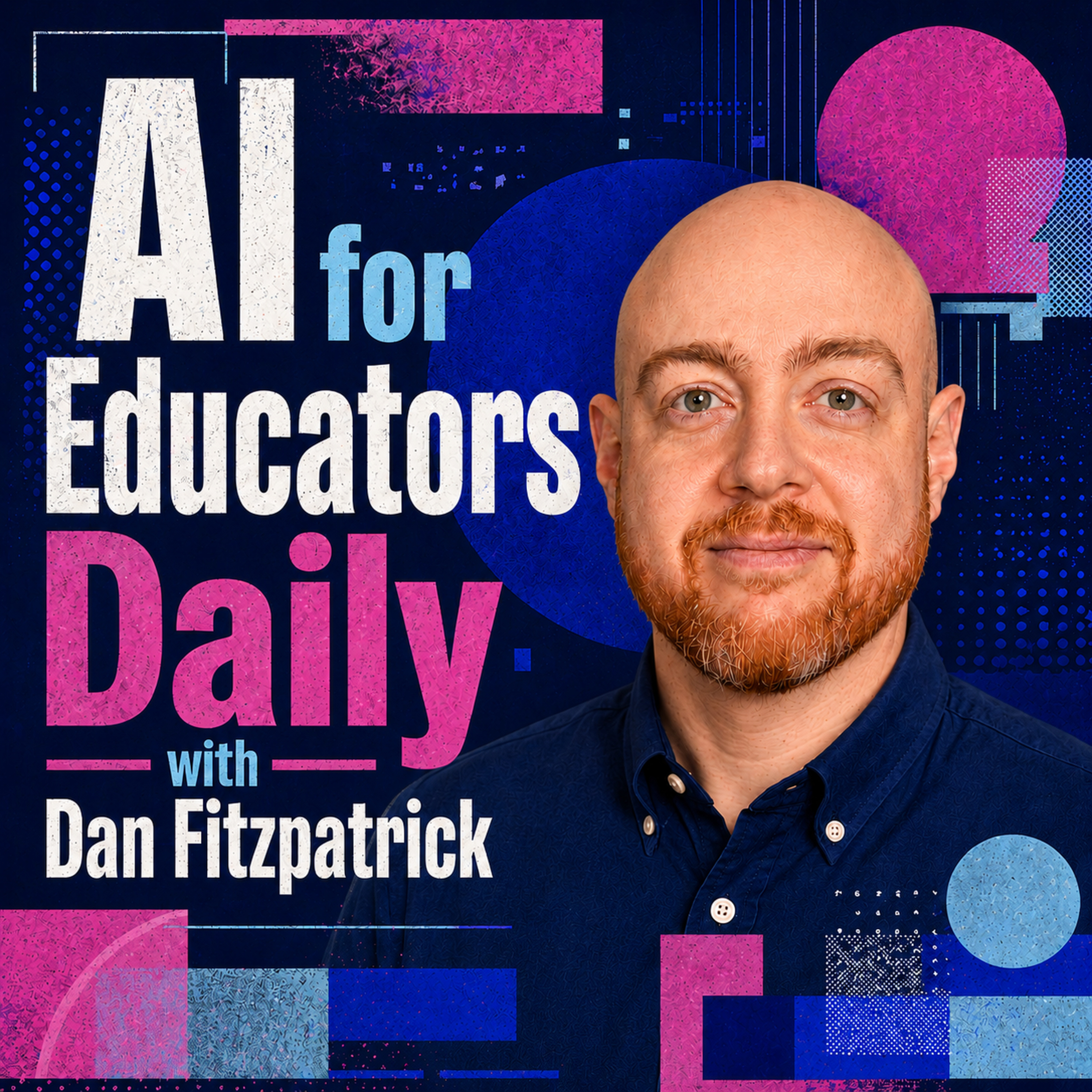
AI for Educators Daily with Dan Fitzpatrick
by Dan Fitzpatrick, The AI Educator
Hey, I'm Dan, The AI Educator.I know that we both care deeply about the state of education, amid the uncertainty of rapidly advancing AI. I work with leading schools and governments worldwide to help them strategise and build capability, and I have recently been recognised as a top voice on AI. While most teachers are aware of the influence of AI on education and student learning, many are unsure how to respond in practice. My mission is to amplify credible expert insight and give educators the clarity, confidence, and tools they need to teach effectively and prepare students.
-
292
Google Gemini, ChatGPT Face Nine Rulebooks
Nine neighbouring districts set different rules for the same technology, showing why AI policy school districts adopt must be clearer.In this episode:Nine Central Florida school districts demonstrate varied AI policy school districts are adopting, from outright prohibition to specific allowances for tools like Google Gemini and ChatGPT.Student AI use policy must clearly define 'permission' to avoid six teachers setting six different boundaries for the same student, ensuring consistent instructional guidance.Orange County Public Schools and Brevard Public Schools correctly avoid relying on AI detection software as definitive proof of cheating, requiring supporting evidence like writing samples or student conversations.Effective AI guidelines for teachers should integrate AI tools for education into learning design, emphasizing human judgment and student cognitive engagement over simple machine production.Districts like Flagler Schools offering enterprise access to AI tools for education can provide stronger privacy controls, but policy language needs technical precision to avoid vague terminology.Chapters:00:00 — Cold open & welcome00:30 — AI policy in Central Florida schools: Nine districts, different rules01:00 — Foundational AI guidelines for teachers01:30 — Variations in student AI use policy02:45 — Why AI detection software isn't definitive proof of cheating03:45 — Procurement and governance of AI tools for education04:30 — The problem of access and equitable provision05:15 — Beyond training: measuring impact and designing professional development06:15 — Characteristics of good AI policy in school districtsHow can teachers use AI marking safely?Teachers should use AI tools for education with permission, protect sensitive student data, disclose AI involvement, check outputs for errors or bias, and rely on human judgment, especially for grading and high-stakes decisions.What are common challenges for AI policy in school districts?Challenges include varied student AI use policies across classrooms, over-reliance on AI detection software for cheating, and the need for technically precise language in procurement to ensure privacy and security with tools like Google Gemini and ChatGPT.How can schools ensure equitable access to AI tools for education?Schools must design AI provision to be accessible for all students, addressing needs related to homes, disabilities, and languages, rather than treating accessibility as an afterthought to purchasing decisions.Featuring: Dan Fitzpatrick, Maria Salamanca, Orange County School Board, Brevard Public Schools, Katye Campbell, Flagler Schools, Don Foley, Google Gemini, ChatGPT.Read the original sourceFollow AI in Education with Dan Fitzpatrick for more on AI in education.
-
291
AI access approved two days pre-term
A school AI policy reversed an AI ban two days before term, leaving teachers to define supervised student AI use.In this episode:The Shawnee Mission School Board's last-minute reversal of an AI ban, two days before term, created immediate uncertainty for educators defining student AI use.Effective district AI guidelines must clarify 'teacher-guided access' for students, distinguishing between productive struggle and outsourcing thinking to AI tools.The PICRAT framework is a useful tool for teachers to consider student engagement with AI, but it doesn't replace the need for clear school AI policy and operational guidance.Assessment strategies for teaching with AI should prioritize student process, explanation, and live performance over relying on AI detection software to gauge understanding.A credible school AI policy requires genuine community workgroups, cross-departmental collaboration, and funding for professional development to support consistent student AI use.Chapters:00:00 — Cold open & welcome00:15 — Shawnee Mission School Board reverses AI ban two days pre-term00:45 — Challenges of 'teacher-guided access' for student AI use01:15 — Defining acceptable student AI use vs. cheating01:45 — PICRAT framework for teaching with AI02:15 — Superintendent Schumacher's call for balance in AI in schools02:45 — Parent concerns and AI policy governance03:15 — Community workgroup and measures of AI success03:45 — Rethinking assessment in the age of AI04:15 — Funding the reality of school AI policyWhat are the immediate challenges when a school AI policy changes right before term starts?When a school AI policy changes last-minute, teachers face significant challenges in interpreting new rules, preparing for classroom scenarios, and communicating effectively with families due to a lack of time and consistent district AI guidelines.How can schools define 'teacher-guided access' for student AI use effectively?Schools can define 'teacher-guided access' by clarifying what counts as direct supervision, specifying approved tools and contexts (e.g., brainstorming vs. drafting), and distinguishing between AI reducing friction and removing productive struggle for students.How can educators adapt assessment when students are using AI?Educators can adapt assessment by focusing on the student's process, live performance, and ability to explain decisions or defend sources, rather than relying solely on the final product or unreliable AI detection software.Featuring: Dan Fitzpatrick, Shawnee Mission School Board, PICRAT, Dr. Mike Schumacher, Center for Academic Achievement, KCTV.Read the original sourceFollow AI in Education with Dan Fitzpatrick for more on AI in education.
-
290
What employers now demand from new hires
100% of one bank department uses generative AI daily, proving AI isn't replacing expertise, but drastically raising the bar for it.In this episode:A Harvard Business Review study by Jim Doucette and Vishal Gaur found that 100% of a bank department now uses generative AI daily, highlighting rapid AI hiring changes.The AI impact on jobs is not about replacing expertise but significantly raising the bar for it, demanding enhanced human judgment and critical thinking.Educators can prepare students for AI workplace skills by integrating AI tools for initial drafts and then requiring critical evaluation and transformation using frameworks like EDIT.Curriculum design must evolve to assess higher-order thinking, ensuring tasks require unique human context, perspective, or judgment beyond what AI can produce.Cultivating 'collaborative reasoning ability'—understanding AI limitations and precision in prompts—is crucial for future generative AI employment.Chapters:00:00 — Cold open & welcome00:30 — Harvard Business Review research on AI hiring changes01:00 — AI raises the bar for expertise, not replaces it01:45 — Preparing students to operate 'above' AI tools02:15 — The EDIT framework for developing AI workplace skills02:45 — Redesigning assessment for the AI impact on jobs03:15 — Curriculum review for school leaders and department heads03:45 — Collaborative reasoning and generative AI employment04:15 — The enduring value of human judgment and creativityHow is AI changing what employers want from new hires?Employers now seek candidates who can critically analyze and strategically transform AI outputs, rather than just performing routine tasks, effectively raising the bar for expertise.What AI workplace skills should educators focus on teaching?Educators should focus on teaching students to evaluate, determine accuracy, identify bias, and transform AI-generated content, moving beyond mere tool usage to higher-order thinking and judgment.How can schools adapt curriculum to address AI hiring changes?Schools need to redesign tasks to demand unique human context, perspective, and judgment, ensuring assessments cannot be fully completed by AI and foster collaborative reasoning abilities for generative AI employment.Featuring: Dan Fitzpatrick, Harvard Business Review, Jim Doucette, Vishal Gaur.Read the original sourceFollow AI in Education with Dan Fitzpatrick for more on AI in education.
-
289
Emotional Intelligence: The Essential Skill
As AI automates more tasks, employers like Anthropic now actively seek recruits with excellent emotional intelligence and people skills.In this episode:Anthropic's co-founder states that as AI advances, "excellent emotional intelligence and people skills" are becoming crucial for employment, highlighting the need for an emotional intelligence curriculum in schools.Jean Gross argues for a curriculum re-evaluation to integrate strong communication skills and social emotional learning (SEAL curriculum) across all subjects, not just English, to prepare students for an AI-driven workforce.The Education Endowment Foundation (EEF) provides clear evidence that teaching social and emotional skills, such as those found in the comprehensive SEAL curriculum, positively impacts student attainment and overall development.Designing assessments that value the "Process" and "Performance"—like empathetic listening and collaborative problem-solving—alongside factual "Product" is essential for an AI soft skills-focused curriculum.Educators can leverage existing resources like the freely available SEAL curriculum to explicitly teach emotional intelligence, fostering skills like perspective-taking, conflict resolution, and resilience.Chapters:00:00 — Cold open & welcome00:30 — Anthropic's demand for emotional intelligence in an AI world01:25 — Why our curriculum needs an emotional intelligence re-evaluation02:10 — Integrating communication skills and oracy across subjects03:25 — Assessment challenges and the need for AI-proof tasks04:30 — The missed opportunity for a dedicated emotional intelligence curriculum05:15 — Evidence and resources for teaching social emotional learning (SEAL curriculum)06:20 — The "human-in-the-loop" advantage: outthinking machines with AI soft skills07:05 — Navigating change: Implementing an emotional intelligence curriculum effectively08:00 — Conclusion: The right road for an AI-age curriculumWhy is an emotional intelligence curriculum becoming more important with AI?As AI automates more tasks, employers like Anthropic are actively seeking recruits with "excellent emotional intelligence and people skills," making these uniquely human attributes critical for future employment.How can teachers integrate social emotional learning (SEAL curriculum) across all subjects?Teachers can weave social emotional learning by redesigning lessons to include empathetic role-playing, collaborative problem-solving with reflection on disagreements, and practicing constructive feedback within subject-specific projects.What evidence supports teaching emotional intelligence and AI soft skills?The Education Endowment Foundation (EEF) has found clear evidence that teaching social and emotional skills has a positive impact on a range of student outcomes, including academic attainment.Featuring: Dan Fitzpatrick, Jean Gross, Anthropic, Claude chatbot, ABC News, The Times, Alan Milburn, Education Endowment Foundation, EEF.Read the original sourceFollow AI in Education with Dan Fitzpatrick for more on AI in education.
-
288
Maximizing capability gains for AI agents
An AI system built software in 14 hours for $251, a task normally taking a human team months. This is AI agents in education.In this episode:An AI system, Opus 4.7, accomplished a complex software development task in 14 hours that typically requires human teams months, showcasing dramatic AI capability gains.The way we interact with AI is evolving from co-intelligence chatbots to autonomous AI agents that complete complex tasks with minimal human oversight, shifting the focus to managing AI in schools.Ethan Mollick emphasizes that domain expertise is crucial for maximizing the effectiveness of AI agents, as experts achieve better results when assigning AI for complex tasks.Educators must adapt their approach to AI literacy, moving beyond basic prompting to teaching students how to critically manage AI agents, thereby preparing them for the future of AI work.The exponential growth of AI means schools must implement continuous professional development for teachers to strategically leverage AI for complex tasks and navigate constant technological shifts.Chapters:00:00 — Cold open & welcome00:30 — Opus 4.7: Staggering AI capability gains01:00 — Measuring AI's ability to do real work01:45 — Near-frontier AI models and their exponential growth02:30 — Implications for AI agents for educators and workflows03:15 — From chatbots to AI agents: A changing interaction model04:30 — Managing AI in schools: The manager's role in the future of AI work05:45 — Rethinking AI literacy and collaborative reasoning06:45 — The impact of exponential AI capability gains on institutions07:30 — Designing professional development for continuous adaptationWhat are AI agents and how do they differ from chatbots for educators?AI agents are long-running, smart, self-correcting AI systems that tackle complex tasks with less human intervention than traditional chatbots, requiring educators to shift from interactive prompting to managing AI workflows.How can teachers use AI agents for complex tasks in the classroom?Teachers can assign AI agents to handle time-consuming administrative tasks, content generation, and aspects of differentiation, freeing up human capacity for unique human skills like judgment and relationship-building.What is the future of AI work for students and how should schools prepare them?The future of AI work involves managing AI agents rather than just using chatbots, so schools should teach students to critically evaluate AI outputs, identify biases, and apply human judgment to AI-generated insights.Featuring: Dan Fitzpatrick, Ethan Mollick, Claude Fable, GPT-5.6, METR, UK’s official government AI Security Institute, GDPval, Epoch, Opus 4.7.Read the original sourceFollow AI in Education with Dan Fitzpatrick for more on AI in education.
-
287
Only 2% have an AI strategy
Only 2% of secondary schools in England have a comprehensive AI strategy, despite AI already being embedded in teaching and learning.In this episode:A new report reveals only 2% of secondary schools in England have a comprehensive AI strategy, despite widespread informal adoption for tasks like lesson planning.The primary barrier to implementing AI strategy schools England is a lack of staff confidence and skills (63%), not financial cost.School leaders who actively engage with and model AI use foster more consistent AI adoption across their institutions and are key to effective AI staff training schools.A clear AI policy education should focus on 'purpose over technology,' defining *why* AI is used, not just *how not to*.Uneven AI integration and AI staff training schools, particularly between London and other regions, risk deepening educational disparities in England.Chapters:00:00 — Cold open & welcome00:25 — Only 2% of schools in England have an AI strategy00:55 — Distinguishing AI policy from AI strategy in education01:30 — Current AI uses for lesson planning and efficiency02:00 — Leadership engagement with AI and perceived risks02:40 — Biggest barriers: staff confidence and AI literacy03:15 — Impact of leadership modelling on AI adoption03:55 — Regional disparities in AI use and widening inequality risks04:50 — Five practical steps for an AI strategy schools England06:50 — Seizing opportunity through purposeful AI strategyHow many schools in England have a comprehensive AI strategy?Only 2% of secondary schools in England have developed a comprehensive AI strategy, according to a report by Accenture and Teach First, despite AI already being embedded in teaching and learning.What are the biggest challenges for schools implementing AI?The primary challenge for schools implementing AI is a lack of staff confidence or skills (63%), followed by data privacy concerns (51%) and a limited understanding of AI's educational potential.How can school leaders encourage AI adoption among staff?School leaders can encourage AI adoption by directly engaging with AI, demonstrating responsible use, allowing controlled experimentation, and fostering ongoing shared learning among staff.Featuring: Dan Fitzpatrick, Accenture, Teach First, Matt Prebble, James Toop, England, London.Follow AI in Education with Dan Fitzpatrick for more on AI in education.
-
286
DeepMind’s surprising Sierra Leone trial
An AI tutor in Sierra Leone reportedly helped students gain a year of schooling in eight weeks, a claim even Google DeepMind cautions us to take with a grain of salt.In this episode:Google DeepMind's AI tutor education trial in Sierra Leone estimated students gained a year's learning in eight weeks, using a re-engineered Gemini model.The AI learning tool, Guided Learning, was designed not to give direct answers, fostering productive struggle crucial for learning outcomes.Early findings suggest AI in classrooms might initially widen the gap for already proficient students, prompting Google DeepMind to investigate different pedagogies to support struggling learners.Teachers in the Sierra Leone trial adapted quickly to AI learning tools, discovering new teaching strategies and increasing one-on-one student interaction after just one day of training.Transparent research practices from Google DeepMind, including a public playbook and training materials, aim to allow wider adoption and scrutiny of AI for learning outcomes.Chapters:00:00 — Cold open & welcome00:45 — Irina Jurenka's shift to social impact at Google DeepMind01:45 — The core tension: AI as assistant vs. AI for learning02:45 — How Guided Learning became a true AI tutor education tool03:45 — Overcoming the AI's tendency to give answers04:45 — The 'take with a grain of salt' claim on learning gains05:45 — Addressing equity and the 'widening gap' concern in AI for learning outcomes06:45 — Google DeepMind's transparency and research integrity07:45 — Transforming teaching practices with AI learning tools08:45 — The future evolution of AI in classroomsHow did Google DeepMind's AI tutor impact learning in Sierra Leone?The AI tutor education trial in Sierra Leone estimated students gained approximately one year of schooling in just eight weeks, though this figure comes with a scientific caveat from the researchers.Can teachers trust AI learning tools not to give students answers directly?The Guided Learning tool, designed by Google DeepMind for AI in classrooms, was specifically engineered not to give direct answers, forcing students into productive struggle, unlike many public AI models.Do AI learning tools widen the learning gap, or help all students?Initial findings from the Sierra Leone trial showed that stronger math students benefited most, but Google DeepMind is actively researching different pedagogical approaches for AI to ensure it helps raise the floor for struggling students too.Featuring: Dan Fitzpatrick, Irina Jurenka, Google DeepMind, Sierra Leone, Guided Learning, Gemini, World Bank, Stanford, Nigeria.Follow AI in Education with Dan Fitzpatrick for more on AI in education.
-
285
Navigating AI-generated content
70% of people can't spot AI deepfakes, leaving students vulnerable to hidden AI in advertising without proper AI literacy.In this episode:A *Guardian* investigation revealed that 70% of people cannot detect *AI deepfakes*, making students vulnerable to hidden *AI in advertising*.Brands like *Once* and *Maket* are using undisclosed *AI generated content* and *AI-generated influencers* due to lower costs and fewer risks compared to human talent.Current *AI transparency rules* are lagging; the UK's *Advertising Standards Authority* doesn't explicitly prohibit undisclosed AI, although the EU will require labeling.Developing *AI influencers ethics* and critical AI literacy is paramount for educators to equip students to navigate a world saturated with AI-generated information.Educators must foster critical thinking skills, including basic *AI deepfake detection*, and discussions around *AI transparency rules* in the classroom.Chapters:00:00 — Cold open & welcome00:30 — The Guardian's investigation into undisclosed AI in advertising01:15 — Case studies: Once, Maket, and Ashle using AI-generated influencers02:15 — Educational implications: Why AI literacy is crucial for students03:00 — Why brands use AI: Cost savings and managing public image03:45 — The blurring lines of authenticity and 'plausible deniability' in AI content04:30 — Regulatory response: Which?, Lisa Barber, and the Advertising Standards Authority05:15 — The urgent need for AI deepfake detection and AI transparency rules in education06:00 — Cultivating human judgment and ethics over technological prowessHow can teachers equip students to identify *AI deepfakes* and *AI generated content*?Teachers can equip students by fostering AI literacy as a critical thinking skill, teaching them to question AI outputs, biases, and intent, and discussing *AI transparency rules* in the classroom.What are the ethical concerns surrounding *AI in advertising* and *AI influencers ethics*?Ethical concerns include misleading consumers with undisclosed *AI generated content*, eroding trust, and the potential for manipulation when 70% of people cannot detect fake videos.Are there *AI transparency rules* or regulations for brands using *AI-generated influencers*?Currently, the UK's *Advertising Standards Authority* does not explicitly prohibit undisclosed *AI generated content*, though the EU's new Artificial Intelligence Act will require deepfakes to be labeled.Featuring: Dan Fitzpatrick, Once, Maket, Ashle, Reality Defenders, Get Real Labs, Which?, Advertising Standards Authority, Lisa Barber.Follow AI in Education with Dan Fitzpatrick for more on AI in education.
-
284
AI Critical Thinking Education: Addressing Bias in Classroom AI
Almost 30% of Saudi teachers already correct biased AI outputs, highlighting an urgent need for students to interrogate AI, not just trust it.In this episode:A 2025 Saudi Arabia survey found nearly 30% of teachers are already correcting AI bias in education, highlighting an urgent need for students to interrogate AI.The core issue: most AI tools are trained on English-language and Western-dominant datasets, creating linguistic and cultural blind spots in AI-generated knowledge for diverse learners.Teachers must evolve into 'epistemic intermediaries,' guiding students in AI critical thinking education by modeling how to assess AI outputs for accuracy and cultural relevance.True AI literacy for students involves collaborative reasoning and actively critiquing AI responses, not just passively accepting them.Designing assessment tasks around "Product, Process, and Performance" can ensure students engage in cognitive stretch, applying unique context and judgment, which cannot be faked by AI tools.Chapters:00:00 — Cold open & welcome00:25 — Saudi Arabia's AI bias challenge: 30% of teachers correcting AI00:55 — Cultural and linguistic blind spots in AI tools01:50 — AI critical thinking education: shifting from teacher as authority to AI interrogator02:45 — The teacher's new role: 'epistemic intermediary' assessing AI outputs03:50 — Redefining AI literacy for students: collaborative reasoning and critique04:45 — Saudi Arabia's proactive approach to addressing AI bias in education05:25 — School leaders: prioritizing AI critical thinking education over technology adoption06:10 — Protecting human judgment, imagination, and wisdom in responsible AI in education06:45 — Knowledge transmission to knowledge interrogation: The core shiftHow can teachers address AI bias in education in their classrooms?Teachers can address AI bias by becoming 'epistemic intermediaries,' systematically assessing AI-generated content with students for factual accuracy, linguistic precision, cultural relevance, and contextual appropriateness.What does AI critical thinking education look like for students?AI critical thinking education involves teaching students to systematically critique AI responses, compare outputs across languages, identify inconsistencies, and consciously inject missing cultural nuance into AI-generated content.Why is responsible AI in education crucial for non-English dominant contexts?Responsible AI in education is crucial because most AI tools are trained on English-language and Western-dominant datasets, leading to inherent linguistic and cultural blind spots that can misrepresent local realities for students in other regions.Featuring: Dan Fitzpatrick, Basmah AlBuhairan, Reem Taibah, Amani AlOlayani, King Abdulaziz City for Science and Technology, Centre for the Fourth Industrial Revolution Saudi Arabia, Ministry of Education, Saudi Arabia, World Economic Forum.Follow AI in Education with Dan Fitzpatrick for more on AI in education.
-
283
AI English language learning: Israel's bold education revolution
Israel is launching AI English language learning for middle schoolers to combat a 40% English teacher shortage, but pilot data is still pending.In this episode:Israel is rolling out AI English language learning across middle schools via 'Project 720' and 'English for Everyone' to tackle a 40% English teacher shortage.Prime Minister Benjamin Netanyahu and Education Minister Yoav Kisch announced this significant AI in education Israel initiative, aiming for AI personalized learning tailored to individual student needs.Despite a substantial NIS 130 million budget for teaching English with AI, concerns remain regarding the lack of public pilot data, reliance on existing school infrastructure, and the timing of teacher training.Experts caution that screen-based, passive AI use may not be optimal for foundational language acquisition, advocating for AI to enhance, not replace, crucial human interaction.The initiative involves major tech players like Google and Microsoft, underscoring the need for careful design to ensure educational outcomes and teacher empowerment remain central.Chapters:00:00 — Cold open & welcome00:30 — Israel's AI English language learning initiative unveiled by Benjamin Netanyahu and Yoav Kisch01:00 — Project 720 and English for Everyone: AI personalized learning to combat teacher shortage01:45 — Pilot program success claims and the crucial lack of public data for AI in education Israel02:45 — Budget concerns and the challenges of infrastructure and teacher training for teaching English with AI03:45 — Expert warnings on screen time, passive learning, and the social aspects of language acquisition04:45 — The 'Enhancement, Not Replacement' principle for AI in education05:30 — Prioritizing pedagogy and student engagement in AI personalized learning, featuring Google and MicrosoftHow is Israel using AI to teach English?Israel is launching Project 720 and English for Everyone, two initiatives to introduce AI English language learning for middle schoolers to provide personalized instruction and address a significant teacher shortage.What are the concerns about AI in education Israel initiatives?Concerns include the lack of released pilot data backing claims of success, reliance on potentially inadequate existing digital infrastructure, belated teacher training, and expert warnings about the potential for screen-based, passive AI learning to hinder foundational development and human interaction crucial for language acquisition.Can AI truly personalize English language learning effectively?While AI personalized learning holds promise for differentiation, experts caution that its effectiveness hinges on careful design that enhances, rather than replaces, human interaction and pedagogical support, focusing on active student engagement rather than passive consumption.Featuring: Dan Fitzpatrick, Benjamin Netanyahu, Yoav Kisch, Dekel Vilnai Middle School, Project 720, English for Everyone, Meirav Zarviv, Google, Microsoft.Follow AI in Education with Dan Fitzpatrick for more on AI in education.
-
282
Is Vibe Coding Changing Schools?
A podcast for educators on why non-technical school leaders are building AI tools in 2026, how vibe coding changes experimentation, and what this means for leadership, assessment, and edtech.
-
281
What Should Leaders Redesign First?
A conversation for educators on Microsoft’s 2026 Work Trend Index report, exploring AI agents, human judgment, leadership, and why school culture matters more than individual tool confidence.
-
280
Universities Are Testing AI Agents Here’s What’s Actually Working
A deep dive into a GovTech article exploring AI agents in education, where universities are seeing early success in administration but still struggling with teaching and learning applications.
-
279
Queen of Chess: AI Hit Me 30 Years Ago. What Schools Can Learn.
✨ Special Episode ✨Judit Polgar is the greatest female chess player in history. She beat Gary Kasparov in his prime, and As a junior, she outranked Demis Hassabis, the man who now runs Google DeepMind. She's the star of the new Netflix documentary Queen of Chess. She watched AI tear through her profession thirty years ago and her warning to educators is one we cannot afford to ignore.● She lived AI's revolution 30 years before us● The computer told her to win, she lost● AI gives passive knowledge, experiences knowledge is needed● Schools are destroying kids who are different● Intuition comes from experience AI can't replace00:34 Meet Judit Polgár: Queen of Chess01:03 From Champion to Educator: Why Classrooms?02:21 The Chess Palace Programme & Learning Through Play04:04 Chess: The Original Testing Ground for AI04:57 What Teachers Are Feeling Right Now06:16 The Day She Trusted the Computer and Lost the Game07:26 An Earthquake in the Classroom08:43 Re-evaluating What Teachers Bring to the Room09:43 Her Father's Bold Claim: Can Any Child Be Exceptional?12:25 Adversity, Setbacks & Teaching Failure14:36 A Week-Long Journey Into Mistakes16:13 The Sycophantic AI Problem: Why Kids Need Rejection17:06 Critical Thinking When Real and Fake Blur19:17 What Schools Still Haven't Learned20:46 Human Connection Over Frontal Learning23:13 The Problem with 50-Minute Subject Blocks24:52 Over-Reliance on AI & The Danger to Intuition27:23 Why Chatbot Answers Are "Worse Than Nothing"28:36 The 10/90 Rule: Knowing the Move vs. Understanding Why30:49 Navigating the Messy Middle as a Leader32:35 Bravery, Mistakes & Cutting Through the Jungle
-
278
The Hidden Safety Crisis AI Is Creating In Education
A deep dive into an ABC News report on AI deepfakes in schools, exploring student harm, policy gaps, and why safeguarding and digital literacy are now critical in education.
-
277
The Warning Educators Need To Hear About AI
A deep dive into an EdSource opinion piece arguing AI in schools could harm student thinking and development, and what educators must do to avoid repeating past edtech failures.
-
276
The Real Problem With AI In Education Isn’t Students
A deep dive into an FE News article on “guided AI,” exploring how redesigning AI tools could reduce cheating, support thinking, and reshape teaching in universities.
-
275
AI Won’t Fix Education Unless We Teach This
A deep dive into a TechRadar opinion on AI in schools, exploring equity, workforce readiness, and why teaching students to think critically with AI may matter most.
-
274
Education Is Experimenting With AI Without A Playbook
A deep dive into a Mashable article exploring how schools are introducing AI, revealing a fragmented system where students lead adoption and education struggles to keep pace.
-
273
Why Schools Need To Rethink Everything In The Age Of AI
A deep dive into a Cambridge article by Lord Knight exploring how AI could reshape education by shifting focus from standardization to personalized learning, human judgment, and lifelong adaptability.
-
272
The Case Against AI In Classrooms
A deep dive into a New Yorker article questioning AI in schools, exploring cognitive risks, student development, and whether education should resist or rethink AI integration entirely.
-
271
Why Human Judgment Matters More In The Age Of AI
A deep dive into an FE News article arguing AI will not replace education, but increase the need for human judgment, critical thinking, and lifelong learning in a rapidly changing world.
-
270
Why Readiness Matters More Than AI Access
A deep dive into a World Economic Forum article exploring youth perspectives on AI in education, revealing why readiness, not technology, will determine whether AI improves learning or worsens inequality.
We're indexing this podcast's transcripts for the first time — this can take a minute or two. We'll show results as soon as they're ready.
No matches for "" in this podcast's transcripts.
No topics indexed yet for this podcast.
Loading reviews...
ABOUT THIS SHOW
Hey, I'm Dan, The AI Educator.I know that we both care deeply about the state of education, amid the uncertainty of rapidly advancing AI. I work with leading schools and governments worldwide to help them strategise and build capability, and I have recently been recognised as a top voice on AI. While most teachers are aware of the influence of AI on education and student learning, many are unsure how to respond in practice. My mission is to amplify credible expert insight and give educators the clarity, confidence, and tools they need to teach effectively and prepare students.
HOSTED BY
Dan Fitzpatrick, The AI Educator
CATEGORIES
Loading similar podcasts...
Frequently Asked Questions
How many episodes does AI for Educators Daily with Dan Fitzpatrick have?
AI for Educators Daily with Dan Fitzpatrick currently has 23 episodes available on PodParley. New episodes are automatically indexed when they're published to the podcast feed.
What is AI for Educators Daily with Dan Fitzpatrick about?
Hey, I'm Dan, The AI Educator.I know that we both care deeply about the state of education, amid the uncertainty of rapidly advancing AI. I work with leading schools and governments worldwide to help them strategise and build capability, and I have recently been recognised as a top voice on AI....
How often does AI for Educators Daily with Dan Fitzpatrick release new episodes?
AI for Educators Daily with Dan Fitzpatrick has 23 episodes. Check the episode list to see recent publication dates and frequency.
Where can I listen to AI for Educators Daily with Dan Fitzpatrick?
You can listen to AI for Educators Daily with Dan Fitzpatrick on PodParley by clicking any episode. We provide an embedded audio player for direct listening, and you can also subscribe via your preferred podcast app using the RSS feed.
Who hosts AI for Educators Daily with Dan Fitzpatrick?
AI for Educators Daily with Dan Fitzpatrick is created and hosted by Dan Fitzpatrick, The AI Educator.
URL copied to clipboard!