
PODCAST · business
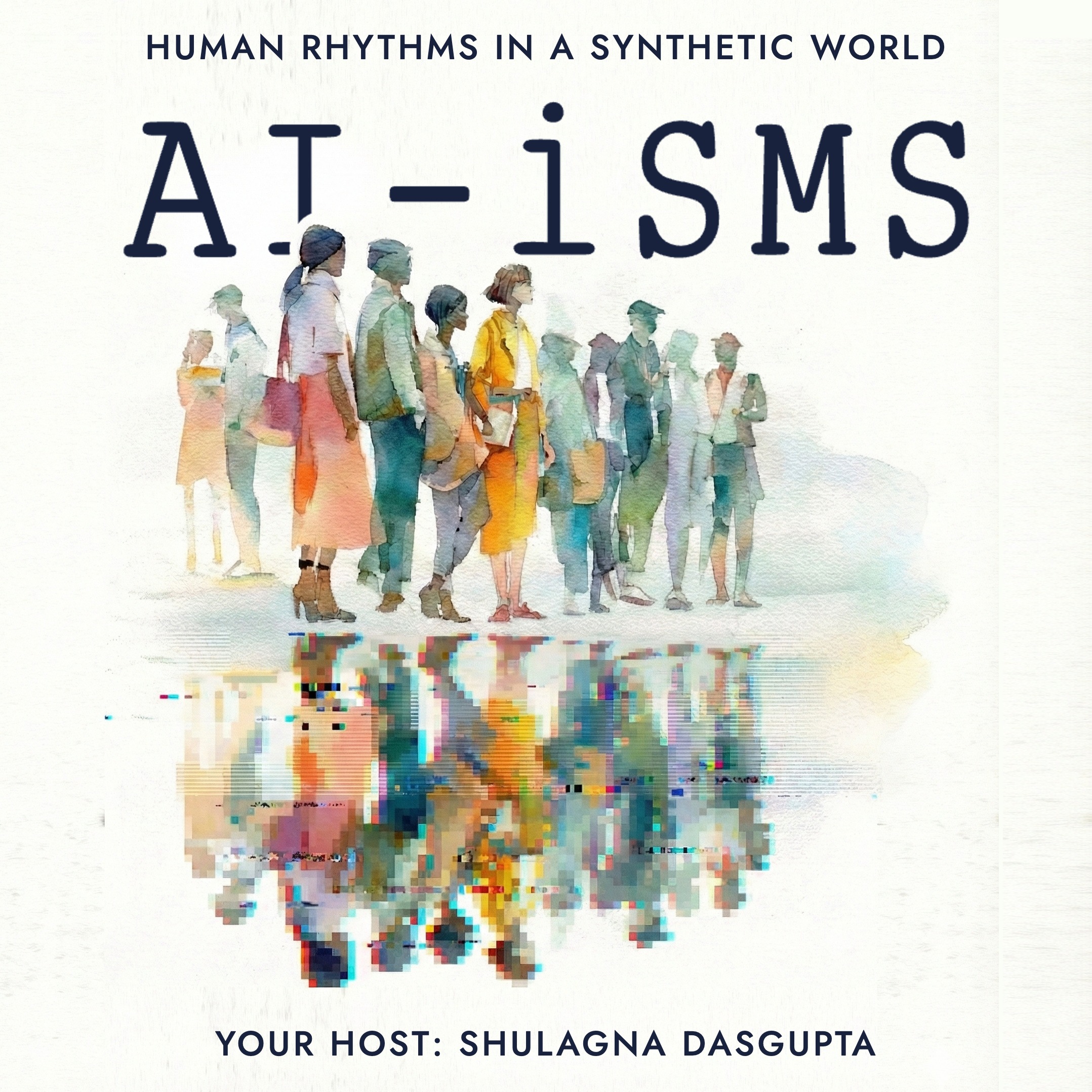
AI-isms: Human Rhythms in a Synthetic World
by Shulagna Dasgupta
Intelligence now surrounds us in every dimension of our lives. It is rapidly evolving not just how we work, but our social norms and core behaviors. We are learning to think, team, lead, play, learn, and even sleep differently. Welcome to AI-isms. My name is Shulagna Dasgupta.For over two decades, I’ve partnered with CXOs through their most audacious transformations. And this is what I can tell you: no matter how sophisticated the technology, at the end of the day, change is almost always human. AI is altering our behaviors and our state of being in the most profound ways - but are we being intentional about what we allow it to do to us? Are we using it in a way that unlocks our greatest potential or are we letting it into our subconscious in ways we didn’t intend to?Join me and a guest as we bring some intentionality to AI-driven behavior change. In each e
-
7
AI-isms: Drift | Kelly Monahan | Is AI accelerating leadership drift?
Nobody takes a leadership job planning to burn people out. And yet that is how most workforces would describe the people leading them. So something happens along the way.Kelly Monahan has spent fifteen years studying how organizations actually work, at Deloitte, Accenture, Meta and Upwork, and now at Beyond the Desk, the company she co-founded. In her book Reclaim the Plot, out this month, she gives that something a name. Drift. The slow slide away from the values that got you into leadership in the first place. Metrics over meaning, performance over purpose, control over trust.In this episode I ask Kelly the question I have been sitting with since I read her early pages. Is AI accelerating drift?Her answer is not the one I expected. AI does not change people. The pressure around it does. A gap between what AI companies promise, what boards then expect, and what implementation delivers, on top of a market that pays two to three times the valuation for anything that can call itself an AI company. Leaders drift into that gap.So I put Kelly in the hot seat with three CEOs in trouble, one for each stage of her book. The Drift. The Delirium. The Dream.What we get into:• Why the power paradox makes drift close to inevitable, and how to design against it• The expectation gap that turns AI adoption into performative theatrics• Why a one-year AI roadmap is the tell• The AI-ism minted live: sometimes the right answer is no AI• What a leader has to say out loud to bring a drifted organization back• Two AI-isms for leaders running an AI transformation, two for the employees living through one• Why your body tells you when you have drifted, before your dashboard doesKelly also names three times she drifted herself, including the year Meta went from the year of learning to the year of efficiency.Chapters00:00 The conversation around leadership has shifted01:41 Meet Kelly Monahan02:21 We have lost the plot on what AI is for04:05 What drift is05:55 The power paradox07:13 Is AI accelerating drift?08:03 The expectation gap08:35 Performative theatrics09:05 Stop chasing the one-year roadmap11:10 Case one, the Drift15:44 Redefining value, from labour to capital17:50 Case two, the Delirium19:34 Solve the business problem before you buy the technology21:30 Sometimes the right answer is no AI22:52 Commoditising the very thing that made you different24:08 Case three, the Dream26:45 Humility, ego, and what a workforce needs to hear29:38 Community is the answer31:22 Two AI-isms for leaders32:40 Two AI-isms for employees35:05 Kelly's own drift39:20 The body tells you when you have driftedThis is AI-isms, human rhythms in a synthetic world. AI will not correct a leader who has drifted. It will hand them a faster way to keep going.Guest: Dr. Kelly Monahan, co-founder, Beyond the Desk. Author of Reclaim the Plot (Wiley, September 2026).Host: Shulagna Dasgupta.
-
6
AI-isms: Coaching | Pam Baker | To Infuse AI into Coaching or not
AI-isms — Ep05: Pam Baker, CoachingIn this episode of AI-isms I sit down with Pam, CEO and founder of Women's Coaching Alliance, the organization she built out of her husband's question. Young women get recruited, interviewed, trained, paired with a co-coach, given an adult mentor, paid, and then handed a team as head coaches. Not assistants. Head coaches. They run the practices, manage the parents, lose some games, and course correct with each other. It is leadership development disguised as a Saturday morning.Then I did what I always do and dragged a beautiful human conversation into AI.The idea that stayed with me came from one of Doug's friends. Two coaches at a sales meeting, and one asks the other how his season went. The answer: I don't know. I'll let you know in 30 years. Pam's point is that a coach is not looking at the scoreboard, she is looking at who these kids become. Sit with that next to every AI business case you have been asked to defend inside a quarter.What we get into:Why the barrier every young woman named was not the game, it was the difficult parents, and why that is the same muscle you use on a difficult stakeholder at workWhy Women's Coaching Alliance pays its teenage coaches, and how Pam connects that to the gender wage gapWhere AI genuinely helps a small organization: synthesis, and turning long manuals into something a 16-year-old will actually readWhy reading off an AI script makes you blind to the person in front of you, the eye contact, the shoulders, the thing that tells you it is working or failingThree real scenarios, Pam as coach: the 20-year-old who feels like she is reading someone else's words, the parent with the wearable data, the company swapping human mentoring for AI coachingAI is sycophantic. A real mentor tells you that will not fly hereWhat happens when someone discovers a new AI capability and cascades it everywhere without asking whose job it wasWhy Pam does not use AI for parenting, and the line underneath it: there is no way AI knows more about my kids and me and our relationship than I doChapters00:00 Where are all the women coaches?01:10 Meet Pam Baker01:52 The question Doug kept asking02:44 Great coaching is great leadership04:27 Eighteen young women raise their hands06:09 She will not raise her hand on her own10:17 Why every coach gets paid10:35 A hard pivot into AI11:38 How a coaching organization actually uses AI13:05 No AI knows what is happening in front of you13:33 "I'll let you know in 30 years"16:13 Case 1: the coach who feels like she is reading a script19:43 Case 2: the parent with the wearable data21:58 An amazing player is not a great team24:08 Snatching someone else's agency25:44 Case 3: swapping human mentors for AI coaching28:13 AI is sycophantic. A mentor is not.33:08 What AI cannot know about your kid39:09 The two things that stayed with meThis is AI-isms, human rhythms in a synthetic world. AI can build your practice plans. It is never going to be the person who believes in you before you believe in yourself. Ask yourself who that person was for you, and whether you are being that person for anyone.Topics: coaching, leadership development, mentoring, AI coaching, AI mentoring, sycophancy, youth sports, women in sports, gender wage gap, culture, team culture, human-AI collaboration, AI adoption, parenting and AI, future of work, Women's Coaching Alliance, Pam Baker
-
5
AI-isms: Authenticity | Lynn Perkins | How to Remain Authentic in the age of AI
Be your authentic self. We have spent years fighting the stories we were told in order to get there. And then the LLMs showed up, and a polished version of your work, your thoughts, even your introduction, became available at the click of a button. So what happens to the battle for authenticity now? It just got a lot harder.In this episode of AI-isms I sit down with Lynn Perkins, co-founder and CEO of UrbanSitter. Lynn works in a category where authenticity matters more than almost anywhere else. You are letting a stranger into your home to care for the person you love most. So we set care aside and talked about the thing underneath it: trust, and what happens to it when a generation of people start using AI to rewrite who they are on paper.The idea that stayed with me: imperfect human beats AI-generated polish, and it is not close. Lynn told me about a competitor that let care providers use AI to write their profiles. Two things happened. Everyone started to sound the same, and the platform's own fraud detection stopped working, because suddenly every profile sounded a little fake. Perfect turned out to be the tell.What we get into:• The science of trust (background checks, credentials) versus the art of it (values, connection, work ethic), and why AI can only fake one• Why a too-polished proposal reads as less care, not more• The fraud-detection paradox: when everyone sounds the same, the machine can't tell real from fake• Four real scenarios, Lynn as coach: the non-native English job applicant, the exhausted sales rep, the 90%-automated inbox, the artist who refuses AI• The pattern underneath all four: human-first for the deep and creative work, AI-first pass for the repeatable• How UrbanSitter scaled AI by curiosity, not mandate, and why they share their failures out loud• The one thing Lynn does to stay authentically herselfChapters00:00 The battle for authenticity just got harder01:28 Meet Lynn Perkins02:36 Trust has a science and an art04:46 When the profile isn't the person06:09 Why "too perfect" erodes trust08:27 The AI proposal that felt like less effort09:43 When everyone sounds the same, fraud detection breaks10:54 Why competitors share their mistakes13:07 Scenario 1: the non-native English job applicant16:15 Scenario 2: the exhausted sales rep18:47 Scenario 3: the 90%-automated inbox21:45 Scenario 4: the artist who refuses AI24:53 Adoption by curiosity, not mandate30:43 Where UrbanSitter measures the outcome33:11 Staying authentically Lynn: share the snafus35:55 The AI-isms from this episodeThis is AI-isms, human rhythms in a synthetic world. The next time you are tempted to run yourself through the machine until you sound perfect, ask what you are trading for it. Tell me what you find.Topics: authenticity, trust, AI and hiring, resumes and AI, personal branding, fraud detection, human-AI collaboration, AI adoption, bottoms-up adoption, change management, marketplaces, childcare, UrbanSitter, Lynn Perkins, future of work
-
4
AI-isms: Role Modelship | Eli Potter | How to Role Model when AI is Listening
What am I role modeling today? Most of us think that question belongs to the most senior people in the building. This episode is here to convince you otherwise.In this episode of AI-isms I sit down with Eli Potter, one of the most respected CIOs in Silicon Valley and an advisor to 125+ organizations. Eli was born in Cold War Bulgaria, arrived in the US with two suitcases, and learned English from the Beatles. Out of a lifelong love of words she coined one the moment needed, role modelship, and wrote the book by the same name.The idea that stayed with me: AI can't be what it can't see. AI isn't just code and models, it's a mirror of our habits, our relationships, and our values, and it learns and unlearns the way we do. Which makes role modeling everyone's job, not just the CEO's. Every prompt is training the thing someone you love will one day ask for advice.What we get into:• Why the gap beyond leaders and managers is the who, and how role models "engineer identity"• AI as a mirror, and why it's dangerous to treat it as an independent thing• The five disciplines of role modelship, through real cases you're probably living right now• Creator vs. consumer: why opting out of AI is a destiny choice, not a tech choice• Mentorship vs. sponsorship, and the reputational chip nobody talks about• What happens when a young employee asks the CEO, "what are you doing to learn AI?"Chapters00:00 What am I role modeling today?01:34 Meet Eli Potter02:13 The origin of role modelship03:39 Managers, leaders, and the missing "who"06:27 Role modelship in the age of AI08:02 Why AI is a mirror09:43 The five disciplines10:24 Stewardship: the biased hiring AI13:52 Fellowship: creator vs. consumer17:25 Mentorship vs. sponsorship22:25 Leadership: the town-hall question27:12 The AI-isms Eli lives by30:20 The five-year-old who got it32:05 Finding your voice in a second languageThis is AI-isms, human rhythms in a synthetic world. Next time you open a chat window, ask yourself: what am I role modeling today? Tell me what you see.Topics: role modelship, AI and leadership, AI as a mirror, stewardship, fellowship, mentorship, sponsorship, creator vs consumer, AI-first vs human-first, future of work, CIO leadership, Eli Potter
-
3
AI-isms: Uncertainty | Liz Fosslien | How to calibrate Uncertainty in AI-times
At the heart of anxiety is uncertainty. There's research that when your brain has full certainty about what's coming, even if what's coming is an electric shock, you feel calmer than when you don't know. Now look at where we are. AI everywhere, no real playbook, a dozen versions of the future arriving at once. Of course we feel uncertain and anxious. In this episode of AI-isms, I sit down with Liz Fosslien to talk about what AI is doing to how we feel at work. Liz studies human emotions at work. She's the author and illustrator of the bestsellers Big Feelings and No Hard Feelings, her work has run on NPR, TED, and Good Morning America. She and her co-author Molly Duffy recently concluded a study on how AI is making us feel at work. The idea that stayed with me is ambivalent anxiety, two opposite emotions in the same body at the same time. I'm scared this ends my job. I'm relieved I might not have to do the part of it I hate. Both, at once. And most of us are performing 'calm' over the top of it.What we get into:• Why "uncertainty" has outgrown the word, and the research on why we'd rather know a bad thing is coming than sit with a fifty-fifty chance• Ambivalent anxiety: holding fear and relief at once, and the quiet tax of performing calm at work• The early-career squeeze, when the first rung is the first to get automated, and the human skills that travel across any industry• Chasing curiosity instead of fear: peer learning, skills swaps, and how to move when nobody hands you a playbook• Why pretending to have it figured out is the biggest mistake leaders make right now, and why the honest questions create more clarity than fake answersChapters00:00 The uncertainty under the anxiety01:36 Meet Liz Fosslien02:36 We need a new word for uncertainty03:26 Why humans hate uncertainty07:25 Enter AI: ambivalent anxiety and performing calm12:57 Case 1: early career and the "AI slop" moment17:37 AI-isms for early career, and the mid-career squeeze20:38 Chasing curiosity: peer learning and skills swaps23:11 Not everything catastrophic will happen26:35 Leading a transformation with no playbook30:31 The illustration: ambivalent anxiety on a swing34:04 How Liz processes her own emotions35:54 The AI-isms I took from this oneThis is AI-isms, human rhythms in a synthetic world. If you're leading people through this shift, what are you feeling underneath the calm? Tell me what you see.Topics: AI and emotions at work, uncertainty and anxiety, ambivalent anxiety, the future of work, early career and automation, reskilling and peer learning, leadership in uncertainty, performing calm, Liz Fosslien, Big Feelings, No Hard Feelings
-
2
AI-isms: Power | Amy Kates | How to think about Power as AI redraws the lines
We spend our careers drawing lines. My team, my P&L, my data, my customers. Then agentic AI starts working across all of them, and the old question comes back sharper than ever: what happens to power?In this first episode of AI-isms, I sit down with organization designer Amy Kates to unpack how AI is redrawing the lines of power inside organizations. Amy is the author of six books on org design and operating models and the founder of Kates Kessler.Her core idea stayed with me - real power lives horizontally. That is where value gets created, and it is exactly where AI is now blurring the boundaries.What we get into:• Why organizational power is horizontal, not just vertical, and why the seams matter more as AI dissolves silos• Designing for outcomes instead of headcount when agents do the work• A real finance-versus-HR standoff over workforce planning, and how to redeploy capacity instead of just cutting it• Why AI is often a red herring for collaboration problems, and how Jay Galbraith's STAR model diagnoses the real issue: trust and metrics• Learning is greater than lurching: the honest answer to how long an org design should lastChapters00:00 Power in the age of agents01:33 Meet Amy Kates02:26 Why power lives in the horizontal seams10:35 Enter AI: the end of people equals power16:50 Case 1: Finance vs. HR and who owns workforce planning24:43 Case 2: Two leaders who won't share the data27:55 Why AI is a red herring for trust (the STAR model)34:10 The shelf life of an org design: learning over lurching37:25 How Amy actually uses AI in her life40:26 The AIisms I took from this oneThis is AI-isms, human rhythms in a synthetic world.
-
1
AI-isms: Trailer
Intelligence now surrounds us in every dimension of our lives. It is rapidly evolving not just how we work, but our social norms and core behaviors. We are learning to think, team, lead, play, learn, and even sleep differently. Welcome to AI-isms. My name is Shulagna Dasgupta.For over two decades, I’ve partnered with CXOs through their most audacious transformations. And this is what I can tell you: no matter how sophisticated the technology, at the end of the day, change is almost always human. AI is altering our behaviors and our state of being in the most profound ways - but are we being intentional about what we allow it to do to us? Are we using it in a way that unlocks our greatest potential or are we letting it into our subconscious in ways we didn’t intend to?Join me and a guest as we bring some intentionality to AI-driven behavior change. In each episode we will talk through lived experiences of people who have used AI to better their lives and behaviors. Maybe, you could borrow an idea or two?This is AI-isms. Let’s talk human rhythms in a synthetic world.
We're indexing this podcast's transcripts for the first time — this can take a minute or two. We'll show results as soon as they're ready.
No matches for "" in this podcast's transcripts.
No topics indexed yet for this podcast.
Loading reviews...
ABOUT THIS SHOW
Intelligence now surrounds us in every dimension of our lives. It is rapidly evolving not just how we work, but our social norms and core behaviors. We are learning to think, team, lead, play, learn, and even sleep differently. Welcome to AI-isms. My name is Shulagna Dasgupta.For over two decades, I’ve partnered with CXOs through their most audacious transformations. And this is what I can tell you: no matter how sophisticated the technology, at the end of the day, change is almost always human. AI is altering our behaviors and our state of being in the most profound ways - but are we being intentional about what we allow it to do to us? Are we using it in a way that unlocks our greatest potential or are we letting it into our subconscious in ways we didn’t intend to?Join me and a guest as we bring some intentionality to AI-driven behavior change. In each e
HOSTED BY
Shulagna Dasgupta
CATEGORIES
Loading similar podcasts...
Frequently Asked Questions
How many episodes does AI-isms: Human Rhythms in a Synthetic World have?
AI-isms: Human Rhythms in a Synthetic World currently has 7 episodes available on PodParley. New episodes are automatically indexed when they're published to the podcast feed.
What is AI-isms: Human Rhythms in a Synthetic World about?
Intelligence now surrounds us in every dimension of our lives. It is rapidly evolving not just how we work, but our social norms and core behaviors. We are learning to think, team, lead, play, learn, and even sleep differently. Welcome to AI-isms. My name is Shulagna Dasgupta.For over two decades,...
How often does AI-isms: Human Rhythms in a Synthetic World release new episodes?
AI-isms: Human Rhythms in a Synthetic World has 7 episodes. Check the episode list to see recent publication dates and frequency.
Where can I listen to AI-isms: Human Rhythms in a Synthetic World?
You can listen to AI-isms: Human Rhythms in a Synthetic World on PodParley by clicking any episode. We provide an embedded audio player for direct listening, and you can also subscribe via your preferred podcast app using the RSS feed.
Who hosts AI-isms: Human Rhythms in a Synthetic World?
AI-isms: Human Rhythms in a Synthetic World is created and hosted by Shulagna Dasgupta.
URL copied to clipboard!