
PODCAST · science
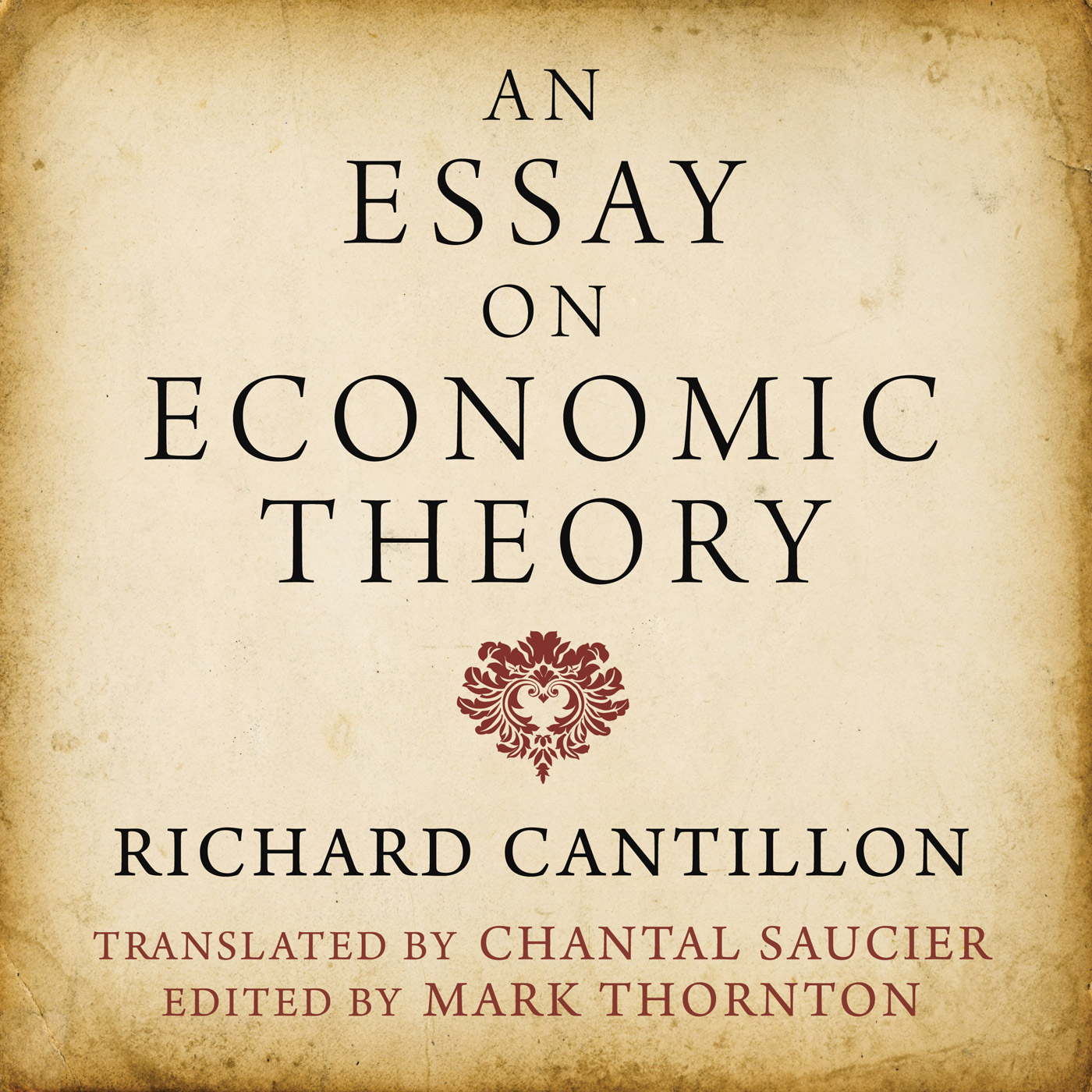
An Essay on Economic Theory
by Richard Cantillon
An English translation of Richard Cantillon’s Essai sur la Nature du Commerce en Général. Translated by Chantal Saucier. Edited by Mark Thornton.This audio book is made available through the generosity of Mr. Tyler Folger. It is narrated by Millian Quinteros.
Episodes
-
Foreword to An Essay on Economic Theory
Foreword to Richard Cantillon's An Essay on Economic Theory. Mark Thornton and Chantal Saucier have accomplished the arduous task of bringing forth a new and improved translation of Cantillon’s famous work. Narrated by Millian Quinteros.
-
Introduction to An Essay on Economic Theory
Introduction to Richard Cantillon's An Essay on Economic Theory. Cantillon deals with a wide variety of fundamental and philosophical issues such as the nature of property, the distribution of income, the origin of money, and the role of government. Narrated by Millian Quinteros.
-
1.1. Wealth
Cantillon defines wealth as the consumption goods produced by land and labor. This contrasted with the Mercantilists who thought money was wealth. From Part 1: "Production, Distribution, and Consumption". Narrated by Millian Quinteros.
-
1.4. Market Towns
Entrepreneurs establish markets in centrally located villages which provide the necessary conditions under which prices are established between supply and demand. The size of the market town depends on the size of the economy it serves. From Part 1: Production, Distribution, and Consumption....
-
1.6. Capital Cities
Wherever a government establishes its capital, the city will grow in size because the additional spending attracts labor and businesses to service the government and its employees and thus, it becomes a commercial center for the nation as well. From Part 1: Production, Distribution, and...
-
1.7. The Labor of the Plowman is of Less Value than that of the Artisan
The opportunity cost of becoming a skilled worker includes both the direct expenses as well as the foregone labor during the training period or apprenticeship. As a result, skilled workers must be paid higher wages than unskilled workers. From Part 1: Production, Distribution, and Consumption....
-
1.8. Some Artisans Earn More, Others Less, According to the Different Cases and Circumstances
In addition to training and the forces of supply and demand, workers with higher quality skills, risky jobs, or jobs which require trustworthy employees will receive higher wages. This is now known as the theory of compensating differentials that is often attributed to Adam Smith. From Part 1:...
-
1.9. The Number of Laborers, Artisans, and Others, Who Work in a State, is Naturally Proportioned to the Demand for Them
The supply of workers adjusts itself to the demand for labor, across all professions, via wage rates, migration, and changes in population. Prosperity cannot be created by subsidizing job training. From Part 1: Production, Distribution, and Consumption. Narrated by Millian Quinteros.
-
1.10. The Price and Intrinsic Value of a Thing, in General, is the Measurement of the Land and Labor, which enter into its Production
Intrinsic value can be measured by the quantity of land and laborers, taking into account the quality of land and labor. Some goods are produced almost entirely with land, others solely from labor. In the garden example, intrinsic value is both the direct expenses of the garden and the foregone...
-
1.11. The Par Value or Ratio between the Value of Land and Labor
William Petty set off the search for a par value between land and labor. Cantillon provides a theoretical answer (referenced in Adam Smith’s Wealth of Nations) that property owners must provide their labor with the production of at least twice the land necessary to sustain the worker in order…
more -
1.12. All Classes and Individuals in a State Subsist or Grow Rich at the Expense of the Property Owners
Cantillon develops a circular-flow model of the economy that shows the distribution of farm production between property owners, farmers, and workers. Farm production is exchanged for the goods and services produced in the cities by entrepreneurs and artisans. While the property owners are...
-
1.13. The Circulation and Exchange of Goods and Merchandise, as well as their Production, are Carried On in Europe by Entrepreneurs, and at a Risk
Here Cantillon introduces, for the first time, the theory of entrepreneurship. Entrepreneurs are the prime directors of resources. Their occupations come with risks due to uncertainty, especially from competition and changing tastes. As a result, their income can be very large, but they also face...
-
1.14. The Desires, Fashions, and Ways of Life of the Prince, and especially of the Property Owners, Determine the Use to which Land is put in a State, and Cause the Variations in the Market Prices of all Things
Cantillon constructs a model of the isolated estate or closed economy where the choices of property owners determine outputs and prices, regardless if they manage the isolated estate or lease it to farmers. Mistakes of the farmers or changes in demand by the property owners cause changes in…
more -
1.15. The Increase and Decrease of the Number of People in a State chiefly Depends on the Taste, the Fashions, and the Ways of Life of the Property Owners
Population is based on the tastes and choices of property owners. Early versions of the Malthusian approach to population growth—that it follows some mathematical formula—are criticized. This chapter also shows that the opulence and lavish spending of the prince and absentee landlords living far...
-
1.17. Metals and Money, and especially of Gold and Silver
Gold and silver were highly valued before they were used as money. They hold many advantages over other goods such as durability, divisibility, transportability, and homogeneity. These are the reasons which led gold, silver, and copper to be chosen as money, not “fancy” or common consent. When...
-
2.1. Barter
Because the opportunity cost of a good cannot be fixed, it is impossible to know the proper exchange ratios for barter. This problem is overcome in the market by using commodities that have marketable characteristics, such as transportability, durability, and a recognized economic value, to serve...
-
2.2. Market Prices
Market prices are determined by the bargaining between suppliers and demanders. Price determination by supply and demand is illustrated with a thought experiment that uses a fixed quantity of a perishable product (i.e., green peas) and known maximum valuations of consumers. From Part 2: Money and...
-
2.3. The Circulation of Money
Farm production produces three rents, one of which sustains the farm workers, while the other two can be sold at wholesale to entrepreneurs who in turn provide property owners and farmers with goods and merchandise. This is the circular flow model of the economy. Money facilitates the flow and...
-
2.4. Further Reflection on the Rapidity or Slowness of the Circulation of Money in Exchange
Large transactions can be accomplished with the use of bills of exchange or barter, which reduces the demand for money. Ordinary transactions by people require actual coin money in circulation. A variety of factors, therefore, affect the flow of money in circulation and this in turn affects the...
-
2.5. The inequality of the circulation of hard money in a State
Rural France was impoverished because commodities had to be sent to the capital and major cities to pay taxes to the state and rents to the property owners living there. It is argued here that if factories were permitted in rural areas, basic commodities could be turned into goods, which could…
more -
2.7. Continuation of the same subject
When there is an increase in the quantity of money, prices will increase depending on how the new money holders decide to spend their money. The price changes will also be affected by such things as regulations on trade and the perishability of the products that are traded. In other words the...
-
2.9. Interest on Money and its Causes
Interest is established in the market by lenders and borrowers and the interest rate on a particular loan is determined by the risk of default. A loan is repaid from the income generated from capital investments and the interest paid is equivalent to the profits of fully capitalized enterprises....
-
2.10. The Causes of Increases and Decreases of the Interest Rate on Money in a State
The interest rate is determined by the supply and demand for loanable funds, not the supply of money. Savings and frugality decrease the interest rate while lavish spending increases it. War increases the interest rate, peace decreases it. Paying off the national debt decreases the interest rate.…
more -
3.1. Foreign Trade
Here the circular-flow economy is extended to international trade. Instead of barter or exchange with money, Cantillon explains how international trade takes place on the basis of bills of exchange. He showsthat a state which accumulates money will enjoy a temporary gain in international trade…
more -
3.2. On Bills of Exchanges and their Nature
There is an expense associated with transporting money based on the distance, risks, and other transaction costs. Bills of Exchange are a type of contract that can reduce this cost by avoiding shipments that are offsetting between two locations. When money must be sent, bankers charge a fee for...
-
3.3. Further Explanations on the Nature of Exchanges
Exchange rates are explained as a function of the balance of trade and other factors. A trade deficit can cause your money to exchange below par, while a trade surplus will cause it to exchange above par. In fact, the exchange rate, above and below par, is an indicator of the general balance of...
-
3.6. Banks and their Credit
Fractional-reserve banking is a system where the banks lend some of their deposits and earn interest. This increases the amount of money in circulation compared to warehouse or 100% reserve banking. This utility of banking comes at the risk of being unable to withdraw your deposits. The amount…
more -
3.7. Further Explanations and Enquiries as to the Utility of a National Bank
National Banks are of little utility and can be the source of economic chaos. The increase in the supply of money that they provide is relatively small and offers the same disadvantages as increases in real money. They are therefore unnecessary and potentially very harmful, as in the cases of the...
-
3.8. The Refinements of Credit of General Banks
When the government’s national bank inflates the money supply by increasing the supply of banknotes, it reduces the rate of interest and can increase the price of stocks. This is a corrupt process and when the notes are redeemed, the price of stocks falls and can result in bank runs and economic...
-
1.2. Human Societies
All human societies are based on a system of property rights. The distribution of rights will necessarily be unequal, and the use to which property is put will be dependent on the tastes of the owners. From Part 1: Production, Distribution, and Consumption. Narrated by Millian Quinteros.
-
1.3. Villages
In this first of four chapters on economic geography and location theory, Cantillon explains that settlements are based on the requirements of production, especially the quantity of labor, and the extent of the specialization and division of labor. From Part 1: Production, Distribution, and...
-
1.5. Cities
Cities form at sites where large property owners have decided to live. Specialization of labor expands to meet the demands of the wealthy. Cities grow even larger when manufacturing industries produce for export, and whose workers are essentially supported by the production of foreign lands....
-
1.16. The more Labor there is in a State, the more the State is Judged Naturally Rich
The wealth of a nation depends on putting the labor force to work. Those who are unnecessary for farming can be employed in making higher quality products and manufactured goods, particularly durable goods made from metal. Saving is the key determinant of wealth and gold is a particularly useful...
-
2.6. The Increase and Decrease of the Quantity of Money in a State
Here Cantillon uses his price-specie flow mechanism to analyze some of the effects of inflation. Increasing the supply of money by mining hurtssome people and benefits others because certain prices and incomes rise faster than others. However, if the new money is accumulated and saved by those…
more -
2.8. Further Reflections on the Increase and Decrease of Money in a State
Increases in the supply of money from a balance of trade eventually causes prices to rise. This in turn puts pressure on domestic producers and increases imports. The result is that the balance of trade is reduced and eventually is negative. This is Cantillon’s price specie-flow mechanism which...
-
3.4. The Variations in the Proportion of Values with Regard to the Metals Used as Money
The price of gold and silver and the ratio between them is determined by markets and is also based on their usefulness, cost of production, and transportation costs. When government mints establish a fixed ratio between gold and silver money that is not based on market prices, the overvalued…
more -
3.5. The Augmentation and Diminution of the Denomination of Money
Raising and lowering the nominal value of money is shown not to undermine the theory of the value of money. In contrast, such measures are shown to be methods by which the prince acquires resources by deceiving individuals about the value of money. The process causes chaos in the market. From…
more
We're indexing this podcast's transcripts for the first time — this can take a minute or two. We'll show results as soon as they're ready.
No matches for "" in this podcast's transcripts.
No topics indexed yet for this podcast.
Loading reviews...
ABOUT THIS SHOW
An English translation of Richard Cantillon’s Essai sur la Nature du Commerce en Général. Translated by Chantal Saucier. Edited by Mark Thornton.This audio book is made available through the generosity of Mr. Tyler Folger. It is narrated by Millian Quinteros.
HOSTED BY
Richard Cantillon
Loading similar podcasts...
Frequently Asked Questions
How many episodes does An Essay on Economic Theory have?
An Essay on Economic Theory currently has 37 episodes available on PodParley. New episodes are automatically indexed when they're published to the podcast feed.
What is An Essay on Economic Theory about?
An English translation of Richard Cantillon’s Essai sur la Nature du Commerce en Général. Translated by Chantal Saucier. Edited by Mark Thornton.This audio book is made available through the generosity of Mr. Tyler Folger. It is narrated by Millian Quinteros.
How often does An Essay on Economic Theory release new episodes?
An Essay on Economic Theory has 37 episodes. Check the episode list to see recent publication dates and frequency.
Where can I listen to An Essay on Economic Theory?
You can listen to An Essay on Economic Theory on PodParley by clicking any episode. We provide an embedded audio player for direct listening, and you can also subscribe via your preferred podcast app using the RSS feed.
Who hosts An Essay on Economic Theory?
An Essay on Economic Theory is created and hosted by Richard Cantillon.
URL copied to clipboard!