
PODCAST · religion
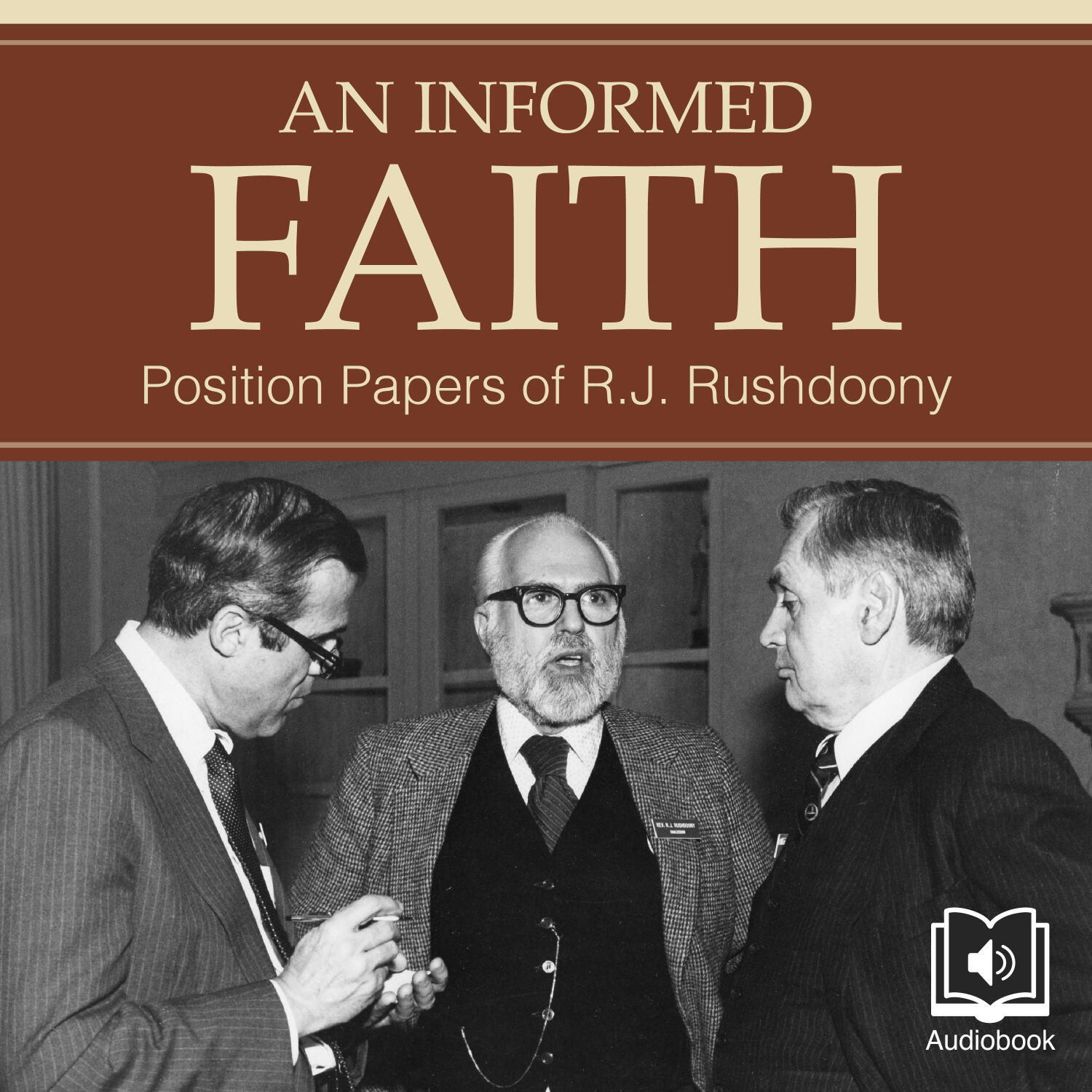
An Informed Faith: The Position Papers of R.J. Rushdoony
by R.J. Rushdoony
Our faith should be an informed one because the God who created all things speaks to every sphere of life, and all facts should be studied in light of the revelation of God in Scripture. This is the foundation of Christian dominion. For R. J. Rushdoony, true government was the self-government of the Christian life in terms of God's law, so he wrote his position papers to better equip Christians to apply their faith to all of life. His objective was not to empower the state, or the organized church, but rather to call every person and institution to God's Word, which often put him at odds with both church and state. (Position Papers from 1979-2000)
-
191
Slavery
Slavery has marked every culture and era, taking many forms and affecting all peoples. While private slavery is widely condemned today, modern societies increasingly practice state slavery through expanding bureaucratic control, regulation, and dependency over citizens. True freedom, Scripture teaches, is not political but spiritual. Slavery begins with bondage to sin, and only Christ can make men truly free. Where Christian faith declines, slavery old or new inevitably returns, and societies drift toward control, conformity, and loss of liberty.
-
190
The Risk Free Life
The pursuit of a risk-free life is a dangerous illusion. Without risk, there can be no victory, responsibility, growth, or freedom. Attempts to eliminate risk always destroy liberty and replace it with control, dependency, and tyranny while creating far greater dangers in the process. Freedom necessarily involves moral risk, accountability, and consequences. To deny risk is to deny justice, causality, and ultimately God’s moral order. A society that fears risk abandons discipline, courage, and responsibility and inevitably trades the risks of freedom for the far worse risks of slavery.
-
189
Guilt
Guilt is one of the strongest tools of control. Guilty people are fearful, easily manipulated, and prone to slavery whether to the state, other people, or destructive habits. History shows that regimes thrive on guilt because it weakens resistance and paralyzes conscience. Only Christ deals with guilt at its root. Psychology teaches men to live with guilt; Scripture declares that guilt requires atonement and only Jesus Christ can provide it. Without His atoning work, guilt enslaves; with it, men are truly free. A people freed from guilt are not easily ruled, for “if the Son therefore shall make you free, ye shall be free indeed” (John 8:36).
-
188
Guilt, Atonement, and Freedom
Guilt is a powerful tool of slavery. From tyrants like Stalin to modern politics and even manipulative religion, guilt weakens people, silences resistance, and makes control easy. A bad conscience imprisons men inwardly before they are ever enslaved outwardly. Politicians, ideologues, and even churches often exploit guilt to dominate rather than to liberate. Biblically, guilt is real but it is meant to lead to atonement, not bondage. True freedom comes only through Christ’s atoning work, which removes guilt, renews the conscience, and makes men genuinely free. “If the Son therefore shall make you free, ye shall be free indeed” (John 8:36). Without forgiveness and regeneration, people remain slaves; with Christ, they become a free people capable of building a free society.
-
187
The Holy Spirit and Freedom
True freedom depends on the Holy Spirit, not human reason or state power. When God’s providence and the Spirit’s rule are denied, control does not disappear it shifts to man, and ultimately to the modern state. Evolutionary and humanistic thinking remove God as the source of order, making totalitarian planning appear necessary to impose meaning, control, and purpose on life. Scripture is clear: “Where the Spirit of the Lord is, there is liberty” (2 Cor. 3:17). The Holy Spirit cannot be separated from God’s written Word, nor replaced by human feelings or intuition. When the Spirit governs through Scripture, men are free; when He is denied or confused with human impulses, freedom collapses into tyranny either personal or statist. There is no lasting liberty apart from the Spirit who is “the Lord and Giver of Life.”
-
186
Property, Charity, and Freedom
Biblically, property and charity are personal responsibilities grounded in God’s ownership of all things, not gifts or guarantees of the state. Historically, property belonged to families and communities, fostering personal care, loyalty, and Christian charity. The Enlightenment especially through John Locke shifted property from a God-given trust to a state-protected abstraction, paving the way for depersonalization, bureaucracy, and eventually statism. As property and charity moved from individuals, families, and churches to the state, freedom declined. Impersonal welfare replaced personal responsibility, taxes replaced charity, and owners lost real control over their property. True freedom does not come from tax revolts or political fixes, but from regeneration in Christ, obedience to God’s law, and renewed personal responsibility to care for one another under God not the state.
-
185
Conflicting Ideas of Freedom
Freedom does not mean the same thing to everyone. In practice, there are two opposing definitions: freedom from law (lawlessness or antinomianism) and freedom under God’s law. Modern culture increasingly defines freedom as the right to reject all restraint justifying theft, immorality, censorship through “heckling,” and even silencing opponents while calling this lawlessness “liberty.” Biblically, however, lawlessness is slavery. Jesus teaches that those who sin are slaves to sin, and that true freedom comes only through Him, resulting in obedience to God’s law as a way of life (John 8:33–36). A society that rejects God’s law in the name of freedom inevitably moves toward chaos and tyranny. False freedom leads to bondage; true freedom exists only under God’s righteous law.
-
184
The Nature of Freedom
True freedom is not license or lawlessness it is liberty under God’s law. History shows that societies which redefine freedom as moral autonomy or sexual license end in tyranny, while Biblical freedom places limits on power, protects property and family, and restrains the state. Israel’s law sharply limited civil and religious authority, grounding liberty in God’s sovereignty rather than human rule. Biblically, freedom is moral and theological before it is political. “If the Son therefore shall make you free, ye shall be free indeed” (John 8:36). Liberty flows from obedience to God, not rebellion against Him. When societies deny God, the state fills the vacuum and becomes a god itself taxing, regulating, and controlling all of life. Freedom will not be restored by policy alone, but by a renewed faith that recognizes God as the true Author of liberty.
-
183
Vouchers, Freedom, and Slavery
State-funded vouchers promise relief but deliver control. History shows that wherever government money goes, government authority follows eroding the freedom, faith, and independence of Christian schools. What begins as “help” quickly becomes regulation, compromise, and eventual conformity to state standards. Christian education has flourished precisely because it has been free from the state and sustained by sacrifice, commitment, and giving. To trade that freedom for public funds is to exchange responsibility for dependence. The cost of faithfulness is real but the cost of surrendering liberty is far greater.
-
182
Freedom and Responsibility
True freedom always carries responsibility and risk. When people refuse to govern themselves under God’s moral law, they invite control by bureaucracies that promise security but deliver slavery. A “risk-free” society is not a free one it replaces personal responsibility with regulation and substitutes state providence for God’s providence. Scripture links freedom to obedience, not license. God’s law requires accountability (as in safeguards that prevent harm), not bureaucratic micromanagement. When sin is excused and risk is treated as evil, freedom erodes, taxes multiply, and power shifts to unelected administrators. In rejecting God’s law, societies trade liberty for control and then complain about the chains they chose.
-
181
The Changed Meaning of Liberty
Historically, liberty meant a religious privilege or immunity freedom from state control because God alone is Lord. Churches, families, and professions possessed protected spheres of life grounded in Christian faith, where the state had no jurisdiction. This understanding survived into early American constitutional thought as “privileges and immunities.” With the Enlightenment and the French Revolution, liberty was redefined. It no longer meant immunity under God’s law, but autonomous self-expression: the right to do whatever one pleases so long as others are not “hurt.” Once God was removed as the definer of man and morality, man and ultimately the state became the new authority deciding what liberty means, who counts as a person, and whose freedoms matter. This new, humanistic liberty led not to freedom but to tyranny. When liberty is detached from God’s law, it becomes license, violence, and finally state control. True liberty, Scripture teaches, comes only from Christ and is grounded in God’s sovereignty, law, and order not in autonomous human will.
-
180
Religious Liberty
True religious liberty is not a gift of the state but a theological reality grounded in God’s sovereignty. During the Reformation, the relationship between Martin Luther and Frederick the Wise revealed this principle: faith, not political power, was the true source of protection. Liberty was understood as immunity from state control in matters of conscience, worship, speech, and instruction because these belong to God alone. The First Amendment in the United States originally reflected this view. It unified religion, speech, press, assembly, and petition as expressions of one reality: freedom of faith. Over time, however, this understanding eroded as the state expanded its authority and faith was confined to private belief. Freedom came to be seen as a state grant rather than a divine privilege. When liberty is divorced from faith, it collapses into control and slavery. Scripture teaches that freedom flows from obedience to God, not dependence on the state. Religious liberty survives only where faith is strong; when believers abandon the Author of liberty, they inevitably lose the liberty itself.
-
179
Liberty
Throughout history, “liberty” has carried radically different meanings. In pagan cultures, liberty meant freedom from restraint especially moral and sexual restraint. It was celebrated in fertility cults, festivals, and carnivals where lawlessness was treated as a virtue and indulgence as a social duty. This idea of liberty was not about justice, responsibility, or human dignity, but about license: the supposed right to do as one pleased. Biblical liberty stands in direct contrast. Scripture presents liberty as freedom under God’s law, not freedom from it. God’s law is described as “the perfect law of liberty” (James 1:25) because it frees man from sin, chaos, and self-destruction. Liberty in this sense is not bondage but joyful obedience a life ordered by God’s truth and empowered by His Spirit. As Paul declares, “Where the Spirit of the Lord is, there is liberty” (2 Cor. 3:17). When societies abandon God’s law in the name of liberty, they do not become freer. Instead, they lose real freedoms religious, political, economic, and personal and descend into disorder and tyranny. License masquerades as freedom, while true liberty withers. Genuine freedom is found not in lawlessness, but in submission to the Lord who alone gives life, order, and peace.
-
178
Religious Liberty Versus Religious Toleration
Religious liberty recognizes Christ alone as Lord of the church and denies the state any authority to license, regulate, or define faith. Religious toleration, by contrast, makes the state supreme granting permission to religions only so long as they conform to government policy. History shows that toleration leads to control, corruption, and persecution, while liberty produces faithful, free churches. The erosion of religious liberty today signals not neutrality, but a growing form of soft totalitarianism that Christians must clearly recognize and resist.
-
177
Rationalism and God
Rationalism treats human reason as the judge of reality and therefore reshapes God to fit man’s standards. By ignoring Scripture’s teaching that all people already know God and suppress that truth because of sin (Ps. 14:1; Rom. 1:18–22), rationalism misdefines atheism as an intellectual problem rather than moral rebellion. It assumes reason is autonomous, neutral, and capable of judging God, instead of recognizing that reason itself is fallen and dependent on God’s revelation. Biblically, God’s existence is not something to be “proved” by reason; He is the ground of all proof and all reason. When man begins with autonomous reason, he inevitably replaces the living God with an imaginary, weakened god who answers to human judgment. Rationalism thus repeats the original temptation man seeking to be his own god (Gen. 3:5) and substitutes human authority for God’s self-revelation, preferring to judge God rather than be judged by Him.
-
176
Rationalism and God
Rationalism treats human reason as the judge of reality and therefore reshapes God to fit man’s standards. By ignoring Scripture’s teaching that all people already know God and suppress that truth because of sin (Ps. 14:1; Rom. 1:18–22), rationalism misdefines atheism as an intellectual problem rather than moral rebellion. It assumes reason is autonomous, neutral, and capable of judging God, instead of recognizing that reason itself is fallen and dependent on God’s revelation. Biblically, God’s existence is not something to be “proved” by reason; He is the ground of all proof and all reason. When man begins with autonomous reason, he inevitably replaces the living God with an imaginary, weakened god who answers to human judgment. Rationalism thus repeats the original temptation—man seeking to be his own god (Gen. 3:5)—and substitutes human authority for God’s self-revelation, preferring to judge God rather than be judged by Him.
-
175
Rationalism and the Chain of Being
Rationalism inherits a Greek idea that treats good and evil as metaphysical states on a “chain of being” rather than moral obedience or rebellion against God. This view assumes a continuity of being between God and man, making human reason capable of accessing ultimate truth and reducing sin to a “thinness of being” instead of lawless defiance of God’s law. Biblically, however, God is uncreated and man is created; sin is moral rebellion, not metaphysical decline. The chain-of-being idea undermines creation, predestination, and the historic atonement, replacing them with autonomy, deification, and a rationalized, impersonal god—ultimately leaving man to enthrone his own reason as supreme.
-
174
Rationalism and Tyranny
Rationalism treats reason as ultimate, impersonal, and nonhistorical, reducing God to a logical concept rather than the living Lord who reveals Himself in history. By denying God’s incomprehensibility and replacing revelation with human reason, rationalism elevates intellectual elites as arbiters of truth. Historically, this leads not to freedom but to tyranny, as “philosopher-kings” claim authority over others deemed less rational. Biblical faith, by contrast, grounds knowledge in God’s self-revelation and affirms all men as image-bearers under God’s law—limiting power, resisting tyranny, and ordering life by obedience rather than domination.
-
173
Rationalism and History
Rationalism consistently detaches truth from history, treating abstract ideas and human reasoning as ultimate rather than God’s acts in time. This stands in direct opposition to Christianity, which is grounded in real historical events—the Fall, the Incarnation, and the Atonement. Scripture proclaims that the Word became flesh, a claim Greek and modern philosophy reject because it unites truth with history. By presupposing man’s mind instead of God, rationalism ends in idolatry: gods made in man’s image and truth judged by human logic. Biblical faith begins with God’s revelation in history and sees human reason as fallen and limited. True knowledge is not autonomous but analogical—thinking God’s thoughts after Him. When rationalism ignores history, it ultimately ignores God.
-
172
The Bankruptcy of Rationalism
Rationalism claims to prove God by human reason, but the “god” it produces is only a product of fallen imagination—acceptable to man but not the living God of Scripture. By ignoring the Fall and its corruption of the human mind, rationalism assumes reason is neutral and pure, when in fact sin has radically warped man’s thinking. Because fallen man resists a God who judges him, he reshapes truth to fit his reason, making himself the final standard of knowledge. This shifts epistemology from God to man and replaces revelation with human judgment. Rationalism is thus not intellectual strength but evidence of the Fall at work. True knowledge begins with God’s revelation and Christ’s atonement, not autonomous reason. The long philosophical trail of rationalism has led not to certainty, but to confusion and despair—revealing its deep intellectual and spiritual bankruptcy.
-
171
Rationalism and Heresy
Rationalism becomes heresy when it places human reason in judgment over God’s revelation. By demanding that Scripture first satisfy the standards of fallen reason, rationalism enthrones man as judge and reduces God to an object needing validation. This repeats the original sin of Genesis 3:5—man seeking to be his own god. Scripture teaches that the Fall corrupted not only man’s will but also his mind. Reason is not neutral, nor capable of rightly judging God apart from submission to His Word. When rationalism ignores the Fall, predestination, and the atonement, it distorts theology even when it uses orthodox language. True faith does not deny reason but restores it to its proper place: serving God’s revelation, not ruling over it. To reject this order is not orthodoxy with a flaw—it is a fundamental departure from biblical Christianity.
-
170
Rationalism and the Mind of Man
Rationalism fails because it ignores the Fall. Scripture teaches that man’s original sin was the desire to be his own god, and as a result every part of his being—including his mind—is corrupted by sin. The Bible is explicit: “the carnal mind is enmity against God” (Rom. 8:7). Fallen reason is not neutral, nor capable of judging God rightly, because it refuses to submit to God’s law. Rationalism assumes that human reason can stand above God and evaluate His revelation, but this simply repeats the rebellion of Genesis 3:5. All thinking is shaped by moral presuppositions: either man begins with God in submission, or he begins with himself in defiance. There is no “pure” or autonomous reason. Today, rationalism has largely faded from secular philosophy but survives within the church, where Enlightenment assumptions still linger. By placing reason before revelation, it undermines biblical faith and denies the noetic effects of sin, turning theology into a subtle form of unbelief.
-
169
Descartes and Rationalism
Modern rationalism begins with René Descartes, whose famous claim “I think, therefore I am” made human self-consciousness the starting point of reality. Instead of God creating and defining all things, man’s thinking became the judge of what is real. God was reduced to an object that must be validated by human reason, laying the groundwork for the modern idea that God can be “created” or dismissed by man. This logic was developed further by Kant and Hegel, leading to the belief that the rational is the real. The result is a worldview in which man, not God, stands at the center, severed from the authority of the past, divine revelation, and moral consequence. Existentialism followed naturally, stressing the isolated moment and denying lasting meaning, accountability, or future hope. Cartesian rationalism ultimately collapses into irrationality, shrinking both theology and human life by exaggerating man’s powers. Christianity must reject this man-centered starting point and return to the Biblical foundation: God’s revelation, not human reason, is the source of truth, meaning, and reality.
-
168
Reason and Rationalism
Reason and rationalism are not the same. Reason is the God-given capacity to think, understand, and draw conclusions; rationalism makes human reason the final authority for truth, judging revelation instead of submitting to it. Christianity uses reason after faith—understanding the implications of God’s revealed truth—whereas rationalism demands that revelation first pass the test of human logic. Rationalism falsely treats man’s problem as intellectual rather than moral. Scripture teaches that all men already know God, but suppress that truth in unrighteousness (Rom. 1). The issue is not lack of evidence but rebellion. By replacing sin with “lack of knowledge,” rationalism undermines the gospel and opens the door to apostasy. True faith affirms reason under revelation, not revelation under reason. When reason is detached from God’s Word, it becomes irrational—and destructive to both theology and the church.
-
167
Invisible Rulers
The belief in secret, unseen rulers controlling history is a way of avoiding responsibility. Scripture teaches that all men already know the truth of God but suppress it in unrighteousness (Rom. 1), choosing instead to be their own gods (Gen. 3:5). The real “strings” are pulled from the fallen human heart, not by hidden elites. Modern philosophy—from Kant to Hegel—reinforced this evasion by teaching that reality conforms to human consciousness. As a result, people live in fiction rather than truth, preferring imagination, feelings, and narratives to God’s revealed Word. This produces moral blindness, denial of sin, and a habit of blaming others rather than repenting. Christ alone rules history: “the government shall be upon his shoulder” (Isa. 9:6). To hunt conspiracies instead of confessing sin is itself rebellion. The problem is not invisible rulers—it is fallen man refusing to rule himself under God’s law. Redemption begins when we stop blaming others and submit to Christ the true King.
-
166
The Hegelian Revolution
The Hegelian revolution completed a long philosophical shift that began with Descartes: reality and truth were relocated from God and creation to the human mind. For Hegel, reason itself became sovereign, and what the rational elite declared to be true became reality. God was effectively replaced by human consciousness, and the state was elevated as the incarnation of reason on earth. This worldview reshaped modern life. It fueled statism, feminism, Darwinism, Marxism, and modern spirituality, all built on the idea of humanity evolving toward freedom from limits—law, morality, family, history, and even God. Churches absorbed this thinking by retreating into vague “spirituality,” rejecting God’s law, and surrendering culture, education, and politics to the state. The result has been liberation without truth: lawless sexuality, moral relativism, and politics without justice. Hegel’s promise of freedom has instead produced bondage and judgment. True freedom, Scripture insists, is found not in human reason or the state, but in repentance, regeneration, and submission to the living God.
-
165
The Myth of Nature
The myth of nature treats the created world as a moral authority—something inherently good, normative, and self-justifying. While nature is real, the myth arises when people read into it laws, meanings, and moral standards that belong only to God. From ancient Greek philosophy to the Enlightenment and Romanticism, “nature” was increasingly viewed as a guiding force rather than a fallen creation. This thinking led to moral relativism and evolutionary ethics, where right and wrong constantly change. Darwinism reinforced the idea that whatever exists in nature is therefore good. From this flowed modern justifications for sexual immorality, lawlessness, and the rejection of Biblical standards, seen clearly in thinkers like the Marquis de Sade and later in the Kinsey Reports. Biblically, nature is created, fallen, and in bondage, awaiting redemption (Rom. 8:18–23). It is not a source of law or morality. Only God and His revealed Word provide true standards. When nature replaces God, culture drifts into chaos; when God’s law is restored, order and life follow.
-
164
Titanism
Titanism is the glorification of human effort that seeks to do the impossible, often disguising pride as virtue. Rooted in Greek mythology and revived by Romanticism, it celebrates defying limits, fate, and even God, treating failure itself as proof of greatness. Within the church, Titanism appears when believers ignore God’s clear commands about limits, stewardship of time, and fruitfulness. Scripture teaches that while God is omnipotent, man is not; Christians are forbidden to waste time on futile efforts, to defy God’s order, or to attempt to “play God” in prayer, ministry, or reform. Faithfulness, not heroics, is required. At heart, Titanism is hubris—the desire to seize God’s role and glory. Biblical faith rejects titanic ambition in favor of humble obedience, wise discernment, and service under Christ’s sovereign rule.
-
163
Monergism and Synergism
The debate over monergism vs. synergism concerns who is decisive in salvation. Monergism teaches that salvation is entirely the work of God’s sovereign grace from beginning to end; man contributes nothing but receives grace. Synergism teaches that God and man cooperate, making man’s decision the decisive factor in salvation. In practice, synergism shifts sovereignty from God to man. If man’s will is decisive, salvation can be gained or lost by human choice, and revival techniques, psychology, and emotional appeal replace God’s Word and Spirit. Monergism, by contrast, upholds God’s sovereignty and leads to confidence in the perseverance of the saints. Though synergism claims cooperation, it ultimately enthrones human will, echoing the temptation of Genesis 3:5. Scripture allows no shared sovereignty: either God saves, or man makes himself god.
-
162
Catharsis
Catharsis is the belief that health—personal or social—comes through the uninhibited expression of inner impulses. Originating in Greek tragedy, it was later moralized by Christians but eventually reverted to its pagan meaning: purging through violence, sexuality, or emotional release rather than moral restoration. In modern times, catharsis has justified revolutionary violence, sexual permissiveness, artistic degeneration, and Freudian psychology, all of which treat repression—not sin—as the problem. Evil is not restrained or redeemed but “vented,” whether through riots, psychodrama, occult rituals, or radical self-expression. The result has been cultural breakdown, mass violence, and moral chaos. Biblical faith rejects catharsis. Healing comes not through self-expression but through repentance, discipline, and God’s regenerating grace. True renewal is God-centered, not man-centered: “Behold, I make all things new” (Rev. 21:5). Catharsis produces death; Christ produces life.
-
161
The Mystery Religions
Claims that Christianity borrowed from ancient mystery religions rest on superficial similarities and miss the real contrast. The mysteries offered secret rites, mystical experiences, spiritual escape, and vague hopes of immortality, with little concern for history, morality, or transforming society. Christianity, by contrast, proclaimed a public, historical faith grounded in God’s revealed Word, the bodily resurrection, and Christ’s lordship over all of life. Ironically, modern churches often resemble the mystery cults more than the early church—reducing faith to private spirituality, emotional experience, and soul-saving alone, while rejecting God’s law, works of mercy, and cultural responsibility. Biblical faith unites belief and action: faith without works is dead, and Christ’s Kingdom calls believers not to retreat from the world, but to serve and reform it under His rule.
-
160
Kenoticism: the “Gospel” of Defeat
Kenoticism turns Christianity into a religion of surrender, teaching that holiness means self-abasement, passivity, and acceptance of defeat. Borrowed largely from Eastern religions and filtered into the West through Pietism, Quietism, and modernism, it redefines virtue as submission to evil rather than obedience to God. By emptying Christ of power, kenoticism also empties the church of courage, responsibility, and victory. Scripture, however, proclaims Christ as Lord—not defeated victim—and calls His people to faith, obedience, and overcoming. Biblical faith is not resignation, but faithful action under the reign of Christ the King.
-
159
Kenosis: The-Great Modern Heresy
Kenosis falsely teaches that Christ emptied Himself of divine power and that true Christianity means self-abasement, passivity, and surrender to evil. Over time, it turned humility into victimhood, portraying holiness as nonresistance, poverty, and submission rather than faithful obedience and righteous action. This doctrine has produced a suicidal faith—undermining justice, excusing sin, weakening nations, and replacing Christ’s lordship with moral retreat. Biblical Christianity calls believers not to glorify defeat, but to live boldly under Christ the King, choosing life, truth, and faithful dominion rather than sanctified surrender.
-
158
The Heresy of Theosis
Theosis teaches that salvation is deification—that man becomes god. Rooted in Greek and Neoplatonic thought rather than Scripture, it blurs the Creator–creature distinction and drifts toward pantheism. Salvation is redefined as mystical union instead of deliverance from sin by God’s sovereign grace. By exalting man and diminishing Christ’s lordship, theosis replaces the biblical gospel with spiritual elitism, mystery, and asceticism. It is not deeper Christianity, but another religion altogether.
-
157
The Great Fear and the Great Faith
The Great Fear marks the collapse of societies when faith dies. As seen in the French Revolution and repeated throughout history, fear begins in the human conscience before it erupts socially. When people abandon God, meaning dissolves, reason falters, and irrational terror takes hold. Men believe anything because they believe nothing, and chaos follows. The only true antidote is the Great Faith—not passive belief or escapism, but living, obedient faith grounded in God’s Word. Biblical faith overcomes fear by affirming God’s sovereign rule over all of life. It applies God’s law, exercises godly dominion, and acts with confidence that Christ reigns now. Where fear paralyzes, faith conquers.
-
156
Quietism
Quietism turned Christianity into passive inward spirituality, separating heart from mind and prayer from action. It treated engagement with doctrine, law, and society as unspiritual, redefining holiness as withdrawal from the world. By minimizing moral struggle, Biblical law, and Christ’s lordship over history, Quietism replaced obedience with spiritual quietude. The result was an irrelevant faith that surrendered culture and responsibility, contrary to Biblical Christianity’s call to active, faithful service under Christ the King.
-
155
The Cartesian Heresy
Cartesianism makes the human mind the source of truth and reality (“I think, therefore I am”), replacing God’s revealed world with subjective ideas and symbols. In theology, this turns Biblical history into “myth” or “meaning” while denying real events like the incarnation or resurrection. At root, it repeats Genesis 3:5—man deciding reality for himself. Scripture teaches that man’s problem is sin, not ignorance, and that truth comes from the triune God, not autonomous human thought.
-
154
Pietism Revisitied
Pietism rejected doctrine as “dead” and reduced Christianity to emotion and private experience. Being “born again” was emphasized without Biblical definition, while theology, catechism, and the full counsel of God were sidelined. Faith became feeling rather than truth grounded in God’s Word. The result was a weakened church and a strengthened state. As Christianity turned inward and man-centered, enthusiasm shifted from Christ’s Kingdom to nationalism and statism. Emotionalism replaced obedience, and personal experience displaced God’s authority. Biblical Christianity is not anti-feeling, but it is God-centered, doctrinal, and comprehensive—calling believers to think rightly, live faithfully, and bring all of life under Christ’s lordship.
-
153
Pietism
Pietism began as a reaction against cold formalism, but it quickly became a distortion of the Christian faith. By dismissing doctrine, theology, and systematic teaching as “dead knowledge,” Pietism reduced Christianity to emotional experience and private devotion. Being “born again” was emphasized, yet stripped of clear Biblical meaning, while catechism, preaching the whole counsel of God, and intellectual engagement with Scripture were sidelined. Faith became intuition and feeling rather than truth grounded in God’s revealed Word. The long-term consequences were severe. Pietism weakened the church and strengthened the state, turning Christianity into a private, inward religion while nationalism and statism filled the vacuum. As doctrine faded, enthusiasm was easily redirected from Christ’s Kingdom to earthly powers. Churches became people-centered rather than God-centered, focused on pleasing congregations instead of proclaiming God’s law-word and lordship over all of life. Emotionalism replaced obedience, and “heart religion” was set against “head religion,” as if loving God with the mind were a sin. Ultimately, Pietism proved implicitly antinomian and man-centered. It shifted authority from the triune God to personal experience, fostered censoriousness, and encouraged retreat from culture, law, and responsibility. Biblical Christianity, by contrast, is God-centered, doctrinal, and comprehensive—calling believers not merely to feel deeply, but to think rightly, live faithfully, and bring every area of life into obedience to Christ the King.
-
152
The Cathars
Catharism was a medieval revival of Manichaean dualism that masqueraded as true Christianity while denying its foundations. By asserting two ultimate powers—a good spiritual god and an evil material god—the Cathars rejected creation, the incarnation, the resurrection of the body, and the Trinity. Christ, for them, was only an appearance, not God made flesh. Salvation was escape from matter, not redemption of the world. This led inevitably to hostility toward Biblical law, marriage, property, and history itself. The Old Testament was treated as the work of an evil creator, and God’s law as an obstacle to salvation. The social consequences were destructive. Cathar spirituality bred antinomianism, sexual perversity, contempt for family and property, pacifism mixed with violence, and a retreat from responsibility. Their “holiness” rested on human renunciation rather than God’s grace, producing elitism, despair, and even suicide. Because they denied law, they could not build a godly order; because they despised creation, they abandoned dominion. Their legacy—false spirituality, hostility to law, retreat from history, and contempt for the material world—has repeatedly resurfaced in the church. Biblical Christianity affirms the goodness of creation, the reality of the incarnation, the authority of God’s law, and Christ’s kingship over history. Salvation is not flight from the world but its restoration under Christ. The Cathars represent the perennial temptation to exchange faith and joy for dualism and despair—and to call that exchange “spirituality.”
-
151
Pelagianism
Pelagianism places man at the center of salvation, treating God’s grace as an aid rather than the decisive cause. By denying original sin and affirming human ability, it recasts conversion as a human choice God merely approves. In doing so, it rejects eternal security, minimizes Christ’s atoning work, and turns salvation into self-improvement rather than resurrection from spiritual death. The consequences are far-reaching. Pelagianism fuels humanism in both church and state, transferring trust from God to man, education, science, and government. It produces a culture that excuses sin, idolizes victimhood, and expands state power while denying divine authority. Scripture, history, and modern collapse all testify to the same truth: man cannot save himself. Only God’s sovereign grace in Christ redeems, restores, and gives lasting hope.
-
150
Pelagianism
Pelagianism teaches that man is not fallen in his whole being and can choose God by the power of his own will. Sin is minimized, original guilt denied, and salvation becomes a cooperative project between human decision and divine help. Grace, rather than being sovereign and necessary, is treated as optional or proportionate to human effort. The result is a Christianity centered on enthusiasm, decisionism, and revival emotion rather than the regenerating power of God. By shifting salvation from God’s action to man’s choice, Pelagianism drains the church of assurance, humility, and true power. Where grace is no longer sovereign, faith becomes shallow, the gospel becomes moralism, and the church becomes increasingly irrelevant.
-
149
The Implications of Arianism
Arianism denied that Jesus Christ is very God of very God, reducing Him to a created being and turning God into an unknowable force. What looked “reasonable” and culturally acceptable in its day had devastating long-term effects: it destroyed certainty in God’s Word, emptied revelation of final authority, and replaced divine truth with human power. When Christ is no longer the full and final revelation of God, men inevitably look elsewhere for certainty—most often to the state. History shows the fruit. Where Arian thinking spread, rulers flourished and tyranny followed. Without an incarnate Lord and an infallible Word to judge kings and nations, the state becomes god walking on earth. Modern parallels abound: relativism, Darwinism, statism, and even occultism all grow where Christ’s deity and authority are denied. The lesson is stark and enduring—diminish Christ, and darker powers rush in to fill the vacuum.
-
148
Donatism
Donatism arose from a sincere desire for a pure church, but it turned holiness into a test of legitimacy rather than a fruit of grace. By insisting that the validity of sacraments and the church itself depended on the personal purity of ministers, Donatism shifted confidence from Christ to men and institutions. This destroyed assurance, fostered separatism, and replaced faith in God’s sovereign grace with trust in human righteousness. Against this, Augustine rightly insisted that salvation and the efficacy of Word and sacrament rest in Christ alone, not in the moral state of the minister. The church is not a museum of the already holy but a school of grace for sinners being sanctified. Whenever zeal for purity eclipses charity, forgiveness, and patience, Donatism reappears—whether in churches or in politics—producing condemnation instead of renewal. The Kingdom of God advances, not by censorious separation, but by sovereign grace working through God’s Word.
-
147
The Heresy of Modalism
Modalism: A Modern Return to an Ancient Error Modalism denies the Trinity by reducing Father, Son, and Spirit to temporary “modes” of a single, unknowable force. It presents God as evolving, changeable, and ultimately beyond clear revelation—making Scripture, theology, and doctrine negotiable rather than authoritative. When God is treated as a shifting life force instead of the unchanging Triune Creator, truth collapses into relativism. Modalism may sound spiritual and humble, but it replaces the biblical God with another religion altogether—one that leaves the church vulnerable to new prophets, new revelations, and enduring confusion.
-
146
Monarchianism
Monarchianism: The Subtle Denial of the Trinity Monarchianism uses orthodox language while quietly emptying it of Trinitarian meaning. God is spoken of as the Father alone, while the Son and the Spirit are reduced to mere modes or manifestations. Jesus becomes a merely “historical” man ethically united to God, not God incarnate—someone to imitate, but not a Savior who redeems. This error drains Christianity of its power. Without the true incarnation and the triune God acting in history, faith collapses into moralism, rhetoric, and personality-driven religion. Where the Trinity is denied or neglected, pride replaces truth, and preaching shifts from exposition to performance.
-
145
The Manichaean Heresy Today
The Manichaean Heresy Today: From Conversion to Destruction Manichaeanism replaces the Bible’s moral conflict (sin vs. obedience) with a false conflict of being—spirit vs. matter, light vs. darkness. When evil is treated as something inherent in people, classes, races, or institutions, the solution is no longer repentance and conversion, but suppression, exclusion, or death. This logic has fueled revolution, Marxism, racism, and modern statism. Christianity offers a radically different answer: creation is good, sin is moral, and the remedy is regeneration in Christ. Where Manichaean thinking produces endless conflict, Scripture calls the church back to faithfulness, conversion, and practical obedience under the one true God.
-
144
The Carpocratians
The Carpocratians: Remaking Jesus to Fit the Age The Carpocratians reshaped Jesus to suit their culture—turning Him into a religious genius, rejecting the Old Testament, denying His uniqueness, and redefining justice as radical equality. By accommodating Christ to contemporary philosophy, they created a fictitious “modern” Jesus whose relevance vanished with the culture that produced Him. This impulse is still with us. Whenever Christ is revised to fit the spirit of the age, faith is emptied of power. The answer then—and now—is unwavering allegiance to the whole Word of God and the true Christ it reveals.
-
143
The Carpocratian Heresy
The Carpocratian Heresy: “Spiritual” License to Sin Carpocratianism dressed itself up as Christianity while rejecting God’s law, Scripture’s authority, and Christ’s atonement. Claiming a “higher spirituality,” it taught that faith and love freed people from obedience, turning grace into permission for immorality and elitism. This heresy lives on wherever believers pick and choose God’s Word, spiritualize away His commandments, and call lawlessness “freedom.” True faith does not rise above God’s law—it submits to it under Christ the King.
-
142
Marcionism
Marcionism: The Gospel Cut in Half Marcionism divides Scripture, rejects God’s law, and pits the Old Testament against the New—turning grace into escapism and faith into retreat from the real world. By denying the unity of God’s revelation, it replaces Christ the King with a “spiritual” Christ who rules nothing. Biblical faith is not separation from creation but redemption of it. Grace restores us to obedience, victory, and dominion under the one Lord of all Scripture.
We're indexing this podcast's transcripts for the first time — this can take a minute or two. We'll show results as soon as they're ready.
No matches for "" in this podcast's transcripts.
No topics indexed yet for this podcast.
Loading reviews...
ABOUT THIS SHOW
Our faith should be an informed one because the God who created all things speaks to every sphere of life, and all facts should be studied in light of the revelation of God in Scripture. This is the foundation of Christian dominion. For R. J. Rushdoony, true government was the self-government of the Christian life in terms of God's law, so he wrote his position papers to better equip Christians to apply their faith to all of life. His objective was not to empower the state, or the organized church, but rather to call every person and institution to God's Word, which often put him at odds with both church and state. (Position Papers from 1979-2000)
HOSTED BY
R.J. Rushdoony
CATEGORIES
Loading similar podcasts...
Frequently Asked Questions
How many episodes does An Informed Faith: The Position Papers of R.J. Rushdoony have?
An Informed Faith: The Position Papers of R.J. Rushdoony currently has 50 episodes available on PodParley. New episodes are automatically indexed when they're published to the podcast feed.
What is An Informed Faith: The Position Papers of R.J. Rushdoony about?
Our faith should be an informed one because the God who created all things speaks to every sphere of life, and all facts should be studied in light of the revelation of God in Scripture. This is the foundation of Christian dominion. For R. J. Rushdoony, true government was the self-government of...
How often does An Informed Faith: The Position Papers of R.J. Rushdoony release new episodes?
An Informed Faith: The Position Papers of R.J. Rushdoony has 50 episodes. Check the episode list to see recent publication dates and frequency.
Where can I listen to An Informed Faith: The Position Papers of R.J. Rushdoony?
You can listen to An Informed Faith: The Position Papers of R.J. Rushdoony on PodParley by clicking any episode. We provide an embedded audio player for direct listening, and you can also subscribe via your preferred podcast app using the RSS feed.
Who hosts An Informed Faith: The Position Papers of R.J. Rushdoony?
An Informed Faith: The Position Papers of R.J. Rushdoony is created and hosted by R.J. Rushdoony.
URL copied to clipboard!