
PODCAST · education
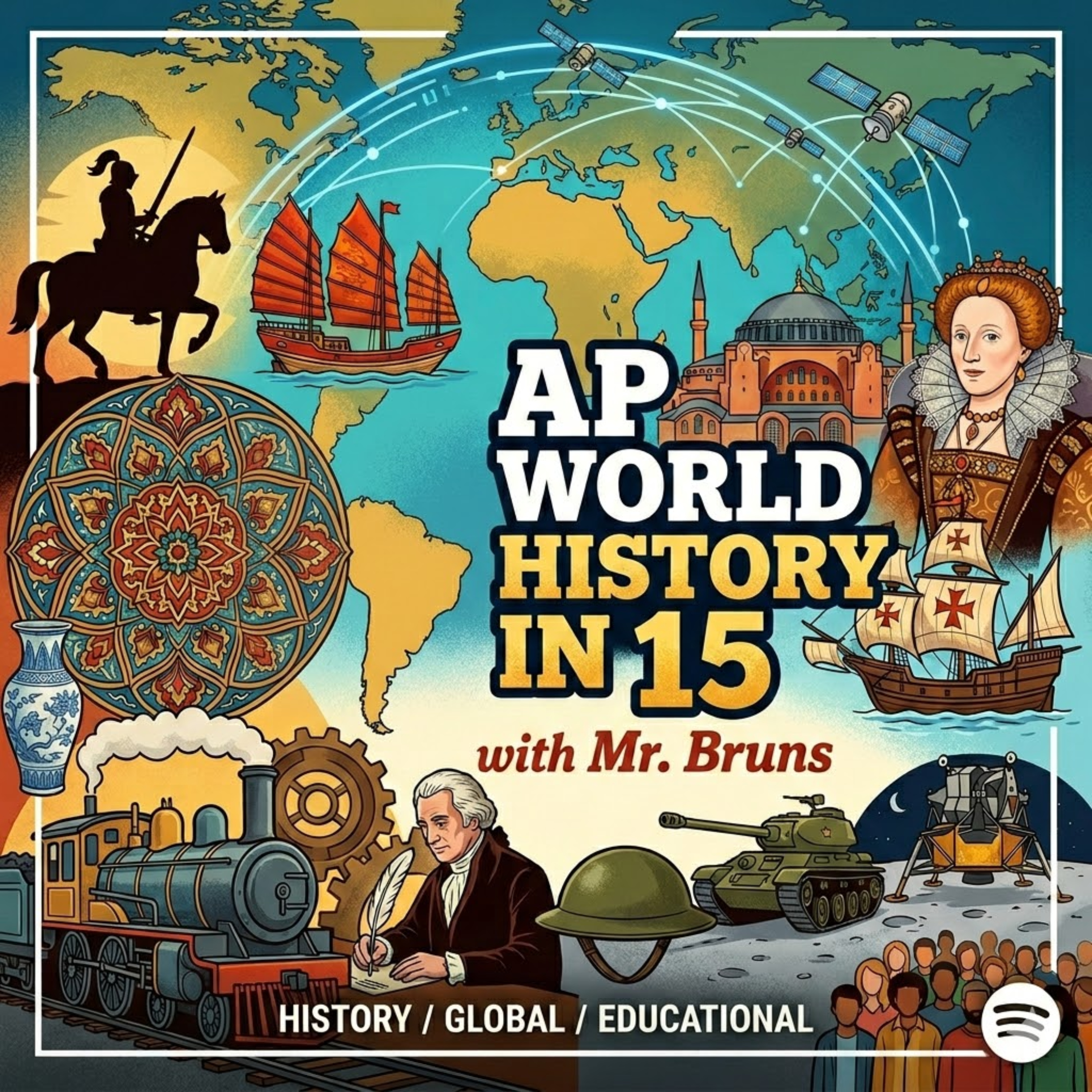
AP World History in 15
by Robert Bruns
AP World History in 15 is your fast-paced guide through the major events, empires, belief systems, conflicts, and innovations that shaped our world from 1200 CE to the present day. Hosted by veteran AP educator Mr. Bruns, this podcast breaks down the people, processes, and turning points that define global history — from the rise of the Mongols and global trade networks to revolutions, industrialization, imperialism, world wars, and globalization.Designed for AP World History students, each episode delivers engaging storytelling, historical analysis, exam skills, and thematic connections in
-
11
Innovation in Dar al-Islam: The Knowledge Network of the Medieval World
In this episode of AP World History in 15, Mr. Bruns explores how Dar al-Islam became one of the greatest centers of innovation between 1200 and 1450 CE. From the mathematical breakthroughs of Nasir al-Din al-Tusi to advances in medicine, philosophy, and literature, Muslim scholars transformed the medieval world. Learn how the House of Wisdom preserved ancient knowledge, how ideas spread through Al-Andalus, and why these developments helped lay foundations for the European Renaissance and global exchange networks.
-
10
Governance in Dar al-Islam: Caliphs, Conquests, and Collapse
In this episode of AP World History in 15, Mr. Brunsbreaks down the rise, expansion, and fragmentation of Dar al-Islam from the death of the Prophet Muhammad through the Abbasid collapse. Learn how Islamic rulers built powerful states, administered vast empires, and expanded Musliminfluence across Afro-Eurasia through trade, missionaries, Sufis, and military conquest. Mr. Bruns also explores the Seljuk Turks, Mamluks of Egypt, and Delhi Sultanates while explaining continuity, innovation, and diversity withinIslamic governance.Perfect review for AP World History students studying governance, state building, and cultural interactions from c. 1200–1450.
-
9
The Abrahamic Religions and Dar al-Islam: Faith, Culture, and Power from 1200–1450
In this episode of AP World History in 15, Mr. Brunsexplores the cultural developments and interactions within Dar al-Islam from 1200–1450 CE through the lens of the Abrahamic religions: Judaism, Christianity, and Islam. Discover the origins, beliefs, sacred texts, and historical experiences of each religion while examining how they shaped politics, economics, trade, scholarship, and cultural exchange across Africa, Asia, Europe, and the broader Afro-Eurasian world. From persecution and pilgrimage to empires and intellectual achievements, this episode reveals how faith connected civilizations during the medieval era.
-
8
Song Dynasty Economy: China’s Industrial Revolution Before Europe?
In this episode, Mr. Bruns takes listeners deep into the booming economy of Song Dynasty China from c. 1200–1450 CE. Explore how the Silk Roads connected Afro-Eurasia, why Chinese trade dominated the medieval world, and how innovations like Champa rice, the Grand Canal, the magnetic compass, and advanced shipbuilding transformed East Asia forever.Discover how silk, porcelain, iron, and steel production made Song China one of the most commercially advanced civilizations in history — and tackle the fascinating historical debate: Was the Song Dynasty experiencing an Industrial Revolution centuries before Europe?Plus:🍚 The impact of Champa rice🧭 Maritime innovations and trade⚒️ Iron and steel production🏺 Silk and porcelain exports🍑 The surprising origin story of peachesPerfect for AP World History students reviewing Unit 1 and the theme of Economic Systems.
-
7
Song Dynasty China: Cultural Developments and Interactions
Explore the cultural world of East Asia from c. 1200–1450 CE with Mr. Bruns in this episode of AP World History in 15! This episode focuses on the AP World History theme of Cultural Developments and Interactions through the beliefs, traditions, philosophies, and social systems that shaped Song Dynasty China and influenced East Asia for centuries.Mr. Bruns breaks down the origins and impact of Confucianism, Daoism, Buddhism, and Neo-Confucianism, explaining how these systems of thought shaped government, education, gender roles, family life, and social hierarchy. The episode also examines the importance of filial piety, respect for elders and authority, and the role of women in Chinese society — including an AP-level discussion of how foot binding fit within Neo-Confucian social expectations.Listeners will also get a fast-paced review of Buddhism, including the teachings of Siddhartha Gautama and the differences between Theravada, Mahayana, and Tibetan Buddhism. Mr. Bruns explains how Buddhism spread into China, Korea, and Japan, how different social groups viewed the religion, and how it transformed East Asian societies culturally and intellectually.The episode also highlights the growth of Chinese literary and scholarly traditions during the Song Dynasty and explores how Chinese cultural traditions influenced Korea and Heian Japan through writing systems, education, bureaucracy, philosophy, and religion.Perfect for AP World History students reviewing:Cultural continuity and change over time (CCOT)Confucianism, Daoism, and BuddhismNeo-ConfucianismFilial piety and gender rolesFoot bindingCultural diffusion in East AsiaSong Dynasty society and scholarshipChinese influence on Korea and JapanFast-paced, engaging, and packed with AP exam connections — this is Song Dynasty culture explained in 15 minutes!
-
6
The Song Dynasty – Governance, Order, and the Mandate of Heaven
Dive into the world of East Asia from c. 1200–1450 CE with Mr. Bruns on this episode of AP World History in 15! This episode, which slightly goes over 15 minutes, explores the AP History theme of Governance through the rise, administration, expansion, and decline of the powerful Song Dynasty.Listeners will first build the essential historical foundation by examining the Mandate of Heaven, the political philosophy that shaped Chinese dynastic rule for over two thousand years. Mr. Bruns also breaks down the origins and core beliefs of Confucianism and Daoism, explaining how these belief systems influenced government, society, family life, and culture throughout East Asia.From the legacies of the Qin, Han, and Tang dynasties to the sophisticated bureaucracy and civil service examination system of the Song, this episode explains how Chinese rulers obtained, maintained, and exercised power. Mr. Bruns also explores Neo-Confucianism, economic expansion, technological growth, and the external pressures posed by nomadic groups and the Mongols.Perfect for AP World History students reviewing:Governance and state-buildingThe Mandate of HeavenConfucianism and DaoismCivil service exams and bureaucracyNeo-ConfucianismSong Dynasty achievements and declineEast Asian continuity and change over timeFast-paced, content-rich, and AP-exam-focused — this is East Asian governance explained in 15 minutes (give or take)!
-
5
Welcome to AP World History
Welcome to the very first episode of AP World History in 15! Meet your host, Mr. Bruns — a 28-year teaching veteran who has taught AP World History since 2004, along with AP European History, AP Art History, AP Psychology, and AP U.S. History. In this kickoff episode, Mr. Bruns breaks down everything students need to know before starting the course.In this episode:The structure of the AP World History examMultiple Choice, SAQs, DBQs, and LEQs explainedHistorical Thinking Skills like comparison, causation, and CCOTMajor course themes including governance, economics, culture, technology, and social systemsWhy AP World History is far more than memorizing dates and battlesMr. Bruns also explains why history is basically one giant human soap opera filled with ambition, conflict, corruption, innovation, and dramatic twists that help answer one huge question:“Why is the world the way it is today?”Whether you’re a brand-new AP student or looking for a motivational jumpstart, this episode sets the foundation for the year ahead.And remember: “You Can’t Cheat the Reading.”
We're indexing this podcast's transcripts for the first time — this can take a minute or two. We'll show results as soon as they're ready.
No matches for "" in this podcast's transcripts.
No topics indexed yet for this podcast.
Loading reviews...
ABOUT THIS SHOW
AP World History in 15 is your fast-paced guide through the major events, empires, belief systems, conflicts, and innovations that shaped our world from 1200 CE to the present day. Hosted by veteran AP educator Mr. Bruns, this podcast breaks down the people, processes, and turning points that define global history — from the rise of the Mongols and global trade networks to revolutions, industrialization, imperialism, world wars, and globalization.Designed for AP World History students, each episode delivers engaging storytelling, historical analysis, exam skills, and thematic connections in
HOSTED BY
Robert Bruns
CATEGORIES
Loading similar podcasts...
Frequently Asked Questions
How many episodes does AP World History in 15 have?
AP World History in 15 currently has 7 episodes available on PodParley. New episodes are automatically indexed when they're published to the podcast feed.
What is AP World History in 15 about?
AP World History in 15 is your fast-paced guide through the major events, empires, belief systems, conflicts, and innovations that shaped our world from 1200 CE to the present day. Hosted by veteran AP educator Mr. Bruns, this podcast breaks down the people, processes, and turning points that...
How often does AP World History in 15 release new episodes?
AP World History in 15 has 7 episodes. Check the episode list to see recent publication dates and frequency.
Where can I listen to AP World History in 15?
You can listen to AP World History in 15 on PodParley by clicking any episode. We provide an embedded audio player for direct listening, and you can also subscribe via your preferred podcast app using the RSS feed.
Who hosts AP World History in 15?
AP World History in 15 is created and hosted by Robert Bruns.
URL copied to clipboard!