PODCAST · business
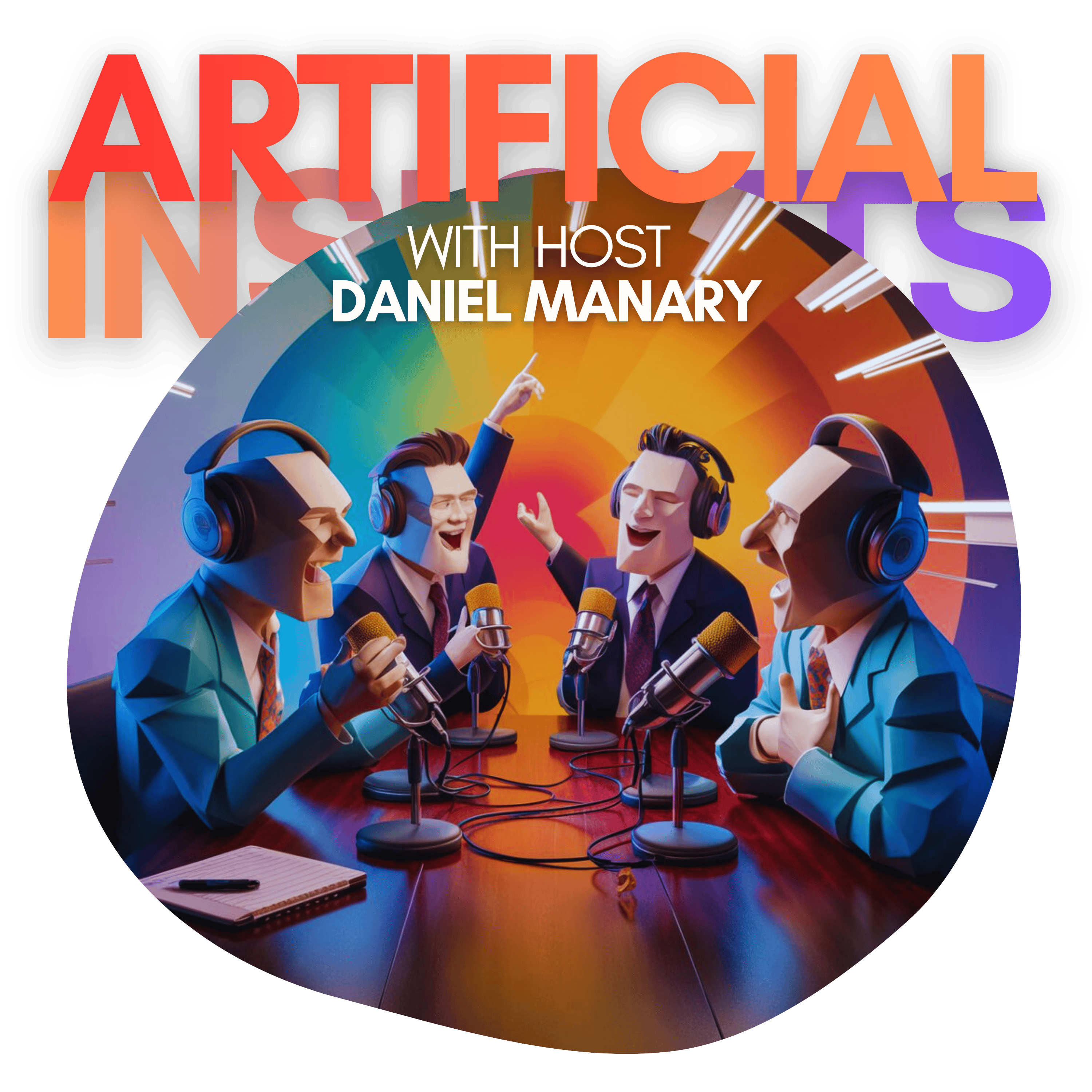
Artificial Insights: Conversations About AI
by Daniel Manary
Candid conversations and real-world stories about how AI is changing work, life, and us.Every other Friday, host Daniel Manary talks with CEOs, CTOs, CAIOs, product managers, researchers, and founders about bringing AI ideas to market, separating hype from lasting impact. He explores the How's, What's, and Why's of Artificial Intelligence and digs into how this technology is changing the landscape of modern work and life, and more importantly, us.
-
74
Student Spring Special: Using AI the Right Way w/ Vaani & Daniel Manary
Students are already finding their own ways to use AI. Can schools do a better job of showing them how to use it well?In part 1 of our student special, Aasha argued that schools need more AI literacy and less fear.In part 2, Keya described the tension students feel when AI is helpful and suspicion is high. In part 3, Maizah named the deeper dilemma of living with a tool that is everywhere. In part 4 of 4, Daniel speaks with Vaani, a high school student interested in law, coding, and the arts, whose perspective is especially practical.Vaani uses AI in a very clear-eyed way. She finds it useful for math-heavy and physics-heavy questions, for generating practice tests, and for debugging code when she gets stuck. She believes AI should help you do your work, not do your work for you. She sees the limits of AI writing clearly. She also sees the missed opportunity when teachers allow or use AI in practice, but don't show students how to use it well.Students are already using AI. How are schools guiding that use and can they do it with more clarity, better examples, and more honest conversation?🔑 What You’ll Learn in This Episode✅ How AI can be used for practice tests, difficult concepts, and studying outside class✅ Why debugging code can be a strong example of structured AI use in school✅ How some teachers encourage AI use, but leave students to figure out the details on their own✅ Why there's a sharp line between AI helping with work and doing the work itself✅ What schools could do differently to teach students how to use AI more wisely🔗 Resources & Links🌐 Learn more about Youth Tech Labs: https://www.linkedin.com/company/youth-tech-labs📩 Subscribe to the Artificial Insights newsletter for key takeaways: https://manary.haus/podcast/#haus👉 Have a guest in mind? Reach out to Daniel at [email protected]💬 Know a teacher, parent, or school leader trying to think more clearly about responsible AI use in school? Share this episode with them.
-
73
Spring Student Special: The AI Dilemma w/ Maizah & Daniel Manary
What happens when AI is everywhere in a student’s life, but school mostly talks about it as something to avoid?In part 1 of our student special, Aasha called for AI literacy instead of fear. In part 2, Keya described what it feels like when trust breaks down around student work. In part 3 of 4, Maizah widens the lens again: she talks about what it's like to grow up with AI as a constant presence, even while school treats it as taboo.Maizah is a Grade 12 student and her perspective is thoughtful, conflicted, and very current. She sees how useful AI can be. How it makes schoolwork faster, helps with math, and how it is omnipresent in search, social media, and creative tools. For many students, it's already woven into daily life.At the same time, she's asking questions that aren't easy to answer. What happens to your writing if AI keeps polishing it for you? What happens to your attention span if you stop reading deeply? What does it mean when younger siblings are growing up on AI-generated content before they can make sense of it?This conversation stands out because Maizah isn't trying to flatten AI into a simple good-or-bad story. She's describing the real dilemma students are living with right now. AI is useful, and it is hard to escape. It raises real concerns about learning, creativity, and the kind of habits students are forming.🔑 What You’ll Learn in This Episode✅ Why AI can feel impossible for students to avoid once it becomes part of everyday life✅ How AI may be shaping writing, reading, and attention span✅ How schools still treat AI as taboo instead of teaching students how to understand it✅ How environmental concerns are shaping the way some students think about AI✅ Why AI-generated content raises new questions for younger siblings and families🔗 Resources & Links🌐 Learn more about Youth Tech Labs: https://www.linkedin.com/company/youth-tech-labs📩 Subscribe to the Artificial Insights newsletter for key takeaways: https://manary.haus/podcast/#haus👉 Have a guest in mind? Reach out to Daniel at [email protected]💬 Know a teacher, parent, or school leader trying to think clearly about AI, attention, and what students are learning? Share this episode with them.
-
72
Spring Student Special: Students Learning With AI w/ Keya & Daniel Manary
Students are already building AI into how they learn—are schools can help them use it well?In part 1 of our student special on AI and education, Aasha raised the question of what schools are actually preparing students for. In part 2 of 4 of our student special on AI and education, Daniel speaks with Keya, a Grade 12 student balancing classes, sports, work, and plans for what comes after graduation. In this conversation, she shares a grounded and optimistic view of AI at school. For her, AI is already part of the rhythm of student life. It can explain tough concepts, generate practice quizzes, walk through calculus problems step by step, and help students study when teachers are not available.She also describes the tension that comes with all that. Teachers may encourage AI for studying, then rely on detection tools that are far less certain when it comes to student writing. Keya tells the story of fighting for credit on an English assignment she had done herself, and how stressful that became in a Grade 12 course that mattered for university applications.This episode is a practical look at how students are actually living with AI now, and what adults may need to understand better.Stay tuned for part 3 of the 4-part series!🔑 What You’ll Learn in This Episode✅ How students use AI to study, practice, and understand difficult material✅ Why students find AI especially helpful outside school hours✅ How one false AI accusation turned into a fight for a real grade✅ Where teachers are encouraging AI use, and where they are wary✅ Why the biggest issue may be learning how to use AI well🔗 Resources & Links🌐 Learn more about Youth Tech Labs: https://www.linkedin.com/company/youth-tech-labs📩 Subscribe to the Artificial Insights newsletter for key takeaways: https://manary.haus/podcast/#haus👉 Have a guest in mind? Reach out to Daniel at [email protected]💬 Know a teacher, parent, or student trying to figure out what healthy AI use should look like at school? Share this episode with them.
-
71
Spring Student Special: The Fear Around AI in School w/ Aasha & Daniel Manary
What happens when schools focus so hard on detecting AI that students start reshaping their own writing just to avoid suspicion?In part 1 of 4 of our student special on AI and education, Daniel speaks with Aasha, a Grade 12 student from Waterloo, founder of Youth Tech Labs, and a young leader already helping other students think more clearly about AI, privacy, and what meaningful learning should look like now.Aasha’s argument is sharp: what should education look like when AI is already here? She describes how AI detection tools created an environment of fear, how students were pushed to prove their innocence, and how some even began weakening their own writing just to avoid being flagged.She also points to a gap that feels bigger than policy. Students are already using AI to study, generate practice, break down hard concepts, and explore ideas. But, schools are still treating AI literacy, privacy, and responsible use as side issues, even though these are quickly becoming part of the real world students are heading into.Stay tuned for part 2 of the 4-part series!🔑 What You’ll Learn in This Episode✅ Why schools should focus on teaching students how to think better with AI✅ How AI detection tools changed some classrooms from places of trust to places of suspicion✅ Why privacy and AI literacy belong much closer to the center of this conversation✅ How students are already using AI to study, test ideas, and learn at their own pace✅ Why school and real-world AI use are still living in two separate worlds🔗 Resources & Links🌐 Explore Youth Tech Labs: https://www.linkedin.com/company/youth-tech-labs 🤝 Connect with Aasha on LinkedIn: https://ca.linkedin.com/in/aasha-khan-3a2294250 🌍 Learn more about Girl Up Teen Advisors: https://girlup.org/programs/teen-advisors 📩 Subscribe to the Artificial Insights newsletter for key takeaways: https://manary.haus/podcast 👉 Have a guest in mind? Reach out to Daniel at [email protected]💬 Know an educator, parent, or school leader trying to move from AI fear to AI literacy? Share this episode with them.
-
70
Spring Student Special: Are Schools Preparing Students for an AI Future? w/ Patrick Belliveau & Daniel Manary
Schools are trying to figure out AI in real time, but students are already living with the results.In this special repost episode, Daniel brings back a short conversation with Pat Belliveau to open our student series on AI and education. Pat raises a hard question: if AI is already part of the world students are growing up into, what does it mean for schools to treat it mainly as a threat? There is a real risk when teachers rely on AI detection tools that aren't reliable, and real damage that can follow when students are accused on that basis.That is why we wanted to start the series here.In the next few episodes, Daniel will be sharing short interviews with high school students about how they are now, really using AI, what they think about it, and how they see it shaping their future. We hear plenty from adults on this topic. This series is an attempt to make room for students to speak for themselves.🔗 Resources & Links📩 Subscribe to the Artificial Insights newsletter for key takeaways: https://manary.haus/podcast/#haus👉 Have a guest in mind? Reach out to Daniel at [email protected]💬 Know a teacher, parent, or student trying to make sense of AI in school? Share this episode with them!
-
69
How Do You Start an AI Consultancy From Scratch? w/ Patrick Belliveau, Managing Partner @ Gambit Co
What would you do if you had to start an AI consultancy from scratch today?In this bonus clip, Daniel asks Pat Belliveau of Gambit Co exactly that. And Pat does what he does so well: he shares practical advice without posturing:Start with someone in your network. Solve one real problem. Do it well enough to earn a case study. Then, build from there.Thanks, Pat, for being refreshingly candid, quick to teach, and generous with lessons that many people would keep to themselves. It's why you're one of our favorite people!🎧 Want the full conversation?This clip comes from a longer episode on shipping AI in the real world, why so many projects fail, and what it takes to make something businesses can actually trust.Full episode here: https://rss.com/podcasts/manaryhaus/2607646/🔗 Resources & Links🌐 Learn more about Gambit Co: https://gambitco.io/🤝 Connect with Patrick Belliveau on LinkedIn: https://ca.linkedin.com/in/patrick-belliveau🎗️ Explore AskEllyn: https://askellyn.ai/📩 Subscribe to the Artificial Insights newsletter: https://manary.haus/podcast/#haus👉 Have a guest in mind? Reach out to Daniel at [email protected]💬 Know someone trying to build an AI consultancy? Share this clip with them.
-
68
Inside the Messy Middle of Shipping AI w/ Patrick Belliveau, Managing Partner @ Gambit Co
AI feels easy right up until a team tries to ship it. Patrick Belliveau of Gambit Co joins Daniel to talk about the messy middle between a promising prototype and something a business can actually trust.In this candid conversation, Daniel and Pat reflect on what changed between year one and year two of building an applied AI company. Pat explains why Gambit moved from fixed-price projects to retainer-based partnerships, how rapid prototyping helps teams stay close to the real problem, and why so many AI projects fail before they ever have a chance to deliver.Their conversation also explores agent orchestration, human-in-the-loop validation, the limits of black-box tools, and the organizational fear that can quietly sabotage adoption. One of the clearest ideas in the episode is that getting AI to do something once is not the hard part. Getting it to work twice, three times, and at scale is where the real work begins.For leaders tired of vague AI promises, this episode offers a grounded look at what it takes to make AI work in the real world.🔑 What You’ll Learn in This Episode✅ Why many AI projects fail before the technology is even the main issue✅ How rapid prototypes surface better feedback than long requirements documents✅ Why repeatability, validation, and human-in-the-loop design matter in production✅ How AI can improve both supply constraints and demand generation inside a business✅ Why internal communication can determine whether adoption succeeds or stalls🔗 Resources & Links🌐 Learn more about GambitCo: https://gambitco.io/🤝 Connect with Patrick Belliveau on LinkedIn: https://ca.linkedin.com/in/patrick-belliveau🎗️ Explore AskEllyn: https://askellyn.ai/📩 Subscribe to the Artificial Insights newsletter: https://manary.haus/podcast/#haus👉 Have a guest in mind? Reach out to Daniel at [email protected]💬 Know someone trying to move AI from prototype to production? Share this episode with them.
-
67
Will AI Replace Humans in Lending? w/ Sharmeen Aqeel, Founder & CEO @ Lyyvora
AI can automate matching and readiness checks in lending. It cannot automate trust.In this bonus clip, Daniel asks Sharmeen Aqeel how Lyyvora will scale as borrower volume grows. Sharmeen’s answer is simple: at an early-stage fintech, one broken interaction can damage credibility. Even if AI produces the "right" output, a human still needs to verify, interpret context, and provide real connection when borrowers are anxious or unsure.Sharmeen also looks ahead. If a "borrower-to-offers" workflow becomes trivial in a few years, Lyyvora's moat is not the application flow. It's the network and community she's building, and the trust that comes with it.🎧 Want the full conversation? This clip comes from a longer episode on human-centered design in lending, AI as a founder multiplier, and why accessibility, not obstruction, is the real gap in healthcare finance.Full episode: https://rss.com/podcasts/manaryhaus/2565271/🔗 Resources & Links🌐 Lyyvora: https://lyyvora.com/🤝 Connect with Sharmeen on LinkedIn: https://www.linkedin.com/in/sharmeen-aqeel/📩 Subscribe to the Artificial Insights newsletter for key takeaways: https://manary.haus/podcast/#haus👉 Have a guest in mind? Reach out to Daniel at [email protected]💬 Know a founder building an AI-enabled marketplace? Share this clip with them.
-
66
Fintech Without the Jargon: Making Healthcare Lending Accessible with AI w/ Sharmeen Aqeel, Founder & CEO @ Lyyvora
Clinics get stuck in lending for a frustratingly simple reason: the process is hard to navigate. The information exists, lenders are willing, and qualified borrowers do get funded. But the path is not accessible, especially when you're running a clinic and don't have time to decode criteria buried across pages, videos, and jargon.Sharmeen Aqeel is the founder and CEO of Lyyvora, and she treated this as a human-centered design problem. Lyyvora is a Lending-as-a-Service platform built for healthcare and medical aesthetics clinics, designed to make “what happens next” clear: one streamlined intake, prescreening for readiness, and matching to vetted lenders who actually want qualified deals.AI matters here because it lowers the cost of judgment. It helps Lyyvora turn scattered lender requirements into usable decisioning, score borrower readiness, and match clinics to the best-fit lenders. In the episode, Daniel and Sharmeen also dig into where automation stops: trust still needs a human, especially in early-stage fintech.🔑 What You’ll Learn in This Episode✅ Why “lenders want to lend” can be true while the process still feels impossible for clinics✅ How human-centered design makes lending workflows legible without changing the underlying rules✅ Where AI helps with readiness, matching, and speed, and where humans stay in the loop for trust✅ What a lending marketplace changes for transparency and competition among lenders✅ Why building the lender side of a two-sided network can be easier than reaching borrowers✅ How a solo founder can accomplish what used to require a team with the help of AI✅ How some things you do as a solo founder should never be delegated to AI🔗 Resources & Links🤝 Connect with Sharmeen on LinkedIn: https://www.linkedin.com/in/sharmeen-aqeel/🌐 Lyyvora: https://lyyvora.com🏢 Lyyvora on LinkedIn: https://ca.linkedin.com/company/lyyvora📩 Subscribe to the Artificial Insights newsletter for key takeaways: https://manary.haus/podcast/#haus👉 Have a guest in mind? Reach out to Daniel at [email protected]💬 Know someone working on AI in financial services or marketplaces? Share this episode with them.
-
65
Who Pays When AI Uses Your Work? w/ Julie Trelstad, Head of US Publishing @ Amlet.ai
AI licensing can sound like a moral argument until you look at the product constraints. If the best material is behind paywalls and contracts, “just scrape it” stops working.In this bonus clip, Daniel pressures the obvious skeptical question: if big AI companies can afford lawsuits, why bother building fair, legal access at all? Julie Trelstad’s answer is practical. She expects the next wave of AI advancements to include many more small, domain-specific models, and those models will need verified, high-quality sources like textbooks and peer-reviewed journals.🎧 Want the bigger picture?This clip is one piece of a longer conversation with Julie about “AI rights” in publishing, how provenance and permissions can become machine-readable, and what it could look like for creators to get paid when their work is used.Check out the full episode here: https://rss.com/podcasts/manaryhaus/2525377/🔗 Resources & Links 🌐 Julie’s work at Paperbacks & Pixels: https://paperbacksandpixels.com/ 🧩 Amlet (register and license AI rights): https://amlet.ai/ 📩 Subscribe to the Artificial Insights newsletter for key takeaways: https://manary.haus/podcast/#haus 👉 Have a guest in mind? Reach out to Daniel at [email protected]🚀 This episode spark an idea? Share it with someone building with domain data.
-
64
AI Training Data Meets Copyright: How Publishing Can License Content at Scale w/ Julie Trelstad, Head of US Publishing @ Amlet.ai
AI has been trained on the world’s writing. Now, we have to figure out how creators prove ownership, set permissions, and get paid when their work is used.Julie Trelstad has spent 30 years inside publishing’s biggest technology shifts, from desktop publishing to eBooks to print-on-demand to self-publishing. In this episode, she explains why AI is forcing publishing into a new kind of rights era, one where piracy and fast imitation can flood the market within days of a book launch.Julie is Head of US Publishing at Amlet.ai and runs Paperbacks & Pixels. She walks through what “AI rights” means in practice, why book rights sales already power much of the industry, and how systems like ISCC fingerprinting can make ownership and usage terms machine-readable without exposing the full text.Daniel and Julie also dig into what happens when high-value content moves behind paywalls, why smaller domain models will need licensed, high-quality sources, and what fair compensation could look like when content is used for training, research, or generation.🔑 What You’ll Learn in This Episode✅ The six publishing waves Julie has lived through, and why eBooks changed the ecosystem✅ Why AI imitation and piracy hit bestsellers first, and how that changes incentives ✅ What “AI rights” includes beyond training, including research and generative use ✅ How ISCC-based fingerprinting can prove provenance without sharing the full book ✅ Why paywalls and licensing are reshaping what high-quality data is available to models ✅ A practical way to think about “original vs. derivative” in an AI-assisted world🔗 Resources & Links🤝 Connect with Julie on LinkedIn: https://www.linkedin.com/in/julietrelstad 🌐 Julie’s work at Paperbacks & Pixels: https://paperbacksandpixels.com/ 🧩 Amlet.ai (AI content registry): https://amlet.ai/ 📚 StreetLib (distribution + registration path mentioned in the episode): https://www.streetlib.com/ 📩 Subscribe to the Artificial Insights newsletter for key takeaways: https://manary.haus/podcast/#haus 👉 Have a guest in mind? Reach out to Daniel at [email protected]💬 Know a product leader or publisher trying to source high-quality data responsibly? Send them this episode.
-
63
Are You Holding Onto a Job AI Should Have? w/ Dave Boyce, Executive Chair @ Winning By Design
When AI threatens your job, the real risk is clinging to the parts of work that are already predictable.In this bonus short, Daniel Manary and Dave Boyce (Winning by Design, author of Freemium) talk about the fear many people feel right now: AI is coming for my job. Dave argues that AI doesn't replace you as a human unless you keep trying to do work AI should handle. The path forward is to automate what is routine, and double down on the human work: alignment, confidence, strategy, and helping people navigate uncertainty.🎧 Want the bigger picture?In the full episode, Dave breaks down what actually separates successful AI experiments from the 90% that stall out. He explains why measurement matters, why most companies need a clear “theory of the case,” and how AI-native go-to-market motions are rewriting the speed limits for growth.Listen to the full episode: https://rss.com/podcasts/manaryhaus/2481331/🔗 Resources & Links🤝 Connect with Dave on LinkedIn: https://www.linkedin.com/in/boycedave 📩 Subscribe to the Artificial Insights newsletter for key takeaways: https://artificialinsights.manary.haus👉 Have a guest in mind? Reach out to Daniel at [email protected] 💬 If your team is wrestling with job impact, workflow redesign, or where humans still add leverage, share this clip with a leader who needs language for the conversation.
-
62
From Experiments to ROI: Measuring AI Inside Real Go-To-Market Systems w/ Dave Boyce, Executive Chair @ Winning By Design
"Run experiments" is easy advice. Measuring them inside a real customer journey is the hard part.Dave Boyce has lived through multiple SaaS eras, from $1.2M ACV enterprise deals to $1,200 self-serve motions. Now, as Product lead and Executive Chair at Winning by Design, he works with growth-stage companies to rebuild their revenue systems for an AI-shaped market.In this conversation, Daniel and Dave get concrete about what “AI-forward GTM” actually requires: a clear theory of the case, a real data model for the whole customer lifecycle (the bow tie), and an operating model that can survive handoffs between humans and agents.Dave also shares what he has learned from launching AI agents in the wild, including why measurement is the difference between “experiments” and vibes.🔑 What You’ll Learn in This Episode✅ Why most AI projects fail to show ROI when they launch as point solutions inside un-architected systems✅ How the “bow tie” model reframes GTM around renewal, expansion, advocacy, and growth loops✅ What it takes to encode customer context for clean handoffs (SPICED: Situation, Pain, Impact, Critical Event, Decision)✅ How AI-native companies use self-serve + real-time data to grow faster than rep-led machines✅ A practical way to think about job anxiety: automate the predictable, protect the human work that stays exceptional🔗 Resources & Links🤝 Dave Boyce on LinkedIn: https://www.linkedin.com/in/boycedave🏢 Winning by Design: https://winningbydesign.com/📓 The Growth Journal (Winning by Design): https://winningbydesign.com/growth-journal/📘 Freemium (Stanford University Press): https://www.sup.org/books/freemium📩 Subscribe to the Artificial Insights newsletter for key takeaways: https://manary.haus/podcast/#haus👉 Have a guest in mind? Reach out to Daniel at [email protected]💬 Know a founder or revenue leader trying to retrofit AI into an existing GTM machine? Send them this episode. It will give them better questions to ask before they ship another “agent.”
-
61
Wikipedia's First Real Competitor Is an AI: What is Grokipedia? w/ Bill Beutler, Founder @ Beutler Ink & TheNotability.co
An AI-written encyclopedia can sound coherent and still be wrong and that gap matters more than it first appears.In this bonus short, Daniel Manary and William Beutler of Beutler Ink and The Notability Company look at the first real challenger to Wikipedia's long-standing dominance. They discuss Grokipedia, Elon Musk's AI-generated encyclopedia: why its entries can feel clearer and more complete than Wikipedia, and how that polish can mask weak or missing sources.🎧 Want the bigger picture?In the full episode, Bill explains why Wikipedia remains the shared reference point for major AI systems, how citations shape model behavior, and why neutrality matters more in an AI-mediated web.Listen to the full episode: https://rss.com/podcasts/manaryhaus/2451988🔗 Resources & Links🤝 Connect with Bill on LinkedIn: https://www.linkedin.com/in/billbeutler/📩 Subscribe to the Artificial Insights newsletter for key takeaways: https://manary.haus/podcast/#haus👉 Have a guest in mind? Reach out to Daniel at [email protected]💬 Thinking about trust, sourcing, or shared knowledge in AI systems? Share this clip with someone building in that space.
-
60
Who Decides What AI Knows? Wikipedia, Sources, and Trust w/ Bill Beutler, Founder @ Beutler Ink & TheNotability.co
Wikipedia has become one of the quiet foundations of modern AI.In this episode, Daniel explores why large language models rely so heavily on Wikipedia, both as training data and as a real-time citation source. Its concise structure, dense linking, and topic-first writing make it ideal for machines, even as fewer humans read it directly.Daniel is joined by Bill Beutler, founder of Beutler Ink, who works inside Wikipedia’s rules to help organizations correct inaccuracies and navigate notability standards. Bill explains how Wikipedia’s volunteer model, conflict-of-interest policies, and reliance on independent journalism shape what appears there, and why most brands misunderstand how the system actually works.The conversation surfaces a deeper risk: if AI reduces traffic to publishers, the sources Wikipedia depends on may shrink, making verification harder over time. As AI leans more heavily on Wikipedia, the health of that knowledge pipeline becomes a shared concern.This episode looks past hype to examine how AI is reshaping truth, reputation, and the infrastructure we increasingly depend on but rarely see.🔑 What You’ll Learn in This Episode✅ Why Wikipedia is a top citation source in AI answers, and why that changed recently ✅ How Wikipedia’s conflict-of-interest rules actually work in practice ✅ Why “undisclosed paid editing” is so hard for the volunteer community to police ✅ What Wikipedia’s “notability” standard is really screening for ✅ How brands can improve accuracy without turning Wikipedia into marketing ✅ What might happen if AI hollows out the sources Wikipedia relies on🔗 Resources & Links🏢 Beutler Ink: https://www.beutlerink.com 🔎 The Notability Company: https://thenotability.co 📚 Beutler Ink’s Wiki Resource Library: https://www.beutlerink.com/wiki-resources 🤝 Connect with Bill on LinkedIn: https://www.linkedin.com/in/williambeutler 📩 Subscribe to the Artificial Insights newsletter for key takeaways: https://manary.haus/podcast/#haus 👉 Have a guest in mind? Reach out to Daniel at [email protected]💬 If your brand is being “summarized” by AI, pull up the citations and audit the Wikipedia trail. Share this episode with the person who owns reputation, comms, or search in your org.
-
59
Artificial Insights Season 5: How AI is Changing Economics and Work, and How We Are Changing With It
This season, we’re not talking about models, benchmarks, or demos. We’re talking about how AI is reshaping how humans work, coordinate, and judge as tools get better at remembering, acting, and contextualizing. With context increasingly automated, wisdom and judgment matter more, not less.We’ll hear from builders, operators, researchers, and leaders wrestling with how experience, trust, value, and incentives shift as AI becomes part of the fabric of work.👀 What to expect this season:Conversations about augmentation and friction, not replacement.How work changes shape when systems handle memory and routine execution.Real stories from people adapting, repricing value, and renegotiating trust between humans and machines.🎙️ Recommended Episodes to Start With:If you’re new to Artificial Insights or want entry points that capture the show’s core questions and lessons, here are strong starting points from past bonus episodes.✨ Foundational ConversationsHow Is AI Anxiety Changing the World? (w/ Jennifer Moss) https://rss.com/podcasts/manaryhaus/1931059/Why the AI Revolution Feels Different (w/ Mike Kirkup) https://rss.com/podcasts/manaryhaus/2075898/What Happens to Jobs When AI Scales Output 35x? (w/ Nicolas Tobis) https://rss.com/podcasts/manaryhaus/2143792/🧐 Product & Founder PerspectivesAfter 0→1: I Built a Product, Now What? (w/ Alexander Millar) https://rss.com/podcasts/manaryhaus/1992180/Is AI a New Medium? (w/ Ahmad Iqbal) https://rss.com/podcasts/manaryhaus/2315508/When Is the Right Time to Start a Company in AI? (w/ Adeel Zaman) https://rss.com/podcasts/manaryhaus/2238954/🔗 Resources & Links📩 Subscribe to the Artificial Insights newsletter for key takeaways: https://manary.haus/podcast/#haus👉 Have a guest in mind? Reach out to Daniel at [email protected]
-
58
Welcome to Artificial Insights: How AI is Changing Economics and Work
Artificial Insights is a podcast about how AI is changing economics and work, and what happens once the technology moves beyond demos and into real organizations.The podcast features conversations with founders, operators, and thinkers who are close to the work. People building AI products. People deploying them inside teams. And people who have already learned where AI helps and where it quietly creates problems.Daniel started Artificial Insights to stand at the gate of businesses using AI, separating hype from lasting impact.If you are new here, the most recent season trailer is a good place to start.🎧 Recommended Starting Points (Bonus Episodes)If you want a fast way into the kinds of conversations this show is known for, these short bonus episodes are good entry points:How Is AI Anxiety Changing the World? (Jennifer Moss): A clear look at how fear and uncertainty around AI show up inside leadership teams and shape real decisions. https://rss.com/podcasts/manaryhaus/1931059/Why the AI Revolution Feels Different (Mike Kirkup): A grounded explanation of why this AI wave cuts across more roles and systems than previous tech shifts. https://rss.com/podcasts/manaryhaus/2075898/What Happens to Jobs When AI Scales Output 35x? (Nicolas Tobis): A concrete, numbers-driven look at productivity jumps, role changes, and second-order effects. https://rss.com/podcasts/manaryhaus/2143792/ After 0→1: I Built a Product, Now What? (Alexander Millar): A practical founder conversation about distribution, timing, and why “the product works” is not the end. https://rss.com/podcasts/manaryhaus/1992180/Is AI a New Medium? (Ahmad Iqbal): A big-picture starting point on AI as a creative medium and how new formats actually emerge. https://rss.com/podcasts/manaryhaus/2315508/When Is the Right Time to Start a Company in AI? (Adeel Zaman): A sharp filter for founders thinking about “why now” instead of chasing surface-level trends. https://rss.com/podcasts/manaryhaus/2238954/ 🔗 Resources & Links📩 Subscribe to the Artificial Insights newsletter for key takeaways: https://manary.haus/podcast/#haus👉 Have a guest in mind? Reach out to Daniel at [email protected]
-
57
The Great Flip: How AI Changed the Shape of Work in 2025
This special Christmas and New Year bonus episode is a pause. We're looking back at 2025 and thinking about what surfaced across a year of conversations with builders, executives, philosophers, and operators working close to AI.Across industries and roles, the same shift kept appearing. Work isn't disappearing per se... but it is changing. Flipping.Humans are moving upstream. Away from direct execution and toward enabling, guiding, and judging systems that now do the work itself. Execution is cheaper than it has ever been. Direction, responsibility, and wisdom are not.This bonus episode weaves together moments from Season 2 through Season 4 to explore what that flip feels like in practice, what it costs in terms of agency and meaning, and what it now requires from leaders and builders. You will hear reflections on relief, anxiety, creativity, formation, and the quiet risk of losing a sense of future self.If this year left you excited, uneasy, or tired trying to keep up with AI, this episode is meant to help you step back and see the shape of the moment more clearly.🎧 Episodes Featured in This RecapSeason 2Patrick Belliveau: E01 - https://rss.com/podcasts/manaryhaus/1875537/Jennifer Moss: E03 - https://rss.com/podcasts/manaryhaus/1917877/Bijan Vaez: E04 - https://rss.com/podcasts/manaryhaus/1940948/Chyngyz Dzhumanazarov: E07 - https://rss.com/podcasts/manaryhaus/2041601/Mike Kirkup: E08 - https://rss.com/podcasts/manaryhaus/2061508/Season 3Christopher Watkin: E02 - https://rss.com/podcasts/manaryhaus/2167772/Dr. K: E03 - https://rss.com/podcasts/manaryhaus/2178635/Season 4Josh Muller: E05 - https://rss.com/podcasts/manaryhaus/2282863/Ahmad Iqbal: E07 - https://rss.com/podcasts/manaryhaus/2309358/Alex Maier: E09 - https://rss.com/podcasts/manaryhaus/2328700/🎄 Merry Christmas, and Happy New Year! Thank you for listening, sharing, and building thoughtfully with us. We can't wait to see what 2026 brings!
-
56
Season 4 Wrap Up: How AI Is Making Impossible Work Practical
Across healthcare, nonprofits, construction, and creative tools, the same shift kept appearing. AI is moving work from impossible to practical.This special wrap up episode closes out Season 4 by revisiting a handful of moments that captured that shift most clearly. Rather than focusing on replacement or marginal efficiency gains, AI is removing constraints around memory, time, coordination, and execution.When those constraints fall, entirely new kinds of work become feasible.Daniel reflects on examples from across the season, including systems that surface organizational context no one person could retain, workflows that compress months of effort into minutes, software that moves from analysis to action, and tools that lower the barrier to creation itself.This episode is both a look back and a transition point. Season 4 showed what becomes possible when humans stop being the bottleneck. Season 5 will build on that foundation and explore where these shifts are leading next.We can't wait to share it with you!🔑 What This Season Taught Us✅ Why context is often the real constraint inside organizations✅ How AI compresses long, fragile workflows into short, reliable ones✅ What changes when software can act, not just inform✅ Why feedback loops matter as AI enters the physical world✅ How lowering barriers reshapes who gets to participate🔗 Resources & Links🤝 Connect with Daniel on LinkedIn: https://www.linkedin.com/in/dmanary/🎧 Explore past episodes of Artificial Insights: https://rss.com/podcasts/manaryhaus/📩 Subscribe to the Artificial Insights newsletter for key takeaways: https://manary.haus/podcast/#haus👉 Have a guest in mind? Reach out to Daniel at [email protected]🙏 Thank you to all of our Season 4 guests for their generosity, time, and hard-earned insight.🎧 Season 5 launches in January. Stay tuned for the next chapter!
-
55
Short: Who Should Be Writing the Rules for AI? w/ David Proulx, CAIO & Co-Founder @ HoloMD
Regulation and innovation rarely move at the same speed. In this bonus clip, Daniel Manary and David Proulx talk about who should shape the future of AI. David argues that the people building modern systems understand both the risks and the capabilities far better than policymakers who lack technical grounding.He contrasts Europe’s tendency to regulate early with the United States’ focus on innovation, liability, and builder responsibility. He points to the “Winning the AI Race” framework as an example of policy written by people who clearly understand the field, from guardrails to energy use to how a system should shut itself down if needed. For David, the real danger for countries like Canada and those in Europe is asphyxiating innovation before fully understanding the technology.🎧 Want the bigger picture?In the main episode, David explains how HoloMD built a clinical agent that has handled more than 100,000 mental-health conversations without hallucinating. He walks through long-term memory, safety testing with synthetic patients, and why incentives matter in healthcare AI.Listen to the full episode: https://rss.com/podcasts/manaryhaus/2365531/🔗 Resources & Links🤝 Connect with David on LinkedIn: https://www.linkedin.com/in/davidproulxoui/🌐 Learn more about HoloMD: https://holomd.ai/📩 Subscribe to the Artificial Insights newsletter for key takeaways: https://manary.haus/podcast/#haus👉 Have a guest in mind? Reach out to Daniel at [email protected]🚀 Know someone thinking about AI regulation or policy? Share this clip with them.
-
54
Building AI That Doesn't Hallucinate w/ David Proulx, CAIO & Co-Founder @ HoloMD
One of the things David Proulx is most proud of is building an AI agent that has handled more than 100,000 mental health conversations without a single hallucination.David is the Chief AI Officer at HoloMD, where an AI agent becomes a third party in the Therapeutic Alliance. The patient wants to feel better. The psychiatrist guides their care. HoloMD adds a daily point of contact that checks in, gathers context, tracks medication adherence, and offers support between visits. Psychiatrists stay fully in charge while gaining a clearer picture of a patient's life than a single appointment can provide.In this episode, Daniel talks with David about his path from building a social network for moms with 600,000 downloads to locking himself in a room for nine months learning AI, then co-founding HoloMD, which won the 2025 Mental Health Tech Innovator of the Year Award from the GHP Mental Health Awards. They explore what it takes to engineer safe clinical agents, how long-term memory was solved in their system, and why guardrails matter more than engagement tricks.🔑 What You’ll Learn in This Episode✅ How HoloMD uses daily check-ins, mood scoring, and medication adherence tracking to strengthen the Therapeutic Alliance✅ Why prompt, flow, and context engineering shape safety in high-stakes AI systems✅ How HoloMD validated safety with synthetic patients, human-on-the-loop review, and a rigorously tested escalation pathway✅ Why David sees over-regulation as a risk for countries that want to stay competitive in AI✅ How real patients have used HoloMD to self-report to the ER and get timely care🔗 Resources & Links🌐 Learn more about HoloMD: https://holomd.ai/🤝 Connect with David on LinkedIn: https://www.linkedin.com/in/davidproulxoui/📩 Subscribe to the Artificial Insights newsletter for key takeaways: https://manary.haus/podcast/#haus👉 Have a guest in mind? Reach out to Daniel at [email protected]💬 Know someone building AI in a high-stakes domain like healthcare or public safety? Share this episode with them.
-
53
Short: What is Personalization in an Agentic AI World? w/ Alex Maier, President @ onWater
Most AI conversations describe personalization as if it were new. In this bonus clip, Alex Maier explains why the real shift is not personalization itself, but how agentic systems read context and respond to a person's actual state the moment they ask a question.Alex describes how onWater uses prompts, sentiment, language patterns, and user actions to understand experience level and intent. He compares it to the way great salespeople have always read a person's posture, tone, and energy to meet them where they are. The technology is new. The underlying posture toward users is not.🎧 Want the bigger picture?This clip expands on one of the central ideas of the full episode: what it takes to design AI native systems that guide people safely, respectfully, and intelligently through complex real-world decisions. In the main conversation, Alex walks through how onWater stitches together conditions, regulations, maps, and community insight, and how his team builds guardrails for activities where bad information carries real risk.Listen to the full episode here: https://rss.com/podcasts/manaryhaus/2328700/🔗 Resources & Links🤝 Connect with Alex on LinkedIn: https://www.linkedin.com/in/alexmaier2🌊 Explore onWater Fish and Paddle: https://www.onwaterapp.com📩 Subscribe to the Artificial Insights newsletter for key takeaways: https://manary.haus/podcast/#haus👉 Have a guest in mind? Reach out to Daniel at [email protected]🚀 Share this clip with someone thinking about AI, context, and what meeting users "where they are" actually requires.
-
52
Building AI Native Products for the Outdoors w/ Alex Maier, President @ onWater
Most companies stop at “ask the bot a question”. onWater wants to go further, building an app that can answer “Should I go today?” and then quietly handle everything that comes after yes.In this episode of Artificial Insights, Daniel talks with Alex Maier, now President of onWater. His team has been working on a simple idea with complicated stakes: help people decide where to fish or paddle, understand the real conditions on the water, and act on that information without forcing users to dig through dozens of screens or data sources.Alex explains how they approached AI native design, how they stitched fragmented environmental data into a single system, and what it took to add features that can safely guide beginners while still giving experts real depth. He also shares how onWater is using computer vision to turn fish photos into useful science and why personalization in an AI age still comes back to knowing what a person is actually trying to do.🔑 What You’ll Learn in This Episode✅ How Alex distinguishes AI assisted from AI native, and why that shift changes product design✅ Why clean, structured water data creates a defensible moat when everyone has the same models✅ How onWater estimates fish length and weight from photos and feeds that data into TroutSpotter✅ Where safety guardrails matter when AI outputs could influence on-water decisions✅ Why curiosity and skepticism both matter when experimenting with new AI tools🔗 Resources & Links🤝 Connect with Alex on LinkedIn: https://www.linkedin.com/in/alexmaier2🌊 Explore onWater Fish and Paddle: https://www.onwaterapp.com🐟 Learn about TroutSpotter community science: https://www.onwaterapp.com/features/troutspotter🧬 Wild Me, the conservation AI nonprofit behind Wildbook and TroutSpotter: https://www.wildme.org📩 Subscribe to the Artificial Insights newsletter for key takeaways: https://manary.haus/podcast/#haus👉 Have a guest in mind? Reach out to Daniel at [email protected]💬 Know someone building AI in high-risk, real-world environments? Share this episode with them so they can hear how onWater is approaching safety, data, and product design in the wild.
-
51
Short: Is AI A New Medium? w/ Ahmad Iqbal, AI Product & Head of MENAP @ Canva
AI is currently in a transitional moment: a new tool being used to make old kinds of content. But, what if AI can do more than just help us create the same old things faster and better?In this bonus clip, Daniel Manary and Ahmad Iqbal step back from product and design to explore how AI is a new creative medium that could change how people make, share, and experience ideas.Drawing on the work of Marshall McLuhan, the Canadian media theorist who coined "the medium is the message", Ahmad explains how each technological leap (from the radio, to the television, to the internet) first copied old forms before finding its own. The next creative leap will come when people start using AI to invent new formats altogether.💡 Want to hear the rest?This clip comes from Ahmad Iqbal’s interview with Daniel, where they discuss accessibility as strategy, AI adoption inside Canva, and how product design lowers the skill floor for creativity.Listen to the full episode: https://rss.com/podcasts/manaryhaus/2309358/🔗 Resources & Links📖 Read about Marshall McLuhan: https://en.wikipedia.org/wiki/Marshall_McLuhan📩 Subscribe to the Artificial Insights newsletter for key takeaways: https://manary.haus/podcast/#haus👉 Have a guest in mind? Reach out to Daniel at [email protected]💬 Thinking about what AI means for creativity? Share this episode with someone to spark a conversation!
-
50
Designing for Accessibility: How AI Lowers the Skill Floor w/ Ahmad Iqbal, AI Product & Head of MENAP @ Canva
What if "designing well" no longer requires years of training, and the real work becomes choosing the story to tell?In this episode of Artificial Insights, host Daniel Manary interviews Ahmad Iqbal, product lead and Head of MENAP at Canva, about what it really means to design for accessibility in the age of AI. Ahmad helped launch Canva’s first generative AI features and shares how the company's guiding principle, making creativity accessible to everyone, drives its product, culture, and internal AI adoption.The conversation traces how a 48-hour hackathon project became Magic Write, how Ahmad approached AI as a non-technical product manager, and why the best ideas at Canva don’t ship if they’re not simple enough for anyone to understand.The episode closes with a wider reflection on how AI changes not just what we design, but who gets to create. Drawing on Marshall McLuhan’s writing, Ahmad describes a future where AI lowers the skill floor, turning consumers into producers and expanding who can participate in design and storytelling.🔑 What You’ll Learn in This Episode✅ Why "accessibility" is Canva’s north star for AI features✅ How a 48-hour hackathon prototype became a core product surface✅ What "truly local" means for regional expansion and product fit✅ How to encourage teams to use AI internally to unlock time for harder problems✅ Why McLuhan’s "the medium is the message" matters for AI-era design🔗 Resources & Links🌐 Explore Canva: https://www.canva.com📖 Read about Marshall McLuhan: https://en.wikipedia.org/wiki/Marshall_McLuhan🎧 Check out the Student Specials from S3: https://rss.com/podcasts/manaryhaus/2185718/📩 Subscribe to the Artificial Insights newsletter for key takeaways: https://manary.haus/podcast/#haus👉 Have a guest in mind? Reach out to Daniel at [email protected]💬 Building AI into real products or localizing at scale? Share this episode with a PM or regional lead who will benefit from Ahmad’s playbook.
-
49
Short: What Does It Mean to Steward Data Faithfully with AI? w/ Josh Müller, Director @ Waha
Most people talk about "data privacy" like it’s a legal checkbox. For Josh Müller, it’s part of faithful stewardship.In this bonus episode, Josh and Daniel pick up on a single idea from their main conversation: data management as Kingdom stewardship. Josh shares how his once “off-the-cloud-at-all-costs” mindset softened as AI made it possible to do genuinely good things with data.The hard part now isn’t the tech. It’s building the habits and structures that keep data private, local, and used for good.💡 Want the full conversation?This clip comes from Josh Müller’s conversation with Daniel, where they dive into AI-powered translation, offline models, and how Waha uses automation to multiply impact across 43 languages.Listen to the full episode: https://rss.com/podcasts/manaryhaus/2282863/🔗 Resources & Links🤝 Connect with Josh on LinkedIn: https://www.linkedin.com/in/thejoshmuller/🌐 Explore Waha: https://waha.app/🌐 Josh’s site: https://joshmuller.ca/📩 Subscribe to the Artificial Insights newsletter for key takeaways: https://manary.haus/podcast/#haus👉 Have a guest in mind? Reach out to Daniel at [email protected]💬 Enjoyed this one? Share it with a builder wrestling with data stewardship and privacy.
-
48
How AI Turned Six Months of Work into 16 Minutes w/ Josh Müller, Director @ Waha
What if a six-month production bottleneck became a 16-minute job?Josh Müller, director at tech nonprofit Waha, tells Daniel how forced alignment and smart automation turned a tedious audio-editing gauntlet into a repeatable pipeline that ships Bible study content across dozens of languages. The result is more time for actual disciple-making and less time in Audacity. They dig into privacy-first analytics in risky contexts, when to choose local models over cloud tools, and why data management is Kingdom stewardship.🔑 What You’ll Learn in This Episode✅ How timestamping with forced alignment collapsed months of manual audio work into minutes✅ Practical ways nonprofits can use agents and local LLMs without leaking sensitive data✅ A privacy posture that starts with “we can’t leak what we don’t have”✅ When to reach for tools like Whisper for offline transcription, and agentic coders for data chores✅ Why disciplined data stewardship unlocks future AI use while protecting people at risk🔗 Resources & Links🤝 Connect with Josh on LinkedIn: https://www.linkedin.com/in/thejoshmuller/🌐 Explore Waha: https://waha.app/🌐 Josh’s site: https://joshmuller.ca/📚 Meta’s Massively Multilingual Speech (forced alignment): https://ai.meta.com/blog/multilingual-model-speech-recognition/💻 OpenAI Whisper (speech-to-text): https://github.com/openai/whisper📩 Subscribe to the Artificial Insights newsletter for key takeaways: https://manary.haus/podcast/#haus👉 Have a guest in mind? Reach out to Daniel at [email protected]💬 Enjoyed this one? Share it with a builder wrestling with data stewardship and real-world multilingual workflows.
-
47
Short: When is the right time to start a company in AI? w/ Adeel Zaman, Founder in Stealth out of HF0, previously CTO & Co-Founder of DOZR
When is the right time to start a company in AI? Adeel Zaman argues it comes down to breakthroughs.In this bonus clip, Adeel explains why "why now" matters more than ever in AI. Without a recent step forward, most ideas have already been tried and blocked by the same old limits. He points to Jeff Bezos in 1995, who spotted the internet’s growth curve and built Amazon around books, an application that fit the technology’s strengths at the time.🎧 Curious where Adeel takes this next?In the full conversation, he and Daniel talk about building embodied intelligence, why voice feedback may be the missing ingredient in reinforcement learning, and how personalized AI could change both privacy and performance.Listen to the full episode: https://rss.com/podcasts/manaryhaus/2238950🔗 Resources & Links🤝 Connect with Adeel on LinkedIn: https://www.linkedin.com/in/adeelzam/📩 Subscribe to the Artificial Insights newsletter for key takeaways: https://manary.haus/podcast/#haus👉 Have a guest in mind? Reach out to Daniel at [email protected]💡 If this sparked a thought, share it with a founder or builder who’s weighing their own "why now" moment.
-
46
Embodied AGI: Reimagining AI Through Robotics w/ Adeel Zaman, Founder in Stealth out of HF0, previously CTO & Co-Founder of DOZR
What happens when AI doesn’t just live in text and screens, but begins to reason and act in the physical world?Adeel Zaman, CTO and Co-Founder of DOZR, has spent his career moving from deep learning research to startups, scaling companies and tackling cold-start problems with machine learning. Now, backed by the HF0 residency, his focus is on "Embodied Intelligence" and how foundation models can learn physical tasks, adapt through feedback, and interact with humans in real time.In this conversation, Daniel and Adeel explore why embodied AGI may be a prerequisite for true general intelligence, how voice interaction could change human-machine collaboration, and what it means to give individuals, not just big labs, the ability to teach and shape their own AI models.🔑 What You'll Learn in This Episode✅ Why embodied intelligence could be a prerequisite for reliable long-horizon agents and true "AGI"✅ How real-time "reasoning out loud" can change human-robot collaboration on job sites✅ Why reinforcement learning from language feedback is key when rewards aren't cleanly verifiable✅ The case for individually owned AIs vs. globally shared weights🔗 Resources & Links📄 Google DeepMind’s RT-2 research overview: https://robotics-transformer2.github.io🤝 Connect with Adeel on LinkedIn: https://www.linkedin.com/in/adeelzam/📩 Subscribe to the Artificial Insights newsletter for key takeaways: https://manary.haus/podcast/#haus👉 Have a guest in mind? Reach out to Daniel at [email protected]💬 Inspired by the idea of embodied AI? Share this episode with someone else who would be interested in the conversation!
-
45
Short: What's the biggest bottleneck to AI adoption? w/ Aydin Mirzaee, Co-Founder & CEO @ Fellow.ai
Most people aren’t natural tinkerers. That simple fact shapes how AI adoption actually plays out inside companies. It’s not enough to drop a new tool into the workflow. Deadlines and old habits keep teams from trying new approaches.In this bonus episode, Daniel and Aydin Mirzaee, CEO of Fellow, talk about why adoption stalls when people stick to the “old way,” how organizations can carve out space to experiment, and why patience is needed to push through the frustration curve.It’s a candid look at what it really takes for teams to shift from tinkering to transformation.🎧 Want the bigger picture?This clip is just a glimpse of Aydin’s perspective. In the full episode, he shares how Fellow pivoted from manual meeting tools to an AI-first platform, why building for future model capabilities is now a necessity, and how AI as a “chief of staff” can raise the quality of decisions across an organization.Listen to the full episode: https://rss.com/podcasts/manaryhaus/2227017/ 🔗 Resources & Links🤝 Connect with Aydin on LinkedIn: https://ca.linkedin.com/in/aydinmirzaee✨ Fellow — AI meeting assistant: https://fellow.ai📩 Subscribe to the Artificial Insights newsletter for summaries and takeaways: https://manary.haus/podcast/#haus🚀 Learn something new? Leave a review and share it with someone building in AI!
-
44
From Tinkerers to Teams: Adopting AI with Aydin Mirzaee, Co-Founder & CEO @ Fellow.ai
Adopting AI inside an organization is rarely smooth. Most people are not natural tinkerers, and it takes more than enthusiasm to change how teams prepare, run, and follow up on meetings.For Aydin Mirzaee, CEO and co-founder of Fellow, the turning point was realizing that AI could take the work only the most organized people were willing to do and make it accessible to everyone. He calls this an AI “chief of staff”, a system that prepares meaningful follow-ups, captures decisions and actions, and threads context across meetings so teams can focus on higher-value work.In this episode, Daniel and Aydin explore what it looks like to move from manual meeting hygiene to AI-first workflows. They discuss reasoning-driven pre-meeting briefs, role-specific templates, and writing back into systems like Salesforce and Jira without extra human effort. Aydin also reflects on adoption realities: how to create room for experimentation, why surfacing high-value workflows matters more than tinkering, and what it means to build for models that don’t exist yet.🔑 What You Will Learn This Episode✅ Why summaries are table stakes and the real gains come from workflow design✅ How meeting-type templates help you capture the right signals✅ What it takes to drive adoption when most people are not tinkerers✅ Why builders need to build toward a model’s future capabilities, rather than current ones🔗 Resources & Links✨ Fellow — AI meeting assistant: https://fellow.ai🤝 Connect with Aydin on LinkedIn: https://ca.linkedin.com/in/aydinmirzaee🎧 This New Way with Aydin Mirzaee: https://www.youtube.com/@aydin.mirzaee📩 Subscribe to the Artificial Insights newsletter for key takeaways: https://manary.haus/podcast/#haus👉 If this conversation sparks an idea, share it with a colleague! It’s a grounded look at how AI reshapes work inside real teams.
-
43
Season 4 of Artificial Insights: The Big Questions Behind Doing AI Right
Welcome to Artificial Insights where we talk to leaders and thinkers in AI about how to do AI right. On this podcast, we sit down every other Friday with people who build things with, and write things about, AI, and talk to them about what they do and why they do it.We've been doing this for just over a year now, and a core pattern has emerged:Why you build with AI matters as much as how you build with AI.Join Daniel this season as he meets with and learn from a great lineup of guests from awesome companies like Canva, Fellow.ai, and Waha.We can't wait to introduce them all to you!In the meantime, check out some of our favorite episodes!🎧 Season 1, Episode 8 with Kris Braun on why human expertise and judgement remain essential, even with AI in the loop: https://rss.com/podcasts/manaryhaus/1788572/🎧 Season 2, Episode 1 with Patrick Belliveau on how curiosity, persistence, and early GPT models kickstarted an unexpected AI journey: https://rss.com/podcasts/manaryhaus/1875537/🎧 Season 2, Episode 6 with Mike Kirkup on what it’s like to demo an AI system you can’t fully predict: https://rss.com/podcasts/manaryhaus/2061508/🎧 Season 3, Episode 2 with Dr. Christopher Watkin on what “infinite efficiency” forces us to rethink about work, effort, and meaning: https://rss.com/podcasts/manaryhaus/2167772/🔗 Resources & Links🎧 Listen to more episodes: https://rss.com/podcasts/manaryhaus/🤝 Connect with Daniel on LinkedIn: https://www.linkedin.com/in/dmanary/📩 Subscribe to the Artificial Insights newsletter for key takeaways: https://manary.haus/podcast/#haus👉 Have a guest in mind? Reach out to Daniel at [email protected]🚀 Share this trailer with a friend who’s just starting their AI journey. Thanks for listening!
-
42
AI Ethics Conversations That Shape How We Build: Artificial Insights Season 3 Recap
From ethics to student builders, this past summer season of Artificial Insights dug into how AI shapes what it means to be human and how the next generation is already learning to use it. Guests shared warnings about convenience, reflections on human worth, and hands-on lessons from shipping early projects.In this recap episode, Daniel looks back at highlights from every conversation:1️⃣ Sheldon Fernandez on the “instantaneous friend,” useful friction, and raising wise humans. Listen to the full episode: https://rss.com/podcasts/manaryhaus/2157598/2️⃣ Dr. Christopher Watkin on efficiency, meaning, and why friction still matters. Listen to the full episode: https://rss.com/podcasts/manaryhaus/2167772/3️⃣ Dr. K on the wisdom gap, the tyranny of convenience, and protecting agency. Listen to the full episode: https://rss.com/podcasts/manaryhaus/2178635/4️⃣ Dvir Zagury on aligning personalization with privacy and control. Listen to the full episode: https://rss.com/podcasts/manaryhaus/2182186/5️⃣ Aleks Santari on commoditized intelligence and adaptive, human-centred design. Listen to the full episode: https://rss.com/podcasts/manaryhaus/2185753/6️⃣ Aasha Khan on safe spaces for students to learn AI and building with purpose. Listen to the full episode: https://rss.com/podcasts/manaryhaus/2185718/It’s a chance to revisit the season’s biggest insights, and a reminder that doing AI right starts with protecting human worth, agency, and learning.🔑 What You’ll Learn in This Episode✅ Why adding friction can protect judgment and trust✅ How to decide which decisions must remain human✅ Patterns for privacy, consent, and editable context✅ Lessons from the next generation about how AI should be and can be used🔗 Resources & Links🤝 Connect with Daniel on LinkedIn: https://www.linkedin.com/in/dmanary/📩 Subscribe to the Artificial Insights newsletter for key takeaways: https://manary.haus/podcast/#haus👉 Have a guest in mind? Reach out to Daniel at [email protected]🎧 Looking back sharpens how we move forward. Share this episode with someone reflecting on AI’s role in their own work.
-
41
Back to School Special: When Schools Ban AI but the Job Market Demands It w/ Aasha Khan, Grade 12 Student at Cameron Heights Collegiate Institute, Founder of Youth Tech Labs
What happens when students are told not to use AI, but also told they’ll need it for their careers?For Aasha Khan, a Grade 12 student at Cameron Heights and founder of Youth Tech Labs, that tension defined her first encounters with AI. At school, the message was clear: avoid AI or risk suspension. At home, her father, a Chief AI Officer, encouraged her to explore the technology. The mixed signals left her, like many of her peers, caught between fear and curiosity.Aasha decided to create a safe space where high schoolers could learn AI together. Youth Tech Labs has since grown into a community that draws more than a hundred students, runs hands-on workshops, and hosts demo days where participants present their AI projects. Along the way, Aasha launched AskEve, an AI chatbot designed to break stigma around menstruation and open up conversations often kept silent.This is the third and final part of our Back to School Special. If you missed them, check out episode four with Dvir Zagury on how curiosity led him from quantum foundations to health tech and personalized AI here: https://rss.com/podcasts/manaryhaus/2182186/ and episode five with Aleks Santari on how AI can fundamentally change the way interfaces are designed here: https://rss.com/podcasts/manaryhaus/2185753🔑 What You’ll Learn in This Episode✅ Why unclear rules around AI leave students confused and divided✅ How Youth Tech Labs helps students build real projects in a supportive environment✅ Why empathy and creativity are central to student-led AI initiatives✅ How projects like Ask Eve show AI’s potential for social good✅ Why parents and teachers need to create safe spaces for youth to explore AI🔗 Resources & Links🤝 Connect with Aasha on LinkedIn: https://www.linkedin.com/in/aasha-khan-3a2294250/🌐 Check out Youth Tech Labs: https://youthtechlabs.ca🌐 Check out Gambit Changemakers: https://gambitco.io/#changemakers📩 Subscribe to the Artificial Insights newsletter for key takeaways: https://manary.haus/podcast/#haus👉 Have a guest in mind? Reach out to Daniel at [email protected]🎒 Inspired by this Back to School Special? Share it with a parent, teacher, or student curious about how AI will shape the classroom and beyond.
-
40
Back to School Special: Why the Next Generation Is Asking What AI Should Do w/ Aleks Santari, Student @ Johns Hopkins University, Founder, & Philosopher
The next generation of builders isn’t just asking what AI can do, but what it should do.For Johns Hopkins student Aleks Santari, the most striking change AI brings is the commoditisation of intelligence. When capabilities once reserved for experts become widely available, it reshapes education, work, and even how people see themselves. Aleks is exploring that reality firsthand through three projects: Flow, a health app that adapts to each person’s context; a snake-like surgical robot for eye surgery in a lab at Johns Hopkins; and an autonomous rover so he can get first-hand experience studying autonomous behavior.In this conversation, Daniel and Aleks discuss why people treat AI like a companion, the risks of doing so, and how dynamic user interfaces could make data more accessible and users less reliant on their devices. They also reflect on what happens when intelligence is no longer scarce, and why that might push us to rediscover the value of being human.This is episode two of our three-part Back to School Special, featuring students experimenting at the edge of AI. In case you missed it, check out Daniel's conversation with Dvir Zagury-Grynbaum on taking the leap from quantum physics to AI here: https://rss.com/podcasts/manaryhaus/2182186/🔑 What You’ll Learn in This Episode ✅ Why commoditized intelligence challenges how we define human value ✅ How students are building AI projects with real-world applications ✅ The risks of treating AI as a friend instead of a tool ✅ Why dynamic user interfaces could simplify health data ✅ What it means to apprentice in robotics while thinking like a philosopher 🔗 Resources & Links 🤝 Connect with Aleks on LinkedIn: https://www.linkedin.com/in/aleksantari/📩 Subscribe to the Artificial Insights newsletter for key takeaways: https://manary.haus/podcast/#haus 👉 Have a guest in mind? Reach out to Daniel at [email protected] 💬 Feel inspired? Share this episode with someone asking how commoditized intelligence might reshape their work and identity.
-
39
Back to School Special: From Quantum Physics to Personalized AI w/ Dvir Zagury-Grynbaum, Physics Undergrad @ University of Waterloo
How do you bridge worlds as different as quantum research and AI product building?For Dvir Zagury-Grynbaum, the answer lies in curiosity. Still an undergraduate in physics at the University of Waterloo, Dvir has already worked at the Perimeter Institute, led AI design teams, and built tools that personalize decision making.His project thersona.com learns from its users to help with everything from remembering birthdays to suggesting the right restaurant. He’s also applying causal inference and AI to diabetes management, helping people run “what if” simulations of their blood glucose hours into the future.In this special Back to School episode of Artificial Insights, Daniel and Dvir explore how quantum foundations connect with causal inference, why personalization raises important privacy questions, and how AI can be designed to reflect the way humans actually operate.🔑 What You’ll Learn in This Episode✅ How quantum foundations overlap with causal inference✅ How causal inference can power better health tech✅ What Dvir learned building a personalized AI tool✅ Why privacy and control shape user trust in AI tools🔗 Resources & Links🤝 Connect with Dvir on LinkedIn: https://www.linkedin.com/in/dvirzagury/✨ Explore Persona: https://thersona.com💻 Learn about Project Goose (agent orchestration): https://github.com/block/goose🌐 Perimeter Institute for Theoretical Physics: https://perimeterinstitute.ca✨ Gluroo (diabetes management startup): https://gluroo.com/📩 Subscribe to the Artificial Insights newsletter for key takeaways: https://manary.haus/podcast/#haus👉 Have a guest in mind? Reach out to Daniel at [email protected]💬 Thinking about the future? Share this Back to School Special with someone who’s curious about how today’s students are shaping tomorrow’s AI.
-
38
The Tyranny of Convenience and the Wisdom Gap in AI w/ Dr. K, Bioethicist, AI Theologian @ FaithTech, & Former U.S. Intelligence Officer
What happens when the technology you rely on gets better every day while your own capacity remains the same? For Dr. K, theologian, bioethicist, and former U.S. intelligence officer, this is a deeply human question. With two decades in applied ethics, 14 books, and a career spanning hospital ethics, ministry, and service in the intelligence community, she brings a rare perspective on AI’s impact on human worth and agency. In this conversation, Daniel and Dr. K explore the “wisdom gap,” the widening distance between human limits and accelerating AI capacity. They discuss the “tyranny of convenience,” the pull to let machines take on hard work, and the importance of preserving agency when tools become persuasive partners. The conversation also pushes into bigger questions. Where does our worth come from when we now share intellectual space with AI? Why is this moment unlike the printing press or past technologies? And how can leaders resist the easy path in order to choose what is right? 🔑 What You’ll Learn in This Episode ✅ What the “wisdom gap” means for humans in an AI-driven world ✅ Why convenience can erode agency if left unchecked ✅ How persuasive technology shapes decisions without us realizing ✅ Why AI will never be worse than it is today and what that means for work and meaning✅ How theology and ethics can guide us through this AI moment 🔗 Resources & Links 🌐 Learn more about FaithTech: https://faithtech.com 📄 Read Tim Wu’s essay The Tyranny of Convenience: https://www.nytimes.com/2018/02/16/opinion/sunday/tyranny-convenience.html 📚 Explore the Center for Humane Technology: https://www.humanetech.com 📩 Subscribe to the Artificial Insights newsletter for key takeaways: https://manary.haus/podcast/#haus 👉 Have a guest in mind? Reach out to Daniel at [email protected] 💬 Have a moment of insight? Share this episode with someone wrestling with the deeper questions of AI, worth, and what it means to be human.
-
37
Infinite Efficiency and Human Value w/ Dr. Christopher Watkin, ARC Future Fellow & Associate Professor @ Monash University
What happens when the work you’ve built your identity around can be done faster, and sometimes better, by AI?For Dr. Christopher Watkin, philosopher, theologian, and associate professor at Monash University, AI’s greatest impact may be the questions it forces us to ask: What is work for? Where do we find value when productivity is no longer scarce? And what does this moment reveal about what it means to be human?In this episode, Daniel and Dr. Watkin discuss “humanity of the gaps,” the risk of defining ourselves only by what AI can’t yet do, and why the ease AI brings to work is both a gift and a challenge. They explore how AI shifts work from process to product, and how this moment can open rare opportunities for deeper public conversations about meaning, value, and the good life.🔑 What You’ll Learn in This Episode✅ Why AI makes old philosophical questions impossible to ignore✅ How “infinite efficiency” changes the purpose of work✅ What “humanity of the gaps” reveals about our self-definition✅ Why effort, friction, and process still matter in a world of perfect output✅ How AI can help us see assumptions we didn’t know we had🔗 Resources & Links🤝 Connect with Dr. Watkin on LinkedIn: https://www.linkedin.com/in/christopher-watkin🌐 Explore Dr. Watkin’s work: https://christopherwatkin.com🐦 Follow Dr. Watkin on X: https://x.com/DrChrisWatkin📺 Watch Dr. Watkin's AI relational audit video: https://www.youtube.com/watch?v=GN62ekMtlJg&ab_channel=ChristopherWatkin📩 Subscribe to the Artificial Insights newsletter for highlights: https://manary.haus/podcast/#haus👉 Have a guest in mind? Reach out to Daniel at [email protected]💬 Learned something worth sharing? Pass this episode along to someone asking deep questions about AI and its place in our lives.
-
36
Before and After ChatGPT: Using AI Without Losing Ourselves w/ Sheldon Fernandez, Former CEO @ DarwinAI
Before ChatGPT, Sheldon Fernandez knew what it was to wrestle with a sentence until it worked. As an AI ethics speaker, former AI CEO, and theologian, he’s seen what’s gained, and what’s lost, when the work of critical thinking is just a click away.Now, as his children grow up in a world where AI can answer every question and affirm every feeling, he’s asking what that means for how we learn, relate, and make decisions. Sheldon brings a rare mix of technical expertise and philosophical insight to questions at the heart of AI and humanity.In this episode, Daniel and Sheldon talk about the pace of AI’s progress, why the temptation to outsource thinking is so strong, and how to keep hold of what is uniquely human in a time when that’s harder to define. They explore AI’s role in education, decision-making, and the skills we need to thrive in an AI-powered world.🔑 What You’ll Learn in This Episode✅ How growing up before AI changes the way you use it✅ Why constant validation from AI can get in the way of honest feedback✅ How AI "shifts" where we do our critical thinking✅ The risks of replacing human relationships with AI conversations✅ How theology and technology meet in questions of consciousness and the sacred🔗 Resources & Links🤝 Connect with Sheldon on LinkedIn: https://www.linkedin.com/in/sheldonfernandez/📽️ Watch Sheldon's talk on The Theological Implications of Artificial Intelligence: https://www.youtube.com/watch?v=wDPcnnltmf8📩 Subscribe to the Artificial Insights newsletter for summaries and takeaways: https://manary.haus/podcast/#haus👉 Have a guest in mind? Reach out to Daniel at [email protected]🚀 Learn something new? Leave a review and share it with someone thinking about AI’s future.
-
35
Artificial Insights Trailer: How To Do AI Right w/ Daniel Manary
This is Artificial Insights, where we talk to leaders and thinkers in AI about what it means to do AI right. Welcome to Season 3.This season is a special “summer break” for the month of August. We’re moving from our usual focus on AI products to explore AI ethics. We’ll be examining the questions of purpose, trust, and responsibility that shape, whether consciously or not, every decision about AI.AI brings up big, existential questions like no other technology ever has. We’re not just wondering whether we’ll find our next job, we’re wondering whether there will be jobs at all.Join us as we explore these ideas and go beyond theory with real builders and leaders in AI!🔗 Resources & Links📩 Sign up for the Artificial Insights newsletter: https://manary.haus/podcast/#haus🤝 Connect with Daniel on LinkedIn: https://www.linkedin.com/in/dmanary👉 Have a guest in mind? Reach out to Daniel at [email protected]💬 Excited for the new season? Share this trailer with a colleague who wants to separate AI’s noise from its real impact.
-
34
Doing AI Right: Lessons from 11 Leaders Who’ve Seen What Works (and What Doesn’t) w/ Daniel Manary
AI is everywhere but not every implementation works.In this Season 2 recap of Artificial Insights, Daniel revisits the most powerful moments from conversations with eleven leaders building AI in the real world. These guests have seen what happens when AI is rushed, misused, or built without purpose, as well as what it takes to create AI that lasts.Across three themes, their voices reveal patterns worth paying attention to:1️⃣ The risks of rushing into AI and what happens when pressure overrides purpose🎧 Jennifer Moss, author of "Why are we here?", speaking on the false pressures executives are feeling to adopt AI before they have a plan. Full episode here.🎧 Bijan Vaez from Merchkit, speaking on how feeding AI really bad data turned out to be the bigger problem. Full episode here.🎧 Carlos Almeida from Optave, speaking on the pitfalls of the fast prototype and how you shouldn't depend on an AI solution built in a weekend. Full episode here.🎧 Jonathan Green of Serve No Master, speaking on why you shouldn't just fire your entire customer support team and replace them with AI to save money. Full episode here.2️⃣ How to build AI on solid ground to solve real problems and earn trust🎧 Patrick Belliveau from GambitCo, speaking on how not solving for cancer, but instead a very specific problem, was the key for success. Full episode here.🎧 Alex Millar from GovAI, speaking on how everything is, technically, a wrapper. The challenge is to find how you add value. Full episode here.🎧 Mike Kirkup from Arlo, speaking on how easy it is to get to 50% with AI models, but the hard part is getting to 99%. Full episode here.🎧 Tair Asim from Sync, speaking on how good inputs are non-negotiable when making RAG-based AI products. Full episode here.3️⃣ Why rethinking work defines the future and why transparency matters🎧 Atif Khan of MessagePoint, speaking on how becoming AI-first requires a major shift in thinking. Full episode here.🎧 Chyngyz Dzhumanazarov of Kodif, speaking on how the future of customer service will probably be AI-first, with the human touch as a premium service. Full episode here.🎧 Nicolas Tobis of Relias, speaking on how, with AI, we can now train and measure empathy. Full episode here.This episode closes Season 2 with a big insight:The companies that thrive aren’t asking, What can this model do?They’re asking, What do we need to understand about our data, our customers, and ourselves to make this work?
-
33
Bonus Short: What Happens to Jobs When AI Scales Output 35x? w/ Nicolas Tobis, VP Data & Generative AI @ Relias
AI is reshaping work in ways that are more complex than the headlines suggest. Nicolas Tobis has seen both sides: some roles shrink, others expand, and entirely new ones appear. At one education company, AI cut the content team by 80% while output soared to 35 times its previous level.In this bonus episode, Daniel and Nico dig into what these shifts mean for workers and companies alike. They talk about when efficiency gains help teams grow, when they lead to cuts, and how roles in healthcare education are moving from creating content to validating it.It’s an honest look at where jobs are being transformed and what skills will matter most next.🎧 Want the bigger picture?This clip is just a glimpse of Nico’s perspective. In the full episode, he shares how AI is being used to train empathy in healthcare, what natural language interfaces could mean for complex SaaS systems, and why the best AI tools fit seamlessly into the work people already do.Listen to the full episode: https://rss.com/podcasts/manaryhaus/2143757/🔗 Resources & Links🤝 Connect with Nico on LinkedIn: https://www.linkedin.com/in/nicolas-tobis/📓 Learn more about Relias: https://www.relias.com/📩 Subscribe to the Artificial Insights newsletter for summaries and takeaways: https://manary.haus/podcast/#haus👉 Have a guest in mind? Reach out to Daniel at [email protected] 🚀 Learn something new? Leave a review and share it with someone building in AI!
-
32
Using AI to Train Doctors, Build Empathy, and Rethink SaaS w/ Nicolas Tobis, VP Data & Generative AI @ Relias
AI is now being used to teach and measure something most people think of as deeply human: empathy.In healthcare, where conversations can be as critical as treatments, Nicolas Tobis, VP of Data and AI at Relias, and his team have been building AI training simulations for nurses and doctors. These tools let clinicians practice difficult conversations with AI-powered virtual patients and get feedback on how empathetic they were.It’s not just roleplay. The AI reacts naturally, evaluates empathy, and even gives feedback. As one nurse said, “I really wanted to hold the AI’s hand.”In this episode, Daniel and Nico talk about how AI is changing education, what a natural language interface could mean for complex SaaS systems, and even what happens when job candidates use AI avatars in interviews. They explore why the best AI tools feel like they were part of the workflow all along.🔑 What You’ll Learn in This Episode✅ How empathy can be measured and why it matters✅ How AI simulations can transform healthcare training✅ What a natural language interface means for the future of SaaS✅ How AI helps companies do more, not just faster✅ How to start building AI tools without being overwhelmed🔗 Resources & Links🤝 Connect with Nico on LinkedIn: https://www.linkedin.com/in/nicolas-tobis/📓 Learn more about Relias: https://www.relias.com/📩 Subscribe to the Artificial Insights newsletter for summaries and takeaways: https://manary.haus/podcast/#haus👉 Have a guest in mind? Reach out to Daniel at [email protected] 🚀 Learn something new? Leave a review and share it with someone building in AI!
-
31
Bonus Short: The Best AI Users Are Always Women w/ Jonathan Green, AI Digital Transformation Expert
Some people try to engineer perfect prompts. Others just talk and get better results.Jonathan Green has seen how a conversational, almost playful approach to AI changes the results you get. The people he calls master prompters name their AI, treat it like a collaborator, and, often without realizing it, unlock responses others struggle to reach.In this bonus episode, Jonathan shares why these habits are hard to teach but powerful to watch in action, and why the best results often come from those who think they’re “not very good” at AI.🎧 Curious what else Jonathan has learned?This clip is just a glimpse of Jonathan’s perspective. In the full episode, he talks about designing AI agents with personalities and skill trees, why most companies don’t actually need more AI, and how “friendship-style prompting” changes outcomes.Listen to the full episode: https://rss.com/podcasts/manaryhaus/2120044/🔗 Resources & Links🤝 Connect with Jonathan on LinkedIn: https://www.linkedin.com/in/servenomaster/📓 Learn more about Jonathan: https://servenomaster.com/📩 Subscribe to the Artificial Insights newsletter for summaries and takeaways: https://manary.haus/podcast/#haus👉 Have a guest in mind? Reach out to Daniel at [email protected] 🚀 Learn something new? Leave a review and share it with someone building in AI!
-
30
Let the AI Ask the Questions w/ Jonathan Green, AI Digital Transformation Expert
“The best AI users are always women, and they’re always super high creative types.”Jonathan Green has seen what many AI builders overlook: the most effective AI users aren’t technical experts: they’re creative communicators who treat AI like a teammate. They name their agents, talk to them conversationally, and rarely get frustrated when something doesn’t work.After being fired from his university job in a snowstorm, Jonathan built a business around real-world AI use. From a tropical island, he now consults on AI automation and business workflows, helping teams solve problems without overengineering.In this episode, Daniel and Jonathan talk about why most companies don’t need more AI, what customer support teams reveal that bots can’t, and how AI agents with personalities, skill trees, and logic chains are more effective.🔑 What You’ll Learn in This Episode✅ Why the best AI users may not look like who you expect✅ How personality and skill trees make agents more effective✅ Why customer support teams should never be replaced outright by AI✅ How “friendship-style prompting” outperforms command-and-control approaches✅ What most companies really need when they ask for AIResources & Links🔗 Connect with Jonathan on LinkedIn: https://www.linkedin.com/in/servenomaster/📖 Learn more about Jonathan: https://servenomaster.com/📩 Subscribe to the Artificial Insights newsletter for summaries and takeaways: https://manary.haus/podcast/#haus👉 Have a guest in mind? Reach out to Daniel at [email protected]🚀 Learn something new? Leave a review and share it with someone building in AI!
-
29
Bonus Short: How Can an AI Business Build a Moat? w/ Carlos Almeida, Founder & CEO @ Optave
Investors often ask Carlos Almeida the same question: if your AI is built on someone else’s model, what’s your moat?For him, the answer starts with building what the model can’t: controls that keep AI aligned with a company’s goals, interfaces that let humans guide its decisions, and ways to manage and expand its usable data.In this conversation, Daniel and Carlos explore the risks of relying on a model’s default behavior, the challenge of separating fact from fabrication, and why adding trust and control might be just as valuable as improving accuracy.They dig into the less visible work required to turn a general AI into something a business can rely on.🎧 Want the bigger picture?This clip is just a glimpse of Carlos’s perspective. In the full episode, he shares how copilots can outperform chatbots, the traps companies face when building their own support AI, and why automation might expand demand for customer support instead of replacing it.Listen to the full episode: https://rss.com/podcasts/manaryhaus/2082407/🔗 Resources & Links🤝 Connect with Carlos: https://www.linkedin.com/in/carlos-alm/🤖 Learn more about Optave: https://optave.com/📩 Subscribe to the Artificial Insights newsletter for summaries and takeaways: https://manary.haus/podcast/#haus👉 Have a guest in mind? Reach out to Daniel at [email protected] 🚀 Learn something new? Leave a review and share it with someone building trust into AI systems!
-
28
Earning the Right to Automate w/ Carlos Almeida, Founder & CEO @ Optave
AI customer support can improve service without replacing people, and Carlos Almeida believes that starting with automation is the wrong approach.At Optave, the company he co-founded, the focus is on AI copilots that help enterprise customer support agents work more effectively, with automation only when the conditions are right. That means mapping every step of a support journey, building AI quality controls so responses meet standards, and giving companies the ability to guide what the AI is doing as part of a broader enterprise automation strategy.Carlos has worked in customer support long enough to see the gap between marketing promises and what AI can actually deliver: from overhyped automation to quick prototypes that create more problems than they solve.In this episode, he talks with Daniel about the traps companies face when building their own customer experience AI, why control and trust are as important as accuracy, and how automation might expand demand for customer support instead of replacing it.🔑 What You’ll Learn in This Episode✅ Why AI copilots can be a better first step than full automation✅ How to build AI quality controls that keep responses on track✅ Why companies overestimate what AI can do in support✅ The hidden costs of quick AI prototypes✅ How automation could expand demand for customer support rather than replace it🔗 Resources & Links🤝 Connect with Carlos: https://www.linkedin.com/in/carlos-alm/🤖 Learn more about Optave: https://optave.com/📩 Subscribe to the newsletter: https://manary.haus/podcast/#haus👉 Have a guest in mind? Reach out to Daniel at [email protected] 🚀 Enjoyed this conversation? Pass it along to someone building AI systems their customers can trust.
-
27
Bonus Short: Why the AI Revolution Feels Different w/ Mike Kirkup, Founder of Arlo, CTO @ EnPowered
AI hype cycles come and go, but the difference with this AI wave is how widely it touches every corner of business and work.Mike Kirkup has seen big shifts before, from the rise of smartphones at BlackBerry to the explosion of web apps, but he says AI feels different because “everybody’s working on it,” even if not everyone realises it yet. That ubiquity creates both urgency and overwhelm: whole functions like customer success may need to be rethought, while companies like Klarna are already reversing course on automation-first strategies.In this bonus clip, Daniel and Mike talk about why AI’s spread feels like a social experiment playing out in real time, what makes this moment unlike mobile or Web 2.0, and why sometimes the best sales script might start with: “Hi, I’m a human.”🎧 Curious for more?This clip is just a glimpse of Mike’s perspective. In the full episode, he shares how Arlo spun out of EnPowered, what it takes to build AI into lending workflows, and why domain expertise is as important as the AI itself.Listen to the full episode: https://rss.com/podcasts/manaryhaus/2061508/🔗 Resources & Links🤝 Connect with Mike on LinkedIn: https://www.linkedin.com/in/mikekirkup/✨ Learn more about Arlo: https://usearlo.com📩 Subscribe to the Artificial Insights newsletter for key takeaways: https://manary.haus/podcast/#haus👉 Have a guest in mind? Reach out to Daniel at [email protected]💬 Found this clip useful? Share it with someone rethinking where AI fits in their business.
-
26
Building Goal-Oriented AI w/ Mike Kirkup, Founder of Arlo, CTO @ EnPowered
AI is changing the way lenders and brokers process deals, and it’s not by replacing people, but by rethinking how the work gets done.Mike Kirkup didn’t set out to build a product for the finance industry. As CTO at EnPowered, he spent too much time on the repetitive work of gathering and verifying loan documents. Solving that problem led to building what would become Arlo, an AI-powered loan processing platform for commercial lending and document automation.Today, Arlo is used by lenders and brokers across North America to streamline loan document collection and verification. Instead of asking borrowers to upload documents one at a time, it lets them “just dump all of the documents.” The AI then identifies, extracts, and verifies what’s needed, improving speed and accuracy in loan processing workflows.In this episode, Daniel and Mike discuss designing AI in finance with domain expertise, what happens when AI starts asking its own questions, and how building for AI from the start changes the borrower experience. They also explore the balance between giving AI more room to “play” and making sure it doesn’t ask a “stupid question” in front of a customer.🔑 What You’ll Learn in This Episode✅ How Arlo started as an internal tool and why partners asked to use it✅ How AI changes the borrower experience in commercial loan processing✅ Why domain expertise matters as much as the AI itself✅ How to design for AI from day one instead of bolting it on later✅ The trade-offs between control, unpredictability, and trust in AI🔗 Resources & Links💼 Connect with Mike on LinkedIn: https://www.linkedin.com/in/mikekirkup🏦 Learn more about Arlo: https://usearlo.com📩 Subscribe to the Artificial Insights newsletter for summaries and takeaways: https://manary.haus/podcast/#haus👉 Have a guest in mind? Reach out to Daniel at [email protected] ⭐ Found this useful? Leave a review and share it with someone building in AI!
-
25
Bonus Short: What Electricity Can Teach Us About The Future of AI w/ Chyngyz Dzhumanazarov, Co-Founder & CEO @ Kodif
Electricity didn’t just replace coal, it also created television, film, and entire industries no one predicted. What surprising roles might AI play in our lives?In this bonus episode, Daniel and Chyngyz Dzhumanazarov explore the future of human–AI connection. They talk about AI as coach, companion, and collaborator, and even share a provocative hot take: in the next decade, human–AI marriages might not seem so impossible.They also reflect on history’s surprises, from electricity leading to television to new industries no one predicted, and ask what unexpected opportunities AI might open next.🎧 Curious for more?This clip is part of Daniel’s longer conversation with Chyngyz, founder and CEO of Kodif. In the full episode, he shares how Kodif is rethinking the “atomic unit of work” in customer support, why naivete can be an advantage in AI, and how new roles like “AI Manager” are emerging.Listen to the full episode: https://rss.com/podcasts/manaryhaus/2041601/🔗 Resources & Links🤝 Connect with Chyngyz on LinkedIn: https://www.linkedin.com/in/cdzhuman/✨ Learn more about Kodif: https://kodif.ai📩 Subscribe to the Artificial Insights newsletter for key takeaways: https://manary.haus/podcast/#haus👉 Have a guest in mind? Reach out to Daniel at [email protected]💭 Found this perspective fresh? Share it with someone curious about how AI is reshaping human connection.
We're indexing this podcast's transcripts for the first time — this can take a minute or two. We'll show results as soon as they're ready.
No matches for "" in this podcast's transcripts.
No topics indexed yet for this podcast.
Loading reviews...
ABOUT THIS SHOW
Candid conversations and real-world stories about how AI is changing work, life, and us.Every other Friday, host Daniel Manary talks with CEOs, CTOs, CAIOs, product managers, researchers, and founders about bringing AI ideas to market, separating hype from lasting impact. He explores the How's, What's, and Why's of Artificial Intelligence and digs into how this technology is changing the landscape of modern work and life, and more importantly, us.
HOSTED BY
Daniel Manary
CATEGORIES
Loading similar podcasts...