
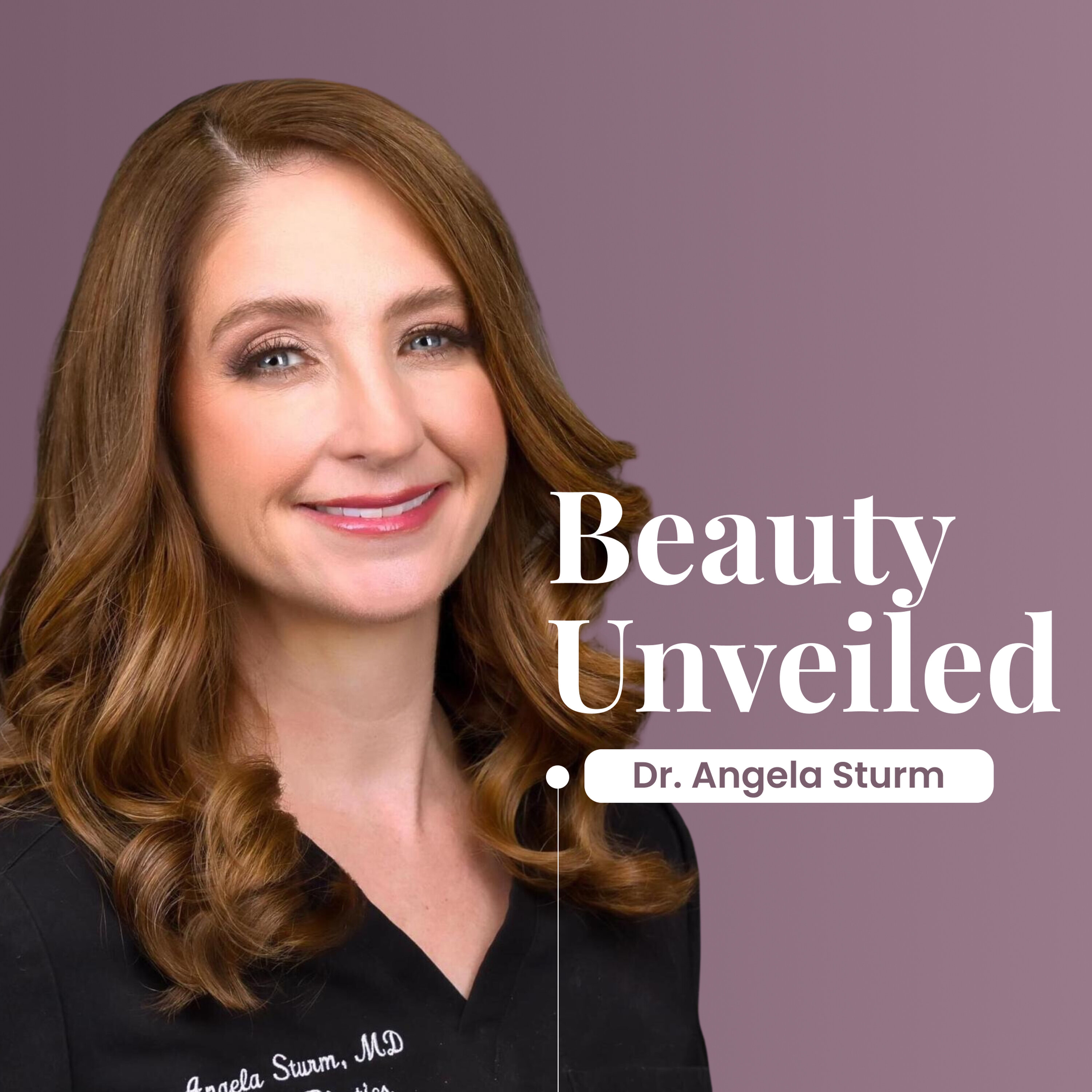
PODCAST · health
Beauty Unveiled
by Dr. Angela Sturm
Beauty Unveiled, hosted by double board certified plastic surgeon Dr. Angela Sturm, takes listeners on a journey into the world of facial plastic surgery in Houston, Texas. Dr. Sturm's podcast explores the art of natural results, the emotional impact of plastic surgery, and empowering individuals to embrace their appearance.Join Dr. Sturm as she shares her expertise and stories from the field, offering a unique perspective on the transformative power of aesthetic procedures.Learn more about Dr. Sturm at drangelasturm.com.
-
100
Aesthetic Moment: Understanding the Dos and Don’ts of Facial Surgery
Subtle changes can make all the difference in facial plastic surgery, allowing people to refresh their look without losing their identity. Dr. Sturm delves into why going for natural enhancements is often the best choice for maintaining a sense of self. In this episode, she shares expert advice on prioritizing small adjustments over dramatic transformations and explains why the eyes are typically the focal point after surgery. Key Takeaways 1. A common concern for people considering facial surgery is ending up looking unrecognizable or noticeably altered. Dr. Sturm reassures that her goal—and the modern approach—is for patients to look like themselves, just refreshed and improved, so that changes aren’t overtly apparent to others. 2. Natural-looking results hinge on subtlety and maintaining facial proportions. Dramatic changes, especially to characteristic features, make someone look noticeably “different” in a way that’s disconcerting, while small, proportionate adjustments yield the best, most believable enhancements. 3. The eyes are a focal point in facial perception. Procedures on the eyes can have the most impact—both positively and negatively. Overdone or incorrect changes to the eyes are quickly noticed and often judged as “bad work,” while slight improvements can make a dramatic positive difference in how someone looks. 4. Modern surgical methods aim for a natural, soft, and youthful appearance. Achieving this depends greatly on having an in-depth conversation with the patient to understand what features define their identity and ensuring updates are made with their personal and cultural context in mind. Outdated techniques and lack of communication often lead to the “overdone” look. 5. Altering features that are significant to someone’s heritage or familial identity without careful consideration can have deep personal and social consequences. Surgeons must approach these decisions with sensitivity, ensuring patients are comfortable with any changes that affect their sense of self and how they are perceived in their community. Subscribe to Beauty Unveiled on Apple, Spotify, and YouTube. Schedule a consult with Dr. Sturm HERE. Follow Dr. Sturm on Facebook, Instagram, and TikTok!See omnystudio.com/listener for privacy information.
-
99
Why I Refuse to Give Everyone the Same Nose
The most common mistake in ethnic rhinoplasty is performing the same nose on every patient regardless of who they are. Dr. Sturm practices in one of the most diverse cities in the country and thinks about ethnicity and anatomy in every rhinoplasty she performs. In this episode, she addresses the patients who come in having seen mostly before-and-afters that do not look like them, who cannot tell what those results mean for their own face. That uncertainty is not unfounded. Some surgeons produce the same nose across their entire portfolio, and if that is not the nose a patient wants, they need to know before they commit. Subscribe to Beauty Unveiled on Apple, Spotify, and YouTube. Schedule a consult with Dr. Sturm HERE. Follow Dr. Sturm on Facebook, Instagram, and TikTok! Key Takeaways 1. Surgeons who produce the same nose across their full portfolio are doing exactly that. Patients who want to preserve their ethnic identity and still look like themselves need to find a surgeon whose before-and-afters reflect people who look like them. 2. Skin thickness, cartilage structure, and healing patterns are not universal. These variables differ across individuals and across ethnic backgrounds, and they shape every decision made during the procedure. 3. The term "ethnic rhinoplasty" is too broad to be useful. The surgical approach for a narrow, high-bridged nose is fundamentally different from the approach for a broader nose with thicker skin, and treating them as the same category is a clinical error. 4. The goal of rhinoplasty is enhancement, not erasure. Taking the nose out of the foreground so the features a patient loves about themselves come forward is the standard Dr. Sturm holds herself to in every case. 5. Before committing to any surgeon for this procedure, patients should ask specifically how many noses that look like theirs the surgeon has done, request in-office photos if public before-and-afters are limited, and evaluate how clearly the surgeon describes the specific surgical plan for their anatomy. Timestamped Overview 00:00 The most common mistake in ethnic rhinoplasty introduced: performing one nose regardless of the patient's background 00:00:15 Why patients from Black, Hispanic, Middle Eastern, and Asian backgrounds struggle to interpret before-and-afters that do not reflect them 00:00:41 Acknowledging that some surgeons genuinely do produce one nose across their full portfolio and what that means for patients with different goals 00:01:08 Why skin thickness, cartilage structure, and healing patterns require individualized surgical thinking in every case 00:01:45 The problem with the category of "ethnic rhinoplasty" and why procedure-specific language serves patients better 00:02:30 The specific anatomical variables Dr. Sturm evaluates: bridge height, ala width, skin thickness, and cartilage shape 00:03:20 The philosophy of rhinoplasty as enhancement: taking the nose from the foreground so the face's best features come forward 00:04:00 Why Dr. Sturm's favorite outcome is a patient whose family approves and says they still look like themselves 00:04:19 Why certain groups face stigma around sharing rhinoplasty results publicly, and how in-office photos can fill the gap 00:05:00 What to ask any surgeon before booking: volume of similar cases, surgical plan specifics, and philosophical alignment on preservation versus alterationSee omnystudio.com/listener for privacy information.
-
98
Aesthetic Moment: Dr. Sturm’s Guide to Avoiding Regret in Cosmetic Procedures
Have you ever wanted to take back a beauty decision? Maybe it was a treatment that seemed simple, but the outcome wasn’t what you hoped for. Dr. Angela Sturm has seen it all—patients asking to reverse procedures, exploring what can and can’t be undone, and sharing what you need to know before making permanent changes. In this episode, you'll learn: - What treatments are easy to reverse and which are not - How to find the right surgeon for your needs - What to consider before choosing a surgical option Key Takeaways 1. Some cosmetic procedures are easily reversible (like lip fillers), while others are very difficult or nearly impossible to undo (like surgical changes to the nose or face). It's crucial to understand the lasting impact before making a decision. 2. Revision surgeries, especially rhinoplasty (nose jobs), are complex due to scar tissue and anatomical changes. It’s much harder to undo or “reverse” surgical procedures, so it’s best to get it right the first time with a highly qualified, experienced surgeon. 3. Selecting a surgeon passionate and specialized in procedures you’re interested in (like rhinoplasty or facial surgeries) significantly increases your chances of satisfaction and safety. Surgeons who love and frequently perform certain procedures tend to deliver better results. 4. Before committing to permanent or highly invasive changes, it’s wise to try less invasive options first. This lets you “try out” the change with the option to reverse it more easily and helps ensure you’re truly confident in your decision. 5. Personalized consults with a facial plastic surgeon are key. This helps determine what’s safe to try, prevents burning bridges for future treatments, and builds a trusting relationship, so you know what to expect if you proceed with something more permanent. Subscribe to Beauty Unveiled on Apple, Spotify, and YouTube. Schedule a consult with Dr. Sturm HERE. Follow Dr. Sturm on Facebook, Instagram, and TikTok!See omnystudio.com/listener for privacy information.
-
97
You Spent Thousands on a Facelift. Here Is How to Protect It
A facelift rewinds the clock. Keeping it that way is the work that comes after. Dr. Angela Sturm, double board-certified facial plastic surgeon and founder of Aesthetic Specialists of Houston, addresses one of the most common points of frustration she hears from facelift patients: the feeling that results do not last. She explains that surgery lifts and repositions, but it cannot stop time or reverse the natural processes of collagen breakdown, volume loss, and gravitational descent that continue afterward. Maintenance is not optional, it is part of the investment. From SPF 30 as a daily baseline to microneedling, lasers like Clear and Brilliant, and neurotoxins such as Botox and Dysport, Dr. Sturm lays out the specific treatments that protect and extend results. Subscribe to Beauty Unveiled on Apple, Spotify, and YouTube. Schedule a consult with Dr. Sturm HERE. Follow Dr. Sturm on Facebook, Instagram, and TikTok! Key Takeaways 1. A facelift rewinds aging by roughly ten years, but it does not stop continued descent or skin quality changes. Patients who expect it to be a one-time fix are often caught off guard when maintenance becomes necessary. 2. Sun exposure is one of the fastest ways to undo facelift results. Daily SPF 30 is the minimum, and unprotected sun breaks down collagen, accelerates brown spots, and undermines the investment made in surgery. 3. Weight stability matters before and after a facelift. GLP-1-related weight loss after surgery can leave excess skin, while weight gain after surgery can create an undesired fullness, both of which may require additional procedures. 4. A maintenance protocol of microneedling, skin-brightening lasers like Clear and Brilliant, and neurotoxin keeps results looking refined over time. High-energy treatments, however, should be evaluated carefully, as some can alter skin texture in ways that detract from the result. 5. Volume loss continues after surgery. Fillers and fat transfer can replace what descends over time, and a second facelift becomes a realistic conversation for patients with significant weight fluctuations or a result that was not as tight as desired at the outset. Timestamped Overview 00:00 A facelift is introduced as a rewind, not a permanent stop, setting the tone for a maintenance-focused conversation 00:00:28 Why patients feel cheated when results change and how reframing the goal changes expectations 00:01:10 The analogy of maintaining a car applied to facelift aftercare, and why ongoing investment protects the result 00:01:50 Sun protection as the single most important and most overlooked daily habit after surgery 00:02:20 How weight fluctuation, especially in the GLP-1 era, creates new challenges for patients before and after facelifts 00:03:00 Treatments that help stimulate collagen and maintain results versus high-energy treatments that can backfire 00:03:30 What a practical maintenance protocol looks like, including microneedling, Clear and Brilliant, and neurotoxin 00:04:00 Why a facelift does not replace volume, and when fillers or fat transfer become part of the long-term plan 00:04:44 Secondary facelifts and skin tightening as options for patients with significant weight changes post-surgery 00:05:10 How to schedule a consultation to plan a comprehensive treatment approach before or after a faceliftSee omnystudio.com/listener for privacy information.
-
96
Why I Tell My Facelift Patients to Stop Chasing Filler
Fillers dissolve. Implants shift. But your own fat, transferred correctly, is yours to keep. Dr. Angela Sturm, double board-certified facial plastic surgeon and founder of Aesthetic Specialists of Houston, breaks down what fat transfer actually does and, just as importantly, what it cannot. As GLP-1 medications like Ozempic continue to change how patients lose weight and where they carry volume, the conversation around fat transfer has become more relevant and more complicated. Dr. Sturm explains the science behind fat retention, why results fall on a spectrum rather than a guarantee, and how weight stability before surgery directly affects long-term outcomes. She also covers how GLP-1 medications alter fat quality and what that means for take rates. Subscribe to Beauty Unveiled on Apple, Spotify, and YouTube. Schedule a consult with Dr. Sturm HERE. Follow Dr. Sturm on Facebook, Instagram, and TikTok! Key Takeaways 1. Fat transfer is not a guaranteed permanent fix. Retention varies by patient, harvest technique, and the surgeon's method, so planning for a potential second session is part of a realistic treatment plan. 2. GLP-1 medications alter fat texture and metabolism, which can reduce take rates. Patients should be at a stable weight plateau before pursuing fat transfer to protect the investment. 3. Volume loss in the 40s and 50s appears as shadowing in the cheeks, temples, and under the eyes. Filler can address true hollowing, but fat transfer offers a more natural light reflection and includes growth factors that improve skin quality. 4. Weight fluctuations after fat transfer will show in the face. Fat transferred from stubborn-fat areas tends to be more stable, but gaining or losing significant weight will affect results. 5. Fat transfer works best as a complement to a facelift. As a standalone procedure it produces subtle improvement, and patients who expect dramatic rejuvenation from fat transfer alone are often disappointed. Timestamped Overview 00:00 Fat transfer introduced as a longer-lasting alternative to filler, especially relevant as GLP-1 medications change the conversation 00:00:57 Why the science of fat retention is more variable than many patients are told, and what a realistic spectrum of results looks like 00:01:45 How surgeons harvest and treat fat to optimize take rates, and why each patient's body responds differently 00:02:30 The role of swelling in early results and why the final outcome takes time to assess 00:03:00 How fat reflects light more naturally than filler and the skin-quality benefits of growth factors in transferred fat 00:03:30 What GLP-1 medications do to fat texture and why metabolic changes affect how well fat survives after transfer 00:04:00 Why weight stability is essential before surgery, and real examples of patients who gained or lost weight after the procedure 00:04:20 Fat transfer as the icing on the cake in a facelift, not the main event, and why expectations matter 00:05:00 Subtle standalone results versus the more dramatic improvement achievable when combined with a lift 00:05:17 How to schedule a consultation to find out if fat transfer is the right fit with or without a faceliftSee omnystudio.com/listener for privacy information.
-
95
Nurse Chasity's Journey from ICU to Aesthetic Nursing
What draws someone to a career in nursing? How do you find your way from the hospital floor to the world of aesthetics? Chasity Zuniga started out knowing she wanted to care for people, and her journey has taken her through ICU shifts during the COVID-19 pandemic, across Texas as a travel nurse, and finally to a new chapter with Dr. Sturm’s team. - You’ll hear about childhood experiences that shaped her path. - Why she chose to dive into the beauty side of nursing. - Her thoughts on what it means to help others feel good about themselves, inside and out. Subscribe to Beauty Unveiled on Apple, Spotify, and YouTube. Schedule a consult with Dr. Sturm HERE. Book your appointment with Aesthetic Specialists of Houston HERE. Follow Dr. Sturm on Facebook, Instagram, and TikTok! Key Takeaways 1. Chasity's journey into nursing was sparked by personal childhood experiences in the hospital. Her compassion for patient care and the influence of supportive medical staff in her early years inspired her to pursue nursing, showing how personal encounters can shape professional aspirations. 2. Chasity has worked in a variety of nursing settings—from intermediate care to ICU to travel nursing—demonstrating versatility and resilience. Her adaptability allowed her to thrive in different environments, including during the COVID-19 pandemic, highlighting the importance of openness to new challenges and flexibility in healthcare. 3. Her background as a makeup artist fueled her interest in aesthetics. Although breaking into the field was challenging, Chasity combined her love for beauty and healthcare by finding opportunities in medical aesthetics, illustrating how diverse experiences can converge into a fulfilling career path. 4. Chasity values the relational aspect of nursing, sharing meaningful moments where small acts of kindness—like gifting a Christmas bracelet—had a significant impact on patients. The theme emphasizes how empathy and thoughtful gestures can greatly enhance patient care and satisfaction. 5. Chasity enjoys providing aesthetic treatments like Morpheus microneedling, Botox, lip fillers, and especially loves using and recommending "Easy Gel" for under-eye improvement. She takes pride in educating and sharing results with clients, underscoring the satisfaction that comes from helping others look and feel their best through innovative treatments. Timestamped Overview 00:00 Childhood Hospital Stay Inspires Nursing 05:21 "Reluctant to Leave, Offered Jobs" 08:05 "Experiencing Clients' Loyalty" 10:05 Blood-Derived Gel for Skin Rejuvenation 12:43 "Glowy Skin Product Love"See omnystudio.com/listener for privacy information.
-
94
12 Syringes of Filler and You Still Look Tired
Twelve syringes of filler and you still look tired. The problem is not your face. Dr. Angela Sturm, double board-certified facial plastic surgeon and founder of Aesthetic Specialists of Houston, addresses one of the most common patterns she sees in new patients: years of filler that have not delivered the results they were promised. She explains why providers who rely on a single tool tend to keep applying it even when it is not solving the right problem, and how patients end up with wide cheeks, puffiness, and an unnatural shape that still does not feel like them. The real issue is often gravitational descent or skin quality, neither of which filler can fix. Subscribe to Beauty Unveiled on Apple, Spotify, and YouTube. Schedule a consult with Dr. Sturm HERE. Follow Dr. Sturm on Facebook, Instagram, and TikTok! Key Takeaways 1. Overfilling happens when providers treat every concern with the same tool. Filler added to lift the cheeks often widens the face instead of lifting it, leaving patients with an unnatural result and a face that still does not look refreshed. 2. Three distinct processes drive facial aging: volume loss, skin quality changes, and gravitational descent. Each requires a different type of treatment, and confusing them leads to spending significant money on the wrong solution. 3. Filler addresses true volume loss, the hollowing in the cheeks, temples, and around the eyes. For skin texture, brown spots, and fine lines, lasers, peels, and microneedling are the appropriate tools. 4. When lifting is the primary goal and the degree of descent is significant, non-surgical options provide limited improvement. Surgery is the most effective solution for patients who want a meaningful, lasting lift. 5. The best injectors know and communicate the boundaries of what filler can and cannot do. A provider who refers to a facial plastic surgeon when the problem exceeds filler's scope is demonstrating the kind of expertise worth trusting. Timestamped Overview 00:00 The opening scenario of overfilled patients who still look tired, and why the problem is systemic, not personal 00:00:27 How the hammer-and-nail dynamic in practices that offer only one modality drives overfilling 00:01:17 Why the promise of instant, affordable results leads patients to keep spending without addressing the root cause 00:01:55 A practical self-assessment framework: gravitational descent, skin quality, and volume, and how to tell which is driving aging 00:02:48 Mapping treatments to causes: lasers and peels for skin quality, microneedling for texture, filler only for true volume loss 00:03:20 When gravitational descent is the issue and why filler cannot lift what needs to be surgically repositioned 00:03:50 Skin tightening devices and RF microneedling as middle-ground options for patients who want a modest lift without surgery 00:04:15 How to factor downtime, budget, and desired outcome into building a realistic treatment plan 00:04:30 What separates the best injectors from the rest: knowing when to refer and having a trusted surgical relationship 00:04:45 An invitation for patients who have been filling without results to schedule a fresh-eyes consultationSee omnystudio.com/listener for privacy information.
-
93
How to Walk Into a Rhinoplasty Consultation and Not Get Taken Advantage Of
Some patients spend more time planning a vacation than preparing for a surgical consultation. The difference shows the moment they walk in. Dr. Sturm, double board-certified facial plastic surgeon and founder of Aesthetic Specialists of Houston, can read within the first few minutes whether a patient has done their homework. In this episode, she walks through exactly what a great consultation looks like from both sides of the table: what patients should bring, what they should watch for, and what the surgeon's behavior during that appointment tells them about the relationship they are about to enter. A surgeon who agrees with everything is not a green flag. Subscribe to Beauty Unveiled on Apple, Spotify, and YouTube. Schedule a consult with Dr. Sturm HERE. Follow Dr. Sturm on Facebook, Instagram, and TikTok! Key Takeaways 1. A consultation that moves straight from before-and-afters to a quote without real dialogue is a warning sign. Patients deserve a surgeon who listens to their goal, offers feedback, and proposes a plan rather than simply agreeing with whatever is asked. 2. The add-on rhinoplasty, where a nose job gets casually appended to an unrelated procedure, reflects a lack of surgical seriousness. Rhinoplasty requires dedicated thought, detailed planning, and its own consultation on its own terms. 3. Bringing inspiration photos is a useful starting point, but the more valuable question is what specifically about that nose appeals to the patient. That conversation reveals the actual goal and gives the surgeon something precise to work toward. 4. Volume matters. A surgeon who performs rhinoplasty two or three times a week has a fundamentally different level of active skill than one who does it a handful of times a year, and a full portfolio of before-and-afters reflects where a surgeon's focus truly lies. 5. The post-consultation reflection is as important as the appointment itself. Patients who felt rushed, held back, or uncertain about whether they were heard should treat that as meaningful information before committing. Timestamped Overview 00:00 The observation that some patients research a vacation more carefully than a surgical consultation, and why it matters 00:01:04 Why a surgeon who agrees with everything is a red flag, not reassurance, and what real engagement looks like 00:01:30 The add-on rhinoplasty problem and why treating nose surgery as an afterthought signals insufficient planning 00:02:00 How Dr. Sturm uses visual options during consultations to find the endpoint the patient actually wants 00:02:30 The importance of back-and-forth dialogue as confirmation that a surgeon is truly listening and building a plan 00:02:58 How to think through goals before a consultation: what kind of nose, what personality of surgeon, what kind of partnership 00:03:30 Questions to ask during the consultation: board certification, training specialty, volume, and surgical frequency 00:04:20 Why training background matters and why specialty alignment with the procedure is a non-negotiable 00:04:48 How to evaluate the consultation afterward based on how it felt, not just what was said 00:05:12 Why some patients see Dr. Sturm multiple times before moving forward, and why that pace is always supportedSee omnystudio.com/listener for privacy information.
-
92
Meet Our Laser Specialist: Art’s Journey from Orthopedics to Aesthetics
What happens when work and family truly mix? Art Severand spent years in orthopedics before joining our practice as a laser specialist, learning new skills and balancing family life along the way. - You’ll hear about the shift from orthopedics to aesthetics - Why 2020 changed the way people sought out treatments - The role of laughter in making patients feel comfortable Subscribe to Beauty Unveiled on Apple, Spotify, and YouTube. Schedule a consult with Dr. Sturm HERE. Book your appointment with Aesthetic Specialists of Houston HERE. Follow Dr. Sturm on Facebook, Instagram, and TikTok! Key Takeaways 1. The conversation introduces Art Severand as Dr. Sturm’s significant other and laser specialist at the practice. Their collaborative dynamic—blending personal and professional life—helps strengthen the practice, supporting both patients and each other. This emphasizes the value of assembling a team with complementary personalities and skills. 2. Art shares his journey from a decade in orthopedics to joining the aesthetics field during the pandemic. The shift was driven by family needs and industry changes (such as the surge in aesthetic demand during 2020), highlighting how adaptability and responding to life circumstances can lead to meaningful new directions in one's career. 3. He and Dr. Sturm emphasize a patient-centered approach, with Art bringing humor and comfort to treatments often seen as unpleasant (like Morpheus). The focus is on making experiences positive, even for more challenging procedures, demonstrating that technical skill and emotional intelligence together can transform patient care. 4. Art acknowledges the importance of mentorship, specifically learning a "delicate touch" from Dr. Sturm, transitioning from the rougher world of orthopedics to the more finesse-driven field of aesthetics. This points to the significance of continuous learning and being open to growth—even from those close to you. 5. Their discussion covers how both have developed grit and determination, shaped by upbringing and past experiences. Art highlights viewing challenges not as problems but as disconnects to solve, underscoring the value of persistence and a solutions-oriented mindset in both personal and professional life. Timestamped Overview 00:00 Balancing Work and Family Demands 05:30 Resilient Mindset: Just Get It Done 07:31 Morpheus Treatment: Overcoming Fear 09:43 Ready for Next ChapterSee omnystudio.com/listener for privacy information.
-
91
What I Find on the Table When I Open a Revision Rhinoplasty
Your first rhinoplasty is not a mistake. Choosing the wrong surgeon for it can cost you a great deal the second time around. I have performed over 1,000 rhinoplasties and do both primary and revision surgery. In this episode, I pull back the curtain on what I find on the operating table in revisions and why the process is so much more complex the second time. Scar tissue, altered cartilage, changed vascularity, and the emotional weight of having already been through it once all come into play. I address the revision rate honestly, quoting the industry figure of up to 20% and sharing my own range of 5 to 10%. Subscribe to Beauty Unveiled on Apple, Spotify, and YouTube. Schedule a consult HERE. Follow me on Facebook, Instagram, and TikTok! Key Takeaways 1. Revision rhinoplasty is more physically and emotionally demanding than a primary procedure. Patients have already gone through the full year-long healing process, placed trust in a surgeon, and now face doing it all over again with a more complicated surgical field. 2. The revision rate in rhinoplasty is real, quoted at up to 20% industry-wide. Dr. Sturm's own rate falls between 5 and 10%, and she is transparent that the exact number across the field is difficult to pin down precisely. 3. Scar tissue from a prior procedure changes the surgical landscape. Cartilage may be removed, warped, or shifted, and vascular changes require more careful handling of the skin throughout the operation. 4. Misaligned expectations are a leading driver of revision surgery. Surgeons who do not use computer imaging may leave both parties with different pictures in their heads, and a nose that is technically well-executed may still not be the one the patient wanted. 5. Revision surgery takes longer, costs more, and rarely achieves the same level of precision as a primary procedure. The goal is always perfection, but the starting conditions make it harder to reach, and patients deserve that honest context before deciding to move forward. Timestamped Overview 00:00 Speaking about rhinoplasty volume and why it's both primary and revision patients in her practice 00:00:30 The question most people do not ask during consultations: what happens if the result is not what you wanted 00:01:16 How healing over the first year to year and a half changes the nose and what patients are evaluating before deciding to revise 00:01:32 The emotional difficulty of trusting again after a previous result fell short of expectations 00:02:15 Why revision surgery is more complex: scar tissue, altered cartilage, changed vascularity, and increased operative time 00:02:52 The most common causes of revision, including expectation misalignment, healing variability, and technical factors 00:03:10 How computer imaging creates a shared visual goal and reduces the expectation gap 00:03:40 How asymmetry, small irregularities, and subtle issues sometimes emerge with healing even after a technically sound surgery 00:04:09 What surgeons encounter in the revision field and why shooting for perfection in a compromised tissue environment is genuinely harder 00:04:48 What to look for in a surgeon's training and approach before committing to revision surgerySee omnystudio.com/listener for privacy information.
-
90
That Time I Canceled an Operation When the Patient was IN THE OR
She was already in the gown, IV in, ready to go. Dr. Sturm canceled the surgery anyway. Dr. Angela Sturm, double board-certified facial plastic surgeon and founder of Aesthetic Specialists of Houston, shares one of the most important stories from her surgical career: the moment she stopped an operation that was technically ready to proceed because the patient was not. She walks through why the surgeon-patient relationship is never just a transaction, why body language and unspoken hesitation carry as much weight as anything on a consent form, and why a gut feeling, whether the patient's or the surgeon's, is always worth pausing for. The patient eventually returned, had her rhinoplasty in a much better headspace, and was thrilled with the result. This episode is a guide for anyone preparing for surgery and feeling uncertain about what they are allowed to feel or say. Dr. Sturm is direct: it is never too late to speak up, reschedule, or ask harder questions. She explains what to look for in a surgeon's communication style during the consultation phase, how that dynamic only intensifies as surgery day approaches, and why emotional readiness belongs right alongside medical and physical readiness as a prerequisite. Listeners leave knowing exactly what a trustworthy surgical partnership looks and feels like before they ever step into an operating room. Subscribe to Beauty Unveiled on Apple, Spotify, and YouTube. Schedule a consult with Dr. Sturm HERE. Follow Dr. Sturm on Facebook, Instagram, and TikTok! Key Takeaways 1. Once a deposit is paid, a surgery date is set, and a consent is signed, many patients feel locked in. A good surgeon recognizes this dynamic and actively creates space for the patient to communicate doubt or hesitation at any point. 2. Body language, tone, and what a patient does not say matter as much as what they do say. Surgeons who pay attention to these signals and start the conversation protect their patients in ways that go beyond technical skill. 3. Gut feelings in medicine are taken seriously for a reason. When something feels wrong, the right move is always to hold off, because elective procedures can be rescheduled and emotional readiness cannot be rushed. 4. The surgeon-patient relationship in facial plastic surgery spans at least a year and often much longer. Feeling genuinely comfortable asking questions and being honest, even about fear, is a prerequisite for a good outcome. 5. Choosing a surgeon whose personality feels like a real match matters more than it might seem. If communication feels strained at the consultation stage, it will feel more strained as surgery day approaches and even harder in recovery. Timestamped Overview 00:00 Dr. Sturm opens with the story of canceling a surgery that was already underway and why she would do it again 00:00:15 Why patients feel locked in after paying deposits and signing consents, and the mindset shift required to stay communicative 00:01:21 Reading body language, what patients do not say, and why a surgeon who pays attention changes the entire experience 00:02:10 The specific moment Dr. Sturm recognized a patient was not ready, asked the question, and stopped the procedure 00:02:50 How gut feelings work in medicine and why honoring them is considered a professional standard, not a hesitation 00:03:20 The comparison to walking away from a wedding: deposits, dress, guests, and all, when the inside feeling says stop 00:03:50 How the same patient returned, had surgery successfully, and was in a dramatically better place the second time 00:04:16 What to look for during consultations: how comfort asking questions early predicts how the relationship holds up under pressure 00:04:45 Why holding back during a consultation is a red flag worth examining before moving forward 00:05:00 Dr. Sturm's standard that every patient should arrive at surgery emotionally, physically, and medically readySee omnystudio.com/listener for privacy information.
-
89
Pre-Surgery Panic: Normal Nerves or a Red Flag
Dr. Sturm talks about what it really means to feel “ready” for cosmetic surgery. She explains the difference between normal pre-op nerves and deeper anxiety or misalignment that may signal it is not the right time. Drawing from real patient experiences, she outlines green flags, red flags, and a practical gut-check framework to help patients decide whether to proceed, pause, or postpone. Subscribe to Beauty Unveiled on Apple, Spotify, and YouTube. Schedule a consult with Dr. Sturm HERE. Follow Dr. Sturm on Facebook, Instagram, and TikTok! Key Takeaways 1. Last-minute nerves are extremely common, and most ready patients cycle between feeling excited and nervous, especially in the week before surgery and on the day itself. 2. A red flag is when worry overwhelms excitement, especially persistent thoughts like “what if I hate this” or “what if something goes wrong” that do not ease even after thoughtful discussion. 3. Major outside stressors such as breakups, job loss, or ongoing drama can drain emotional bandwidth, making it harder to tolerate bruising, swelling, and time away from normal routines during recovery. 4. Cosmetic surgery should not be done purely for an event or to fix deeper emotional pain, bullying, or family comments, because changing the face cannot resolve longstanding internal wounds. 5. It is always acceptable to postpone elective surgery, even on the day of, and patients should feel safe being honest with their surgeon about fears, pressure from others, and the need for more time. Timestamped Overview 00:00 The core question: freaking out before surgery and whether that means you are not ready00:00:05 Why last-minute nerves are extremely common and how to distinguish them from deeper misgivings00:00:53 Typical emotional waves before surgery, from excitement to doubt and back again00:01:17 Why cosmetic surgery decisions never exist in a vacuum and how life stress, kids, and work factor in00:01:48 The emotional pattern of a well-prepared patient: excited and nervous at the same time, with clear reasons for wanting surgery00:02:45 The patient profile that raises concern: almost all anxiety, little excitement, and persistent worry about bad outcomes00:03:01 Guidance to pause and step back if “what if it is not right” is on repeat in the week before surgery00:03:20 Why it is acceptable, and sometimes best, to delay for people who feel pressured or uncertain in their gut00:03:42 How a negative mindset going into surgery often leads to obsessive worry over tiny asymmetries very early in healing00:04:14 Examples of patients who were medically ready in pre-op but not emotionally ready, and how postponing helped00:05:10 Reassurance that surgery can be rescheduled at any point before entering the operating room00:05:16 Why stacking surgery on top of big life events can overwhelm emotional reserves and complicate healing00:06:14 The importance of being in a good emotional place to recognize a technically successful result as a success00:06:40 Why surgery should be part of a long-term plan for how you want to feel, not a rushed fix for a single date or event00:07:58 Introduction of the 90-second gut check to clarify motivation and readiness00:08:02 The first question: if no one else ever saw this change, would I still want it and be happy I did it00:08:21 The second question: am I trying to fix my face or my life, and why surgery cannot heal deep emotional wounds00:09:07 The third question: do I have the emotional bandwidth for weeks of swelling, bruising, and temporary lifestyle changes00:09:46 Why that early recovery period is especially hard for anyone already carrying significant emotional strain00:09:54 The importance of speaking honestly with the surgeon about fears and expectations instead of protecting their feelings00:10:02 Why up-front conversations about perfection, realism, and possible outcomes are critical before proceeding00:10:46 Reassurance that patients can and should request postponement if the timing feels wrong, regardless of deposits or dates00:11:15 Clarifying that almost every cosmetic patient is nervous and why that is normal rather than a flaw00:11:18 The reality that medical, emotional, and logistical factors all need to align for the best experience and outcome00:12:11 Final normalization of feeling scared and the typical trajectory of emotions coalescing into one “ball” of nervous and excited on surgery daySee omnystudio.com/listener for privacy information.
-
88
Aesthetic Moment: My Personal Rhinoplasty Story
How does experiencing your own surgery change the way you connect with your patients? Not only has Dr. Sturm performed over a thousand surgeries, she, too, has had a rhinoplasty. She discovered not only physical benefits, like better breathing and confidence, but also gained empathy for the emotional journey patients experience. Embracing imperfections and the ups and downs of healing became part of her insight. Subscribe to Beauty Unveiled on Apple, Spotify, and YouTube. Schedule a consult with Dr. Sturm HERE. Follow Dr. Sturm on Facebook, Instagram, and TikTok! Key Takeaways 1. Dr. Sturm shares that having undergone rhinoplasty herself gave her unique insight into the patient’s emotional and physical journey. Experiencing both roles helps her better understand and empathize with her patients. 2. She discusses how she didn't realize her own self-consciousness about her nose until after the surgery. The procedure improved her confidence and made her feel better about herself, highlighting the significant psychological benefits that can come from cosmetic surgery. 3. Dr. Sturm initially pursued surgery to address breathing difficulties caused by a deviated septum. The surgery dramatically improved her breathing, especially during exercise and sleep, underlining how rhinoplasty can bring life-changing functional benefits, not just cosmetic ones. 4. She emphasizes that it is normal to have mixed feelings, uncertainty, or anxiety after seeing post-surgery changes for the first time. The adjustment process is different for everyone, and support from loved ones can be crucial during this period. Over time, most people come to accept and appreciate their new appearance. 5. Dr. Sturm points out that no result is absolutely perfect—minor asymmetries or imperfections may remain. Learning to accept these and appreciate the overall improvement is important. It’s about loving yourself, being content with realistic outcomes, and not aiming for unattainable perfection.See omnystudio.com/listener for privacy information.
-
87
Instagram Noses vs. Real Life: Dr. Sturm’s Take
Dr. Sturm offers a reality filter for anyone trying to decide what a “good nose” looks like in the age of edits, filters, and trending Instagram noses. She explains the two main aesthetics patients request, from ultra-cute “Barbie” noses to refined but natural noses that still feel like their own. Drawing on her surgical experience and even her own rhinoplasty journey, she walks through how to balance appearance, breathing, and long-term durability while making sure the nose fits a person’s face, features, and personality. Listeners learn how to use social media examples productively, what photos to bring to a consult, and how to communicate clearly with a surgeon so they do not end up with a copy-and-paste nose that does not feel like them. Subscribe to Beauty Unveiled on Apple, Spotify, and YouTube. Schedule a consult with Dr. Sturm HERE. Follow Dr. Sturm on Facebook, Instagram, and TikTok! Key Takeaways 1. Most patients arrive with strong ideas shaped by social media, often split between wanting a very small, scooped “Instagram nose” or a natural refinement of their existing nose, and very few fall in the middle. 2. The best rhinoplasty results fit the individual’s face, features, and personality, which is why imaging and multiple proposed outcomes are so important when deciding how much change is appropriate. 3. Social media can educate but also distort expectations, especially with on-table photos and early “reveal” videos that do not show swelling, healing time, or how a nose looks and functions years later. 4. A thoughtful rhinoplasty plan balances three priorities: harmony with the rest of the face, preservation of nasal breathing, and durability so the nose still looks intentional and stable 10 to 20 years after surgery. 5. The most helpful reference photos are of people whose skin thickness, facial structure, or ethnic features are similar, and it is crucial to identify what you like about each nose so your surgeon can translate that into a result that fits you rather than replicating the same nose for everyone. Timestamped Overview 00:00 The core question: defining a “good nose” when photos are filtered and celebrities deny surgery00:00:21 The two main camps of nose goals in consultation: tiny, scooped Instagram-style noses versus natural, refined versions of a patient’s own nose00:01:04 Why any nose design must fit the person’s face, personality, and overall presence, and how imaging helps visualize options00:01:35 How patients often bring Instagram examples of very small, cute noses, and what attracts them to that look00:02:01 The alternative ideal: straight, less “perfect” noses that embrace subtle individuality and imperfections00:02:20 Why perfectly “too perfect” noses can look unnatural and how true normal noses always have minor asymmetries00:02:37 The importance of discussing breathing and long-term stability when someone wants a very small nose00:03:18 How over-resection can weaken nasal structure, affect airflow, and create problems years after surgery00:03:21 The double-edged nature of social media in surgery, showcasing both helpful education and extreme, on-table transformations00:03:40 How patients bring examples of what they definitely do not want alongside images they love00:03:53 Why patient screenshots of the surgeon’s own work are especially helpful, since they often involve similar skin thickness or width00:04:24 Limitations of reveal videos that show day 5 or day 7 results, and why early swelling can mislead expectations00:04:53 How timelines appear compressed online, from surgery to reveal to one-year photos, versus the real experience of a year-long healing process00:05:18 The value and downside of highly informed patients, and the need to reshape expectations around timing and final results00:05:47 The risk that viral outcomes may not be the right aesthetic or structural choice for a particular person00:05:55 Dr. Sturm’s own rhinoplasty story and her desire for a straight, natural dorsum rather than a tiny Barbie nose00:06:26 How seeing many rhinoplasties in training helped her communicate precisely what she wanted00:06:59 A “reality filter” for nose surgery: balancing nose shape with eyes, lips, jawline, body, and personality00:07:20 Using imaging to show multiple possible outcomes, including “too far,” so patients can calibrate what feels right00:08:00 The hierarchy of priorities: function first for breathing, then aesthetics, then long-term durability over decades00:08:40 Why durability has become a major focus, aiming for a nose that remains stable rather than drifting more upturned or extreme over time00:09:27 Practical advice for bringing photos to consultation and choosing examples similar to your own anatomy00:09:48 How Dr. Sturm asks what exactly a patient likes in each photo, such as slope, tip size, or rotation, to guide planning00:10:20 Concerns about every nose starting to look the same on some social media feeds and what that reveals about a surgeon’s aesthetic00:10:40 The issue with very high-volume, one-style practices and why that can be a plus or a mismatch depending on your goals00:11:20 The importance of a nose that respects gender, ethnicity, background, and personality rather than copying a single trend00:11:45 Final encouragement to maintain open communication with the surgeon about goals, limits, and what will truly work for youSee omnystudio.com/listener for privacy information.
-
86
Stop Adding Filler: Find the Real Reason You Look Tired
In this episode Dr. Sturm explains why some people still look tired in photos and on video despite doing Botox, filler, peels, and lasers. She breaks facial aging into four key components: gravity, structural change, volume loss, and skin quality. Using clear, accessible language, she shows how treating only one layer allows the others to “tell on you.” Listeners learn a simple mirror exercise to identify which factors are driving their tired appearance and how to align that with the right mix of treatments over time. Subscribe to Beauty Unveiled on Apple, Spotify, and YouTube. Schedule a consult with Dr. Sturm HERE. Follow Dr. Sturm on Facebook, Instagram, and TikTok! Key Takeaways 1. A tired appearance usually comes from a combination of factors, including gravity, bone and structural changes, volume loss, and skin quality, rather than a single issue that one treatment can fix. 2. Bone resorption around the eyes and midface, along with weaker supporting tissues, allows the face to descend over time, which contributes to jowls, neck laxity, and deeper folds that show more prominently on camera. 3. Volume loss in the skin, fat, and deeper structures, not smoking alone, often causes vertical lines around the mouth and general hollowing in the cheeks, temples, and lower face. 4. Skin quality issues such as fine lines, rough texture, and brown spots, heavily influenced by sun exposure and genetics, interact with volume loss so that deflated skin wrinkles more visibly, like an empty grocery bag. 5. A simple mirror map helps separate whether the main problem is skin, volume, or descent, which makes it easier to know when lasers, fillers, skin tightening, or surgery will make the biggest difference, and to plan treatments intelligently over one to five years instead of just repeating what has been done before. Timestamped Overview 00:00 The question of why someone still looks tired after Botox, filler, peels, and lasers00:00:18 Overview of the main contributors to a tired look: structure, volume, skin quality, and eye-specific changes00:00:34 Explaining the goal of unpacking each layer of aging and how to combine treatments for a refreshed look00:00:47 Introduction to the four pillars of aging, beginning with gravity and visible descent in jowls and neck00:01:00 How structural bony changes around the eyes and nerves reduce support and contribute to sagging00:01:56 Discussion of volume loss in skin, fat, and even bone, and how faces naturally thin with more birthdays00:02:26 The role of skin quality, including brown spots, fine lines, texture, and the “empty grocery bag” analogy00:02:56 Why most people are a mix of gravity, structure, volume, and skin issues, and how package-based med spa approaches can miss this nuance00:03:20 The problem with relying on more filler to lift the face and the issue of overfilled cheeks that do not fix jowls or folds00:03:37 Introducing a mirror “map” exercise to understand which aging component is most dominant00:03:44 How to evaluate skin quality first by looking for fine lines, discoloration, and rough texture00:04:03 How to assess volume loss by checking cheek fullness, chin support, temples, and vertical lines around the mouth00:04:26 Clarifying that “smoker’s lines” around the mouth are usually from volume loss, not smoking in most patients00:04:46 How to evaluate descent by examining the jawline, neck, nasolabial folds, marionette lines, and overall laxity00:05:09 Using this self-assessment to categorize yourself primarily as skin, structure/gravity, or volume, or a combination00:05:19 How to use that insight in consultation to see whether a provider’s plan aligns with what you observe in the mirror00:05:39 When volume replacement makes sense, when lasers make sense, and when descent suggests tightening or facelift instead of more filler00:06:09 How to translate this understanding into a one- to five-year plan that may include Botox, lasers, and ultimately surgery for the lower face if needed00:06:39 Encouragement to use this framework to make informed decisions so treatments look natural, targeted, and truly refreshingSee omnystudio.com/listener for privacy information.
-
85
Aesthetic Moment: Dr. Sturm Talks About Why Every Millimeter Matters In Surgery
Dr. Sturm has spent nearly two decades caring for patients, building relationships, and performing delicate surgeries where every millimeter matters. Today, she shares what makes her field unique, how patient care extends far beyond the operating room, and why she believes getting to know people is at the heart of her work. - The discipline required to succeed in plastic surgery - The importance of detail and patient connection in facial procedures - Stories that shape a surgeon’s view of care Subscribe to Beauty Unveiled on Apple, Spotify, and YouTube. Schedule a consult with Dr. Sturm HERE. Follow Dr. Sturm on Facebook, Instagram, and TikTok! Key Takeaways 1. Plastic surgery, especially facial plastic surgery, requires a specific kind of person—detail-oriented, patient, and driven. Those in the field thrive on precision, high-stakes outcomes, and have an intense dedication to their craft. Not everyone is suited for this specialty, as it demands both technical skill and a passion for helping others. 2. Success in facial plastic surgery depends on caring deeply about every millimeter. Small changes have a significant impact on appearance, particularly on the face, so surgeons in this field must be meticulous and attentive to even the tiniest detail. 3. Dr. Sturm emphasizes genuinely caring for patients, getting to know their stories, and developing strong, personal relationships. This personal investment in patient well-being is integral to her approach, making patients feel heard, valued, and deeply cared for—not just treated clinically. 4. A crucial part of professional development is identifying what one does best and delegating other tasks, as highlighted by Dr. Sturm referencing business advice. By focusing on core strengths, a practitioner can maximize both their impact and the quality of patient care. 5. Trust and impact in medicine go beyond technical skill; the greatest honor is when families and individuals view their physician as integral to their lives, even in challenging moments. Dr. Sturm’s story about being called by a patient’s family in a time of loss illustrates the deep, meaningful connections built through compassionate care.See omnystudio.com/listener for privacy information.
-
84
The Med Spa Checklist: What to Look for Before You Book
Dr. Angela Sturm, double board-certified facial plastic surgeon and founder of Aesthetic Specialists of Houston, explains what truly sets a surgeon-led med spa apart from a standard experience. She walks through how her team selects devices, personalizes settings, and builds combination treatment plans that prioritize safety, results, and long-term outcomes. Using examples from daily practice, she highlights why expertise, collaboration, and surgical insight matter more than any single machine. Listeners get a practical checklist they can use to evaluate any med spa and a clear understanding of how they serve as a bridge between non-surgical care and future surgical options. Subscribe to Beauty Unveiled on Apple, Spotify, and YouTube. Schedule a consult with Dr. Sturm HERE. Follow Dr. Sturm on Facebook, Instagram, and TikTok! Key Takeaways 1. A med spa led by a facial plastic surgeon focuses on more than quick packages, building individualized plans that consider whether a patient is better served by injectables, devices, or even surgery in the future. 2. Device choice is intentional, with a focus on technology that can be used year-round in a sunny climate and on a wide range of skin types in a highly diverse city. 3. Energy settings, passes, and combinations are tailored to each person rather than kept conservatively low for everyone, which allows for meaningful results while still prioritizing safety. 4. Surgical awareness shapes treatment recommendations, especially for patients who plan facelifts or other procedures, so that radiofrequency and similar treatments do not compromise future surgical outcomes. 5. The right med spa asks about long-term goals, collaborates daily as a team, explains the need for series and adjustments, and has the skills and experience to manage both great results and any complications that may arise. Timestamped Overview 00:00 The opening question about how Aesthetic Specialists of Houston differs from any other Houston med spa00:00:10 Comparing a surgeon-led, team-based med spa model with package-driven med spas00:00:20 How similar devices can deliver different results depending on training, experience, and treatment design00:00:53 Why Aesthetic Specialists of Houston is built around long-term planning, honest candidacy conversations, and integrating injectables, RF, and lasers00:01:23 The emphasis on investing in people, not just devices, and why skilled providers matter most00:01:55 How devices are chosen for year-round use and across all skin types in a diverse, sunny city00:02:37 Customizing energy, passes, and treatment combinations so each patient sees results that feel worth their time and investment00:03:33 Planning around life events and future surgery, including when to avoid RF microneedling before a facelift00:04:29 Why many patients are underwhelmed by past treatments and how proper series, education, and adjustments change outcomes00:05:14 Patient stories of painful RF experiences elsewhere and how Esthetic Specialist focuses on comfort, numbing, and a better overall experience00:05:47 A quick checklist for choosing a med spa, starting with on-site board-certified physician leadership and real involvement in planning00:06:27 The importance of daily collaboration between injectors, nurses, laser techs, and the supervising surgeon00:06:55 Understanding treatment implications for future procedures rather than delivering isolated, one-off services00:07:24 Why non-surgical treatments must be respected as medical procedures with real risks and the need for providers prepared to manage them00:08:07 What to expect in a first visit, from photos and priorities to building a year-long maintenance plan00:08:57 Aesthetic Specialists of Houston as the bridge between being “not ready for surgery” and still wanting to look good a decade from now00:09:40 How plans evolve over time as skin responds, and how flexibility across devices and techniques supports the best long-term resultsSee omnystudio.com/listener for privacy information.
-
83
Your Age-by-Age Guide to Botox, Lasers, and RF Microneedling
Dr. Sturm explains how to approach prejuvenation with a long-term plan instead of endless maintenance. She outlines which treatments in your 20s and 30s support future options and which ones can create challenges if you later choose surgery. Drawing on her facelift experience in the operating room, she shares an age-based framework for Botox, microneedling, RF, lasers, and skin care. Listeners gain practical guidance on how to keep doors open for future procedures while still getting meaningful results now. Subscribe to Beauty Unveiled on Apple, Spotify, and YouTube. Schedule a consult with Dr. Sturm HERE. Follow Dr. Sturm on Facebook, Instagram, and TikTok! Key Takeaways 1. Prejuvenation is most effective when guided by strategy, with a focus on treatments that preserve future options rather than stacking procedures solely to delay surgery. 2. Botox and traditional microneedling are strong early tools because they improve lines and skin quality without creating scar tissue or altering long-term surgical plans once their effects resolve. 3. Heat-based devices such as RF microneedling and ultrasound tightening intentionally create scar tissue, which can make facelift dissection more difficult in some patients, so they should be chosen thoughtfully, especially if surgery is likely within the next several years. 4. Treatment priorities shift by decade: in the 20s and early 30s the emphasis is on skin health, SPF, and targeted Botox; in the 30s and 40s volume restoration, peels, and lasers become important; by the mid-40s and beyond the decision often becomes non-surgical tightening versus surgical lifting. 5. The most effective plans are personalized and collaborative, built by a team that considers age, anatomy, goals, and probable future surgery so that each step opens, rather than closes, doors over time. Timestamped Overview 00:00 The core prejuvenation question and the idea of prevention versus endless maintenance00:00:30 How the Esthetic Specialist team builds personalized plans that maximize current results while preserving future options00:00:49 Early-career approach to delaying surgery and how improved techniques have shifted that mindset00:01:33 Treatments in the 20s and 30s that enhance skin quality without creating long-term issues, including Botox and standard microneedling00:03:07 How RF microneedling, ultrasound, and other heat-based tightening devices create scar tissue and may impact future facelifts00:03:33 Real-world variation in how prior treatments affect facelift dissection and why collagen response and treatment aggressiveness matter00:04:36 When to consider going straight to surgery instead of relying on non-surgical tightening for jowls and neck laxity00:04:46 Age-based planning in the early 20s and 30s, with emphasis on skin care, barrier protection, SPF, and subtle, targeted Botox00:05:42 How planning evolves in the 30s and 40s with lasers, fillers, Sculptra, peels, and central-face volume strategies that respect future facelift plans00:07:05 The 40s and beyond, including when non-surgical tightening is reasonable and why 50 often becomes a “sweet spot” for surgery00:07:47 How the team coordinates settings, combinations, and endpoints across providers instead of defaulting to generic packages00:08:39 The guiding rule of thumb: choose treatments that keep doors open rather than limit options, and how this shapes long-term aesthetic planningSee omnystudio.com/listener for privacy information.
-
82
Aesthetic Moment: Liquid Rhinoplasty vs. Surgical Rhinoplasty
*This episode originally aired on April 28, 2025 What are the available options for changing the shape of your nose? Dr. Angela Sturm, a facial plastic surgeon, delves into options for altering the nose's appearance. Non-surgical methods include liquid rhinoplasty, which uses hyaluronic acid fillers to refine the nose by smoothing bumps and lifting droopy tips. This procedure is simple, with minimal recovery time but requires an expert injector due to potential risks. Alternatively, threads, resembling fishing wire, can be used to add volume and support. This method stimulates collagen production but may create scar tissue if surgery is pursued later. For those seeking permanent solutions, traditional rhinoplasty involves reshaping nose structures under general anesthesia. Dr. Sturm emphasizes that rhinoplasty can be performed open or closed, using materials like donated rib for structural support. Revision rhinoplasty, a more complex procedure, addresses previous nose surgeries and involves careful consideration of scar tissue. Dr. Sturm underscores the importance of consulting experienced professionals and thoroughly understanding each option. Subscribe to Beauty Unveiled on Apple, Spotify, and YouTube. Schedule a consult with Dr. Sturm HERE. Follow Dr. Sturm on Facebook, Instagram, and TikTok! Key Takeaways 1. Liquid rhinoplasty utilizes fillers to subtly change the appearance of the nose, especially effective for minor adjustments such as smoothing bumps, lifting a droopy tip, or evening slight unevenness. It’s a less invasive option but comes with the risk of complications due to the nose's vascularity. 2. Due to the complexity and delicacy of nasal procedures, choosing a skilled and experienced professional, particularly a facial plastic surgeon, is crucial for both safety and success. 3. Both liquid rhinoplasty and thread lifts are non-permanent, offering temporary changes that provide an opportunity to trial modifications without committing to permanent surgery. They are also a step towards understanding what surgical results might achieve. 4. Rhinoplasty is a surgical option for more permanent and detailed nasal reshaping, conducted under general anesthesia with various methods and materials to achieve the desired appearance. 5. This is for individuals who have had prior rhinoplasty and seek further refinement. It's a complex procedure that requires a surgeon with specific expertise due to the altered anatomy and presence of scar tissue. Timestamped Overview 00:00 Nose Filler: Risks and Longevity 06:16 Nose Surgery Prioritizing Comfort 08:32 Surgery Complications and Realistic Expectations See omnystudio.com/listener for privacy information.
-
81
Inside a Facial Plastic Surgeon’s Life: Autonomy, Outcomes, and Being a Present Mom
Dr. Lindsey Pennington shares how she built a focused facial rejuvenation practice, from non-linear training and constant skill refinement to managing complications with deep responsibility, while also working with her spouse and creating firm boundaries so she can be both an excellent surgeon and a present mom. Connect with Dr. Pennington HERE. Subscribe to Beauty Unveiled on Apple, Spotify, and YouTube. Schedule a consult with Dr. Sturm HERE. Follow Dr. Sturm on Facebook, Instagram, and TikTok! Key Takeaways 1. A surgical career can evolve unexpectedly, with mentors and exposure gradually pulling you toward facial plastics and cosmetic work.2. High-autonomy training and continual education give surgeons the confidence to narrow their practice to the procedures they love most.3. Strong results come from replaying cases, studying other surgeons, and treating every complication as an opportunity to improve.4. Deeply caring for patients is powerful but heavy, driving surgeons to show up through complications while making it harder to switch off at home.5. Working with a spouse can be a major asset when you understand each other’s work styles and intentionally leave boss mode at the door.6. Protecting family time requires proactive systems, like blocking school events early and setting nightly windows of undistracted presence.7. Long-term sustainability as a cosmetic surgeon and parent depends on emotional boundaries and life design as much as technical skill. Timestamped Overview 00:00 Introduction to Dr. Lindsey Pennington and her focus on facial rejuvenation, facelifts, and eyelids01:31 Early interest in rural family medicine, discovering neck anatomy in the operating room, and realizing surgery could be her path03:23 The impact of strong female mentors in ENT and the pediatric surgeon whose example pushed her into head and neck surgery05:23 End-of-residency burnout, a pivotal conversation with her program director, and choosing to pursue fellowship anyway06:53 Fellowship with high autonomy, trauma reconstruction, and first exposure to cosmetic private practice and injectables08:22 Launching her own practice while pregnant, learning business basics from scratch, and facing the gap in business education during training09:18 Growing with her patients from injections to surgery and gradually narrowing her work to the facial rejuvenation procedures she loves most12:06 Choosing cadaver labs and visiting other surgeons over traditional vacations, and why that still feels like fun to her13:12 Why no surgeon starts out amazing and how constant tweaking and evolution of technique lead to better outcomes over time14:12 The double-edged sword of perfectionism, replaying cases mentally, and losing sleep over fine surgical details17:14 Operating on other surgeons, handling complications personally, and seeing patients as often as needed until they are better18:45 Viewing complications as gifts that bring remarkable patients and new skills rather than only stress19:45 The emotional cost of taking patients home in her thoughts while trying to be fully present at dinner and kids’ activities21:10 Setting a yearly intention and focusing on building structures that allow two uninterrupted evening hours with her children21:50 Practical boundaries: clearing messages in the car, using staff as a buffer, and remaining reachable for true emergencies23:18 Feeling surgically in a groove and shifting energy toward being both the safest surgeon and a more present mother24:02 Navigating last-minute school events and the need to block important dates well in advance to reliably show up25:02 Letting family help with field trips while planning so she can share those experiences directly in the future25:44 Working with her spouse in the practice, the blessing-and-curse dynamic, and how their opposite work styles serve patients26:16 Using a work style assessment to understand staff and partner personas and how misalignment predicts burnout27:11 The one hole versus many holes metaphor that guides how she and her husband respect each other’s focus at work28:57 Learning to turn off Dr. Pennington when she gets home and respond as mommy instead of an operating room boss30:25 How her son is fascinated by the operating room while her daughter wants nothing to do with needles or blood31:24 Closing reflections on seeing the world through her children’s eyes and inviting listeners to connect with her practiceSee omnystudio.com/listener for privacy information.
-
80
Red Flags Surgeons Watch For Before Rhinoplasty Or Facelifts
Not every consultation should end in a surgery date. In this episode, Dr. Sturm shares exactly what she looks for in strong candidates for facial plastic surgery and which patterns make her pause. Clear concerns, realistic expectations, stable health, and a positive mindset all play important roles in successful outcomes. She also talks about red flags, including perfectionism over tiny asymmetries, major emotional upheaval, and event‑driven motivations that set patients up for disappointment. Subscribe to Beauty Unveiled on Apple, Spotify, and YouTube. Schedule a consult with Dr. Sturm HERE. Follow Dr. Sturm on Facebook, Instagram, and TikTok! Key Takeaways 1. Great candidates can clearly describe what bothers them, even if they do not know the technical solution, which helps the surgeon match procedures to specific, meaningful concerns. 2. Realistic expectations are essential, including understanding that surgery makes features better but not perfect, and that total symmetry or flawless results are not achievable. 3. Emotional stability and timing matter, because adding surgery during a major life stressor can intensify recovery and rarely delivers the kind of life change people hope it will. 4. Surgery is most successful when patients pursue it for long‑term confidence rather than events or deadlines, since healing timelines and individual responses cannot be fully controlled. 5. A thoughtful surgeon prioritizes safety, medical optimization, and clear alignment on goals, and will decline or delay surgery when the risks, expectations, or motivations do not support a good outcome. Timestamped Overview 00:00 Introduction to what makes an ideal candidate for facial plastic surgery00:30 Description of clear concerns and focused goals in consultation01:10 Overview of realistic expectations including limits of perfection01:50 Review of health, medical optimization, and accepting real downtime02:30 Examples of positive attitudes and collaborative patient relationships03:10 Discussion of red flags such as obsession with tiny asymmetries03:50 Exploration of surgery during emotionally unstable periods and why timing matters04:30 Clarification of what cosmetic procedures can and cannot change in life05:10 Emphasis on long‑term motivations rather than event‑driven decisions05:50 Guidance on goal alignment, revision priorities, and when to say not yetSee omnystudio.com/listener for privacy information.
-
79
Is There an Ideal Age for Facelifts?
*This episode originally aired on March 17, 2025 What is the ideal age for a facelift? The perception of the ideal age has shifted from 55-65 to the late 40s and early 50s, thanks to advancements in surgical techniques. Modern facelifts offer better results with less downtime. They also provide rejuvenation that appears natural and is complemented well by non-surgical treatments. Subscribe to Beauty Unveiled on Apple, Spotify, and YouTube. Schedule a consult with Dr. Sturm HERE. Follow Dr. Sturm on Facebook, Instagram, and TikTok! Key Takeaways 1. The ideal age for a facelift is not fixed and can vary. While it used to be typically between 55 and 65 years, advancements in techniques have made facelifts more effective and appropriate for a broader age range. The decision should be based on the degree of skin laxity and the visible benefits of the procedure. 2. There have been significant improvements in facelift techniques, such as the deep plane facelift, which allows for better outcomes with less tension on the skin and more natural-looking results. This advancement makes facelifts feasible and appealing to younger individuals and those with different skin types. 3. The mindset has shifted from viewing non-surgical treatments as a preparatory step for eventual surgery to seeing them as either standalone options or complementary to surgical procedures. This shift has expanded the decision-making process regarding facial rejuvenation. 4. Opting for facelifts at a younger age (late 40s to early 50s) may have several benefits, including better surgical outcomes, fewer medical complications, faster recovery, and more natural-looking results that are less obvious to others. 5. Combining surgical and non-surgical treatments can provide optimal, long-lasting results. While non-surgical treatments like Botox and microneedling can enhance the skin's appearance, surgery can address more significant skin and muscle laxity. This integrated approach ensures natural and effective facial rejuvenation.See omnystudio.com/listener for privacy information.
-
78
Matching Skin Treatments To Tone Texture And Downtime
Skin resurfacing comes in many strengths, and not every device fits every face. In this episode, Dr. Sturm organizes lasers, peels, and microneedling into a practical spectrum, from minimal downtime refreshers to high‑impact CO2 treatments. She explains how skin tone, concerns like brown spots or fine lines, and available downtime shape her recommendations. Subscribe to Beauty Unveiled on Apple, Spotify, and YouTube. Schedule a consult with Dr. Sturm HERE. Follow Dr. Sturm on Facebook, Instagram, and TikTok! Key Takeaways 1. Skin resurfacing exists on a spectrum, where lighter peels and microneedling offer subtle improvements with minimal downtime and stronger lasers deliver bigger changes with more recovery. 2. Darker skin tones require more conservative use of heat and energy to avoid hyperpigmentation or hypopigmentation, so device choice and settings are critical. 3. Dr. Sturm prefers practices with multiple devices and is willing to refer out when another technology, such as a specific Q‑switched laser, would serve the patient better. 4. Treatment plans are based on the patient’s primary concern, skin type, and realistic downtime rather than pre‑set packages or single‑device sales. 5. Resurfacing can be paired with surgery or used alone to create a non‑surgical “facelift‑like” improvement in texture, pigment, and mild lifting for patients who are not ready for surgery. Timestamped Overview 00:00 Opening overview of the full spectrum of resurfacing treatments00:30 Comparison of light peels and microneedling with stronger laser options01:10 Discussion of how skin tone and melanin guide safety and device choice01:50 Explanation of treating patients year‑round in a sunny climate02:30 Commentary on the limitations of single‑device or package‑driven med spas03:10 Practical examples of tailoring plans to goals, skin type, and downtime03:50 Story of patients who switched to different lasers and saw better results04:30 Description of non‑surgical facelift‑style plans using resurfacing aloneSee omnystudio.com/listener for privacy information.
-
77
Trouble Breathing? Here's How to Plan Your Rhinoplasty
Form and function share the same space in the nose. This episode focuses on how Dr. Sturm protects and often improves breathing while reshaping the nasal framework. She outlines the advantages of combining septoplasty with cosmetic rhinoplasty, describes spreader grafts in plain language, and explains why structural thinking is crucial for long‑term airflow. Patients will also hear how allergies, nasal medications, and smoking habits influence both surgical planning and recovery. Key Takeaways Combining septoplasty and rhinoplasty in one operation allows surgeons to use septal cartilage for structural grafts while addressing both breathing and aesthetics with a single downtime. Spreader grafts placed between the septum and upper lateral cartilages can straighten the nose from the front and improve internal valve airflow at the same time. Dr. Sturm thinks of the nose in architectural terms, prioritizing long‑term support so that patients continue to breathe well and maintain shape years after surgery. A thorough consultation includes questions about allergies, prior trauma, previous nasal surgeries, and snoring so functional issues are not overlooked. Smoking and certain medication or spray histories can complicate healing, so patients are advised to stop smoking around surgery and discuss all nasal treatments in advance. Subscribe to Beauty Unveiled on Apple, Spotify, and YouTube. Schedule a consult with Dr. Sturm HERE. Follow Dr. Sturm on Facebook, Instagram, and TikTok! Timestamped Overview 00:00 Introduction to combining breathing goals with cosmetic nose surgery00:30 Explanation of why septoplasty and rhinoplasty often pair well together01:10 Description of using septal cartilage for long‑term structural support01:50 Detailed look at spreader grafts for straighter lines and better airflow02:30 Reflection on older techniques that led to gradual airway compromise03:10 Key history and breathing questions asked during consultation03:50 Walkthrough of typical breathing changes in the early recovery phase04:30 Discussion of allergies, nasal sprays, and smoking in relation to healingSee omnystudio.com/listener for privacy information.
-
76
Aesthetic Moment: The Art and Psychology of Rhinoplasty
Rhinoplasty's more than just changing one's nose. You can't hide it. You can't hide from it. And for better or worse, it sometimes becomes part of your identity. In this episode, Dr. Angela Sturm discusses the art and psychology behind rhinoplasty, highlighting the transformative impact it can have on a person's self-image. She emphasizes the importance of understanding each patient's unique vision of beauty and cultural background when performing rhinoplasty. Dr. Sturm also touches on the challenges of revision rhinoplasty and the importance of finding a surgeon who is experienced in both the aesthetics and functionality of the nose. At the end of the day, you'll want to ensure you choose a surgeon who shares your vision. Takeaways 1.) Rhinoplasty is a surgical procedure that involves reshaping the nose, and it requires artistic thought and attention to detail. 2.) The psychology of rhinoplasty is different from other plastic surgeries, as it involves creating a completely new look rather than restoring a previous appearance. 3.) Cultural sensitivity is important in rhinoplasty, as patients may want to maintain certain features that reflect their ethnicity and background. 4.) Finding the right surgeon for rhinoplasty is crucial, and it's important to prioritize communication, shared vision, and experience in both aesthetics and functionality of the nose. Chapters 00:00 Introduction04:15 Cultural Sensitivity in Rhinoplasty09:28 Finding the Right Surgeon for Rhinoplasty14:09 Conclusion Subscribe to Beauty Unveiled on Apple, Spotify, and YouTube. Schedule a consult with Dr. Sturm HERE. Follow Dr. Sturm on Facebook, Instagram, and TikTok!See omnystudio.com/listener for privacy information.
-
75
Why Rhinoplasty Results Keep Evolving For Months
Healing after rhinoplasty unfolds in stages, not overnight. In this episode, Dr. Sturm walks through the arc from splint removal to late refinement so patients know what to expect at each milestone. She explains how swelling shifts, why some noses look worse before they look better, and how long it can take to see the final contour. Subscribe to Beauty Unveiled on Apple, Spotify, and YouTube. Schedule a consult with Dr. Sturm HERE. Follow Dr. Sturm on Facebook, Instagram, and TikTok! Key Takeaways 1. Most patients see visible improvement as early as splint removal, but the nose is still very swollen and far from the final result at that stage. 2. Swelling typically comes down from the bridge toward the tip over the first months, with the lower two thirds often refining between three and six months. 3. Noses with thick skin, trauma, or previous surgery may have a tougher early recovery and can take longer to look refined, even though they continue to improve. 4. Progress photos at follow‑up visits help patients see small but meaningful changes that are easy to miss in the mirror day to day. 5. Small bumps or minor irregularities sometimes remain, and Dr. Sturm counsels patients carefully on whether a touch‑up is worth the added surgical risk once the nose is already mostly excellent. Timestamped Overview 00:00 Overview of the full rhinoplasty healing journey from day one onward00:30 Description of early changes seen at splint removal01:10 Discussion of progress between day ten and the one‑month follow‑up01:50 Explanation of refinement that occurs between three and six months02:30 Perspective on how long subtle changes can continue beyond a year03:10 Insight into thicker skin and trauma cases that heal more slowly03:50 Review of how progress photos highlight improvements over time04:30 Guidance on revisions, tiny imperfections, and risk‑versus‑reward decisionsSee omnystudio.com/listener for privacy information.
-
74
Why Selfies Distort Your Face And Nose In Photos
The camera does not always tell the truth, especially when it is a front‑facing phone held at arm’s length. This episode explores how lens distortion, angles, and lighting change the way a nose and face appear in photos. Dr. Sturm explains how she plans rhinoplasty around the views that matter most in real life, particularly the front and three‑quarter views. She also gives a peek into the operating room, where constant multi‑angle evaluation ensures patients still look like themselves after surgery. Subscribe to Beauty Unveiled on Apple, Spotify, and YouTube. Schedule a consult with Dr. Sturm HERE. Follow Dr. Sturm on Facebook, Instagram, and TikTok! Key Takeaways 1. Selfies often exaggerate nose size and shape because of lens distortion and arm’s‑length distance, so they are not an accurate reflection of how others see you. 2. Mirrors and well‑taken, non‑distorted photos provide a more reliable baseline for surgical planning and aesthetic decisions. 3. Dr. Sturm prioritizes the front and three‑quarter views in rhinoplasty because these are how people most often see themselves and others in real life. 4. A beautiful profile alone is not enough if the front view feels off to the patient, so true success requires harmony from all angles. 5. During surgery, Dr. Sturm moves around the patient and evaluates the nose from multiple positions to fine‑tune millimeter‑level details and achieve cohesive, natural results. Timestamped Overview 00:00 Episode introduction on the fear of looking unrecognizable after surgery00:30 Breakdown of selfie distortion and wide‑angle phone lenses01:20 Comparison between selfies, mirrors, and standardized photos02:00 Rationale for prioritizing the front and three‑quarter views in planning02:40 Explanation of how bumps and contours appear differently by angle03:20 Insight into three‑dimensional thinking when designing rhinoplasty04:00 Description of constant repositioning around the patient during surgery04:40 Closing thoughts on preserving identity while refining the noseSee omnystudio.com/listener for privacy information.
-
73
Aesthetic Moment: The Impact of Cosmetic Surgery on Men
Why do some men hesitate to undergo cosmetic procedures? Dr. Angela Sturm hosts Shelby Kibodeaux, a friend and patient who shares his journey from Louisiana to Texas in support of animal welfare. Shelby discusses his personal experiences with cosmetic procedures, including lip fillers and Botox, and how they have positively impacted his self-image. He reflects on the challenges of working as a flight attendant, emphasizing the impact of in-cabin air on his skin. Shelby also details his philanthropic efforts and the influence of his upbringing on a beef farm on his dedication to animal rescue. Shelby's story provides insight into the acceptance of cosmetic procedures among men and the stigma they face. He highlights the importance of self-care and how looking good helps him feel more confident and happier. Dr. Sturm and Shelby's conversation touches on the societal pressures men face and encourages more men to consider taking steps to improve their appearance and well-being. Key Takeaways The way individuals perceive themselves often differs from how others see them. Shelby and Angela discuss how taking care of one's appearance, including procedures like lip fillers, can enhance self-confidence and overall well-being. Cosmetic procedures, often associated with women, can also benefit men. Shelby emphasizes the importance of normalizing these procedures for men to help them feel better about their appearance without feeling emasculated. Shelby's passion for animals stems from his childhood experiences and is a significant part of his life. He is dedicated to raising money for animal care, reflecting his compassion and commitment to making a difference. Shelby's experience as a flight attendant highlights the toll certain professions can take on physical appearance and health, particularly skin health due to the in-cabin air environment. This experience partly motivated him to explore cosmetic treatments. Both Shelby and Angela value the social support they receive from their community. Shelby mentions how attending events and being part of a close-knit community has enriched his life and emphasizes the positive feedback and encouragement one gets from looking and feeling good within their social circles. Timestamped Overview 00:00 From Sulphur, LA; ex-flight attendant.05:01 People should visit Dr. Sturm for improvements.09:16 Met at a gala, discussed bad nose job.10:57 Shocked after Botox; surprise at own reflection.13:44 Loved Dr. Sturm's lip treatment; everybody noticed.19:20 35th reunion: I look unchanged; others transformed.21:00 City crowd loves looking good, resisting emasculation.24:37 Met in line, dated, moved to Houston.26:11 Four years to break me; now happy. Subscribe to Beauty Unveiled on Apple, Spotify, and YouTube. Schedule a consult with Dr. Sturm HERE. Follow Dr. Sturm on Facebook, Instagram, and TikTok!See omnystudio.com/listener for privacy information.
-
72
What Facelifts Can And Cannot Do For Smile Lines
Smile lines are a frequent complaint in consultation, yet they are also essential to natural expression. In this episode, Dr. Sturm clarifies what facelifts and neck lifts can realistically achieve for nasolabial folds and marionette lines. Rather than chasing a completely line‑free look, she focuses on softening, lifting, and restoring lost structure with approaches like deep plane facelifts and fat transfer. Subscribe to Beauty Unveiled on Apple, Spotify, and YouTube. Schedule a consult with Dr. Sturm HERE. Follow Dr. Sturm on Facebook, Instagram, and TikTok! Key Takeaways 1. Facelifts alone rarely erase nasolabial folds without creating an overdone look, and the goal is a softer, more youthful contour rather than a line‑free face. 2. Deep plane facelifts can lift the midface and fold area more effectively than some SMAS techniques, improving how folds appear while maintaining natural motion. 3. Volume loss in the cheeks, around the mouth, and even in bony structure contributes significantly to the depth of folds and must be addressed to see real change. 4. Fat transfer helps restore volume and brighten the fold region by improving contour and how light reflects, functioning like a more durable “highlighter” effect. 5. Dr. Sturm relies on full‑face analysis and computer imaging to show patients how lifting, volume, and structural adjustments can work together before they commit to surgery. Timestamped Overview 00:00 Opening discussion on common expectations for smile lines and facelifts00:30 Clarification of natural versus overdone results around the mouth01:10 Explanation of deep plane facelift benefits for the midface and folds01:50 Overview of how volume loss deepens nasolabial folds and marionette lines02:30 Description of fat transfer as structural support and contour “highlighting”03:10 Examples of patients with significant volume loss such as endurance athletes03:50 Exploration of chin and jawline balance to improve lower face appearance04:30 Walkthrough of how imaging is used to plan treatment and set expectationsSee omnystudio.com/listener for privacy information.
-
71
Keeping Your Jowls And Neck Firm After A Facelift
Time does not stop after a facelift, but strategic planning can help results age beautifully. In this episode of Beauty Unveiled, Dr. Sturm explains what patients should expect in the first weeks, the first months, and many years after surgery. She compares SMAS and deep plane techniques, highlighting why she favors a deep plane approach for extended lift and better neck definition. Practical advice on weight stability, skincare, lasers, and non‑surgical tightening rounds out a clear maintenance roadmap. Subscribe to Beauty Unveiled on Apple, Spotify, and YouTube. Schedule a consult with Dr. Sturm HERE. Follow Dr. Sturm on Facebook, Instagram, and TikTok! Key Takeaways 1. Swelling and tightness are normal in the first weeks after facelift surgery, with most patients looking settled and presentable by about one month. 2. Deep plane facelifts can provide a more durable lift in the midface, jawline, and neck, often lasting closer to 10 to 15 years compared with shorter averages for some SMAS techniques. 3. Significant weight loss, especially with modern weight‑loss medications, can change skin drape and may require additional lifting if it occurs after surgery. 4. Long‑term results depend on ongoing care, including sun protection, medical‑grade skincare, and targeted treatments like lasers to support skin texture and brightness. 5. If mild laxity returns, options range from microneedling and non‑surgical tightening to small surgical touch‑ups, allowing patients to maintain results with different levels of downtime. Timestamped Overview 00:00 Introduction to what is normal in the first weeks after a facelift00:40 Description of swelling, tightness, and the one‑month milestone01:20 Breakdown of SMAS versus deep plane facelift longevity02:10 Real‑world examples of weight loss and GLP‑1 medications after surgery02:50 Insight on skin stretchiness and how it influences surgical planning03:30 Recommendations for sunscreen and skincare to preserve results04:10 Overview of lasers and office treatments that support long‑term outcomes04:50 Options presented for non‑surgical tightening when laxity returns05:30 Explanation of small in‑office touch‑ups for additional refinementSee omnystudio.com/listener for privacy information.
-
70
Timing Your Plastic Surgery After Significant Weight Loss
What happens if you have a facelift after significant weight loss? Dr. Angela Sturm, a double board certified facial plastic surgeon, explains the unique considerations for post-weight loss facelifts. Weight loss patients often present extra skin and volume loss, which can be effectively addressed by combining aggressive lifting techniques with potential fat transfer. Tailoring the procedure to the patient's journey ensures long-lasting and youthful results. Subscribe to Beauty Unveiled on Apple, Spotify, and YouTube. Schedule a consult with Dr. Sturm HERE. Follow Dr. Sturm on Facebook, Instagram, and TikTok! Key Takeaways 1. Performing a facelift on individuals who have lost significant weight can yield remarkable results because of the changes in bone structure visibility and the need to address loose skin and volume loss. 2. The skin loses elasticity after significant weight loss, similar to a balloon that doesn’t return to its original shape after being deflated. Therefore, a more aggressive lift might be necessary to achieve lasting results as the skin relaxes over time. 3. Volume replacement, such as fat transfer from other parts of the body, can complement the lift to restore facial fullness. Being conservative with volume replacement is crucial due to potential future weight fluctuations. 4. Understanding and supporting the patient's weight maintenance journey is essential. The timing of the facelift should coincide with a stable point in the patient’s weight to ensure the best and longest-lasting results. 5. Combining surgical procedures with non-surgical treatments like skin tightening and resurfacing can enhance the overall outcome. These adjunctive treatments can address issues like skin elasticity to provide a more comprehensive and lasting result.See omnystudio.com/listener for privacy information.
-
69
Why Facelift Timing Depends On Skin Quality And Structure (Not Age)
Facelift timing is not about how many birthdays you've collected. In this episode, Dr. Sturm shares how jawline definition, skin quality, laxity, and overall health guide her recommendations. Listeners hear why some people in their 30s are already surgical candidates while others in their 80s are still excellent prospects. Subscribe to Beauty Unveiled on Apple, Spotify, and YouTube. Schedule a consult with Dr. Sturm HERE. Follow Dr. Sturm on Facebook, Instagram, and TikTok! Key Takeaways 1. Facelift timing depends more on jawline, laxity, and skin quality than on chronological age, since some 80 year olds have excellent structure while some 30 year olds already show pronounced laxity. 2. Both non‑surgical and surgical paths are valid, but patients should understand how early fillers and other treatments may affect future facelift planning. 3. Chasing filtered or edited photo aesthetics is a warning sign that it may be too early for surgery, since real‑life results must look natural in motion and in person. 4. Microneedling and a structured skincare regimen are powerful tools to maintain youthful skin until a facelift will create a noticeable and worthwhile change. 5. There is rarely a hard upper age limit, and overall health and ability to tolerate anesthesia are far more important than the number of birthdays a patient has had. Timestamped Overview 00:00 Episode opens with a candid look at how facelift timing is decided00:30 Explanation of why anatomy and skin quality matter more than age01:20 Discussion of jawline changes and early laxity in younger patients02:10 Comparison of non‑surgical strategies and earlier surgery choices03:00 Guidance on avoiding decisions based solely on filtered photos03:40 Overview of microneedling and skincare as bridge treatments04:20 Review of health and anesthesia considerations in older patients05:00 Summary on individualized timing and long‑term facelift planningSee omnystudio.com/listener for privacy information.
-
68
What is a Deep Plane Facelift?
How has the deep plane facelift revolutionized facial plastic surgery? Dr. Angela Sturm explains that early facelifts only tightened the skin, often leading to unnatural results. The deep plane facelift offers a more natural, longer-lasting appearance by addressing deeper structures. This technique provides smoother healing and shorter recovery times for patients. Subscribe to Beauty Unveiled on Apple, Spotify, and YouTube. Schedule a consult with Dr. Sturm HERE. Follow Dr. Sturm on Facebook, Instagram, and TikTok! Key Takeaways 1. Facelifts have evolved from skin-only techniques to more advanced procedures like the SMAS lift and deep plane facelift. Initially, facelifts only addressed the skin, which resulted in short-lived and often unnatural results. Advances in the field have led to more long-lasting and natural appearing facelift techniques. 2. The SMAS lift involves lifting both skin and deeper structures but can result in uneven lifting due to ligaments. In contrast, the deep plane facelift involves releasing these ligaments and allows for a more uniform and natural lift of the face and neck as a single unit, leading to more consistent and longer-lasting results. 3. One significant advantage of the deep plane facelift is reduced tension on the skin incisions, improving healing and minimizing scarring. This allows for better results and makes the procedure suitable for a wider range of skin types and patient ages. 4. Patients undergoing a deep plane facelift experience lesser discomfort and faster recovery compared to those undergoing a SMAS lift. The deep plane technique results in less visible bruising and swelling, facilitating a quicker return to daily activities, which significantly enhances patient experience. 5. The extended deep plane facelift can integrate face and neck lifting into a cohesive procedure, providing enhanced outcomes. Surgeons can also address other aesthetic concerns like subplatysmal fat and submandibular glands, offering improvements that might surpass a patient’s baseline appearance, thus providing a highly personalized approach.See omnystudio.com/listener for privacy information.
-
67
How to Know When It’s Time for Plastic Surgery
What is the ideal age for a facelift? The perception of the ideal age has shifted from 55-65 to the late 40s and early 50s, thanks to advancements in surgical techniques. Modern facelifts offer better results with less downtime. They also provide rejuvenation that appears natural and is complemented well by non-surgical treatments. Subscribe to Beauty Unveiled on Apple, Spotify, and YouTube. Schedule a consult with Dr. Sturm HERE. Follow Dr. Sturm on Facebook, Instagram, and TikTok! Key Takeaways 1. The ideal age for a facelift is not fixed and can vary. While it used to be typically between 55 and 65 years, advancements in techniques have made facelifts more effective and appropriate for a broader age range. The decision should be based on the degree of skin laxity and the visible benefits of the procedure. 2. There have been significant improvements in facelift techniques, such as the deep plane facelift, which allows for better outcomes with less tension on the skin and more natural-looking results. This advancement makes facelifts feasible and appealing to younger individuals and those with different skin types. 3. The mindset has shifted from viewing non-surgical treatments as a preparatory step for eventual surgery to seeing them as either standalone options or complementary to surgical procedures. This shift has expanded the decision-making process regarding facial rejuvenation. 4. Opting for facelifts at a younger age (late 40s to early 50s) may have several benefits, including better surgical outcomes, fewer medical complications, faster recovery, and more natural-looking results that are less obvious to others. 5. Combining surgical and non-surgical treatments can provide optimal, long-lasting results. While non-surgical treatments like Botox and microneedling can enhance the skin's appearance, surgery can address more significant skin and muscle laxity. This integrated approach ensures natural and effective facial rejuvenation. See omnystudio.com/listener for privacy information.
-
66
How Long Does Rhinoplasty Take?
Dr. Angela Sturm explains that the procedure can vary significantly in duration, ranging from one to six hours, depending on the complexity of the surgery. Factors like addressing breathing issues or previous surgeries can extend the time. Regardless, planning for the day should include time for pre- and post-operation steps. Subscribe to Beauty Unveiled on Apple, Spotify, and YouTube. Schedule a consult with Dr. Sturm HERE. Follow Dr. Sturm on Facebook, Instagram, and TikTok! Key Takeaways 1. The duration of rhinoplasty surgery varies greatly depending on the surgeon and the specifics of the procedure. It can take from one hour to six plus hours. Factors influencing this include whether it's a simple cosmetic procedure, if there are breathing problems to address, or if it's a complex revision surgery. 2. The specific tasks performed during the surgery, like correcting breathing issues or revising previous surgeries, contribute significantly to the length of the procedure. More complex revisions take longer compared to simpler corrections. 3. General anesthesia is typically used for rhinoplasties for comfort and safety, which extends the total procedure time because of the additional time needed for patients to fall asleep and wake up. Different anesthesia methods can affect recovery time. 4. Patients should plan for their surgical experience to take at least half a day, from pre-surgery preparation to post-surgery recovery, even if the surgery itself might only be a few hours. 5. Rhinoplasty can be combined with other cosmetic procedures, like eyelid lifts or facelifts, allowing patients to have multiple enhancements in a single surgical session, which is time-efficient but results in a longer overall operation time. However, the extent of combined procedures depends on patient and surgeon considerations. See omnystudio.com/listener for privacy information.
-
65
Septoplasty, Turbinates, and Snoring: The Medical Side of Nose Jobs
This episode originally aired on Cruz through HTX, where Dr. Sturm was Freddy Cruz's guest. Dr. Sturm breaks down how functional nasal surgery can dramatically improve day-to-day breathing, energy, and sleep. She explains septoplasty, a procedure that straightens the divider between the two sides of the nose to open the airway and often decrease snoring. She also describes how reducing enlarged turbinates (she calls them “little hot dogs” inside the nose) can calm chronic inflammation and allow air to move more freely, highlighting that these medical procedures are about quality of life, not just appearance. Key Takeaways 1. Medical hygiene and patient safety come first, which is why many surgeons avoid long ties and traditional white coats that can act as fomites and carry bacteria from room to room. Dr. Sturm talks about how unrealistic it is to keep multiple white coats perfectly clean in a busy practice and why options like bow ties for male physicians can be a smarter, lower-risk choice. 2. Rhinoplasty is not only a cosmetic operation; for many people, it’s a medically necessary procedure to help them breathe better. Dr. Sturm walks through surgeries like septoplasty for a deviated septum and turbinate reduction, showing how they increase airflow, decrease snoring and congestion, and support overall health. 3. Surgery demands intense focus, planning, and the ability to perform under pressure, especially early in a surgeon’s career. Dr. Sturm shares how her own preparation and experience have evolved over time and why the reward of seeing patients’ lives improve makes that stress worthwhile. 4. Helping patients go to sleep and wake up smoothly from anesthesia is one of the most unpredictable parts of surgical care. Dr. Sturm talks about how different patients can respond very differently based on factors like age and health history, and how the team works to keep recovery as calm and safe as possible. 5. AI tools are beginning to change how physicians practice, especially by handling repetitive administrative work and helping with research in areas like facial aesthetics. Dr. Sturm emphasizes that for AI to be truly useful, it has to simplify life for doctors and patients—not add more noise, clicks, and complexity to an already busy day.See omnystudio.com/listener for privacy information.
-
64
Balancing Business and Medicine
Dr. Angela Sturm's journey from an employed physician to the owner of her own practice highlights resilience and learning. Initially facing challenges with practice ownership, she embraced risks and lessons from business, leadership, and mentorship. Her story emphasizes the importance of betting on oneself and embracing change for growth. Subscribe to Beauty Unveiled on Apple, Spotify, and YouTube. Schedule a consult with Dr. Sturm HERE. Follow Dr. Sturm on Facebook, Instagram, and TikTok! Key Takeaways 1. Every decision in entrepreneurship involves risk, but always betting on yourself and understanding your risk tolerance is crucial. Embrace the idea that stability in employed positions might incur opportunity loss, and accept that change is inevitable and can be beneficial. 2. Identifying and adhering to your core values and mission early in your entrepreneurial journey is essential. Hiring and retaining staff who align with these values creates a cohesive and efficient working environment, even if it involves initial turnover. 3. Not all leadership advice applies universally. It's critical, especially for female physicians, to balance approachability with maintaining strong professional boundaries to manage relationships effectively within the workplace. 4. Learning from mentors and their experiences is invaluable, but it’s necessary to adapt their advice to fit your unique circumstances. Additionally, seeking diverse perspectives from different industries can provide innovative solutions to common business challenges. 5. Failure should be viewed as a growth opportunity. Embrace setbacks as chances to learn and adapt, and reframe obstacles as opportunities for redirection and improvement in both business practices and surgical procedures. Timestamped Overview 00:00 Balance professional choices with personal identity.04:52 Change is good; define values and standards.08:17 Stick to your moral compass and rules firmly.12:42 Value diverse perspectives for personal and professional growth.17:24 Embrace change, solve problems, grow despite challenges.19:02 Embrace business in medicine; give without expectations. See omnystudio.com/listener for privacy information.
-
63
Dr. Sturm on Let’s Talk About Your Breasts: Confidence After Cancer
This episode of Beauty Unveiled will sound different. In this special feed drop, you’ll hear Dr. Angela Sturm’s appearance on The Rose’s podcast, Let’s Talk About Your Breasts. During this conversation, Dr. Sturm explains how her work helps women feel more like themselves, from thoughtful conversations about support systems to options like noninvasive hair restoration and hair transplantation for women, including breast cancer survivors whose hair never fully returned after chemo. She also shares her journey as a woman leader in a historically male specialty and why she’s passionate about advocacy and education for women facing ovarian and breast cancers. Subscribe to Let’s Talk About Your Breasts on Apple Podcasts, Spotify, iHeart, and wherever you get your podcasts. Subscribe to Beauty Unveiled on Apple, Spotify, and YouTube. Schedule a consult with Dr. Sturm HERE. Follow Dr. Sturm on Facebook, Instagram, and TikTok! Key Takeaways 1. Facial plastics is about identity, confidence, and how you move through the world, not just “fixing” a feature. 2. A strong support system is crucial before and after cosmetic surgery, especially when changing a feature that runs in the family. 3. Hair loss in women has many causes; for survivors, noninvasive scalp treatments and targeted serums are often a first-line option, with transplantation available when needed. 4. Women remain underrepresented in leadership within facial plastics, but that landscape is finally shifting as more women step into visible roles. 5. For breast cancer survivors, choosing an aesthetic procedure can be an act of self-care and reclamation, not vanity. 6. Let’s Talk About Your Breasts and Beauty Unveiled share a common goal: honest conversations that help women feel seen, informed, and empowered in their own bodies.See omnystudio.com/listener for privacy information.
-
62
Avoiding Common Mistakes When Choosing a Facial Plastic Surgeon
Dr. Angela Sturm sits down with facial plastic surgeon Dr. Anil Shah for a candid conversation on art, anatomy, and the evolution of modern rhinoplasty. Together they explore how true specialization, 3D thinking, and a clear aesthetic vision shape more refined, natural noses. Listeners gain practical insight into choosing the right surgeon, understanding 5D rhinoplasty, and recognizing why the surgeon’s eye matters as much as technique. The episode delivers grounded, real-world guidance for anyone considering facial surgery or refining their own aesthetic practice. Subscribe to Beauty Unveiled on Apple, Spotify, and YouTube. Schedule a consult with Dr. Sturm HERE. Follow Dr. Sturm on Facebook, Instagram, and TikTok! Key Takeaways 1. Art, sculpting, and design training sharpen a surgeon’s ability to see faces three-dimensionally and directly influence the quality of rhinoplasty outcomes. 2. Dr. Shah’s 5D rhinoplasty concept focuses on making the nose volumetrically smaller while refining tip definition, length, bump, projection, and deviation in a coordinated way. 3. The best rhinoplasty results come from aligning the nose with the patient’s personality, goals, and “vibe,” rather than copying a single aesthetic template. 4. Patients benefit from choosing surgeons who specialize in noses and faces, have a clear, consistent aesthetic, and can demonstrate repeatable results in that area. 5. Selecting a facial plastic surgeon based on office decor, convenience, or personality alone can backfire, while prioritizing expertise and aesthetic alignment helps reduce the need for revision surgery. Timestamped Overview 00:39 Dr. Shah’s path into medicine and facial plastics, family influence, early exposure to fashion, and the privilege of working on the face. 03:45 Advice to his younger self, avoiding “groundhog day” thinking, and staying present during training and career building. 05:11 How art history and sculpting shaped his three-dimensional thinking, and how this perspective informs rhinoplasty as facial sculpture. 06:22 Approach to consultation, imaging, and “reading” a patient’s personality to design a nose that matches their vibe, including the Versace vs Armani analogy. 11:12 Building rapport, memory through associations, and why knowing patients beyond their chart matters in surgical care. 12:11 Introduction to 5D rhinoplasty, why many patients want a smaller nose, and using 3D imaging to measure volumetric reduction. 14:23 Breaking down the “five Ds” to refine tip definition, length, bump, projection, and deviation in a coordinated way. 15:35 Rhinoplasty as modern sculpture, the idea of a surgeon’s signature aesthetic, and parallels to classical artists. 17:19 What patients often get wrong when choosing a surgeon, and why aesthetic alignment matters more than office decor or convenience. 19:00 “Copying” in the industry, limitations of trends from surgical meetings, and the importance of finding an authentic personal aesthetic instead of mimicking others. 20:15 Final guidance for patients: choosing a true facial specialist, valuing expertise over small cost savings, and how good primary surgery can prevent costlier revisions.See omnystudio.com/listener for privacy information.
-
61
Aesthetic Moment: How Slimming Drugs Enhance Surgical Art
How does weight loss impact the outcomes of a facelift procedure? Dr. Angela Sturm, a double board-certified facial plastic surgeon, explains that medications like Ozempic and GLP1s enhance surgical outcomes by promoting overall health, making patients better candidates for surgery. Weight loss can affect skin elasticity, necessitating a more aggressive tightening and lifting approach during the surgery. Maintaining a steady weight post-procedure ensures lasting results, contributing to an impressive transformation. Subscribe to Beauty Unveiled on Apple, Spotify, and YouTube. Schedule a consult with Dr. Sturm HERE. Follow Dr. Sturm on Facebook, Instagram, and TikTok! Key Takeaways 1. Medications like Ozempic and other GLP1s help patients achieve a healthier weight, making them better candidates for surgery due to easier anesthesia and improved recovery. 2. Significant weight loss can reduce skin elasticity, potentially affecting the outcomes of procedures like facelifts. Surgeons may use additional treatments to optimize results. 3. While the core surgical techniques do not change, surgeons become more aggressive with tightening and are conservative with fat transfer to account for tissue response and future changes. 4. Open communication about potential outcomes and necessary follow-up treatments, such as tuck-ups or non-surgical options, is crucial to patient satisfaction and understanding. 5. Given the difficulty in removing transferred fat, surgeons prefer a staged approach to fat transfer, allowing for gradual enhancements and adjustments to achieve the desired result.See omnystudio.com/listener for privacy information.
-
60
How Personal Rhinoplasty Experience Builds Empathy with Patients
Dr. Sturm hosts Dr. Theda Kontis, a pioneering facial plastic surgeon, former AAFPRS president, and injectables expert, to discuss thriving in a male dominated field. Dr. Kontis shares her journey from personal rhinoplasty at age 14 to 30 years in private practice with partner Ira Papel. Listeners learn how passion for work, male mentorship, and leadership roles like academy presidency pave paths for women surgeons. Key insights cover family legacy in medicine, patient transformations, and advice against self criticism. Learn more about Dr. Kontis here. Subscribe to Beauty Unveiled on Apple, Spotify, and YouTube. Schedule a consult with Dr. Sturm HERE. Follow Dr. Sturm on Facebook, Instagram, and TikTok! Key Takeaways 1. Passion for daily work sustains long careers in private practice and leadership, turning challenges into fulfillment across roles like motherhood and surgery. 2. Personal rhinoplasty experiences foster deep patient empathy, transforming pre op discomfort into post op excitement over before and after results. 3. Male mentors often provide crucial support in male dominated fields, while addressing queen bee dynamics among women builds stronger professional networks. 4. Long term partnerships succeed through mutual respect, open communication, and shared patient consultations despite differing views. 5. Choosing a niche like injectables allows expertise development without direct competition, enabling teaching and leadership among peers. Timestamped Overview 01:48 Passion for work balances private practice, motherhood, and leadership.03:06 Daughter pursues ENT residency despite parental warnings.06:00 Personal rhinoplasty story inspires career in facial plastics.07:43 Patient joy in before after photos shows transformation power.10:34 Male mentors propel women forward in facial plastics leadership.12:07 Pioneering as AAFPRS second woman president opens doors.14:10 30 year practice partnership thrives on respect and teamwork.16:09 Academy presidency challenges slow processes but drives change.17:51 Fighting insurance policy win via personal connections.21:15 Queen bee effect hinders women more than male barriers.22:54 Injectables niche carves expertise without rhinoplasty competition.24:57 Advice to younger self: Avoid self criticism and embrace strengths.See omnystudio.com/listener for privacy information.
-
59
How Partners Shape Confidence Before and After Plastic Surgery
In this episode of Beauty Unveiled, Dr. Angela Sturm is joined by psychotherapist and sex and relationship expert Mary Jo Rapini to explore how plastic surgery intersects with emotional health, partnership, and self worth. Together they unpack what really happens inside relationships when one partner chooses to change their appearance, from subtle insecurity to open sabotage. Mary Jo explains why true support begins long before the operating room and how couples can prepare emotionally for the changes that follow surgery or major weight loss. Listeners gain a clear framework for recognizing healthy support, addressing resentment, and using aesthetic decisions as a catalyst for growth rather than conflict. For more of Mary Jo's insights, go to her website, and watch her YouTube channel. Subscribe to Beauty Unveiled on Apple, Spotify, and YouTube. Schedule a consult with Dr. Sturm HERE. Follow Dr. Sturm on Facebook, Instagram, and TikTok! Key Takeaways 1. Lasting relationships thrive when each partner sees change as a personal commitment to growth and to the vibrance of the relationship, not as an obligation to fix the other person. 2. Partner support significantly influences recovery after plastic surgery, affecting not only emotional resilience but also how patients experience swelling, bruising, and early doubts about their decision. 3. When a partner resists or undermines aesthetic change, it often reflects their own insecurity, fear of losing connection, or unresolved shame about their body rather than a problem with the surgery itself. 4. Addressing these dynamics in therapy can shift couples from competition and withdrawal toward mutual encouragement, healthier intimacy, and a shared commitment to each person’s well being. 5. Choosing procedures from a place of self respect, rather than revenge or post breakup urgency, allows patients to bring more confidence, stability, and honesty into both new and existing relationships. Timestamped Overview 03:00 How long term couples stay together by committing to personal growth instead of trying to change each other.06:00 The vulnerability of plastic surgery patients and the powerful impact of a partner’s response during early healing.08:15 Why some partners sabotage a loved one’s weight loss or aesthetic change and how insecurity drives that behavior.11:30 Using therapy to uncover hidden fears, shift power struggles, and rebuild support when one partner is changing physically.14:30 How men are socialized to avoid vulnerability, and why they often rely heavily on women for emotional processing.17:00 Unique dynamics between male patients and male surgeons versus male patients and female surgeons around fear and results.20:30 Why men are less likely to seek plastic surgery or psychotherapy and what finally motivates them to engage.24:00 Surge in plastic surgery after divorce or infidelity and why waiting until a breakup can limit support and deepen resentment.26:00 How tending to personal appearance and confidence within a relationship can prevent drift, blame, and unspoken frustration.31:00 The different emotional needs of men and women after surgery and why male patients may depend even more on partner reassurance.32:30 Mary Jo’s advice for partners to show up with calm, consistent support during cosmetic procedures and recovery.See omnystudio.com/listener for privacy information.
-
58
Aesthetic Moment: The Truth About Ultherapy
Have you ever wondered if the latest non-surgical treatments really deliver the results they promise? There are a lot of options out there, and sometimes the risks are not clear until it's too late. Today, Dr. Sturm covers the following things you may not know about Ulthera: -Why she doesn’t recommend it to her patients -The potential impact it can have on future surgery -The risks that may outweigh the benefits Key Takeaways 1. Ulthera (ultherapy) is a non-surgical treatment, so patients should not expect the same results as with surgical procedures like facelifts. The technology is convenient in terms of downtime and price, but its results are more subtle and limited compared to surgery. 2. Having Ulthera can make future facelifts more challenging due to increased scarring and less distinct tissue planes. This is important for patients to consider if they might want surgical procedures in the future, as Ulthera can impact the quality and difficulty of those results. 3. Ulthera is not a painless procedure; it often causes discomfort, and while numbing can help, many providers do not offer this. Patients should weigh discomfort, results, and price together to determine if the treatment is worth it. 4. Results from Ulthera are highly variable—sometimes impressive, but often subtle or difficult to notice. The unpredictability makes it harder for providers to confidently recommend the procedure, as patient satisfaction can be inconsistent. 5. Complications from Ulthera can include unintended fat loss (especially if the device is used too aggressively) and even temporary or rare permanent nerve damage. These risks, combined with less predictable results, mean that Dr. Sturm generally does not recommend Ulthera and prefers newer, safer technologies. Subscribe to Beauty Unveiled on Apple, Spotify, and YouTube. Schedule a consult with Dr. Sturm HERE. Follow Dr. Sturm on Facebook, Instagram, and TikTok!See omnystudio.com/listener for privacy information.
-
57
Navigating Med Spa Market Shifts and Financial Best Practices
Money makes or breaks a med spa. Christin Trujillo explains how Maven Financial helps medical and aesthetic practices manage financial decisions and benchmark performance. She covers compensation models, cost analysis, startup planning, and market trends. Dr. Angela Sturm reflects on financial guidance in practice management and the risks of selling without expert advice. Subscribe to Beauty Unveiled on Apple, Spotify, and YouTube. Schedule a consult with Dr. Sturm HERE. Follow Dr. Sturm on Facebook, Instagram, and TikTok! Key Takeaways Christin explains that a fractional CFO bridges the gap between basic financial partners (like bookkeepers and CPAs) and actionable, strategic financial management. They dive deep into practice operations, help increase revenue, optimize profitability, and provide actionable benchmarks, enabling owners to make informed, growth-oriented decisions. Both Christin and Dr. Sturm emphasize the value of using industry benchmarks for expenses, payroll, and compensation. Understanding these numbers helps practices remain competitive, profitable, and fair, especially amid the confusion around various pay models (gross vs. net production). Having objective data allows owners to justify decisions and optimize staff compensation. Practices approach Christin and her team at all stages—startup, growth, and exit. The central message is that no matter where a practice is in its lifecycle, being proactive and intentional with financial planning (like budgeting, forecasting, and strategy) is crucial to long-term success. Tracking and measuring finances is essential for growth and sustainability. The med spa market is highly dynamic, with rapid expansion leading to greater competition and market saturation. Christin notes that only the most strategic, adaptable, and service-oriented practices thrive, as consumers now expect more than just "meeting expectations." The environment is shifting, and successful operators are those who innovate in marketing, customer service, and operational excellence. There’s a growing trend of private equity and multi-location groups seeking to acquire med spas. Christin cautions owners to be diligent, not jump at the first offer, ensure their finances are in order, and consider consulting a broker to maximize value. The key lesson: selling a practice is a major financial decision that should be approached thoughtfully and strategically to avoid leaving significant money on the table. Timestamped Overview 00:00 Optimizing Practice Revenue and Performance 05:29 Med Spa Business Metrics Insights 07:30 Simplifying Compensation and Finance 12:40 Provider Incentives and Patient Care 15:25 Strategic Planning for Business Growth 18:59 "Evaluating Business Finances Strategically" 21:11 Healthcare Shift: Providers Seeking Independence 23:30 "Thriving Through Exceptional Marketing" 26:39 "Med Spas: Growth and Consolidation" See omnystudio.com/listener for privacy information.
-
56
Aesthetic Moment: Seeing Beauty Through the Lens of an Oculoplastic Surgeon
*This episode originally aired on April 2, 2024 Dr. Sturm welcomes Dr. Eric Hamill to the show. During this conversation, they discuss the intricacies of the human visage, and the gentle touch necessary to deliver superior results for patients. They delve into the delicate relationship between the brows and eyelids, understanding their collaborative impact on our expressions and the rejuvenation techniques that can accentuate their natural harmony. Learn about the meticulous approach these seasoned practitioners take in treating brow ptosis and their less invasive methods that symbolize the finesse of modern cosmetic care. Hear personal stories from Dr. Hamill, an oculoplastic surgeon with a rich background and a passion for precision, who shares insights from his journey in medicine and the satisfaction derived from positively transforming patient lives. Finally, appreciate the human aspect behind the practitioners as they discuss the delicate balance between professional commitments and family life, painting a picture of the dedication required in their field. Turn up your earbuds, and see beauty through the lens of those who shape it with their hands and hearts. Key Takeaways 1. Oculoplastic surgery focuses on eyelids and brows, addressing both functional and aesthetic concerns. 2. Training in oculoplastic surgery involves an ophthalmology residency followed by a fellowship in ophthalmic plastic and reconstructive surgery. 3. Choosing a niche within oculoplastic surgery allows surgeons to specialize and become experts in specific procedures. 4. Advancements in brow and eyelid surgery have led to techniques like brow repositioning, which provide more natural and rejuvenating results. 5. Balancing work and family life can be challenging, but having a supportive network and flexible schedule can help. Timestamped Overview 01:11 Training and Specialization in Oculoplastic Surgery03:09 Choosing a Niche in Oculoplastic Surgery04:06 Different Routes to Becoming a Plastic Surgeon05:06 The Focus of Oculoplastic Surgery07:00 Practicing Medicine in the Hometown07:58 Balancing Work and Family Life08:56 Advancements in Brow and Eyelid Surgery10:49 Changing Perspectives on Brow Lifts11:43 The Interplay Between Eyelids and Brows13:06 Repositioning the Brow for Rejuvenation14:25 Customizing Surgical Approaches16:10 Evolution of Brow Lift Techniques18:26 Markings and Technique for Upper Blepharoplasty19:20 Technical Nuances of Lower Blepharoplasty20:48 Preserving Fat in Lower Blepharoplasty23:11 Challenges with Filler in the Lower Lids25:55 Advice for Aspiring Oculoplastic Surgeons Learn more about Dr. Hamill HERE. Subscribe to Beauty Unveiled on Apple, Spotify, and YouTube. Schedule a consult with Dr. Sturm HERE. Follow Dr. Sturm on Facebook, Instagram, and TikTok!See omnystudio.com/listener for privacy information.
-
55
Beyond the Mirror: Rethinking Beauty in a Diverse World
Stories reshape careers. Dr. Sturm interviews Dr. Jose Barrera, who shares his journey from immigration and a car accident to facial plastic surgery via the Air Force. Topics include jaw evolution, the meaning behind "ethnic rhinoplasty," global perspectives, and preservation rhinoplasty techniques. Collaboration and patient care take center stage. Connect with Dr. Barrera here. Subscribe to Beauty Unveiled on Apple, Spotify, and YouTube. Schedule a consult with Dr. Sturm HERE. Follow Dr. Sturm on Facebook, Instagram, and TikTok! Key Takeaways 1. Dr. Barrera discusses his unconventional path into medicine and facial plastic surgery, influenced by a personal car accident, his immigrant background, and initial interest in research. His journey emphasizes that non-traditional backgrounds and life experiences can deeply shape and enrich medical careers. 2. There’s an in-depth conversation between Dr. Sturm and Dr. Barrera about how diet, intermarriage, and cultural blending have shifted beauty standards and the physical features people desire or present today. The main takeaway is that beauty is neither static nor universally defined; rather, it’s continually reshaped by genetics, culture, and societal trends. 3. They examine the terminology used in rhinoplasty, particularly the term “ethnic rhinoplasty.” They agree that such broad terms often “other-ize” non-Caucasian patients and can obscure important differences within ethnic groups. The key takeaway is the importance of using more inclusive, precise, and culturally aware language in plastic surgery to better respect and serve diverse patient populations. 4. Dr. Barrera shares his adoption and innovation in preservation rhinoplasty, highlighting the importance of continual learning, hands-on skill development, and evidence-based practice. The core idea is that embracing new surgical techniques—and thoroughly testing them before broad application—leads to better patient outcomes and advances the field. 5. Both Dr. Sturm and Dr. Barrera talk about the value of mentorship, collaboration, and networking within the field, from supporting each other’s practice growth to sharing resources and learning from leaders. The takeaway is the power of professional relationships in personal growth, navigating challenges, and elevating standards of care for patients. Timestamped Overview 00:00 "Life-Changing Accident and Journey" 03:33 "Flight Doc Adventures in Asia" 09:18 "Global Similarities in Beauty Ideals" 10:08 "Diversity in Rhinoplasty Norms" 13:19 "Diversity in Rhinoplasty Standards" 19:13 "Influences and Advancing Surgical Techniques" 20:48 "Surgical Expertise and Experience" 23:25 "Surgical Center Relocation Plans"See omnystudio.com/listener for privacy information.
-
54
Big Butts, No Lies: The Empowering Side of Plastic Surgery Journeys
Success rarely looks like a straight line. Mavi Rodriguez joins Dr. Angela Sturm to discuss her transition from patient coordinator to the host of Big Butts No Lies and creator of Bruise Juice. Time blocking helps her balance roles as a mom and entrepreneur. She helps patients choose surgeons, explains industry differences, and guides them through recovery. Connect with Mavi here. Subscribe to Beauty Unveiled on Apple, Spotify, and YouTube. Schedule a consult with Dr. Sturm HERE. Follow Dr. Sturm on Facebook, Instagram, and TikTok! Key Takeaways Mavi highlights the importance of patient advocacy, helping mostly women understand the complexities of plastic surgery—from choosing the right surgeon and understanding pricing differences, to supporting them during the recovery process. Her approach is about empowering patients with information and a support system, ensuring safety and successful outcomes. Mavi discusses her path from medical assistant and patient coordinator, to launching her own podcast and product line. She openly shares her struggles with imposter syndrome, but reveals that her patient-side perspective became her unique strength. Persistence, curiosity, and grit are emphasized as essential qualities for carving out a new path and making an impact. A significant portion of the conversation centers around educating patients about the differences between cosmetic surgeons and board-certified plastic surgeons. Mavi stresses the need for thorough research, not just relying on social media or a single consultation, and being alert to red flags. Making informed choices can mean the difference between a positive transformation and a problematic or even dangerous outcome. Dr. Sturm and Mavi explore how social media often distorts the realities of plastic surgery, with photoshopped images and misleading presentations of results. They emphasize the need for patients to look beyond the curated images, to healed and long-term results, and not let filtered content set unrealistic expectations. Mavi provides emotional support, acting as a “surgery bestie” for her clients, holding their hand from consultation, through recovery, to their post-op transformation. The conversation underscores the priceless value of having someone knowledgeable to reassure, guide, and advocate for patients—an element often missing from traditional medical care. Timestamped Overview 00:00 "Journey from Assistant to Innovator" 05:51 "Developing a Better Recovery Solution" 07:20 "Creating a Unique Podcast" 12:25 Choosing the Right Surgeon 13:39 "Choosing the Right Surgeon" 18:59 Predatory Practices in Cosmetic Surgery 21:56 Patient Guidance and Realistic Expectations 23:25 Surgery Preparation and Support Process 26:28 "Feeling Good, Looking Amazing"See omnystudio.com/listener for privacy information.
-
53
'Beauty Unveiled' Season 3 Wrap Up (and What’s Next!)
In the season three finale of Beauty Unveiled, Dr. Angela Sturm reflects on the year’s conversations about surgery, recovery and self-image, while thanking listeners for their support. She recaps themes like support systems, embracing the recovery process and using surgical and non-surgical options to align appearance with how patients feel, then previews expert guests and deeper dives coming in 2026 and invites listeners to subscribe, share and stay connected. Key takeaways A strong support system is crucial for a smoother, more positive surgical recovery. Recovery is a gradual process, and accepting that helps manage expectations and emotions. Aesthetic procedures can be a form of self-care and empowerment that lets people rewrite their story. Non-surgical treatments like injectables, microneedling, lasers and medical-grade skincare can significantly improve skin quality and perceived age. The next season will feature expert guests, deeper education on rhinoplasty and recovery, and encourages listeners to stay engaged and suggest topics or guests. Subscribe to Beauty Unveiled on Apple, Spotify, and YouTube. Schedule a consult with Dr. Sturm HERE. Follow Dr. Sturm on Facebook, Instagram, and TikTok!See omnystudio.com/listener for privacy information.
-
52
Redefining Purpose: Resilience and Reinvention in Media and Medicine
Dr. Sturm is joined by entrepreneur and Beauty Unveiled producer Freddy Cruz, who traded a career in radio for the leap into business after hundreds of job rejections. Both reveal how stepping away from established institutions in pursuit of new ventures requires vision and resilience. Their conversation shares insights about embracing risk and finding fulfillment in entrepreneurship, whether transforming patients’ lives in surgery or building a brand from scratch. Subscribe to Beauty Unveiled on Apple, Spotify, and YouTube. Schedule a consult with Dr. Sturm HERE. Follow Dr. Sturm on Facebook, Instagram, and TikTok! Watch Dr. Sturm on Freddy's podcast Cruz through HTX here. Connect with Freddy ([email protected]). Key Takeaways Both Dr. Sturm and Freddy share their transitions from structured employment to entrepreneurship, highlighting the uncertainty and risks of going out on your own. A clear vision and commitment with “no plan B” stand out as vital for success. Professional relationships and a solid reputation provide support and continuity when leaving established systems. Freddy’s first clients came from former connections, and Dr. Sturm’s loyal patients followed her into her private practice. Authenticity and rapport remain crucial across careers. A willingness to learn—drawing from podcasts, mentors, and thought leaders—is emphasized over raw skill. Both value being coachable and recognize that sometimes a new perspective delivers a breakthrough realization. Balancing business and family life is a recurring challenge. Dr. Sturm reflects on working with her significant other, the need for clear boundaries, and assigning roles based on strengths to maintain harmony both at work and at home. Dr. Sturm explains why many physicians become entrepreneurs, citing inadequate business education and the burnout of traditional systems. She discusses building a practice with scalable processes for long-term value and fulfillment. Timestamped Overview 00:00 Entrepreneurship and Resilience Insight 05:18 Growth Through Podcasts & Learning 07:16 Embrace Tasks with Positivity 13:54 Embracing Growth Through Struggles 18:24 Focus on Strengths, Not Paperwork 22:04 Embracing Failure in Your 20s 23:47 Finding Purpose Through Uncertainty 28:06 Residency Commitment Through Generations 32:04 Medical Practice Value Challenges 35:36 Advocating for Self & Others 38:13 Residency Shift Work StrugglesSee omnystudio.com/listener for privacy information.
-
51
ENCORE: Embracing Confidence with a Facelift
What goes into the decision to get a facelift? Dr. Stum delves into the considerations and procedures involved in choosing a facelift. She notes that many patients transition from simply pulling their skin in the mirror to committing to surgery. A facelift primarily lifts the skin and muscle from the cheeks to the neck. Additional procedures such as brow lifts, CO2 laser resurfacing, and fat grafting can be combined for enhanced results. Dr. Sturm emphasizes the importance of selecting a surgeon whose aesthetics match your own and having a support system during recovery. Understanding these elements can assist in making informed decisions about facelifts and achieving a natural, rejuvenated appearance. For more insights, visit Dr. Angela Sturm's website or follow her on social media. Subscribe to Beauty Unveiled on Apple, Spotify, and YouTube. Schedule a consult with Dr. Sturm HERE. Follow Dr. Sturm on Facebook, Instagram, and TikTok! Key Takeaways 1. Individuals seek facelifts not out of vanity but as a form of self-care. Feeling good about one's appearance can significantly boost self-esteem and overall well-being. 2. A facelift primarily targets the area from the cheeks to the neck, lifting the skin and muscle to enhance facial appearance. It is often misunderstood, so clear communication with a surgeon about expectations is crucial. 3. Facelifts can be complemented with other procedures like CO2 lasers and fat grafting to achieve more comprehensive results. These additional treatments address skin texture, volume loss, and other aging changes. 4. Selecting a surgeon involves considering their aesthetic sense, looking at before-and-after photos, and ensuring clear communication. Additionally, having a support system during recovery is important. 5. Preparing for a facelift involves avoiding certain non-surgical treatments like deep dermal energy treatments (e.g., microneedling with RF) and fillers that can complicate surgery. Opt instead for treatments like botox and lasers that prime the skin without creating deep scar tissue. Timestamped Overview 00:00 Combine brow lift and facelift for rejuvenation. 03:48 Face lift adds fat to aging faces. 08:55 Communication with surgeon, timing, and treatment choices. 13:06 Sculptra is an injectable for adding volume. 14:11 Fillers can persist, impacting surgical procedures.See omnystudio.com/listener for privacy information.
We're indexing this podcast's transcripts for the first time — this can take a minute or two. We'll show results as soon as they're ready.
No matches for "" in this podcast's transcripts.
No topics indexed yet for this podcast.
Loading reviews...
ABOUT THIS SHOW
Beauty Unveiled, hosted by double board certified plastic surgeon Dr. Angela Sturm, takes listeners on a journey into the world of facial plastic surgery in Houston, Texas. Dr. Sturm's podcast explores the art of natural results, the emotional impact of plastic surgery, and empowering individuals to embrace their appearance.Join Dr. Sturm as she shares her expertise and stories from the field, offering a unique perspective on the transformative power of aesthetic procedures.Learn more about Dr. Sturm at drangelasturm.com.
HOSTED BY
Dr. Angela Sturm
Loading similar podcasts...
Frequently Asked Questions
How many episodes does Beauty Unveiled have?
Beauty Unveiled currently has 50 episodes available on PodParley. New episodes are automatically indexed when they're published to the podcast feed.
What is Beauty Unveiled about?
Beauty Unveiled, hosted by double board certified plastic surgeon Dr. Angela Sturm, takes listeners on a journey into the world of facial plastic surgery in Houston, Texas. Dr. Sturm's podcast explores the art of natural results, the emotional impact of plastic surgery, and empowering individuals...
How often does Beauty Unveiled release new episodes?
Beauty Unveiled has 50 episodes. Check the episode list to see recent publication dates and frequency.
Where can I listen to Beauty Unveiled?
You can listen to Beauty Unveiled on PodParley by clicking any episode. We provide an embedded audio player for direct listening, and you can also subscribe via your preferred podcast app using the RSS feed.
Who hosts Beauty Unveiled?
Beauty Unveiled is created and hosted by Dr. Angela Sturm.
URL copied to clipboard!