
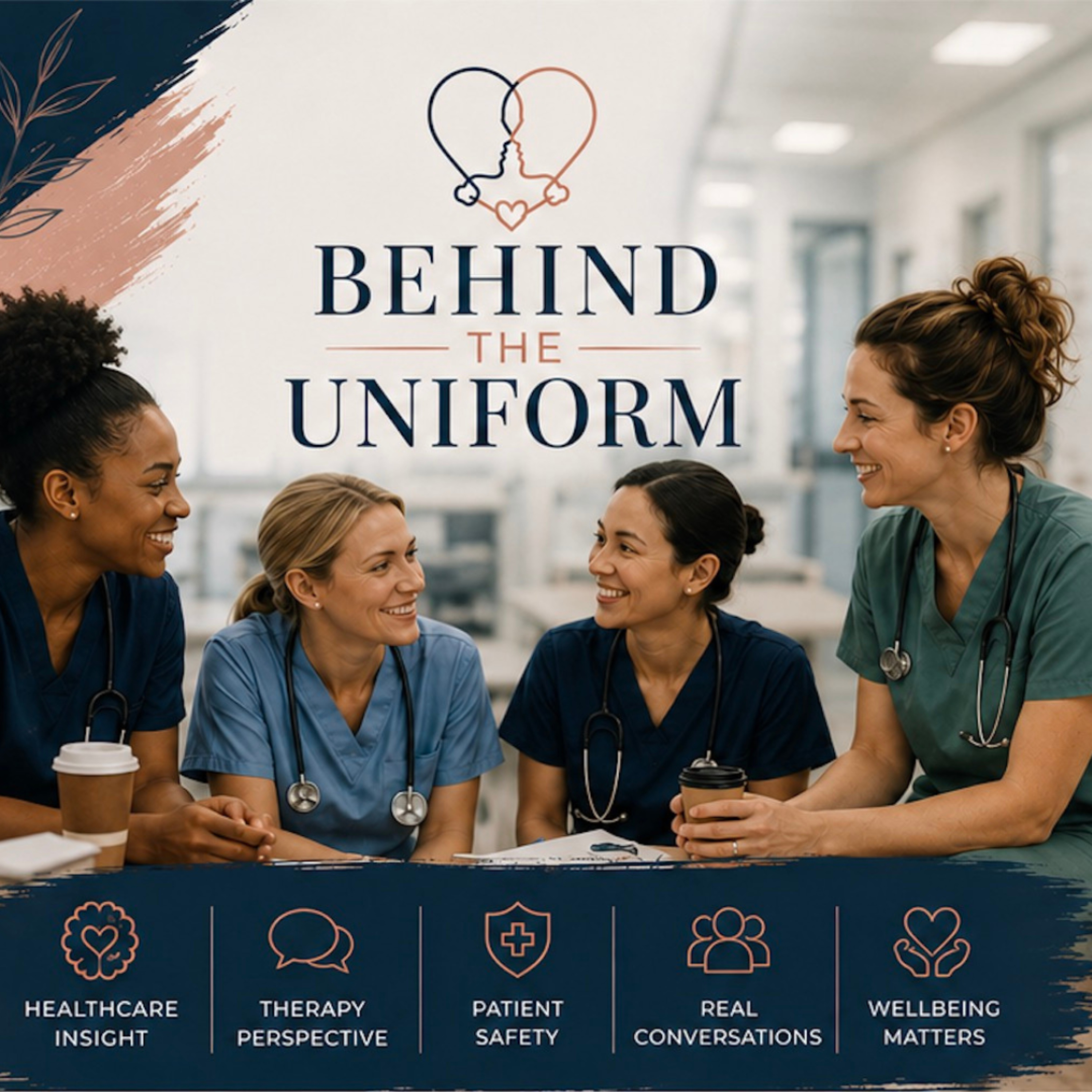
PODCAST · health
Behind the Uniform I The Human Side of Healthcare
by Advanced Clinical Solutions
🎙️ Welcome to Behind the Uniform-Real Conversations about the Human Side of Healthcare👭 Hosted by two sisters with two very different professional perspectives.🏥 One has a clinical background and currently works in Governance & Patient Safety, working with healthcare organisations to improve quality, safety, leadership and patient outcomes.🧠 The other is a qualified Integrative Counsellor & Therapist, helping people understand trauma, emotions and the impact of life's experiences.💙 Together, we explore the human side of healthcare.
-
6
🎙️ Behind the Uniform | Episode 6I Backing Your Own Corner: Learning to Trust Yourself in Healthcare
"Something doesn't feel right..."Most healthcare professionals have had that feeling. You might not immediately be able to explain it. The observations might not look particularly worrying. Nothing is screaming emergency.But something has changed.And sometimes the hardest part isn't recognising it.It's trusting yourself enough to say it out loud.In Episode 6 of Behind the Uniform, Josie and Gemma explore confidence, self-doubt, clinical intuition and what it really means to back your own corner when you work in healthcare.We talk about:🧠 Why clinical intuition isn't simply "gut instinct"🩺 Patricia Benner's Novice to Expert model and how experience changes the way clinicians recognise situations🔎 How experienced professionals develop pattern recognition💭 Why very capable people can still struggle with self-doubt🗣️ The importance of trusting yourself enough to speak up🤝 Why asking for help is a sign of professional judgement — not a lack of confidence🌱 Gemma's 3 Cs: Connection, Competence and Choice💙 How confidence develops quietly through experience, reflection, feedback and all those moments when you think "I've got this."Sometimes patient safety depends on somebody having enough confidence to say:"Can we just stop for a second? Something doesn't feel right."Because behind every uniform is a human being. 💙Benner's work explores how clinical competence develops through education and experience.https://pubmed.ncbi.nlm.nih.gov/6917683/Gary Klein's Recognition-Primed Decision model helps explain how experienced professionals can make rapid judgements through pattern recognition and previous experience, Oxford Academic – Why Intuition Often Gets It Right: Recognition-Primed Decision-Makinghttps://academic.oup.com/book/45545/chapter/394671102NHS England identifies supportive, psychologically safe teamwork and enabling people to speak up as important characteristics of a positive patient safety culture.https://www.england.nhs.uk/patient-safety/patient-safety-culture/safety-culture/A practical guide covering teamwork, communication, psychological safety, just culture, civility and creating environments where people feel able to ask questions and raise concerns.https://www.england.nhs.uk/patient-safety/patient-safety-culture/improving-patient-safety-culture-a-practical-guide/NHS England's work on spoken communication and patient safety highlights how communication failures commonly feature in serious incident investigations https://www.england.nhs.uk/patient-safety/improving-safety-critical-spoken-communication/The NMC Code sets out professional expectations around practising effectively, preserving safety, working within competence and taking action when patient safety may be compromised.https://www.nmc.org.uk/code/NMC guidance reinforces the professional responsibility to raise and, where necessary, escalate concerns about patient safety https://www.nmc.org.uk/standards/guidance/raising-concerns-guidance-for-nurses-and-midwives/read-raising-concerns-online/GMC professional standards require medical professionals to work within their competence, act promptly where patient safety may be compromised.https://www.gmc-uk.org/professional-standards/the-professional-standards/good-medical-practice/the-duties-of-medical-professionals-registered-with-the-gmcBehind the Uniform is intended for education, professional reflection and general discussion.The conversations shared are based on professional experience, current evidence and our respective areas of practice, but should not replace individual clinical judgement, organisational policies and procedures, professional guidance or personalised healthcare or psychological advice.If anything discussed in an episode raises concerns about your own wellbeing, please seek appropriate support from your GP, occupational health service, employee assistance programme or another suitably qualified professional.
-
5
E5 I Behind the Uniform I Why do we remember that One Bad Shift.....and Not the 10 Good Ones ?
Why Do We Remember the One Bad Shift... and Not the 10 Good Ones?You can have ten good shifts.Ten shifts where patients are cared for safely, the team works brilliantly, problems are spotted before they become incidents and thousands of things simply go right.And then you have one bad shift.Guess which one your brain wants to talk about at 3am? 😂In Episode 5 of Behind the Uniform, Josie and Gemma explore why negative experiences seem to stick with us and whether healthcare itself sometimes reinforces that way of thinking.We get a little bit nerdy in this one...🧠 Negativity bias — why bad experiences can have a disproportionate impact on how we think and remember🩺 Safety-I — learning from incidents, harm, errors and things that go wrong💙 Safety-II — turning the question around and asking why healthcare goes right so much of the time📊 Why clinical governance traditionally collects enormous amounts of data about failure, but perhaps not enough about success👏 Learning from Excellence — what we can learn from teams, systems and individuals when care goes really well📚 Gemma's Library of Yeses — deliberately noticing and storing the good experiences our brains can be very quick to dismissNone of this means ignoring incidents, complaints, risk or harm.We absolutely need to understand what goes wrong.But if we want to understand what makes healthcare safe, perhaps we also need to understand what makes it go right.Because behind every uniform is a human being. 💙🧠 Baumeister et al. – Bad is Stronger than GoodThe classic research paper exploring why negative events, emotions and feedback can have a greater psychological impact than positive experiences.https://doi.org/10.1037/1089-2680.5.4.323🩺 NHS England – Safety CultureNHS England describes safety culture as one of the foundations of the NHS Patient Safety Strategy and discusses using a Safety-II inspired approach to understand everyday work and learn from what supports safe care.https://www.england.nhs.uk/patient-safety/patient-safety-culture/safety-culture/🔎 NHS England – Safety Culture: Learning from Best PracticeA particularly relevant resource for this episode. NHS England used a Safety-II inspired approach to look at organisations rated Good or Outstanding for safety and asked what could be learnt from what they were doing well.https://www.england.nhs.uk/long-read/safety-culture-learning-from-best-practice/💡 Learning from Excellence – Evidence & ResourcesResearch, publications and practical resources exploring positive reporting, appreciative inquiry and how healthcare organisations can learn from excellent practice as well as adverse events.https://learningfromexcellence.com/resources-and-evidence/🏥 Royal College of Obstetricians & Gynaecologists – Safety-I and Safety-IIA really accessible explanation of the difference between learning from what goes wrong and understanding how everyday healthcare usually succeeds.https://www.rcog.org.uk/about-us/quality-improvement-clinical-audit-and-research-projects/each-baby-counts-learn-support/safety-thinking-toolkit/safety-i-and-safety-ii/Behind the Uniform is intended for education, professional reflection and general discussion.The conversations shared are based on professional experience, current evidence and our respective areas of practice, but should not replace individual clinical judgement, organisational policies and procedures, professional guidance or personalised healthcare or psychological advice.Any clinical examples or scenarios discussed are anonymised, adapted or hypothetical to protect confidentiality.The views and experiences discussed are our own and do not necessarily represent those of any organisation, employer, regulator or professional body.If anything discussed in an episode raises concerns about your own wellbeing, please seek appropriate support from your GP, occupational health service, employee assistance programme or another suitably qualified professional.
-
4
Behind the Uniform | Episode 4 I The Joy of Working in Healthcare
🎙️ Behind the Uniform | Episode 4 I The Joy of Working in HealthcareWe talk a lot about the difficult side of healthcare — the pressure, emotional workload, burnout, incidents and the days that stay with us.But that's only part of the story.Healthcare workers also get a front-row seat to some pretty incredible moments.The first steps after surgery.The patient who finally smiles.A family getting the news they've been waiting for.A team pulling together when everything seems to be going wrong.A heartfelt thank you from someone who genuinely means it.And, occasionally, locating the missing bladder scanner. 😂In Episode 4 of Behind the Uniform, Josie and Gemma talk about the joy that exists alongside the difficult stuff.We explore:💙 The moments patients and healthcare workers never forget🧠 Why our brains don't always hold onto the good stuff📚 Gemma's Library of Yeses👏 Why healthcare professionals can be terrible at accepting compliments📊 Why compliments are data too🌱 Recognition, belonging and workplace culture🩺 Why patient safety should learn from what goes right — not only what goes wrongBecause noticing joy isn't about pretending healthcare isn't hard.Both things can be true.A shift can be exhausting and meaningful.Heartbreaking and beautiful.Chaotic and bloody hilarious.Sometimes we just need to get better at noticing the good bits too.❤️ Because behind every uniform is a human being.Institute for Healthcare Improvement (IHI) – Framework for Improving Joy in WorkAn evidence-informed framework exploring how healthcare organisations can create the conditions that support meaning, wellbeing and joy at work.https://www.ihi.org/library/white-papers/ihi-framework-improving-joy-workIHI – Workforce Wellbeing and Joy in WorkResources exploring workforce physical, psychological and emotional wellbeing and its relationship with quality and patient safety.https://www.ihi.org/library/topics/workforce-well-being-and-joy-workLearning from Excellence – Resources & EvidenceResearch and resources exploring positive feedback, appreciative inquiry and how healthcare can learn from what goes well — not only when things go wrong.https://learningfromexcellence.com/resources-and-evidence/Care Quality Commission (CQC) – Learning CultureCQC's quality statement on creating a proactive and positive culture of safety, learning and continuous improvement.https://www.cqc.org.uk/guidance-regulation/providers/assessment/single-assessment-framework/safe/learning-cultureCare Quality Commission (CQC) – Well-ledCQC's assessment framework covering leadership, organisational culture, staff support, governance, learning and improvement.https://www.cqc.org.uk/guidance-regulation/providers/assessment/single-assessment-framework/well-ledIf anything discussed in an episode raises concerns about your own wellbeing, please seek appropriate support from your GP, occupational health service, employee assistance programme or another suitably qualified professional.💬 We'd love to hear yours...What's one tiny moment from working in healthcare that still makes you smile?⚠️ DisclaimerBehind the Uniform is intended for education, professional reflection and general discussion.The conversations shared are based on professional experience, current evidence and our respective areas of practice, but should not replace individual clinical judgement, organisational policies and procedures, professional guidance or personalised healthcare or psychological advice.
-
3
Psychological Safety: Can We Really Speak Up?
🎙️ Behind the Uniform | Episode 3 Psychological Safety: Can We Really Speak Up?Every healthcare professional has experienced that moment.You notice something doesn't feel right.You have a question.You think someone has made a mistake.Do you speak up?Or do you stay silent?In this episode of Behind the Uniform, Josie (Clinical Governance & Patient Safety Consultant) and Gemma (Counsellor & Therapist) explore one of the most important factors influencing patient safety, staff wellbeing and organisational culture: Psychological Safety.Together we discuss:🗣️ What psychological safety actually means (and what it doesn't)🩺 Why speaking up can literally save lives🧠 How fear, hierarchy and workplace culture influence our behaviour💙 The impact psychological safety has on staff wellbeing🏥 The connection between psychological safety and patient safety👥 What leaders can do to create teams where people feel safe to speak up💬 Real-life healthcare scenarios we've all experiencedWhether you're a nurse, doctor, AHP, paramedic, healthcare assistant, therapist, manager, student or healthcare leader, this conversation is for anyone who believes that safe cultures create safer care.Because behind every uniform is a human being.📚 Resources & Further Reading🩺 NHS England – Psychological Safety📖 NHS England – Psychological Safety Toolkit (formerly HEE)🗣️ Freedom to Speak Up🏥 NHS Patient Safety Strategy⚖️ Patient Safety Incident Response Framework (PSIRF)🧀 Human Factors & Systems Thinking🏛️ CQC – Well-led📢 CQC – Freedom to Speak Up
-
2
Stress Management & Self-Care for Healthcare Professionals: Why It’s Not a Luxury
🎙️ Behind the Uniform | Episode 2 I Stress Management & Self-Care for Healthcare Professionals: Why It’s Not a Luxury Healthcare is demanding: long shifts, difficult conversations, critical decisions and emotional labour.In this episode, Josie and Gemma explore why self-care isn’t selfish — and why staff wellbeing matters for safe, compassionate care.We discuss:💙 How stress affects decision-making🧠 The stress response and nervous system🩺 Staff wellbeing and patient safety🧀 James Reason’s Swiss Cheese Model🚨 Critical incident stress🎭 Understanding and naming emotions🎬 What Inside Out can teach us about emotions🚧 Setting boundaries at work🌱 Practical self-care strategiesSelf-care matters, but it cannot compensate for unsafe staffing, excessive workloads, poor leadership or harmful workplace cultures.❤️ Because behind every uniform is a human being.📚 ResourcesJames Reason: Human Error, Models and Managementhttps://pmc.ncbi.nlm.nih.gov/articles...The NHS Patient Safety Strategyhttps://www.england.nhs.uk/patient-sa...HSE Management Standards for work-related stresshttps://www.hse.gov.uk/stress/standar...HSE Stress Talking Toolkitshttps://www.hse.gov.uk/stress/talking...NHS Employers: Supporting NHS People Experiencing Stresshttps://www.nhsemployers.org/articles...Mind: Managing Stress and Building Resiliencehttps://www.mind.org.uk/information-s...Palouse Mindfulness: Free eight-week programmehttps://palousemindfulness.com/Self-Compassion Exercises – Dr Kristin Neffhttps://self-compassion.org/category/...The Feelings Wheelhttps://feelingswheel.com/Pixar’s Inside Outhttps://www.pixar.com/inside-out💙 Confidential supportSamaritans: Call 116 123https://www.samaritans.org/how-we-can...Shout: Text SHOUT to 85258https://giveusashout.org/Frontline19: Support for frontline workershttps://frontline19.com/get-support/BMA counselling: Call 0330 123 1245https://www.bma.org.uk/advice-and-sup...For urgent mental health support in England, call NHS 111 and select the mental health option. Call 999 where there is an immediate risk to life.DisclaimerThis podcast is for education and professional reflection. It does not replace clinical judgement, organisational policy or personalised healthcare advice. Any scenarios discussed have been anonymised or adapted.#behindtheuniform #healthcareworkers #stressmanagement #selfcare #patientsafety #wellbeing
-
1
Emotional Workload: The Thing Nobody Talks About in Healthcare
🎙️ Emotional Workload: The Thing Nobody Talks About in HealthcareWelcome to Behind the Uniform — where healthcare meets therapy.Hosted by sisters Josie Winter, Clinical Governance & Patient Safety Consultant, and Gemma Thomas, Integrative Therapist & Counsellor.In our very first episode we explore something every healthcare professional experiences but very few people openly discuss...Emotional workload.By the end of this episode, you'll understand what emotional workload is, why it is particularly significant in healthcare, and why recognising it matters for both staff wellbeing and patient care.Healthcare workers are trained to manage clinical workload.But what about the emotional weight of:🩺 Caring for seriously ill patients💙 Supporting grieving families🚑 Responding to trauma⚠️ Managing complaints and incidents🧠 Carrying emotional experiences long after a shift has endedTogether we explore:✔ Emotional workload✔ Compassion fatigue✔ Burnout✔ Occupational trauma✔ Why self-care is a patient safety issue✔ The Water Butt analogyWhether you're a nurse, doctor, paramedic, AHP, healthcare assistant, manager or healthcare leader, this conversation is for anyone who believes that looking after healthcare professionals is fundamental to looking after patients.❤️ Because behind every uniform is a human being.🌐 Learn moreAdvanced Clinical Solutionshttps://www.advancedclinicalsolution....Navigating Minds Therapyhttps://www.navigatingmindstherapy.comFollow us:LinkedIn / josie-winter-78680029 / gemma-thomas-b31699415 📚 Evidence & Further ReadingNHS England – NHS Staff SurveyUnderstanding staff experience, wellbeing and workplace culture.https://www.nhsstaffsurveys.com/NHS England – People PromiseSupporting staff wellbeing and creating compassionate workplaces.https://www.england.nhs.uk/ournhspeop...NHS England – NHS People PlanWhy staff wellbeing is fundamental to delivering safe patient care.https://www.england.nhs.uk/ournhspeople/Health and Safety Executive (HSE)Managing work-related stress.https://www.hse.gov.uk/stress/World Health OrganizationHealth workforce wellbeing and support.https://www.who.int/teams/health-work...Books📘 The Body Keeps the Score – Bessel van der Kolk📘 When the Body Says No – Gabor MatéDisclaimerThis podcast is intended for education and professional reflection. The discussions shared are based on current evidence, professional experience and therapeutic practice but should not replace individual clinical judgement, organisational policy or personalised healthcare advice.Any clinical scenarios discussed have been anonymised or adapted to protect confidentiality.
We're indexing this podcast's transcripts for the first time — this can take a minute or two. We'll show results as soon as they're ready.
No matches for "" in this podcast's transcripts.
No topics indexed yet for this podcast.
Loading reviews...
ABOUT THIS SHOW
🎙️ Welcome to Behind the Uniform-Real Conversations about the Human Side of Healthcare👭 Hosted by two sisters with two very different professional perspectives.🏥 One has a clinical background and currently works in Governance & Patient Safety, working with healthcare organisations to improve quality, safety, leadership and patient outcomes.🧠 The other is a qualified Integrative Counsellor & Therapist, helping people understand trauma, emotions and the impact of life's experiences.💙 Together, we explore the human side of healthcare.
HOSTED BY
Advanced Clinical Solutions
Loading similar podcasts...
Frequently Asked Questions
How many episodes does Behind the Uniform I The Human Side of Healthcare have?
Behind the Uniform I The Human Side of Healthcare currently has 6 episodes available on PodParley. New episodes are automatically indexed when they're published to the podcast feed.
What is Behind the Uniform I The Human Side of Healthcare about?
🎙️ Welcome to Behind the Uniform-Real Conversations about the Human Side of Healthcare👭 Hosted by two sisters with two very different professional perspectives.🏥 One has a clinical background and currently works in Governance & Patient Safety, working with healthcare organisations to improve...
How often does Behind the Uniform I The Human Side of Healthcare release new episodes?
Behind the Uniform I The Human Side of Healthcare has 6 episodes. Check the episode list to see recent publication dates and frequency.
Where can I listen to Behind the Uniform I The Human Side of Healthcare?
You can listen to Behind the Uniform I The Human Side of Healthcare on PodParley by clicking any episode. We provide an embedded audio player for direct listening, and you can also subscribe via your preferred podcast app using the RSS feed.
Who hosts Behind the Uniform I The Human Side of Healthcare?
Behind the Uniform I The Human Side of Healthcare is created and hosted by Advanced Clinical Solutions.
URL copied to clipboard!