
PODCAST · religion
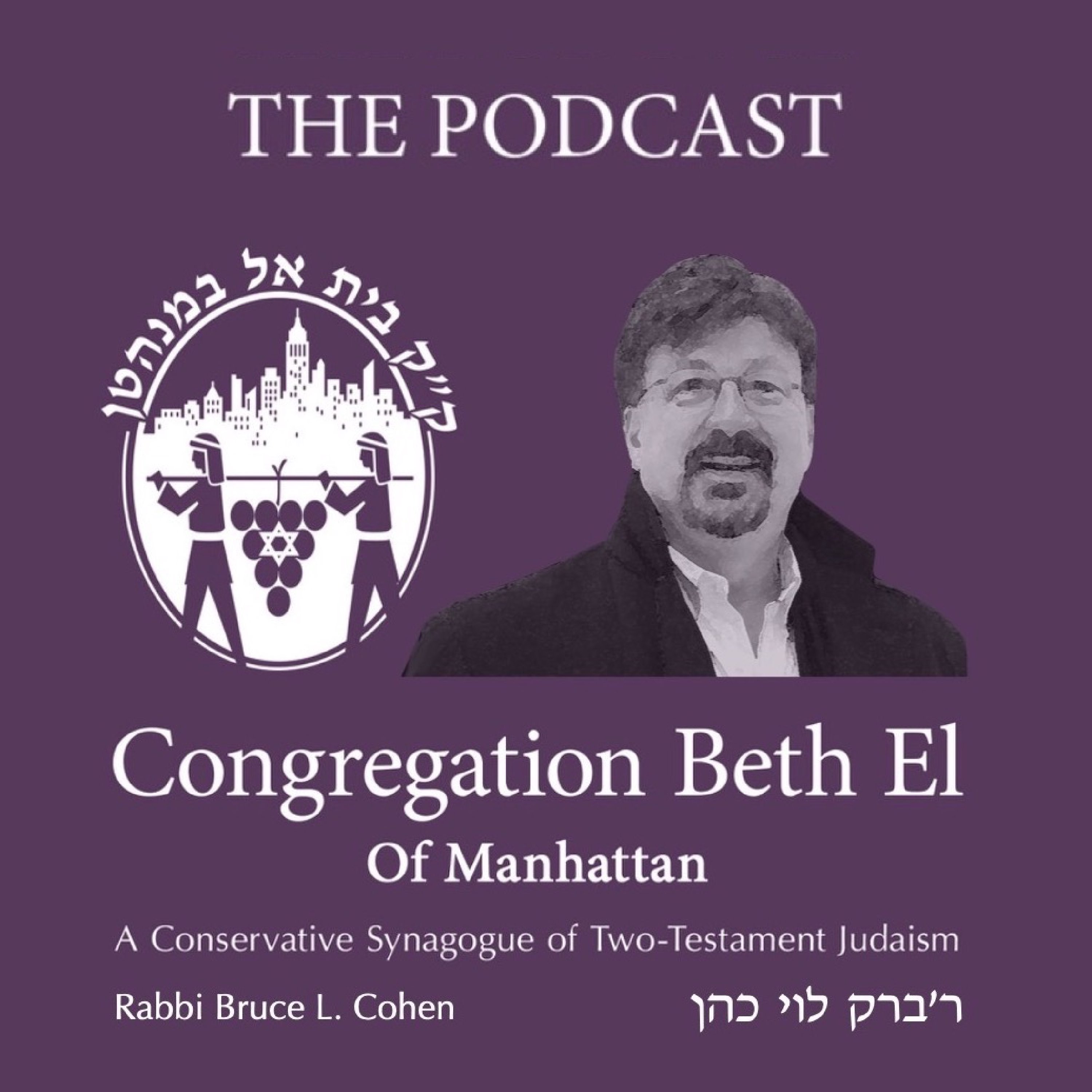
Beth El of Manhattan, Two-Testament Synagogue
by Rabbi Bruce L. Cohen
Rabbi Bruce L. Cohen’s sermons at Congregation Beth El of Manhattan – an unaffiliated Conservative Synagogue of "Two-Testament" Judaism in the Upper East Side of New York City – where Jewish people and “People of Calling” (not born Jewish), and Interfaith couples come together in Manhattan since 1993 to observe, connect, and celebrate. For more information, please visit us online at www.bethelnyc.org or an Facebook.
-
296
-
295
Theology Affects Translations
An examination of specific examples of denominational theologies having produced inaccurate translations: and a recounting of my lunch with the late Dr, Alan F. Segal, PhD, professor of religion at Columbia University in New York City, in which he and I explored a"tortured text" – a skewed translation of Mark 7:19 in regard to kosher laws affecting Jewish perpetuity.
-
294
Do-Be-Do-Be-Do 🎶
In our era, it is tempting to retreat from the storm-tossed world into a faith-life that is meditative, contemplative, and sealed off. Is this essentially monastic life God's goal for us in regard to "holiness?" Or – is the goal of contemplation the development of right views leading to the kind of rightful agency in the real world we call "doing justice?" We explore from the Haftarah this week affixed to the Torah portion, "Kedoshim.".
-
293
HaBayitah (Home) Part 2
In the Parasha "Lech Lecha" we have what is considered by many Scripture scholars "the" core text on God-following in the entire Bible. The Hebrew is an idiom for "get going" - but it literally means "go to yourself." Your true self. The reason you are on the planet. "Home." Your genuine "spot" in the center of God's will and the reasons for which He brought you into being. We continue to explore this idea of "Home" we started with last Shabbat.
-
292
Hearing
"Accepting the Lord" (Psalm 2 & Psalm 24) involves exactly that: we come to be "saved" (in right standing with God) when we "accept (God as) The Lord" of our lives. We live in a genuine 1-on-1 Theocracy, not merely in theory. We cannot obey our King until we hear him. Somehow, some way, we need to come know we have "shema'd" (heard) so we can "shema" (obey). We explore our relationship with God and with the Atoning Messiah in some depth this way today. May it be for shalom!
-
291
Two Leaders Sharing (Abbreviated Service)
Since there was a mini-service on 16 May with the rabbi absent, and no service on 23 May due to Memorial Day – we offer this in place of the usual sermons. Trustee Sherry Shieh shares some Scripture, prayers and thoughts on Jerusalem Day; and Elder Scott Poticha shares a brief "drasha" entitled, "Names," pondering the week's Torah portion, "Ba-Midbar." Shavuah tov & shalom!
-
290
God *Does* In The Real World
When God commanded us as Israel to do a "Shmittah" or a Jubilee year (every 7 years let the land rest without being farmed for a solid year) ... God also promised to give us enough food in the sixth year for a 3 year buffer - with other sources of food promised as well. Messiah Yeshua we are told in Matthew 16 called this dynamic in "the lesson of the loaves" – and urged us to learn it, and not forget it. So - here - we ponder into this pattern to weave to deeply into our soul's expectations. Shavuah tov, and Enjoy!
-
289
Not For Nothing (Schrödinger's Futility) :-)
We are told in Romans 8:20-21 that God has woven **apparent** futility into the fabric of existence in the material universe. Yet, Scripturally, it exists in a kind of spiritually "quantum" state where futility both exists, and does not - at the same time.Concerning what *seems* futile to both King Solomon (see Ecclesiastes 1) and The Messiah, Himself (Isaiah 49:4) –– we are also told, "God has put all your tears in a bottle: none are forgotten" (Psalm 56:8) "even if you give a cup of cold water" to someone who needs it, "you will not lose your reward." (Mark 9:41). The tragedies that begin the Book Of Ruth end with the birth of line of King David and the Messiah. What is our Creator, our Father in Heaven, up to?
-
288
Not My Toy Or Trophy
Sermon Subtitle: "Limping With The Limp With Which God Has Made Us A Limper" Aaron, the first High Priest, lost both his sons early in the Exodus journey; and by the direct hand of God; and afterwards served for 40 years as the first High Priest of Israel, the central mediator between Israel and the God who had directly slain his two boys. How did Aaron's soul and spirituality survive this terrible contradiction of heart he surely "never saw coming" before it befell him? We reverently explore how God places what Rav Saul called "a thorn in the flesh" as part of the path by which God ushers "out of the kingdom of darkness into the kingdom of His dear Son." May it be for shalom.
-
287
Beyond The Emoji Exodus
Going beyond reduction to simplicities and soundbites, the Scriptures tell a story of Israel's national origin that is highly complex and filled with stages. It is not slavery to beach-vacation in one neat step. The Exodus has much in common with many group-origin stories: God creates a "camp" (the slaves in Goshen, Gideon's 300, the Israelites committed to King David, the Disciples of Yeshua) ... and gives them a cause. Then, God schools them in precept and experience in the new life and journey He is offering them. And in Messiah - the life is indeed new! We become "a new creation." We feast on this one! May it be for shalom!
-
286
The Flying "Nuun"
In the Torah portion this week there is an enlarged "nuun" (Hebrew Letter "N") in every Torah scroll's Exodus 34:7. This number in Hebrew represents the number "50." The Sages of Israel say there is profound reason this "Nuun" is made large to grab attention: It has to do with the limits of how much anyone - even a Moses who knew God so intimately - can "know" God to the full reach of God's identity. We explore this aspect of knowing God today. Enjoy, and Shalom!
-
285
Change Is Coming
A double holiday with great meaning for Two Testament synagogues all over the world. God has declared certain things will happen. Not might happen - WILL happen. Declarations of such certainty are certainly worth exploring! Enjoy & Shalom!
-
284
Commanded To Command
"And you shall command ..." the week's Torah portion starts. Commands, vows, and promises powerfully elevate ideas by eliminating alternative options. A thing is the only thing we may do, or must not do. Beyond his - as God did with Moses this week – He also chooses to put us as humans into positions in which we must issue commands, and make or stand by promises or vows. We explore this way of God communicating with us in Torah Portion, "Tetzaveh."
-
283
The Power Of Two ... Or More
"And Moses congregated the whole assembly of the children of Israel, and said to them, 'These are the things that the Lord has commanded you to do.'" (Exodus 35:1) God gathered a group that had been created by a shared experiences (Exodus & Sinai) creating a sense of calling ... and then gave them "spiritual DNA" for the journey forward as a community. This depth in this concept is extremely valuable to all assemblies existing for the realization of vision & mission lived as actual communities of faith-driven souls. So - we seek to explore the texts with the level of energy it truly deserves. Enjoy!
-
282
According To The Pattern ...
With the intricate descriptions of exactly how God wants the implements of the Temple Service to be made, we are given an summary commandment: "See to it that you make everything in accord with their patterns shown to you (by God) on the mountaintop." We explore in this week's study what it means to learn – and to stay within – God's designs rather than just make up or substitute our own.
-
281
Love & Love ... And Love
This week's Torah portion "Mishpatim" contains an exquisite rhapsody on resisting the very human urge to attack and exploit weakness. It takes us to sublime understanding of Love Of and For God, and Love Of and For Humankind. We dive in with zeal to understand the heart of God and nature of moral truth expressed by these laws of compassion and mercy, and the commentary of the New Testament upon them.
-
280
God Ideas vs. Good Ideas
Revelation from God interferes with things coming naturally to humans: hurtful or wrongful deeds we often reflexively do. The 10 Commandments go to the heart of how God "sent His Word and healed" us. Our Parent in Heaven teaches us how to rein in our instincts and be "good people," just as any good parents teach their children. Yet, Scripture does far more than offer "good" ideas. It offers "God Ideas." Certainties certain enough to be values upon which we are invited/called-upon to "bet our all." "All in" on rightful living "here" - and eternal life "there." Enjoy!
-
279
Saved To The Uttermost (on "Shabbat Shirah")
In this parasha Beshalach on "Shabbat Shirah" – "The (Red Sea rescue) Song-Shabbat" – we hear sung, "And you have become my salvation." This salvation/rescue is not some meager, just-barely-effective deflection of the sabotages of God's Adversary (Ha-Sa-táhn). It is the UTTERMOST "rescue" God can provide, leaving BOTH our Free-Will and His Sovereign Will honorably intact. Not "meager" - but "to the uttermost" we are saved. We explore this together now. Shalom!
-
278
Becoming A Marvel
In this week's Torah portion we see the Exodus from Egypt being accomplished with miracles involved in the process. The words used for what God did were "Otot" (signs) and "Mof'téem" (marvels). In Psalm 71, the writer says, "I have become a 'marvel." ("Mo-fétt" singular of "Mof-téem.") How exactly does a *person* become a "marvel?"
-
277
The Name Above Every Name
What does it mean that we have been given awareness of, access to, use of, and right to "stand within" The Name Above Every Name? The name of Yeshua The Messiah. We steep ourselves in His Name in this message. Enjoy!
-
276
And They All Lived Happily Ever After
The Haftarah with this week's Torah portion "VaYechi," closing out the book of Genesis, shows King David at the end of his life cleaning up loose ends and passing the baton to his son, Solomon. It is not a one-dimensional story of "happily ever after." It is a balanced story of fulfillments, disappointments, enjoyable blessings to pour out, and unpleasant-but-necessary justice & statecraft to put into action. King David rises off his death bed to put his last efforts into right outcomes after his passing. A very balancing read.
-
275
Mercy Is The Air We Breathe
God's very Name in which we are told to trust (Isaiah 50:10) is "Rakhum V'Chanun" – Compassionate & Merciful. We see the traits in this Name surface especially clearly in moments of high chaos like this week's Parasha in which Jacob returns to Beth El, and his name is changed to "Israel" after he wrestles for his rightful destiny with passionate endurance.
-
274
Dysfunction Junction
How do we go about rightly being fallible Human Mortals following and effectively accessing the Perfect God among Imperfect Humans in A Stormy and Unsafe Universe? This sermon "gropes for truth" as to these questions through the powerfully unvarnished and candid Patriarchal Narratives of Genesis.
-
273
Going On While Bereaved
This week's Torah and Haftarah are both about the endgame of human existence. Everyone ages and passes away - and for the aging and the bereaved, the rest of life does not necessarily go kind and gentle before, during, or afterwards. This week, we watch some of life's hardest hammer-blows land on God-following (not perfect) souls (Abraham and David), and learn from these passages which other Scripture tells us "were written down as examples for us, of our instruction." (1Cor. 10:11) So - let us learn together.
-
272
The Loneliness Of The Long Distance Runner
Choice-making narrows our world. Choosing to be a long-distance runner has inherent in it the choice to be often alone. The story of Noah gives us a sobering portrait of how some choices in God-following and truth-living can lead to seasons narrow or lonely - with Noah as an extreme example. Scripture also teaches us how people of truth survive such storms. We solemnly engage with this lesson this week.
-
271
HaBai'yitah (Home)
The Hebrew word "HaBai'yitah" (Home) has been rich in the news as the remaining living Israeli Hostages in Gaza were returned home to Israel. "Home" is a sentiment deep in the heart of the People Israel in the Jewish homeland - and scattered across the world. "Home" for God-followers is a concept God defines: and His definition is worthy of serious contemplation. And so - we ponder, together.
-
270
The Honey AND (Not OR) The Stinger
We are commanded to rejoice exclusively for seven days, and yet we are conscious of the Hostages still in Gaza as we rejoice, like background radiation in everything we do. As Believers who seek to do God's will as revealed through His Word, how do we SANELY engage with life as life throws itself at us? We are not the first generation of God-followers to have such a balancing act made incumbent upon us. We explore together.
-
269
We Can't Deliver Perfection To God Or Each Other
Since we cannot deliver perfection to God or humankind in our actions or ideas ... how can we live with reasonable "shalom" in a world filled with error/sin-committing-and-repeating creatures ... like ourselves?
-
268
The Mercy Of Return (with Special Musical Treat At End)
Fresh from "Tashlikh," we are full of consciousness of God's mercy that leads to relationship with Him in this world (Olam Ha'zeh), and eternity with Him in the next (Olam Ha-Ba). We take a deep dive into God's mercy toward us - and right mercy toward ourselves and our fellow human beings. AFTER the sermon is a 1981 recording by the musical group Kol Simcha of a song our Rabbi Bruce Cohen composed, arranged, and played piano on - based on Micah 7:18-20, one of today's Haftarah passages, and the very passage upon which Rosh HaShanah's "Tashlikh" ceremony is based. Shanah Tovah.
-
267
Newness From Here And Now
How do we get to "new" from where we are now? With all swirling about us in the news and our own human life-journeys, how do we genuinely walk in the spirit of the greeting "Shanah Tovah L'cha" - "A Good Year For You!" beyond merely practicing "mindfulness" on the purely human level?
-
266
Rise And Shine. Or ...
The Haftarah for the Torah parasha Ki Tavo this week exhorts, "Rise, and shine!" This means someone is needed to arise, and some darkness needs light to shine into it." Judges 5 tells us, "Village life in Israel ceased until I arose ..." A person arose - and life restarted, and darkness was dispelled. How does this dynamic apply to each of us - now - today - in our individual arcs of influence?
-
265
Othering: Am I My Brother's Keeper? - Part 2
[FYI - Sermon is only 11 minutes in length.] Continuation of the theme of "Ahavat Adam" ("love of all humankind) from recent sermons, "do not look out for your own interests, but for those of others also," (Philippians 2:4) ... an attitude Scripture tells us "was in Messiah Yeshua" and exhorts us to "let it be in you also." We are to factor in the interests of all humankind for whom Messiah offered up Himself. (Isa. 49:6ff)
-
264
The Sure Mercies Of David
In this week's Haftarah, God promises those who come to Him for guidance the same mercies given to King David, himself. What hope do we have of meriting such things as "the man after God's own heart" received from On High? Well ... given King David's nearly bipolar history of glories and errors – it turns out, our chances are pretty good. Let's study and see.
-
263
Haftarat "Nachamu" Reading
On the 2nd Saturday of every month, we have an abbreviated Shabbat morning service with no Torah Service or Sermon, so after services the synagogue's members and attendees can do "Nosh n Drash" – a communal discussion of the weekly Torah portion and other writings or ideas related to it. S0 - instead of a sermon, this week we share with you our Rabbi's reading of the weekly Haftarah portion from the Prophet Isaiah 40:1-11,, in the style we read the Torah in Beth El services, based on Nehemiah 8:8's clear description of how The Scriptures were read to Israel. Enjoy!
-
262
Right For Me, Right For Us - Part 2
We continue this Shabbat with the theme of interwovenness: how our decision-making is guided by balancing what Scripture calls "our own interests" with "the interests of others" - and God's right as rightful Sovereign to "cast the tie breaking vote" in all our choice-making.
-
261
Boundary-Making (with "Messiah Morsel" After Sermon)
We learn this week how "me" is balanced by "we." This week's parasha "Matot/Maasei" continues our learning from the situation of the daughters of Tzelof'had. Last week, his orphaned daughters asserted their rights, and God backed them up. This week we see them learn from God that their rights had limits, and needed to be exercised factoring in the overall calling of the nation and the needs of their fellow Israelites in their tribe, in regard to their own personal desires in romance and family-building. [After Sermon ends, there is a brief "Messiah Morsel" explaining an important text-artifact in this week's Torah Portion in the overall span of Messianic prophecy.]
-
260
God Remembers Devotion
God, Himself, declares, "I remember your devotion in your youth, the way you followed Me into a wasteland with no life in it." What grace! God remembers YOUR every choice following Him, even when it took you into lack or danger. We meditate upon this in the Haftarah attached to the Torah portion "Pinchas" – named for a person whose devotion earned from God an eternal priesthood.
-
259
Daily Bread
Everything is not relative. That perspective can affect accuracy of understanding is genuinely an important consideration; but still, there are still some things and some stories that are true - and some that are not. This week's Haftarah gives a stunning example of an anti-factual "narrative" being used to justify stealing Israel's land; and the careful historicity of the Israelite Judge Yiftakh's fact-recitative reply – and then his deeds of resistance against the acts the false story generated. This is an important passage for people Yeshua the Messiah described as His crew: "those who are 'of the truth.'" (John 19:37)
-
258
The Song of "It Can't Be Done."
In the parasha, "Shelakh" we see what became our synagogue's logo: the Two Spies carrying the "Eshkol" (cluster of fruit). They saw the "land flowing with milk and honey, and full of enemies. God stated several times in "giving" us "our own land" that it would contain enemies needing to be overcome. Why is God's "gift" He is "giving" to us full of enemies?
-
257
The Shining (God's Name Placed Upon Us)
The "Aaronic Benediction" is described by God in the verse following it as "how you (the Aaronic Priesthood) shall put My Name on the children of Israel." It invokes God's very presence, His "face" to shine on us. When His presence shined on Moses, the face of Moses beamed light for long afterwards. How shall we "shine" in era in which God has caused us to be born and reborn? We ponder this together.
-
256
A Promise, Not A Command
The statement in the opening of this week's parasha is in the Hebrew future tense, which can read as either a statement of a future event, or a command. Most read it as a command: but it takes on a very different flavor when it is read as a predication of the natural result of spending time with, and following God, echoing Messiah's teaching, "Every student who has been fully trained will (inevitably) be(come) just like their teacher." (Luke 6:40)
-
255
A Place For Us
Rabbi Bruce's first sermon back from his six-month sabbatical. [NOTE: Please forgive the sound quality: the air conditioner above the podium was mistakenly set on "high fan" and loud fan noise had to be filtered out of the mix, affecting the overall tone while making the words understandable. This will not be the usual sound quality of the podcast.] Shalom!
-
254
Obedience
"These are the things the Lord has *commanded* (not suggested for) you to do."
-
253
The Fleas Come With The Dog
In this sermon for the weekly Torah portion "Terumah" (Voluntary Offering), Rabbi Bruce explores in deep detail and with personal examples how to replace unhelpful complaining with constructive realism.
-
252
Heartbreak
Starting from the Haftarah for this week in Isaiah chapter 6, our own heartbreak and that of others is pondered for wisdom and appropriate engagement/action.
-
251
"Hard Hearts, Soft Hearts"
During last Shabbat (8 Feb 2025), the service leader made reference to Rabbi Bruce's sermon "Hard Hearts, Soft Hearts" given on 18 January 2006. Since that sermon was the driver for the leader's comments, and no sermon was given last weekend because the congregation was saving the time for group-study after the service ... it seemed fitting to rebroadcast the sermon to which he referred from 19 years ago for another go-around. :-) We hope you find it nourishing. Shalom!
-
250
Hineini Again
We present ourselves to God ... what happens then? How does it unfold? What results?
-
249
The Interrupted Conversation - Pilot: "I was there when it happened."
During the rabbi's sabbatical, every 2nd Shabbat of the month is not recorded so the congregation can have after services an on-site "Nosh & Drash" in which the week's Torah section ("Parashat Ha-Shavu'a") is discussed while we eat together. So – this week, in lieu of a recorded sermon from the service, we offer the pilot episode of an experimental podcast Rabbi Cohen and Beth El's social media team recorded in December 2018. We feel the pilot has genuine value for anyone interested or involved in Two Testament Judaism. We hope you enjoy it, and pray you are nourished by it. Shalom!
-
248
Relationship Rupture and Repair
A mental health-care professional gives us a very insightful glimpse into the relational dynamics presented by the Biblical scenario of our patriarch, Joseph - a victim of terrible harms - reacting to seeing genuine repentance and change in his brothers who did him those harms.
-
247
Hanukkah - Messiah As The Ultimate Shamash
Hanukkah is Hebrew for "dedication" – and dedication as service to God and to Humankind is role-modeled for us by Messiah Yeshua, who was "The Light of The World" – and urged us as His followers to live as "lights to the world" and to "shine in the darkness."
We're indexing this podcast's transcripts for the first time — this can take a minute or two. We'll show results as soon as they're ready.
No matches for "" in this podcast's transcripts.
No topics indexed yet for this podcast.
Loading reviews...
ABOUT THIS SHOW
Rabbi Bruce L. Cohen’s sermons at Congregation Beth El of Manhattan – an unaffiliated Conservative Synagogue of "Two-Testament" Judaism in the Upper East Side of New York City – where Jewish people and “People of Calling” (not born Jewish), and Interfaith couples come together in Manhattan since 1993 to observe, connect, and celebrate. For more information, please visit us online at www.bethelnyc.org or an Facebook.
HOSTED BY
Rabbi Bruce L. Cohen
CATEGORIES
Loading similar podcasts...
Frequently Asked Questions
How many episodes does Beth El of Manhattan, Two-Testament Synagogue have?
Beth El of Manhattan, Two-Testament Synagogue currently has 50 episodes available on PodParley. New episodes are automatically indexed when they're published to the podcast feed.
What is Beth El of Manhattan, Two-Testament Synagogue about?
Rabbi Bruce L. Cohen’s sermons at Congregation Beth El of Manhattan – an unaffiliated Conservative Synagogue of "Two-Testament" Judaism in the Upper East Side of New York City – where Jewish people and “People of Calling” (not born Jewish), and Interfaith couples come together in Manhattan since...
How often does Beth El of Manhattan, Two-Testament Synagogue release new episodes?
Beth El of Manhattan, Two-Testament Synagogue has 50 episodes. Check the episode list to see recent publication dates and frequency.
Where can I listen to Beth El of Manhattan, Two-Testament Synagogue?
You can listen to Beth El of Manhattan, Two-Testament Synagogue on PodParley by clicking any episode. We provide an embedded audio player for direct listening, and you can also subscribe via your preferred podcast app using the RSS feed.
Who hosts Beth El of Manhattan, Two-Testament Synagogue?
Beth El of Manhattan, Two-Testament Synagogue is created and hosted by Rabbi Bruce L. Cohen.
URL copied to clipboard!