
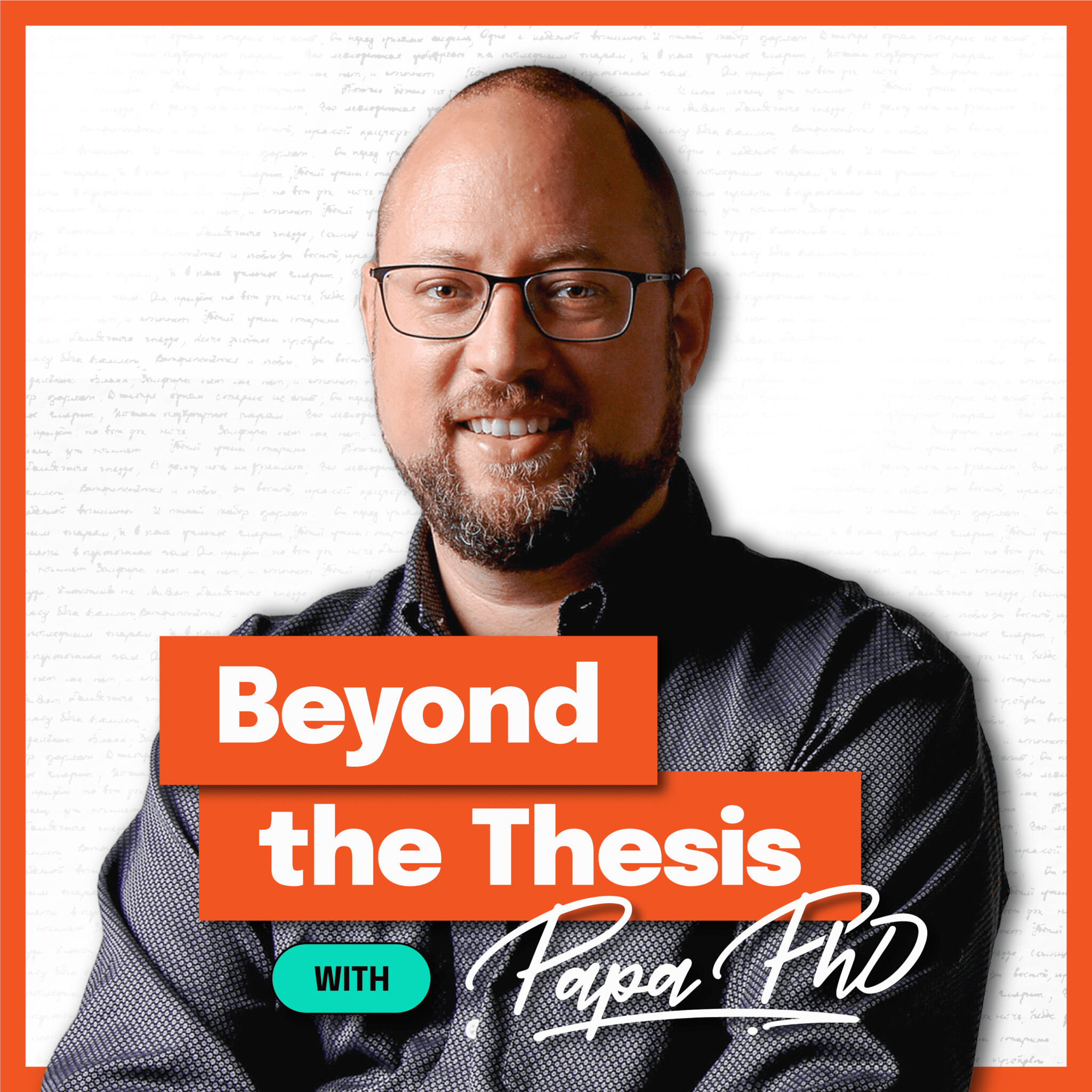
PODCAST · business
Beyond the Thesis With Papa PhD
by David Mendes, PhD
What can you do with a PhD? Do you wonder what career you can aim for with a graduate degree? Do you fear you’ll be unemployable as a PhD or after a postdoc? If these are questions you ask yourself, Papa PhD will help you dispel them by bringing you the career journeys and insights of MSc and PhD graduates around the world on job searching, skills development, networking, entrepreneurship, mental health, and more.PapaPhD.com | Patreon.com/PapaPhD | Twitter.com/PapaPhDpodcast | Facebook.com/PapaPhD
-
371
From Academia to New Pathways: Insights on Post-PhD Success with Fatimah Williams
Are you at a crossroads after your PhD, unsure about what comes next? In this inspiring episode of Beyond the Thesis with Papa PhD, host David Mendes sits down with Dr. Fatimah Williams - executive coach, founder of Professional Pathways, and author of "Options for Success" (Oxford University Press) to explore the real challenges and mindset shifts required to thrive beyond academia. Drawing on over 15 years of experience in career strategy and consulting, Dr. Fatimah Williams shares her journey from cultural anthropology PhD to career reinvention, offering actionable advice for anyone feeling stuck, experiencing an identity crisis, or considering a bold move outside the traditional academic track. Discover practical strategies to overcome fear, break the mold, embrace curiosity, and begin translating your academic skills into meaningful, rewarding careers in industry, nonprofits, and beyond. Topics Covered: Navigating fear and isolation when considering non-academic careers The identity crisis many PhDs face and how to move beyond it The importance of holding your PhD experience with "lightness" Real-life stories of career pivots and off-the-beaten-path choices How to use social listening and ecosystem mapping to expand your options Translating, not just repackaging, your skills for the job market Building agency, courage, and authentic professional identities after your PhD Whether you're a graduate student, postdoc, or recent PhD looking for your next step, this episode is packed with tips, encouragement, and unique wisdom to help you chart your own path to success beyond academia. Learn more: Book: Options For Success (with free resources) Coaching & resources: ProfessionalPathways.co Connect with Dr. Fatimah Williams on LinkedIn and Instagram (@FatimahPhD) Subscribe, share, and join us on the journey Beyond the Thesis!
-
370
Tania Longpré : francisation, intégration et communication scientifique au-delà du doctorat
Dans cet épisode d’Au-delà de la thèse avec Papa PhD, découvrez le parcours de Tania Longpré, docteure en éducation, spécialiste de la francisation, de l’intégration des nouveaux arrivants et de l’enseignement du français langue seconde. Au fil de la conversation, Tania raconte comment son chemin l’a menée de l’enseignement à la recherche, puis vers la vulgarisation scientifique, les médias et l’engagement public. Elle partage aussi sa vision du rôle que peuvent jouer les chercheur·euse·s au-delà du laboratoire, en mettant leur expertise au service de l’éducation, de l’inclusion et du débat social. À retenir de ma conversation avec Tania : Un parcours académique qui s’élargit au-delà de l’université : de l’enseignement au doctorat, Tania montre qu’un chemin en recherche peut aussi mener à la vulgarisation et aux médias. La francisation comme enjeu social majeur : son travail met en lumière l’importance de l’apprentissage du français pour l’intégration et la participation à la société québécoise. La vulgarisation scientifique comme levier d’impact : écrire, parler au public et intervenir dans l’espace médiatique permettent de rendre la recherche plus accessible. Le lien entre terrain et recherche : son expérience montre à quel point la pratique, l’enseignement et la recherche peuvent se nourrir mutuellement. Une voix scientifique engagée dans l’espace public : Tania illustre comment une expertise doctorale peut contribuer concrètement aux débats de société. Envie d’en savoir plus sur la carrière après le doctorat, la communication scientifique et les façons de faire rayonner votre expertise au-delà du milieu académique ? Écoutez l’épisode et découvrez comment transformer un parcours doctoral en levier d’impact, d’éducation et d’inclusion.
-
369
From Lab Bench to Leadership - Finding Purpose and Sustainability Beyond Academia
Episode Overview PhD holders Elle Campbell (Lab Renew) and Patrick Penndorf (Re:Advance) share their journeys from lab benches to leading sustainability initiatives in science. Discover how scientific skills fuel entrepreneurship, reduce lab waste, and build purpose-driven careers beyond academia. Ideal for PhD students exploring non-academic paths, lab managers optimizing workflows, and scientists passionate about green research. Guests Elle Campbell: Master's in Bioanalytical Chemistry (University of Warsaw); leads Lab Renew, a nonprofit helping research labs cut environmental impact through programs, funding, and sustainable strategies in Canada's bioeconomy. Patrick Penndorf: Biochemistry and molecular medicine background; founder of Re:Advance, a German sustainability consultancy teaching scientists greener workflows; popular LinkedIn voice on lab sustainability and science communication. Timestamps 00:00: Intro to Beyond the Thesis with Papa PhD – redesigning the lab ecosystem. 00:29: Elle Campbell's pivot from PhD to environmental mission. 01:07: Patrick Penndorf's serendipitous path to Re:Advance. 04:00: Finding purpose: Sustainability as a "why" for scientists. 12:00: Lab-to-CEO: Networking, volunteering, and iterative steps. 17:00: Founder vs. CEO – drive, blissful ignorance, and growth. 21:00: Transferable PhD skills: Problem-solving, data, adaptability. 28:00: Mentorship, family influence, and shifting mindsets. 37:00: Market needs vs. academic rigor in entrepreneurship. 52:00: Overcoming doubts, listening to your path. 54:00: Connect – LabRenew.org, LinkedIn profiles. Key Takeaways Entrepreneurship mirrors PhD research: Set goals, iterate experiments, adapt to data – just like building sustainable programs. Scientists excel in granular problem-solving; break big sustainability challenges (e.g., lab waste) into actionable steps for impact. Networking via societies and volunteering reveals adjacent careers; sustainability differentiates PhD resumes in bioeconomy and consulting. Shift from "truth-chasing" to market solutions: Prioritize efficiency, seek mentors outside academia for faster pivots. Links & Resources Lab Renew: labrenew.org Elle Campbell on LinkedIn: https://www.linkedin.com/in/elleacampbell/ Patrick Penndorf on LinkedIn: https://www.linkedin.com/in/patrick-penndorf/ Re-Advance: https://re-advance.com/ Podcast: Beyond the Thesis with Papa PhD Subscribe for more PhD career stories, share if this inspired your green lab transition, and connect with guests on LinkedIn! #PhDCareers #SustainableScience #ScientistEntrepreneurship
-
368
Entrepreneuriat scientifique : mythes, réalités et programmes de soutien au Québec
Dans ce nouvel épisode d’Horizon PhD, on plonge dans le monde de l’entrepreneuriat scientifique au Québec avec Marie-Pierre Cossette, directrice au Grand Défi de société du Fonds de recherche du Québec, et Marine Queffeulou, cofondatrice et présidente de Kalego Solutions. Ensemble, elles et il montrent qu’il existe mille façons de transformer un parcours scientifique en projet d’impact. Marine partage son chemin, de la microbiologie en France jusqu’à la création d’une entreprise en technologie avancée au Québec. Elle raconte comment un intérêt pour la recherche, les collaborations et les occasions de formation l’ont amenée à découvrir un terrain qu’elle n’imaginait pas au départ : celui de l’innovation scientifique et de l’entrepreneuriat. De son côté, Marie-Pierre explique comment le Fonds de recherche du Québec soutient des parcours qui permettent d’aller plus loin avec une idée, une expertise ou une technologie. L’épisode met en lumière plusieurs programmes d’accompagnement qui aident les scientifiques à explorer, tester et structurer un projet entrepreneurial, à différentes étapes de maturité. On y parle aussi de compétences transférables : gestion de projet, communication, validation d’hypothèses, réseautage, résolution de problèmes et capacité à naviguer l’incertitude. L’épisode casse au passage plusieurs stéréotypes sur l’entrepreneur ou l’entrepreneure scientifique, en montrant qu’il n’existe pas un seul profil, mais une grande diversité de parcours et de rythmes. Enfin, l’épisode rappelle que l’entrepreneuriat scientifique ne se fait pas seul. Il repose sur un écosystème de mentors, d’incubateurs, de formations, de cohortes et de programmes comme QcES, Lab au marché et CESI, qui peuvent aider les chercheurs, chercheuses et diplômé·e·s à passer de l’idée au projet concret. Liens Fonds de recherche du Québec : https://frq.gouv.qc.ca/horizonphd QCES – Québec Entrepreneuriat Scientifique : https://qcse.ca/ CESI – Création d'entreprise scientifique et innovante : https://fr.v1.studio/cesi Kalego Solutions : https://www.kalegosolutions.com/
-
367
Communiquer la science au doctorat - l'aventure du balado Scienturion
Des doctorantes qui vulgarisent la science pour tous Écoutez l’épisode maintenant : Bienvenue sur ce premier épisode en studio d’Au-delà de la thèse avec Papa PhD, avec deux invitées exceptionnelles : Isabelle Boudreau-Julien et Gabrielle St-Arnaud, doctorantes à l’Université Laval et créatrices du balado Scienturion. Ce podcast met en lumière les projets de recherche d’étudiants·tes des cycles supérieurs pour rendre la science accessible et discuter des défis quotidiens. Rencontrées à ComSciCon, elles incarnent la passion pour la communication scientifique au Québec, renforçant les liens entre recherche et société. Pourquoi lancer un balado en doctorat ? Isabelle et Gabrielle expliquent comment Scienturion (nom inspiré de « science » + « centurion » pour 100 minutes/mois) équilibre doctorat et projet créatif. Motivation : Diversifier les tâches pour éviter la monotonie ; vulgariser rehausse la motivation en reliant recherche et impact sociétal. Symbiose : Communiquer simplifie concepts complexes, aide aux bourses (dialogue public valorisé) et ouvre des portes professionnelles (enseignement, embauche). Avantages inattendus : Réseau élargi, confiance accrue, gestion de projet/budget – compétences CV-friendly pour académie ou industrie. Financement : cognez à toutes les portes Pas de budget ? Elles partagent des pistes concrètes pour étudiants·tes : Université Laval : Fondation ASSEC, Faculté des études supérieures, Centre NutriSci (partenariats thématiques). FRQ : Bourse Dialogue (jusqu’à 10 000 $ pour communication publique). Autres : Ministères (commandites rayonnement), centres de recherche ; soyez créatif·ve, poli·e et persistant·e – un « non » mène souvent ailleurs. Coût réaliste : Studio pro (vidéo 4K, pré-montage) ~287 $/épisode (rabais étudiant) ; ajustez rythme à votre charge (1/mois ou moins). ComSciCon : accélérateur de projets ComSciCon Québec (gratuit, déplacement remboursé) a catalysé Scienturion : Formats : Audio, écrit, vidéo/BD ; feedback + ateliers (humour, politique). Réseau durable : Famille des communicateurs·rices québécois·es ; édition 2025 à McGill (candidatures ~décembre).Flagship Boston : Niveau international, gratuit aussi – lancez-vous ! Production : audio simple, vidéo impactante Studio clé-en-main : Préférez pro pour montage/post-prod (temps précieux au doctorat). Vidéo obligatoire : Même si intimidant, booste visibilité (YouTube, TikTok/Reels) ; gérez commentaires négatifs (supprimez, ignorez). Capsules : Bourse FRQ → Silence en sciences (2-3 min animées via Impact Scientifique) ; sondages communauté pour thèmes. Leçons et mots de la fin Ce qu’elles changeraient : Rien – apprentissage en faisant ; persévérance > perfection (premier épisode imparfait ? Normal !). Recrutement : Rencontre préparatoire, rassurez invités (setup caméra expliquée) ; bouche-à-oreille + visibilité aident. Motivation : « 10 auditrices·eurs suffisent si pertinent ; rien à perdre, tout à gagner (compétences, réseau). Just do it ! » Contactez-les : [email protected] | Instagram Scienturion | Proposez-vous comme invité·e (tous domaines, ULaval ou ailleurs) ! Abonnez-vous à Papa PhD pour plus d’histoires inspirantes au-delà de la thèse. Partagez si ça vous motive à vulgariser ! 🚀
-
366
Canadian Hemophilia Society CEO Sarah Ford with Fiona Robinson | Podcasthon 2026
This is a special episode of Beyond the Thesis with Papa PhD, where we spotlight the inspiring transformation of one of Canada’s foremost patient advocacy organizations. In this off-series Podcasthon 2026 episode, guest host Fiona Robinson, a medical writer and editor specializing in inheritable bleeding disorders, sits down with Sarah Ford, Chief Executive Officer of the Canadian Hemophilia Society (CHS). Together, they explore the CHS’s exciting journey as the organization embarks on a significant rebranding - from its decades-long identity to the new name, Bleeding Disorders Canada / Troubles de la Coagulation Canada. You’ll hear how this change reflects a broader commitment to supporting all individuals and families affected by inheritable bleeding disorders, including hemophilia A and B, von Willebrand disease, and rare factor deficiencies, platelet disorders, women and girls with bleeding disorders, and people without a diagnosis. Drawing from community consultations and strategic planning, Sarah shares insights into honoring the organization's 70+ year legacy - including hemovigilance advocacy post-Krever Report - while expanding bilingual education on gene therapy, novel treatments, and shared decision-making with providers through 10 provincial chapters. You’ll learn: The community-driven process behind the inclusive rebrand and seamless transition at hemophilia.ca (redirecting post-June 2026) How CHS plans to grow programs meeting people "where they're at," from new diagnoses to underserved groups Why advocacy must expand to protect multidisciplinary care systems - and how donations sustain this vital work Simple ways to volunteer, donate, access resources, and connect via provincial chapters and treatment centers The "for the community, by the community" model powering future innovations in bleeding disorders support This conversation sheds light on how Bleeding Disorders Canada aims to meet the needs of a diverse and growing community while maintaining strong ties to its roots and continuing to play a vital role in national healthcare advocacy and hemovigilance. How can you support this evolution through action today? 🌐 Canadian Hemophilia Society (CHS) ➡ https://hemophilia.ca 🎧 Listen now, donate today, and share to help a charity transforming bleeding disorders care in Canada.
-
365
Parenting While PhDing – Graduate School, Care Work & Academia
Parenting during a PhD is rarely discussed openly in academia — yet more graduate students are becoming parents while navigating research, teaching, and the pressures of academic life. In this episode of Beyond the Thesis with Papa PhD, David Mendes speaks with Dr. Jackie Hoermann-Elliott and Dr. Jenna Morton-Aiken, editors of Parenting While PhDing. Together, they explore the lived experiences of graduate student parents and the systemic challenges that make parenting during graduate school so difficult. Drawing from their own journeys and the contributors to their book, they discuss how academia can better support students balancing research, writing, and care work. You’ll learn: • What it’s really like to start or raise a family during graduate school • Why student parents remain largely invisible in academia • How graduate students navigate graduate school stress and academic expectations while parenting • The importance of community and support networks for PhD students • Practical advice and reflections from real parenting-while-PhD stories This conversation offers an honest look at an often overlooked academic experience and raises an important question: how can universities create environments where researchers can thrive both as scholars and as parents? 📘 Parenting While PhDing (Book) Learn more about the book Parenting While PhDing, edited by Dr. Jackie Hoermann-Elliott and Dr. Jenna Morton-Aiken. The book brings together advice narratives and lived experiences from graduate student parents navigating academia. ➡ https://www.rutgersuniversitypress.org/parenting-while-phding/9781978843769 👩🏫 Dr. Jackie Hoermann-Elliott Associate Professor of English at Texas Woman’s University, researcher in embodied learning and academic writing. ➡ X: https://x.com/DrJackieWrites ✍️ Dr. Jenna Morton-Aiken Writing program leader and scholar at Brown University’s Sheridan Center, working on pedagogy, writing, and academic mentorship. ➡ X / Twitter: https://x.com/writejma 🎧 Listen now and share this episode with a colleague navigating graduate school or academic parenthood.
-
364
De la virologie à la communication scientifique – Le virage d’Océane Sorel
Comment passe-t-on d’un postdoc en virologie aux États-Unis à une carrière à temps plein en communication scientifique suivie par des centaines de milliers de personnes ? Dans cet épisode, je reçois Océane Sorel, docteure vétérinaire et virologue, connue sous le nom The French Virologist. Après un parcours académique entre l’Europe et la Californie, un passage en biotech et en affaires médicales pendant la pandémie, Océane a créé en 2021 un compte Instagram pour répondre à la désinformation scientifique autour du COVID. Ce projet est devenu une mission… puis une carrière. Nous parlons de : Son parcours du doctorat aux postdocs en Californie Son passage dans l’industrie biotech et les affaires médicales La montée fulgurante de sa communauté en ligne Le burn-out et la décision de se lancer à temps plein L’impact et la responsabilité de la communication scientifique aujourd’hui 🔎 Retrouver Océane : Instagram : https://www.instagram.com/thefrenchvirologist Site Web : https://www.thefrenchvirologist.com/ Newsletter : https://thefrenchvirologist.substack.com/ Livre : Virus, bactéries, microbes : tout savoir pour y échapper https://www.amazon.ca/Virus-bactéries-microbes-savoir-échapper/dp/2501176340 Un épisode sans filtre sur la fatigue, la responsabilité scientifique et le courage de redéfinir sa trajectoire après la thèse. 👉 Si cet épisode te parle, partage-le avec un·e collègue qui explore d’autres chemins.
-
363
Navigating Gender Bias in Tech – PhD Career Advice with Kae Kronthaler-Williams
What does it take to thrive in a system that wasn’t designed for you? In this candid conversation, tech executive and author Kae Kronthaler-Williams joins David Mendes to discuss building a career in male-dominated spaces - and the hard-won lessons she shares in her book Not Made for You. Drawing on her 30-year journey from telemarketing to the C-suite, Kae breaks down the subtle and systemic biases women still face in STEM, academia, and industry, and how you can equip yourself to overcome them. She also shares powerful insights on confidence, strategic visibility, and why women must learn to name and speak to bias without fear. 💡 You’ll learn: Why tying your work to business goals boosts visibility and influence How self-doubt affects women's careers and how to break that cycle Tools and language to handle workplace bias constructively What academic women in STEM can learn from business leadership Whether you’re navigating graduate school, your first industry role, or a leadership path, this episode offers practical, empowering strategies to lead with purpose in tough environments. Kae Kronthaler-Williams' website: https://www.kaewilliams.com/ Not Made For You - https://www.kaewilliams.com/book/ 🎧 Tune in and share with someone who needs a reminder: it’s not you — it’s the system.
-
362
Du PhD à la Stratégie Biotech – Yamina Berchiche sur les Carrières Postdoc
Comment passer d’un doctorat en biochimie à un rôle stratégique dans l’industrie biotech ? Dans cet épisode de Beyond the Thesis with Papa PhD (en français), Yamina Berchiche partage son parcours riche et atypique : chercheuse, leader en startup, fondatrice de Doctor GPCR, conseillère stratégique en pharmacologie, et créatrice de communauté. Yamina revient sur les défis de l’après-PhD, les apprentissages de ses expériences en laboratoire et en startup, et sur l’importance d’identifier ses forces pour pivoter en toute confiance vers des rôles hors-académiques. Elle aborde aussi la place du réseautage dans une carrière scientifique, même quand on est introverti·e ou ambiverti·e. Vous apprendrez : • Comment repérer et utiliser vos compétences transférables • Ce que le leadership en startup lui a appris • Pourquoi bâtir une communauté peut transformer une carrière • Des stratégies concrètes pour réseauter sans s’épuiser • Comment évoluer vers une carrière alignée avec vos valeurs 🎧 Un témoignage inspirant pour toute personne en reconversion après le doctorat.
-
361
Design Your Life After a PhD: Ashley Jablow on Career Clarity, Regret, and Reinvention
What if your time in grad school wasn’t wasted—but the foundation of a life you’re just beginning to design? This week on Beyond the Thesis with Papa PhD, Ashley Jablo—career coach, strategist, and founder of Life Design School—joins us to talk about reinventing your path after academia. From her own journey through government layoffs, business school pivots, and career uncertainty, Ashley shares how to move from shame and regret to clarity, purpose, and creative momentum. We break down her 4-step Life Design framework—Discover, Define, Imagine, Iterate—and explore tools you can use right now to gain confidence, reconnect with your values, and start taking small but powerful steps forward. Perfect for PhDs, postdocs, grad students, or anyone feeling stuck or lost after a big transition. 🎧 In this episode: What to do when your academic path falls apart Why “no experience is wasted” in your career journey How to reframe failure as part of your unique story Building clarity through small joyful actions The power of “onlyness” and owning your personal narrative Using iteration to make sustainable, low-risk career moves 💡 Whether you’re post-PhD, considering a non-academic career, or just navigating change, this episode will show you how to start where you are and design a path that fits who you are now. 🔗 Ashley’s Clarity Kit (Free Workshop): https://lifedesignschool.co 📌 Keywords: PhD career clarity, grad school regret, non-academic careers, postdoc transition, life design, burnout recovery, job search strategy, academic identity, coaching for PhDs, career reinvention
-
360
De la NASA à Nexus – Le parcours d’un astrophysicien devenu vulgarisateur avec Arnaud Stiepen
Dans cet épisode d'Au-delà de la thèse avec Papa PhD, David reçoit Arnaud Stiepen – astrophysicien, vulgarisateur scientifique et fondateur de Nexus. Depuis la Belgique, Arnaud nous raconte comment un dessin animé a éveillé sa passion pour la science, comment son doctorat l’a mené à collaborer avec la NASA, et pourquoi il a décidé de quitter le monde académique pour devenir une voix incontournable de la vulgarisation scientifique en francophonie. Nous abordons ensemble : Comment transformer un doctorat en tremplin vers l’entrepreneuriat Le syndrome de l’imposteur chez les chercheurs en reconversion L’importance d’apprendre à raconter la science pour mieux la partager Le pouvoir de l’émotion dans la communication scientifique Ce qu’Arnaud aurait aimé savoir au moment de lancer Nexus Un témoignage inspirant pour tous les doctorants et docteurs qui veulent aller plus loin… au-delà du labo. 🎧 Écoutez et partagez !
-
359
PhD to Industry – Building the Dr. GPCR Platform with Yamina Berchiche
What happens when a GPCR bench scientist becomes a global connector in biotech? In this episode, Dr. Yamina Berchiche shares her inspiring journey from academia to industry, and how her passion for communication and community-building led her to found the Dr. GPCR ecosystem. With over 20 years in GPCR pharmacology across academia and biotech, Yamina blends deep scientific insight with entrepreneurial vision. Learn how she transitioned out of the lab, embraced marketing and sales, and now supports scientists and CROs through strategic consulting. You’ll hear about: The origin of the Dr. GPCR podcast and how it grew into a global platform Yamina’s leap from postdoc to sales, and why she left the bench How PhDs can reframe their skills to lead in industry settings Communication lessons from the world of scientific marketing Her thoughts on personal branding and building connections in biotech Whether you’re exploring non-academic careers for PhDs or looking to amplify your science communication impact, this episode offers a grounded look at finding purpose beyond the pipette. 🔗 Find Yamina's work here: https://www.ecosystem.drgpcr.com/yamina-corner https://www.facebook.com/yamina.org 🎯 Share this episode with a colleague exploring science communication or biotech business roles!
-
358
Du doctorat à la MedTech : façonner son parcours avec Marc-André Hachey
Dans cet épisode sincère et éclairant d’Au-delà de la thèse avec Papa PhD, David Mendes reçoit Marc-André Hachey, ingénieur mécanique et ancien doctorant en micro-fabrication. Marc-André partage avec authenticité son cheminement académique, les réflexions qui l’ont conduit à quitter son doctorat, et comment il a trouvé un nouvel élan professionnel dans le secteur de la MedTech. Ensemble, ils abordent des thèmes essentiels pour la communauté des chercheurs : le syndrome de l’imposteur, la santé mentale aux cycles supérieurs, la quête de sens dans les études, et la transition vers l’industrie. Un épisode riche en conseils pour celles et ceux qui envisagent une réorientation après le doctorat. 💡 Points clés de l’épisode : Pourquoi la finalité professionnelle est un facteur clé de motivation Le rôle des compétences transférables dans une transition réussie Ce que Marc-André a découvert dans le milieu des technologies médicales L’importance de prendre soin de sa santé mentale tout au long du parcours doctoral Réfléchir à son avenir professionnel avec lucidité et bienveillance 🔗 Ressources : Visitez PapaPhD.com pour explorer plus d’épisodes et de ressources Retrouvez Marc-André sur LinkedIn Suivez Papa PhD sur Instagram et YouTube 📬 Abonnez-vous, laissez un avis et partagez cet épisode autour de vous. Ensemble, faisons évoluer la conversation autour de l’après-PhD 🌱
-
357
Mental Health, Motivation, and Meaning in the PhD Journey – With Dr. Agnieszka Piotrowska
Why do we really pursue a PhD—and what happens when the reason no longer feels valid? In this honest and powerful conversation, host David Mendes is joined by Dr. Agnieszka Piotrowska—founder of The Scholars Mentor—to unpack the psychological and emotional challenges PhD students face, especially those studying abroad. Drawing on her background in psychoanalysis and decades in higher ed, Agnieszka discusses the quiet crisis many international and doctoral students go through: anxiety, isolation, and the haunting question—should I just quit? Whether you're feeling stuck, burned out, or just deeply unsure, this episode offers grounded advice on how to move forward with clarity and compassion. 🔍 What You’ll Learn: The hidden toll of doing a PhD away from home How institutional structures can amplify stress and mental health issues Practical tips for choosing the right supervisor and university How to tell if you’re sabotaging your PhD journey—and how to get back on track The power of talking, writing, and “speaking your truth” when things get hard Why AI tools can help but shouldn’t replace real human support What to do when you're seriously thinking of dropping out 🛠️ Mentioned Resources: The Scholars Mentor coaching platform: https://www.scholarsmentor.com/ Agnieszka’s book: https://www.amazon.ca/dp/1805586963 💬 Notable Quote: "If you’re doing something but actually you don’t want to do it, you very quickly start sabotaging yourself." – Dr. Agnieszka Piotrowska
-
356
From NASA to Nexus: Turning Science Into Impact with Arnaud Stiepen
How do you turn a PhD in astrophysics into a career making science accessible to everyone? In this inspiring episode, Arnaud Stiepen - science communicator, TV host, and founder of Nexus by Arnaud Stiepen - joins David Mendes to share his journey from NASA collaborations to building a science-communication business. 💡 Topics include: Building a meaningful career in science communication Overcoming the “shame of money” in academia What entrepreneurship looks like for scientists Mentorship, Aikido, and learning to fail forward Whether you’re exploring life beyond academia or dreaming of launching your own project, this conversation will remind you that your PhD is just the beginning. 🎧 Listen to more episodes at PapaPhD.com #PhDCareers #ScienceCommunication #BeyondAcademia #PapaPhD #PhDLife
-
355
L’avenir après les études supérieures – Table ronde d'ouverture J2R 2025
Dans cet épisode spécial enregistré en direct à l’UQAR lors des Journées de la relève en recherche 2025 de l’ACFAS, David Mendes anime la table ronde d’ouverture intitulée « L’avenir après les études supérieures : parcours inspirants ». Laissez-vous inspirer par les partages de cinq panélistes qui partagent leurs trajectoires professionnelles au-delà du doctorat, illustrant la diversité de carrières possibles après les études supérieures: Valérie Bélanger, directrice régionale Rimouski / Bas Saint-Laurent / Gaspésie chez Axelys, Maude Boissonneault, coordonnatrice du programme PLAINE et des missions scientifiques au Réseau Québec maritime, Sébastien Chabot, professeur de littérature au Cégep de Rimouski, Sabine Dodard, agente du conseil de recherche, Développement des cultures et des ressources aquatiques au Conseil national de recherches Canada et Bertrand Genard, président des Laboratoires Iso-Biokem Inc. Du monde académique à l’industrie, de la recherche à la coordination scientifique, ces échanges offrent un aperçu précieux des chemins non linéaires empruntés par des diplômés passionnés. 🎙️ Vous entendrez : Des témoignages de transition vers des carrières hors du milieu universitaire Les défis et avantages de la multidisciplinarité L’importance de redéfinir le succès après le doctorat Des conseils concrets sur la valorisation de la recherche et les compétences transférables Un dialogue riche avec le public étudiant 👉 Que vous soyez en début ou en fin de parcours, cet épisode vous éclairera sur les possibles qui vous attendent après la thèse. Épisode enregistré en direct – qualité de son variable
-
354
From Executive to Passionpreneur – Career Reinvention with George Appling
What happens when a high-powered executive walks away from a billion-dollar corporate role to build a life of passion-driven ventures? In this episode of Beyond the Thesis with Papa PhD, David speaks with George Appling – former McKinsey partner turned “passionpreneur,” festival founder, and author of Don't Settle: A Pick-Your-Path Guide to Intentional Work. George shares his transformative pivot from strategy consulting and telecom leadership to launching a medieval theme park, a summer camp rooted in artisan crafts, a mead company, and a nonprofit for veterans. His story is a blueprint for mid-career reinvention and aligning work with personal values. 🎯 You’ll learn: Why a calendar reminder changed George’s life at age 36 How to design your exit from corporate success to purpose-led work What “intentional work” means and how to find it Tips for using long-term planning to fuel major career transitions Insights on leveraging business acumen for meaningful impact Tune in to explore how George found freedom and fulfillment after industry – and how you can, too. 🎧 Subscribe now and share this episode with a friend exploring non-academic paths.
-
353
Clarity vs Complexity - Branding for Researchers With Michael Dargie
What if your academic CV is working against you? This week on Beyond the Thesis with Papa PhD, creative strategist and branding expert Michael Dargie joins David Mendes to reframe how researchers can become memorable in non-academic spaces. Drawing from his new book Brandjitsu, Michael shares his unique approach to personal branding, designed for introverts and extroverts alike. Learn why showcasing only 20% of your experience can be more powerful than oversharing, and how to shift the spotlight from your journey to your audience’s needs. You’ll learn: Why clarity beats complexity when talking about your PhD background How to tailor your “brand story” to industry audiences The difference between “showing up” and commanding attention How to overcome the emotional challenge of pruning your experience How to think like Yoda, not the hero, in your narrative Whether you’re navigating your next PhD career transition or still figuring out how to tell your story, this conversation is packed with actionable strategies. 📩 Share this episode with a colleague who’s preparing their elevator pitch. Keywords: personal branding for PhDs, PhD career transition, PhD to industry, transferable skills, LinkedIn for researchers
-
352
Débuter en diplomatie scientifique - Sept profils de scientifiques en résidence à l'étranger
Dans cet épisode spécial d'Horizon PhD, je t’emmène à la rencontre de sept PhDs qui ont choisi une voie peu connue, mais pleine de sens : devenir scientifique en résidence dans une délégation du Québec à l’étranger. À Toronto, New York, Mexico, Rabat, Paris, Rome et à Séoul, ces jeunes scientifiques mettent leurs compétences au service de la diplomatie scientifique et de la coopération internationale au sein du programme de résidences scientifiques du Fonds de recherche du Québec. Leur point commun ? Le désir de faire rayonner la science québécoise à l'étranger. Tu entendras les témoignages de : Jonathan Faucher (psychologie), SER à Toronto Laurent Vinet (chimie), SER à New York Enrique Hernández-Rodriguez (sciences de l’environnement), SER à Mexico Véronique Boyer (littérature), SER à Paris Julie Babin (géographie politique), SER à Séoul Pierre-Luc Beauchesne (sociologie), SER à Rabat Alexane Thibodeau (biologie cellulaire et moléculaire), SER à Rome 🔍 Dans cet épisode, tu découvriras : Ce que signifie être “scientifique en résidence” Quelles compétences transférables tu peux valoriser hors académie Pourquoi il est important d'intégrer la science dans la diplomatie et les affaires publiques Des parcours variés qui sortent des sentiers battus 🎯 Si tu explores des options de carrière après le doctorat, cet épisode te montrera comment allier ton expertise à un impact international. 👉 Pour en découvrir davantage sur le programme des scientifiques en résidence du FRQ : frq.gouv.qc.ca/horizonphd
-
351
Bending Time, Beating Burnout, and Building a Career You Love with Michelle Niemeyer
In this episode of Beyond the Thesis with Papa PhD, I talk with Michelle Niemeyer - speaker, coach, and former attorney - about how to stay sharp, productive, and joyful without burning out. After experiencing burnout herself during her legal career and facing a life-changing health diagnosis, Michelle developed The Art of Bending Time: a framework to help professionals align their work, life, and purpose. Together, we explore: Why traditional “time management” often fails, and what to focus on instead The hidden costs of multitasking and how to protect your energy How small sparks of joy can prevent burnout and fuel your productivity Why “work-life balance” is a myth and what to aim for instead Practical tools (like the Clarity Exercise and SWORD Analysis) you can use today to refocus and reclaim your time Whether you’re a graduate student, postdoc, or early-career professional, Michelle’s story and strategies will inspire you to rethink how you spend your time and how you define success. 👉 To access Michelle’s free tools, text CLARITY to 33777 (US only) or visit michelleniemeyer.com.
-
350
From Burnout to Balance – Lexi Reid on Healing and Reinventing Your STEM Career
How do you go from scientist to science-informed coach helping women in STEM manage stress and avoid burnout? In this powerful episode of Beyond the Thesis with Papa PhD, I sit down with Lexi Reid - a former plant biologist and regulatory affairs specialist who found herself emotionally depleted after years in academia, government, and the medical device industry. Lexi shares her deeply personal and transformative journey of confronting burnout and rediscovering purpose through creativity, neuroscience, and mindfulness. Now a certified coach and founder of MIND+ART+WELLNESS, Lexi supports high-achieving women in science to reconnect with themselves using accessible, evidence-based tools. Her story is a reminder that a PhD doesn't just prepare you for research - it can also guide you toward reinvention and well-being. 🎧 You’ll learn: • What burnout looked like for Lexi and how she responded • How plant science, policy, and medtech shaped her post-PhD path • The role of art and mindfulness in her healing process • Tips for high-achieving women navigating stress and transition • Why structure, story, and self-compassion are key for career sustainability 🖥️ Learn more about Lexi’s work: mindartwellness.com 📸 Connect with her on Instagram: @lexireidstudio 🔗 More career transition stories: PapaPhD.com/subscribe ☕ Talk with David on Skool: PapaPhD.com/Skool
-
349
PhD to Industry – Navigating Career Growth & Mentorship with Katerina Thomas
What happens after you land your first job post-PhD? For many researchers, the transition from academia is just the beginning. In this episode of Beyond the Thesis with Papa PhD, Katerina Thomas joins David Mendes to explore how mentorship, self-awareness, and internal motivation shape the next stages of a PhD’s career journey. Drawing from her own experience as a PhD in the life sciences now thriving in industry, Katerina reflects on redefining success beyond titles, finding mentors aligned with your values, and the importance of stepping into discomfort to grow. Whether you're still in academia or have already made the leap, this conversation will help you think more intentionally about your career path and about what truly drives you. 💡 You’ll learn: How to navigate career growth after leaving academia The role of values-based mentorship in professional development Why inner work is essential in career transitions Strategies for making deliberate, fulfilling career choices This episode is packed with career clarity insights for PhDs seeking purpose beyond their degrees. 👉 Listen and share with someone navigating their own post-PhD transition.
-
348
Enseigner au Cégep - Indépendance, rigueur et épanouissement avec Mathieu Bélisle
Dans cet épisode d’Au-delà de la thèse avec Papa PhD, je reçois l’essayiste et professeur Mathieu Bélisle. Ensemble, nous revisitons son parcours universitaire marqué par des doutes, des abandons et une reconquête progressive du sens à travers l’enseignement collégial. Ce témoignage nuancé aborde la pression académique, la fatigue mentale en doctorat, et la quête de sens qui pousse parfois à sortir des sentiers battus de l’université. 🎓 Vous entendrez : Pourquoi le début du doctorat peut être plus difficile que la fin Comment alléger les attentes peut sauver un parcours doctoral Les dessous politiques du monde académique Ce que le cégep peut offrir aux esprits critiques et passionnés Un épisode introspectif pour quiconque se questionne sur l’avenir postdoctoral, la valeur d’un doctorat en dehors de l’université, et les choix professionnels alternatifs comme l’enseignement collégial. 🎙️ 👉 Abonnez-vous pour des récits de parcours variés et des stratégies concrètes de transition professionnelle.
-
347
Finish Your PhD Faster and Healthier – Time Management & Mindset Shifts with Lucia Juarez
🎙️ This week on Beyond the Thesis with Papa PhD, Lucia Juarez, PhD, academic coach and creator of the SmartPhD system, joins us to talk about how PhD students can reclaim their time, boost academic confidence, and finish faster without sacrificing their wellbeing. Drawing from her own journey through burnout, motherhood, and academic overwhelm, Lucia shares how she shifted from “just work harder” to a smarter, more human approach to research. Her strategies blend mindset work, intentional rest, and productivity tools like the Pomodoro technique, all tailored to the realities of grad school. 💡 In this episode: Why mindset shifts are critical to academic resilience How to adapt productivity tools like Pomodoro to your real life Tips for managing burnout and avoiding toxic productivity How to create joy, not just survival, in your PhD journey Whether you're in the early stages or nearing the finish line, this conversation is packed with practical, heartfelt advice to help you thrive in grad school and beyond. 🎯 Your PhD doesn’t have to cost your health. 📱🎧 Tune in now.
-
346
Être déléguée générale du Québec à Munich avec Geneviève Rolland
Bienvenue dans ce nouvel épisode d’Horizon PhD! Dans cet épisode, nous partons à la rencontre de Geneviève Rolland, déléguée générale du Québec à Munich, pour mieux comprendre le rôle des scientifiques en résidence au sein des délégations du Québec à l’étranger. Au fil de l’entretien, Geneviève partage son expérience au sein du programme, explique le quotidien de ces jeunes scientifiques qui mettent leurs compétences multidisciplinaires au service du rayonnement international du Québec, et revient sur l’importance de la curiosité, de l’adaptabilité et du réseautage dans ces carrières hors du laboratoire. Ensemble, ils démystifient la transition entre le milieu académique et celui des représentations diplomatiques, et livrent des conseils précieux à celles et ceux qui hésitent encore à franchir ce pas. À retenir de ma conversation avec Geneviève : Ce n’est pas un programme de recherche : La résidence scientifique, c’est avant tout devenir un pont entre le Québec et l’écosystème local, faciliter les collaborations et aider à financer et organiser des projets internationaux, pas poursuivre vos propres travaux académiques. Vos compétences de PhD sont valorisées : Savoir vulgariser, être polyvalent·e, avoir une curiosité naturelle et une capacité à s’adapter sont des atouts majeurs. Votre expertise et votre réseau québécois rendent l’équipe plus forte et créent de la valeur ajoutée. Des retombées concrètes et un impact réel : De la cartographie de réseaux à la création de partenariats et à l’organisation de missions, les résultats sont tangibles. C’est une superbe façon de contribuer différemment au développement scientifique et économique du Québec. Envie d’en savoir plus ou tenté·e de postuler ? N’hésite pas à écouter l’épisode, à explorer le programme Horizon PhD, ou à contacter celleuxs qui sont déjà passés par là – tout commence par une conversation ! . Si tu veux en savoir davantage sur les programmes « Scientifiques en résidence » des Fonds de Recherche du Québec, rends-toi sur : PapaPhD.com/HorizonPhDFRQ Bonne écoute et bonne exploration ! Tu aimeras aussi ces épisodes : Anne-Marie Pilote – Valoriser son doctorat en tant que scientifique en résidence : PapaPhD.com/horizon-phd-ampilote Julie Ducharme – Être scientifique en résidence À Los Angeles : PapaPhD.com/horizon-phd-julie-ducharme Horizon PhD – Le conseil scientifique dans un ministère : PapaPhD.com/horizon-phd-darine-ameyed Horizon PhD – Être scientifique en résidence auprès d’un ministère : PapaPhD.com/horizon-phd-alexandra-gelle
-
345
Season 7 Trailer - Beyond the Thesis With Papa PhD
🎓 Beyond the Thesis with Papa PhD is the podcast that helps researchers, graduate students, and PhDs explore career possibilities beyond academia. Hosted by David Mendes, each episode shares real stories of PhDs who have successfully transitioned into diverse roles across industry, government, communication, and entrepreneurship. With over 300 interviews and listeners in 100+ countries, this show is a treasure trove for anyone navigating the challenges of life after grad school. In this trailer, discover what the podcast is all about and why it’s become a top destination for PhDs seeking career clarity, inspiration, and strategies for thriving outside the ivory tower. 👉 Follow Beyond the Thesis with Papa PhD on Apple Podcasts, Spotify or wherever you listen to podcasts to start your journey from PhD to purpose-driven career.
-
344
Daring to Go Astray: Jillian Reilly Shares the Power of Self-Permission After Graduate School
Welcome back to Beyond the Thesis with Papa PhD! In this episode, host David Mendes sits down with Jillian Rilley – founder, writer, keynote speaker, and consultant whose decades of work focus on helping people navigate change and accelerate learning, especially in disruptive times. Drawing on her experiences across Africa, Asia, and Central Europe, Jillian shares her personal journey of making bold transitions, including her pivotal move from academia in the U.S. to South Africa during a historic turning point. ogether, David and Jillian dive deep into the concept of “the 10 Permissions,” the subject of Jillian’s upcoming book, offering guidance for anyone feeling stuck on their current path or struggling with the weight of external expectations. The conversation takes an honest look at the discomfort and growth that comes from choosing a non-linear, self-directed life—especially relevant for graduate students, early career researchers, and anyone stepping off the well-trodden academic or career path. They discuss concrete practices for building “discomfort tolerance,” the power of self-permission, and the importance of cultivating a diverse portfolio of experiences—both for personal satisfaction and future adaptability. If you’ve ever faced doubt, disappointment, or confusion from your support network over career decisions, or are simply looking to make your journey more intentional, this episode is filled with insight and practical advice for you. Jillian Reilly is a founder, writer, keynote speaker, and consultant. Having spent her 30-year career working in social, organizational, and individual change across Africa, Asia, and Central Europe, Jillians focus is on helping people unlock their ability to navigate change and accelerate growth and learning. Jillians upcoming book, The Ten Permissions, guides readers in permitting themselves to design lives that fully leverage the possibilities of our disruptive world. What we covered in the interview: Discomfort Tolerance is a Superpower: Learning to distinguish between discomfort and danger is crucial. Most growth happens when we venture into the unfamiliar, so don’t let discomfort masquerade as danger and hold you back from essential, uncomfortable conversations or bold decisions. Approval is Desirable, Not Essential: Especially when making “novel” decisions that disappoint or surprise family and close ones. Your path won’t always be easily understood by others, but their approval isn’t a requirement for action. Back yourself, be your own permission giver. Diversify Your Experiences: Academia often encourages tunnel vision, but Gillian urges building a “portfolio of capabilities.” Explore beyond your specialization – network, revive old hobbies, join communities, and experiment. This adaptability and broad perspective are key assets in today’s chaotic (yet possibility-filled) world. Jillian’s advice is a timely reminder: Your life isn’t about ticking the next institutional box, but about cultivating agency and resilience for a world in constant flux. See the resources section below for Jillian Reilly’s links! This episode’s resources: The 10 Permissions | Website The 10 Permissions | Book Thank you, Jillian Reilly! If you enjoyed this conversation with Jillian, let her know by clicking the link below and leaving her a message on Linkedin: Send Jillian Reilly a thank you message on Linkedin! Click here to share your key take-away from this interview with David! Leave a review on Podchaser ! Support the show ! You might also like the following episodes: Daria Levina – Behind the Scenes of Graduate Admissions Morgan Foret – Demystifying Industry Careers Al Zdenek – From Graduate School to Financial Freedom Sylvie Lahaie – Navigating Stress and Anxiety in Graduate School
-
343
From Research to Financial Freedom – Al Zdenek on Money Strategies for PhDs
Welcome back to Beyond the Thesis with Papa PhD! In this week’s episode, host David Mendes is joined by Al Zdenek—a seasoned entrepreneur in the wealth management industry, acclaimed author, and passionate advocate for financial literacy. With over 40 years of experience as a CPA, personal financial specialist, and now co-founder of K Club, Al brings invaluable insights to academics navigating the often daunting shift from the structured world of academia to the uncharted waters of industry and business. Together, David and Al dive deep into practical strategies for salary negotiation, understanding job offers, and mastering the critical financial decisions that come with career transitions. Al reflects on the importance of self-awareness, preparation, and communication, sharing both personal stories (like taking up classical piano at the age of 66!) and professional wisdom to empower graduate students and researchers making their next big move. Whether you’re on the verge of leaving academia, struggling with financial fears, or simply curious about negotiating for your true worth, this episode is packed with advice and real talk that will help you prepare for, and thrive in, your next chapter. Tune in for a blend of actionable finance tips, empathy, and encouragement—plus get the inside scoop on tools like the K Club app that can support you every step of the way. Al Zdenek is a seasoned financial planner, wealth advisor, and certified public accountant (CPA) whose career centers on helping people navigate the complexities of personal finance. Early in his journey, Al recognized the importance of asking the right questions about employment benefits—pension plans, 401(k) matches, and opportunities for student loan assistance. He saw firsthand how critical it was for individuals to understand what employers offered, from tuition reimbursement to promotion opportunities tied to further education. Throughout his career, Al has encouraged individuals to consider both traditional employment and self-employment, believing that being a consultant opens doors to valuable tax deductions and greater financial control. He stresses the importance of assembling a “championship team” of experts—including a trustworthy CPA—to maximize savings and stay compliant. Whether advising on employee benefits, self-employment strategies, or optimal tax planning, Al’s focus is always on empowering others to make informed decisions and build lasting wealth. What we covered in the interview: Do Your Financial Homework: Treat your job search like a research project—do the same kind of prep you would for a thesis. Understand salary ranges, benefit packages, student loan repayment options, and even company stock programs before your first interview. Ask Strategic Questions: Don’t hesitate to inquire about stock options, loan repayment assistance, work hours, and advancement opportunities. Bringing a well-prepared list of questions makes you look savvy and helps you negotiate from a position of strength. Embrace Growth and Flexibility: Expect and accept initial setbacks—rejection is normal, and it’s part of the learning curve. Practice your communication skills, seek mentorship, and don’t be afraid to pivot in your career path. Real-world success is built on flexibility and continuous learning. Big thanks to Al Zdenek for demystifying this crucial transition. Whether you’re about to defend your thesis or already eyeing roles outside academia, this episode is packed with actionable insights on building a solid financial future. See the resources section below for Al Zdenek’s links! This episode’s resources: CakeClub App | Website Master Your Cash Flow | Book Master Your Business Cash Flow | Book Thank you, Al Zdenek! If you enjoyed this conversation with Al, let him know by clicking the link below and leaving him a message on Linkedin: Send Al Zdenek a thank you message on Linkedin! Click here to share your key take-away from this interview with David! Leave a review on Podchaser ! Support the show ! You might also like the following episodes: Daria Levina – Behind the Scenes of Graduate Admissions Morgan Foret – Demystifying Industry Careers Karina Machado – Being a Young Scientist in the Global South Sylvie Lahaie – Navigating Stress and Anxiety in Graduate School
-
342
Being a Young Scientist in the Global South with Karina Machado
In this episode of Beyond the Thesis with Papa PhD, host David Mendes sits down with Dr. Karina do Santos Machado, a trailblazing young scientist from Brazil whose journey exemplifies the power of collaboration and open science in the global South. Karina shares her path from a childhood fascination with computers to becoming a principal investigator leading cutting-edge drug discovery research with global impact, all from her home base in Rio Grande. Facing the challenges of limited funding, infrastructure hurdles, and fewer resources common to universities in developing countries, Karina highlights how resourcefulness and community spirit have been fundamental to her success. Collaboration is not only a choice but a necessity in the Brazilian scientific landscape. By building networks both within her institution and internationally, Karina has leveraged open science initiatives to propel her team onto the world stage, including successful participation in global drug discovery challenges such as Conscience's CACHE initiative for COVID-19 therapeutics. As Karina explains, open science has been key in providing access to critical data, software, and partnerships, democratizing opportunities for smaller labs like hers. Her story is a testament to how determined scientists, even from under-resourced environments, can foster innovation and make tangible contributions to global health. Karina dos Santos Machado holds a degree in Computer Engineering from the Universidade Federal de Rio Grande and a Master’s and Ph.D. in Computer Science from the Pontifícia Universidade Católica of Rio Grande do Sul. Between 2018 and 2019, she worked as a postdoctoral fellowship in the NANO-D research group at INRIA in Grenoble, France. She is currently a Lecturer at FURG, working in the graduate programs in Health Sciences and Computer Science, where she coordinates the Computational Biology Laboratory. Her research focuses primarily on Bioinformatics and Data Science, including the following topics: Genomics, Machine Learning, Virtual Drug Screening, Molecular Docking, and Molecular Dynamics. Three Inspiring Take-aways from my conversation with Karina: Collaboration is a Superpower: In environments where resources are scarce, building bridges—within your university and beyond—makes it possible to tackle complex scientific problems. Don’t hesitate to ask for help, offer your expertise, and create interdisciplinary teams; together, you go further. Open Science Levels the Field: By embracing open-source tools, sharing data, and participating in global challenges, you can give your work international visibility and validation, regardless of your location or funding status. Open science isn’t just a philosophy; it’s a passport to global research networks and impact. Your Local Challenges Have Global Resonance: The unique scientific questions you face in your community, like drug resistance in tuberculosis, are shared by the worldwide research community. Your perspective and commitment to real-world problems can drive both local solutions and contribute to advancing science on a global scale. Karina's journey proves that with innovation, community, and openness, you can thrive and lead in science, no matter where you start. If you’re curious about AI, biosciences, or just want to see how resilient, creative science happens outside the “usual” power centers, this episode is a must-listen. Reach out to Karina on LinkedIn, and check out the episode for more wisdom! Let’s build a more open, global scientific community together. See the resources section below for Daria Levina’s links! This episode’s resources: X | Karina Machado CONSCIENCE | Webpage CACHE Challenges | Webpage Thank you, Karina Machado! If you enjoyed this conversation with Karina, let her know by clicking the link below and leaving her a message on Linkedin: Send Karina Machado a thank you message on Linkedin! Click here to share your key take-away from this interview with David! Leave a review on Podchaser ! Support the show ! You might also like the following episodes: Daria Levina – Behind the Scenes of Graduate Admissions Morgan Foret – Demystifying Industry Careers Tina Persson –Leaving Academia and Embracing Industry Sylvie Lahaie – Navigating Stress and Anxiety in Graduate School
-
341
Pépite Papa PhD : Surmonter les rejets après la thèse avec Nathalie Nguyen-Quoc Ouellette
Dans cette nouvelle Pépite Papa PhD, Nathalie Nguyen-Quoc Ouellette, astrophysicienne et communicatrice scientifique passionnée, nous raconte comment, après son doctorat, elle a osé sortir du parcours traditionnel pour se lancer dans la vulgarisation scientifique, surmontant de nombreux refus avant de trouver sa voie. Nathalie souligne l’importance de la résilience, de l’apprentissage face à l’adversité et du fait de suivre sa passion, même quand le chemin n’existe pas encore. Pour tous ceux qui hésitent à sortir des sentiers battus, son parcours montre que la curiosité et la persévérance ouvrent des portes insoupçonnées. Nathalie Nguyen-Quoc Ouellette est une astrophysicienne passionnée par la communication scientifique. Après ses études doctorales, elle a reconnu que la voie académique traditionnelle n’était pas faite pour elle et a décidé de s’orienter vers des métiers de vulgarisation. Ne sachant pas précisément quels postes étaient accessibles à quelqu’un avec son parcours, elle a mené de nombreuses recherches, explorant principalement les domaines du journalisme scientifique et de l’éducation muséale. Cependant, elle s’est vite rendu compte que la plupart des offres dans les musées et centres de sciences étaient destinées à des profils moins avancés ou à des personnes issues de l’éducation. Malgré ce défi, Nathalie a persévéré pour trouver sa place et mettre ses compétences en astrophysique et en communication au service du grand public. Points à retenir : Persévérance face au rejet : Sortir du parcours académique traditionnel n’est pas toujours simple. Nathalie a essuyé de nombreux refus et a dû apprendre à rebondir, ce qui a enrichi son expérience et affiné son orientation professionnelle. La valeur des compétences transversales : Sortir du parcours académique traditionnel n’est pas toujours simple. Nathalie a essuyé de nombreux refus et a dû apprendre à rebondir, ce qui a enrichi son expérience et affiné son orientation professionnelle. L’importance des pratiques humaines dans le recrutement : Son expérience du côté candidat influence aujourd’hui son approche : elle tient à répondre personnellement à tous les stagiaires postulant dans son équipe – une belle leçon d’empathie et de respect pour les chercheurs d’emploi ! Pourquoi écouter cet épisode ? Un formidable message d’espoir et d’énergie pour tous ceux qui envisagent une carrière « au-delà de la thèse ». Que vous soyez jeune chercheur·e en quête d’inspiration ou simplement curieux·se du monde de la science… cet épisode est fait pour vous ! Envoie-nous tes commentaires : Pour entrer en contact avec nous et partager tes réflexions ou poser tes questions, laisse-nous un message vocal sur speakerpipe.com/papaphd. Nous aimons entendre nos auditeurs et tes retours sont précieux pour l’évolution du balado. Passe à l’écoute : Ne manque pas cet épisode captivant et suis “Au-delà de la thèse avec Papa PhD” sur ton application préférée pour ne jamais rater une occasion d’apprendre davantage sur la réalité du marché du travail après le doctorat. Écoute cette pépite maintenant et laisse-toi inspirer par le parcours de Nathalie! Liens de l'épisode Astro Panda | Site Web Institut iREx | Site Web Transcription de l'épisode David Mendes: Bienvenue sur cette nouvelle pépite Papa PhD. Dans ce nouvel épisode, je partage avec toi une partie de ma conversation avec Nathalie Nouyenne Kwakwellette, astrophysicienne et communicatrice scientifique passionnée où elle m’a raconté comment sa curiosité pour l’univers l’a mené à dépasser le parcours académique classique et à se tourner vers la vulgarisation scientifique. De ses débuts à Queen’s University jusqu’à son rôle avec le télescope spatial James Webb, Nathalie partage son parcours, les défis rencontrés et l’importance de suivre ses passions même en dehors des sentiers battus. Un message inspirant si tu hésites à sortir du cadre traditionnel. Bonne écoute. Bienvenue sur Au-delà de la thèse avec papa PHT. Ton inspiration hebdomadaire pour le développement de carrière après le doctorat. Avec moi, David Mendes. David Mendes: Comment est-ce que tu as fait, tu as navigué vers tes premiers postes ou tes premières missions ou projets Est-ce que tu avais comme quelque chose en toi que un message particulier que tu voulais faire passer Dans ton coeur, on disait que le poste doc, il n’y est pas, est-ce qu’il y avait d’autres choses qui étaient là qui voulaient sortir Nathalie Ouellette: C’était un moment étrange parce que comme tu l’as dit, mon mon coeur n’était pas pour le poste doc et j’ai décidé à QSVC de faire de la communication sans tisser, mais lorsque j’ai pris cette décision, je ne savais pas vraiment c’était quoi les genres de poste qui existaient dans ce domaine pour quelqu’un avec un profil comme le mien. Donc, j’ai j’espère beaucoup de recherches pour trouver des postes qui pourraient correspondre à ce que j’avais en tête. Et puis je dirais qu’il y avait 2 grandes catégories que j’avais considérées, il y en a d’autres, mais comme le journalisme scientifique, mais je n’avais pas vraiment une formation en journalisme. C’était vraiment dans le monde de l’éducation muséale, donc dans les centres de sciences ou dans des musées. Donc, je cherchais pour des rôles là-dedans, mais beaucoup des rôles, c’était des rôles d’animation pour quelqu’un qui était cégep ou qui faisait son bac, pas nécessairement pour quelqu’un avec un doctorat. Et puis même que je devais, je pense que ça change aussi tranquillement pas vite, mais ils cherchaient beaucoup quelqu’un avec un profil en éducation ou en études muséales. Avoir un doctorat en sciences, en astrophysique, j’arrive, je dis, j’ai un doctorat en astrophysique. Eux, leur problème a l’impression que c’est peut-être, que cette personne-là ne va pas être capable d’expliquer quelque chose à même en trente-cinq ans ou quelqu’un du grand public, ils sont tellement canés dans une niche d’un sous-domaine, d’un sous-domaine d’assaut physique, ça va être difficile. Nathalie Ouellette: Donc, mon profil ne correspondait pas nécessairement à ce que eux recherchaient. Donc, j’ai dit, j’ai essayé beaucoup de rejets de ce côté-là et je n’étais pas habitué. J’ai eu une lancée dans ma carrière académique assez linéaire avant ce moment-là, ou si j’appliquais pour quelque chose, je le recevais. C’était rare pour moi de recevoir un nom. Donc, après mon doctorat, j’ai commencé à recevoir plein de noms, puis j’ai quand même dû enquêter, puis apprendre à encaisser des des rejets, donc ça, c’était, c’était intéressant. Néanmoins, il y avait quand même un autre, un autre profil de poste que j’ai trouvé, qui est vraiment un profil d’être le communicateur scientifique dans un institut de recherche. Et ça, je ne sais pas. Parce que ça souvent, ils cherchent quelqu’un qui a un profil scientifique de recherche, il y a un doctorat, parce que tu vas côtoyer des chercheurs au quotidien et tu prends leurs recherches et tu le traduis en quelque chose qui est accessible pour le grand public. Nathalie Ouellette: Donc là, j’ai eu plus de chance, j’ai passé des entrevues, j’ai trouvé ça peut-être même très intéressant, voir c’était quoi la diversité de ce genre de rôle qui existe de plus en plus souvent. J’étais très proche de d’obtenir le même rôle que j’ai maintenant pour le télescope spatial James Webb, mais aux États-Unis. Ah oui. J’étais très triste de ne pas l’avoir à l’époque, mais je suis contente de pouvoir faire la même chose au Canada maintenant. Donc, c’est c’était bien parti en fin de compte. Mais le premier, le premier poste que j’ai eu professionnel dans ce domaine-là, c’était dans un nouvel institut d’astroparticules qui commençait à l’époque à l’université Queen. Donc, je connaissais déjà bien le contexte de l’université et puis c’était un tout nouveau institut. C’est un sport, mais particulier aussi, mais je veux dire je connaissais assez la physique pour que ça fonctionne bien. Nathalie Ouellette: Tout nouveau comme institut, J’ai dû complètement bâtir tous les programmes. Donc, j’ai même dû créer des expositions muséales, puis je n’avais aucune idée qu’est-ce que je faisais. Donc, je me suis dit, je me suis dit, j’ai appris sur le terrain pendant que je le faisais, c’était fantastique, c’était une année très passive où j’ai appris énormément. Mais mon but, c’était toujours de revenir éventuellement à l’astronomie pure et à Montréal, j’espère que le poste que j’ai maintenant a été affiché au début de deux-mille-dix-huit, j’ai appliqué, je l’ai eu et j’ai eu la chance de revenir et de travailler pour le téléscope, ça vient de vous aussi, mais au Canada, à la place des États-Unis. David Mendes: Maintenant, j’ai une question, j’ai une question pour toi. Tu parlais d’essuyer beaucoup de noms de rejet, et ça, je pense que quand on sort d’un doctorat et qu’on va dans un autre domaine, ça va se passer, juste parce que en ce moment encore, il n’y a pas encore cette connaissance du côté du marché de l’emploi, de c’est quoi quelqu’un qui vient avec un doctorat, de quoi ils sont capables. En tout cas, en plus, il y a des préjugés par rapport à ça, mais je connais même des personnes qui ne donnaient pas 9 doctorats sur leur CV lorsqu’ils accélèrent dans certains domaines. David Mendes: Oui, ou à cause des préjugés, mais tu vois, ça illustre ce que je venais de dire. Maintenant, en pensant à ça, en pensant à toutes ces entrevues qui n’ont pas marché, je trouve ça important ce message de dire il faut être résilient envers les noms. Les noms ils vont venir, les rejets ils vont venir, mais est-ce que en regardant maintenant vers l’arrière, parce que je sais que je suis sûr que à l’époque c’est juste de trouver un nom c’était dur, on passe à la prochaine, mais en regardant en arrière, est-ce que chacune de ces conversations t’ont appris quelque chose et tu nous as déjà un peu dit qu’elles t’ont appris que, bon, mais ce type de poste-là, ils ne veulent pas quelqu’un avec ton profil, mais est-ce que tu penses quand même que tu as bâti un certain, un certain bagage qui t’a permis après de quand tu as trouvé le bon aiguillage de où aller, tu sais, est-ce que tout ce trajet de non, non, non, non, tu as quand même apporté quelque chose de positif dans tes premières conversations productives qui t’ont mené au premier oui. Nathalie Ouellette: Je pense que oui et je pense que c’est la première fois que je passe des des entrevues vraiment professionnelles et tu reçois pas nécessairement une liste des questions qui vont te poser. Donc ça m’a certainement appris à penser rapidement en moins fiable comme on dit en anglais. On a un peu cette expérience-là pendant par exemple un examen de doctorat de le can d’outils examen. Tu ne vois pas non plus une liste des questions que tu vas te poser à ce moment-là, mais c’est dans un autre contexte. Ça m’a aussi appliqué beaucoup sur comment fonctionnent ces différents investitures, même si je ne travaille pas dans un centre de sciences par exemple, je collabore avec des centres de science. Donc, penser ces processus d’entrevue ou même seulement lire les affichages pour ces postes-là. Je comprends un peu mieux comment ça fonctionne dans les musées. Donc, quand je collabore avec eux, je suis plus consciente de leur réalité. Donc, ça m’a donné un aperçu plus global du domaine en général, de la communication scientifique et de l’éducation informelle, même si je ne travaille pas dans tous les milieux de ce domaine-là. Ça, ça, j’ai trouvé ça vraiment, vraiment bien. Je dirais aussi que le oui, l’académique peut être très difficile, on ne se cache pas, le doctorat, ça peut être très pénible par moment, mais pour d’autres choses, on est quand même relativement noyé dans le sens que typiquement, si on applique pour quelque chose, on reçoit une réponse ou un directeur de recherche va nous expliquer pourquoi ce n’est pas un bon titre ou quelque chose comme ça. Mais c’est vraiment dur dans le privé, dans l’industrie. Tu lances ton TV dans un cours et puis les chansons que tu n’en prendrais plus jamais parler de ce poste-là, de cette compagnie-là. Il y a beaucoup plus de contacts un peu plus directs dans le milieu académique, je dirais. Et une chose que ça m’a appris, c’est que je veux vraiment à Xeney être le trou noir qui accepte des CV qui ne donnent plus jamais de réponse ou de même proaction à qui que ce soit. Nathalie Ouellette: Donc, par exemple, on a un programme de de stages d’été en direct. Et même si on reçoit cent-cinquante candidatures, je réponds que ça soit positif ou négatif. Je réponds à chaque personne pour dire malheureusement vous n’êtes pas accepté ou vous n’êtes pas accepté, mais c’est parce qu’il y avait tellement peu de place, mais vous avez un problème super intéressant, je m’encourage de réappliquer l’année prochaine. David Mendes: Merci d’avoir écouté ce nouvel épisode de la saison 6 d’au-delà de la thèse avec papa PHP. Tu as une question sur cette entrevue Tu veux laisser un commentaire sur le balado Tu veux recommander quelqu’un pour une autre entrevue Rends-toi sur speak pipe point com slash papa PHD et laisse-moi un message vocal. Clique sur le gros bouton enregistrer et laisse-moi un message de jusqu’à quatre-vingt-dix secondes. Je les écoute tous et je les considère tous pour passer sur des épisodes à venir. Encore une fois c’est speak pipe point com slash papa PHD. Bien d’entendre ta voix. Merci Nathalie ! Si cet entretien avec Nathalie Nguyen-Quoc Ouellette t’a plu, fais-lui en part en cliquant sur le lien ci-dessous et en lui laissant un message sur LinkedIn : Clique ici pour la remercier sur Linkedin ! Clique ici pour partager avec David le principal message que tu retiens de cet épisode ! Si tu trouves de la valeur dans le contenu que je t’apporte chaque semaine, clique sur l’un des boutons ci-dessous et renvoie-moi l’ascenceur Don sur PayPal Deviens supporter sur Patreon ! Ou paye-moi un café Tu aimeras aussi ces épisodes : Pépite Papa PhD – La clé de l’entreperneuriat étudiant avec Manon Fantino : PapaPhD.com/pepite-001-entrepreneuriat-etudiant/ Erika Dupont – Le parcours doctoral est-il au service des jeunes chercheur·e·s ? Rémi Quirion – Projeter les jeunes chercheur.e.s dans des carrières d’avenir : PapaPhD.com/203 ComSciCon Québec – Assia Asrir – Valoriser son doctorat pour réussir sa transition vers le privé
-
340
Papa PhD Gold: From Bird Brains to Broadcasts - Dr. Kiki Sanford’s Science Communication Journey
Welcome back to Beyond the Thesis! This week, host David Mendes sits down with Dr. Kirsten “Kiki” Sanford, a science communicator with an unconventional path from bird neuroscience to the front lines of science storytelling. In this episode, Dr. Kiki shares behind-the-scenes stories of launching “This Week in Science,” collaborating with mentors like Leo Laporte, and mastering new technologies – much of it self-taught. She reflects on the real-world skills her PhD provided, the power of embracing change, and gives practical advice for anyone looking to turn obstacles into launching pads for new opportunities. Whether you’re at a crossroads in your career or searching for inspiration to forge your own path, this conversation is packed with actionable insights and fresh perspectives. Tune in and get ready to rethink what’s possible after a PhD! Kirsten Sanford is a passionate science communicator whose journey began in graduate school, where she studied bird brains and discovered her love for sharing science with others. Today, she juggles multiple roles: producing her own podcasts and telling engaging science stories, running a production company that creates videos and scripts for scientists, and helping to unite fellow science communicators through her work with Science Talk. Through these varied projects, Kirsten is dedicated to making science accessible and exciting for everyone. Key take-home messages: Embrace Lifelong Learning: Dr. Kiki taught herself audio/video editing, production tech, and business management. Being open to learning new skills—even outside your academic training—can open new doors in unexpected fields. Leverage Your Research Skills: Project management, adaptability, and perseverance aren’t just academic buzzwords. These are vital, transferable skills that help you thrive in entrepreneurship and content production. Build and Nurture Your Network: Attending conferences and connecting with mentors (even outside your original field) led Dr. Sanford to collaborations and opportunities that fueled her passion projects. If you’re ready to transform setbacks into stepping stones and chart your own unique path, Dr. Kiki Sanford’s journey is a must-listen! Check out her work at This Week in Science (TWIS) and be inspired by a career that truly goes beyond the thesis. Connect with Us: Have you thought about pivoting from the bench to broader impact? Would love to hear your stories below! This episode’s links: Dr. Kiki Sanford | Instagram This Week In Science | Podcast Association of Science Communicators | Website Episode Transcript David Mendes: Are you struggling to find your path to pivot from academia to entrepreneurship? On this new episode of Papa Ph.D. gold, Dr. Kiki Sanford shares the details of her journey from neurophysiology research to science communication. She opens up about the twists, challenges, and breakthroughs of building a fulfilling career on her own terms. So if you’re ready to transform setbacks into stepping stones and to craft your own unique path, listen now to get inspired and take action. Welcome to beyond the thesis with Papa PhD. Your weekly inspiration for post PhD career development with me, David Mendez. What steps brought you from your PhD to TWIS, to This Week in Science? Kirsten Sanford: After my PhD, I finished and I was like, okay, this is what I’m doing now. I’m going to be a science communicator. I’m going to try and re. And this is before science communicator was really even a term or a word. It was like this nascent idea. People were starting to use it, but it wasn’t really adopted yet. I remember going, what am I? Who am I? How do I describe myself to people? And yeah, thank goodness Science Communicator has grabbed a hold. But what I started doing is I started going to conferences and networking and trying to meet a larger community of people doing a similar thing. So podcasting. I no longer going to the science conferences, the research conferences so much. I started going to the podcasting conferences and doing the podcasting conferences. I started meeting a whole bunch of people in that field. And again, with mentors being so important, I met a guy named Alex Lindsey, and he worked on a podcast called this Week in Tech. And so I was at this podcasting conference and I saw his name tag with his podcast name, and I went up to him and I said, hey, you’re this Week in Tech. I’m this Week in Science. And he said, hey. And we started talking. And that led to a collaboration, doing a video program. And this is right at the beginning of itunes starting to offer video podcasts. It wasn’t even YouTube, wasn’t even a huge deal yet. And we did a series called Food Science. And I, we created 14 videos related to various aspects of food science. It was super fun. And along that way, I. That was again, getting to use my, you know, my video production skills. I was writing scripts, I was doing the hosting. So I learned how to do more on camera work through that. David Mendes: Okay. Kirsten Sanford: And in that effort, he introduced me to the host of and the founder of this Week in Tech, Leo Laporte. And Leo Laporte. Then this is kind of step by step, Leo laporte said, hey, do you want to come do some stuff with Twit? And said, hey, that’d be great. And so I started doing some work with this Week in tech, commentating on certain things, doing a little bit more tech reporting instead of specifically Science. So TWIS was a podcast. We were still at KBBS doing the radio show. That’s it. So, but I, because I had finished, I moved back to San Francisco. I was no longer. So I kind of bounced back and forth between Davis and San Francisco. And I was like, okay, we got to keep TWIS going. The podcast format is amazing. I love live radio. I love live. How can we keep that happening? And so, because I had met Leo, he was doing live streaming on his TWIT video network. And I asked him if we could use his network to broadcast this week in Science.And so that’s. We made the move from live on KDBS Davis to live on twit. And we became a video stream, a live video program. And I’d take the audio and then I would send the audio to KDBS and I would put the audio up as a podcast. And so we started distributing in these different ways. You know, I kept working on different video shows and then expanded my work on the TWIT network. And I started doing an interview program called Dr. Kiki Science Hour, which I did about a hundred episodes, just over a hundred episodes, I believe. And TWIS was going the whole time. And then at a certain point, TWIT was expanding, but then they decided they really needed to. They needed to pare themselves down. And so they got rid of all third party produced programs, which meant TWIS had to find a new home, we had to find a new platform. Google Hangouts was just becoming a thing. We took advantage of Google Hangouts and started broadcasting TWIS to YouTube live. David Mendes: Live to YouTube. Kirsten Sanford: And then this summer, Google Hangouts went away and we found a new platform. And now we are using a platform called Streamyard to broadcast to YouTube. But we have visions now of expanding to Twitch. And I’m. Yeah, we, we. I’m trying to develop the funding model to be able to expand the number of programs that we offer. And that’s where I am right now, because I want to go back to doing more interview shows. So now I’m looking outward at doing more. More production myself and expanding TWIS. But TWIS just did our 740th estimated podcast episode. I mean, yeah, in terms, that’s estimating that we started officially podcasting on iTunes in 2005, basing it on about 50 episodes a year, our estimate of about where we are, we can hit 800 next year. Yeah, and we’re super excited about that. But I mean, in reality we’ve been like, you know, pretty much nonstop since 99, 2000, so it’s huge. David Mendes: And like now you’ve, you know, you’ve, you’re telling me your story and I’m just, you know, starting to get this, this picture of how much you’ve had to learn in this because you know, in this domain of producing content, of dealing with distribution platforms, how did you go about, did you, are you self taught in all of this? Were there like apart from the AAS program that you fellowship? Yeah, yeah, the mass media fellowship. Apart from that, was there other training that you felt was necessary that you get to be able to step it up in terms of, you know, taking grasp of these technologies or how did you go about getting this? Kirsten Sanford: Yeah, so all of it. I am self taught. I have paid attention to people. So all of the editors I’ve ever worked with, I watched them as they were editing. I paid attention to what they were doing and asked questions as we were setting up cameras and lights to do the shoot. Even though I wasn’t the camera person or the lighting person or the sound person, I paid attention and I asked questions. Every time I’ve done something, I try to be involved and engaged in what I’m doing and not just. I’ve really tried to not just be focused on my one little part of a project, to pay attention to how it fits in with the other aspects of the project as a whole. And so in doing that, now, you know, I’ve self taught. I’m not the best editor, but I have been editing my own audio for years. I edit video now. I can work as the production tech, I can set up the sound and I can make a recording. I can be a single individual going out, recording an interview, come back, edit it and put out a final product. I taught myself how to do that. The things that I have also taught myself how to do, which I think I gained more experience in as a graduate student, are the business management aspects. Because you, I mean, I’m still terrible at time management. I am a scatterbrain and I always, I’ve always been one of those people who work great under pressure and it would be better if I could organize myself better because then I wouldn’t like a little ball of nerves all the time error. But I do think that a lot of how I’ve been able to organize What I do organize is the skills that I learned while I was in graduate school in starting a project, finishing a project, writing it up, you know, all the project management skills that go so unacknowledged. David Mendes: Yeah, that’s one of the big things that I like to try and dispel. One of the myths or the popular beliefs about doing a PhD is that if you don’t fall into academia, then you don’t have skills. You will have lost that time because you didn’t develop real world skills, let’s say. And it’s totally not true. And I’m super happy that you’re mentioning that because it’s not everyone that can hop onto a three year, five year, seven year project without sweating it and taking it to the last stage and defending and concluding it and presenting it. So definitely, I agree 200%. Kirsten Sanford: And I think I, you know, the other really unacknowledged skill is, you know, like I’m like I was able to pick things up and still try to pick new things up even though I have this like, oh my God, this is another thing I have to learn. This technology is, you know, because technology is always moving forward. Oh, I have to learn this new skill. I have to do this new thing that is grad school. Every time you want to add a new technique to your studies to be able to ask a certain question, you learn something new. I mean, it is this mindset you learn while a student that you can always learn something. David Mendes: Thank you for listening to this new episode of season six of beyond the Theses with Papa PhD. Have a question about this interview? Want to leave a comment on the podcast comment? Have someone you want to recommend to be interviewed? Go to speakpipe.com/papaphd and leave me a voice note. Just hit the big record button and leave me an up to 90 second message. I listen to all my messages and I consider all of them for feature on future episodes. So it’s speakpipe.com papaphd Hope to hear from you soon. Thank you, Dr. Kiki! If you enjoyed this conversation with Kirsten Sanford, let her know by clicking the link below and leaving her a message on Linkedin: Send Dr. Kiki a thank you message on Linkedin! Click here to share your key take-away from this interview with David! Leave a review on Podchaser ! Support the show ! You might also like the following episodes: Papa PhD Gold – The Benefits of Science Communication With Elodie Chabrol Papa PhD Gold – Four Practices You Must Learn From Gig Workers With Sue Ashford Jessica Schleider – Dealing With Mental Unrest in Graduate School Melissa Gismondi – The Power of Graduate Internships
-
339
Pépite Papa PhD : Oser prendre la parole en tant que scientifique avec Olivier Bernard
Bienvenue dans cette nouvelle Pépite Papa PhD ! Dans cet excerpt de mon entrevue avec Olivier Bernard, pharmacien et vulgarisateur reconnu, il parle de comment communiquer efficacement la science, même face à la pseudoscience et aux sujets polarisants. On a parlé de l’importance de l’empathie, de la nuance et de surmonter la peur de prendre la parole publiquement. Le message à retenir : 95% des gens sont prêts à entendre la vérité, alors ose partager tes connaissances et prends ta place dans la discussion scientifique. À très vite pour une nouvelle dose d’inspiration ! Olivier Bernard est un communicateur scientifique passionné par le partage du savoir et l’engagement du milieu académique dans la société. Après avoir constaté que la diffusion des connaissances demeure peu valorisée dans le monde universitaire, il s’est donné pour mission d’encourager ses collègues, en particulier les jeunes chercheurs, à prendre la parole dans l’espace public, malgré leurs doutes et les craintes face aux sujets polarisants. Lui-même a développé ses compétences en communication en acceptant toutes les occasions de s’exprimer dans des émissions, des chroniques ou des podcasts, convaincu que l’aisance s’acquiert par l’expérience. Aujourd’hui, il milite pour que la vulgarisation scientifique soit reconnue, et inspire les universitaires à surmonter leurs hésitations pour participer activement au dialogue public. Points à retenir : Osez prendre la parole : Même lorsque vous débutez, chaque voix compte. Dire « oui » aux invitations à des podcasts, chroniques ou émissions permet de gagner de l’aisance et de la légitimité en communication. Privilégiez l’empathie et la nuance : Faire preuve de compréhension envers les personnes possédant des croyances erronées ouvre la voie à des échanges constructifs, plutôt qu’à la confrontation. Gardez en tête l’impact positif : 95% du public apprécie l’accès à une information claire et vraie, même si une minorité bruyante résiste. Ne laissez pas cette minorité freiner votre envie de partager la science ! Pourquoi écouter cet épisode ? Ces conseils sont précieux, surtout quand il s’agit de débattre autour de la pseudoscience ou du climat, sujets si importants et pourtant si souvent controversés. Envoie-nous tes commentaires : Vous souhaitez réagir à cet épisode ou proposer un(e) invité(e) pour une prochaine entrevue ? Rien de plus simple : rendez-vous sur speakpipe.com/papaphd pour enregistrer un court message vocal. Nous avons hâte de vous entendre ! Passe à l’écoute : Ne manque pas cet épisode captivant et suis “Au-delà de la thèse avec Papa PhD” sur ton application préférée pour ne jamais rater une occasion d’apprendre davantage sur la réalité du marché du travail après le doctorat. Écoute cette pépite maintenant et laisse-toi inspirer par le parcours de Manon! Liens de l'épisode Olivier Bernard | Site Web Olivier Bernard | Instagram Transcription de l'épisode David Mendes: Salut. Dans cette nouvelle pépite papa PHD, je t’apporte une partie de mon entrevue avec Olivier Bernard, pharmacien et vulgarisateur scientifique reconnu pour son combat contre la pseudoscience. On discute de l’importance de la communication, de l’humour pour rendre la science accessible et surtout de l’impact qu’on peut avoir même quand ça semble difficile. Le message, osez communiquer, soyez nuancé et rappelez-vous, la majorité des gens sont prêts à entendre la vérité. Bonne écoute. Bienvenue sur au-delà de la thèse avec papa PHT. Ton inspiration hebdomadaire pour le développement de carrière après le doctorat. Avec moi, David Mendes. David Mendes: J’aimerais quand même un peu maintenant apporter un un peu de de ton expérience et faire le parallèle avec des jeunes chercheurs qui sont maintenant en train de faire leur doctorat ou leur maîtrise et qui ont un peu ce désir de, par exemple, combattre la pseudo science en lien avec le climat. Ce que j’aimerais, ce serait de poser la question de comment est-ce que tu te positionnes en tant que jeune chercheur dans ce type de conversation souvent qui sont polémiques et et c’est quoi des bons principes pour des fois dans des conversations qui peuvent avoir l’air un peu perdues déjà au départ de quand même avoir des résultats positifs et de pas juste se frustrer ou ou se fâcher. C’est quoi des des bons principes pour être dans une conversation avec quelqu’un que tu sais qui est comme un sceptique ou ou qui a une pseudo croyant une croyance, une fausse croyance très enracinée. Est-ce que tu en as appris au cours de ces années Olivier Bernard: Oui, j’ai tellement de choses à dire là-dessus. Je vais essayer de je vais essayer de résumer tout ça puis en particulier parce que là tu me poses la question par rapport à des jeunes chercheurs chercheuses des gens qui seraient au doctorat ou au post-doctorat par exemple ou même des des jeunes chercheurs qui sont demandés mais j’ai envie de commencer ça. Bon premièrement on le sait là le le les gens du milieu académique ça fait partie de la mission académique de diffuser le savoir donc c’est pas très valorisé malheureusement c’est pas ça qui donne des de t’investir sur la place publique, de participer à des podcasts, ce n’est pas ça qui fait que tu as des demandes de que tu as plus de subventions et plus de bourses malheureusement, mais on le sait que ça fait partie de la mission académique de le faire. Moi, je le sens quand je parle à des gens du milieu académique, des universitaires, je sens un désir il y a beaucoup de gens qui aimeraient ça pouvoir parler et il rencontre certaines barrières la première étant je sais pas comment faire je suis peut-être pas assez bon je suis peut-être pas assez bonne ça j’adresse ça rapidement moi il faut que je convainque souvent les gens que oui ils sont assez bons il faut souvent là que je me batte avec les gens là en disant comme oui non regarde je te dis que tu es capable go donc des fois les gens ont besoin de vaincre cette espèce de résistance là puis la faire aussi c’est que si on cessait pas on deviendra jamais bon c’est devenir un bon communicateur une bonne communicatrice exprimée bien c’est quelque chose qu’on développe par l’expérience donc si vous avez des invitations à des podcasts vous avez des invitations à des émissions à faire des chroniques des télé radio sur le web dites oui à tout moi c’est ça que j’ai fait personnellement au début je disais oui à tout qui était dans mon champ de compétences puis c’est comme ça que j’ai développé une certaine aisance deuxième chose c’est sûr qu’aujourd’hui ça fait un peu peur de parler de certains sujets sur la place publique il y a beaucoup de sujets qui sont polarisants qui sont délicats et puis ça je comprends complètement je comprends complètement des universitaires de dire ça j’ai pas envie de m’embarquer là-dedans moi il y a des gens que je contacte puis qui me disent j’aimerais vraiment ça pouvoir faire une entrevue avec toi là-dessus mais j’ai peur des conséquences que ça va avoir sur j’ai peur des qui est du backlash des choses comme ça. David Mendes: Est-ce qu’il va apparaître dans ma boîte courriel tout à coup Olivier Bernard: Ouais. Ben moi il y a déjà un chercheur qui m’a dit que un de ses collègues s’était fait crever ses pneus de voiture quand il y avait parlé d’un sujet en particulier sur lequel je lui demandais de parler il m’a dit je vais le faire mais je te dirais je te cacherai pas que j’ai peur tu sais je pense qu’en ce moment c’est un nouveau phénomène mais je pense qu’il faut pas non plus comment dire il faut il faut quand même s’investir il faut ceci puis il y a moyen puis je le dis là moi ça fait 10 ans que je fais ça j’ai dit des choses vraiment là que maintenant je leur dirais pas les choses de la même façon parce que je me rends compte que ça a fâché des gens que c’était pas la bonne manière de m’y prendre garde un moment donné là il y a moyen de le faire il y a moyen de se positionner sur des sujets qui sont délicats on peut le faire d’une manière nuancée je pense que la clé parce que tu me demandais comment le faire je pense que la clé là c’est que il faut l’aborder avec beaucoup d’empathie puis de compréhension pour l’autre c’est à dire que moi puis moi j’ai encore une fois j’ai commencé comme ça en 2012 là j’étais vraiment comme telle croyance c’est faux pour telle raison puis les gens qui croient ça ben ils devraient pas croire à ça c’est pas une bonne façon de faire c’est on le voit dans la recherche là d’y aller par une méthode qui est confrontationnelle ça marche pas donc je pense qu’au départ il faut aborder la question sous l’angle de et moi là cette croyance là imperistante dans l’espace public ça m’intéresse je me demande pourquoi les gens croient à ça je comprends aussi pourquoi les gens croient ça je pense que c’est normal c’est quand j’ai lu j’ai lu ça c’est normal d’avoir des doutes normal d’être inquiet aussi d’avoir des inquiétudes de dire aussi qu’il y a un fond de vérité souvent c’est rare qu’il y a des croyances qui ont complètement fausses puis qu’il y a absolument rien de vrai il y a souvent des choses vraies puis après à travers ça il y a des choses qui sont peut-être un peu exagérées donc de le présenter plus sous cet angle là plutôt que d’arriver juste en disant c’est faux pour la raison suivante moi personnellement quand j’ai vu des gens faire ça quand moi je l’ai fait généralement ça se passe bien c’est ça la réalité c’est quatre-vingt-quinze pour 100 des gens sont toujours très heureux d’avoir accès à la bonne information puis je pense que le 5 de gens qui sont toujours très mécontents si on a tendance à mettre beaucoup de focus là-dessus ou d’avoir peur ou tout ça je pense pas que c’est la bonne approche David Mendes: et 95 c’est déjà très bon en effet Olivier Bernard: C’est un chiffre approximatif, là. J’utilise souvent ce chiffre-là 95/5, là. Quatre-vingt-quinze pourcent des gens sont contents mais le 5 pourcent qui sont pas contents, ils font quatre-vingt-quinze pour 100 du bruit là. David Mendes: Ah oui c’est ça c’est ça Olivier Bernard: Mais ça, il faut il faut toujours se ramener à la plupart des gens sont très contents en ce moment qu’on puisse parler de ça. David Mendes: Merci d’avoir écouté ce nouvel épisode de la saison 6 d’au-delà de la thèse avec papa PHP. Tu as une question sur cette entrevue Tu veux laisser un commentaire sur le balado Tu veux recommander quelqu’un pour une autre entrevue Rends-toi sur speak pipe point com slash papa phd et laisse-moi un message vocal. Clique sur le gros bouton enregistrer et laisse-moi un message de jusqu’à quatre-vingt-dix secondes. Je les écoute tous et je les considère tous pour passer sur des épisodes à venir. Encore une fois c’est speak pipe point com slash papa PHD. Bien d’entendre ta voix. Merci Olivier ! Si cette pépite Papa PhD avec Olivier Bernard t’a plu, fais-lui en part en cliquant sur le lien ci-dessous et en lui laissant un message sur LinkedIn : Clique ici pour le remercier sur Twitter ! Clique ici pour partager avec David le principal message que tu retiens de cet épisode ! Si tu trouves de la valeur dans le contenu que je t’apporte chaque semaine, clique sur l’un des boutons ci-dessous et renvoie-moi l’ascenceur Don sur PayPal Deviens supporter sur Patreon ! Ou paye-moi un café Tu aimeras aussi ces épisodes : Pépite Papa PhD – La clé de l’entreperneuriat étudiant avec Manon Fantino : PapaPhD.com/pepite-001-entrepreneuriat-etudiant/ Erika Dupont – Le parcours doctoral est-il au service des jeunes chercheur·e·s ? Rémi Quirion – Projeter les jeunes chercheur.e.s dans des carrières d’avenir : PapaPhD.com/203 ComSciCon Québec – Assia Asrir – Valoriser son doctorat pour réussir sa transition vers le privé
-
338
Papa PhD Gold: Rethinking Selling and Storytelling in ScienceWith Anna Clemens
Welcome to this new episode of Papa PhD Gold! Here’s the big takeaway from this excerpt from my conversation with scientific writing expert Anna Clemens: Selling isn’t a dirty word in academia – it’s all about communicating your research in a way that connects with people, even if they aren’t specialists in your field. If you approach editors, funders, or stakeholders with clarity, enthusiasm, and a strong story, you’re not being sleazy, you’re making your hard work accessible and impactful. So, embrace storytelling, invite others to the party, and remember: refining your message through feedback is how you truly shine. David and Anna discuss practical strategies for pitching research effectively, tackling the stigma around self-promotion, and learning to think from the reader’s perspective—whether that’s an editor, peer reviewer, or even a potential funder. They also touch on the importance of feedback, the challenge of letting go of your favorite sentences, and how emotional reactions can stand in the way of clearer, more impactful science communication. If you’re ready to reframe how you talk about your research and embrace the skills that get your work noticed, this episode is for you. Key take-home messages: Selling Isn’t a Dirty Word: Selling your research is simply about communicating its value. Think of it as presenting your findings in a way that editors and broader audiences can truly see their significance, not exaggerating, but clarifying impact. Tell the Right Story: Good storytelling (not hype!) helps you realize and highlight the true significance of your work. Pitch at the right level – especially for general editors who may not be deep in your specialty – and make your message accessible. Embrace Feedback (and Ditch Your Darlings): Don’t get attached to specific sentences or ideas. Use peer and non-expert feedback to clarify your writing before peer review; sometimes the most clever lines aren’t the clearest ones! If you’re looking to sharpen your academic communication and get your research noticed – for publication, funding, or public engagement – this episode is a must-listen. This episode’s links: Anna Clemens | Website The Researchers’ Writing | Podcast Episode Transcript David Mendes: One of the things that you mentioned that was interesting and that I think people should take note is when you are communicating with this general editor, you are not communicating with an academic. It’s someone who is working for a business. You said something that I think often is not a bad word. But anyway, it can be almost a bad word. Sell your article. You said that. And I do think people, you know, if you’re listening and this kind of give you chills hearing this, try to accept it in a way and say, in this specific framework of communicating with this person who is kind of a gatekeeper of. Does this article go to the next step or not? I need to. If it’s not you, if you’re not able to have this conversation in a less academic and more selly marketing way, maybe someone in your lab will. But I think it’s important to develop a relationship with these people where you can have a relaxed conversation and just talk. Like kind of popularizing what the article is about. This is kind of what I got from what you said, and it’s the first time I hear about it. And that’s why I kind of put a note to talk about it. Anna Clemens: Yeah, I love that it clicks up on that because you were right. Like, selling is the dirty word in academia. And if it makes you cringe, I mean, running my own business, I had to think about selling. I had to really examine my relationship with selling because of that. Because I come from academia as well. I have been there. I know how, like, selling and capitalism, things like that are frowned upon. And, And I mean, you know, I do agree, I do agree about. I hate bad salesmanship. But selling can also be good. Selling is not inherently bad. That’s what I want. Say if you think about, you have a problem, right? And you. Let’s say you go to the pharmacy of a skin problem and you tell them about your problem and they give you a really good product that solves your skin, I don’t know, eczema or whatever. You’re like super happy that it will help your problem and you walk away, you use the product, your skin goes better. You’re like, wow. I mean, this is selling. Selling isn’t only sleazy and bad. Telling us, basically. And I mean, I don’t talk about planning magic, actually. I talk way more about storytelling. But lots of people don’t like storytelling because they think it’s too much, it’s too salesy. And because storytelling is like, oh, it means like, oh, you’re like, exaggerating your findings, like, overstating them. And I feel like this is not the fault of selling and this is not the fault of storytelling, but this is the fault of using it the wrong way, you know, using the tool the wrong way. Like there is a way of using the tool the right way. And this is. We really try to think about where your readers at. Like, well, I always say it’s like put yourself in your reader’s shoes, think about where they’re at. Like the general editors who say they’re not an academic or they probably did like a PhD postdoc, but they’re not in academia anymore. Look up like the general editor you’re submitting to. Look up what field they’re covering and just get it like going to like think about, okay, how many research topics do they need to be able to judge? Right. Like they won’t have in depth knowledge, the same as your peer reviewers or as your like direct colleague. So just thinking about that and trying to like pitch it at a level that they will be able to understand and significant and actually often it is that we ourselves as the author haven’t really thought about the significance, you know, not in that specific way. I mean, I see this happen all the time. That thinking about what story you are telling helps you as the author to actually realize what potential impact your research could have. Because we often don’t. Like we are. Especially if you’re a PhD student, you probably struggle with this a little more because you’re so close to your research and you haven’t maybe haven’t read all the literature surrounding, you know, that maybe your PI has or someone who has been working on that topic for a longer time. I suggest just re examine, just challenge. If you feel like selling is a bad thing, just think about it a little bit. Try to challenge that thought a little bit. David Mendes: Yeah, Jen says, and it’s interesting. Selling is like inviting people to your party. If you don’t, nobody will come. And it’s true. You just, if you do it according to your values, it’ll be fine. It’s just that actually in that space, the academic space, some things have a bad ring to them. It’s like one thing that I’ve tried to find a new expression for is personal branding. I think this is really interesting and I think just picking up on what you said, doing this work of doing a little bit of storytelling and selling of the story of your research will also for sure have impacts on talking with stakeholders who might be funding you later on, et cetera, et cetera. So I think there’s only positives to that. Now, the other thing I picked up on that I found really, really interesting, it has to do with the peer reviewers. And you said, you know, it’s on you, to be clear. And I do remember also that with that reaction of, oh, they didn’t understand what, you know, they, you know, they didn’t understand what I wrote. There’s some frustration there that I remember seeing people getting. And I wonder, you know, I feel that getting frustrated is not the useful reaction. So like you said, these comments that might sound like they don’t know enough on the topic, they don’t get it, is kind of stopping you from actually looking at what you wrote and making it better. I feel that’s what you were saying. I was just wanting to make a point of reinforcing it because emotions can get in the way of you getting a better product at the end. Anna Clemens: You’re right. I mean, it really is like that. There’s actually, in general, there is a saying that is called kill your darling. Sometimes we are very in love with our own. Like, we have like a sentence or tone of phrase we really like. It happens to me all the time when I write, I’m like, I love this sentence. When you reread it or when you get feedback and you feel like, okay, it doesn’t go. It’s always the ones you like the most that unfortunately they don’t help. You know, they don’t help you get the flow you want. They don’t help you. I mean, they may be breaking the flow. They may make it unclear, or there’s like a better way of cutting it. Like, yeah, don’t be too attached to what you have written and do get feedback. I mean, it is really a process and it is a skill. So it’s a skill you need to do. Like, to develop a skill, you first need to know how to do it and then you need to practice it. Right? Like, even if someone tells you this is how you do it, I always think it’s better if you have someone who tells you how to do it, because then you kind of have a shortcut. But then once you know kind of the system or the strategy is, then practice it and get feedback. Like, have people have other people read it. Like, have your lab mate read it. I mean, your supervisor, whoever, like, read it and ask them, okay, is this clear? Like, did you follow this? Or is there any confusion? I mean, I always think it’s good to have someone read it who doesn’t know so much about your studies. You have a bit of an outside perspective, and you don’t need to give them your whole article. Just if you have points where you aren’t sure or something, you can kind of prevent getting that feedback from the peer reviewers if you do that. Thank you, Anna Clemens! If you enjoyed this conversation with Anna, let her know by clicking the link below and leaving her a message on Linkedin: Send Anna Clemens a thank you message on Linkedin! Click here to share your key take-away from this interview with David! Leave a review on Podchaser ! Support the show ! You might also like the following episodes: Papa PhD Gold – The Benefits of Science Communication With Elodie Chabrol Papa PhD Gold – Four Practices You Must Learn From Gig Workers With Sue Ashford Jessica Schleider – Dealing With Mental Unrest in Graduate School Melissa Gismondi – The Power of Graduate Internships
-
337
Behind the Scenes of Graduate Admissions: Insights and Advice from Daria Levina
Welcome to this new episode of Beyond the Thesis with Papa PhD! In this one, host David Mendes sits down with Daria Levina, Harvard-educated lawyer, academic, author, and founder of Harvard State of Mind. Daria shares her experience navigating international graduate applications, the challenges of securing funding, and how resilience is key to overcoming academic setbacks. Their conversation dives deep into the technical and psychological hurdles of applying to master’s and PhD programs, offering actionable advice for students worldwide. Daria describes her journey from Moscow State University to Harvard, her experience on admissions committees, and her passion for helping others find clarity and confidence in their own applications. Daria Levina is a Harvard-educated lawyer, academic, and author, currently working on my third book in the field of cross-border trade and investment dispute resolution. What we covered in the interview: Daria’s Academic Journey: From law studies in Russia to Harvard and beyond; learning languages to access global opportunities. Application Strategy: The importance of authenticity, crafting a compelling personal narrative for master’s programs, and developing research proposals for PhDs.. Common Pitfalls: Why treating the admissions process as a “lottery” hurts your chances, and the dangers of being either too impersonal or too personal in applications. Funding Challenges: Daria’s experiences with self-funding, securing grants (including highly competitive ones), and navigating international funding landscapes. Resilience & Mindset: Overcoming rejection, depersonalizing failure, and the value of developing perseverance—in academia and beyond. Practical Tips: How to balance personal storytelling and professionalism in motivation letters, and why ongoing practice improves application success. Finding Support: Building a support network, seeking help proactively, and finding encouragement in unexpected places. Her final tip? Track the support and encouragement (even small moments!) you receive along the way — it will give you strength when things get tough. If you’re navigating your own academic-to-industry leap, Tina’s journey proves that you’re not alone and that there’s real power in asking for help, exploring new territory, and owning your story. See the resources section below for Daria Levina’s links! This episode’s resources: Harvard State of Mind | Website Thank you, Daria Levina! If you enjoyed this conversation with Daria, let her know by clicking the link below and leaving her a message on Linkedin: Send Daria Levina a thank you message on Linkedin! Click here to share your key take-away from this interview with David! Leave a review on Podchaser ! Support the show ! You might also like the following episodes: Sarah McLusky – Research Adjacent Podcast Collab Morgan Foret – Demystifying Industry Careers Tina Persson –Leaving Academia and Embracing Industry Sylvie Lahaie – Navigating Stress and Anxiety in Graduate School
-
336
Valoriser son doctorat : conseils pour réussir sa transition vers le privé avec Assia Asrir
Bienvenue à ce nouvel épisode d’Au-delà de la thèse avec Papa PhD, le podcast qui explore toutes les facettes de la vie après le doctorat ! Cette semaine, David Mendes accueille Assia Asrir, docteure en immunologie et figure engagée dans l’accompagnement des parcours scientifiques vers le secteur privé, nommément par le biais de la communauté Résalience. Au long de la conversation, Assia partage les résultats d’une étude qu’elle a co-mené sur la perception des doctorants par les entreprises françaises du secteur des biotechnologies. Ensemble, David et Assia lèvent le voile sur les incompréhensions persistantes entre le monde académique et le privé : manque d’information, préjugés, difficulté à valoriser ses compétences ou à négocier son salaire… Assia n’élude aucune des problématiques rencontrées par les jeunes chercheurs, tout en proposant des pistes concrètes pour s’affirmer sur le marché de l’emploi et construire des ponts entre science, communication et business. Dr. Assia Asrir est une scientifique passionnée et une communicante engagée. Après 10 ans de recherche académique en immuno-oncologie, elle occupe aujourd’hui le poste de Directrice Life Sciences au sein d’Opscidia, une startup spécialisée dans l’intelligence artificielle appliquée au traitement de l’information scientifique. En parallèle, elle met son expertise au service de la transformation des carrières scientifiques : d’abord à travers son association Résalience PhD, fondée en 2021, puis en lançant son propre cabinet de coaching, où elle accompagne les PhD dans leur transition vers le secteur privé. Son approche ultra-personnalisée permet aux chercheurs de valoriser leurs compétences et de réussir au-delà du monde académique. Convaincue que l’innovation naît de la rencontre entre science, communication et technologie, elle s’attache à créer des passerelles entre ces mondes pour ouvrir de nouvelles perspectives. Points à retenir : Il faut savoir mieux se vendre : L’humilité, très présente chez les docteurs, peut devenir un frein lors de la négociation salariale et des entretiens. Connaître sa valeur et savoir la défendre face aux recruteurs fait toute la différence — et impacte directement la perception (et la rémunération !) des futures cohortes. Préparation et réseautage : Les employeurs ont encore des doutes sur la capacité des docteurs à s’adapter au secteur privé ! Il est indispensable de se renseigner sur les métiers, de développer un réseau et de comprendre la culture d’entreprise pour gagner leur confiance. S’investir dans sa transition, c’est investir dans son futur : C’est normal d’hésiter à investir du temps et de l’argent dans un accompagnement, mais c’est un catalyseur pour décrocher l’emploi qui correspond à tes ambitions, ton expertise et tes valeurs. Prendre soin de son avenir professionnel, c’est aussi reconnaître et honorer le travail accompli pendant la thèse. Retrouve l’épisode intégral pour des conseils pratiques, des anecdotes et des ressources pour préparer votre carrière post-thèse ! Les ressources de cet épisode : Assia Asrir | Site Web Merci Assia ! Si cet entretien avec Assia Asrir ‘a plu, fais-lui en part en laissant un commentaire sur LinkedIn : Profil LinkedIn d’Assia Asrir Tu peux aussi laisser ton commentaire sur X en utilisant ce lien ! Si tu trouves de la valeur dans le contenu que je t’apporte chaque semaine, clique sur l’un des boutons ci-dessous et renvoie-moi l’ascenceur Don sur PayPal Deviens supporter sur Patreon ! Ou paye-moi un café Tu aimeras aussi ces épisodes : Boucar Diouf – Le doctorat – un passeport vers la créativité : PapaPhD.com/Boucar-Diouf Valoriser son doctorat en tant que scientifique en résidence : PapaPhD.com/anne-marie-pilote Horizon PhD – Être scientifique en résidence à Los Angeles : PapaPhD.com/horizon-phd-julie-ducharme/ Estefania Dominguez – Le doctorat – une odyssée émotionnelle : PapaPhD.com/estefania-dominguez/
-
335
Mindset Shifts: Tina Persson on Leaving Academia and Embracing Industry
In this episode, host David Mendes sits down with Tina Persson, a PhD in organic chemistry turned career coach, recruiter, and author, to dive into the reality behind making the leap from academia to industry. During the conversation Tina shares her personal journey, from her PhD and climbing the academic ladder, to discovering that professorship wasn’t the right fit for her ambitions and personality. David and Tina reflect on the unique challenges PhDs face when transitioning to the corporate world, including the crucial need to understand what companies value, and how to “sell yourself” outside of the academic bubble. Tina also discusses the importance of being coachable, building the right networks, and embracing new tools like AI. With advice rooted in firsthand experience, she reminds us that successful career transitions require strategy, self-awareness, and the courage to ask for help. Tina Persson, Associate Professor, is an ICF-certified career, Leadership, and Team Coach with over 20 years of experience in academia and 10 years in the corporate sector. As CEO of Passage2Pro, a global educational and coaching company, she provides career coaching, leadership training, and team development for professionals in a fast-paced and AI-driven world where Innovation is a future skill. What we covered in the interview: Mindset Shift Is Everything: The longer you stay in academia, the harder it can be to adapt to the mindset industry expects. It’s not just about technical skills. It’s about learning to communicate your value in a new language, understanding what companies want, and positioning yourself accordingly. Embrace Being Coachable & Adaptable: Today’s job market evolves quickly. AI and tech are reshaping roles at lightning speed. Tina’s advice? Stay coachable. Willingness to unlearn, relearn, and adapt is a superpower, especially as career pathways become less linear and more dynamic. Don’t Undervalue Diverse Experiences: Whether it’s a “detour” into sales or a stint in recruitment, every experience adds value. Tina reflects on how roles she didn’t initially appreciate proved vital for her future as a coach and entrepreneur. Sometimes, your “side quests” become your secret strengths. If you’re navigating your own academic-to-industry leap, Tina’s journey proves that you’re not alone and that there’s real power in asking for help, exploring new territory, and owning your story. See the resources section below for Tina Persson’s links! This episode’s resources: Passage2Pro| Website Thank you, Tina Persson! If you enjoyed this conversation with Tina, let her know by clicking the link below and leaving her a message on Linkedin: Send Tina Persson a thank you message on Linkedin! Click here to share your key take-away from this interview with David! Leave a review on Podchaser ! Support the show ! You might also like the following episodes: Sarah McLusky – Research Adjacent Podcast Collab Morgan Foret – Demystifying Industry Careers Rayana Luna –Navigating Medical Affairs Careers Sylvie Lahaie – Navigating Stress and Anxiety in Graduate School
-
334
Demystifying Industry Careers for PhDs With Morgan Foret
Welcome to this new episode of Beyond the Thesis with Papa PhD! In this episode, host David Mendes sits down with Morgan Foret, who brings a fresh perspective on navigating the journey from academia to industry. Morgan shares her personal story, beginning with her undergraduate studies in cell biology, an international research internship in Germany, and her PhD in pharmacology at McGill University, where she focused on Alzheimer’s disease. Now working in regulatory affairs at Thermo Fisher, Morgan discusses the realities and misconceptions of moving into industry after a PhD. Together, David and Morgan unpack the challenges she faced and the transferable skills and career strategies that helped her smoothly transition out of academia and into regulatory affairs. Morgan Foret’s journey in science began at the University of Calgary, where she earned her undergraduate degree in cell biology. Driven by curiosity, Morgan spent a year on academic exchange at Lund University in Sweden, conducting undergraduate research that expanded her international perspective. Back in Calgary, she explored the world of nanoparticles and lung cells, gaining hands-on experience using an atomic force microscope, a time she remembers fondly for the engaging research and the thrill of discovery. After graduation, Morgan pursued an industry internship in Germany through the DAAD RISE Professional program, spending three months at Merck in Darmstadt. There, she crossed into the world of industrial research, getting a firsthand look at how scientific discoveries move from lab to industry. Throughout her journey, Morgan has combined academic excellence, international experience, and research initiative, shaping her as a promising and well-rounded scientist. What we covered in the interview: Embrace Hands-On Industry Experience Early: Programs like the DAAD RISE internship in Germany or organizing/attending industry networking events during your studies are game-changers, helping you understand how your research background can translate to industry roles and widen your global perspective. Leverage Transferable Skills, Not Just Your Title: Don’t underestimate the power of skills honed during your academic journey—project management, communication, collaboration, and resilience. Learn to highlight these when applying for roles, even if your previous title doesn’t match the new one exactly. Stay Curious & Build Your “Organic” Network: Networking doesn’t have to be intimidating or formal. Reach out to peers a year or two ahead of you, connect with alumni, or even organize your own events. Be guided by curiosity; those casual conversations can open doors and demystify the industry landscape. Whether you’re considering a move to industry or just want to understand what really happens after the PhD, this episode is packed with practical advice, personal anecdotes, and inspiration. See the resources section below for Morgan Foret’s links! This episode’s resources: RAPS Quebec Local Networking Group| linkedin.com/showcase/raps-quebec-local-networking-group PCSN (Pharmaceutical Career Student Network, student group at McGill) | linkedin.com/company/pcsn-mcgill Women in Bio Montreal Chapter | linkedin.com/showcase/wib-greater-montreal Women Leaders in Pharma | linkedin.com/company/women-leaders-in-pharma Healthcare Business Women’s Association | linkedin.com/showcase/hba-canada-region Thank you, Morgan Foret! If you enjoyed this conversation with Morgan, let her know by clicking the link below and leaving her a message on Linkedin: Send Morgan Foret a thank you message on Linkedin! Click here to share your key take-away from this interview with David! Leave a review on Podchaser ! Support the show ! You might also like the following episodes: Sarah McLusky – Research Adjacent Podcast Collab Colleen Kelley – Unlocking Science Literacy Before University Rayana Luna –Navigating Medical Affairs Careers Sylvie Lahaie – Navigating Stress and Anxiety in Graduate School
-
333
Unlocking Chemistry Literacy: Comic Books, Storytelling, and Molecular Imagination with Colleen Kelley
Welcome to a brand new episode of Beyond the Thesis with Papa PhD! In this conversation, host David Mendes sits down with Dr. Colleen Kelly, a seasoned chemistry professor, researcher, and now award-winning author of children’s chemistry comic books. With a PhD in chemistry from Penn State, Colleen’s career has spanned environmental toxicology, medicinal chemistry, and decades of teaching at the University of Arizona. But it’s her mission to transform “molecular literacy” for learners ages eight to one hundred and eight that sets her apart. Inspired by her own educational journey as a first-generation college student and by watching her students struggle with the basics of chemistry, Colleen shares how she’s harnessing the power of stories and comics to make the foundational elements of science accessible—and fun—for kids (and adults!). In this episode, you’ll hear about Colleen’s personal path from student to researcher to educator, her realization that many students hit a wall due to “molecular illiteracy,” and her bold decision to bring chemistry alive through colorful storytelling. We’ll explore how she draws on pop culture, imagination, and even comic book heroes to help students of all ages see and understand the science around them. You’ll also get a peek at her Emmy-winning PBS documentary, Comic Book Chemistry, and her growing collection of educational comic adventures. Whether you’re a scientist, an educator, a parent, or just someone who wants to see more people excited about science, this episode is packed with inspiration, practical insights, and heartwarming stories of curiosity, resilience, and the lifelong power of learning. Creating fun and accessible chemistry stories has been a labor of love for Colleen as a retired University of Arizona chemistry professor and author of a series of kid’s chemistry comic books. In 2023, the PBS short documentary, “Comic Book Chemistry” was awarded an Emmy. This documentary centered around Colleen’s vision, chemistry comic book series and her success with teaching college-level chemistry concepts to kids. This vision was then presented as a TEDx talk, “Molecular Literacy for Ages 8 – 108” in 2025. During Colleen’s 30 years of teaching chemistry, she became aware that her students were struggling with basic concepts, including fluency with the symbols for the elements themselves. These comic books, videos, and activities are Colleen’s gift to all future scientists – one that will help them succeed in college chemistry. Colleen holds a Ph.D. in chemistry from Penn State University, was awarded a Chateaubriand Fellowship to conduct research at the Universite Pasteur in Strasbourg, France under the direction of Nobel Prize Winner, Jean-Marie Lehn. Colleen was a tenured faculty member with research expertise in environmental toxicology, medicinal chemistry, and chemistry education. She has published four chemistry textbooks, over 30 peer-reviewed articles, and has presented her work globally. What we covered in the interview: Early Foundations Matter: Dr. Kelley argues for introducing the “alphabet of science” (the periodic table) to kids as young as 8, when their brains are wired to associate symbols with meaning – just like learning to read or play music. Storytelling Changes Everything: By turning molecules into characters and chemistry lessons into narratives, students remember and see the science, rather than just memorize it. Literacy Beyond Academics: Chemistry literacy empowers everyone, from future doctors to curious consumers, to make informed decisions about medicine, the environment, and everyday life. Science is a language everyone deserves to speak. Whether you’re eyeing your first job outside academia or aiming to grow within an organization, this episode has advice you can act on today! See the resources section below for Rob Lion’s links! This episode’s resources: Website: KidsChemicalSolutions.com Thank you, Colleen Kelley! If you enjoyed this conversation with Colleen, let her know by clicking the link below and leaving her a message on Linkedin: Send Colleen Kelley a thank you message on Linkedin! Click here to share your key take-away from this interview with David! Leave a review on Podchaser ! Support the show ! You might also like the following episodes: Sarah McLusky – Research Adjacent Podcast Collab Sara Thompson – Four Practices You Must Learn From Gig Workers Rayana Luna –Navigating Medical Affairs Careers Sylvie Lahaie – Navigating Stress and Anxiety in Graduate School
-
332
From Research to Real Impact: Navigating Leadership and Culture Beyond Academia With Rob Lion
Welcome to another episode of Beyond the Thesis With Papa PhD. This week, host David Mendes sits down with Dr. Rob Lion, professor of Human Resource Development at Idaho State University, expert in culture, leadership development, and organizational performance, and co-owner of Black River Performance Management. With over two decades of experience guiding individuals and organizations, Rob shares his personal journey from early leadership roles to consulting, and how his curiosity led him to focus not just on systematic solutions, but on the human factors that drive real, lasting change in organizations. In this conversation, Rob unpacks the realities of workplace culture, the true meaning of leadership, and the importance of behavioral science in making organizational improvements actually “stick.” For grad students and early-career researchers, he offers honest insights about the professional world outside academia, including the value of humility, self-awareness, and team skills in landing your first job—and thriving in your career afterwards. Whether you’re interested in active leadership, building workplace culture, or just starting to explore where your PhD might take you, this episode is packed with practical advice and new ways of thinking about the future. Dr. Rob Lion is a professor of human resource development at Idaho State University. He specializes in culture, leadership development, strategy, and organizational performance. In addition to his teaching and research, Rob and his wife, Angie Lion, own Black River Performance Management. With over 20 years in leadership and organizational development, he is recognized as a visionary leader who promotes sustainable, actionable science-backed solutions for individuals and organizations. Rob is a dynamic speaker and consultant who understands how to integrate the theory and teachings of best practices into organizational practices, resulting in strategic and sustainable improvement solutions. As a professor and researcher specializing in the psychological and behavioral sciences, Rob provides expert guidance to clients, addressing their “people” needs, obstacles, and opportunities. What we covered in the interview: Embrace Humility & Keep Learning: No matter how advanced your degree, entering a new work environment means there’s still much to learn. Being open, humble, and ready to adapt is key to long-term success and professional growth. Practice Teamwork & Emotional Intelligence: Technical knowledge opens doors, but your ability to collaborate, communicate, and navigate group dynamics determines how far you’ll go. Emotional intelligence is a crucial differentiator for hiring managers today. Take Initiative in University & Beyond: Universities are a “petri dish” for low-risk leadership experiences—get involved beyond the lab or classroom! Organizing events, working with clubs, or connecting with alumni not only build your resume but also expand your professional mindset and network. Whether you’re eyeing your first job outside academia or aiming to grow within an organization, this episode has advice you can act on today! See the resources section below for Rob Lion’s links! This episode’s resources: Website: BlackRiverPM.com Thank you, Rob Lion! If you enjoyed this conversation with Rob, let him know by clicking the link below and leaving him a message on Linkedin: Send Rob Lion a thank you message on Linkedin! Click here to share your key take-away from this interview with David! Leave a review on Podchaser ! Support the show ! You might also like the following episodes: Sarah McLusky – Research Adjacent Podcast Collab Papa PhD Gold – Sue Ashford – Four Practices You Must Learn From Gig Workers Rayana Luna –Navigating Medical Affairs Careers Sylvie Lahaie – Navigating Stress and Anxiety in Graduate School
-
331
Navigating Graduate School Stress with Neuroscience, Breathwork, and Yoga with Sylvie Lahaie
Welcome to another episode of Beyond the Thesis With Papa PhD. In this episode, David Mendes sits down with Sylvie Lahaie, a neuroscientist, yoga and meditation teacher, and expert in stress management and burnout prevention. Sylvie shares her compelling journey through academia, detailing both the pressures and rewards of graduate research, and candidly opens up about her personal struggle with chronic burnout during her master’s program. But Sylvie didn’t just overcome adversity—she transformed it, integrating her scientific background in neuroscience with a passion for yoga, breathwork, and meditation to foster real, sustainable relief from stress. Tune in as Sylvie unpacks the science behind fight-or-flight responses, the path to deep self-care, and practical breathwork techniques you can use to find calm in the middle of academic storms. Whether you’re a graduate student trying to strike that elusive work-life balance, or simply curious about how neuroscience meets mindfulness, this conversation is packed with honest reflections, actionable advice, and hope for a healthier approach to success. So, get comfortable and prepare to breathe—let’s get Beyond the Thesis! Sylvie Lahaie is a neuroscientist, yoga and meditation teacher, and expert in stress management, burnout prevention, and brain rewiring for greater productivity and ease. She is a content creator, educator, and workshop facilitator who helps people experience real and lasting relief from stress. Sylvie leverages her background in neuroscience (MSc), her personal experience with chronic burnout, and over four years of teaching yoga and meditation. She is currently pursuing her PhD in neuroscience and teaches yoga in Montreal. What we covered in the interview: Surviving—and Thriving After—Burnout Sylvie opens up about the long hours, the isolation, the pressure to publish, and the physical and mental toll of academic life. She’s candid about her challenges, including reaching out for professional help and the rocky moments with her supervisor. But she also shares the silver linings: with distance, support, and the right tools, things truly can get better. The Brain Science of Stress & Calm Get a crash course on the brain’s stress response: the difference between your “fight-or-flight” sympathetic nervous system and your “rest-and-digest” parasympathetic state. Sylvie breaks down how simple practices—yes, even a YouTube yoga routine!—can help reset your nervous system, relieve anxiety, and bring much-needed perspective when the storm hits. From Yoga Skeptic to Yoga Teacher Hear how a few honest minutes on the mat opened Sylvie to a new way of living (and eventually, teaching!)—and why consistent practice, not perfection, is the key to lasting change. Her approach is accessible, science-backed, and totally judgment-free. Breathwork You Can Use Today You don’t need a fancy app or special equipment. Sylvie generously shares TWO practical breathwork exercises you can do anytime—during a tough moment at your desk, before a presentation, or just when you need to dial down the stress. Want a guided recording? DM Sylvie on Instagram! If you’re feeling alone, pressured, or lost—this episode is for you. You’ll hear about the importance of supportive friends (even the ones who invite you out when you always say no), the healing power of community, and the critical reminder: your health matters more than any paper. See the resources section below for her links! This episode’s resources: Instagram: @synaptic.sylvie TikTok: @synaptic.sylvie Montrealers: Practice with her in-person at Akasha studio! Thank you, Sylvie Lahaie! If you enjoyed this conversation with Sylvie, let her know by clicking the link below and leaving her a message on Linkedin: Send Sylvie Lahaie a thank you message on Linkedin! Click here to share your key take-away from this interview with David! Leave a review on Podchaser ! Support the show !
-
330
Valoriser son doctorat en tant que scientifique en résidence avec Anne-Marie Pilote
Bienvenue dans ce nouvel épisode d’Horizon PhD! Aujourd’hui, nous partons à la découverte des horizons insoupçonnés du doctorat, en poussant les portes de la diplomatie scientifique avec notre invitée Anne-Marie Pilote. Docteure en communication politique de l’UQAM, Anne-Marie occupe aujourd’hui le poste de directrice adjointe des études, volet recherche et innovation, au Cégep de Jonquière. Au long de l’entrevue, elle nous raconte comment la pandémie a bouleversé son parcours, l’amenant à saisir l’opportunité qu’offre le programme des scientifiques en résidence du FRQ, et à aller passer un an à la Délégation générale du Québec à Munich. Aux côtés de David Mendes, Anne-Marie décode pour nous les enjeux, les défis et l’impact qu’un doctorat peut avoir bien au-delà du monde académique. Comment se vit le passage de la recherche universitaire au cœur des relations internationales et de la diplomatie scientifique? Quels nouveaux rôles et compétences les PhD peuvent-ils jouer dans ces environnements stratégiques et en perpétuelle évolution? Entre anecdotes concrètes, conseils pratiques et regards inspirants sur la diversité des parcours, cet épisode offre un éclairage précieux à toutes celles et ceux qui s’interrogent sur la place des docteurs dans la sphère publique et internationale. Que tu sois doctorant·e, jeune chercheur·e ou tout simplement curieux·se des nouveaux débouchés de la recherche, laisse-toi inspirer par le témoignage d’Anne-Marie Pilote et viens explorer avec nous ce chemin plein de potentiel qu’est la diplomatie scientifique. Bonne écoute! Avec Anne-Marie, on a abordé : Les compétences transversales acquises durant le doctorat : L’autonomie, le sens politique, la capacité à vulgariser sont de véritables atouts en dehors du milieu académique, notamment en diplomatie et en gestion de projets internationaux. Être SER, une courroie de transmission entre le Québec et le reste du monde : on favorise les collaborations, on connecte les chercheurs, on représente notre culture scientifique tout en apprenant des autres. L’importance du réseau : le programme est structurant, favorise le mentorat, la collaboration d’équipe et l’échange avec la francophonie internationale, ouvrant des perspectives insoupçonnées, tant à l’étranger qu’au retour au Québec. Si tu songes à une carrières hors du commun après le PhD où tu pourras mettre la science au service des politiques publiques et au centre des processus décisionnels qui les soutiennent : fonce ! Tu as plus de valeur dans l’écosystème socio-économique et politique que tu l’imagines. Si tu veux en savoir davantage sur les programmes « Scientifiques en résidence » des Fonds de Recherche du Québec, rends-toi sur : PapaPhD.com/HorizonPhDFRQ Bonne écoute et bonne exploration ! Tu aimeras aussi ces épisodes : Julie Ducharme – Être scientifique en résidence À Los Angeles : PapaPhD.com/horizon-phd-julie-ducharme Horizon PhD – Le conseil scientifique dans un ministère : PapaPhD.com/horizon-phd-darine-ameyed Horizon PhD – Être scientifique en résidence auprès d’un ministère : PapaPhD.com/horizon-phd-alexandra-gelle Horizon PhD – Le conseil scientifique aux villes avec Julie-Maude Normandin : PapaPhD.com/horizon-phd-municipalites
-
329
Après le doctorat, je fais quoi ? Un panel ÉOA Hors les murs
Bienvenue dans cet épisode spécial du balado « Au-delà de la thèse avec Papa PhD» produit en collaboration avec l’équipe ÉOA hors les murs de l’École d’orthophonie et d’audiologie de l’université de Montréal, au long duquel nous vous invitons à plonger dans une conversation inspirante et authentique enregistrée en direct devant public, où notre animateur David Mendes anime un panel d’invités aux parcours post-PhD aussi inspirants que diversifiés. Ensemble, ils lèvent le voile sur la fameuse question : que se passe-t-il vraiment après l’obtention d’un doctorat ? À travers les voix de Stéphanie Luna, Pascale Dubois, Christophe Alarie et Katherine Montpetit-Tourangeau, vous découvrirez les réalités – parfois similaires, souvent très différentes – de la vie professionnelle post-PhD. Ils partagent sans filtre les doutes, les réflexions, les bifurcations imprévues, mais aussi leurs découvertes et leurs satisfactions personnelles et professionnelles, qu’ils travaillent dans la recherche, dans le privé, au gouvernemental ou dans le mlieu de l’innovation. Dans cet épisode, on aborde les enjeux de la sortie du milieu académique, l’importance du choix du superviseur dans cette transition, la place du réseautage, de l’introspection et du mentorat, ainsi que les hauts et les bas du parcours doctoral. Les invité·es nous expliquent comment ils ont su transposer leurs compétences pour s’épanouir au-delà de la thèse, et livrent de précieux conseils à ceux et celles qui songent à leur avenir tout en jonglant avec les défis de la rédaction, de l’équilibre vie-travail et des incertitudes de la fin de parcours doctoral. Préparez-vous à découvrir des histoires vraies, des conseils concrets, et des témoignages porteurs d’espoir et de motivation pour tous celleuxs qui se questionnent sur l’après-thèse. Bonne écoute ! Trois points à retenir : Le réseau, c’est de l’or : Le réseautage n’a rien d’effrayant – il s’agit simplement de rester curieux, de poser des questions, et d’échanger avec des personnes de différents horizons. Que ce soit à travers des organisations étudiantes, des cafés virtuels ou LinkedIn, chaque rencontre peut ouvrir de nouvelles portes. Introspection et alignement personnel : Prendre le temps de se connaître, de définir ses valeurs et ses priorités, c’est essentiel pour orienter sa carrière post-doctorale. Ne pas hésiter à demander du mentorat, à explorer plusieurs pistes, et à s’appuyer sur les services offerts à l’université pour planifier la suite. Le doctorat, une source de compétences transversales : Au-delà du sujet pointu de recherche, le doctorat développe des compétences solides en résolution de problèmes complexes, en gestion de projets, en synthèse et en communication – des atouts précieux dans tous les milieux professionnels, public comme privé. Merci aux panélistes pour leur authenticité et leurs conseils concrets. La vie après la thèse est tout sauf une ligne droite — et c’est justement là que réside la beauté du parcours. Vous hésitez sur le « après » ? Gardez l’esprit ouvert, osez réseauter et faites confiance à vos acquis ! Les ressources de cet épisode : ÉOA Hors les murs | Site Web Version vidéo | YouTube ACS | Instagram Merci Stéphanie, Pascale, Christophe et Katherine ! Si ce panel t’a plu, n’hésite pas à rejoindre les panélistes sur LinkedIn ! Clique ici pour partager avec David le principal message que tu retiens de cet épisode ! Tu aimeras aussi ces épisodes : Podcasthon 2025 – L’association des communicateurs scientifiques du Québec : PapaPhD.com/Podcasthon-ACS Podcasthon 2024 – Thésez-Vous : PapaPhD.com/Thesez-vous ComSciCon QC – Ton tube à essai pour apprendre à vulgariser : PapaPhD.com/ComSciCon-QC Myriam Beaudry – L’importance de rencontrer d’autres chercheur.e.s pendant ton doctorat : PapaPhD.com/Myriam-Beaudry-adt
-
328
Navigating Medical Affairs Careers After a PhD with Rayana Luna
Welcome to another episode of Beyond the Thesis With Papa PhD—a podcast where we dive deep into what happens after the PhD and how you can leap from academia into a diverse universe of fulfilling careers. This week, host David Mendes sits down in-person with Rayana Luna, a seasoned expert in medical affairs with over a decade of experience spanning multiple leadership roles, industry transitions, and a consulting business: Your MSL Coach. In this in-depth conversation, Rayana shares her journey from doing a PhD and feeling locked into the traditional academic path, to discovering the world of medical science liaison (MSL) roles and climbing the career ladder in medical affairs. She opens up about the realities of breaking into the industry, the variety of entry-level roles available (including MSLs, medical writers, and more), and sheds light on salary expectations—spoiler: they’re generally higher than postdoc salaries! Rayana also addresses common hurdles PhDs face when shifting careers, like learning to “sell” yourself beyond an academic CV, mastering LinkedIn, and networking with authenticity. Packed with actionable advice, inspiring stories, and a deep dive into what medical affairs teams actually do in big pharma, this episode is a must-listen for anyone considering taking their research skills Beyond the Thesis. Rayana Luna’s career journey is a testament to growth and adaptability within the medical affairs field. Starting out, Rayana observed that roles like medical science liaison (MSL), medical advisor, and medical writer not only offered higher starting salaries than traditional postdoctoral positions, but also provided abundant opportunities for advancement. Over the span of ten years, Rayana changed positions six times, quickly climbing the career ladder by focusing on collaborative environments and personal fulfillment over prestigious titles or starting pay. Her story encourages valuing meaningful work and positive teamwork, reinforcing that career progression comes naturally when you do what you love and build strong professional relationships. What we covered in the interview: Career Progression is Fast & Rewarding: Entry-level roles like medical affairs fellow or MSL may seem humble, but with consistent performance and strategic networking, career (and salary) growth can be rapid. “Don’t get hung up on initial titles; focus on enjoying your work and collaborating with great people.” Networking & Self-Advocacy are Essential: Start intentional networking early (don’t wait until you need a job!) and tailor your LinkedIn to what you WANT to do—not just what you’ve done. Your visibility and authentic connections can open unexpected doors. Your Advanced Degree Matters: Finishing your PhD is increasingly required for most roles in medical affairs and opens many more doors for your industry trajectory. Don’t give up in the final stretch—your perseverance will pay off. If you’re prepping for your next step, focus on crafting a standout LinkedIn profile, invest in building genuine connections, and keep an open (and growth-oriented) mindset. There’s a whole world of opportunity beyond the bench! See the resources section below for her links! This episode’s resources: Instagram: @your.msl.coach LinkedIn: Your MSL Coach Thank you, Rayana Luna! If you enjoyed this conversation with Rayana, let her know by clicking the link below and leaving her a message on Linkedin: Send Rayana Luna a thank you message on Linkedin! Click here to share your key take-away from this interview with David! Leave a review on Podchaser ! Support the show ! You might also like the following episodes: Sarah McLusky – Research Adjacent Podcast Collab Papa PhD Gold – Sue Ashford – Four Practices You Must Learn From Gig Workers Papa PhD Gold – Elodie Chabrol –The Hidden Benefits of Science Communication Alexandra Howson – A Career in Continuing Medical Education
-
327
Sarah McLusky of the Research Adjacent Podcast
Welcome to a special collaborative episode of “Beyond the Thesis with Papa PhD” featuring Sarah McClusky, host of the Research Adjacent podcast. In this conversation, David Mendes sits down with Sarah to explore the often overlooked world of research-adjacent careers—the roles, paths, and opportunities for PhDs and researchers beyond traditional academic tracks. Sarah draws on her extensive experience as a freelance consultant, trainer, and facilitator, sharing her journey from plant pathology and biochemistry into the wide-ranging ecosystem of research support, management, and communication. She candidly discusses the challenges many graduate students face as they near the end of their degree, offering practical advice on how to identify and leverage transferable skills, tell compelling stories in job applications, and confidently step into new professional spaces. Together, David and Sarah shine a light on the diverse roles that make research successful—from grant managers to science communicators, policy advisors, and beyond—and discuss why these careers, though sometimes hidden, are valuable, fulfilling, and increasingly essential in the research landscape. Sarah McClusky is an editor and podcast contributor passionate about bridging the gap between academia and research-adjacent careers. On her podcast, Sarah empowers listeners with practical advice about navigating non-traditional roles, highlighting the importance of concrete examples over generic claims. Drawing from her own experience earning a PhD and leading outreach projects with local schoolchildren, she demonstrates how storytelling and real-life accomplishments can make candidates stand out. Sarah’s approach guides job seekers to focus on teamwork, problem-solving, and tangible impacts—key qualities she believes matter most beyond degrees and qualifications. What we covered in the interview: 📣 Concrete Examples > Bold Claims: When applying for research-adjacent jobs, don’t just claim you have great communication or management skills. Share specific, real-life stories from your PhD where you demonstrated those abilities. Examples win interviews. 💪 Transferable Skills Are Key: Curiosity, flexibility, and interpersonal skills will always be in demand, even as job titles and tasks evolve. Leverage the problem-solving and communication chops that your research journey has given you. 🎯 Your PhD Is an Asset, Not a Limitation: The path from PhD to impactful career isn’t always a straight line—and that’s okay! You might start at a lower level, but your expertise and ability to learn quickly can help you advance faster than you think. 🔍 If you’re starting to explore career options or want to shine a light on the unsung heroes behind great research, I highly recommend checking out the “Research Adjacent” podcast and our latest episode together. Let’s celebrate all the diverse ways we can drive research forward, in and beyond academia! 💬 Have you navigated a “research-adjacent” path? Share your story or tips below! 🔗See the resources section below for her links! This episode’s resources: Website: ResearchAdjacent.com Research Adjacent Careers Quiz: ResearchAdjacent.com/quiz Thank you, Sarah McLusky! If you enjoyed this conversation with Sarah, let her know by clicking the link below and leaving her a message on Linkedin: Send Sarah McLusky a thank you message on Linkedin! Click here to share your key take-away from this interview with David! Leave a review on Podchaser ! Support the show ! You might also like the following episodes: Papa PhD Gold – Sue Ashford – Four Practices You Must Learn From Gig Workers Papa PhD Gold – Elodie Chabrol –The Hidden Benefits of Science Communication Amani Said – How to Make Impact with Your Career Isabelle Kohler – Building Your Post-PhD Career
-
326
Prendre le leadership de sa vie après la thèse avec Nayana Guerrero
Bienvenue à ce nouvel épisode d’Au-delà de la thèse avec Papa PhD ! Dans ce nouvel épisode d’« Au-delà de la thèse avec Papa David Mendes reçoit Nayana Guerrero, chercheuse en sciences sociales et directrice associée au département de gestion et de leadership au Tecnologico de Monterrey. Nayana, titulaire d’un doctorat en sciences administratives de l’UNAM, a également enrichi sa formation à Sciences Po Paris et à l’American University. Spécialisée dans l’intelligence artificielle, le genre et la durabilité des entreprises, elle consacre une grande partie de sa carrière à promouvoir un leadership inclusif, la transformation sociale et l’utilisation éthique de la technologie. Dans cette conversation, Nayana partage son parcours de vie marqué par le multiculturalisme, ses expériences personnelles et professionnelles, ainsi que les défis rencontrés en tant que femme dans le monde académique et entrepreneurial. Entre anecdotes touchantes et conseils pratiques, elle évoque l’importance du mentorat, du réseautage, et surtout, de rester aligné avec ses valeurs tout au long de son parcours académique et professionnel. Le Dr Nayana Guerrero est sociologue et directrice adjointe du département Gestion et leadership à l’Institut Tecnológico de Monterrey. Titulaire d’un doctorat en sciences administratives de l’UNAM et ayant suivi des études complémentaires à Sciences Po Paris et à l’American University, elle est spécialisée dans l’IA, le genre et la durabilité des entreprises. En tant que professeure, elle enseigne la gestion stratégique, le leadership féminin et la technologie dans les sciences sociales, incitant ses étudiants à relever les défis mondiaux de manière innovante. Ardente défenseuse d’un leadership inclusif et durable, Nayana Guerrero met l’accent sur les approches multidisciplinaires pour promouvoir la transformation sociale et économique, en défendant l’égalité des sexes, la durabilité et l’utilisation éthique des technologies. Points à retenir : Le leadership commence par soi-même : Prendre le contrôle de sa trajectoire, se connaître, s’aligner avec ses propres valeurs, c’est la base pour avancer et inspirer ceux qui nous entourent. Le réseau et le mentorat sont déterminants : Ils font toute la différence dans les moments difficiles et pour ouvrir de nouvelles portes. La diversité de ton parcours est une richesse : Il existe une multiplicité de chemins après un doctorat – enseignement, recherche, management, entrepreneuriat… Ose explorer, même (surtout !) si ton profil n’est pas linéaire. 🎧 Ne manque pas cet épisode ! Écoute-le et laisse-nous ton retour sur LinkedIn ou YouTube. #Podcast #Leadership #PhD #Parcours #Diversité #Mentorat #CarrièreScientifique Les ressources de cet épisode : Nayana Guerrero | Linkedin NayanaGuerrero.com | Site Web NayanaGuerrero| X Merci Nayana ! Si cet entretien avec Nayana Guerrero t’a plu, fais-lui en part en laissant un commentaire sur ta plateforme d’écoute préférée. Je le lui transmettrai avec plaisir. Tu peux aussi laisser ton commentaire sur X en utilisant ce lien ! Si tu trouves de la valeur dans le contenu que je t’apporte chaque semaine, clique sur l’un des boutons ci-dessous et renvoie-moi l’ascenceur 🙂 Don sur PayPal Deviens supporter sur Patreon ! Ou paye-moi un café 🙂 Tu aimeras aussi ces épisodes : Boucar Diouf – Le doctorat – un passeport vers la créativité : PapaPhD.com/Boucar-Diouf Podcasthon 2025 – Voyage au cœur de l’ACS : PapaPhD.com/podcasthon-acs Horizon PhD – Être scientifique en résidence à Los Angeles : PapaPhD.com/horizon-phd-julie-ducharme/ Estefania Dominguez – Le doctorat – une odyssée émotionnelle : PapaPhD.com/estefania-dominguez/
-
325
Building Your Post-PhD Career: Networking Tips and More With Isabelle Kohler
In this episode of Beyond the Thesis with Papa PhD, host David Mendes is joined by Isabelle Koller, an assistant professor at VU Amsterdam and the founder of NextMinds. Isabelle shares her passion for helping early career researchers navigate the complexities of academia, from enhancing their well-being during their PhDs to planning the next steps in their careers. Throughout the conversation, Isabelle and David explore the challenges facing PhD students, particularly as they look to transition into industry or other sectors beyond academia. They talk about the importance of starting career exploration early, the value of networking, and practical tips for making a successful leap into post-PhD life. Whether you’re a PhD student or someone guiding researchers, this episode is packed with insights on how to approach career development strategically and thoughtfully. Isabelle is Assistant Professor at VU Amsterdam, founder and CEO of NextMinds, certified coach and active writer. She is passionate about helping early-career researchers navigate academia – from increasing their well-being during their PhD to preparing the next steps of their career. What we covered in the interview: ⌚ Start Early: Seek career guidance as early as possible in your PhD journey to avoid the pitfall of going blind into the job market. You should make use of all resources possible to to prepare for the diverse opportunities available. Start by taking stock of what your program offers you. 🤝 Network, Network, Network: The most impactful career exploration strategy is human connection. Speaking with mentors, colleagues, and industry professionals can open doors that a CV alone might not. Even a comment on LinkedIn can lead to your dream job!! 🎯 A Plan B is Key: While it’s great to have a dream job in mind, being open to other possibilities is crucial. Your first job doesn’t have to be perfect; it can be a stepping stone toward your ideal career path. Be strategic and flexible with your career choices. No matter where you are in your PhD journey, remember the power of networking and the value of broadening your horizons beyond your thesis. 💡🔍 🎧 Listen to the episode to dive deep into Isabelle’s insights! 🔗See the resources section below for her links! This episode’s resources: Website: Nextminds.net Thank you, Isabelle Kohler! If you enjoyed this conversation with Isabelle, let her know by clicking the link below and leaving her a message on Linkedin: Send Elodie Chabrol a thank you message on Linkedin! Click here to share your key take-away from this interview with David! Leave a review on Podchaser ! Support the show ! You might also like the following episodes: Papa PhD Gold – Sue Ashford – Four Practices You Must Learn From Gig Workers Papa PhD Gold – Elodie Chabrol –The Hidden Benefits of Science Communication Amani Said – How to Make Impact with Your Career Ines Thomas Almeida – A Winding Journey From Biology to Musicology
-
324
Être scientifique en résidence à Los Angeles – Julie Ducharme
Bienvenue dans ce nouvel épisode d’Horizon PhD! Dans cette entrevue, je t’apporte Julie Ducharme, une scientifique passionnée qui entame sa deuxième année en tant que scientifique en résidence à la délégation du Québec à Los Angeles. Au cours de l’entrevue, Julie explique en détail son parcours, depuis ses débuts en science jusqu’à son expérience actuelle, en passant par ses études doctorales en chimie à l’Université McGill et son post-doctorat à Caltech. Ensemble, nous explorons le concept de diplomatie scientifique et les opportunités professionnelles que celle-ci offre aux personnes ayant un doctorat. Reste avec nous et découvre comment le programme scientifiques en résidence du FRQ lui a permis d’étendre ses horizons et d’apprendre à tisser des liens entre la communauté scientifique québécoise et la communauté de recherche de Los Angeles. Bonne écoute ! Avec Julie, on a abordé : Porte ouverte sur des opportunités insoupçonnées : Au début de sa deuxième année dans le programme, Julie Ducharme apprécie le fait que celui-ci lui permet de rester immergée dans le domaine scientifique tout en explorant des pistes inattendues et passionnantes au plan professionnel. C’est une occasion sans pair de sortir du cadre traditionnel de la recherche et de voir où ton diplôme peut te mener, en acquérant des compétences variées qui augmenteront ta flexibilité sur le marché du travail. Le rôle central du relationnel en diplomatie scientifique : Julie insiste sur l’aspect vital du réseautage dans le rôle de scientifique en résidence. Le programme est une chance unique de tisser des liens entre différentes institutions scientifiques et technologiques à l’échelle internationale dans un environnement où les relations se construisent et débouchent sur des collaborations enrichissantes. Renforcement des compétences transversales : Julie mentionne combien elle a développé ses compétences transversales dans son rôle de scientifique en résidence. Entre la gestion de projets, le réseautage et l’organisation d’événements, Julie a enrichi son bagage professionnel de façon significative. Si tu veux en savoir davantage sur les programmes « Scientifiques en résidence » des Fonds de Recherche du Québec, rends-toi sur : PapaPhD.com/HorizonPhDFRQ Bonne écoute et bonne exploration ! Tu aimeras aussi ces épisodes : Hyppolite Dansou – Être scientifique en résidence dans le municipal : PapaPhD.com/horizon-hyppolite-dansou/ Horizon PhD – Le consiel scientifique dans un ministère : PapaPhD.com/horizon-phd-darine-ameyed Horizon PhD – Être scientifique en résidence auprès d’un ministère : PapaPhD.com/horizon-phd-alexandra-gelle Horizon PhD – Le conseil scientifique aux villes avec Julie-Maude Normandin : PapaPhD.com/horizon-phd-municipalites
-
323
Papa PhD Gold: Four Practices You Must Learn From Gig Workers as a Scientist
Welcome to the second episode of Papa PhD Gold! In this riveting conversation, we have the pleasure of delving into the world of gig workers with Professor Sue Ashford from the University of Michigan, as she shares her insightful research on how these workers maintain their identity and vitality in a professional world full of uncertainties. Sue introduces us to the four key connections that experienced gig workers build to manage anxieties and thrive in their careers. This includes building supportive networks of peers or mentors, creating inspiring workspaces, identifying meaningful purposes for oneself, and establishing sustainable routines. Each of these connections plays a crucial role in sustaining creativity, productivity, and mental well-being amidst the challenges of independent work. And that is why it applies to you as a scientist. Whether you’re a gig worker, an academic, or simply curious about the dynamics as an independent professional, this episode is sure to offer you valuable perspectives and actionable takeaways. Come along and dive in! Sue Ashford is the Michael and Susan Jandernoa Professor in the Management and Organizations group at the University of Michigan, Stephen M. Ross School of Business. She has previously taught at the Tuck School of Business at Dartmouth College and received her MS and Ph.D. degrees from Northwestern University. Sue’s passion is using her teaching and research to help people to be maximally effective in their work lives, with an emphasis on self-leadership, proactivity, personal growth, and leadership and its development. Her teaching at the Ross School currently focuses on the executive MBA program (negotiation) and several short-term executive education programs (leadership, change, growth). She also teaches regularly in the Leading Women Executives program of the Corporate Leadership Center and for various companies. Key take-home messages: Building Connections: Sue Ashford emphasizes the importance of connecting with people who elevate and encourage you. Whether it’s a mentor, a writing group, or your spouse, these connections serve as a support system, keeping you on track and affirming your path. Creating a Space for Success: The place where you work can profoundly impact your productivity and mindset. Sue shares stories of various professionals who have tailored their workspaces to boost focus and creativity, turning their immediate environments into sources of inspiration. Finding Purpose: Understanding why you engage in your work can help you overcome the challenges of an independent career path. Sue shares her personal story of perseverance, driven by a desire to share wisdom and make an impact. Establishing Routine: If we consider routines as the “warden of accomplishment”, adopting consistent habits, such as setting daily intentions and defining weekly rhythms can support us in maintaining focus and achieving our goals. Why Listen? Sue Ashford’s interview reminds us that while the path of gig work can be fraught with anxiety, intentional actions focusing on connection, space, purpose, and routine can build a solid foundation for a fulfilling career. Connect with Us: Have thoughts about this episode? Want to recommend a guest for us to interview? Share your voice with us! Visit speakpipe.com/papaphd to leave a voice note. We value every piece of feedback and look forward to featuring some in future episodes. Tune In: Don’t miss this insightful conversation aimed at helping you redefine your path Beyond the Thesis. Subscribe to Papa PhD on your favorite podcast platform, and join us next week for another inspiring episode! P.S.: We’d love to hear your thoughts on this episode. How do you apply these principles in your work life? Share with us on our social media channels or reply directly to this email! This episode’s links: Sue Ashford | Website The Power of Flexing | Book Agony And Ecstasy in the Gig Economy | Article Episode Transcript Sue Ashford: What we found is the things that these experienced gig workers did, the ones that describe their identity as pretty firm, they knew who they were and they lived it, and they describe their working life as more vital, So they created what they needed for themselves to contain the anxieties that came from working in this style. So they did four things. They created four connections. So I’ll describe one, and then we’ll give you a chance to ask a questons. I have not done that. David Mendes: I’m curious to hear about that. Yeah. Sue Ashford: Okay. So one is a connection to other people. So people that, elevated them and encouraged them and focused them. So, you know, it might be if you’re a writer, you were in contact with your editor. If you’re a consultant, just one person had an independent group of consultants that were independent consultants that got together and they would share. For academics, it’s often a writing group, where you get together and you share your writing. But, basically, you know, it gives you, you know, a place to be if you don’t show up to your writing group. Somebody’s gonna wonder and check on you. It gives you, others like you who, you know, understand what you’re doing. It gives you people to give you feedback. It gives you people to give you affirmation, people to give you support. And so for a lot of people, it was their spouse, you know, and their spouse would say, yeah. No. You were built for this. Keep going. And, so that’s connection to people. So that one makes sense. Right?. David Mendes: It does make sense. Some examples you said are just one person, like a mentor or a spouse. But some of them, it seems to be kind of more of a small network of people who give you that security or that kind of village that’s built in when you’re in academia or in a company. But when you’re working on your own, it’s not built in anymore. You kind of need to nurture it itself. Sue Ashford: Yeah. Build and nurture it and maintain it. David Mendes: And maintain it. Sue Ashford: Otherwise, it tends to fall apart. Whereas, you know, I always liken it to I I grew up I had there were six kids in my family, and so, you know, I never had to think about whether I wanted to maintain a relationship with my brothers and sisters. I just went home to visit my parents, and they happen to be there. David Mendes: A question I have around that is, so there’s clear a clear difference to me between, let’s say, a mentor, an editor, someone who’s kind of a A boss. Yeah, kind of a boss, but in a, you know, in a different way than than in a than in a company. But someone who is kind of pulling you up and, like you said, give showing your showing you your value and and kind of, confirming to you that you’re on the right track. And but it it’s different when you say a writing group. It feels more like a group of peers, but then you have a bunch of them that are maybe like minded, that maybe could be the subject that you work on, your personality agrees with them, etcetera. Did you ask of of the people you interviewed how they came up with building either of these types of relationships, these more one on ones or these more group relationships? Because I don’t think it’s, evident to everyone. And if you’re very involved in finding your path and trying to do the right thing, And especially if you’re an introvert, for example, it might be tough to even think of, okay, how do I build a small community? How do I find a mentor? Someone who kind of can pull me up. Sue Ashford: Yeah. We’ve continued a group of of us have continued on this research. And we have one paper we’re working on right now on the relationships that happen for independent workers. And one of them might be helpful for your introverts, which are parasocial relationships. You know, my advisor was this very scary man, very queer, very direct, very sure of himself about what I should and shouldn’t do. And, and that was one of the lessons I had to unlearn over my life was that his was just one opinion. Turns out he did differently about it. But I would often think, what would Larry do? That’s a parasocial relationship. You’re not really in the relationship, but you know enough about that person to to to be guided by, you know, what they think or the advice they would give, you know, or this is an idea that Larry would love. So I feel a sense of affirmation, even though Larry has died, Larry’s gone. Or your mentor didn’t take the time to invest in you, but you’ve seen through a talk or two, you’ve seen a person you really admire and you think, you know, what would that person would love this track that more. Get the affirmation that way. And we found that people did that. David Mendes: That’s really interesting. And, actually, someone I don’t recall the exact person, but someone on the show told me, oh, this is my mentor, and it’s someone who is not alive anymore and but who wrote books that the person really gets inspiration from, and the person considers this writer, a mentor. So it I think it it does fall into that parasocial. Sue Ashford: The second connection that people build, beyond people, that they contained helped contain their anxieties, etcetera, was to place where they typically did their work. And, I live that. My office is full of tchotchkes that, that mean something to me, that tell me people are with me, that tell me I’ve accomplished this or that, you know, that I know what I’m doing, you know, that kind of thing. And people talked about that. You know, a writer said, you know, a novelist, she said, I put up some of my reviews and awards in a place that’s visible to me. So when I’m stuck, I say, no, you know, I obviously can do it. You know, clearly that’s not available to brand new PhD students. But, you know, you’ll get an email from someone saying something, you know, that could be put up on your wall. But it’s not all about affirmation. Sometimes it was about bringing focus. Like one, a novelist, other than the one I just talked about, he did all of his writing in a six by eight foot shack out on the on a property. And he said that space contained him, contained his thoughts so that he could be productive. It’s been if the space went any bigger, it didn’t work. And so, you know, another guy who was an independent consultant, so he’s out there fighting for business all the time, trying to get someone to accept him and bring him in. And he said, You know, my office looks like the cockpit of a fighter jet plane with the technology I have. And you could just imagine this guy who’s got to go out and fight in the marketplace to win the business, get the contract. His office kind of reinforces that to him that you are a man, a warrior, a man of a mettle, you know, kind of thing. And I don’t think it was conscious on his part. I don’t think he said, oh, I’ve got to set my office up that way. But I think it probably served that function. Another screen she was a script writer, and she, said, I do all my raw writing in my bed. She said, you know, my bed is I feel cosseted and, you know, sort of secure and warm. And, you know, that’s where I do my writing. And then I edit later on the computer. So it’s thinking, being thoughtful about place and what the place where you typically do your work is doing for you and not doing for you. Like, there are many times when I say you just have to take an hour and clean your office because the messiness of your office is beginning to be reproduced in the messiness in your mind. So there’s a lot of different examples. They did it different ways, but it’s really attending to place and recognizing place can make a difference. I think if you honor your place and you’re thoughtful about how you set up your place, you’re honoring you, you’re honoring your importance in the world, you’re honoring the value of what you’re doing, even if nobody yet notices it. My friend, my neighbor went off to do ceramics on dark January mornings. Nobody knew, nobody cared, but she honored it herself, made a difference. David Mendes: I really like that idea of of honoring and because one of the dangers, and we talked about identity some a few minutes ago, and, one of the things that you that’s a danger when you’re in this situation of anxiety and trying to reach goals, that you don’t even know where the goalpost is, is that you may forget to honor yourself. You may put yourself on the shelf and and say, okay, I’m going to, focus on this. This is what’s important. And I guess that’s what leads a lot of young researchers, academics, and people in general, but this is the population we’re talking about, to, to exhaustion, to burnout, etcetera. Sue Ashford: The third one was, I’ll go with purpose, and I’ll leave the one that I actually think is more important, but I’ll leave it to last because there’s a funny thing about it. So purpose was, why are you doing what you’re doing? Why do you care about the project you care about? And I said there was a long history of this paper getting out. And I’ll use myself as an example, and then I’ll use some of the gig workers. But part of that history was my student left the field. My attention was being drawn off. But also, I didn’t totally know how to do qualitative research, even though I’m pretty experienced in the field. And so I get anxious about that whole anxious productivity, anxious productivity cycle described me pretty well. But I was able to keep going because the people we talked to had such wisdom. They really had such wisdom about living, working, mattering. And so I wanted their words to be out to people. I wanted to get them out. And if I didn’t keep going, they would die with me. And so that would be an example of how a purpose can help with the personalization, the precariousness, the productivity cycle thing, is if you have a purpose, it helps you to keep going, you know? They also talked about a purpose tells you what kind of Like a consultant said, I have a really defined purpose. I didn’t earlier, but now I do. And it tells me what work to say no to, what work to say yes to. It tells me, yeah. So, you know, I think in academia, you know, some people I know have a real purpose, like people who are doing research around, DEIA issues. Like they want to make the world better for those people. People who are doing work around sustainability, recognize that the world’s, you know, the biosphere is declining and they want to get the word out, you know, as fast as they can. So, you know, I think purpose can elevate what you’re doing. One guy, he was a consultant to songwriters. David Mendes: Okay. Sue Ashford: That was his gig. And he said, I’m participating in America’s song culture. Ronald Reagan says, “America is a song culture”, and I’m playing a part in that. Well, that’s like a very elevated rendition of what he’s actually doing. But I think that portrayal helped him to keep going, that kind of thing. So connection to purpose does matter. David Mendes: I think what you mean is not, to be confused with the goals that you have, weekly, monthly goals. It’s something that’s more, you know, 30,000 feet view. Right? Sue Ashford: It’s the why that underlies those goals. Why do you care about getting that achieved in a month or a week? And and some of it is getting a job, getting tenure. I I don’t deny those very pragmatic things. I will note that academia has a very long life after those things. And, you know, you need to have something more than that to sustain you. But I think even on your way to tenure, having a purpose, something bigger, the wide beneath all the task goals you have, can really help when times get tough. The fourth, connection. And we called them connections because we wanted to clearly indicate that the agency is in the hands of the gig worker. Nobody’s gonna do this for you. You have to make these connections. Your workspace could be ad hoc or it can be intentional. But it’s gonna depend on you. The fourth one, and I left it for last, not because it’s least important, but because I’m frustrated by how we named it. We called it, remember there’s people, place, purpose, and we called it routines. David Mendes: Oh, you need another ‘P’! Sue Ashford: We call it practices. Somebody else did later. I saw in a talk and I’m like, Oh, darn it. But routines, I think are really super important. You know, routines are kind of like the warden. One writer said routines are the warden of accomplishment. David Mendes: Oh, wow. Sue Ashford: That’s a beautiful saying. So routines are everything from how you start your day to how you end your day and everything you do in between. After I wrote this paper, I was talking to someone and they said, you know, there’s a famous writer and I just can’t remember his name, but it was a long time ago writing like after World War II. And he used to get up in the morning, put on a suit and tie, leave his house, walk around the block, come back to his house, walk up to his attic office and start his work day. You know, so that’s a routine that says, I’m no longer in my home life, I’m now in my work life. Another routine might be, how you end the day. You know, we have a second article where we took these ideas and tried to apply them directly to academia. And I can view that one. Please. The link for that one. But so we talked to a lot of academics about, well, what routines do you use? And this one person said that, she always ends with a Post it at the end of her day that she’s gonna attach to her computer. And the Post it tells her where to start the next day. Mhmm. Because morning self wants to, you know, look at the email and maybe there’s a, you know, a link to Facebook. And so you go over there and then you go to LinkedIn and you do but nighttime self knows that morning self really what morning self really wants to do is that. And so she’d write this post it, stick it on her computer. And then in the morning, you know, the directive for the next day would be there. So routines might be, you know, like I have a routine I use in my academic work. And these show up in that second article. These aren’t so much from the gig workers themselves. But I have two desks in my office. I have the one you can see in this picture. And then over there, there’s a round table. And I go to the round table when I’m doing deep thinking. And I do it in part because I’m away from all of the technology and the computer and the distraction. I take a pad of paper, I take my water bottle, and I go over. And I often will set a timer and I make myself stay there until that timer goes off. And I’m thinking about the new research directions or the this or that that I wanna think about, but that is causing me anxiety. And I know it’s causing me anxiety because I have thoughts like, I really ought to get that light bulb changed. The work for it. You know, has been unworking for, you know, five years, but suddenly it seems crazy. So that’s a routine. So routine might be how you tackle your job. A routine might be like this morning, I came in and worked for two hours before I opened email at all. And, you know, I’ve got two hours of good work in before any distractions came. So it’s how you handle that. And it’s all sorts of different things that you do. And you might have a weekly routine, like where you do certain things on Mondays and Fridays, different, you know, that kind of thing as well. But you’re thoughtful about your routines, and your routines support the work you wanna get done. Thank you, Sue Ashford! If you enjoyed this conversation with Sue, let her know by clicking the link below and leaving her a message on Linkedin: Send Sue Ashford a thank you message on Linkedin! Click here to share your key take-away from this interview with David! Leave a review on Podchaser ! Support the show ! You might also like the following episodes: Papa PhD Gold – The Benefits of Science Communication Sue Ashford – Building Skills Through Flexing Jessica Schleider –Dealing With Mental Unrest in Graduate School Melissa Gismondi – The Power of Graduate Internships
-
322
Podcasthon 2025 – Voyage au cœur de l’ACS : un demi-siècle de communication scientifique québécoise
Cette semaine sur Au-delà de la thèse avec Papa PhD, je t’apporte un épisode spécial Podcasthon 2024, où je te présente une association dont la mission est de créer un environnement et une communauté propices à la rédaction de thèse et d’articles – Thèsez-vous. Née en 2015, lors de la première retraite de rédaction organisée par et pour les étudiant.e.s, Thèsez-vous a pour mission la mise en place d’environnements physiques et humains réfléchis pour faciliter la rédaction universitaire. L’équipe de de cet organisme à but non lucratif propose aux étudiant.e.s des cycles supérieurs et aux chercheur.e.s des conditions idéales pour rédiger un mémoire, une thèse, un article scientifique ou une demande de financement, et ceci selon les meilleures pratiques documentées par la recherche. À retenir : Solidarité et productivité : un écosystème bienveillant où la co-présence et la méthode Pomodoro fusionnent pour vaincre la procrastination et stimuler la motivation. Les étudiants en rédaction avancent ensemble, côte à côte, boostant leur concentration et leur productivité. Adaptation et accessibilité : L’équipe Thèsez-vous réfléchit constamment à comment s’adapter aux besoins de la communauté. Des services ajustés, des ateliers de soutien, et des bourses permettent un accès plus large, soutenant également les communautés BIPOC au sein du milieu académique. Impact durable et soutien post-diplomation: Le concept ne s’arrête pas à l’obtention de ton diplome. Thèsez-vous encourage ses alumni à diffuser l’esprit de collaboration et d’entraide dans leur milieu de travail. La notion de membership diplômé permet aux anciens étudiants de continuer à bénéficier et contribuer à ces espaces de travail structurés et collaboratifs. Les valeurs portées par Thèsez-vous illustrent l’importance de l’entraide dans la réussite académique. Un modèle à suivre et à propager ! N’hésite pas à les rejoindre si tu veux contribuer au projet ! Les ressources de cet épisode : Thèsez-Vous | Site Web Thèsez-Vous| Facebook Thèsez-Vous | Instagram Thèsez-Vous | Twitter / X Merci Émilie, Justine-Anne et Marion ! Si cet entretien avec les membres de l’équipe Thèsez-vous t’a plu, fais-leur en part en cliquant sur le lien ci-dessous et en leur laissant un message sur LinkedIn : Clique ici pour les remercier sur LinkedIn ! Clique ici pour partager avec David le principal message que tu retiens de cet épisode ! Tu aimeras aussi ces épisodes : Podcasthon 2024 – Thésez-Vous : PapaPhD.com/Thesez-vous Podcasthon 2023 – ComSciCon QC : PapaPhD.com/Podcasthon-2023-PhDOOC ComSciCon QC – Ton tube à essai pour apprendre à vulgariser : PapaPhD.com/ComSciCon-QC Myriam Beaudry – L’importance de rencontrer d’autres chercheur.e.s pendant ton doctorat : PapaPhD.com/Myriam-Beaudry-adt
We're indexing this podcast's transcripts for the first time — this can take a minute or two. We'll show results as soon as they're ready.
No matches for "" in this podcast's transcripts.
No topics indexed yet for this podcast.
Loading reviews...
ABOUT THIS SHOW
What can you do with a PhD? Do you wonder what career you can aim for with a graduate degree? Do you fear you’ll be unemployable as a PhD or after a postdoc? If these are questions you ask yourself, Papa PhD will help you dispel them by bringing you the career journeys and insights of MSc and PhD graduates around the world on job searching, skills development, networking, entrepreneurship, mental health, and more.PapaPhD.com | Patreon.com/PapaPhD | Twitter.com/PapaPhDpodcast | Facebook.com/PapaPhD
HOSTED BY
David Mendes, PhD
Loading similar podcasts...
Frequently Asked Questions
How many episodes does Beyond the Thesis With Papa PhD have?
Beyond the Thesis With Papa PhD currently has 50 episodes available on PodParley. New episodes are automatically indexed when they're published to the podcast feed.
What is Beyond the Thesis With Papa PhD about?
What can you do with a PhD? Do you wonder what career you can aim for with a graduate degree? Do you fear you’ll be unemployable as a PhD or after a postdoc? If these are questions you ask yourself, Papa PhD will help you dispel them by bringing you the career journeys and insights of MSc and PhD...
How often does Beyond the Thesis With Papa PhD release new episodes?
Beyond the Thesis With Papa PhD has 50 episodes. Check the episode list to see recent publication dates and frequency.
Where can I listen to Beyond the Thesis With Papa PhD?
You can listen to Beyond the Thesis With Papa PhD on PodParley by clicking any episode. We provide an embedded audio player for direct listening, and you can also subscribe via your preferred podcast app using the RSS feed.
Who hosts Beyond the Thesis With Papa PhD?
Beyond the Thesis With Papa PhD is created and hosted by David Mendes, PhD.
URL copied to clipboard!