
PODCAST · education
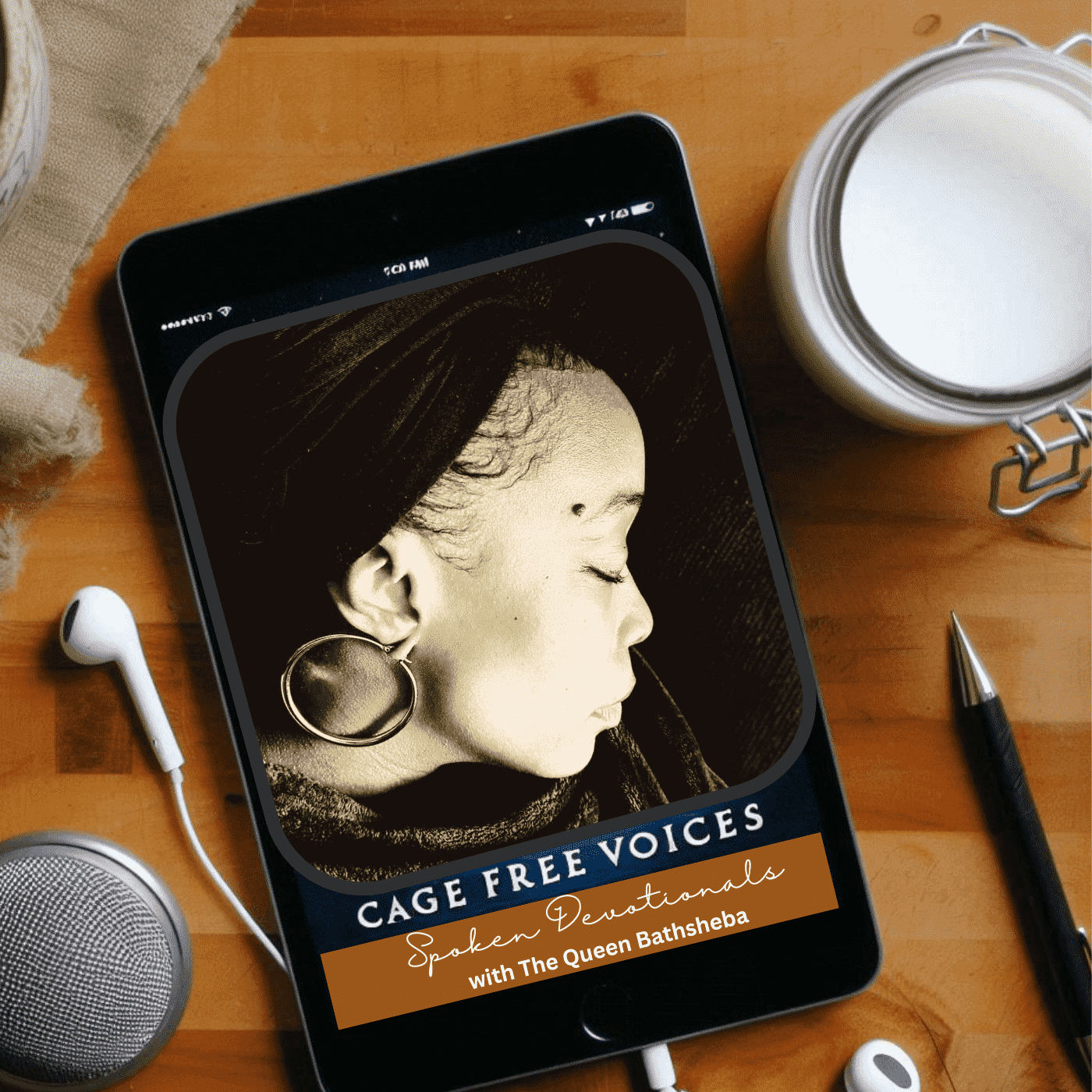
Cage Free Voices Spoken Devotionals
by CFVSpokenDevotionals
Cage Free Voices Spoken Devotionals is dedicated to guiding individuals on the journey to becoming their highest, God-given selves. While many associate being “cage free” with doing whatever one pleases, our definition goes deeper: to be cage free is to no longer be bound by the things that once held you captive, but instead to live in a way that reflects the freedom and purpose found in becoming who God created you to be—a direct reflection of His glory.
Episodes
-
Weaponizing Scripture Part II: Judging the Tree Without Judging the Heart
*This episode was recorded in a space where there was a great deal of background noise. Don't worry, all of it was eliminated during production. The Queen Bathsheba explores how the Bible can be misused to control and harm, sharing her own experience to distinguish judging a person’s heart from...
-
On the Authority to Correct: Proximity, Relationship, and the Ethics of Rebuke
Who Gave You the Right to Correct Me? Why could Nathan confront King David, but a stranger online can’t condemn a pastor they’ve never met? We trace every major rebuke in Scripture and find a pattern: real correction always comes through relationship, proximity, or clear divine commissioning —...
-
Dear Children of God
The Queen Bathsheba delivers a powerful Cage Free Voices devotional calling out hypocrisy in religious authority and insisting that true peace can only come after truth. She challenges those who wield scripture to sanctify oppression and urges listeners not to accept a manufactured peace built on...
-
Is Your Warfare Actually Warfare? Rethinking Spiritual Warfare, Worship, and the Weapons God Actually Names
The Queen Bathsheba examines biblical spiritual warfare as posture, truth, and submission rather than loud performance or emotional display. Drawing on examples like Jehoshaphat, Jericho, Paul and Silas, David and Saul, Daniel, and Jesus, she argues the true weapons are the word of God and...
-
Weaponizing the Word Part I: How Scripture Gets Bent to Exercise Abuse and Protect Power
The Queen Bathsheba shares a personal account of clergy misconduct and childhood abuse to show how religious language—rules about modesty, submission, and divorce—can be twisted to protect abusers and silence victims. The episode examines scriptural passages and historical context, highlights...
-
Waiting on God? Discerning Faith from Longing
The Queen Bathsheba examines what it means to wait on God versus waiting out of unhealed desire, questioning whether endurance alone proves divine promise. The episode contrasts biblical examples (Joseph, Abraham, Ishmael, Shadrach, Meshach, and Abednego) to show the difference between covenantal...
-
Be Like Jesus?
*The reference to Yeshua not having been taught is in relation to his advanced knowledge—not study of Torah in his early years (ages 6 -7). The Queen Bathsheba examines Jesus as a first-century observer would have seen him: a scandalous birth, humble origins, unconventional methods, and bold…
more -
Concerning Noah’s Nakedness & The Curse Part IV: The Grandson Theory
In this final episode of the series, The Queen Bathsheba presents the "grandson theory," arguing that Canaan—not Ham—was the one who violated Noah, while Ham simply discovered and reported the incident. The episode examines the passage's language, timeline, and later biblical evidence (including...
-
Concerning Noah’s Nakedness and the Curse Part III: The Maternal Incest Theory Explained
Host The Queen Bathsheba examines Genesis 9’s phrase “the nakedness of his father” (ervat aviv) and explores the maternal incest theory: that Ham violated Noah by violating Noah’s wife, a breach of the family covenant linked to Levitical language on forbidden relationships. The episode considers...
-
Concerning Noah's Nakedness and the Curse Part II: The Ham Controversy
The Queen Bathsheba explores the second part of the Noah story, focusing on the "direct paternal violation" theory: did Ham commit a grievous act against Noah that justified the curse on Canaan? The episode reviews traditional readings from Genesis, Talmudic and rabbinic interpretations, and the...
-
Concerning Noah’s Nakedness and the Curse Part I: What Really Happened?
Part 1 of this series examines Genesis 9’s puzzling account where Noah is found uncovered and curses Canaan. The episode explores timeline details, Hebrew wording, and the connection to Levitical language to clarify what the text actually says. It surveys major interpretations—whether the offense...
-
The Father Has Two Sons — Rethinking the Prodigal
The Queen Bathsheba revisits Luke 15:1–32 to retell the parable commonly called the prodigal son, examining the wider context of tax collectors, Pharisees, and the symbolism of the table. She explores both sons’ perspectives—the younger who leaves and the older who stays—to reveal the father’s...
-
Christlikeness Is Not Niceness: The Lion and the Lamb
Correction: *Yeshua tells them to sell their cloaks and get swords in Luke 22:36. The Queen Bathsheba challenges the misconception that Christlike humility equals weakness. This episode explores how Yeshua embodied both tender mercy and unstoppable authority—teaching believers when to surrender,...
-
When Fruit Attracts Flies: The Fig Leaves and the Fig Tree
The Queen Bathsheba explores how genuine spiritual fruit—like fresh fruit—draws both blessing and opposition, using fruit flies and the fig tree as vivid metaphors. She traces the fig image from Eden through the prophets to Yeshua's cursing of the fig tree, exposing the danger of outward...
-
Dominion Without Domination Part II: The Great Reversal
The Queen Bathsheba explores how Genesis reveals partnership, how Genesis 3 introduced domination, and how the gospel calls us to restore God’s original design. She examines Pauline instructions in context, arguing they address specific congregational problems rather than overturning creation’s...
-
Dominion Without Domination Part I : Before the Fall
Was male rule over women ever God’s original design? For centuries, Genesis 3 has been used to define gender roles, but what if we’ve been reading the consequences of the Fall as though they were God’s commands? In this thought-provoking episode, we return to the beginning—not to human tradition,...
-
Sex, Worship, and Covenant Part V: God’s Welcome for the Differently Abled
*Content Advisory: This episode contains discussions of disability, neurodiversity, infant exposure, abuse, exploitation, death, and other historical practices from the ancient world. These topics are presented for biblical, historical, and educational purposes and may be difficult for some...
-
The Net That Gathers All: God Sees Hearts, Not Labels
The Queen Bathsheba explores Matthew 13:47–50 to show that God’s kingdom gathers people from every background, but final separation is based on righteousness of the heart, not external categories or identities. She explains that true righteousness is expressed in justice, mercy, faithfulness, and...
-
Joseph — The Stepfather King
In this Father's Day devotional, The Queen Bathsheba explores Joseph as the overlooked "stepfather king"—a descendant of David whose quiet righteousness, obedience, and sacrificial stewardship shape Yeshua's earthly life. The episode traces Joseph's legal and royal identity, his faithful response...
-
Sex, Worship, and Covenant — Part IV: When Humanity Becomes Currency
The Queen Bathsheba examines the commodification of human life across the biblical narrative, tracing practices from child sacrifice and sexualized religious economies in the Old Testament to slavery, exposure, and structural exploitation in the Greco-Roman world. The episode contrasts a covenant...
-
Should Women Keep Silent in the Churches? A Biblical Deep Dive
The Queen Bathsheba examines the controversy over whether women should keep silent in churches by studying 1 Corinthians 14 and 11, placing Paul’s words in their congregational and cultural context amid recent debates such as the Southern Baptist Convention vote. The episode argues Paul’s concern...
-
Whose Side Are You On? — The Question Jesus Never Answered
In every generation, human beings are trained—overtly and subtly—to answer the same question: Whose side are you on? It is a question that assumes the world is divided into clean categories, where people can be sorted into camps of right and wrong, loyalty and betrayal, us and them. But when…
more -
Sex, Worship, & Covenant Part III: Roman Slavery, Sexual Order, Covenant Breakdown, and the Temple of the Holy Spirit
Host Queen Bathsheba continues Part 3 of Sex, Worship, and Covenant, examining Roman slavery, sexual order, child exposure, prostitution, and concubinage to explain the social world behind Paul’s words in 1 Corinthians 6:19–20. The episode shows how the gospel transforms identities—declaring...
-
Sex, Worship, & Covenant Part II: Sex, Power, and Marriage: From Ancient Rome to English Law
Host Queen Bathsheba explores how ideas about sex and marriage transformed from Roman practices through early Christianity to medieval English law in Part Two of Sex, Worship, and Covenant. The episode traces Roman sexual hierarchies, the covenantal shift in early Christian teaching, and how...
-
Sex, Worship, & Covenant Part I: Fornication: What Does It Really Mean?
This episode explores the biblical concept of fornication beyond the modern definition of “sex before marriage,” tracing its meaning through Scripture, language, and ancient culture. We begin with the Hebrew word zanah, which refers to both literal sexual immorality and spiritual unfaithfulness.…
more -
No Weapon Shall Prosper — Covenant Over Suffering
Host Queen Bathsheba examines Isaiah 54:17, explaining that the verse promises covenantal victory rather than immunity from suffering. The episode distinguishes between temporary pain and God’s enduring purposes, showing how suffering can coexist with spiritual triumph. Through biblical...
-
Silence Is Not Peace: When Permission Becomes Participation
The Queen Bathsheba leads a spoken devotional confronting the danger of silence that enables harm. Using Yeshua's example, she contrasts inward-only spirituality with acts that protect abusive systems, urging listeners to discern fruit, expose distortion, and choose people over reputation. This...
-
Wrestling with God: When Anger Becomes the Beginning Of Healing
In this episode, we explore how deep anger—born from grief, betrayal, and injustice—becomes the beginning of healing when brought honestly before God. Drawing on biblical examples like Jonah, Moses, and Job, the host shares personal testimony about carrying resentment and learning to surrender to...
-
Walking in the Light: Discernment Beyond Credentials
In this episode we reassess a controversy involving a public figure who has not fully disclosed the basis of her claimed expertise. The host explains that credentials and scholarship matter, but distinguishes privacy from secrecy, and contrasts legitimate degrees with branding or trademarked…
more -
Queen Mother: The Hidden Throne: Mothers Who Shape Kingdoms
This episode explores the biblical office of the Gebirah—the queen mother—and how mothers historically and today shape leaders, nations, and generations through hidden influence, intercession, and formation. Host The Queen Bathsheba reflects on examples from Scripture, honors the many forms of...
-
Discerning the Roots of the Troubled Mind Part IV: Restoration Over Intensity
*Please disregard the glitch in the middle of the episode. In Part 4 of Discerning the Roots of the Troubled Mind, Queen Bathsheba explores how to distinguish spiritual, psychological, physical, cultural, and philosophical causes of human distress, emphasizing that discernment must precede...
-
Discerning the Roots of the Troubled Mind Part III: When Healing Disrupts Systems- Trauma, Memory, and the Economics of Helplessness
Part 3 of “Discerning the Roots of the Troubled Mind” explores how trauma, memory, and healing intersect with systems that may benefit from prolonged helplessness. Drawing on both Scripture and neuroscience, this episode unpacks how unresolved wounds are stored in the mind and body, how genuine...
-
Discerning the Troubled Mind Part II — The Embodied Mind, Spiritual Atmospheres, and the Battle for Human Wholeness
Host Queen Bathsheba explores part two of discerning the roots of the troubled mind, diving into the embodied mind, spiritual atmospheres, and the battle for human wholeness. Using the Gospel account of the man among the tombs, the episode shows how biological dysregulation, environmental...
-
Discerning the Roots of the Troubled Mind Part I
Join The Queen Bathsheba on Cage Free Voices Spoken Devotionals as she begins a new series exploring the roots of the troubled mind, distinguishing biological, emotional, spiritual, and divine causes of mental instability. This episode calls for discernment, compassion, and a balanced, holistic...
-
Who Told You That Was Your Business?
The Queen Bathsheba examines the dangerous habit of judging others without God’s assignment, drawing on Genesis, Numbers, and New Testament warnings. She contrasts visibility with authority and explains how presumption—not observation—is what Scripture condemns. The episode calls listeners to...
-
Eternal Spirit Unveiled: Living From Resurrection Power
In this episode Queen Bathsheba defines the eternal spirit, the soul, the body, and the role of Holy Spirit, explaining how resurrection power and faith connect our eternal essence to everyday life. She explores how aligning spirit, soul, and body through rebirth, renewed mind, and obedience...
-
What Can Separate Us: Sin, Death, The Grave…?
The Queen Bathsheba explores sin, life, and death, explaining that God did not cancel humanity but offered life through Yeshua. The episode shows that the dividing issue is not sin itself but the refusal to receive the gift of life that overcomes death. She unpacks scripture to show that…
more -
What Is the Resurrection? What Is Resurrection Power?
If Yeshua was already the resurrection, then what happens in the grave? This episode unpacks how resurrection power breaks into time, making eternal life active and present in the everyday.
-
Good Friday: Jesus, James, & John
The Queen Bathsheba reflects on Good Friday by focusing on Yeshua's brother James and the surprising decision to entrust Mary to John. The episode explores how familiarity can blind faith, the importance of presence in suffering, and James’s journey from doubt to leadership after the…
more -
Healing By Design: When the Mind Hides the Soul: A Healing Journey
This episode of Cage Free Voices Spoken Devotionals explores the slow, often hidden process of healing when the mind suppresses the soul. The Queen Bathsheba reflects on her therapy session, a poignant poem, and how survival mechanisms like overthinking, emotional numbing, and constant noise can...
-
Healing By Design: Why Trauma Healing Makes the Body Tired
In this spontaneous episode of Cage Free Voices Spoken Devotionals, The Queen Bathsheba dives into why trauma healing can leave us feeling deeply drained. She unpacks how trauma is stored in the nervous system and why the biological work of healing is metabolically demanding. As the…
more -
Healing by Design: An Unplanned Interruption: The Cries of Your Inner Child
This episode explores an unplanned moment in which the host’s inner child surfaces as she deliberately slows, allowing long-held pain to emerge safely. Through personal reflection and clear insights into the parasympathetic nervous system and the biology of emotional tears, it highlights how…
more -
Healing By Design DAY 2 — Humility as Healing: Reordering the Self and the Body
The Queen Bathsheba explores how pride and humility influence both body and soul, presenting humility as an honest recognition of one’s place that shifts the nervous system from survival mode to repair mode. She weaves together biblical and philosophical insights with physiological understanding,...
-
Provision Is Not Permission: Why God’s Presence Never Sanctifies Abuse
In this episode of Cage-Free Voices Spoken Devotionals, The Queen Bathsheba explores Genesis 16 and 21 to distinguish between God’s provision and the misuse of that provision by others. Through the stories of Hagar, Sarai, and Ishmael, she emphasizes that God’s care does not imply approval of…
more -
Healing By Design: The Biology of Sin and the Theology of Restoration: Day One: Order, Pride, Disorder, and the Conditions for Healing
The Queen Bathsheba presents Healing by Design, a six-part devotional series exploring the connection between Scripture and the body’s biology. The series shows how pride disrupts the natural order, creating stress and imbalance, and how God’s grace restores alignment and wholeness. In this first...
-
From Milk and Honey to Living Water to Resurrection: Understanding the Kingdom of God in Covenant and History
This episode examines the biblical images of milk and honey, showing how they illustrate God’s promise of provision, land, and freedom. It then follows how these promises shift inward to living water and the internal kingdom. The episode explains that covenant life sustains faith under empire…
more -
Phobias, Schisms, & Isms: When the Scales Fall Off
The Queen Bathsheba examines how fear-driven readings of Scripture have justified racism, homophobia, sexism, and exclusion, and calls listeners to unlearn harmful traditions. She urges a faith rooted in context, compassion, and the inclusive love of God that honors diversity and welcomes the...
-
Words, Judgment, and the Call to Love
The Queen Bathsheba explores judgment, social media criticism, and the biblical call to love and gentle restoration, urging listeners to prioritize relationship and compassion over public shaming. Drawing on Matthew 7 and Galatians, she encourages speaking thoughtfully, correcting with care, and...
-
God vs. Humanity: Why We Cannot Judge the Creator
The Queen Bathsheba responds to a TikTok claim and explores why humans cannot judge God by human standards, using the Immaculate Conception and the Virgin Mary as a case study. She explains that God exists outside time, is the Creator while we are created, and that measuring divine action with...
-
Cannabis: The Plant They Tried to Hide
This episode of Cage-Free Voices Spoken traces the history and meaning of qaneh bosem/kaneh bosem in the Bible, exploring translation choices, ancient botany, and the role of aromatic plants in worship. It connects biblical language to the historical criminalization of cannabis, examines how…
more
We're indexing this podcast's transcripts for the first time — this can take a minute or two. We'll show results as soon as they're ready.
No matches for "" in this podcast's transcripts.
No topics indexed yet for this podcast.
Loading reviews...
ABOUT THIS SHOW
Cage Free Voices Spoken Devotionals is dedicated to guiding individuals on the journey to becoming their highest, God-given selves. While many associate being “cage free” with doing whatever one pleases, our definition goes deeper: to be cage free is to no longer be bound by the things that once held you captive, but instead to live in a way that reflects the freedom and purpose found in becoming who God created you to be—a direct reflection of His glory.
HOSTED BY
CFVSpokenDevotionals
CATEGORIES
Loading similar podcasts...
Frequently Asked Questions
How many episodes does Cage Free Voices Spoken Devotionals have?
Cage Free Voices Spoken Devotionals currently has 121 episodes available on PodParley. New episodes are automatically indexed when they're published to the podcast feed.
What is Cage Free Voices Spoken Devotionals about?
Cage Free Voices Spoken Devotionals is dedicated to guiding individuals on the journey to becoming their highest, God-given selves. While many associate being “cage free” with doing whatever one pleases, our definition goes deeper: to be cage free is to no longer be bound by the things that once...
How often does Cage Free Voices Spoken Devotionals release new episodes?
Cage Free Voices Spoken Devotionals publishes regularly with 121 episodes available. Check the episode list for the typical release schedule.
Where can I listen to Cage Free Voices Spoken Devotionals?
You can listen to Cage Free Voices Spoken Devotionals on PodParley by clicking any episode. We provide an embedded audio player for direct listening, and you can also subscribe via your preferred podcast app using the RSS feed.
Who hosts Cage Free Voices Spoken Devotionals?
Cage Free Voices Spoken Devotionals is created and hosted by CFVSpokenDevotionals.
URL copied to clipboard!