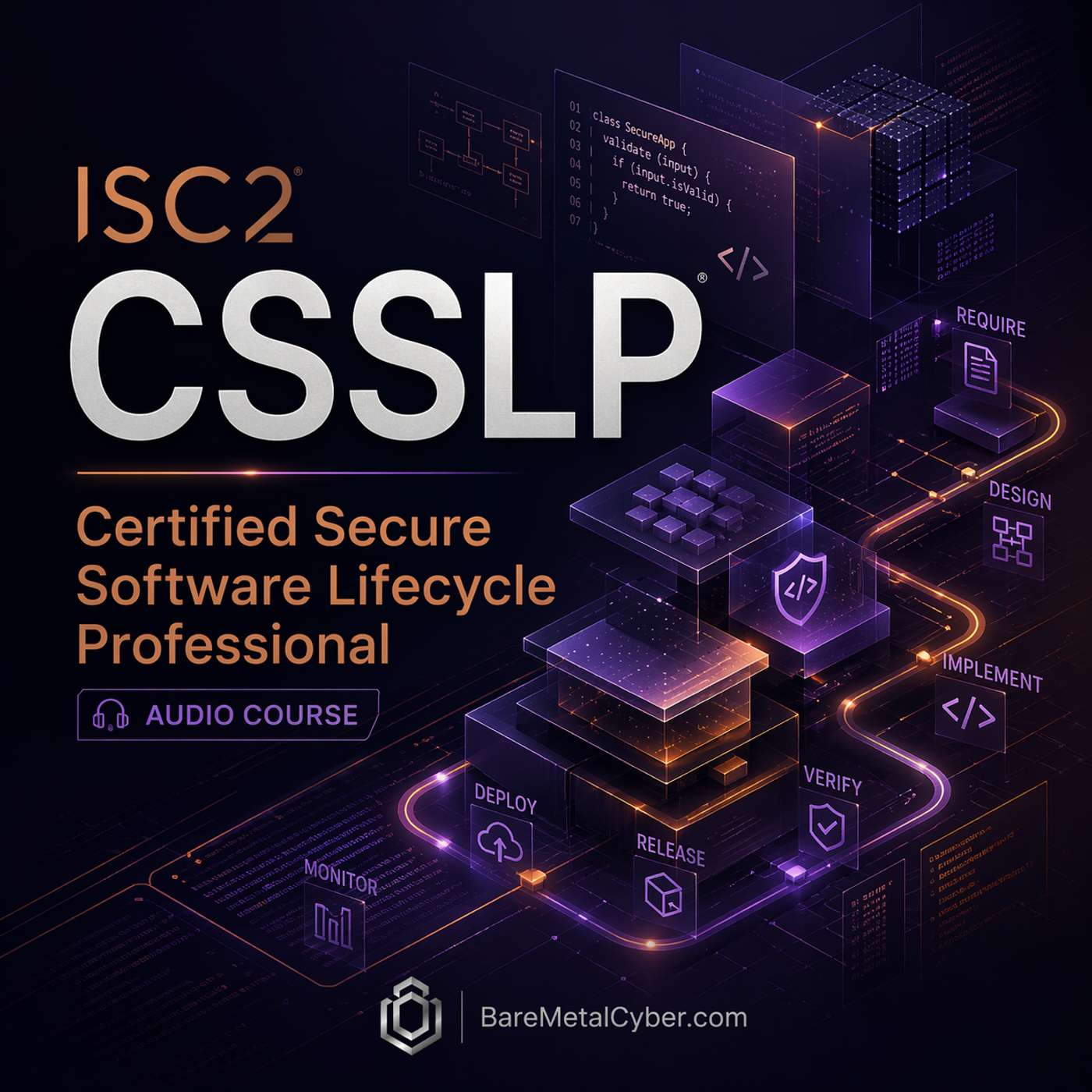
Certified: The ISC2 CSSLP Audio Course
by Dr. Jason Edwards
This audio-only CSSLP prep course is built for busy security professionals who want to study anywhere, without a screen. Across 70 tightly focused episodes, you’ll walk the full Certified Secure Software Lifecycle Professional exam blueprint, from requirements and architecture to implementation, testing, operations, and supply chain risk. Each episode is structured as a guided journey: clear concepts, concrete examples, pitfalls to avoid, and quick mental rehearsals you can follow along with in real time.You’ll hear practical takes on exam strategy, secure design principles, SDLC integration, threat modeling, metrics, documentation, incident response, and more, all in plain language. Recap checkpoints, glossary episodes, and acronym refreshers reinforce what you’ve learned so it sticks when you sit for the exam. Whether you’re commuting, at the gym, or in between meetings, this podcast turns small pockets of time into steady progress toward your CSSLP.
Episodes
-
Episode 70 — Essential Terms: Plain-Language Glossary for Fast Review
Key terms and principles appear throughout the CSSLP exam, and being able to recall them quickly in plain language is essential for reading questions correctly and evaluating answer options. This episode presents a concentrated glossary of high-yield concepts such as least privilege, defense in...
-
Episode 69 — Crush Exam Day With Calm, Repeatable Tactics
Exam day performance depends as much on process as on knowledge, and CSSLP candidates who manage time, stress, and attention methodically have a clear advantage. In this episode, you walk through the logistics and mindset that support a predictable exam experience, starting with arrival planning,...
-
Episode 68 — Recap Checkpoint: Domains Seven and Eight Mastery
Later CSSLP domains extend security thinking into supply chain, operations, and broader governance, and a focused recap helps integrate these topics into a cohesive mental model. This episode revisits core themes such as supplier onboarding and lifecycle oversight, contractual guardrails,...
-
Episode 67 — Support Contracts, Intellectual Property, and Software Escrow
Contracts define how legal, operational, and security responsibilities are shared, and the CSSLP exam often expects you to interpret these agreements from a security and risk perspective. In this episode, you look at how intellectual property ownership, license terms, and confidentiality clauses...
-
Episode 66 — Enforce Supplier Security Requirements Through Lifecycle Oversight
Supplier security cannot be assured at contract signing alone; it has to be monitored and enforced throughout the full relationship, which is a recurring theme in CSSLP scenarios. In this episode, you examine how to translate internal security expectations and regulatory obligations into concrete...
-
Episode 65 — Verify Component Pedigree and Provenance to Reduce Risk
Component pedigree and provenance determine whether you can trust the origins and integrity of the software building blocks in your systems, and the CSSLP blueprint highlights this as a critical element of modern assurance. This episode explains what pedigree and provenance mean in practice:...
-
Episode 64 — Analyze Third-Party Software Security Before Adoption
Choosing a new third-party product or service is effectively choosing to share risk with another organization, and CSSLP questions often examine how thoughtfully that decision is made. This episode outlines the key elements of pre-adoption security analysis, starting with understanding the...
-
Episode 63 — Implement Comprehensive Supply Chain Risk Management Practices
Software today depends on a layered supply chain of cloud platforms, third-party services, open-source components, and commercial products, and the CSSLP exam expects you to treat this web of dependencies as a primary risk focus. This episode introduces the core steps of supply chain risk...
-
Episode 62 — Align Service Levels and SLAs With Security Outcomes
Service levels and formal SLAs influence how software and supporting services are designed, monitored, and improved, and CSSLP items increasingly connect these agreements to security expectations. This episode explains how to define service level indicators and objectives that capture not only...
-
Episode 61 — Support Business Continuity and Disaster Recovery Objectives
Business continuity and disaster recovery planning connect directly to the CSSLP focus on availability, resiliency, and risk treatment across the software lifecycle. This episode explains how to identify critical business services, map them to specific applications and data stores, and understand...
-
Episode 60 — Integrate Runtime Protection Controls for Live Defenses
Runtime protection adds an active defensive layer while applications are serving real users, and CSSLP questions increasingly probe how these controls fit with design, testing, and operations. Core capabilities discussed here include web application firewalls and API gateways that enforce…
more -
Episode 59 — Operate a Measurable Vulnerability Management Program Continually
Vulnerability management goes beyond running scanners; it is a continual process of discovering, assessing, and closing real weaknesses, and the CSSLP exam examines whether that process is balanced and evidence-driven. Emphasis is placed on maintaining inventories that relate assets to business...
-
Episode 58 — Run Patch Management Effectively Without Business Disruption
Patch management connects vulnerability knowledge to operational change, and the CSSLP exam focuses on whether this connection is timely, prioritized, and controlled. The process begins with accurate asset inventories that record software versions, ownership, business criticality, and maintenance...
-
Episode 57 — Execute the Incident Response Plan With Confidence
Incident response is where plans and controls are tested under stress, and CSSLP scenarios often examine whether organizations can move from detection to containment and recovery in a structured way. Core concepts in this episode include defining what constitutes an incident versus a minor event,...
-
Episode 56 — Monitor Security Using Meaningful, Observable Telemetry
Security telemetry turns raw events into insight about how systems behave, which threats are active, and whether controls are working as intended, and the CSSLP exam expects you to recognize effective monitoring designs. The starting point is defining clear questions that telemetry must answer,...
-
Episode 55 — Obtain Authority to Operate Through Evidence and Assurance
Authority to operate represents formal acceptance of risk and confirmation that required controls are in place, and the CSSLP exam views it as the culmination of many lifecycle activities. This episode describes how to define the scope of a system seeking authorization, including boundaries,...
-
Episode 54 — Ensure Secure Installation and Deployment Procedures Consistently
Installation and deployment procedures are moments of high risk, when new systems, configurations, and paths are created, and the CSSLP exam frequently examines whether those moments are controlled. This episode explains how to design installation processes that verify prerequisites, validate...
-
Episode 53 — Manage Secrets, Keys, and Sensitive Configurations Securely
Secrets management sits at the center of many high-impact breaches, and the CSSLP exam expects a disciplined approach across the entire secret lifecycle. This episode clarifies what counts as a secret, including passwords, API keys, certificates, private keys, tokens, and sensitive configuration...
-
Episode 52 — Release Software Safely Through a Hardened CI/CD
Continuous integration and continuous delivery pipelines determine how changes reach production, and the CSSLP exam increasingly reflects the need to secure those paths end-to-end. This episode outlines the structure of a typical CI/CD setup, including source control, build stages, artifact...
-
Episode 51 — Enforce Secure Configuration Baselines Across Environments
Secure configuration baselines define the minimum hardening level every system must meet, and the CSSLP exam treats them as fundamental controls rather than optional refinements. This episode explains how baselines are derived from sources such as vendor guidance, regulatory expectations…
more -
Episode 50 — Perform Operational Risk Analysis to Guide Controls
Operational risk analysis connects live system behavior to the choice and tuning of security controls, and the CSSLP exam frequently evaluates whether that connection is clear. The process begins with inventorying services, dependencies, privileges, and customer-facing transactions, then...
-
Episode 49 — Recap Checkpoint: Implementation and Testing Essentials
Implementation and testing domains contain a dense set of practices that influence almost every other part of the CSSLP blueprint, and pausing for a structured recap helps solidify those connections. The emphasis at this checkpoint is on revisiting secure coding fundamentals, input validation,...
-
Episode 48 — Perform Independent Verification and Validation for Assurance
Independent verification and validation provide a higher level of assurance that systems meet their stated requirements and security objectives, and the CSSLP exam expects you to recognize what true independence entails. The focus here is on separating responsibilities so that the group…
more -
Episode 47 — Protect and Govern Security Test Data End-to-End
Security test data presents a unique challenge because it must be rich enough to exercise realistic conditions while still respecting confidentiality, privacy, and regulatory constraints. The starting point in this episode is understanding how to classify test data according to sensitivity…
more -
Episode 46 — Analyze Test Results and Track Defects Rigorously
Security testing only creates exam-relevant value when the results are analyzed systematically and defects are tracked from first observation through final closure. In this episode, the focus is on consolidating outputs from multiple sources such as static analysis tools, dynamic testing,...
-
Episode 45 — Verify Documentation and Uncover Undocumented System Behavior
Documentation is often treated as a static description of a system, yet the CSSLP exam expects you to recognize that written artifacts must be validated against reality. This episode focuses on comparing policies, standards, procedures, and runbooks with what systems actually do, especially…
more -
Episode 44 — Conduct Penetration and Fuzz Testing With Purpose
Penetration testing and fuzzing provide deep, focused insight into how systems behave under hostile conditions, and the CSSLP exam emphasizes the need for clear objectives and disciplined execution. This episode explains how to define rules of engagement for penetration tests, including in-scope...
-
Episode 43 — Automate DAST and IAST for Continuous Coverage
Dynamic application security testing and interactive application security testing are powerful when configured and integrated correctly, and CSSLP questions often explore whether they are being used thoughtfully rather than just switched on. This episode describes how DAST exercises running...
-
Episode 42 — Design Targeted Attack Surface Test Cases Clearly
Attack surface testing delivers the most value when each test case has a crisp hypothesis about how an exposed element might fail, and the CSSLP exam reflects this focus on precision. This episode explores how to move from a high-level inventory of endpoints, protocols, and entry points to…
more -
Episode 41 — Plan a Cohesive Security Testing Strategy Upfront
Security testing is most effective when it grows out of a deliberate strategy rather than a scattered collection of tools and ad hoc activities, and the CSSLP exam tests your ability to recognize that structure. This episode explains how to define the scope of a security testing strategy by…
more -
Episode 40 — Secure the Build Pipeline and Protect Artifacts
Build and release pipelines have become prime targets for attackers, and the CSSLP exam increasingly reflects the need to treat them as critical security assets. This episode outlines the components of a typical pipeline, from source repositories and build runners to artifact registries and...
-
Episode 39 — Integrate Components Safely to Minimize Hidden Couplings
Modern systems depend on many interacting components, and the CSSLP exam emphasizes whether those integrations are designed to limit risk rather than amplify it. Core ideas in this episode include maintaining a comprehensive inventory of components and dependencies, defining stable contracts...
-
Episode 38 — Treat Identified Risks and Track Remediation Through Closure
Risk treatment is the process of moving from awareness to action, and CSSLP exam scenarios frequently test whether you can manage that journey in a disciplined, traceable way. Attention is placed on triaging risks based on impact, likelihood, exposure time, and business criticality, rather than...
-
Episode 37 — Implement Application Security Controls That Actually Work
Application security controls only deliver value when they are correctly implemented, consistently enforced, and aligned with realistic use cases, and the CSSLP exam often probes for gaps between intentions and execution. Focus here is on controls such as authentication checks, authorization...
-
Episode 36 — Analyze Code to Uncover Latent Security Risks
Code analysis is where design assumptions meet implementation reality, and the CSSLP exam expects you to understand how careful review reveals risks that are not obvious from diagrams or requirements alone. This episode explains how to approach a codebase with a structured mindset, starting from...
-
Episode 35 — Sanitize Inputs and Handle Errors Without Leaks
Input sanitization and careful error handling protect systems from both direct exploitation and inadvertent information disclosure, and this combination appears repeatedly across CSSLP domains. Attention is directed toward validating data at boundaries using schemas, length checks, format...
-
Episode 34 — Apply Secure Coding Fundamentals Across Languages and Stacks
Secure coding fundamentals are language-agnostic habits that reduce entire classes of vulnerabilities, and CSSLP questions routinely distinguish between code that applies these fundamentals and code that does not. Key concepts covered here include input validation, output encoding, secure use of...
-
Episode 33 — Exam Acronyms: Quick Audio Reference for Learners
Acronyms compress key ideas into a few letters, and the CSSLP exam uses them heavily, expecting you to recall what they stand for and how they relate to secure software lifecycles. Focus is placed on expanding the most common terms you will encounter, such as CIA, AAA, RBAC, ABAC, SSO, MFA, TLS,...
-
Episode 32 — Model Constraints and Operational Architecture for Reality
Systems rarely run in ideal conditions, and the CSSLP exam frequently explores how well designs account for the constraints and operational realities they will face. Attention here centers on identifying and modeling key limitations such as latency budgets, throughput requirements, cost ceilings,...
-
Episode 31 — Conduct Architectural Risk Assessments That Drive Mitigations
Architectural risk assessments sit at the point where design intent meets real-world threats, and the CSSLP exam expects you to recognize when these assessments are thorough, repeatable, and tied to actual decisions. The focus here is on defining a clear scope that includes critical assets, trust...
-
Episode 30 — Evaluate Attack Surface Using Intelligence and Context
Attack surface evaluation tells you where a system is exposed and how attractive those exposures are to real adversaries, and the CSSLP exam expects you to blend technical discovery with contextual understanding. This episode sets out a disciplined approach to enumerating assets, interfaces…
more -
Episode 29 — Model Threats Effectively Using STRIDE and PASTA
Threat modeling is one of the most powerful analytical tools in the CSSLP toolkit, and structured methods like STRIDE and PASTA help you apply it consistently. This episode explains how to define the scope of a threat model by identifying assets, actors, trust boundaries, and critical data flows....
-
Episode 28 — Apply Virtualization and Trusted Computing to Strengthen Platforms
Virtualization and trusted computing concepts give you tools to isolate workloads, prove platform integrity, and protect secrets, and the CSSLP blueprint expects familiarity with these capabilities. This episode introduces how hypervisors, containers, and micro-VMs segment workloads and limit…
more -
Episode 27 — Select Identity and Credential Technologies That Scale
Identity and credential technologies underpin almost every control discussed in the CSSLP, yet many exam scenarios hinge on subtle choices about how those technologies are selected and deployed. This episode reviews the main categories of authentication factors, the difference between traditional...
-
Episode 26 — Perform Secure Interface Design for Trustworthy Integrations
Secure interfaces act as contracts between components, teams, and organizations, and the CSSLP exam frequently tests whether those contracts are designed to resist misuse and failure. This episode explores how to define an interface’s purpose, data flows, preconditions, and postconditions in...
-
Episode 25 — Establish Secure Architecture and Foundational Design Choices
Architecture decisions set the long-term security posture of a system, and CSSLP questions often explore whether those decisions create strong or fragile foundations. This episode explains how to articulate architectural goals that balance security, performance, reliability, and operability, and...
-
Episode 24 — Recap Checkpoint Covering Domains One Through Three
Early CSSLP domains lay the groundwork for how you think about requirements, architecture, and design, and a structured recap helps reinforce those connections before you move deeper into the blueprint. This episode revisits the central themes from the first three domains, including security...
-
Episode 23 — Set Enforceable Third-Party and Supplier Security Requirements
Third-party relationships extend your attack surface and regulatory obligations, and the CSSLP exam expects you to treat supplier security as an integral part of the software lifecycle. This episode explains how to define clear, enforceable security requirements for suppliers by starting with the...
-
Episode 22 — Build Robust Security Requirement Traceability From Start
Traceability is the connective tissue that links risks, requirements, designs, tests, and evidence, and the CSSLP exam expects you to understand how that chain is constructed and maintained. This episode introduces the idea of assigning stable identifiers to risks, controls, and requirement...
-
Episode 21 — Develop Realistic Misuse and Abuse Cases for Resilience
Misuse and abuse cases push you to think like an attacker or a stressed user, and the CSSLP exam regularly checks whether you can anticipate negative behaviors before they appear in production. This episode explains how to start from normal use cases and systematically invert them, asking how...
About this show
This audio-only CSSLP prep course is built for busy security professionals who want to study anywhere, without a screen. Across 70 tightly focused episodes, you’ll walk the full Certified Secure Software Lifecycle Professional exam blueprint, from requirements and architecture to implementation, testing, operations, and supply chain risk. Each episode is structured as a guided journey: clear concepts, concrete examples, pitfalls to avoid, and quick mental rehearsals you can follow along with in real time.You’ll hear practical takes on exam strategy, secure design principles, SDLC integration, threat modeling, metrics, documentation, incident response, and more, all in plain language. Recap checkpoints, glossary episodes, and acronym refreshers reinforce what you’ve learned so it sticks when you sit for the exam. Whether you’re commuting, at the gym, or in between meetings, this podcast turns small pockets of time into steady progress toward your CSSLP.
Hosted by
Dr. Jason Edwards
Categories