
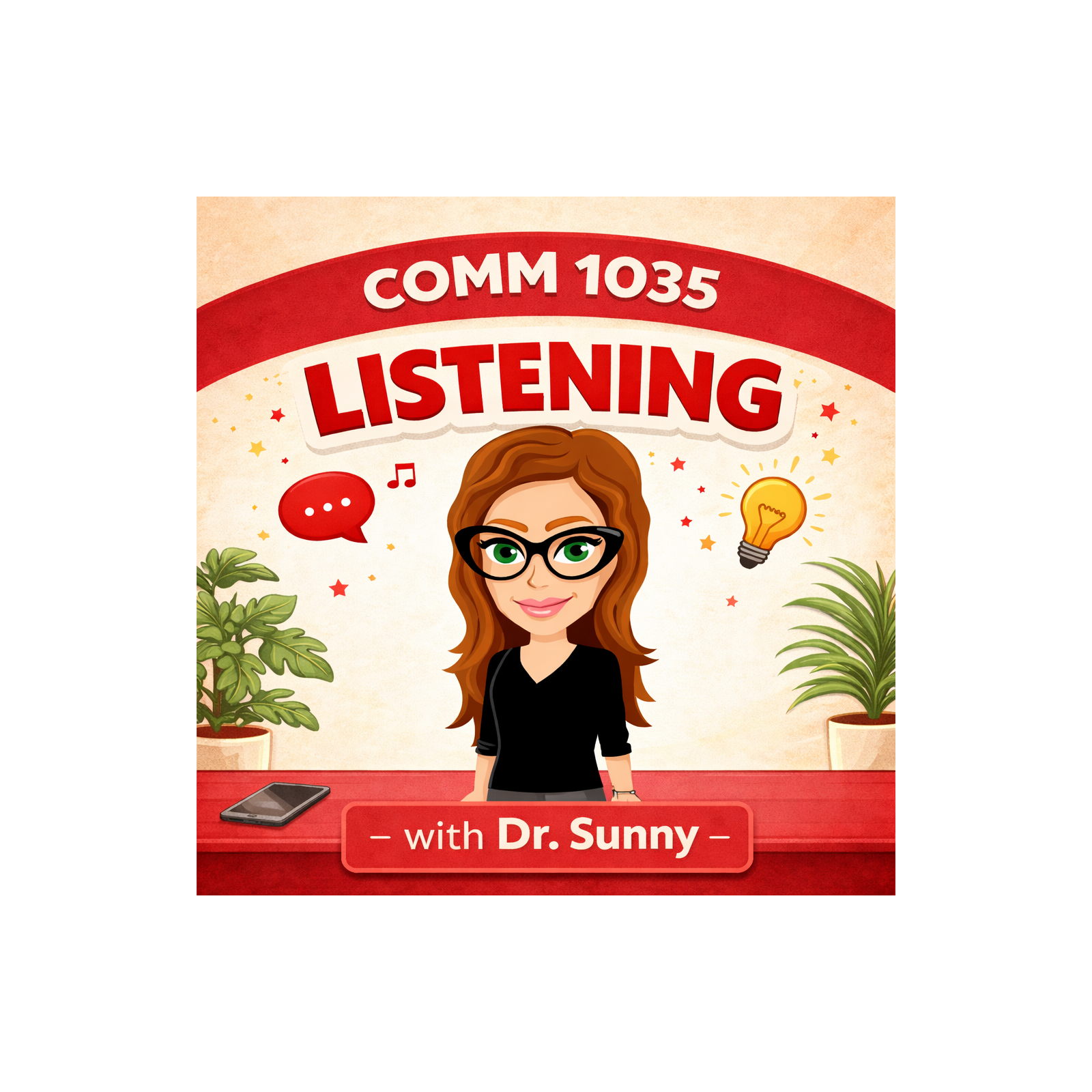
PODCAST · education
COMM 1035 Listening
by Sunny Skye Hughes
The Listening podcast series supports students’ understanding of listening as an active, cognitive, and strategic communication process. Across the course, episodes explore the mental processes and challenges involved in understanding spoken messages while introducing key theories, perspectives, and principles that shape effective listening. Students are guided to analyze how message types, contexts, response styles, and personal biases influence communication dynamics and meaning-making. The series also emphasizes critical listening skills, helping students evaluate the quality, reliability, and credibility of information they encounter in academic, professional, and everyday contexts. Through real-world examples and applied scenarios, the podcasts connect theory to practice, enabling students to deepen their understanding of listening processes and develop adaptive, resilient listening and response strategies for challenging communication situations.
Episodes
-
Unit 7 Lecture: Adaptive and Resilient Listening
Unit 7 focuses on adaptive and resilient listening, emphasizing how to remain effective when communication becomes difficult due to emotional reactions, cognitive overload, or environmental distractions. The lecture explains that listening breakdowns often result from internal triggers, limited...
-
Unit 7 Recap: Adaptive and Resilient Listening
As Unit 7 concludes, the focus shifts from simply understanding listening to being able to apply it effectively under pressure. You learned that the real challenge in communication is not comprehension in ideal conditions, but maintaining accuracy when faced with internal triggers, cognitive...
-
Unit 7 Overview: Adaptive and Resilient Listening
Unit 7 focuses on adaptive and resilient listening, shifting from simply understanding messages to maintaining effectiveness when communication becomes difficult, emotional, overwhelming, or high-stakes. You will learn how factors like internal triggers, cognitive overload, emotional intensity…
more -
Unit 6 Lecture: Evaluating Information Quality
In this lecture, you will learn how to move beyond simply understanding messages to actively evaluating their credibility. You will explore how listeners often rely on fast, automatic thinking, and how this can lead you to accept information too quickly based on confidence, emotion, or…
more -
Unit 6 Recap: Evaluating Information Quality
In Unit 6, we shifted from simply understanding messages to actively evaluating the quality of the information we hear. You learned that listening is not just about comprehension—it’s about determining whether a message is accurate, reliable, and credible. Using the EERB framework—expertise,...
-
Unit 6 Overview: Evaluating Information Quality
In Unit 6, you shift from focusing on how listening works to evaluating the quality of the information you hear. Instead of just asking what a message means, you begin asking whether it should be believed. You learn that not all information is equal—some messages are supported by strong evidence...
-
Unit 5 Recap: Response Styles and Personal Biases
In this episode, we wrap up Unit 5 by turning the focus inward. You’ve moved beyond analyzing communication from the outside and begun examining your own role within it. This unit explored how response styles and personal biases shape not only how you interpret messages, but how conversations...
-
Unit 5 Lecture: Response Styles and Personal Biases
In this episode, we take a deeper look at what really shapes communication—not just what is said, but how it is interpreted and how we respond. While earlier units focused on external factors like context and environment, this lecture shifts inward to explore the role of the listener. Why can two...
-
Unit 5 Overview Response Styles and Personal Biases
In Unit 5: Response Styles and Personal Biases, the focus shifts inward. If Unit 4 was about reading the room, this unit is about reading yourself. Even when messages are clear, communication can break down—not because of what was said, but because of how it was interpreted and how we respond.…
more -
Unit 4 Recap: Listening and Communication Context
In this recap of Unit 4, we reflect on how contextual intelligence transforms both speaking and listening. You’ve learned to identify relational, situational, cultural, power, and channel influences — and to apply them in real-world communication. As we reach the halfway point of the course, the...
-
Unit 4 Overview: Listening and Communication Contexts
In this Unit 4 overview, we introduce the central idea that words don’t carry meaning on their own — context does. This module explores the five key communication contexts (relational, situational, cultural, power, and channel) and how they shape interpretation in both speaking and listening....
-
Unit 4 Lecture: Listening with Contextual Intelligence
In this episode, we focus on how to listen with contextual awareness in real time—especially in personal, face-to-face conversations. Using a relatable relationship scenario, you’ll learn a practical step-by-step method for pausing before reacting, separating content from interpretation, and...
-
Unit 4 Lecture: Speaking with Contextual Intelligence
In this episode, we shift from analyzing how context shapes listening to learning how to speak with contextual awareness. Communication doesn’t fail only because people mishear us — it often breaks down because we ignore the relational, situational, cultural, power, and channel contexts…
more -
Unit 4 Lecture: Listening and Communication Contexts
In this episode, we explore how meaning is shaped not just by words, but by the contexts surrounding them. Using the recurring example, “Can we talk about your last report?”, we examine how relational context, situational context, cultural norms, organizational power structures, and communication...
-
Unit 3 Recap: Theories and Principles of Listening
In this Unit 3 recap, we revisited the major theories and principles that explain how listening works beneath the surface. Rather than viewing listening as automatic, the unit emphasized that listening is cognitive, emotional, relational, and interpretive all at once. We began with the HURIER...
-
Unit 3 Lecture: Theories and Principles of Listening
This Unit 3 lecture shifts from the “what” of listening to the “why” and “how” by introducing the major theories scholars use to explain listening. The unit’s main goal is to analyze and evaluate listening models—not just define them—so students can diagnose breakdowns and choose better responses...
-
Unit 3 Overview: Theories and Principles of Listening
In Unit 3, we move beyond understanding what listening is to exploring why and how it works through major communication theories. Earlier in the course, we examined attention, perception, and memory. Now, we focus on how scholars explain listening and how those theories help us analyze...
-
Unit 2 Recap on Barriers and Challenges in Listening
In Unit 2, we examined why listening often breaks down—not because people don’t care, but because barriers interfere with attention and understanding. We explored four major types of listening barriers: physical barriers like noise and technology issues; physiological barriers such as fatigue,...
-
Unit 2 Overview of Barriers and Challenges in Listening
Unit 2 focuses on the barriers and challenges that interfere with effective listening, emphasizing that even strong listeners encounter obstacles that affect understanding. This unit introduces four main types of listening barriers—physical, physiological, psychological, and semantic—and explains...
-
Unit 2 Lecture: Barriers and Challenges in Listening
This episode explores the barriers and challenges that interfere with effective listening, emphasizing that listening is an active skill influenced by both internal and external factors. It introduces four main types of listening barriers—physical, physiological, psychological, and semantic—and...
-
COMM 1035: How will you learn?
In this bonus episode, Dr. Sunny explains how you will be graded, the different types of assignments, and the course latework policy, as well as time expectations.
-
Welcome to COMM 1035 Listening
COMM 1035 is built around the idea that listening is an active, learnable skill that shapes how we learn, work, and connect with others. The course includes eight units, each following a clear, consistent structure that guides you through learning, applying, and reflecting on key listening...
-
Unit 1 Recap for The Foundations of Listening
In this recap episode, we review the key takeaways from Unit One. You learned the difference between hearing and listening, explored the stages of the listening process, and examined how attention, perception, schemas, and memory shape what we understand and remember. We also connected these...
-
Unit 1 Lecture: The Foundations of Listening
This lecture introduces listening as an active, cognitive process rather than a passive act of hearing. Students explore the key differences between hearing and listening, the three stages of listening (receiving, understanding, and remembering), and the roles of attention, perception, memory…
more -
Unit 1: Overview of the Foundations of Listening
Unit 1 introduces listening as an active process rather than a passive skill. Students learn to distinguish between hearing and listening by examining attention, perception, memory, and prior experiences that shape meaning-making. Through videos, knowledge checks, and applied activities, students...
We're indexing this podcast's transcripts for the first time — this can take a minute or two. We'll show results as soon as they're ready.
No matches for "" in this podcast's transcripts.
No topics indexed yet for this podcast.
Loading reviews...
ABOUT THIS SHOW
The Listening podcast series supports students’ understanding of listening as an active, cognitive, and strategic communication process. Across the course, episodes explore the mental processes and challenges involved in understanding spoken messages while introducing key theories, perspectives, and principles that shape effective listening.
Students are guided to analyze how message types, contexts, response styles, and personal biases influence communication dynamics and meaning-making. The series also emphasizes critical listening skills, helping students evaluate the quality, reliability, and credibility of information they encounter in academic, professional, and everyday contexts.
Through real-world examples and applied scenarios, the podcasts connect theory to practice, enabling students to deepen their understanding of listening processes and develop adaptive, resilient listening and response strategies for challenging communication situations.
HOSTED BY
Sunny Skye Hughes
Loading similar podcasts...
Frequently Asked Questions
How many episodes does COMM 1035 Listening have?
COMM 1035 Listening currently has 25 episodes available on PodParley. New episodes are automatically indexed when they're published to the podcast feed.
What is COMM 1035 Listening about?
The Listening podcast series supports students’ understanding of listening as an active, cognitive, and strategic communication process. Across the course, episodes explore the mental processes and challenges involved in understanding spoken messages while introducing key theories, perspectives,...
How often does COMM 1035 Listening release new episodes?
COMM 1035 Listening has 25 episodes. Check the episode list to see recent publication dates and frequency.
Where can I listen to COMM 1035 Listening?
You can listen to COMM 1035 Listening on PodParley by clicking any episode. We provide an embedded audio player for direct listening, and you can also subscribe via your preferred podcast app using the RSS feed.
Who hosts COMM 1035 Listening?
COMM 1035 Listening is created and hosted by Sunny Skye Hughes.
URL copied to clipboard!