
PODCAST · society
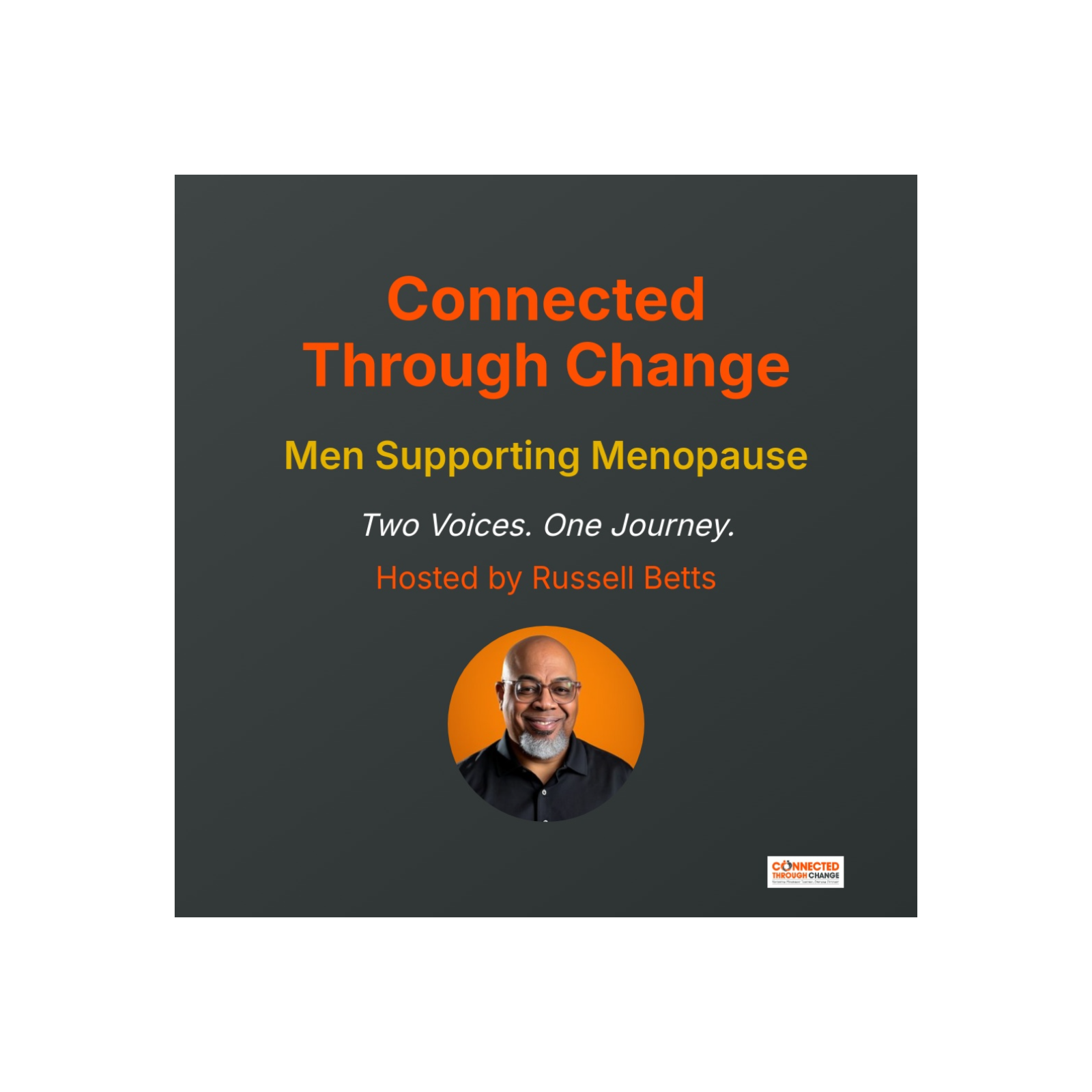
Connected Through Change: Two Voices. One Journey
by Russell Betts
Midlife change and menopause are not separate journeys—they are shared transitions that call for emotional leadership, empathy, and connection. The Connected Through Change™ Podcast guides couples, families, and organizations through these seasons with clarity, compassion, and practical tools.Each episode explores a weekly theme from two voices, one journey:• The man’s perspective—naming his midlife change with dignity.• The woman’s perspective—reframing how she interprets and responds to his reactions.• The shared practice—rituals, reflections, and neuroscience‑informed strategies for walking together.Listeners will discover metaphors, stories, and rituals that make abstract change tangible, while gaining practical insights for building cultures of trust, belonging, and resilience.Whether you’re preparing for menopause, navigating midlife transitions, or leading communities through change, this podcast offers a steady voice of stewardshi
-
19
The Architecture of the Hearth: Navigating the Silent Room
SummaryExplore the transition from the high-intensity 'Fireworks' season of early relationship building to the stable, radiant 'Fireplace' season of midlife. Learn how to navigate the anxiety of silence and move from performance to presence through the practice of the Diagnostic Drop.Key TakeawaysThe transition from high-intensity 'Fireworks' to steady 'Fireplace' energy is an evolution, not a decline.The DIAGNOSTIC DROP invites you to stop treating a quiet relationship as a broken appliance.Peace in a relationship isn't a stall; it is cruising altitude after years of building.Timestamps00:00Grounded Entry: The Massive Silence01:45Release: You Aren't Failing02:30The Method: The Diagnostic Drop04:15The CTA: The Sixty-Second Wait05:10Integration Close: Sitting by the FirePull Quotes"The quiet you’re feeling isn't a sign that the fire is going out. It’s evidence that the heat has moved.""You stop looking at your partner as a project or a puzzle and you start looking at them as a landscape.""Peace is allowed here."Linksgo.connectedthroughchange.com
-
18
The Gift of the Cooling Room
When the high-intensity 'fireworks' of a relationship begin to cool, many couples misinterpret the change as a sign of decline. This episode reframes the quiet of midlife as an evolution into 'thermal mass'—a state where the connection becomes more efficient and enduring.Key TakeawaysThe silence of midlife is often the sound of a relationship transitioning from 'heat loss' to 'thermal mass.'The urge to create drama or 'fix' the quiet is a nervous system response to a perceived loss of power.A mature relationship moves from an 'open broadcast' that loses energy to a steady radiance that stores it.Efficiency in a long-term bond means needing less 'spectacle' to maintain more heat.
-
17
The Silence is Not a Symptom: Why Your Impulse to Fix is Keeping You in the Cold
In this episode, we explore the 'Containment Phase' of midlife relationships—the uncomfortable period when the old intensity fades and silence begins to feel heavy. We examine why high-achievers reflexively try to 'fix' the cooling temperature and how that impulse can actually prevent a deeper, more mature connection from forming.Key TakeawaysThe 'Impulse to Fix' often arises from a fear that silence indicates relational failure rather than natural evolution.High-functioning couples often transition into a 'Diagnostic Gaze' where they treat their partner like a problem to be solved.Containment is the practice of holding relational tension without rushing to create artificial intensity or 'noise-making.'
-
16
When the House Goes Quiet: Recognizing the Midlife Shift from Spectacle to Sustenance
We explore the unsettling transition many couples face in midlife: when the high-intensity 'Fireworks Energy' of building careers and raising families fades into a new, heavy silence. This episode renames that silence not as a sign of decline, but as a developmental shift from the Spectacle of early love to the Sustenance of mature partnership.Key TakeawaysThe shift from intense 'Fireworks Energy' to a quieter season is a natural developmental evolution, not a relationship failure.Common attempts to 'relight the rockets' through forced intensity often increase relational pressure rather than solving it.Transitioning from performance to presence requires navigating an 'in-between' phase where the old noise fades before new intimacy takes root.
-
15
The Map for the Journey Ahead: Moving from Speechlessness to Precision
SummaryIn this final episode of the series, we move from the exhaustion of constant translation to the precision of the RQ Index. Learn how to stop paying the 'Never Mind' Tax and start using a shared map to bridge the gap in your relationship.Key TakeawaysThe 'Never Mind' Tax is a systemic infrastructure failure, not a personal communication deficit.Precision in language releases the 'lock' in the throat by reducing the perceived threat of high-stakes translation.Transitioning from emotional pleas to shared coordinates allows both partners to observe the relationship as a third-party object.Take the Connected Through Change Assessment at https://core.connectedthroughchange.com
-
14
The Frequency You’re Missing: Why Words Aren't Enough
SummaryThis episode explores why communication often fails during deep midlife transitions, reframing the silence as a protective response to inadequate language rather than a personal or relational flaw.Key TakeawaysThe "Never Mind" Tax is a protective response to a lack of linguistic precision, not a sign of relational apathy.Relational safety is a prerequisite for vulnerability; if the language doesn't feel accurate, the body moves to stay silent.The struggle is often a "capacity threshold" where the current dialect can no longer carry the depth of an evolving self.
-
13
The High Cost of Translation: Why Your Most Intelligent Self Is Struck Dumb at Home
SummaryIn this episode, we explore why even the most articulate women find themselves "struck dumb" when trying to explain their internal shifts to a partner. We move beyond the idea of "communication skills" to look at the high cost of trying to translate a complex midlife transition into a language that wasn't built to hold it.Key Takeaways- Standard communication tools like "I Feel" statements are often designed for transactional negotiation, not for the naming of a deep identity shift.- The "Never Mind" Tax accrues every time you sand down your truth to make it understandable to someone using an outdated operating system.- Clarity can sometimes function as a relational weapon, demanding a logical explanation for an experience that is still being formed.Quotes- "You are a master communicator working on an outdated operating system that cannot process the complexity of your current life."- "Standard communication skills are designed for negotiation and conflict resolution; they are not designed for the naming of an evolving soul."- "We are trying to fit the cathedral of your midlife transformation into the word 'building.' It won’t fit."
-
12
Why You’re Struck Dumb in Your Own Kitchen The Ghost in the Room: Why being 'articulate' fails you here.
SummaryIn this episode, we explore why even the most articulate and self-aware women often find themselves speechless when trying to describe the growing distance in their relationships. We name the specific fatigue of "Translation Exhaustion" and the hidden cost of the "Never Mind" Tax.Key TakeawaysRelational confusion is often not a lack of intelligence, but a lack of precise vocabulary for complex midlife experiences.Generic words like "lonely" or "disconnected" often fail to capture the visceral reality of standing on the other side of a "pane of glass" from a partner.The silence we feel in our relationships is frequently the result of an unnamed experience sitting between two people like a ghost.
-
11
When Strength Stops Working: The Art of the Graceful Step Back
SummaryDiscover a practical method to shift from over-functioning to true partnership. Learn how to 'hold the gap' and create a sustainable rhythm of connection without the weight of solo responsibility.Key TakeawaysThe Graceful Step Back is a strategic relocation that creates space for partnership.Holding the Gap involves observing a need without immediately rushing to fix it.Trading total control for shared presence often involves a temporary drop in logistical execution.
-
10
The Management Trap: Why Your Best Effort is Creating Distance
SummaryWe explore the "Functional Model" of relating and how constant management leads to a profound sense of isolation. This episode reframes the exhaustion of the 'strong one' as a structural issue rather than a failure of connection.Key TakeawaysYour exhaustion is a result of occupying all the available functional space in the relationship.Over-functioning for two people creates a barrier that prevents you from being truly known.True strength is the courage to leave the gap unmanaged long enough for a partner to enter it.
-
9
The Efficiency Trap: Why Your Resilience is Holding the Door Shut
The "strong" partner often believes their extra effort is the only thing keeping the relationship alive. This episode explores why high-functioning resilience can actually become a barrier to intimacy. By absorbing the consequences of relational gaps, the over-functioning partner creates an "efficiency trap" that prevents their partner from engaging.Key Takeaways:- Over-performance in a relationship creates a corresponding deficit in the partner’s engagement.- High competence can act as "structural interference" that prevents the other person from growing into their shared responsibilities.- The harder one partner tries to "fix" a vacuum of connection, the more they consume the relational oxygen needed for partnership.
-
8
When Your Strength Becomes Your Cage
In this episode, we explore:Why high-functioning people experience a unique kind of fatigueThe hidden cost of always being “the one who handles it”How overfunctioning quietly reshapes your relationshipWhy your strength may be preventing real balanceKey idea: You aren’t just tired—you’re relationally depleted.Reflection: Where have you become the bridge—and what is it costing you?Next step: Just notice it. No fixing. No pressure.
-
7
Micro-Attunement: Responding to the Drift
Join Russell as he explores how to maintain connection and empathy during the emotional and physical shifts of menopause.
-
6
The Signal in the Hum: Reinterpreting the Distance
In this episode Russell explores emotional distances in relationships during menopause and offers advice on bridging the gap.
-
5
Containment: Holding the Gap Without Fixing It
In this episode, we dive into the idea of holding space in relationships, understanding the subtle shifts in connection, and focusing on being present without the urgency to solve everything. It's about developing deeper empathy and connection through emotional distance.
-
4
When Something Feels Off (But Nothing Is Wrong) | Part 1: The One-Degree Drift
Join Russell as he explores the emotional complexities behind that lingering feeling of disconnection in relationships, especially during transitions like menopause. Through personal anecdotes and hypothetical scenarios, he sheds light on why these feelings arise and how to start addressing them.
-
3
When Something Feels Different — But No One Can Explain Why
An integrative conversation exploring how one partner may feel a shift before the other understands it, how both perspectives are valid, and how unspoken awareness creates subtle relational tension. Includes a guided reflection exercise to help couples recognize what feels different without needing to solve it immediately.
-
2
Celebration of Foundations
Russell delves into the essential building blocks of a healthy relationship, sharing strategies for couples to support each other and grow together, especially during life changes like menopause.
-
1
Anchoring in Uncertainty
Join Russell as he navigates the complex waters of uncertainty during menopause, offering practical guidance and heartfelt insights to help couples stay connected.
-
0
Mood Waves
In this episode, Russell Betts delves into the complexities of mood changes within relationships as couples navigate the menopause journey. Offering personal insights and practical advice, he explores how partners can better understand and support each other through this challenging time.
-
-1
Emotional Leadership
Russell Betts dives into emotional leadership, exploring how men can support their partners through menopause with empathy and understanding. He shares strategies to enhance communication and deepen connection during this life transition.
-
-2
Resilience as Roots
In this episode of Connect Through Change: Men Supporting Menopause, host Russell Betts explores the concept of resilience being foundational in navigating menopause. He discusses personal and relational resilience, vulnerability as strength, and provides guidance for couples striving to adapt to changes while maintaining connection and support.
-
-3
Reclaiming Rest Without Guilt
In this episode, Russell explores the concept of reclaiming rest without guilt, focusing on the shared challenges and perceptions faced by men and women. He delves into the tension between societal expectations and personal need for rest, offering insights into overcoming the guilt associated with taking breaks and emphasizing rest as a form of trust and self-care. This conversation addresses the psychological and relational impacts of rest, providing practical guidance on how to balance work, life, and personal well-being.
-
-4
Patience & Presence
In today's episode, Russell delves into the essence of patience and presence in relationships, especially during menopause. Emphasizing the transition from enduring discomfort to maintaining emotional regulation, he discusses how patience can be perceived differently by men and women. While men often view patience as an effort to remain calm, women may see it as withdrawal, leading to misunderstandings. The conversation highlights the importance of presence over silence, and how both partners can foster a more supportive environment by understanding each other’s experiences.
-
-5
Building Emotional Safety
Episode DescriptionTrust is often talked about as something that is broken in big moments. But most relationships don’t fracture all at once—they erode quietly, in the everyday.In this episode of Connected Through Change, we explore emotional safety as it is actually lived in long-term relationships. Not as a contract or a promise, but as a nervous system experience.Two people can be standing in the same relationship and living in entirely different internal worlds.This episode gently explores that gap.What This Episode ExploresWhy trust is less about intent and more about nervous system safetyHow men often experience trust as pressure, performance, and character judgmentHow women often experience trust as consistency, reliability, and the ability to restThe invisible loop that forms when one partner feels monitored and the other feels aloneWhy no one is “the problem”—and why the mismatch still hurtsHow emotional safety is built through repair, not perfectionKey ThemesEmotional safety vs. emotional intentNervous system regulation in relationshipsMental load and unseen vigilanceShame, withdrawal, and self-protectionTrust as a lived, ongoing experience
-
-6
Drop the Rock: Grace at the Kitchen Counter
In this episode of "Connected Through Change," we delve into the silent, tense moments of conflict that every couple knows too well. We explore how both men and women experience these standoffs, often in completely different ways, and how our individual responses can either widen the gap or bring us closer together.For men, we challenge the notion that grace equals surrender. We invite you to drop your defensive rocks and become stewards of your relationship.For women, we encourage you to lift the weight of unspoken words and speak your truth with courage.Grace, as we'll discover, is not a feeling. It's a decision—a decision to prioritize connection over winning an argument.Join us as we explore how to transform the kitchen counter standoff into an opportunity for deeper connection and understanding.Key Takeaways:- Understand how conflict often plays out silently through body language and unspoken words.- Discover how men and women can experience the same moment of conflict differently.- Learn how to shift from a mindset of winning arguments to prioritizing connection.- Recognize the power of grace as a tool for managing conflict and connecting with your partner.
-
-7
Intimacy Beyond Desire: Deepening Emotional Closeness in Midlife
Intimacy Beyond Desire: Deepening Emotional Closeness in MidlifeIn this episode of Connected Through Change, we explore a quieter, deeper kind of intimacy—the emotional closeness that often gets lost in midlife relationships. When desire changes, routines settle in, and stress accumulates, many couples find themselves together but not truly connected.From the men’s perspective, emotional closeness can feel like a test they were never taught to take—leading to retreat, problem-solving mode, or silence. From the women’s perspective, carrying the emotional and mental load can create a wall of competence that unintentionally blocks true connection.This episode reframes intimacy as presence and safety, not performance or fixing. You’ll learn why both partners protect themselves in different ways, how those protection strategies create distance, and what it takes to bridge the emotional canyon between you.Couples Practice: The Witness & Exhale ExerciseTry this simple 10-minute practice together this week:Sit facing each other with no distractions.One partner names a single feeling (e.g., “lonely,” “heavy,” “quiet”)—no explanation.The other partner simply reflects and listens without fixing or solving.Switch roles.This practice builds emotional safety, visibility, and connection—without pressure or performance.
-
-8
The Lighthouse and the Hearth: Honoring Energy Without Fixing Each Other
In this episode of Two Voices, One Journey, we explore what happens when shifts in energy inside a relationship are misunderstood—and how learning to stay grounded instead of reactive can transform connection.Many couples experience the same moment in very different ways: When one partner’s energy dips, the other may feel anxious, responsible, or compelled to fix it. Meanwhile, the partner who is tired or quiet may simply be needing rest—without explanation or performance.This episode reframes energy as weather, not a problem to solve, and introduces the idea of being a lighthouse rather than a thermostat—a steady presence that builds safety instead of pressure.You’ll hear:Why trying to “fix” your partner’s mood often increases distanceHow unspoken expectations around emotional availability create resentmentThe hidden cost of always being “on” in a relationshipWhat it means to honor energy without withdrawing or rejecting each otherHow men and women often experience energy shifts differently—and how to bridge that gapThe episode closes with a guided couples practice you can do together to build clarity, safety, and trust when energy changes.This conversation is not about fixing each other. It’s about learning how to stay present—together—through change.Couples Practice Included in This EpisodeThe Weather & Lighthouse Practice, a simple three-step exercise to help couples:Name internal energy without judgmentUnderstand what each partner needs during low-energy momentsCreate one small agreement that protects connectionThis practice is designed to be done gently, without debate or problem-solving.Ideal For Listeners Who Are:Navigating stress, burnout, or emotional fatigueFeeling pressure to always be emotionally availableWanting deeper connection without constant fixingLooking for practical relationship tools that feel human and doableAbout the SeriesTwo Voices, One Journey explores relationships from two perspectives—often experienced differently by men and women—while honoring the shared journey couples are on together.These conversations are about presence, steadiness, and emotional safety through real-life change.
-
-9
Listening as the Foundation of Connection
Listening is often treated as a communication skill—but in relationships, it’s something deeper. In this episode of Two Voices, One Journey, we slow down and explore listening as a form of presence rather than performance.This conversation sits inside the moments where connection quietly strengthens or quietly slips away: when one person is speaking, and the other is deciding—often unconsciously—whether to fix, explain, or stay.Rather than offering techniques or advice, this episode invites you to notice what happens inside when emotion doesn’t resolve quickly. What listening asks of us. What it costs when it turns into fixing. And how staying present—without solving—can create the kind of safety where connection holds.This episode explores:Why listening often feels harder than speakingThe internal pressure to fix, clarify, or move things alongHow being “handled” can feel different than being heardThe difference between silence and spaceWhy presence, not solutions, is often what builds trustThis is not a how-to episode. It’s a space to slow down, feel the moment, and stay.
-
-10
The Cost of Silence: What Men Carry Alone
Most men don’t choose silence.They inherit it.They learn it young.They carry it into every room, every relationship, every season of change.In this grounding episode, Russell explores the emotional cost of silence—what men carry alone, what it costs them, and what it costs the people who love them. This isn’t a call-out. It’s a quiet naming. A gentle invitation to notice the weight of what’s unspoken.Before the January series begins, this episode slows everything down.It offers language for the things men rarely say out loud.It opens a door to emotional leadership—not through performance, but through presence.
-
-11
EPISODE ZERO+: When Midlife Isn’t a Crisis — Naming His Change With Dignity
Most men don’t crash into midlife.They drift into it.Quietly.Restlessly.Often without language for what’s changing inside them.In this grounding episode, Russell shares the story of his own midlife shift—not as a crisis, but as a slow turning of the soil. He explores what it feels like to outgrow old roles, how silence becomes a habit, and why naming our inner change is the first step toward becoming a steadier partner.This episode is for the man who feels something shifting under his ribs…and for the partner who’s been sensing it all along.
-
-12
EPISODE ZERO: Welcome to Connected Through Change
In this episode, Russell introduces listeners to the podcast, "Connected Through Change: Men Supporting Menopause". He explains the mission to provide men with an understanding of menopause and how it impacts relationships. The conversation covers the need for open communication, the emotional and relational challenges during menopause, personal anecdotes from Russell's experience, and a reflection on the importance of support between partners.
We're indexing this podcast's transcripts for the first time — this can take a minute or two. We'll show results as soon as they're ready.
No matches for "" in this podcast's transcripts.
No topics indexed yet for this podcast.
Loading reviews...
ABOUT THIS SHOW
Midlife change and menopause are not separate journeys—they are shared transitions that call for emotional leadership, empathy, and connection. The Connected Through Change™ Podcast guides couples, families, and organizations through these seasons with clarity, compassion, and practical tools.Each episode explores a weekly theme from two voices, one journey:• The man’s perspective—naming his midlife change with dignity.• The woman’s perspective—reframing how she interprets and responds to his reactions.• The shared practice—rituals, reflections, and neuroscience‑informed strategies for walking together.Listeners will discover metaphors, stories, and rituals that make abstract change tangible, while gaining practical insights for building cultures of trust, belonging, and resilience.Whether you’re preparing for menopause, navigating midlife transitions, or leading communities through change, this podcast offers a steady voice of stewardshi
HOSTED BY
Russell Betts
CATEGORIES
Loading similar podcasts...
Frequently Asked Questions
How many episodes does Connected Through Change: Two Voices. One Journey have?
Connected Through Change: Two Voices. One Journey currently has 32 episodes available on PodParley. New episodes are automatically indexed when they're published to the podcast feed.
What is Connected Through Change: Two Voices. One Journey about?
Midlife change and menopause are not separate journeys—they are shared transitions that call for emotional leadership, empathy, and connection. The Connected Through Change™ Podcast guides couples, families, and organizations through these seasons with clarity, compassion, and practical tools.Each...
How often does Connected Through Change: Two Voices. One Journey release new episodes?
Connected Through Change: Two Voices. One Journey has 32 episodes. Check the episode list to see recent publication dates and frequency.
Where can I listen to Connected Through Change: Two Voices. One Journey?
You can listen to Connected Through Change: Two Voices. One Journey on PodParley by clicking any episode. We provide an embedded audio player for direct listening, and you can also subscribe via your preferred podcast app using the RSS feed.
Who hosts Connected Through Change: Two Voices. One Journey?
Connected Through Change: Two Voices. One Journey is created and hosted by Russell Betts.
URL copied to clipboard!