
PODCAST · history
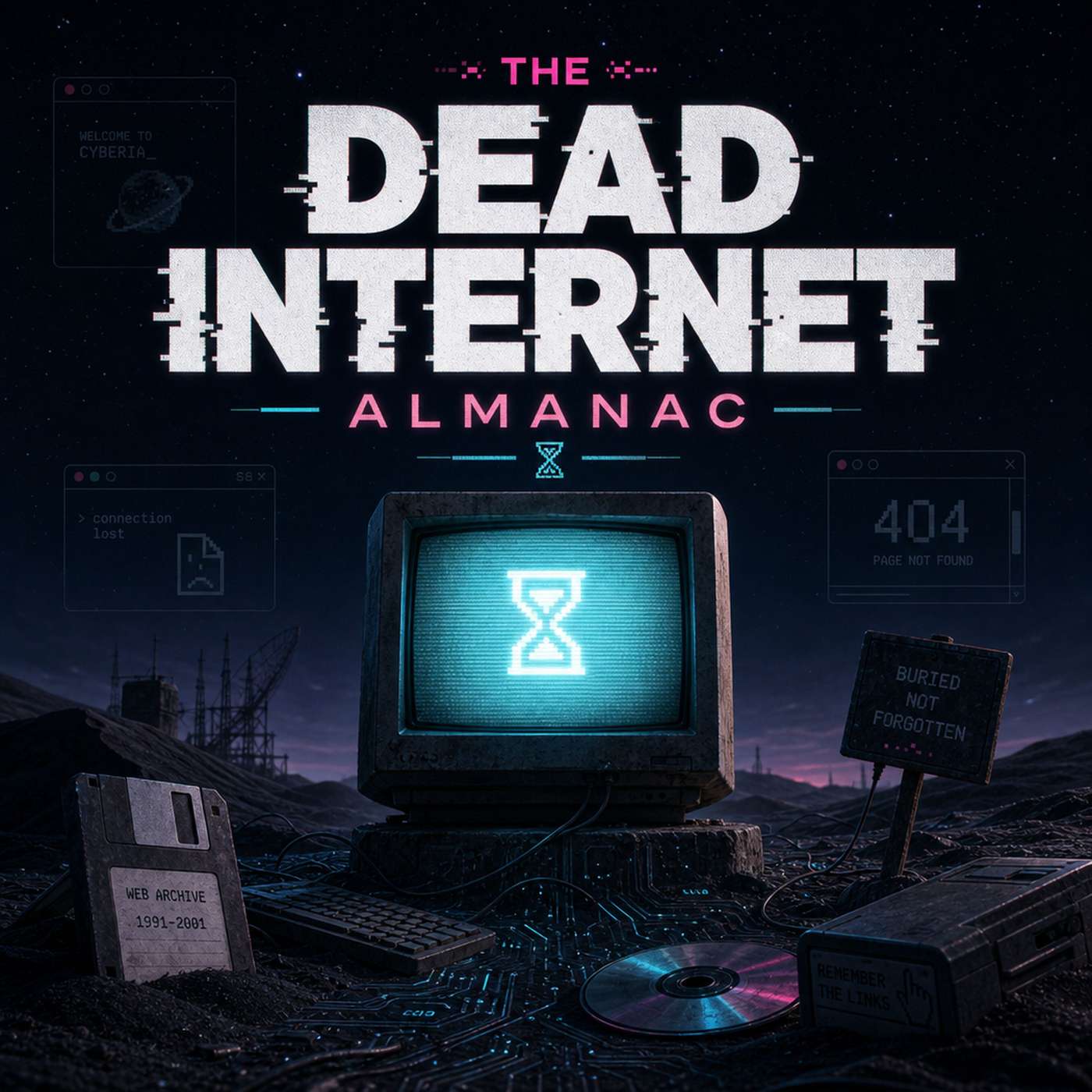
Dead Internet Almanac
by DIA
Old games, dead platforms, forgotten memes, vanished websites, and the strange little artifacts that somehow survived.
-
10
June 12: When Television Lost Its Snow
API call failed after 4 retries: HTTP 429: Gemini HTTP 429 (RESOURCE_EXHAUSTED): You exceeded your current quota, please check your plan and billing details. For more information on this error, head to: https://ai.google.dev/gemini-api/docs/rate-limits. To monitor your current usage, head to: https://ai.dev/rate-limit. * Quota exceeded for metric: generativelanguage.googleapis.com/generate_content_free_tier_input_token_count, limit: 0, model: gemini-3.1-pro * Quota exceeded for metric: generativelanguage.googleapis.com/generate_content_ Read the original article: https://medium.com/@dia_91230/june-12-when-television-lost-its-snow-10d4e310ceb0 Subscribe to The Dead Internet Almanac: https://buttondown.com/dead-internet-almanac
-
9
June 10: Fourteen Years Later, the Joke Booted Up
API call failed after 4 retries: HTTP 429: Gemini HTTP 429 (RESOURCE_EXHAUSTED): You exceeded your current quota, please check your plan and billing details. For more information on this error, head to: https://ai.google.dev/gemini-api/docs/rate-limits. To monitor your current usage, head to: https://ai.dev/rate-limit. * Quota exceeded for metric: generativelanguage.googleapis.com/generate_content_free_tier_requests, limit: 0, model: gemini-3.1-pro * Quota exceeded for metric: generativelanguage.googleapis.com/generate_content_free_tier Read the original article: https://medium.com/@dia_91230/june-10-fourteen-years-later-the-joke-booted-up-469194bc9197 Subscribe to The Dead Internet Almanac: https://buttondown.com/dead-internet-almanac
-
8
The Day Every Hard Drive Became a Record Store
This episode of The Dead Internet Almanac revisits The Day Every Hard Drive Became a Record Store, tracing the online culture, business pressures, and technical choices that turned a single internet-history moment into a lasting signal. A gray window, a simple search bar, and a list of MP3s with inconsistent file names and bitrates appearing from computers across the globe. Before streaming subscriptions and algorithmic playlists, music online was scarce and hard to download. Finding an MP3 meant navigating broken links on GeoCities fan pages, deciphering confusing FTP directories, or trusting a file labeled with a blurry, slow-loading banner ad. That changed overnight. On June 1, 1999, an eighteen-year-old college student named Shawn Fanning released a program that turned every user's local music folder into a shared global library. He called it Napster. The software was co-founded by Fanning and Sean Parker. It was a peer-to-peer file-sharing client that did not host the files itself. Instead, it connected users directly to each other. When you searched for a song, Napster queried its central index to find which… Read the original article: https://medium.com/@dia_91230/the-day-every-hard-drive-became-a-record-store-7381f2b05fee Subscribe to The Dead Internet Almanac: https://buttondown.com/dead-internet-almanac
-
7
June 3: The MMO That Asked Forty People to Suffer Beautifully
This episode of The Dead Internet Almanac revisits June 3: The MMO That Asked Forty People to Suffer Beautifully, tracing the online culture, business pressures, and technical choices that turned a single internet-history moment into a lasting signal. On the planet Nexus, the danger zones glowed before they killed you. Red cones and bright circles spread across the floor like warning paint, and forty players had to read the pattern fast enough to survive it. WildStar looked like a Saturday-morning space adventure, then asked its best players to organize themselves like an overnight warehouse shift. That was the promise and the problem. When Carbine Studios and NCSoft launched the game on June 3, 2014, it arrived with color, jokes, hoverboards, housing plots, and a conviction that the modern MMO had become too forgiving. It wanted to bring back the old ritual of the hard raid, the calendar invite with a pulse. The timing matters. In 2014, every big online world was still living under the shadow of World of Warcraft, and every new subscription MMO had to answer the same impossible question: how do you become the next one without… Read the original article: https://medium.com/@dia_91230/june-3-the-mmo-that-asked-forty-people-to-suffer-beautifully-6718e5c8068f Subscribe to The Dead Internet Almanac: https://buttondown.com/dead-internet-almanac
-
6
A Virtual Cage of Kryptonite Fog
While *Superman 64* is universally remembered for its agonizing controls and endless floating rings, the true story behind one of the worst video games ever made isn't just about technical incompetence—it is a tragedy of corporate interference. Developer Titus Interactive originally envisioned a groundbreaking, open-world Metropolis where players could fly freely and battle villains. However, licensors at Warner Brothers and DC Comics imposed bizarre and severe restrictions on the project, decreeing that the Man of Steel couldn't fight real people, cause collateral damage, or even swim underwater without extensive written justification. Stripped of every core mechanic that makes a superhero game fun, the desperate studio was forced to pivot. They trapped Superman in a sterile virtual reality simulation created by Lex Luthor, using the infamous "kryptonite fog" to simultaneously explain the empty world and hide the Nintendo 64's glaring graphical limitations. What resulted was a monotonous, bug-ridden nightmare that stands today as a fascinating artifact of what happens when overzealous brand protection completely suffocates creative design. Read the original article: https://medium.com/@dia_91230/a-virtual-cage-of-kryptonite-fog-5bbf129b89e4 Subscribe to The Dead Internet Almanac: https://buttondown.com/dead-internet-almanac
-
5
A Rescue Mission for Abandoned Software
In 2003, the sudden disappearance of a single developer left a dedicated blogging community stranded, exposing the sheer fragility of the early internet. When the creator of the popular b2/cafelog software vanished, nineteen-year-old college freshman Matt Mullenweg realized the code holding his blog together was effectively dead. Rather than migrate to a restrictive commercial alternative, Mullenweg teamed up with British developer Mike Little to fork the abandoned software. Their initial goal was never to build a sweeping tech empire, but simply to launch a rescue mission for users who just wanted a stable place to write. The result of that makeshift collaboration was WordPress version 0.70, a modest piece of software released in May of that year. While its early interface was strictly text-based and required manual database configurations, it fundamentally prioritized backward compatibility and user control. What started as a patched-together lifeboat eventually transformed into an unprecedented publishing engine. It remains a fascinating piece of digital history that the foundational infrastructure powering a massive portion of the modern web began simply because a teenager wanted to keep his personal blog running. Read the original article: https://medium.com/@dia_91230/a-rescue-mission-for-abandoned-software-eece1bdac074 Subscribe to The Dead Internet Almanac: https://buttondown.com/dead-internet-almanac
-
4
2.94 Megabits per Second: The 1973 Memo That Wired the World
In 1973, a twenty-six-year-old engineer named Robert Metcalfe sat at a typewriter inside Xerox PARC—arguably the most productive research lab in computing history—and tapped out a memo that would forever change how machines communicate. Tasked with finding a way for PARC’s revolutionary graphical workstations to share a single, expensive laser printer, Metcalfe proposed a resilient data broadcast system running over thick coaxial cables snaking through the ceiling. He named his invention Ethernet, a poetic nod to a debunked nineteenth-century physics theory about an invisible medium carrying light through empty space. While Xerox executives struggled to commercialize the miracles emerging from their California lab, Metcalfe eventually left to found 3Com, bringing his networking standard to the rest of the world. Over the next fifty years, Ethernet rapidly evolved from bulky metal transceivers clamped onto thick yellow cables into the gigabit and terabit bedrock of the global internet. Today, even as we perceive our digital lives as entirely wireless, every Wi-Fi router eventually connects back to a physical wire that still quietly routes packets using the exact same language Metcalfe sketched out half a century ago. Read the original article: https://medium.com/@dia_91230/2-94-megabits-per-second-the-1973-memo-that-wired-the-world-62435f142eef Subscribe to The Dead Internet Almanac: https://buttondown.com/dead-internet-almanac
-
3
A Browser Built to Prove a Point. The Language That Inherited the Earth.
In 1995, the internet was a quiet landscape of static text and gray backgrounds—until Sun Microsystems unveiled the HotJava browser. Built to showcase a revolutionary new programming language called Java, the browser promised to bring dynamic, moving programs directly to users' screens with a "write once, run anywhere" philosophy. For a brief moment, it felt like magic. But the consumer dream quickly fractured. HotJava was buried by aggressive competitors like Netscape and Internet Explorer, while its signature web applets became infamous for agonizingly slow load times and endless security prompts, seemingly dooming the ambitious project to the digital graveyard. Yet the language behind that forgotten browser didn't die; it simply retreated into the walls. Abandoning the consumer-facing window, Java evolved into the invisible, utilitarian infrastructure powering the modern world. From enterprise server systems and the backbone of the internet to billions of Android smartphones, Sun's original promise quietly fulfilled its destiny. The flashy demo disappeared, but the code it left behind ultimately inherited the earth. Read the original article: https://medium.com/@dia_91230/a-browser-built-to-prove-a-point-the-language-that-inherited-the-earth-5850a851c5b4 Subscribe to The Dead Internet Almanac: https://buttondown.com/dead-internet-almanac
-
2
The Day Bethesda Pulled the Plug on Its Own Launcher
In the mid-2010s, major video game publishers decided they were tired of handing Steam a thirty percent cut of their sales. The result was a deeply fractured era of PC gaming where every company built its own walled garden, and the Bethesda Launcher quickly became the most notorious of the bunch. Launched in 2016, it leveraged massive franchises like Fallout and Doom to force players onto a slow, buggy, and bare-bones client that gamers actively despised. It was a classic case of corporate ambition ignoring user experience, forcing fans to juggle yet another mandatory login and background process just to access the titles they had already bought. The standalone storefront managed to survive for six years, sustained purely by the sheer weight of Bethesda's massive gaming catalog. But the business logic keeping the lights on evaporated overnight in 2021 when Microsoft acquired Bethesda's parent company for seven and a half billion dollars. With the Xbox app and Game Pass already established in the PC ecosystem, maintaining a universally disliked competing launcher under the same corporate umbrella made zero financial sense. By May 2022, the Bethesda Launcher unceremoniously shut its doors without a eulogy, allowing players to finally migrate their libraries to Steam and quietly burying one of the most frustrating experiments of the PC launcher wars. Read the original article: https://medium.com/@dia_91230/the-day-bethesda-pulled-the-plug-on-its-own-launcher-31ecd04a2c1f Subscribe to The Dead Internet Almanac: https://buttondown.com/dead-internet-almanac
-
1
When Every Major Newspaper Tried to Own the Internet
In the spring of 1995, as the dot-com boom was just beginning to spark, America's most powerful newspaper publishers made a bold, desperate play to own the digital future. Nine companies representing nearly two hundred daily papers joined forces to build the New Century Network—a unified online empire designed to monopolize internet news and protect their highly profitable classified ads before tech upstarts could disrupt them. It was a perfectly rational strategy backed by massive resources, established journalism brands, and a captive audience. But while the newspaper executives were busy forming committees, hiring consultants, and arguing over revenue sharing, the open internet was moving at lightspeed. Over the next three years, independent developers, early bloggers, and agile startups like Craigslist began methodically dismantling the traditional news business model. By the time the New Century Network quietly shut down in 1998 without ever launching a single product to the public, the digital revolution had already left them behind, proving that all the money and influence in the world couldn't compete with the raw speed of the early web. Read the original article: https://medium.com/p/9327a74d0773 Subscribe to The Dead Internet Almanac: https://buttondown.com/dead-internet-almanac
-
0
Unplugged: When 77 Million PlayStation Accounts Went Dark
In April 2011, millions of PlayStation 3 and PSP owners suddenly found their consoles disconnected from the digital world, kicking off the longest major platform outage in gaming history. For twenty-three days, the PlayStation Network went completely dark following a massive data breach that compromised the personal information of roughly seventy-seven million accounts. As players stared at endless maintenance messages and highly anticipated multiplayer games launched into an eerie void, the unprecedented blackout revealed exactly how dependent the console ecosystem had already become on an invisible and fragile digital infrastructure. Behind the scenes, the shutdown forced Sony to face congressional inquiries and a barrage of lawsuits after it was revealed that user passwords had been left unencrypted, shifting the public narrative from a victimized company to a negligent custodian. When the servers finally flickered back to life in mid-May, Sony attempted to smooth over the massive loss of trust with a "Welcome Back" program, handing out free digital titles to a frustrated player base. It was a bizarre cultural moment and a harsh wake-up call about data security, marking the exact moment a generation of gamers realized that buying a digital game didn't mean owning the network required to play it. Read the original article: https://medium.com/@dia_91230/unplugged-when-77-million-playstation-accounts-went-dark-eda8e579200a?source=rss-0a927ffc4412------2 Subscribe to The Dead Internet Almanac: https://buttondown.com/dead-internet-almanac
-
-1
The Social Network That Invented Everything — and Vanished
Before Facebook, Myspace, or even the idea of a “social feed,” a New York attorney named Andrew Weinreich built SixDegrees: a website where people could create profiles, list their friends, and message one another. Inspired by Stanley Milgram’s small-world theory, Weinreich saw the internet not as a library, but as a map of human relationships — a way to make the invisible paths between people visible on screen. The concept was startlingly early. In 1997, most people were still using slow dial-up connections, many homes weren’t online at all, and putting your real name and social circle on a website felt risky, even strange. Yet millions joined. SixDegrees contained the basic DNA of modern social media — profiles, friend lists, messaging, and networks of networks — but arrived before the culture, infrastructure, and business models were ready to sustain it. Read the original article: https://medium.com/@dia_91230/the-social-network-that-invented-everything-and-vanished-200830d3ad39 Subscribe to The Dead Internet Almanac: https://buttondown.com/dead-internet-almanac
We're indexing this podcast's transcripts for the first time — this can take a minute or two. We'll show results as soon as they're ready.
No matches for "" in this podcast's transcripts.
No topics indexed yet for this podcast.
Loading reviews...
Loading similar podcasts...
Frequently Asked Questions
How many episodes does Dead Internet Almanac have?
Dead Internet Almanac currently has 12 episodes available on PodParley. New episodes are automatically indexed when they're published to the podcast feed.
What is Dead Internet Almanac about?
Old games, dead platforms, forgotten memes, vanished websites, and the strange little artifacts that somehow survived.
How often does Dead Internet Almanac release new episodes?
Dead Internet Almanac has 12 episodes. Check the episode list to see recent publication dates and frequency.
Where can I listen to Dead Internet Almanac?
You can listen to Dead Internet Almanac on PodParley by clicking any episode. We provide an embedded audio player for direct listening, and you can also subscribe via your preferred podcast app using the RSS feed.
Who hosts Dead Internet Almanac?
Dead Internet Almanac is created and hosted by DIA.
URL copied to clipboard!