
PODCAST · society
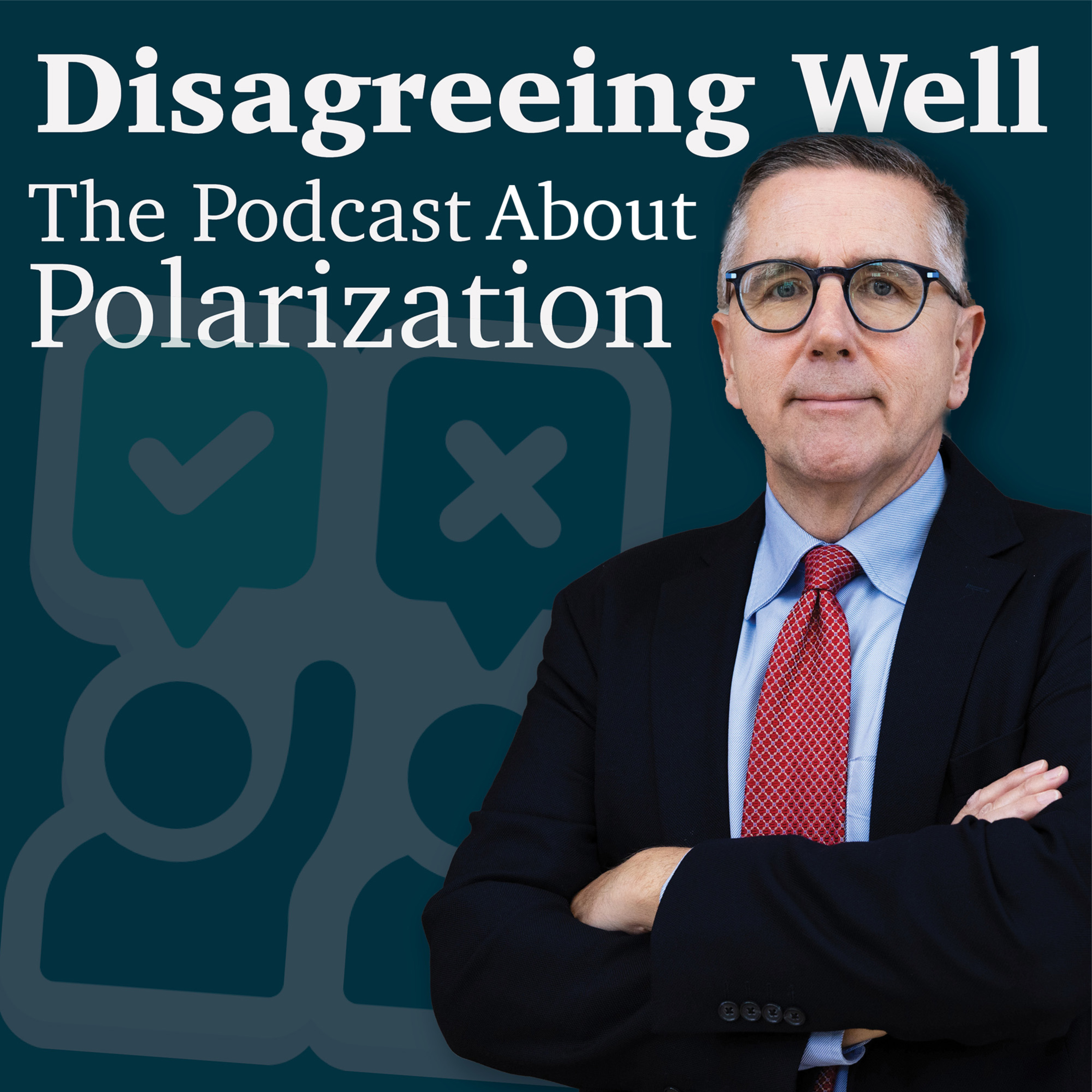
Disagreeing Well: The Podcast About Polarization
by John Milloy
Disagreeing Well is a podcast about polarization - why it matters, what drives it, and what we should be doing about it. Can faith play a role? John Milloy, retired politician, commentator, and Director of the Centre for Public Ethics at Martin Luther University College speaks with authors, commentators and practitioners about one of the most pressing issues of our time.For more information about the podcast and the people involved, see our Substack https://centreforpublicethics.substack.com/?utm_campaign=profile_chips
-
8
Talking about religion in a divided world
At the heart of polarization is an unwillingness to engage seriously with those who hold different perspectives from our own. Although we often think of polarization in political terms, it can extend to other areas including religion. In our secular society, people of faith are often dismissed as misguided, superstitious, or trying to impose their beliefs on the unwilling. Even between followers of different faith traditions, unfamiliar beliefs are often met with suspicion or mistrust. This week I speak with three guests - Alice Chan, Hicham Tiflati, and Margie Patrick. They are all representatives of the Centre for Civic Religious Literacy (CCRL), an organization dedicated to breaking down barriers by helping Canadians better understand religious, spiritual, and non‑religious worldviews.Our discussion challenges the idea that religion is purely private, arguing instead that beliefs shape identity, values, and civic engagement for many Canadians. All three of my guests make a strong case that increased religious literacy is crucial to promoting understanding and fighting polarization.
-
7
Reclaiming the Digital Public Square
In this episode of Disagreeing Well, I sit down with Shlomit Broder, CEO of the Canadian organization Digital Public Square, to explore how technology is reshaping the way we engage with each other. Although the “digital public square” can be a place for meaningful dialogue, digital spaces can also fuel polarization. Shlomitt and I discuss the nature of polarization in Canada today and the challenges posed by new technologies – from misinformation to amplified outrage to the way it often drowns out nuanced voices.Shlomit shares how her organization is building digital tools and creating spaces that foster curiosity, empathy, and meaningful dialogue—even on the most polarizing issues, including Israel-Gaza. The conversation offers both a clear-eyed assessment of the risks of online discourse and a hopeful vision for how we can rebuild trust, embrace nuance, and learn to disagree well.Learn more about Digital Public Square
-
6
The Media and Polarization: Feeding it or Fixing it?
Is the media fueling polarization or is it helping to defend truth and hold our battered and bruised society together?In this episode of Disagreeing Well: The Podcast About Polarization, I sit down with Bill Killorn, Executive Director of Journalists for Human Rights, to explore the relationship of the media and polarization from both a Canadian and global perspective. Drawing upon his experience in government and international journalism development, Bill discusses the way in which the media can both deepen divisions as well as serve as a source of accountability and informed public debate. We talk about everything from misinformation to the pressures shaping modern newsrooms and the need for balanced journalism that prioritizes understanding over outrage.We also highlight the work of Journalists for Human Rights, supporting journalists in Canada and around the world to produce fair, accurate, and inclusive reporting—often in challenging environments.Join us as we take a thoughtful look at why a strong, independent press—and public support for it—is essential to a healthy democracy.Learn more about Journalists for Human Rights.
-
5
Minding the Myth Gap
In this episode of Disagreeing Well, I sit down with Alex Evans, author of The Myth Gap: What Happens When Evidence and Arguments Aren’t Enough and founder of Larger Us, a UK organization focused on reducing division. Together, we explore why polarization remains so difficult to overcome—and what we may be missing in our efforts to address it.Drawing on his experience in the British government and politics along with his work at the United Nations, Evans makes the important point that while facts and evidence are essential, they are rarely enough to change minds. Instead, the stories we tell about what matters, who we should trust and what the future holds plays a decisive role in addressing division.Unfortunately, our world has a shortage of these stories to help us deal with our current set of challenges – what Evans calls the “myth gap”. In that gap, more divisive stories often take hold, reinforcing an “us versus them” dynamic.Drawing upon his work of Larger US, Evans offers a more hopeful path forward. Citing practical examples—from climate conversations to grassroots bridge-building—he highlights how listening, curiosity, and shared stories can help expand our sense of a “larger us.”To learn more about Larger Us.To learn more about Alex’s book.
-
4
What Is Truth?
In this episode of Disagreeing Well: The Podcast About Polarization, I explore one of the basic challenges of combatting polarization – truth itself. In a world where competing viewpoints all claim that the facts are on their side, understanding the nature of truth is crucial to the discussion.To help us explore “truth”, I am joined by Jeffrey Dudiak, a Christian philosopher and Professor at The King’s University in Edmonton, and author of Post-Truth? Facts and Faithfulness.In our discussion we consider a different way of thinking about truth. Instead of something we simply have, Jeff suggests truth is something we live out— something that we are faithful to – in our lives. Along the way, we explore the nature of polarization, why people can look at the same evidence and come to different conclusions and the importance of humility in making space for others in our divided world.Learn more about Jeff’s book.
-
3
Dismantling the Wall: How to talk about Israel-Palestine
In talking about Israel–Palestine, there are so many loud and certain voices – and so little listening.In this episode of Disagreeing Well: The Podcast About Polarization, I take on one of the most polarizing topics we face—not to resolve the conflict - but to explore how we talk about it. Discussion of Israel–Palestine too often becomes a winner-take-all situation —framed as right versus wrong or good versus evil—leaving little room for nuance or genuine engagement.I am joined by Raja Khouri and Jeffrey Wilkinson, a voice from the Palestinian community and a voice from the Jewish community - co-authors of the Wall Between: What Jews and Palestinians Don’t Want to Know About Each Other. Together, we dig into the role of competing narratives—stories that are deeply important to those who hold them but that often leave no room for the other.This episode is about stepping out of that pattern—creating space for listening, for complexity, and for a different kind of conversation.Learn more about the book and Raja and Jeff’s work: https://www.conversationswithoutwalls.org
-
2
Polarization: Can Faith Make a Difference?
What if the problem isn’t that we disagree—but how we disagree?In this episode of Disagreeing Well: The Podcast About Polarization, I am joined by Kiera Phyo and Jo Alstott from London, England, to talk about the Church of England’s Difference Course, a growing global effort to help people use their faith to navigate deep divides more constructively.The five-session course doesn’t ask people to change their beliefs. Instead, it asks something harder: to stay curious, to truly listen, to reimagine new ways forward and to resist the urge to turn others into “the other.”It sounds simple but it isn’t and the course is designed to lead participants through some challenging exercises to help them adopt practices that are helping people move beyond polarization—not by avoiding hard conversations, but by having them differently.At a time when division feels baked into everything, this is a refreshingly practical and hopeful conversation about an initiative that’s making a “Difference”.For more about the Difference Course see: https://difference.rln.global
-
1
The Divided U.S. - Courageous Conversations
In this episode, Disagreeing Well turns its attention to the United States as I speak with Katie Hyten, Co-Executive Director of Essential Partners, a U.S.-based organization which has been working to address polarization since 1989. We discuss the causes and dangers of polarization as well as the current situation in the United States. Katie highlights the important work her organization is doing in neighbourhoods, schools, universities, and faith communities to foster courageous conversations across a wide range of issues—from abortion to guns to everyday tensions. She outlines practical tools and provides real-world examples from the important work of Essential Partners to rebuild connection and community - even in the most polarized situations.Learn more about Essential Partners.
-
0
How Polarized is Canada…And Should We Worry?
How Polarized is Canada… And Should We Worry?” In this episode of Disagreeing Well: The Podcast about Polarization, I speak with political scientist Eric Merkley, author of the new book Polarization Eh? The Causes and Consequences of Affective Polarization in Canada. We discuss the rise of “affective polarization” in our country – the tendency to dislike or even hate those on the other side of politics.What’s driving this division? How dangerous is it? And what can both citizens and political leaders do to address it. Learn more about Eric’s book.
-
-1
Us vs Them: Why We Think This Way
I am joined by social psychologist Anne Wilson to explore the psychology of polarization. What’s really happening in our minds—and in the minds of those we disagree with—when polarizing issues arise? Is there something about human nature that’s preventing us from listening to the other side and pushing us further apart?We discuss misperceptions, why facts alone rarely change minds, and the role social media plays in deepening polarization. Anne also shares practical strategies for having conversations across disagreement without making things worse.Anne Wilson is a Professor of Social Psychology at Wilfrid Laurier University, where she researches the psychology of polarization.Learn more about Anne’s work. For more information about the podcast and the people involved, see our Substack.
We're indexing this podcast's transcripts for the first time — this can take a minute or two. We'll show results as soon as they're ready.
No matches for "" in this podcast's transcripts.
No topics indexed yet for this podcast.
Loading reviews...
ABOUT THIS SHOW
Disagreeing Well is a podcast about polarization - why it matters, what drives it, and what we should be doing about it. Can faith play a role? John Milloy, retired politician, commentator, and Director of the Centre for Public Ethics at Martin Luther University College speaks with authors, commentators and practitioners about one of the most pressing issues of our time.For more information about the podcast and the people involved, see our Substack https://centreforpublicethics.substack.com/?utm_campaign=profile_chips
HOSTED BY
John Milloy
Loading similar podcasts...
Frequently Asked Questions
How many episodes does Disagreeing Well: The Podcast About Polarization have?
Disagreeing Well: The Podcast About Polarization currently has 10 episodes available on PodParley. New episodes are automatically indexed when they're published to the podcast feed.
What is Disagreeing Well: The Podcast About Polarization about?
Disagreeing Well is a podcast about polarization - why it matters, what drives it, and what we should be doing about it. Can faith play a role? John Milloy, retired politician, commentator, and Director of the Centre for Public Ethics at Martin Luther University College speaks with authors,...
How often does Disagreeing Well: The Podcast About Polarization release new episodes?
Disagreeing Well: The Podcast About Polarization has 10 episodes. Check the episode list to see recent publication dates and frequency.
Where can I listen to Disagreeing Well: The Podcast About Polarization?
You can listen to Disagreeing Well: The Podcast About Polarization on PodParley by clicking any episode. We provide an embedded audio player for direct listening, and you can also subscribe via your preferred podcast app using the RSS feed.
Who hosts Disagreeing Well: The Podcast About Polarization?
Disagreeing Well: The Podcast About Polarization is created and hosted by John Milloy.
URL copied to clipboard!