
PODCAST · education
Don’t Miss That Radiology ⭐
by Dr. Matthew Hartman
Learning radiology doesn’t have to be overwhelming. Don’t Miss That Radiology delivers high-yield imaging pearls, classic radiology signs, board-style questions, and real-world cases in short, easy-to-understand episodes. Whether you’re a medical student, resident, PA, NP, or healthcare professional, you’ll learn practical imaging concepts you can apply immediately. Hosted by Dr. Matthew Hartman, radiologist, educator, and creator of Radiology 101, this podcast focuses on the findings you don’t want to miss.
-
19
Radiology Exam Review Part 3 | Episode 18
The review continues! In Episode 18, Part 3, we cover more high-yield imaging concepts every medical student should know: 🔹 What appears bright on ultrasound—and why?🔹 How can you recognize free intraperitoneal air?🔹 What does air in the liver mean?🔹 How can you distinguish portal venous gas from pneumobilia? Test yourself with rapid-fire questions and practical explanations designed for rotations, exams, and real clinical cases. #Radiology #MedicalEducation #MedStudent #Ultrasound #RadiologyReview
-
18
Radiology Exam Review Part 2: 3 More Questions You NEED to Know | Episode 17
Radiology Exam Review continues with 3 more high-yield concepts every medical student should know.In Episode 17, Part 2 of Don’t Miss That Radiology, we break down:🫁 Lungs are too white — a simple approach to the differential🤰 Ectopic pregnancy — key ultrasound findings you don’t want to miss🔍 Hartman’s 6 Patterns of Pathology — Innie, Outie, Narrowing, Dilation, Thickening & DisplacementThese are practical, board-style concepts designed to help you recognize patterns, answer exam questions, and approach imaging with confidence.⭐ Don’t memorize everything. Learn the patterns. And Don’t Miss That Radiology.Hashtags#Radiology #RadiologyExam #MedStudent #MedicalSchool #RadiologyEducation #BoardExam #USMLE #ClinicalRotations #RadiologyResident #MedEd #DontMissThatRadiology
-
17
Episode 16: Top 12 Things to Know for Your Radiology Exam: Part 1
Episode 16: Top 12 Things to Know for Your Radiology Exam—Part 1Have a radiology exam coming up? Start here. I updated one of my most popular TikTok exam reviews—the same review students told me helped them perform well—and turned it into a podcast series.In Part 1, we work through the first three of my Top 12 Things to Know for Your Radiology Exam, with high-yield images, practical explanations, and memorable pearls to help you recognize the right answer.For slides/notes check out https://linktr.ee/radiology101Study smarter—and don’t miss that radiology exam question.#radiology #medicalstudent #radiologyexam #radiologyreview #meded
-
16
Abdominal anatomy: CT & ultrasound Anatomy Pearls to Impress on Rotations (and while watching The Pitt)
We start with a quick review of the key anatomy from Part 1, then take it a step further with some anatomy you can actually use on your next rotation.In this episode:• Peripancreatic anatomy — a great ultrasound-to-CT correlation that makes identifying the pancreas and surrounding vessels much easier• Malrotation — how understanding the relationship of the SMA, SMV, and bowel can help you recognize this important diagnosis• Morrison’s pouch (hepatorenal recess) — where to look for free fluid and why this space is so important in trauma• FAST exams — connecting the anatomy to real-world emergency imaging and a finding that seems to show up on almost every episode of The PittThe goal isn’t to memorize anatomy for an exam. It’s to understand the anatomy well enough to recognize when something is wrong.⭐ Don’t Miss That Radiology — practical radiology pearls for medical students, residents, and anyone who wants to get better at imaging.#radiology #anatomy #ultrasound #CT #thePitt
-
15
Episode 14: Abdominal Anatomy Pearls – Part 1
Episode 14: Anatomy Pearls – Part 1Anatomy is the foundation of radiology. Before you can recognize pathology, you have to know what normal looks like.In the first episode of this new anatomy series, Dr. Matt Hartman reviews high-yield anatomic relationships and landmarks that every medical student, resident, and clinician should know. Rather than memorizing endless structures, you’ll learn practical anatomy that you can immediately apply while interpreting imaging studies.In this episode, we cover:The lesser sac and why it mattersThe two important structures that pass between the aorta and superior mesenteric arteryThe portal vein using the “Three Rivers” analogyMajor branches of the abdominal aorta that appear on everyday imagingWhether you’re preparing for your radiology rotation, studying for board exams, or simply want to become more confident reading CT and ultrasound, these anatomy pearls will help you build a stronger foundation.🎙️ Don’t Miss That Radiology — Practical radiology education for medical students, residents, and clinicians.#Radiology #Anatomy #MedicalEducation #FOAMRad #MedEd
-
14
ERAS Signaling Explained: How to Maximize Your Radiology Interview Chances
Confused about residency signaling? In this episode of Don’t Miss That Radiology, Dr. Matthew Hartman reviews the latest evidence on ERAS preference signaling, explains why signaling matters, summarizes current research, and shares practical advice on choosing where to send your signals. Topics include: * Why signaling was created* Gold vs. silver signals* Latest interview data* Common mistakes applicants make* Practical strategy for diagnostic radiology applicants Whether you’re applying this year or planning ahead, this episode will help you use your signals more effectively. 6 gold9 silverLet's maximize our chances “Don’t signal where you only want an interview. Signal where you’d be happy to match.”#medicalstudent #eras #residencysignaling #residencyinterview #radiology
-
13
Episode 12: Sharp Lines--One of the Most Important Clues in Radiology
Some of the most important findings in radiology announce themselves with a sharp line. In this episode, Dr. Matt Hartman explains why every crisp interface on an imaging study should make you stop and ask, “Why can I suddenly see this border?” You’ll learn a practical pattern-recognition approach that helps you identify critical diagnoses while avoiding common pitfalls. Topics include: * Pneumothorax and the visceral pleural line * Rigler’s sign and free intraperitoneal air * Air-fluid levels in achalasia * Hematocrit levels within hematomas * Milk of calcium * Skin folds and other common mimics Rather than memorizing isolated diagnoses, you’ll learn a visual framework that can be applied across radiology and improve your interpretation of chest radiographs, CT, fluoroscopy, and beyond. Whether you’re a medical student, resident, clinician, or practicing radiologist, this episode will change the way you look at sharp lines on imaging. 🎧 Listen wherever you get your podcasts, or watch the full video on YouTube to follow along with the imaging examples. Don’t Miss That Radiology—helping you recognize the findings that matter most. #radiology #medical student #meded #pneumothorax #podcast
-
12
Episode 11: All Issues Contrast – Understanding Contrast-Enhanced Imaging
Episode 11: All Issues Contrast – Understanding Contrast-Enhanced ImagingWhen should you order contrast? When should you avoid it? What do the arterial, portal venous, and delayed phases actually show?In this episode of Don’t Miss That Radiology, Dr. Matt Hartman explains the fundamentals of contrast-enhanced imaging using real clinical cases and easy-to-remember principles. Rather than memorizing protocols, you’ll learn why tissues enhance differently and how enhancement patterns help narrow your differential diagnosis.Topics include:Why and when to use IV contrastArterial, portal venous, and delayed phase imagingTiming matters: understanding enhancement patternsA classic hepatic hemangioma and progressive nodular enhancementWhen contrast changes management—and when it doesn’tCommon pitfalls in ordering and interpreting contrast studiesThis episode works as an audio podcast, but because we’re discussing imaging, you’ll get even more out of the video version on YouTube or Apple Podcasts, where you can follow along with the CT images as we review each phase.Remember: Tissue is the issue. Contrast doesn’t just make pictures prettier—it helps reveal the underlying pathology.If you’re enjoying the series, please subscribe, leave a review, and share the podcast with a colleague, resident, or medical student.Don’t miss that radiology!#radiology #medical student #contrast #medicaleducaion
-
11
Episode 10: Ultrasound Basics – The Fundamentals Every Medical Student Should Know
Episode 10: Ultrasound Basics – The Fundamentals Every Medical Student Should Know Ultrasound is one of the most powerful bedside imaging tools in medicine—but it can be intimidating when you’re first starting out. In this episode of Don’t Miss That Radiology, Dr. Matthew Hartman breaks down the essentials every medical student and resident should know before picking up a probe. You’ll learn: * Basic ultrasound physics made simple* How image orientation works* Common probe types and when to use them* Hi yield anatomy* Common artifacts and how to recognize them* Clinical applications you’ll encounter on the wards and in the emergency department Whether you’re preparing for your radiology rotation, learning point-of-care ultrasound (POCUS), or reviewing for exams, this episode provides a practical foundation to help you understand and interpret ultrasound with confidence. Don’t Miss That Radiology is a high-yield educational podcast designed to help medical students and residents think like radiologists through systematic approaches, memorable frameworks, and real-world clinical cases.
-
10
Episode 9: How to Read an Abdominal CT (Part 1) | Don’t Miss That Radiology ⭐
Episode 9: How to Read an Abdominal CT (Part 1) | Don’t Miss That Radiology ⭐Opening an abdominal CT for the first time can feel overwhelming—but it doesn’t have to.In this episode, Dr. Matt Hartman walks through a real contrast-enhanced abdominal CT using the same systematic approach he uses every day as a practicing radiologist. Rather than jumping straight to the diagnosis, you’ll learn how a consistent search pattern helps uncover important findings without getting lost.In this episode you’ll learn:✅ Why the clinical indication matters before you look at a single image. ✅ Why you should always Scout Before Slice. ✅ How to perform a rapid big-picture review. ✅ How to use windowing (soft tissue, lung, and bone windows). ✅ A practical review of Hounsfield Units (HU). ✅ How to apply Hartman’s 6 Patterns of Tubular Pathology to bowel, ureters, and blood vessels. ✅ How a systematic approach leads you to an important diagnosis.Whether you’re a medical student starting your radiology rotation, an intern, resident, PA student, NP student, or anyone interested in learning radiology, this episode will help you develop a reliable framework for interpreting abdominal CT scans.🎧 Subscribe for new episodes every week as we simplify radiology—one case at a time.⭐ Don’t Miss That Radiology#Radiology #MedicalStudent #CT #AbdominalCT #RadiologyEducation #FOAMed #MedEd #RadiologyResident #InternalMedicine #EmergencyMedicine
-
9
Ep 8: How to Study Radiology | 10 Principles Every Medical Student Should Know
How to Study Radiology | 10 Principles Every Medical Student Should KnowHow do you actually study radiology?After working with hundreds of medical students and residents, I’ve noticed something: the students who become great radiologists aren’t necessarily the ones who memorize the most—they’re the ones who develop a system.In this episode of Don’t Miss That Radiology, I’ll share the 10 principles I teach students to build confidence, recognize patterns, and think like a radiologist.In this episode you’ll learn:⭐ Start with the big picture⭐ Use a systematic approach⭐ Why 2–3 hours of focused study beats marathon cramming⭐ Active learning vs. passive reading⭐ Why “Whatever is important will be repeated”⭐ The Pancake Principle 🥞 (slow and steady wins)⭐ The best high-yield radiology resources⭐ Why you must learn normal anatomy before pathology⭐ How to build a study system that actually works⭐ The mindset that successful radiologists shareWhether you’re a medical student, resident, PA student, NP student, or anyone learning medical imaging, these strategies will help you study more efficiently and retain what matters most.📚 Don’t Miss That Radiology Pocket GuideAvailable now.🎧 Listen on Apple Podcasts, Spotify, YouTube, and wherever you get your podcasts.🔗 Follow for more:TikTok: @Radiology101TikTok: @Dr.RadDadMattLinktree: radiology101 Official: TikTok, Instagram | LinktreeRemember…⭐ Whatever is important will be repeated!!
-
8
-
7
Ep 6--Hartman 6 Patterns of Tubular Pathology | Stop Memorizing Diseases. Start Recognizing Patterns
Hartman’s 6 Patterns of Tubular Pathology | Stop Memorizing Diseases. Start Recognizing Patterns.What if almost every disease affecting a tubular structure could be understood using just six basic patterns?In this episode of Don’t Miss That Radiology, Dr. Matthew Hartman introduces one of the most powerful frameworks in radiology education: Hartman’s 6 Patterns of Tubular Pathology.Originally developed and popularized by Dr. David Hartman, this approach teaches you to recognize imaging patterns rather than memorize endless lists of diseases. Whether you’re evaluating the bowel, esophagus, bile ducts, ureters, blood vessels, bronchi, or other tubular structures, these six patterns will help you organize your thinking and build better differential diagnoses.In this episode you’ll learn:✅ In-growth (inside the tube)✅ Outpouching (diverticulum, perforation, fistula)✅ Narrowing (stenosis/stricture)✅ Dilatation (obstruction or aneurysm)✅ Thickening (inflammation or tumor)✅ Displacement (external mass effect or abnormal position)This framework is designed for:Medical studentsRadiology residentsEmergency medicine residentsSurgery residentsInternal medicine traineesAnyone learning diagnostic imagingIf you’ve ever felt overwhelmed trying to memorize hundreds of diagnoses, this episode will change how you approach radiology forever.Stop memorizing diseases. Start recognizing patterns.⭐ Subscribe for weekly radiology education designed specifically for medical students and residents.#radiology #medical student
-
6
July 1: How to crush your radiology rotation
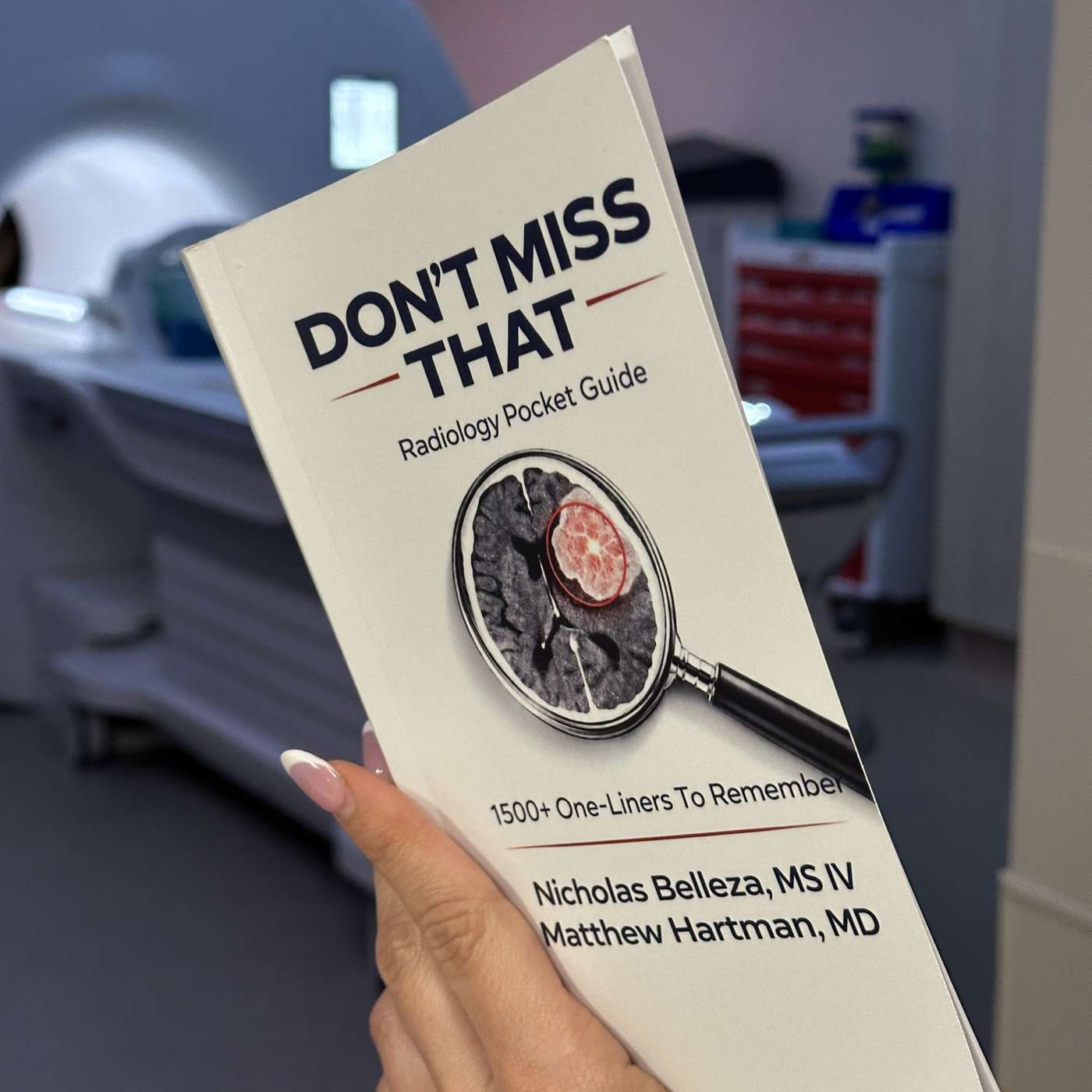
🎙️ Episode 5: How to Crush Your Radiology Rotation as a Med StudentIt’s July, and thousands of medical students are starting their radiology electives and audition rotations. In this episode, we shift from reading images to learning how to stand out on the rotation (though I'll throw in a pearl about XGPN).You’ll learn practical strategies that can make a lasting impression—from the importance of being early and being well dressed and attentive. We will also go over common mistakes that can hurt your evaluation. We’ll discuss how to work effectively with residents and attendings, what to do before your first day, and how to demonstrate curiosity, professionalism, and initiative without getting in the way.Whether you’re considering radiology as a career or simply want to maximize your elective, this episode provides actionable advice to help you succeed.Topics include:• How to prepare before day one• Reading room etiquette• Asking questions that impress• Common mistakes to avoid• Tips for earning an outstanding letter of recommendation• Resources to continue learning after the rotationBecause in radiology, you only see what you know—and attendings notice students who are eager to learn. Remember not to be staring at your smartphones during rotations. Instead have a pocket radiology guide in which you can take notes--I think I know a good one.We will have a part 2 where we talk about how to approach cases as a medical student if you are on the "hot seat"#Radiology #MedicalStudent #RadiologyRotation #AuditionRotation #FutureRadiologist #MedicalEducation #DontMissThatRadiology #MedEd
-
5
Don't Miss That--Radiology of why the lungs are so white? Blood, water, cells or pus!
Episode 4: Why Are the Lungs Too White? Blood, Water, Cells, or Pus?Why do lungs look too white on a chest X-ray? In this episode of Don’t Miss That Radiology ⭐, you’ll learn a simple framework to quickly narrow the differential: blood, water, cells, or pus.We’ll build a practical approach to chest X-ray interpretation by covering:The Silhouette Sign – localize disease by determining which normal borders disappear.The Spine Sign – recognize lower lobe pathology that can be easy to miss.The Air Bronchogram Sign – understand what it tells you about alveolar disease.Interstitial vs. Alveolar Disease – learn the key imaging patterns every medical student and resident should recognize.Congestive Heart Failure (CHF) and Pulmonary Edema – identify classic findings including vascular congestion and the batwing (bat-wing) sign, and learn how to distinguish pulmonary edema from pneumonia and other causes of diffuse lung opacities.Cavitary Lung Lesions – finish the episode with the CAVITY mnemonic to remember the major causes of pulmonary cavities and build a practical differential diagnosis you’ll use on rotations and exams.Whether you’re preparing for your radiology rotation, studying for shelf or board exams, or simply want to become more confident reading chest X-rays, this episode provides practical, memorable teaching points you can apply on your very next shift.Don’t miss that diagnosis.
-
4
Don't Miss That--Chest X-Ray Emergencies
Episode 3: Chest X-Ray Emergencies – Don’t Miss These Critical FindingsSome chest X-rays can’t wait. In this episode of Don’t Miss That Radiology, Dr. Matthew Hartman reviews the life-threatening findings every medical student, resident, and clinician should recognize before the patient leaves the imaging department.In this episode you’ll learn:✅ How to identify misplaced lines and tubes✅ Recognize a pneumothorax before it becomes a tension pneumothorax✅ Detect free air under the diaphragm and know when it signals a surgical emergency✅ Recognize pneumomediastinum and understand its key imaging clues✅ Identify pleural effusions and distinguish them from other causes of chest opacity✅ Develop a systematic approach to interpreting emergency chest radiographs with real teaching cases and practical pearlsWhether you’re on your radiology rotation, in the emergency department, or preparing for exams, this episode focuses on the chest X-ray findings you simply can’t afford to miss.📚 Don’t Miss That Radiology helps medical students, residents, and healthcare professionals build confidence through memorable teaching points and real-world cases.🎧 Subscribe for new episodes every week!#Radiology #ChestXRay #Pneumothorax #Pneumomediastinum #PleuralEffusion #LinesAndTubes #FreeAir #MedicalStudent
-
3
Don’t miss that—radiology of bowel obstruction and ileus
Episode 2: Don’t Miss That Bowel Obstruction! 🚨Small bowel obstruction or large bowel obstruction? In this episode of Don’t Miss That Radiology, Dr. Matthew Hartman walks you through a practical, step-by-step approach to abdominal radiographs using the Rule of Threes to quickly recognize bowel pathology.You’ll learn how to:✅ Differentiate small bowel from large bowel obstruction✅ Apply the Rule of Threes to bowel dilation✅ Recognize the classic coffee bean sign of sigmoid volvulus✅ Identify imaging clues that should never be missed✅ Build a systematic search pattern for abdominal X-raysWhether you’re a medical student, resident, or clinician looking to improve your abdominal imaging skills, this episode provides memorable teaching points and real-world examples to help you read with confidence.Remember: You only see what you know… don’t miss that.🎙️ Follow @Radiology101 for more radiology teaching pearls.📚 Learn even more with the Don’t Miss That Radiology Pocket Guide.#Radiology #MedicalEducation #AbdominalXray #BowelObstruction #SmallBowelObstruction #LargeBowelObstruction #SigmoidVolvulus
-
2
Law of Burps and Farts: A Simple Way to Find Free Air on Radiology
Don’t Miss That Radiology ⭐ | Episode 1: The Law of Burps and Farts (Free Air Detection)Looking at abdominal X-rays doesn’t have to be intimidating. In this first episode of Don’t Miss That Radiology, Dr. Matthew Hartman introduces a simple, memorable approach to identifying free intraperitoneal air using the “Law of Burps and Farts.”You’ll learn:✅ A systematic approach to every abdominal radiograph using Stones, Bones, Mass, and Gas✅ How patient positioning changes the appearance of free air✅ The “Law of Burps and Farts”—an easy way to remember where air should (and shouldn’t) be✅ How to recognize Rigler’s sign and other classic clues to pneumoperitoneum✅ Real cases that help you avoid missing a surgical emergencyWhether you’re a medical student, resident, emergency physician, or anyone learning radiology, this episode provides practical tools you can apply immediately on your next abdominal X-ray.📚 Don’t Miss That Radiology is a podcast dedicated to helping learners recognize critical imaging findings through memorable teaching pearls and real-world cases.🎧 Subscribe for new episodes every week!#Radiology #MedicalStudent #AbdominalXray #FreeAir #Pneumoperitoneum #RiglersSign #EmergencyMedicine #GeneralSurgery
We're indexing this podcast's transcripts for the first time — this can take a minute or two. We'll show results as soon as they're ready.
No matches for "" in this podcast's transcripts.
No topics indexed yet for this podcast.
Loading reviews...
ABOUT THIS SHOW
Learning radiology doesn’t have to be overwhelming. Don’t Miss That Radiology delivers high-yield imaging pearls, classic radiology signs, board-style questions, and real-world cases in short, easy-to-understand episodes. Whether you’re a medical student, resident, PA, NP, or healthcare professional, you’ll learn practical imaging concepts you can apply immediately. Hosted by Dr. Matthew Hartman, radiologist, educator, and creator of Radiology 101, this podcast focuses on the findings you don’t want to miss.
HOSTED BY
Dr. Matthew Hartman
Loading similar podcasts...
Frequently Asked Questions
How many episodes does Don’t Miss That Radiology ⭐ have?
Don’t Miss That Radiology ⭐ currently has 18 episodes available on PodParley. New episodes are automatically indexed when they're published to the podcast feed.
What is Don’t Miss That Radiology ⭐ about?
Learning radiology doesn’t have to be overwhelming. Don’t Miss That Radiology delivers high-yield imaging pearls, classic radiology signs, board-style questions, and real-world cases in short, easy-to-understand episodes. Whether you’re a medical student, resident, PA, NP, or healthcare...
How often does Don’t Miss That Radiology ⭐ release new episodes?
Don’t Miss That Radiology ⭐ has 18 episodes. Check the episode list to see recent publication dates and frequency.
Where can I listen to Don’t Miss That Radiology ⭐?
You can listen to Don’t Miss That Radiology ⭐ on PodParley by clicking any episode. We provide an embedded audio player for direct listening, and you can also subscribe via your preferred podcast app using the RSS feed.
Who hosts Don’t Miss That Radiology ⭐?
Don’t Miss That Radiology ⭐ is created and hosted by Dr. Matthew Hartman.
URL copied to clipboard!