
PODCAST · arts
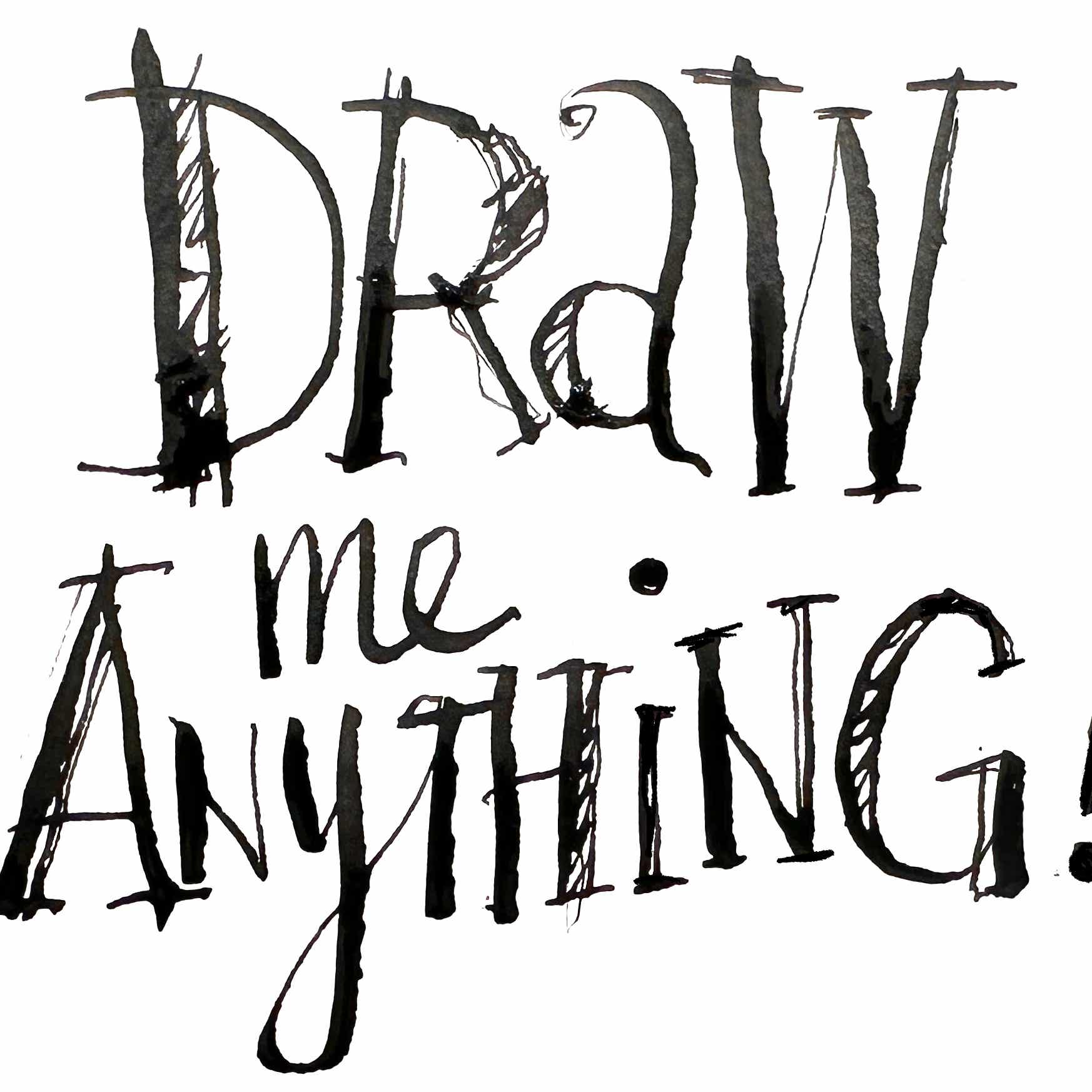
Draw Me Anything with Jason Chatfield
by Jason Chatfield
Live drawing videos with the most interesting creative minds in the world, hosted by Manhattan-based New Yorker cartoonist and comedian Jason Chatfield. www.newyorkcartoons.com
-
36
DMA#56: The Patron Saint of the Scary Email with Carly Valancy
This is a free preview of a paid episode. To hear more, visit www.newyorkcartoons.comCarly Valancy beamed in from Valencia, Spain.Some of you will remember Carly. She interviewed me on her Substack, A Good Omen, a while back. This week I got to return fire.Four years ago, Carly reached out to the writer Alex Dobrenko`. When she interviewed him, she asked who she should talk to next. He said me. She sent me one email. I said yes. Then I sent her one email (”I know how busy you are, but...”), and she said yes. Somewhere since then, I also filled out the intake form for her next Reach Out Party cohort, which means I am now both her interviewer and her student, a conflict of interest I intend to exploit fully.She told me my ask landed as a gift, not an imposition: “I ran outside and told my husband. You know what’s so cool? The chain of events that can happen from one email or DM.” That’s her entire body of work in a sentence. One email. Everything else is scaffolding.Carly is a former actor. Broadway community, Hell’s Kitchen, 44th Street, the whole catastrophe. At about 25, stuck in a coffee shop job she hated and hunting for an agent, she did the thing that would become her life’s work without knowing it: she reached out to 1 stranger a day for 100 days.It worked, in the boring, verifiable way these things sometimes do. She found an agent she’s still friends with. She booked a national tour. And around day 82, she finally mentioned the whole scheme to her acting coach, who was appalled. Not by the project. By the secrecy. “You have to tell people you’re doing this!” Then: “When you get to day 100, you should throw a party at the studio. I’ll host it. You can call it Carly Valancy’s Reach Out Party.”She ran the 100 days again at 30, and the second lap taught her the lesson hiding inside the first:“There was so much more beauty in the process, in who I became in it and how I found my voice. A lot of people treat networking as a means to an end. It’s something you do when you need something. Instead, think about it as a process of becoming.”Carly has a phrase I’ve been carrying around like a lucky coin: increasing your surface area for luck. More reach-outs, more rooms, more chances for the universe to trip over you. Lately she’s refined it into something even better: “placing yourself in the current of serendipity”…I asked her to define a good omen, given she’s named an entire publication after one. She gave me a visual instead:“I’m going to give you a lava lamp. It’s constantly moving, and there’s some kind of glow about it where you’re just like, what is that thing? It’s got texture, and it’s alive.”Then she gave me a better one, borrowed from the theatre director Anne Bogart, whom she cold-emailed (of course she did) with the same question:
-
35
DMA#56: with special guest Carly Valancy
This is a public episode. If you'd like to discuss this with other subscribers or get access to bonus episodes, visit www.newyorkcartoons.com/subscribe
-
34
#66: IP Theft Is Huge in the Moth Community
Subscribe, rate, and please leave us a funny ⭐️⭐️⭐️⭐️⭐️ review wherever you listen to podcasts.Welcome back for another episode of Is There Something In This? Outside, seaplanes kept coming down the East River like they’d been thrown, and every twenty minutes Scott and I stopped mid-sentence to watch one not crash. One aborted, came around, and hit the water hard enough that we both made the noise. Nobody plans these segments. I’m back from Columbus, where actual listeners turned up and forced us to describe our audience out loud. Here’s what we landed on: you’re pretentious, but you’re dumb enough to know you shouldn’t be. You want Barry Blitt on trade deficits, but you also want to know if the mouse has a really big dick. You are, in other words, exactly like us. (btw here’s a thing: I’m now live-drawing the ideas as we go, so the video version on Substack and YouTube is where you can watch me ruin a perfectly good joke in real time.)Then we did the jokes. A jester’s head in the guillotine bucket, and the salesman who pitched the guillotine to the king as a workflow disruption. A MoMA guard with a new sign about muttering AI slop near the Van Gogh. A snowman in couples counselling, his wife a bucket of water: “I just think this summer has changed her.” A moth has an idea, and every moth for miles descends on it…Somewhere in there, we stopped writing jokes and got onto the Flock cameras, the licence-plate network that lets cops look up their exes without a subpoena.Also: the balls on the Big Merino, a pigeon with a hustle, a Borg water tower in Greenpoint, and a Gallagher courtroom gag from which Scott has formally removed his name. Because why not?Our new book, You’re Not a Real Parent Until..., is out on October 13th and available for pre-order now wherever you buy books. It has, I’m reliably informed, already reached one bookshelf in Moscow.By the way, if you want to binge all of our previous episodes in an endless playlist like it’s some kind of Netflix Drama that just got nominated for an Emmy®, you can find our entire backlog right here.Send us your cartoon idea suggestions! We can’t guarantee we will read every one on the show, but we will read all messages we get here.Subscribe now▶ Be sure to send in your suggestions via Instagram @newyorkcartoons or [email protected]. Cheers!▶ Buy our new book at: www.realdogowner.com▶ Check out our Facebook page at: www.facebook.com/ITSITpodcast‘til next time!Your pal,PS. Look, if this actually did something for your brain (or at least distracted you from the creeping dread of your own inbox for six minutes), please consider restacking this and sharing it with your people. It’s the only way the word spreads.Copyright Disclaimers: We’re inviting you into our living room; don’t walk out with our lamp. Please refrain from selling our jokes. All original content is © Copyright 2024 Jason Chatfield & Scott Dooley for “Is There Something In This?” All rights reserved.We welcome you to download and play the podcast and share it with others for personal use; please acknowledge “Is There Something in This?” Podcast as the source of the material. You may not, except with our express written permission, distribute or commercially exploit the content.On the topic: This podcast may include images that are used under the Fair Use doctrine of the U.S. Copyright Act (17 U.S.C. § 107). These images are utilised for purposes such as commentary, criticism, news reporting, education, and research. Fair Use allows for the limited use of copyrighted material without requiring permission from the rights holder, provided the use does not infringe upon the market value of the original work.We do not claim ownership of any third-party images used in this podcast. All rights remain with their respective copyright holders. If you believe your copyrighted work has been used in a way that does not fall within Fair Use, please contact us, and we will address any concerns promptly. This is a public episode. If you'd like to discuss this with other subscribers or get access to bonus episodes, visit www.newyorkcartoons.com/subscribe
-
33
DMA#55: Paid to be in trouble with Avi Steinberg
About twelve years ago, a teacher hired me to draw a caricature of her colleague as a gift. The colleague, she mentioned, was a New Yorker cartoonist. I said yes immediately, then realised I had no idea what the man looked like.That’s the whole profession, basically. You know the work, you know the signature, you’ve never seen the face. “It’s the perfect crime,” Avi Steinberg said this week, a decade after drawing him without his knowledge. “You can be famous on paper and still walk around without anyone bothering you.”Avi kept the caricature. I look at it and see only the mistakes, but he tells me it’s a treasured possession. I’m deciding to believe him.Ten years, Ten a week.Avi started submitting to The New Yorker straight out of high school and sold nothing for roughly a decade. I asked whether he hit year seven and wondered if he should pack it in. “I don’t wait till year seven to feel like that…”The turn came when he worked out what the cartoonists he admired were actually doing. “The greats, they drew a batch of ten cartoons every week. And when I really learned that, my heart sank.” So he gave himself a year of ten a week. No more emotional rollercoaster. At the end of it, he could either do this properly or quit.He teaches kindergarten in New York City, which is where he gets his best material on artistic confidence. “My students are the best artists in the world. No one told them how not to draw something.”I told him about being fifteen, getting detention for a savage caricature of my history teacher, then having that same teacher sidle up to my desk during detention and offer me twenty dollars to do a mean one of the retiring school gardener. Avi diagnosed the whole career in one line: being a cartoonist is the balance of being in detention and getting twenty dollars.Paid to be in trouble. Still true at forty-two.Then Tom Toro , our official ‘Ryan Seacrest of Comic-Con’ gossip elbowed his way in to the streamTom appeared halfway through, still wearing his San Diego Comic-Con lanyard, having got home at half one that morning. He would like to be appointed my official Comic-Con Correspondent. Granted, obviously.His collection And To Think This Started As A Book Club was up for an Eisner. Then the winners leaked. Comic-Con briefly posted the results on their own website, somebody screenshotted it, and Reddit did the rest. “Not since the Will Smith slap of Chris Rock has there been such a scandal at an award show.”Tom resisted. Tom failed. He looked the night before, reasoning he would enjoy the dinner more if he knew, and found he had lost to Tom Gauld, “who has the flawless first name of Tom.” He was there with his son and struck a deal: every second book sale converted directly into Pokémon cards. “I basically started asking for payment in Pokémon cards, because that’s what it would be anyway.”Tom is also up for Gag Cartoonist of the Year at the Reubens, after a Thurber finalist nod and the Eisner. He is hoping to lose all three. “I think it’ll be funnier to go 0 for 3 than 1 for 3.” Rule of threes. The man is committed to the bit.Avi’s new book contains an alien character he invented at twelve, posted to the newspaper syndicates, and had rejected. He kept the file for thirty years. “Nothing is ever totally gone. It was very nice to see that the work I did as a twelve-year-old wasn’t a waste.”He is also banking the small milestones as they arrive: the cover, the proofs, the first box of copies. “However the book sells, whatever the reception is, those things are yours.”Tom’s verdict on his friend, delivered with real affection: “Avi is like the Aristotle of gag cartoons. Your stick figures coping with the horror of existence is one of my favourite things.” Avi: “My biography.”Watch the replay, then buy the books.The full episode is up now. There is live drawing in the back half, and Tom talked his way out of it by claiming he cannot sketch, which I am choosing not to believe.Avi Steinberg, The Jumble is out 3 November and available to pre-order wherever you buy books. Pre-orders genuinely matter: they all tick over on release day and become the number the publisher looks at.Tom Toro, And To Think This Started As A Book Club, his Eisner-nominated collection, is out now. His children’s book Between the Balloons lands at Thanksgiving and is also up for pre-order.Buy them from bookshop.org, from your local, from all of it. As Avi put it: buy one from each place, just to spread it around.‘til next time!Your pal,PS. I am up for a Reuben this year in book illustration division for You’re Not a Real Dog Owner Until, drawn with Scott Dooley, alongside two books I own and rate more highly than my own. Morris remains unimpressed, and has been on the drafting table chair since Tuesday.PPS. Look, if this actually did something for your brain (or at least distracted you from the creeping dread of your own inbox for six minutes), please consider restacking this and sharing it with your people. It’s the only way the word spreads. This is a public episode. If you'd like to discuss this with other subscribers or get access to bonus episodes, visit www.newyorkcartoons.com/subscribe
-
32
DMA#54: The Kindest Cut with Josh Gondelman
I said at the top of this episode that I didn’t want to call Josh Gondelman a comedian, because the word does about a third of the required work.Here is the CV, and I have since checked it against his actual bio rather than my memory, which is a courtesy I extend to guests and to no one else. Five years at Last Week Tonight with John Oliver, first as web producer and then as staff writer, where he collected four Emmy Awards, two Peabody Awards and three WGA Awards. Head writer and executive producer on Desus & Mero at Showtime. A contributor to the final season of The Marvelous Mrs. Maisel. Two stand-up specials: People Pleaser (2022) and Positive Reinforcement (2025). A book of essays, Nice Try: Stories of Best Intentions and Mixed Results. Co-creator of the parody Twitter account @SeinfeldToday. A regular panellist on NPR’s Wait Wait... Don’t Tell Me!We first met about ten years ago at Union Hall, doing Picture This, the show where cartoonists draw live while comedians perform and everyone pretends this is a normal way to spend an evening. I have two deeply unemployable skills: cartoonist and comedian. My parents are thrilled. Picture This is the only place on earth where both of them are load-bearing at once.Josh’s read on it was better than mine:“You’re watching something that’s never happened before and will never happen again. Everybody is kind of on edge seeing how the artists will interpret the comedy and how the comedians will react to the art. It’s perfect.”We also remembered a show where the comic on stage was working a long stretch about diarrhoea, and I, being a professional, had no choice but to render it. Gratuitously. Backstage was a convivial disgrace. We were crying.That’s the whole show, really. Backstage is better than the stage. (Don’t tell the box office.)The Overnight Success That Took 9 YearsI confessed that I had followed @SeinfeldToday for years without ever once registering that Josh was behind it. He co-created it with Jack Moore in late 2012: log lines for Seinfeld episodes, were they to exist in the present day, and present day was 2012 into 2013… which is now a period piece.The numbers are f*****g absurd:“By, I would say, 48 hours later, it had like 100,000 followers... Never had anything like that happen to me before or since. It was like as close as I had to being Hawk Tuah.”The Sunday night the account was formed, Josh had dinner with a friend who worked as a manager. She told him, gently, that she loved working with him and would keep helping him out, but that her boss was after clients with a slightly higher profile.Two days later, the boss wanted a meeting. And to sign him!“I’ve never seen something turn on a dime like that in my life before.”He had samples. He’d been doing stand-up for years. But he didn’t have the bulletproof script sitting in a drawer waiting for the world to finally notice him. He had drafts that were “all kind of a little rough.” So the lightning struck, and he spent the next year converting it into late-night writing applications, one at a time, like a man turning a lottery win into a mortgage.The heat arrives whether or not you’re ready. It doesn’t wait while you tidy up.The Taste of a 57-Year-Old Father of ThreeNice Try is a collection of essays, and I have described it, to Josh’s face and now to you, as being like “A Kind David Sedaris.” He took the compliment the way he takes everything, which is to say he immediately turned it into an admission of ongoing inadequacy:“We moved into a new apartment last week and I was just shelving my books and I saw my old copies of Naked... I haven’t looked at it in years, but it was like, I’m chasing that still as a prose writer.”Same. The personal essay has a king, and we are both loitering outside the palace.There’s a bit in the book about a childhood library trip and discovering R.L. Stine, and a line about having the taste of a 57-year-old father of three.“Books were kind of the place where I could have more adult taste. My parents were a little more protective with movies and TV and even violent video games. But with books, it was kind of whatever I could get my hands on.”Which is how a child ends up with real, considered positions on prime John Grisham. The Rainmaker. The Client. The Firm. He said “prime Grisham” the way other men say “prime Coltrane.” That truly is 57-year-old-father-of-three behaviour.Writing in Someone Else’s MouthHere’s the thing about Josh’s writing that I’ve never been able to get past. Him on stage is him on the page. The voice is identical, and it’s completely unique, and yet he spent five years writing in an acerbic British one, and got four Emmys for it.How?Below: how you make an atrocity funny without becoming a ghoul, the word Gary Gulman put in my head that I can’t get out, the pumpkin quiche incident, and why the meanest guy in the room in 2007 was never the one to copy.“In a good writer’s room, the best writer’s rooms, I think, have real diversity of perspective. And so even when the host is filtering it through how they think and talk and see things, you are bringing what your interests and ideas are when you can get it through the lens of what they do.”Part of what the host wants, he said, is breadth. He pointed to a Last Week Tonight piece made after his time there, on Black hair care and health, led by Ali Barthwell:“That’s really cool that John has the range to go, I’m going to figure out how to talk about this thing that is compelling to me even though it is not of my personal experience. And then I want someone like Ali who can go, I can speak to this from personal experience and I can make it sound right coming out of John.”So it isn’t impressionism. It’s not doing the accent in your head. You learn the show’s keystone phrases and structures and referential touchstones, and then:“How can I expand this palette in directions, like in vectors, that are fun and specific to me as well?”Which means that all those weird esoteric tangents, the ones that feel like they’ve been beamed in from a stranger’s dream? Those are somebody’s fingerprints, and if you know the room, you can dust for them.“Oh, this is about an angry penguin with a whimsical name. And you’re like, well, that’s a Jill Twiss specialty for sure.”He also recalled an extremely elaborate bit, requiring numerous graphic mock-ups, concerning an ornate sex party at Wes Anderson’s house. Unmistakably Will Tracy, who went on to write The Menu and Bugonia and worked on Succession for its entire run.Now that I think about it, I’d always been able to spot Asher Perlman on Colbert the same way. There’s a full stop that arrives, and you go: ah. There he is.Getting Your Fingernails UnderneathI asked him the question I actually wanted answered. At Last Week Tonight, he had to take genuinely bleak news and other material and make it funny. Not funny instead of serious. Funny as the delivery mechanism for serious.“I think that layer kind of lets you take a couple of harder swings.”You don’t always mock the tragedy. You mock the discourse around the tragedy. But, he said, it doesn’t always have to be removed levels of commentary. Sometimes the material walks right up and hands you itself:“Then you see the CEO of the company that did the polluting going, look, you gotta dump sludge somewhere. And you’re like, okay, that we can make fun of. We can make fun of this a*****e.”Then the second part, which is the best description of comedy writing I’ve heard in a long time:“Look for the little things where you can get your fingernails underneath and go, oh, I can claw something up here that’s fun and funny, and not just a wry good point.”Because a very good point that only elicits ‘clapter’ is, as he put it, its own thing. Fine. Applause is not laughter and laughter is not agreement.“There’s an idea that you can really sink into someone’s subconscious, that they walk away and they’re actually thinking about it going, holy s**t.”…“The efforts of these shows are not mostly to change the world. It’s to make things intelligible.”Not to fix it. To give you the vocabulary and the narrative at your fingertips for a thing you’d half-heard and had a feeling about and couldn’t articulate. Give them the utility. Give them the words.It’s the same job as a political cartoon, incidentally. You are not passing legislation. You are handing someone a shape for the thing they already felt.Oliphant knew that. He never wrote for the awards. He wrote for himself, and the rest of us borrowed the shape.It’s Pronounced ‘Quiche’Which brings us to the vocabulary people.Gary Gulman is, to my mind and Josh’s, a master linguist operating under cover of stand-up, and the thing Josh loves about him is the exact opposite of what you’d expect from a man with a large vocabulary:“He didn’t invent a new word. He did not put words together in a way they’d never been put together before. But he just cut through. Just the emphasis and specificity and structure of, I’m going to use the same words twice in the opposite order. And it gets a huge laugh. To me, that’s like watching surgery.”I told him I’d watched Grandiloquent thinking the same thing: this is neurosurgery. Fastidious to the point of being slightly frightening. It is not about being baroque or ornate with the construction. It’s the opposite. It’s distillation.Gary taught me a word recently that I cannot shake. He and Myq Kaplan were doing their thing over lunch, the two of them together, and Gary described the practice of shepherding your sentences. He’d picked it up as a legal term. It means carefully guiding, organising, and directing the flow of your writing so it leads the reader exactly where you want them to go.And here is where I should tell you that these are the same men who, at lunch on the Upper East Side, destroyed me. I ordered the pumpkin quiche at a vegan place. It arrived within about five minutes, which is barely enough time to make eye contact with a waiter, let alone a quiche.“Whoa,” I said. “That was quick.” Within half a split second, without looking up, Kaplan said: “It’s pronounced quiche.”Gary said, " Wow! " in the tone of a man witnessing a hole-in-one, “Kaplan. That mind. He’s so…” and I said, “…Quiche?” Then it was just three idiots laughing at themselves over a vegan tart.That’s it. That’s the whole reward. Decades of craft, a Peabody or four between us, an entire language at our disposal, and the peak human experience remains three men in their forties and fifties giggling at a homophone.“The Born to Run of That Thing”Josh’s stated ambition, which I’d like framed:“I always joke that I want everything to be the Born to Run of that thing. Just give me all the horns and the bells. Give me all the s**t.”But then, the caveat that makes it actually true:“That kind of maximalism of intention, if not of execution, I think is really beautiful. I just want to fill this vessel, whatever it is, whether it’s a book or a song or a painting, with meaning. Whether that means it’s one long brushstroke of varying pressure that communicates it really clearly, or whether it’s a novel that’s 120,000 words. As long as it is the fully realised version of the thing it is, and done with enthusiasm, I love it.”One brushstroke of varying pressure. He said that to a man holding a pencil, live, on camera, and I don’t think he even knew he’d done it.“The Attell of It All”“I think maybe the most copied comedian of all time, or of the last 25 years, is Dave Attell.”I agree, and I have receipts, because I spent years on the comics’ bench at the Cellar watching him close out the late show, trying to reverse-engineer it. How the f**k is he doing this?? It felt like a magic trick performed in a room full of magicians.And the second you try to imitate it, you lose something in translation, because there’s a layer underneath that isn’t transferable. There’s no way to do it without simply being Dave Attell.Josh:“I’ve heard dozens, if not hundreds, of people where you can draw a straight line from Dave Attell to where they are. But no one that captures...”The globe joke. I travel so much for stand-up. I used to be afraid to travel, because when I was a kid, my father beat me with a globe. One of my all-time favourites, and one of his.“I’ve seen so many people change the setup and the punchline by one word. And it’s like, that’s not slick. We know the seed that that’s coming from is so clear.”The inimitable thing about Attell isn’t the darkness. Josh nailed it:“The more bleak the comedy gets, the more grimy, having that gentle touch goes so far. This is a person, there’s a sweetness in this person, and they are also willing to look at the grimy parts.”Which is, incidentally, precisely what makes Aaron Chen work. His special Funny Garden is on Netflix, and it is one of the most singular things you’ll see. So innocent on the surface, and then he picks up a vase to drink from, and takes you somewhere genuinely deep, and you don’t notice you’ve gone.Josh made a related point about voices being unforgeable. Maria Bamford. Daniel Simonsen, with a thick Norwegian accent that is not, on inspection, Norwegian, or anything else. No one talks like that. Whatever that is, is him.The Kindest CutHere’s what I actually wanted to ask him, and I saved it for last because I wasn’t sure how it would land.I started in Perth in 2007. Everyone in that scene was watching the same two people: Dane Cook and Louis C.K. Fellow suburban Bostonians, as it happens. And there was a meanness in the water. The comedy rewarded the fastest, meanest person in the room. That was the metric. That was the whole ladder.Josh started in Boston in 2004, at the actual epicentre, and built an entire career being conspicuously the opposite. I asked whether it was a bit he couldn’t get out of, or genuinely his personality.“Yeah, that’s exactly what it was. It took me a little extra effort. I started in Boston in 2004, and there were maybe a dozen guys who were like, oh, Dane Cook is what comedy is. And we’re all doing iterations of that.”A dozen. All of them. Vituperative by default, because that was what winning looked like.What saved him wasn’t a principle; it was proximity. He got lucky enough to be around the emerging Boston lot: Gary Gulman coming back through on Last Comic Standing. Erin Judge. Lamont Price. Joe List. The Walsh brothers, Chris and Dave, running a weekly show of strange sketch and storytelling that had no business working.“Seeing that was like, oh, you don’t just have to do the thing that you see most prevalently or most successfully.”That’s it. That’s the whole thing.I sat on that bench at the Cellar for years trying to work out how to become Dave Attell, and the answer, which took me an embarrassingly long time to arrive at, was that there wasn’t one. Not because I lacked the technique. Because the vacancy was already filled. By Dave.Josh worked that out in 2004, in a room full of a dozen men doing iterations of the same guy, and quietly went and did the other thing.Four Emmys. Two Peabodys. Three WGAs.Nice try.Watch the replay, then go subscribe to Josh!Josh writes That’s Marvelous!, a weekly newsletter of pep talks: for readers, for strangers, and for inanimate objects. He described it in the chat, and I’m describing it here because I’d like you to actually go.thatsmarvelousnewsletter.comAlso: Positive Reinforcement, his new special. People Pleaser, his first. Nice Try, his essay collection. Wait Wait... Don’t Tell Me!, where he has also guest-hosted. All of it good. All of it kind. None of it soft.I could have talked to him for hours and was only stopped by the tyranny of the clock and the fact that I was, by then, drawing him.‘til next time!Your pal,PS. Look, if this actually did something for your brain (or at least distracted you from the creeping dread of your own inbox for six minutes), please consider restacking this and sharing it with your people. It’s the only way the word spreads. This is a public episode. If you'd like to discuss this with other subscribers or get access to bonus episodes, visit www.newyorkcartoons.com/subscribe
-
31
DMA#53: "Don't Call It a Recap" with Austin Kleon
Over Austin Kleon’s shoulder, the whole time we talked, Lynda Barry watched us.Not the actual Lynda Barry; an original manuscript page from Cruddy, hanging on his studio wall next to an outtake from Making Comics. He calls them his Guardian Spirits, and the plan is to keep adding to them until he’s got a full pantheon of demigods looming over his desk.I understand the impulse completely. I’ve got a drawing of Larry David in my studio that Luke Watson painted for me, and he glares at me every day with an expression that says, “Is that really the version you’re gonna go with? Aeeeeh, it’s prettaaay pretty good.”This was Austin’s second time on Draw Me Anything, and I’d be lying if I said we covered the book in an orderly fashion. We started with 63 people in the chat and ended with 350, which means roughly 287 people wandered in midstream to find two middle-aged cartoonists arguing about whether Hook is secretly a midlife-crisis film.It is. More on this later. It gets worse. (Bangarang!)Don’t Call It a Book TourThe new book is called Don’t Call It Art, and Austin, a man committed to the bit, named the promotional run for it the Don’t Call It a Book Tour. Previous books got 25-city tours. This one got three cities: Austin, Nashville and Cleveland, which he described as “kind of like a straight shot to Cleveland type tour.”If you enjoy my work and would like to support, please upgrade to become a paid subscriber (only $1 per week)He slept in five beds in six days. “This is a young person’s game,” he said, and every comedian who’s ever done the road nodded so hard the vertebrae in their necks audibly clicked. The week after a launch, he told me, all the things that keep you alive as a creative person, the sleep, the walks, the daily ritual, go straight out the window. The man who wrote the book on sustainable creative practice blew himself out promoting a book about sustainable creative practice. “I wish the books worked on me better,” he said, which might be the most honest thing anyone has ever said on this series.Nobody Knows Anything, ConfidentlyWe got into the publishing industry, which Austin summarised via William Golding’s old line that nobody knows anything: true of Hollywood, true of books. Nobody in publishing knows what sells books, he said, “but they’ll say something confidently to you about it.” Everyone’s chasing BookTok, which is lightning in a bottle, on purpose, which is not how lightning or bottles work.The only thing that actually sells a book, he said, quoting Ann Patchett, is one person holding it up and saying I love this. Word of mouth. That’s it. That’s the whole machine.And then he reached for Charles Portis, because of course he did. There’s a line in Gringos about two men who “had known the despair of selling things that people didn’t want,” and Austin pointed out that this is the entire creative life. Nobody is asking for another book. Nobody asked for another cartoon. Nobody wanted a live-action Moana. You make the thing anyway, and then you present it, over and over, like Marshawn Lynch running through a man’s chest. Austin apparently plays the Beast Mode clip to himself on a loop when the self-promotion shame creeps in. If you run through somebody’s face, over and over and over and over and over …. eventually they can’t take it any more. This is also, coincidentally, my approach to open mics.The shame is real, though. You think: my audience must be so sick of hearing about this thing. Meanwhile, an actual paid subscriber to Austin’s newsletter walked up to him in Nashville and said If I’d known you were in town, I’d have brought all my friends. The man works across the street from the hotel. He pays money to be told these things. He did not know.So no. Nobody is sick of hearing about your thing. They have not heard about your thing.The Taco Bell Theory of ArtMy favourite framework of the day came from, and I want to be clear that I am quoting a bestselling author here, Taco Bell. Austin loves their “distinctiveness rule”: you can change the taste, or you can change the form, but never both at once. That’s how he thinks about his readers. Keep the familiar square format, but fill this book with his kids’ drawings and new textures, so it reads like an Austin Kleon book that was somehow drawn by his children. (This “RED” rule stands for relevance, ease, and distinctiveness.)He’s unapologetic about thinking of his audience while he works, which felt almost transgressive to hear out loud. “My readers have given me everything,” he said. “This idea that I wouldn’t think about them when I was writing is just weird to me.” His books, he insists, aren’t pure art anyway; they’re the byproducts of him trying to make stuff. The Montel Jordan principle: this is how we do it. Not how you have to do it. This is how we do it.Neither of us went to art school, which is probably why we both find kids so instructive. They don’t know the correct way to do anything, so they just let it rip.Why the Book Exists at AllThe title comes from a John Baldessari quote: I learned so much about art from watching a kid draw. Kids don’t call it art. They’re not making Art; they’re just doing stuff. There’s a Brian Eno line in the book to match: people do much better when they don’t think they’re being artists. If you don’t call it art, you’re likely to get a better result.Austin described the book as being for anyone who’s lost that lovin’ feeling: you’ve been doing the work a long time, maybe even successfully, and the joy has quietly left the building. Where Keep Going was about pushing through a world gone mad, this one is Keep Going 2.0: the call is coming from inside the house. The chaos isn’t out there. It’s in here, with the deadlines and the invoices and the creeping suspicion that your passion has become your landlord.I know this feeling intimately. Twenty-one years as a full-time cartoonist, and people still say “you’re so lucky, you get to do what you love every day,” and I want to grab them by the lapels and explain that they have no idea how hard it is to stay in love with a thing that is actively driving you insane. It’s not drudgery exactly. It’s more like the fruit has started to turn, and instead of leaping out of bed to bite the apple you’re standing in the kitchen at 7am wondering if you can make some sort of bread out of it.Charlie Bucket’s Midlife CrisisWhich brings me to my Willy Wonka theory, which I made Austin sit through and now you will too. End of the film. Great Glass Elevator. Wonka looks down at Charlie and says, “Don’t forget what happened to the man who suddenly got everything he ever wanted.” Charlie asks what. And Wonka says he lived happily ever after, but what he should say is: This is a public episode. If you'd like to discuss this with other subscribers or get access to bonus episodes, visit www.newyorkcartoons.com/subscribe
-
30
DMA#51: 'Truths Are Just Jokes That Nobody Laughed At' with Myq Kaplan
Let me tell you who Myq Kaplan is, because if you’re not already a fan, that changes today.He’s been doing comedy for going on twenty-five years. He has a Comedy Central special. He was a finalist on Last Comic Standing. He’s been on Comedy Bang Bang and Keith and the Girl more times than I can count. He has two specials on YouTube - AKA and Rini - and a new one he’s just recorded. He runs a Substack called Myq Kaplan's Arty Har-Hars, which you should subscribe to immediately after this. He is one of the most densely packed laughs-per-minute comedians working anywhere in this city, and I say that as someone who has been watching this scene very closely for fifteen years.He is also the reason I once shot IPA out of my nose at a comedy show on Second Avenue. But we’ll get to that.The first thing you need to know about Myq Kaplan is that his name is, by design, a barrier to entry.“I brought it upon myself, obviously, the spelling of my name,” he told me, almost immediately after we started recording. “There’s a little bit of a barrier to entry. But once you get past, then I feel like there’s a lot of reward.”He then, in the same breath, held up a microphone.“That’s a Myq” he said.I say “by design” because everything about Myq’s comedy is by design - the spelling of his name, the precision of his phrasing, the way a simple prop becomes the punchline to a joke that is also, if you look at it properly, a philosophical position about the rewards of paying attention. Nothing is accidental. The commitment to craft runs so deep that it’s become invisible, which is when craft becomes art.The name story is one I’ve been dining out on since 2014. I was a young, fledgling comedian appearing on a certain popular podcast, and I was doing my plugs at the end of the show. Bob Kelly was hosting. I was reading names off the lineup for an upcoming show - I think it was the Producers Club - and I arrived at Myq’s name, and I said: “and Meek Kaplan.”The room turned on me. Louis J. Gomez. Dan Soder. Joe List. All of them looking at me with the particular expression that New York comics reserve for someone who has just revealed a catastrophic gap in their knowledge.“You f*****g Australians,” somebody said. “How have you never heard of Myq Kaplan?” They laid into me for twenty minutes. About my accent. About my ignorance. About the basic expectation that someone doing comedy in New York should know who Myq Kaplan is, which is, I’ll grant them, a fair point.And then, having absorbed all of this - having been fully educated and corrected and aware - I subsequently introduced Myq on stage that night as “Meek Kaplan.” Again.Myq received this with extraordinary grace. “Your trauma is my treasure,” he said.But the real first time I encountered Myq Kaplan was not that night. It was earlier - 2011, or thereabouts. I was still coming to New York as a tourist then, once a year, for a month at a time, in the way that people who are going to end up living somewhere do before they commit to actually living there. I was going to as many comedy shows as I could, trying to understand the scene, sheepishly introducing myself to people and then overthinking every conversation afterwards on the subway home.The show was called Kabin. It was on Second Avenue, the back room of a bar. Rebecca Trent booked it. It was, by the general consensus of everyone who was there at the time, the best comic hang in the city. Their fifth anniversary show, I think it was, went from six in the afternoon until five in the morning. 11 hours. I was in that room for most of it.I had a beer in my hand. Sean Donnelly was hosting, or someone like Sean Donnelly. Whoever it was said, with the full weight of insider authority: you are going to love this next guy.I took a sip.Myq Kaplan walked on stage and said something. I genuinely do not know what it was. I have never known. What I know is that the beer - an IPA, specifically, which made the whole thing considerably worse - travelled at velocity through my nasal cavity and exited my face in a direction that beer is not supposed to exit. My eyes were streaming from the carbonation. I was making sounds that grown adults should not make in public. Eight minutes later, Myq left the stage, and I was a different person.It is a trauma-memory. The kind that’s vivid, not because it was bad, but because it was so involuntary. The laugh didn’t ask my permission.“That’s very, very kind, very thoughtful for you to share,” Myq said when I told him this story on the podcast. “Better than a spit take. Your trauma is my treasure.”If you enjoy my work and would like to support, please upgrade to become a paid subscriber (only $1 per week) This is a public episode. If you'd like to discuss this with other subscribers or get access to bonus episodes, visit www.newyorkcartoons.com/subscribe
-
29
DMA#50: Aussies in New York Getting Sandwiches with Ben Gollan
My drawing board is currently covered in a mix of art supplies and aggressively pungent deli meats.I’ve got a puddle of Higgins ink dangerously close to a towering pastrami on rye, and my entire apartment smells of mustard. Outside my window, a sanitation truck is violently reversing down 9th Avenue. The floorboards are vibrating. On my monitor, looking entirely too relaxed for a man navigating the crazy New York City culinary scene, sits Ben Gollan, a fellow Aussie expat making a go of it in the big smoke.If you enjoy my work and would like to support, please upgrade to become a paid subscriber (only $1 per week)Ben’s the undisputed Sandwich Tour King of New York. He runs a wildly successful walking tour company called ‘A Man and His Sandwich’, where he guides people through the absolute best, most artery-clogging delis in the five boroughs. But the thing that always short-circuits my brain about Ben isn’t his encyclopaedic knowledge of cured meats. It’s his backstory.It’s always deeply comforting to talk to another expat. We spent a significant portion of the hour just being two Australians with thick accents, complaining loudly about the structural inefficiencies of New York City while simultaneously admitting we’d never live anywhere else.We got into the gritty reality of the New York hustle. If you’re an Aussie expat, you know the exact cultural whiplash we’re talking about. Back home, we have this insidious thing called the tall poppy syndrome. If you try something outside the box, people immediately try to cut you down. Ben mentioned that when he goes back to Australia and tells people he runs sandwich tours, they laugh and ask what his real job is. But here in New York? People look at him and say, “That’s a great idea, I bet you’re the best.”The city runs on that delusional, infectious encouragement. It’s the only place where a hungover, out-of-work chef from South Africa can stare at leftover Indian paratha bread and some banh mi scraps in his fridge, accidentally invent a pulled-pork paratha taco, and suddenly end up running three wildly lucrative storefronts. (That’s the true story of Goa Taco, by the way. A legendary Lower East Side staple born entirely out of desperation and a hangover).As I mentioned, Ben’s a fellow expat Australian. Back in Sydney, he was a crisply dressed corporate lawyer working for the government. He traded the courtroom for the chaotic, unforgiving streets of New York back in 2016, all to support his wife’s career. Somewhere along the line, a single pastrami sandwich at a now-defunct East Village deli completely derailed his professional trajectory. He ate the sandwich, had a culinary epiphany, and decided he was going to dedicate his life to the space between two pieces of bread.There’s something deeply terrifying about abandoning a stable, lucrative law career to yell about sandwiches on a Brooklyn sidewalk. But it’s the kind of unhinged creative pivot I completely admire...During our Draw Me Anything session, I set myself the absurd task of drawing a photorealistic pastrami sandwich while we talked. I quickly realised that drawing bread’s a nightmare. Bread’s just a chaotic sponge. You try to capture the crust with pilot pen, and it just looks like a diseased rock.Ben’s got this incredible, magnetic energy. You can see exactly why his tours are perpetually sold out. The live chat was losing its collective mind over his deli recommendations. You could feel the audience getting hungry through the screen… This is a public episode. If you'd like to discuss this with other subscribers or get access to bonus episodes, visit www.newyorkcartoons.com/subscribe
-
28
DMA#53: Drinking Your Own Bath Water: A Morning with Rich Sparks
There’s a cartoon early in Rich Sparks’s new book of a man my age, alone in a bath, lifting a spoon to his lips. No setup, no crowd, no scene. Just the act, and a title underneath:“Youp.”Where I’m from, that’s a diagnosis. My uncle Greg taught it to me as a child: “Mate, get a load of this bloke. He drinks his own fucken bath water.” (Australian for arrogant.) First cousin to tall poppy syndrome, that great national project of never letting anyone tout their own success.I opened the book to that page first, and decided the next hour of my morning was spoken for. Which is roughly how the whole conversation went.A book with no thread, which is the whole point…The reason for the visit was Horseshoes and Tardigrades and Other Drawings, Rich’s new collection, put out by our mutual pal Marty over at The Weekly Humorist. A book of single-panel cartoons is one of the hardest things in the world to assemble, and I say that as someone who has tried. There’s no narrative. No theme. No throughline to hide behind. It’s just a brain, decanted onto a few hundred pages, arranged so a stranger will smile no matter where they crack it open.I got my copy in the mail the other day. I had mail to sort- urgent, adult, responsible-immigrant mail. Instead of opening my Jury Duty letter, I sat down with the book instead and didn’t move for an hour and a half. Morris watched me from the floor with the quiet judgment of a dog who knows the difference between work and joy and resents being excluded from the second.Rich works out of Chicago, has been at it for decades, and turns up pretty much anywhere a cartoon can legally be printed- the New Yorker, Air Mail, the lot. The story goes that he got his start redrawing a Ring bell for service sign on the scale in the produce department of a grocery store, then quietly updating it every week until customers started coming by to see what it said. That’s the whole career in miniature, really. Couldn’t not do it.“Getting a dog right doesn’t mean getting a dog funny.”This is the line I came away with, and I suspect it’ll rattle round my skull for months. (it’s around the 40:47 mark).We got talking about reference, because Rich draws his animals from photos. I thought he knew what a dog looked like. Then I spent months -months!— trying to work out the shape a dog makes when it leaps to catch a ball, only to discover that the real anatomy of a jumping dog is so deranged it looks like a printing error.He personally lands, as you do, somewhere between the truth and the lie.I quoted the late James Stevenson, the New Yorker cartoonist, who said that “Until you draw a picture of something, you are apt to be dead wrong about what it looks like.” And that’s the trade, isn’t it? You think you know your own father’s face until you try to put it on paper and realise you’ve been carrying around a rough sketch your whole life.But here’s the bathos (because there’s always bathos). Even after all that fastidious study of the real, Rich’s actual insight is that accuracy isn’t the job. You can chase the truth of a thing for weeks and still have to abandon it at the last second for the funnier pose. There’s a reality inside the panel, and it is not this one.I think about that with caricature. The likeness lives in the asymmetry- the bit of a face that’s slightly wrong is the bit that’s most them. Same with bodies. Rich said he sees the human form in three dimensions, rotating, and that when genuine symmetry turns up it’s so rare it’s almost shocking to look at. The rest of us are gloriously, correctly lopsided. The algorithm would like to convince you otherwise. The algorithm can drink its own bath water.Here’s the bit where I rattle the tin.These recaps take a while. The interview’s the fun part- the writing-up is me, alone, in the studio, doing the cartoonist’s equivalent of drawing the dog’s back leg forty times until it’s both true and funny. It’s a solitary job, as Rich said.If you’ve read this far, you’re my kind of reader, and I’d love you to consider upgrading to a paid subscription. It’s a dollar a week. That’s less than a single bad coffee in this city, and considerably less than a good one.It keeps the lights on, the cheap whiskey in the glass, and the bath water in the bath, where it belongs.The men in the cartoons are all his father.This was the moment the whole hour tilted.I’d been banging on about the glasses -Rich draws this specific flat-topped frame, the kind where you can’t see the eyes, and I’d built an entire theory about Scott McCloud, and how a reader projects themselves onto a face they can’t quite read.Then he said the men in the drawings are his dad. Or versions of his dad. The glasses, the little moustache, the high-waisted trousers, the bit more hair than a man that age has any right to keep. He’s been drawing his father, over and over, for a career.We didn’t dwell. Cartoonists never do. We pivoted immediately to the fact that he draws nearly everything with a Uniball Vision. Because the ink isn’t waterproof, I sometimes cheat a little wash out of it with a water brush- making it look like I hauled a full watercolour kit to the desk when really I just smudged a pen.The deep cuts, the dick jokes, and Vlad the EmployerThe book is stuffed with what I can only call cartooning deep cuts. There’s a Leonardo da Muncie, a Charlie Brown gag built on the first Peanuts strip ever published. There’s a podcast hosted by a dog that I would, hand on heart, subscribe to over most of the human-hosted ones currently clogging the feed.And then there’s Vlad.Rich has a Vlad the Impaler in the book, and seeing it sent me straight back to my own- a Vlad the Employer I drew years ago, the warlord interviewing a candidate, captioned “You start Monday!” I went to enormous, faintly insane lengths to get the costuming, jewellery and spear historically correct, because the New Yorker employs fact-checkers and I wasn’t about to be caught out on the haberdashery of a fifteenth-century warlord.The joke is stupid. I knew it was stupid. I drew it purely to please myself and threw it into the batch as filler, fully expecting it to make the good ones look better by comparison. It’s the one Bob Mankoff took one look at and said O.K. -which, as anyone who’s submitted a batch knows, is never the one you bet on. You send your bangers and your sacrificial throwaway, and the machine reaches past all of it for the daft one you never meant anyone to see.We also fielded a chat question from Cartoons by Collins about how on earth Facebook hasn’t banned him, given the, ah, anatomical confidence of certain drawings. Rich’s answer was a masterclass in living with the unknowable: he genuinely doesn’t know whether it’s a buggy AI, a phantom moderation team, or simple cosmic luck, and he’s decided that thinking about it is the surest way to summon it. “I feel like I’m always on the verge of getting in trouble,” he said. I told him that’s a wonderful place to live. I should know. I’m subletting there too.Chickening out at DisneylandThe detail I can’t shake: Rich has been to the Billy Ireland Cartoon Library at Ohio State (the site of this year’s Reuben awards). It’s the largest cartoon collection on Earth, the actual Disneyland for people like us, originals sitting in flat files like it’s nothing. And while he was there, he spotted the curator Caitlin McGurk behind a door. A social media friend. Someone who’d have been thrilled to meet him. And he got starstruck and couldn’t bring himself to say hello. This is a public episode. If you'd like to discuss this with other subscribers or get access to bonus episodes, visit www.newyorkcartoons.com/subscribe
-
27
DMA #52: The Patron Saint of NYC Comedy Photos, with Mindy Tucker
This is a free preview of a paid episode. To hear more, visit www.newyorkcartoons.comWhen I first moved to New York 12 years ago, I did what every terrified transplant does: I asked other comedians for advice…This was a mistake, because comedians are a bag of cats and no two of them agree on anything. One told me to do every open mic in the city. One told me to do none of them. One told me, with great seriousness, to “find my inner hobgoblin,” which is the kind of thing people say when they have no actual information to give you and would like you to leave them alone please.But there was one piece of advice that came back every single time, from every single person, like a liturgical response…“Go get yourself a Mindy.”Stop using Facebook photos for your headshot, you absolute disgrace, and go get a real one done by Mindy Tucker.So I did. That’s how we met. I schlepped to her studio in Brooklyn, helped her haul lighting gear around Williamsburg in search of a wall that wasn’t a condo yet, sweated through a shirt, and carried the gear back up the stairs again. We did things this way because we couldn’t afford a studio, and back then you could still shoot outside before the entire borough turned into guarded glass.That was twelve years ago. This week, Mindy came on Draw Me Anything, and I finally got to tell a few thousand people what the New York comedy scene has known for two decades: she’s the best there is.Draw Me Anything is a livestream & podcast about artists, comedians, writers, and the people who make things.This newsletter costs less than an IPA in this neighbourhood, which, in my experience, is money well spent either way. Please consider becoming a paid subscriber to keep it going…Here’s the thing about Mindy that took me years to understand. She doesn’t just take a good photo. She gets something out of you that nobody else can.Comedians are a nightmare to photograph. We’re always on. We’re cracking wise, busting balls, performing, running a bit, because the bit is a shield and the camera is a threat. Point a lens at a comic and watch them deploy their entire personality as a defence mechanism.Mindy disarms all of it. Her trick, which is not really a trick, is time. She found that comedians needed more time, and that if you gave people time they seemed to calm down and stop being nervous. She gives you a job. She has you help her move a light. And somewhere in the puttering and the “oh wait, stay right there,” the armour comes off, and she catches the actual person underneath.When I told her this, she explained where it comes from, and it’s the best origin story: Her dad was a chaplain. Not a desk chaplain, a sports chaplain. He’d pray with the team before the game, sit through the game, and if a player got hurt, he’d be the one riding in the ambulance, relaying what was happening back to the church. And Mindy looked at me and said, with total clarity:“Basically what I’ve done is I’ve taken what my dad has always done, and I’ve added photos.”It was recently Jim Gaffigan, of all people, who first pointed this out to her. Four years into shooting comedy, he told her: “Your dad’s a preacher*, that’s why you get along with performers, you lived with a performer.” He just read her whole life back to her like a palm. She didn’t fully clock it herself until later. The wax-on-wax-on moment; this realisation that she’d been training for the thing her whole life without knowing it.(*Other famous preachers-turned-comedians include the incredible Sam Kinnison and one-time NYC Regular Justin Smith)A million of us. In a box.Now to the actual reason she came on… Mindy’s launched something called Mindy’s Comedy Archives, and you need to understand the scale of it before you understand why it matters:She has, at last count, over one million photographs. A million. And that number was current as of the day she taped her second and third episodes, so it’s already wrong, and wrong in the upward direction, because she keeps adding to it…I went on a bit of a tear about this on the show, so forgive me, but: there is no real history of New York comedy. There are scattered special reviews, the odd opinion piece in the Times, a Chortle write-up here and there. But there is no cohesive, visual, living document of this absurdly specific art form in this absurdly specific city.Except there is. It’s in Mindy’s hard drives.Last week I had Myq Kaplan on, and we talked about the brutal churn of a comedy career: the bright-eyed arrival, the agent, the manager, the late-night spot, the sitcom, the rollercoaster with no terminus. Myq’s point was that once you realise that’s the career, the constant insane flux, that’s the whole thing.What Mindy has is that flux, frozen, frame by frame. One comedian over an entire career, from their very first nervous headshot all the way through shows and festivals and late-night spots, and you watch them change. Their posture, their costume, their face. They age. They evolve. Nobody else has documented this the way Mindy has. She did it by accident, one shoot at a time, for twenty years.The formatis beautifully simple.A comic comes in and gets handed a box of photos. It starts with the very first photo Mindy ever took of them, and they go in chronological order, telling her as much or as little as they want about what was going on in their career and in the New York comedy scene at the time.The first episode, out this week, is with Rosebud Baker, and Mindy calls it the blueprint. Rosebud starts in a 2014 group photo, a gaggle of comedians, and by the end they’ve done a Netflix special cover and land on her book cover.“That’s why we live here.”The first episode didn’t go perfectly. The blog post wasn’t up on time. The workflow wasn’t sorted. And Mindy’s attitude toward all of it was the thing I keep turning over. She told Rosebud, essentially: it’s not perfect, can you help me get started?
-
26
DMA#49: Creativity within Confines & the Poetry of the Page with Grant Snider
This is a free preview of a paid episode. To hear more, visit www.newyorkcartoons.comI am sitting at my drawing board in my sweltering Manhattan apartment. Grant is sitting in his room in Wichita, Kansas. The contrast between our two environments is immediate and palpable.His background is calm, lined with books. There is a quiet, steady, midwestern stillness to his frame that makes my own neurotic, constantly vibrating New York energy feel unhinged.I have been a big fan of Grant’s work for a long time. If you have spent any time on the internet looking for art that makes you feel deeply seen, you’ve likely stumbled across his comics. They’re incredibly insightful, minimalist, and poetic. He manages to take complex, abstract concepts like mindfulness, anxiety, the crushing weight of the creative process, and distil them into beautiful, clean, uncluttered panels.His style is a brilliant amalgamation of influences, echoing the whimsy of Quentin Blake and the neurotic genius of Roz Chast, yet entirely his own. But there’s a detail about Grant’s life that always manages to short-circuit my brain.Grant is a practising orthodontist.By day, he is literalizing the mechanics of human smiles. He operates a medical practice in Wichita. He looks into people’s mouths, adjusts wires, and fixes the geometry of their teeth. And if that wasn’t demanding enough, he also has five kids. He is managing a small, highly energetic army of children, running a medical practice, and somehow still managing to be one of the most prolific and poignant cartoonists I’ve ever met.When you spend your life as a working artist in a city that charges you fifty dollars just to leave your apartment, you tend to view time as a hostile currency. The idea of holding down a demanding, highly technical medical career while simultaneously producing emotionally resonant art feels impossible.During our session, I had to ask him how on earth he manages it. Does the day job drain the creative battery, or does it fuel it?Grant’s answer completely flipped my understanding of creative burnout. He explained that his multifaceted skill set is actually the secret engine of his productivity.“You need some kind of natural reset button. For me, my job where I straighten teeth and, you know, talk to people and, you know, do some good work is part of that for me”.It’s a deeply reassuring concept. Instead of draining his creative reserves, his orthodontic work acts as a mental palate cleanser. It engages a completely different, highly analytical, physical part of his brain. When he’s adjusting a bracket on a teenager’s molar, he is not agonising over the narrative arc of a graphic novel. By stepping away from the drawing board to do a job grounded in the physical, real world, he allows his creative side to rest, recharge, and process ideas in the background.We fell into a deep discussion about this, touching on David Epstein’s brilliant book, Range, which argues that generalists -people with diverse, multifaceted backgrounds and varied experiences- often triumph in a specialised world. I mentioned that I was currently reading Epstein’s other book, Inside the Box, which explores the idea of creative thinking within strict confines.
-
25
DMA#48: Drawing Sneaky Art in Times Square: AI Slop & the Radical Act of Paying Attention
This is a free preview of a paid episode. To hear more, visit www.newyorkcartoons.comAs always, if you want to watch the full replay, please upgrade to Paid. I really appreciate your support.If you want to test the absolute limits of your nervous system, try sitting in the middle of Times Square with a sketchbook, a pen, and an open microphone...It is a sensory assault. It does not smell like inspiration; it smells like roasted nuts, diesel exhaust, and the sweat of ten thousand tourists realising they’ve lost their Marriott room key. The noise is a physical weight. Sirens, pedicabs aggressively looping Alecia Keys, and people dressed as off-brand Spider-Man aggressively demanding five dollars for a photo.“Drawing in New York is combat journalism. You’re trying to capture lightning in a bottle while the bottle is being kicked down Broadway by a guy screaming at his phone.”But this is exactly why I do this. When I started New York Cartoons, the core promise to you, the reader, was that I wasn’t just going to send you polished, sterile drawings from the safety of an air-conditioned studio. The promise was to show you what living, surviving, and creating in New York City actually looks like. The chaos, the invisible labour, and the absurd encounters that fuel the work.So, for this week’s episode of Draw Me Anything, I took the studio to the street!My guest was the brilliant Nishant Jain, better known to his massive audience as The Sneaky Artist. Nishant came down from Canada to sit with me in the blistering epicentre of Manhattan. For an hour, amidst the absolute bedlam of Times Square, we drew the chaos in real-time.Before the stream started, a tall man holding a brown paper bag whipped towards us before locking eyes with me… it was, of course, my neighbour and pal Anthony LeDonne. Because of course it was. (You can see his SYML entry here.) When I introduced him to Nishant, I’d mentioned we were nerding out about Derrida last time we spoke. When he asked who that was, I knew he’d be in for an education… Nishant gave him a primer on the arsehole French philosopher and his musings. I could see the hamster in Anthony’s brain begin to sweat, then die in a mad panic. Derrida: It’s one helluva conversation starter.What started as a live drawing session quickly spiralled into one of the most profound, quotable, and vital conversations I’ve had in years. We talked about everything from French philosophy and the existential threat of tech companies to the mindfulness of observation and the stark contrast between Canadian politeness and New York velocity.Here’s what happens when you put two process-junkies in the loudest intersection on Earth…Part I: Vancouver VS. New YorkThere’s a distinct difference in the way a New Yorker observes the world versus the way a Canadian does, and watching Nishant work was a masterclass in pacing.Nishant possesses a terrifying level of calm. He didn’t fight the chaos. He observed it. “In Canada, the environment gives you the space to think,” Nishant told me, his eyes tracking a guy in a chaotic neon jacket. There is a physical and auditory room to breathe. The silence lets you construct the narrative. But in New York, the noise forces you to react. It’s an entirely different muscle.He’s right. Drawing in New York is combat journalism. You’re trying to capture lightning in a bottle while the bottle is being kicked down Broadway by a guy screaming at his phone.But despite the velocity of the city, Nishant’s process is startlingly deliberate. As we talked, he casually built what would become a beautifully complex drawing of the scene. He wasn’t rushing. He was practising what he calls the radical act of paying attention.“...your body and mind are absorbed in the union of an ask, which is to look to interpret and then to put it down, translate it. And in a lot of ways, you shut out a lot of concerns, you stop thinking about time, you stop thinking about your responsibilities of service, and you're just here for a while.”Part II: The Mindfulness of the Pen, and the Radical Act of Paying AttentionWe spend so much of our time talking about “mindfulness” as this sterile, corporate buzzword. (I’ve written about this before) Tech companies have commodified it. They sell us apps that ding to remind us to breathe, which we check on the same glowing rectangles that are actively destroying our attention spans.Nishant’s approach to drawing is the exact antidote to this. For him, drawing isn’t about producing a piece of “content” for an algorithm. It is a grounding mechanism.“Drawing isn’t about making a pretty picture,” Nishant said, his pen moving carefully across the paper. “It is about forcing yourself to sit still in a world that profits entirely off your distraction. When you draw something, you are forced to actually see it. You aren’t just looking at it. You are understanding its geometry, its weight, and its relationship to the things around it. You are acknowledging its existence in a way that taking a photograph never will.”That hit me like a freight train. In the digital mailstrom, we take thousands of photos we will never look at again. We consume the world in half-second swipes. But when you drag a pen across watercolour paper, you’re making a physical record of time spent. You are saying, I was here, and I paid attention. “The modern world wants us to skim,” he added. “Drawing is the refusal to skim.”If you’re a free reader, now is the time to upgrade.A subscription costs less than a bad bodega sandwich, and it directly funds the real, human, unapologetic art that the tech companies are actively trying to automate out of existence. Support the artists who are actually paying attention.Please upgrade to become a paid subscriber (only $1 per week)Part III: Derrida, Language, and the AI Plagiarism MachineNaturally, sitting in the glowing neon Mecca of American capitalism, the conversation pivoted to the tech overlords and the looming shadow of Generative AI.If you read my essays, you know my stance on the “AI Slop Machine.” I view it as a cultural parasite. But Nishant brought a deeply intellectual, philosophical lens to the conversation that completely reframed the issue for me. He brought up Jacques Derrida.For those who skipped French Philosophy in college, Derrida was the father of “deconstruction.” He famously argued that language isn’t just a tool we use to describe reality; language creates the boundaries of our reality. We can only understand the world through the vocabulary we have to describe it.“Think about what AI actually is,” Nishant explained. “These tech companies aren’t building ‘intelligence.’ They are building predictive language models. They are machines that guess the next word, or the next pixel, based on a massive, stolen dataset of the past.”He paused to add a shadow to the drawing of an awning.“If Derrida is right -if language shapes our reality- then handing our visual and written language over to a machine is incredibly dangerous. An AI cannot create a new vocabulary. It can only recycle the old one. It homogenises human experience into an average. It regresses us to the mean.”This is the exact problem with AI art. It looks perfect at first glance, but it contains absolutely zero humanity. It has no point of view. It doesn’t know what it feels like to sit on a cold metal chair in Times Square while a siren blares in your left ear.“When a human draws a line,” Nishant said, “even if it’s a wobbly, imperfect line, it contains intention. It contains a decision. The AI slop has no intention. It is just statistical probability masquerading as art. And humans are biologically hardwired to eventually reject things that have no soul.”He added something that I really wanted to write down for a discussion later:“...the point of AI is not to make articles; the point of AI is to make an endlessly spinning mill of content to feed their social media algorithms to hypnotise and make you into addicts so that you become a passive consumer instead of a creative.”Part IV: The Finished MasterpieceBy the end of the 50-minute conversation, my own drawings were a frantic, scratchy, high-energy reflection of the anxiety of Times Square. It looked like New York feels.But then Nishant held up his sketchbook.I actually stopped talking for a second. Look at that, I said on the stream. It was incredible. This guy had just casually, while dissecting French deconstructionism and the ethics of tech conglomerates, built the most insanely beautiful drawing of the intersection.It wasn’t just a rendering of buildings and tourists. It had life in it. You could see the deliberate choices he made -what to include, more importantly, what to leave out, what to emphasise. It was the absolute antithesis of an AI-generated image. It was a physical artefact of a human being paying deep, mindful attention to a chaotic world.Watch the Full Replay…Reading these quotes and clips is only half the experience. If you want to actually see the process -if you want to hear the sirens, see the pen hit the paper in real-time, and watch two working artists navigate the muck of New York City while talking about the survival of human art, you need to watch the replay.This is the promise of New York Cartoons. I don’t hide the process. I don’t put a filter on the reality of this job. The full, uncut, 50-minute video replay of our Times Square drawing session is available right now for paid subscribers.
We're indexing this podcast's transcripts for the first time — this can take a minute or two. We'll show results as soon as they're ready.
No matches for "" in this podcast's transcripts.
No topics indexed yet for this podcast.
Loading reviews...
Loading similar podcasts...
Frequently Asked Questions
How many episodes does Draw Me Anything with Jason Chatfield have?
Draw Me Anything with Jason Chatfield currently has 12 episodes available on PodParley. New episodes are automatically indexed when they're published to the podcast feed.
What is Draw Me Anything with Jason Chatfield about?
Live drawing videos with the most interesting creative minds in the world, hosted by Manhattan-based New Yorker cartoonist and comedian Jason Chatfield. www.newyorkcartoons.com
How often does Draw Me Anything with Jason Chatfield release new episodes?
Draw Me Anything with Jason Chatfield has 12 episodes. Check the episode list to see recent publication dates and frequency.
Where can I listen to Draw Me Anything with Jason Chatfield?
You can listen to Draw Me Anything with Jason Chatfield on PodParley by clicking any episode. We provide an embedded audio player for direct listening, and you can also subscribe via your preferred podcast app using the RSS feed.
Who hosts Draw Me Anything with Jason Chatfield?
Draw Me Anything with Jason Chatfield is created and hosted by Jason Chatfield.
URL copied to clipboard!