
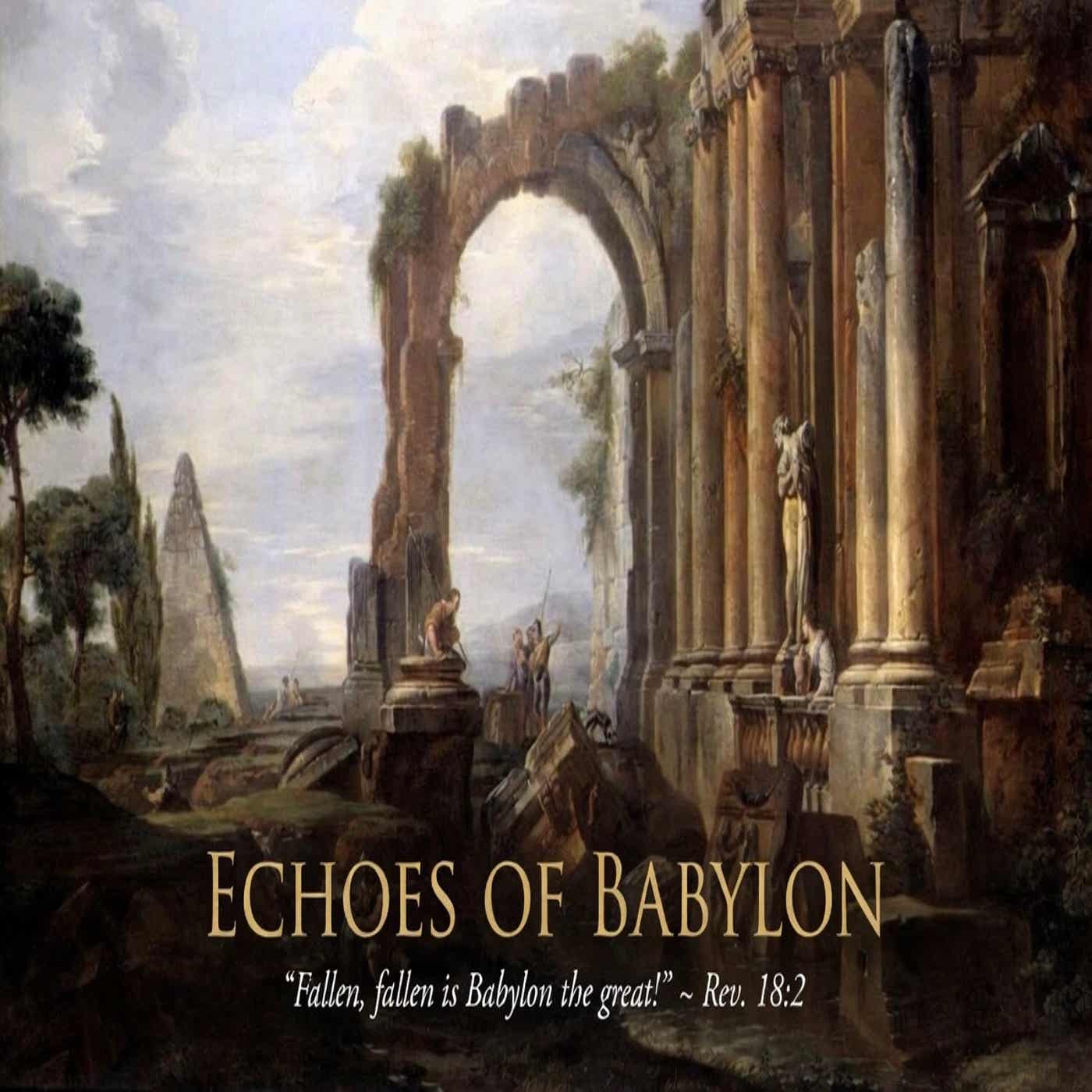
PODCAST · religion
Echoes of Babylon Podcast
by Ancient Pilgrim
A journey through the Book of Revelation—exploring how much of it unfolded in real history, and how the rest continues to shape the world we’re living in now. echoesofbabylon.substack.com
-
9
[CH. 1] SECTION 4.5 - THE PAST AS ANSWER
Preterism isn't a modern novelty. Its roots reach back to the earliest generations of the church — and its first full expression came from a Jesuit scholar in sixteenth-century Seville that almost no one has heard of.This episode is the story of where it came from, what it sees, and what questions it leaves open. This is a public episode. If you would like to discuss this with other subscribers or get access to bonus episodes, visit echoesofbabylon.substack.com
-
8
[CH. 1] SECTION 4.4 - THE MAP THAT REFRAMED HISTORY
On July 6, 1415, a Czech priest walked into a cathedral knowing he would not walk out alive. What happened that day is the doorway into historicism — the Reformation's way of reading Revelation as a map of church history unfolding in real time. For three centuries it was not a minority position. It was the position. This episode is about where it came from, what it sees, and where it strains. This is a public episode. If you would like to discuss this with other subscribers or get access to bonus episodes, visit echoesofbabylon.substack.com
-
7
[CH. 1] SECTION 4.3 - THE ANSWER THAT TRAVELED A DIFFERENT ROAD
How the Eastern Church Received RevelationIn the previous section, we watched Augustine build a cathedral of thought in response to a world that had stopped making sense. The sack of Rome in 410 had shattered assumptions that had held for centuries — that civilization was durable, that Christian empire was progress, that the story was moving somewhere stable. Augustine answered that crisis with architecture: two cities, two loves, a theology of history with enough room to absorb the wreckage and keep walking. In the Latin West, that answer deeply shaped how Revelation would be read for centuries to come.But the West was not the whole church.While Augustine was writing in North Africa, another half of the Christian world was developing its own relationship with Revelation — more slowly, more quietly, and by a different road entirely. To follow that road, you have to go east. And you have to go to a moment that, in its own way, felt just as much like the end of everything.Note: The following essay owes a debt to the scholarship of Dr. Eugenia Constaninou in her book “Guiding to a Blessed End: Andrew of Caesarea and His Apocalypse Commentary in the Ancient Church.” If you would like more information, please support her work by purchasing a copy of your own here.A City on the Edge of the WorldSometime in the early seventh century — during the Persian invasions, as best as scholars can determine — the ancient city of Caesarea in Cappadocia was living under a shadow it could not name.The shadow had been gathering for years.A generation earlier, the Roman Empire had seemed capable of renewal. The great Justinian had rebuilt Constantinople after the Nika riots leveled half the city. He had completed the Hagia Sophia — a domed church so vast and so suffused with light that those who first entered it struggled to find words. Justinian himself, walking through its doors at the dedication, is said to have whispered: “Solomon, I have surpassed you.” He was not boasting about architecture. He was making a theological claim. This was the new temple. The place where heaven and earth met. The axis around which the whole Christian world turned.Then the plague came.The Plague of Justinian — arriving in 541, returning in waves for the next two centuries — killed tens of thousands in Constantinople alone. By some estimates, it carried off one-third of the entire Byzantine population before it finally exhausted itself. Cities that had hummed with trade went quiet. Fields went unplanted. The empire that Justinian had stretched thin across three continents began to contract.By the early seventh century, contraction had become crisis. The emperor Maurice was overthrown and murdered by a centurion named Phocas, whose brutal eight-year reign collapsed the army and opened the eastern frontier to Persian forces under Khosrow II. A new emperor, Heraclius, had just taken power — but in those early years, what was visible was not promise. It was the advance. Antioch had fallen. The Persians were sweeping through Cappadocia. And sometime in 609 or 610 — the very years scholarship associates with Andrew’s commentary — Persian forces first occupied Caesarea in Cappadocia, Andrew’s own city. They would hold it, besiege it, and finally burn it to the ground in 612.Andrew’s city.Let that land for a moment.The man who would write the standard Greek commentary on the Book of Revelation was writing it in a city under foreign occupation — surrounded, by his own account, by what he called “the unspeakable misfortunes encircling us by barbarian hands.” He did not write from safety. He wrote from inside the catastrophe. The plague had already taken people he knew. The holy places of the East — Antioch, and soon Jerusalem, and soon the True Cross itself — were being carried off by Persians whose religion was as foreign to Christian eyes as their armies were to Christian cities.For Christians steeped in John’s vision, the resemblance was not subtle. Conquest. War. Famine. Death. The four horsemen were not symbols requiring imagination — they were the headlines.And the people around Andrew were reading Revelation.Not calmly. Not academically. They were reading it the way people read a book when they believe it is about them, right now, in the most urgent and terrible sense. The seals were opening. The horsemen were riding. The end — surely — was near.This is the pressure Andrew wrote into.The Task He Was GivenAndrew did not arrive at his commentary through private curiosity. The prologue makes clear that the work had been assigned to him — requested by a recipient he addresses as “Makarios,” a word that in Greek can function either as a proper name or as a title meaning “Blessed One” or “Beatitude.” The exact identity remains uncertain, but the leading scholarly candidate is Patriarch Sergius I of Constantinople — the same man who would later rally the entire city during the Persian and Avar siege of 626, personally leading religious processions along the tops of the walls, singing hymns, carrying icons, bearing relics of the Mother of God, refusing to let the people despair. Whether Sergius commissioned the commentary because he already believed the end was not near, or whether Andrew’s work helped form that conviction, is impossible to say. What is clear is that someone in authority looked at the eschatological fever running through the population and made a decision: the church needed a responsible, anchored, orthodox reading of this book. Not one that confirmed the panic. One that answered it.That commission matters. It means the commentary was almost certainly not one man’s personal theological project in isolation. It was an act of pastoral steadying — the church, in the middle of genuine civilizational terror, reaching for Revelation not to fuel the fire but to bring it under control.And Andrew’s commentary, after surveying all of it — the visions, the seals, the beast, the millennium, the new Jerusalem — amounts to a sustained argument that the end was not near.He said so himself, in the prologue’s opening lines. Aware of the catastrophes pressing in on every side — the plague, the famine, the Persian armies, the capture of his own city — Andrew still asked: “How could anyone who is deprived of the prophetic spirit not appear bold by attempting to explain these things whose end is not in sight?”He was not denying the darkness. He was refusing to let it do the interpreting.The end of the world, he concluded, was not near. But — and this is the pastoral turn that gave the commentary its enduring power — the end is always near for each of us since we do not know the time of our own death. What Revelation offers is not a schedule for history. It is preparation for a death that could come at any moment, in any generation, under any empire. “For this reason,” Andrew wrote, “death must be despised, since in a little while it grants the unfading crown of life.”That was not evasion. It was a reframe that changed everything. The book that people were reading as a countdown to catastrophe was, in Andrew’s hands, something older and steadier: a guide, in his own words, for those who read it toward “a blessed end.”To understand how he got there, you have to understand how he was trained to read.A Different Way of SeeingAndrew stood in a tradition that had handled Revelation with characteristic caution since the earliest centuries. In the Greek East, the book had been received with something closer to reverence held at arm’s length than the confident deployment it sometimes found in the West. The Montanists had used it too aggressively. The chiliasts had pressed its imagery too literally. A cloud of suspicion had gathered around it — not enough to exclude it from the canon, but enough to keep it out of the cycle of texts read aloud in Eastern worship each week. In the West, Revelation was preached and taught with some regularity. In the East, every other book of the New Testament was read aloud in Sunday worship. Revelation alone was not. It was authoritative — simply handled with the care that a book this powerful, this easily misread, this susceptible to panic and speculation, required.Andrew inherited that instinct. And he gave it its fullest expression.He begins his commentary by stating his foundational approach explicitly. “Since there are three parts to a human being,” he writes in the prologue, “all divinely inspired Scripture has been endowed with three parts by divine grace.” There is the literal or historical sense — the body of the text, what it says on the surface. There is the moral sense — the soul of the text, what it asks of the reader. And there is the spiritual level — the spirit of the text, the divine realities it discloses, the things that exceed what any literal language can fully carry. Significantly, Andrew never uses the word “allegory” — he had no interest in dissolving the text’s concrete weight into free-floating spiritual interpretation. He insisted on all three levels together, each illuminating the others.This is a refusal to flatten the text, not an evasion of it. Pure literalism stays trapped at the surface and misses the theological depth the book is actually trying to open. Pure allegory loses the book’s historical anchor and lets the interpreter float wherever imagination takes him. Andrew insisted on both. The symbols are real. They refer. But they refer at a depth that no single historical moment can exhaust.When he looked at Revelation’s imagery — the altars, the incense, the thrones, the Lamb, the hymns of the elders — he saw a book saturated with the grammar of worship. Not a geopolitical timetable. A vision of heaven breaking into earth, expressed in the language of liturgy that his readers knew from their own gathering as a church. The visions of Revelation were disclosures of what was actually happening in the governance of the world, in the war behind the visible war, in the life of God with his people. They were not predictions to be decoded. They were windows to be looked through.Andrew’s most dominant description of God throughout the commentary is the Greek word philanthropos — the One who loves humankind. He uses it no fewer than fourteen times. That instinct shapes everything about how he reads the book. The catastrophes in Revelation are not signs of divine abandonment. They are the pressure of a God who, as Andrew writes, “thirsts for our salvation” — who uses even affliction as an invitation back.Andrew presented multiple interpretations of difficult passages without always adjudicating between them — not because he was uncertain, but because he was convinced that the symbols of Revelation carried more meaning than any single reading could hold. He gathered interpretations from earlier Fathers, from oral traditions reaching back through the Greek East, from scattered patristic comments no one had assembled before. He was not inventing a reading. He was receiving and ordering a tradition — and in his prologue he names his witnesses: Gregory the Theologian, Cyril of Alexandria, Irenaeus, Methodius, Hippolytus, and others. He comes to the text not as an innovator but as a steward.What This Reading SeesThe pastoral heart of Andrew’s commentary is this: Revelation is not written to satisfy curiosity about the future. It is written to form the people who read it.The visions are not a code to be cracked by the cleverest interpreter. They are a sustained act of theological formation — showing the church what is really happening, who is really in charge, what is really at stake, and what faithful life in that reality looks like. The comfort Revelation offers is not the comfort of knowing the schedule. It is the comfort of knowing the outcome.Andrew reads the millennium — the thousand years of Revelation 20 — symbolically, as the present age of the Church. In this he arrives at territory adjacent to Augustine. But he arrives differently, and the difference matters. Where Augustine tends toward theological closure — the meaning is fully present now, the binding of Satan already accomplished — Andrew’s Byzantine sensibility holds the symbols open to ongoing historical unfolding. The thousand years names something real about the present age, but apocalyptic symbols may continue to manifest across time in ways that no single interpretation can anticipate. The framework resists finality. It leaves room.This is characteristic of the Eastern tradition more broadly. The West, inheriting Augustine, built systems. The East, inheriting Andrew, built contemplative stability. Both resist chiliasm and sensationalism — but in different registers. One through architecture. The other through a kind of liturgical wisdom that shapes the worshipping community’s imagination rather than mapping the future.Andrew’s influence was not only interpretive. Of the approximately three hundred surviving Greek manuscripts of Revelation, one-third are accompanied by Andrew’s commentary — meaning the commentary itself is responsible for a significant portion of the copies in which the book survived at all. In the Georgian church — an ancient Christian community in the Caucasus evangelized centuries before — Andrew’s commentary was so deeply woven into how Revelation was transmitted that the commentary and the text arrived together as an inseparable pair; the Georgian church excluded Revelation from its New Testament canon until St. Euthymios translated both the text and Andrew’s commentary into Georgian in the early eleventh century. He did not merely comment on the book. He shaped how it survived, how it was copied, and how whole peoples first learned to hear it.Where the Questions GatherAndrew built a doorway, not a system. That was the point. But doorways, unlike systems, do not always show you where to go next.The same restraint that protected the East from sensationalism also meant that when readers pressed Revelation toward specificity — wanting to know not just what the symbols mean in general but what they mean here, now, for us — the tradition tended to model wisdom more than it offered orientation. Andrew’s method invites contemplation. It does not always resolve urgency. That tension is built into the approach itself, and Eastern interpreters have been aware of it.There is also a question about what Andrew’s synthesis preserved and what it quietly reshaped. He gathered streams of earlier interpretation, filtered them through his own careful judgment, and handed on a coherent tradition. Chiliastic and more overtly millennial readings present in some earlier Fathers did not disappear — but they receded. Whether that represents the Spirit guiding the tradition toward greater clarity, or a narrowing of the interpretive inheritance, is a question Eastern Christianity has not felt the need to resolve definitively. It has simply lived with the tradition Andrew bequeathed.And finally, Revelation’s place in Eastern worship has never been formally settled in the way other canonical questions were. Its absence from the weekly lectionary is not a wound the tradition acknowledges — it is simply the shape the tradition took. A book can be received as fully authoritative and still occupy a contemplative rather than proclamatory place in the life of the church. Whether that is exactly right, or whether something is quietly left on the table, is a question Eastern Christians themselves have occasionally raised — and just as often set aside as beside the point.These are not objections from outside the tradition. They are questions the tradition itself has lived with — and in some cases, continues to live with openly.One Tradition, Two Temperaments — ContinuedThe section on Augustine closed by noting that the East and West arrived at similar practical territory by very different routes. It is worth pausing here to feel the full weight of that difference.Augustine built a framework — systematic, philosophical, historically ambitious — that could be taught, inherited, defended, and applied across centuries. It gave the Western church not just an interpretation of Revelation 20, but a complete theology of history within which that interpretation could live. That made it formidable. It also made it the kind of thing that could calcify — something to be received and repeated rather than inhabited freshly.Andrew built something different. He built a doorway. His commentary is not an architecture. It is an invitation into the text — held within tradition, alert to layered meaning, resistant to tight eschatological closure. His reading is expansive where Augustine’s is precise, contemplative where Augustine’s is systematic, more interested in what the visions disclose about God and the soul than in mapping them onto a sequence.The Latin and Greek traditions — systematic and liturgical, architectural and contemplative — arrived at similar convictions by entirely different paths. That convergence is itself worth sitting with. It suggests that what each tradition was reaching toward, however differently, was something neither invented alone.What This Means for the Journey AheadAndrew’s commentary was not written in a library. It was written in a city under occupation, by a man who described his own situation as “the unspeakable misfortunes encircling us by barbarian hands” — and whose deepest claim was that the book everyone was reading as a timetable of doom was not a timetable at all. It was a way of seeing. A way of enduring. A way of remaining faithful when the world no longer made sense.That reading held. It still shapes the Eastern Church’s quiet, restrained relationship with Revelation today.But it did not answer every question. It contained the fire without extinguishing it. And in another part of the Christian world, those unresolved questions would not stay contained for long.The Reformation was coming. And when it arrived, Revelation would not be handled with restraint.That is where we turn next.Thanks for reading Echoes of Babylon! Subscribe for free to receive new posts and support my work.A Note on These Posts: These essays are written with the help of AI-assisted research and drafting tools, then reviewed and refined by me before publication. If you notice a factual error, I welcome the correction.Sources and Further ReadingThe primary scholarly source for this section is Eugenia Scarvelis Constantinou’s translation of and introduction to Andrew’s commentary, published in the prestigious Fathers of the Church series from Catholic University of America Press. Constantinou is the leading expert on Andrew of Caesarea and the first scholar to translate his commentary into any modern language. Her introduction covers Andrew’s historical context, methodology, eschatology, and lasting influence in careful detail and is the basis for most of the specific claims made in this section.Andrew of Caesarea. Commentary on the Apocalypse. Translated by Eugenia Scarvelis Constantinou. Fathers of the Church, vol. 123. Washington, DC: Catholic University of America Press, 2011.Constantinou, Eugenia Scarvelis. Guiding to a Blessed End: Andrew of Caesarea and His Apocalypse Commentary in the Ancient Church. Washington, DC: Catholic University of America Press, 2013.For the Byzantine historical context — the Persian wars, the reign of Heraclius, and the crisis of the early seventh century — the standard scholarly references are:Haldon, J. F. Byzantium in the Seventh Century. Rev. ed. Cambridge: Cambridge University Press, 1997.Stratos, Andreas. Byzantium in the Seventh Century. 5 vols. Translated by Marc Ogilvie-Grant. Amsterdam: Adolf M. Hakkert, 1968.For the Eastern reception of Revelation more broadly, including its uncertain canonical status and its absence from the Byzantine lectionary:Stonehouse, Ned Bernard. The Apocalypse in the Ancient Church. Goes, Holland: Oosterbaan and Le Cointre, 1929.For the commentary of Oikoumenios — Andrew’s predecessor and the first Greek commentary on Revelation, whose theological conclusions prompted Andrew’s own work:Oikoumenios. Commentary on the Apocalypse. Translated by John N. Suggit. Fathers of the Church, vol. 112. Washington, DC: Catholic University of America Press, 2006.For the manuscript tradition of Revelation in the Greek East and the Andreas text type:Schmid, Josef. Studien zur Geschichte des griechischen Apokalypse-Textes. 3 vols. Munich: Karl Zink Verlag, 1955–56. This is a public episode. If you would like to discuss this with other subscribers or get access to bonus episodes, visit echoesofbabylon.substack.com
-
6
[CH. 1] SECTION 4.2 - THE ANSWER THAT LASTED FOR A THOUSAND YEARS
How Augustine Reshaped the Way the Church Read RevelationIn the previous section, we watched the earliest reading of Revelation encounter a pressure it was never built to absorb. Chiliasm — the early church expectation of a coming earthly millennial reign of Christ — had been shaped by conflict. It knew how to make sense of suffering. It knew how to hold hope in the face of a hostile empire. What it did not know how to do was exist inside a friendly one. When Constantine moved Christianity from the margins to the center of Roman life, the framework built around Rome-as-adversary began to lose its footing. The categories did not bend easily. And the question that surfaced — how does the Church understand its place in a world that has stopped persecuting it and started favoring it? — required a different kind of answer.That answer came. And it would shape how Revelation was read for centuries.On the night of August 24, 410 AD, someone opened the Salarian Gate of Rome from the inside.The gate took its name from the Via Salaria — the ancient Salt Road, one of the oldest roads in the Roman world, running northeast through the otherwise impregnable Aurelian Walls. It was a major northern entry point into the city, flanked by two great semicircular towers. Eight centuries of Roman dominance had passed through that gate. Armies had marched out of it to conquer the world.For nearly two years, across three separate sieges, Alaric and his Visigoths had been tightening their grip on the city. They had seized the Tiber, cutting off the grain supply. They had watched Rome slowly starve behind its walls — grain rationed to a third of normal, bodies left unburied in the streets — until the Senate stripped and melted down its own statues to buy them off. Rome had paid. Alaric had left. And then he had come back.By the time the gate opened on August 24, the eternal city had already been brought to its knees.What happened next was not a conquest. It was a door, quietly opened from the inside.The people who opened it that night were slaves. Gothic servants who had endured the siege alongside their Roman masters, who had watched the city slowly starve behind its walls, who asked themselves — at midnight, in the dark — why they should suffer any longer for the empire that had enslaved them.They opened the gate.And the Visigoths walked in.But to feel the full weight of what happened next, you have to understand what Rome meant.Not Rome the city. Rome the idea.For eight centuries, Rome had been the organizing fact of the Western world. It had absorbed the Greeks, the Egyptians, the Carthaginians, the Gauls. It had built roads across three continents. It had given the world a common language, a common law, a common currency. Emperors had come and gone — murdered, exiled, deified — but Rome itself had never fallen.It was not simply a capital. It was the proof that civilization was possible. The proof that order could hold against chaos.The eternal city.That was not a boast. That was a conviction — as settled and unquestionable as the rising of the sun.And now, for the first time in nearly eight hundred years, barbarians were in the streets.It is difficult to overstate the psychological shock of this moment. Modern Americans might reach for comparisons — Pearl Harbor, September 11 — moments when something that felt structurally impossible suddenly happened, and the ground shifted beneath an entire civilization. But even those comparisons fall short.What happened in Rome in 410 was different in kind.Rome was not attacked.Rome — the eternal city, the unconquerable city, the city that had defined the shape of the world — simply fell.For three days the Visigoths moved through it. The basilicas of Peter and Paul were declared sanctuaries. There was no general slaughter. Much of the city stood intact when they were gone.None of that mattered.Jerome was in Bethlehem when word reached him. He tried to write. He couldn’t.“My voice sticks in my throat; and, as I dictate, sobs choke my utterance. The city which had taken the whole world was itself taken.”Jerome was not a sentimental man. He was one of the sharpest, most combative minds in the ancient church — the man who had translated the entire Bible into Latin, who had debated everyone worth debating and insulted everyone who wasn’t. If the sack of Rome reduced him to weeping silence, you begin to understand what the moment felt like from the inside.For Christians, the shock carried an additional weight.This was not simply Rome falling.This was a Christian Rome falling.For nearly a century, since Constantine had extended his favor to the church, the empire and the faith had been intertwined. Emperors had convened councils, funded basilicas, enforced creeds. The question that had once been how do we survive under this empire had quietly become what does it mean that this empire is ours?Now the empire was burning.And pagans had a ready answer for why: Rome had abandoned its gods. Christianity had weakened it. The old sacrifices had kept the city safe for centuries. The new faith had undone what the old faith had built.That accusation demanded more than a rebuttal.It demanded a new way of seeing history itself.Augustine of Hippo would spend the next thirteen years writing one.The Groundwork Already LaidIt would be too simple to say that Augustine invented a new way of reading Revelation in response to 410. The truth is both more interesting and more important for understanding why his answer landed with such force.The work had already begun — quietly, a generation earlier — in the writings of a North African theologian named Tyconius.He was, by any measure, an unusual figure: a member of the Donatist movement, a group the broader church considered schismatic, yet a biblical interpreter of such penetrating insight that Augustine — who disagreed with him ecclesiastically — could not set him aside.Tyconius had written a commentary on Revelation and a set of interpretive rules for reading Scripture that pushed firmly against the literal, chronological approach to prophetic texts. For Tyconius, Revelation was not primarily a timetable.It was a portrait.A portrait of the Church as a mixed body. A portrait of two cities intertwined throughout history. A portrait of a conflict whose real dimensions were spiritual even when its expressions were visible.Augustine read him carefully.And when the crisis of 410 demanded a response, he had resources already in hand.What Augustine built was not invented from nothing.It was a cathedral raised on a foundation someone else had quietly laid.The City of GodAugustine began his magnum opus, The City of God, in 413, three years after the sack. He would not finish it until 426.It is one of the longest, most ambitious works in the history of Christian thought — part apologetics, part philosophy of history, part theology of the Church.And at its center is a distinction that would reorganize the way Western Christianity understood everything that followed.There are two cities, Augustine argued.Not two territories. Not two institutions.Two loves.The City of God is built on love of God, extending to the point of contempt for self. The earthly city is built on love of self, extending to the point of contempt for God.These two cities have been intertwined since the beginning of history — in Cain and Abel, in Babylon and Jerusalem, in Rome and the Church — and they will not be finally separated until the last judgment.This framework answered the pagan accusation directly.Rome did not fall because Christianity weakened it.Rome fell because Rome was always, at its root, an earthly city — impressive, ordered, capable of real goods, but never the kingdom of God.The Christians who died in its streets were not abandoned by their Lord.They were pilgrims whose true city was never Rome in the first place.But Augustine’s argument did something more than answer a charge.It permanently reoriented the way Revelation’s imagery was read.If the kingdom of God is not a political geography — if it cannot be identified with any empire, any civilization, any visible institution — then Revelation’s vision of a thousand-year reign cannot be a future earthly golden age waiting to be established.It must be something else.Augustine found it in the present.The Millennium, RereadIn Book 20 of The City of God, Augustine turned his attention to Revelation 20.The thousand years, he argued, refers to the present age of the Church — the whole period between Christ’s first coming and his return. This is the reading that later generations would call amillennialism — and it has remained one of the most widely held approaches to Revelation in Christian history.It has shaped the theology of the Roman Catholic Church, informed the symbolic and non-chiliastic instincts of the Eastern Orthodox tradition, and been carried forward in much of Protestantism — especially among Reformed, Anglican, and Lutheran churches.In other words, this is not a fringe reading. It is one of the main ways Christians across centuries have understood Revelation 20.If you’re like me, from an evangelical, non-denominational corner of the world, this may come as a surprise. I know it did for me.Seen from within this framework, the binding of Satan is not a future event.It has already happened, in principle, through the cross and resurrection.Satan’s ability to deceive the nations — to hold them in complete darkness, preventing the spread of the gospel — has been decisively broken.That is what the image of the chain signifies.Not that evil has been eliminated, but that it has been restrained in a specific way, so that the gospel can go out to all peoples.The saints who reign with Christ during this thousand years are reigning now — and Augustine’s emphasis falls especially on the martyrs and the faithful departed, already in the presence of God. The first resurrection is the resurrection from spiritual death and, especially, the reign of the departed faithful in the presence of God. For those still living, participation in Christ’s life through faith is its present form.The second resurrection — the general resurrection of the body at the last judgment — still lies ahead.The binding will end. Satan will be released for a short season. The final conflict will come. And then judgment.This reading did not evacuate Revelation’s drama.It relocated it.The conflict is real. The stakes are ultimate. The outcome is certain.But the theater of that conflict is not a future political moment.It is the whole sweep of history — from the ascension of Christ to his return.The age the Church is living in right now.What This Reading SeesIt would be easy, from a distance, to hear this as a retreat — a spiritualizing move that drains the urgency from the text.That reading of Augustine’s reading is wrong.What the Augustinian framework sees, with genuine force, is something the New Testament insists on from beginning to end:The decisive victory has already happened.Christ is not waiting to become king. He is king.The strong man has already been bound so that his house may be plundered. The nations are already being discipled. The resurrection has already begun in the person of Jesus, and those who are in him share in it now.When Augustine says the millennium is present, he is not shrinking the promise.He is insisting that the New Testament’s own logic be taken seriously.This reading also sees, with unusual clarity, the danger of tying the kingdom of God too tightly to any visible structure.A church that had spent a century inside a Christian empire was in danger of a subtle but serious confusion — mistaking the flourishing of Rome for the flourishing of the kingdom.Augustine severed that identification cleanly.No civilization is the city of God. No emperor is the fulfillment of Revelation’s promise. The pilgrim city passes through history without being reducible to any moment of it.That is not pessimism.It is freedom.And there is something pastorally durable in this that is often overlooked.The Augustinian framework does not generate a countdown. It does not require recalibration every generation when the predicted sequence fails to arrive.It says instead:This age is the age of the Church. The kingdom is present in hidden form. The consummation is coming, but its timing is not disclosed.Live faithfully. Endure. The city you are building toward is real.And it will stand when everything else has passed away.Where the Questions GatherNone of this means the framework carries no tensions. It does — and they are worth naming honestly.The first concerns the binding of Satan.If the binding means that Satan cannot prevent the gospel from going to the nations, that is a serious and defensible claim.But the history of the Church age presses on it.Centuries of widespread darkness, the persistence and expansion of systems hostile to the gospel, the catastrophic violence of the modern era — these do not easily resemble a world in which deception has been decisively restrained.The framework has answers.But the answers require careful qualification that the text itself does not obviously provide.The second concerns the two resurrections.The text describes both using the language of those who had died and now live again — which naturally places them in the same interpretive category.If the first resurrection is spiritual and the second bodily, the reader has to explain why two events described in similar terms belong to entirely different registers.The framework can make that case.But it requires work the passage does not obviously invite.The third concerns the thousand years itself.The number may well be symbolic.But the structure the number participates in is narratively sequential:a binding, a reign, a release, a final conflict, a judgment.That sequence moves. It has a shape.And a reading that flattens the sequence into a single undifferentiated age has to account for why the text is structured the way it is.The fourth pressure is subtler, and it concerns the framework’s own success.Augustine resisted, with great care, the conflation of the city of God with any earthly institution.And yet — as the Augustinian reading became dominant across the medieval West — that careful distinction was not always maintained.The corrective is within the framework.But the distortion recurred anyway.These are not fatal objections.They are honest tensions — the kind that every serious reading of a serious text carries.One Tradition, Two TemperamentsBefore leaving this framework, it is worth pausing on a difference that often goes unnoticed.The difference between how the West and the East arrived at similar places by very different routes.In the Latin West, the Augustinian reading became the architecture.It was systematic, philosophical, historically engaged.The City of God gave the Western church not just an interpretation of Revelation 20, but a complete theology of history within which that interpretation could live.The East moved differently.The most influential early Eastern commentary on Revelation was written by Andrew of Caesarea.And it reflects a distinctly Eastern sensibility.Andrew reads the book as spiritually and symbolically rich, full of layered meaning, but resists the kind of tight eschatological architecture the Latin West was building.His commentary is expansive, contemplative, more interested in what the visions reveal than in mapping them onto a rigid historical sequence.This is characteristic of the Eastern tradition more broadly.Revelation is not read aloud in the Byzantine liturgy — the only book of the New Testament that holds that distinction.The East received it as theologically significant while keeping it at a certain liturgical distance, approaching it more as an icon to be contemplated than a timetable to be decoded.The result is a tradition that lands in similar territory — non-chiliastic, symbolically alert, resistant to sensationalism — but arrives there through worship and contemplation rather than system.This difference matters for an ecumenical reading of the tradition. The instinct that the millennium names something present rather than future, that Revelation’s imagery operates at a depth that resists reduction to a single historical sequence, that the kingdom of God cannot be identified with the advance of any earthly power — this instinct is not the property of one tradition.It surfaces, in different forms, across the Latin West and the Greek East, in systematic theology and in liturgical prayer.That breadth is worth noticing.It suggests that something real is being seen.What This Means for the Journey AheadThe Augustinian framework was a serious and enduring attempt to read Revelation faithfully in the light of the whole New Testament.It took seriously:the present reign of Christ, the mixed nature of the Church in history, the danger of tying the kingdom to earthly power, and the need for a hope that does not depend on predicting a schedule.It endured because it answered real questions.But history was not finished pressing on it.And in the centuries that followed, a new set of pressures would arrive — ones this framework, for all its strength, had not fully anticipated.The Reformation was coming.And when it did, Revelation would be pulled into the center of one of the most consequential controversies in the history of the Church.That is where we turn next.Thanks for reading Echoes of Babylon! Subscribe for free to receive new posts and support my work.A Note on These Posts: These essays are written with the help of AI-assisted research and drafting tools, then reviewed and refined by me before publication. If you notice a factual error, I welcome the correction.Further Reading & BibliographyThe sources below represent the key primary texts and secondary works behind this section. They are offered for readers who want to go deeper — whether into Augustine himself, the historical context of 410, or the broader tradition of amillennial interpretation.Primary SourcesAugustine of Hippo. The City of God Against the Pagans. Translated by R.W. Dyson. Cambridge University Press, 1998. The foundational text of this entire section. Book 20 contains Augustine’s direct engagement with Revelation 20 and his argument for the present millennium. Books 1–5 address the sack of Rome and the pagan accusation directly. Dyson’s translation is the most accessible modern scholarly edition.Augustine of Hippo. Confessions. Translated by Henry Chadwick. Oxford University Press, 1991. Not directly about Revelation, but essential for understanding Augustine’s mind, his intellectual development, and the theological instincts that shaped The City of God.Jerome. Letters. In Nicene and Post-Nicene Fathers, Series 2, Vol. 6. Edited by Philip Schaff. Hendrickson, 1994. Jerome’s letters written around the time of the sack of Rome — including the famous passage quoted in this section — are found here. Letter 127 and the preface to his Commentary on Ezekiel are particularly relevant.Tyconius. The Book of Rules. Translated by William S. Babcock. Scholars Press, 1989. Tyconius’s seven rules for interpreting Scripture, which shaped Augustine’s approach to Revelation. Rarely read today but essential for understanding where Augustine’s framework came from.Andrew of Caesarea. Commentary on the Apocalypse. Translated by Eugenia Scarvelis Constantinou. Catholic University of America Press, 2011. The most influential Eastern commentary on Revelation. Reflects the symbolic, contemplative approach of the Greek tradition. Important for understanding how the East handled Revelation differently from the Latin West.Historical ContextHeather, Peter. The Fall of the Roman Empire: A New History of Rome and the Barbarians.Oxford University Press, 2006. The best modern narrative history of the period surrounding 410. Readable, authoritative, and essential for understanding the world Augustine was responding to.Brown, Peter. Augustine of Hippo: A Biography. University of California Press, 2000 (revised edition). The definitive biography of Augustine. Brown situates The City of Godwithin Augustine’s life, his North African context, and the broader crisis of the late Roman world. Essential reading.Ward-Perkins, Bryan. The Fall of Rome and the End of Civilization. Oxford University Press, 2005. A compelling and accessible account of what the collapse of the Western Empire actually meant for ordinary people. Provides important texture for understanding the stakes of the world Augustine inhabited.Theological & InterpretiveHoekema, Anthony A. The Bible and the Future. Eerdmans, 1979. The clearest modern introduction to amillennialism written from within the Reformed tradition. Accessible to non-specialists. A good starting point for readers who want to understand the framework as it is held today.Riddlebarger, Kim. A Case for Amillennialism: Understanding the End Times. Baker Books, 2003. A readable, pastoral defense of amillennialism written for an evangelical audience. Engages directly with dispensationalism and explains why many serious Bible readers hold the amillennial position.Beale, G.K. The Book of Revelation. New International Greek Testament Commentary. Eerdmans, 1999. The most thorough scholarly commentary on Revelation from an amillennial perspective. Technical in places, but the introductory sections are accessible and the theological framework is clearly laid out.Wainwright, Arthur W. Mysterious Apocalypse: Interpreting the Book of Revelation.Abingdon Press, 1993. A historical survey of how Revelation has been interpreted across the centuries. Covers the early church, Augustine, the medieval period, the Reformation, and beyond. Invaluable for understanding the interpretive tradition as a whole.Daley, Brian E. The Hope of the Early Church: A Handbook of Patristic Eschatology.Cambridge University Press, 1991. A thorough survey of eschatological thought in the early church fathers. Essential for understanding the diversity of the pre-Augustinian tradition and the context out of which Augustine’s synthesis emerged.On the Eastern TraditionConstantinou, Eugenia Scarvelis. Guiding to a Blessed End: Andrew of Caesarea and His Apocalypse Commentary in the Ancient Church. Catholic University of America Press, 2013. The definitive scholarly study of Andrew of Caesarea and his commentary. Situates Andrew within the Eastern tradition and explains the distinctly Greek approach to Revelation.Louth, Andrew. Greek East and Latin West: The Church AD 681–1071. St. Vladimir’s Seminary Press, 2007. A readable account of the divergence between Eastern and Western Christianity across the early medieval period. Helps explain why the two traditions handled Revelation so differently.A note on accessibility: Most of the primary texts listed above are available in affordable paperback editions or freely online through resources like the Christian Classics Ethereal Library (ccel.org). Readers without access to academic libraries will find most of what they need through that resource. This is a public episode. If you would like to discuss this with other subscribers or get access to bonus episodes, visit echoesofbabylon.substack.com
-
5
[CH. 1] SECTION 4.1 - THE FIRST READERS
How the Early Church Held Its HopeIn the previous section, we traced how every major way of reading Revelation developed in response to pressure — not as a timeless system handed down intact, but as a living response to a changing world. That raises a question worth sitting with: where does the story begin? Before Augustine, before the Reformation, before Darby — what did the first readers think this book was saying? That is where we start.Before there were systems, there were communities.Before there were frameworks, debates, and interpretive schools, there were actual people — living in actual cities, navigating an actual empire — trying to understand what the vision given to John meant for them. Not for some distant generation. For them.If we want to understand how Revelation has been read across history, we have to begin there. Not with theology in the abstract, but with the world those first readers inhabited. Because the way they read it wasn’t arbitrary. It wasn’t naive. It was a response — a deeply human, deeply faithful response — to the most sophisticated and demanding environment the early church ever faced.And once you see that environment clearly, their reading begins to make a different kind of sense.The World Behind the TextWe tend to imagine Roman persecution as the primary pressure on the early church. And it was real. But it was only one dimension of something larger. The Roman Empire was not simply a military power. It was a cosmic claim. Across the cities of Asia Minor — the very cities named in Revelation — the imperial cult had woven itself into the fabric of everyday life.Temples. Festivals. Priesthoods. Civic rituals. Guild feasts. Economic networks. All of it moved through structures that bore the emperor’s divine image. To participate in public life was, at almost every level, to participate in the worship of Rome.This wasn’t abstract. Archaeologists have uncovered the physical remains of it. At Miletos, the civic council building housed an altar platform decorated with scenes of divine justice — local mythology repurposed to encode Roman sovereignty as the sacred order of the gods. At Aphrodisias, a towering complex called the Sebasteion displayed the emperors as mythic heroes.Claudius in the pose of a divine warrior, crushing Britannia. Nero in the iconography of Achilles, subduing Armenia. Historical conquests elevated to the status of cosmic myth.The message was not subtle: Roman rule was not merely political. It was sacred. Caesar was not just a king. He was Lord of earth and sea — the living presence of divine order in history over the entire world.Into that world, John’s vision arrived. Addressed to seven churches. Delivered as urgent. Written to people who understood exactly what it cost to say that Jesus — not Caesar — was Lord.What They Believed, and WhyAmong the most widely held expectations in the second-century church — particularly in communities most shaped by the Jewish apocalyptic tradition — was something called chiliasm, from the Greek word (Χίλιοι chilioi) for a thousand. It was the belief that history was moving toward a real, bodily, earthly vindication: that Christ would return, that the powers oppressing his people would be defeated, and that a reign of justice would be established on this earth.If that instinct sounds familiar, it should.Many Christians today — including many like myself who were baptized in evangelical churches — carry some version of this same hope. The language is different. The systems are newer. But the underlying impulse is ancient: the world is out of balance, God’s justice will make it right, and that righting will be visible. That is not a modern invention. It is one of the oldest readings of this book.That expectation had deep roots. It was most likely carried into the cities of Asia Minor by Jewish-Christian communities who fled Jerusalem after its destruction in 70 AD — bringing with them a tradition shaped by centuries of Hebrew prophetic hope: that God’s promises were real, that they would be fulfilled in history, and that the suffering of the righteous would not go unanswered.That hope surfaces across a wide range of Jewish texts from the period. The expectation of a messianic reign — a period of vindication before the final judgment — appears in 4 Ezra, in 2 Baruch, and in early rabbinic sources. It was not a fringe idea.It was the air that apocalyptic communities breathed.And when those communities became Christian, they brought that expectation with them — now centered on the risen Christ.The figures who carried this reading in the second century were not marginal voices — they were Bishops, philosophers, theologians, and confessors — some who are venerated as saints across the ancient churches. Justin Martyr held it. Irenaeus of Lyons defended it. Tertullian advocated it. Papias — who reportedly received his tradition from people who had known the apostles — described a coming age in terms so vivid they made later interpreters uncomfortable.These were not credulous enthusiasts. They were serious theologians, reading a serious text, in a serious situation.And the situation is everything.What They Saw ClearlyThere is something in the chiliast reading that deserves more than dismissal. Something that, if you sit with it honestly, is genuinely difficult to argue with. Revelation begins as a letter. Not a code, not a timetable — a letter. Addressed to real congregations, in real cities, with real names. The opening chapters speak with pastoral directness: hold on. Don’t compromise. I know where you live. I know what you’re facing.These communities were not abstract recipients. They were living inside a system resembling precisely what Revelation describes. When the vision speaks of a beast whose authority extends over buying and selling, over the economic life of the world, they knew exactly what that meant.To refuse participation in the imperial cult was not simply a spiritual decision. It had consequences — social, economic, relational. The pressure was constant, layered, and real.Chiliasm took that reality seriously. It refused to spiritualize the promises of God into something so internal and invisible that they offered no actual answer to the suffering of actual people. The martyrs who cry from under the altar in Revelation 6 are not asking for a metaphor. They are asking for justice. And the chiliast reading insists: justice will come. Not merely in heaven. Here. In the world where the injustice happened.There is something deeply Hebraic about this instinct. The Hebrew prophets did not speak of restoration in purely spiritual terms. Swords beaten into plowshares. The wolf lying down with the lamb. Nations streaming to Zion. These are images of a transformed world, not a vacated one.Chiliasm refuses to let those promises evaporate into allegory before they have been fulfilled.And at the center of it all is the resurrection. If Christ is truly risen — if the resurrection is not a spiritual event but a bodily one, the firstfruits of a new creation — then creation’s redemption is not a metaphor either. It is an event still arriving. The chiliast instinct is, at its root, a refusal to let the resurrection mean less than it claims to mean.Where the Questions BeginAnd yet.For all its integrity, the chiliast framework carries pressures it never fully resolved. They are not the objections of later critics. They are tensions that surfaced within the tradition itself, almost from the beginning.The first is textual. The millennium appears in one passage — Revelation 20 — in a book saturated with symbolic imagery. Every other feature of that book had been interpreted figuratively by someone. Why was this passage different? The question was never cleanly answered. And the relationship between the millennium, the resurrection, and the final judgment remained murky even among the tradition’s strongest defenders.The second is historical. Chiliasm drew its energy from urgency. The Lord is coming soon. That was not rhetoric — it was the heartbeat of the expectation. But soon was written in the first century. Papias expected it. Justin expected it. Irenaeus expected it. Each generation had reasons that felt just as compelling as the last.And the world kept going.A framework whose power derives from imminence absorbs delay badly. The urgency that had once felt like a lifeline began to feel, in quieter moments, like a question no one wanted to ask directly.The third pressure arrived from an unexpected direction.Chiliasm had been calibrated for a world where Rome was the adversary — where the conflict was clear and the hope of divine intervention made obvious sense. But in the early fourth century, something happened that the framework had no category for.The emperor became a Christian.When Constantine legalized Christianity — and then favored it, funded it, convened its councils and built its basilicas — the logic of conflict that had sustained the chiliast reading was suddenly complicated. For those who had read Rome as the beast, the question now pressed: what does the framework mean when the emperor is building churches?The categories did not bend easily.A Different InstinctIt is worth noting that chiliasm was never the only reading, even in the early period.The Alexandrian school — shaped by Clement and, decisively, by Origen — moved early and deliberately in a different direction. For Alexandria, the promises of Scripture were not less real for being spiritual. The millennium was not a future earthly reign but a present reality — the soul’s participation in divine life.This was not evasion. It was a different theological grammar, one shaped by the encounter between the gospel and the best of Greek philosophical thought.In the Greek East more broadly, Revelation was handled with characteristic caution. Though the book’s canonical status was eventually affirmed, it was not incorporated into the Byzantine lectionary — the cycle of texts read aloud in worship — in the way the Gospels and Epistles were. The East tended to receive it as a vision of heavenly worship and cosmic conflict, approached symbolically and liturgically rather than as a prophetic sequence to be mapped onto history.The West would eventually systematize. But the early diversity matters. It shows that the question of how to read Revelation was never settled cleanly — even among people who shared the same faith, the same canon, and in many cases the same suffering.What This Means for the Journey AheadThe chiliast reading was not a mistake. It was a faithful response — rooted in Scripture, shaped by suffering, carrying a genuine theological instinct that has never entirely disappeared.What it could not survive was the change in circumstance that arrived in the fourth century.When the empire stopped being the adversary, the framework built around that conflict needed to find new footing.That is where the next stage begins.A Note on These Posts: These essays are written with the help of AI-assisted research and drafting tools, then reviewed and refined by me before publication. If you notice a factual error, I welcome the correction.Thanks for reading Echoes of Babylon! Subscribe for free to receive new posts and support my work.Further Reading For General ReadersBritannica — “Eschatology: The Early Church”* A concise, reliable overview of how chiliasm developed and declined in the early centuries. Good starting point for readers new to the topic.Modern Reformation — “Why the Early Church Finally Rejected Premillennialism”* A careful, balanced treatment of the decline of chiliasm. Covers the key figures and the theological reasons the early consensus shifted. Readable and fair to all sides.Joshua P. Steele — “You’re Reading Revelation Wrong”* A pastor-scholar’s accessible case for reading Revelation in its first-century context. Helpful orientation for readers coming from a dispensational background.The Exalted Christ — “From Chiliasm to Amillennialism: A Timeline”* A useful visual timeline of eschatological shifts from the apostolic era through Augustine, with primary source quotations throughout.For Deeper StudyRichard Bauckham, The Theology of the Book of Revelation (Cambridge University Press, 1993)* The most accessible scholarly introduction to Revelation’s theology and first-century context. Not a verse-by-verse commentary — a thematic study of what the book is actually doing and why. Start here if you read one scholarly book on Revelation.Steven J. Friesen, Imperial Cults and the Apocalypse of John (Oxford University Press, 2001)* The definitive archaeological study of how the imperial cult functioned in Asia Minor and what that means for reading Revelation. The first half — the survey of Miletos, Ephesus, and Aphrodisias — makes the world of Revelation’s original readers concrete in a way no commentary does.Michael J. Gorman, Reading Revelation Responsibly (Cascade Books, 2011)* A scholarly but readable guide to Revelation as a call to faithful witness rather than a prophetic timetable. Bridges the gap between academic scholarship and the practicing church.Charles E. Hill, Regnum Caelorum: Patterns of Millennial Thought in Early Christianity, 2nd ed. (Eerdmans, 2001)* The most thorough scholarly study of chiliasm and its alternatives in the first three centuries. Hill traces which early figures held which views and why — essential for anyone who wants to engage thepatristic evidence directly.BibliographyAcademic sources drawn upon in the research for this section:Friesen, Steven J. “Myth and Symbolic Resistance in Revelation 13.” Journal of Biblical Literature 123, no. 2 (2004): 281–313.Grant, Frederick C. “The Eschatology of the Second Century.” The American Journal of Theology 21, no. 2 (1917): 193–211.Helyer, Larry R. “The Necessity, Problems, and Promise of Second Temple Judaism for Discussions of New Testament Eschatology.” Journal of the Evangelical Theological Society 47, no. 4 (2004): 597–615.Lietaert Peerbolte, Bert Jan. “How Antichrist Defeated Death: The Development of Christian Apocalyptic Eschatology in the Early Church.” In Paul, John, and Apocalyptic Eschatology: Studies in Honour of Martinus C. de Boer, edited by Jan Krans et al., 238–255. Leiden: Brill, 2013.Longenecker, Richard N. The Christology of Early Jewish Christianity. Studies in Biblical Theology, Second Series 17. London: SCM Press, 1970.Zwiep, Arie W. “Eight Kings on an Apocalyptic Animal Farm: Reflections on Revelation 17:9–11.” In Paul, John, and Apocalyptic Eschatology: Studies in Honour of Martinus C. de Boer, edited by Jan Krans et al., 218–237. Leiden: Brill, 2013. This is a public episode. If you would like to discuss this with other subscribers or get access to bonus episodes, visit echoesofbabylon.substack.com
-
4
[Ch. 1] Section IV: Familiar Readings, Unasked Questions
I didn’t know it at the time, but the question I had begun asking had been asked before.The way Revelation has been read—what I had assumed was simply the view—had a history. It developed over time, shaped not only by the text itself, but by the circumstances in which Christians were trying to understand it.And once you begin to see that, the map starts to look different.In the earliest centuries of the Church, Revelation was not approached with a single, settled framework. There was no unified system handed down intact from the beginning. Instead, there was a range of readings—sometimes overlapping, sometimes in tension—emerging from communities living under real pressure.Some Christians, especially in the second century, read the book with a strong expectation that Christ would return and establish a tangible, earthly reign. That instinct had particular force in a world where the Church was marginalized, and at times openly persecuted. A vision of judgment, vindication, and the defeat of oppressive power was not abstract. It was hope.At the same time, not everyone read the imagery in the same way. Some approached the book more symbolically, seeing in its visions patterns, spiritual realities, and layered meaning that went beyond a single sequence of future events. These weren’t opposing camps so much as different instincts—different ways of listening to the same text.Even the place of Revelation itself was not entirely uniform. While it was received and used early, its status was discussed more cautiously in some parts of the Church, especially in the Greek East. That caution affected how centrally it was read and how tightly its imagery was systematized.From the beginning, then, the picture is not one of simplicity, but of engagement—real people, in real conditions, trying to understand a difficult and powerful book.As the centuries passed, the setting changed—and with it, the questions.In the early fourth century, with the rise of Emperor Constantine, Christianity moved from a persecuted minority to a recognized and eventually favored religion within the Roman Empire. The urgency surrounding Revelation did not disappear. But the context shifted. The Church was no longer asking only how to endure under pressure. It was also asking how to understand its place within a changing world.It was in this setting that figures like Augustine of Hippo began to shape the way Revelation would be read for generations. In the early fifth century, as the Roman world was shaken by the Sack of Rome (410 AD), long-standing assumptions about stability and divine order began to fracture.Augustine was not responding to abstract questions, but to a world that suddenly no longer made sense. Within that context, the “thousand years” of Revelation 20 came to be understood not as a future political reign, but as the present reign of Christ through His Church.This approach did not take hold everywhere all at once, nor did it eliminate other ways of reading the text. But over time—especially in the Latin West—it became a stabilizing framework. Revelation was no longer primarily heard as a timetable of imminent events. It was read more as a theological vision of the Church’s life in the world, the ongoing conflict between good and evil, and the final judgment still to come.The pressure had changed. And the reading adjusted with it.In the centuries that followed—through what we now call the medieval period—that general orientation held, but it was never the whole story.Revelation continued to be read in ways that were symbolic, moral, and ecclesial. At the same time, moments of upheaval—social, political, or religious—often brought renewed interest in its more dramatic imagery. The book has a way of resurfacing in periods of instability.In the twelfth century, during the height of the medieval world, figures like Joachim of Fiore explored the possibility that history itself might unfold in discernible stages—an instinct that would later echo in more developed historical readings of the book. His influence was significant, though not definitive. What matters more is what his work represents: the persistence of the question.Even when a general framework had taken hold, the text continued to press on it.That pressure became especially visible again in the sixteenth century, during the upheaval of the Reformation.As divisions opened within Western Christianity, Revelation was read with renewed intensity—not simply as a distant vision, but as something that might be speaking directly to the present moment. For many Reformers, the book was not only about the end of history. It was about the course of the Church through history, including the corruption they believed they were confronting in their own day.This gave rise to ways of reading Revelation as a kind of unfolding panorama—its symbols corresponding, in various ways, to real events and institutions across time. These readings were not identical, and they were not produced in a vacuum. They were shaped by conflict, by conviction, and by a desire to understand where the Church stood within the larger story.Again, the setting had changed. And the reading followed.In that same period, as the Catholic Church responded to the Reformation, alternative approaches began to take clearer shape.Some interpreters emphasized that Revelation must first be understood in its original context—among the first-century churches to whom it was addressed. Others emphasized that its most decisive events still lay ahead, pointing toward a future culmination not yet realized.Over time, these streams would come to be associated with what we now call preterist and futurist readings. Figures like Luis de Alcasar and Francisco Ribera are often mentioned in connection with these developments, though the ideas themselves are broader than any one person.What matters here is not the labeling, but the pattern: as new questions arose, new emphases emerged—some reaching back toward the original audience, others pressing forward toward a final resolution still to come.In the nineteenth century, one of those emphases would become especially widespread.Through the work of John Nelson Darby and others, a strongly future-oriented reading of Revelation was developed and organized into a more comprehensive framework. This did not emerge in a vacuum. It took shape in a world where older assumptions about a distinctly Christian society were beginning to fracture—where political upheaval, intellectual shifts, and growing skepticism made it harder to see history itself as the steady advance of Christ’s kingdom.In that setting, a different question began to take shape: if the promises of Scripture did not appear to have been visibly fulfilled in the course of history, where should they be located?Darby’s answer was to place much of Revelation’s imagery in a still-future period of decisive intervention—a final moment when what had not unfolded gradually in history would be brought to completion directly by God.Over time—through teaching, conferences, study Bibles, and popular media—this way of reading Revelation became familiar to many Christians, particularly in the modern evangelical world. For many, it became the default lens through which the book was understood.Not because it was the only way the book had ever been read—but because it was the way it had most recently been taught.Running alongside all of this, though often less prominently, another instinct never disappeared.Across centuries, in both Eastern and Western traditions, many readers continued to approach Revelation not primarily as a timeline to be mapped, but as a vision revealing recurring patterns—the ongoing conflict between Christ and the powers of the world, the call to faithful witness, the danger of compromise, and the certainty of final judgment.This way of reading does not deny that Revelation speaks to real events. It simply resists confining those events to a single moment or sequence. It sees in the book something that continues to unfold, in different forms, across time.And it has been there from the beginning.When you step back and look at the whole picture, a pattern begins to emerge.Revelation has almost never been read in only one way for very long. As the conditions of the Church have changed—persecution, stability, division, reform, modernity—different aspects of the book have come into sharper focus. Different questions have taken priority. And different frameworks have formed in response.There is continuity in this. The central convictions remain: Christ reigns, evil will be judged, and faithfulness matters. But the way those convictions are mapped onto the imagery of Revelation has not remained fixed.It has developed.And that matters.Because it means the frameworks themselves—the ways of organizing and understanding the book—are not identical with the text. They are responses to it. Thoughtful, often faithful responses. But responses nonetheless.Over time, these responses have tended to cluster in a few recognizable directions.Some read Revelation as describing events that have already taken place, rooted primarily in the world of the first-century Church—an instinct that takes seriously the book’s original audience and its urgent, immediate tone. Others read it as unfolding across the course of history, its symbols corresponding in various ways to the ongoing story of the Church—an approach that seeks to trace meaning through the long arc of time. Others read it as pointing largely to events still to come, centered on a future period of final crisis and resolution—preserving the expectation that the most decisive moments remain ahead. And others read it as revealing patterns that recur throughout the entire age between Christ’s ascension and His return—seeing in the book a theological vision that continues to speak in every generation.These are not rigid categories. They overlap. They borrow from one another. Few people hold any one of them in a completely pure form.But each leans in a different direction.And each, in its own way, is trying to answer the same question:What kind of book is Revelation?And most readers today don’t approach that question from a blank slate.They inherit an answer—often without realizing it.For many, especially within modern evangelical and non-denominational settings, Revelation is read primarily as something still to come—a future sequence of events that has yet to unfold. For others, particularly within traditions shaped by the Reformation, the instinct may be to see the book as tracing the course of the Church through history, its symbols unfolding across time in ways that connect past and present. Within Catholic and Orthodox contexts, the emphasis has often been less on constructing a detailed timeline and more on receiving the book as a theological vision—one that speaks to the life of the Church, the nature of spiritual conflict, and the certainty of final judgment.These are not strict boundaries. They overlap. Individuals and communities often carry elements of more than one approach.But wherever we find ourselves, we are usually standing somewhere within a story that was already in motion long before we entered it.Each of these approaches captures something real. Each takes seriously some aspect of the text that cannot easily be ignored. And each, if followed far enough, begins to leave questions of its own.Which means the issue may not be as simple as choosing the right system and discarding the rest.It may be something more basic than that.Not just which view is correct—but what each view assumes about the text, the audience, and the way the book is meant to speak.And that’s where we turn next.A Note on These Posts: These essays are written with the help of AI-assisted research and drafting tools, then reviewed and refined by me before publication. If you notice a factual error, I welcome the correction.Thanks for reading Echoes of Babylon! Subscribe for free to receive new posts and support my work. This is a public episode. If you would like to discuss this with other subscribers or get access to bonus episodes, visit echoesofbabylon.substack.com
-
3
[Ch. 1] Section III: When the Map No Longer Fits the Terrain
In 2021, after years of setting aside questions about biblical prophecy—picking them up occasionally, then putting them back down—a close friend reached out to me. Someone had asked her about the Book of Revelation, and she wanted help thinking it through.I hesitated.I was rusty. And if I’m honest, more than a little reluctant. For years I had lived in that world—tracking signs, watching events, trying to locate myself on the timeline. Eventually I had stepped back. Not because Scripture stopped mattering, but because something about the way I had been taught to read it no longer sat right. It wasn’t a crisis. It was more like a slow loosening. A quiet sense that the framework I’d inherited didn’t quite fit what I was actually reading.Still, I agreed to help.So I opened Revelation again. Not with the old intensity—but with distance. The framework was still there, somewhere in the background. It had just stopped controlling the reading the way it used to.And almost immediately, something caught my attention.The book didn’t begin like a code.It began like a letter.Not just a vision—a message. Addressed to real churches, in real cities, at a specific moment in history. And before the imagery even begins, the tone is already fixed.It is urgent.The language is immediate.Things which must soon take place.For the time is near.I had read those words before. Many times. But this time they didn’t pass by.They stopped me.Because a question surfaced that I hadn’t really allowed myself to sit with before:If this book is meant primarily for the last generation—for people living at the far end of history—why is it written this way?Why give it to John?Why send it to those churches?Why frame it in language that sounds so pressing, so immediate, if the people receiving it would be dead two thousand years before any of it arrived?The question didn’t dismantle anything all at once. But it created pressure.And as I kept reading, the pressure built.Because the more I paid attention, the harder it became to ignore how grounded the opening of the book really was. These were not abstract recipients. These were communities—people with names, histories, real struggles. The message to them wasn’t vague or distant. It was direct. Pastoral. In places, corrective.That word—pastoral—started to matter.I remembered something from a church history course years earlier, at Liberty University. These weren’t symbolic placeholders standing in for some future audience. They were actual congregations. And John wasn’t a distant visionary with no connection to them. He was their shepherd. He knew them. He was responsible for them.Which raised another question.If John is writing as a pastor—if his concern is for these actual people in these actual cities—what does that say about the message he’s been given to deliver?It’s not impossible for a pastoral letter to address distant events. But it would be unusual. Unusual for a shepherd to send his flock an urgent message about something with no meaningful connection to their present reality. Unusual to frame that message in the language of immediacy—soon, near, the time is at hand—if the events described were still millennia away.Especially given what was coming for them.This didn’t mean everything in Revelation was confined to the past. It meant something more grounded than that—that the book was written to real people in their moment, and that whatever it revealed would have to make sense there first, before it could mean anything for anyone else.Because those churches didn’t exist in a vacuum. They were living inside an empire that would soon bring waves of increasing pressure—social, economic, religious—culminating in what history remembers as some of the most intense persecution the early church ever faced.That context didn’t answer the question. But it sharpened it considerably.Because now it wasn’t just: What does the text say?It was: What would this have meant to them?And that’s when a thought surfaced—quietly at first, then impossible to set aside:What if this was for them?Not exclusively. Not in a way that strips it of relevance for later readers. But genuinely, primarily, concretely for them—written to a real audience, in a real moment, with real stakes.What if the urgency wasn’t rhetorical?What if soon meant something they could actually recognize?That possibility stopped me.Because it didn’t adjust a detail. It shifted the entire frame.And once it was on the table, another question followed almost immediately:If the letters are for them… is it possible the vision is too?Not in a mechanical, one-to-one way. But in a way that assumes continuity—that the book holds together, that the opening and what follows belong to the same purpose, the same audience, the same moment.That question didn’t arrive with an answer.It stopped me. Then it lit a fire.Because once you ask it, the text begins to read differently. Not because you’re forcing a new interpretation onto it—but because you’ve stopped automatically filtering it through the old one.And when that filter loosens, things begin to stand out. Connections. Patterns. Details that were always there, but never quite registered.The previous framework doesn’t collapse all at once. It loosens. It begins to feel less like solid ground and more like something that had been quietly shaping the reading—deciding in advance what I was supposed to see—without ever being examined.The text hadn’t changed.But the approach had.And that was enough to surface a question that wouldn’t go away:If I had read these words so many times before… how had I never really seen this?Not because the answer was hidden.But because the map I had inherited had already decided what I was supposed to find.And that’s what we’ll turn to next.Thanks for reading Echoes of Babylon! Subscribe for free to receive new posts and support my work. This is a public episode. If you would like to discuss this with other subscribers or get access to bonus episodes, visit echoesofbabylon.substack.com
-
2
[Ch. 1] Section II: The Inherited Map
Christians have inherited frameworks and systems for reading the Book of Revelation, and most of what we believe about biblical prophecy comes through them--not the text. This is a public episode. If you would like to discuss this with other subscribers or get access to bonus episodes, visit echoesofbabylon.substack.com
-
1
[Ch. 1] Section I: Introduction – Why We Must Begin Here
Every map is shaped by assumptions. If the compass is off—even slightly—you end up far from where you intended to go. That’s what’s happened with how most of us read Revelation.We inherited a system. A framework. A way of mapping time, prophecy, and God’s future plans. And like all systems, it helps us make sense of the world. That’s not the problem. The problem is that it no longer fits the terrain—and in some places, it leads us directly into confusion.But letting go of a system is not easy. These frameworks shape not just what we think, but how we think. They form our instincts, our identity, even our sense of safety. To question them feels like questioning the scaffolding of faith itself.That’s why I want to proceed with care.What follows is not an attack. It’s a renovation—but not cosmetic. Structural. Foundational. The kind of work that’s disruptive in the short term, but life-saving in the end.So before we talk about dragons, beasts, or the mark, we need to do something harder.We need to clear the debris.Because most of what the modern Church believes about Revelation is not drawn directly from the text itself. It comes through systems—frameworks built over time to make sense of it. Some of those systems see something real. But none of them see the whole.In other words, the problem isn’t the text—it’s the filter.If we want to see clearly, we have to name the filter. Examine it. Then lay it down.So before we move forward, we need to ask a harder question:What exactly have we been using to read this book? This is a public episode. If you would like to discuss this with other subscribers or get access to bonus episodes, visit echoesofbabylon.substack.com
We're indexing this podcast's transcripts for the first time — this can take a minute or two. We'll show results as soon as they're ready.
No matches for "" in this podcast's transcripts.
No topics indexed yet for this podcast.
Loading reviews...
ABOUT THIS SHOW
A journey through the Book of Revelation—exploring how much of it unfolded in real history, and how the rest continues to shape the world we’re living in now. echoesofbabylon.substack.com
HOSTED BY
Ancient Pilgrim
CATEGORIES
Loading similar podcasts...
Frequently Asked Questions
How many episodes does Echoes of Babylon Podcast have?
Echoes of Babylon Podcast currently has 9 episodes available on PodParley. New episodes are automatically indexed when they're published to the podcast feed.
What is Echoes of Babylon Podcast about?
A journey through the Book of Revelation—exploring how much of it unfolded in real history, and how the rest continues to shape the world we’re living in now. echoesofbabylon.substack.com
How often does Echoes of Babylon Podcast release new episodes?
Echoes of Babylon Podcast has 9 episodes. Check the episode list to see recent publication dates and frequency.
Where can I listen to Echoes of Babylon Podcast?
You can listen to Echoes of Babylon Podcast on PodParley by clicking any episode. We provide an embedded audio player for direct listening, and you can also subscribe via your preferred podcast app using the RSS feed.
Who hosts Echoes of Babylon Podcast?
Echoes of Babylon Podcast is created and hosted by Ancient Pilgrim.
URL copied to clipboard!