
PODCAST
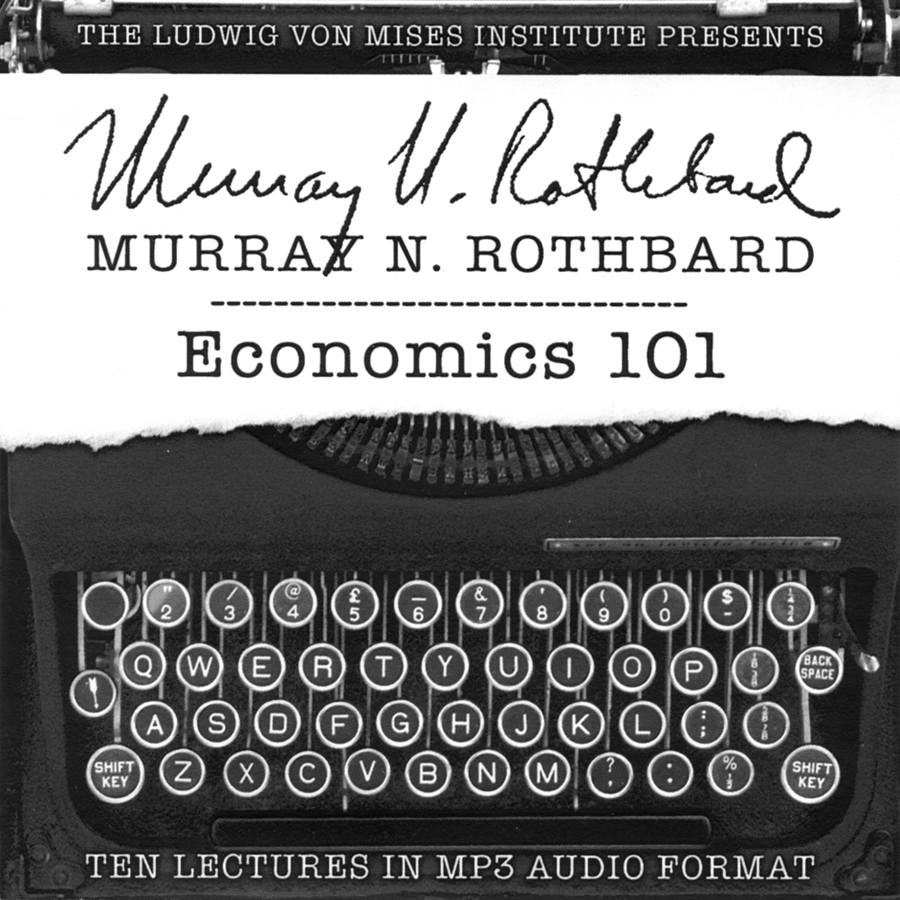
Economics 101
by Murray N. Rothbard
A collection of ten speeches and lectures by Murray N. Rothbard, spanning from the 1970s to the early 1990s. He is speaking in a small classroom setting, explaining economics from the ground up, and systematically in the manner of a classic 101 course on the topic—but with a revolutionary approach.Download the complete audio of this collection (ZIP) here.
Episodes
-
Chicago Economics v. Austrian Economics
Recorded in 1971.
-
The Future of Austrian Economics
Murray Rothbard presented this speech in 1990 as the final lecture of the Mises University, in the days following the collapse of socialism. He assesses the event in terms of its impact on the Austrian School and the prospects for liberty generally.
-
Demand and Supply, Consumer Goods, Prices and Exchange
Microeconomics starts with the basic fact that each person has short term and long term goals, like buying a ham sandwich and graduating from college. People act in the world to accomplish something. Human action is purposive. You employ different means to achieve certain goals. Rothbard begins...
-
Mises in One Lesson
Austrian economics has nothing to do with the economics of Austria. Austrian Economics (AE) began with Carl Menger in 1871. It is based on an analysis of individual action, not aggregates or groups. Economics predated Adam Smith. The British classical economics school could not solve the value...
-
Money and Prices
Many believe that if governments would just issue greater quantities of money then all problems would be solved. In truth that would create unsurmountable problems by lowering the purchasing power of each money unit. Money is the one good that is not made better by increasing its supply. Rothbard...
-
Capital, Interest, and Profit
Profit is total revenue minus total costs. Ours is not just a profit system, it is a profit and loss system. Losses are a sign that you wasted land, labor, or capital, yet those who make profits are criticized. Entrepreneurship is an art not a course you can learn. Labor earns wages. Land earns...
-
Labor
Minimum wage laws force unemployment up. All of those with few skills looking for an entry position will be denied because they cannot add enough value to the business labor field to be paid minimum wage. Unemployment follows minimum wage hikes. Marginal workers are being denied the labor market....
-
Labor and Unions
Rothbard covers the principles of demand and supply curves. Prices are at the seat of the whole system. Use the logic of reality. The most mobile labor force is teenagers. Over time, capital equipment per laborer increases. Real wage rates increase. Consumer prices decrease. Unions cannot…
more -
Conservation and Property Rights
Free markets shift resources from where they are less valued to where they are most valued, benefiting consumers. When private property and free markets are allowed to operate, a natural conservation of resources occurs. Nothing is a resource unless it is useful to man. Governments do not own...
-
Banking and the Business Cycle
One of the most difficult things to understand about banking is how money is created out of thin air. Current commercial bank liabilities are immediate. The banks do not have the reserves to redeem all demand notes. Thus, banks are inherently insolvent. But, government has eliminated runs on…
more
We're indexing this podcast's transcripts for the first time — this can take a minute or two. We'll show results as soon as they're ready.
No matches for "" in this podcast's transcripts.
No topics indexed yet for this podcast.
Loading reviews...
ABOUT THIS SHOW
A collection of ten speeches and lectures by Murray N. Rothbard, spanning from the 1970s to the early 1990s. He is speaking in a small classroom setting, explaining economics from the ground up, and systematically in the manner of a classic 101 course on the topic—but with a revolutionary approach.Download the complete audio of this collection (ZIP) here.
HOSTED BY
Murray N. Rothbard
Loading similar podcasts...
Frequently Asked Questions
How many episodes does Economics 101 have?
Economics 101 currently has 10 episodes available on PodParley. New episodes are automatically indexed when they're published to the podcast feed.
What is Economics 101 about?
A collection of ten speeches and lectures by Murray N. Rothbard, spanning from the 1970s to the early 1990s. He is speaking in a small classroom setting, explaining economics from the ground up, and systematically in the manner of a classic 101 course on the topic—but with a revolutionary...
How often does Economics 101 release new episodes?
Economics 101 has 10 episodes. Check the episode list to see recent publication dates and frequency.
Where can I listen to Economics 101?
You can listen to Economics 101 on PodParley by clicking any episode. We provide an embedded audio player for direct listening, and you can also subscribe via your preferred podcast app using the RSS feed.
Who hosts Economics 101?
Economics 101 is created and hosted by Murray N. Rothbard.
URL copied to clipboard!