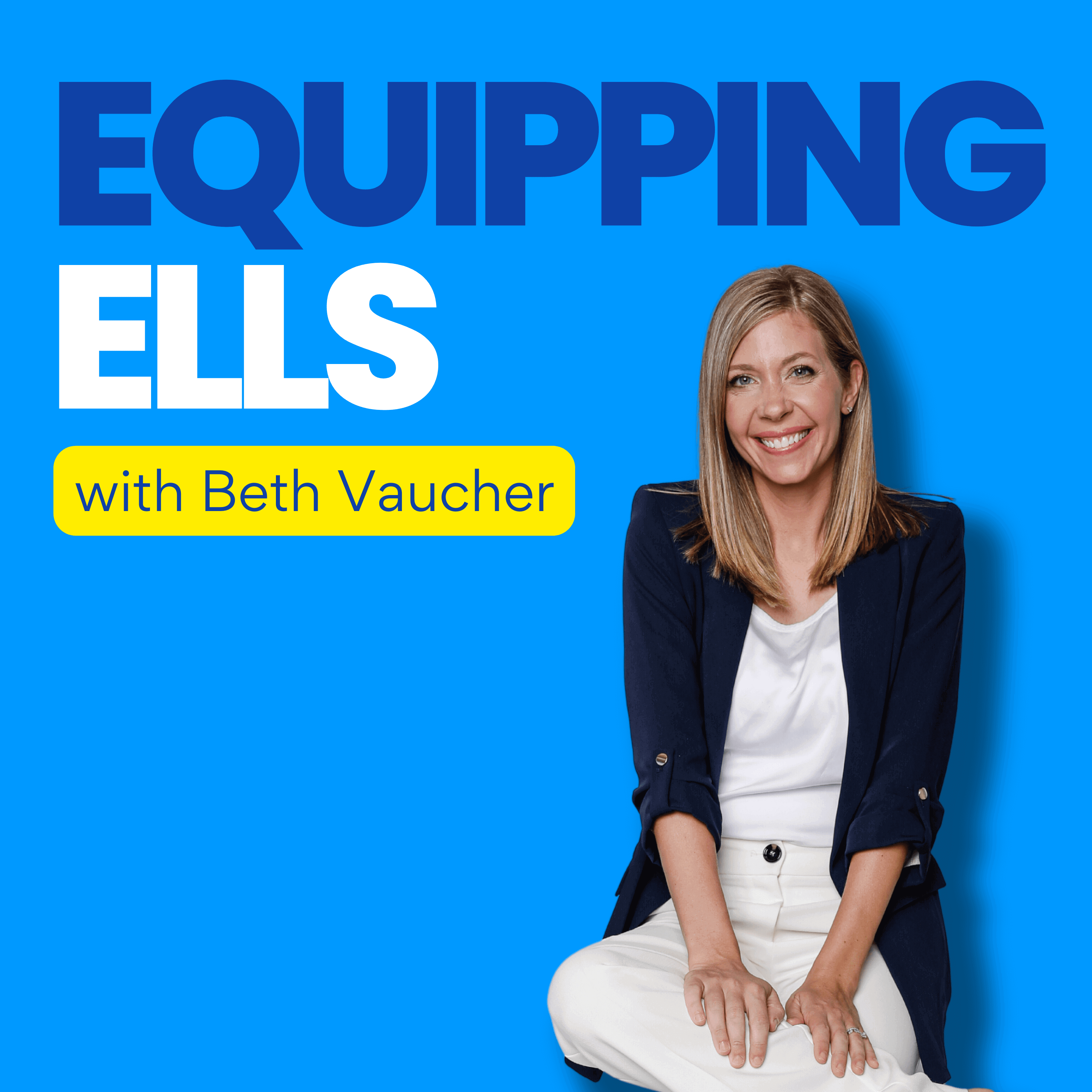
Equipping ELLs podcast artwork

PODCAST · education

Equipping ELLs

Equipping ELLs is a podcast for ESL specialists and homeroom teachers who are looking for effective and engaging ways to support their English Language Learners without adding to their endless to-do list. Each week you’ll hear tips, strategies, and inspirational stories that will empower you to better reach your ELL students, equip them with life-long skills, and strengthen relationships with colleagues and parents. Your host, Beth Vaucher, is an ESL certified homeroom teacher with over 10 years of experience teaching in the US and internationally. Learn more at www.inspiringyounglearners.com.

  1. 209

    EP208 The Scaffolding Teachers Actually Use — And What Makes Them Work

    In Episode 208 of the Equipping ELLs podcast, Beth Vaucher tackles one of the most widely discussed and most misunderstood concepts in ELL instruction: scaffolding. Every ELL teacher has heard the word, most can name a few strategies, and most genuinely believe they are scaffolding for their students. But when Beth observes teachers using these tools, she consistently finds the same problem — scaffolds are being used inconsistently, without clear purpose, and without any plan to eventually remove them. And when scaffolding never gets phased out, it stops being a scaffold entirely.Beth begins with the definition most teacher training programs get wrong. Scaffolding comes from the construction metaphor — a temporary structure built alongside a building while it is going up. The key word is temporary. The whole point of a scaffold is that it eventually comes down. In teaching, scaffolding is any temporary support that allows a student to access content they cannot access independently yet. That word yet is everything. Scaffolding is always pointed toward independence — always building toward the moment when the support is no longer needed. This is what makes scaffolding fundamentally different from accommodation, which is a permanent adjustment. Both have their place, but treating them as interchangeable is one of the most common mistakes in ELL classrooms — one Beth admits she was guilty of early in her own teaching career.The most common scaffolding mistake, Beth explains, is keeping the same scaffold long after it has stopped helping students grow. She uses sentence frames as the example most teachers will recognize: a teacher introduces frames for writing, students use them, lessons go better, and the teacher keeps using the same frames week after week. Students get comfortable. They rely on them completely. The teacher feels good because language is being produced. But completing a frame is not the same as internalizing a structure. Students can fill in the same sentence frame for six months without ever acquiring the academic language it contains. The scaffold has stopped building — it is only carrying.The fix is gradual release, not sudden removal. Beth walks through the progression: I do it, we do it together, you do it with support, you do it alone. Each step is a little more independent than the last. That progression is what turns a scaffold into real acquisition.The heart of the episode is a walkthrough of five scaffolding strategies that consistently make the biggest difference for ELL students. Sentence frames and sentence starters are the most versatile and highest-impact tools in the toolkit — but their power depends entirely on whether complexity is increasing over time. Beth walks through how to move from a complete frame to a partial frame to a prompt word to a word bank to nothing at all. Graphic organizers make thinking visible and are especially powerful for writing and reading comprehension — Beth recommends picking one organizer to master deeply before introducing others, and phasing out from fully structured to blank to student-created. Visual supports are not decoration — every image in a sheltered classroom should carry meaning, and Beth addresses how to move students toward generating their own visual connections over time. Pre-teaching vocabulary is the most commonly skipped scaffold and the one that makes the single biggest difference — five to eight essential words introduced before the lesson begins, not during and not at the end, with context, visuals, and multiple exposures. And modeling through think-alouds is the most underused scaffold of all, one that costs nothing — doing the task yourself out loud in front of students before asking them to attempt it, including making mistakes visibly so students see that confusion and self-correction are part of the process.Beth closes with the reminder that scaffolding is not one size fits all — the right scaffold always depends on the student's language stage and the specific task. And she leaves teachers with one question to ask before every lesson about every scaffold they plan to use: am I using this because my students need it to access the content right now, or am I using it because it makes the lesson feel smoother and I am not sure what else to do? FREE RESOURCE: DM the word SCAFFOLD to @EquippingELLs on Instagram for the free ELL Scaffolding Strategy Guide — scaffolding strategies organized by proficiency level with examples from Level 1 through Level 5.

  2. 208

    Ep207 Stop Waiting for ACCESS Scores to Tell You What to Teach

    In Episode 207 of the Equipping ELLs podcast, Beth Vaucher makes a case that most ELL teachers need to hear: you already have more data about your students' language development than any standardized test will ever give you. The question is not whether the data exists — it absolutely does. The question is whether you are collecting it intentionally and using it to drive your instruction.Beth opens with one of the most common ways ELL teachers accidentally limit their own effectiveness: waiting. Waiting for ACCESS scores. Waiting for a language proficiency report. Waiting for a scope and sequence the school never provides. Waiting for official data to tell them what their students need. And the problem with that approach, she explains, is simple — those scores were collected in January or February, and by the time you receive them, your student has been acquiring language every single day. The score is a photograph of someone who has already grown. Waiting for ACCESS scores to plan instruction, she says, is like driving while only looking in the rearview mirror.The heart of the episode is a practical, domain-by-domain framework for intentional observation that teachers can start using immediately. Beth begins with listening — a domain she identifies as the most powerful predictor of success across all other domains and one that is often skipped because it feels harder to observe. She gives concrete signals to watch for: whether a student can follow multi-step directions without looking at a peer, whether they can respond accurately to comprehension questions, whether they laugh at jokes and understand social context, whether they can follow a lesson without visuals. She also introduces a practical tool that many teachers overlook — the three-sentence dictation — which simultaneously reveals listening comprehension, sound-letter connections from reading instruction, and writing development in one simple activity.Speaking observation is about more than whether a student talks. Beth walks through specific indicators: Are they using complete sentences or single words? Spontaneous language or only when asked? Can they explain their thinking or only describe what they see? Are they using academic vocabulary or only conversational language? Are they self-correcting or attempting complex structures? Each indicator maps directly to a specific instructional response.Reading observation, Beth emphasizes, must go beyond decoding. A student who can read fluently but cannot tell you what the text was about is not a proficient reader — they are a decoder. She has seen this frequently with multilingual learners and stresses the importance of observing comprehension separately from fluency, because the instruction needed is completely different.Writing gives teachers the most permanent record of language development. Beth guides teachers through what to look for: sentence completeness, punctuation, academic versus conversational vocabulary, paragraph organization, planning and graphic organizer use, sentence variety, and whether errors are consistent or random. Consistent errors — like missing articles — are actually good news. They show exactly what the student is working on acquiring and tell you precisely what to address next.The episode then addresses the practical reality of observing 30 students across four domains. Beth's solution is elegant: pick one domain per week. Focus your observation lens entirely on that domain for all your students, then shift the following week. Over four weeks you have current data across all four domains for every student — far more useful, specific, and actionable than any annual test score. She also gives practical note-taking suggestions: a folder for sticky notes, a notebook, a phone notes app, or a Google Form that organizes data automatically.The episode closes with the language domain rubrics — a free resource that transforms vague observation into a precise, repeatable system by giving teachers specific, research-backed indicators for what language development looks like at each proficiency level in each domain.FREE RESOURCE: DM the word RUBRICS to @EquippingELLs on Instagram for the free language domain rubrics — ready to use in your classroom right away.

  3. 207

    Ep206 What Second Language Acquisition Actually Means for Your Classroom

    In Episode 206 of the Equipping ELLs podcast, Beth Vaucher goes one level deeper into the WHO of the ELL Success Cycle — moving from knowing where students are (the five stages from last week) to understanding how language is actually acquired. This episode is built around one of the most influential bodies of research in language education: the work of Stephen Krashen. By the end of the episode, listeners will understand their classroom environment in a completely new way — not as a soft, feel-good addition to instruction, but as a direct lever on language acquisition itself.Beth opens with a scenario every ELL teacher has experienced: a student who seemed to be making progress and then suddenly stalled. They went quiet, stopped taking risks, started shutting down. The answer, Beth explains, often lies in something called the affective filter — and understanding it changes how you read every student in your room.Before getting to the affective filter, Beth lays the foundational distinction that Krashen identified between language acquisition and language learning. Language learning is conscious and explicit — memorizing grammar rules, studying vocabulary lists, conjugating verbs. Beth shares her own experience learning Spanish, where she could conjugate verbs perfectly on paper but completely fell apart in actual conversation. That gap between learned knowledge and natural use is exactly what Krashen's research addresses. Language acquisition, by contrast, is subconscious — the same process a child uses to acquire their first language. It happens through immersion, meaning-making, and internalization, not deliberate study. Krashen's key finding is that what we ultimately want for our students is acquisition, not just learning, because only acquired language can be accessed automatically in real conversation, spontaneous writing, and academic work.The first condition for acquisition is what Krashen called comprehensible input — language that is just one step beyond the student's current level. Not way above, not at their current level, but i plus one. When input is comprehensible, the brain processes it and acquisition begins. When it is incomprehensible — too far above the student's level — it is essentially noise. Beth makes the connection direct and practical: assigning a grade-level text to a developing student without scaffolding is not instruction, it is noise. Using visuals, gestures, simplified language, and context clues to make content accessible is comprehensible input. This, Beth explains, is exactly why sheltered instruction matters and why scaffolding is not lowering expectations — it is creating the conditions for acquisition.The second condition is the affective filter — the wall that goes up when a student feels anxious, self-conscious, afraid of making mistakes, or unsafe. When the filter is high, even comprehensible input cannot get through. The language is there but the brain blocks it from being processed. When the filter is low — when a student feels safe, relaxed, motivated, and supported — comprehensible input flows directly into acquisition. Beth gives a vivid example: the difference between how students perform in her pull-out classroom versus when they return to a homeroom classroom where they feel less safe. The affective filter explains that difference completely.Beth closes with four concrete classroom applications — audit your input, lower the filter intentionally, create meaningful interaction, and be patient — and introduces the free comprehensible input classroom checklist available by DMing the word INPUT to @EquippingELLs on Instagram.FREE RESOURCE: DM the word INPUT to @EquippingELLs on Instagram for the free comprehensible input classroom checklist. Evaluate your current classroom environment in minutes.

  4. 206

    Ep 205 From Silence to Fluency: The 5 Stages of Language Acquisition Every ELL Teacher Needs to Know

    In Episode 205 of the Equipping ELLs podcast, host Beth Vaucher dives deep into one of the most foundational topics in ELL education — the five stages of language acquisition — and breaks them down in the most practical, classroom-ready way possible. This is not a repeat of what you heard in your credential program. This is a real-classroom guide to what each stage looks and sounds like on a Tuesday afternoon, what students need at each stage, and — just as importantly — what teachers should stop doing that is quietly slowing language growth.Beth begins the episode by addressing why knowing the stage names is not enough. Most ELL teachers can name the stages, but truly understanding what they look like in a real classroom is a completely different skill. When teachers do not have a clear picture of each stage, they misread their students, plan for the wrong things, and struggle to advocate confidently when homeroom teachers or admin question why a student is not producing grade-level work.The episode opens with Stage 1 Pre-Production — the silent period — and immediately reframes silence as a stage to honor rather than a problem to fix. Beth explains that a student in pre-production is taking in enormous amounts of language even without producing a single word, and that the most damaging thing a teacher can do at this stage is call on the student in front of the class. She also introduces a critical and often overlooked point: the rate of speech. As native speakers, teachers naturally speak faster than they realize, and for a student whose entire day is spent listening, a slower rate of speech directly increases vocabulary growth and listening comprehension.Stage 2 Early Production captures the joy of the first output — single words, familiar phrases, yes and no responses — and Beth shares the delight she personally feels watching newcomer students take those first steps. She emphasizes the role of sentence frames, predictable questions, and low-stakes speaking opportunities in supporting this stage, and cautions against correcting every error or demanding extended responses.Stage 3 Speech Emergence is where Beth identifies the most common teaching mistake: pulling scaffolding too soon. Because students at this stage are speaking more confidently and vocabulary is growing rapidly, it can appear that support is no longer needed. But social language and academic language develop on completely different timelines, and writing — the last language domain to develop — is just beginning to emerge. Beth explains that what these students need is not less support but different support: extended sentence frames that push complexity, academic language scaffolding, and structured writing supports like graphic organizers and mentor texts.Stage 4 Intermediate Fluency addresses the students who look almost fluent — and often exit ELL services around this level in many states. Beth makes a direct case for why homeroom teachers need to understand this stage: these students are still making significant errors, still developing academic language, and still building the deep proficiency needed for complex academic tasks. Losing support at this stage can cause students to flounder quietly, losing confidence and momentum.Stage 5 Advanced Fluency closes with Beth's reminder that language learning is a lifelong journey, and that even near-native proficiency students benefit from encouragement, celebration of wins, and continued academic vocabulary development.The episode closes with a practical three-part framework for using this information: identify your students' stages through observation, plan one lesson with multiple entry points for all stages, and communicate what you know to advocate confidently for every student in your care.Beth then invites listeners to join the free live five-day ELL challenge starting Monday May 25 — five days of step-by-step setup for next school year, over $100 in free resources, and the confidence to walk into the fall feeling ready.FREE CHALLENGE: Sign up at equippingells.com/challenge or DM the word CHALLENGE to @EquippingELLs on Instagram. Challenge starts Monday May 25.

  5. 205

    Ep 204: What Confident ELL Teachers Do Differently

    Have you ever watched another ELL teacher and thought — how does she make it look so easy? In Episode 203 of the Equipping ELLs podcast, Beth Vaucher pulls back the curtain on what confident ELL teachers actually do differently — and the answer has nothing to do with easier students, a smaller caseload, or more years of experience. The difference comes down to something far more learnable: having a clear framework underneath every decision you make.Beth introduces the ELL Success Cycle — a four-part framework built around WHO, WHAT, HOW, and WHEN — and walks through exactly what each piece looks like in a real classroom. Drawing on the research of John Hattie, she explains why teacher confidence isn't just good for you — it's one of the most powerful predictors of student success. And here's what matters most: that confidence is not a personality trait. It is built.The WHO piece is about knowing your students deeply before you plan anything — not just names and grade levels, but where each student actually is in their language development across speaking, listening, reading, and writing. The WHAT piece is about knowing what language growth actually looks like at different proficiency levels so you can recognize progress even when it's slow and messy. The HOW piece is about building consistent routines that free up your mental energy so you can be fully present with your students. And the WHEN piece is about having a process for knowing what to do next — without guessing or pulling random worksheets off Google.One of the most powerful messages in this episode: the worst thing you can do is try to work on all four pieces at once. Pick the one area where you have the most room to grow. Start there. Build that foundation. The other pieces will follow. This episode also introduces a free two-minute quiz that identifies exactly which piece of the ELL Success Cycle is holding you back — and gives you a personalized action plan.FREE RESOURCE: DM the word QUIZ to @EquippingELLs on Instagram — find out which part of your ELL framework needs the most attention and get a personalized action plan in 2 minutes.

  6. 204

    Ep 203 Why Your ELL Students Aren't Making the Progress Everyone Expects (And What to Do About It)

    If you have ever sat in a data review meeting and heard someone ask why your ELL students aren't making progress — this episode is going to change how you walk into that room forever. In Episode 203 of the Equipping ELLs podcast, Beth Vaucher addresses one of the most painful and persistent experiences ELL teachers face: being held accountable for outcomes built on a fundamental misunderstanding of how language actually develops. The problem isn't you. The problem isn't your students. The problem is that the expectations were never realistic to begin with.Beth walks through the critical research behind second language acquisition, including Jim Cummins' landmark distinction between BICS (Basic Interpersonal Communication Skills) and CALP (Cognitive Academic Language Proficiency). Conversational language takes one to three years to develop. Academic language proficiency — the kind students need to read complex texts, write arguments, and access grade-level content — takes five to seven years even under ideal conditions. When schools measure ELL students annually and expect grade-level movement each year, they are measuring the wrong thing on the wrong timeline.This episode also takes an honest look at the limits of standardized language proficiency testing. Tests like ACCESS measure a single snapshot in time — one moment, one format, one set of tasks — and they cannot see the growth that ELL teachers observe every single day. A student moving from silence to attempting sentences. A student whose writing shifts from copied phrases to original ideas. A student self-correcting mid-conversation for the first time. These moments are real data. They just don't show up in a spreadsheet.Beth also addresses the unique pressure ELL teachers absorb from every direction — admins, homeroom teachers, families, district accountability systems — and gives a direct, compassionate message: that pressure is not yours to carry. And yet the teachers who carry it most lightly are the ones equipped to walk into data meetings as the expert — not defensively, but with clarity, confidence, and the right tools.The episode closes with three things every ELL teacher can control: knowing students deeply, tracking visible growth consistently, and proactively educating the people around them. Beth also introduces a free resource — language domain rubrics covering speaking, listening, reading, and writing — that give ELL teachers a clear observational framework to know exactly where each student is and what they need next.Whether you are a newer ELL teacher still finding your footing or a veteran who is exhausted from being questioned about outcomes you cannot fully control, this episode will leave you feeling validated, equipped, and ready to advocate for your students with confidence.🎁 FREE RESOURCE: DM the word RUBRICS to @EquippingELLs on Instagram and we will send you our language domain rubrics — free, ready to use in your classroom this week.

  7. 203

    202. The Translation Trap: When Google Translate Stops Helping Your ELL Students

    One of the most common dilemmas in ELL and ESL classrooms today is the question of translation — specifically, when does letting your English language learners use Google Translate actually help them, and when does it quietly start holding them back? In Episode 202 of the Equipping ELLs podcast, Beth Vaucher tackles this exact question with a story from a real professional development session that stopped her in her tracks. A middle school math teacher raised her hand and asked something deeply honest: "I know I'm not supposed to let my students translate everything — but right now it's the only bridge I have. Is that bad?"If you've ever felt that tension as an ELL teacher, this episode is for you. Beth walks through what the research actually says about home language support and ELL student language acquisition, including Jim Cummins' Interdependence Hypothesis — the idea that concepts learned in a student's home language transfer to English, making strategic home language use a form of smart scaffolding, not a shortcut. This episode validates the complexity every ESL teacher navigates daily while giving them a clear, practical framework to make better decisions in the moment.The core of this episode is a three-question decision framework for ELL translation strategies that teachers can use at any grade level. The first question asks whether the task is a comprehension task or a production task — because home language support is appropriate for getting content in, but English output is where language acquisition actually happens. The second question asks whether the student is stuck on the language or stuck on the concept — two completely different problems that require two completely different responses. The third question asks whether the support has an exit plan — because good scaffolding phases out, and if it doesn't, it stops being a scaffold and becomes a ceiling.Beth also breaks down what intentional translation use looks like in both elementary and secondary settings — covering bilingual word walls, the Preview-Review strategy, sentence frames, the "English first, check second" protocol, and the 50/50 rule for writing tasks. Whether you're an elementary ESL teacher, a secondary content teacher, or an instructional coach supporting a multilingual learner program, this episode gives you the language and the framework to make confident, research-backed decisions about translation in your classroom.🎁 FREE RESOURCE: DM the word TRANSLATE to @EquippingELLs on Instagram for a free printable decision chart — 3 questions to keep at your desk and share with your team.

  8. 202

    201. Why nothing seems to stick for your ELL students (and what to do instead)

    Are you constantly trying new teaching strategies with your English Language Learners, only to feel like nothing truly sticks? In this episode of the Equipping ELLs Podcast, Beth Vaucher returns after a short break to share a powerful insight that could completely shift how you approach instruction in your classroom.Many educators feel the pressure to continuously adapt, implement new tools, and chase the next “magic” solution for student engagement and language development. But what if the real problem isn’t a lack of effort—or even a lack of effective strategies?Beth dives into the often-overlooked truth: consistency is the missing piece. When teaching practices are constantly changing due to schedules, administrative demands, or new initiatives, students don’t get the repetition and structure they need to truly develop language skills.In this episode, you’ll discover why repetition, familiarity, and routine are essential for language acquisition—and why constantly switching strategies may actually be holding your students back. Beth also shares a simple but powerful mindset shift: instead of asking “What should I try next?”, start asking “What can I commit to consistently for the next two weeks?”You’ll walk away with practical, classroom-ready ideas you can implement immediately—without adding more to your already full plate. Whether you’re working with beginners or advanced multilingual learners, this episode will help you refocus your energy on what actually drives results.If you’ve ever felt discouraged, overwhelmed, or stuck in a cycle of trying new things that don’t last, this episode is for you. You’ll be reminded that it’s not about doing more—it’s about doing less, more consistently.👉 Ready to take action?DM on Instagram @EquippingELLs the word CONSISTENT for your free guide of routines and resources to use right away.Tune in and start building consistency that leads to real language growth!

  9. 201

    200. Scaffolding Success: 5 Strategies for Newcomers in Your ELL Classroom

    In this powerful episode of the Equipping ELLs podcast, host Beth Vaucher (formerly Boche), founder of Inspiring Young Learners, dives deep into one of the most pressing challenges facing educators today—supporting newcomer English Language Learners (ELLs) in the classroom. As classrooms across the country see a rising number of newcomer students, many educators feel overwhelmed and unsure where to begin. In Episode 11, Beth shares a step-by-step roadmap to scaffold lessons effectively so newcomers feel supported, engaged, and empowered from day one.This episode goes beyond the basics of welcoming newcomers and focuses on actionable strategies to make instruction accessible, even when students enter with little or no English or native-language literacy. Beth explains why understanding a student’s literacy background in their first language (L1) is essential and how it informs your approach to lesson planning. She breaks down five simple, yet powerful scaffolding strategies you can start using this week—from using visuals and QR codes for listening comprehension to incorporating cognates and sentence starters.Drawing from her personal experience teaching abroad in Panama during the pandemic, Beth offers insight into why today’s newcomers may have drastically different needs than those from pre-pandemic years. With many having experienced years of interrupted or nonexistent schooling, educators need practical tools more than ever to bridge the gaps in foundational learning.Whether you’re a homeroom teacher or an ESL specialist, Beth emphasizes the critical importance of collaboration between both roles to see real progress in your newcomer students. She provides real-life classroom examples, reflective questions, and helpful analogies (like learning about the solar system in a language you don't speak!) to inspire confidence in teachers who may feel underprepared.Tune in to hear how you can blend foundational language instruction with content-area learning, all while making students feel safe and successful. Plus, Beth shares how small, intentional efforts—like slowing your rate of speech or providing picture-supported vocabulary—can make a huge difference in helping newcomers thrive.Finally, Beth invites educators to join the Equipping ELLs membership, where they can access done-for-you lesson plans, coaching, and a community of passionate teachers ready to support each other. If you’re looking to grow your confidence and capacity when working with newcomer ELLs, this episode is a must-listen.Links and Resources:⁠⁠⁠Join the Equipping ELLs MembershipShop our TpT Store[FREEBIE] Newcomer Welcome Kit[FREEBIE] Newcomers Scope & SequenceReady for more? Grab our best-selling Newcomer Yearlong Bundle

  10. 200

    199. Cooperative Learning Strategies for ELLs: Scaffolding for Effective Peer Interaction

    Frustrated with keeping your ELL students engaged? Or struggling to give everyone the chance for output in a short amount of time?In this episode of the Equipping ELLs Podcast, we dive into 4 practical Kagan Cooperative Learning strategies that will help you keep every student participating. Boost engagement, scaffold activities, and empower your students to take the lead in their learning journey. Join us for insights that'll make your teaching life easier and your classroom time more productive!Resources: ⁠⁠⁠Join the Equipping ELLs Membership (Everything you need for your school year!)Shop our TpT StoreSign Up for the FREE WebinarFREEBIE: Using Cooperative Learning Strategies with ELLs

  11. 199

    198. How to Build a Vocabulary-Rich Classroom for English Learners

    In this high-impact episode of the Equipping ELLs Podcast, Beth Boche dives deep into one of the most loved topics by the community: teaching vocabulary that sticks. With a countdown to the 200th episode underway, we're celebrating by revisiting this listener favorite that’s packed with actionable strategies for vocabulary instruction using a tiered approach. If you've ever wondered how to move beyond flashcards and truly empower your English Language Learners (ELLs) to use vocabulary with confidence, this episode is your roadmap.Beth begins by exploring the three tiers of vocabulary—Tier 1 (basic words), Tier 2 (cross-domain academic vocabulary), and Tier 3 (domain-specific terms)—and explains how each tier plays a unique role in language acquisition. Through relatable examples and practical classroom scenarios, she highlights how Tier 2 vocabulary is the sweet spot for focused instruction that leads to lasting learning.Listeners will gain insight into how to strategically plan vocabulary instruction that’s rooted in context, culturally responsive, and scaffolded by language proficiency levels. Beth also shares a 5-step planning framework to help teachers pre-select and teach vocabulary words effectively. From choosing 6–8 high-impact words per unit to creating visual supports like anchor charts and flashcards, you’ll walk away with tools you can implement right away.One powerful takeaway is the emphasis on "shades of meaning"—teaching synonyms and related terms based on a student’s language level to reinforce vocabulary in meaningful ways. Beth also reminds educators to consider the cognitive load of learners, especially newcomers, and encourages keeping vocabulary instruction simple, targeted, and rich with repetition and context.Whether you're a new ELL teacher or a veteran looking to refine your vocabulary approach, this episode offers a fresh perspective rooted in real classroom experience and research-backed strategies. Beth shares her own story of learning Spanish and uses it to emphasize the importance of learning vocabulary in real-life situations—not just through memorization.Don't forget to enter our celebration giveaway by leaving a review, taking a screenshot, and sending it to us via Instagram (@equippingELLs) or email ([email protected]). Weekly winners receive a $20 Teachers Pay Teachers gift card and are entered into the grand prize drawing for a $200 Amazon gift card!Make sure to follow along on Instagram and subscribe so you don’t miss the remaining episodes in our Top 5 Countdown. For even more support and ready-made resources for your ELL students, visit inspiringyounglearners.com.Resources: ⁠⁠⁠Join the Equipping ELLs MembershipShop our TpT Store

  12. 198

    197. ACCESS Testing Tips for ELL Teachers: How to Reduce Stress and Maximize Support

    Welcome back to the Equipping ELLs podcast! As we count down to our 200th episode, we're celebrating YOU, our amazing community, with top-loved episodes and exciting giveaways. This week, we’re revisiting a listener favorite that’s packed with actionable advice: how to effectively prepare your students, colleagues, and yourself for ACCESS testing season.In this episode, Beth Vaucher, founder of Inspiring Young Learners, shares a deeply practical and encouraging guide for navigating the often overwhelming ACCESS testing period. Whether you're a new or experienced ELL teacher, you'll find clarity and confidence in these simple but impactful strategies. Learn how to prepare your students without spending weeks on test prep, why the format matters more than the content, and how to build confidence and calm in your classroom.You'll also discover tips for helping students feel valued beyond their test scores, from visual prep to self-affirming activities that boost morale. Beth dives into how to effectively communicate with homeroom teachers and parents, including using pre-made templates and WIDA-translated letters. Plus, she shares tech setup tips, scheduling strategies, and how to keep your own mental health in check during this intense season.Whether you’re testing digitally or on paper, you’ll walk away with resources, tools, and mindset shifts to make ACCESS season smoother and more successful. Don’t miss the free Access Testing Guide available in the show notes—it's filled with email templates, editable notes home, and more time-saving tools.Why traditional test prep isn’t the answer for ELLsThe role of format familiarity and technology readinessCollaboration strategies with homeroom teachersVisuals and communication tips for students and familiesSelf-care and schedule planning for teachers🎁 Don’t forget to enter our giveaway by reviewing the podcast, taking a screenshot, and sending it via Instagram @equippingELLs or email at [email protected]. Each review enters you for weekly gift cards and a chance to win a $200 Amazon grand prize!Resources: ⁠⁠⁠Join the Equipping ELLs MembershipShop our TpT StoreTranslated Connection Letters: Access Testing for Parents of ELLsFREE Access Testing Guide

  13. 197

    196. Mastering the 4 Language Domains: Daily Routines for ELL Success

    In this special lead-up to the 200th episode of the Equipping ELLs podcast, host Beth Vaucher dives into one of the most requested and transformational topics for educators of multilingual learners—how to build practical, effective routines to strengthen all four language domains: listening, speaking, reading, and writing. Whether you're new to supporting English Language Learners or a seasoned ELL specialist, this episode is filled with immediately applicable strategies that will streamline your planning and empower your students.Beth breaks down the importance of focusing on each language domain and how they connect to real classroom success. She shares research-backed insights that explain why active listening is the foundation for language acquisition, and why pre-listening strategies can dramatically improve comprehension. She then reveals a simple yet powerful speaking routine using picture prompts that not only promotes daily oral language practice but builds vocabulary and confidence in a safe, engaging environment.When it comes to reading, Beth emphasizes the need to front-load vocabulary—especially Tier 2 words—and gives clear guidance on how to select which words to pre-teach for maximum impact. Writing doesn’t get left behind—she introduces the fun and collaborative “Strengthen a Sentence” routine that makes writing less intimidating and more interactive for ELL students at all levels.The episode wraps up with a practical walkthrough of how to integrate all four language domains into one cohesive lesson using a single anchor text. From read-alouds to conversation cards to scaffolded writing prompts, Beth outlines a plug-and-play structure that ensures your lessons are both academically rich and language supportive.Listeners are also invited to celebrate the podcast’s 200th episode with a special giveaway—weekly $20 Teachers Pay Teachers gift cards and a $200 Amazon grand prize. To enter, simply leave a review on your favorite platform, screenshot it, and send it to @equippingELLs on Instagram or email [email protected] you're looking for done-for-you resources that align with this episode, check out the Unlocking Language Through Read Alouds bundle, or grab the free domain-by-level expectation charts in the show notes. Whether you teach newcomers or advanced multilingual learners, this episode is your step-by-step guide to empowering every student with intentional, high-impact routines. Don’t forget to leave a review and enter the giveaway before October 24th!Links and Resources:Sign Up for the FREE Webinar⁠⁠⁠Join the Equipping ELLs Membership Shop our TpT Store

  14. 196

    195. The 6 most common mistakes teachers make with ELLs and how to avoid them

    Are your ELL students falling behind—even when you're doing everything you can to support them?Welcome back to the Equipping ELLs Podcast! In this insightful episode, host Beth Vaucher breaks down the six most common mistakes educators make when working with English Language Learners (ELLs)—and, more importantly, how to avoid them. As the school year begins, this is the perfect time for reflection and adjustment. Whether you're a seasoned ESL teacher or new to supporting multilingual learners, this episode provides practical, actionable advice to transform your teaching mindset and classroom practices.Beth emphasizes that intention, not perfection, is key to successful ELL instruction. She unpacks the dangers of waiting too long to involve ELLs in meaningful classroom work, explaining why full participation from day one matters. Listeners will gain strategies for scaffolding content, using visuals, and engaging newcomers without isolating them.Another crucial point discussed is the "silent period"—a misunderstood phase where students are actively learning despite not speaking. Beth offers reassurance and practical tools to support these learners without forcing premature speaking. The episode also dives into the importance of understanding language levels and how misinterpretation can lead to either too much or too little support.Beth addresses the reality many teachers face: trying to figure it all out alone. She underscores the power of community and collaboration and shares resources like the Equipping ELLs membership and active online communities. Another major misconception? Treating all ELLs as a homogenous group. Beth urges educators to go beyond labels and use student profiles to plan more purposefully.Finally, she reframes language development as a whole-school responsibility, reminding us that every teacher is a language teacher—regardless of subject. This episode is full of encouragement, real talk, and empowering tools for teachers who want to help their ELLs not just survive, but thrive.Don't miss Beth’s call to action to join the Equipping ELLs membership, now offering 20% off with the code EQUIP20. Plus, discover how to access free tools, training webinars, and community support to elevate your ELL teaching game.If you found this episode helpful, please leave a review and share it with a fellow educator who supports English learners. Your support helps amplify best practices in ELL education. Tune in now and empower your classroom for success!Links and Resources:Sign Up for the FREE Webinar⁠⁠⁠Join the Equipping ELLs Membership Shop our TpT Store

  15. 195

    194. Ask yourself these 3 questions to keep your lessons aligned all year

    Do you ever feel like your lesson plans are just a collection of random activities—fun in the moment but not really building toward anything? You’re not alone. Many teachers, especially those working with English language learners, find themselves overwhelmed trying to fit in every domain, standard, and activity into a short block of time. The result? Lessons that feel scattered, students who walk away unclear on the purpose, and a teacher who’s left wondering if any of it really stuck.In this episode of Equipping ELLs, Beth Vaucher shares a simple yet powerful framework to bring clarity and direction back into your teaching. She calls it your GPS: Goal, Personalize, Scaffold. By asking three quick questions before you plan, you can transform your lessons from disconnected to intentional, ensuring every activity builds toward language growth and student success.Beth breaks down how to set a clear goal for each lesson, why personalization is the secret ingredient to boosting student engagement, and how to choose scaffolds that support without holding students back. You’ll also hear practical examples—from using tortillas to teach main idea to tying ecosystems to students’ own neighborhoods—that show just how simple (and powerful) these strategies can be.Whether you’re planning tomorrow’s lesson or mapping out a unit, this GPS system will keep your teaching aligned, purposeful, and student-centered all year long.LINKS AND RESOURCES:Sign Up for the FREE Webinar⁠⁠⁠Join the Equipping ELLs Membership Shop our TpT Store

  16. 194

    193. The 3 essential tracking systems every ELL teacher needs, without drowning in paperwork.

    Are you feeling overwhelmed by all the paperwork that comes with assessing and tracking your English learners? You’re not alone. Many ELL teachers ask the same questions: How do I assess my students without drowning in forms? How do I keep track of their growth in a way that’s meaningful and sustainable?In this episode of the Equipping ELLs Podcast, Beth breaks down the three essential tracking systems every ELL teacher needs to stay organized and support student success—all without adding extra stress to your workload. She shares simple, practical tools you can start using right away to monitor growth, set goals, and clearly show progress to students, parents, and administrators.You’ll learn how to:Use quarterly progress monitoring for consistent snapshots of student growth.Implement generic rubrics that work across assignments and grade levels, making it easier to measure language development and communicate goals.Build language portfolios that tell the powerful story of each student’s growth through their own work samples.Beth also explains where WIDA standards fit into all of this—helping you move from “Where are my students now?” to “Where should they go next?” She walks through her FAST framework to simplify lesson planning with WIDA.Ready to put this into action? Here are some resources mentioned in today’s episode:Free Generic Rubrics → DM the word rubrics to Equipping ELLs on instagram to get your free set.Simplified WIDA Can-Do Descriptors Guide → Download it for free.Equipping ELLs Membership → Access all the tools, resources, and support you need for K–12, all language levels, and all domains at www.equippingells.com. Use code EQUIP20 to take 20% off the yearly membership.Digital Portfolios with Kelly → Listen Here.By the end of this episode, you’ll have a clear path to tracking progress that not only saves your sanity but also builds student confidence and guides meaningful instruction.

  17. 193

    192. Should You Translate Everything? Essential ELL Strategies for Teachers

    Should you translate everything for your English Language Learners?Overusing translation can actually slow down language acquisition and create over-dependence on students' first language.In this episode, Beth breaks down when translation becomes a barrier and when it can be a powerful support. You'll hear real classroom examples that show the difference — like how a moment of intentional translation helped a student feel included, and how translating every direction can overwhelm both students and teachers.She outlines key times when translation is essential — such as communicating with families, supporting newcomers emotionally, and helping students understand routines or vocabulary. You'll also learn how to support intermediate students who hit a learning plateau by using translation to build academic vocabulary and improve writing and speaking fluency.Beth shares practical ways to use translation across all four language domains — listening, speaking, reading, and writing — and emphasizes that translation should be used as a scaffold, not a crutch.This episode also highlights some of the most effective translation tools available today, including TalkingPoints, Microsoft Translator, SayHi, and more. You’ll walk away with strategies that balance support and language growth — helping your students thrive in English while honoring their native language.Don’t forget to grab your free chart linked below! Join the Equipping ELLs membership and use code EQUIP20 to save 20% on the Tier 3 yearly plan.Links and Resources:Sign Up for the FREE Webinar⁠⁠⁠Join the Equipping ELLs Membership Shop our TpT StoreDownload the "To Translate or Not to Translate" Resource!

  18. 192

    191. Prioritize Supporting Exceptional Learners with Beth Skelton and Tan Huynh

    Are your multilingual learners fluent in conversation but still struggling with academic content?In this episode of the Equipping ELLs podcast, host Beth Vaucher speaks with Beth Skelton and Tan Huynh, authors of Long-Term Success for Experienced Multilinguals, to unpack why fluency isn’t the finish line—and how educators can better support multilingual students who’ve been in language programs for years.Beth and Tan introduce a powerful shift in mindset: replacing the limiting label of “long-term English learner” with “experienced multilingual.” This simple but meaningful change recognizes students’ strengths and reframes how teachers approach instruction. Tan shares his personal story as a former English learner in the U.S. system, offering firsthand insight into the gaps students face when academic language isn’t explicitly taught.Educators will walk away with practical strategies rooted in their “Orchard Framework”—a planning model that helps teachers align content and language goals from the start. The episode also previews their upcoming book for ELD teachers, offering actionable guidance for integrating reading, writing, speaking, and listening across all subjects.This episode is a must-listen for teachers, coaches, and specialists ready to move beyond surface-level support and build language-rich classrooms where all students can thrive. Don’t miss it.Links and Resources:Long Term Success for Experienced Multilinguals BOOK!Connect with BethConnect with TanSign Up for the FREE Webinar⁠⁠⁠Join the Equipping ELLs Membership Shop our TpT Store

  19. 191

    190. Time-Wasters vs. What Actually Works: How to Plan ELL Lessons That Save You Time and Boost Student Success

    Are you spending hours planning ELL lessons that your students don’t even seem to retain?Welcome back to the Equipping ELLs Podcast — the space where we take the overwhelm out of teaching English language learners and replace it with clarity, strategy, and confidence. In this episode, host Beth Vaucher dives deep into the common time wasters ELL teachers encounter during lesson planning — and what to do instead to reclaim your time without compromising student success.If you’re spending hours planning beautiful slides, customizing lessons for each language level, or trying to retrofit a one-size-fits-all curriculum, you’re not alone — but it doesn’t have to be that way. Beth breaks down five major time-wasting habits and provides practical, proven alternatives that save time and increase impact.You’ll learn how to:Use editable slide templates that speed up prep without sacrificing qualityPlan one strong lesson with scaffolded access points instead of three separate onesFocus on what your ELL students need rather than forcing a general curriculum to fitChoose one intentional focus per lesson, not cram every domain into 30 minutesReplace busy work with interactive, language-rich activities that truly build skillsBeth also shares insight into effective systems — not just strategies — that lead to better routines, faster planning, and more confident teaching. From using the WIDA Can Do Descriptors to plugging into ready-to-go resources inside the Equipping ELLs Membership, this episode is full of takeaways you can apply right away.🎧 Whether you're a new teacher overwhelmed by where to start, or a veteran educator ready to streamline your approach, this episode will leave you feeling empowered to teach what matters most.👉 Want to go even deeper? Sign up for the free webinar "From Overwhelmed to On Track" by messaging the word webinar to @equipping.ells on Instagram or join at the link below.💡 Plus, as a thank you for listening, use code TAKE10OFF for 10% off your Tier 3 monthly or yearly membership at Equipping ELLs.LINKS AND RESOURCES:Sign Up for the FREE Webinar⁠⁠⁠Join the Equipping ELLs Membership Shop our TpT Store

  20. 190

    189. From Theory to Practice: Kelly Reider on Making Language Visible in Every Classroom

    In this episode of the Equipping ELLs Podcast, host Beth Vaucher is joined by renowned educator and language planning expert Kelly Reider for a deep dive into the world of functional language planning—a critical but often misunderstood approach to supporting multilingual learners in today’s classrooms.With over 30 years of experience in education, Kelly shares how her journey from classroom teacher to district coordinator and national facilitator helped her shape a better way of aligning language development with content instruction. Together, Beth and Kelly explore the challenges educators face when planning for diverse learners, especially when co-teaching or pushing into content-area classrooms with limited prep time.Kelly breaks down the five core principles of functional language planning, rooted in Systemic Functional Linguistics (SFL), offering a practical, research-based alternative to traditional grammar-focused approaches. She emphasizes a context-driven, flexible planning model that helps teachers support student communication and academic achievement, regardless of curriculum changes or language levels.Listeners will learn how functional language planning:Prioritizes real-time, context-based language needsShifts from "what to teach" to "what students need to do with language"Incorporates grammar as a tool for meaning-making, not an isolated objectiveEmpowers teachers to model, scaffold, and practice target language structures with studentsSimplifies planning through backwards design and alignment toolsBeth and Kelly also discuss the importance of student talk time, explicit modeling, and peer-to-peer interaction as foundational strategies that help students internalize and apply academic language in meaningful ways.This episode isn’t just theory—it’s full of actionable insights. Whether you're a general education teacher, ESL specialist, or instructional coach, you’ll walk away with a renewed sense of what’s possible when we make language visible, intentional, and functional for multilingual learners.🎓 Resources Mentioned:https://www.englishlearnerportal.com @EngLrnPortal on X @englishlearnerportal on Instagramhttps://www.facebook.com/englishlearnerportal https://www.youtube.com/@englishlearnerportal235 https://www.linkedin.com/in/kelly-reider-7595a747/Don’t forget to subscribe, rate, and review the show! Your feedback helps us grow this supportive community of educators who are equipping ELLs to thrive.

  21. 189

    188. How to support ELLs through differentiated instruction without feeling overwhelmed.

    Has differentiation always felt like the most overwhelming part of your lesson plan?host Beth Vaucher dives deep into one of the most pressing challenges educators face: how to differentiate instruction for English Language Learners (ELLs) without feeling overwhelmed. This episode unpacks a practical, three-step framework that empowers teachers to support students at all language levels while maintaining a single, streamlined lesson plan. If you've ever found yourself stressed trying to create five versions of the same lesson or unsure what differentiation even means for language learners, this episode offers immediate relief and clarity.Beth begins by validating the very real struggle teachers face when juggling multiple proficiency levels, language domains, and curriculum expectations. Instead of overcomplicating things, she shows educators how to start with language data—such as WIDA levels and can-do descriptors—and plan intentionally based on what students can do. You’ll learn why understanding these levels and aligning expectations accordingly builds both student confidence and academic progress.The episode then explores how to maintain one strong content objective and simply scaffold supports based on student needs. From tiered vocabulary cards to sentence stems and visual aids, Beth outlines easy-to-implement tools that unlock content without requiring multiple lessons. Finally, she walks through how to differentiate the output, not the content, so all students can meet the objective in a way that matches their language level—from labeling visuals to writing structured paragraphs.Beth also models how this approach works in a real lesson, using anchor texts like videos or read-alouds to engage all learners. Whether it’s small group work tailored by proficiency or scaffolded writing routines, this method reduces teacher workload while increasing student engagement. The result is a classroom where ELLs grow in both language skills and confidence.Listeners are encouraged to download the simplified can-do descriptors and explore the full range of read-alouds, scaffolds, and writing routines available inside the Equipping ELLs membership. Beth reminds educators that differentiation doesn’t have to be exhausting—it can be simple, effective, and even enjoyable.If you’re ready to support your ELLs with clarity and consistency, this episode will become your go-to guide for creating an inclusive and empowering classroom environment.LINKS AND RESOURCES:WIDA Can Do Descriptors Simplified!Sign Up for the FREE Webinar⁠⁠⁠Join the Equipping ELLs Membership Shop our TpT Store

  22. 188

    187. If I wanted to go from now to confidently supporting ELLs within the first month, here are the exact steps I would take.

    Do you feel lost on how to support your English learners in the first month of school without a clear plan?In this episode of Equipping ELLs, host Beth Vaucher delivers an empowering and actionable roadmap for teachers stepping into the school year with multilingual learners. Whether you're a brand new ESL teacher, juggling a multi-building caseload, or a content teacher with English learners for the first time, Beth walks you through a precise 4-week game plan to shift from feeling overwhelmed to teaching with confidence.Discover how Week 1 focuses on building relationships, trust, and observation to lay the foundation for long-term success. Learn how to pronounce student names correctly, use visuals to connect personally, and implement inclusive "getting to know you" activities that don't require spoken language.In Week 2, Beth explains the importance of gathering academic and language data strategically—without over-assessing students in those vulnerable early weeks. You’ll hear how to leverage WIDA scores and use simple yet powerful assessments to benchmark and guide instruction.Week 3 dives into targeted instructional supports. From co-teaching strategies and scaffolded lessons to picture prompts and tiered vocabulary, this week is about meeting students where they are and helping them grow.Finally, in Week 4, Beth walks you through creating sustainable systems and routines—ranging from scheduling and classroom management to weekly lesson plans that empower both students and teachers. With ideas like daily picture prompts and bilingual resources, she ensures that both newcomers and intermediate ELs feel seen, supported, and successful.This episode is packed with free and paid resources available through the Equipping ELLs membership and the Inspiring Young Learners store. Whether you're working with Spanish-speaking students, Ukrainian newcomers, or any other language group, Beth's tools help make the complex feel simple.Get ready to feel confident, clear, and fully equipped to support your English learners all year long. Plus, listeners can use code TAKE10OFF for 10% off any monthly or yearly Tier 3 plan.🎧 Tune in now and start your school year strong—with a plan that works.LINKS AND RESOURCES:Sign Up for the FREE Webinar⁠⁠⁠Join the Equipping ELLs Membership Shop our TpT Store

  23. 187

    186. The secret ingredient to making your ELLs feel seen, valued, & confident from day one

    In this heart-centered episode of the Equipping ELLs podcast, Beth Vaucher dives into one of the most overlooked yet powerful strategies for supporting English Language Learners (ELLs): intentional connection. As the new school year begins, Beth emphasizes the importance of creating an environment where students feel seen, valued, and confident from the very first day. Instead of focusing solely on academic prep, she encourages educators to prioritize building authentic relationships that set the foundation for long-term success.Beth walks listeners through five proven strategies for establishing intentional connection, starting with the vital act of pronouncing students' names correctly, a simple but impactful gesture that validates identity. She discusses how to offer choice in sharing, acknowledging that newcomers may not be ready to open up about their backgrounds right away. Through flexible, low-pressure activities like “Would You Rather” games, teachers can gently encourage participation without overwhelming students.The episode also explores how to use culturally relevant materials, from books and visuals to classroom decor, to affirm students’ diverse identities. Beth shares how daily routines and rituals, like consistent greetings and check-ins, help build predictability and trust. Most importantly, she highlights the value of celebrating multilingualism through classroom labels, bilingual books, and encouraging students to share in their home language.Listeners will walk away with practical tools, including free resources like multilingual labels and access to an upcoming webinar on setting up routines. Beth also challenges teachers to think beyond their classrooms, how can they help their entire school become a welcoming place for ELLs? With thoughtful guidance and heartfelt encouragement, this episode is a must-listen for any educator seeking to build inclusive, responsive classrooms where all students can thrive.Subscribe to the Equipping ELLs podcast for more actionable tips, and don’t forget to connect on Instagram for exclusive free resources. Whether you're new to supporting ELLs or a veteran educator, this episode will inspire you to take one small but meaningful step toward creating a safe, engaging space for every learner.Sign Up for the FREE Webinar⁠⁠⁠Join the Equipping ELLs Membership Shop our TpT Store

  24. 186

    185. Feeling Uncertain? How to Lead with Confidence in the Classroom

    Welcome back to Equipping ELLs! In Episode 185, host Beth Vaucher delivers an empowering and practical message tailored to ESL and ELL educators navigating the often-overwhelming world of multilingual teaching. This episode, titled “How to Lead with Confidence in the Classroom,” tackles the ever-present feeling of imposter syndrome and the unrealistic expectation for ESL specialists to have all the answers.Beth kicks off the episode by acknowledging the emotional weight many educators carry, especially when stepping into leadership roles without feeling fully equipped. She reminds listeners that confidence is not about perfection—it’s about presence, purpose, and persistence.Listeners are guided through three actionable strategies that can be implemented right away to foster confident teaching:Build a "Confidence Go-To File" – A powerful tool filled with student notes, success stories, affirmations, and progress data to remind educators of their impact.Collaborate with Purpose – Beth breaks down how to form strong partnerships with homeroom teachers through mutual respect, curiosity, and clear communication—avoiding the “dumping ground” dynamic.Set Boundaries to Protect Energy – Prioritize one to two focus areas to grow expertise without burning out. Learn how to say “not right now” with confidence and clarity.This episode also highlights common challenges faced by ESL teachers such as unclear job expectations, lack of curriculum, and managing multiple grade levels. Beth offers mindset shifts and practical advice, including how to align with administrators and how to focus deeply on areas that make the biggest impact.Listeners will also learn about the Equipping ELLs Membership, which offers ready-to-use resources and trainings designed to ease lesson planning and improve student outcomes. Use code TAKE10OFF for 10% off tier three plans.This heartfelt episode will resonate with new and veteran ESL teachers alike who are looking to lead with confidence, not fear, and create lasting change for their multilingual learners. Don’t miss the bonus encouragement and invitation to the live webinar: From Overwhelmed to On Track.If you’ve ever questioned your readiness or role, this episode is a must-listen. Share it with a fellow educator, subscribe for weekly insights, and leave a review to help support the global community of passionate ELL teachers.Sign Up for the FREE Webinar⁠⁠⁠Join the Equipping ELLs Membership Shop our TpT Store

  25. 185

    184. From Exhausted to Energized: Movement Strategies for Busy Educators

    In this inspiring episode of the Equipping ELLs podcast, host Beth Vaucher wraps up her empowering series on habits that support a healthy, balanced life... this time focusing on physical movement and fitness for educators. As a former athlete turned busy educator and parent, Beth shares a deeply personal yet practical approach to staying active, especially during the demanding school year.Whether you’re juggling lesson plans, family obligations, or end-of-day exhaustion, Beth reassures listeners that you don’t need a gym membership or hours of spare time to see real benefits. She emphasizes how small, consistent habits can boost energy, reduce stress, sharpen focus, and improve sleep, all crucial for educators striving to bring their best selves into the classroom.Beth dives into 10 simple, realistic fitness strategies that anyone can implement, from starting your day with a short stretch and incorporating “movement snacks” throughout the day, to using step goals and scheduling workouts like appointments. Each tip is rooted in her personal experience and supported by research on the mental and physical benefits of regular movement.She also highlights tools and resources that have worked for her, including online platforms like Nourish Move Love, and encourages listeners to explore what brings them joy, be it Zumba, yoga, strength training, or a daily walk. A key takeaway: consistency beats intensity when building lasting health habits.Throughout the episode, Beth offers relatable encouragement, actionable advice, and motivational challenges. She discusses how accountability partners, online fitness challenges, and even foam rolling during TV time can keep momentum going without feeling like a chore.Listeners are encouraged to celebrate small wins, track progress, and remember that every bit of movement counts. The episode closes with an uplifting reminder: it’s not about being perfect, it’s about progress and showing up for yourself.As the Equipping ELLs podcast gears up for a new season of back-to-school content, Beth invites her audience to reflect on their own summer wellness goals and prepare to return to the classroom refreshed, strong, and focused.Links and ResourcesAtomic Habits⁠⁠⁠Join the Equipping ELLs Membership (We have everything you need for the school year!)Shop our TpT Store

  26. 184

    183. Fuel Your Mind and Body: 10 Simple Healthy Eating Habits for Educators

    In this special summer wellness series, host Beth Vaucher explores how to apply simple, intentional habits to transform your health, starting with what you eat. If you're an educator, parent, or busy professional who often finds nutrition falling to the bottom of your priority list, this episode is a must-listen.Beth shares her personal journey from fast food and frozen dinners to a more mindful, nourishing lifestyle—and how it’s dramatically improved her family's energy, focus, and emotional well-being. Through practical insights and a non-judgmental tone, she walks you through 10 realistic habits that make healthy eating more consistent and less overwhelming.Discover how to streamline your week with effective meal planning tools like "Plan to Eat," the benefits of grocery pickups, and strategies for staying hydrated. Learn how to prep nutrient-rich breakfasts and snacks that kids will actually eat, batch-cook for stress-free dinners, and sneak in more veggies without complaints. Plus, Beth emphasizes the importance of mindset, focusing on what you can add to your diet, rather than what to restrict.She also shouts out her favorite recipe creators, including Lily Eats and Tells, Jar of Lemons, Cookie and Kate, Half Baked Harvest, and Ambitious Kitchen, offering go-to resources for anyone who wants healthy meals without the hassle.Whether you're looking to simplify your routine, boost your classroom stamina, or just feel better in your own skin, this episode is your friendly guide to start building better habits today. Don’t forget to tune in next week as Beth covers staying active and fit during the school year.✨ Hit subscribe, share with a fellow teacher, and let us know what healthy habits you're working on this summer. Let’s grow together!RESOURCESPlan to EatLillie Eats and TellsJar of LemonsCookie and KateHalf Baked Harvest⁠⁠⁠Join the Equipping ELLs Membership (We have everything you need for the school year!)Shop our TpT Store

  27. 183

    182. 5 Daily Mindset Habits Every Teacher Should Start This Summer

    In this powerful episode of the Equipping ELLs Podcast, host Beth Vaucher dives into the transformative role of mindset and how intentional daily habits can help educators feel more grounded, focused, and emotionally regulated—especially during the hectic school year. While it’s summer, Beth challenges listeners to leverage this calmer season to build small but impactful routines that stick.Beth opens up about her personal journey with mindset, sharing how integrating simple practices like daily gratitude, breathwork, and scheduled pauses has helped her feel more present and less overwhelmed. Drawing from her experience as a mom, teacher, and business owner, she offers relatable insights and concrete tips that are both practical and deeply meaningful.Tune in to learn about:The life-changing effects of starting a gratitude journal, inspired by the book 1,000 Gifts by Ann Voskamp.How breathwork, especially the "box breathing" technique, can reset your nervous system in under a minute.Why scheduled pauses during your teaching day are not a luxury but a necessity.How to design effective morning and evening routines without adding more stress to your day.The impact of setting tech boundaries and how even a 15-minute timer can reclaim hours of lost time and energy.Beth also discusses the importance of preparing now for the upcoming school year, emphasizing that routines formed during quieter seasons often serve as anchors during chaotic times. Whether it’s taking a deep breath during your planning period or resisting the scroll on Instagram at bedtime, these small habits create ripple effects that elevate your overall mindset and performance.This episode is a must-listen for any educator looking to show up more fully for their students, family, and themselves. It's not about perfection—it’s about progress. And with a few intentional tweaks, your mindset can become your greatest asset.Resources Mentioned:1,000 Gifts by Ann VoskampThe 5 AM Club by Robin Sharma⁠⁠⁠Join the Equipping ELLs Membership (We have everything you need for the school year!)Shop our TpT Store✨ Next Week: Tune in for tips on building healthier eating habits and simple meal prep strategies for busy teachers!🔗 Don’t forget to subscribe, leave a review, and share this episode with a fellow educator who could use a mindset refresh!

  28. 182

    181. Summer Habits That Stick: How Small Routines Lead to Big Changes

    Are you heading into summer feeling burnt out and overwhelmed, wishing there was a way to reset before the next school year sneaks up on you?In this energizing kickoff to a new series on the Equipping ELLs Podcast, host Beth Vaucher dives into the transformational power of habits, routines, and rhythms—especially for educators navigating the unique pace of summer break. Titled “The Power of Starting Routines and Rhythms Now,” this episode invites teachers to use the summer as a launchpad for sustainable, life-giving changes that will carry into the school year.Beth shares candid reflections from her own journey, describing the chaos of her early teaching days and the profound difference simple habits have made in her life, family, and business. With four kids and a growing brand, she’s living proof that systems—not just goals, create lasting change. Inspired by James Clear’s Atomic Habits, Beth highlights how daily structure can reduce stress, improve sleep, and increase mental clarity.Listeners will learn why summer offers a golden window for habit formation, how to get started without overwhelm, and why consistency—even in the smallest things—pays the biggest dividends. From meal prepping on Sunday mornings to setting a mindful morning coffee routine, Beth gives practical examples anyone can implement right away.She challenges listeners to treat their commitments to themselves with the same respect they show to others and reminds us that these tiny adjustments influence not just our well-being, but also how we show up for our students, families, and colleagues.Whether you're a teacher looking to reset, a parent hoping to create calmer days, or a leader aiming to sharpen your systems, this episode offers actionable advice with heart. Plus, Beth previews what’s coming up in the series: episodes on mindset, fitness, and classroom-ready routines.Don’t miss her encouragement to join the Empowered Educator Facebook group, where listeners can access a fun summer bingo challenge and win giveaways to stay accountable. You’ll also hear some powerful quotes, book recommendations, and a sneak peek into how mindset ties everything together.So pour your coffee, take a breath, and press play—this episode is your permission slip to reset, rebuild, and refocus.Resources: ⁠⁠⁠Join the Equipping ELLs Membership (We have everything you need for the school year!)Shop our TpT Store

  29. 181

    180. Collaboration in ELL Classrooms: Expert tips from Dr. Andrea Honigsfeld

    Struggling to foster effective collaboration in your ELL classroom? In this episode of Equipping ELLs, host Beth Vaucher sits down with renowned expert Dr. Andrea Honigsfeld to explore the transformative power of collaboration among teachers. Discover practical strategies for co-teaching, building professional learning communities, and differentiating instruction to meet the diverse needs of your English language learners. Tune in for actionable tips and inspiring insights that will help you create a more inclusive and supportive learning environment for your ELL students.Resources: ⁠⁠⁠Join the Equipping ELLs Membership (We have everything you need for the school year!)Shop our TpT StoreFind more from Dr. Andrea HonigsfeldGet your copy of Growing Language & Literacy: Strategies for English LearnersGet your copy of Collaborating for English Learners: A Foundational Guide to Integrated Practices

  30. 180

    179. Translanguaging and Literacy: Helping Multilingual Learners Thrive with Sara Knigge

    In this powerful and practical episode of the Equipping ELLs Podcast, host Beth Vaucher welcomes Sarah Knigge, an independent consultant and co-author focused on bilingual literacy, to unpack the essential role native language plays in developing English literacy for Spanish-speaking students. With years of experience as a bilingual teacher and program leader, Sarah shares actionable strategies for educators navigating the complex dynamics of supporting multilingual learners.Beth and Sarah begin by discussing the benefits of leveraging a student’s home language in the classroom and how it can foster deeper family engagement, boost student confidence, and reinforce cultural identity. Sarah emphasizes the importance of intentional native language use and explains why simply translating materials isn’t always the best support strategy. Instead, she encourages educators to adopt sheltered instruction practices and structured scaffolding techniques that promote true language development.Listeners will learn about the key differences between Spanish and English literacy—such as phoneme systems, syllabic decoding, and metalinguistic awareness—and how recognizing these contrasts helps educators better support literacy transfer. Sarah highlights the role of cognates and contrastive analysis as bridges between the two languages, offering practical examples educators can apply immediately in their classrooms.The conversation also dives into misconceptions about bilingual education, including the unintended consequences of concurrent translation. Sarah candidly shares her early missteps and how those experiences shaped her commitment to effective bilingual instruction and eventually led her to co-author a literacy curriculum designed specifically for emergent Spanish readers.From enhancing vocabulary through oral language strategies like QSSSA to making writing accessible with sentence pattern charts and graphic organizers, this episode is filled with proven tools that help ELLs build confidence and fluency. Beth and Sarah also address the realities of time constraints in classrooms, offering ways teachers can support literacy without overwhelming students with redundant phonics drills.For educators looking to strengthen their instruction and advocacy for bilingual learners, Sarah’s insights offer a clear and compassionate roadmap. Whether you're in a dual-language setting, ESL classroom, or simply want to better support your Spanish-speaking students, this episode is a must-listen.Links and Resources:ReadInEspanol.comREAD en espanol, Inc. on Linked InPurchase the Primary Skills Book for Spanish ReadingConnect with Sarah on Linked InConnect with Sarah on InstagramConnect with Sarah on Facebook⁠⁠⁠Join the Equipping ELLs Membership Shop our TpT Store

  31. 179

    178. Creating Safe Classrooms: Trauma-Informed and Restorative Practices with Marg Thorsborne & Joe Brummer

    In this powerful episode of the Equipping ELLs podcast, host Beth Vaucher sits down with two leading voices in trauma-informed and restorative education, Marg Thorsborne and Joe Brummer, for a deeply transformative conversation on rethinking student behavior, discipline, and classroom culture. Marg, a global pioneer in restorative practices, and Joe, a trauma survivor turned international peacebuilder, bring decades of lived experience and professional wisdom to the table. Together, they co-authored Becoming a Trauma-Informed Restorative Educator, a vital guide for educators ready to move beyond punitive systems and foster true healing and connection in schools.This episode explores the critical differences between behaviorism and trauma-informed approaches, debunking the myth that all behavior is a choice. Joe explains how trauma shapes students' nervous systems, causing many to enter classrooms in survival mode rather than learning mode. Marg highlights the importance of adult self-regulation, reminding us that students need at least one regulated brain in the room — and that starts with the educator.The discussion also dives into the invisible signs of trauma and the necessity of cultivating empathy through self-awareness. Educators are encouraged to start their journey by working on their own wellness, nervous system regulation, and childhood conditioning, especially as many default to the discipline patterns they experienced as children.Listeners will learn why restorative practices aren’t a “soft” alternative but a structured, empathetic approach to accountability and healing. They’ll also hear the heartbreaking but eye-opening story of how misread facial expressions can trigger violence in culturally diverse classrooms — and how trauma-informed strategies could prevent such outcomes.Whether you're teaching newcomers from war-torn countries or students experiencing daily chaos at home, this episode offers grounded, research-backed strategies to help every educator foster a safe, inclusive, and emotionally available learning environment. With actionable advice and heartfelt insight, this episode is a must-listen for teachers, administrators, and school counselors.📘 Don’t miss the chance to dive deeper by reading Becoming a Trauma-Informed Restorative Educator — perfect for your summer professional development stack.Links and ResourcesBecoming a Trauma-Informed Restorative EducatorConnect with Marg:www.thorsborne.com.auX: @ThorsborneMargBluesky: Margie ThorsborneLinkedIn: Margaret ThorsborneFB: Margaret Thorsborne and AssociatesConnect with Joe:Joebrummerjoebrummer.com⁠⁠⁠Join the Equipping ELLs MembershipShop our TpT Store

  32. 178

    177. How Digital Portfolios Drive Student Success: Insights from Kelly Aldinger

    How can I effectively track and showcase the progress of multilingual learners across all language domains when traditional assessments often fail to capture their growth?In this episode of Equipping ELLs, host Beth Vaucher is joined by Kelly Aldinger, a bilingual learning and development expert with a passion for fostering educational equity for multilingual learners. Kelly shares her expertise on the power of digital portfolios in showcasing language development, particularly in helping multilingual students see their progress over time.A digital portfolio is more than just a collection of student work, it's a tool that brings together audio, video, and written samples to demonstrate real growth in all four language domains: listening, speaking, reading, and writing. Kelly walks us through how teachers can use these portfolios to monitor language growth, identify skill gaps, and make data-driven decisions to inform instruction. She also shares insights into making the process more manageable for teachers and offers practical steps to get started with setting up digital portfolios in the classroom.This conversation highlights the value of using data to drive decision-making and how digital portfolios give both teachers and families a clearer picture of student achievement. Kelly provides actionable tips on how to integrate these portfolios into your practice, including the importance of student reflection and how to connect with families through accessible and meaningful tools. Whether you're a teacher looking to enhance your classroom or someone seeking to learn more about fostering student progress, this episode is packed with valuable information that can make a big impact.Key Topics Discussed:What digital portfolios are and how they differ from traditional student foldersThe benefits of using portfolios for tracking progress in all four language domainsPractical steps for setting up digital portfolios and using them effectively in the classroomHow to leverage student reflection for growth and goal-settingThe power of data in driving educational decisions for multilingual learnersListen to this episode and start planning how you can implement digital portfolios in your classroom to celebrate student growth and improve instructional strategies.Links and Resources:In this Google Drive Folder, you will find a copy of presentation slides, NYSESLAT Targets of Measurement, K-5 Digital Portfolio Reference Guide, Google Site Template**IMPORTANT** Right click on the file within the Google Drive folder --> "Make a copy" --> Be sure to store it outside of the shared folder in your OWN drive, otherwise it won't allow you to make the copy. A copy of the site will be created, and you can rename it and make changes as needed. ⁠⁠⁠Join the Equipping ELLs Membership Shop our TpT StoreConnect with Kelly on Linked In

  33. 177

    176. Reimagining Literacy: Prioritizing Family Collaboration with Nawal Qarooni

    How can educators overcome the challenge of engaging multilingual families in their child's literacy development, especially when language barriers or cultural differences exist?In this enlightening episode of the Equipping ELLs Podcast, host Beth Vaucher is joined by Nawal Qarooni, an educator, writer, and adjunct professor who’s reshaping the approach to family engagement in education. With a holistic approach to literacy, Nawal dives deep into how families play a crucial role in literacy development, and how educators can leverage this valuable partnership to create more inclusive, authentic learning environments.Nawal shares her journey from newspaper journalism to becoming a passionate advocate for integrating families into the educational process. She emphasizes the importance of celebrating the cultural richness families bring into the classroom and how we can use these connections to enrich students’ literacy practices. By reframing the conversation from “what can families do for us?” to “how can we celebrate and build on what families already bring?” Nawal highlights a transformative approach to student success.In this episode, Nawal explores her philosophy on literacy, which goes beyond traditional book-based learning. She discusses funds of knowledge, the idea that literacy encompasses much more than reading and writing—it includes the storytelling, traditions, and rituals that families pass down through generations. By building stronger connections with families, educators can tap into this well of knowledge, creating more engaging and meaningful learning experiences for students, especially English language learners.Key Highlights:Nawal’s personal story and how her diverse cultural background informs her work.The significance of observational literacy and the role of talk in connecting ideas.Practical strategies for engaging multilingual families in literacy practices.The concept of translanguaging and how it enriches literacy development.Insights from Nawal’s book, Nourishing Caregiver Collaborations, on creating authentic school-family partnerships.Whether you’re a teacher, administrator, or parent, this episode offers actionable insights to help foster authentic family engagement and ensure that every child thrives in a culturally inclusive learning environment.Links and Resources:⁠⁠⁠Join the Equipping ELLs Membership Shop our TpT StoreCheck out Nawal's book Nourishing Caregiver CollaborationsConnect with Nawal on Instagram

  34. 176

    175. Talk for Writing: The Scaffolding Secret to Confident ELL Writers

    In this episode of the Equipping ELLs podcast, host Beth Vaucher dives into one of the most transformative and practical frameworks for supporting English Language Learners (ELLs): Talk for Writing. Beth introduces listeners to this British-based strategy that builds students’ confidence in all four language domains - listening, speaking, reading, and writing - by starting with what students do best: talk.Beth shares how her own children’s bilingual school introduced her to Talk for Writing and how it has fundamentally shifted her approach to language instruction. The method begins with oral storytelling, giving students the chance to internalize sentence structures and vocabulary in a fun, low-stakes environment. She walks us through how students can retell stories, use story maps, engage in shared writing, and eventually transition to independent writing, all while being supported through rich visuals, sentence frames, and vocabulary prompts.This episode is packed with classroom-ready tips, including how to choose a rich, authentic text, like Goldilocks and the Three Bears or The King Who Was Afraid of the Dark, and how to use those stories to anchor a 4–6 week language unit. Beth emphasizes the power of modeling, repetition, and visuals, and how even reluctant writers can thrive under this framework. She also shares personal anecdotes of her daughters’ experiences, including how her second grader confidently wrote her own version of a class story.Teachers will learn how to scaffold language practice, how to provide peer and teacher modeling, and how to build in interactive opportunities for collaboration and creativity. Beth also offers suggestions on how to incorporate native language support and how to involve parents through performance and presentation.Whether you’re brand new to Talk for Writing or looking to deepen your instructional strategies, this episode offers both inspiration and practical steps for implementation. Tune in to discover how this framework fosters confidence, creativity, and language mastery among ELL students - and why it might be the missing link in your teaching toolkit.Links and Resources:More Information on Talk for Writing⁠⁠⁠Join the Equipping ELLs Membership Shop our TpT Store

  35. 175

    174. Making Language Accessible: Using GLAD to Support ELLs with Bridget Dale

    Are you struggling to support your English Language Learners without sacrificing academic rigor or adding more to your already full plate?In this powerful episode of the Equipping ELLs Podcast, host Beth Vaucher welcomes Bridget Dale, a Tier 4 OCDE Project GLAD trainer, educational consultant, and founder of Elevated Language Development, LLC. Bridget brings over 20 years of expertise in English language acquisition and inclusive education to the table, offering actionable insights for educators looking to support English Language Learners (ELLs) in meaningful, effective ways.This conversation dives deep into the transformative potential of Project GLAD® (Guided Language Acquisition Design), a research-based instructional model packed with over 60 strategies designed to make academic content and language accessible to all learners. Bridget and Beth explore how GLAD isn’t “something new to add,” but rather a framework that enhances how teachers deliver required content, all while elevating outcomes for multilingual learners.Listeners will learn how GLAD strategies help balance content mastery with language development, allowing students to engage in rigorous instruction without watering down academic standards. From observation charts to interactive journals and creating language-rich classroom environments, this episode offers a roadmap to making your classroom more inclusive, collaborative, and empowering for all students.Bridget shares examples of how GLAD promotes equity and positive behavior through co-created resources, cooperative learning, and intentional scaffolding. She also explains how these strategies help build learner confidence, foster peer-to-peer engagement, and shift the teacher’s role from direct instructor to facilitator of discovery and voice.Whether you’re just hearing about GLAD for the first time or looking to deepen your practice, this episode is filled with real classroom strategies, practical advice, and encouraging takeaways you can start using immediately—yes, even in April!Links and Resources:Connect with Bridget on InstagramConnect with Bridget on Linked In⁠⁠⁠Join the Equipping ELLs Membership Shop our TpT Store

  36. 174

    173. Unlocking Student Potential through Visible Thinking with Shelley Love de Feliú

    In this episode of the Equipping ELLs Podcast, host Beth Vaucher is joined by Shelley Love de Feliú, an experienced educator and math instructional coach with over 18 years of experience in the field. Shelley is the founder of Raising Thinkers and Raising Mathematicians, where she focuses on helping parents and educators nurture curiosity and critical thinking, especially in math. Together, they dive into the powerful concept of visible thinking, an educational framework that makes students' thinking processes visible and accessible.Shelley shares valuable insights into how visible thinking strategies can support multilingual learners, making learning more inclusive and engaging for students of all language levels. Through routines such as “What makes you say that?” and “Think-Pair-Share,” educators can foster deeper thinking, problem-solving, and student collaboration in their classrooms. Whether you're teaching first graders or middle school students, visible thinking strategies are effective tools to enhance communication and comprehension across all subjects and grade levels.In this episode, Shelley also emphasizes the importance of scaffolding language skills and how visual supports and peer interactions can empower multilingual learners to contribute meaningfully to class discussions. These simple yet impactful routines not only encourage student participation but also allow teachers to better understand students’ thought processes, ensuring that learning is meaningful and impactful.Tune in to hear about the benefits of using visible thinking routines to create a learning environment where all students, regardless of their language proficiency, can engage, contribute, and thrive. Plus, find out how to integrate these strategies into your own classroom with minimal preparation. Resources and links to Project Zero’s Visible Thinking routines are included in the show notes.Key Takeaways:Discover practical visible thinking routines that enhance student engagement.Learn how to support multilingual learners through scaffolding and peer interaction.Find out how to use simple strategies to deepen student thinking in any subject.Get tips for implementing visible thinking routines in your classroom.Call to Action:Want to bring visible thinking into your classroom? Check out Project Zero’s Visible Thinking Toolkit and start experimenting with routines like “What makes you say that?” or “Think-Pair-Share” today! Don’t forget to visit Shelley’s podcast Raising Thinkers for more insights and resources on supporting student thinking.Links and ResourcesProject Zero's Visible Thinking ToolkitRaising Thinkers PodcastEpisode 20 on Gifted and Exceptional ELLs with Shelley ⁠⁠⁠Join the Equipping ELLs Membership Shop our TpT Store

  37. 173

    172. Simplifying ELL Instruction: A Series on Effective Teaching Frameworks for All Four Domains

    Do you feel like instruction for your ELLs is overwhelming and complicated?Welcome to a brand-new series from the Equipping ELLs podcast! In this exciting kickoff episode, host Beth Vaucher sets the stage for a transformative journey designed to empower educators of multilingual learners. Whether you're teaching kindergarten or high school, this series will equip you with cutting-edge frameworks and actionable strategies to support English language learners (ELLs) more effectively than ever before.Beth opens by addressing the challenges educators face when working with ELLs, and introduces the concept of having a roadmap, a set of proven teaching frameworks that streamline lesson planning, differentiate instruction, and provide structured, scaffolded support. From Harvard's Project Zero to Project GLAD, Visible Thinking, and Talk for Writing, these are not just buzzwords, they're game-changing methodologies that make content accessible and engaging for all learners.You’ll hear why now, even at the end of the school year, is the perfect time to begin experimenting with these tools. Starting today means you'll walk into the next school year more confident and prepared with a full toolkit ready to go.Listeners can expect future episodes to feature real classroom examples, expert interviews, and practical tips that are easy to implement immediately. Plus, if you're tuning in on YouTube, you'll gain exclusive visual access to classroom demonstrations of these frameworks in action, an invaluable addition for any visual learner or hands-on educator.This episode is a call to action for teachers who want to go beyond the textbook and truly meet the needs of their ELL students. Subscribe now so you don’t miss a single tip, resource, or expert insight in this powerful new series.Links and Resources:⁠⁠⁠Join the Equipping ELLs Membership Shop our TpT Store

  38. 172

    171. Building Writing Confidence: 5 Fun Routines for ELL Students

    Welcome back to Equipping ELLs! In this final episode of our language domain series, host Beth Vaucher dives into one of the most challenging yet rewarding skills for English Language Learners: writing.If you’ve missed our previous episodes on listening, speaking, and reading, be sure to check them out, as all language domains build on each other to create a strong foundation for ELL students. Today, we tackle why writing is essential for language development, the common struggles ELL students face, and most importantly, five easy and engaging routines to build writing fluency and confidence.Beth shares practical strategies like modeled writing, picture prompts with sentence frames, the five W’s and how method, collaborative storytelling, and the writer’s gallery walk. These fun and structured approaches will help students overcome limited vocabulary, grammar confusion, fear of mistakes, and lack of writing stamina.Beth also highlights bonus activities, including pre-writing discussions, peer feedback, shared journals, and writing celebrations, all designed to make writing more natural and enjoyable for ELLs. Whether you're a classroom teacher, ELL specialist, or homeschooling parent, this episode will equip you with immediately actionable tools to help students express themselves clearly and confidently in writing.Don’t forget to grab the free downloadable PDF that includes all these routines for easy reference in your lesson planning. Plus, check out the writing intervention bundles and speaking & writing cards available on Teachers Pay Teachers or through the Equipping ELLs membership.Links and Resources:Get your Free Writing Activities Cards Download⁠⁠⁠Join the Equipping ELLs Membership Shop our TpT Store

  39. 171

    170. 5 Essential Reading Routines for Supporting ELL Readers

    Do your ELL students struggle with reading comprehension, vocabulary, and fluency—leaving you unsure how to support them? In this episode of the Equipping ELLs Podcast, Beth Vaucher tackles one of the toughest challenges for English learners: developing strong reading skills. As part of our series on supporting ELLs, Beth shares why reading is not just about decoding words, but about building comprehension, vocabulary, and academic language. You'll learn how to identify exactly where your students are on their reading journey and how to meet them with the right support.Beth breaks down five simple, high-impact reading routines that work for all levels, including pre-reading vocabulary previews, guided annotation, interactive read-alouds, visual story mapping, and daily fluency practice. These strategies will help your ELLs overcome common obstacles like limited background knowledge and unfamiliar phonics patterns while gaining confidence as readers. Beth also explains why patience, consistent routines, and targeted instruction are essential to help ELLs thrive.By the end of this episode, you’ll have practical tools to make your reading lessons more effective, engaging, and accessible. Plus, don’t miss the free set of printable reading routines at inspiringyounglearners.com/reading to easily implement these strategies in your classroom. If you’re ready to stop feeling stuck and start seeing growth in your ELLs’ reading skills, this episode is for you.Resources and LinksGet your Free Reading Activities Cards Download⁠⁠⁠Join the Equipping ELLs Membership Shop our TpT Store

  40. 170

    169. Empowering ELLs Through Speaking: 5 Practical Oracy Routines

    Are your ELL students staying silent during class discussions no matter how much you encourage them to participate?After laying the groundwork with listening in our previous episode, today’s spotlight is on the speaking domain—arguably one of the most intimidating and vulnerable areas for ELL students.Speaking out loud in a new language can bring up fears of making mistakes, mispronunciations, and the anxiety of being judged by peers. But with the right classroom environment and simple, effective routines, we can remove those barriers and help our ELLs become confident communicators. In this episode, Beth shares five practical speaking routines you can implement immediately to foster student participation, lower the affective filter, and create natural opportunities for language output—all without adding more work to your plate.We also take a deep dive into oracy—a crucial, often overlooked skill that benefits not just multilingual learners, but all students. Beth explains how oracy encompasses physical, linguistic, cognitive, and social-emotional skills and why developing strong communication habits is essential for academic success and real-world readiness.What You’ll Learn in This Episode:✔️ Why speaking is the next critical step after listening for language development.✔️ The top barriers ELLs face when it comes to speaking, and how to remove them.✔️ How to create safe, low-pressure environments that encourage risk-taking and participation.✔️ The power of oracy and why communication skills must be a classroom priority.✔️ Five simple and fun speaking routines that boost confidence and fluency.Beth also shares bonus ideas for pre-speaking, active-speaking, and post-speaking routines like vocabulary brainstorms, talking chips, Four Corners, partner interviews, and self-assessments to keep your students engaged and growing.If you're ready to transform your classroom into a space where ELLs feel excited and empowered to speak, this episode is packed with actionable strategies you can start using tomorrow!Links and ResourcesGet your Free Speaking Activities Cards DownloadThe Oracy Skills Framework from Oracy CambridgeSentence Stems Resource⁠⁠⁠Join the Equipping ELLs Membership Shop our TpT Store

  41. 169

    168. The Power of Listening: 5 Simple Routines to Help ELLs Thrive

    Have you ever wondered why your ELL students struggle with speaking, reading, or writing? The answer often comes down to one foundational skill: listening. In this episode, Beth Vaucher explores why listening is the gateway to all language learning, what makes it so challenging for English Language Learners, and—most importantly—five simple and effective routines you can implement right away to help your students strengthen their listening skills.Listening is often the most difficult skill for ELLs because they are processing a new language in real time, surrounded by unfamiliar vocabulary and fast-paced speech. Without strong listening skills, students struggle to understand directions, participate in classroom discussions, and make sense of academic content. This episode breaks down the biggest barriers to listening comprehension and provides actionable strategies you can use immediately.If you’re looking for ready-to-use listening activities that seamlessly fit into your lessons, the Equipping ELLs Membership provides over 350 resources designed to support your students’ language development. With a dedicated section on listening activities, you’ll have access to daily warm-ups, independent practice, and scaffolded routines to build listening comprehension. Try implementing one or two of these routines in your classroom this week, and let us know how they work for your students. You can share your experience by tagging @equippingELLs on Instagram or sending us an email at [email protected]. We’d love to hear from you!Next week, we’ll continue our series on language skills by focusing on speaking. We’ll discuss why speaking is the next critical step in language development and share five practical routines to help your ELLs build confidence and fluency.Links and Resources:Get your Free Listening Activities Cards Download⁠⁠⁠Join the Equipping ELLs Membership Shop our TpT Store

  42. 168

    167. Listening, Speaking, Reading, Writing: Simple Routines to Boost ELL Learning

    Welcome back to the Equipping ELLs Podcast! In this episode, host Beth Vaucher kicks off a powerful new series designed to help you maximize the last few months of the school year without adding to your workload. If you’re feeling exhausted but still want to give your English Language Learners (ELLs) the best support possible, this episode is for you.Beth breaks down the critical role of language acquisition and the importance of focusing on the four essential domains: listening, speaking, reading, and writing. You’ll learn why these domains don’t exist in isolation and how to identify which areas your students need the most support in. Discover practical, easy-to-implement routines that make teaching language skills more effective and less overwhelming.In this episode, you’ll learn:Why the last few months of the year are prime for language growth.How to strategically focus on the four language domains for maximum impact.Simple ways to assess your students' strengths and weaknesses without formal tests.Practical, stress-free routines to boost listening comprehension, oral fluency, reading comprehension, and writing skills.Beth also shares insights from her own language learning journey, highlighting the foundational role of listening in building overall language proficiency. Plus, she previews the upcoming episodes in this series, where each domain will be explored in greater depth, complete with actionable routines you can start using immediately.🎙️ Don’t miss out! Hit that subscribe button and share this episode with a fellow teacher who could use a little extra support during this busy season. Together, let’s help our ELLs continue growing, one domain at a time.RESOURCES AND LINKS:⁠⁠⁠Join the Equipping ELLs Membership Shop our TpT Store

  43. 167

    166. The Power of Being Bicultural: Lessons for Educators & Multilingual Learners with Gabby Rivera

    Did you know that supporting your students' growth goes far beyond bilingualism and language itself?In this episode of Equipping ELLs, host Beth Vaucher welcomes Gabby Montenegro Rivera, a bilingual and bicultural educator with a powerful personal story. Gabby, who grew up in Panama with Colombian and Panamanian roots, shares her journey of embracing both Latin and American cultures, highlighting the challenges and advantages of being bicultural.What You’ll Learn in This Episode:How early exposure to English shaped Gabby’s academic and personal growthThe difference between bilingualism and biculturalism, and why both matterThe cultural barriers multilingual learners face in educationHow to foster a sense of belonging for bicultural students in the classroomThe emotional impact of living between two cultures, and what “home” really meansAs an educator, understanding the cultural experiences of multilingual learners is key to helping them succeed. Gabby shares eye-opening insights on the importance of cultural fluency, her personal struggles with writing in English despite being fluent, and why teachers should actively create spaces where students can embrace both their linguistic and cultural identities.Plus, Gabby dives into how language influences personality and how educators can bridge cultural gaps in the classroom.Whether you're a teacher, student, or someone passionate about cultural identity, this episode is filled with practical strategies and inspiring takeaways.🎧 Tune in now and learn how to support bicultural students in and beyond the classroom!RESOURCES AND LINKS:⁠⁠⁠Join the Equipping ELLs Membership Shop our TpT Store

  44. 166

    165. Dismantling Misconceptions About ELLs: What Really Stands in the Way of our Students' Success with Pamela Broussard

    Have you been told that your students' grades are all that matters as indicators of their success? They can figure out the rest on their own?In this eye-opening episode of Equipping ELLs, host Beth Vaucher sits down with the incredible Pamela Broussard, a veteran educator with over 30 years of experience working with multilingual learners, refugees, and students in high-need communities. Together, they dismantle the myth that multilingual learners will simply "figure things out" on their own. Instead, Pamela highlights the critical importance of social and cultural capital in ensuring these students don’t just graduate but thrive beyond high school, whether in college, careers, or their communities.Pamela shares actionable strategies that educators, schools, and families can implement at every stage of a student’s journey, from elementary school to high school graduation. You’ll learn:✅ Why “school + something else” is the key to scholarship opportunities and career success✅ How to bridge the gap between ELLs and native English-speaking peers✅ Ways to introduce leadership opportunities, even for students with limited English proficiency✅ The role of extracurricular activities in breaking cycles of poverty and opening doors✅ How schools can intentionally create cross-cultural relationshipsPamela also offers practical solutions for making sure ELLs gain access to scholarships, service hours, and leadership roles that set them apart in college and career applications. Plus, she reveals why starting in elementary and middle school is crucial for long-term success.This episode is packed with real-life success stories, expert advice, and a fresh perspective on how we can better serve multilingual students.RESOURCES AND LINKS:Leading ELLs Facebook GroupVisit Pamela's Website for More Info and Resources⁠⁠⁠Join the Equipping ELLs Membership Shop our TpT Store

  45. 165

    164. Dismantling Misconceptions About ELLs: Rethinking Assessment with Andrea Honigsfeld & Margo Gottlieb

    Do you find yourself questioning whether the assessments you are giving are truly accomplishing what they are intended to accomplish?In this episode of Equipping ELLs, host Beth Vaucher welcomes two of the most influential voices in multilingual education and assessment: Dr. Andrea Honigsfeld and Dr. Margo Gottlieb. As part of the ongoing series, Dismantling Misconceptions About Multilingual Learners, this conversation focuses on rethinking assessment practices to better support English Language Learners (ELLs). Traditional testing methods often fail to capture the full potential of multilingual learners, limiting both students and educators in the process. Dr. Honigsfeld and Dr. Gottlieb challenge these outdated perspectives, advocating for a collaborative, asset-based approach that empowers both teachers and students.Drawing from their latest book, Collaborative Assessment for Multilingual Learners: Pathways to Partnerships, they explain how assessment can be integrated into daily instruction rather than treated as an isolated, high-stakes event. Instead of relying solely on standardized tests, which often fail to reflect students' true abilities, they introduce strategies that emphasize student voice, self-reflection, and peer collaboration. By shifting the focus away from rigid testing structures and toward ongoing, meaningful and collaborative assessment, educators can better understand their students' academic progress while fostering confidence and engagement. Dr. Honigsfeld and Dr. Gottlieb make the case that effective assessment should be an ongoing, collaborative process rather than a one-time event. Through real-world examples, they highlight how student voice, choice, and self-reflection can transform assessment into a tool for empowerment rather than a barrier to success. They also emphasize the importance of school leadership and systemic support in making meaningful change, while providing practical steps for educators who want to start small and build more inclusive assessment practices in their classrooms.ResourcesCollaborative Assessment for Multilingual Learners and TeachersCheck out Dr. Margo Gottlieb's WorkCheck out Dr. Andrea Honigsfeld's Work⁠⁠⁠Join the Equipping ELLs Membership Shop our TpT StoreCheck Out Dr. Honigsfeld's other episode on the Equipping ELL's Podcast!

  46. 164

    163. Dismantling Misconceptions About ELLS: Embracing the Linguistic Assets of Multilingual Learners with Valentina Gonzalez

    In this transformative episode of the Equipping ELLs podcast, host Beth Vaucher is joined by the incredible Valentina Gonzalez, a former English Language Learner (ELL), educational consultant, and passionate advocate for multilingual students. Together, they tackle the widespread misconception that ELL students are starting from scratch in their educational journey. Valentina shares her personal experiences, professional insights, and actionable strategies to challenge this narrative and elevate the role of linguistic and cultural assets in education.Listeners will discover why labeling ESOL as an "intervention" undermines the potential of ELL students and how educators can shift their mindsets to foster inclusive, affirming learning environments. Valentina delves into practical, low-prep, high-impact strategies for supporting language development, such as leveraging cross-linguistic connections, integrating visuals, and providing meaningful wait time. She also shares her own journey as an ELL, the challenges of navigating an education system that often prioritizes assimilation, and her fight to ensure linguistic diversity is celebrated, not erased.Whether you're an educator, administrator, or advocate, this episode is packed with inspiration and tools to create classrooms that honor the unique strengths of multilingual learners. Plus, Valentina shares exciting updates about her upcoming illustrated guide, Welcome to Teaching Multilingual Learners, co-authored with Doug Fisher and Nancy Frey. Don’t miss this enriching conversation that will leave you motivated to rethink how you support ELL students in your schools.Key Highlights:The importance of seeing ESOL as an asset, not an intervention.Strategies for designing culturally inclusive classrooms.Why embracing linguistic diversity benefits all learners.How administrators can lead change to support ELL students.Valentina’s inspiring personal story and her advocacy for multilingual learners.ResourcesVisit Valentina's BlogPurchase one of Valentina's BooksConnect with Valentina on Instagram⁠⁠⁠Join the Equipping ELLs Membership Shop our TpT Store

  47. 163

    162. Dismantling Misconceptions About ELLs: Disrupting the Monolingual Bias with Dr. Lillian Ardell

    In this episode of the Equipping ELLs podcast, host Beth Vaucher dives into dismantling misconceptions about English Language Learners (ELLs) with the help of Dr. Lillian Ardell. A bilingual education coach, keynote speaker, and advocate for multilingual equity, Dr. Ardell sheds light on the pervasive "monolingual bias" in education. Through real-life stories, she illustrates how this bias impacts teachers’ expectations and instructional strategies. Dr. Ardell passionately outlines her framework for teacher advocacy, emphasizing linguistic justice, culturally sustaining pedagogy, and actionable steps to support ELLs effectively.Listeners will hear how assimilation narratives harm multilingual students and why embracing their linguistic and cultural identities fosters stronger learning outcomes. From practical disruptors to engaging students in meaningful ways, this episode offers tools for educators to create more inclusive and joyful classrooms. Dr. Ardell also provides strategies for addressing policy-driven pressures and finding allies in the fight for equity. Tune in to learn how to reframe approaches, amplify advocacy, and sustain motivation in challenging environments. Don’t miss this empowering conversation and a sneak peek at Dr. Ardell’s upcoming book, "Disrupting the Monolingual Bias."ResourcesConnect with Dr. Ardell on InstagramGet More Info on Dr. Ardell's book Disrupting the Monolingual Bias⁠⁠⁠Join the Equipping ELLs Membership Shop our TpT Store

  48. 162

    161. Equipping ELLs: Dismantling Misconceptions for 2025

    Are misconceptions and biases about multilingual learners holding your students back from reaching their full potential?Welcome to the Equipping ELLs podcast, your essential guide to supporting multilingual learners and fostering inclusive classrooms. Hosted by Beth Vaucher, founder of Inspiring Young Learners, this episode kicks off 2025 with exciting updates and a powerful new direction. This year, Equipping ELLs expands to YouTube, bringing engaging video content alongside the podcast you know and love.Beth’s decade of experience teaching both nationally and internationally equips her with insights that help educators navigate the unique challenges of teaching English Language Learners (ELLs). In this episode, Beth introduces a groundbreaking four-part series designed to dismantle the persistent misconceptions surrounding ELLs.The series features renowned experts, including Dr. Lillian Ardell, who leads a compelling conversation about overcoming monolingual biases. Educators Margo Gottlieb and Andrea Honningsfield offer invaluable strategies for collaborative assessments that genuinely reflect ELL progress. Valentina Gonzalez shares insights on engagement and inclusion, while Pamela Broussard delivers practical tools to cultivate equitable classrooms for all students.Listeners can expect actionable insights, bridging the gap between educational theory and classroom practice. Whether you’re a seasoned teacher or just beginning your journey with ELLs, this series offers practical strategies to elevate your teaching and empower your students.Tune in weekly for episodes packed with tips you can implement immediately. Don’t forget to subscribe, follow us on YouTube, and join the mission to transform classrooms and advocate for multilingual learners.Resources⁠⁠⁠Join the Equipping ELLs Membership Shop our TpT Store

  49. 161

    160. Essential ESL Teacher Resources: Our Top 5 Must-Haves

    Are you struggling to find the right resources to effectively support your ELL students without spending hours on lesson planning?In this episode of the Equipping ELLs podcast, host Beth Bochet shares her top five essential resources for ESL teachers looking to support their English language learners (ELLs) effectively. Whether you're navigating lesson planning for diverse classrooms or searching for tools that truly make a difference, this episode delivers actionable insights. Beth discusses the importance of phonemic awareness, the power of visual aids for vocabulary retention, and how digital libraries can transform accessibility for students. She highlights key resources such as Hegarty Phonics, SnapWords, and Nearpod, explaining how these tools foster engagement and growth.Additionally, Beth emphasizes the flexibility and comprehensive support offered through the Equipping ELLs membership. From downloadable K-12 lesson plans to interactive training and a vibrant educator community, this membership ensures teachers have what they need to succeed. Learn why personalized resources, adaptable curriculums, and consistent student check-ins are crucial for fostering literacy and confidence in ELLs.Resources & LinksJoin the Equipping ELLs MembershipShop our TpT Store⁠⁠⁠Join the Equipping ELLs MembershipShop our TpT StoreHeggerty PhonicsSnap WordsReading A-ZEpicUnite for LiteracyNearpodFlocabulary

  50. 160

    159. Every Teacher is A Language Teacher: 6 Strategies to Integrate Language Instruction in the Content Areas

    Are you struggling to meet the needs of your English Language Learners while juggling the demands of your entire classroom?Supporting English Language Learners (ELLs) in the classroom can feel overwhelming, but with the right strategies, every teacher can become an effective language instructor. In this episode, host Beth Vaucher shares six impactful strategies to help teachers of all subjects integrate language learning into their lessons. Learn how to craft dual objectives, embrace the four language domains, and incorporate multimodal instruction to meet the needs of diverse learners. Beth also dives into the power of pacing and pausing, the importance of modeling tasks to build student confidence, and how scaffolding can bridge the gap between what students know and what they’re capable of achieving.These strategies aren’t just for ELLs—they’ll help every student in your classroom thrive by enhancing content delivery and language acquisition. Whether you’re a seasoned educator or new to teaching, these tips will empower you to create an inclusive and effective learning environment. Don’t miss this chance to reimagine your approach and see how language learning can transform your teaching.Tune in to hear real-world examples, practical tips, and Beth’s passion for equipping teachers to empower their students. Share this episode with colleagues and start a school-wide conversation about how every educator is a language teacher. Visit EquippingELLs.com for more resources, and don’t forget to subscribe and leave a review to support this mission!Resources: ⁠⁠⁠Join the Equipping ELLs MembershipShop our TpT Store

Type above to search every episode's transcript for a word or phrase. Matches are scoped to this podcast.

Searching…

We're indexing this podcast's transcripts for the first time — this can take a minute or two. We'll show results as soon as they're ready.

No matches for "" in this podcast's transcripts.

Showing of matches

No topics indexed yet for this podcast.

Loading reviews...

ABOUT THIS SHOW

Equipping ELLs is a podcast for ESL specialists and homeroom teachers who are looking for effective and engaging ways to support their English Language Learners without adding to their endless to-do list. Each week you’ll hear tips, strategies, and inspirational stories that will empower you to better reach your ELL students, equip them with life-long skills, and strengthen relationships with colleagues and parents. Your host, Beth Vaucher, is an ESL certified homeroom teacher with over 10 years of experience teaching in the US and internationally. Learn more at www.inspiringyounglearners.com.

HOSTED BY

Beth Vaucher, ELL, ESL Teachers

Frequently Asked Questions

How many episodes does Equipping ELLs have?

Equipping ELLs currently has 50 episodes available on PodParley. New episodes are automatically indexed when they're published to the podcast feed.

What is Equipping ELLs about?

Equipping ELLs is a podcast for ESL specialists and homeroom teachers who are looking for effective and engaging ways to support their English Language Learners without adding to their endless to-do list. Each week you’ll hear tips, strategies, and inspirational stories that will empower you to...

How often does Equipping ELLs release new episodes?

Equipping ELLs has 50 episodes. Check the episode list to see recent publication dates and frequency.

Where can I listen to Equipping ELLs?

You can listen to Equipping ELLs on PodParley by clicking any episode. We provide an embedded audio player for direct listening, and you can also subscribe via your preferred podcast app using the RSS feed.

Who hosts Equipping ELLs?

Equipping ELLs is created and hosted by Beth Vaucher, ELL, ESL Teachers.
URL copied to clipboard!