
PODCAST · society
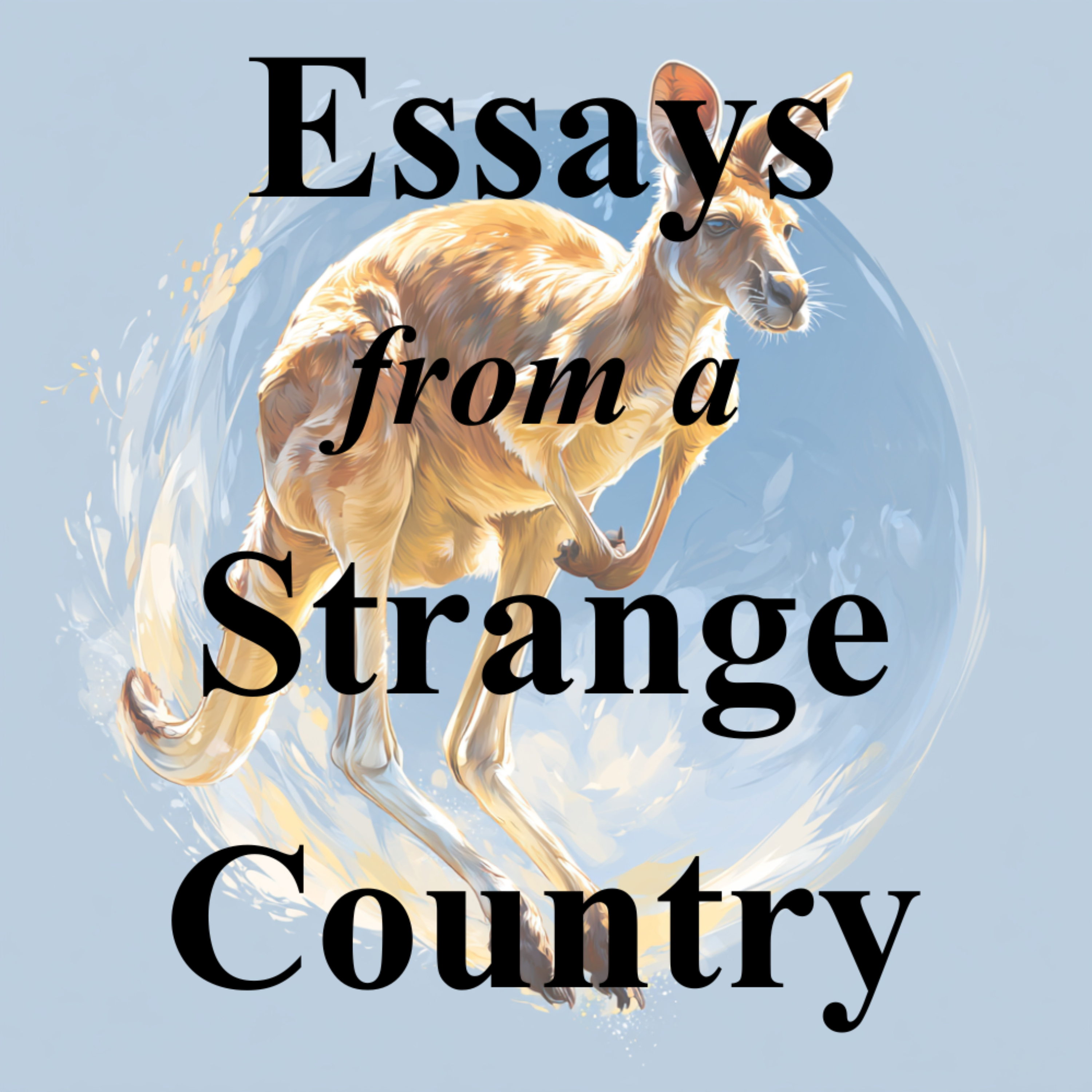
Essays From A Strange Country
by Jasmine Wolfe
Welcome to Essays from a Strange Country, a podcast about Australian identity. I’m your host Jasmine Wolfe. Each episode, through the lens of what our culture has produced, such as an Australian film, literature, art, and music to ask how this country has imagined itself, and who has been conveniently left out of the portrait. This is not a search for one neat national identity. Mercifully, no such thing exists. Instead, we’ll read the mess: the stories, images, songs, and screen myths that make Australia feel familiar, strange, beautiful, brutal, and faintly ridiculous.
-
3
End of Season Hello and Goodbye, for now
I am taking two weeks hiatus, and will see you again soon.
-
2
Last Gothic Thoughts on Australia's Character
Australian identity has rarely been a simple inheritance. It has more often been a cultural manufacture: a story told with unusual confidence because its foundations are unusually uncertain. From the penal era through Federation, the need to distinguish the settler society from Britain produced a national mythology centred on the bushman: white, male, laconic, physically hardy, loyal to his mates, hostile to authority, and supposedly innocent of class pretension. This figure offered a convenient answer to the colonial problem of belonging. If Australia could not claim ancient European continuity, it could at least claim a new democratic type, forged by hardship and purified by distance from the old world.
-
1
Haunting and Displacement in Michelle Dr Kretser's "The Lost Dog"
Michelle de Kretser’s The Lost Dog is not merely a novel about disappearance, migration, and private unease. It is a cultural document that exposes a more persistent Australian condition: the difficulty of feeling at home in a place built upon acts of historical forgetting. The novel’s central anxieties—Tom Loxley’s lost dog, his shame before his Indian mother, Nelly Zhang’s art of destroyed originals, the spectral pressure of the bush—gather around a national problem that is both intimate and historical. Australia appears here not as a settled identity but as an unsettled arrangement: modern, ironic, efficient, and outward-facing, yet continually disturbed by what it has attempted to discard.
-
0
Unsettled Belonging: The Contemporary Australian Gothic Landscape
Contemporary Australian Gothic is most revealing when it stops treating terror as an exotic disturbance and recognises it as a condition of habitation. In a settler society, the home is never simply home: it is a legal arrangement, a story of possession, a marketable address, and a denial rehearsed until it begins to sound like common sense. The Gothic’s familiar grammar of haunting, secrecy and return therefore acquires a local sharpness. What comes back is not merely a buried crime but the unfinished structure that made ordinary life possible: dispossession, racial classification, migrant dislocation, gendered looking, and the national appetite for heroic self-description.
-
-1
Enduring the End of the World: Mudrooroo and the Unfinished History of Settlement
Australian cultural identity has often been composed around an ending that would not end. In Van Diemen’s Land, British colonisation drew authority from a rhetoric of extinction: the Palawa were imagined as a “dying race”, their disappearance rendered as melancholy inevitability rather than organised dispossession. This was not merely a bad prediction. It was a political convenience. If Aboriginal people were already vanishing, then invasion could be redescribed as settlement, theft as progress, and genocide as the sombre weather of history. The fiction of extinction allowed the colony to mourn what it was actively destroying.
-
-2
Stolen Spirit: The Gothic Reconstruction of Aboriginal Identity
Aboriginal Gothic begins as a refusal of a convenient inheritance. The European Gothic arrived in Australia with its familiar machinery of haunted houses, ancestral crimes, spectral returns and threatened innocence, but on this continent those conventions could not remain merely decorative. Transplanted onto stolen land, the Gothic’s old anxieties about inheritance, legitimacy and buried violence acquired a sharper historical charge. What had often functioned as a “silencing discourse” within colonial writing—casting Indigenous presence as primitive, uncanny, vanishing or monstrous—becomes, in Aboriginal Gothic, a means of writing back to Empire. The genre turns the settler’s own imaginative apparatus against him.
-
-3
Picnic At Hanging Rock: Literature, Landscape, and Cinema.
Picnic at Hanging Rock endures because it gives elegant form to a less elegant national disturbance: the suspicion that European settlement in Australia has never quite settled anything. Joan Lindsay’s novel, Peter Weir’s film, and later theatrical reworkings return obsessively to the same scene of colonial confidence undone: white schoolgirls, dressed for discipline and display, enter an ancient volcanic landscape and fail to come back. The mystery is usually treated as the work’s great seduction. Yet the more consequential mystery is cultural rather than narrative. Why has a fictional disappearance of white girls become one of Australia’s most durable myths, when the historical disappearance of Aboriginal children under state policy was, for so long, denied the same imaginative and civic attention?
-
-4
Haunted Country, Convenient Ghosts: Settler Vulnerability and Indigenous Absence in Australian Gothic
This essay argues that the Imperial Gothic lays a foundation for Australian culture by organising artistic representations of place around settler unease and white vulnerability. Its most durable mechanism is the "White Vanishing" trope, which transforms the colonial landscape into a scene of disappearance and mourning. In colonial art, this appears through the visual grammar of the lost child and the bush as entrapment. In literature and film, it becomes a national myth in which white absence stands in for origin, belonging, and victimhood. In music and contemporary Gothic forms, it persists as a melancholy aesthetic that allows white Australia to mourn itself with impressive stamina. Across these mediums, Imperial Gothic does not merely decorate Australian culture with fog, rocks, shadows, and ominous trees. It supplies a structure of feeling: one in which settlers become the haunted, the land becomes the threat, and Indigenous presence is made to vanish without ever quite disappearing.
-
-5
"A Convict's Tour to Hell" Frank the Poet | Poem Recital
A recital of the classic poem "A Convict's Tour to Hell," written by Frank the Poet in 1832. Australia.
-
-6
Frank the Poet: The Bardic Weapon of Penal Resistance
Francis MacNamara, famously known as Frank the Poet, was an Irish convict transported to Australia in 1832 whose intellectual defiance and improvised verse transformed the brutality of the penal system into a foundational Australian mythology. Despite enduring at least 14 floggings and over 650 lashes for his persistent refusal to submit to the "System," MacNamara weaponized his literacy and bardic training to produce works like A Convict’s Tour to Hell, which inverted the colonial moral order by consigning cruel administrators to torment while dignifying the oppressed
-
-7
The "Dungeon of the World": Trauma, Landscape, and the Contradictions of Convict Gothic.
This essay reads Convict Gothic as one of Australian culture’s less flattering inheritance claims. It looks at the neat British rhetoric of reform and improvement, then sets it against the rather messier business of carceral violence. It argues that the penal system did not simply occupy the landscape; it made the landscape do some of the punishing. From there, it traces the afterlife of this logic through literature and contemporary cinema. What emerges is a national imaginary built, rather inconveniently, on confinement, brutality, and the kind of haunting that refuses to stay historical.Soundbites are clipped from the preview/trailer of the 1981 film "For The Term Of His Natural Life."
-
-8
Why Australian Stories Are Unlike Anything Else On Earth
Discover why Australian storytelling is gloriously unruly: ancient Aboriginal knowledge systems, Country as living protagonist, Gothic reversals of colonisation, and the national talent for laughing while bleeding. This essay cuts through myths, cringe, Hollywood noise, and polite amnesia to show a literature shaped by memory, land, law, and bruised irony.
-
-9
EfaSC Preview
A short introduction to the spirit of Essays from a Strange Country.
We're indexing this podcast's transcripts for the first time — this can take a minute or two. We'll show results as soon as they're ready.
No matches for "" in this podcast's transcripts.
No topics indexed yet for this podcast.
Loading reviews...
ABOUT THIS SHOW
Welcome to Essays from a Strange Country, a podcast about Australian identity. I’m your host Jasmine Wolfe. Each episode, through the lens of what our culture has produced, such as an Australian film, literature, art, and music to ask how this country has imagined itself, and who has been conveniently left out of the portrait. This is not a search for one neat national identity. Mercifully, no such thing exists. Instead, we’ll read the mess: the stories, images, songs, and screen myths that make Australia feel familiar, strange, beautiful, brutal, and faintly ridiculous.
HOSTED BY
Jasmine Wolfe
Loading similar podcasts...
Frequently Asked Questions
How many episodes does Essays From A Strange Country have?
Essays From A Strange Country currently has 13 episodes available on PodParley. New episodes are automatically indexed when they're published to the podcast feed.
What is Essays From A Strange Country about?
Welcome to Essays from a Strange Country, a podcast about Australian identity. I’m your host Jasmine Wolfe. Each episode, through the lens of what our culture has produced, such as an Australian film, literature, art, and music to ask how this country has imagined itself, and who has been...
How often does Essays From A Strange Country release new episodes?
Essays From A Strange Country has 13 episodes. Check the episode list to see recent publication dates and frequency.
Where can I listen to Essays From A Strange Country?
You can listen to Essays From A Strange Country on PodParley by clicking any episode. We provide an embedded audio player for direct listening, and you can also subscribe via your preferred podcast app using the RSS feed.
Who hosts Essays From A Strange Country?
Essays From A Strange Country is created and hosted by Jasmine Wolfe.
URL copied to clipboard!