
PODCAST · history
Europe and Liberal Democracy
by Eli Benovitz
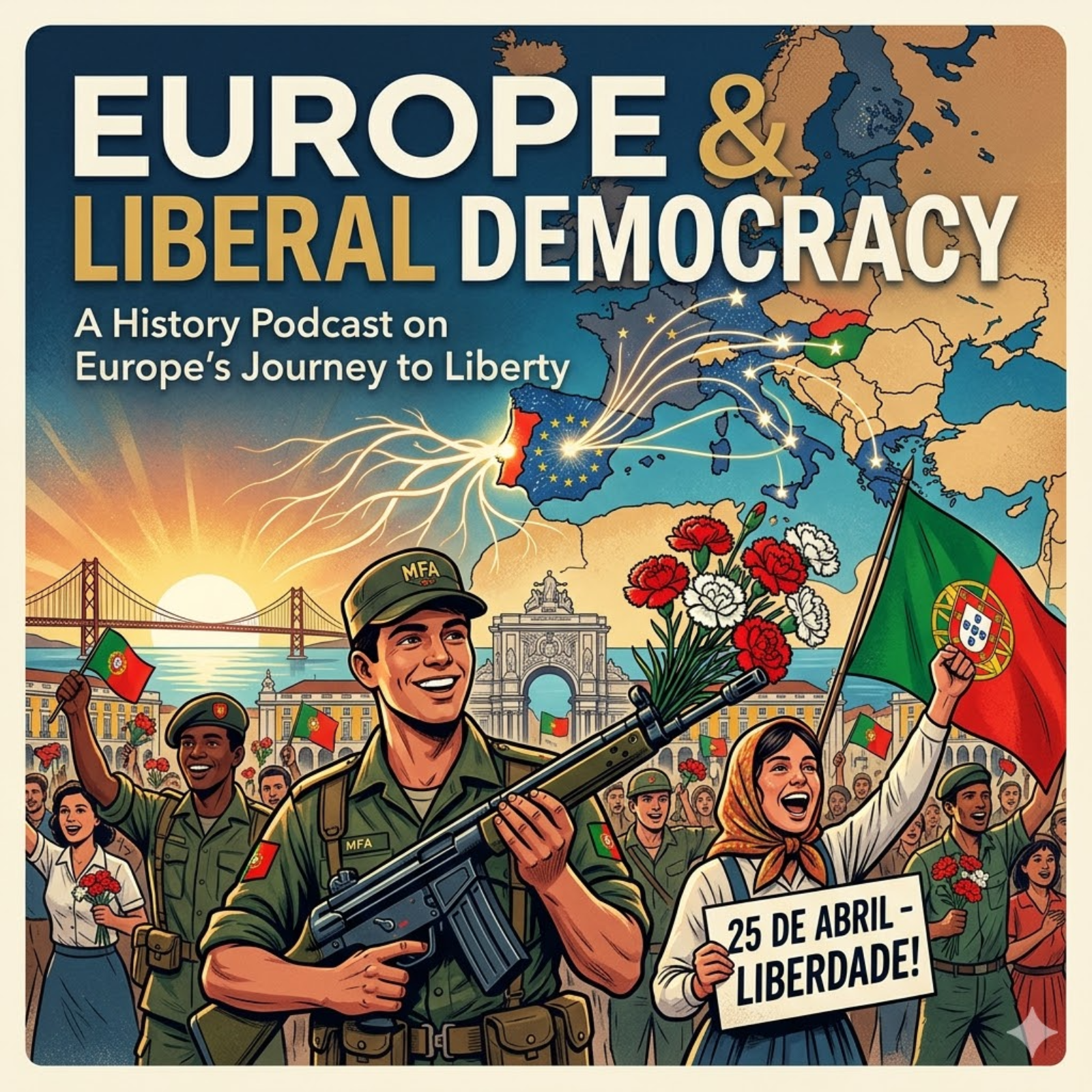
Europe and Liberal Democracy is a podcast that explores how Europe became the world biggest center of democracy in the post 1945 world. In our first season we look at the first time that the European Union and related organizations were able to bring and stabilize democracy, with Portugal's Carnation Revolution in 1974 and its aftermath.
-
3
Portugal and the Carnation Revolution Part 3
In this episode, the final one of our first season, I discuss democratic consolidation in Portugal between 1975 and 1976. Additionally, I talk about the defeat of the Communist Party. I finish up with a discussion of how Europe today is changed by the extraordinary involvement of the EEC in keeping Portugal democratic and how that remains important today.Bibliography:Constitute Project. "Portugal 1976 (rev. 2005) Constitution." Accessed May 26, 2026. https://www.constituteproject.org/constitution/Portugal_2005.European Council. "Conclusions of the European Council, Brussels, 16-17 July 1975." Archive of European Integration. July 1975. https://aei.pitt.edu/1427/1/brussels_july_1975.pdf.Story, Jonathan. "Portugal’s Revolution of Carnations: Patterns of Change and Continuity." International Affairs 52, no. 3 (July 1976): 417–33. https://doi.org/10.2307/2616554.The New York Times. "Aid to Portugal Expected." October 2, 1975. https://www.nytimes.com/1975/10/02/archives/aid-to-portugal-expected.html.The New York Times. "Portugal Quells Military Revolt." November 27, 1975. https://www.nytimes.com/1975/11/27/archives/portugal-quells-military-revolt-casualties-light-security-chief.html.
-
2
Portugal and the Carnation Revolution Part 2
In this episode, I begin by discussing the Carnation Revolution itself. Next, I discuss the political dysfunction that comes after the coup. Additionally, I talk about the issue of the colonies for the new Portuguese government, whose main goal was to end colonial wars. Through all of this I mention the huge influence Europe had on Portugal throughout this whole experience.Bibliography:Giniger, Henry. "Portugal’s Socialist Party Pulls out of Government." The New York Times, July 11, 1975. https://www.nytimes.com/1975/07/11/archives/portugals-socialist-party-pulls-out-of-government-portuguese.html.Maxwell, Kenneth. "The Consolidation of Political Democracy in Portugal: Some Unanswered Questions." Portuguese Studies 5 (1989): 161–77. https://www.jstor.org/stable/41104887.Rodrigues, Luís Nuno. "António de Spínola and the International Context of Portuguese Decolonization." Luso-Brazilian Review 50, no. 2 (2013): 93–117. https://doi.org/10.2307/43905285.The New York Times. "Portugal on the Brink?" August 9, 1975. https://www.nytimes.com/1975/08/09/archives/portugal-on-the-brink.html.The New York Times. "Portugal’s Army Seizes Control and Proclaims Democratic Goal; Caetano’s Surrender Announced." April 26, 1974. https://www.nytimes.com/1974/04/26/archives/protugals-army-seizes-control-and-proclaims-democratic-coal-at.html.
-
1
Portugal and the Carnation Revolution Part 1
In this episode, I set the stage for the beginning of the Carnation Revolution. I bring 3 main causes:Diplomatic Repression in Portugal under Salazar with the PIDEWar in the ColoniesFinancial Pressure from the European Economic CommunityI then talk about the leadup to the coup itselfBibliography:Fishman, Robert M. "What 25 April Was and Why It Mattered." Portuguese Studies 34, no. 1 (2018): 20. https://doi.org/10.5699/portstudies.34.1.0020.Gallagher, Tom. "Controlled Repression in Salazar's Portugal." Journal of Contemporary History 14, no. 3 (1979): 385–402. https://www.jstor.org/stable/260013.Story, Jonathan. "Portugal's Revolution of Carnations: Patterns of Change and Continuity." International Affairs 52, no. 3 (July 1976): 417–33. https://doi.org/10.2307/2616554.Wikipedia. "Estado Novo (Portugal)." Accessed May 25, 2026. https://en.wikipedia.org/wiki/Estado_Novo_(Portugal).
We're indexing this podcast's transcripts for the first time — this can take a minute or two. We'll show results as soon as they're ready.
No matches for "" in this podcast's transcripts.
No topics indexed yet for this podcast.
Loading reviews...
ABOUT THIS SHOW
Europe and Liberal Democracy is a podcast that explores how Europe became the world biggest center of democracy in the post 1945 world. In our first season we look at the first time that the European Union and related organizations were able to bring and stabilize democracy, with Portugal's Carnation Revolution in 1974 and its aftermath.
HOSTED BY
Eli Benovitz
CATEGORIES
Loading similar podcasts...
Frequently Asked Questions
How many episodes does Europe and Liberal Democracy have?
Europe and Liberal Democracy currently has 3 episodes available on PodParley. New episodes are automatically indexed when they're published to the podcast feed.
What is Europe and Liberal Democracy about?
Europe and Liberal Democracy is a podcast that explores how Europe became the world biggest center of democracy in the post 1945 world. In our first season we look at the first time that the European Union and related organizations were able to bring and stabilize democracy, with Portugal's...
How often does Europe and Liberal Democracy release new episodes?
Europe and Liberal Democracy has 3 episodes. Check the episode list to see recent publication dates and frequency.
Where can I listen to Europe and Liberal Democracy?
You can listen to Europe and Liberal Democracy on PodParley by clicking any episode. We provide an embedded audio player for direct listening, and you can also subscribe via your preferred podcast app using the RSS feed.
Who hosts Europe and Liberal Democracy?
Europe and Liberal Democracy is created and hosted by Eli Benovitz.
URL copied to clipboard!