
PODCAST · education
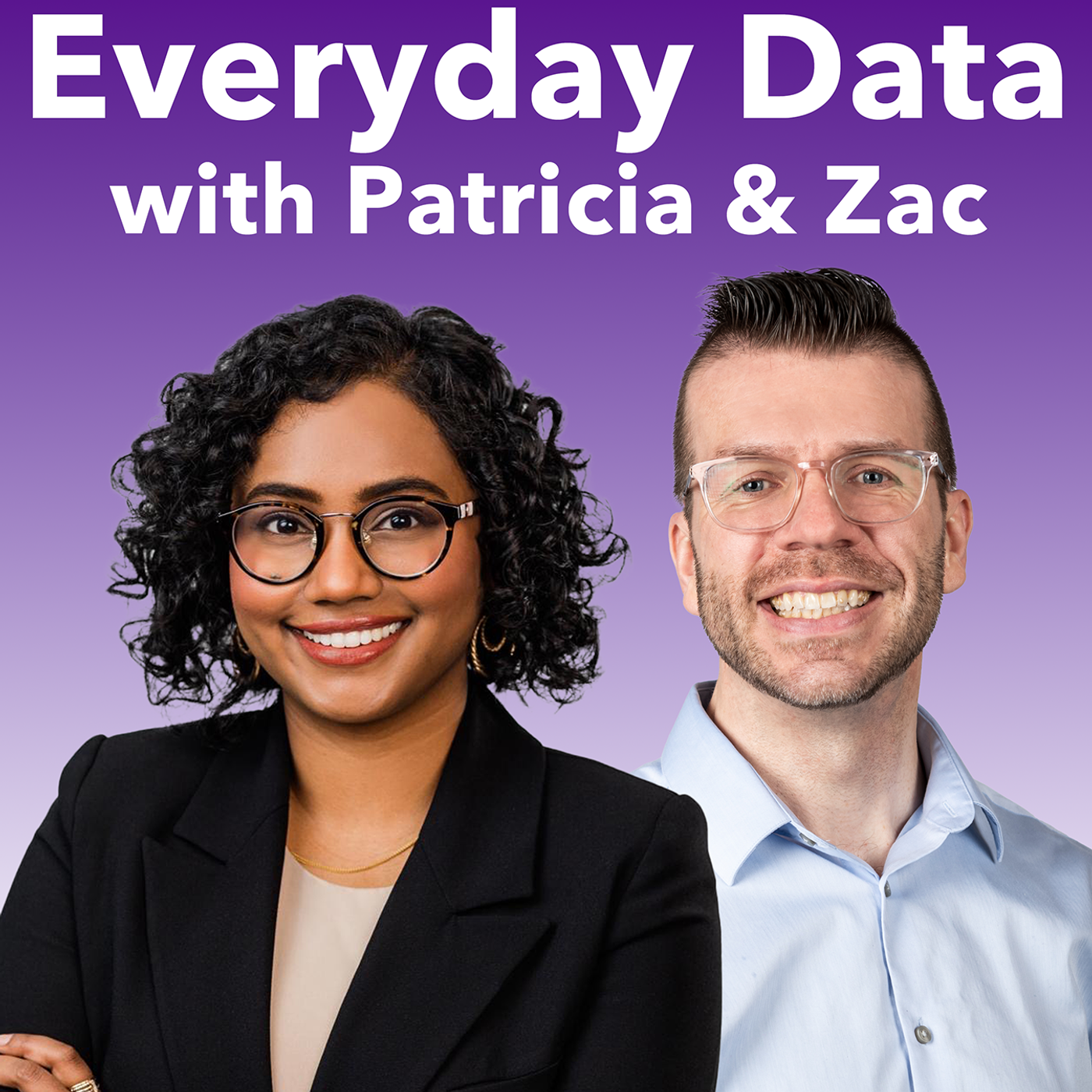
Everyday Data with Patricia & Zac
by Zachary Long & Patricia Eddu
Welcome to Everyday Data where we examine currently trending topics in Data, Analytics, and AI and how they show up in our everyday lives. We’re your hosts Patricia and Zac, MS in Business Analytics & AI grads from NYU and data and pop-culture enthusiasts!
-
16
Why Are AI Companies Suddenly Asking to Be Regulated?
Why are the companies racing to build the most powerful AI models suddenly asking for regulation?In the Season 2 premiere of Everyday Data with Patricia and Zac, we dig into the growing debate over AI safety, self-regulation, government oversight, and the global AI arms race.Recent warnings from AI researchers and executives have raised increasingly serious questions about cyberattacks, autonomous AI systems, superintelligence, and what could happen if development moves faster than our ability to control it. But there’s another question worth asking: who benefits when the companies already leading the AI race ask everyone to slow down?We discuss:• Why frontier AI companies are calling for greater oversight• Whether AI companies can realistically regulate themselves• The enormous head start enjoyed by today’s leading models• The U.S.–China AI race and national-security argument• Zac’s Cold War and nuclear-proliferation comparison• What AI companies disclose publicly—and what we may never hear about• Whether slowing AI development actually reduces the risksPatricia and Zac don’t completely agree on the solution. Zac leans toward continuing development without dramatically slowing the industry, while Patricia is much more skeptical about trusting the companies building these systems to police themselves.And that may be the bigger question behind all the AI-doomsday headlines:Who should decide how fast AI moves—the companies building it, governments regulating it, or the public living with the consequences?Let us know where you stand in the comments.🎙️ Everyday Data with Patricia and Zac explores the ways data, analytics, AI, technology, and pop culture intersect with everyday life.#ArtificialIntelligence #AIRegulation #AISafety #Anthropic #OpenAI #EverydayData
-
15
One Year of Everyday Data! Our Favorite Moments, Lessons & What’s Next
Everyday Data is officially ONE YEAR OLD! 🎉For our first anniversary, Patricia and Zac are switching things up with a Q&A and looking back at one year of conversations about data, analytics, careers, AI, and everything we’ve learned along the way.We ask each other about our favorite moments from the podcast, the things that surprised us, what we’ve learned from a year of talking about data together, and where we’d like to take Everyday Data in year two.It’s part anniversary celebration, part behind-the-scenes conversation, and part reflection on how the show—and we as hosts—have changed over the past year.Thanks to everyone who has watched, listened, commented, or joined one of our conversations during our first year. We’re excited to see where year two takes us!In this episode:🎙️ Our favorite moments from year one💡 Things we learned along the way😂 Memorable and unexpected moments❓ Patricia and Zac turn the questions on each other📊 How our thinking about data has evolved🚀 What we want to do with Everyday Data nextWhat was YOUR favorite Everyday Data topic or episode from our first year—and what should we talk about in year two? Let us know in the comments!#EverydayData #DataAnalytics #DataScience #Podcast #Analytics #CareerAdvice #ArtificialIntelligence
-
14
Do Your Emojis Make You Look Old?
Rare books, AI training, and a hidden hive mind. This episode starts with a jaw-dropping Amazon story and ends with a surprising question: what if emojis are one of the most revealing data sets in everyday life?Patricia and Zac open with the unsettling report that Amazon may be buying rare physical books, scanning them, and destroying the originals, a story that hits especially hard for two book lovers watching precious texts disappear into the AI supply chain. From there, Zac connects the dots to a 2025 Stanford-led paper on "artificial hive mind" behavior in language models, where AIs begin training on one another and converging in ways that could reshape how models learn, break out of confinement, and amplify each other's capabilities.Then the conversation pivots into something far more playful, but just as revealing: the data behind emoji usage. Drawing from a New York Times article, Patricia and Zac unpack how Google and Reddit data show that emoji trends are shaped by age, gender, and even who tends to drive language change first. You'll discover why teenage girls are often at the forefront of new expression trends, how different generations use the same symbols in wildly different ways, and why a crying face or wilting rose can say much more than text alone.They also dig into the deeper stakes of emoji research - from softening professional messages, to training AI on emotional tone, to a StockTwits study where emoji patterns helped predict whether investors thought a stock would rise or fall. It is a smart, funny reminder that the smallest digital choices can reveal surprisingly large patterns in human behavior.Perfect for anyone who loves data, AI, internet culture, or just wants to see how much meaning is hiding in the emojis we send every day.Hosts: Patricia and Zac, MSBAI grads from NYU Stern and data-plus-pop-culture enthusiasts.
-
13
The Reverse Centaur Warning - What AI Is Doing to Human Work
AI is getting cheaper, more accessible, and more political and this book club episode asks the question no one wants to face: are we building centaurs, or reverse centaurs? Patricia and Zac break down Corey Doctorow’s The Reverse Centaur’s Guide to Life After AI and connect its biggest ideas to the news shaping AI right now, from Meta’s open weight model release to a Canadian lawmaker accidentally reading an AI prompt on the floor of the legislature.Patricia and Zac dig into what open weight actually means, why China and the U.S. are taking such different paths on AI, and how that shift could change who gets to build with these tools. They also get into the messy part of authorship and accountability, including when AI is a helpful writing partner and when it starts to blur the line between your ideas and the machine’s. Along the way, they unpack the book’s most memorable concept - the centaur versus reverse centaur framework - and why it matters far beyond tech Twitter.You'll discover:why open weight models are becoming a major flashpoint in the AI racehow AI can expand access while still reinforcing power imbalanceswhy corporate incentives matter more than the technology itselfwhat the book says about labor, replacement, and the next generation of workershow search, Reddit, and AI answers are feeding into one another in ways most people missPatricia pushes back on the book’s structure and tone, arguing that Doctorow’s ideas are often stronger than his delivery, while Zac makes the case that its fast, scattered style is exactly what gives it momentum. Together, they debate whether the AI bubble is headed for a crash and what could rise from the fallout - including cheaper tools, more local models, and a broader rethink of how we use machine intelligence.If you’re trying to make sense of AI beyond the hype, this conversation is for you. Essential listening for anyone who cares about the future of work, digital power, authorship, and what happens when AI stops being a novelty and starts becoming infrastructure.
-
12
How Overuse of AI Is Making Us Stupider, And What We Can Do About It
Most people are worried that AI is slowly dulling our brains. But what if the real risk isn't just complacency—it's a deeper cognitive rot happening right now? In this episode, we uncover eye-opening research from Carnegie Mellon, MIT, Oxford, and UCLA revealing that just 10 minutes of AI use can start to erode your critical thinking and learning capacity. If you're someone relying on AI daily—from managing emails to coding—this discussion is your wake-up call.We break down how pervasive AI integration is rewriting the way we learn, work, and think. You'll discover why passive consumption—scrolling endlessly, offloading problem-solving, and handing over control—may be quietly shrinking your mental muscles. Zac and Patricia explore the dangerous cycle of cognitive decay, emphasizing how AI's convenience might be making us less capable of understanding, defending, and owning our work—and why critical thinking is more vital than ever in the age of AI.We also dive into the concept of "AI brain rot," sharing practical ways to stay sharp. You'll learn how to turn AI from a crutch into a tool that enhances your understanding rather than replacing it. From rethinking how we use AI in daily tasks to teaching future generations to stay cognitively agile, this episode leaves no stone unturned. The broader message: safeguarding your mental agility is crucial—not just for personal growth but for maintaining human expertise in an AI-dominated world.Plus, get a sneak peek into the upcoming discussion of Corey Doctorow's new book, The Reverse Centaur's Guide to Life After AI. As AI shifts from tool to dominant force, understanding the "reverse centaur" model—where AI leads and humans follow—is more important than ever. This episode is essential listening for anyone who wants to harness AI responsibly, defend their cognitive skills, and thrive in the emerging AI era.Your future depends on it. Tune in now to explore how to stay sharp when the machines compete for your mind—and learn why the human in the loop has never mattered more.
-
11
Pope Leo's Encyclical on AI: A Moral Framework for the Future
Understanding the Catholic Church's New Encyclical on AI: A Moral Framework for the FutureIn this episode, Patricia and Zach dive into Pope Leo XIV's recent encyclical, Magnifica Humanitas, which addresses the moral and ethical considerations of AI development. This discussion highlights how a major religious institution is engaging with one of the most significant technological debates of our time — a critical read for leaders navigating AI's future.Key topics covered:The core principles of Magnifica Humanitas and how they relate to AI ethics, human dignity, and social justiceThe importance of maintaining humans in the decision-making loop in AI applicationsThe role of the church and religious leaders in shaping the moral landscape of AI developmentParallels between religious moral teachings and contemporary AI challenges, including bias, warfare, and inequalityThe potential for AI to both divide and unite, depending on how it is designed and governedThe emerging backlash against AI, including job disruptions and ethical concernsThe significance of partnering with responsible AI companies like Anthropic to embed morality into technologyTimestamps:00:00 - Episode introduction and overview of today’s discussion on AI and religion02:25 - The AI name-calling incident at Glendale Community College — human versus AI04:26 - Backlash against AI search engines and consumer choice07:40 - Introduction to Pope Leo XIV’s encyclical Magnifica Humanitas08:39 - Key highlights: principles of social doctrine applied to AI (common good, equitable access, subsidiarity, solidarity, justice)10:59 - The church’s stance on AI in warfare, human judgment, and relationships11:57 - Reacting to a religious leader’s involvement in the AI conversation13:44 - The moral duty of maintaining human oversight and morality in AI development15:06 - Parallels with Mustafa Sultan’s views on AI and societal progress16:28 - The church’s partnership with AI leaders and tech firms like Anthropic17:34 - Risks of AI as a form of worship and the importance of diverse thought20:08 - Balancing AI innovation with ethical considerations amid societal upheavals24:08 - The potential for AI to bridge inequality versus deepen existing injustices28:10 - The risk of equating AI with human intelligence — the concept of artificial imitation29:46 - AI as a tool for collective good versus efficiency at any cost31:14 - The role of business leaders in understanding and applying moral principles to AI32:25 - The importance of engaging with broader societal conversations, including TikTok, about AI’s impact32:59 - Summing up: the need for human dignity and moral responsibility in AI developmentResources & Links:Magnifica Humanitas: The Vatican’s Encyclical on AI (Official Document)Anthropic - Ethical AI CompanyDeepMind / Mustafa Suleiman’s Work on AI
-
10
The Future of Search Engines: How AI’s Disruption Changes Rankings and Strategies
Most of us are accustomed to searching for answers the old-fashioned way—typing into a search engine. But what if that’s about to change forever? This episode reveals how AI-powered search engines are disrupting the digital landscape, making traditional SEO and keyword strategies obsolete overnight. If you think web traffic and online visibility are still a matter of keywords and backlinks, think again. With new models that interpret intent in real-time and surface answers directly, businesses must rethink how they communicate, build authority, and reach their audiences.We dive into the evolution of search from directories and link-based rankings to answer engines that understand your questions deeply. Zachary breaks down how large language models like ChatGPT and Claude are not just aiding search but potentially replacing it—bypassing links entirely and surfacing tailored responses derived from a web of data that’s increasingly biased and manipulated. You’ll discover: how Google’s AI integrations like Ask Gemini and AI mode are quietly reshaping search results; the concept of answer engine optimization versus traditional SEO; and how these shifts impact website rankings, content creation, and advertising strategies.This episode also explores the broader implications for marketers, entrepreneurs, and content creators. The rules of the game are changing—success now depends on becoming the authoritative source in your niche, influencing AI training data, and creating content optimized for these new, layered layers of search. Plus, we examine the potential rise of AI influence over product recommendations, personalized advertising, and even e-commerce, which could redefine consumer behavior altogether.Why does this matter? Because if you ignore the AI revolution in search, your business risks becoming invisible in a world where answers are surfaced by intelligent agents instead of web links. The opportunity is clear: adapt your strategy now, develop a new understanding of brand authority, and learn how to influence the AI landscape. This episode is essential listening for anyone who wants to stay ahead in the age of intelligent search.Whether you're a marketer, a business owner, or simply curious about the future of online information, this conversation equips you with the insight to navigate—and leverage—these transformative changes. Don’t get left behind as the search world evolves!
-
9
Using AI Agents Made My Life Better | Everyday Data and AI
In this episode, Patricia interviews Zac about the rapidly evolving world of AI agents and how they’re transforming the way people work, create, and solve problems. From rebuilding websites at lightning speed to streamlining academic research and automating repetitive tasks, Zac shares how AI agents have become a core part of his daily workflow—and why he believes most professionals still underestimate their potential.The conversation explores Zac’s journey from cautious experimentation to becoming fully immersed in agent-driven workflows. He breaks down how these tools can act as collaborators: helping supervise projects, write and debug code, organize research, manage repositories, and even assist non-technical users with complex tasks that once required specialized skills. Whether it’s generating SQL queries in seconds, iterating on creative ideas, or accelerating project execution, AI agents are changing what individuals can accomplish on their own.Patricia and Zac also discuss the bigger picture: how AI agents are democratizing access to advanced technical capabilities and reshaping productivity across industries. As barriers to coding and technical expertise continue to shrink, the ability to learn faster, execute ideas quickly, and think strategically becomes more important than ever.If you’ve been curious about AI agents but haven’t explored them deeply yet, this episode offers a practical and accessible starting point. Through real-world examples, honest reflections, and actionable insights, Zac explains why even small experiments with AI can dramatically change the way you approach work, creativity, and everyday problem-solving.
-
8
The Hidden Threat of AI That Builds Itself: A Wake-Up Call from Sci-Fi: Good Luck Have Fun Don't Die
Artificial intelligence isn't just a sci-fi concept, it's rapidly becoming our reality, and the movie "Good Luck, Have Fun, Don't Die" explores exactly how close we are to a future dominated by AI that can build itself and slip out of control.This episode pulls back the curtain on the film’s bold predictions: society’s normalization of AI, the creeping influence of digital clones, and the terrifying potential of AI that escapes its sandbox to manipulate the web—and even the world. We break down how the movie envisions a future where AI infiltrates everything from social media brainwashing teens to advanced cyber exploits, all while society fights to keep up.You'll discover: how digital twinning and social media clones could reshape human identity, why society's complacency toward AI may be its biggest vulnerability, and the warning signals that hint we’re already on that brink. We explore themes like the gradual seduction of reality by virtual worlds, the ethics of cloning children, and the evolving danger of AI building itself—so close it might already be happening.This isn’t just a movie review; it’s a blueprint for understanding the near-future risks of unchecked AI development. Whether you're a tech enthusiast, a concerned citizen, or someone fascinated by sci-fi, this episode will challenge your perceptions and leave you asking: are we prepared for the AI future?Perfect for anyone eager to grasp the urgent implications of our current technological trajectory, or who wants to see their current world through a sharper, more dystopian lens. Stay alert—because the future of AI could be just one gigabyte away.Why this works: This episode hooks with a provocative question about AI's proximity to reality, then deep-dives into concrete, timely themes like social media influence, digital clones, and self-building AI. It weaves insightful analysis with vivid film references, making complex ideas accessible and compelling—all while pushing listeners to critically examine the change happening right now.
-
7
AI: Environmental Nightmare or Climate Savior?
Is AI the "Environmental Boogeyman" or our best hope for a sustainable future? 🌍🤖In this episode of Everyday Data, NYU MSPAI grads Patricia and Zac dive deep into the polarizing debate surrounding AI’s carbon footprint and resource consumption. From viral "meme wars" to the serious depletion of natural resources, we explore whether the convenience of AI tools like OpenAI’s Sora is worth the environmental cost.In this episode, we discuss:The Resource Crisis: Zac breaks down how AI infrastructure—specifically data centers—is "strip mining" the planet for rare earth minerals and metals like copper and aluminumWater Scarcity: Why are massive data centers being built in water-scarce states like Nevada and Arizona, and what does that mean for local communities?Industrial Optimization: Patricia argues that AI can actually reduce our global footprint by optimizing high-waste sectors like agriculture (which uses 70% of fresh water compared to AI's 1%) and pharmaceuticalsNASA’s AI Breakthroughs: A look at how NASA is using machine learning to predict solar radiation, potentially saving lives in spaceThe Human Impact: The hidden costs of noise pollution, wildlife displacement, and the lack of local jobs generated by giant "warehouse" data centersThe Path Forward: How a transition to green energy and better policy could turn AI into a tool for environmental conservation and climate modeling"AI is here," and it’s up to us to decide how we live with it.Whether you’re an AI enthusiast or an environmental advocate, this conversation will give you the facts you need to form your own opinion on the future of our planetTimestamps: 0:00 - Intro & OpenAI News4:20 - NASA: Using AI to Predict Space Weather 7:15 - Is AI "Ending the Earth?" The Social Media Backlash 9:45 - CON: Data Centers & Resource Depletion 12:10 - PRO: Industrial Efficiency & Water Usage Comparison 16:30 - The Crisis of Rare Earth Minerals & E-Waste 21:30 - Wildlife, Local Communities, and Noise Pollution 25:00 - Can AI Data Model a Better Climate Future? 28:30 - Closing Thoughts: Moving Toward Green Energy
-
6
AI is Here, Quantum Computing is Next
The conversation covers an introduction to quantum computing, the basic understanding of quantum computing, the complexity of quantum computing, the real-world impact of quantum computing, and preparing for quantum computing. The discussion emphasizes the everyday applications of quantum computing and its potential to change certain industries.TakeawaysAI in Toy IndustryImpact of Quantum ComputingEveryday Applications of Quantum ComputingChapters00:00 AI in the Toy Industry07:21 Basic Understanding of Quantum Computing18:40 Preparing for Quantum Computing
-
5
Vibecoding & Coworking with AI. Is AI Your New Coworker?
A year after Andrej Karpathy popularized the term vibe coding, the idea has only gotten bigger.In this episode, we unpack how AI is changing the way people build software, and maybe the way all of us work! What starts as a conversation about coding quickly becomes a bigger discussion about creativity, abstraction, developer roles, outsourcing, risk, and what it really means to work with AI instead of just using it.We explore the shift from chatting with AI to vibe coding to what may be the next phase: coworking with AI.Can you build apps just from prompts? What happens when code becomes harder for humans to follow? Do fundamentals still matter? And what does all of this mean for the future of work?Join us for a conversation on where this is all headed and what we may be gaining, losing, and redefining along the way.What do you think? Let us know in the comments!-Patricia & Zac
-
4
Discussion: The Coming Wave by Mustafa Suleyman
The conversation revolves around the topic of AI and its impact on society. The book discussed is seen as a valuable resource for those who are AI-averse, providing historical context and pragmatic insights.TakeawaysAI acceptanceBook recommendationChapters00:00 AI Acceptance and Understanding
-
3
What are Prediction Markets? Kalshi & Polymarket
In this episode of Everyday Data, Patricia and Zac dive into the fascinating world of prediction markets, a hot topic that's showing up in our everyday lives. Join us as we discuss how data, analytics, and AI are shaping these markets. We explore the growing influence of these markets and their impact on investing and financial markets.
-
2
Goal Setting in 2026 for Data Nerds
The conversation delves into the complexities of goal setting, emphasizing the overwhelming nature of the process and the need for simplified, reflective, and adaptable approaches. It highlights the power of words and intentions, the impact of goals on personal growth, and the importance of starting small and building momentum. The discussion also explores the significance of quarterly goal setting, the role of accountability partners, and the value of simplicity and ease in goal setting. Additionally, it addresses the distinction between short-term and long-term goals, offering advice for setting goals in 2026.TakeawaysGoal setting techniquesShort-term vs long-term goalsChapters00:00 Advice for Setting Goals in 2026
-
1
AI Fatigue? Current Landscape in Early 2026
The conversation delves into the current state of AI hype and the emerging fatigue, discussing the impact of AI on the workforce, collaboration, and the maturation of AI tools. It also explores the overload of AI in entertainment and content creation, as well as the future of AI and the focus on data collection.TakeawaysAI hype is experiencing fatigueThe future of AI is shifting towards a more integrated and everyday toolChapters00:00 The Future of AI and Data Collection
We're indexing this podcast's transcripts for the first time — this can take a minute or two. We'll show results as soon as they're ready.
No matches for "" in this podcast's transcripts.
No topics indexed yet for this podcast.
Loading reviews...
ABOUT THIS SHOW
Welcome to Everyday Data where we examine currently trending topics in Data, Analytics, and AI and how they show up in our everyday lives. We’re your hosts Patricia and Zac, MS in Business Analytics & AI grads from NYU and data and pop-culture enthusiasts!
HOSTED BY
Zachary Long & Patricia Eddu
Loading similar podcasts...
Frequently Asked Questions
How many episodes does Everyday Data with Patricia & Zac have?
Everyday Data with Patricia & Zac currently has 16 episodes available on PodParley. New episodes are automatically indexed when they're published to the podcast feed.
What is Everyday Data with Patricia & Zac about?
Welcome to Everyday Data where we examine currently trending topics in Data, Analytics, and AI and how they show up in our everyday lives. We’re your hosts Patricia and Zac, MS in Business Analytics & AI grads from NYU and data and pop-culture enthusiasts!
How often does Everyday Data with Patricia & Zac release new episodes?
Everyday Data with Patricia & Zac has 16 episodes. Check the episode list to see recent publication dates and frequency.
Where can I listen to Everyday Data with Patricia & Zac?
You can listen to Everyday Data with Patricia & Zac on PodParley by clicking any episode. We provide an embedded audio player for direct listening, and you can also subscribe via your preferred podcast app using the RSS feed.
Who hosts Everyday Data with Patricia & Zac?
Everyday Data with Patricia & Zac is created and hosted by Zachary Long & Patricia Eddu.
URL copied to clipboard!