
PODCAST · education
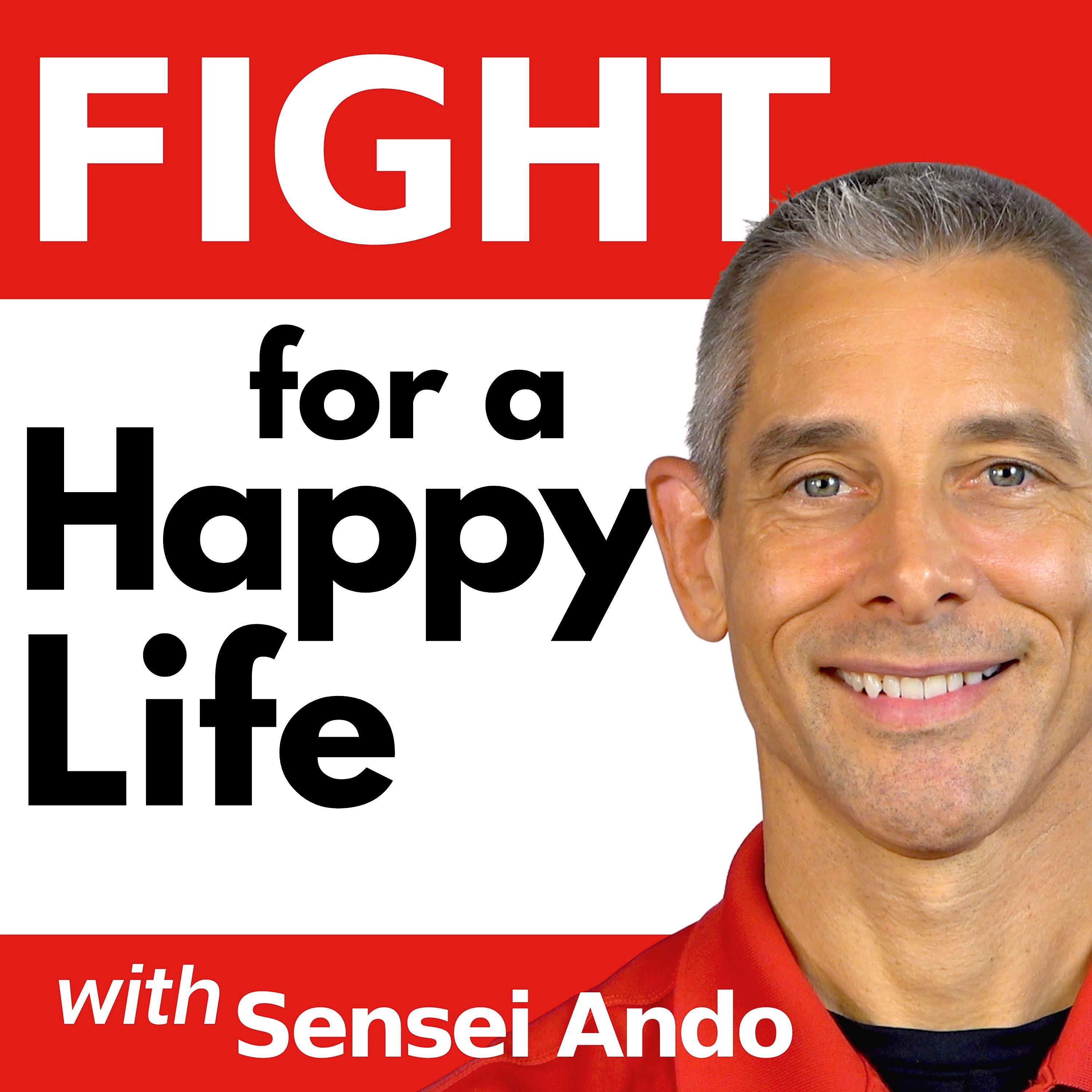
Fight for a Happy Life with Sensei Ando: Martial Arts for Everyday Life
by Ando Mierzwa: Martial Artist, Teacher
Martial arts are a powerful path to fitness of the mind, body, and spirit... yet most people never even try a class! Join Ando Mierzwa as he shares ways to apply the wisdom of Karate, Kung Fu, BJJ and other martial arts to everyday life. If you are pursuing success in health, relationships, or business, you will quickly discover how even a little martial arts makes life a whole lot better!
-
124
#130: 16 Years to Black Belt [Podcast]
Welcome to Episode #130 of the Fight for a Happy Life podcast, “16 Years to Black Belt.” That’s right. It took me 16 years to receive my black belt in Brazilian Jiu Jitsu. That’s a long time getting tapped, smashed, and crushed! Am I bitter about it taking so long? Not at all! That’s the... The post #130: 16 Years to Black Belt [Podcast] appeared first on Sensei Ando.
-
123
#123: How to Build Courage in Martial Arts [Video Podcast]
Welcome to Episode #123 of the Fight for a Happy Life podcast, “How to Build Courage in Martial Arts.” Many people worry that they won’t have the courage to fight back against a real-life attacker… and that includes martial arts students! It makes sense, really. You can build strong muscles and practice cool moves all day long, but when fear strikes, you might still find yourself curled up in a ball and frozen solid. Don’t let that happen to you! In this episode, I’ll share some tips to help you face your fears and build your courage… no matter what threats come your way. (Believe me—you’re not alone. I need these tips, too!) If you’d like even more advice on overcoming fear—particularly when sparring—check out this video: How to Reduce Fear in Sparring and Fighting. The good news is that you’re already brave… you’re already a fighter. Believe it! The big trick is simply not allowing anyone or anything to make you forget it. Okay—let’s get started! Let me know what you think! To LISTEN to “How to Build Courage in Martial Arts,” here’s the link. Play the audio podcast below… or download to your device. Subscribe on iTunes or Stitcher or Google Podcasts or Spotify. To WATCH the video version or READ the transcript, scroll down below. If you’d like to support this show, share the link with a friend or leave a quick review over on iTunes. Thank you! Oh—and don’t forget to sign up for free email updates so you can get new shows sent to your inbox the minute they’re released. Thanks for listening! Keep fighting for a happy life! How to Build Courage in Martial Arts Here’s a video of the podcast. If the player doesn’t work, you can click this direct link. As always, if you’d like to keep the conversation going, feel free to leave a comment here or through my Contact Page. TRANSCRIPT Hello, again! Ando here from Happy Life Martial Arts. Welcome to episode #123 of Fight for a Happy Life, the show that believes even a little martial arts makes life a whole lot better. Great to be back on video, I’ve missed you. I’ve been busy training, been busy teaching, but I’m here now. And, if I’m going to be honest, feeling a little old. Let me tell you why. In the mail, I got this lovely note. Yes, and what does it say? It says, Andrew, because they really know me. Andrew, make a plan that celebrates your life. And who is this from? Why, it’s a cremation service. Yes, I’ve finally reached the age where there are officially people waiting for me to die. They can’t wait to burn my corpse. So now I’m walking outside every day, looking up, seeing if today’s the day. Are there any vultures? How bad do I look? Have I lost weight? Anyway, I keep this on my desk. I didn’t throw it out because it reminds me that life is short and life is crazy. Live while you can, my friend. If you have to leave the episode right now, that’s what you needed to know. So live. What I’d like to talk about, if you’re still going to hang around though, is courage. It takes courage to live in this world, doesn’t it? It takes courage to go after your goals. And it will certainly take courage to defend your life or to defend your goals if someone tries to stop you. I bring this up because I get this comment either through video reactions or through email quite often. Someone will write, Dear Sensei Ando, I am afraid that I won’t be brave enough to fight back if I’m ever attacked. I’m afraid that I don’t have the courage to stand up for myself. Whoa. All right. Let me make this simple, okay? And then maybe if you want to cut the episode short and you want to take off, okay. To me, this question is just missing one thing, context. There are incidents every day where people with no martial arts training defend themselves successfully. Could be multiple attackers, could be a weapon involved, but people who did not see trouble coming finding a way to survive, finding a way to win. And it’s not just in the world of self-defense. There are people who have been wiped out one way or the other and rebuilt their lives. Whether it was addiction and drugs, whether it was bankruptcy and financial ruin, whether it’s disease, the pandemic, whether their town was bombed in a war or invaded. Throughout history, human beings find ways to pull themselves back together and move forward. And if they can do it, I believe I can do it. And if I can do it, I believe you can do it. So the context here is situations that put us in emergency mode. Code red. When necessity is strong enough, you will fight. When desperation is high enough, you will find a way to fight back. That’s what I believe. In those moments of extreme crisis, your strengths will be revealed. And I believe you will overcome fear. I think fear is something we can just imagine when there is no crisis. So of course, it seems like we’re going to be overwhelmed. But you’re not giving yourself enough credit, my friend. If you were attacked by a shark, I have no training for that. You probably have no training for that. But I’ll bet you’d fight. I’ll bet you’d fight hard. So tap into that. Believe in that. You have an emergency mode that, if things are truly, truly bad, you have resilience, you have toughness, you will fight your fight. I’m not guaranteeing you survive. I’m not guaranteeing you win. But I guarantee you’ll fight. So, moving on again, episode number three within one episode. The fact is most life is not emergency mode. This is where the problem comes in. So, if we’re not put in extreme crisis, how do I have the courage to go after what I want in life? How do I do it? There are so many things that we want to do, but we don’t have to do. And therefore, we end up floating, just floating in indecision and inaction. And we don’t get what we want. And we just float. And over time, that starts to build, I think, resentment and bitterness, self-loathing. I don’t think it’s a healthy path. So the question here today is, how do we build courage to take action in our normal life? Again, presuming that emergencies got that covered. But what about normal life? Let me give you my theory about courage. I think courage is rooted in safety, a feeling of safety. So, for example, this is a sliding scale, your courage and feelings of safety. Let’s say I say, hey, I knock on your door, come out here quick, you got to fight this guy. And you look over, and the guy is a hundred pounds less than you. No weapon. Imagine that feeling. Now, I knock on your door, pull you outside, say, hey, you got to go fight this guy. And this time, the guy is a hundred pounds bigger than you. Two hundred pounds bigger than you. And he’s got a knife. You probably don’t feel the same. The feeling of courage is going to be different because your feeling of safety in that situation is different. Same thing if you’re on the street, and you hear a call, like, I’m going to get you. I’m going to kill you. And you look over, and it’s just one thin guy by himself. Versus, we’re going to get you. And you look across the street, and there’s a gang of people with bats and guns. Now, what’s interesting here to me is that in any of these situations, you are always the same person, same history, same skills, same smarts, same everything. And yet, in a moment, you can be led to feel completely differently. You project your performance in what’s about to occur. And your prediction of failure or success immediately affects your entire organism and sets off different hormonal responses. So, as we move through our normal life, we’re assessing threats, we’re assessing possibilities, then we assess our capability to survive that situation or to succeed in that situation, and that immediately provides us a level of courage. So, I think that’s how this mechanism works. It’s all about the odds. If you think you’ve got great odds, then you’re going to be pretty courageous and take actions. If you think the odds are totally against you, you might freeze up and do nothing. And that’s why we have to be careful, since my main topic is usually self-defense. This type of dynamic will get you killed. Fear and doubt are never going to help your performance be its best. If you allow yourself to believe that you have no chance, if you believe you’re going to die, then you shrink, right? You shrink physically. I think you want to start curling up and hiding. You shrink psychologically. You start thinking, I can’t do this. I can’t figure it out. I can’t solve this problem. You add more tension. You get tunnel vision. You’re less aware. You don’t move as well. And you hesitate. All of those things are going to get you killed. So, the bottom line is, if, as you’re moving through life, normal life, if you believe you’re going to lose, if you believe you’re going to die, then you’ve just increased the odds that you’re going to lose or you’re going to die. But, if you believe you have a chance to win, a good chance, if you believe you have a chance, a good chance to live, then you’ve just increased the odds that you’re going to win or live. I think it’s that simple. I didn’t say easy, but simple. These things go together. Your courage and your projection of how safe you are in any given context. Now, let me immediately throw in a flag here on the topic of delusion. That is a common criticism that you’re going to find in the world of martial arts, right? Including myself. People put up videos sharing technical tips or ideas for self-defense. Different styles showing off their training methodologies. And immediately, you’re going to see comments under those videos saying, these guys are crazy. This is a cult. They’re engaging in fantasy. None of this stuff is going to work. Okay, fair enough. Everyone’s entitled to their opinion. But I have a question for you. Is it better to believe that you have a chance and then take action on that belief? Or is it better to not believe that you have a chance, that you’re not prepared for this situation, and not take action? I’m talking about self-defense. When you have no choice but to engage an attacker or a threat, you couldn’t talk your way out of it. You couldn’t run. In that moment, you have this choice. Would you rather believe that you can handle it and make a move? Or would you rather succumb to fear and doubt and freeze and shrink up? I think the answer is pretty obvious. I personally would rather be deluded and ensure my maximal performance than to doubt myself and freeze up and do nothing. So there is a place for delusion even, I think, in training. Now, don’t take that out of context. Don’t take this the wrong way. I’m not saying you should train for delusion or you should seek delusion. Of course not. That’s not my first choice in my training. If you’re training, the goal should be true confidence. A true set of skills. That you are training your body and your mind and your heart, your spirit, to handle situations. So that’s not just confidence that comes from good, honest training, that comes with feedback. It comes also with making peace with the universe or your God. You believe you have a mission, you believe that your causes are righteous, that you fight for good reasons. This requires having your morality put together. You know what you’ll fight for, you know what you won’t fight for. So if you are pushed to fight, you know it’s for a good cause. You believe in it. It requires that you’ve managed your ego. You’ve had enough losses in your training, and you’ve had enough victories, and you’ve had enough injuries or setbacks, that you can face all of it. You’re not afraid of any of those things, because you’ve experienced them over and over again. So you’ve learned in short to do your best, put up your best performance, no matter what the threat is, even if it’s completely overwhelming. So these are the choices that we are given, that we’re allowed in life. As we move forward, you have these choices… First choice, be afraid. Be frozen. Do nothing. Hope for the best. Lay and pray. Next level up, yeah, I’m going to upgrade to delusion. Believe that you can handle situations. Believe you’ve got those skills, because at least your physical response, your psychological response, will make you relaxed enough, aware enough, creative enough, and confident enough to make that first move and at least try something. But that is still a far cry from the number one goal, which should be training for true confidence. Training to try no matter what. Training to go down swinging. It’s not about winning or losing. You just are programmed to try, to fight. Win or lose, live or die. Now, if it’s true that courage requires safety nets, then the question is how do we build them? How do we construct these safety nets? I’m glad you asked. I have five quick tips that might help… Tip number one, seek challenges. Create emergency mode situations in your life. I’m not talking about being reckless here. I’m talking about seeking challenges that will push you out of your comfort zone to force you to reveal not just your strengths, but also your fears. Like I said, there’s always goals in our heads that we don’t pursue. So set a goal for yourself, a goal maybe that you’ve been thinking about for years. And now, what is the but? I want to do this, but what? I would like you to figure out exactly what you’re afraid of. If we can’t identify the fear, we can’t face it. So whatever it is, you’re afraid of losing money, you’re afraid of ruining your reputation, you’re afraid of failing again, pursuing a particular goal which is just going to confirm that it’s not meant for you and you’re going to feel like a loser. Whatever that fear is, name it so you can face it. Tip number two, protect yourself. Now let’s start finding out a way to face that fear and build that safety net. Let me give you an example. It’s a little embarrassing, but when I was a kid, I played little league, played for several years, pretty good at it, all star, until puberty. Over one summer, it seemed like every other dude my age hit puberty, and I didn’t. So when we came back for the next season, everyone was taller, bigger, and had stubble. I do believe some of them had aftershave on. I didn’t even know what that was. Now, the problem there was, when I got into the batter’s box and I’m staring down some pitches, those balls were flying past me beyond anything I’d ever seen before. And unfortunately, a couple years earlier, I had a friend who I saw right next to me get hit in the face with a baseball, and both of her front teeth got knocked out, fell right on the ground at our feet. So I have this image of being hit in the face with a baseball and losing my teeth. And now that everyone’s bigger, stronger, faster than I am, every time I went up to that plate, all I could imagine was getting hit in the face with that ball and losing my teeth. So I quit. I quit. I quit baseball. Now, not a great loss for the sports world, but it hurt me because I knew I had quit out of fear. How could I have protected myself? Sure. I mean, I guess we didn’t have enough money. If they had a helmet with one of those masks in the front, the iron gate on the front of my teeth, I would have kept playing baseball. I may have been terrible, but at least I wouldn’t have quit out of fear. It would have been other incompetence athletically. But I didn’t. I didn’t have that equipment, so I left. Years later, side note, I was dragging around that shame, and I did go to a batting cage, crank up that pitching machine as fast as I could, and stood there until I could stare down those balls and start making contact with some of them, so I feel like I redeemed myself. But the bigger point here is, how can you face your fear? If you already named it, now what do you have to do? Is it a piece of equipment? Is it consulting a lawyer? Is it doing some research? Is it saving up a little nest egg and having a little backup money? Is it taking on a partner? Someone who can take that journey with you and accomplish the goal with you? There are many different ways to approach a problem or to achieve a goal. So get creative and figure out what kind of helmet you need to build to get through that next step. Martial arts example again, if you were like I was and primarily a stand up martial artist when the UFC started and you saw people being taken to the ground, pinned and unable to get up, well that was frightening. I could name that fear right away. I don’t want to get pinned on the ground and choked. So what did I do? I faced a smaller fear, sign up for a BJJ class and start learning how to grapple. So again, figure it out. Name your fear and then build your plan to protect yourself. Tip number three, attack. Let’s talk about martial arts again, sparring, fighting, wrestling. You don’t know what your attacker or partner, opponent is going to do. You don’t know what move they’re going to do and you don’t know when they’re going to do it, which creates anxiety. This feeds fear, the unknown. What’s going to happen? I don’t know. When’s it going to happen? I don’t know. So attack. Win or lose, do it on your timetable. When’s this going to happen? Right now, I’m attacking. What’s going to happen? This is going to happen. I’m going to lead the dance. I’m not going to wait around to see your best move when you’re ready for it. I’m going to force the issue, put pressure on you, and perhaps cause you to do something predictable. If I throw something up at your face in an attack, there’s a good chance you’re going to raise at least one hand to try to stop that. So now you become a little more predictable. Crazy, chaotic life becomes a little more controllable, which makes me feel safer. So I find because life is so crazy, who knows what’s going on with the economy, culture shifts, diseases, relationships, betrayals, new friends. So much is out of our control, can’t be predicted. So don’t wait around and hope that the wind is going to blow your way, that trends are going to go your way. Just get out there and start making moves. Attack. Get clear on what you want, get clear on what you want, and then get moving. Tip number four. This one might be a little odd at first, but hang with me. Make some noise. I have another video where I talk about trigger words. And I don’t mean it in the way of being hurt and victimized by something someone says. I mean talking to yourself as like a trigger to fire, to take an action. Maybe when you’re under stress and you’re freezing up and your mind is spinning, you need to focus by just training yourself to maybe say go, go, go or fight, fight, fight. Create a mantra for yourself. Create a code word for yourself that says, all right, I recognize that I’m slipping. I’m starting to have a performance that’s going to be subpar. So here we go… Here’s my keyword, my trigger word to get me back in action, to back on the attack. It may just be as simple as taking a breath and exhaling. One big breath might do it for you. It might be more guttural, more primal. You may want to grunt, caveman style. I’m all for that. Yes, even if you’re in the middle of a business meeting and you know you have to get up and contradict the boss or whatever it is, if you have to go, cough, whatever you have to do, make some noise. I mean, think about the concept of kiai. Kiai in karate. A spirit shout. You are building up the spirit with your voice, with your breath, to engage the rest of your body, to start some movement. Think about battle cries in general. We are not the first generation to face stress. I would say back in the day, if you had a spear and a shield and a small village and you are being attacked by the neighboring village or some army, you are outnumbered, your family is behind you, your home is behind you, and all you have is this spear or an axe and you have to go running into that battlefield to fight, into this field of butchery. People have done this, you know, millions. So what do they do? They bang on drums and they scream and they bring up that spirit to go fight. So in whatever way you find appropriate, I would say, find a word, find a sound, find a mantra, shout it out, do what you got to do to get some noise out of your body. Don’t let the fear freeze you. Free up your heart, free up your muscles by making some noise. Tip number five, practice. You know, martial arts, I’ve watched a lot of videos, I’ve listened to a lot of teachers, been to seminars, talked to a lot of people. And almost all of the conversation, all of the content is physical. It’s technique talk, it’s style versus style talk, it’s mechanical. There’s a much smaller percentage of that material that addresses psychology and emotions. And look, I know a lot of people who have put in the time physically, but if you go slap them in the face, it’s likely they’re going to freeze up and fall apart, as if they have no training. But that’s only because they’ve been focused on the mechanics and the muscle, and not on their mind and their heart. So I would say it’s very important to practice your psychology of fighting. Practice the emotions, practice your courage. And it can be as simple as just closing your eyes or sitting down somewhere, and use your imagination. Play the what-if game. Imagine the most terrifying situations you can. Shark attack is a good one. Imagine whenever you want being pulled out of your car at a red light in a mob scene, gone crazy. And just see it, visualize it. I think even with imagination, you’ll feel your heart race a little bit, you might feel a little clammy. You can trick yourself into actually starting to get a little nervous. And in those moments, practice your trigger word. Practice taking control of your breath. Visualize how you’re going to stand. What expression is on your face. How you want to move. What you’re going to say. It can be as extreme, of course, as an actual battlefield. Or maybe you’re preparing for a job interview that’s got you nervous. And you want to just bring up a little courage. Great, then just imagine it. Imagine walking in. Imagine how you’re going to sit. Rehearse it. Maybe now take your imagination and in a safe space, like a dojo or your living room or in the shower when no one’s around. Whatever you have to do, rehearse the movement. We have kata and forms and drills for the physical parts of our martial arts, the physical parts of fighting, and we do those ad nauseum over and over and over. But where are your reps for emotional strength? Where are the reps for building courage? It’s, I would say, not just as important, I’d say it’s more important. Because if you freeze up psychologically, if you have no spirit, doesn’t matter how big your muscles are or how many times you’ve practiced those techniques. So, rehearse, get the reps in with your mind and your heart. Alright, let’s wrap this up. Don’t forget, the first point is probably the most important. In extreme crisis, there is an emergency mode that I believe you will find yourself in. It will click over and you’ll be ready to fight. But we don’t have to wait for code red to be at our best. As these fine people at the cremation service have reminded me, life is short. Therefore, consider life to be an emergency. We’re always in code red. Every moment could be your last. If you treat life like an emergency, if you accept that it’s just a matter of time before you are dropped in a box or you are slid into a furnace, I think you’ll find the motivation to get out there and do your thing. And do it now. Attack life before it attacks you. Alright, enough said. The clock is ticking, my friend. Get out there and make your moves before the Grim Reaper makes his move on you. Until next time, smiles up, my friend. Let that smile be your shield and your sword. Keep fighting for a happy life. The post #123: How to Build Courage in Martial Arts [Video Podcast] appeared first on Sensei Ando.
-
122
#122: Yin or Yang: A Tale of Two Black Belts [Video + Podcast]
Welcome to Episode #122 of the Fight for a Happy Life podcast, “Yin or Yang: A Tale of Two Black Belts.” There are many paths to choose from in the martial arts… but how do you know if you’re on the right one? Wait—there’s actually an even bigger question to think about— Should you be following in someone’s else’s path at all? Don’t get me wrong—I’ve been blessed to train under several amazing teachers over the years, but the fact is they all believed in different things! One says do this, one says do that. As a student, it’s been confusing (and frustrating!) to seek advice from teachers I respect, only to receive concepts and tactics that completely contradict one another. I’ll bet that’s happened to you, too! So, in this episode, let’s see if there’s a greater wisdom hiding behind all of that well-meaning, but conflicting advice. Is it possible we’re not supposed to choose between Yin or Yang? Is it possible to walk a path that reconciles both? Check it out and let me know what you think! To LISTEN to “Yin or Yang: A Tale of Two Black Belts,” here’s a link. Play the audio podcast below… or download to your device. Subscribe on iTunes or Stitcher or Google Podcasts or Spotify. To WATCH the video version or READ the transcript, scroll down below. If you’d like to support this show, share the link with a friend or leave a quick review over on iTunes. Thank you! Oh—and don’t forget to sign up for free email updates so you can get new shows sent to your inbox the minute they’re released. Thanks for listening! Keep fighting for a happy life! Yin or Yang: A Tale of Two Black Belts Here’s a video of the podcast. If the player doesn’t work, you can click this direct link. As always, if you’d like to keep the conversation going, feel free to leave a comment here or through my Contact Page. TRANSCRIPT Howdy, Ando here from Happy Life Martial Arts. Welcome to episode #122 of Fight for a Happy Life, the show that believes even a little martial arts makes life a whole lot better. Now, last time, episode number 121, the theme was confidence. Self-defense is rooted in self-confidence, that was my claim. But where does confidence come from? The answer, I say, it should come from you. It shouldn’t come from a teacher. It shouldn’t come from a panel who votes for you. It shouldn’t come from a certificate. It should come from within. So today, I want to stick to that theme and give you another example of how I’ve come to this way of thinking. A Tale of Two Black Belts. Let me introduce you to two teachers that I have worked with. They don’t know each other. And I’m not going to share their names because, well, they didn’t ask to be dragged into this. So let me tell you about these two teachers. I think you’ll be amazed at how many similarities they share. I’m always amazed by it. First of all, both of these teachers are male. Okay, they’re both smaller gentlemen. They would never be the biggest person in the class. So let’s say they’re both around five foot six. Let’s say they’re always around 130, 135 pounds. No more. They’re also both about my age, so over 50. So right off the bat, that’s a lot of similarities. They’re also both good guys. They’re also both intelligent people. They are also both blessed with a good sense of humor. They’re also lifers. They’ve been training in the martial arts of one kind or another their entire lives. They’re also both grinders. They’re not lazy about it. They’re in great shape. They work at it. They’re compulsive about it. They also are teachers of Brazilian Jiu-Jitsu, but that’s not all. They also have instructor level status in multiple arts. They know how to hit and they know how to submit. Now, they’re also both professionals. I should say that they’re full timers. This isn’t something they used to do in their 20s or 30s. They’re still at it. So that’s a huge list of similarities. For two guys who have never met, never crossed paths, every time I work with either one of them, I’m always reminded of the other. The biggest difference between them, yes, there’s a difference, which always strikes me as odd, is that they don’t fight the same at all. And that always blows my mind. Because I keep thinking, man, you’re just like this other teacher I know, in every way except the reason that I seek you out. The way you fight. How can that be? They face the same problems, how to fight and defend themselves against people who are bigger and stronger. They have about the same tools. They have the same experiences. They’ve been on the mats about the same number of hours, let’s say. And yet, they’ve come to completely different solutions. And that blows my mind. So at the risk of oversimplifying, let me sum up how they fight in this way. One is Yin and one is Yang. Yin and Yang. One of them believes in attacking first, taking charge. They believe in getting in your face, coming in hard, creating impact. And I can tell you, when you roll or you spar with them, you know you’re in a fight. Right from the beginning, you know it, you can feel it. The other one, no. The other one believes in counterattacking. They believe in yielding and flowing. They believe in turning things around. When you spar or you roll with them, you don’t really know you’re in trouble until it’s too late. They’ve been setting a trap for you the whole time. Completely different. Now, don’t get me wrong, they’re both well-rounded martial artists, but for sure, if you spar to work with either one of them, I think you’d come to the same conclusions that I have. Now, I find that really frustrating because if I seek them out as teachers, they’re giving opposite advice, right? I seek smaller teachers. I like working with smaller teachers because to me, that means they must by trial by fire, they have figured out how to deal with larger, stronger attackers, which is the dream, I think, of every martial artist. You want to be outgunned, but still figure out how to survive. So when I go to either one of them looking for the tricks, the secrets of the martial arts, and to find out that they have different sets of answers, it bothers me. Because that means the answers have to come back from me. I can’t just take one of their bag of tricks and use it for myself. Because there’s another teacher that I respect that has the complete opposite opinion. Frustrating. And of course, I’m reducing my entire martial arts career into just these two teachers, but this is true for every teacher I’ve worked with pretty much. Sure there’s things that they have in common, there are some principles that overlap, but overall, my teachers all disagree with one another. They don’t know each other. They’re all great at what they do, but they give me different advice. One teacher absolutely believes in forms, in kata. That is the lifeblood of their practice. Other teachers that I respect have zero use for kata, think it’s a waste of time. Why would you ever do that? Some of the teachers that I respect, not into sparring, don’t like it. Other teachers I respect, absolutely, there’s going to be sparring every time you get with them. One might be into weights, other teachers not so much, body conditioning. One’s into meditation, visualization, a lot of mental work. Others, no, waste of time, keep moving, use it or lose it. Some teachers believe in teaching techniques first, and over time you decode the principles behind them. Other teachers say, no, I don’t teach techniques, I will only teach you principles and you’ll have to create your own techniques out of that. What is going on? How can this be? How can you have such completely opposite opinions and yet still all be really good at what you do? This reminded me of my experience taking philosophy in college. When I took philosophy in college, I may have talked about this before, at first I was thrilled because the first generation of lessons that I got, the first philosophers that I read, it sounded like they had figured out all the answers to life. So I thought, yay, this is fantastic, I’ve got the answers. Now I know how to live a good life. Until you read the rebuttals, the next generation of philosophers who came around and said, don’t listen to those guys, here’s an opposite opinion, here’s something completely different. And I thought, oh yeah, you’re right, they were wrong, you guys are right. And then the next generation of philosophers, and they say, whoa, no, no, don’t listen to either one of those guys, here’s a hybrid of both information sets. I’m like, what? So at some point, it was the same frustration. One teacher that I respected, being trumped by another teacher I respect, being trumped by another teacher that I respect, until once again, it was put back on me. This is what I ultimately learned way back in college, and now over and over again in the martial arts. The frustration that you feel when you’re not sure who to listen to should ultimately lead you to freedom. Frustration should lead to freedom, because you realize you’re free to find your own path. Since no one agrees on the one right way to do something, that means your way is just as good as theirs. Your experience is just as valid as theirs, as long as you came by it honestly. So again, all of these great teachers have some things in common. They are all dedicated. They all have a strong work ethic. They all believe in testing what they’re doing. So I trust all of their information, and each of those teachers, more often than not, now that I’m just reviewing that in my head, they found confidence in themselves in their own way to the point where they don’t really go out looking anymore. They just do what they do, and they do it well, which is its own skill. That was the point really of not just the last episode, but many episodes of this show, that confidence in what you’re doing, finding your way, your art, your version of martial arts. That is its own skill. That’s the confidence that you need to be effective. Now I’m bringing this up to you in case you’ve only ever had one teacher or you only trust one teacher. Maybe you’re early in your career or maybe you just stuck with a great teacher right from the beginning and you’re still with them many years later. It’s very easy in that situation to believe that your teacher’s way is the only way. And that’s where I would just throw up a flag of caution. As I said, I’ve worked with many teachers who share very different opinions. And today I’m just boiling it down to two specific teachers who you would think would have the same experiences and have reached the same conclusions. But no, it’s Yin and Yang. Which then becomes confusing because if you, if you’ve only had one teacher and your teacher was Yin, they would tell you, hey, listen to me, as a smaller guy, I can tell you this is how you fight. But if you ran into the other teacher and that’s where you were training, they would say, hey, listen to me, as a smaller guy, I can tell you this is how you fight. And they’re both right. They both make it work. But it may not fit your personal set of tools or your personality. So at some point, you have to make it your own. And again, it’s confusing. I’m even confusing myself a little here because if you watch both of these teachers, Yin and Yang, and you watch them grapple, let’s say, you will see both of them get to the same techniques. They’ll both get a rear naked choke. They will both get the exact same arm bar. But how they got there was completely different. That’s what I’m talking about. The art of fighting. There’s only so many ways you can punch someone and knock them out or kick them or choke them or break something. So, the end is the same, but the journey was very different for how they got there. Which brings us to the idea of Bruce Lee, right? Doesn’t it always? When he talks about honestly expressing yourself, what’s he talking about? It’s not just making up moves because again, I think there’s a fixed number of moves. You’re going to end up choking, punching, kicking, breaking, throwing. So, not much difference there. The honestly expressing yourself doesn’t come in necessarily in which moves you’ve selected, but in how you executed them. Are you just copying someone you saw in a video? Are you just copying your teacher? That’s where things get tricky. That’s where you’re not an artist. If you’re copying, you are not your own person. And that, I think, is the ultimate challenge. That’s what we need to do. We have to figure out what really works for us, how to make it work for us. That’s when you become a true, full martial artist. The less you copy and the more you can choose and develop for yourself, the more powerful you will be. So where do you fall? Where do you fall on the spectrum? Let’s say Yin and Yang, a little reflection for you. Are you a believer in attacking? Are you a believer in counter-attacking? Do you believe in mixing it up? What would be your percentage then, if you analyzed your own sparring or rolling? What percentage of the time are you attacking? What percentage of the time are you setting traps to counter-attack? Do you have a preference? Do you feel better when you’re on the attack? Or do you feel more clever when you’re letting them fall into traps? It might be a tricky question, because you’re so into your own head in your own games, you might need an outside opinion. So I would ask some of your training partners, or your teacher if you haven’t had that kind of talk, to analyze you and say, do I come off to you as Yin or Yang? Am I in your face or am I yielding and letting you come to me? You might be surprised at what they say about you. Because I can tell you, it’s funny for me, I’ve worked with Yin and I’ve worked with Yang. And again, they don’t know each other. When I’m working with Yang, let’s call him, when I’m working with Yang, he will tell me you need more Yang, you’re too Yin. But when I’m working with Yin, he’ll tell me you need more Yin, you’re too Yang. Again, that’s where the frustration comes in. Because if I’m trying to copy either one of them, I’m failing in their eyes. If I allow their judgment of my work be my only guiding light, then I’m going to be at odds with my true goal of just being me and doing what I think works best. So understand that even your teacher will have a bias to what they believe works and what works for them. They’re not trying to harm you. A great teacher, of course, will allow you the freedom to find your own way within whatever they have offered you. But some teachers may not even realize that they have a bias, which is why sometimes when you go into a martial arts school, you’ll see that there’s a culture that is trickled down from the teacher. If the teacher is a very hard-nosed, aggressive person, you’ll feel that through a lot of the students there. And in the same way, if you have a school that’s headed by someone who’s very soft and very yielding and flowing, you’ll find that they’ve attracted that type of student and that’s how they perform generally. But ultimately, you’ve got to be aware of what kind of culture you’re in, figure out how much that fits with your own personal wants and needs, and make some decisions. And if that means you’re at odds sometimes with the culture of your school, so be it. If that means you have to go seek another school that fits your culture, fits your mindset, so be it. Just don’t forget the same lesson from last episode. Ultimately, it’s about what works for you. What satisfies you? Try everything. Be fair. That’s why I seek out different teachers. Because I’ve realized how much I benefit from seeing different perspectives and experiencing different cultures. But, as I’ve also remarked in recent episodes, when you get to a certain age, at some point, at some point, you have to make a decision of which path you’re on. Because if you stay in that mode of frustration, where, oh, I’m going to try this for a while. This feels great. Wait. No, it’s this way to do it. Oh, I’m going to try that for a while. Wait. This is better. No, wait, that’s better. Then you’re just chasing. You can’t chase confidence in that way. Confidence comes at some point from saying, this is where I’m standing. This is my spot, and I’m going to make this work now. So my advice in this Tale of Two Black Belts is to not allow yourself to be two black belts. Don’t carry a division in your thoughts. You should be training for clarity. That means you have to make some choices. Don’t get caught up with so much respect for other people’s experiences that you devalue your own. Your path is just as valid as anyone else’s, especially if you’re doing the training, if you’re working at it, if you’re honest about it, if you’re reflecting, if you’re looking at your results. I’m going to presume that you do that. Of course, we’re not all able to turn martial arts into a full-time endeavor. I get that. So you may not be able to train a million different ways and meet a thousand different teachers. So in that case, I would say, pick what’s working for you. And if that’s Yin, then be Yin. If it’s Yang, then be Yang. And go as deeply into that as you can, as I have seen demonstrated by some teachers that I respect. They have made their choices, and they have gone deep, deep, deep into those choices. And they’re not interested anymore in what other people are doing. And if that’s your choice, I respect that. But as a closing thought, I would like to point out that in my study of the Yin and Yang, it’s not really Yin and Yang. Sometimes people talk about the opposites in that way, as separate. It’s Yin over here and, in the middle, Yang over here. But in reality, it’s Yin Yang. There is no and. They are already one. They are part of the great ultimate, the grand experience of the universe. They are one at the same time. Both the Yin and Yang incorporate the other into them. So if you are really training to be the best you can be, I would say make it a goal to be Yin Yang. Both simultaneously. Be able to use whatever tool you need to survive, to succeed. No one’s A game works all the time. Yes, if you are up against people without any training, people who are indecisive, people who aren’t sure what’s happening, what’s going on, and you come in strong with your A game, whatever that is, Yin or Yang, you’re going to have a lot of success because you’re very good at what you’re doing versus someone who’s not very good at anything. Good. But at the same time, if you’re all Yin, you are vulnerable to Yin. And if you’re all Yang, you are vulnerable to Yin. And I don’t want to be vulnerable. I don’t want to plant a flag in anybody’s country and say, I’m only here. I want to transcend all of that. So my advice is to seek balance. Seek combining what seem like opposites and realize that it’s all in service of survival. I don’t care what you call it or where it comes from. My goal is to live. My goal is to thrive. My goal is to move forward with my dreams. And when possible, to bring the people I care about with me to help them achieve their dreams. So I don’t care how it’s done. Don’t get caught up too deeply into that. Or I can only do it this way and that’s who I am. No. Transcend that. Embrace it all and use it all. I think that’s one of the keys to a happy life. All right, thanks for sticking it out to the end. I hope that gave you something to think about. And if you have a thought you’d like to share, please leave me a comment or send me an email. I’ll tell you, sitting here talking to myself is kind of weird. Until next time, smiles up, my friend. Let that smile be your shield and your sword. Keep fighting for a happy life. The post #122: Yin or Yang: A Tale of Two Black Belts [Video + Podcast] appeared first on Sensei Ando.
-
121
#121: Hero Worship in the Martial Arts [Video + Podcast]
Welcome to Episode #121 of the Fight for a Happy Life podcast, “Hero Worship in the Martial Arts.” We all need teachers and role models in the martial arts… but can following a leader become harmful at some point? Is it possible to show a teacher too much respect? YES! If we’re not careful, our humility as a student can be transformed into hero worship. Once that happens, it becomes impossible to maximize our skills and build true confidence. And without true confidence, your ability to defend yourself is greatly diminished. Be careful! It’s happened to me… don’t let it happen to you! In this episode, I’ll share a couple of stories that not only showed me the dangers of constantly seeking a teacher’s approval, but also helped me figure out how to train with a balance of humility and confidence. As a result, as you may know, I created and awarded myself my own black and white belt! 🙂 Here’s to healthy training habits and learning to become your own hero! To LISTEN to “Hero Worship,” here’s a link. Play the audio podcast below… or download to your device. Subscribe on iTunes or Stitcher or Google Podcasts or Spotify. To WATCH the video version or READ the transcript, scroll down below. If you’d like to support this show, share the link with a friend or leave a quick review over on iTunes. Thank you! Oh—and don’t forget to sign up for free email updates so you can get new shows sent to your inbox the minute they’re released. Thanks for listening! Keep fighting for a happy life! Hero Worship in the Martial Arts Here’s a video of the podcast. If the player doesn’t work, you can click this direct link. As always, if you’d like to keep the conversation going, feel free to leave a comment here or through my Contact Page. TRANSCRIPT Welcome, my friend. Ando here from Happy Life Martial Arts. This is episode #121 of Fight for a Happy Life, the show that believes even a little martial arts makes life a whole lot better. Today, heroes, mentors, role models, teachers, we all have them in the martial arts and beyond. But when does following a leader become harmful? When does admiration transform into adulation? And when does adulation transform into idolization? Can you show too much respect for a teacher? When does respect transform into hero worship? Now, yes, I still have teachers. I still seek guidance. That’s what teachers are for. Teachers can inspire us to get started. Teachers can encourage us to keep going. And teachers can guide us to make sure we’re heading in the directions of our goals. That’s all good. But I find in the martial arts that oftentimes teachers are elevated into gods. They’re glorified. They’re deified. And I know this, of course, from my own personal feelings towards some teachers, particularly early on in my martial arts career. I also know this from listening and reading many interviews with martial artists, some famous, some not. And I also know it from different martial artists that I’ve spoken to in person. You’ll hear people make comments like, oh, I’ll never be as good as my teacher. Or they will describe their teacher in legendary terms. The stories that you hear are just incredible, unbelievable, often. They’ll say, oh, their skills. I still don’t understand how they could do what they did. It was almost magical. And very simply, it puts yourself, these stories, in a place of being nothing. Oh, compared to my teacher, I’m nothing. Now to all of that, I say stop it. Stop. Respect your teachers, of course. That’s not what I’m talking about. If a teacher changed your life, then of course you’re always going to have respect for them. Even a bad teacher. A bad teacher meaning maybe they cheated you in some way. Maybe you had a difference of opinion and it broke up the relationship. Maybe politics got in the way. There are lots of stories of people falling out with their teacher. But you still respect them. Because if they changed your life, you still carry that lesson with you. So, this isn’t about respect only. Respect is its own category. There’s a different topic to talk about though. And that’s just knowledge and skill. I’m asking today, can you be better than your teacher? Are you better right now than your teacher? Does that question come off as disrespectful right off the bat? I would say no. I would say no because learning is not a competition. Your teacher is on his or her own journey. They have their own stories to tell. You’re on your own journey. You have your own goals that may be different from your teacher’s goals. You certainly have different histories. You certainly have different training methodologies perhaps, or the amount of time that you can put into it. So you’re not on the same exact journey. So it’s not fair to compare them. So I ask again, are you right now better than your teacher at something? It doesn’t have to be everything. But can you find some qualities, some attribute that you have that maybe your teacher does not? Quick example just for myself, simple. When I was younger, I practiced a lot of high kicks. So I still have a lot of knowledge and some muscle memory of high kicking. And many of my teachers were in styles that didn’t practice high kicks. So right off the bat, I can tell you, I am better and know more about kicking high than several of my teachers. It wasn’t worth talking about at the time. And they certainly never pointed it out, because that’s not why I was there learning from them. It was not the appropriate topic to discuss, and it wasn’t a competition. So it didn’t matter, irrelevant. But what about you? The reason I’m asking is because in your training, if our goal is to be the best we can be and to have a happy life, to be fulfilled, to get the most out of your training and your life, we have to reveal any self-limiting beliefs. I cannot walk around always thinking that I’m not as good as someone else. Maybe, yes, of course, if there’s someone who is a professional martial artist and they’re training full-time and they’ve been doing it for decades, and maybe you’re a hobbyist and you only train for a couple of hours on a couple of things, well then sure, there will always be a long list of skills and attributes that you can say, yeah, my teacher is better than me at a lot of these things, all of these things. But that doesn’t mean there’s not room for you to still be great or to achieve a higher level of skill than your teacher at at least one thing, something. That’s of course up to you to figure out what that would be. But I just want you to have the possibility in your head that as you train, that you’re not always lesser than, you’re not always a weaker, watered down version of your teacher. And the reason for that is because self-defense is rooted in confidence. How can you possibly defend yourself if you don’t believe in what you can do, if you don’t believe that you have some skill? That’s not healthy. There is ego that we need, healthy ego that says, I can do this, I can beat that guy, I am good enough. Quick little story, I remember training with a guy and at that point we were both senior students in a style. And at one point we were doing pretty well, we had a good flow going, we felt pretty competent, you could feel good momentum coming on. And he broke it. He broke the momentum by saying, I don’t know, he was saying, man, you know, that was good, but can you imagine how this would never work against our teacher? And I wasn’t quite sure what he meant, like, what are you talking about? He said, well, you know, I mean, that’s a really good move and, you know, we did it well, but if you imagine, can you imagine trying that against our teacher? He’d kill us. And I just remember thinking, are you crazy? How ridiculous. What a crazy thing to say. So you’re telling me if you went home right now and your teacher, the teacher, was beating your wife or beating your child, you wouldn’t be able to overcome him. You can’t even imagine a reality where you would destroy him and take him down. Now maybe that sounds disrespectful to create that scenario in your head, but I don’t care. This is important. You have to believe in your head that you could take out anybody who means you harm. You have to believe that. The opposite is damaging to you. How can you walk around thinking that right off the bat, the people that you know in your own small circle, you can’t even beat them in a life and death situation? No. I don’t care if it’s my teacher. I don’t care if my teacher’s got a knife. I don’t care if my teacher’s swinging a sword. If they mean me harm or the people that I love harm, I can visualize taking them down and taking them out with respect. Now my friend, when I came back with that attitude, snorted. He didn’t accept that thought at all. He’s like, you’re crazy. And I thought, what? Call me crazy if you want to. Call me delusional. But I would rather be delusional in my training than limited, self-limiting, believing that there’s no possibility of beating someone that I know, let alone some phantom that I don’t know, some future bad guy. How do you feel about that? Who is the martial artist that you hold in the highest esteem? Whose skills do you have the most respect for? Can you visualize a scenario where you beat them? If this guy broke into your home, if this guy was hurting someone you love, could you take them out? I hope that you can imagine, yes. Yes you could. So limitations are dangerous to me if you’re training for self-defense. It opens the door to cult-like thinking. The very idea that someone is better than you and you are always going to be lesser than them, that there is no possibility ever that you will be better than they are, is the most damaging belief system I can think of as a self-defense student. We’ve got to weed that out. If you need a leader, need a leader, not just respect a leader and say, oh, I’d like to follow this leader and see what they’re doing, learn from them, copy them in some ways until I can find my own way, that’s healthy. But if you find yourself always needing a leader, needing validation, needing them to see you and say, you’re good at this, you’ve got skill. If you can’t stand on your own, that’s a problem. If you need to be connected to someone higher than you at all times, someone to always refer to or defer to and say, well, oh, I’m not that good, but he’s great and I’m part of their organization, his organization, therefore I have some abilities, but only because it’s his school, not because of my own work, not because of my own practice. That scares me. It scares me that people put on a patch or wear a logo and think that’s the source of their skill, that’s the source of their confidence, that’s what makes them feel good about themselves as opposed to wearing their own patch, their own logo, carrying their own flag. And again, I mean no disrespect to an organization or a teacher that you’re part of, but it should be balanced. It would be fantastic if you could be proud of your teacher, proud of your school, proud of your affiliation, but equally proud of yourself, if not more so. Because that’s what this is all about. It’s your life. I cannot put the power in someone else’s hands to make me happy, to make me proud. It’s got to be on my own terms. We’re talking about confidence here. Where does confidence come from? Every martial arts, I think, has that somewhere in their marketing materials that you’re going to build confidence, come to the art, do this training, and you’re going to build confidence. But where does it come from? Do you have confidence? Real confidence. To me, that’s an uncomfortable question, because I’ve met so many nice people, good people, hard working people, loyal people, showing up, doing work, practicing, and yet when push comes to shove, maybe literally, they don’t have confidence in what they’re doing. Or they’re waiting for someone to tell them that they should have confidence in what they’re doing. If you wait around, if you’re not careful, and you’re waiting around to get a teacher’s approval, if you are seeking validation, if you’re waiting for a teacher to tell you that you’re good, you may be in big trouble, because you may never get those words. You may never hear the testimony from a teacher or that senior student that you look up to that you’re doing a great job. So, don’t set yourself up for that feeling that you’re not good enough, that you didn’t work hard enough. That’s not fair. And, furthermore, there’s an ugly fact that we need to admit. Particularly in the martial arts, you may find some teachers who don’t want you to think that you are better than they are. They don’t want you to think or believe that you could ever be better than they are. There are many teachers in the martial arts who enjoy creating a mystique around them. They enjoy being a little mysterious. They enjoy being a little set off from the crowd. They like being held in the regard of being like a legend or almost godlike. That status is what feeds their confidence and feeds their ego. But that does nothing for you. This creates a paradox, by the way. I’ve always wondered about this. I call it the humility paradox. If I say, oh, my teacher, they’re amazing. I’ll never be as good as my teacher. And if your teacher then says the same thing about their teacher, oh, I could never be as good as my teacher. My teacher was perfect, I am imperfect. That means that your art is getting weaker and more watered down every generation. What is the point of studying that art if you can’t maintain it or improve it? Your humility is actually an insult. Because what you’re saying is either you’re a terrible student because your teacher showed you what to do and I guess you failed. You dropped the ball. You didn’t maintain the art. But that also is an insult to your teacher because apparently, since they’re the teacher, they didn’t do a good enough job with you. They didn’t share the right stuff, their timing was off, whatever. However, if you are worse than your teacher, that’s an insult to your teacher and it’s an insult to you. You’ve both failed. So nobody wins when you have that level of humility. On the other hand, if you say, oh yeah, I am as good as my teacher and your teacher says I am as good as my teacher, then that art might be worth studying because you are passing down something that’s staying strong. You are a strong student and you have a strong teacher and your art is also strong. Everybody wins with a little less humility and a little more confidence, self generated confidence. Now backing up a second, let me tell you the big story that brought all this into my head and compelled me to share. I have a story about the mystique factor and a younger student, me, who bought into that for a while, bought into the legendary stuff. Here’s how it went. When I started in a particular art, I wasn’t training with the top guy. I was training with a senior student of the top guy. The top guy lived out of town, which was fine. My senior student, my teacher, my direct teacher, was highly skilled and I thought a lot of him. Now my teacher spoke in hushed tones about his teacher, the top guy. That guy was a killer. That guy was a pioneer. Nobody can touch that guy. So of course, as a young student, respecting my own teacher, who I can see has a bunch of skills, if he’s talking like that about his teacher, the top guy, I’m sold. I’m terrified of this guy. Wow, what a legend. And I get to meet him? I’m part of his organization? I get to wear his patch? Ooh, I’m very excited. I’m proud to be there. Now the only time I would see the top guy would be at belt tests. On a schedule, the teacher would come around and preside over belt tests. And those first couple of times, I couldn’t wait to be in the same room with this guy, this killer. And I was always disappointed because this top guy wouldn’t say anything. Wouldn’t do anything. He would literally just watch the test. And then as soon as it was over, take off. That was it. Now on the one hand, it was disappointing because I’m looking for wisdom. I’m looking for information. I’m looking for a demonstration of what this is supposed to look like beyond what my teacher is showing me. But I never got that. But it did keep feeding the mystique. Oh, he didn’t say anything this time. Oh, he didn’t show anything this time, but maybe next time. Maybe if I just hang around a little longer, maybe if I build his trust a little more, maybe if I prove myself a little more. Now, a big excitement came up, arose, when I got my hands on a video. It was a bootleg copy of a seminar from the top guy from a couple of years ago. I couldn’t wait to get that thing in my VCR at the time. Put that tape in, I was only allowed to have it for a week. The person who gave it to me said, look, I got to have this back. Don’t tell anybody you have this. This was like top secret stuff. You weren’t supposed to see this. Here’s this seminar tape. I popped this thing in and I watched it several times. Always looking for the magic. What does he say? What does he do? How does he move? And I couldn’t find anything. I was very disappointed in the tape. He did say a couple of things and he did do a couple of things. So it was valuable for that. I’d never seen him say or hear him say anything or do anything. So it was something, but it wasn’t much. So when I gave the tape back, I was a little disappointed until I found out there was a real seminar, a new seminar coming up, and I could attend it. I was at a rank where I was allowed to attend. Oh boy, inner circle stuff. So I go to that seminar. I can’t wait. Turns out the top guy gave the exact same seminar that I’d seen on the tape. Made the same couple of talking points, showed the exact same couple of techniques that were on the tape. Nothing new. But it’s worse than that because there was also no special moment, an off-video moment. There was no walking around and coming over to put his hand on my elbow to say, here, not there, or to say, that’s great, or to say, that’s terrible. There was no any personalized commentary to let me know that he could see what I was doing. In other words, no praise, no correction, no validation, no nothing. And like before, like every belt test, when the seminar was done, he was gone. Finally, and this is years in now, a black belt test. My black belt test. Now, I’ve got to drive out of town. This is at the main school. Drive out of town, pay the big bucks, all the excitement and preparation that you can imagine and you’ve done yourself for a black belt test. Here we go. Get up to the test. This is the last chance. What’s going to be different? Maybe something now is going to spill forth from this fellow. No. Black belt tests, just longer tests, lots of work. I did my part, but once again, the legend sat there, watched, only said a word or two at the end, didn’t demonstrate anything. There was nothing extra. Same old, same old. And when it was all over, I had done my part, right? I sweated, I gritted my teeth, I got through all the requirements. And when it was over, he was lingering for a moment, because there were plenty of other students there and senior students. So he wasn’t able perhaps to just bolt out the back door, because he had so many people from his affiliation there. And I saw him taking a picture with someone, a photo. And I thought, what the heck, I’ve kind of had enough of all this. This might be the last time I’m here. I would at least like to get a photo with the guy, the top guy. And so I went over, waited my turn, and I just simply said, may I take a photo, sir? He didn’t answer with words, he just gave me a quick little nod. I stepped up next to him, stood there, and here’s how this goes. The camera flashed, and while my eye was adjusting back to the normal light, he had already turned and was gone. Literally gone in a flash. I was standing there, no handshake, no pat on the back, no look in the eye, nothing. Gone. And I stood there thinking, what kind of teacher is this? Bigger question. What kind of person is this? I just paid you money. I drove up here to pay you this honor, to support this school. I’ve been loyal for years. I’m wearing your patch, not even a handshake. But wait, there is still the biggest question coming, the point of this whole episode. The question really wasn’t, what kind of teacher was he? The biggest question was, what kind of student am I? What kind of person am I? Why did I need this person’s approval so badly? Why am I seeking this person’s validation? I don’t even know him. I have had no special memories with this person. I’ve only ever heard about him or seen him from afar. I’ve literally never touched the man. So what am I looking for here? Why do I need this affirmation? I don’t like the answers that I’m coming up with at the time on my drive back. So now I have to take a bigger view. Why did I sign up in the first place? Why am I interested in martial arts? Why am I paying people for tests? Why am I seeking teachers? Why am I practicing? Was I looking for self-defense? Yes. Self-control? Yes. Get in shape? Yes. Confidence? Kind of. The thing is, I got everything I wanted. Self-defense, self-control, getting in shape. I got all that stuff. But the confidence was not really there. Somehow I had been either because of my own personality that I came in with, or because of the culture of that type of training, that I was led to believe that I needed someone’s approval, someone’s validation. I needed someone to tell me, good job, that’s correct, you’re doing it right. Or in short, yes, I see you. Yikes. What a strange another paradox here. Wearing a black belt, seeing my name on a certificate, with the words confidence on it. Integrity and confidence and strength. And yet I don’t feel like that. I feel like I’m missing something. That’s a huge problem. And I’m thankful to that whole system to have revealed it to me. This was the opposite of self-defense. Because again, if self-defense is rooted in confidence, this didn’t actually give me confidence. Because my confidence at that time was hinged or linked to someone else’s opinion of my work, instead of my own opinion of my own work. And that’s my big message for you today… I’m hoping that you can validate yourself, that you have your own system of measurements that will prove to you that you’re doing good work and that you are on the right path and that you have this possibility of being great at what you do, whether or not anyone else ever sees it or tells you. Maybe that’s a lot to ask. I really, when I think about this topic, I can’t help but think about the Wizard of Oz and how similar the Wizard of Oz can be to some martial arts teachers. In the Wizard of Oz, if you recall, spoiler alert, at the end, they find the wizard and the wizard gives the scarecrow a diploma to prove that he has a brain. He gives the tin man a heart, a plastic heart clock, it ticks, to prove that the tin man has a heart. He gives the lion a medal to prove that he has courage. And of course, the punchline is that those three characters demonstrated all of those traits in the adventure to come see the wizard. They already had all those attributes. The wizard was just there to affirm it, to validate it, to say, yes, you’re right, you have these things. Which then brings us to Dorothy. If I recall correctly, Glinda, the good witch, tells Dorothy, Oh, you want to go home? You had the power to go home all along. All you had to do is click your heels three times and say there’s no place like home. You had the power all along. You have the power. You don’t have to wait for anyone to give you the power, certify the power, tell you about the power. It’s already within you. So don’t wait for a sensei, for an idol, for a hero, for a good witch, to tell you that you’re doing great work. You should know. You should know because you are getting results from your work. You have feedback from your practice. All you need to do is be honest about it, reflect it, reflect on it, and see if you’re getting what you expected. When you are getting good results, keep doing that stuff. When you’re not, don’t. But end the confusion of doing work, getting some results, but not judging them until someone else comes to help you to judge them. You know whether it’s working or not, either you’re getting punched in the face or you’re not. That’s what I love about martial arts. Either you have a cut lip or you don’t. Either you just tapped out to a choke or you didn’t. So that’s why you need your own measurement system to know how to judge your teacher. If you only rely on your teacher’s judgments about your progress, then that means you’re also allowing them to tell you how you should feel about them. I need to have an independent inquiry into my own results. So I know if the teacher’s guidance is on point or not. So again, self-defense, self-reliance, self-confidence. They all go together. And I hope that sounded respectful. Because I am still respectful to even the teacher who enrobed himself with mystique and didn’t shake my hand at the black belt test. I still have respect for that teacher. And I still believe that they were very solid in what they can do. And that they deserve their legendary status. I’m not taking anything away from that person. I still respect them. But I’ve learned to respect myself with or without them. And that’s the point. As a matter of fact, that’s why I gave myself a belt. Where is it? Maybe you’ve seen me wear this. This is my own black and white belt. Half black, half white. My yin yang belt. And I made this myself. Because I wanted to represent that on the one hand, the white side says, I’m still a student. I’m still seeking teachers. I’m still seeking information. I’m still learning. But on the other hand, on the other side, there’s black, which represents, I do have some skills. I do know some things. I have not been wasting my time. By my own measurements, I’m not that bad at a few things. I’ve got some real skill. And so when I tie this on, I think that puts me in a very balanced place. I think that’s a healthy spot to be in. And I hope you are too. So let me wrap this up. I hope that you are training right now with no limiting beliefs. I hope that you are training with the possibility of greatness in what you can do. And I hope that your heroes, your teachers, I hope that they would be proud of you and tell you that they are proud of you if you ever surpass them in anything or everything. If your teacher is not the kind of person who would say something like that, that you are better than they are, that you have achieved more than they ever could, then maybe it’s time to choose a new teacher. Maybe it’s time to choose a new hero. Okay, I wish you happy training, my friend. Trust in the work that you’re doing, be honest about the results that you’re getting, and build confidence in what you’re learning and who you’re becoming. Until next time, smiles up, my friend. Let that smile be your shield and your sword. Keep fighting for a happy life. The post #121: Hero Worship in the Martial Arts [Video + Podcast] appeared first on Sensei Ando.
-
120
#120: Use It or Lose It [Video + Podcast]
Welcome to Episode #120 of the Fight for a Happy Life podcast, “Use It or Lose It.” Some people say martial arts is like riding a bike… I don’t! I say use it or lose it! The fact is that no matter how hard you train, you can’t practice everything all the time, which means some skills will always end up being neglected. But wait—the situation is worse than you think. Unfortunately, a lack of time is not the only reason you will see your hard-earned skills slipping away… not by a long shot! So, consider this your wake-up call. In this episode, I’ll break down the three major reasons (and a few minor ones) our capabilities get rusty. But I’m warning you in advance—you can’t always stop the corrosion and rot. Put simply, life is a losing game! Whoa. That sounds bleak, doesn’t it? Don’t worry—along with the bad news, I’ve also got a four-step formula to help you hold on to your skills for as long as possible. So, don’t give up yet! To LISTEN to “Use It or Lose It,” here’s a link. Play the audio podcast below… or download to your device. Subscribe on iTunes or Stitcher or Google Podcasts or Spotify. To WATCH the video version or READ the transcript, scroll down below. If you’d like to support this show, share the link with a friend or leave a quick review over on iTunes. Thank you! Oh—and don’t forget to sign up for free email updates so you can get new shows sent to your inbox the minute they’re released. Thanks for listening! Keep fighting for a happy life! Use It or Lose It – A Martial Arts Warning Here’s the video. If the player doesn’t work, click this direct link. As always, if you’d like to keep the conversation going, feel free to leave a comment here or through my Contact Page. TRANSCRIPT Howdy, Ando here from Happy Life Martial Arts. Welcome to episode #120 of Fight for a Happy Life, the show that believes even a little martial arts makes life a whole lot better. Happy to be back after a little bit of a break. In case you didn’t know, this is the 10th anniversary of the podcast. I’ve been doing one episode a month for the last 10 years. So I took a little break just to feel it out and make sure I still felt like yammering on camera. As it turns out, I still love the sound of my own voice, so I’ll be keeping it going for a while. Also during my time off, I did a little work on an online course, a new course called Martial Arts Over 50. So if you’re getting older and you either took a break from your training or you feel like you’re not getting as much out of your training as you used to, take a look at this course. It might help as you get into your older years to get the most out of your training as possible. I’ll put a link below. But today, the topic, losing. I’ve got a warning for you. You are losing skills every day. But do you know which ones? You work hard, you train hard, you study hard. You may have skills at a world class level. But the fact is, you’re losing something all the time. If you’re working on this, that means you’re not working on that. No matter how much time and energy you put into one area of your training, that means you’re neglecting a different area of your training. It’s not always your fault. There are many different factors that go into what you’re gaining and what you’re losing. And that’s what I want to look at today. Let’s figure out how to maximize our capabilities moving forward and stop losing the skills that are the most important to us. Now let’s start off by breaking down what I think are the three ways that we lose skill. One, life changes. Two, your body changes. And three, your focus changes. Let’s break these down. Starting off with life. This category is mostly not your fault. Most of these factors you had no responsibility for, it’s just life. So for instance, maybe money. Maybe you lost your job. Maybe you had to use your money for medical bills or to help out a family member or a friend and suddenly you just don’t have the money to go to class or to take those private lessons or to fly and take that seminar. Maybe it was time. Maybe you used to have a lot more time when you were back in college or in your 20s, but now you have a family. You have a child and another child. Maybe you have to take on a second job. Time can slip away and now you have less for training. Maybe it’s the location. Maybe you had to move for your job or to take care of a sick family member and you’re just not in the same town where your old school was. Maybe the school changed locations or the school closed down and now you’re without your training group. Maybe your teacher passed away. Maybe your favorite training partner moved away or passed away. All of these things are not your fault. Life happens and hopefully our training has equipped us to do the best we can in these circumstances. But no matter how you cut it, your training changes every time one of those factors is changed. So most recently, you could probably all relate, the lockdown. I wasn’t responsible for that. But definitely that was a major change to my training routine. Suddenly only training alone. Solo training only. No partner practice for over a year. That was unthinkable. I had never imagined something like that could happen. And yet there it was. So in the beginning, it was shocking. And then in a way, it turned into a blessing. Because it forced me to change my perspective on how I was training. It forced me to shake up my priorities and take a good look at how I was spending my time to really figure out if I was using it the best way I could. We can all fall into a routine that becomes a rut-teen. You’re in a rut. It could be a good rut, but often it’s a bad rut. If you haven’t updated it in several years, I think it’s a great idea to take a look at it. And the lockdown forced me to take a look at it. I’ve always said that martial arts is really two projects. There’s time spent on developing yourself, and then there’s the time spent developing yourself with another person. Or two or three. Self-defense is ultimately a relationship. How you manage other people, there’s two sides to that. There’s you and then there’s them and you’re together. So the lockdown took my focus off of how to control other people and brought it back to how to control myself, my body, my thoughts, my feelings, my strategies. What can I make better? I had to ask. What have I been neglecting? What skills am I not maximizing? What skills have I lost? And that led to a whole new training routine. And when it was all done, when the lockdown was over, I found I was in better shape than ever. I also found that my mechanics were better. I think I had better balance, better weight shifting, my strikes had more impact. I just felt better. And my breathing, my coordination with my breathing and my mindset, all of it I thought had been polished to a higher degree. So I was grateful for that. But there were losses. Some things I didn’t expect. I didn’t expect the timing in my sparring to be off because I was visualizing when I’m hitting stuff, I always visualize shadow boxing. But people are different and different people are different. So there’s always a slightly different space-time continuum to deal with. And so getting back in the groove of reading body language and setting myself in positions where I need to be, that took a little time to sharpen back up. I didn’t expect that as much. A big surprise was pain tolerance. I’d lost a bit of my pain tolerance. When I wasn’t getting tapped out or choked out or hit all the time. When I came back and had partners again and felt that pressure and impact, yeah, there was a little bit of an ow factor. Like, ugh, that’s uncomfortable. So I had to catch up on that again, getting back into pain tolerance. And very specifically, I remember being in a Brazilian Jiu Jitsu class and my backward roll for some reason, just not there for me. I had done other conditioning on the ground, but that specific, completely super small backward roll, my back had stiffened up a bit, and I just had a problem with it. Of course, I wanted it all back. When I realized I’d lost some timing and pain tolerance and a couple of different moves, I wanted them all back. I felt they were all important. And now I know if I ever have to train alone, if I’m forced to, or just in my own private routine, added a couple of hand-eye coordination drills, like with a ball, playing a little handball against a wall, hitting myself with a stick, poking myself with a stick, just a little bit of impact practice on my own so I don’t lose that. And animal movements, a little extra time on the ground with a more specific visualization of being stacked up, having all that pressure on my neck, being able to roll that out. So I benefited when I found out what I’d been losing. How about you? During the lockdown, whether you honored that for two weeks or a year or you’re still honoring that, what have you lost? Did you notice anything? Did you get it back? Even without a lockdown, even if you are not forced to just train alone, I think it would be valuable if you just took a minute and reflected on the importance of your school, your teacher, your training partners, and really be specific about what each of those offers you. What do you get out of those experiences and relationships of being in a school with a teacher, with training partners? Don’t take any of those things for granted. Whatever situation you’re in with your training right now, get as much out of that as you can while you can before life steps in and closes that school, takes away that teacher, or messes with your time and money and location and you can’t get there anymore. Just be aware of it so you can get more out of it. Next, after life changes, your body changes. This one, mostly, you can’t do anything about either. It’s expected that your body is going to change as we grow older, but still there are some surprises that come along with that. Since we’re aging, you’re going to find muscle mass goes down. You start losing muscle mass, no matter how strong you are. Bone density can change. You might start losing some bone density. Your balance, you might start having some issues with that. Your eyesight, I don’t take that for granted anymore. Energy level down, recovery time up. These are just changes from the genetics of being human, apparently. I’ve even noticed lately, I’m having difficulty swallowing. What the hell is that about? Maybe that’s great because it slows me down eating, but I keep getting caught. I just can’t swallow. I’m looking into it, don’t worry, but that was a surprise. Of course, I’ve talked before about arthritis. In my late thirties, my shoulders really started bothering me. In my forties, my feet started giving me problems. Now I have to wear orthotics most of the time when I’m training. And in my fifties, herniated discs became more of an issue. I didn’t plan on any of these things. I certainly didn’t prepare for those things in my twenties and early thirties. But yep, there it is. To be expected, as we get older, your body changes. But let me tell you what was unexpected. I lost the bounce in my step. The spring in my step. That youthful little spring. I figured this out crossing the street. You know when you’re crossing the street and the timer is counting down, 5, 4, and so you do a little quick jog just to get across the intersection. You bounce up onto the curb and you’re on your way. Well, to my horror, I was with my wife a couple of times. We’d be going across the street, see the timer counting down, and I ended up doing the old man jog. I started saying, let me hurry up here. My hands started moving, but my feet didn’t. So I was basically just still walking, but pretending like I was jogging. My feet felt like they were stuck in cement. No bounce, can’t get going. And when I got to the curb, forget about bounding up there. No. I found myself stopping and pausing, stepping up safely, and then getting up on the curb. Who is this guy? What is this? You’re a martial artist? What the heck happened there? I figured it out. I realized that I used to train in the stadium near where I live. I used to do a lot of stair training. Bounding up, bounding down, jumping down. I realized, oh yeah, you don’t do the steps anymore. You’ve moved into other kinds of training. I just didn’t do it on purpose. I just stopped going to the stadium. And then I also realized that I had broken my jump rope. I was never a big rope jumper, but I usually always have one. In the trunk of my car, particularly when I was out working out in the park during the lockdown, I was jumping rope. I had a lot of bounce in my step. It felt great. But then eventually the rope wore out. It broke. And that was one of those things on my list, like, oh yeah, you need a new jump rope. I never got around to it. And there it was. Without my thinking about it or planning on it, I found myself with no bounce in my step anymore. Horrific! So this is what I’m talking about. While you’re doing one thing, you’re not doing something else. And if you really want a bounce in your step, you better keep training it. And now I do. I do appreciate a good bounce in my step. So I’m back to bouncing. I add a little bouncing into my daily routine. And I’ve added some frog jumps. Very simple. It’s taken about three or four months, but I’m happy to report that my body reclaimed its spring. So you can too. Evaluate what you’ve been missing. Make a little effort to add it back. And I think you can get it back. All right. So three. Life can happen. Your body can change. And now the one that’s more responsible, you’re more responsible for, your focus can change. Right off the bat, I can think about high kicking. Kicking head height. When I started martial arts in my teens, in my early 20s, high kicks were very important to me. What other measure is there as a martial artist than being able to spin hook kick someone in the head? That’s what I wanted to do. That’s what I did. I stretched, I conditioned for it, I practiced it. High kicking. No. Once I got into my mid 20s, I started realizing, hang on, this is a skill that takes a lot of my training time. And as I get older, as I’ve seen my older teachers struggle with high kicks and complain about their backs and tight hamstrings and hip implants, I kind of made a decision like, I would rather spend this time practicing techniques that I can work into old age more easily. I can always just pick up a stick. I can always just kind of move my hands around. So let me just focus on that stuff and forget about the high kicks. And so I set high kicks aside for quite a while. I mean, I’d still throw them here and there, but they weren’t part of my regular training program. But then in my 40s, I think it was my 40s, I changed my mind. I suddenly thought, well, wait a minute, why am I willingly giving up mobility and the coordination, the balance that high kicks demand? Isn’t it just good for me as a human animal, just as a someone who’s in motion a lot, to be able to lift my leg up, to have the flexibility and that mobility and the confidence to move my body in any way I want? I wanted that range of motion back, so I said, you know what, I’m going to start throwing some high kicks again. Let me add that into my training routine. To my horror, they were gone. It wasn’t just as easy as, okay, let me turn that switch back on, toggle on. No, I had lost that skill. Sure, there’s some muscle memory, but the memories were of younger muscles. If 10, 15 years have gone by and you haven’t thrown many high kicks, you don’t have them anymore. I don’t believe martial arts is like riding a bike. Your body needs updates all the time. I was basically running old software on a new computer, and there were just too many bugs to let that run smoothly. In my mind, I felt like I know how to do this, but my body did not remember it really. So the upgrade began. I needed to switch out, update, get better software, switch out the processing, whatever. I’m not a computer guy, but you know what I mean. I needed to update the systems all across the board, and very slowly and painfully, I’ve gotten my high kicks back. Of course, I’m in my 50s now, so I’m constantly updating and getting that groove back, to get that leg up there with some kind of control and some kind of accuracy and get that done. I don’t regret it at all, but again, it’s another example that my focus changed and I lost a big chunk of my skill. Weapons would be another category of loss for me. In years past, I went through a stick phase, went through a knife phase, and staff has come and gone. Long staff. When I’ve lived in a small apartment, which is most of my life, staff is just not convenient. I’ll keep it in my car, if I go to the park, like during lockdown, suddenly staff became far more a bigger part of my training program. When I moved to North Carolina, the back of our place opened up to a big field. So again, staff. I was working with it all the time. I’ve moved back to Los Angeles now. I’m back in a small apartment. So, staff? Difficult. I’ve taken it out to the park. Once I moved back, it broke. I smacked it onto a tree and it broke. I haven’t gotten another one, and very quickly it just slipped my mind. Like, oh yeah, I got to go get another staff. What happened to the sticks and the knives? Very simply, I’m sure you’ve done this. You rearrange your training space or you move to a new place. You put some things, your equipment, into a cupboard or in a closet or they’re in a box somewhere, and then you forget you even have them. Months go by, years go by, and suddenly you think, what happened to my knives? Where did my chucks go? You haven’t picked them up in years. So what happened to your skill? The good news is, clearly you’ve had more time to work on something else, so you’ve been developing, but if you really wanted that knife skill or that stick skill or that staff skill, that stuff might be gone. So out of sight, out of mind. We’ve got to be careful about that, because time goes by so fast, and every day that you’re not doing what you want to do, you’re losing something. That’s the warning today. All right, so is there a solution to this? What’s the solution to this? How do you stop losing the skills? Is there a way? Well, yes, and no. The fact is, here’s the hard, cold truth. In the end, we all lose everything. We lose our lives. So let’s start there and move backwards. In this slow crawl to the moment that you’re dead, you’re going to be losing things, like it or not, because of life, because of your genetics, your body, your focus, your dreams. Things change. Everything changes. So what are the last things, the last skills that you want to lose? Please take a minute and answer that question for yourself. Pause the video. What are the last skills that you want to have with you the moment before you die? What are the most important skills to you? Is it high kicking? Would you like to be able to do a split till the day you die? Is it your strength? Do you want to have guns? You want to be able to flex your arm and impress people in a tank top? Do you want just a clear head and a calm soul? Do you need to add more meditation to your life? Should that become your number one training exercise? Is it your cardio, heart and lungs? Do you think you’ll live longer if that’s your number one priority? Do you want to maintain your explosiveness? Do you think that’s the most important? Do you want to be an encyclopedia of forms, of every style? Make that list. The shorter the better, I would think. As we’re all losing everything, and you know the ending of the story, you’ve got nothing. What are the last skills you want to have in your possession? This is the formula, my friends. Start with that. Number one, set your goals. Which skills do you want till the end? Number two, prioritize your training to make sure that those things on your goals list are practiced first and most. If you love stick fighting and that’s your favorite thing, that should be the first thing you do, and that should take up the most of your training time. Don’t get distracted. Focus on that. Number three, after you set your goals and you prioritize your training routine, keep the tools that you need in sight. Like I said, out of sight, out of mind. So, if you want to keep that balance in your step, then you better have a jump rope, or you better live right next door to some stairs if you want to jump on them. Keep them near you. Keep them in sight. Don’t put them in a closet. Don’t put them in a box. Put them right up in front. If you want to work on that staff, put the staff right by your door. You want to lift weights, put those dumbbells right by your bed. Put the tools that you need right in front of you so that they’re always on your mind. It could be as simple as a poster, by the way. If you’re inspired by a certain body type or a certain hero, put that poster up where you can see it all the time. Maybe get a tattoo. If there’s some icon or some symbol that means something to you that reminds you of what you want from your training as a martial artist, put that tattoo front and center so that you can see it and keep it in your mind. Because life is busy, and you will find other things to focus on. Just an idea. Keeping things in view, to me, also means being viewed. Being seen. So that means show up to your class. If you’re part of a class, keep showing up. If you have a teacher, keep seeing the teacher. If you have good training partners, keep that relationship going. Show up. Be seen. Get in there. Last part of the formula. Set your goals, prioritize your training, keep your tools in sight. Reflection. Before you train, after you train, take that moment to ask if you’re getting what you wanted. Are you meeting the goals that you set out for yourself? I don’t think you can do enough of this. Figure out what you’re working on and why and keep that list updated. It’s so easy to drift into an agenda that’s 20 years old, 10 years old, or someone else’s agenda. Peer pressure, what you see in a movie, what you see in a tournament. Come back to basics. You’re going to die. What do you really want to be known for? What do you really want to have in your possession? Which skills? The clearer you are, the better. And that’s it. That’s the formula, my friend. And don’t wait for old age. Don’t wait to shock yourself with what you’ve lost to start this process. Do it right now. I don’t care if you’re 15 years old. I don’t care if you’re 25 years old. Go through this exercise right now. The clearer you are, the earlier, the earlier you can be clear, the better for your future training. If your focus changes over the years, so be it. But get clear now. Remember this–life is a losing game. I don’t care who you are or how hard you train. In the end, the Grim Reaper always wins. He will take everything from you. So, our job is to fight, fight, to hold on to what we want as long as we can, to not let that stuff go until the very last second. It’s your choice if you want to let something go or just suck it up when something is stripped away from you without your choice. Either way, when these things happen, when you have to let something go or something is taken from you, we must be strong enough to make peace with that. If you can make peace with what’s lost, that gives you more time and attention on what you still have. And focusing on what you have and being grateful for it is absolutely the secret to a happy life. Okay, you’ve been warned. Time is short in getting shorter. Which is why I’m so grateful that we could spend some of that time together. If you’d like to spend a little more time together, either training online or taking a class here in Los Angeles, let me know. Training together is something I plan to do until the Grim Reaper says otherwise. Until next time, smiles up, my friend. Let that smile be your shield and your sword. Keep fighting for a happy life. The post #120: Use It or Lose It [Video + Podcast] appeared first on Sensei Ando.
-
119
#119: Lighten Your Load – Tai Chi’s Double-Weighted Error [Video + Podcast]
Welcome to Episode #119 of the Fight for a Happy Life podcast, “Lighten Your Load – Tai Chi’s Double-Weighted Error.” The art of Tai Chi Chuan is often criticized (or even mocked) in modern martial arts circles. Of course, much of that criticism comes from people who have never researched or practiced the art whatsoever! Typically, the critics have only seen Tai Chi Chuan students being defeated in competitions and then concluded that the art’s strategies and techniques offer no value to a serious martial artist. NOT SO! To be fair, many teachers of Tai Chi Chuan prefer to practice the philosophical aspects of the art more than the practical, which can definitely lead to trouble in the realm of self-defense. However, that does not mean the art itself is lacking in profound and valuable concepts. One concept that I find extremely helpful is the “double-weighted error”. Even as a mere admirer of Tai Chi Chuan, as opposed to a formal student, my understanding of this classic piece of advice has changed my practice for the better. Right or wrong, I hope this concept will change yours, too! To LISTEN to “Lighten Your Load – Tai Chi’s Double-Weighted Error,” here’s a link. Play the audio podcast below… or download to your device. Subscribe on iTunes or Stitcher or Google Podcasts or Spotify. To WATCH the video version or READ the transcript, scroll down below. If you’d like to support this show, share the link with a friend or leave a quick review over on iTunes. Thank you! Oh—and don’t forget to sign up for free email updates so you can get new shows sent to your inbox the minute they’re released. Thanks for listening! Keep fighting for a happy life! Lighten Your Load – Tai Chi’s Double-Weighted Error Here’s the video. If the player doesn’t work, click this direct link. As always, if you’d like to keep the conversation going, feel free to leave a comment here or through my Contact Page. TRANSCRIPT Welcome my friend. Ando here from Happy Life Martial Arts. This is episode #119 of Fight for a Happy Life, the show that believes even a little martial arts makes life a whole lot better. Let me ask you, have you ever felt stressed out, overwhelmed, like you’re carrying the weight of the world on your shoulders? Well, of course, you’re human. And the fact is that life is heavy. And when it comes to self-defense, someone trying to injure you or even kill you, well, that’s about as heavy as it gets. Today I want to break down the four different ways, the four different categories of weight in this world. Why does life get so heavy? And I also want to share three tips to help you unload some of that weight or, hopefully, avoid it altogether. Now, this whole discussion was inspired from the art of Tai Chi, or Tai Chi Chuan. In the classics of Tai Chi, you will find a term, double-weighted. Now, the idea of being double-weighted is an error. It’s something you want to avoid in your practice, whether it’s alone or with a partner or in a real fight. Now, let me say right up front, I am not speaking today as a student, formal student of Tai Chi. I’ve dabbled, but I’m certainly not an expert. I wouldn’t even call myself a formal student. I am an admirer, and as someone who has read about and dabbled in practicing Tai Chi, this concept was inspiring. So, I’m just going to share my thoughts, my understanding of this concept. And if it doesn’t match up with what the experts say, well, guess what? When it comes to the Chinese martial arts, even the experts disagree. We don’t know exactly what the old masters meant when they wrote it down. And if the experts can disagree, then I feel much better about sharing my humble opinion. So, here’s what double-weighted means to me and how I’m using it in my practice. First of all, you might find some people who think that double-weighted just means even distribution of your weight in your feet, like a horse stance, 50-50. That idea makes no sense to me, so I’m just going to ignore it. To me, double-weighted starts to make sense when you think about that feeling you get, when you feel stuck, when you feel frozen. For instance, you are standing and someone comes over and puts their head on your shoulder and leans on you, let’s say. Now, when they’re leaning on you and you are now crooked, you are not just supporting your weight, you’re also holding up some of their weight. So, if I don’t accommodate that, if I don’t shift my position, I don’t adjust my posture, I am now tighter, I’m straining a little bit, and I’m not as free as I was, I’m somewhat constrained. So, in that way, I would say you are double-weighted. It’s my weight plus their weight. The state of being frozen. It could also be just on your own, if you slip and you fall, okay, you have the physical challenge of managing this fall down to the ground, but let’s say you’re also afraid. You stiffen up, your eyes go wide, your hands pop out, and when you hit the ground, because you’re stiff and because you weren’t able to soften and go with it, you break a wrist or you hit your head, you have a bad fall. So in that way, I would say you were double-weighted because you felt stuck or frozen, helpless, for that fall to the ground. So this is something, this state of being double-weighted, getting heavier than you normally are, of getting stuck, can happen on your own or it can happen because of someone else’s activities against you. So let’s break it down even further. Like I said, four different ways, more specifically, that you may add heaviness, weight to your life. And hopefully we can avoid these, but here’s the first one. The first one is your body versus gravity. This one, we can’t escape. There’s no way you can get around it. You’re living in a body, I presume. So your weight is always being pulled down by gravity. And we try to manage that with good posture, right? So one of our studies as martial artists is the study of stances and our alignment. If you are bent over in your life or you’re hunched over commonly, that means that some of your muscles are working harder than they need to. You’re burning calories, extra calories. You are adding tension into your body. And that strain is limiting your freedom of movement because you’re tighter some place. And over time, certain muscles are getting weaker while others are trying to accommodate for them. So you’re imbalanced and you’re constrained and you’re unnecessarily burdened. So we try to lighten that load by good posture. Once we start moving, it becomes even more challenging. If you can’t balance yourself and get rid of excess tension when you’re just standing, now that you’re stepping, running, kicking, fighting, it’s only more difficult. So example, a spinning hook kick to the head. Do you practice spinning hook kicks to the head? Well, that’s physically challenging. If you had a jump spin hook kick to the head, okay, now we’re getting somewhere. You really have to have a great skill to figure out your alignment, your timing, your shifting, to execute that technique and land comfortably. And this is the point of our training. As martial artists, we are in the pursuit of efficiency. I can’t stop gravity. There will always be some tugging and some effort. That’s our single weight. Let’s call that. I’m not double-weighted yet. It’s single-weighted, just that natural alignment. But anything that takes us off of that, if we’re tilting, leaning, we’re not practicing how to move in this world with coordination and ease, then we are now double-weighting ourselves. We’re making it even harder. So, if you’re training well, then in most cases you should be finding comfort in how you stand, how you sit, and how you move in the world. So that’s category number one, where you might find excess weight in your life. The second category, instead of your body versus gravity, what about your mind? Your mind versus beliefs and your mind versus emotions. What is your mental state at any given moment? Let’s say something frightens you, like when you take that fall. That immediately adds tension into your body as well. Or if you’re afraid, you hear a bump in the night, and your body gets tight, okay, now you’re double-weighted that way. In your head, if you’re afraid of something, you may also be less aware than you would have been if you were just staying calm. You start to tunnel vision. You start to add worry, like what was that? Am I going to die? Do I have what it takes to get out of this situation? So while you’re worrying, you’re not paying attention to opportunities and possibilities. You’ve lost some of your creativity. So it’s very likely that you will find yourself on a daily basis, on one level or another, stuck in your own body and stuck in your own thoughts. Stuck because of anger, tension, tunnel vision, self-doubts, worrying that you’re not competent at something. Worry about anxiety, not worry about anxiety, anxiety in general. Worry that you’re going to lose your job, worry that you’re going to get sick, worry that you won’t be there for the people who love you. Tons of reasons to carry around anxiety. Embarrassment, that you’re going to make a mistake, that you’re going to fail, that you’re not going to live up to your own expectations, let alone someone else’s expectations. All of this stuff adds up to trouble, a clouded mind, our training should lead us to clarity. Comfort in our body, clarity in our minds. We need to learn how to make peace with mistakes, how to make peace with our failures. We need to learn how to make peace with pain, physical pain. If I’m injured, that’s a physical problem, but it’s also a mental problem depending on how I react to that. If my identity has now been broken. Like I’m a really good kicker. But now my leg is broken, so who am I? I’m a loser now. We can’t let that happen. We need to train constantly for comfort in our bodies and clarity in our minds. That leads to confidence. And that’s the goal of our training, right? We want confidence that I can move anywhere and I’m always free in my thoughts to create what I need to survive. Third category. So far we’ve only been talking about the extra weight that we put on ourselves. But of course, particularly in self-defense, we are concerned about the weight that others are going to throw on top of us. And the third category would be my body versus your body or someone else’s body. This is probably the heart of self-defense problems. Someone’s got their hands on your neck. Someone is pulling your hair. Someone is punching you in the stomach. Their body is affecting your body. Are you still comfortable when someone is choking you? Are you comfortable when someone is punching you? If you are pulling off that spinning hook kick, even if you found a nice way to be efficient and skillful at it, even if you are clear headed when you throw it, if physically someone pushes you while you are throwing that kick or is pulling you, then you have something new to contend with. There is extra weight on you. There is a new challenge that’s come from the outside for you to execute that kick. This is the beauty of training to fight. You have to deal with that, manage it. So hopefully your training leads you not to just be efficient with your own movement, but to be efficient when someone is trying to oppose that movement. Training with resistance. Someone is trying to take away your balance, and you are training yourself to get through that, to manage it, to keep my balance no matter what you do to me. Punch, push, pull, lift, tackle, that I can maintain the comfort in my body so that I can be free to do whatever I need to do. That’s very challenging. Fourth category. Before it was our mind against our own thoughts and our own emotions, but what about your mind versus someone else’s mind? Someone makes a threat. Someone says, I’m going to kill you. How does that affect your mind? If you allow someone to intimidate you, to frighten you, well, then your body is going to change, your thoughts are going to change, and usually not in a good way. You’ll be constrained. You will feel less free. We have to guard against this. Before someone even touches you, you may already be intimidated and double-weighted just by the thought of what they might do to you. You’re throwing that spinning hook kick again. Even if you’re very efficient hitting a bag or throwing it in the air, if someone says, hey, I want you to spar the champ over here. Here’s the heavyweight UFC champ. You have an opportunity. Go spar this guy. Well, now as you think about throwing that spinning hook kick, you may instantly have worry now, where you didn’t have it before on the bag, that this guy is going to catch your foot or shoot when you’re kicking and take you right down or you’re going to miss. Now that kick is being affected simply because in your head you’ve added worry. You’ve allowed it to get in. That’s in a sporting session. What about on the street? Someone jumps out of their car at a red light, storms over to your car. You get out. Not sure that was a good idea. You get out. You’re thinking about that spinning hook kick to the head. But this guy looks tough. This guy’s got a knife. This guy’s got a buddy. Psychologically, you start shutting down perhaps. You’ve lost your clarity. Now you’re just confused. You’re scared. You’ve got doubts. They weren’t there before. It’s the presence of this other person that put those things into you. We’ve got to guard against that. And again, this is where training comes in. We should be training not just to be calm and confident with our own thoughts and emotions, but we need to maintain that calm, cool demeanor and our confidence even when someone else’s mental presence, their glare, their words, their mere presence starts to change how we feel. So I would call that with resistance. We have to train not just for efficiency against resistance, but clarity against resistance. Okay, so this is what I’m talking about when I talk about double-weightedness. Anything that’s making you carry a heavier burden than you normally do, or that you should be. Anything that takes you from your optimal state when you’re feeling great to something suboptimal where you feel limited and strained. Anything that takes you from a state of freedom and creativity and joy to a state of worry and limitations and pain. A quick aside, when I say influences from outside of you, we’ve been using a person for that right now. A person’s body or a person’s mental state or threats. Really, it could be anything in life. Outside of the martial arts realm, that other could be anything outside of yourself that adds weight to your life. If you’re taking a hike and lightning strikes and a tree falls and traps you under it, well, you have to deal with your body plus the body of this tree. So in that sense, you’re now double-weighted. If that is freezing you up and you’re frozen, you feel stuck and you’re thrashing about, wasting energy, you’re double-weighted. It could be a virus, right? Be having an illness is weakening your body, maybe changing the way you think about yourself, it’s taking you out of your groove, out of your optimal state. So technically that virus is double-weighting you if you allow it. The list goes on and on. That’s the point. In life, you’re always fighting something. Gravity is always there. Hunger, the need for affection, all these things we have in our lives, we need money, we’re always fighting. And if you want a happy life, we need to get better, I think, through training. We need to get better, we need to build the skills to avoid these extra weights, to unload these weights if we can. And for any weight that we can’t unload, how to carry it with some grace, with some dignity, to make the best of it, to maximize our opportunities no matter what. Okay? So, if we’re on the same page, again, I appreciate this inspirational concept from Tai Chi, but I do think it stops short of how bad the problem can get. Double-weighted, most of these examples that I’ve been giving, you’re not just double-weighted, you’re triple-weighted. You’re quadruple-weighted or more. If you have a bad knee, if you tore your ACL, okay, well, one, if I want to throw a kick, well, there’s the physical challenge, I’ve got to balance that, that’s my single weight. But now there’s pain in that injury, and there’s fear from that injury, that I might hurt it again, need another surgery. There’s also my identity that’s been broken, because I was the star of the class, I throw these kicks so great, and now I’m hobbling. So, very quickly, you’re two, three, four times heavier than you normally would be when you’re in your prime optimal state. If you have bad posture, alright, you’re already double-weighted, you’re already making life hard on yourself, and then someone threatens you, I’m going to go over there and punch you in the face, now there’s fear, so already I’m triple-weighted, and then they actually do punch you, so now you have to deal with pain, fear of more punches, maybe you’re already falling to the ground, and you had bad posture, and you don’t move well, I can’t even keep up with how many times your weight is being added on top of you. It doesn’t take much, and it’s very sad, really, to think about how many of us, or how often, even the best of us, walk around already double-weighted. We’re already walking around in a fight that’s two-on-one before I even see another human being. If I feel like a loser, and I feel like a victim and helpless in this world, I’m already double-weighting myself. It’s already two-on-one, if that makes sense. My soul has two problems now. I’ve got to move my body through this world, and I have to do it while I’m feeling like a helpless loser. So now if another person comes into this picture and they want to hurt me, I’m already battling my own problems, my own two-on-one, and now here comes you. That’s three-on-one right off the bat. If I have bad posture, I don’t move well, I don’t feel comfortable in my body, I also don’t like myself much, I don’t feel very competent in this world, and here comes you making threats, and you’re putting your hands on me. Four-on-one. If you have a friend, it’s getting worse. We stack the odds sometimes so heavily against us, we cannot win. We are automatically putting ourselves in situations where it’s impossible to succeed, and that’s sad. It’s so sad, and whether I’m talking about you sometimes, I mean, all of us are there sometimes. Or someone you love, and we all know this, people that you know who are their own worst enemies, their own worst enemies. Think about that phrase. They’re already beating themselves up. You don’t have to do anything to hurt their feelings or make them feel lesser than or unworthy of a better life. They’re already doing it to themselves. Everything else just piles on, and then it becomes hopeless, it seems. But hang on. Don’t turn off the video and jump off a cliff just yet. I’ve got three humble tips that I’m going to offer here that have helped me. Number one. Don’t take life so personally. It’s very easy to get pulled into drama. Even on our own. If I’m training and I hurt my wrist, tweak my wrist on the bag, I immediately feel sorry for myself. I feel like a loser. What am I doing? I should have known better. Blah, blah, blah. What about tomorrow? Now they’re going to think I’m terrible. It’s amazing how quickly you can go from optimal state to crushing self-pity, self-doubt. We can’t let that happen. We need to operate from a place of objectivity. If this calls to mind the philosophy of stoicism, so be it. Excellent. Take a big helping of stoicism. If this brings to mind some Zen concepts, being able to see things uncolored by judgment and just see things as they are, okay, then take that approach. But the point is to be able to transcend our judgments, transcend our emotions, transcend the drama and just float above the noise. Float above the chatter. That alone is freeing. Transcend to kind of float above it. You’re lighter. You can’t do that if you’re down in the trenches, down in the mud, wallowing in self-pity. You can’t float down there. So the trick here though is when you’re objective, that means you dismiss the negative aspects of your life and I would say the positive aspects of your life. I can’t allow myself to get swayed either way. That’s the exercise. That’s pure stoicism. No matter what you do in this world, there will be people who love you and love what you’re doing and people who hate you and hate what you’re doing. No matter what you do. I can’t let either one of those poles affect me. Whether you love me or hate me, my focus has to be objective to just say, I just want to be my best. I just need to know what I’ve got, what I want, and can I make it happen the best way I can? I just want to fight my best fight in this world. And to do that, I need to get the drama out of my way. Now, granted, for this tip, when I say don’t take life so personally, that’s like saying, hey, don’t be sick. Hey you, don’t be poor, be rich. Doesn’t help. So how do you do it? How do you get to this stoic state, this Zen mind? How do you get there? Very simply, I’m not a doctor or a magician. I would just say very simply, take the long view of your life. Take the wide view. See the big picture. If right now I asked you to think back to yourself when you were 20 years ago, whatever age, if you’re only 20 right now, then think back to when you were 10. What were you worried about 20 years ago? What were you worried about? Was there a bully making your life more difficult? Were you worried about asking someone out on a date? Finding a job? Passing final exams and graduating school? Getting into a martial arts school? Getting to the right school? Passing your next belt test? Being a black belt? Opening a school? What were you worried about? Take a look. You’re here. You made it. You survived. Clearly, you had the tools to get through all of that. But how much time and energy and attention did you waste with all of the worry? The worry didn’t help, I bet. The worry just takes away your energy, slows you down, and limited your actions. There’s really no positivity behind the worry. The anxiety doesn’t get you where you want to go. It only slows you down and holds you down. So break free of that. Seek objectivity. If you take it the other way, let’s go 20 years now into the future. 20 years from now, look back to where you are right now, today, and what is worrying you? 20 years from now, what are you still going to be worried about that you’re worried about today? Or, once again, will you see 20 years from now that you got through it, you survived, you succeeded, you did what you had to do? Your job is to be the best person you can be right now and fight as hard as you can for what’s right for you. That’s it. If you allow worry and anxiety and doubts, get in the way and make yourself heavier, you’re not going to go as far. So, please remember, the noise and the chatter just don’t matter. They don’t. Just focus on what you want and focus on your next move to make it happen. That’s it. Tip number two. Keep training. All along, I’ve been saying that training is a solution to all of this weight being piled on us. I’ve been saying it all along. We think about lifting weights. There we go. Forget for a moment about physical metal plates on bars that you’re lifting. I’m talking about the weight of life, the four different ways that we have weight put upon us. We want to lift those weights. We want to figure out how to manage those weights better. How do you do it? Training. To me, that’s what martial arts training is the best at. Martial arts training gives you a chance to face fear, the weight of that fear and work through it and either manage it better or remove it. Fantastic. It allows you to take on insecurity, ignorance, incompetence. I think it has it all. That’s why I love martial arts training. You can purposely put yourself in situations that add weight and then you get a chance to lift it and get better at it and get stronger and more skillful and then lighter. When you first started sparring, was it easy? No, it’s heavy. It’s dark. It can be traumatic, but you give it time. You give it effort. You keep training. And with time and effort, you develop skill. You develop knowledge. You find comfort and confidence. And that’s the point. So keep training. As a side note, please train with other people. If not all the time, sometimes. Remember, of the four categories of weight, two are just you. The other two come from someone other than you. That’s a partner. So if you’re not training with a partner, well, then you’re only getting good at two of the categories for weight-bearing. A partner fills in the other half. If you want to have the lightest journey through this world, you need to train with other people. I don’t just want to be free when I’m alone. I want to be free when I’m with somebody else, especially if they’re trying to punch me in the face. I want to feel free. Tip number three. Keep measuring. By measuring, I mean pay attention. Pay attention to what makes you feel heavier, what makes you feel stuck or frozen, and figure out why. What caused it? Who were you with? What were you doing? Where were you? Every time that you sense a change in your breathing, maybe you stop breathing or you’re starting to breathe faster, what caused that? Every time you feel a tightness in your chest or your neck or your back, what’s going on? What triggered that? Can you remove this from your environment? What if you feel queasy, nauseous, sick to your stomach? What caused this? There are clues here. It shouldn’t be a mystery. Something shrinks your body. Pay attention. What just made you feel smaller in your space? What took away your size? If you feel intimidated, you don’t feel like you can speak your mind, you don’t feel safe, you feel threatened, you feel like a loser, what just happened? Why don’t you feel worthy of what you want in this world? There are clues here. You will see patterns if you pay attention. You may already be able to identify those things. It may not be a mystery at all. So then the challenge becomes, can you remove them? Can you stop them? Can you avoid them? Get rid of them. Of course, while you’re busy measuring what makes you heavier, you should also be measuring what makes you feel lighter. When do you feel free? When do you feel creative? When are you in the flow? When do you feel weightless? If double-weighted is a problem, and even being single-weighted is part of life, naturally, well, anything we can do to feel weightless that lifts us up must be good, must be better for us, must give us more opportunity. So, pay attention to both sides. What makes you feel heavy? What makes you feel light? The fact is that we are fighting all day every day, so you should be measuring all day every day. If something is making you heavier, change it. If something is making you feel lighter, keep doing it. That’s really simple. Now, hang on. Before we wrap this up, I do have to warn you, in case you didn’t know, we all die. We all end up crushed under some weight, whatever that may be, an accident, an illness, a murder. I just want you to know, the number one takeaway, if nothing else, is you’re not alone in feeling that pressure. You’re not alone in feeling the crush of life. But as martial artists, we have this goal that we can be our best under that pressure. Under the weight, we learn how to defend ourselves and still put out our best effort to go as far as we can. Doesn’t mean we always win, but we go as far as we can with what we’ve got. Whether that weight comes from ourselves, or from life itself, or from other people. We learn to avoid carrying extra weight. We learn to unload extra weight. And if we can unload it, we learn to carry extra weight with a little more grace and maybe even a little style. Of course, we’re not just martial artists. We’re also good-hearted, kind, caring human beings. And as such, that carries its own goal. I don’t just want to be my best self. I want to help others be their best self too. So if I can learn how to lighten my load, I’ll do whatever I can to help someone else lighten their load too. And if we can do that, if all of us can do that, then not only will we have happy lives, but everyone we love will have a happy life too. All right, thanks for letting me unload all of that. Hey, if you’re a student of Tai Chi, let me know in my way off base on my thinking about double-weightedness or does some of this make sense? If you’re not a student of Tai Chi, let me know what you’re thinking anyway. I’m always curious. Maybe you’ve got a tip to help me lighten my load. Until next time, smiles up my friend. Let that smile be your shield and your sword. Keep fighting for a happy life. The post #119: Lighten Your Load – Tai Chi’s Double-Weighted Error [Video + Podcast] appeared first on Sensei Ando.
-
118
#118: How to Get More from Your Martial Arts Practice [Video + Podcast]
Welcome to Episode #118 of the Fight for a Happy Life podcast, “How to Get More from Your Martial Arts Practice.” You train hard… but are you getting everything you can out of your martial arts practice? Probably not! Don’t worry—in this episode, I share three practice tips that will pay you back with BIG results. At least they did for me! No, they’re not magic. No, they’re not quick ‘n’ easy. But if you’ve ever felt stuck in a rut, these might just be what you need to hear… and do! Especially if you’ve ever felt like QUITTING martial arts completely, this episode is for you! Before you walk away from all that time and effort you’ve invested in training, give these three tips a try. Heck, try even one! Yes, I believe even a little martial arts makes life a whole lot better, but sometimes if you give just a little bit more, you can get a LOT more in return! To LISTEN to “How to Get More from Your Martial Arts Practice, here’s a link. Play the audio podcast below… or download to your device. Subscribe on iTunes or Stitcher or Google Podcasts or Spotify. To WATCH the video version or READ the transcript, scroll down below. If you’d like to support this show, share the link with a friend or leave a quick review over on iTunes. Thank you! Oh—and don’t forget to sign up for free email updates so you can get new shows sent to your inbox the minute they’re released. Thanks for listening! Keep fighting for a happy life! How to Get More from Your Martial Arts Practice Here’s the video. If the player doesn’t work, click this direct link. As always, if you’d like to keep the conversation going, feel free to leave a comment here or through my Contact Page. TRANSCRIPT Hello, hello. Ando here from Happy Life Martial Arts. Welcome to episode #118 of Fight for a Happy Life, the show that believes even a little martial arts makes life a whole lot better. And I really believe that, you know, what I just said there. A little martial arts makes life a whole lot better. At least that’s how it’s worked for me so far. And that’s why I’m shocked, shocked at how many people have not gotten that message. How is it possible? Martial arts is so mainstream now. People see it everywhere. They know it’s a safe activity, relatively speaking. And they must know that it does so much to transform your life in a positive way, which is why I am shocked. Don’t tell me, well, there are millions of people participating in martial arts. Yeah, but there are billions of people on the planet. Why isn’t everyone signed up for a self-defense course or doing at least a six-month investment somewhere in some type of training? Answer me that. Anyway, you know what’s more shocking? More shocking than the number of people who don’t look into martial arts at all is the number of people who start martial arts and then quit. That blows my mind. What? You did the hardest part. You walked through the door. You signed up someplace. You started and then you stopped. Now, I’m not talking about, well, I couldn’t afford classes or I got a bad knee. Life happens. I get that. But there’s always a way to keep pushing forward a little bit to make some improvements, even if you’re just training on your own, especially in this day and age with the video. So what’s with all the quitting? If you had a business opportunity and every time you put in $1, you got $2 out, would you ever stop investing? No, either would I. So that’s where I get confused because for me, every investment I make in the martial arts definitely pays me back. Well, at least two-fold, five-fold, ten-fold. I have to make up a number there. But I feel it gives me more than I put into it. Hence, even a little martial arts makes life a whole lot better. So if you are in a rut right now in your training, or if you are not training at all, or if you feel bored by your training, or you are thinking about quitting your training, that’s what this episode is for. Today I want to give you three quick tips on how to get more out of your training so that hopefully you don’t quit. Because I do believe if you are training well, you should be getting a lot of benefits out of it. Okay, tip number one. Go full time. Go pro. Now I’m not talking about making this a career, being a professional fighter or a professional teacher. That’s not what I mean. I mean in your mindset. Stop thinking of yourself as a part timer and start thinking of yourself as a full timer. You’re always a martial artist. Make that part of who you are. I get it. In the beginning, martial arts may just be an activity, something that you try. And it’s interchangeable. It could be a yoga class you went to try or a swimming group or softball team. You just wanted to do something and you tried martial arts. But if you stay in that part time interchangeable, it’s just another activity, something to do mindset, well then it will get changed out. Eventually, you’ll get bored with it. Eventually, it’s not something that excites you anymore because you never really committed to the idea that I’m all in. I’m a full time professional martial artist. So we have to make that shift. Make the shift that it’s not just something you do, it’s who you are. I think of it a little bit like Superman. Bear with me, old school Superman. If you’re a part timer, at least the way I was when I started, I would have my normal life in my normal clothes and then you get to go to class. And when you go to class, you take off your clothes and then you put on your uniform. And there was a little mini transformation there. You put on that uniform and you start to transform into the person, maybe, that you want to be. I feel stronger, bolder, I’m getting tougher, I’m working. But then class is over and you put on your normal clothes, you go back to your normal life, and that class just kind of becomes a memory. You don’t necessarily take it with you. Now, old school Superman is a little different. Old school Superman always had his Superman uniform on underneath his Clark Kent clothes. Meaning he was always Superman, but he would play different roles and he would put on a different suit to cover that up sometimes. But make no mistake, he’s always Superman. He’s always on the hunt for when can I be of help? When can I be of service? When can I be a hero? So we should be the same way. A part time martial artist is someone who only feels great when they’re in class wearing their uniform and then goes back to an ordinary life where they don’t feel as wonderful. But a full time martial artist, a pro, you’re always a martial artist. And when you feel great in class, you take that outside into the world, you still feel great. When you feel like you’ve got some courage or some toughness, you bring that into the rest of your life because you’re a full time martial artist. So that would be my challenge to you. Make this mental shift. Don’t be an amateur martial artist. Just start thinking like a professional martial artist. Once you make that shift, meaning that you stop focusing on your martial arts style and start focusing on your lifestyle. Do you see that little switch there? It’s not the style of martial arts that you do. It’s your style of living that matters. Once you do that, you have that attitude, everything changes. The way you eat is going to change because there is no on day, off day, I’m going to go to class later, so I’m going to eat a little bit healthier, so I don’t feel sluggish. No, every day you feel like I want to be at my best, so I’m going to eat pretty clean here, I’m going to be healthy. The way you sleep, you’re not going to say, well, I worked out hard yesterday, so I’ll give myself a little extra sleep, but then tonight I’ll stay up late. No, I want to be at my best all the time, so I want to get to bed, recover, be ready for the next adventure the next day. And I’ll tell you, even my wardrobe changed, meaning that I used to have a separate part of my dresser that was just for workout clothes. I wasn’t going to class. I was going to go workout in the park or in the garage or whatever. I would have some old t-shirts, old pants, tattered, stained, ripped up, old, because I figured, well, I don’t want to wreck my good clothes. But then at some point, when I made that shift, that’s exactly the time, when I went from part time to full time in my mind, I said, why am I treating my practice time with so little respect? Why am I wearing clothes that I don’t want anyone to see me in? I wouldn’t wear these clothes anywhere else into the world. So now I have this separation in my head between, oh, there’s the training version of me, and then there’s my real me back out in the real world. I wanted to break down that barrier. And once I made that attitude shift, I threw out all the tattered clothes and realized that I wasn’t paying enough respect to the full time martial artist that I want to be, that I am. And yeah, so I got some workout clothes, nicer clothes to work out in. And that makes me feel a little bit prouder, might seem superficial, but it gets me into the, it keeps me in the mindset of being at my best. Caught that. It doesn’t change it, it keeps it going. So that as great as I feel out during my day, I feel just as great training, then I get boosted by my training, I slip right back into the world. So I highly recommend overall, go full time in your head, go pro and see if that has a trickle down effect on everything you do. Tip number two, assign yourself homework. This is very important. If you are a full time professional martial artist, and you are now, right? Did you already flip the switch? You can’t just rely on class time to reap benefits. That’s not the only place where you should be investing yourself, or pushing your limits, challenging yourself, because just do the math. That’s such a small part of your life. Let’s say you go to class three times a week, and let’s say each of those classes is an hour and a half long. Okay, so what’s that? I’m not a math guy. Is that four and a half hours? Four and a half hours of training time. That’s not much. That’s almost nothing compared to how many hours there are in a week. So why do you think there’s some magical carryover that four and a half hours of training, that’s if you’re training three times a week for an hour and a half, is going to influence everything else in your life? The scales are off. It’s very little training. Yes, I believe even a little makes your life better, but I want you to get more, because if you’re thinking about quitting, it means you’re not getting enough. That’s what we’re talking about. So I need you to start finding more ways to get more out of your class time and then more out of your out of class time. And you know me, I’m going to tell you that the whole world is your dojo. Everywhere you go is a classroom. Everyone you meet is a teacher. Everything that happens to you is a lesson. Once you take that bigger view of things, you’ll understand what I’m talking about. You’re always improving. You’re always learning. You can always be getting better. So, okay, but specifically, in class, even if you decide to ignore everything else I’m saying, at least get more out of your actual class time. Don’t be the person, if you set up a bag and you’re taking turns with someone else, you’re number three in the line, you’re going through, don’t be the person who goes up, hits the bag, and then strolls back to the end of the line, and then waits for your next turn, and then you hit the bag, and then you stroll back, and you don’t do anything. What are you doing? That will be one example of time that you can fill with extra practice. When it’s your turn to hit the bag, you hit the bag, then you shuffle back to the end of the line, you practice that combo in your head until you get to the bag. There’s no reason why you still can’t be practicing. Or don’t be that person who fills class time with small talk about movies and social events. I’m not saying don’t make friends and don’t be friendly, but if you’re going to rely on your class time as your main time for improvement, you need to be on it because you’re a professional martial artist and you came into that class for a very specific reason. Or at least by now, I hope you have specific goals for yourself. So get after it. Do a little extra practice. Don’t wait for your teacher to come over and tell you to do that. That’s a mistake. Now, outside of class, of course, I still want more. So absolutely, I would keep a journal. Keep some type of diary, some type of notebook. I’ve recommended this before, and I’m saying it again, because that’s such an easy thing to do. Before you drive home after class, or first thing you think of in the morning, or after a practice session, anytime something occurs to you, you see something on video, a crime being committed, and someone fighting, and you have a thought about it, journal it. Write it down. That’s another way to learn. It’s another way to enforce your beliefs. So it’s just a great idea to kind of keep this little running diary. And even if you have nothing to say, go back. Flip through where you’ve been in your life. Go back through some of your old thoughts. See if they still ring true. See if you have new ideas. You are in development. So keep a record of that development. I think it’s very encouraging when you may feel a little blue or feel a little unmotivated. It’s great to go back and say, Wow, I used to think that or whoa, I’ve come so far from this note. I’m a big fan of keeping the journal. I would also recommend in this idea of assigning yourself homework, don’t wait for a teacher to give you a goal. Yeah, you’re a part of a school perhaps, and so they have a curriculum and maybe there’s testing requirements. And if you’re a good student, you follow those. But don’t rely on those. You should always have a small project that you are working on, on your own. You have to take some responsibility for your development. You are your own teacher. If you think your class is unchallenging, that’s not the class’s fault. You should be adding challenges to your own practice to make it more challenging. Whatever value you’re getting from the class, great, get that. But that’s not the end of it. That doesn’t define your entire martial arts journey. It’s still up to you to figure out what do you want to get better at? What do you need to get better at? And write that down. And for me, I think the smaller and more specific goal you can craft for yourself, the better. If you just say, I want to get better at sparring, I don’t know what that means. How? I’m talking about very small goals that you can put in that journal or make a separate notebook for just for goals. Things that you can measure and check off when you’ve achieved it. If you think, you know what, from now on, I’m just going to pay attention and make sure my wrist is a little straighter. Perfect. That’s a very small thing that you can fix. I’m going to work on that alignment between my knee and my ankle so I don’t keep getting into these wonky positions with my stances and footwork. Wonderful. There are so many things you can do. I won’t go on with a hundred of them, but think about it. The smaller the better, what is something you can give yourself as a homework assignment that you can measure and monitor and check off and say, I did that. The reason you want to do that is because that gives you that little boost of happy hormones where you feel, I did that. I accomplished something. I’m getting better. There’s proof that I got better. That’s the addiction, I think, that keeps me going because I’ve figured out how to give myself assignments that I can achieve, that I feel great about that. I can celebrate that. And then I’m excited to get to the next one. That becomes my drug of choice, improvement. So give yourself homework. Don’t wait for someone else to do it for you. That’s kindergarten first grade thinking. You’re a professional. You’re a full time martial artist. It’s who you are, which means you are your own teacher. So give yourself homework. Tip number three, how to get more out of your martial arts training. This one might sound a little odd, but stay with me. Tip number three: Measure your afterglow. So afterglow meaning that great feeling you have when you work out. Have you ever finished a great workout, finished a great class, been proud of yourself, and felt, boy, I wish I could feel like this all the time. This is great. This is what I signed up for. I love this feeling right now. I’m in my body. I feel centered. I feel balanced. I feel like I know who I am. I like who I am. I like who I’m becoming. Boy, this feels great. That little buzz, that glow. Well, what happens after, though? After the workout. When I was younger and I still compartmentalized my training life over here and my other life over there, I was constantly going up and down that satisfaction scale or that glow. I would work out, feel great, feel like, yes, this is wonderful. I got everything I want, wanted out of this training. And then you take a shower, you change your clothes, go back to your job, back to your relationships, back to your business, whatever. And your neck starts getting stiffer and your legs are cooling down now. And you forgot what you were working on earlier. And now there’s other stress coming in. You’re starting to not feel as good about yourself and life happens. And your training is nowhere to be found. And the longer you go, maybe you had this great workout, you peaked optimal state, feeling great. And then maybe you haven’t trained for a day. You’ve just been free falling. And maybe two days have gone by and you haven’t really worked out. Now you’re feeling bad about yourself. All that feeling in your body and balance and blah, blah, blah. It’s all gone. It’s just, pew, evaporating. We don’t want that to happen. As full time martial artists, the goal, and this is it, this is what self defense is all about as far as I’m concerned, is first defining our optimal state. Figuring out the exercises, the styles, the whatever you need to do, the workouts to get you into that state where you feel almost invincible at your best. First figure out what that is. What’s your baseline? What does it take to get you to feel your best? Once you’ve gotten that feeling, now the challenge is to hold on to it. When life comes after you now, how can you maintain it as long as possible? Don’t get me wrong, life is tricky. So you’re going to take some hits, you’re going to take some falls, but how deep do you go? How deep is that dive off of your optimal platform? And how quickly can you regain it and come back? That, to me, is what self-defense is all about. You might feel great about yourself and someone slaps you in the face, and if that completely changes you, that’s a problem. If someone insults you, betrays you, rips you off, and that immediately puts you into a worse version of yourself, they’re winning. Self-defense means no, I’m going to defend myself, my best self. So to do that, measure how great you feel when you are at your best. Then second, pay attention to what takes that feeling away. Where are you when you don’t feel great? Who are you with when you don’t feel great? What are you doing when you don’t feel great? And all of your confidence is being chipped away, all of your joy is being chipped away. What’s happening? Because those are the things you need to change. Get away from those people, move out of that place, change what you’re doing. Sometimes you can’t, sometimes you’re stuck with this relationship, you’re stuck with this location, or at least for now you are. Okay, so then what can we do? That’s where to me micro workouts come in. If we presume that you feel great when you have a full workout, it’s time to yourself, time with your partner, boom, boom, and you’re in that zone, you’re feeling good. You’re getting the benefits that you hoped for out of martial arts. Now, as a full-time martial artist, you leave that workout, something starts to chip away at your happiness. That’s the time to have a micro workout, something that gets you back into that state as quickly as possible. Maybe it’s 10 squats. I don’t know what it’s going to be for you. Maybe it’s a minute of shadow boxing. Maybe it’s a breathing exercise. Maybe it’s a mantra. But you have to start experimenting once you realize that your glow is fading to find these little ways to perk it back up, to brighten it back up. And it’s up to you to do that. No one can tell you how to do that. I wish I could. I could say, hey, all you got to do is say, hokum pokum and you’re done. You’re going to feel great. No. If that does work, by the way, feel free to try hokum pokum. I don’t know. Probably not. But the idea is to keep your momentum going. You train hard. You challenge yourself. You reach that high. You’re proud of yourself. You start to dip. Nope, micro workout. You pull it back up. You start to dip. Life is hard. Oh, you pull it back up. And you’re just trying to stay up there as long as you can. And I believe what happens is all that hard work that you’re doing, instead of always trying to come out of the valley and come back up to the peak, the less you dip and then they add on more work, the higher you start to go. So your peak starts to rise. And that’s ultimately what we want. I don’t want to just gain an optimal state and then just hope to maintain it. I want to keep gaining. That’s idealistic, so be it. I want to keep gaining. So the only way to do that is to hold on to what you’ve got. You got to take ground, hold that ground, and then move forward. We can’t keep getting pushed back to where we started. Just as an aside, I’ll tell you, my favorite afterglow test is in the middle of the night. You ever wake up to use the bathroom or get a quick drink of water, and sometimes I’ve trained whatever I did during the day, and I wake up, and I can’t make a fist, and my back hurts, and I just feel wonky, and I bump into the wall. I have no awareness of anything. And that to me is a big clue that whatever you did during the day, here you are in this night state, and something is not carrying through. My goal is to have the best parts of me carry through all the time as a full-time martial artist, even when I’m sleeping. And yes, I sleep in clothes. I don’t even sleep in sleepwear. I always want to be at my best, ready for presentation and go. Or sometimes, when I train, I wake up in the middle of the night and I feel in my body. I feel balanced. I feel I know my place in the universe. I have no problem getting into the bathroom and back. I don’t bump into anything. It’s a very strange experience to have one great night, one bad night. But it makes me think like, well, what did I do today? Why am I so out of it sometimes and so in it other times? So, take the wake up challenge. See where your mind is at. What state are you in when you wake up in the middle of the night? It might be a big clue. All right. I hope that helps. That was three tips. Those were three tips to help you get more out of your training. I really hope that if you’re bored or you feel like you’re in a rut, you feel like you’re stuck, that you’ll heed my words. Don’t quit. Not yet. Try a couple of these things. Try one of them even. Because martial arts, I still believe, is a great investment. That dollar in will give you $10 out if you just keep believing in it. It just takes a little work. It’s not magic. So, don’t give up on this. Put a little more in, and I bet you get a whole lot more out. Okay, hope that helps. I really do believe if more good people are training in the martial arts, the better this world’s gonna be. So, go pro, give yourself homework, and measure your afterglow. That’s the formula for a successful happy life. Until next time, smiles up, my friend. Let that smile be your shield and your sword. Keep fighting for a happy life. The post #118: How to Get More from Your Martial Arts Practice [Video + Podcast] appeared first on Sensei Ando.
-
117
#117: Bad Advice in the Martial Arts [Podcast]
Welcome to Episode #117 of the Fight for a Happy Life podcast, “Bad Advice in the Martial Arts.” You get a lot of advice as a martial arts student… you probably give a lot of advice, too! But is it possible that all of that good advice is actually bad advice? In this episode, I’m examining five pieces of popular advice that might not be helping anyone. In fact, these teaching clichés might be making your life harder! Here are the five suspects— Relax. Don’t use so much muscle. Leave your ego at the door. Stop doing the same technique–try something different. Don’t give up. Any of these sound familiar? 🙂 Don’t get me wrong—there are good intentions behind all of these training tips, so I’m not saying you’re a bad person for repeating them. But I am saying that there’s a right time to share these words of wisdom and a wrong time… it’s that crucial judgment that makes the difference. To LISTEN to “Bad Advice in the Martial Arts”, here’s a link. Play the audio podcast below… or download to your device. Subscribe on iTunes or Stitcher or Google Podcasts or Spotify. To WATCH the video version or READ the transcript, scroll down below. If you’d like to support this show, share the link with a friend or leave a quick review over on iTunes. Thank you! Oh—and don’t forget to sign up for free email updates so you can get new shows sent to your inbox the minute they’re released. Thanks for listening! Keep fighting for a happy life! Bad Advice in the Martial Arts Here’s the video. If the player doesn’t work, click this direct link. As always, if you’d like to keep the conversation going, feel free to leave a comment here or through my Contact Page. TRANSCRIPT Howdy, Ando here from Happy Life Martial Arts, back from a bit of a hiatus. First one in ten years, I don’t feel too bad about it. Welcome to episode #117 of Fight for a Happy Life, the show that believes even a little martial arts makes life a whole lot better. Yeah, since you’ve seen me last, I moved from Raleigh, North Carolina back to Los Angeles. We lived there almost two years, about a year and three quarters. And don’t get me wrong, I have no hate for the East Coast. I’m from there. All of my family is there. On this particular trip, I met some really great new people, some great new training partners. I learned a lot. I have nothing but nice things to say about the experience. But what can I say? I love LA. So we are back. But enough about me. Let’s talk about you. Today, I have five pieces of bad advice that you’ve probably heard in the martial arts. And now that I can tell you, I’ve trained from coast to coast. I am sure no matter what your school is or who your teacher is, you’ve heard these pieces of advice. Spoiler alert. The five pieces of advice I’m going to talk about today… Number one, relax. Number two, don’t use your muscle. Number three, leave your ego at the door. Number four, stop doing your favorite technique all the time. Do something else. And number five, don’t give up. Those are the five pieces of advice that I’m going to call bad today. Now, here’s what I mean. All advice, I think, is well-meaning, well-intended. But that doesn’t mean it’s always correct. For example, very wise words, look before you leap. Have you ever heard that? But maybe you’ve also heard, he who hesitates is lost. Now, those two pieces of advice are opposites. They have two different ideas. So which one is good and which one’s bad? It all depends on your particular situation and when you hear the advice, right? The advice that you get today may not be so good tomorrow and vice versa. So the advice that I’ve already listed here, the five pieces of advice, in some contexts is probably good advice. But not always. And I want to talk today about when that is bad advice and when you shouldn’t follow it at all. All right, makes sense. So let’s get right to it. Number one, relax. Now, I have already ranted about how I think this is a terrible piece of advice in a separate video. So I’ll put that link below if you want to go into the full, full discourse, you can find it there. But in case you haven’t seen it, I’ll sum it up very quickly. When people tell you to relax, they fail to see that your tension, if you’re tight, is a symptom of a problem. It’s not the problem itself. If you are really a concerned teacher and you see someone is tense or you feel that you are tense yourself, the question is why? Why are you tense? Why are you not relaxed? That’s what you need to figure out. I don’t think anybody walks around purposely trying to be tense. So when your teacher comes up or if you say to a student, relax, it’s like, well, no kidding, I would like to be relaxed. Why don’t you ask me why I’m not relaxed? For instance, do you like getting hit in the face? Maybe you start martial arts and you don’t want to get hit in the face. So of course you’re tense. Maybe you don’t like someone putting their arm around your neck and trying to choke you out and so you tighten up, you get tense. Those are natural reactions. So telling me to relax doesn’t help. What is good advice? Well, the solution to tension is experience. You need to get better at what you’re doing. You need to get comfortable at what is making you so tense. So as a teacher, you should be showing your students how to relax. Don’t just tell me to relax. Show me how. If that means something simple like take a breath, that’s a great first step. Take a breath that does help me relax a little bit unless I’m being choked, then no, it’s futile. Generally, it’s going to be introducing a skill, giving me a tip to show me why this isn’t so bad a situation, how to make it better, how to turn it around. And then the more you practice that, the more your tension will go away, the more comfortable you’ll feel, and suddenly, you just are relaxed. It’s not something that you pursue directly. It’s something that happens as a reward for your practice. So, get more experience, and that should solve itself. Number two, stop using your muscle. Stop using all your strength. Recently, I was in a Brazilian Jiu Jitsu class, and there was a big guy. He’s a white belt, head taller than I am, at least 50 to 70 pounds, bigger than I am, and cut. This is a weight lifting kind of guy. And when we rolled, I was moving all over him. I was tying him up. I was able to get out from under. And after we rolled, I said, you know, it’s okay for you to fight back. It’s okay for you to use what you got there. Use your muscle. And he said, oh, well, they told me not to. I answered, who told you not to? They’re just trying to make it easier on themselves, I think. With all respect to anyone who gave him that advice, you left him with nothing. It’s like saying, hey, listen, don’t use your muscle. And you don’t use your speed. I see you’re very fast. Don’t use that. Hey, I see you’re very flexible. Please don’t use that. Don’t kick me in the head. I don’t want you to use your flexibility right now. What? Hey, you seem to have really good cardio. Could you just hold your breath sometimes so we could even this out? Because I’d prefer if you were out of breath. Hey, I noticed that your eyesight seems to be pretty good. Do you mind just closing one eye while we work out? You wouldn’t say those things, right, typically? So why does muscle get such a bad rap? I don’t think that’s fair. Particularly if you look at the heights of the sport, let’s say, of Brazilian Jiu-Jitsu, do you see people without muscle? No, I see people who are jacked up, people who admit to using steroids. So they have muscle, they use muscle, and oh, by the way, they also happen to have solid technique. Okay, so as a white belt, this guy came in with muscle, which is an asset. That is something we should all have, some strength. But then they told him, okay, don’t use the strength. But he had no technique to back him up. So now you have someone who doesn’t want to use their muscle because he’s being a good student, he’s doing what he’s told. But he also has no technique, so therefore, he’s a sitting duck. He’s getting trounced by an older, smaller man, simply because he doesn’t know what to do. Again, that’s a bad habit. I say if you have muscle, use it. Absolutely use it. Now, any advice I’m giving you today, I’m not saying hurt your partners, be reckless, be dangerous. No, of course not. But if you have an asset, use it. Otherwise, what’s the alternative? You’re training yourself to not use your strengths. Believe me, if you jump out at me in the middle of a parking lot with a knife, I’m with my family or alone, I’m going to use everything I have to defend myself. If I have muscle, I’m going to use every bit of it. So it doesn’t make sense for me to not use assets. That’s a terrible habit to get into. Hopefully, the goal would be like, okay, you’re brand new, you have your muscle, so of course you’re using it because that’s all you know. So maybe you’re 99% muscle and you’re 1% technique. But then a month or two goes by, maybe now you’re down to 95% muscle and 5% technique. Six months to a year, maybe you brought that down, maybe you’re 70% muscle use, and you’re relying on 30% technique. And you keep training and training until the scales tilt, and maybe you’re so good, you’re like 99% technique and you just use a very little bit of muscle just so that you can function. Well, that’s a wonderful training journey that you just went through. You figured out how to use your assets and how to succeed without a particular asset. That’s a full training experience. And again, I think if you’re in a good school, you’ll have that luxury to learn that. You will learn when to use your asset and when not to, you’ll find the limitations of your asset. Hey, I went really hard that first round using all muscle, but now I am gassed out. I can’t breathe. So now what am I going to do? Ah, now you’re forced to figure out some techniques and strategies now that your muscle has been taken away from you. That’s what good training does. It strips away your strengths at some point, strips away your assets, so you’re forced to use something else. And that’s where the training fills in. So, don’t fall into that trap. If you’ve got muscle, go ahead, bring it in. Don’t hurt anybody, but use it until you can’t. And then you’ll be able to use it more wisely. So use it and learn to use it wisely. Piece of advice number three, leave your ego at the door. I get it, I get it, but this falls into the same category as not using your muscle. For me, martial arts training should be a full body, full personality experience. So if your ego has gotten you this far in life, whatever successes you’ve had up till now, bring all those tools onto the mats. If you are a prejudicial person, you walk in saying like, well, girls can’t fight. No woman’s going to beat me. Good. Keep believing that until you run into the female who taps you out. Now, your beliefs are challenged, which is exactly what should happen in a good school. Maybe you come in arrogant. You say, well, I’m already a black belt in that style, so this style won’t be so hard. Oh, okay. Well, keep believing that. Good. And then when you find out that the tricks that work for you in that school don’t work so well in this school, then again, you’re going to have to relearn new habits. You’re going to have to start over again. Maybe you were raised as mommy’s special little person. And so you walk everywhere thinking, I’m better than you. I’m a superstar. And believe me, I’m part of all of these things. I’m prejudicial, arrogant, and a spoiled brat. And martial arts wiped that smirk right off my face. Good training will do that. It will wipe that smirk off your face. Again, so whatever your beliefs are, it makes no sense to tell someone, well, don’t believe those things. How old are you? You’ve been doing this for 18 years, you’ve been alive. Or you’ve been alive for 30 years. You’ve been alive for 50 years. And those beliefs have gotten you this far. But now try to start as a blank slate and see what happens. You’ll have nothing. You need to learn the limitations of your beliefs. You need to learn the errors in your ways. So, I say don’t leave your ego at the door. Bring it on to the mats. That’s where we can test it. That’s where we can challenge it. That’s where change happens. So bring it. Number four, stop doing your favorite technique all the time. Try something else. I think we’ve all had this experience, right? You have a partner and you already know what they’re going to do, whether you’re sparring or rolling, whatever you’re doing. It’s like they always do the same thing. So you tell them, hey, try something else. Now to me, this falls again into the same category as telling people not to use their muscle or not to bring in their ego. Now you’re telling them, hey, stop doing your favorite technique. This is a strategic criticism. I already know what you’re going to do. But again, this is tricky. When you start martial arts, you probably have some insecurities. You don’t know what you’re doing. And then you’re taught some techniques and you practice those techniques. And lo and behold, one of them perhaps starts to work for you. And once you feel something working, that insecurity is now replaced with confidence. And now that confidence that you keep repeating because it keeps working becomes your identity. You are that technique. If I’m sparring, I’m going to kick you with that roundhouse to the face because that’s my technique. That’s who I am. That’s what I do. We’re inseparable. Well, that’s fine. But again, you should not be clinging on to that high kick like a security blanket, right? When we were kids, we talked about security blankets. The little kid can’t go anywhere without their favorite blanket. They’ll cry if you take it away from them because that’s their security. The world is chaotic. They found this one piece of cloth that they can hold on to, they can control, makes them feel good. And now that’s how you can become if you cling to one particular technique all the time. Now we know at some point, you have to grow up, right? As a human being, at some point, it’s better that you learn to let go of that blanket and find your security and other attributes in your life than to have someone come finally and rip that blanket away from you when you’re 25, you’re working at a bank and someone says, what’s with the blanket? That’s enough. You’re making it’s embarrassing that you work here. No one’s going to come and ask you for a loan. Give me that blanket. You don’t want to end up in a tug of war with your security blanket out in the real world. The dojo is a place where you can bring in your security blanket and then learn to let it go because you replace it with other more lasting and universal attributes. So that may become another technique. Okay, you stop doing this technique and now you learn this other technique. But again, you don’t want to be reliant on any one or series of techniques. Your goal ultimately is to just be a confident person, knowing that you’re going to do your best no matter what the situation is and what tools you have to work with. You’re not reliant on anything. So force yourself out of that comfort zone and if you don’t do it yourself, again, I hope you’re part of a good club, a good school that forces you out of it. If you keep trying your favorite technique, there should be someone eventually who shuts it down, who takes it away from you. And I’m, by the way, I’m only speaking from my own experience. I kept pushing a certain technique. Just recently I could think of one move and I was using it for at least six weeks straight. I kept purposely putting myself into this bad position because I knew no one could do anything once I got there. I was just learning how to shield up really, really well until I met one guy who broke through and then I realized I was vulnerable and then I had to let that go. So I’m just speaking from my own experience. Let go of your security blankets before someone rips it out of your hands and you stand there crying and wetting your pants. That’s too late to start learning lessons. Don’t let that happen in the real world. Let it happen in the dojo and just be brave. You want to be a confident person, not just someone who can execute certain techniques confidently. I think that makes sense. Last one, number five. Don’t give up. Boy, so many posters, so many anthems about not giving up, being tough, get back in there. But not all the time. Not all the time. I know so many people who have spoken of a martial arts experience where they went to a school, starting martial arts, tore their shoulder, popped a knee, hurt their neck, and then gave up. And I would say that was the right thing to do at that time. Yes, you should give that up. If you keep going back to a school and you keep getting hurt, something is wrong. And it may not be you. It could be a reckless environment, the vibe there, the teacher is not supervising, the techniques themselves just aren’t for you. Not right now. So I would absolutely tell you, yes, get out of that school. Give up on that school. Perhaps you’re following a diet. You’re on the XYZ diet, trying to lose weight, good for you. Six months has gone by, you’re really not losing any weight, and worse, you’re starting to stress out because you’re counting the right number of macronutrients, you’re timing your meals the right way, you’re doing everything you think correctly, but it’s not working for you. Give up. Six months has gone by with no change, and now you’re just stressed out because maybe you’re not doing it right or you should try harder. No, maybe it’s just not for you. Give it up. Self-defense. You might say, I’m really interested in self-defense and I found this club and we do forms and we do these pad drills, but you know, we never do partner work and it’s been a couple years now and I’m starting to think that I’m not meeting my goals about feeling confident in self-defense skills. Give up. Give up that school. Now to be very, very clear, I’m not saying give up your goal. I’m saying give up that particular plan. If you’re going to a martial arts school where you keep getting hurt, don’t give up your goal of becoming a great martial artist and learning to defend yourself. Find a different school, but give up on that first one. If your diet’s not helping you become healthier and it’s just stressing you out, give it up. Don’t give up on the goal of becoming fitter and healthier. Just find another way to do it. This is tricky because I think martial artists in particular are faith-based creatures. In the beginning, again, we’re insecure. We don’t know what we’re doing. So you go out looking, you find that school or that teacher, that style that speaks to you, you feel comfortable. And I have to have faith that if I do what they are doing, what they tell me to do, that I will reach my goal. We have to have that faith to sign up at any club, right? But sometimes we forget what the goal was and we just end up stuck in a school or in a diet, or in any type of situation, where we forgot why we started. So you’ve got to always measure what’s happening. Are you getting the results that you intended? If you’re not getting the results that you wanted and what you are getting isn’t better than what you wanted, give it up. Give up. There’s no shame in that. I’ve given up more things than I can count. I’d have to sit here forever just listing all the things I’ve given up, whether it was a career path, whether it was pursuing a particular talent that I thought I had. I’ve given up certain schools, certain teachers, not with malevolence. I don’t have hate for any of them, but they just weren’t meeting my goals. They weren’t pointing me in the right direction. So I gave up. I’m not a quitter. That’s different. It’s okay to give up, just don’t quit. If the goal is worthy, give up, but don’t quit. It gets confusing. I know. All right. Well, those are the five pieces of advice. So as we wrap this up, I’ll say again, if you are feeling tense, okay, be tense. If you are using muscle and your strength, okay, use your muscle. If you’re an arrogant, egomaniacal, prejudicial student, okay, use it. If you’re using techniques that keep working, great, keep working until they don’t. And if what you’re doing, your plan is not working out, well, then give it up. Form a new one. All advice can either be bad or good. It’s truly up to your situation and to the timing when you get it. And my big message today, just remember, sometimes doing the opposite of good advice is the secret to a happy life. Okay, I hope you heard something today that was the right advice at the right time in your life. If not, hey, come back in two weeks or two years, listen again. Maybe then it will be the perfect advice at the perfect time. Until next time, smiles up my friend. Let that smile be your shield and your sword. Keep fighting for a happy life. The post #117: Bad Advice in the Martial Arts [Podcast] appeared first on Sensei Ando.
-
116
#116: You Got This! Confidence in the Martial Arts [Video + Podcast]
Welcome to Episode #116 of the Fight for a Happy Life podcast, “You Got This.” Confidence is a tricky commodity. If you have too much—trouble. If you have too little—trouble! Especially in the martial arts, place too much faith in your skills, you might wind up dead. But place NO faith in your skills, you might also wind up dead! With those high stakes in mind, let’s discuss the effort to find the right balance between confidence and humility. Along the way, we’ll look at the Dunning-Kruger effect, belt tests, self-defense demos, and a few tips to get more out of your training. (For all you Boy Scouts out there, there’s also a shout out for the Totin’ Chip award!) To gain a more accurate measure of your knowledge and skills, you can LISTEN to “You Got This” here: Play the audio podcast below… or download to your device. Subscribe on iTunes or Stitcher or Google Podcasts or Spotify. To WATCH the video version or READ the transcript, scroll down below. If you’d like to support this show, share the link with a friend or leave a quick review over on iTunes. Thank you! Oh—and don’t forget to sign up for free email updates so you can get new shows sent to your inbox the minute they’re released. Thanks for listening! Keep fighting for a happy life! You Got This! Here’s the video. If the player doesn’t work, click this direct link. As always, if you’d like to keep the conversation going, feel free to leave a comment here or through my Contact Page. TRANSCRIPT Howdy, Ando here from Happy Life Martial Arts. Welcome to episode #116 of Fight for a Happy Life, the show that believes even a little martial arts makes life a whole lot better. Today, I wanna talk about confidence. We all want to say, I got this… Do you know how to do that? I got it. Can you do that? I got it. But sometimes that’s just not true! On the other hand, sometimes you might think you can’t do something. You think you don’t know enough when you actually do. Now, this problem of having either too much confidence or not enough confidence can hold you back not just in martial arts, but in every part of your life. If you can’t get an honest assessment, if you don’t have a clear picture of where you stand with your knowledge and your skills, then how can you set appropriate goals for yourself? How do you know which teachers to seek out? Which information that you need? Which questions to ask? What to practice? We have to have a clear picture of where we stand. So let’s see if we can talk about this a little bit and maybe we can help straighten out our next steps in life. Now, to start, I’d like to back up a little bit to when I was a lad. Back to when I was a Boy Scout. Yes, I was a Boy Scout. Now, in the Boy Scouts, they have an award called the Totin’ Chip Award. And it’s not so much like a ribbon. It’s a badge. But at the time, it was just a card, a card that you could either put in your pocket or into a wallet. I didn’t have a wallet back then, so I had to earn my leather working merit badge by creating a wallet. Then I had something to put my Totin’ Chip card into. Very clever. Anyway, the Totin’ Chip award is given when you can demonstrate proper safety handling of an ax, a hatchet, a saw, and a knife. So anything with a blade, you have to show that you know how to handle them. They’re not toys, they’re tools. And one of the coolest rules that I remember from that training was, and by the way, it strikes me now that having a bunch of kids in the woods with maybe one adult supervisor for a weekend running around chopping things up and setting fires was a wonderful time. I hope they still do that. But one of the rules that I remember the most was when you wanted to hand someone else a blade, let’s say an ax, if I was going to hand you an ax, one I’d make sure the blade was not facing either one of us, I would offer you the handle and I would say, got it? And you would reach out, extend and hold on to that handle and then you would say, got it. And then and only then would I let go and let you have it. So this was a process to make sure there was no gray area. I wasn’t just handing it out into space, presuming you had it and then I let it go too early. And if I’m trying to receive it, I’m not just saying, yeah, yeah, and just holding it, then I didn’t really have it. Now it falls, cuts off one of our toes or cleaves my shin. It’s a good safety guideline. I believe nowadays they’ve changed the verbal cueing. I think nowadays you offer it to someone and they say, thank you, and then you can say, you’re welcome. I believe they’ve updated the words, but the idea is the same. Trust, but verify. That is the safest course. I’m going to trust that you’re going to receive this, and I’m going to trust that you’re giving this to me. On both sides, we’re going to verify it with some verbal cueing. I think that’s a really good example of how you can take some of the vagueness out of any exchange. If I’m a student or a teacher, I want to make sure that the information going back and forth is clearly received. As a teacher, let’s say I’m in class, and I’m teaching you how to throw a punch, and I say, okay, put your chin down, set your shoulder this way, put your thumb here, turn this way, breathe that way. Got it? And as a student, you say, got it. Now, do you really? Probably not. No, I just listed off maybe, let’s say, five tips to throw a decent punch. When the student then says, yeah, I got it, what are they talking about? Can they throw the punch all of a sudden? They know how to throw the punch? No. We have to first of all realize that the transmission of knowledge is broken up into two pieces. There’s the actual information, the idea, the concept, the concept, and then there’s the actual skill, the doing, the performing, the executing of that knowledge. So right off the bat, if you are giving someone something, information-wise, say, hey, can you throw this punch? Yep, I got it. You as a teacher have to know they don’t have the skill, they’ve just got the knowledge. But really, they don’t even have that knowledge yet because most tips have to be felt and experienced to truly understand the words that they just received. There are levels to the knowledge. That’s why I think keeping a notebook is so important because when you have a notebook, you can write down things that you don’t fully understand yet. You have a surface level understanding from where you are today. But five years from now, you’ll go back, read that same information and you’ll have a deeper insight, same words, deeper experience of what those words actually meant. So the point is, your knowledge and understanding is relative to where you are in life at that moment. So when you say, you got it, on the one hand, you’re talking about the knowledge. I understand what you’re saying. But what about your skill level now? What can you execute? Because that’s a separate question. If a teacher says, you have it, you got it, and you say, yeah, I got it. Maybe the next good question would be, can you do it? Because that at least lets us know we’re talking about two different things, understanding and being able to perform it, capability. When it comes to the skill, and you’ve just learned it, of course, you don’t know how to do it. Not to the specifications that your teacher just said. It’s going to take time, repetition, it takes effort, it’s going to take attention, some more corrections, work, sweat. That’s how you build the skill. So again, it’s relative. Your skill level is relative to the amount of work you’ve been doing. And it’s endless. There’s always another level that you can get better, which is why if you say, I got it when it comes to skill, can you throw that punch? Yeah, I got it. You’re not exactly accurate, because there’s always another level you can make it better. There’s always a deeper level of understanding. When you compare martial arts, let’s say you take boxing and Choy Li Fut. Now, on paper, one art, boxing, might look very simple. There’s a small number of strikes that are allowed, small number of guards, positions, limited number of footwork drills you’ll probably do. Choy Li Fut has got hundreds of forms, weapons, the kicks. There’s just a much longer list of movements that you would have to know. But it doesn’t matter whether it’s a simple art, I would say like boxing, or it’s a more complex art like Choy Li Fut. Either way, there are levels, there are nuances. You can always make something better. I’m not slighting boxing when I say it’s simpler. It’s just as complex as any other skill, because you can go on and on forever, practicing and learning and increasing your timing and your spatial awareness and combination cleverness. It’s unlimited. And of course, the same goes whether you’re a chef. Just because you graduated culinary school doesn’t mean you don’t learn anything more about cooking, right? Whether you’re a surgeon. Hey, I don’t want a surgeon who stopped looking at other research papers or studying other techniques once they got out of medical school. I want someone who’s up to date, who’s paying attention to everything else that’s going on. Making his skills better or her skills. And certainly as a parent, as a friend, we can always be looking at how we handle people, how we deal with people to make our relationships better. Right? Right. Now, I get it. It’s a human quirk. We all want to say, I got it. So I don’t have to keep working. I don’t want to feel like I don’t know anything. So once I do know anything, something, I want to jump on that and feel fully confident and then maybe have some relief that I’m not an ignoramus anymore. A little is a lot more than nothing. Even a little. So if you had never studied martial arts, you don’t know anything about martial arts. Even that first month of training in whatever style you do, that jump in knowledge and experience is huge because you’re comparing it to nothing. One day of class is more than nothing. And if you’ve had anxiety about not knowing anything about martial arts and now you’ve got a month of classes under your belt, wow, you think you really know something. And that’s okay. It gets you in the right direction. You’ve got some confidence, but the mistake, of course, will be to think that you’re not going to learn anything more if you stay two months or ten years or fifty years. Now, you can see this human quirk in kids easily. They don’t know how much knowledge there is out there or how much experience is in front of them. So they’ll very quickly think they know everything, particularly when I’ve worked with kids in the martial arts, when it’s coming near time for a belt test, and they’ll say, Oh, can I test for my new belt? And I’ll say, OK, well, let’s see the moves that you’re required to know. And they can’t do them at all. They’re no good. And they still think they’re OK. They’re the one who asked in the first place, Can I test for a new belt? I’m like, Well, let’s see the moves. Is that the right move? No, it’s not the right move. You’re doing it wrong. So here, let me show, let me help you. Here, try it again. Better. Okay, you’re getting there. Okay, there. Now, that was a good one. And then they still think, Okay, so now can I test? They’re confused, thinking that, Oh, now that they have a clearer piece of knowledge, that means they also have the skill. Whereas, I, an older person and the teacher, I’m thinking, No, no, I need you to now take that knowledge, go turn it into a skill that becomes a habit, so that if I put you in a pressurized situation, like a belt test, or God forbid, a real life situation, that skill would be there. But the kids, they don’t get that. Unfortunately, many adults don’t get that. It’s the same thing. Many adults, certainly in the martial arts, walk around with an attitude of, been there, done that. Yeah, I did that style. Yeah, I already earned that belt. As if it’s it, that’s it. And there’s nothing more for them to learn, which is crazy, right? This is a word I’ve been using lately. They have talk-nique, but not technique. They can talk a really good game. When I’ve worked with teachers in the past, and even some high-ranking people, people who’ve owned schools, and they’re up on the wall, they’ve got all kinds of diplomas and certificates, but they’re just not that good, in my opinion. Okay, granted, it’s my time on camera, so that’s what I’m saying. I look at it and I think, that’s not the level of skill that you are demonstrating that I would expect when I look at all of those certificates and pictures of you on the wall. There’s a disconnect here. Your talk-nique is very strong, but your technique doesn’t seem so. And that would be even if they’ve had a school, maybe for decades, and I’ll watch them teach, and I just don’t think their teaching style is very good. They seem to be kind of self-absorbed, they don’t really have a good system in place, they’re not giving good feedback, they’re not paying attention. And yet, they would say that they’re a professional teacher, they are a professional martial artist, they’re really great at both of those things. And I’m looking at it like, no, there’s a disconnect here. And again, the problem here is that some people see learning as a checkbox. Oh, you got your high school diploma, check. You graduated college, check. You got your black belt, check. And that diploma, that certificate, that award, that new belt is seen as a period or an exclamation point. But it’s not. It’s just dot dot dot… an ellipsis. It’s to be continued. You are engaging in a process, a practice, and it never ends. There is no end to it. If you’re a true student, it never ends. So, when people come on so strong, like, yeah, I got that, yeah, I know what I’m doing. Be careful with that. If you’re the one talking like that, don’t let your technique outdo your technique. Be careful. And again, I’m a human being, so I have the same flaw, quirk. I’ve been doing martial arts for 30 years, over 30 years. So don’t you think I want to say, I got this, I know what I’m doing. I don’t say that. I’m very careful about that because on either side, you’re probably wrong. If you think you know everything, you’re wrong. If you think you know nothing, you’re wrong. I think there’s that great Bruce Lee quote. Someone asks, hey, are you a great martial artist? And he says something like, if I tell you that I’m great, you’ll think I’m bragging. If I tell you I don’t do anything, I’m no good, then you’ll know I’m lying. We have to try to find that balance in the middle. And this, of course, brings up what you’ve probably heard of already, the Dunning-Kruger effect. Now, I’m not a psychologist, so I can’t speak to the solidity of their research methods or how their studies have been criticized by current psychology, but as a popular term, the Dunning-Kruger effect is basically the idea that most people overestimate their level of competence. People who don’t know much think they know more than they do. And on the flip side, the people who are truly skilled and who are truly competent usually feel insecure about it and feel that everyone else knows as much as they do or more, and they feel that they’re not that good at things. So it’s this odd, again, the human character. The people who know a little think they know a lot, and the people who know a lot end up thinking they don’t know so much. Either way, you can end up in trouble with that kind of thinking on either extreme. So of course, I’m curious about how you assess yourself. Where do you need knowledge? Where do you need more skill? Where do you need information? Where do you need practice? As much as you can, I think it’s helpful to reflect on your level so you know where you are. And I would encourage you to find a balance. Find the balance between confidence and humility. Yes, you should have confidence in the experiences that you’ve already had in the past. But at the same time, you should have the humility to know that you haven’t experienced everything. You haven’t seen everything. So there is an unlimited amount of new that can come to you. You are still capable of learning. I’m not saying it’s easy, but I think that’s where you want to be. I think that’s where you don’t get into trouble. The minute that you think this dichotomy between confidence and humility doesn’t exist, that you either think you’re a loser, you don’t know anything, or you think you’re the greatest in the world and you can’t learn anything more, that’s when you’re going to get into trouble. And maybe not just for you, but for the people around you. For example, have you ever seen a self-defense demonstration online or in person that just wasn’t very good? Now again, I don’t want to come off judgy, but I have some experience that leads me to believe when I see other people sometimes executing a technique or a demonstration, I think that could be done better. Particularly when they play metal music while they’re demonstrating, or they’ve got a cocky grin on their face, or they’re laughing while they do it and they say it’s easy. Here’s a choke defense. It’s easy. Do this, do that. Now to me, that doesn’t, that hurts people to see something done poorly. And the problem is here that the demonstrator thinks they have it. If you said, oh, do you know how to get out of a choke? Oh yeah, I got it. In fact, I’m so confident I’m going to show it. Okay, so you’ve got maybe someone who doesn’t know that much leading. They’re the one putting themselves in the spotlight to say, look at me, I’ll show you how this is done. And you’re looking at it thinking, man, it looks to me like a strong wind could knock you down. That’s trouble. On the other hand, there can be someone who’s got lots of experience and has spent a good deal of time studying and practicing and experimenting, and they have something good to offer, but they don’t want to deal with criticism, they don’t feel they’re that good, they see everyone else doing the flashy videos, and they don’t think they’re good enough for that. So they hide, and they help no one. So this is the dilemma. If you don’t have the balance right between what you know and what you don’t know, you could be hurting people or helping no one. Another example, let’s say as a student, as you’re trying to learn, maybe you walk into a school, you run into another martial artist, and they say, oh, do you know how to do an armbar, this new kind of cool armbar? Now if your ego or your just miscalculations of your own skill lead you to say, oh yeah, yeah, yeah, I got that, I can do an armbar, I know how to do that. That’s it, you just closed the door. Now this other person who is just going to probably show you something has no reason to pursue you anymore, like, oh, okay, great, you know how to do an armbar, we both know. Whereas if you’re a little more humble and they say, hey, you want to see how to do an armbar? And you say, sure, I’d love to see how you do an armbar. Now the door is open, they can excitedly share what they have, and you as a student have access to new information, perhaps, and it only takes that subtle little change of how they maybe grip something or say something that really makes an impact on how you do it for the rest of your life. It’s worth it to try. It’s that idea maybe of Socratic irony, Socrates, the philosopher, the idea that you go in to an argument playing dumb. Don’t come in thinking that you know everything or letting people see that you know everything. You come in saying, I don’t know, what are you talking about? What is it that we’re arguing about? You let the other person share what they’ve got and then you know better what angle to argue and then you know better who you’re dealing with. So that might be a little more aggressive, but I think just as a student to learn, you want to leave that door open. And by having the humility to say, I don’t know, I’d like to see how you do it, then you’ve got a chance to learn something. One more example, belt tests, particularly traditional styles, Karate, Taekwondo. When you have a belt test and you have to know certain number of forms or memorized combinations, maybe vocabulary and history, maybe you have to demonstrate a board break, you can do some sparring, you can have a long list of requirements. And as a teacher, they come to you and they say, well, your test is, your due date is coming up, you got it, you know all the material, how do you feel? You could be, again, trouble. You could say, oh yeah, I got it, no problem. Which borders on cocky, like, oh yeah, you think you got it. But the truth is, maybe your form is not that good. Maybe you try to break that extra stack of boards and you smash your hand. I’ve seen all of these things happen and fallen victim to it myself, victim of my own ego. And I can say that on that end of the spectrum, when you think, yeah, I got this, no problem, that can really shatter you. That can be ego, identity, shattering. Because you went in with all this hubris and confidence, and then you made a mistake in your form. And it’s not just a mistake for you. It’s a crack in your identity. Because you said, I have this. I am perfect. I know everything. And then in front of everybody, you don’t. I’ve fractured my wrist trying to break boards that I shouldn’t be breaking. It’s embarrassing, but it’s a great lesson, right? On the other hand, if your teacher says, okay, well, I’ve seen you working hard over here, you’re ready for the test? And you think, oh, no way. I don’t want to take a chance of making a mistake. I know I’m not perfect. I keep getting hit when I’m sparring. I’m afraid of breaking those boards. You’re just full of anxiety. You have not been building confidence in your work. And if you’re not forced to test, you probably would never test. You’d just be a white belt for the rest of your life. That’s also a problem. Now, you’re missing out on the sense of achievement that you could have had. Now you’re missing out on getting to the next level and learning new information that builds on the current information that you’re making better. So again, the problem here is not having a solid, clear assessment of where you stand in your knowledge base and in your skill sets. We want ultimately to have balance between confidence and humility. When someone says to you, I’ll give you my formula, when someone says to you, you got it? I think there’s a yes and a no. Anytime there’s a challenge to what I can do, there’s a yes and a no. You got it? I might say, yes, I am better than I was, but no, I’m not as good as I could be. Feel the balance there? Giving myself credit for what I’ve done, but leaving the door open for improvement. You can say, yes, I’ve improved, but no, I’m not done improving. That’s fair. That seems balanced. Yes, I’m on the right track, but no, I haven’t gotten where I want to go yet. Nice, balanced. You feel that? It’s a lot better than saying, oh, no, no, I’m not ready, or saying, yeah, I got this. Better. You can say, yes, I’ve got some of this. You could even say, yes, I’ve got a lot of this, but no, I don’t have all of it yet. Oh, nice answer. Practice saying that one. Yes, I’ve got some of this, but not all of it. It’s never wrong to say that. Yes, I’ve got as much as I can understand and do today, but no, not as much as I will have tomorrow. Nice. Yes, but I’m still learning. Yes, I have something, but I am still learning more. You get the idea. Practice this feeling of balance. I always want you to be proud of the work and the research that you’ve done in the past, but at the same time, I want you to be hopeful and excited about the future. Because there is no limit to how much you can learn. There is no limit to how many fields you can find success in. Got it? Okay, I hope that ramble will lead you to reflect on what you really know and what you can really do. Then I hope you’ll be able to set some appropriate goals to take the next steps towards a happy life. Until next time, keep reflecting, my friend, and keep fighting for a happy life. The post #116: You Got This! Confidence in the Martial Arts [Video + Podcast] appeared first on Sensei Ando.
-
115
#115: How to Be a Good Judge in Martial Arts and Life [Video + Podcast]
Welcome to Episode #115 of the Fight for a Happy Life podcast, “How to Be a Good Judge.” Are you a good judge or a bad judge? In the martial arts (and in life!), I’ve definitely been both. But as I get older, I’d like to think I’m getting better at passing judgement. Whether we’re talking about fighting styles, techniques, and training methodologies or art, food, and people, how can we be sure we’re making the right decisions? Is there a way to see the world clearly and avoid making mistakes? In this episode, I’ll share some mistakes I’ve made as well as some strategies to maximize success in your training, career, and relationships. Don’t get me wrong—I still make mistakes! But I’ve gotten better at swallowing my ego, making corrections, and moving forward towards my goals. So, if I can get closer to being a good judge, I believe you can , too! To LISTEN to “How to Be a Good Judge,” you can either: Play the audio podcast below… or download to your device. Subscribe on iTunes or Stitcher or Google Podcasts or Spotify. To WATCH the video version or READ the transcript, scroll down below. If you’d like to support this show, share the link with a friend or leave a quick review over on iTunes. Thank you! Oh—and don’t forget to sign up for free email updates so you can get new shows sent to your inbox the minute they’re released. Thanks for listening! Keep fighting for a happy life! How to Be a Good Judge in Martial Arts and Life Here’s the video. If the player doesn’t work, click this direct link. As always, if you’d like to keep the conversation going, feel free to leave a comment here or through my Contact Page. TRANSCRIPT Hello and welcome to episode #115 of Fight for a Happy Life, the show that believes even a little martial arts makes life a whole lot better. My name is Ando here at Happy Life Martial Arts, and I am quite thankful to see you. Today, I want to talk about judgment. They say, don’t judge a book by its cover. But is that good advice? Hmm. In martial arts, there sure is a lot of judgment, isn’t there? That technique won’t work on the street. That style is ridiculous. That teacher is a fraud. That guy is a legend. That’s the best martial art there ever was. We hear it all the time. I think I’d like to share a few thoughts on how I’ve navigated the world of judgment over the years, so that it might help your martial arts journey. And hopefully, maybe even your life. So let’s get started. The reason I’m bringing up this topic is because over the Thanksgiving Day holiday, I had a chance to take some family to an art museum. My wife, my mother, and at the art museum, we came upon the Impressionism wing, and my mother is a fan of Impressionism. She was also a career art teacher, so I figured we’d be in there for a while. As we went into the room, one of the first exhibits we saw were three Monet paintings, right next to each other. Now, I’ve seen Monet exhibits before, and I’ve got to tell you, I thought these were not his best work. The first one was just looked like a sun and a rock, no big deal. The second one was some kind of landscape reflecting on a pond. And the third, actually, I couldn’t figure out what the heck it was. My wife thought maybe it was a horse drinking water, which would have been odd. I actually couldn’t tell what it was. So I do know that Monet went blind towards the end of his career. So I just figured, you know, these were from that period, his blind period. And of course, because his name is on that painting, museums are happy to put these paintings up, whether they’re good or not. And these were just some of the not so good ones. Okay, so I had my little judgment, and we moved on. Worked our way along the wall until we came about ten minutes later to the end of the hall opposite the three Monet paintings. And before we left that gallery, my mother said, hey, look back at the Monet. I turned around, and it was as if three new paintings had been hung up. Suddenly, all three were just illuminated, as if there was sunshine coming from within each of the frames. It was striking. The first one absolutely was like a sun setting behind a rock. The second one was like this mirrored effect of this lovely landscape on the water. And the third one now did reveal itself to be a plant in water. They were just marvelous. Now, I’m not going to say there was greatest works, but they had changed so much. Within ten minutes, just by standing at a different place in the room, my judgment changed from these are garbage to these are masterfully done. Now, that made me a little nervous, because how can you not think immediately, man… …how many times in my life have I looked at something, passed judgment, and then moved on, never looking back again? How many times was I just dead wrong about my first assessment? So the advice, in case you have to go, and you can’t make the rest of this, the big message today is take a second look. Don’t just say, I got this, and move on. It’s a fast-paced culture, or maybe just we’ve always been fast-paced creatures. We like moving forward, we like moving fast and furiously. There’s a fear of missing out. If I don’t keep up with the pack, I’m going to fall behind. So I just got to keep taking in new information and keep going, which means I have to judge quickly. But that doesn’t always mean I’m accurate. How many times have you said or do you hear people say, oh yeah, been there, done that. I’ve been to Paris, been there, done that. Oh yeah, I took Aikido, been there, done that. I know it. I got it all. I got everything I need to know. But did you? Did you really pass a fair judgment? Did you have the full experience? Did you take a second look? In martial arts, I’m just as guilty as anyone of passing judgments and then maybe not wanting to look back because I got to get on to the new thing. In my style of Kung Fu, many, many times, I was shown by a teacher a “fancy” technique. And while they’re showing this technique, oh, we’re going to start on the ground and kick up and then you’re going to roll over and grab this and strike this. And I’m thinking, there is no way, there is no conceivable scenario I would ever do this. Why would I do that technique? That’s crazy. But then we would do a multiple attacker drill or we’d introduce a weapon or some limitation, you know, broken arm, something. And suddenly I would find a similar movement or maybe the exact movement coming out of my body. Suddenly the context had changed and that move wasn’t so fancy. It became the only thing I could do. This happens all the time for me nowadays in Brazilian Jiu Jitsu. I’d say overall Brazilian Jiu Jitsu has changed over the years and maybe in the old school version, you didn’t have to be quite as athletic to pull off all the techniques that are going on. But I think it’s gotten a lot more athletic. If you want to do all the inversions and rolling attacks, it requires a slightly more useful and agile body, I would say. So again, when I go to class and the professor starts to show some technique, well, you grab this fancy grip and you feed it through here, then you flip over there, then you’ve got to invert and roll around to this side, and out of respect, I will practice the technique and I’ll try, but my brain is saying, no way. But then same thing, we start to roll, get tired, my tricks aren’t working, they start stacking me up, put pressure on, and my body just turns away. That’s very similar to what was shown. And I see where the technique was born. I get it. I go, oh, that’s how that happened. So I’m just fascinated as I’ve gotten older how no way can become okay. And I’m sure you have your own examples of that. Of course, I’m not just talking about martial arts here, I’m talking about judgments you’ve made in all areas of your life. Let me give you an example from my life. Do you like falafels? Growing up in Buffalo to the age of 23, I’d never had a falafel, never heard of a falafel. When I moved to Los Angeles, not only do they have falafels, I found an article when we moved there that said, the top 20 falafels in Los Angeles. It just blew my mind. Well, what is this thing? So we drove out and I found a falafel, and I hated it. My judgment was, this is fully awful. That was my little joke. Falafels are fully awful. A couple years went by, and the opportunity came up to try falafels again. And it was a different experience. A different kind of falafel. Different spices, different size, different texture. And I loved it. I thought, oh, now that’s pretty good. Nowadays, I’ve eaten falafels all over the place. Now I’m fussy. I’m a connoisseur of falafels. There’s a certain coarseness that I like. There’s a certain spice blend that I like. There’s a certain texture that I like. My judgment has changed over time. The same, of course, goes with people. How many times have you met someone that you didn’t really hit it off with at first, but over time, you start to respect their manner. You start to respect their work ethic. And you start to change your opinion of them. And, of course, on the other hand, people that make a fantastic first impression. Boy, what a friendly guy. Boy, they were so helpful. But then over time, you find that they’re very manipulative. And they’re actually kind of toxic. You need to get away from them. This happens. Our first judgments, our first impressions are often dead wrong. And, of course, from a teaching standpoint, can you think back to a time when you had a teacher who was hard on you? And over time, you realized you didn’t hate them. You actually loved them for the fact that they held you to a standard and they saw more in you than maybe you saw in yourself. They were a tough love teacher. I just think it’s amazing how many times I’ve been wrong. And the older I get, the more I find that I was wrong. And perhaps you have found the same. So, back to don’t judge a book by its cover. Is that good advice? No, of course not. We must judge. As a matter of fact, even in the context of books, you should judge a book by its cover. That publisher and the author and the artist purposely put together that cover so that you could judge it. Oh, that’s a cookbook. Oh, that’s a romance novel. Oh, that’s a technical book on some software program. You need to know what’s in the book based on the cover. So, yes, judge. How did you get into martial arts in the first place? At some point, you had to judge you wanted to do martial arts as opposed to a different activity. Then you had to judge the art that you wanted to take. Judge the school and judge the teacher. Judge your training partners. Judge your training routine. And then, of course, outside of that, you have to judge your spouse or your partner. You’re going to judge what kind of business you go into. Judge your career path. Judge your job and your coworkers. This is all part of life. We have to judge. So, yes, judge a book by its cover. But recognize that that is a first judgment. That’s a first impression. It cannot be final. As we get older, we realize the first judgment is not the final judgment. What’s the second judgment? Well, you judge that book by its cover, you like the cover, so you bought the book. Now you have to read it. You found a person, they seem very charming, now you get to know them. So you write them an email, you go out to dinner, you get to know them better, you spend time with them. Now we’re reading them. All through life, you’re going to find that your impressions change as your relationship deepens. The more you know, the better able you are to pass a judgment. And often there’s a surprise. Sometimes not, but often there’s a surprise. So be open to it. But wait, there’s more. I’m still not done. The first impression isn’t final. Taking a look back to that second impression, that second judgment, is also not final. Because something funny happens… We get older. We gain more experience. We recognize different patterns. Our perspective changes. So now, that book that you thought was so wise and incredible when you were 20, seems really sophomoric and kind of trite when you’re 50. Things change. That movie that you thought was so funny when you were 30, when you’re 50, I don’t really want to watch it again. It’s not funny anymore. When you’re younger, you might have gone into that art museum, looked at a painting and said, I like the colors or I don’t like the colors. And that was the basis of your judgment. As you get older, you start to maybe get a little art history. You find out there’s a political meaning behind that painting or religious significance. Or you learn more about the artist and you realize what struggles he was going through at that time in his life. And you start to see what he was trying to express or she was trying to express. And now suddenly, you’re not just looking at the painting. You’re looking at the person behind that painting. That leads to a very different judgment in most cases. So the advice here is don’t become a prisoner to your first judgment. Don’t become a prisoner to your first judment, second judgment, or any judgment. Because you’re changing. In the martial arts, specifically, I can think when you’re young, maybe you’re exposed to Tai Chi. Now I’ll say right off the bat, I’m going to talk about the stereotype of Tai Chi. Some Tai Chi can be explosive and can move just as quickly, and just some of their training is slow. But let’s go with the stereotype that all Tai Chi is slow and soft. So maybe as a youngster, young martial artist, you see some people practicing in the park and then moving in slow motion, and you think, what in the world is that? That doesn’t look like a fight. Nobody moves in slow motion. Tai Chi is stupid. Case closed. Judgment passed. But then let’s say you’re in your late 20s, you’re in your 30s, and you get an injury, and you can’t work at that same dynamic or explosive level that you were in whatever art you’ve been in. Whatever that could be. BJJ, taekwondo, kickboxing, whatever. And suddenly that Tai Chi, you take another look at it. Take that second look and you say, well, you know, maybe if I slow down a little bit, I can still work on my legs. Or maybe if I just slow down, I can work on my breathing and do a little body connection work here. Maybe if I do a little visualization with the movements that I already know and just slow down, I can learn a little bit more about them. See how my alignment is changing. See how my weight is shifting. Break your techniques down a way you have never done it before. Certainly, then, maybe as you grow older, now you’re 70 or older, and now for sure you start to see more value and like, gee, I’m glad I experimented with that Tai Chi back in my 30s because now I might even give up what I used to do in my 20s and just practice in this slower methodology. I have enough experience with the other stuff. Let me dive deeper into this methodology. Now along that way, maybe you go back to your original art, maybe you switch arts, maybe you create a hybrid of your own. It’s all good, but the point is it changed over time because you allowed yourself to change your judgment. You took a second look, a third look. As you changed, you allowed your judgment to change. The opposite, I warn you, because I get this email all the time, hey, I train in this such-and-such a style, hard-hitting, I’m injured, and now I’ve had to take off six months, or gee, it’s going to be a while before I can get back to it. What should I do? And you can just tell that they’ve already not considered anything outside of what they do. I can’t do what I normally do, therefore I have to stop training. And that’s a sad situation to put yourself in. And let me say, you put yourself into it, because you didn’t allow yourself a review, a second look at all the things that you threw out and thought were worthless. Especially when life forces you to take a second look, take that opportunity, open your mind again, and see if what was so stupid 10 years ago, or even a month ago, suddenly now is worth a try and makes sense. I think you’ll be surprised more often than not. Of course, another famous quote about judgment comes from the Bible. In the Bible, we get the quote, Judge not, lest ye be judged. Does this mean we should not judge ever? I don’t think so, because as I said, we have to judge which food is rotten and which food is healthy. What kind of people should I be spending my time with and which people should I not be spending my time with? We have to judge. Judgment is a survival mechanism. But when they say, Judge not, lest ye be judged, perhaps there’s a warning in there. The warning is, don’t go around judging other people by different standards than you judge yourself, because that’s not fair. You can’t go around saying, well, if I make a mistake, if I do something that’s perceived as evil, or wrong, or mean-spirited, I can justify that. I have reasons for it. You don’t understand where I’m coming from. So you want to allow yourself that margin of error, but if someone else does something mean-spirited on the surface or seemingly evil, you don’t have that same understanding. You don’t allow them to justify it. You don’t allow them a way to explain themselves. You just say, no, you’re evil. I have excuses. You’re just evil. So I think that’s what that quote’s all about. Apply the same standard to yourself as you would apply to anyone else. My advice on that would be to make sure that when you’re judging yourself or others, you do it with a sense of fairness. You do it with as little bias as possible. And being in the Bible, I think it also means to judge with some kindness, some compassion in your heart, because that opens up the door to some understanding. It doesn’t mean that anything someone does is okay or that you don’t have to put some evil actions down and then maybe later come back and say, okay, what’s going on here? Of course, self-defense means I have to judge that you’re doing something wrong and I’m going to stop you. But I don’t have to have contempt in my heart to do that. I just need to get that job done, protect myself, protect my loved ones, protect the common good. And then let’s see if there’s room for compassion here, and maybe I can understand where you’re coming from. So, fairly and kindly and with some understanding, let me ask you, how would you say you do judge yourself? Do you feel that you judge yourself fairly and kindly? Because it’s also true you could be very harsh to yourself, very critical and unforgiving. You might make a mistake and it absolutely crushes you. I hope not. I hope you can lighten up a little bit. Because if you’re harsh on yourself, that is a surefire way to kill your goals. You think you’re not worthy, you think you can’t do it. It will kill your dreams if you’re too harsh. As opposed to a healthy sense of self-criticism, where you recognize where you could have done something better or differently. And you allow yourself a little sense of forgiveness. You allow yourself to make a mistake. You make the correction, you make the correction, you encourage yourself to try better next time, and you move forward with your life. So I hope that’s how you judge yourself. Second question would be, how do you judge others? And do you judge others the same way that you judge yourself? Do these go together? You can absolutely be harsh on other people, which kills relationships. When you judge someone as, oh, they’re evil, I hate that person, you’ve just closed the door to ever building a relationship with them. And maybe you could have helped each other in some way. Or maybe you closed the door on someone today, and you don’t realize that three years from now, five years from now, they’ve gone through a transformation. And if you don’t allow them that chance to express that, or to take a second look and say, are they still the same? You might be missing out. I’m not saying that you should go around giving people who have wronged you another chance to wrong you. No, I’m all about self-defense. Protect yourself. I’m just saying, every time you close that door, if you have the time and the space in your heart, sometimes it’s worth a second look to see if anything’s changed. Just a thought. So I hope that you can forgive some mistakes that you make, and I hope that you can find some allowance to make allowances for other people to make mistakes. Recognize that they’re also learning, they’re also growing, and it’s not always from a place of evil. Sometimes it was just bad judgment. You’ve made bad judgments. You’ve changed your judgments. Maybe they would have done that differently if they had another chance. Or maybe if you ran into them next week, they would have taken another path. So we’re all out here learning and growing together, hopefully. I can definitely tell you if you try to compare Teenage Ando to 50-year-old Ando, these are two different guys. Sure, there’s some things in common, but there are some stark differences as well. And if you judged me only by my behavior as a teenager, ooh, maybe you wouldn’t talk to me again. Maybe you wouldn’t like that guy and never give me another chance. And then, oh, you wouldn’t have been able to watch this great video. So, do the same for yourself. Don’t hold yourself today accountable for everything you did back when you were a teenager or 20s or yesterday. The mistakes that you made in your past were based on the information that you had at the time. You’ve got to believe that you made the best judgment you could at that time. But today is different. So, give yourself the freedom to make a new decision and pass a new judgment. I think that’s the healthy way to go. Overall, the piece of advice here, as we’re getting near the end, is to try and make your first judgment humble, not hardcore. When you’re judging, when you’re figuring out what you like and what you don’t like, come at it with some sense of humility, knowing that your opinion might change over time. The older we get, I think the easier that is to do. When you’re younger, it’s easier to just come in hardcore, like, that’s garbage, that’s your diet. No, that’s wrong. Science says this, da da da. That’s your religion? That’s wrong. I’ve got the right way. I know. Passion makes it hard to change your position down the road. The harder you come in with that first impression, with that first judgment, the more invested you get into it, the more your identity is connected to it, the more you become a prisoner of what you’ve been preaching. And that’s no good. That becomes an egotistical activity, instead of just living life and trying to judge things in the moment fairly and kindly. In the world of martial arts, I’ve met people who would say, don’t weight lift. Are you into weight lifting? I know some teachers say, weight lifting–don’t do that. It’ll slow you down. It’ll make you too bulky. You’ll be tight. You should be practicing your techniques, not lifting weights. But then let’s say that same martial artist who’s been preaching that for decades turns 55. They have an injury, and their physical therapist says, you need to lift weights. You know, we need to improve your bone density. I need more stability in this joint. This is going to benefit you a lot. You need to lift weights for your well-being. Now, if you’ve been so hardcore against weight lifting your whole life, that remedy is going to be really hard for you to accept. Like, what? Weight lift? I can’t let my students see me weight lifting. I’ve told them for decades, don’t lift weights. What do you mean I need to lift weights? The more hardcore you are in your beliefs and the more hardcore you are in your preaching of those beliefs, when life changes, when you change, it’s just harder to adapt. It’s harder to move forward. It’s harder to find a new way. So don’t do that to yourself. I know even just for me, since we’re mentioning weight lifting, when I was a teenager, weight lifting? Yes! I wanted to be bigger and stronger. Absolutely. By the time I got to my late 20s and early 30s, it was taking a lot of time. I didn’t feel comfortable eating that much, but I was still in martial arts, so I felt, well, yeah, I’ll still lift weights, but not to get bigger. It’ll just be to stay in shape and stay strong. As I got into my 40s, I had some injuries, time is short. I figured, you know, my training time is really special. I think these weights are actually restricting me and just cause for injury. I’m just going to switch to bodyweight exercises, calisthenics, animal movements, natural movements. So no weights. Cancel the gym membership. Now I’m in my 50s. And guess what? Just bought some new dumbbells. I just felt the need. I just felt weak and disconnected. I felt like I needed that pressure back on my skeleton to feel strong and to feel full again. So I’ve been all over the weightlifting spectrum. Absolutely yes, to absolutely no, and a couple of times, well, a little bit in the middle. So I’m very proud of myself for never having been so hardcore that I was telling other people, yes, weights or no weights. It’s up to you. Who are you? What do you want? What do you need? What can you handle? That’s where your judgment should come from. Hardcore, if you’re hardcore, that’s like saying, I’ve made a judgment and it’s forever. Case closed. If you’re humble, your humility says, I’ve made a judgment for today. This case is subject to review. Judgments may change in the future, because who am I going to be in the future? What am I going to want in the future? What do I need in the future? I don’t know. Do you? So be careful with those judgments. So at this point, my friend, let me say, go forth and judge freely. Judge yourself, judge others, judge everything. Just remember that the decisions and the judgments that you make today may change tomorrow. That’s the way it is. So give yourself the freedom to learn and to grow. Give yourself that freedom to change. Be fair, be kind and be forgiving. I think that is an important formula for a happy life. Hey, you’re still here! Therefore, I judge you as being very cool. Truly, I am honored every time that our paths cross, and I look forward to it happening again. Until next time, smiles up, my friend. Let that smile be your shield and your sword. Keep fighting for a happy life. The post #115: How to Be a Good Judge in Martial Arts and Life [Video + Podcast] appeared first on Sensei Ando.
-
114
#114: Driving Without Brakes – A Warning for Martial Arts and Life
Welcome to Episode #114 of the Fight for a Happy Life podcast, “Driving Without Brakes.” I’ve done some stupid things in my life… but driving without brakes may be the stupidest! Of course, I didn’t plan on putting myself (and everybody on the road around me!) in danger, but it also wasn’t a big surprise. Nope! I’m ashamed to admit that I had ignored the warning signs for months before experiencing the terrifying consequences. I hope that by sharing this embarrassing story of bad decisions and misguided priorities, you can avoid creating unnecessary terror in your life. This incident truly scared me straight and changed my life for the better… I hope it might change you a little, too. To LISTEN to “Driving Without Brakes,” you can either: Play the audio podcast below… or download to your device. Subscribe on iTunes or Stitcher or Google Podcasts or Spotify. To WATCH the video version or READ the transcript, scroll down below. If you’d like to support this show, share the link with a friend or leave a quick review over on iTunes. Thank you! Oh—and don’t forget to sign up for free email updates so you can get new shows sent to your inbox the minute they’re released. Thanks for listening! Keep fighting for a happy life! Driving Without Brakes Here’s the video. If the player doesn’t work, click this direct link. As always, if you’d like to keep the conversation going, feel free to leave a comment here or through my Contact Page. TRANSCRIPT Howdy, Ando here from Happy Life Martial Arts. Welcome to episode #114 of Fight for a Happy Life, the show that believes even a little martial arts makes life a whole lot better. I will apologize up front, in case you hear any construction noise, we’ve got some work going on next door. They’ve got radio blasting, hammering, sawing, yelling. So, let this be the first message of the day. You can’t always wait for perfect conditions to do things. Do the best you can with what you’ve got. And this is what I’ve got today. What else do I have today? Well, not just that message. I’ve got a story for you. This is a terrible story. And by terrible, I mean full of terror. My own personal terror. You probably won’t care. But this is a story that was a real horror for me. And it’s also very embarrassing because it was completely my own fault. But it did happen over 30 years ago. So I am prepared to forgive myself, especially if sharing this horrific story can in some way help you avoid a similar mistake. So let me hit you with this story. Prepare. And then I’ve got three quick lessons that I drew from it. And maybe one of them will make sense to you, too. All right, ready? I was 16 years old. This is 16 year old Ando. Had just gotten my driver’s license. Didn’t have a car. I was holding out, saving up for some type of sporty coupe. But that plan never worked out. Instead, a kindly neighbor had an old Buick station wagon that she no longer required. And I picked it up for I think $600. That was my first car. Dark blue, red leather-ish interior. And like most older cars, there were some tricks to operating it. It had a window that you had to kind of jimmy a little bit to get to work. And yes, it was an old-fashioned window, not an electric window. There was some smoke coming out of the tailpipe and the carburetor was tricky. It had some type of the butterfly valve on top where you had to use a twist tie once the car got running in the cold weather, you have to go out and tie it open. So there were some tricks to keeping it moving, but I didn’t care. It was my car. This was freedom. This was my chariot of independence. So there I was, a young driver, and I got a couple years out of that thing, at least a year and a half, two years, but I had no money. So I wasn’t one of those kinds of people who could soup up the car or trick it out in any kind of way. I had no money and, of course, no mechanical knowledge. That’s the other big part of that. And no friends who had any mechanical knowledge. So anything that was wrong with that car stayed wrong or got worse. In most cases got worse, which brings us to this horrific story. One day, I hit the brakes and heard a squeak. And as I learned, that might be an early sign that your brakes are starting to go. You might need to replace those. But I had more important things to do and they were still working, so I didn’t think too much about it. But as time went on, and this is one of those things that you don’t really notice right away because it’s so gradual, but at some point I noticed that I was really having to press the pedal deeper than I used to. Instead of just touching the brakes, you would have to get it half an inch, maybe then to an inch, an inch and a half. You had to press more and more. Until eventually, and here we’re getting into the embarrassing part, I had to press that pedal all the way to the floor. Not only did I have to press it all the way to the floor, I found myself having to turn in my seat, jam my heel down into it and use the back of my chair to kind of add extra leverage to really depress that pedal and pin it to the floor to get any kind of breaking reaction out of it. Now again, I’m going to just claim that I was young, poor and stupid. That’s what makes this so embarrassing. I just thought I could get by. It seemed like I had more important things to do. I was able to drive. I was functioning. I actually developed a whole technique where I didn’t really use the brakes that much. Instead of speeding off to destinations, I would just take my time and if I looked up ahead and I saw that there was some braking going on, I would just start coasting. And I always gave myself a big cushion of space around the car, which is good defensive driving anyway. And I found that I could just kind of stay in this bubble and time myself to get from place to place. So it’s crazy how you can adapt to things you shouldn’t have to adapt to. I shouldn’t even have had to develop that skill. And it didn’t last that long because ultimately, here’s what happened. Heading to Taekwondo class. I think it was like a seven o’clock class across town. I’m driving myself to class because I’m a big boy. I head out and this is all happening within a block or two of my house. I head out and the first turn I need to make is a left into a two-lane road. One lane coming, one lane going. So I time it, there’s a space, I roll out into traffic, I’m heading towards an intersection. Up ahead, I see the light turn red, there’s five or six cars because it’s basically, I mean, it’s a seven o’clock class, so there’s a lot of traffic on the road. This is basically rush hour. I need to stop. I turn in my chair, I jam my heel down to the ground, I start pressing… and on this day, no reaction whatsoever from the car. No braking response. I am rolling unhindered. Calculating very quickly, I realize I’m going to smash into the back of those cars. There was not enough room to coast, there was not enough time to wait for that light to turn green. This was bad. So I swerve into the oncoming lane. First miracle. I didn’t hit anybody, didn’t run into anything. I get into the oncoming lane, but I can’t stay there for long because now there’s cars making their right hand turns up there and whatever they’re doing, left hand turns. So I get right past the residential portion and there’s a gas station on the corner. I get out of the incoming lane and I make it to the edge of the parking lot of the gas station. I roll into the gas station, still going full speed. Second miracle. There is an opening to get through the parking lot around the gas pumps to get to the far side of the gas station. So I’m thinking, great, I can just kind of let this slow down. And as I round the corner of the gas station on the far edge, I see an air pump, right? And behind it is a high curb, maybe like six inches high. Behind that, there’s a big row of like seven or eight foot high hedges, green hedges. So I just set course for that curb and figure if I can just hit the curb, boom, just get ready for that jolt. You’re going to come to a sudden stop here, but you will stop. Nope! I hit that curb, ba-boom, and roll right over the curb and right through the hedges. Miracle three. I didn’t know what was behind those hedges, but fortunately, there was no one there. Could have been kids playing, could have been… who knows, right? I mean, it’s horrible. What I end up seeing as I break through the hedges is a front lawn, a driveway, a front lawn, a driveway. There’s a whole block of houses, houses on my left, street on a right. And I just start rolling. And I make it about three or four front lawns before I start slowing down. And I realize, well, you can either stop on someone’s front lawn, which seemed like a bad choice, or you can just jam that wheel, get up one of these driveways, and at least get into a backyard on a driveway. That’s what I did. I yanked the wheel, went down a driveway, ended up in someone’s backyard, and I figured out finally, threw it into park, and the car stopped. Now, why didn’t I use the emergency brake, you might ask. Never occurred to me. Never once did that occur to me. I never used the emergency brake, so it just wasn’t in my thinking. I never used it, so I wouldn’t even know where it was. Anyway, there I was, sitting in the driveway. I realized how many miracles I had just experienced, how lucky I had just gotten, and how ridiculous my decision-making had been up to this point. What a fool I was. And as I caught my breath, I realized, okay, the next step’s here. You’re not going to make it to class tonight, my friend. I pulled out a scrap of paper out of the glove compartment, left my phone number and a note for the homeowner, walked home — talk about a walk of shame — walked home, and then contacted a salvage yard. I walked back, met the guy that night, and he gave me 50 bucks for the car. I was shocked. Maybe that’s a mini-miracle. I just remember his flatbed truck, him towing up that car, and him driving off into the night. I never saw the car again. Goodbye, my chariot of independence. So that’s the story. And boy, I learned a lot from that. I really did. And I’ll try to sum up very quickly three important things that I still think about. I still think about that brake story. I don’t know why it took so long to share it on the podcast. Probably because I’m embarrassed by it. But here we go. Lesson number one, look ahead. Look down the road to really get a full view of where you’re going in life. When I was young, I thought so many things were just not that big of a deal, whether it was brushing your teeth or fixing a headlight or squeaky brakes. There were so many things that just seemed too small to worry about. I had more important things to do, whether it was school or training or my hobbies at the time, everything was more important. But as you grow older, you realize no problem starts big, really. Everything starts small. There are little warning signs, little flags, and as you get wiser, you start to notice those things and you pay attention to them. And if you’re smart, you deal with them. You nip them in the bud. If you don’t brush your teeth for one night, okay, if that becomes your habit, down the road, if you take a look, you’re probably going to have to spend a lot of money and go through a lot of pain to fix those problems. I have a video, maybe you’ve seen, called Why I Quit Taekwondo, and no, it wasn’t because I lost my car. Taekwondo changed my life, so I’m not bashing Taekwondo. So, if you’re in Taekwondo, stay there, I hope you’re getting what you want out of it. But at the time, I was doing fine, I felt great, but this was my late teens into my early 20s, so it wasn’t that hard for me to bounce around, throw high kicks, stay flexible, stay athletic enough to participate. But eventually I started to really ponder, would I be able to participate in my 40s, 50s, 60s? Could I see myself as an old man doing the conditioning to participate in an art like this? Would I want my self-defense strategy to rely on that kind of conditioning and those kinds of tactics? I ultimately decided, no, I think it’s time to shift into a different art where I could invest my time and my energy so that I could do things even into my 60s, 70s or 80s. I wanted an art that I could grow old with and I just did not believe, right or wrong, you may have a different opinion, I just didn’t believe Taekwondo was the art for that. So that was one example of looking ahead and I think it saved me a lot of pain and disappointment. And now that’s become my life habit. I try as much as I can. If my headlight is out, I will go get that serviced right away. Even doing dishes, I used to always think everything was more important than doing dishes, and then it starts to smell, you get mold or people visit and it’s embarrassing. So now as soon as I use a dish, I wash it right away. I do not let dishes linger anymore. And of course, this applies to everything you do. Self-defense, same thing, when a flag pops up, you should deal with it right away. If someone is crossing your boundaries, if someone is disrespecting you, if someone breaks your trust, the earlier that you speak up for yourself, the earlier that you set a boundary or move away from them, the safer you’re going to be. So in self-defense, the earlier you act, the better. Saving money, the earlier you start saving, the better. Your good health, the earlier you start practicing good habits, food, sleep, stress, the healthier you’re going to be. So that’s lesson number one. Take the long view. Look down the road and see if what you’re doing today, if all the little flags and warning signals that are going off around you really are something you can ignore? Or if you look down the road, do you see them getting worse and worse and putting you in danger? Lesson number two, keep moving. Let’s say you’re sitting at an intersection. The light turns green. When I started driving, that green light was like you were racing cars. Go! As fast as you can. Hit the gas. Go! And it didn’t matter if the next light had already turned red or if there was a bunch of traffic. It was just fun to hit that gas. Go! And then, okay, you’d have to stop and slam on the brakes. That’s probably why my brakes wore down. I was used to a very herky-jerky style of driving. Stop! Go! Stop! And it wasn’t until I was forced to change my habits to start slowing down a little bit and just kind of finding the flow in the traffic where I didn’t have to be so herky-jerky. Of course, that saves gas. It’s not as hard on the car. It’s not as stressful. You can just stay in that sweet spot and just move along. And I think that’s a far more mature way to drive. It’s also true that you could end up at a green light and start daydreaming or looking at your phone or staring at the person next to you and thinking about their life. And you suddenly, beep, beep, beep, you’ve been sitting too long. You weren’t paying attention. You’re not going to get where you want to go. Now you’re running late. Now you’re interrupting the flow. Either way, these are not good habits to take off like a rabbit or to just sit there and lose your focus. And that’s the same also in anything you do in life. You might jump into a project, I know, I’m going to start this business. And you jump in, you invest a lot of money, you just, you go so fast and you end up burning out, making a huge mistake, not setting things up properly and the whole thing crashes and you lose. On the other hand, you might have a great idea for a business, but you’re terrified that it’s going to fail. So you don’t even start. You don’t even try. And that also gets you nowhere. So we have to start trying to find that flow in our lives where we can keep moving, keep learning, keep improving without courting the risks of crashing or just sitting still. And of course, this applies to your training, right? In your sparring or in your wrestling, if you’re aggressive, aggressive, go, go, go all the time, well, you could walk right into a KO. People see you coming and say, whoa, boom, walk right into a punch, walk, dive right into a leg triangle. But on the other hand, if you’re always blocking and passive and backing away, well, you can also get knocked out. You can’t block forever. At some point, you got to find the balance between aggression and passivity, between waiting and attacking. You find that sweet spot. In your training in general, there’s the risk of overtraining, but there’s also a risk of undertraining. If you train too hard, that can hurt your body. If you train too little, that’ll hurt your skills. You won’t be very good. So again, you have to find that balance. Find the sweet spot. This is really important. So that’s tip number two. Find your flow. Find your timing on whatever projects you’re working on, whatever is important to you, so that you can keep your forward momentum going, that you can keep flowing, so you’re not always starting and stopping or just quitting. The key here is to not worry about other people. Don’t worry about falling behind your buddies. Don’t worry about getting ahead of everybody you know either. Run your race. Set your pace. You know I love rhyming. So I say again, run your race, set your pace. Tip number three, just ask. Ask for money if you need it. Ask for information if you need it. Ask for more time if you need it. Ask for help if you need it. You’ve got to invest in yourself. And one of the greatest investments you can make is just to ask questions. Put yourself in a situation where you are the student. It’s okay to do that. When I was younger, I didn’t like that. I thought it made me look stupid and made me look weak to ask for anything from anybody. But that’s completely wrong. That is completely foolish. With what’s worse, feeling stupid for asking a question or feeling stupid because you just crashed your car through a row of hedges and watched your car get taken away on a flat bed truck. Yeah, that was stupid. So please, don’t wait till you end up in jail to learn this lesson. Don’t wait until you lose everything you’ve got. Don’t wait until you crash your car. Don’t wait till all of your teeth have to be replaced. Don’t wait until you find out you’re terrible at what you do. Don’t become a person who’s just bitter and angry and makes excuses. Get what you need. Money, information, time, help. Get it. Ask for it. Please don’t be afraid. Life is short. Get on it. Let me tell you, I have spent thousands of dollars, I’m not kidding. I’ve never added it up formally, but I can tell you for sure, thousands of dollars on private lessons, on classes, of course. I’ve also asked thousands of questions. I’m putting out the bills and I’m putting out the question marks. I have not been afraid to put on a white belt. Sure, you know, you have the anxiety of starting over or trying a new art or being the new guy, but ultimately I haven’t stopped putting on white belts over and over again and be the new person. So take the class, sign up for the course, pay for the private lesson, email that contact, approach that mentor, do what you have to do to get what you need. You don’t have to suffer alone. You don’t have to be afraid alone. You don’t have to just live your life quietly alone. That choice usually leads you down a darker and darker path. And I think you’ll find that your life only gets worse, not happier. Make no mistake, the better you are at being you, the better able you’ll be to help everybody else. So invest in yourself. Ask for what you need, work for what you need, and be the person you should be. Was that already lesson number three? That didn’t take long at all, right? So let me wrap this up… I really, truly hope that by sharing this horrible story, this embarrassing story, that it will spare you from making any similar mistake. You are probably wiser than I am, but there’s also probably some part of your life that you could apply one of these ideas to, and I hope you do. The big plan here is to keep setting goals, okay? And you don’t have to jump into them right away and blow all your resources. Don’t jump in blindly. Take your time. Look down the road. Pace yourself. Find your flow so that you can keep moving, keep learning, keep improving. And when you need to ask for help along the way, ask for help. If, on that journey towards your goals, you need to pump the brakes, or you even need to come to a stop sometimes, that’s okay. That’s okay. That’s part of driving. That’s part of life. But I do believe that the more you practice finding your flow, listening to your own timing, whether you’re driving or you’re living, you won’t need the brakes as often. You’ll be able to stay in that safety cushion. You know who you are. You know what you’re doing. You’re not concerned about anybody else. You’re just focused on your goal and you found your flow to get there. If you do that, I think you’ll just keep rolling along and get closer and closer to a happy life. Okay, I hope sharing my story will help you avoid crashing through the hedges in your life. Hey, if you’ve got an example of something that started off small in your life and grew into something horrific, feel free to leave it in the comments. I’d love to hear about it. I’m just happy that you survived to tell the tale. Until next time, smiles up, my friend. Let that smile be your shield and your sword. Keep fighting for a happy life. The post #114: Driving Without Brakes – A Warning for Martial Arts and Life appeared first on Sensei Ando.
-
113
#113: The First Technique in Martial Arts [Video + Podcast]
Welcome to Episode #113 of the Fight for a Happy Life podcast, “The First Technique in Martial Arts.” Do you remember the first technique you learned in the martial arts? Was it a jab? A block? Maybe a breakfall? Whatever it was, let me ask you—would you say it was also the most important technique? If not— Don’t you think it should be? Over the years, I’ve learned a wide range of both practical and somewhat “fancy” moves, but the fact is NONE of them will work on their own. That was a problem until I figured something out… There’s actually a powerful technique you can include before any move to increase its chances of succeeding! I’d say it’s not only the most important lesson in the martial arts, it may be the most important lesson in living a happy life. What is that technique? Just hit “play” and I’ll be happy to break it down for you! 🙂 To LISTEN to “The First Technique in Martial Arts,” you can either: Play the audio podcast below… or download to your device. Subscribe on iTunes or Stitcher or Google Podcasts or Spotify. To WATCH the video version or READ the transcript, scroll down below. If you’d like to support this show, share the link with a friend or leave a quick review over on iTunes. Thank you! Oh—and don’t forget to sign up for free email updates so you can get new shows sent to your inbox the minute they’re released. Thanks for listening! Keep fighting for a happy life! The First Technique in Martial Arts Here’s the video. If the player doesn’t work, click this direct link. As always, if you’d like to keep the conversation going, feel free to leave a comment here or through my Contact Page. TRANSCRIPT Hi ho, Ando here from Happy Life Martial Arts. In a great mood today, hope you are too. Welcome to episode #113 of Fight for a Happy Life, the show that believes even a little martial arts makes life a whole lot better. Ain’t it the truth? Sitting here today in my cool Mantis Boxing Rash Guard. Maybe you can see the mantis there. This comes from my friend, Randy Brown. Sifu Randy and I, as you may know, just held a four-day in-person Kung Fu training camp up in New Hampshire. And may I say, it was a success. It was fun. I think everyone learned something and no one died. That’s the formula for a success. Fun, learning, and no deaths. We’ll probably have another event similar to that coming up. Maybe you could join us at the next one. Get your own cool rash guard. I’d really like that. But let me tell you about the best takeaway I got from the camp because that’s the topic today. When I showed up, I really didn’t know who was going to be there. I mean, yes, there’s a registration, but I hadn’t worked with almost any of them. So I didn’t know what they were going to do or certainly how they were going to do it. It’s a big mystery. And that forced me to prioritize what I was going to do. I want to be prepared for anything. So then the question becomes, well, what are the priorities? What do I need to do first so that I’m prepared to be at my best no matter what happens? In other words, what should be your first technique? What is the most important technique to start this engagement with? I’m also curious, what was your first technique? I’m curious because you would think that the first technique that you’re ever taught would be also the most important technique from your teacher’s point of view. So, if you can remember, I would love it if in the comments you would just let me know, what was the first thing you ever learned in a martial arts class? Was it a jab, a block, a breakfall, an armbar? I’m just curious, what was it? And, if you have the time, do you feel it was the most important lesson that you ever learned? Where did it fall in to what you learned later? I would suggest to you that the first technique in martial arts, the most important technique in martial arts that you should learn, is preparation. I mean specifically, preparing to face a challenge. The technique before the technique, if you will. The technique before you move. I’m talking about optimizing your state of mind and your state of body so that you will perform at your best no matter what happens. That makes sense, right? Here’s the problem. Let’s say you are sparring with someone. You put your hands up and right away, they grab your wrist. Now, in that instant, what happened to you? Who are you? When you felt that wrist grab, come on, there’s a physical reaction. You feel that pressure, a little bit of impact maybe, maybe even some pain. On the psychological side, there’s also a reaction. Maybe you are a little afraid, maybe you’re a little embarrassed, caught you off guard. Maybe you feel weak because this person really grabbed aggressively. You might even feel stuck. You could instantly feel trapped. Let’s just recognize that in that instance, in that instant, you’ve just become suboptimal. You are not at your best. Whatever moves that you’ve learned, punches or kicks or grab escapes, even specifically this type of guard grab wrist attack, whatever you’re going to do is not going to be at your best because your mental state and your physical state have now changed. A minute ago, maybe you were feeling great. You felt powerful, you felt unlimited, you felt comfortable in your body. And now all of a sudden, that one quick instant, that all changed. This could happen, maybe, let’s say sparring. Have you ever had this experience? You’re feeling great. And they’re pairing up partners for sparring. Could be at a tournament, could be in your class. And they say, okay, you are going to spar that person. And you look over… Now, that first look is what I’m talking about. Your feelings in that first look. If you look over and it’s an eight year old kid, you probably feel safe. You probably feel competent. You probably feel like you can have some fun with this. But sometimes you look over and that first look is somebody bigger than you, stronger than you. Maybe you don’t know them and they look mean. Maybe they’re a higher rank. Maybe they have a reputation for hurting people. Maybe they’ve hurt you. So how do you feel now? You might start off your match already feeling defeated. You may already feel like you don’t have much of a chance. You are automatically suboptimal. And now that was just in the context of a class. Imagine you’re walking down the street and suddenly someone shoves a knife in your face. Imagine suddenly someone puts a gun in your face. Imagine suddenly three guys grab you and drag you behind a building. I just want to be clear that whatever that first feeling that you get, whatever fills your soul, that is going to determine your capability to defend yourself, to fight. Let’s be very clear… No matter what style you study, no matter how long you’ve been training, no matter what kind of shape you’re in, your second technique will not work or certainly won’t work as well as it could unless you’ve mastered the first technique, which is managing your state of mind and your state of body as you are first confronting a situation. Now this topic I actually discussed a little bit in a recent video called, The Most Important Stance. And in that video, I was kind of being cute that the most important stance was not the horse stance or a cat stance or a front stance or any stance that we really focus on that looks cool. I suggested that the most important stance was the ready stance! In traditional martial arts, we’ve been given a gift of some type of preparatory stance before you do a form or even before you spar. You have a chance to stand at the ready. That is your time to practice putting yourself in an optimal state. To power up, to get your mind right and get your body right and, yes, your spirit right. Whatever comes after that is just an expression of the resources you just pulled together. Your ready stance pulls your power together, kiyotsuke, and then you get ready to use it, yoi, and then you move it around. You play with it. You express it. So in that moment, that preparatory stance, who are you? How great are you? How great do you feel? How ready are you really to face whatever’s coming next? Even if you’re not in a traditional martial art, you still have that moment before maybe you touch gloves or you slap and knuckle up. You have that moment to get your head together before you engage. That’s one advantage, perhaps, over self-defense, where you may not, you may get sucker punched or caught off guard. But at least in training, we have this chance to develop who we are. And you should really think about that for a second. Self-defense. Think about those words. Self-defense. Who is the self? Who are you protecting? You at your best. We are training to develop ourselves to be the best we can. Then we’re trying to defend it so that nobody can take it away from us. We train to be optimal human beings. And then we train to have the power to hold on to that. We don’t want to lose it on our own. And we certainly don’t want it to be taken away from us by someone else. If you think about it, that’s what a bad guy does. That’s what makes them a bad guy. The bad guy is trying to make you forget how powerful you are. They’re trying to minimize you. They’re trying to shrink you in your space. They’re trying to make you feel helpless. They’re trying to make you feel unworthy. They’re trying to make you feel voiceless. Like whatever you have to say doesn’t matter. They are trying to make you less than your best. And it is my opinion that the less best you go, the more danger comes into your life. The more you’re led down that path, where you’re either giving away power or letting power be taken from you, the more danger you are going to be in. Again, we’re here to train, to maximize our power and hold on to it, no matter what happens. Think about some professional fighters. Now, it’s no secret that a pro fighter, that’s a hard life. And I’m sure you’ve seen enough documentaries or followed your favorite fighter to see the struggles that they have to go through sometimes, whether it’s just the losing weight or having injuries, having a bad training camp, coming into a fight, tired with jet lag, maybe there’s a family drama going on, maybe they’re having some problems with their diet, maybe they’ve got food poisoning. There are all kinds of things that a pro athlete has to deal with. But when the event shows up, when it’s time to get in there and perform, it’s time to perform. The champions in sport find a way to be their best even under bad circumstances. Even when it seems that everything is against them, they still find a way to keep fighting and bring up their best performance. That’s what champs do and that’s what we should do. Whether or not you’re a professional fighter or professional athlete of any kind, you get the point. Real life is the ultimate match. It’s the ultimate tournament. You are more than a professional athlete. That’s not derogatory to say, well, you’re not a professional fighter. No, no, no. You’re bigger than that because real life is bigger than any one sporting event. That’s why martial arts is not just a sport, it’s a lifestyle. It’s a way of life. We are preparing to be at our best in all situations, not just when the whistle blows. Yes, not just the ring, the ring of life we’re talking about here. Okay, so if you agree with me that it’s all about the preparation, it’s about how we face challenges first before we start taking actions that matters. We’ve got to ask how. How do we get better at this? How do we optimize ourselves and maximize our resources? I think it starts simply by recognizing it and saying, okay, I’m going to prioritize that first feeling. I am going to prioritize my optimization that I practice feeling my best everywhere I go. I think some of us take that for granted. You just kind of wake up in the morning and you go. You have a routine and you just start checking off the boxes. You go through your day. But maybe you didn’t make it a priority to prepare yourself for the day. That’s what we need to fix. We want to make our psychology our number one priority. And I’m going to hit you with four Cs. For me, the four Cs to optimize my psychology, my mindset for the day. I want to be calm. I want to be clear headed. I want to be comfortable. And I want to be confident. How do you do that? I believe in minimizing the drama in your life. Oh, pick your battles carefully, my friend. Pick your battles carefully. Use your energy wisely. Maximize your resources whenever possible. Don’t get sucked into someone else’s agenda, someone else’s problems, someone else’s drama, someone else’s priority list. Make your own psychology number one. Now, since we’re talking about sports anyway, think about some pro athletes. How do some of these champs get into that state where they can defy setbacks? You’ve seen it. Many pro athletes before a match will put on some headphones and listen to their favorite music. Maybe some will go off into a corner and have a ritualized warm-up procedure that they go through. Maybe some wear a favorite pair of lucky socks. They set superstitions and rituals that put them in the mindset to be at their best no matter what. I can think of a Taekwondo instructor who was the master in the school. He was the top guy. And he was always very composed, very controlled. And once in a while when he would come out and do some sparring, he was always a little reserved, conservative in his technique. And most people were respectful of that and would just match that tone. But every once in a while, there would be some hot shot student who would forget himself and start going after the master a little recklessly, out of control. And this master had a ritual when that happened… He would step away for a moment, just a moment. He would turn around, take a breath, and tighten his belt. And after he tightened his belt, he would turn around and he had his game face on. And then he would put his foot through your chest. So that’s interesting, but how about you? Do you have a ritual to be at your best? If you’re going on a job interview, when was the last time you went on a job interview? You probably had some type of ritual to get yourself in the right mindset. Maybe you went over your resume, started rehearsing answers to common questions, looked at yourself in the mirror, you put on special clothes, whatever. You went in to make the best impression possible and to perform at your best. What about a first date? Have you been on a first date lately? I have not. But I sure remember that you want to perform at your best, show up at your best. What about just going to class? Do you have a ritual before you go into class or while you’re putting on a uniform? What about just getting up in the morning? Like I said, most people I think just dive into their day and they don’t take a moment to prepare themselves for the day. How do you get up? Do you meditate or say a prayer, have a cup of coffee in the quiet, pump out 10 squats, 10 push-ups, 10 sit-ups? Do you have a ritual? I’m not prescribing what your ritual should be. I’m just suggesting that knowing yourself so that you can develop a ritual to be your best self is a great idea. I think it’ll make your whole day better. It may take some time to study that, to research that, to figure out who do I need to be to succeed in this art, in this class? How much time do I need to spend on conditioning versus meditating versus visualizing versus partner practice versus solo practice? That may take some time to figure out a formula for yourself. But once you figure it out, then you can get through it more quickly. And that’s what would lead me to another thought here, to give yourself time for state breaks, right? You have a state of mind, you have a state of body. You spend time developing what you want the character that you want, the person that you want to be, not just in your class now, but everywhere you go in life. And sometimes you’re going to need to take little breaks to get yourself back into that character because it’s very easy to get knocked out of character, to forget the person that you want to be or to forget the person that you are because there are so many outside influences pushing in on you, expecting things from you, trying to screw you up sometimes. That’s the nature of self-defense. That’s what bad guys are trying to do–screw you up, make you forget who you are and what you can do. So, I encourage you to develop this ritual for yourself. Maybe it involves just taking a breath. You just are able to take a deep breath, get your power back, and now you’re back on. Maybe you have a mantra that you develop for yourself. Something you can say when you get scared, when you get hurt, when you’re starting to feel hesitation about taking an action you know you need to take. Something you can say to yourself. Maybe it’s a smile. I find a smile to be very, very powerful, and it has a physical effect as well, a reaction through the body. Maybe you just clap your hands, maybe you rub your hands together, maybe you squeeze your fists. It can be something very physical. Maybe you stretch. Maybe you just have a totem of some kind. Maybe you wear a ring, or you get a tattoo, or you always wear a special necklace. Something that reminds you who you want to be or who you are. I think it’s really important that we have that little touchstone in behavior or attitude or thought that snaps us back to our full power. As you move through your day and you feel a dip, you feel that little slide away from your 100% optimal self, you have this technique to get it back. This is the first technique I believe that we should have as martial artists and as human beings how to sense when your power is lessening and how to snap and get it back as fast as you can. To be aware of that first feeling of loss and be able to immediately whiplash into gain. And don’t get me wrong, this is hard. This is really difficult. I’m a grown man in his 50s now, and it’s still shocking how quickly I can either lose power on my own or have it taken away from me. I think it’s very natural to shrink, to give up sometimes. To give in to thoughts of failure or to just not wanting to play the game anymore. Just being exhausted by trying so hard all the time. I get it. Particularly if you compare yourself to others. Not just in person. Oh, I got to spar with this guy, he’s way younger, stronger, better. But even if you’re just watching a movie or television, you think, ah, look at this person. They’re so far ahead of me. They’re so much better than I am. What am I doing? Why do I even try anymore? As far as self-defense goes, it could be someone just raising their voice. That could cause you to give up some power. Someone could make a direct threat to you. That could make you lose some power. Someone just by getting closer to you could make a change in your body or your mindset. That leads to danger. I just, oh, you know what I just realized? Even the weather, even the weather, I have a window right here outside the camera and it’s a cloudy day, threatening rain. Some people would look at that and even let that take them out of their optimal state. You wake up, you start your ritual, ah, I’ve got my green tea and I’ve stretched for 10 minutes. Everything’s great. Oh, I look out the window, there’s a cloud. What a terrible day. No, no. Don’t be tricked, my friend. Don’t let anyone trick you into believing that you’re not powerful, and don’t trick yourself into believing that you’re not powerful. We have to believe as martial artists and as enlightened human beings that there’s always something we can do. There’s always some way for us to fight back, to keep fighting for what’s important to us in life. So that’s the goal. We want to skip the dip. As you move through your day today, and you have these fluctuations of confidence and fluctuations in comfort, skip the dip. When you feel it going down, get to your state break. Get your mindset again. Feel better in your body. Get back to your optimal self. Why? So that we can perform at our best and get more out of life. That’s the point. So this is my challenge to you now, my friend. It’s very simple… Step one. The challenge is, first, identify your first feelings. In any given moment today, just be aware of how you’re feeling. Become aware. Pick a measure. Start with your heart rate. Someone says something unkind. You feel your heart starting to increase, adrenaline starting to flow. Okay, just identify it. Just say, hey, I notice that this person is getting my heart going. Check out your shoulders. That’s another way to measure how you’re feeling. Are you calm and clear and comfortable and confident? Are your shoulders starting to come up? Is your neck getting tighter? Just identify it. Don’t judge it as good or bad. Just at least be aware of it first. Like, huh, there’s a change happening in my body. What about your mind? Is something happening to you where suddenly you feel you should just be quiet? You don’t want to say anything. You feel voiceless. Or do you go the other way? Is something happening right now that’s making you angry? And you feel like you have to say something. You want to shout. I challenge you just to identify, to step back a little bit and observe yourself to see what the natural reactions are in your mind and in your body just so that you’re aware of them. Step two will be to then control those feelings. Because the feelings that you get may not be the ones you want. They may not lead you down the optimal path. So, okay, somebody insults you or threatens you and you feel your heart starting to race. See if you can control that heart rate. Can you take a breath? Can you slow down? Can you repeat a mantra? Can you squeeze your hands? Is there something you can do to bring your heart rate down? If you feel that tension in your shoulders or tightness in your jaw, can you relax your neck for a second? Can you drop your shoulders? Can you settle your weight down? Can you feel your feet? Drop it. Can you do it? This is the question. This is the challenge. Can you control what has come out of your body at this point naturally? If you feel like you’re shrinking, someone has an advantage on you in some way, and they’re lording it over you, and there’s a power imbalance, can you widen your stance a little bit? Can you broaden your chest a little bit? Can you expand a little bit instead of shrink? Very small changes that you can control will start opening a door, I think, to bigger changes. So experiment with them. And of course, if you’re feeling like you shouldn’t say anything, you’re feeling quiet, at least say, I agree, or I disagree. If that’s all you can get out, then at least control that feeling like I shouldn’t say anything. And just say, I agree. And if you feel like you absolutely have to say something, see if you can zip it. See if you can just let the moment pass without saying something, just for the challenge of control. Step three. If you’ve identified that first feeling, and controlled it, now, choose your action. Choose your second technique. That was the first technique, to prepare yourself to make a second movement, a second action. And once you do that, observe the results. I bet that if you give yourself this power of controlling that first feeling, of putting yourself back into an optimal state, you will get better results in accordance with your goals. If you’re just reacting and shooting from the hip, you’re going to get what you’ve always gotten, which is where you are today and who you are today. If you’re expecting more of yourself, or if you desire more of yourself and more of your future and better results, then here we are. Start controlling that first feeling and make more optimal choices. Observe those results and start adding up your data and see which choices led to which results and which ones led to the same old results that you don’t want. Whether you win or lose, remember you’re winning just because you’re controlling it. Your power is really that you have the choices in your behavior. If you’re just reacting, if you’re just repeating cycles that somehow got wired into you when you were a baby or a kid, then you’re not free to choose and that means you’re stuck. We’re trying to break that mold. We’re breaking up that wiring and we’re trying to reevaluate and rewire the way we want it to be. To be the person we want to be, to build the character that we want, to be optimal. So, win or lose, I mean, it doesn’t matter because there’s no guarantees. We all end up dead. We all suffer losses anyway. We’re just trying to make the most of what we’ve got while we’ve got the chance to do something. That’s the optimizing. And again, it’s natural along this journey to make mistakes and to feel like you didn’t do things right and to in that way give away power because you’re starting to judge yourself like you’ve done something wrong or you’re not good enough. But that’s an illusion. Remember, you fight back. You keep coming back to this project and get better at it. This is the technique. That’s why I’m calling it a technique. It’s not just, hey, be a winner. Hey, be awesome. That’s not a technique. That’s just a desire. The technique is how to change our negative thoughts into positive thoughts. That’s something we have to practice. And we need to do it faster and better than yesterday. It’s just like a punch. When you learn how to throw a punch or a kick, you’re not very good at it at first. It takes time to develop that skill. Along the way, it starts coming to you faster and more competently. You can throw a better punch and a better kick. This technique is the same. The technique of mastering the first feeling, the technique of putting yourself in a mind state and a body state that is optimal for the best results. This is something we have to practice. But if right now it takes you a month to find your optimal state, that’s okay. Then it’s going to take you a couple of weeks to get back to that optimal state. That’s fine. But keep going. Make it so that you can eventually, instantly get back into that optimal state. Look over at that sparring partner who’s reckless and dangerous. Instantly, you’re at your best. I’m going to deal with them. Somebody pulls a knife and instantly, I have held on to my power and I’m going to do the best I can to defend myself. That is the goal. And ultimately, if you can do that fast enough, maybe there will be no transition. Maybe we can just stay in that state all the time. Again, that’s the end goal. For me right now, I still have fluctuations. I still feel the dips, but I am getting better at how fast I can come back to feeling great again, to being my best. I’ve gotten better at it. It’s a technique, but my goal is still that that’s just who I am. It doesn’t matter what happens. I’m going to skip the dip. I don’t have to snap back. It’s just in me. And so that will be the challenge for you too. So that’s what I wanted to share with you today. That’s pretty much it. Let’s recognize that we have an optimal state. So know yourself the best you can and bring it into your control. Because if you can put yourself into your optimal state, then you will be able to make optimal choices. Those optimal choices are going to lead to optimal results. And that, my friend, will lead to an optimal, happy life. Whoa, whoa, whoa! Before you go, give yourself a moment right now for a state break. Do what you have to do to put yourself in the best state of mind and state of body that you can. And then, my friend, go forth and conquer. Until next time, smiles up, my friend. Let that smile be your shield and your sword. Keep fighting for a happy life. The post #113: The First Technique in Martial Arts [Video + Podcast] appeared first on Sensei Ando.
-
112
#112: Lessons from Being Choked Out [Video + Podcast]
Welcome to Episode #112 of the Fight for a Happy Life podcast, “Lessons From Being Choked Out.” When I started training in the martial arts, I practiced a long list of moves to escape from chokes. No air, no problem… right? WRONG! It turned out that there’s a big difference between a “practice choke” and a REAL strangulation. Thankfully, I found out before someone tried to really kill me! Thanks to teachers like Carl Cestari and “Judo Gene” LeBell, I had the chance to feel how effective (and terrifying!) being choked out can be. Those experiences also taught me a few good life lessons, which I’d like to share with you. Before you listen to the podcast, you might also want to check out my video, How to Survive a Choke. It might come in handy! To LISTEN to “Lessons From Being Choked Out,” you can either: Play the audio podcast below… or download to your device. Subscribe on iTunes or Stitcher or Google Podcasts or Spotify. To WATCH the video version or READ the transcript, scroll down below. If you’d like to support this show, share the link with a friend or leave a quick review over on iTunes. Thank you! Oh—and don’t forget to sign up for free email updates so you can get new shows sent to your inbox the minute they’re released. Thanks for listening! Keep fighting for a happy life! Lessons From Being Choked Out Here’s the video. If the player doesn’t work, click this direct link. As always, if you’d like to keep the conversation going, feel free to leave a comment here or through my Contact Page. TRANSCRIPT Howdy, my friend! Ando here from Happy Life Martial Arts. Welcome to Fight for a Happy Life, the show that believes even a little martial arts makes life a whole lot better. Sad news in the martial arts world. As you’ve probably already heard, the legend, Judo Gene LeBell, has passed away at the age of 89. Now, there are so many stories about Judo Gene LeBell, and I’m going to add another one to the library today. Judo Gene was, of course, a pioneer in cross training in the martial arts. He made a name for himself in the sports world, the entertainment world, and of course, the teaching world. It seems that Judo Gene worked with everybody who’s anybody, and it’s just an incredible legacy that he has left behind, the influence that he has had on the martial arts world. But more than that, what I was probably most impressed by was the fact that he always carried himself with a sense of humor. Martial arts is a serious topic, self-defense is a serious topic, but he found a way to make it very human and to balance out that energy that can sometimes run away to being too aggressive or frightening. And he made it very human. At least that was my take on it. As it happens, I was lucky enough to meet him one time. Just once, but once might have been enough because he choked me out. I’m going to tell you that story and the lessons that I took away from it in one moment, but first let me back up and give you my quick history on chokes in general. Now, forgive me, when I say chokes, we’re really talking more properly, probably about strangulations, but common usage, I’m saying chokes, so let’s not get too technical about it at the moment. Now, my first formal schooling was in Taekwondo, and in our Taekwondo program, we did practice choke defenses. So you know, two hands on a throat, arm around your neck. But I would say even though we were practicing choke defenses, I was never really choked. So you’d get a little squeeze, you’d say, oh okay, Yeah, I get it. But to me, I didn’t have a lot of extra respect for choking as opposed to a wrist grab or a collar grab or any other kind of grab. It just seemed like, Okay, well here’s what you do for a choke, just like any other attack. I just do this, I do that. Now, of course, that’s a bit of a problem, a bit of a blind spot to not take chokes more seriously. And my attitude changed forever when I went to a seminar with Carl Cestari. Now, I don’t know if you know about Carl Cestari, but he was a highly trained martial artist. He was more of a pioneer in the combatives field. He popularized or brought back to life a lot of the teachings from World War II, the work of people like Fairbairn and Applegate, and so he came in with a really practical, tough-edged type of training. Now, I was still a young Taekwondo belt at the time and I didn’t know what I was looking at here. I just knew this guy’s tough. And at one point during the seminar, he was in a mount position on the ground and he put a choke on a guy. And to my ignorant eyes, I thought, well, the guy’s hands are both free, his legs are both free. We’ve done choke defenses. Surely that guy can get out of there. And so I asked that question. Yes, my friend, I asked that foolish question. And I, with respect, I said, Gee, you got that choke, but why can’t he just get out of that? And Sensei Carl said, Oh, come here. And I lay down on the ground. He got into the mount. He basically prepared his hands and he said, tell me when you’re ready and then you could do whatever you want. As soon as you feel the choke, you do whatever you want. And I said, okay. Go! And I kid you not, what happened was, I think I’ve told this story before, my arms not only did not click into some automatic choke defense, my body actually extended! To my horror, my arms shot out and my legs shot out because he put that choke on and it felt more like a punch to the throat than a choke. So I would say that was the first time I was ever really choked. It was terrifying. I immediately had respect for chokes and put them in a different class than a wrist grab or a collar grab. Chokes are terrifying when applied fully and properly and with bad intent. All right, so I’m a little slow on that, but I figured it out. Now, back to my Taekwondo class. Our class was held in a school. They shared the rent with a Judo program and I was friendly with a couple of the guys in the Judo program. At one point they saw us working on choke defenses and one of the black belts offered, Would you like me to choke you out? That’s right. That’s the kind of things that happen in a Judo school. It was just very normal. It was like he was getting a cup of coffee. He said, Would you like me to choke you out? And my knee-jerk response was no, because I was still living in terror from Carl Cestari’s choke. I just thought, Oh my God, I don’t want that again. But more than the terror of being choked out, I didn’t really trust this guy. Nice guy, but I’d never seen him choke anybody else out. I had not been choked out fully when Sensei Carl put that choke on me. I had tunnel vision and I saw stars and I was that close to going out, but he let it go. I presume he knows what he’s doing and he let me go just before I blacked out. I didn’t mention that detail, but that’s why it was so terrifying, because I was pretty much gone. So when this guy said, I’m gonna complete it, seal the deal, I said no– no I don’t, because I don’t know what’s gonna happen to me and I certainly don’t trust you. Now that was a decision that I regretted for years. Even though I was still learning other self-defense styles and still working through choke defenses, I always had that nagging voice in my head saying, you should have gotten choked out, you should have taken that opportunity, you should have said yes. Now you don’t know. So I don’t know the full extent of what this choking experience is like, or strangulation. So that went on for years until, ta-da, here we go… How I Was Choked Out by Gene LeBell I went to a martial arts event in Las Vegas and Judo Gene had a station at a booth at the event. I think he was selling his book, maybe he had some DVDs. I didn’t buy those, but I did get the book– here it is. Gene LeBell’s Grappling World, The Encyclopedia of Finishing Holds. The deal was, I’m a little foggy on this part, but you stood in line, and then you could buy this book, and it might have been, you get a patch if you let him choke you out. So two different deals– you can either just come up and buy the book or if you wanted the book and a patch, well, then he would choke you out to earn the patch, to say I was choked out by Gene LeBell. Now, you’ll see inside, he was a kind enough fellow to sign the book. He put, “To Ando, the best of all worlds. Your friend, Gene LeBell.” And can you see there he actually drew a picture of himself. So, sense of humor, big heart, doesn’t know me from Adam and he took the time to do that. One of my treasured possessions. Okay, so now, to get the choke, you had to get in line, and by the way, I can’t imagine how many people Judo Gene must have choked out in his lifetime, because just there at this event, there were, I don’t know, 20 or 30 people in line. It was a multiple day event, so just from that place alone, he must have choked out a hundred people, I’m guessing. So I can’t even imagine how many people he put to sleep. But I got into line. The friends that I was with wanted no part of this. Not only weren’t they going to join me, they were trying with all of their power to dissuade me from doing this. Like, what are you crazy? Don’t get choked out! That’s not healthy! It’s dangerous! You can’t do that! But I knew who Judo Gene LeBell was and I knew that if I was gonna get choked out by anybody, that’s the guy who should do it. I trusted his experience, his legend. That’s the guy I wanted to be choked out by. So I ignored my friends and we’re moving up in line and I’m standing strong. Now there’s a guy ahead of me in line. Just a little aside here– this guy, I’m wearing normal clothes, but this guy came with an image. He’s wearing an all-black gi and a black belt, okay. And he’s got his girlfriend with him. They’re a really good-looking couple. I hate them already. They’re super young, fit, good-looking couple, but this guy’s got a bit of an attitude. This guy’s pretty cocky. It’s the way he’s holding himself and kind of moving around and talking about stuff. He’s pretty cocky. Now I don’t know where I picked it up, but somewhere along my journey in martial arts, I’d picked up the idea that if Judo Gene LeBell is choking you, if you give him attitude, then he’ll drop you on the floor. He’ll choke you out and then drop you on the floor. If you are respectful and kind, then he will lay you down on the floor and be good to you in your unconscious state. So I already knew going in, and I would have anyway, treat him with respect, treat him with honor. And I did. But the guy in front of me, like I said, he had a little bit of attitude with him. So I can’t speak for a Judo Gene. I’m not saying anything bad happened here, but here’s what happened. My friends are all still watching in horror, like, please don’t do this, don’t do this. And I keep saying, it’s totally safe, it’s not a big deal. It takes six to eight seconds. It’s just a drop in oxygen here. I’ll be right back, no big deal. This guy ahead of me though, stands up, Judo Gene gets behind himand puts the rear naked choke on him. Guy goes out. Gene puts him on the floor. And when he awoke, Gene goes back to the table because he’s signing autographs and doing his bit. My memory is that it was his wife and one of his senior students who would collect the person from the floor, get them back to being sensible, and then escort them away. So I do believe that was Judo Gene’s wife who was there. Now, as this guy wakes up, he freaks out. He’s just panicking. He’s like, what’s going on? I mean, like bad acting in a bad movie. He didn’t take it well. And Judo Gene’s wife, who must have seen this a million times, said, Are you all right, honey? She’s very calm about it. Are you all right, honey? And he’s like, No, I’m not all right! Flipping out. I’m pretty sure that his girlfriend left him that day. I’m pretty sure, because the show that he put on just was very embarrassing. So that’s on him. But back to me– far more important. My friends were now doubly terrified, because not only did they have their preconceived notions of what would happen when you get choked out, they just saw this tough guy freaking out from being choked out. So a little extra pressure on me to keep my cool. All right, so it’s my turn. I go up. I say something very respectful, like this is an honor. Thank you for doing this. How crazy is this, right? This guy makes a living choking people out. But I’m there. I’m all about it. So presumably, he senses that I am respectful because he didn’t slam me on the ground. But sure enough, he puts the puts his arm around my neck. He says, Are you ready? I say, Yes, sir. And my last thought, because the pressure came on pretty fast, a little bit slower than Carl Cestari did it, but here it came… And my last thought was, Gee, that’s tighter than I thought. That was my last thought. Gee, this is a lot tighter than I thought it would be. Okay, now we pause because that’s what happened to me. I don’t know exactly how long I was out. I’m sure it wasn’t long. But when I woke up, it was a very surreal experience. It was like being reborn, I guess. The only thing I can think of is that song, Comfortably Numb, from Pink Floyd. The distant ship smoke on the horizon. Because when my eyes opened, of course I was on the rug and looking up at the ceiling and there were some of my friends’ faces hovering above me. I swear to you, I didn’t know my name. I didn’t know where I was. I didn’t know who these people were. There was a moment or two there where I was just completely zoned out. And then slowly the memory like, Oh, I know where I am. Oh, I know what just happened. Oh, and it was very calming. It was very peaceful. It was like just like a reboot of the whole system. And I just found myself full of joy, full of warmth. I was very thankful for the experience. It wasn’t terrifying at all, the reawakening. So I was very thankful to Judo Gene for that memory. For that safe passage into the world of being choked out. After the fact, of course, I eventually got into a Brazilian Jiu Jitsu school. And I have fought many, many chokes since then. I’ve gotten back to that point of the tunnel vision, and the stars, and not being able to swallow for a couple of days. I’ve been that guy. But never been choked all the way out. So Judo Gene is still my benchmark for chokes. Now the lessons that I took away from that event. Three quick lessons… Number one, if you’re in martial arts, whether you’re a student or a teacher, respect the attack. I don’t care what you’re practicing. If it is wrist grabs, or punches or kicks, or you’re working with knives and sticks, whatever it is that you’re doing, please never ever forget that these are movements designed to hurt, maim, and kill people. Justified or not, that’s what’s going on. This is one of the reasons why– I’m not telling school owners how to run their business– but when I had the opportunity to be one of the guys throwing a birthday party in a martial arts school, and you see other people using samurai swords to cut cakes, that’s not me. I absolutely am against that. I don’t like the intermingling of weapons and humor. Not like that. I said before, Judo Gene always had a sense of humor about himself, his own character. Or you could trash talk between students and other teachers. Okay. But to me, it always seemed very distasteful to take a sword, a killing weapon– this is not for harvesting bananas, this thing is not for churning butter, this thing was made to cut people apart, kill them– and to use it to cut a child’s birthday cake. Call me a killjoy, say I’m a stick in the mud. It just seems wildly inappropriate. I also don’t use guns to put peanut butter on bread. I don’t think that’s cool, but you do what you want. I’m not going to stop you. I’m just saying that’s how I feel. So number one, respect weapons, respect barehanded weapons. You’re in martial arts, it’s martial, that’s warfare. Please always respect what you’re doing. Even if you’re not choking each other out and really hurting each other, even if you’re doing light contact sparring, don’t be giggling about some joke you heard. Don’t talk about movies and TV. Honor the fact that what you’re doing is rehearsing, killing, or being killed. It’s just very important. Number two, second lesson, Judo Gene inspired me to become a person of trust. Someone that you could trust, someone who could inspire trust in others. Like I said, I had an opportunity from a nice guy who was a Judo black belt years before to choke me out. But there was something missing that I just didn’t trust him to do it. Judo Gene, for whatever reason, even though I had never met him before, but in learning about his history, knowing about his history, seeing him that day, getting the vibe of what was going on, and seeing how he was choking other people out, I trusted him. Maybe that’s irrational. We’re irrational beings sometimes. But it still gave me the idea that it would be so cool to live a life that would allow others to trust me with something as precious as their life, let alone telling me a secret, telling me something that’s bothering them. Whatever it is, it would be so great if I could go around to anyone and say, May I choke you out? And have them say, Oh yeah, sure. Let me put my coffee down. Sure, go ahead. I trust you. It’s an interesting way to measure your character. If you’re going around offering to choke out people and they say, Absolutely not, never, not in a million years, you might want to look at how you’re treating people. Be a person who can choke others out. Be like Judo Gene. Lesson number three is to make peace with death. Accept that death may just be a new beginning. This is a theme I’ve talked about before, so I won’t belabor this. Specifically in episode #24. It was called Facing Death. I talk more about this in depth. But let’s not forget, again, it’s martial arts. You are practicing, in a quality class, you are not forgetting that you are practicing death in its extreme form. I’m either trying to prevent you from killing me or I’m in a situation where it would be justifiable to take your life. Of course, we trained hopefully so that we have so much control that we have options. So maybe even if it is justifiable to take a life, you don’t have to. Maybe you choose just to damage their body so they can’t fight you anymore. Maybe you find a way to get away from them. Maybe you find a way even to befriend them at some point in your life. We want that range of options, I think, if we’re fully functioning human beings. But at its core, we’re still talking about worst case scenarios. So you have this chance in your martial arts training to practice facing death, which is the ultimate failure, the ultimate loss. How do you handle that? How do you face it? When I was choked out by Judo Gene, I woke up in a state of joy, of warmth, of happiness. I had a really nice day after that. The guy ahead of me did not. He was tense, he was upset, he was flustered, his identity was shaken. He did not face that death well. And again, I can’t speak for him, maybe he was just having a bad day. But for you, give yourself these opportunities when you’re training. When you lose, that’s a chance to practice dealing with loss. When you fail, that’s your chance to practice facing failure. How do you handle it? Can you, do you get angry about it? Do you feel shame or do you see it as a learning experience? Can you even face failure with a smile because you know you have another chance. Obviously, death is death. Perhaps there is another beginning after death. But if you do wake up on this plane of existence, you got another shot. Waking up is, Wow, I have another shot to get things right, to make things better. So, treat every loss and every failure as a rebirth. Yes, don’t get me wrong. Sometimes that can sound a little too idealistic. Can you make everything better? Is life just this never-ending series of improvement if you keep a positive attitude? No, no, I don’t think so. We’re all different, right? Genetically, some of us are going to be predisposed to shutting down under stress more than other people. Then we have environmental concerns, where you’re raised, how you’re raised, who your role models were early on. Don’t get me wrong. We all come into this world in that first 10 years or so with wildly different makeups. However, whatever your makeup is, I do believe that you can change. You can make it better. You can improve whatever your station is. I know that only because I changed mine. I’m not perfect. I wasn’t born perfect. But I know that before martial arts training, I definitely had a hotter temper. I was far less patient with people. I was far more critical of myself. I did feel shame more if I lost or wasn’t number one. I was far more competitive for the wrong reasons, for unhealthy reasons. I did take everything personally. A red light is personal. That insult is personal. You really meant that. A bad grade on a test, that teacher’s out to get me. More paranoid. But martial arts really reset me because failure is part of that process. Losing is part of that process. Getting hit is part of the process. Getting choked is part of the process. Tapping out is part of the process. That’s not something to run away from. That’s something to embrace. Because if you can accept all of the losses, then you will grow. And that’s my goal. And I presume it’s yours. So please go into your training at class with your partners. Never with an unhealthy competitive spirit. You’re there to improve yourself and you improve yourself every time. You can look at that loss, look at that failure, and smile because you know you have another chance to make it right. Even training on your own. Yes, you could do pushups until you conk out. You could try to hold a horse stance as long as you can and get to that point where you, eventually, your muscles fail and you collapse to the floor. Okay, those are physical examples, but let me repeat one little lesson from Episode 24. I would also encourage you on your own to think negative. What? Aren’t you Mr. Positivity? Well, sometimes. But it’s also valuable to think negative. I mean specifically spending time with your scariest thoughts and meditating on your nightmares. That’s something I said in another episode. Spend time with your scariest thoughts and meditate on your nightmares. So, yes, should you visualize winning? You bet. That will make your techniques better. Should you also visualize losing? Yes, because that will make your learning better. If you go around denying that anytime you lost was a fluke– Oh, I wasn’t trying, he got lucky– you didn’t learn something. So practice losing when it’s not real, like anything else. Like a kata–how am I going to respond when I lose next time? How am I going to respond when I fail next time? How am I going to face it? I mean literally, if you’re going to visualize getting out of a choke successfully, also spend a moment imagining what would happen if you didn’t get out of that choke. How would your friends feel? How would your family feel? Maybe that’ll remind you what you were fighting for in the first place. How would the world be different if you’re not here? Spend time visualizing being knocked out. Visualize being jumped on by four or five guys and you can’t win. You just accept the beat down. You’re going to have to heal now. Visualize being shot. Imagine being stabbed. And let those emotions come up. Let those feelings come up and reflect on them. You will learn so much about yourself by seeing how you respond to failure. Probably more than what you learn from when things are going great, when you’re winning, when everything worked out. So that’s my advice. Think negative. And that is what I’m going to put under my Judo Gene LeBell chapter in my martial arts teaching handbook. He helped me learn that. By being choked out and going to the extreme of losing consciousness and being able to wake up again and keep going, a better person, a more knowledgeable person, yeah, I’ll always be thankful for that. Now, am I telling you that you should go get someone to choke you out? I’m not here to recommend anything of that nature. Your journey is your journey. You may be able to intuit information better than I can. You may have already had close calls in other areas of your life where you don’t specifically need that. I’m just saying that that choke helped me learn about myself and learn about the world. So, that’s the big lesson that I wanted to leave you with today. Again, a bow to Judo Gene wherever he is today. Let’s not forget that losing is the path to winning. That failing is the path to succeeding. And if you can find that balance between thinking positive and thinking negative, you’ll be the best prepared to lead a happy life. Okay, time to practice. I hope you’re looking forward to your next death, and I hope you’re really looking forward to your next rebirth. Until next time, smiles up my friend. Let that smile be your shield and your sword. Keep fighting for a happy life. The post #112: Lessons from Being Choked Out [Video + Podcast] appeared first on Sensei Ando.
-
111
#111: How to Make Martial Arts Techniques Work [Video + Podcast]
Welcome to Episode #111 of the Fight for a Happy Life podcast, “How to Make Martial Arts Techniques Work.” You see a move. You learn a move. You try a move… …but it doesn’t work! ARGH! So frustrating. The truth is, sooner or later, we all hit a wall in our training. We all get to the point where we have to decide whether a technique is possible or impossible. But what if we’re wrong? Before you give up on those so-called “fancy” moves, let me give you some advice—no technique works in the beginning! Heck—forget the beginning, even if you drill a technique over and over for years, you still might have a problem pulling it off for real. But don’t give up! In this episode, I will share the six stages of learning that you must pass through to truly master a technique. No, it’s not an easy path to follow, but it’s the only way to get you where you want to go. To LISTEN to “How to Make Martial Arts Techniques Work,” you can either: Play the audio podcast below… or download to your device. Subscribe on iTunes or Stitcher or Google Podcasts or Spotify. To WATCH the video version or READ the transcript, scroll down below. If you’d like to support this show, share the link with a friend or leave a quick review over on iTunes. Thank you! Oh—and don’t forget to sign up for free email updates so you can get new shows sent to your inbox the minute they’re released. Thanks for listening! Keep fighting for a happy life! How to Make Martial Arts Techniques Work Here’s the video. If the player doesn’t work, click this direct link. As always, if you’d like to keep the conversation going, feel free to leave a comment here or through my Contact Page. TRANSCRIPT Howdy, and welcome to episode #111 of Fight for a Happy Life, the show that believes even a little martial arts makes life a whole lot better. My name is Ando of Happy Life Martial Arts, and I’m here today to tell you a story– a story about the very first question I ever asked in a martial arts class. I had trained on my own in my garage for a couple of years, but when I finally ventured out and signed up for a formal martial arts class, this was the first question that came to my mind. And it’s a question that I kept repeating for several years. And it’s all on the topic of– How do you make a martial arts technique really work? Perhaps you’ve had a similar question in your mind. You go to class, you see a cool technique, maybe a fancy technique. Your instructor seems to be able to do it, but you can’t and you want to. What’s up with that? Well, let me get to the story and then I think I can give you a solution, a pathway at least, to making your techniques work. So the story, and I believe this was probably the first class, literally, the first class that I was standing in the Dojang, Taekwondo school. The teacher, a nice guy, and a very skillful guy, I believe it was probably his normal routine when a new student comes in to demonstrate some of his skill, to impress upon the student, Here’s why I’m the teacher. In this case, the teacher would either take another student, or in this case me, and turn them into a puppet. He took my hand and grabbed my fingers, grabbed the palm and twisted my wrist, made me go down, flipped it over, goose neck, chicken wing, finger lock, arm lock. He just had me going up and down, up and down like a puppet. And of course, it was all very cool. It was impressive and skillful. And when he let me go, he had that look on his face like, Impressive, huh? Now, I was not trying to be a wise guy. Well, maybe 10% being a wise guy, but 90% actual interest. I just had to ask, Yeah, but how did you get my hand? I understand that if you’re grabbing my fingers and you twist them around multiple ways, I’m going to react to that. I got that. But if I’m punching you, how did you catch my hand to begin with? And he looked at me with a very straight face and he just said… That comes later. Someday I’ll show you. That was his answer. Now, in fairness, I’m a brand new student, so if there is a secret to catching someone’s hand out of mid-air in a real fight, why show me? Earn trust, pay your dues. I’m on board with that. So okay, that’ll come later, I just have to have a little bit of faith. Now as it happens, my time in the Taekwondo school came to an end before I ever learned how to catch somebody’s hand out of mid-air to then turn them into a puppet. I ended up eventually in a Kung Fu school and I ran into the same problem. Loads of difficult, dare I say, fancy moves in the Kung Fu school. All the things that people say don’t work in real fights. Wrist locks, sweeps, lockups of various kinds, hip throws. And I couldn’t get any of them to work, right? And, as a matter of fact, perhaps this was being a bit of a wise guy, but I was older. I even at some point put up a challenge to my classmates and I said, If any one of you can get a hip throw on me, a legitimate hip throw, while we’re free sparring, I’ll give you $100. I believe it’s also the case I raised that to $1000 at some point. $1000 to anyone who can drop me with a hip throw. Now, to be fair, I wasn’t hip throwing anybody either. I couldn’t do it either. But that didn’t change the fact that we were being taught hip throws and we were expected to be able to do hip throws. I’ve mentioned before that early on in my martial arts journey, I was a bit of a technique collector. I had notebooks full of techniques, cool moves, the stuff I wanted to do. But I couldn’t and it was very frustrating. I’m sure for you too, if you have a similar problem, you show up, you do what you’re supposed to do, you work hard, you practice, you ask questions, but it’s not enough. You still can’t get the moves to work. And for me, the real slap in the face came when I was working with kids. Maybe when you’re working with adults, you can get away with saying, Well, this guy’s bigger and that guy’s stronger, that guy’s a higher rank. So of course I can’t get these things to work. But when I worked out with kids, and I would kind of slip in an attempt to throw them and surprise them, maybe delight them with something a little fancier, I would also be fumbling around to try to get that hand or get to that right position. So even with kids, I couldn’t do it. And that infuriated me. At some point, that came out as anger, like I’m resenting this whole training methodology because none of this stuff you say it works, works. My Kung Fu teacher said something that I believe he said many times, but the first time I really heard it was on this one particular occasion where he told me– First you learn how to work Kung Fu, then you learn how to make Kung Fu work. Ah, this to me was the exact same advice or sentiment from my Taekwondo teacher when he said, that comes later. Which now told me that there are two separate projects when it comes to making your techniques work. Two completely different projects– One project is collecting some moves, get some techniques. The second project is how to apply them, to make them work. One does not necessarily lead to the other. Just because you keep learning techniques doesn’t mean you can do them. At some point, you have to shift your mental gears from learning what to do to learning how to do it. It’s a big shift. But if you do it, I think there are rewards. I know I’m only speaking from my own personal experience, of course, but I did change my mentality. I stopped writing techniques down. I already knew I had too many. I had thousands of techniques written down, but who cares? I couldn’t do any of them. Not really. So I dedicated myself then to the second project, to making the Kung Fu work. And how do you do that? Experimenting. You have to fail. You have to make yourself vulnerable, put yourself back into a beginner’s mindset, just like you did the first time you walked in and said, What do I do? To starting over and saying, Well, now how do I do it? So you in effect become a white belt again. But I do believe there’s a happy ending here because if you do this right work, if you follow what I’m going to prescribe here, I do believe you can make pretty much any technique work. Those fancy moves that people love to hate on, myself included at some point, I was a hater, I became a lover, a much happier person because I saw that these things were possible. These techniques were passed down for a reason. They do work if you do the right kind of work. So that’s what I want to share. I’ve got six stages of work you have to do to make your martial arts techniques work. And I’ll tell you right up front, these stages can overlap, it could be a little sloppy. You might have to go back and repeat certain steps. We’ll get into all that, but they’re all necessary. I don’t think you can be the best martial artist you can be without moving through all six of these stages. Ready? First stage to make your martial arts techniques work is the technical stage. That’s when you are a beginner, you walk into your school, and you’re really just asking, what do I do? He’s got a hand on my throat, what do I do? He’s grabbing my wrist, what do I do? He’s trying to punch me in the head, what do I do? That’s when you start learning your first moves, maybe your first combinations, your first forms. And frankly, this is the easiest of all six stages. Absolutely, especially now in the age of the internet, where you can see the greatest martial artists alive performing for you, you can learn a million different moves very quickly. Information is cheap nowadays. However, here’s the mistake… You hear that knowledge is power, but that’s a lie, and I’ve talked about that before. Knowledge is not power. Action is power. Informed action is superpower. So yes, this first stage of technical information, learning techniques is crucial. We have to know something, but it’s only the first step towards the technique, technical skill that you want, to be able to pull off your fancy moves. So information alone, no good, which pushes you to the second stage. Once somebody tells you what to do, you get that information. The next stage is physical. Right off the bat, your technique’s not working. So you think, wait a minute, I already know what to do. I just need to do this better, which opens the door to what I would call hard skills. The hard skills category would include increasing your speed, increasing your strength, improving your flexibility, developing your coordination. In short, all of the conditioning that a martial artist goes through. You sweat it out to build your body up to be faster and stronger and more capable of pulling off all of those cool moves that you’ve already seen. And the good news here is, yes, that will give you better results. I’m not here to argue against being faster and stronger and more flexible. Condition yourself, be in the best shape you possibly can. You will improve and you will have better luck landing your fancy techniques. However, you’re going to hit a wall because if someone’s faster, stronger, more flexible, better coordinated, more experienced than you are, they won’t work anymore. So maybe you can throw around an eight-year-old, good for you, but not someone who is a superior physical specimen, which is going to push you to the next stage, right? We go from the technical to the physical. The next stage is the mechanical. That’s where we start diving deep into the details, to see those little things that you missed the first time around. This is where you try to pick up as many tips and tricks as possible. You believe that the answer to your success lies in these little tiny details, like where exactly did you grab? I saw that you grabbed, but where exactly did you grab? You start paying more attention to the precise angle of your effort. You pay attention a little bit more to the exact distance you need. You pay a little more attention to the pressure that you need to exert. You pay a little more attention to how your body is moving. What kind of movement? Is it efficient? This might lead you into a study of anatomy and pressure points and meridians. However deep you want to go, you’re trying to get down to those little tiny things that make a big difference. And good news yet again. If you get to this stage, once again you will get better results. Your technical prowess will improve. But I’m afraid, my friend, it’s still not enough. You’re better probably than the friends that you have who don’t train at all. For sure, you’re better than some of the beginners in your class, for sure. But once again, there’s always somebody better. And that’s where you’re going to start feeling frustration again. And it’s at this point– we’re three stages in now to this learning process, technical, physical, mechanical– that we’re going to cross the threshold now. We’re going to move away from the overall physical attributes that you might have and the information that you have and we’re going to move into the mental attributes. Maybe even the spiritual attributes that you have. Which leads us to the fourth stage, strategic. At this point, you really are starting to question, how do you set up the movement in question? Not just what do I do, how do you set it up? That’s what opens the door to tactical tips and tricks, not just physical ones, but strategic tricks. That’s going to lead you into distraction, faking, messing around with timing, purposely messing around with distance, creating a chain of what ifs. You are now becoming a chess player in your martial arts, not just an animal. You’re being thoughtful and careful. You’re setting traps. If I move here, the other guy is either going to go to A or to B. If he goes to A, then I do this. If he goes to B, then I do that. So you’re starting to become very efficient in your decision making by setting traps, recognizing positions, and knowing where to move after that. This is a huge jump in your skill level. When you get to stage four, this will really make a big difference. Things will start falling into place because you put them there. You set the mousetrap. Now this is where certain combative arts like boxing, wrestling, Judo, Brazilian Jiu Jitsu all have taken a big leap ahead of some so-called traditional martial arts because their methodology includes more sparring and rolling, free time to actually play around with the strategy. That’s the number one way that you’re gonna build better strategy by experimenting with how to set the trap, which traps work, which traps don’t. What kind of analyzing, what kind of personality that you’re dealing with, so you can better choose your next moves. It becomes very involved, but again, I don’t want you to think that it’s the art that makes the difference. At this level, it’s just your training methodology. To prove that, let’s say you want to be a boxer, and so you get some videotape on boxing and you learn the basic punches, you learn basic footwork, you condition yourself, you get in great shape, but you never spar. You’ve never faced anybody. You’ve never taken a punch and you’ve never hit anybody. Would you be a great boxer? Could you be a great boxer? I would argue no. No. Just like if you’re only doing forms in Karate or Taekwondo, you also will not be very proficient at sparring. And then to the next level, real life self-defense. So it’s not the art. It’s the training methodology. And for the fourth stage, to make your martial arts techniques really work, to develop your strategy, you’re going to need to roll or spar or have that playtime to experiment, which opens up the door to failure. But that’s where we learn you have to be vulnerable to this stuff. All right, so once again, you’re going to make a big jump at this fourth level. But you’re going to notice that there’s still another level out there. You’re still going to run into people who just move you and you don’t want to be moved and you can’t move them, which takes us to the fifth level. The fifth stage of your development is now going to be psychological or emotional, or let’s put them together, psycho-emotional. This would open the door to what I would call the soft skills of martial arts, not the conditioning, the hard skills, the soft skills. That would include dealing with fear. That would include increasing your awareness, managing your ego, judging yourself too harshly, not being worried about the judgment of others who are watching your practice. This would also involve increasing your sensitivity, how you’re feeling each moment, the development of your confidence, the sharpening of your focus, your ability to commit and follow through on something. And like I said in the last stage, your ability to make mistakes and keep flowing, moving forward to get to the lesson. If you’re afraid of making mistakes, if you’re worried about how people are going to judge you, if you don’t want to be seen failing, then you will never pass into this stage. You will never develop to make your techniques work better against more people. Again, looking back, you will have success over a large number of people. But if you’re trying to be the best martial artist you can be, every little topic I just mentioned there has to be faced and dealt with. So how do you do that? This involves reflection. After you’re sparring, after you’re rolling, after you’re experimenting, all this stuff you’re working on on stage four, you need to sit down and just relive it, reflect on it. What was working, what wasn’t. Be honest. Where did you feel great? Where did you feel awful? Be honest about it. Where did your temper get you out of position? Where did your passivity put you in a bad position? When did you do too much? When did you do too little? When did you not see something coming? When did you just make the wrong choice? When did a trap work? When did it not? The key here is the taking the time to reflect and then being super honest with yourself. It’s just you. Be honest. Figure out what’s missing. Is it my ego? Is it my fear? Is it my commitment? And then choose your tool. Maybe meditation time is where you can work on some of these issues. Maybe a mantra, reminding yourself of how powerful you are and what you can do. Maybe visualization could be a powerful tool for you. Seeing things work better, seeing yourself perform better the way you want to, dealing with your psychological and your emotional issues. This also involves, I think, experimenting. You have meditation, visualization, and even while you’re rolling and sparring, change your mindset to see what happens. The experimentation that you were doing in the last stage might just be very physical… I’m going to grab here to see what they do. I’m going to move here to see what they do. But now inwardly, you say, well, what happens if I keep my breathing slow while I spar today? I’m just going to focus on any differences that come up from me altering my breathing patterns. Maybe you’re going to keep reminding yourself it’s okay to make mistakes and you’re going to forgive yourself up front to free yourself from that inhibition, just to see how that affects your workout, to see if that changes anything. I will tell you personally, I’m amazed how if I’m driving into a workout, if I put an idea in my head, a separate, a new concept or a different concept, a singular concept, I cannot believe what a difference it makes on everything else. You could have 20, 30 years worth of habits and moves that you’ve been working on, but you change your attitude about something, you change your outlook on how you treat yourself inwardly, and the whole workout could be completely different. It’s like you’re a different guy. So I encourage you to experiment not just with your physical movement, but experiment with your attitudes and your opinion of yourself, because it makes a huge difference. And by the way, I’d like you to consider that perhaps it’s these soft skills, your sensitivity, your awareness, your commitment, your focus, that will ultimately be more important to you than anything physical. Because as we get older, no matter who you are or what style you do, you’re going to get a little more brittle, you’re going to have a little less energy, you won’t be quite as explosive, you’re going to lose some muscle mass. So no matter how fast and strong you were and how much that’s helped you in the past, at some point you’re going to have to shift over to the soft skills to really get what you need. Just a thought. Now, if you’ve come through those five stages, you’re probably doing really, really well. You’re pretty much untouchable perhaps in your school. But wait, my friend, there’s still one more level. Please, don’t give up yet. One more level. Stage six is the creative stage. Now is the time that you truly become a martial artist. A martial artist, a pure, fully functioning, fully empowered martial artist, is not asking anymore, What do I do? You’re asking, What do I want to do? When you ask that question, What do I want to do, the goal would be to have everything as your choice. I want to be able to do anything I want. I want to kick you in the head. I want to take you down. I want to choke you. I want to let you go. I want to break your arm. I want to control you. Whatever you want. I want to end you. I want to befriend you. I should have those choices if I am a true martial artist, at the highest level. I’m not saying that’s easy. I’m not saying I’m there. But that’s where I’m heading. That’s where I’m aiming. At that point, all the information that you’ve gathered and all your experience leads you to creation. I’m not looking anymore– please tell me what to do. Hey, how did you do that? I’m not interested really anymore in everyone else’s experience because I know that everything now is up to me. I’ve seen it all. I’ve felt it all. Now I need to figure out how to put these pieces together, how to collect the principles that make all techniques possible, and let that be my guide. I’m no longer following a playbook. I’m no longer just following one coach’s system. I’m not following a step-by-step procedure. I’m in the moment. I’m customizing every situation to what I want. I am making martial arts my own. I’m not a copy of anyone. I’m not a replica. I am me. And this is what I do. At this stage, there’s really no limit. It’s going to depend on how long you live and the level of your training. If you’re already very confident back at level 3, you mastered your technical, physical, and mechanical self, and you’re able to maintain that conditioning for most of your life, you won championships and now you got to school and you don’t really feel like sparring and rolling anymore, you want to kind of just sit back and share what you got, that may be enough for you. If you kept going to really start playing with strategy and your emotions and the soft skills, and now you’re breaking through to this creative level, I think you’ll be able to get more enjoyment out of your martial arts forever, because you won’t hit that wall that so many of us do, where the physicality runs out, you get an injury, you get a knee implant, and then you quit. This happens all the time. People think, Oh, that’s the end of my martial arts because I’m 20 pounds overweight. Oh, I hit the end of my martial arts because I have a hip replacement. I hit the end of my martial arts because, hey, I’m not a kid anymore. No, martial arts is for everyone at all times. You know that. If you can get to the sixth stage, the creative stage, if you’ve done all the work on your hard skills and your soft skills, you can still play the game. You are still a force to be reckoned with. So please make that your goal. All right, so those are the six stages, I believe, that it takes to make your martial arts techniques, no matter how fancy they may be, to really work. To sum this up, Number one, nothing works right out of the box. So no matter where you are, what style you’re studying, when someone shows you a move, it never just works right now for you. It can’t. You’re going to have to go through this process. And again, these stages will overlap. That’s because, number two, we’re all different. Some people might come in and they’re already really athletically powerful. So, they rely on that all the time. And they don’t have any value for the soft skills. They don’t see the future. They don’t see any examples of the wise old man. Their teacher is a big strong guy. They’re a big strong guy. So, they just make that stuff work to that level. Okay, someone else comes in. They’re not athletically strong. They’re not well coordinated. So, right off the bat, they might gravitate towards the soft skills first. They already know I’m never going to be big and strong and explosive. So, I’ve got to be more sensitive. I’ve got to have more confidence in what I’m doing. I’ve got to set better traps. So, we’re all coming in at different stages. And don’t forget, number three, we change. So, even if you are a hot shot in your 20s, then you get into a car accident, you’ve got some nerve damage, maybe now you can’t rely on your body the way you used to. So, you’ve got to switch over to some more soft skill prowess. Plus, we all get older, as I already said. So, as your capabilities change, you’ll have to come back through these stages and rework, Gee, now that I can’t move my hip a certain way, I need new information. What other techniques can I do with one leg out? What can I do when I lose my flexibility? What can I do if there’s multiple attackers and I never really thought about that before? What can I do if I’m on a cane? So, you might go back and start over again and get new information and then start working on the details of that and then start working out how to set up new traps with that new tool or your different body. So, that’s okay. Please know, we all hit walls. That’s part of the process. We will always be hitting walls. That’s the nature of this stuff. But this never ending process should also include experimentation and the openness to change, to fail, to keep learning. That is the one constant through all of these stages. We’ve got to be open to the change. I say again, the good news is, the happy ending here, is that, I believe, if you do the work, your techniques will work. If you’re doing the right work, as we laid it out here. And this is true for everything in your life. You know what money is all about. And if you do the work, you’ll be more financially secure. If you want good relationships, you know what that takes. If you put in that work, experiment, fail sometimes, but learn, observe, reflect, be honest, you’ll have better relationships. If you want to be healthy, you know what to do. Do the work. Experiment a little. Refine it. You’ll be healthier. That’s the good news. You will always be able to improve. The only warning I have is that the process is always very frustrating too. Because no matter how good your information is, and no matter how hard you work, you can still lose. Lose your money, lose your friends, lose your life. We’re born to lose. We’re all losers in that sense. But what makes us winners is that we keep trying. That we don’t give up. We don’t just accept, say, Well, gee, I’m 14 years old, but I heard I’m going to die someday. So, I’m out. I’m not going to do anything. I’m just going to lay around, eating ice cream, watching the tube. That’s a sad waste of life, right? Because I think the fun of life is to see how far we can go. For the fun of it. Not because you have to, because it’s fun. It’s fun to focus on improvement. And that’s really the closing thought. If you focus on improvement, not perfection, you will find the secret to making your techniques work. And if you focus on improvement, instead of perfection, you will also find the secret to a happy life. Okay, I hope that helps. Please remember, none of this is easy. Making your techniques work, or making your life work, is not an easy process. But that’s why you should be proud of yourself for each step that you take. Until next time, smiles up, my friend. Let that smile be your shield and your sword. Keep fighting for a happy life. The post #111: How to Make Martial Arts Techniques Work [Video + Podcast] appeared first on Sensei Ando.
-
110
#110: Close Your Mind to Learn More [Video + Podcast]
Welcome to Episode #110 of the Fight for a Happy Life podcast, “Close Your Mind to Learn More.” We all know that a martial arts student should keep an open mind, right? But should it stay open forever? Is it possible that you can keep learning even when you close your mind to new information? Is it possible that you could learn MORE? I SAY YES! Of course, I didn’t always believe that, but a recent incident changed my mind for good. A lesson from my first Karate teacher broke a pattern of behavior that I wasn’t even aware of… and it was holding me back! If you’d like to hear some unconventional advice that might just turn you from an empty cup into a full cup, I welcome you to listen or watch below. To LISTEN to “Close Your Mind to Learn More,” you can either: Play the audio podcast below… or download to your device. Subscribe on iTunes or Stitcher or Google Podcasts or Spotify. To WATCH the video version or READ the transcript, scroll down below. If you’d like to support this show, share the link with a friend or leave a quick review over on iTunes. Thank you! Oh—and don’t forget to sign up for free email updates so you can get new shows sent to your inbox the minute they’re released. Thanks for listening! Keep fighting for a happy life! Close Your Mind to Learn More Here’s the video. If the player doesn’t work, click this direct link. As always, if you’d like to keep the conversation going, feel free to leave a comment here or through my Contact Page. TRANSCRIPT Hi ho, Ando here from Happy Life Martial Arts. Welcome to episode #110 of Fight for a Happy Life, the show that believes even a little martial arts makes life a whole lot better. Today, let me ask you a question. As you move through the world, do you feel your mind is open or closed? Do you see yourself as an empty cup or is your cup full? I ask this because the answer seems obvious, right? I’ve preached many times that we should always be a student, always ready to learn. So I would like to answer that I am an open-minded empty cup everywhere I go, particularly in my martial arts training. However, my friend, something happened not too long ago, an incident that made me rethink that. This incident led to advice that I want to offer to you today that’s a little uncommon, a little unconventional. It’s a great reminder that advice, no matter where you get it, is contextual. In one situation, the best advice might be to stand your ground and do not back down. In another situation, the best advice might be to let it go and walk away. The right advice at the right time is your best chance for success. The wrong advice at the wrong time can get you killed. So let’s for the moment open our mind to a little bit of advice that might be unconventional. Here’s the incident. About a year ago now, I had the privilege to go train with my very first Karate teacher. He’s in his 70s now, but he’s a dedicated student and so his skills are very impressive. Always worth seeking him out. I was blessed enough to have a few hours to work with him and in that time, as always, he would show me a technique. And since I’ve been around for a while, the pattern would go, oh, that technique is kind of cool. That’s very similar to a technique I’ve seen in another art. I would tell him and he would listen. He would give me a concept and I would say, oh, you know what, in the Chinese arts, there’s a word for that. They call it– and then he stopped me. He interrupted. He actually said, “Stop. I don’t need that in my head. That’s just clutter.” That’s the incident. At first, I was shocked, right, completely taken aback because I’ve done this for years sharing notes, right? Of course, I am there as a student, so I’m there to learn. But as an older fellow who’s been around a little bit, I always feel maybe I can make their time feel better spent if I can offer something back as well. Is that arrogant? I don’t know. It just feels friendly. But in this case, after all these years, he finally just told me stop. But more importantly, he said he didn’t want the information. So my reaction was, whoa, do you mean to tell me you, one of my martial arts heroes, has a closed mind? You don’t want to learn something? And it took me, I’ll be honest, it took me a couple of weeks to actually figure this out and make peace with it. What I figured out was, it’s a false choice to say whether your mind is open or is it closed. Perhaps there’s a third choice. What about just a focused mind? He was telling me, I don’t need the information that you’re offering and it’s actually a distraction to my work. It’s hard enough to get good at something, right? You need to be focused on it and work on it and have some faith in it. And if I come in and start saying, oh, look over here, look over there, it’s like this, it’s like that, it actually slows down his work. He’s already made his commitment to what he wants to be great at. So I hadn’t really considered that before. And maybe now that I’m older, it’s the natural time to start thinking that way. As I reflected on this incident, I realized that this pattern wasn’t just with him. It basically had repeated itself with every teacher I’ve ever had. Again, I have always been of that school of thought thinking, I’m an empty cup. I have an open mind. I will learn from anyone, anytime, anywhere. That’s why I’m so cool. But then I realized that over the years, with several different teachers, all of whom I respect, all of whom were absolutely worth spending time with and listening to and learning from, they were all uninterested in what I had to offer them. That pattern always showed up. Someone would show something, I would respectfully add in, and I’m not a jerk, I’m not saying every single time, every single moment, but once in a while, I’d pick a moment like, wow, that is so similar to this other thing that I have seen. You might find this interesting, they call it this, or they do it this way. But then it hit me, after this incident, where I was told to stop, that none of those teachers over the years had ever actually asked me a follow-up question. They never said, tell me more, they never said, can you repeat that? Can you show me again? Hey, why don’t you take over the class for a moment, send me a link, what are you talking about? Never. I don’t recall any teacher ever asking me to repeat anything, they were always polite. Now that I realize that that’s been that pattern, I realized this new advice, that perhaps there is a time to close your mind, to focus it, in a different wording. Because let me be clear, all of these teachers are really good at what they do. Whether or not you agree with what they do, they are good at what they do. They are all intelligent, they were all hard workers, and none of them are delusional. Because I know right away you might think, oh well, they practice this narrow band of skills and they don’t even realize that they don’t know how to do something with that knife, or on the ground, or against multiples, or whatever they are doing, they are not doing something else and therefore they are vulnerable. They are incomplete. But they are not delusional and that’s the difference. If you say, hey, I’m a boxer, that’s all I do, and I’ll never get attacked by a knife, well that’s delusional. Or if you say, there won’t be multiple people, well that’s delusional. I’ll never get taken to the ground, that’s delusional. But all of these teachers, with the skills that they’ve chosen to develop and master, they’re not delusional. They know what they can do and they know what they can’t do. They know where they’ve spent their time and they know where they haven’t spent their time. And they’ll be the first ones to tell you that. So how can you live with that vulnerability? Isn’t it true that more is better? As a student of the martial arts or life? Isn’t it always about learning more, learning more, more? Isn’t that a good thing? No. That’s why this might be uncommon or unconventional advice. This is the old warning about being a jack of all trades and a master of none. Especially nowadays, in the age of information, the internet, you can get multiple answers to any question or problem that you have. Whatever problem you have, you go searching for an answer and you can spend days, if not weeks, finding one approach, an alternative approach, another approach. But when is it enough? When do you say, I’m good? Do you just keep searching forever on the same question, the same problem, forever? Once you find the answer, once you solve a problem, shouldn’t that be enough? Why do you have to keep looking? Why do you keep searching? For example, you want to learn martial arts, you want to learn how to kick. Your first teacher shows you how to throw a kick. Here’s your round kick and here’s how you get your power. Here’s how you keep your balance. Here’s how you protect yourself when you throw it. Great. But then you come across another teacher and they do it a different way. Oh, it’s a different style. And over here, we put our foot this way, turn our hip at this timing, throw the weight at this moment. Oh. Then you meet another teacher in that same style and they agree on some of that but not all of that and they have a little variation of that. Well, let’s say you’ve got four different ways to throw a round kick now. Which is better? Should you practice four sets of 50 reps and each set is a different style of round kick or is it better to throw one style of round kick 200 times? I’m not a math guy but I think that worked out. Four times 50 or one set of 200? Or let’s say you’re worried about fighting on the ground. You don’t have a background in wrestling or Brazilian Jiu Jitsu. So you say, gosh, you know, the most fear I feel about being on the ground is if someone’s sitting on top of me, a mount, I’d like to solve that problem. How can I focus on, how can I escape a mount? Now let’s say you had the resources, the money and the time, and you looked up a hundred champions in Brazilian Jiu Jitsu. You listed them, a hundred champions, and then you arranged to have 100 private lessons. One lesson with each of those champions, masters. Would that be a good idea? Does that sound appealing to you? Would you like to do a hundred private lessons with a hundred different masters to ask them each that same question? Or would the first person that you met give you the answers that you needed? Gave you something to drill, gave you some concepts to go work on. Should that be enough for you? Do you need the other 99? Can you cancel those? Or maybe you take the first two private lessons and you talk to two different masters. Should that be enough? Now you have choices between this technique or that technique, this concept and that concept. Now you can maybe play them off of each other and use them as a combination. Great, at what point do you simply have too much information? Do you remember that old song by The Police? Too much information running through my brain. Too much information driving me insane. You’re welcome, I didn’t sing that, but that was the thought. Too much information starts working against you. Too many choices will actually hinder your skill development. Because first of all, there’s simply not enough time for you to practice everything. You can’t, that’s just not possible. And as I’ve talked about in other podcasts, where does your confidence come from? Your confidence comes from being good at something. If you’re chasing a hundred different methods, you’ll never have confidence in any of them. There will always be a doubt that there was a better way. If I had just gone to one more lesson, there might have been a better technique, a bigger concept. There are too many unknowns to ever feel confident in what you’re doing if you don’t spend the time doing it. If you don’t commit to something, you’ll never be good at anything. And if you’re not good at anything, you won’t have the bigger value of what martial arts training is supposed to give you, the confidence. You stand up strong and feel comfortable in your space because you know you can do something. It doesn’t mean you always win, ever. But you want to at least have a shot to feel good about what you’re doing. You have to have faith in what you’re doing. And the only way you can have faith in what you’re doing is to go deep. You take some information, you work it and work it and see where it leads you. Now that first information you get may not be enough for you. It may not solve the problem. You might test it and it might fail. Then you can either go back to making that better or adding some more information. Now you do need another approach. Fair enough. You tested it. You tried. You went deep as you could. That makes sense. But let’s just not forget that you want to develop your skills to the point when you have confidence because confidence is a technique unto itself. It may be more important than any specific technique. The spirit with which you wield the weapon is more important than the weapon itself. The spirit behind it is the engine. So whatever you are training, you’ve got to have faith in it. You have to have passion for it. You’ve got to be working it and testing it and getting to know it. That’s when it becomes effective for you. Now that kind of leads me to this big idea or simple, simple but big. If you have a closed mind, yes, you will limit how much you learn. But it’s also true that if you have an endlessly open mind and you’re always learning something new, you are also limiting how much you can learn. If you have a closed mind, then you will lack breadth. You will not be seeing far and wide. Maybe you’ll miss some of the big picture. But you’ll be able to go very, very deep into what you do. You’ll be able to master what you’ve chosen. If you have an open mind, you will have the bigger picture. You will have a little bit of everything. You’ll see far and wide, but you will lack the depth. You won’t be great at any of those things. It’s just not possible. So reflecting on your own practice, where do you fit in? How much of your mind is open? When is it closed? When do you have enough? Part of the answer to that, if I may help, because I’m just reflecting on my own practice, is it’s going to come down to, well, how much time do you actually have to practice? How much energy do you have to practice? What state is your body in? And what are your goals to begin with? How great did you want to become? And what did you want to be great at? Why are you doing this? No matter how you answer those questions, no matter what your goals are, how much time, energy, money, resources you have, if you’re a part-time student, and let’s say you’re practicing four or five hours a week, well, obviously, I think, obviously, if you’re a part-time student, you definitely have to choose only a couple of things to work on. If you’re a searcher, if you’re keeping this open mind, and you’re always cross-training and looking for new things and new seminars, new teachers, new techniques, you’ll never be good at anything because you only have four or five hours a week to practice something. I would say it’s better for you to stick to those few things that you’ve already decided that you like and that work for you and just go as deeply as you can into those in that limited time that you have. That seems reasonable to me. On the other hand, let’s say you’re a full-time martial artist. You can practice every day for several hours. Even then, you can never learn everything. You will never have the time to drill everything that you know, that you’ve seen, that you’ve been exposed to. Even a full-time, all-day martial artist for years and years cannot be a master of everything. So we’re all in the same boat, whether you’re a part-time or full-time student. There’s just only so many hours in the day. Your body can only do so much. So we all must make choices. The difference just might be how many different choices you choose to put into your training. If you’re a part-time student, you know I want to be good at my footwork, basic hand strikes, and maybe some low-level kicks. Okay. If you’re a full-time student, hey, I’m going to also add some grappling in there, get back up to my feet, get out of chokes, that’s important to me, and some knife defense. Okay. Hey, you’re a professional martial artist. It’s your all-day, everyday thing for your whole life. Maybe you can add a few more skills in there. But at some point, no matter who you are, how you’re training, what your goals are, I think you’re going to have to make some choices, which then means closing your mind to other choices. At some point, the door has to close and say, I’ve got enough. And I’ll give you some examples. Because I’m 52 now, and I have been in a cross-training mindset for all my whole life. So this is all new for me. If you’ve already hit these revelations, then good for you, you’re ahead of me. But recently, I have been surprising myself with my attitude of closing my mind. For instance, I got three quick examples… Number one. There’s a lovely gentleman here that I’ve met who loves Qigong, energy work, to be healthy and happy. And he has been very generous with his passion. He’s always trying to share a new Qigong set. Another variation. Let me tell you the history of this. Let me show you how I’ve created this whole story around this Qigong set, beautiful, creative, and valuable work that he is offering me. And I have now continuously said to him, no, stop. I don’t want to know this. Hearing those words come out of my head is shocking to me as someone who’s always preached, be an open mind, keep learning, be an empty cup. But I’m already happy. I’m already healthy. I already have practices, mind, body, energy, work practices in my training. So anything extra, I don’t have the bandwidth for. There’s no reason for me at this point to learn another set, to learn another variation, to have more history or symbols or whatever is being offered. I simply don’t have the time in my life to explore all of those things. I respect them. I say, okay, I see what you’re doing and that’s fitting in with your goals in your life. Beautiful. And I still feel we’re on the same path. But for me personally in my own practice, I don’t want that. I don’t need that. I’m good. I’ve got enough. Which is a blessing by the way. So one, I’ve had to say no to him. Number two. There are seminars all over the place, right? There are opportunities to train down south, up north, over here, over there. Lots of great people, great martial artists, highly skilled people. And I have some time. I could absolutely attend all of those seminars, if I wished. And I keep saying no. A buddy will say, hey, you’re going to go to that seminar? No. No, I’m not. And that sounds crazy. Because when I was younger, I would go to every seminar I could. Every book, every video, show me, show me, show me. No, not anymore. Why? Because I already have so much work to do. Don’t forget, I feel blessed that I ever found one good teacher, let alone several good teachers. Each of them shared things with me. They’re passing things down to me. In some cases, I’m a very, I’m one of a very small number of people that get that information. So where do I get off turning around saying, yeah, yeah, thanks for that. I’m off to find some more. What was the point of gaining their trust? What was the point of creating a bond? What was the point if you’re just not even going to practice it or remember it? It’s an insult. If you have these blessings of good teachings, the best way you can pay that homage is to practice them. Go deeply into them. See what you get out of them. At least you should do that before you go running off to find new stuff. Number three. No to the Qigong, no to seminars, and no to history. What I mean by that is when I started off in martial arts, when I was doing Taekwondo, I wanted to know everything about the history of Taekwondo. When I got into Aikido, what’s all this about? Where did this come from? How did it get like this? When I got into Kung Fu, oh my gosh, this style is my favorite. Where does it come from? What part of China should I visit there? Down to Chinatown, looking through books, talking to old people. Give me as much information as I can get. But time and time again, if you’ve done this, I’m sure you know, particularly in the Kung Fu, I hit a lot of dead ends. There’s a lot of fog in the history of martial arts. But that’s true even just for my own family history. Forget about the Kung Fu for a second. Even just researching my own family history. Well, why did great grandpa come to this country? What was their life like there? How many relatives do I have? What did they do for a living? What was his name again? Even my own personal family history is foggy and has huge blackouts in it, and I don’t know what’s going on. But at some point, the lineage doesn’t matter. The history doesn’t matter. This is what I’ve come to realize. What’s most important is what I’m doing today. I’m alive. I’m in the present. I need to make the most of this moment. Looking backwards is interesting at first. And just like I need to practice the information that’s been given to me by teachers, I also need to honor my ancestors, whether that’s the Kung Fu ancestors or my bloodline ancestors. The best tribute I can pay them is to take what they’ve been passing down, what they sacrificed for, what they lived for, and run with it forward. Looking backwards is just slowing me down. I know enough at this point. I’ve stopped looking into it. I don’t care about the research anymore. It doesn’t matter. So all of those are just examples of how I’ve closed my mind. But again, I don’t like that false comparison between open or closed. I see it now as focused. That’s the third category. I am a more focused mind. I’m open to new experiences, but not necessarily outside what I’m focusing on. When you focus on something, you’re going to have new experiences anyway. Going deep is going to dig up new ideas, new concepts, new techniques, new insights. There is still new in the old, if you keep tunneling deeper into it. That’s the main piece of advice I would like to offer you today. Yeah, my mind is closed now increasingly. Not maybe on everything. It’s closed on gaining more and more and more width, but I am completely open to depth. I’m not as interested anymore in what I can do for self-defense. What moves can I do? I’m more interested in how I’m doing things and ultimately why I’m doing things. And I don’t need to talk to anyone about that. I don’t need to read a book or see a video for that. I need to work. I need to practice on that. So, hopefully, in that way, I will become just like my teachers, whom I respect. They all figured out the right time to make the choices on what they wanted to master and then focused on those things. And in their dedication to looking for depth now, over-breath, and in seeing their role modeling of how they’ve achieved excellence with that formula, I can only offer the same advice to you. Now, of course, we started off by talking about empty cup, full cup. And just to be more specific, let’s revisit the old tale, historical or fable. This whole idea of the cup, of course, comes from the old story of a Zen master. And he’s visited by a scholar, a teacher, who wants to learn more about Zen. And as they’re spending time together, the scholar is the one doing all the talking, sharing experiences, telling stories, offering advice. And the master is in the position of just listening to him. So, the master decides to serve tea, puts down the two cups, pours the tea, and once the visitor’s cup is full, keeps pouring, keeps pouring, it’s spilling out, it’s spilling out, until the scholar says, stop, what are you doing? The cup is full. The symbolism there, of course, the Zen master says, you are like this cup. How can I fill you with anything new if you’re already full, if you’re already running over? The utility of the cup is that it’s empty, that it can take in something new. So that’s the story, of course. And I would offer today, if we’re going to break down that story a little deeper, that story pertains, in my mind, to beginners. The scholar in that story is the beginner. You’ve just started martial arts, you’ve just started in life, whatever your pursuit is, you’re the beginner. As a beginner, yes, you should not be going in with a full cup, with preordained beliefs, with any kinds of prejudice at all. You should be just a blank slate, an empty cup, so that you can search and find. The second level, then you become a practitioner. You’ve sought out information as a beginner. You found something, a teacher, a bit of information, an experience. Now you’re going to practice that information. So, now your cup should be full. You fill your cup, in my mind, with that stuff. If your first style is Karate and you’re doing that form of these techniques, then focus your brain on that. Fill your cup with that. It’s no time to be empty right now. You need to have faith and work and test that information. If it fails you, if that information that you’ve been working on is not answering your problem, is not meeting your need, that’s the time to then empty your cup. Now you can spill out some of that. Because you already drank it. You filled your cup, you drank it, and now it’s upsetting your stomach. Something’s not right. You need more, something healthier. I’m mixing up as many metaphors as I can here. If you run into trouble, then you have to fill your cup again. But at some point, as you get older, as you practice, as you’ve worked with several people, you might find that you got enough. And I would say at that point, you don’t need a cup. Again, it’s a false choice. Are you an empty cup? Are you a full cup? How about I don’t even have a cup? Because what I filled it with was nourishing enough that I don’t need anything else. I’m good. In fact, I would like to change that story. I would like to have that story end differently. I would like the scholar to say, stop, you’re spilling it everywhere. What are you doing? And the Zen master says, well, you were just like this cup. I can’t give you anything if you’re full. And the scholar says, yes, you’re right, you’re right. And then the scholar picks up the teapot and says, let me pour you some tea. And there’s no cup there. He says, well, aren’t you going to drink any tea with me? And the master says, no, I’m good. I think that would be a fuller story. And a little more helpful. Because the old story just put me in, I must always have an empty mind. I must always be an empty cup to be noble. And at this point, no. I think it’s the choices that you make and the work that you’ve done to verify the value of those choices that is most noble. So this is what I’m offering to you. Remember, advice is relative. So depending on where you are in your journey, in your development, this may be a time for you to be an empty cup, because you’re just getting started or because your needs are not being met. Okay, time to open your mind, empty your cup. On the other hand, you might be in a place where you feel you really have enough. You know what you need to work on, you enjoy what you work on, and it’s meeting your goals. You don’t really need anything more. So for you, I would say, take that pressure off yourself that you’re missing something or doubting what you’re doing like it’s a waste of time. It’s not. Keep going deeper into what you’re doing. Enjoy every minute of it. Get as much out of it as you can. Drink it up. Because ultimately, that’s what’s going to lead to confidence, which is more important than any technique that you’re practicing. It’s a little tricky, but that’s the way it is, in my opinion. So, if you can do that, if you can, come to the place in your life where you feel very good about your choices. And like my Karate teacher, you can tell yourself to stop. You don’t need to search anymore. If you can feel that and now dedicate yourself to not being distracted by what other people are doing, and you can start to focus going deeper into that focused mind, I think you might be surprised to find out that you actually have everything you ever wanted. Not by searching far and wide, but by looking right where you are with what you have, respecting it, appreciating it, working it, until the day you die. That, my friend, might be unconventional advice, but I think it’s the right advice. Okay, back into the world we go. And as we go off into the world, let’s remember to choose a mindset that will work for us, not against us. In my way of thinking, positivity is the mindset. I have closed my mind to all other options. So I hope you’ll join me when I say, smiles up my friend. Let that smile be your shield and your sword. Keep fighting for a happy life. The post #110: Close Your Mind to Learn More [Video + Podcast] appeared first on Sensei Ando.
-
109
#109: Panic and Pandemonium | Self-Defense in a Crowd [Video + Podcast]
Welcome to Episode #109 of the Fight for a Happy Life podcast, “Panic and Pandemonium.” In self-defense, facing a single attacker is never easy. Now imagine defending yourself from 80,000 people! That sounds crazy, but that’s basically what happened to me. In this episode, I’ll share the story of a young, inexperienced security guard (that’s me!) who suddenly found himself in a panic during a football game. If you happen to be a fan of the Buffalo Bills, I’m talking about the AFC East championship game that turned into the “Fandemonium” of 1988. Yes, I was there! This historic event taught me three important self-defense lessons, which I still repeat to myself to this day. I hope you’ll join me as I repeat them for you, too! To LISTEN to “Panic and Pandemonium,” you can either: Play the audio podcast below… or download to your device. Subscribe on iTunes or Stitcher or Google Podcasts or Spotify. To WATCH the video version or READ the transcript, scroll down below. If you’d like to support this show, share the link with a friend or leave a quick review over on iTunes. Thank you! Oh—and don’t forget to sign up for free email updates so you can get new shows sent to your inbox the minute they’re released. Thanks for listening! Keep fighting for a happy life! Panic and Pandemonium Here’s the video. If the player doesn’t work, click this direct link. As always, if you’d like to keep the conversation going, feel free to leave a comment here or through my Contact Page. TRANSCRIPT Howdy, Ando here from Happy Life Martial Arts. Welcome to episode #109 of Fight for a Happy Life, the show that believes even a little martial arts makes life a whole lot better. A lot has happened since the last time we got together. Actually, it all happened on the same day. It was my birthday. I turned 52 and I realized there are 52 cards in a playing deck. So I now believe for the first time in my life, I’m finally playing with a full deck. Second, same day, I started feeling ill. Turned out COVID had finally struck. After two years of dodging our favorite virus, I finally fell to it. And it wasn’t easy, but I certainly feel blessed that it wasn’t as horrible an experience as it was for others. And other than giving it to my wife, I’m happy to say that it went well. So a little congestion left, but dare I say I have come out of it stronger. But it did lead to the lesson, right off the bat, to do what you can while you can. I was feeling very healthy and strong and virile before I got the virus, and being knocked down that fast, in bed, unable to swallow, just feeling sorry for myself, unable to do as much as I normally do. Boy, that’s rough. Just remember, we’re always one stroke, one slip and fall, one accident away from having a completely different life. So do what you can while you can. The third thing, the same day, my birthday, COVID, I hosted a Zoom seminar on takedowns using traditional stances. It was a live seminar on Zoom. Had a great time. And if you missed it, sign up for my email list and you’ll not only know when I release new videos and podcasts, but you’ll be the first to know when I offer the next Zoom seminar. Hey, maybe you could be there live. That would be great. I’d love to see you there. All right. Onward. Today’s topic. I’m going to tell you a story, as usual. Behind the scenes, I can tell you, I usually write down two or three pages of notes–points I want to make or details I want to make sure I share. This one, this is a one-pager. I’m just going to tell you this story. It’s deeply ingrained in my head and I think it will speak for itself. So I won’t need to wax philosophical for very long about this one. I’m just going to tell you this story. Here it comes. The date of the story, I can give you the date, was November 20th, 1988. I was 18 years old at the time. Now, what happened was, I was working as a doorman at a club at that time. And not a bar, I don’t mean like that. It was a private club in Buffalo where I was born and raised. The security guard who worked there asked me if I wanted to make a little extra money. And I said, sure. He said they were looking for extra security guards for the upcoming Buffalo Bills football game, which was very exciting. I didn’t have tickets for that game and we’re talking about a championship game. This would be the game where the Buffalo Bills played the New York Jets for the AFC East Championship. Now going into that game, the Bills, who historically had not been a winning team, had an 8-0 record, if I recall. They were undefeated at least at home. And this was a championship game. So, the feeling was the Bills are going to win finally a championship right there at home. And of course, from a security standpoint, this is an 80,000 person stadium. At the time it was called Rich Stadium and the capacity was over 80,000 people. So, they were looking for a few extra bodies in case things got out of hand. Now to spoil the end of the story, let me just get to it in case you already know where this is heading. This is also the date that in Buffalo is now known as Fandemonium. Fandemonium because we won that game and 80,000 people in that stadium went nuts. But let me back up. We’re about a week out and he said, you want to work security? And I said, sure. Is there any training for this? No, not at all. All you had to do to be a body was show up at the stadium on game day. I think there was like a one page sign away your rights type of paper and they gave me a jacket. I think there was a baseball cap and I’m on the job now. Okay, first assignment at the stadium. They put you at a gate where the people enter and the rule was just really simple, no booze, no bottles. They want to make sure you’re buying their concessions inside the stadium and no one should be throwing bottles around. That’s dangerous. Now, I like rules and I don’t drink. So this was fun for me. And the first lesson I learned was power goes to your head fast. I can see where historically people get out of control once they’re given a little bit of authority. I get it. Because right away, once I had my shades on and I had my security jacket on, I’ve got a job, and now I’ve got all these people coming in and we’re patting them down. I really enjoyed that job. And I could feel though, I became self-aware, like, take it down a notch. You’re enjoying this a little too much. I will tell you, however, each of the gates had a big plastic garbage can. And those cans got full of six-packs, flasks, bottles, an occasional forgotten pocket knife. People try to play around the rules, get around the rules, which is why security jobs have a job, security people. Anyway, so that was the first lesson. Don’t let power go to your head. Still be a compassionate human being. You can still do your job in a humane way. You don’t have to be a jerk about it. Now we’re going to skip ahead because really there was nothing else to do. Get everyone into the stadium safely and now the game’s on. And nothing’s going on because everyone’s in the stadium watching the game. So basically all we had to do, this was the best part of the job, was enjoy the free ticket to the game. As long as you could find somewhere to stand, you could watch the game. And I did. Now we get all the way towards, let’s say, five minutes before the end of the fourth quarter, or the end of the game. They bring us all down to the tunnel field level and our real job is now being explained to us. Here’s the job– Again, there are 80,000 people in the stadium. How many security guards are there? Well, there sure as heck weren’t 80,000 of us. So I don’t think there are even a thousand of us. I can’t even tell you for sure if there were 100 or 200. But it couldn’t have been more than that. So the ratio is nuts, okay? This is not a fair fight. But the job is given to us as follows. Here’s what we’re going to do… We’re going to walk out on this field with a couple of minutes left and we’re going to form a perimeter around the football field. We’re going to space out every, I don’t know, five, 10 yards. And in this big perimeter, we’re going to make sure that in case someone’s had a little too much to drink, if we win the game, make sure nobody jumps over that wall and comes down onto the field. We don’t want anyone making a scene. We don’t want anyone getting hurt. We don’t want any of the players getting harassed. Just, if anybody tries to get on the field, keep them off the field. That’s the job. Great, okay. So sure enough, we march out and we form this perimeter and we’re facing up to the stands. We’re not facing the field. We’re all standing. So another lesson in human nature– generally people, in crowds for sure, if they’ve been drinking, even more sure, don’t like authority figures. So even though they don’t know me, here comes a little snowball. Some yelling and swearing, a bottle. Hey, where the heck did that bottle come from? You know, you get a little bit of attitude right away just because you’re in a position in authority. So that’s not cool. Come on, don’t be that person. We all have our jobs and we’re there technically to try to keep you safe. All right, so anyway, we’re all around this perimeter. Now the game itself at this point is highly tense. I believe it’s a tie game and the clock’s running down. The Jets get into a position to score a winning field goal. This is it. The whole season rests on this field goal attempt. The Bills block the field goal and sends the game into overtime. So this is super exciting. It looked like we were about to die, but no, we have another chance. Overtime starts. The Jets get the ball first. Uh-oh, don’t like that. The Bills strip the ball from the Jets. Okay, so this excitement, the momentum, the home crowd advantage is really working. We just stopped the victory. We’re in overtime. We stripped the ball away from them. And here it comes. We get down the field. And we– the Bills, Scott Norwood. I had nothing to do with it– Scott Norwood kicks the game-winning field goal in overtime. Ah, the crowd, of course, goes bananas. This has been a long time coming. Buffalo is a cold town. We don’t win things. We fight. We don’t win. And here we are. We just took the AFC East Championship. So the battle cry comes down again. Don’t let them on the field. That’s the job. The first person makes the attempt. In front of me. I’m sure the same thing was happening everywhere. But in front of me, here comes that first drunken fella trying to get on the field. Now, here’s what I did not expect. When I put myself in the mindset of a security guard or a bouncer or a police officer, if I’m in that mindset, I’m imagining someone who’s angry, someone who’s hostile, someone who means to do harm. Which then means on my side of things, I feel justified stiff arming that person or raising my voice or snarling back. It’s just matching that energy. I’m the protector, so I’m the good guy. But what I did not expect was that in this case, the battle was between security guards and happy people. These fans weren’t meaning harm. They were jubilant. They were full of joy. So this first guy comes over that wall and then a second, a third with big smiles on their face. Their arms are wide open like they’re going to give me a hug and he’s running right at me like, ahhhhh! Now I have this dissonance in my head. I got the other guy yelling down the line, don’t let him on the field and I’m getting paid to keep them off the field. At the same time, I’m very excited that the Bills won. That was a long time coming, so I’m excited. And this guy just wants to celebrate. But a job is a job, my friend, a job is a job. So I stiff-armed this guy. Boom! Okay, you can’t be on the field. That’s wrong. But it’s an odd feeling. Just wanted to make that point. Anyway, so here’s guy number one. Here comes guy number two. Uh-oh, guy number three slips between myself and my other security card brother over there. Very quickly, I can’t tell you how long because this is all happening very quickly, but we’re overwhelmed. There are too many people. The confidence that the crowd has now gained from seeing the first few people get on the field successfully is spilling over and now everybody’s coming down. Now we’re back to our 80,000 people versus 100 or two and we are quickly overwhelmed. So at some point, another scream comes down the line. I hear, Let them go, let them go. Well thank God for that because it was not pretty. So that just meant we finally got to turn our backs and look towards the field instead of at the stands and now there were just thousands of people streaming onto the field. Okay, so for a moment you feel defeated like, ah, of course the dice were loaded. There was no chance we were ever going to stop the stadium from taking the field, but it’s still for a moment it felt like, oh, that’s a bummer. I didn’t do my job. I failed here. But then another voice, and I honestly can’t tell you whether it was a voice in my own head or whether it was an actual command from the security people, but the next goal we came, don’t let them take down the goal posts! On either end of the field, you got the big yellow goal posts and of course the people are swarming out of the field. They’re now surrounding underneath the posts, starting to shake them, people are starting to help each other, boost them up so they can climb up and get on top of the field goals, which seems dangerous. It also seems like vandalism, seems like it’s going too far, those things could fall, hit someone on the head, seems like a bad idea. So I make my way, I start swimming through the people to carry on my job. By the way, I’m probably getting paid minimum wage, but there’s a sense of duty here. And safety, right? You don’t want to see anyone getting hurt. So anyway, I swim through the crowd, best as I can, get under the goalpost and they’re right there. And I’m trying to pull people off the goalpost. I am such a killjoy, right? I recognize that. I am that guy. I’m sorry, at least at the time. Anyway, there I am under the goalpost and I realize that’s a lost cause as well. So now let the goalposts go. We’re losing that battle too. Which is another life lesson, okay? The life lesson here is you got to know when to cut your losses. You have to know when to just yield. When it’s overwhelming and you’re just going to get hurt in the process of trying to enforce something, you got to just let it go. Whether it’s a grip on a collar when you’re rolling, whether it’s storming in with some combination, but you’re taking hits to the face. At some point, you have to just change your strategy. Fight another day. That is what you’re looking to do. I’m not looking to die under that goalpost. I’d like to carry on with my life. So know when to cut your losses so you can fight another day. It’s okay if you feel that defeat. Learn from it. Move on. Now, up till now, perhaps parts of this story are interesting to you. Maybe even a little entertaining, I hope. But if you’re still here, now I’m getting to the point of the story, the reason I’m sharing it with you. Because now I think things get important. Unexpected consequences. That’s what I would call this. Unexpected consequences. Again, these people who are storming the field were happy. Nobody, I don’t believe, was intending to hurt anybody. However, it was chaotic. It was pandemonium. Everything was out of control. No order. And what happened was, on TV, it all looks fun. And I’m sure the commentators were saying things like, wow, what a great celebration, boy, this city deserves it. Look at them having a blast down there. This is great. What a party. However, all around me was panic. What I saw was panic. Those smiles that had started on the field were now just pale, stone-faced, full of terror faces because there were too many people. That was the cliched crush of humanity. There were so many people now crushed onto the field that you could not find your feet. Myself, personally, I got squeezed in so that my arms were stuck at my sides, my feet were crushed together, and it became, if you remember the video, a smooth criminal with Michael Jackson or the Tin Man when they find him in The Wizard of Oz, where the body is swaying and swaying and round and round and they’re not really on their feet. My, literally, the soles of my feet were off the ground, back and forth. I was off my feet. The only thing holding me up was the pressure of the people next to me. And that’s what was causing the panic. Because you couldn’t move your arms, you couldn’t move your feet. And we were just at the mercy of this swaying pressure. At any moment, that pressure could have just opened up one way or the other, and you could easily have just slid right to the bottom. And now you’re being trampled or maybe people are falling on top of you. So, if you have an issue with claustrophobia or just being out of control in general, this was now a nightmare, which is kind of where my head was at. And I’ll never forget, it wasn’t just me. I remember staring right into the face of a middle-aged fellow whose face was full of terror and he was just screaming, Where’s my daughter? Where’s my daughter? So, this wasn’t even just a bunch of able-bodied dudes bumping into each other. There were families on the field. Kids. Unexpected consequence. Everybody’s celebrating. They’re thinking, hey, that’s where the party is. Let’s go on the field. And then, unexpectedly, it’s turning into danger zone. That’s basically the end of the story. I mean, I survived, obviously. I don’t believe there were any deaths that day. I can’t account for if there were some first aid situations. I don’t know. I didn’t get that information. But I can tell you that eventually, when everyone was cleared out of that field, Rich Stadium, you couldn’t see basically the turf, the green of the turf there. It was just littered with scarves, hats, gloves, flasks, eyeglasses, broken eyeglasses, shoes been kicked off. It was just looked like mayhem had taken place there, because it had. Pandemonium. But it really put in my head the message that I still preach, the most basic self-defense lessons. I don’t care what style you do, I don’t care where you are in the world. Here are the top three lessons of self-defense that you should never ever forget… One protect your head. That means keeping your hands up in most cases. Do you wear a helmet? Are you wearing a helmet right now? Most of us don’t. If you get hit in the head, the whole thing is over, right? If you get knocked out or if you get cut on the throat and you bleed out, you lose all of your chances to do anything. You have no choices left. So number one, when there is panic and pandemonium, I would highly recommend you get your hands up and make a helmet of some kind to protect your head. Whether you’re on your feet or you end up on the ground getting trampled, protect your head. And by the way, it’s not just because someone’s punching you in the face directly. People start throwing stuff around. People start swinging their arms around. People are falling. Structures are collapsing. You just don’t know. But number one, I do know, is if my head gets hit, I’m out. So I need to protect my head. In any type of crisis, when you hear a scream, a gunshot, something’s going wrong, free up your hands and get ready to make a helmet around your head. Don’t let them get stuck in your pockets or by your side. That’s number one. Number two, stay on your feet. Or thinking in a different way, stay mobile. Because sure, maybe you hear a gunshot and the best thing to do is to get down and find cover. Okay, technically, maybe you’re not on your feet, you’re on your knees, but you should be leaving yourself in a position to move, be able to move. In most cases, that means stay on your feet. If you think that’s being dramatic, the next time you spar with someone, tuck your hands in your pocket and tie your feet together and see how well you do. See how long you can stay on your feet. That feeling of helplessness is a horror show. You’re in your own house of horrors. When your hands are trapped and your feet are trapped, can’t protect your head, can’t move. It’s a nightmare. So number one, protect your head. Number two, stay on your feet, stay mobile. Number three, find exits. Know where the exits are. Know how to escape a bad situation as quickly as you can. Know where to go. Like on an airplane when they say the emergency exits are over here and there’s also some exits up there. You should know which one you’re closer to. That cabin fills up with smoke or everything goes dark or you’re under water. You got to know where that exit is. If there’s a crush of humanity that way, then you might need to go the other way. Options are always nice. How many times do you hear about some club packed, there’s a shooting, or there’s a fire, or something happens and everyone crushes towards the same door and it makes it worse? Not just because sometimes those doors turn out to be locked or barricaded somehow, but it’s just too many people. It’s always nice to know, can you get out through the kitchen? Is there a back door to the alley? Is there a side door? Is there an exit over there? Fire escapes? It’s just good to know. That’s not being paranoid. To me, this is self-defense basics. Where do you sit in a restaurant? Where are you walking in the mall? Just what’s up? Protect your head, stay mobile, and know where your escape hatches are, paths to get out of places. Because it can happen anywhere. I said I wasn’t going to wax philosophical and I’m going to keep my promise, but this is just practical thinking. Whether you’re at a supermarket, at a restaurant, you’re at some kind of rally, you’re at a concert, you’re in a club, anywhere there’s a group of people, please recognize that that in itself is a threat to your safety. And again, I’m not saying because the people themselves are looking for trouble. You might go to a rally that is looking for trouble, okay. But let’s say most, if you’re in a church, that’s a group of people and we know now that terrible things can happen inside a church. Someone walks in with a gun or a machete, bad, horrible things happen everywhere. So recognize that the other people, even if they’re not your enemy, are still a threat because they all want to get to that exit the same as you do, or they all want to get behind that barricade the same as you do. They all want to protect their families as much as you do. It’s just a question of resources and opportunity and a fight for those things. That’s why, just like when that guy came running down in the field, a smile on his face, he’s not my enemy, but strategically, he’s in my way. He’s opposing my goal. And it’s the same here. If you have to fight the crowd or fight the mob, it’s unfortunate. But self-defense means you have to defend yourself no matter what. It doesn’t mean you can’t offer the life raft to someone else, or let someone get through the door before you, or help other people to safety. But if your intention is also to survive, protect your head, stay mobile, and know where the exits are. You just have to do this. As an exercise, I’m always trying to think about, well, how could I simulate these feelings again? If I am afraid of being confined and tied up. Your closet. Maybe you have a closet with lots of jackets and boots and a crowded closet. Just throw yourself into that closet and feel what it’s like to have your arms next to you, just rolling around on the fabric, and just get used to that feeling, and say, wow, okay, that’s what that feels like. And then try to wiggle your hands up, try to get back to your feet. You could do this in a crowded forest, right? I go for hikes sometimes. On the path, you’ve got space, you got an exit. But sometimes you come up to a nice patch of thick hedges, sticks, no path. It’s really fun just to kind of run through there or move through there. Because you know, all those sticks come swatting in the face, there’s always something caught catching your clothing. But what a great awareness drill and what a great dexterity drill just to kind of figure out how to move differently instead of always in your form or your favorite combos. Just to have this spontaneous style of movement to get through that thorn, get out of that hedge. Just trying to give you ideas of ways to play around. Of course, you could just go experiment when you’re in crowds. If you’re at the mall, unavoidable, you’re at the supermarket, big long line, you’re at any place where you see a group of people, move through it as an exercise. Move through the crowd, being aware of where your hands are, how you’re spacing yourself, how you turn to regard people, just to keep that awareness of where am I? Can I find the space? I remember running through an airport. I’ve never run faster than when I’ve been late for flights and sprinting for that plane and trying to get through the crowds of people. Boy, your brain is just functioning on such a high level, physically, mentally, you’re just in that zone where I got to get through and find the space, find the space. Same thing here. Whether you’re sparring or you’re trying to get out of a crowded, panicking crowd, that’s what you’re trying to do. Find the space, find the exit, find a way to breathe, find a way to get your hand back up, find a way to get your feet spread out, move. Anyway, like I said, I won’t get philosophical. That’s the practical part of it. That was an experience when I was a young man, which really, I’d already been training in martial arts at that point, right? I could kick high, I could punch fairly hard, thought I was cool. But completely unexpectedly, the greatest threat to my safety and others around me was something no one could have foreseen, nobody wanted to foresee– a happy occasion when everyone wanted to come together and celebrate, but turned into a nightmare. Fandemonium definitely taught me to protect your head, stay on your feet, and make sure you’re always aware of how to get out. It’s one thing to throw yourself into a situation, it’s another thing to find a way out. That’s what self-defense should be. Go after whatever you want in your life. Like I said, do what you can while you can. That’s the exciting part of life, throw yourself in there. The self-defense part of your brain should then say, and what’s the way out, just in case. Don’t burn the bridge, don’t burn the boats. I’m going to throw myself into this, take a chance, take a risk, do something. But I should also leave a little trail of breadcrumbs for myself to make sure I can get back out in case things go badly. Not through any bad intention of anyone else, sometimes just because life turns against you. It’s just the way it is. So that’s my advice for today. Prepare for the Panic. Prepare for Pandemonium. Prepare to Protect Your Happy Life. There you go, that’s the story I wanted to tell you. And don’t get me wrong, I’m not saying the world is a horrific place. The fact is, the world can bring you unexpected beauty and unexpected joy, as much as it can bring you unexpected horror. So the trick is to be ready to face both. And what’s the best way to do that? Well, you already know the answer. Smile’s up, my friend. Let that smile be your shield and your sword. Keep fighting for a happy life. The post #109: Panic and Pandemonium | Self-Defense in a Crowd [Video + Podcast] appeared first on Sensei Ando.
-
108
#108: The Hardest Part of Self-Defense [Video + Podcast]
Welcome to Episode #108 of the Fight for a Happy Life podcast, “The Hardest Part of Self-Defense.” I have some bad news–the hardest part of self-defense is something you can’t change or stop. What am I talking about? Knowing how far to go when defending yourself. Here’s the problem–bad guys have a plan. They know what they want and what they’re going to do to get it. But good guys are forced to wait to see what happens before figuring out what needs to be done to survive. This dynamic gives bad guys a HUGE advantage, putting them in a position to act, while good guys are left to react. Without being able to see into the future, how can good guys gain a fair chance to defend themselves? In this episode, I’ll share some thoughts on the “Good Guy Dilemma”, plus offer some ideas on how to deal with the unknown. Hope you can join me! To LISTEN to “The Hardest Part of Self-Defense,” you can either: Play the audio podcast below… or download to your device. Subscribe on iTunes or Stitcher or Google Podcasts or Spotify. To WATCH the video version or READ the transcript, scroll down below. If you’d like to support this show, share the link with a friend or leave a quick review over on iTunes. Thank you! Oh—and don’t forget to sign up for free email updates so you can get new shows sent to your inbox the minute they’re released. Thanks for listening! Keep fighting for a happy life! The Hardest Part of Self-Defense Here’s the video. If the player doesn’t work, click this direct link. As always, if you’d like to keep the conversation going, feel free to leave a comment here or through my Contact Page. TRANSCRIPT Hi-ho, Ando here from Happy Life Martial Arts. Always a pleasure when we can spend some time together. Welcome to episode #108 of Fight for a Happy Life, the show that believes even a little martial arts makes life a whole lot better. And that’s true. Today, I’m going to tell you right up front, I’m in more of a rant mode than wise philosopher mode. But don’t worry, I will present a problem, but I also have three solutions. That’s overstating it. Not solutions perhaps, but at least thoughts, hopefully to make the problem a little better. Let’s get into it. What is the hardest part of self-defense? I’m not talking about training. So this isn’t about remembering techniques or getting injured during practice time. This is actually something that you cannot train. Here it is. The hardest part of self-defense that you cannot train is knowing how far you need to go to be safe. So this is what I mean. A bad guy has a plan. Maybe they just want to scare you. That’s fun for them. Maybe their intent is to rob you, beat you, rape you, murder you. The good guy has no idea what the bad guy’s plan is. Pulls the gun, says, give me your money. So now I don’t know, well, if I just give him the money, he’ll leave me alone, I live, or is he going to shoot me anyway? So it would be better to make a grab for the gun. I don’t know the plan, so therefore my decision making is on hold. And even if the situation starts getting a little more intense, I’m never quite sure when to ramp up to the next level. So that’s where we get caught thinking, what’s happening, right? Already the shock of some trouble is going on. Is this really happening? Most good people can’t even believe these kinds of situations are coming up, that bad guys would do these things. Should I do something? What should I do? When should I do it? How far should I take this? These are all problems. And I think they’re the biggest problems because they stop us from making decisions. This just goes under the heading of action and reaction. Which is faster? Action. There is a power and advantage to taking action. Reacting is always behind. It’s always going to be a little weaker. Which leads us to what I call the “Good Guy Dilemma”. Here’s the Good Guy Dilemma as far as self-defense goes… Trouble starts. If you, as the good guy, in response to that trouble, if you do too much too early, you’ll get in trouble. Maybe you’re arrested, maybe judged by your friends, overreacted, you’re out of control. On the other hand, if trouble appears and you do too little too late, well now you can be injured or even killed. That’s the dilemma. Too much too early or too little too late? Now in contrast, we have combative sports. Sports is a completely different situation, whether it’s a karate or BJJ tournament or boxing MMA, doesn’t matter. First, you agree who you’ll be fighting with. Both people know who’s going to be part of the contest. Second, you both want to fight. You’re both willingly entering into this competition. Three, you agree when it’s going to happen. Okay, set the date, promote it even, bring my family even. Four, more germane to what I’m talking about today, you agree on the rules. You agree on what is going to happen, what’s allowed, what’s not allowed. In short, how far is this going to go? If anything goes outside those lines, then the whole thing will be stopped. We agree on the rules. In self-defense, none of that is true. First, you don’t know who your attacker may be. They may be a friend or a family member who’s suddenly drunk or crazy or enraged and turns on you, but I didn’t plan on fighting that person. And of course, it could be a stranger. So I don’t know who it is. Worse, the bad guy gets to pick who they want to attack. That’s part of their plan. And a bad guy usually picks someone that they feel they have an advantage over either because of size and strength or because they’re going to take them by surprise when they’re not expecting it or they have a weapon or there’s two or three of them. No matter how you stack it, the bad guy makes sure that it’s not a fair fight. Not a fair fight. So right off the bat, that’s different than combative sports. Second, you don’t want to fight. The bad guy, that’s his plan. I’m going to go start trouble. The good guy is walking around, I don’t want to fight. I don’t want to hurt anybody. I don’t want danger in my life or near the people I love. So that’s different. Third, I don’t know when it’s going to happen. If you’re a good guy leading your normal life, nobody says, oh, at 4 o’clock today, someone’s going to mug you and maybe kill you. You don’t get to know that. So I don’t know who. I don’t want to fight. I don’t know when. And then, four, I don’t know how far this is going to go. What are the rules? Are you just trying to intimidate me to make yourself feel stronger today or are you letting off steam because the rest of your life is out of control? Or are you actually going to murder me? I have no idea. Therefore, creating a response to this trouble that I’m now sensing is very, very difficult. So, sports and self-defense, these worlds are not the same, not even close. Now, the problem here that I’m describing, the Good Guy Dilemma, is societal, it’s cultural. Our culture says, at least the way I was raised, and I think most good people are raised, the culture tells us that it is not okay to defend yourself until it’s too late. You’re just not allowed to. If you’re at school and someone pushes you and you punch them in the face, who gets in trouble? The puncher will get in trouble, in most cases, because it’s seen as escalating. Well, he only pushed you, and then you punched him. Which of course is dumb, because a push downstairs, in front of a car, you fall down, hit your head on a curb, a push can be just as injurious as a punch. It’s physical contact, and anytime there’s physical contact, there is danger. You don’t get to measure that by degrees. What about someone’s just in your face, and they’re walking at you, they’re crowding you, they’re screaming at you, and you knee him in the groin. He doubles over. Now, who gets in trouble? You. Why? Because he didn’t even touch you. He was just yelling, oh, he didn’t come that close, oh, you didn’t have to knee him. All ridiculous. It’s ridiculous to keep ranking trouble or danger in degrees. It’s not fair that good guys have to follow the lead of the bad guy to see how this plan of theirs is going to unfold. And the bad guy knows this, by the way. The bad guy knows that this mystery of what they actually are going to do is working against the good guy. They know that. They know you don’t know. That’s where their power comes from. Even on a low level, maybe this has happened to you. It’s certainly happened to me. Someone starts to make you uncomfortable. Maybe they’re staring at you. Maybe they’re in your space. Maybe they even poke you a little bit or grab a wrist or something. Seems mild. And then maybe you react to it. You say, get off me or, hey, back up. You make a stand. And then they laugh, dude, relax, I’m just messing with you. Really? Well don’t. Don’t. To me, if you’re messing around with somebody, you’re signaling that you’re a bad guy. Because good guys don’t do that to each other. Good guys don’t go around messing with each other. I’m not talking about trash talk. I’m not talking about pranks or having good clean fun. I’m talking about intimidating, threatening, touching, hurting. None of that is what good guys do to other good guys. So to me, what’s fair is, if you’re in a situation where you even have to wonder what’s happening here, how far is this going to go? Uh-oh. As soon as you’re in that mindset, that should equal the permission. That should give you the permission, green light, to stop it. To do whatever you have to do to stop that situation right there. Now that might come off sounding a little extreme, right? The guy’s in your face, he hasn’t touched you, and you get to just knee him in the groin? Yeah. The guy poked you in the chest and you punched him in the face? That’s fair? Yes. To me, in this moment, yes. Am I talking about preemptive striking? Yes. I vote yes. Now let me say right now, I am in no way a lawyer. I am not a police officer. I am also not a priest. So I can’t recommend to you anything as far as legalities or moralities. Legal issues and moral issues are on you, your personal choices, your reflection. I’m just pointing out what would make a fair fight. It’s already unfair that a bad guy has targeted you and decided to enact his evil on you. But if I have any chance in the self-defense situation, my best chance will come if I’m allowed to recognize danger as early as possible and take whatever actions I need to to get out of that situation. That is fair. All right? I just want to make sure that’s clear. I’m talking about preemptive escaping as well here. So it’s not just preemptive striking. Preemptive escaping. As soon as I know there’s trouble, if I can get out of there, get out of there. Take that course of action. Preemptive deescalating. Somebody’s looking at you like there’s going to be trouble and you can already make peace by offering to buy the beer or give up the parking space or let them get ahead of you in line, whatever that’s going to be. If you can preemptively deescalate and let people know, I’m not looking for trouble here, fantastic. I have a video that’s on the same kind of topic. I believe it’s Self-Defense Tip: Fight Back Now. That’s the tip– to fight early. The big idea being, the sooner you take action, the safer you’ll be. The longer you let that trouble develop, the harder it gets to get out of it and the more serious the consequences usually are. If we think about this in terms of animal attacks, I don’t think there’s any legal or moral issues here. I think we’d all be on the same page. If you’re in the ocean and you’re swimming and a shark fin pops up right there, six feet away, eight feet away, as soon as that gray shape comes near you, I’m going to punch that in the nose, hammer it in the eye, start thrashing, making noise. I need to give a signal to the shark that I am not going to be an easy lunch. Maybe you do eat me, but it’s not going to be easy. I’m going to go down fighting. Now, again, in fairness to the shark, I don’t know the shark’s plan. Maybe the shark just saw my shape and is just coming by curious what’s in the water. Maybe, maybe just wants to bite off one of my feet. I have two. Is that asking for too much? But maybe it wants to grab my leg, pull me underwater, drown me and eat me completely. I don’t know the shark’s intention. I don’t know the shark’s plan. What I do know is once I’ve identified in my environment a killer, a predator, and now it’s in my space, I know that I need to take the earliest action possible to best my chances of survival, to maximize my chances. That I know. If you agree with that, whether that’s a bear or a shark, what about human beings? We are also animals. My friend, we are also animals. I say it should be the same with human beings. When a person in our society, where we have rules, we have polite society, if one of those lines of polite society is crossed, to me that’s just like a shark fin popping up out of the water. Boom. And that means, uh oh, I’ve just identified a bad guy. And I don’t know what this bad guy’s plan is. All I know is bad guy. And like any predator, I need to treat that person with that respect of, you’re a killer, could be, or a predator, or could be. I just don’t know how far this is going to go, which is the self-defense problem that I’m talking about today. I’m just trying to be fair. Is this fair to the bad guys that you’re allowed to overreact? That you’re allowed to retaliate immediately at the first transgression? Look, I say it’s not about being fair to the bad guy. It’s about being fair to the good guy. Isn’t life crazy enough already for you? Am I going to get that job? Can I make money starting this business? Does he like me? Does she like me? Is somebody cheating on me, betraying me? Am I getting sick? Do the people I love, are they going to have success, are they going to die? Life is crazy. More than ever, you know that. Why do I have to add on the possibility of being murdered, attacked in any way? Why do I have to add that to my list of things to worry about on a daily basis? I shouldn’t have to. It’s not fair that bad guys get this power to mess with good guys. And good guys are expected to just wait to find out what to do about it. That’s not fair. So let me be clear. I’m not saying that good guys have a license to murder anyone they want. Someone calls you a name and you get to murder them. I’m not saying that. There’s a large presumption here to my argument. The presumption is you’re a good person. If you’re a good person, then I trust your judgment to make good choices in a given situation. If someone’s staring at you, that doesn’t mean you get to take out a gun and shoot them. But it does mean you get to do something. And I believe that that something will be a minimum action, a minimal level action to stop the situation. And if that means jumping it up a degree, if we have to measure degrees of trouble, then you should be allowed to do that. Now, culture is not set up that way. This is the problem, at least for now. Maybe after this recording, we can start shifting momentum the other direction. Fairness for the good guy, not for the bad guy. All right, so in that spirit, here are three thoughts to help shift that momentum, to help make fights fairer, this fight for safety in life, a little fairer for the good guy. Three thoughts to prepare you for unfair fights… First thought, in your training as a martial artist, is to include exercises to help you shorten the gap, shorten that timing, that it takes you to identify trouble, label it, accept that is trouble, make a decision, and then execute on that decision. That’s a lot of steps in there. But if you can’t speed up that whole process, that’s only going to make your life more dangerous. Even if we still don’t know how far to go in our defense, everything that leads up to finally doing something has got to be faster. That part we can train. Let’s say you’re in a restaurant. You’re sitting at a table with your family. Someone, some dude staring at you, don’t know him, staring at you from across the restaurant. And it gets so uncomfortable, you don’t know what’s going on. He’s over there staring, gesturing towards you. You move. You move to a different table. They follow. They change positions too. They’re still staring at you. Now they get up and they approach the table. You put your hands up right away and say, hey, hey, I don’t know what’s going on here, but I don’t want any trouble. You’re using your words. You’re doing what you’re supposed to do. They make a threat. For whatever reason, they make a threat. You try to keep them calm, try to offer to buy their dinner. You try to keep them cool. You deescalate. They don’t listen. They keep threatening. Now they get closer and they touch you. They poke you. You back up. You give them space. You say, hey, hey, hey, I said I don’t want trouble. You give them that space. It doesn’t matter. Now they pull a knife. You grab their hand. They pull away. You say stop. They stab you. You grab that knife again. They pull away. You keep trying to grab the knife. They keep trying to hurt you. At no time are you thinking about hurting them. You’re just trying to stop this because you still can’t believe it’s happening. And now you’re dead. Another good person dead, why? Because denial, you can’t believe this is happening. Refusal to label a bad guy a bad guy at the earliest moment when that shark fin popped up and this person was staring at you, which is not something good people do to one another. So because you weren’t prepared to match or jump up a level of violence, to use your physicality to stop this person versus trying to just stop the knife or stop the whole situation, you die. Maybe fear of getting in trouble is part of the problem here. Well, I don’t want to make a scene, get kicked out of the restaurant. I don’t want to get arrested for going too far, too soon, too much, too fast. And of course, finally, you were waiting to see the plan. You waited too long to see how far this was going to go. What were the rules here? What was this person’s intent? He already had this knife in his pocket when he showed up at this restaurant. He was targeting you early on. Now he’s over here stabbing you even though you’re doing everything you thought possible to prevent it. And now you see the plan is, oh, he is going to stab you no matter what I do. And now it’s too late. It’s too late to defend yourself. All of this remediable could have been remedied by taking early action, earlier action at a higher level at any one of those stages. The staring, the approaching, the threatening, the touching, the producing of a knife, the stabbing with the knife, the repeated stabbing, at any point there was an opportunity to stop. Sometimes life just doesn’t go your way, but there was opportunities. So that may be a clumsy example, but I’m just trying to show that how many stages there are could be in a self-defense situation, how many opportunities there could be if you’re prepared to up the level of your response to get ahead in the timing, to make the bad guy react to you instead of you waiting to find out what’s going to happen. So my first thought, solution, perhaps, is to always train yourself to make the first sign of trouble in your environment, that first shark fin, the last sign of trouble. As soon as you know there’s an unknown that is a threat to you, don’t dabble in degrees of bad and say, well, it’s not that bad, well, no. We have to respect that it is all the way on. Take the early action. That’s my first piece of advice. Number two, my second thought, get involved. Get involved. If it was a perfect world, well, maybe there wouldn’t be bad guys. All right, so slightly less perfect. In a perfect world, it wouldn’t just be you looking for the shark fins. It wouldn’t just be you looking for the first signs of trouble. Imagine if you’re in that same restaurant and some guy is mad dogging you, he’s eyeballing you from across the room. And imagine if everyone in the restaurant noticed this bad energy from this person and the whole restaurant got up together as soon as that guy stood up off his stool to come over to your table. The whole restaurant said, Hey, hey, where are you going? What are you doing? You’re having a bad day, whatever’s going on, but let’s just keep it cool. No one’s going to get hurt here tonight. It sounds crazy because that’s not how the culture is set up. Imagine you’re on a bus. We’ve all seen these things happen, whether it’s in a movie theater or a bus, at the mall, whatever. And you see someone being abusive to somebody else, yelling, raising their voice, intimidating, just being a jerk, whatever. Crossing the lines of his polite society. And what do most people do? They ignore it. Wouldn’t it be cool if we lived in a world where as soon as that bully, that bad guy makes himself known, everybody says, Hey, hey, hey, stop. It just gets me excited to even think about how that would feel to the bad guys. Like, wow, if I pop up my little shark fin here and if people see what’s going on, they’re all going to come after me. It’s not just one on one here. I’m not targeting one person. It’s everybody. Everyone’s going to be here. Bad guys don’t like attention. Remember this. Bad guys don’t like attention because they know what they’re doing is wrong. They don’t want witnesses. They don’t want the crowds. So maybe instead of good guys alone being afraid of gangs, of bad guys — that’s how it usually is. Oh, there’s a gang of punks over there. I’m by myself. That’s frightening. — wouldn’t it be cool if it was reversed where a bad guy is afraid of a gang of good guys? They know if I cross the line and anyone sees it, they’re all going to come after me. They’re all going to step in and do something. We have to get involved. As good people, we need to get involved if we want to live in a more perfect world. But usually you hear the opposite. People say, I don’t want to get involved. I’ve told the story on this podcast about my wife and I tackling that thief and a big crowd of people just all standing around watching us for minutes wrestle with this guy. Nobody wanted to get involved. They watched or walked away. And that’s including the owner of the car who said, Hey, stop that guy. Even he didn’t help. That’s how crazy it is. I’ve also told the story, early podcast, The Blonde-Haired Warrior. One of my favorite examples. So many self-defense lessons in that episode. If you haven’t gone back to listen to that one, The Blonde Haired Warrior. The story of a young lady who lived down the street from us. We woke up in the middle of the night. She was screaming, long and short of it. She had left, just left her apartment. First level apartment on the ground level. She had just walked outside and a premeditated attack. A man tried to rape her right in her carport. Her roommate was right by the, sleeping on the couch by the door. Heard her friend screaming and yelling, never opened the door. Scared, didn’t know what to do, shock. I mean, I have sympathy. If people are not prepared, how horrible that must feel. But that’s the point. We can train to get past that. We can train to get involved on some level. The golden rule here is if you want people to help you when you’re in trouble, then you need to get involved to help other people. That’s how we change the culture. That’s how we change society. Where it’s understood if good people help good people, then they’ll help you too. We all help each other. That’s not really crazy, is it? It sounds like common sense. But in action, it’s apparently pretty difficult. Not to say there aren’t great people out there doing great things and putting their life on the line for others. Yes, of course, there are heroes all the time. I just wish it was more commonplace that we hear those stories way more than the tragedies. So yeah, let’s even lower the bar here. Because I can give you a couple of examples of people do get involved on a minimal level so that they can still feel safe. Have you ever seen a fight in a street? Two guys fighting or whatever, I’m sorry. Two human beings fighting. And people just start honking their horns. They’re just in their car. They don’t have to get out of the car, but you honk your horn. Just to send some energy over there to let them know, hey, we see you. We don’t like this. Stop. We’re gaining attention to what’s going on here. That’s a great way on some level, on a minimal level, to get involved without putting yourself in danger. Because it can get awkward, I understand. I mean, getting involved can be awkward. You say, well, that’s a domestic dispute. That’s between a husband and wife over there. Or that’s between a parent and their kid. I’m not going to get into whether they should be spanking or not. We get into these situations where that’s kind of their business. But in my heart, I feel I’m a good person. So what I’ve done in the past and what I think can be done by anyone is, let’s say you see someone being abused. And as a good person, I have to trust my intuition, like, Whoa, that’s not okay. That woman shouldn’t be shaking that kid while the kid’s crying like that. That’s, it’s going too far. That woman shouldn’t be slapping that guy in the face over there screaming at him. I don’t know what’s happening. However, even if I just bear witness, to move a little closer, to stand and look, to at least let them know that someone is seeing this. Because again, most bad guy behaviors are private. Bad guys would prefer that they’re quiet because they know they’re over the line. They know they’re abusing someone. So the very fact that you’re there to witness it can be, not always, people lose their tempers or are out of their heads, I get it, but it’s better than nothing, is my argument. To at least stand and bear witness. Yes, when this has happened, I would have someone say, what are you doing? Mind your own business. This doesn’t concern you. Move along. And then I’m thinking, dude, you’re in the mall. You’re not standing in your living room with your kid or your wife. You’re right here in front of me. You put yourself in front of me. So it is my business. You’re in public. Just a counter thought. Third thought, don’t be so quick to judge other people when they’re taking early actions to defend themselves. You hear this all the time. People, especially with Instagram and all these videos that are out there, TikTok, whatever, and fights and people defending themselves and crimes caught on tape. And tons of people comment, Oh, well, that’s not what I would have done. Or someone said, Well, they didn’t have to do that. Why didn’t he just do this? Why didn’t she just do that? Well, he could have just done this. It’s so easy to judge after the fact, because after the fact, the plan is more clear. Now we know who’s involved, when it was involved, what the rules were, how far it was going to go. Now we know. But where’s the sympathy for the good guy in those situations who had no idea what was going to happen? Remember the Good Guy Dilemma here… Either you’re going to get judged for doing too much too early, or you’re going to get judged for doing too little too late. At least if you do too much too early, you’ll have a chance of surviving. But if you wait, it may be too late. So again, I would love to see the culture shift towards sympathy and say, Yeah, I get it. If I was in that situation and I didn’t know what was going to happen, I would do that. Now, I expect ignorant commentary from people who don’t train in the martial arts, people who don’t study violence. Maybe they don’t study crime. They don’t really think it through. They don’t know how hard it is to restrain somebody who doesn’t want to be held. They don’t know how hard it is to stop somebody with a knife. They just don’t know. So these are the people who say things like, Well, he was just yelling. Well, all he did was bump into you a little bit. Well, he was just close, he wasn’t doing anything yet. But martial artists should know. Martial artists should know what danger looks like. They should have accepted that there are bad guys out there and are very quick to figure out that’s one of them right there. Don’t let his plan advance any farther. And they should know how difficult it is to actually fight somebody, so that preemptive beat, that preemptive action, how valuable that is, that you’re the one acting and not reacting. Martial artists should know that. So if we can somehow do these things, maybe we can change the culture to not only forgive good guys when they take early action, but applaud it. Applaud the fact that someone took the action to stand up to a bad guy right away, to try to nip that in a bud, instead of saying after the fact, Oh, that’s too bad. I guess there was nothing he could have done. Yes, there was. Earlier. He could have done something right away, and the whole thing would have stopped. If you’re still not sure about any of this, if any of this is making you uncomfortable, one more little add-on here. Forget about you for a second… What if you’re with your kids or you’re babysitting someone else’s kids and that shark fin pops up? What if you’re with your elderly parent or relative? Maybe your life isn’t worth defending, but what about theirs? How close are you going to let this shark get to the kid? To your mom or dad? How much danger are you willing to expose them to? How many unknowns? How long are you going to keep wondering how bad this situation is going to get before you take some type of action to protect your kids or your parents or someone you love? I bet, as a thought experiment, you would take early action for them. I only ask that you would take early action for yourself as well. Alright, so let’s wrap this up. Self-defense is tricky. We agree on that, right? If we can all agree that we should stop bad guys, that’s the first premise of self-defense, right? The good guys should defend themselves against bad guys. We agree on that. We can even maybe agree if we sit down long enough over pie and coffee on how to stop them. Use this weapon, use this technique, use these words, use these escape routes. We can prepare tactically, strategically. Got it. But can we also agree on when, when to deploy our weapons, our strategies, our tactics, our preparations? When? For me, just to sum this up, I believe we should all be training as martial artists, as human beings, to take early action. When that shark fin pops up, it has to be just like you’re running in a race. That’s on your mark, get set, and then if it progresses, go. The earlier, the better. Don’t wait till it’s too late. Number two, get involved. The golden rule of society. If you want people to help you, then you should help them. I don’t even know what else to say. At least bear witness to the struggle that someone else is going through and let them know that they’re not alone. Number three, don’t judge too quickly. Don’t judge your fellow good guy too quickly. Instead of judging what somebody does, consider this. Instead of judging which technique they picked out, ask yourself why are they in that situation to begin with? Judge the why, not the what. Why did they feel they had to do this in the first place? Oh, because there was this other person making them uncomfortable, pressuring them, intimidating them, threatening them. And that’s why. That’s why they did anything in the first place. They never would have been in that situation if the bad guy hadn’t started it. So don’t judge so quickly. It’s just not fair. It’s not fair. And life can be unfair enough. Again, I’m not saying that these are all solutions. Certainly not perfect solutions, but it’s not a perfect world. The best plan, the best advice I’ve got for you is to be a good guy. Do whatever you have to do to protect yourself and the ones you love. And then remember, you’re not alone. You’re not the only good guy out there. You are part of team good guys. So if you can protect yourself and the ones you love and your fellow good guys, help protect team good guys, then that hopefully will spur them to help you. And now we are closer to living in a perfect world. Okay, I’m done. I hope that gave you something to think about. I also hope it inspires you to take action, early action, to stay safe, and build a happy life. Until next time, smiles up, my friend. Let that smile be your shield and your sword. Keep fighting for a happy life. The post #108: The Hardest Part of Self-Defense [Video + Podcast] appeared first on Sensei Ando.
-
107
#107: The Art of Moving Furniture [Video + Podcast]
Welcome to Episode #107 of the Fight for a Happy Life podcast, “The Art of Moving Furniture.” I moved twice in the last year—first from L.A. to Raleigh and now to a new place 6 miles up the road. That means I have spent a ridiculous number of hours packing, lifting boxes, and hauling furniture. You might remember how my efforts led to a case of tennis elbow in Episode #97: Little Pain, Big Trouble. This time around, I was humbled once again, but not by pain. This time, it was the prowess of the movers that made me feel like I was a physical misfit. Watching their skill made me reconsider how I’ve been training in the martial arts. Like I always say—everything you do is a lesson and every person is a teacher. Of course, I believe my story will help you get more out of your training, too! As a bonus, I added a quote from Bruce Lee. So, join me, Bruce, the movers, and some heavy pieces of furniture for an important training lesson. To LISTEN to “The Art of Moving Furniture,” you can either: Play the audio podcast below… or download to your device. Subscribe on iTunes or Stitcher or Google Podcasts or Spotify. To WATCH the video version or READ the transcript, scroll down below. If you’d like to support this show, share the link with a friend or leave a quick review over on iTunes. Thank you! Oh—and don’t forget to sign up for free email updates so you can get new shows sent to your inbox the minute they’re released. Thanks for listening! Keep fighting for a happy life! The Art of Moving Furniture Here’s the video. If the player doesn’t work, click this direct link. As always, if you’d like to keep the conversation going, feel free to leave a comment here or through my Contact Page. TRANSCRIPT Hi-ho, Ando here from Happy Life Martial Arts. Welcome to episode #107 of Fight for a Happy Life, the show that believes even a little martial arts makes life a whole lot better. I’m always honored when we can spend some time together, so let’s get to it. The topic today, we’re not just going to talk about martial arts, we’re going to talk about the art of moving furniture. Huh? Is there a connection between training in the martial arts and moving furniture? I say yes. It may not be clear now, but hopefully very soon, the connection will be clear. This all comes up, this topic, because I have moved yet again. You may know about a year ago, my wife and I, after 28 years in Los Angeles, moved to North Carolina, and now we are moving again. Well, we just did. That’s because we had signed for an apartment from Los Angeles, not knowing the area in North Carolina, and as soon as we got here, we realized, oops, that was a mistake. So we have now found a happier place to live. So yay for that. However, in case no one has told you, moving is work, hard work. And look, I’ll just say, I’m in pretty good shape. I work out every day. I’ve been doing it a long time. No, I’m not the strongest guy. I’m not the most flexible guy. But I still spar. I still roll. I’m still active. So that’s why I was shocked and humbled by the work that had to be done to move out of LA and now to move just five or six miles up the street. Same amount of work, in fact. So my little experience here breaks up into two stories. First, the move from LA to North Carolina. We don’t have a lot of stuff. Even though we’ve been living in the same place for over 20 years back in LA, we didn’t really accrue that much stuff. We didn’t think. But still, it ended up being like 160 items on the movers itinerary. It really does add up. But the main thing was that there were two pieces of furniture that were, I would say, obnoxious. One was a very tall bookcase that’s on a spinner. The bookcase can spin around. So it’s tall, it’s heavy, and it moves. The other piece is a big double-wide dresser with a big mirror on it. Also just big, heavy, hundreds of pounds. And I know this because we were the ones prepping for the movers. We had to put everything in boxes, and we wanted to put everything by the door to make it easy and quick. And those two pieces of furniture were just awful. So you’re trying to inch it across, you’re trying to use all your leverage, you’re trying to be smart. I’m thinking like, oh, this is like a hip throw, or, you know, I’m using my visualizations to make it more interesting. But boy, those two pieces of furniture really stood out. So I kind of felt bad about it, because even though these professional movers are coming, I still felt bad that they would have to carry these things, especially since our new place was up on a third floor apartment. So I knew that was going to be trouble. Anyway, I felt a lot better when the moving truck showed up in LA because there were three guys in the truck and they’re professionals. And I figured, great, they will handle this. I was trying to do this basically by myself. Of course, my wife was there trying to help, but still it was a lot. Okay, so I’m standing back, kind of watching these guys do their thing, and the moment comes. All the boxes are cleared out and here’s this tall bookcase. And I’m curious to see how they’re going to approach it, how they’re going to handle it. Well, here comes the shock part. It didn’t take three guys, it didn’t take two guys. One guy who was smaller than I was, about the same build but a couple inches shorter, he didn’t even break stride. He walked straight into the apartment, didn’t change a step, walked right up to it, bear hugged it, lifted it up, and walked it out of the apartment. My first reaction was just, wow, I know how heavy that thing is. I had a hard time just getting it over towards the door, and he just yanked it up like it was nothing. And then wow turned into, wait, what? I don’t get it. I’m in really good shape, and I’m halfway tough, reasonably tough. So my ego jumped in, started making excuses. Well, that guy’s clearly a lot younger than you, and I can’t hate myself for being older. He’s young. Well, he’s a freak. Some guys are just stronger. Their muscle fibers, blah, blah, blah. He’s just a freak. Ego also said, you know what? Hey, Ando, take it easy. You could have. If you really had to, you could have done that. If your life was on the line, if you didn’t care about hurting your back, you probably could have done that too. So that’s where I left it. I just put a little closure on that and said, okay, that was just a freak situation. Don’t worry about it. Okay, here we go. Fast forward to just a week or two ago. Moving from the apartment on the third floor to this place now, town home. Again, struggle trying to box everything up and load everything by the door, move those furniture pieces as close as I can to the door. Now, this time I felt really bad because only two guys showed up. It’s a local move. So I only hired the movers to take the big stuff and then I would take care of all the medium and small stuff. That was the plan. But only two guys showed up. Now, I knew that the tall bookcase could be taken by one guy. I’d seen that happen. But that bureau, the big double-wide dresser, I knew that was going to be hard. So as soon as they got there, I walked them up and I gave them the quick tour of what was going to be moved. I said, OK, guys, and this piece is super heavy. I know I’m sorry in advance. This thing’s going to be hard to get down three flights and up two. But I’m here. That was my consolation for them. I’m here. I will help you. That will make three of us. And we will make this work. So they didn’t really seem too bothered by it. They were just, OK, OK. I’m figuring, well, that’s their ego. They don’t want to make it seem like they’re intimidated. OK, great. So I get busy and I’m going down my checklist, making some, doing some emails. And I notice all of a sudden the bureau is gone. There’s just a big space there. Wait, what? Maybe they just put it out on the porch there. No, I look over the railing. It’s already on the truck. So I didn’t see how, but somehow those two guys got it down three flights of stairs and onto the truck already. I’m figuring, well, they have straps, those furniture straps for the shoulders, or they must have had a dolly. I wasn’t paying attention, but God bless them, they did it. Okay, so now I follow them over. We drive over to the new place. There’s a little step up porch. And then there’s a two level staircase to get to the second floor. Up halfway, you make a turn on a landing, and then up to the top. Okay, once again, I’m getting busy. They’re bringing some pieces in. I’m a little distracted. But again, I tell them, I’m here, I’m ready. Just give me a call. And once again, before I know it, I’m watching them walk this bureau, the dresser, off the truck. Now, here again, I am saying, wow, because they’re not using straps. They do not have a dolly underneath it. These guys aren’t even wearing gloves. They’re not even wearing heavy shoes. It’s just two dudes, tee shirts, bare hands, sneakers. And they’re not just carrying this thing, my friend. They’re talking. They’re taking full steps. They’re laughing. They’re making some jokes about their girlfriends. Like it’s just having coffee. I would have, my arms would have already snapped off and I would have been buried in a hole by now. But these guys are making it, they’re not just doing it, they’re making it look easy. This is the humbling part. So, sure enough, I’m right there saying, hey, you guys got it? Yeah, man, we got it. And sure enough, they walk it up the porch. It takes a little bit of doing just to get it through the door, because it’s a tight fit. Now, they get to the bottom of the stairs inside, and they don’t even take a break. They don’t reset. This is right off the truck, down the ramp, up a sidewalk, up the porch, in the door, and now they’re already starting up the stairs. Nothing to get ready, they’re just going. So, they get to the top of the first half of the staircase, where there’s the landing. The guy on the top says to the guy at the bottom, he says, you want to break? The guy on the bottom says, no, I’m good. Okay, so I’m wow squared at this point. Like, what? What do you mean you don’t need a break? Not only doesn’t this guy need a break– I’m getting so excited here, because I still can’t believe what I saw– not only doesn’t this guy need a break– the guy on the bottom, who’s a little taller than I am, they’re both a little heavier, one’s taller, one’s shorter than I am, so again, not superheroes, just guys, younger– not only does this guy not take a break on the bottom, he just says, hang on, let me switch grips. Because up till now, he’d been holding it underhanded, right? His fingers are pointing down. He’s holding it from underneath. As they start up the second part of the staircase, I swear to you, what he did was, he just hip bumped it up, so that he could let go for a second, and he repositioned his hands with his fingers up, and then he shoulder pressed it up to the guy on the top of the stairs. And I saw it. I saw it. No straps, no dollies, no gloves, no boots, no break, no extra breath, no pep talk, no steroids, as far as I can tell. I didn’t ask for a urine sample. Just amazing. So now, of course, that shocked me back into what happened in LA. Now I’m just blown away by movers, professional movers. Like, what is this witchcraft? What magic do you guys have access to? Because whatever that is, I want it for the martial arts. I need it for the martial arts. So they put this thing in the bedroom. I’m literally, my mouth is like hanging open. I just can’t believe their prowess. So they go back downstairs, whistling a happy tune, and I follow them out. And even though it seems ridiculous, I asked the question. I had to ask. I couldn’t help it. I says to the guy, Hey man, you guys are putting on a magic show here. How the hell did you just pick up that bureau and get it upstairs without a break? How did you do that? And the answer came, and I think it was perfect. The guy with no ego whatsoever, picked up his hands, he wiggled his fingers, and he said, Hey, you do something for a while, you get good at it. Isn’t that beautiful? That’s it. That, my friend, is Kung Fu. That is work and time. If you do the work for enough time, it transforms into a skill. That is the formula for success in every part of your life. Work at something for a long time. Now, more specifically for martial arts training, I want to recognize and understand that your body, my body, the human body, is a magic machine. The magic is, it will adapt to whatever you ask it to do. Now, of course, there are genetic limitations, and your environment, your diets, and sleep habits, all of that will play a part in this, injuries. But in general, your brain and your body will adapt to whatever task you are asking of it. So now, my warning to you, or my advice, however you want to take this, is to ask yourself– What are you asking your body to do? Are you into martial arts for fitness? Is that you want abs? You want to look good at the beach? You just want to make your heart and lungs healthy? You want to stand up a little straighter? Is that the specific job that you’re asking your body to accomplish? Are you interested in tournaments? So are you asking your body to get razor sharp on a small number of techniques, within a rule set, training like an athlete, peaking and having an off season? What are you doing specifically to maximize your tournament results? Are you training for self-defense? Do you want to be ready all the time? There is no season. There are no rules. How wide a skill set do you need? Are you training for people bigger than you? Are you training for multiple attackers? Are you training with weaponry? Here’s the good news. Whatever your goal is, whatever it is you’re trying to accomplish, again, your body is a magic machine. Your body will adapt to whatever it is you’re asking of it. That’s the good news. But that’s also the bad news. The bad news is, your body will adapt to exactly what you’re asking of it. Exactly. Not something that kind of looks like it or is kind of close to it. It has to be exact. Your body doesn’t play around. It only will do exactly what you want it to do. Now, what I mean by that is, from an outside perspective, if you didn’t know me and you didn’t know those movers, you’d say, yeah, all those guys are in shape. They all look like they’re in good shape. And if you saw us moving around and we weren’t getting winded, you’d say, yeah, they can all do the same stuff. However, I’m pretty sure those guys can’t kick a bag real well or coordinate punches and kicks the way I have trained to do. And I can sure as heck tell you, I can’t lift a dresser up three flights of stairs or down three flights of stairs and up two flights of stairs the way they did. So even though we’re all in shape, we are not the same. We have asked our bodies to do very different things. I’ll give you another example. I was working out with a fellow the other day, solid martial artist, someone I respect. But his training methods are typically around 70 or 80 percent of optimal or maximal cardio. Doesn’t go full out sparring or rolling that often. Does mostly forms and drills and not at 100 percent. So we pushed it. We were doing something competitive like sparring. And he got winded very quickly. And he actually said, a grown man actually said, Geez, you know, I practice breathing with these techniques over and over, a thousand times. You’d think I’d be better at it. To which I replied, No, I wouldn’t think that. Absolutely not. If you’re not training your cardio to perform these techniques at this level, then why would your body be ready for that? That makes no sense once you understand how your body works. I’ll give you another example. When I started Brazilian Jiu Jitsu, like I said, I’m in good shape. I was in great shape. Punch, kick, spar all day. Great. Run sprints. Fantastic. Well conditioned. But not for a horizontal plane. That first period of time in Brazilian Jiu Jitsu was a horror show. I was sore. I was pulling muscles. I was stressed out. I felt lost. Even though the principles of fighting are, I think, generally the same, whether you’re standing or on the ground, the execution of those principles in my body was completely different. My body wasn’t ready for that. And there’s a bit of a frustration in your head because you’re thinking, Wait, I’m really good at martial arts. Wait, I’m in really good shape. But I wasn’t in Brazilian Jiu-Jitsu shape. My body had not adapted at all to that because I hadn’t done it. It’s very important that you understand that. You’ve got to give your muscles and your mentality time to transform, to adapt to a new goal. So yeah, self-defense, martial arts, it’s fun to learn techniques. You can collect all kinds of escapes and cool combinations. Good for you. You’re learning your art. However, you then have to condition yourself to execute those techniques at a high level, at 100%. Not all the time. Of course, you can’t go 100% all the time. You won’t learn much that way. You’ll condition yourself a particular way. But to learn, we slow down, we break things into pieces, we drill, all kinds of stuff, normal class activity. But make no mistake, once you’ve learned techniques, you need to condition them at the speed and power level that you want them to be there for you in real life, whether that’s a tournament or a self-defense situation. And that will lead to confidence. When you have good techniques, and you’re well conditioned to perform those techniques at 100%, and then you have that confidence to perform them, now you have a skill. Now you’re the guy who can look at a bookcase and without even changing your stride or hesitating, you already know walking into the room, I can pick that up, I can get that on the truck. And you just walk over to it, you pick it up, and you take it on the truck. You already know when you start rolling, I know where I’m going with this move. I know what this guy is going to do, I’m going to catch him in this move. You already know, you’ve done it. Now, of course, no podcast would be complete without a mention of Bruce Lee, so here is my mention of Bruce Lee for the day. There’s a great quote that always stuck in my head that relates to this. He wasn’t talking about picking up couches, but back in that book series, Bruce Lee’s Fighting Method, he is quoted as saying, whether it’s true or not, I don’t know, but he is quoted as saying, “I don’t know of any sprinter in the world who can break the record only by jogging around the track.” Perfect. Exactly what I’m saying. Again, to an outsider, if you’re just driving your car down the street and you don’t run at all, and you see someone in sneakers and their arms are pumping back and forth and they’re moving faster than a walk, you’re going to say, Oh, that’s a runner. But to a runner, there is a huge difference between running a 100 meter sprint, a 400 meter, a 5K, a half marathon, a full marathon, an ultra marathon. Running is a vast topic, just like martial arts, and there are all kinds of different ways you can call yourself a runner. And they’re all different. And you need to condition yourself for the particular type of running that you’re interested in. Right? It’s not all the same. So physical conditioning, whether you’re running or a martial artist or anything, you’re doing yoga, you want to dance, you want to move furniture, you want to climb rocks– iIf you want to perform at 100%, you’ve got to practice at 100%. And that has to be a regular part of your practice. The key for today is, it has to be specific practice. The more specific, the better. I’m using that word exactly. Your practice has to be exactly what you want to achieve outside of your training. So, again, I have full respect for styles and schools that practice drills slowly. You have to do that. Nobody learns the alphabet, all the letters at once at high speed. That’s impossible. Your brain doesn’t work that way. So, of course, I’m not saying everything has to be fast and hard as you can. But, you have to open it up sometimes and get to the 100% in the context that you want it to be there for you to see if you’re on track. If you’re not on track, you can’t be surprised. You have to go back and say, whoa, whoa, whoa, I need to fix this because I’m not exactly where I want to be. Let me give you one last example of what I’m talking about. And this one I would consider a backwards example or a reverse example of conditioning. Because in this move in particular, when we moved out of LA, we kind of misjudged how much work it was going to be. So within a couple of days, we had to get everything together. There were a couple of all-nighters where we just worked really hard. And I talked about that in a previous podcast, where I got tennis elbow from having to tape up so many boxes so fast. I ended up actually injuring myself. This time, there was a little more lead time. So I had a couple of weeks to assemble everything. Now, like I said, the movers only moved the big stuff, which means I was in charge of all of the medium and small stuff, which meant endless trips up and down the three flights of stairs and then up into the new place. Endless boxing, loading, unloading, carrying, unpacking. So it’s been almost two weeks of just nonstop moving activities, which broke up my martial arts training. I have not been faithful to my Kung Fu or my BJJ in this last period of time. I always work in a little, and of course every box can be an opponent in my head, but I broke up my routine. Now in the first couple of days, my body of course reacted by being very sore. My back, my hands, my shoulders, didn’t have very good technique. In the next couple of days, I was kind of just numb. And then I started to notice, about a week into it, that my form was better. I could balance the boxes better. My footing was more assured when I was coming up and down the stairs, even when I couldn’t see my feet, my footing was more confident. I could feel my body already adapting to what I was asking it to do. The magic machine that is your body, and is mine, adapted. As we finished up, and I’m putting the last boxes into place and unpacking things, it’s not so bad. But here’s the flip side, even though my beautiful magic body adapted to moving, now I’m going back to Brazilian Jiu Jitsu today. I’m going there right now. And I’m already a little like, Oh no, my body feels cranky. I already feel like, Oh no man, it’s gonna be a bad day. Because I already know that I’m not quite where I want it to be physically, to go perform at my best in the BJJ class or tomorrow’s Kung Fu class. I’m already a little cranky, because I have not done my normal routine that would make me feel that I’m at my best. That’s how fast your body changes. So I ask you again, before we wrap this up, what are you asking your body to do? What work are you doing? And is it exactly what you need to do to achieve the goals that you’ve set for yourself? You know this phrase, use it or lose it. It’s absolutely true. Like I said, even in just short of two weeks, I already feel a little out of touch with my martial arts skills. But before you can lose it, you have to choose what you’re using in the first place. Let me re-say that. First you choose an activity, you choose what you’re going to train. Then you pay your dues. You invest in that. You keep doing it. What did you choose? Now pay your dues. That’s what you hope to use for real, whether that’s a tournament or just walking around or real life self-defense. You choose it, you pay your dues, and then you get to use it. If you don’t pay your dues, then you won’t be able to use it, and you will lose it if you had it at all. That is what Kung Fu, those words, that formula for success is all about. Choose the work you want to do. Pay your dues in that work, and then you’ll have skills that you can use. That’s not just the secret to success in your relationships and your business and your martial arts training. That’s the formula and the secret to a happy life. Okay, I hope that gave you something to think about. For a little challenge today, why don’t you go pick up a table and see if you can move it across the room, or get your hands onto that couch and see if you can lift it up over your head. I think we can learn a lot from moving furniture. Until next time, smiles up my friend. Let that smile be your shield and your sword. Keep fighting for a happy life. The post #107: The Art of Moving Furniture [Video + Podcast] appeared first on Sensei Ando.
-
106
#106: It’s Okay to Suck at Martial Arts [Video + Podcast]
Welcome to Episode #106 of the Fight for a Happy Life podcast, “It’s Okay to Suck at Martial Arts.” After almost two years of hiding out from Covid, I finally stepped outside and joined a BJJ school. Well, re-joined, actually. And guess what? I SUCK! Yup. I may only be two years older, but I’m feeling 10 years rustier. As expected, I was under attack immediately and found myself tapping like a beginner… which is exactly what I wanted! I wanted to tap? I wanted to lose? YES! That’s because I know you have to suck before you can learn. Losing and failing are not experiences to avoid in training, they’re something to pursue, welcome, and embrace. I’ve talked about the importance of failing before, like in #55: I Want You to Fail, but this time, we’re going to delve deeper into the benefits of throwing yourself into situations where the odds are hopelessly stacked against you. Hope you like it! To LISTEN to “It’s Okay to Suck at Martial Arts,” you can either: Play the audio podcast below… or download to your device. Subscribe on iTunes or Stitcher or Google Podcasts or Spotify. To WATCH the video version or READ the transcript, scroll down below. If you’d like to support this show, share the link with a friend or leave a quick review over on iTunes. Thank you! Oh—and don’t forget to sign up for free email updates so you can get new shows sent to your inbox the minute they’re released. Thanks for listening! Keep fighting for a happy life! It’s Okay to Suck at Martial Arts Here’s the video. If the player doesn’t work, click this direct link. As always, if you’d like to keep the conversation going, feel free to leave a comment here or through my Contact Page. TRANSCRIPT Hi-ho, hi-ho. Ando here from Happy Life Martial Arts. Welcome to episode #106 of Fight for a Happy Life, the show that believes even a little martial arts makes life a whole lot better. The topic today, It’s Okay to Suck. To suck at martial arts, to suck at BJJ, to suck at cooking, to suck at whatever it is you love to do. It’s okay to suck. Now, I’m going to tell you right up front just to get this theme rolling. I suck at martial arts. No, not all aspects of martial arts, but many of them. Enough that I stay very humble. Enough that I stay in a student mindset every single day of my training. I get hit, I tap, I get hurt, I lose, and I’m proud of all of that. I’m proud because I know that’s how you learn. The only way I got good at some aspects of martial arts is because I was willing to suck in the beginning or suck maybe for even a long time. That’s how winning is done. Now this is not an altogether new theme for this show. Way back in episode #55, there was a show called, I Want You to Fail. That pretty much sums it up. I want you to suck. I want you to fail. I want you to go through that process. Because again, that’s how you get better. Now in that episode, I tried to equate the idea of a white belt with freedom. The white belt symbolizes freedom. What kind of freedom? I’m glad you asked. The freedom to fail. The freedom to suck. You have to just think about that for a second, right? A white belt has no expectations put on them. And hopefully you don’t put expectations on yourself if you’re wearing a white belt. Your job is to fail as a white belt. That’s your job. If you knew what you were doing, why would you even sign up for the class? If you were already an expert, you wouldn’t need to be there. The whole point of being a white belt is that you get the chance to try something new, to make mistakes, to fall down and to learn. So if you can get over that first fear of being the new person, of not knowing what you’re doing, then the rewards will come to you quickly because everything you do will fail and then you’ll quickly improve. There’s nothing more exciting than being a white belt, really. Ask anyone who’s accomplished something. That first phase of learning is thrilling because you make the jump from having no knowledge and no skill to having some skill right away. It happens pretty quickly. It’s at the advanced levels that maybe you don’t see progress or it’s not obvious to you for longer periods of time. But in the beginning, the freedom to fail is also the accelerant on the learning process. So never be afraid to go start something new. I’ve talked about that before. Even more recently, episode #104, we talked about participation trophies. And in that episode, I said absolutely that effort should be rewarded. We all can’t be winners. There’s only so many medals and trophies that can be handed out. At some point, what you recognize is that you’re trying. But I don’t think I even went deeply enough into that point. It’s not just that you’re participating. I think you should reward yourself if you suck. If you’re the worst one in your class. If you are absolutely awful, as long as you’re showing up and trying, paying attention and working, you should still be rewarding yourself. You should still be proud of yourself, yeah, even if you suck. At least, I do. I can tell you. I’ll always have a pie in my refrigerator ready for celebration. Got tapped 12 times today, I’m having a piece of pie. Now, just to let you know, just to reaffirm that I practice what I preach, that I’m not afraid to suck, let me tell you something. I just signed up at a Brazilian Jiu Jitsu school. I have returned to Brazilian Jiu Jitsu after a two-year almost break due to the lockdowns from COVID. Now, I’m not new to Brazilian Jiu Jitsu, I started 13 years ago. For the first year, it was some buddies who I could roll with, and I went to some seminars, and got some instructional videos, and just really just wanted to feel what the art was all about. And I loved it. But I was getting wiped out, I was getting creamed, and that was addictive, I really caught that bug. So after it took about a year, I did join a school formally and stayed there for 10 years. Now, Brazilian Jiu Jitsu was never my main art, it was always a supplement to everything else I was doing. But that emotional process of just getting my butt kicked all the time was so valuable, which is why I’m still preaching it right now and why I wanted to return. Once COVID hit, March of 2020, so almost two years, that first year, I don’t think I touched anybody. But then slowly in the second year, pod here, partner there, I’ve been able to start working a bit, but it wasn’t enough. So I knew now that I’m feeling safer, it was time to go back, primarily because I wanted to feel that sensation of sucking even more. My training was not giving me enough opportunity to suck, and BJJ is perhaps the greatest art for allowing you to suck badly right away, every class. So I’m here to tell you, I practice what I preach. You shouldn’t just be scared to try a new art or try a class as a white belt. You should also be able to face the fear of starting a class that you’re returning to, returning to a class. It’s not just starting that scary, it’s returning. Frankly, to be honest, it was even scarier going back with a brown belt on as a senior student than it was a white belt. Because again, a white belt, no expectations. Brown belt? Expectations, right? Found a friendly group of people. Everyone’s being very cool, but still, when you’re standing there with a brown belt on, people are looking at you like, okay, hot shot, what do you got? What have you been doing all these years? So there’s the expectations I feel, and there’s also my ego, right? I’m a human being. I don’t want to come off like I suck. The sucking is for my personal journey. I don’t mind sucking, but I don’t want to come in saying, Hey, everybody, I suck. So you have this little conflict. Ultimately, though, it’s better to get over that because you’re still free. That would be my lesson if you’re a senior student or a returning student, you want to go back after COVID, you’re an intermediate or advanced student, you’re still free. Any student of any kind, you’re always free to suck. Most of the expectations are in your head. Most of that is ego driven. If you can put that aside and get right back to the sucking as fast as you can, then you’ll be learning as fast as you can and you’ll start feeling better as fast as you can. At least that’s what’s happening for me currently. It’s been a couple of weeks now and I’m not kidding, the butterflies I felt going in may be more than I’ve ever felt going into any martial arts class in my entire life. I’m going in as a brown belt, two years of rust, I teach for a living, I’ve got a website, I’ve got a YouTube channel, not that they’ve probably ever seen it, but I’m just carrying all these expectations on myself. And sure enough, when I showed up, I was the oldest guy in the room, these guys are younger, bigger, stronger, they’re competitive, they’re technical, they didn’t take two years off. So it was a nightmare for my ego, but it was a dream come true, it was exactly what I wanted for my student mindset. So I’m here, I survived, that’s the big message. I was able to embrace the suck, face that fear, face my own ego, and get back into it. I’ve survived. So the advice that I have given for as long as I’ve had this website and beyond, to never be afraid to walk into a school, to give a class a try, to whether you’re going to change arts, start a new art, return to an art, whether it’s been two years, ten years, twenty years, do it. I’m right. The advice is true, I am practicing what I preach. Get in there and do it. That’s the big message. So if you have to go, have a beautiful day, thanks for being here. I am going to take a little added journey here, though, a special note for people who practice traditional martial arts, Kung Fu, Karate, Taekwondo, arts that are set up in that fashion. I think that makes it even more difficult to return. White belts are white belts across the board, so I hope I’ve addressed that problem. But let’s say you’re returning to an art of a traditional nature. Look, traditional martial arts, at this point, I have a love-hate relationship with them. On the love side, I do believe that the old masters knew what they were doing. They knew what fighting was. They lived in far more brutal times. They understood this stuff, martial arts. A lot of what they’ve handed down, the exercises, the forms, the drills, the conditioning, a lot of that probably has been miscommunicated and misunderstood. And so therefore, some people look at it now and say, well, I don’t get this. That’s a waste of time. They didn’t know what they were doing. I don’t believe that. I do believe it is worth digging through that dirt, brushing off that dust to reveal the gold that’s underneath. So I am a fan of traditional martial arts. At least I think it’s worth a look to respect what has been going on before we got here and see how we can help our training. If you can’t find any value in it, great, then go do your thing. But I’ve been able to find great value in most traditional martial arts training models. That’s the love side of it. So what do I hate? Here’s what I hate. Glad you asked. Let’s take forms, for example, okay? If you practice forms, let me ask you, have you ever performed your kata and had a teacher say, Wow, that was perfect? Not me. And I’m betting not you. There’s something about the traditional martial arts that lends itself to corrections, corrections and more corrections. Not necessarily improvements like, Hey, I saw you rolling over there and wrestling. Don’t forget to keep that arm tight. That’s a tip to make you better. Doing a form, someone might just come over, your teacher or senior student say, well, no, this fist has to be this way, not that way. Yeah, but the other teacher said it was this way, not that way. Why exactly? That’s tradition. I don’t have a good reason. Well, he says that’s for this reason. He says it’s for another reason. You can start getting lost in corrections. And that’s a problem because where does your confidence come from? Presumably, you signed up in martial arts to be tougher, stronger, maybe more fit, and ultimately, confidence. Confidence in your body, confidence in your skills. Confidence is rooted in competence. You should feel like you know what you’re doing. But if every time you work on your exercises, you’re practicing your forms or some type of solo drilling or something, and you’re always given the message, that’s not right, that’s not proper, that’s not enough. Here’s another correction, here’s another correction. To me, that becomes dangerous because each of those corrections can chip away at your confidence if you ever had any at all. That’s the way I would feel. I mean, I was a serious student. When I started in Taekwondo, there were lots of forms to learn. And that meant lots of corrections. That meant just a constant stream of, no, you got to fix that, no, you got to fix that. Now, don’t get me wrong. I’m not saying you shouldn’t get corrections. I’m not saying there isn’t a need for right and wrong. Many corrections could have something to do with the safety of your body. Making sure your knees are safe, your wrist is safe, that your chin is down. There are certain things that, yes, you need to be corrected on. My problem is when the goals of your training become trying to be great at this art and not worrying about being a better person. You shifted your goals from, here’s what I’m trying to create in myself, to, hey, I hope I can pass this test and get that form right. When that happens, I’ve talked about this before, so I won’t belabor it, but that becomes a problem. Quick example, when I moved after college from Buffalo to Los Angeles, I had just gotten my black belt in Taekwondo. I’d studied Aikido as my supplemental art for a little while. So, I had a really good idea of what I was looking for when I started at a new school. Very quickly, I found a Karate school that seemed great. Very knowledgeable, skilled teacher, nice group of people, very hands-on group, very small group. And I was there for about three months, that’s how long I made it. And the reason I left, the main reason, was this. They did forms, absolutely, and there was a belt test. And there was a woman there, probably college-aged. And she was a great student. She showed up, she worked hard, great attitude, not unskilled. Did the kumite, did the solo drills, did the forms, respectful person. In my mind, she did everything well and right. Doesn’t mean perfect, but this was a belt test, not like some advanced belt even. This was like one of the second or third belts in the system. She failed the test. The teacher failed her. And the reason was one thing. The teacher said that on a front stance, forward stance, the back foot was turned out five degrees too much for his liking. Five degrees on one foot for that stance! Now again, if this was a matter of knee safety, and their back foot was turned all the way in the other direction, you had 180 degrees between your toes in a forward stance, that could be a major issue. Like, whoa, whoa, whoa, that’s incompetent, that’s dangerous for your body. But that’s not what this was. This was five degrees off on a beginner level belt when everything else, the kumite, the kihon, the kata, were all really well done. To fail that student, the message to me– again, everyone’s got their own standards. That’s his dojo, his rules, I respect that– but rather than stay and complain or argue about it, I just realized, Whoa, this opens up a part of my brain and my personality that I don’t want to open up. I had already felt that in the Taekwondo training. That it wasn’t about my priorities of what I was trying to get out of the training, it was about pleasing this art, their look to it. And that five degrees off, I mean, who knows, maybe she had a pulled groin muscle, maybe her hips are just genetically set up in a certain way where that foot out makes her feel more stable and powerful. I don’t even want to get into it. The point was, that to me was symbolic of, Uh-oh, this training is pointed at the wrong goals, not the goals that I want to pursue at this time. So I need to find another school. And I did, which brings me to a quote from Gichin Funakoshi. I’ve seen this type of quote attributed to many different people, but I’m going to go with Gichin Funakoshi. His quote, you’ve probably heard it before– The ultimate aim of karate lies not in victory or defeat, but in the perfection of character. Yeah, exactly, that’s right. Go Gichin. That’s right. The victory or defeat, all right, well, maybe that’s a tournament or war or even just getting beat up on the street. We don’t want to die, but ultimately the training process to prepare you for that fight on the street or that tournament is what’s most important. What kind of person are you? It’s not what moves you can do, it’s who are you performing those moves? Who are you becoming? How are you developing? It’s not about, Oh, are you perfect or do you suck? It’s who are you? Who were you when you started? Who are you today? Who are you going to be in the next month or year if you go through this training exercise? Which leads to the immediate question, what are your character goals? We all, it’s very common to talk about fitness goals. Maybe you want to lose a few pounds. Maybe you want to be a little more flexible. Maybe you even measure the distance between your feet when you stretch. Maybe your goal is a belt rank. Oh, I want to get to that next belt. I have to learn this new form. Maybe you have tournament goals. Oh, I want to be the champ. I want to win regionals. Maybe your goal is to be a teacher, to have a certain standard for your students. But what about your goals for just yourself when you’re not wearing the belt, you’re not wearing the uniform, you’re not in the school. What are your character goals? Who do you want to be? I’m not sure if everyone asks that question. I think it’s more common to ask that question before you start training. Like, Ah, something’s missing from my life, whether it’s confidence, or toughness, fighting spirit, whatever, and you think, well, the martial arts is going to help me achieve that. I want to develop this. But then again, there’s a little bit of a switcheroo. You start focusing on the exercises and not who you’re becoming doing the exercises. If it’s difficult to come up with your own character goals, because I hope you’ll think about that. What am I trying to be better at? If it’s hard to think about that for yourself, easy exercise. What character goals do you have if you have a child, for your child, for your son or daughter? What goals do you have for them? If you’re a teacher, what goals do you have for your students? What are the most important things that you want to see them develop as a human being under your tutelage? Whatever those answers are, whatever you want for a child or a student, I presume you’d want those exact same things for yourself. Because your teacher would want those for you, your parents would want that for you, so of course you should want those things for yourself. And you could probably now make up a long list of qualities that you would like to see in yourself. I’ll pick three, because three is a nice number. Three character qualities to develop… Number one, I would hope for myself and for you that you could develop a character that has no fear in the face of failure. That’s the theme of this episode today, right? It’s okay to suck. I need you to embrace that. I need to embrace that. To not be afraid to lose, to not be afraid to suck, to be the worst one in the class. Ultimately, I think those are just symbolic of not being afraid to die. Getting killed in a fight, self-defense situation, that’s the ultimate loss. You suck. You died. That guy got the best of you today. Okay, but I can’t be afraid to fight the fight. That doesn’t make sense. So how do you get over that? Well, you get over the fear of failure by not identifying yourself first as always being a winner. If you create an identity for yourself where you win, you’re perfect, you’re awesome, you’re a black belt– you’ve just set yourself up to be afraid to fail. You don’t want your students to see you making mistakes. So you don’t participate with students. You just give orders from the side. There are some teachers like that, but I don’t want that to be you. The only way you can get over that fear of failure is to make it a habit, to give yourself the opportunities to suck. I just said I went back to Brazilian Jiu-Jitsu so I could formally, routinely, on a schedule, suck in public with people who have been doing it less time than I have, because that’s good for my soul. So that I am in a habit of saying, I’m not afraid of dying, I’m not afraid of failing, I’m not afraid of sucking. It’s good for you. So number one, I would say build the character that is not afraid to fail. Number two, make it a character goal to focus on progress, not perfection. You’ve probably heard that idea before. I won’t go into it for too long then. Progress not perfection. Perfection is exhausting. The pursuit of perfection, even if you can achieve perfection, it’s exhausting. It is stressful and ultimately it’s self-defeating. Because it only, from my experience, leads to insecurity. When I have achieved in my mind the status of, Hey, I think I’m the best one in this group, the stress to maintain that title can be crippling. When I think back to school and I was the leading student, straight A’s, I’m the number one rated in the class, that was incredibly stressful. I didn’t mind the work to achieve it, to achieve that status, but the stress to hold on to it, because now my identity was connected to it– Oh, he’s the star student. Oh, he’s the best one here. Whoa, now I’m afraid to make mistakes, now I’m afraid to fail, because that’s going to kill my identity. That’s going to destroy my ego, but I can’t allow that to happen. So, by focusing on progress, not perfection, that’s a totally different life, that’s a totally different lifestyle. If you’re just focused on improvement, just what can I make a little better today? Yeah, I’ll fail in the effort of it, but if I could just improve a little bit today, then class is exciting, always exciting. It’s fulfilling, and ultimately, instead of being self-defeating– I’m working against myself because I don’t want to try anymore because I’m afraid to fail– it’s actually empowering, because I don’t care who’s watching me. I don’t care who I work out with. I don’t care if I trip, if I fall, if I tap, if I get hit, I don’t care because I’m only focused on progress, on the learning, and that’s the way we should all be. Third, number one, be fearless in the face of failure, two, be focused on progress, not perfection, and number three, as a character trait, be a fighter. Be a fighter. I would love to be regarded as a fighter. I would like you to be regarded as a fighter. This goes back to the original tenets of Taekwondo as I first learned them, one of which, indomitable spirit. Nothing keeps you down. You cannot only show the toughness to endure hardships and humiliations and failures, you persevere through them. You keep moving forward. You get knocked down, you get back up. You’re not riding the pine, riding the bench. You get back out on the field and you play, and you play hard. And it doesn’t matter if you lose, it doesn’t matter if you’re the worst one out there, you’re out there. That goes back to the participation trophies. That is a noble character trait that you do not give up, that you keep going. Even if people are pointing and jeering and mocking. They’re usually doing that from the stands. It’s usually not the people standing next to you on the team. So let the people who are watching from the side mock you all they want. Get out there, fight. Even on the show, I usually end every video and podcast by saying, keep fighting for a happy life. That doesn’t mean I have a happy life. That doesn’t mean I’m always happy. No, I’m saying you’re fighting for the happy life. I’m fighting for a happy life. Keep fighting for a happy life. Not just one day or for that month I was fighting, you got to keep fighting. But the only way that you improve your life, you get closer to happiness, is if you try. And if you try, you will fail. But if you’re afraid to fail, you won’t try, and if you don’t try, you can’t improve, and therefore you can’t have a happy life. So the formula is very simple. If you can be a fighter, focus on progress, and not be afraid of the failure, that’s your best shot at having a happy life. It all makes sense to me. So now, back to you. Before you turn off this video today, what can you improve right now? What can you make better today? Just a little bit. But to do it, you’re going to have to face yourself sucking maybe, not being so good. So, you want to kick over your head? Go try to kick over your head. Give it a couple more chances. You want to control your breath and stay cool under pressure, fighting at business, or fighting with your family or something, not going your way. You at least want to stay calm. Work on that today. Make that a little bit better. You want to do a handstand, but you suck at it. You want to juggle, pick up a new skill, cut up a celery as fast as you can without cutting your finger. Whatever it is, go try it. Today, don’t be afraid of failing. Don’t be afraid of the sucking. That’s what makes you cool. That’s the best part. If while you’re doing this, someone sees you and they say, you suck, I want you to say, thank you. Thank you very much. Yeah, I do suck, but I’m working on it. I’m getting better at it. When you see yourself sucking and you say to yourself, Ah, I suck at this, I suck. I just want you to smile and say, good job. Good job facing this fear. Good job for making the effort to improve. That’s what it’s all about. So that’s my message for you today. Don’t be afraid to fail. Don’t be afraid to lose. Don’t be afraid to suck. I suck. I hope you suck too. That’s the secret to success. And that’s the secret to a happy life. So there’s your challenge. Get out there and suck. Then keep fighting to make things a little bit better. And hey, don’t let anybody stop you. Especially you. Until next time, smiles up my friend. Let that smile be your shield and your sword. Keep fighting for a happy life. The post #106: It’s Okay to Suck at Martial Arts [Video + Podcast] appeared first on Sensei Ando.
-
105
#105: Waiting to Die [Video + Podcast]
Welcome to Episode #105 of the Fight for a Happy Life podcast, “Waiting to Die.” My wife and I once found ourselves in a scary situation. Fortunately, we lived to tell the tale… so I’m going to tell it! Of course, you don’t need to survive a scary situation to remind you that life is short—or at least you shouldn’t! But consider this… From the moment we are born, we are all waiting to die. The big question is are you making the most of your life before that day comes? In this episode, I’ll share my thoughts on how to live a healthy, productive life. We may not control everything (or much at all!), but we should definitely try to take control when we can. To LISTEN to “Waiting to Die,” you can either: Play the audio podcast below… or download to your device. Subscribe on iTunes or Stitcher or Google Podcasts or Spotify. To WATCH the video version or READ the transcript, scroll down below. If you’d like to support this show, share the link with a friend or leave a quick review over on iTunes. Thank you! Oh—and don’t forget to sign up for free email updates so you can get new shows sent to your inbox the minute they’re released. Thanks for listening! Keep fighting for a happy life! Waiting to Die Here’s the video. If the player doesn’t work, click this direct link. As always, if you’d like to keep the conversation going, feel free to leave a comment here or through my Contact Page. TRANSCRIPT Howdy, friend. Ando here from Happy Life Martial Arts. Welcome to Fight for a Happy Life, the show that believes even a little martial arts makes life a whole lot better. And I really do believe that. Today, I’ve got a story for you. It’s a short story, but it’s pretty intense. Frankly, the story has a lesson in it that pretty much speaks for itself. But you know me, I will beat it into the ground, so make sure you stick around for that. Let’s get right to it. Okay, this story occurred a few years ago now. On a sunny day in Los Angeles, my wife and I were out running errands. Turns out she needed some hair product, so we stopped into a drugstore. I realize now that many stories in my life have started with my wife needing hair product and us walking into a drugstore. Okay, but on this particular day, we’re standing in the aisle, and she’s deliberating over every brand of hair product there is. And I’m kind of tuned out until I sensed a disturbance in the force… Some voices were getting kind of loud towards the front of the store, and so I glanced over. And all of this happens in a split second, okay? So I’ll try to slow time down here. But as I glanced over– I’m hearing loud voices– and as I’m locating the source of the sound, in a split second, I see a scruffy guy standing at the cash register, clearly having some type of words, some type of argument, with the employee at the cash register. And then his hand raises, the sunlight catches it, and I see that little sparkle, it’s metal. So I say, Gun! Yes, in public, out loud, I scream, Gun! And then I ran. Okay, so wait, hold on, hold on, hold on. Don’t judge me. First of all, I am willing to help in a bad situation. I’ve told other stories where I’ve gotten involved. But in this particular case, the cash register was perhaps 20, 25 feet away. Obstacles in the way. It seemed that this situation was already gonna go the way it was gonna go. So in that split second, my instinct was run. So I’m not gonna apologize for that. Secondly, if you saw this on a security camera, if you saw me, it probably would have looked like I was a hero of sorts. Because I say to the store at large, gun! And then I immediately turn, as if shielding my wife, and herd her towards the back of the store, away from the gunman. And then we both bolt down that aisle. Okay, but now an honesty check. If she had been standing on my left when I had seen what I saw, I’m not convinced necessarily that I would have grabbed her and pulled her with me. It’s possible, just possible, I would have darted off on my own. But we don’t know, because that’s not the way it happened. I’m going to go with what the security camera shows, which is a heroic husband herding his wife down the aisle. All right, so anyway, back to the story. Gun, turn, push wife, running down aisle. So we’re booking down the aisle, and there’s still voices behind us. That’s the only noise I’m hearing. And as we’re coming to the end of the aisle, towards the back of the store, an old man comes rounding the corner, and I’m about to run straight into him. He’s on a walker. He’s got both hands on a walker. He’s coming around that corner. He doesn’t know what’s going on. Perhaps he’s not hearing well. Like I say, he’s old. Even an old man would look at this man and say, he’s old. So he’s barely getting around the corner. I almost run straight into him. So I kind of peel off. I just glide past him. And as I pass him, I say, there’s a guy with a gun. That was my helpful citizen help at that moment. I said, there’s a guy with a gun. And slid right past him. And my wife and I headed to the back of the store. So I’m not going to see that guy again. He’s a sitting duck. There’s no chance for that guy. Now, as we’re booking, we run out of store. We’re already in the back. So we turn towards the corner. And there’s one of those kind of fake doors that separates the back of the store from the front of the store, kind of rubbery type of shield things. So we burst through that, right? Because this is an extraordinary circumstance. We burst through that, looking for a door out of the building. Sure enough, there’s a door right there. A big cinder block wall. There’s the door. Big bar across the door. Push on the door. Locked. Actually chained up. There’s a big chain wrapped around it. That door is locked. No, no, no. How can this be? Boom, boom, boom. But we can’t get out. All right. So quickly, looking around this very small space, there’s a very narrow staircase leading to what looks like an office space up on the second floor. Perfect. So we both book up the stairs, get through the door, leave the lights off. It’s dark. Close the door. There’s no lock or anything on it, but we just close the door and we huddle to the back of the room. And that’s it. In that moment, listening for gunshots, listening for mayhem, hearts pounding in our ears, right? I shouldn’t speak for my wife. Heart pounding in my ears. We were basically just waiting to die. In my mind, this guy’s on a shooting spree. He’s going to come through that door any moment and he’s going to just shoot us. Now, this didn’t last long at this point–once we got up to this office. But there was just enough time, thankfully, to learn a lesson. There was just enough time for my mindset to switch from hiding, waiting to die, and have that change into, Wait, if anyone comes through that door, we attack. It doesn’t matter what he’s got, what the gun, it doesn’t matter. We’re going down fighting. So there was just enough time to make that switch from doing nothing and deciding to do something if that situation arose. Now, at this point, it’s been quiet. Other than some excited voices, it’s been quiet. No gunshots have been fired. And we eventually hear an employee say, he’s gone. Okay, so it seems like the coast is clear. And now I’ll tell you why there were no shots fired. I was wrong. He did not, in fact, have a gun. That was my bad. It turned out it was a knife. More properly, it wasn’t even a knife. He had a piece of metal. Sure enough, it was metal. I got that part right. And it had been sharpened. It was like a crude machete type of thing. There was a genuine threat. He did in fact slash the employee across the face with it. And I believe he received first aid, an ambulance came, and I believe they took him to the hospital. We didn’t have to give a statement or anything like that, so we didn’t stick around. So he was taken out. And for what it’s worth, the scruffy guy was in fact, a homeless guy. And he was known to the employees in the store. He was actually someone who had kind of taken camp, or made camp, in the front bushes of the store. So they knew him from just kind of being in and out, or having the police come and clear him away a couple of times. So we found out that they had known him, but he was in fact arrested anyway. Well, of course. So there you go. So by the end of this story, my wife and I are safe. The injured employee had been taken to the hospital. The bad guy had been arrested. And we left with a hair product and a lesson. If it isn’t already obvious to you… What are the lessons here? First of all, the big lesson. Life is all about chance. Life is just built on chance. Two kinds of chance that I’m going to break it down into. I think there’s passive chance and active chance. Passive chance is the idea of, Hey, you know what? Sometimes you’re just in the wrong place at the wrong time. On the other hand, you might be in the right place at the right time. So it can work either way for you. Bad things can happen to you for no reason, and good things can happen to you for no reason. But either way, you have nothing to do with it. It’s just what the universe has in store for you. Passive. The other kind of chance, active. And by active, I mean you’re choosing things. You are purposely taking chances. Choice. That’s the mechanism of chance. Choice. Your choices at any given moment are going to put you on a path for either these chances or those chances. Good chances, better chances, bad chances, whatever. But your choices are going to dictate your chances. What do you do? What do you not do? That’s what it comes down to. Because not doing something is also a choice, right? You choose to do something or you choose to wait and not do something. Take the old man for example. Because he’s the key character to this whole story, in my opinion. The old man took a chance by choosing to leave his house that day. He is physically vulnerable. He’s on a walker. I don’t believe he could hear very well because he hadn’t already turned for the back door when I yelled, gun. So here’s someone who’s vulnerable, yet he left his house. He took that chance to leave. Presumably he drove. He certainly didn’t walk. He drove there and I’m sure his reflexes aren’t what they used to be. So he took a chance getting into a vehicle. How about that? Now you could say, wow, maybe that was reckless. Maybe he shouldn’t have left the home, his house, or the home. Maybe he shouldn’t have been driving. But on the other hand, isn’t he also taking a chance staying at home? Don’t you also take a chance not socializing with anyone and just being in your home all day alone? Doesn’t that lead to isolation and loneliness and depression? Doesn’t that take you down a different path? Yeah. Not exercising his independence. Still feeling, no matter what his vulnerabilities are, that he’s able to get into a car, drive himself to the store, buy what he needs and come home. Just that exercise of willpower. That is worth something. And isn’t it also true that he could be at home, choosing to not go out, fall in the shower, no one’s there to help him, and he dies alone in the bottom of a shower. So he’s taking a chance whether he leaves the home or whether he doesn’t leave his home. That’s why this is so interesting. Let’s talk about me. Even more interesting. Number one. Well, I could take a chance at running towards this guy who I thought had a gun, or even if I knew it was a knife, you could take a chance to go over there and intervene and maybe help out. That would have been taking a chance. What if instead of thinking about the back door, I see the front door? It’s around the bad guy. What if I just grabbed my wife and we both ran out the front door? We could have taken a chance to go closer to the action to go out that exit to escape. We chose not to. Okay, so chosen not to engage with the bad guy, chosen not to go towards the danger, towards the door, but we’re still choosing to escape. So now we’re choosing to go towards the back of the building. Okay, that’s our new chance. Now we take a chance, choosing to hide. If our mentality had not switched to choosing to attack, then we’re taking a chance that maybe he’s going to open the door, he sees us, but maybe I can negotiate. There’s a chance, there’s something I can offer him or talk him down or somehow relate to him in some way so we don’t get shot or spare my wife, shoot me, whatever. It’s all taking chances. Even attacking would be taking another chance. If not in the front of the store, up in the office, it still would have been taking a chance. So either way, you’re taking chances. So that leads us to the big question… What type of chances are you taking? What dictates your choices? Which path of chances are you putting yourself on in any given moment and why? I think it’s a deep, deep question, really. Are you the kind of person, have you trained yourself to be someone, who waits or someone who does things and takes action? Are you the type of person who holds on to kind of see, let’s see what happens, let’s see what happens before I make any decisions? Or do you say, you know what, it doesn’t matter what’s happening, I’m going to start making things happen. I’m going to make some opportunities here. Are you the type of person who is hiding away from the world and hoping good things come to you and hoping bad things stay away from you? Or are you the kind of person who is attacking life that carries its own hopes? You’re going to go on the attack and hope you get good things and avoid bad things, but it’s still hope, it’s still chances. So what kind of person are you? Are you living your life based on passive chance or active chance? Now, like I said, this doesn’t have to be a long episode today. I think these lessons are really clear. For me, I believe I would like to be known as someone, I would like to become a person who is not hiding. I don’t think that hiding and waiting is a very healthy or productive lifestyle, generally speaking. Of course, there’s always going to be times where you need to gather more information, we have to let certain situations play out naturally. Yeah, it doesn’t have to always be go, go, go, do, do, do. No, there’s a balance, of course. But what I’m talking about specifically is this idea of hiding because you’re afraid to take a chance. That’s different. And I think you know what I’m talking about. If not you, think about the people you know. I have no doubt that you know people, people you love, people you care about, who are hiding. Maybe they have a talent they’re not using, a skill set they don’t employ, potential that is not being met. And that could be a dicey subject to judge someone and try to measure what’s your potential and what are you actually manifesting and making happen. That could be a little murky. But the point is the same. You know people who are, let’s say, underperforming, who are purposely not engaging with life the way you would hope they would, because you know they have something good to offer. I know certainly if you teach martial arts, as I do, you know what, even if you’re just a fellow student with other martial artists, other students that you care about and you see developing, but they’re not developing enough. You see a student giving up in sparring, or tapping out too early, or using an injury to play it safe and not push themselves in other ways that they could, but they use that injury as kind of a way to hide behind something, so they don’t have to participate 100%. Afraid of failure, afraid of success, I talk about these themes all the time, but that’s all under this umbrella of hiding. Something is preventing you from actively making choices that put you on a path that takes more chances, the chances that you can be proud of, win or lose. So, bottom line, I believe life is for living. It’s not for waiting. It’s certainly not for hiding. Life is about taking chances, not just waiting and hoping that the chances that are already in place are going to favor you. I just don’t think that’s healthy or productive. There’s one detail of this story that I left out… And again, to me, the old man is the key figure in this story, because he would be an example of someone who was just at the wrong place, the wrong time, and you would hope by that point in his life that he had made enough active choices in his life. He had taken willfully chances that he wanted to, so he could die with no regrets, so that he could die a happy death. That would be my hope for him. But here’s this last little detail that you might find interesting. I did. The day that this all happened was Ash Wednesday. If you’re not familiar, Ash Wednesday is a Christian holiday, a holy day. I think that’s the same word, a holy day, where you mark your forehead, a priest, marks your forehead with ash, literally ash. And it’s a reminder. It’s a reminder that you are from ash and you will return to ash. Ashes to ashes, dust to dust. So basically the theme is mortality. That we’re all going to die. We’re all waiting to die. Now that might sound like a downer, a bummer. However, the flip side of it is life is short. So you want to make the most of it. You don’t want to be in hiding. You don’t want to be passive. You want to take those chances. You want to make some choices that put you on the path as close to what you want as possible. So yes, the message that you should already know is we’re all waiting to die. From the moment you’re born, we’re waiting to die. And passive chance might bring you disease or a stray bullet or a car jumping a curb, and it takes you out immediately. You had no chance, and that was your life. So we’re all waiting to die in that way. But there’s more than one kind of chance that we can take. It’s not all passive, it is active. So my question to you, my friend, is are you actively taking chances? Are you on the attack in your life? Are you curled up in a dark corner? Or are you out there in the light, swinging, swinging punches? I hope that you’re living your life as much as you can, your way, not waiting around, but making things happen. To me, that feeling of hiding, when we were up in that dark office, it was so symbolic. I told you, I’d beat this into the ground. We were sitting, I think, I believe, we actually went not only into this dark office, closed the door, but then we were sitting for a moment. I don’t know why we grounded. Be a smaller target, perhaps. And that felt exactly like death. It felt exactly like death. What is death? You dig a hole, let’s say, at the end when it’s all over, and you’re put in the ground in a box, and it’s dark, and you’re just there motionless. Stuck, trapped, limited, boxed in. And that’s what it felt like. If you feel like that in any time in your life, at any time, we’ve got to break out of that. We’ve got to stand up. We’ve got to get that dirt out of our face, and get out and back into the light, get up on top. Because it’s just no way to live down there. Don’t hide. The big message, my friend, life is short. Don’t go down waiting to die. Go down fighting for a happy life. Okay, let’s not waste another second. Life is very short, my friend, so I’m very honored that we can spend a little time together. Until I see you next time, smiles up! Let that smile be your shield and your sword. Keep fighting for a happy life. The post #105: Waiting to Die [Video + Podcast] appeared first on Sensei Ando.
-
104
#104: Participation Trophies [Video + Podcast]
Welcome to Episode #104 of the Fight for a Happy Life podcast, “Participation Trophies.” Awarding trophies for participation, as opposed to the actual winning of an event, is a controversial topic. But should it be? Over the years, I’ve seen the good and the bad side of awarding participation trophies… and the crazy side! In the end, my vote is in favor of the practice… depending on HOW it’s executed. In fact, I’d say it’s no different from awarding belt ranks in the martial arts! In this episode, I’ll share my thoughts on the value of recognizing effort and celebrating first steps on and off the mats. Is it possible that simply showing up to try really is more important than being the best? Listen to my rant, then let me know what YOU think! Thanks for participating. High-five for you. 🙂 To LISTEN to “Participation Trophies,” you can either: Play the audio podcast below… or download to your device. Subscribe on iTunes or Stitcher or Google Podcasts or Spotify. To WATCH the video version or READ the transcript, scroll down below. If you’d like to support this show, share the link with a friend or leave a quick review over on iTunes. Thank you! Oh—and don’t forget to sign up for free email updates so you can get new shows sent to your inbox the minute they’re released. Thanks for listening! Keep fighting for a happy life! Participation Trophies Here’s the video. If the player doesn’t work, click this direct link. As always, if you’d like to keep the conversation going, feel free to leave a comment here or through my Contact Page. TRANSCRIPT Howdy and welcome to episode #104 of Fight for a Happy Life, the show that believes even a little martial arts makes life a whole lot better. My name is Ando. I’ll be your host, which makes you my guest. Welcome, thanks for showing up. That’s actually what we’re going to talk about today, showing up. Let’s get right to it. Comedy writer, filmmaker Woody Allen has a quote that’s been attributed to him, and it goes something like this– 80% of success in life is just showing up. In other words, participate, participation. Now, I have already made a video called The One Move Workout that basically offers up this exact same sentiment. And it came in response to all the emails I get with people who say they don’t have time to work out, or they’re too old, or they’re injured, or they’re losing motivation, and they just don’t know how to set up a workout. I would always tell them, just do one move. Even just do one move one time, because if you do that first move, you’re likely to do the second move. And if you do a couple of moves, you’ll probably do a set. And if you do one set, you’ll probably then keep going and do a second set. One thing will lead to another. What’s the most important part? What’s the most difficult part? Getting started. So really, even in fairness for that video or that idea, before you can do the one rep, before you pick that one exercise, you have to show up. Go to the gym, go to your martial arts class, go into that part of your home where you work out, and get there first. Just get there. Then you can move on to the first exercise and first rep. So participation is really what it’s all about. Just showing up. Should you get an award for that? Ah, now we’re into kind of a controversial topic. Participation trophies. If you talk about participation trophies, you’ll find a lot of people immediately roll their eyes and say, ugh, that’s the reason for the downfall of Western civilization. Every child feels like a winner or is made to feel like a winner. There’s no such thing as first, second, or third place. Everybody’s equal. Giving everybody a trophy for everything is a scourge. All right, well, I’ve worked with kids for a long time, and I’ve handed out participation trophies. So let me offer my point of view on that subject… Any idea is good or bad based on how it’s executed. That’s my opinion. Any idea can be good or bad depending on how you do it, how you run it. For instance, martial arts. How do you feel about belt ranking? Right off the bat, you’ll probably get a couple of camps again. One is going to roll their eyes and the other one is going to say, no, they’re an important tool. In the beginning, let’s say Judo, early Karate, they came up with this idea about belt ranking, right? And there was black and there was white. Sound like a good idea? Well, it’s not that bad, is it? Even if you’re against belts, at least it kind of made a gesture to say, okay, you guys are brand new. You’re the white belts. You guys have been here for a while, so why don’t you wear the black belts? So at a glance, I at least know who I’m talking to, beginners and some advanced people. Not a bad idea. All right, we’re on board so far. Then someone said, well, but there are people who’ve been here kind of in the middle. We don’t want them to give up. So how about a brown belt? Yeah, but then there’s some people who’ve been here a little less, but we want to encourage them. How about a green belt? And then so on and so on. Over the decades, not just in this country, yellow, orange, blue, red, purple, purple, polka dot, camouflage, gold, silver, you name it. Now, is that still a good idea? What about adding stripes? It’s not enough that you have all these colored belts. Most schools, many schools, put stripes on those belts. One, two, three, four, five, many. Right off the bat, you might walk into a school, maybe they have 10 different color belts, and each one has three to five stripes on it. So now how many ranks, I’m not a math guy, but it seems like right away now you have 30 to 50 different rankings in that school. Is that still a good idea? I’m not here to judge your school or your beliefs. I’m just pointing out that an idea can be as simple as two belts or as complex as 50 belts. Good or bad? I think it depends again on how it’s executed. Is there meaning behind each one of those rankings? The Good and the Bad Like I said, I’ve handed out Participation Trophies. I’ve dealt with the extremes and I’ll give you those two extremes right now. Let me give you the crazy one. Yeah, I’m going to say this mom was crazy. Here’s an example of the worst side of Participation Trophies. In the school, we were running a tournament, so usually a limit of 12 to 15 kids, something like that. So we put up the flyers, Hey, participate in this tournament. And this is for kids 4 and 5 years old. Three days out from the tournament date, only two kids have signed up. So what we typically do is say, Well, that’s not much of a tournament. Let’s postpone it until we can get some more sign ups. No problem. So we postpone the tournament. Next day, get a hot call from a mom. This will be the crazy mom. Get this hot call from this mom who says, How dare you cancel that tournament! I had grandma coming in. It was going to be a big family event. We’ve already planned the whole day around that tournament. I calmly say, Oh, I didn’t see your name on the roster. Did you already sign up for it? No, we hadn’t signed up for it yet. Oh, okay. So point for me on that one. How am I supposed to organize an event if I don’t even know if you’re coming? But now here’s the crazy part. You ready? She says, she demands, she yells, I still want a trophy for my kid. He’s so disappointed. He was so looking forward to participating in that tournament. I feel he should still get a trophy for it. Now, I’m a professional and I’m kind. So I talk her through this, as opposed to just laughing and hanging up and canceling them immediately. What are you talking about? The kid’s four years old. You’re telling me, I mean– I don’t believe for a moment this child is sitting there, anticipating the event, imagining getting a trophy and grandma’s proud of him. I don’t believe any of that for a moment. This is a mom, from her heart, wanting something for her child that she believes will make him feel great. Again, I’m not saying bad mom, I just think in this case a little crazy not seeing the bigger picture here. The crazy part being awarding a trophy, not just for participating but for not participating. For sitting at home doing nothing. And then can you imagine that presentation of being handed a trophy and the kid looking up like, Well, what’s this for? Oh, you know, the tournament that we were going to do? No, I don’t remember. Anyway, that will be the one extreme of absolute nonsense, bad execution. If you give that kid a trophy, that is badly executed. Terrible idea. Let’s go to the other extreme for a second. Let’s say the school’s got 200 kids in it and you have this opportunity for a tournament. Is that a sell out? Not always the case. Let’s say you get 8 kids out of 200 who show up. And again, these can be young kids from 4 to 10. And let me be clear, when you have children working with you, many of them are terrified at stepping into a tournament situation. Crying, fighting with their parents in the car won’t come out of the car. Maybe they come into the school, but now they won’t put their uniform on. Maybe now they won’t step into the dojo. Maybe they step into the dojo and then they have a meltdown and start crying. Maybe they participate in one or two events and then have a meltdown and have to be escorted out of the building. What do you say to those kids? They did the hardest part in my mind. If you’re a 4 year old, a 5 year old, up to 10. Whatever. It’s not easy to get out of your house, the comfort and security of your bedroom, put on a uniform, drive across town, show up to an event, be put on the spot, perform, do this, do that. There’s clocks, there’s measurements, there’s clapping, there’s all kinds of stress from competition. Shouldn’t there be something to offer that human being to let them know, Hey, we celebrate the fact that you showed up? 190 other kids said, No way, we’re not going. Even if you excuse the ones who are playing soccer or had other family commitments, I get that, but still my point is, the vast majority choose not to participate. So for the ones who get through that barrier, the emotional fears and the psychological insecurities to show up, stand up, get in there, try your best, win or lose, I don’t mind giving that kid a trophy and saying good for you for being here today. I think that’s a well done execution of the idea of a Participation Trophy. Now let me be clear, that trophy doesn’t say first place on it. The way we figured it out was, hey, these are young human beings, we want to encourage them to try things, so let’s give them a trophy for being here and going through this, but then we’ll also give medals for whoever comes in first. They should get an additional award. You were first place, so therefore you get the award on top of the trophy just for being here in the first place. Is that so wrong? Is that so bad? In my opinion, that was a healthy way to explain an award, and that’s the key here. In the case of Participation Trophies and the subject of participation in general, you have to be clear about why you’re giving the award to someone. What is this for? If you give a trophy to anybody, but particularly the young, and say, You’re a winner. You’re equal to everybody. We’re all the same. Well, no, that’s not true. That’s a lie. And that will blow up in someone’s face at some point. Then it does become entitlement. It does become a false sense of confidence and competence. That doesn’t make sense. But if you say, this is because you were here. You left the comfort of your home, you stood up to your fears, and you participated today, that’s a big deal because most people didn’t. Most people did not answer the call. So we’re proud of you just for that. And believe it or not, they will still cry if they didn’t win, and that’s fine. That’s the emotional journey now. Bcause most human beings, if one person gets something, we all want something. So when you have that extra tier of, Well, you weren’t the fastest person today, or you didn’t do the most reps of something, well, that’s why he got the medal. They still get the life lesson if you execute this well. All right, that’s my point. The big thing is, I believe it’s totally proper to encourage people and award people, not just for being number one, but for participating, for effort in life. That’s ultimately going to be more important than always winning, because we don’t always win. We’re not all number one. That’s a small number of people. But if the alternative is, don’t participate, don’t even try, because you’re not great, because you won’t be a legend at this, then why would anybody do anything? If they haven’t understood the great feeling that you get just from participating, that it’s something joyful. And if in the beginning you need a little outside, extrinsic reward to make you see how cool it is and you get something for it. I think it’s hard for some people if they go through first experience and they get nothing. They just feel like they lost and then it’s done. Maybe they don’t want to do it next time because not only did they have a hard time getting there, now they feel humiliated. Yeah, losing is a good lesson, don’t get me wrong. But that’s a secondary lesson. The first lesson is good for you for putting yourself out there, man, because that’s not easy. All right, so one category of participation that should also be celebrated, I think, is creation. Creation of any kind. This reminds me of a quote from another comedy writer, Steve Martin. You know him. And I don’t recall the exact wording of this, but this was the idea. This was at the time when he had a movie come out called Bowfinger’s Big Thing. I was actually an extra on that movie. You can’t see me, but I was on the set for a day. When that movie came out, there were plenty of bad reviews for the movie. And typical, that’s normal. But what I loved was his response. I heard him in an interview and he said, Gee, I thought the movie was pretty good considering that when I started, it was just a blank sheet of paper. Now isn’t that great? I think that’s fantastic because people just take the creative process for granted. Once again, it’s not easy to create something, whether it’s making a video, writing a song, getting up on stage to perform a poem, to start a business, to start a family, to start a new job, starting a class in martial arts, starting anything. Creating a new career path. It’s not easy to create and put yourself out there in that way, like a tournament. Creation is difficult. So you take for granted that, Oh well, someone had to have their own volition, sit down, face that fear, face that insecurity, put something down, and then share it and say, Look what I’ve done. Look what I’ve created. Particularly a movie which takes years to put together, right? And spends millions of dollars and employs all these people. And some jokes work, some don’t. And they put this whole thing together after years of work and thinking, and you put it out there, and then some person who just sees it for an hour and a half just goes, No, I don’t like it. It’s no good, it stinks. Like, wow. So you just completely devalue the entire creative process that it took even just to put this in front of you. That’s not cool. So that’s another point to think about. The encouragement of the participation, the encouragement of creation. Because we’re not here for very long, my friend. I think those things should be celebrated and encouraged. Now don’t get me wrong, I’m older now, right? I’m 51. When I was younger, I was a critic– don’t like that. That’s ridiculous. That’s stupid. And now I see, though, as I’ve gotten older, what’s really important. When I was young, I just thought, Oh, if it’s not the best, it’s no good. If you’re not number one, I’m not interested. But as you get older, and the numbers start coming in, you realize how many things have you done that are number one, that’s the best in the world? Probably not a lot. But that doesn’t mean you’re a loser. That doesn’t mean you’re not a winner. It just means there’s only room for a few of the best. And that’s subjective, largely, unless you’re the fastest person alive or something. That’s measurable. So as I got older, I realized that’s what I should be respecting. Someone’s initial effort and then their continuation. And the one example that always pops into my head is Barry Manilow. You know Barry Manilow, the singer/ performer? When I was a kid, it was very fashionable to make fun of Barry Manilow. He was very successful, singer, songwriter, performer, but it was just pretty, you know, compared to the pop artists and the people who were cool on MTV, Barry Manilow or even Neil Diamond or Tony Bennett before he had his Renaissance period, these people were made fun of. And then one day, I’ll never forget, I was late 30s and just flipping around the channels and they had a Barry Manilow concert on. And I had reached an age where I saw him with new eyes and new ears. I said, Well, look at this guy. His voice isn’t so bad. That’s a pretty darn good song he just sang. And he wrote that. And he’s still doing this and he still loves this after decades. He’s still going. Good for you, man. That’s awesome. And then immediately, Neil Diamond, unbelievable. Look at this legacy you’ve been creating all this time. Even though you have your critics and ups and downs, but you’re still going, doing what you love. When life could be so cruel and try to stop you in so many different ways and you’re still going. Not right now. Tony Bennett, I believe I just saw him. He’s 92, I think, with Alzheimer’s. He just performed maybe his last concert. He’s still going, still sounds great, but even if he didn’t, he’s up there on that stage and he’s doing something he loves. At some point, that’s what you have to celebrate and you clap for it. And that’s a form of a trophy. You say, Good job, I’m going to clap for that. I’m going to tell people that I think you’re cool. I’m not afraid about that. I don’t care what anybody else is saying. Oh, he doesn’t sound that good. Oh, he’s pretty old. Oh, how sad. Shut up. What are you doing? And what will you be doing when you’re 92 and suffering? Will you still find joy in your life? Are you still going to be creating and doing and sharing? Hope so. That’s the point of what I wanted to say today. Show up. Create. Do. Join. Start. Take that first step. Don’t worry about being number one. Don’t worry about being great at it. Don’t worry about the success. The success is starting. If you let the critics stop you, whether that’s the critic in your own head or the critics outside, they win. They win. You’ll never even come close to a success in any form, on any level, if you listen to the critics and the fears and the insecurities and the doubts. It doesn’t just doesn’t work that way. You got to get up. You got to get out there and do it. And celebrate it. How do you feel when you see someone in their 50s or 60s join your dojo? Starting Karate or BJJ for the first time, and they’re older. Now honestly, like I said, when I was younger, I would think, Ugh, what a drag. I don’t have to spar with them. I don’t want to break them. Wow, they’re going to slow me down. I’m on a path to greatness here. I’m trying to be number one. This person clearly will never be number one. This is a waste of time for them. Why are they even here? What a jerk. What an immature attitude. Now I get it, because I’m 51, and I started BJJ when I was older. I was like 40. Starting internal arts, older. Now I have nothing but respect for those people, because I’ve lived long enough to know how hard it is to be the new person. Especially when you already know your time for being great has passed. It’s gone now. Your body won’t be able to put up those repetitions or go through those contests that everyone is watching to earn that championship belt. It’s too late for that. So your scale is on something completely different, right? You’re being measured now on something else. Your effort, your spirit, your perseverance, your ability to make the most of what you have. And that’s the case for most of us. Most people are not going to be the best, like I said. So we have to judge ourselves on these other qualities. Participation being number one. Because if you don’t show up to start it, you’ll never be able to prove your perseverance. You won’t be able to prove how tough you are or what a good student you are or how kind you are. You won’t even be there. You’ll be at home, hiding. But the kid who’s crying under his bed? We cheer for that 90-year-old who’s testing for their first belt in Karate. We cheer for the little kid who was crying in the car but then came in and tried their best and worked hard and stood up to their fears. We cheer for both of them on the age extremes, young and old. But why should any age not be part of that celebration? A teenager, you’re not going to be the best. I still celebrate that you’re on the team, that you’re trying. Didn’t make the team? I still celebrate that you came out and even tried to get on the team. Hope you come back next year. I feel that it’s always scary to start something new. It’s always scary to sign up for that new class. It’s always scary to put yourself at the mercy of a new teacher or a new company or ask that person out on a date. All of it is scary. That’s why we should celebrate it. Then once you get past that first hump of “I took the first step”, it’s difficult to continue to keep going. You’re a human being. You know this. You know it from your childhood. You know it from your adolescence. It never changes. If you’re young and you’re listening to me, it never changes. It only gets harder. But it shouldn’t. You should not only make it easier on yourself to start things and try things and not care what other people think. you should be the first one to encourage other people to do the same thing. You should be the first one to clap for someone that you see signing up, getting on board, stepping into that room for the first time. Because you’ve been there. You know how hard it is. So be the first person to cheer. Be the first person to go over to the new guy, give him a smile and a handshake and say, welcome. I hope you do well here. Be the first person to slap someone on the back and say, good job. I really like what you’re doing here. That’s really all I wanted to say. Be fearless in your power of participation and celebrate other people participating. Because life is short. Life is short. And if you let these opportunities go by and you don’t participate, I believe that’s usually the number one sorrow, or the number one pain point, for senior citizens, for older people. They say, I don’t regret the things I did, I regret the things I didn’t do. Don’t be one of those people. I don’t want to be one of those people. Even as I’m saying this, I’m thinking of things I always wanted to do and I haven’t done. I need to participate more. I’m guilty of it too. I let the fears get the better of me. Martial arts helps me get past those. Because it’s never easy to get punched in the face. It’s never easy to get tackled and put on your back. It’s never easy. But getting in there and doing it, I’ve never driven home from a class. I may have gone into a class a little anxious, but I’ve never left a class feeling that way. I always go home feeling proud of myself for being there. Then I can figure out whether that black eye was worth it or not. But I never feel bad for at least I showed up. Ever. So, my challenge to you, my friend, participate. Show up. And I don’t just mean for martial arts. Show up for every part of your life. Participate with your family as much as that is healthy for you. Show up for them. Show up for your friends. Participate as much as you can, as much as they can take your advice and support and help and love. Show up. Show up for them. Show up for your career, your job. Do a good job. Care about what you’re doing. You owe that to yourself, first of all, integrity. And if people are paying you for it, you owe them that. If you don’t feel like you’re getting paid enough, well, then deal with that. But don’t blame them if you don’t feel like you’re in the wrong job, not getting paid enough, but then you’re quiet about it, well, do something about it. Show up for your health. Show up for your happiness. Show up to make your life as happy as you can, okay, because it’s your responsibility first. And along the way, I think you’ll find, as you participate, learning becomes your trophy. Laughing, enjoying that process, laughing at yourself, laughing at life, becomes another trophy that you can put up on your shelf. Your improvement, you’re not number one, but you’re getting better. You’re using what you’ve got. That becomes a trophy. And who knows, along the way, no matter what age you are, if someone actually hands you a real trophy, take it, be proud of yourself, and put a picture of it up on your social media. Don’t be embarrassed to celebrate participation. All right, that’s my rant for today. Thank you so much for showing up here. Now it’s time for you to go show up someplace else. Go participate, go create, go get something done. Until I see you next time, smiles up my friend. Let that smile be your shield and your sword. Keep fighting for a happy life. The post #104: Participation Trophies [Video + Podcast] appeared first on Sensei Ando.
-
103
#103: Tools Not Rules [Video + Podcast]
Welcome to Episode #103 of the Fight for a Happy Life podcast, “Tools Not Rules.” Is there a difference between sticking to a routine and being stuck to one? YES, absolutely! If you’ve ever felt like a failure for skipping a workout or been stressed out for missing a class, this episode is for you… because you shouldn’t feel that way! When exactly did your martial arts training turn from being a joy to a job? The answer is simple—the moment you started to focus on rules instead of goals. Once that happens, you may quickly find yourself on a path towards self-destruction instead of self-improvement. But don’t worry—I’ve got a solution! Join me for a discussion all about control, responsibility, self-defense, and free will. Let’s make sure the tools you choose are working for you, not against you! To LISTEN to “Tools Not Rules,” you can either: Play the audio podcast below… or download to your device. Subscribe on iTunes or Stitcher or Google Podcasts or Spotify. To WATCH the video version or READ the transcript, scroll down below. If you’d like to support this show, share the link with a friend or leave a quick review over on iTunes. Thank you! Oh—and don’t forget to sign up for free email updates so you can get new shows sent to your inbox the minute they’re released. Thanks for listening! Keep fighting for a happy life! Tools Not Rules Here’s the video. If the player doesn’t work, click this direct link. As always, if you’d like to keep the conversation going, feel free to leave a comment here or through my Contact Page. TRANSCRIPT Howdy, howdy. Ando here from Happy Life Martial Arts. Welcome to episode #103 of Fight for a Happy Life, the show that believes even a little martial arts makes life a whole lot better. Today’s topic, Tools Not Rules. What the heck does that mean? All right, I’ll tell you. Let’s start off with a question. Who, my friend, is in charge of your training routine? If you’re listening to this, you’re probably a martial artist. But even if you’re not, your daily life is set by some type of routine. So I want to know who’s in charge of that routine. Who is making the rules? Who is telling you who is choosing what you do, when you do it, and how you do it? Are you following tradition? Is your routine based on rules set down for hundreds of years, from word of mouth to scrolls? Are you listening to a teacher? Someone you admire? Someone who can do things that you cannot? And they’ve told you, you’ve got to do this, you’ve got to do that. So that’s who set your routine. Maybe you picked up some advice from a book or a video. Okay, fair enough. But if you know me at all, and let’s say you do, you know that I believe you should be in charge of your routine. You’re the one who should be making the rules. Because after all, these are your goals that you’re pursuing. It’s your life. However, no matter where the rules come from, let’s put that aside for a second, whether you’re following someone or you’re setting your own rules, it’s easy to get stuck in a rut. And you’ll know that when you lose the joy of what you’re doing and everything just becomes a job, your joy becomes a job. When that happens, particularly if it feels like a job– that you don’t want to go to anymore, that you’d like to change, like you want to just run away from it– when that happens, that indicates that you’ve given up your power. How does that happen? Well, I’m glad you asked. Did you ask? Because I’m going to tell you. But here’s how you lose your joy and you end up showing up for a job you don’t really want. In the beginning, you have a goal. Because you’re cool, you want to improve your life somehow. So you set a goal. And it might be to lose weight. It might be to have more clarity and concentration. So let’s call that fitness of your mind, fitness of your body, fitness of your spirit, a better connection to the universe. You might just want some self-defense skills. Whatever it is, you have a goal to improve some part of your life, which is going to require some control of your life. You have to choose exercise or diet or influencers to figure out how to improve your life. But this is a very powerful stage. That desire to improve your life is power. You want something. That’s a great place to start. Your actions are now starting to be taken. Great. So the next step is you need a tool or multiple tools to achieve that goal. Okay. So for me to achieve the goals of self-improvement, martial arts. Powerful tool, I believe the most powerful tool. But maybe for you, it’s not the most powerful, but it’s one of the tools. Great. Whatever. You choose martial arts. Powerful. Now, that’s going to lead to choosing a school, choosing a style, choosing a teacher, but it doesn’t stop there. You want to be really good at this stuff. You want more improvement. So I might have to supplement more tools. Join a gym. I think I should lift weights or do some extra cardio on the side. Diet. I better watch what I eat to make sure I’m recovering, getting the nutrition that I need so that I’m healthier all around. Might need to read some books. What have other people who practice martial arts found out? What’s their wisdom? Meditation. Should I meditate? That’s another powerful tool. I’ve seen other people do that. Maybe I’ll do that. Again, this is a very powerful stage because you’re the one choosing tools. You wanted something and now you’re figuring out how to get it. All good. Now here’s where the dangers come in… Here’s where you start to lose your power because up till now, you’re in charge. Number one danger, hero worship. We’ve talked about this one before. You look at tradition or your teacher, or some sports hero, or a movie star, as knowing more than you, as having more wisdom than you, and you immediately put yourself in a subservient position that they know better for you, even if they’ve never met you. I want to be like GSP. He doesn’t know you. I want to be Bruce Lee. That’s not going to happen. So this is natural. Don’t get me wrong. When you start off, you have to be a follower because you don’t know. You wouldn’t have to go out seeking tools if you already knew how to do it. So that’s natural to put yourself in a subservient position in the beginning, at the start. But for how long? How long should you play this role of just following? It can be dangerous because some people get stuck here forever– that original mentality of being a student, the original mentality of an empty cup, I don’t know what to do, please guide me– they never lose it. They never lose it. It could be insecurity that keeps them there. It could be humility or false humility that keeps them there, but they just stay there. They just stay there and they get stuck forever. In other words, you’ve lost your power. We’ve talked about that one a bit before, so I don’t want to go into that one too much now. What I want to switch it up to is the second danger. Instead of hero worship, it’s routine worship. You worship rules. Whether they came from someplace else or they came from you, you’ve set some rules into your life and now that’s it. They never change. You are stuck on them. Again, it’s natural to start with rules. Okay, every day I’m going to sit in a horse stance for five minutes. Every day I’m going to go to the gym and work out for an hour. Every day I’m going to read a chapter of a book and I’m going to meditate for 20 minutes. Great, you set some rules. You’ve begun this process of self-improvement. Good for you. But part of the process of self-improvement is reflection, measurement. You have to assess, am I getting what I wanted when I chose these tools? When I set these rules? Very often, you get so focused on following the rules, you get so obsessed about following the routine, that you forgot why you started the routine. And once again, you’re losing power now because now the routine has power over you. The rules have power over you. That’s not the way it’s supposed to work. Your experiences using the tools is supposed to lead you to reflection so that you can modify your choices. You might find out after a month or six months or a year that you need to choose a new tool because you’re not really getting what you wanted out of it. Or you might keep the same tool but set new rules for how you use the tool. That’s the wisdom of your self-discovery. My friend Stephan Kesting, you know him over at grapplearts.com, he has a great podcast called The Strenuous Life. Definitely check that out. He talked about this recently in a video. The subject of overtraining. That might be what comes into your mind right away when I talk about this. Overtraining– you’re following this routine and you’re not giving yourself chances to recover. You’re so obsessed with hitting the numbers every day, this many reps, this long, that you’re not paying attention, that your body’s breaking down. That you’re hurting yourself. But I would like to propose to you that what I’m talking about isn’t just that physical danger. There’s a psychological danger. It’s not just that you’re doing the same thing over and over again. It’s you’re doing the wrong thing over and over again. That’s what I’m talking about today. The psychological danger of rules. So let me give you an example. In my 20s and 30s, I definitely supplemented my martial arts training with weightlifting. I definitely wanted to gain some muscle mass. Now to do that, at the time, the science that I was aware of, the rule was if you wanted to gain muscle mass, you had to eat at least 2 grams of protein for every pound of bodyweight that you were carrying around. And you had to consume this protein– since that’s a lot of protein, if I was 170 pounds and I have to consume 2 grams of protein for every pound of bodyweight, okay, you do that math– you had to consume that every 4 hours. That was the second rule. Because if you didn’t, my understanding was that your body would start to cannibalize your muscle tissue for energy. I think a lot of these rules have changed, these perceptions have changed, but at the time it had to be 2 grams of protein per pound of muscle mass and you had to eat every 4 hours or risk losing your gains. So hey, I’m dedicated to self-improvement. I had a goal. I chose my tools. I set those rules. Now I’m following this routine for years. One day, beautiful day, Southern California, sun’s outside, summer day, gorgeous. My wife innocently asks the crazy person, you want to go for a hike? And my reaction, I can only describe as panic. Inside, I could feel stressed out because I knew, well, that doesn’t fit my routine. How long is that going to take? We got to drive there. We got to take the whole hike, get back to the car, get back. I don’t really want to carry a protein shake with me on the whole hike. I don’t want to leave it in the car. It’s going to get too hot. How can I possibly manage to get this protein shake into my– I can’t. It’s going to be four hours. I can’t. And so I said that to my wife. I said, I can’t go hiking because I need my protein. I can’t go. Now at that moment, I had already been in this routine for years. I heard how crazy that sounded, let alone her look of disappointment or frustration or contempt, whatever. I knew that that had gone too far. And that kind of broke the spell, that day. I knew that the rule was causing me an unhealthy level of stress. I knew that if I was to go on that hike– which would have been a beautiful experience, right?– would have made me feel like a loser. How can that be? How can taking a hike with your wife on a beautiful day, when you’re healthy enough to do that, you have the time to do that, you have all these blessings to do that, and all the benefits that come from taking a hike in the sun on a beautiful day, how can that possibly make me feel like a loser? Only because I was clinging to a routine and a rule that in that context made zero sense. Of course, there’s lots of other examples of this that I hope that you’re now reflecting on in your life- rules that cause you stress. I do a horse stance every day, five minutes, that’s the rule, been doing that for years. Try to do your forms every day, maybe you’ve set that rule for yourself. Meditate every day, read every day. I’ve even preached this before. I love this old saying that, Hey, if whatever routine you’re on, whatever practice schedule you’re on, if you miss one day, you’ll know. If you miss two days, your teacher’s going to know. If you miss three days, everybody knows. Man, I love that saying, I’ve shared that expression with people. However, it’s really just a formula for stress. It’s a formula for shame. Because if I go one day without training, immediately that’s what I feel. The whole day, I’m like, Oh, when am I going to train? Oh my God, I should be training. And if I don’t meet that rule, then it’s shame. I feel like a loser when I go to bed. I feel like a loser the next day, even when I start training again, because I know I missed yesterday. Now, the quality of my life has dropped. Instead of being on a self-improvement path, I’m on a self-destruction path. That’s not acceptable. This is not how this routine stuff and rule stuff is supposed to work. Failing the rule, failing your school, failing your teacher, failing your family, failing your friends, failing your style, however far you want to take it, this is not how you’re supposed to feel. You’re not supposed to feel weak and lazy because you’re following a routine or breaking a routine. None of that should be coming up. When that happens, which is common, people quit their diets, making New Year’s resolutions, they can’t follow through after a couple of weeks, they quit, they give up, and that’s a mistake. When your rules become so important to you that breaking them means you feel like such a loser that you decide to give up on the whole project– I’m not even going to try to improve myself anymore, because I couldn’t stick to the routine, therefore, I’m a loser, forget it. Why even try? What? Do you see how fast this gets crazy? You know what I’m talking about. This I think is just a universal human experience. So let’s get rid of it. We’ve got to remember that we cannot turn tools into rules. When you chose a tool, you had power. When you set the rules, originally you still had the power. When those rules started telling you how to live your life and started making you feel bad about yourself, now they’ve gotten into power. They are in power over you and that’s not okay. So please remember, if you’re weightlifting, your goal is not actually to lift weights or to be good at lifting weights. Your goal is to get fit. That was the goal, right? If you want to meditate, your goal is not to actually be good at meditating. That’s not what you sought when you started meditating. No, you were looking for self-knowledge or communion with the universe. You were looking for wisdom, enlightenment. You weren’t looking to be, oh, I’m really good at meditating, right? If you’re practicing martial arts, your goal is not actually to be great at martial arts. That one might take a second to really think about, wrap your head around. If you’re taking any martial art, that’s not the goal to be great at it. Oh, I want to master that art. That wasn’t really the goal, is it? You didn’t wake up one day and say, I want to improve my life. I want to be a master of martial arts. No, you said, I want to improve my life. How can I do it? Maybe through martial arts. That’s my chosen tool. I just want to have a happier life, a healthier life. I want to have more peace in my life. I want to feel stronger, more confident. It’s not to be great at martial arts. Right? So, here’s the test. If you have a rule in your life, you’re following some routine today, if you feel stressed breaking that rule, then it has power over you, the scales have tipped in the wrong direction. If breaking your routine makes you feel like a failure, if it makes you feel like a loser, then you have to change that routine. That’s my advice for you. Break the rule, change the routine when it has too much power over your self-worth and your self-esteem. That’s not the way it was supposed to work. Here’s another way to think about it if it causes you stress, one, makes you feel like a failure, two. If you hear yourself saying something like, Well, if I don’t do it, if I don’t follow the rule, if I don’t meet up with my routine, I don’t even know who I would be. I would lose myself. That’s who I am. I am this routine. That’s a problem. You’ve gone too far. It sounds cool, right? Like, I’m so committed and dedicated. That’s who I am. But no, actually, that’s crazy talk. I’ll tell you why. I have this rule. I’m going to do my horse stance every day for five minutes. What if I was in a car accident today and I lost my legs and I wake up in the hospital? I have no legs. And I say, Well, I got to do my horse stance today. I got to do it for five minutes. Now I can’t. Well, who am I? Is it really the case that I’m not still Ando? I’m not still me because I lost my legs? No. The routine may change, and if I don’t have legs, it will change. But I’m still the same person. That was the point. I chose doing a horse stance every day to change myself for the better. And I don’t need the legs to keep changing myself for the better. I just need to find a different tool, a different set of rules. Right? If you’ve chosen tools and you’re using them wisely, then you will be led to feeling more confident and more fit in your mind, in your body, in your spirit. But if your rules are abusing you, then you’re going the opposite direction. Now you’ve lost your power. You’re becoming unfit. You’re getting unhealthier in your mind, body, and your spirit. You forgot why you started this whole project of self-improvement. That’s not cool. You will not only break yourself down physically, you will break yourself down psychologically, emotionally, spiritually, and then you’re in big trouble. Now, let me be clear. I’m not saying any of this to be disrespectful to a tradition that you’re part of, or a teacher that you admire and that you follow. Not at all. They all serve a purpose to present you with choices. They are solution givers to problems that you have. You’re coming in saying, I want to improve something. They offer some tools to you, whether it’s a tradition, or a teacher, or a friend, whomever, a book. They are offering you, Well, here’s some things you can do. And here’s when you should do it. And here’s how you should do it. They are sharing this information with you. They are offering you these tools. But these tools are like drugs. Drugs can heal you or drugs can kill you. The difference is whether you’re using those drugs or you’re abusing those drugs. You might get a prescription today and it helps heal something. But once you’re healed, if you keep taking that drug, now it’s going to harm you. We have to approach everything we do in life with that same test. Is this still helping me or is this hurting me? Okay, so now let’s talk about you. Let’s take a look at your routines and the rules that you’re following on the path towards self-improvement. Do you feel stress when you break up your routine? I hope you don’t. Because I’m thinking, there’s only two reasons that you do break your routine. And by the way, we all do it. Because life happens. And when life doesn’t happen, you happen. Here’s what I mean. Number one, life happens. I would just call this, you break a rule because of responsibility. Your self-improvement goals, that’s not the only thing you live for. You also have family responsibilities, community responsibilities, work responsibilities, maybe religious responsibilities. I don’t judge you. But you’re more than just your training. Right? Your training is supposed to enhance your ability to function in all those other contexts of your life. So, for example, let’s say today is leg day. Whether that means kicking or I’m going to go to the gym and lift weights for my legs. It’s leg day. But, oh no, someone in your family got into a car accident. I’m big on these car accidents today. They lost their legs. They’re in the hospital. Now, when you get that call– Oh my gosh, mom’s in the hospital. She lost her legs.– you’re on your way to the gym. Your responsibility, however, now is to your mother to get to the hospital and show her support, be there for her, provide for her needs, try to improve her life. But it is very possible that you’re going to stand there in that hospital room, not just feeling sad for your mother, but feeling stressed out because you feel like a need to be at the gym. Today’s leg day. If I don’t get to the gym later, I’m going to lose my gains. I’m off track. My routine’s been shattered. I’m a loser. I’m failing. That’s crazy, right? When do you give yourself the credit for answering bigger responsibilities? Leg day? Forget it. Your mom lost her legs. It’s no leg day. Isn’t that more important? Yes is the answer. In case you’re confused, yes. So when do you give yourself the pat on the back to say, good for me for being there for her? Because my family responsibilities, the routine, the rule of respecting my mother, is more important than my leg day rule at the gym. Give yourself credit when you’ve broken a routine because of a larger responsibility, whatever that may be. Two, I said either life happens or YOU happen. What I mean by that is, impulse, instinct, intuition, all the ins. You just want to do something else. You just don’t feel like it today. Is that so bad? Now, be careful. I’m not saying, I don’t feel like working out because you’re lazy. I’m not saying you should go out and trash yourself. Go out and binge on a couple pounds of bacon or a handful of barbiturates. I’m talking about when you’re grinding, when you’re in that job mode, when you don’t really want to train today because you’re aching from yesterday. You’re just bummed out. You just don’t feel excited about what you’re doing anymore. I’m not just talking about the discipline. Yeah, part of improvement is going to be you got to keep going. Of course. But some days, you are better off choosing a different tool. This is important. Breaking a rule doesn’t mean that you’re giving up on your goal. Some days you just need to choose a different tool to get to the same goal. Simple as that. Okay, so you set a rule for yourself. I’m going to practice my forms every day. Great. That’s a fine rule. But one day, you just say, I just can’t. I can’t. Not today. I would rather just turn on some music and dance. No, you’re not going to catch me ever doing that. Windows will be closed. Turn off the lights. I don’t even want to see me dance. But what about dancing? Aren’t there benefits to dancing? Yeah. Are you still going to connect with your body? Yes. Is it still a release of tension? Yes. Is it fun? Yes. Does it still develop coordination? Yes. Isn’t that what the forms are doing too? Yes. It’s just a different context. So you’re still on a goal of moving your body to make yourself healthier– mind, body, and spirit– it’s just you’ve chosen to use a different tool. Dance instead of martial art forms today. So for me, I’d say good for you. For you, I hope you say good for me. Good for you. Same thing. You gotta go to the gym. This is like my wife when she asked me to go on a hike. Okay, well, I could go to the gym and be on the treadmill, do my routine there, count some reps, clock my times. Or you could just go for a hike. Go for a walk in the park. Aren’t there benefits to that too? Yeah, we know the benefits you’re gonna get if you go to the gym, except that spiritually you’re just not into it today. So really you’re just feeling beaten down. Well, that counts for something. If you go for the hike, you’re gonna work your heart and your lungs, you’re going to expand your vision, you’re gonna see some greenery– studies show, that’s good for you– you might have a nice conversation with a loved one. There’s tons of benefits there, relaxation and breathing. So you’re gonna get benefits either way, but I would argue, on this day that you have the impulse to not go to the gym, but go take the hike, you’re gonna get more benefit, and more important benefits. Instead of just a little bit of cardio at the gym, but feeling beat down, you’re exercising your power of free will. You’re exercising your self-determination. That’s more important than anything you were gonna get at the gym that day. Right? Yes. It reminds me, it’s gotta be over ten years ago, a long time ago, you might be familiar with that satirical online news site called, The Onion. They’ve been around forever. I haven’t been there lately, but they had an article a long time ago, and this was the headline. The headline was– Karate Lessons Give Child Self-Confidence to Quit Karate. This is the perfect example of what I’m talking about. There was a quote in that article, and here’s how it goes. The kid was talking, and he said, If it wasn’t for the focus and determination I learned in Karate, I would still be doing Karate right now. Come on, that’s so perfect. It’s perfect because Karate was never the goal. If their parents, and this is all hypothetical, the parents signed this imaginary kid up for Karate– why? To develop confidence, to make decisions, to trust their instincts, to follow through on decisions. And they succeeded. The child gained the confidence to say, You know what? I don’t need the Karate anymore. Perfect. So let’s remember this as our real goal. Here’s your goal. Y You choose a tool. You use a tool. And then hopefully, you lose the tool. That should be the goal for everything you’re doing. You’re trying to improve your life. You’ve chosen a way to do it. You work it. And then you succeed at it, so that you don’t have to work it that way anymore. You have the freedom to take another look and say, well, what do I want now? How do I get to another level of self-improvement? Is this still serving me or am I serving it? That should be part of it. Now you’re back in control. Now you’re freeing yourself. Ah, you’ve achieved something, so much so that you can change it. That’s where the insecurity can come in. Maybe you don’t know, well, who am I if I’m not doing that routine? We already talked about that. That just proves that you’re stuck. That’s not what you wanted. So please remember that your training routine, your training in general, is not just for your muscles, it’s for your mindset. Your training is not just for your cardiovascular system, it’s for your character. Those are the bigger self-improvement goals. Not just a little pump here, a little better blood pressure there. That’s small, small thinking. Alright, now again, I’m not saying you should not have any rules in your life and have no routine. Development demands dedication. No question about it. But when you feel that that demand is attacking your self-worth, you gotta stop. You gotta break the rules, break up that routine. You’ve gotta stop to remember who is in charge, who set up that routine in the first place, who made you follow those rules. You did. Even if you got them from someone else originally, you’re the one who chose to follow them. So it’s all on you. You are the one in power. This is especially true if you consider yourself a perfectionist. I’m a hard worker. I’m a little compulsive. I’m dedicated. I’m disciplined. If those words sound like you, it’s all positive. You need those qualities to achieve things. No question. I would rather fall into that camp than lazy, weak, quitter. Of course. Be compulsive. Be disciplined. Go for perfection knowing you can’t achieve it, but strive for it. Yes. But the trick here is to stick to your routine and not be stuck to your routine. One little letter of difference. Stick to your program, but don’t be stuck on it. That’s the difference. When you get stuck, when you’re headed in the wrong direction, there’s no way out. It’s just going to lead to self-destruction. If you’re just sticking to a program, then you’re able to let it go sometimes. You’re following it, but you can also get back in the front and lead it. That’s what we want. Of course, everything that I’m saying right now about taking a breaks and breaking rules, this is occasional. If you find yourself with an impulse to break up your routine every week, every couple of weeks even, that’s definitely a clue that you need to probably find a different tool. It’s not working for you. It shouldn’t be that hard to follow your routine. So just keep that in mind. This should be occasional. The basic way you measure that is you should be feeling better when you break a rule. It should be a little bit of a relief like, Oh, okay, I found something else today. I feel better that I’m taking a hike than going to the gym. I actually feel empowered doing that. That should feel great. And the crazy thing here is, when you break the rule, particularly because it’s for a greater cause, you have another responsibility to serve, even if it’s just to yourself, to your own impulses, your own instinct that day, you will gain more power from that, not less. You will feel that you’re back in charge. You’re the leader. And then everything changes for the better. The crazier thing is that when you go back to your routine again, the next day, it’ll work more. It’ll give you more benefits. Because it’s like training a dog. It’s like now you have the dog back on the leash. You’re the alpha. I’m the one who’s training you. You’re not training me. I just can’t say enough about the psychological and emotional importance of taking back your power to choose your tools and set your own rules. It just has to be that way. Alright, so the first question I asked, let me repeat it: Who is in charge of your training? Is it you? If you’re not sure, remember you can always measure it with the amount of stress that you feel. With the amount of shame that you feel. When you’re not able to follow the rules and follow your routine, either because of life or because of your own impulses. If that leads to stress and shame, you’re probably not in charge. Your routine is in charge of you. If you feel like a failure, if you feel like a loser, your tools have become rules. Gotta break it. If you feel like a follower, if you feel like a slave to your routine, you gotta break it. If you’re feeling weaker, not stronger, as you’re doing the work, no good. We can’t let rules become more powerful than our intuition and our instincts. I hope we can agree on that. Because ultimately, when it comes to martial arts, we’re talking about self-defense skills. Whether that’s all the time in your brain or not, it’s martial arts. Martial. It’s self-defense. We’re fighting for everything. Our lives. Someone else’s life. But if rules are in power over you, I would bet you your self-defense skills are fragile. When the pressure is on, it won’t be your technical skills that save you. It’s gonna be your character skills. It’s gonna be who you are first. Because the odds of a self-defense situation fitting perfectly into some technical routine that you’ve been following, that’s probably not gonna happen. There’s just way too many variables when it comes to self-defense. Way too many. What you’re gonna need to rely on is who you are, what kind of person you are. Are you able to think for yourself? That’s gotta be part of your training. I’m training to think for myself. Do you trust your decisions? That has to be part of your training. I need to trust my decisions. Because when someone’s flashing a knife around, I need to think for myself and trust myself to do what’s right. I cannot be thinking, well, what would someone else think? What’s the advice I should follow now? Ah, it’s too late. You should be training to think for yourself and trust yourself. You should be training to listen to yourself. When do you feel endangered? What do you feel is going to be the right move to do? When should you do it? How hard should you do it? How long should you keep going until you can get out of there? Until this danger is over? All that’s gotta come from you. You need to train to free yourself, to make decisions and take action, and feel good about it. I’m not saying you have to feel great about taking down a bad guy, but if you’re fighting for a good cause, if you’re fighting because you’re a good person, and you’re defending other good people, I don’t see why that shouldn’t feel good. I don’t see why. Alright, so, fitness of mind, body, and spirit. That means you’re empowered. And that power comes from control. And the control means you choose the tools, you choose the routine, you set the rules. That’s the big message. And when it comes to martial arts as one of your tools, never forget, my friend, you’re the one who chose to do martial arts. You’re the one who chose it. And your goal was not to be great at martial arts, was it? Your goal was to improve your life. That was the goal. And as long as martial arts is serving that goal, then continue the way you’re doing it. If it is not, if it’s causing you stress and shame and feeling like a failure, either change the art, change the school, change the teacher, or change your routine. That’s my advice. If this idea causes you any stress even thinking about it right now, hey– break a rule just to prove to yourself that you’re in charge. Take a day off from your routine just to prove to your routine who’s in charge, who’s calling the shots. If that idea in your head causes you a little stress, feels uncomfortable, you gotta do it. You gotta do it. Believe me, the universe, such as it is, will still love you if you break your routine. Your teacher will still love you if you break your routine. Your friends and your family, if they are worth knowing as people at all, will still love you if you break a rule. What I want more than anything though is I want you to still love you if you break a routine or break a rule that you have set for yourself. If that is still just a little too difficult today, if you can’t give yourself the permission the next time you feel an impulse to break your routine or the next time a bigger responsibility needs you to be there and now you’re feeling stressed about it, if you need permission, then I’ll give it to you right now. Okay, does that help? I hereby grant to you permission when you need to, either through responsibility or through impulse, to break a rule in your training routine. If that’s for a day, it’s a day. If you need a week, take a week. Whatever you need to do, I just ask that you find a different way to serve your goal of self-improvement. Maybe that means skipping your training, but you go and visit an old friend that you haven’t seen in a long time. That’s beautiful. There’s benefits to that. Maybe it means volunteering at a charity, at your church, whatever. Find someone else to help. You’re telling me that’s not worth doing? Of course it is. Maybe you write a letter to someone, reach out, write an email. Maybe you just cook for yourself, cook for your family, bake some cookies and take them somewhere. Did I say cookies? Bake a pie and send it to me. That’s what this whole podcast was about. Stop what you’re doing and make me a pie. If you get a chance. How about a hobby? Any hobby that you love or you think you love, but you never have time for, I give you permission to go try it out. Give yourself a little time over there. Because I promise you that’s good for your soul. That’s good for the big you, not just the small you that’s trying to achieve one little thing. That’s character. That’s big stuff. And again, I promise, if you do that and then you go back to your routine, it’ll be fresh because you broke the spell. We all get into this grind. The joy becomes a job and you’re just hypnotized by your own routine and your own rules. But when you break it, just like that, you wake up. And now you are free again to do what you should have been doing all along, which is having experiences. Let me measure the results. Let me modify the routine, modify these rules. Maybe I need to choose a new tool. Maybe I need to lose a tool. Maybe I just need to change a rule. How and when I do things, all good. Just don’t forget, you, my friend, are in charge. You are the leader. And really, only you have the power to create a happy life. You pumped up? You feel your power? Well, then let’s choose some tools, use our tools, and maybe someday lose those tools. Until next time, smiles up, my friend. Let that smile be your shield and your sword. Keep fighting for a happy life. The post #103: Tools Not Rules [Video + Podcast] appeared first on Sensei Ando.
-
102
#102: 3 Halloween Self-Defense Lessons [Video + Podcast]
Welcome to Episode #102 of the Fight for a Happy Life podcast, “3 Halloween Self-Defense Lessons.” When I was a kid, Halloween was a big deal. That’s because in our town, you were allowed to “trick or treat” for TWO nights instead of just one! Unfortunately, I learned the hard way that while life can certainly bring you treats, it can also bring some serious tricks. Hopefully, my tragic story will help you write a story of triumph! Okay—to be fair, my story isn’t really “tragic”, but it sure felt that way at the time. 🙂 Either way, I’ve got some self-defense advice to help you bolster your personal safety as well as strengthen your pursuits of success and happiness. I hope you can join me! To LISTEN to “3 Halloween Self-Defense Lessons,” you can either: Play the audio podcast below… or download to your device. Subscribe on iTunes or Stitcher or Google Podcasts or Spotify. To WATCH the video version or READ the transcript, scroll down below. If you’d like to support this show, share the link with a friend or leave a quick review over on iTunes. Thank you! Oh—and don’t forget to sign up for free email updates so you can get new shows sent to your inbox the minute they’re released. Thanks for listening! Keep fighting for a happy life! 3 Halloween Self-Defense Lessons Here’s the video. If the player doesn’t work, click this direct link. As always, if you’d like to keep the conversation going, feel free to leave a comment here or through my Contact Page. TRANSCRIPT Howdy! Ando here from Happy Life Martial Arts. Welcome to episode #102 of Fight for a Happy Life, the show that believes even a little martial arts makes life a whole lot better. It’s Halloween season as I record this, so I thought it would be great to tell you a ghost story. Unfortunately, I’ve never seen a ghost, but don’t worry, I have something even more frightening, even scarier than a ghost story. I have a bad guy story. Yes, even though I’ve never seen a ghost, I’ve seen bad people, and I think they’re way more frightening because they’re real. So if you’re ready, I’ve got a Halloween story, one story, that will offer up, I think, three self-defense lessons. And these lessons, I think, will help you in your pursuit of safety, success, and happiness. You ready for that? Let’s go. All right, here’s the story… It was a cold, dark Halloween night in Buffalo, New York. Now at the time of this story, this is going back a ways, I was probably in seventh or eighth grade, which puts me around 13 years old. Now you might be thinking right away, 13, you’re out trick-or-treating when you’re 13? You’re a little too old for that. And I say, mind your own business. I enjoy trick-or-treating, and we were pretty good at it. And there’s two reasons for that. One, the older I got, the more territory we could cover. You knew where the good neighborhoods were, where they were, and who was handing out the full-size candy bars, and you had the legs to get you there. So that was one huge advantage, experience. Secondly, where I lived, we were on a border between Buffalo and a town called Cheetowaga, and they had different nights for trick-or-treating. One of them allowed trick-or-treating or endorsed it for the 30th, Halloween Eve– mischief night for some– so that was the night you were supposed to go out. But the other said, no, no, it’s on the 31st, that’s trick-or-treating on Halloween proper. But most people living on the border, they were just confused, so they would just give out candy on both nights, which meant double the candy, double the fun. So because I was older and because of the two nights of trick-or-treating, we scored. We always scored. Now, because I’m 13, however, my friends weren’t always so gung-ho about dressing up. So on this particular night, they showed up in really what I would call, to be nice, low effort costumes. At that age, you’re talking about a guy had a black sweatshirt on and a ski mask and says, I’m a ninja. And the other guy pulls up a hoodie, puts some charcoal on his face and he says, you know, I’m a demon. So pretty low effort, but not me, friends. Not me. No, no, I’m in it to win it. So very quickly, here’s what I put together for perhaps I think it was my last year of trick-or-treating. At school, maybe some of you participated in this, Campbell’s Soup Company, the red and white label, the soup people. They had a program called Labels for Education. So, if you had a can of soup at home, you could take that label, bring it into your school. The teachers would collect all of those labels, send it into the company, the company would give your school money or supplies or something. I don’t think they run this anymore, but at the time, we were all bringing in soup labels. Now, where did you put the soup labels? Well, they had a container. It was a cardboard can about three and a half, four feet tall. And that’s where you would drop in your labels. Now, I went into the library one day where they had this container and I saw that they were putting it to the side. They were going to throw it out. I think they were replacing it with a new one or a new fancy nylon version. But there was this beautiful can. And I just asked, can I have that? Boom, Halloween, done. I stapled a little strap or little ropes inside like suspenders and I could stand inside that can. So I’m a can of soup. Okay? But that’s not all. No, no. My friend, you know me. I want more. So I decided I would dress up like a clown in the can of soup. Clown in a can. That’s the high concept for this, okay? Clown in a can. All right, so picture this now. It’s cold, there’s a frost on the lawn, and it’s getting late. But I’m older and there’s no real curfew so I can stay out later. And it’s dark because it’s late. And it’s cold. And I’m wearing my can. I’ve got, yes, some big shoes. I’ve got the whatever, the wig, all this stuff. And I’ve got this can that I’m kind of working within, all right? It’s a little small. And I’ve got my bag of candy that I’m holding on top. Okay. So we’re making our way and we’re trying to get to the good houses. And we realize that the houses are starting to turn off their porch lights. It’s getting a little too late. But we wanted to make one more score. And to get there, to get to the other neighborhood, we had to go down a long dark street. So whatever. We’re 13. I don’t care. So we start going down this street. Okay. Crunch, crunch. Walking down frosted ground. And as we’re walking, I notice out of the corner of my eye, there’s a car rolling up. Now, like I said, I’ve never seen a ghost. But when you’re, let’s say, five years old, what scared me more than anything, maybe you too, was the idea of the big kids, right? If I was coming home from school and I was five years old and there were eight-year-olds or nine-year-olds coming the other way, I’d cross the street because I was afraid of the big kids. Well, now I was one of the big kids. I’m 13. I am a big kid. But then there’s another level to be afraid of. Big kids with cars. That’s a whole other level of scary, at least to me. Anyway, there we are, like a shark out of the corner of my eye. There’s this car, I think it was a Camaro, this makes me upset. There’s this car just rolling right along, matching our speed. And right as we’re kind of noticing– Hey, what are they doing?– boom, that’s it. Door opens. Two of the bigger kids come screeching out straight at us. And my two friends, again, they’re just wearing sneakers and sweatpants. And they’re all dressed in black on a dark street. So, they take off like bottle rockets. I don’t even know if I saw them again in my life. I don’t even remember their, I don’t even know who they are at this point. They just took off and disappeared immediately. But what about your friend, the clown in a can with the big shoes? I couldn’t even lift up my knees inside that cardboard can. I was just taking little steps all night. But when these monsters come running at me, I try to run because fear is natural. And I start pumping my legs, I crease the can. I go down, face plant, roll over, I’m in the frost. And the big kid comes over, pins me down, reaches inside the can, strips away my bag of candy. They run back to their car, they’re gone. I’m laying on the ground alone, cold. It’s dark, no candy. My can is broken. My spirits are crushed. There’s no more to that story. That’s it. There’s no justice. The cops didn’t catch them. Cops? Who cares? It was just a candy theft. That’s it. However, if that was the trick, there was a treat. Because even if you lose something, if you learn something, you didn’t really lose. Right? That’s what we say. Although I probably would have preferred the candy. So let’s get to these 3 lessons… My 3 Halloween Self-Defense Lessons Ready? First lesson. This one goes right to the safety heading, okay? Your personal safety. Here it is. Kids, little kids, walk into trouble without even knowing it. Grown-ups, at least they should, grown-ups know where the trouble is and they avoid it. Now in this case, it was late. You’ve heard these types of rules like “nothing good happens past midnight” or “nothing good happens past 2 a.m.” The signs were there. Lights were being turned off. It was late. Too late to be trick or treating. Take your candy and go home. Didn’t listen. It’s dark. We chose to walk in a dark neighborhood, down a dark street, isolating ourselves. No good. I was set up so that I could not run. My footwear was not okay and my legs were limited inside the cardboard can. No good. My hands were not free to fight, to push away, to do anything. I was holding up this can, holding on my candy. No good. Elbows inside. No good. Now these kinds of tips seem obvious. I’ve even already made a video about this, Tips to Avoid Being Sucker Punched. And we go over the same thing. This is one of the reasons I made that video because I learned that I always want proper footwear. I don’t wear flip-flops. I learned that I don’t want to grow a ponytail. I’m going to keep short hair so no one can grab my head. I learned that I don’t ever wear hoodies. I don’t wear anything that’s dangling or hanging off of me. I don’t want a leash on my head or my person, so I don’t wear that. I don’t wear tight pants or anything constrictive. I want to be able to run or kick. So all of that, hopefully, you get. Stay in bright lights. Stay around other people. Follow the rules. Use common sense. Always be able to fight, be able to run. And here’s another lesson. Give them the candy. They went through all that effort. Their version of trick-or-treating was to go rob a kid who’s doing all the trick-or-treating That’s pretty smart. I’m not saying they’re dumb, they’re just bad people. Give them the candy. If I was thinking faster, and as soon as I saw that car coming up, I said, Oh, they’re going to rob us, and now they’re running at us, and oh, my friends took off. If I had just taken the bag of candy and dropped it, or thrown it over the edge of the can, maybe that would have been enough. Now in fairness, bad people are bad people. Maybe this goes under the category of cow tipping. Maybe they also just wanted to tip over the clown in a can. So maybe I was asking for it in two different ways. Walking around in a can and I’ve got a big bag of candy. Either way, I’m not blaming the victim here, but I sure made it easy for them to take advantage of me. So give them the candy. They want your wallet? Give them the wallet. You got a backpack? Drop the backpack. They want your computer? Hit them with the computer and run. Get your priorities straight. That’s a lesson. But overall, the big takeaway for me on that one, the big treat from that trick, was to not look for trouble and don’t welcome trouble. When you’re a kid, like I said, a little kid, they don’t know. They don’t know where the danger is. That’s why you need a chaperone or an adult to escort you around, tell you which houses to go to, which ones to stay away from, who to talk to, who not to. Go through the candy. Don’t eat that one. That one looks safe. Kids don’t know. But then you get a little older, like a teen, and you’re not completely mature yet. You’re not completely mature, so you almost welcome trouble. All the rules that you learned along the way as a little kid, now you want to test them. So you’re not supposed to stay up late. Go to bed. I want to stay up late. I’m going to sneak out. I want to go out late. You’re not supposed to drink. I’m going to get bombed. Don’t smoke. It’s bad for you. Well, what does it taste like? I want to know what that cigarette is all about. Hey, you got a driver’s license. Follow the law. Stay to the right. Follow the speed limit. No, I want to see how fast this car can go. Don’t fight with anybody. Don’t look for trouble like that. You’ll get hurt. I’m going to start a fight. What are you looking at? That’s immaturity. It’s perhaps a natural stage of growth, but it is immature. You’re looking for trouble. You’re almost welcoming the excitement that trouble brings. It breaks you out of that box you were raised in. I get it. And frankly, some people never outgrow this stage. Age is not what matters here. I say teens, but that’s not fair. There are some very level-headed, mature teens. And there are some really immature 50, 60, 70-year-olds and beyond. But I’m going to say that if you’re a grown up, you truly understand consequences. You can weigh risks and rewards and you can make wise choices for your life. I’m not telling you which risks are okay and which ones are not. That’s up to you. We all play this game of picking our battles. Where do you want to take risk? Where do you not? But just evaluate that. Please evaluate it. Are you in the bright light or are you in dark areas of your life? Are you traveling alone? Or do you have friends? Do you have good friends? Are you prepared to run and leave something? Are you prepared to fight and stand your ground if you have to? These are the kinds of things I think that you have to think about. So, lesson number one for self-defense. Kids walk into trouble without even knowing it. Immature people know the rules of safety, but they want to challenge them and test them to see how far they can go. Grown-ups know the rules, follow the rules, create their own rules to minimize trouble, if not completely avoid it. Okay, lesson number two from my Halloween story. This one’s more in the success category. Here’s the lesson. Masks are for kids. Being yourself is for grown-ups. When you’re a little kid, you probably don’t have much say in what you’re going to be dressed up as for Halloween. Your parent thinks it’s cute, oh, you’re going to be a clown, you’re going to be Dracula, you’re going to be Pac-Man, whatever. So little kids have no idea what they’re dressed up as. That’s it. You find a mask that your parent wants you to wear. Then you get older. And now you do have the awareness to start choosing what you want to be. You get to choose the mask you want to wear on Halloween and beyond. You’re looking for that mask that fits your personality, that fits your desires, that fits the energy of your life at that time. Maybe you’re goody-goody, you want to walk on the dark side. Maybe you don’t feel very good and you want to dress up like a hero. So you could get into all of that. Why did you choose that costume? What does that say about you? Or maybe it’s just fun. But I would say that the older you get, the more power you have to choose what you want to be. And that then plays over into your real life, right? You’re not just wearing a literal mask on Halloween, but if you’re at school, if you’re at a new office, you start choosing, well, who are the cool kids here? Do I want to dress up like they do? Which clique seems to be the power clique here? Who do I want to associate with to get ahead? Well, in my estimation, that can also get you into trouble. I was thinking about it as I was putting this podcast together, and I remember falling in with the cool kids, but they weren’t so cool. They were jerks, and that made me a jerk. I remember wanting to be part of that cool clique, but only because they were in power, not because they were good people. So, that can be a really distorted view of what’s good in the world. Just because they’re powerful or cool doesn’t mean that’s for you, doesn’t mean it’s right, doesn’t mean it’s good. So we’ve got to think about that, and that’s where growing up comes in. Once again, here’s the maturity. As a grown up, I don’t think you should be wearing masks anymore. I think the sign of being a grown up is you don’t wear a mask. You don’t need a mask. You can be yourself. That to me is the mark of maturity. There is no cool kid cooler than you being yourself. There is no cool clique that is cooler than you being yourself. So now you just have to ask yourself, are you wearing a mask? Do you wear one mask at work, another mask with your friends, another mask when you’re working out? Who are you trying to be? Who do you want to be? Who are you? Do you think when you put on these masks, you’re fooling anybody? Are you trying to fool yourself? Maybe you come off like you’re really tough, putting on that mask, but really you’re not. Maybe you’re coming off like you’re very intellectual, you’ve got all the politics of the world figured out, but really you’re just parroting somebody else and you don’t really know. I just worked out with a guy, it comes to my mind, who presented himself with the mask of being a cool guy, nice guy, happy guy, friendly guy, high five guy. But then when you worked out with him, he was trying to stick it to me. He wasn’t such a nice guy. As a matter of fact, it turned out, in my opinion, my estimation, that he was so over the top trying to be nice to hide the fact that his heart had a little bit of evil in it. He enjoyed causing pain. He wanted to get away with hitting someone and being a bit of a bully and hoping that he could hide that part of himself. Oh no, sorry buddy. I caught on. So, you got to be careful. If you’re wearing a mask, you got to wonder, are people seeing through it? And then what are the consequences? That guy I just mentioned, who I think took advantage of me in that workout until I stopped it. How many other relationships are going to disappear and opportunities because people saw through his mask and he doesn’t know? He’s still walking around with that mask. But behind his back, people are saying, Yeah, there’s something wrong with that guy. Yeah, he’s not what he seems to be. I don’t trust that guy. And therefore, I don’t call him. I don’t offer him anything. I don’t want to work out with him anymore. And now he’s lost. No treats for him. So be careful if you’re wearing a mask, because it may or may not hide who you really are. That was lesson number 2. Masks are for kids. Being yourself is for grown-ups. Lesson number 3. In the category on this one, I would just put under happiness. Just to be happy in this world. The lesson to me is this. Begging and hoping is for kids. Planning and providing for yourself is for grown-ups. When you’re a kid, I think you want everything. I want this. I want that. Gimme, gimme. I want more. You want everything, which is not practical, not tenable. You can’t have everything. And if you try to give a child like that everything, they’re still going to be disappointed. It’s never enough when you want everything. So as you grow up, as you grow older, you become more selective. You must become more selective. Instead of wanting everything, again, you pick your battles and you say, well, I want that. I want this and I want that. You learn to focus on a goal or two. So that’s one sign of maturity. But now there’s another challenge. Now that you set your goal, you know what you want. How are you going to get it? And this is a big one. This is tricky. Are you going to go around begging for it, hoping for it? Or are you going to build it? Are you going to make it happen? Trick or treating is really, when you think about it, a very immature activity. It is for kids. It should just be for kids. Because you are asking someone else to determine what you get. You’re saying trick or treat. And then you’re just hoping to get something you want. It’s all faith-based. When you go up to that door, you have no idea what’s on the other side. And by the way, when you get a trick– if you live your life like that, just begging people for things, gimme, gimme, gimme, and not working for things, expecting things, feeling you’re entitled to things, being disappointed when you don’t get what you want, even though you didn’t do anything to get it, except for whine– imagine when you get the trick, imagine if you’re a little kid, five years old, you go up to the door and you say, Trick or treat, and they open the door, and he’s got a deck of cards, the guy that lives there, and he says, Oh great, I have a trick. I don’t have any treats. I have a trick tonight. It’s a magic trick. Pick a card, kid. How many kids do you think will be delighted to participate in a card trick instead of getting a piece of candy? Really what the child wants is treat or treat. They just want to come to the door and go, give me a treat. That’s really what it comes down to. It’s a false choice from the beginning. Trick or treat. The problem is, in life, I think there are more tricks than treats. The tricks are coming. Treats are more rare. The treats you have to actually work for. This is the lesson that you learn as you grow older. Those kids taking away my candy taught me something really important. All of that stuff that I had amassed, all that sugar came from begging for it, hoping for it. Yeah, I was walking around, but come on. Someone else just came and took it from me. That was life giving me a trick and I didn’t like it. I had faith that I could just get what I wanted, go home and keep it. Nope, life said, I got a trick for you. You don’t get to keep it. Now he gets it. So this is your choice in life. Do you want to just deal in faith or do you want to deal in fact? Do you want to take a chance and knock on a door and see what comes–could be candy, could be a punch in the face– or do you want to just buy your own candy? Make your own candy. Provide your own candy. I don’t even have to go outside the house. I don’t have to dress up. I don’t have to do a song and dance. I don’t have to look like a fool. I don’t have to put myself at risk. How about I just buy my own candy? It’s a far more sensible way to live your life. I know it’s in my bag because I put it there. I didn’t ask you to put it there. So, what do you want? You funnel down, “I want everything” to “I want something”. So what is it that you want? Now ask yourself, how are you going to get it? Are you running around knocking on doors, whether the lights are on or off? Are you living on faith that good stuff is going to come if you just hang out long enough and keep asking for it? Are you hanging out with people who are going to take off when you’re in trouble? Are you hanging out with people who are going to laugh at you or help you when you need help? What kind of friends are you bringing into your life? What kind of relationships are you allowing in your life? Are you just on good faith hoping people are going to be nice to you and not rip you off or do you have contracts? Did you lawyer up? Did you trust but verify? Do you ask the hard questions? Do you set the boundaries? This is self-defense for financial health, personal physical health, and just happiness, I think, in general. So that was lesson number 3. Begging and hoping is for kids. Planning and providing for yourself is for grown-ups. And I think that brings us to the end of the lessons. That’s it. So, I hope you can learn from this humble clown in a can. I do appreciate the tricks that life provides, because I do feel that the treat at the end is that I’ve learned something. If you made it this far in the podcast, I hope you’ve learned a little something too. My wish for you is to make it– don’t hope for– make it a safe, successful, happy Halloween for yourself, and then beyond that, make it a safe, successful, happy life. I hope you can take that tragic part of my life and turn it into a triumph in yours. Until next time, smiles up my friend. Let that smile be your shield and your sword. Keep fighting for a happy life. The post #102: 3 Halloween Self-Defense Lessons [Video + Podcast] appeared first on Sensei Ando.
-
101
#101: You Are the Dojo [Video + Podcast]
Welcome to Episode #101 of the Fight for a Happy Life podcast, “You Are the Dojo.” A few years ago, I made a video called, The World Is Your Dojo. The message—that you can learn anywhere, from anyone, at any time—is still a good one. However… …it’s not the whole story! In fact, I’d say I missed the most important point. In this episode, I’m going to explain how the lockdowns we experienced during the Covid pandemic not only changed the world, but changed my mind about dojos. After all, aren’t you a part of this world? So, then it makes sense that you are a dojo, too! The only question is—what kind of dojo are you? Is your dojo open or closed? Quiet or noisy? Changing or stagnant? Let’s talk about making sure our dojo is the best it can be and accepting our role as both a student and teacher in the martial arts… and in life. To LISTEN to “You Are the Dojo,” you can either: Play the audio podcast below… or download to your device. Subscribe on iTunes or Stitcher or Google Podcasts or Spotify. To WATCH the video version or READ the transcript, scroll down below. If you’d like to support this show, share the link with a friend or leave a quick review over on iTunes. Thank you! Oh—and don’t forget to sign up for free email updates so you can get new shows sent to your inbox the minute they’re released. Thanks for listening! Keep fighting for a happy life! You Are the Dojo Here’s the video. If the player doesn’t work, click this direct link. As always, if you’d like to keep the conversation going, feel free to leave a comment here or through my Contact Page. TRANSCRIPT Howdy, and welcome to episode #101 of Fight for a Happy Life, the show that believes even a little martial arts makes life a whole lot better. My name is Ando and I’m so happy you could drop by. Today, a correction. Or maybe an update, if you prefer. I made a video a little while ago. It wasn’t a full podcast. It was just a short topic. It was titled The World Is Your Dojo. And in that video, this was the premise… Every place is a classroom. Every person is a teacher. And every moment is a lesson. Nice, right? Now, I made that video as a response. It was an answer to all of the students that I have talked to over the years, in person and online, who come up with all of these reasons that they’re not training, that they won’t start training, why martial arts is just not a good fit for them right now. Top three reasons people don’t train, they would say: not enough time, not enough money, don’t know a good teacher. Next top three reasons, if I had to pick another three: too old, too young, too out of shape, or having some kind of injury that they feel will hold them back. So, I made this video as a response to that, because to me these weren’t really reasons, they were excuses. I think if you’re a student of martial arts, if you want to be a student of martial arts, you find a way. And let me take another quote from that video, because that’s what egomaniacs do– What’s your source? Why, it’s me. So, in that video, if you’ll allow me, I said, if you are a real student of martial arts, a little judgmental there, but I said that– –if you are a real student of the martial arts, you will learn anywhere, anytime, and from anyone. You don’t need to be standing in a dojo or a gym. Wherever you are right now, that’s your dojo. Whatever you’re wearing right now, that’s your uniform. Whoever you’re with, that’s your teacher. And whatever you’re doing, that’s your lesson. Well, there you go. Now, that all sounded great until last year, until COVID. What happened? Well, if the premise was that the world out there, all these places that you can go, is your dojo, well, what happens when that world is closed, when you’re locked down? The world shrank. Not just for me, but I think for everyone. Personally, not only couldn’t I go to the schools and work with teachers and fellow students, I lost the places where I taught. So that was gone. At one point in Los Angeles, they also shut down the parks. I had made a ritual of going out to the parks every day and couldn’t do that, off limits. Then there were fires. I’ve talked about this before. So you weren’t even allowed to really go outside because there was so much smoke. And I was living in a very modest, small place, so I was stuck. There was no world out there. If the world was my dojo, well, the dojo was closed. So cabin fever eventually gave way to the feeling that I was in jail. But that’s because I missed the biggest lesson. That’s what I want to correct today. Yes, the world is your dojo. That’s still true. But there’s more to it. Because logically, you are part of the world. You occupy a space, do you not? And you are a person, are you not? Therefore, you are a dojo. And now I would say, you are the dojo. The greatest dojo, the most important dojo. Not the world out there, the world right here. You. Let’s break that down. How does that make sense? Well, dojo is basically what? It’s the place where you study the way, the place where you learn. Common speak, it’s a classroom, a school, a place you learn. Well, where does learning really take place? Geographically speaking, you drive across town, you go to a school. Is that where you learn? Is that where change takes place? No. The change that occurs is in you. You are the place where the learning happens. People and places out there are just people and places out there. It’s you that matters. This was the big lesson that I got from the lockdown. Because the dojo has to be in me, otherwise you really never will learn. I hope that makes sense, because it’s true. You don’t find the way, whatever that way is for you, out there. You have to find it in you. That might take the form of meditation, of exercising, solo drilling, visualizing, talking to people still on the phone, videos, podcasts, whatever you got. In doing that during the lockdown, I’ve already talked about it, I learned a lot. It was a very fruitful period to be locked down for me, because it really forced me to figure out that I’m the dojo, that I don’t have to go other places. I can do it on my own. I’m not saying that’s ideal, but because you like the stimulus of other ideas that you get from other people, of course. But again, what good is it if you’re not going to change, if you’re not going to learn, if you’re not getting anything out of it? That’s on you. You are the dojo. So let’s talk about that. What kind of dojo are you? Metaphorically, if you drive around town looking at martial arts schools, as soon as you drive by, you get an impression of them. You get an impression of what’s going on inside. There’s an image right away. The sign, the way the parking lot is structured, stuff in the windows. You get a feeling, right? So, looking at yourself through that metaphor, is your dojo clean or cluttered? Are you a bright dojo or are you a dark place? Would you say that your dojo is quiet or is it noisy? A lot of stuff going on in your head? Is the door, so to speak, to your dojo open and welcoming? Or is it closed, a barrier? Is there a window in your dojo so that you can see outside and be influenced and get ideas? Or no windows, is it all cinder blocks? Is there a mirror in your dojo so that you can see yourself better? So you can take a look at yourself and be honest and say, hmm, that’s what I need to work on. If you’re with me on that metaphor, I hope you’ll think about that. If you see yourself as a place of learning and then try to make sure that you’re equipped to learn as much as you can, that there are doors and windows and mirrors, that it is clean, that it is quiet, so you can get the lessons you need to get. Now, here’s the problem… Like I said, even if you have no excuses, you find the time, you find the money, you find the style you like, you find a great teacher, if you are not prepared to learn, if you are not prepared to change, it doesn’t matter. Doesn’t matter where you go, who you talk to, what you do. Doesn’t matter. You’re stuck in a dark, cluttered, noisy dojo. And I hope that’s not you. Now, I know this is to be true, not just from my own experience, my own stumbles as a student, but from a teaching point of view. And I’m sure if you reflect, if you’re a teacher on your students or just your fellow classmates, you will see some students having experiences but not learning from them. Am I right? You see it all the time. Technically speaking, they have left their house and come to a formal dojo. They made the drive. They put on the uniform. They paid the tuition. Now they’re on the mats. They’re sweating. But for whatever reason, they’re having the same experience of failure over and over again, and they’re never changing. They haven’t learned a lesson. What’s worse is they don’t even recognize their failure as a failure sometimes, whether that’s ego or denial or a fear of change. Whatever it is, they have some issue that’s preventing them from getting better. So they get hit by the same punch. They slip the same way. They get caught in the same arm bar. For some reason, their game, their skill level just doesn’t change. No change, no learning. That is what I’m terrified of. I don’t want that to occur in this dojo. I don’t want that to occur in your dojo. So then you have to ask yourself, in your dojo, in you, a place of learning, what is your curriculum? We can talk about the styles and content and drills and curriculum of the schools out there. What did you guys write down? What are your priorities? How do you train? What’s your methodology? But what about you? What are you willing to change in yourself? In your dojo, in you, what lessons are you willing to learn? Are some things off the table you don’t want to even look at, don’t want to touch? These are important questions. Now, we talk about being the best student you can be a lot in this podcast. So I’m going to stop that part of this topic right there. I leave it to you to examine yourself as a dojo and really figure out if you are ready to learn and ready to change as much as you think you are. That’s one part of this topic. I’m going to switch it over to another aspect of this, though. And here it is. If you’re a dojo– let’s just follow the logic here, because I said if every place you go is a dojo, then where you are is a dojo. And if every person is a teacher, you’re a teacher. Ah, you’re a teacher. You are a teacher, which means you are a place of learning for other people too. You, your space, your voice, your hands, your movement, your attitudes, your statements, your words. That’s not just an expression of what you’re learning and how you’re changing. It’s also going to be an influence on the people that meet you and that come into your space and hear your voice. So, what kind of teacher are you? And you should own this, because you may not think of yourself as a teacher, but we all influence one another, right? And they may never tell you that you’re a teacher or that you influence them or that you change their mind about something. You may not get that right to your face, but you know what I’m talking about. You are influential. So what kind of teacher are you? This dojo that you have. If someone comes into your dojo, they come into conversation with you. Every interaction you have, this is a lesson that you are putting into the world. So what kind of teacher are you? What kind of dojo are you running here? I would say the way you spar is the way you live, right? If martial arts is really part of you, then your sparring is just an expression of your personality. So is your sparring style really rough? Is it really kind of passive? Or do you have that balance in the middle? And now by extension, in every interaction you have with your friends, with strangers, with your family, with business associates, are you kind of rough around the edges? Are you taking cheap shots? Are you giving up too much space? Are you letting other people push you around? Or have you found that balance in the middle? Are you able to play both roles? Be firm when you need to be firm and let things go when you need to let go. What about winning? When you spar, you might be the kind of person who wants to just win every time. Every match, every round is a competition. And you’re going for that prize every single time. Well, is that how you act in conversations too? You have a disagreement with someone and you will not let it go until they say you’re right. Of course, they never do, so then you just go away angry or frustrated or you cut off that relationship altogether. Is that how you roll? Or do you allow people to have their say? Do you let people have their turn? Do you let people share your spotlight? Do you allow people to make mistakes in front of you and to grow and learn the way I would hope people do for you? Or do you punish people for making mistakes in front of you, for saying the wrong thing, for being a little out of control sometimes? Do you punish them for that or do you point it out to them with patience and understanding and allow them to develop because you’re a teacher, right? If you just punish and berate and criticize everyone that comes into your life, you may not have that many people in your life. Just asking. Are you the kind of person in your lessons, as a teacher in this world, where it’s your way or the highway? Or can you meet people halfway and help them get to where you want them to go? And if they don’t go your way, can you still be friends? Can you still love them? Accept them? Do you apologize when you’re wrong? What kind of teacher are you? Do you allow yourself to make mistakes as a teacher? Do you let people see when you’re wrong and then say, you know what, I’m wrong about that? Or you know what, I don’t know. Or you know what, I’m still gonna learn more about this. Let me get back to you. Do you allow yourself room to develop? Do you forgive yourself for your mistakes? Are you consistent? These are just questions. This is for your reflection. Any one of these might be a period of crying. They are for me. So play this back until you find one that makes you cry. Are you consistent in your teaching, in your behavior? Or are you erratic? I’m sad to say I’ve had to cut some people out of my life because they’re erratic and unpredictable, which becomes a cause for anxiety and stress. You never know who you’re going to end up talking to. One day they’re supportive, the next day they’re abusive, and you’re like, what? Is that how you roll? Is that how you live? Or are you consistent? Have you built up habits that people understand who you are, whatever those choices may be, but are you at least consistent about them? Or are you all over the place, and it just seems like random? In a recent podcast, #99: You Are a Master, I talked about how everyone is a master of something, not necessarily a martial arts skill, like a kick or a particular headlock, but of an attribute, a character trait, whether that’s patience or humor or creativity, something that you’re just really good at. Do you own that? As a teacher in this world, do you own and understand that, yes, this is what I’m good at. I accept that, I own it, and I show it. I don’t hide that. I use that tool. Whatever it is that I’m good at, I use it. Everywhere I go. If you do, then that should lead to a reputation for being good at that. People should know that and be learning from you when you’re patient, when you’re giving, when you’re generous, when you’re forgiving. That teaches them that that’s okay to be like that. And they look at you as a role model. It’s so important that we understand that. Me too. To own the fact that even people who hate you, they know you. And if you’re behaving in a way, that is real and consistent– Hey, this is who I am– even if they don’t agree with you, you’re in their head that that is an option for living. That they don’t have to always be the way they are. They know that you’re on the opposite end of maybe that spectrum. So it’s not as if their reality is like, well, everybody’s like this. Everyone’s a selfish jerk. But if you’re not a selfish jerk, and even if they hate you for not being a selfish jerk, at least they know there are people in the world who aren’t selfish jerks. And in that way, you’re in their head, so that at some point they may feel more comfortable changing, because they know they won’t be alone when they are now someone different, behaving in a different way. Just thoughts. Anyway, the point is, I say all the time that martial arts isn’t or shouldn’t be just something you do. Martial arts is who you are. Maybe it just starts off as part of who you are, but over time it’s who you are. So that, yes, the way you spar is the way you live. The way you grapple is the way you hold conversations. It is the way you conduct business. They feed each other. Your strengths are strengths across the board in every area of your life. And hopefully you find with that mirror your weaknesses. So you can polish those things up and fix the cracks and come back as a better version of yourself. That’s the goal. Well, if it’s true that martial arts is who you are, and I believe it should be, I’m trying my best to live that way, to be a role model of that. That also means that you can learn everywhere, because I just said you can learn everywhere from anyone and you are always here and always you. So, accept that. Own it. That’s my challenge for you today. Be the best student you can be. Be the best teacher you can be. Be the best dojo you can be. Because you, my friend, are not just a dojo… you are the dojo. Okay, there you have it. I hope you’ll spend a little time looking into your dojo. If you see something that needs sweeping up, sweep it up. As for me, hey, I’ve got a pie in the oven in case you stop by. Until next time, smiles up, my friend. Let that smile be your shield and your sword. Keep fighting for a happy life. The post #101: You Are the Dojo [Video + Podcast] appeared first on Sensei Ando.
-
100
#100: Throw the First Punch [Video + Podcast]
Welcome to Episode #100 of the Fight for a Happy Life podcast, “Throw the First Punch.” That’s right! We made it to Episode 100. I say “we” because if you weren’t here, I wouldn’t be here either, so thank you for your support! 🙂 In this show, I share my thoughts on two very different strategies for living a happy life. The first I would call, “Quiet and Private,” and the second, “Loud and Proud”. Trust me–I’ve tried both strategies and the difference is significant! Of course, these two strategies can also be applied to your martial arts practice. So, if you want to make the most of your training time, I’ve got some advice for you– Stop waiting for things to happen and MAKE things happen! Send that email.Take that class.Tell your story.Ask for help.Throw the first punch! To LISTEN to “Throw the First Punch,” you can either: Play the audio podcast below… or download to your device. Subscribe on iTunes or Stitcher or Google Podcasts or Spotify. To WATCH the video version or READ the transcript, scroll down below. If you’d like to support this show, share the link with a friend or leave a quick review over on iTunes. Thank you! Oh—and don’t forget to sign up for free email updates so you can get new shows sent to your inbox the minute they’re released. Thanks for listening! Keep fighting for a happy life! Throw the First Punch Here’s the video. If the player doesn’t work, click this direct link. As always, if you’d like to keep the conversation going, feel free to leave a comment here or through my Contact Page. TRANSCRIPT Howdy, and welcome to episode #100. Did he say 100? Yes, 100 of Fight for a Happy Life, the show that believes even a little martial arts, makes life a whole lot better. I have now said that 100 times, and it’s still true. Yes, 100 episodes, cause for celebration, it’s a big milestone. On the other hand, it did take me almost nine years to reach it. But whatever, I am still going to celebrate. I’m going to buy myself a pie. I was going to buy myself a pie anyway, truth be told. So it’s just kind of like any other day. But you know what? Enough about me. How about you? Thank you for being here. Whether you found this show right from the very beginning, you joined somewhere along the way, or maybe this is the first time you’ve ever dropped by, thank you for being here. Honestly, I see this whole project, the website, the videos, the podcasts, as a team effort. If you’re not here, then there’s really no reason for me to be here. I would have packed this in about episode number 10. That’s about as much as I would have given it. But you are here. And I’m still here. So let’s celebrate. Please buy yourself a pie. Will you do that for me? Let’s both have a pie and celebrate. Alright, on with today’s show. Of course, a few episodes ago, I was thinking, Hey, I should have a special topic for episode 100. And I narrowed it down to a couple. But as these things always go, something else happened that inspired me to talk about something different. So I just kind of threw this together at the last second because it just happened. I thought it was kind of exciting. So here we go. Now, sometimes on this show, I take something that happens in the martial arts and I try to apply it to the rest of my life. And other times, something happens in regular life and I try to bring that into my martial arts practice. This is a story on that side of the spectrum. This is something that just happened. It’s not even a big deal, and yet, it’s a big deal. Here’s what happened… It’s probably something that’s happened to you today– I got caught in a conversation. A conversation I didn’t see coming and didn’t want to participate in. But it was someone brand new. I didn’t know this person, and they didn’t know me. We had just met, and the other person just started going. Just too much information. Now, don’t get me wrong, a good person– a good-hearted, kind person– but someone who is really comfortable sharing every part of their life right away to a stranger. Tragedies from their life, setbacks, obstacles, dreams, goals, plans, in about 20 minutes plus, all of that came just gushing out. Now, of course, at first, in a world that’s often guarded, certainly my world, I was surprised. You hear someone revealing personal information, and at first, just a little shocked, like, are you talking to me? Do I need to know this? Holy smokes, this is serious stuff you’re talking about. We just met. But then that surprise starts turning into being annoyed, because I start wondering, Well, if you’re telling me all of these personal things, and you don’t even know me, do I even really need to be here? Isn’t this more therapeutic for you? You’re just talking to hear yourself talk, or you just need to get something off your chest, and you might as well be talking to this tree. Do I even need to be here? So I started getting a little annoyed, and then a little frustrated, because I’ve got places to go, I’ve got things to do, and this person just kept going. And then it hit me. It was really later the next day, when I remembered some advice that I had heard from a very wise teacher. Oh, wait, it was me. Okay, I remembered a piece of advice that I had given way back in episode number 39. It was called, The Crazy Critic. And in that episode, I gave a piece of advice which I needed to hear myself, as all good teaching is, you teach what you need to learn. The advice went something like this. What you criticize most in others is often what disappoints you most in yourself. I’ll say that again. What you criticize most in others is often what disappoints you most about yourself. Hmm, okay, so what does that mean? Perhaps I wasn’t really annoyed at her. I was really annoyed at myself. For what? Well, why does she feel so comfortable talking to me, yet I don’t feel that comfortable talking to her or anyone? Why don’t I feel comfortable talking to people in such an open manner? Now, that might sound a little weird because I’m sitting here talking to you in front of a camera and posting it for the public. So what do you mean I’m not comfortable? That’s totally different because you have the option of either playing this or stopping this. There doesn’t have to be an awkward social moment where I see that you hate my guts, or you think I’m an idiot, or you walk away, or you tell me to shut up. I don’t have to deal with that. You may say those things in a comment or an email, but that’s not the same thing. In person, generally, I don’t say that much. My wife makes fun of me all the time. We’ll go to a party and someone will say, Well, what do you do? And I say, Oh, this or that, what do you do? I just deflect a lot. I don’t feel comfortable talking about myself. That’s basically my policy for about the first 42 years of my life. That’s the age when I started the website. When I realized that being quiet in private, that was my policy. Just quiet in private. Mind my own business. Don’t talk to people. It’s just not comfortable. So I’m annoyed that this person, my new friend, was so comfortable talking to me. Annoying. Annoying about myself. I’d also say it was, I had the feeling that I’m wasting time. As I’m sitting here and she’s talking, I’m thinking like, You’re wasting my time. But on the other hand, I’m annoyed with myself that I feel that sharing my feelings is wasting someone else’s time. A friend, a family member, anyone. A student, a teacher. Why do I have this feeling? What happened to me in my life where I feel if I share my feelings that I’m absolutely going to waste your time? That is just not a great way to live your life, I have learned. The same with just the idea of caring. This person is telling me about these tragedies and future goals– and near tears– and why does she think I care? Do I care? Well, the thing is, on some level I do care. I’m a nice person, most people are nice people. So why am I walking around for most of my life up till now with this belief that nobody really cares? Go ahead, share your dreams. Nobody cares, nobody’s listening, nobody’s going to help you. But that is a crippling way to live your life. This is what she helped me remember. This policy of living quiet and private, quietly and privately, it just doesn’t get you where you want to go. Now, don’t get me wrong, I don’t see my 42 years of life before I started the website as a failure. I made progress, I had successes, but they weren’t even close to what I intended to do. Whether it’s in music or writing or acting or martial arts, relationships, friends, anything. I always felt like, Yeah, this is not enough, this is not what I wanted. I’m happy with what I have, the glass is half full, but I think I should have a bigger glass. Something’s missing here. Now I’ve realized, and she helped me remember, Yeah, quiet and private at some point should turn into loud and proud. That has to be the new policy if I want to go where I want to go. If I want to see what I want to see, meet the kinds of people I want to meet, learn what I need to learn. The only hitch is it takes courage to do that. To switch from quiet and private to loud and proud, you got to take that breath and step in there, speak up, and that takes guts. And that’s why I’m so thankful that I met my new friend, because she was very brave to open herself up. That’s fearless to meet someone for the first time and start sharing your hopes, your dreams, your fears, your failures, to just put all that out there. But here’s what I’ve learned… Because if it’s true that I think I’m a nice person, and I think most people are nice people, when you tell them about yourself, you’re putting a dot on a piece of paper. And the person who’s hearing you, who receives your message, is another dot. And it’s inevitable that you’re going to connect those dots. So while she’s telling me her story, at one point I hear, Oh, I’m looking for a rental space to host a certain activity. So immediately my brain starts kicking into, Well, do I have a rental space? Do I know someone who has a rental space? She says, I’m going to need a printer to get a part of this project done. Now I’m thinking, Oh, I just used a printer. Do I have a printer I can refer to her? It’s inevitable, even though I don’t know her, I don’t know her cause, it’s just natural for nice people to want to connect dots. It just happens. So on her side of things, by giving out so much information, she’s recruiting me into her cause, whether I want it to be in it or not. She’s going to tap into my advice, my expertise, if she’s willing to listen to it, my experience, because I’m there too. Connect these dots. This is my advice today. Because this podcast and the videos is an example of me trying to connect dots, one way or the other. Now, like I said, sometimes it’s martial arts to a life lesson, sometimes it’s a life lesson to martial arts. So let me take this idea of being loud and proud instead of quiet and private and apply it to martial arts. One memory that came to my head, because even though I don’t like talking about myself much, in my practice of martial arts, I learned earlier that quiet and private was not helpful to learning, that you wanted to act in a way that was loud and proud. So, for instance, there was a time, I was at a Brazilian Jiu Jitsu class rolling with a guy from out of town. Always fun to have someone from out of town because they don’t know your tricks, I don’t know their tricks, so it feels a little more like a real fight because there’s a little more surprise going on, right? So we start to roll. He sits, I’m trying to pass guard. And right as I’m in the middle of a pass, I gave him my back, on purpose. Not even fast, I just started turning, which is breaking the golden rule, basically. That’s like just dropping your hands in boxing. You don’t give anyone your back, right? But I did it. I did it on purpose. And it was so ridiculous that the other guy actually said out loud, why in the world would you do that? I’ll never forget that because, well, to me, that was a victory. He’s like, why in the world would you do that? And I told him the answer. I just wanted to see what you would do. What did he do? He tried to take my back, of course. But how? How is he trying to take my back? And then when he got my back, what am I going to do about that? I put myself out there, purposely, into a bad situation, just so I could learn what to do about it. Isn’t that the point of going to class? Yes. Here’s an example of the opposite, which maybe you do or certainly you know someone who does. When you’re sparring, some people, you line up, touch gloves, you got a five-minute round, go. And for five minutes, they stay away from you, or you stay away from them. They keep coming in, they keep attacking, block, block, move, move, around, around, run away, run away… five minutes is up. What did you learn? Did you really need to come to a martial arts class to learn how to stay away from somebody? To me, that’s the opposite of why you came. When you get the chance to spar with a partner, that’s the gold standard, right? For me, for martial arts training, that’s the hardest thing– how do you find a partner? A partner you can trust, a partner who’s got skills, a partner who can push you. If you can find all that, you want to make the most of every second of that training time. You lose that opportunity every time you disengage, detach, run away, and decide not to play. I’ve been really frustrated, I know even black belts, who I go to work with and they won’t do anything because they just want to work on their counter fighting. They just want to see what I’m going to do. And not just once in a while, they do it every single time. That kind of partner, they’re not even worth practicing with anymore because they’re refusing to engage, which is where the learning is going to take place, right? So, I would like you to join me in this movement from quiet and private to loud and proud and specific to the martial arts. Make this your policy, throw the first punch. Throw the first punch not just to see what happens, but to make things happen. If you’re going to spar, of course, most people’s instinct is, Oh, I don’t want to get hit. Let me just do something really safe. I don’t want to make a fool of myself. I don’t want to lose. Yeah, yeah, yeah. I got it. On the other hand, you’re here to learn. I’m not here to not lose. And learning means experimenting. It means failing. It means trying stuff. So, ding, ding, go. Here I come. I’m going to throw the first punch. I’m going to be the first one to make a grip. Let me start the action so that something happens. And now I have a chance to learn something. That’s going to apply to everything in your life. I believe that’s going to get you more out of life. Let me go back to my friend for a second, because I left that unfinished. Our first encounter, like I said, she just starts sharing a lot. In my head– I’m smiling– but in my head, I’m annoyed and I’m frustrated. Later on, next day, I realize I’m not frustrated and annoyed at her, I’m annoyed and frustrated with myself. I have this revelation. So I won’t leave it there. The next time I see her, because I did run into her again, I admit to her everything that I’m saying to you. I tell her, It was really overwhelming when you hit me with all that stuff. And at first, I’m going to tell you, just honestly, I was a little put off by it. But you taught me something. You taught me that I shouldn’t be afraid, that people do care, that it’s not a waste of time to talk about yourself. And she received all that very well and put a cherry on top. Here’s the cherry on top… Her inspiration to behave like that, in part, came from a teacher she had worked with. She credited a gentleman named Kahu Wendell Silva. He is an educator in Native Hawaiian culture. And the quote that she ascribed to him was the following. She said that he said: If you don’t tell your story, you will disappear. Now, don’t get me wrong, I’m a realist. We all disappear. If the pyramids and the Coliseum can degrade and disappear, sands of time cover you up, we’re all going to disappear. You, me, everybody. But how soon is that going to happen? How long will that take? How long will the impact of your life last? I hope that you will join me in telling your story more often, louder and prouder. I hope that you, like me, I’m teaching what I need to learn, will put yourself out there more often. I hope you will throw the first punch. I believe that is the greatest strategy now, to learn more and to go farther in your life, to get you closer to where you want to go. Do we ever get where we want to go in 100%? Probably not. That’s life and that’s okay. But if you want to enjoy the journey, and you want a longer journey, you want a more exciting journey, throw the first punch. Make things happen. I’m not saying it’s easy. Like I’ve told you, I was 42 years old before I decided to start the process of throwing some punches out there, by starting a website. Before I started the website, no real social circles. I don’t go out, didn’t talk to anybody much. My wife and I stay home, home bodies. And that was fine. Then I realized this has got to change. So I started the website, but here’s the thing. Nine years ago, I only wrote articles. I started off that first two or three months, I just wrote articles. I didn’t want to put my face out there. I didn’t want my voice out there. It felt safe to me to just write. So yes, I started to tell my story just through words. Cool. In about two or three months, I had about 60 subscribers. I thought, well, this is amazing. Just look at that. That gave me the confidence to then start the podcast. Episode number one took, I think, three months or so. Three, four months to get episode number one up. I recorded it three different times. I was just so in my head about telling your story. How are you going to tell it? What should you say? Eventually got it out there. I threw that punch. Boom. Episode number one. And for two years, that’s where I stayed. I just wrote articles and recorded the podcast for two years because that was my level of putting myself out there where I felt safe. I had a few hundred people listening to the podcast, reading the articles a month. Great. More than I could have ever have hoped for really when I started. But once you get a taste for Hey, there are people out there who are like you and they want to talk and share things… maybe it’s time to try a video. And I did. Then the videos became more popular than the podcast. And so much more popular than the writing that I stopped writing articles and just started focusing on making videos and the podcast. I’ve been very happy with that. Now I’m at the point– since the lockdowns closed down the schools and my wife and I have moved and we’re starting over– now this part-time website video podcasting thing becomes full-time. Now this is my next step in putting myself out there. Hey, put up a couple of courses. Hey, teach some stuff on Zoom, private lessons, seminars. Let’s tell your story even more. Put yourself out there. And the reward for all that– I don’t want you to think this is about money or views or fame– I’ve met so many nice people. My whole world view has changed. I’ve talked about that in other videos. I’ve made friends, legit friends, through this. Incredible. I’ve been offered opportunities that never would have come my way. Invited to schools, come be on our podcast. Hey, can you teach this? Teach that? Can I make a request? Will you work with my kids? Absolutely I will. But why would you have offered me that if I hadn’t thrown the first punch? Of course, I’ve learned a lot. The more you put yourself out there, the more dots start getting connected, inevitably, you just are learning more because more things are happening, there are more interactions. Making the most of that role, making the most of that sparring session, the more you force to happen, the more you learn about yourself, the more you learn about the world, there’s no downside to it. It’s just reward, reward, reward. So here we are, episode #100, almost 9 years, and a lot has happened in that time, good and bad. But the underlying message here is always, life is short. Tell your story before time runs out. Tell your story. Whatever level that you’re doing that, I’m not saying everyone has to have a video channel, but whatever level that you are telling your story, push it one up. That’s my challenge to you. I started with the writing, then went to the audio, then went to the video, now hopefully full time endeavor. What can you do? What’s the next step you can take to tell your story a little louder and a little prouder? If you’re suffering alone, you don’t have to. If you’re trying to build something beautiful in this world, alone, you don’t have to. There are people who will help you. Connect those dots, reach out, put your flag in the sand. Let people know where you are, who you are, and what you’re trying to do. Don’t keep that private. Knock on a door. Go shake someone’s hand. Step into that room. Stand up, speak up. Take a chance. If you failed at something, try again. Ask someone for help. Tell someone what you’re trying to do. If you don’t know exactly what you want to do or where you want to go, you can still put yourself out there. You can still throw a first punch by asking someone else how you can help them. That’s a beautiful way to put yourself out there. And in finding ways to help other people, you will probably find out another way to help yourself. It’s just connection. Not being afraid of the connection. Dot to dot, person to person, heart to heart, soul to soul. Let it happen. Open that door. So that’s my big message– episode #100– the episode itself, to reach to 100 is the message. To put yourself out there and keep putting yourself out there. Episode 1, episode 10, episode 100, episode 1000, 10,000, may I live long enough. Keep putting yourself out there. Turn quiet and private into loud and proud. Throw the first punch. Make something happen. And then let’s both celebrate, my teammate. Let’s both celebrate a beautiful new beginning. All right, there you have it, episode number 100. Thank you for being here, thank you for your support. Thanks for being on Team Happy Life. Until I see you next time, smiles up my friend. Let that smile be your shield and your sword. Keep fighting for a happy life. The post #100: Throw the First Punch [Video + Podcast] appeared first on Sensei Ando.
-
99
#99: You Are a Master [Video + Podcast]
Welcome to Episode #99 of the Fight for a Happy Life podcast, “You Are a Master.” Do you ever feel like a martial arts “loser”? Ever feel like you’re so far away from achieving your goals that you might be better off just giving up? STOP! I bet you’re doing just fine. In fact, I have some good news for you– You are already a master…you just don’t know it. Is that possible? Can you really be a master without knowing it? Well, that’s the advice someone gave me years ago. To be honest, those words of wisdom made no sense at the time, but over the years, I believe I figured out what my teacher was trying to tell me. If you’ve got a few minutes, I’d like to share that message with you! Uh–42 minutes, actually. But if you listen on double speed, it’s just 21. 🙂 Anyway, to LISTEN to “You Are a Master,” you can either: Play the audio podcast below… or download to your device. Subscribe on iTunes or Stitcher or Google Podcasts or Spotify. To WATCH the video version or READ the transcript, scroll down below. If you’d like to support this show, share the link with a friend or leave a quick review over on iTunes. Thank you! Oh—and don’t forget to sign up for free email updates so you can get new shows sent to your inbox the minute they’re released. Thanks for listening! Keep fighting for a happy life! You Are a Master Here’s the video. If the player doesn’t work, click this direct link. As always, if you’d like to keep the conversation going, feel free to leave a comment here or through my Contact Page. TRANSCRIPT Howdy, Ando here from Happy Life Martial Arts. Welcome to episode #99 of Fight for a Happy Life, the show that believes even a little martial arts makes life a whole lot better. Today, what are we talking about today? Well, I’ve got some good news for you. You, my friend, are a master. Say, what? Yep, surprise, you’re a master! Now, this little piece of advice came to me years ago when I was starting out in Taekwondo. I mentioned this one other time in an earlier podcast, but I didn’t really go into detail about it. So today, I think I will. We were at class and we had a guest master come. He lined everybody up and he sparred us one at a time, went right down the line. And to make it even cooler, not only was he kicking our butts, he was wearing one of those weighted vests, all the little pockets with little weight plates in it. So he was carrying around probably another 30 pounds while he was doing all of this sparring. Now, at the end of the session, we were all beat up, ragged, and he was beating us up, beaming. Sweating, but beaming, and he was looking out upon us and feeling merciful. He just shared a little bit of a pep talk, which ended with the idea of this. He said, You are all masters. You just don’t know it yet. I thought that was very encouraging. I thought that was beautiful. And yeah, at the moment, it made me feel better, like I’m a master. I just don’t know it yet. Okay. I am a master. Unfortunately, it felt good, but it didn’t leave me with any actionable steps to take to keep that feeling going. Because if he had said, Let’s spar again, I don’t think my performance would have changed at all. It certainly didn’t help me with my next belt test. There was actually nothing that it helped with. But yet it felt good. So I wrote it down because I figured maybe someday this will pay off. Someday that will make sense to me. And I’m here to tell you that eventually I did find a way to make sense of it for me. Whether or not that’s what he intended, I don’t know. But I was at a seminar recently. I shared this idea, my interpretation of what this idea meant. And it went well. A couple of people said, Hey, I really liked what you said. And I thought, Hey, I should probably put that into a podcast. And here I am. That’s what podcasts are for, right? So let’s break it down. What does this piece of advice mean? You’re already a master, you just don’t know it. First, let’s back up and define our terms. Master. What is a master? In its simplest terms, I think we would all agree, a master is someone who can do something very, very well. But it’s important to notice here, a master of one thing does not mean that you’re a master of everything. If you just master one skill within a larger art, you’re really just a specialist. You’re a master of one thing within a larger category. So say for instance, in martial arts, maybe you’re not great at brick breaking. Maybe your memory is terrible when it comes to forms. But for some reason, round kicks. They just fit your body. You don’t ever remember having a problem with them. You just love round kicks. And despite all of your other failings, the round kick is always there for you. People even comment on it. They say, man, you’re really good at round kicks. So in that sense, you’re a master of the round kick. And that’s great. You’re a specialist. Mike Tyson in the world of boxing. We think of him, maybe I do, as a master of the peek-a-boo style. Not of the Philly shell. He’s not a master of all boxing styles, but he was a master of what he did, right? So a specialist within the art of boxing. And of course, this pertains to everything. If you’re a chef, professional chef, in a professional kitchen at a restaurant, that doesn’t mean you’re great at everything you cook. But maybe you specialize in soups. Maybe you are known for French onion soup. Everybody knows you’ve got the best French onion soup in town, if not the world, and you are a master of it. Not of everything, but of that one thing. So that will be the first level of mastery, a one skill specialist. Obviously, that opens the door now to the next level or category, I think, of mastery. You can be a, what I would call, multifaceted master. You’re not just good at one thing within your category, your art. You’re good at maybe two or more things. You’re not just good at round kicks, you’re good at maybe all kicks. So now you’re a specialist in kicking, not just the round kick. I think that would be our goal. If you’re a martial artist, you don’t go into a martial art thinking, I just want to be the master of the round kick. You want to be a master of the martial art of whatever it is you’re studying, right? I want to be a Taekwondo master. I want to be a Brazilian Jiu Jitsu master. And that suggests multifaceted skills. I have to be good at lots of different things to really claim that title. Of course, mastering a skill is the first step to mastering the overall art. And then I think what we’re going to get to is that mastering of an art then leads perhaps to mastering your life. That would be the logical progression. So let’s back this up one more time. So what is a master? You’re really good at something. Multifaceted master? You’re good at several things. And if you’re a master of life, well maybe you’re pretty good at everything. Everything you need anyway. Now here’s the problem. The problem is as a student, you are choosing a goal. So you say, Hey, I want to be great at Brazilian Jiu Jitsu or whatever. And then you go take that class, maybe you’re even there for a year or two, but you’re not a master. And you’re just losing all the time. You’re getting crushed. You’re coming home bruised and sweaty and tired. You are not feeling not just like a master, you’re not even a champion, you’re not even the best in the class. It’s just a horrible experience that you can find yourself in as a student working towards a very large goal. And that problem is based on the idea that you’re focusing on what you cannot do, you’re not focused on what you want to be. You’re focused on the here and now– Yeah, I want to be a master. That’s why I’m here. But today, I’m not a master. And that bums me out because then who am I? I’m just this guy who can’t do a lot of things. That can be really defeating. Of course, it’s unfair to judge yourself like that. We know that and yet at least I fall into that trap of focusing on what I can’t do and letting that define me. And then define my day. If I go and I get beat up, the whole day it bothers me. I’m not what I want to be. And then what does that lead to? Why is this a problem? Because not only am I having a bad day, but now I’m losing my confidence. I’m not good at this. And now I don’t feel good at anything. Now I’m losing my motivation. I don’t even want to go back to class. That’s the place where I feel like a loser. That’s the place where I have proof that I’m a loser because I’m tapping out, I’m getting hit. That’s hard to face over and over again. Of course, if I’ve lost my confidence, I’ve lost my motivation to continue learning, I can even start to forget anything that I’ve ever done in my entire life that was successful. If you’re being dramatic– and I am, I’m being dramatic– that’s the extreme of it. You defined yourself by your success at a chosen goal. When you failed at achieving that goal right away, you then let that overlay your entire self-image so that you feel like a failure at everything, and you don’t even want to participate in life anymore at the darkest edge of that thought. Now, all of this is natural, of course. That’s why I’m talking about it, because I’m pretty sure you understand exactly what I’m talking about. You’ve been there or are there. It’s the ego. It’s just natural for your brain to categorize good/bad. As you start working with someone, your ego immediately is going to tell you, this guy’s better than you, or you’re better than this guy, right away. Even if you don’t want to, even if you’re just chill, and you’re objective, and you’re cool like that, it just comes up. You’ve never sparred with this person. You just saw them for the first time. You put on your gloves, you line up, and then right away, that first exchange, either, I got this guy, or, Whoa, this guy’s got me. It’s just natural. The trick here is, though, the solution to this problem of defining yourself by one moment, or one goal, or one failure, is to widen out your judgment. Widen out the categories, widen out the qualities that you’re looking at yourself. Because yes, maybe you’re not so great at this one thing, but I’m sure earlier in the class or earlier in that day, your ego told you you were really good at something else. You just need to remember that. You need to accept, of course, as a student, what you’re not good at, but at the same time, you can’t stop accepting what you’re good at. The ego can work both ways. It can hurt you, make you feel like a loser, or it can help you and remind you of what you should be proud of, what you are good at, what keeps you going. That’s also part of your identity. So when you’re feeling low, when you feel like a loser, the trick is to widen out your lens and see yourself in the larger picture. If you’re a martial artist and you say– I get this email all the time. In fact, that should be my next video, something about flexibility again. I get this email all the time from beginning students, even people in their 60s or 70s, who say– I really want to do a full split, but I’m having such a hard time, and class really sucks because I can’t do a full split. Now, look– maybe I am here to judge your goals on some level. But why do you want to do a full split? Okay, but that’s a separate issue. Hey, if that’s your goal, I’m all for it. Go for it. Achieve that full split. But at the same time, who cares? If you’re feeling bad about your progress, you feel bad about your class and you’re losing motivation, well, here we go. That’s exactly what I’m talking about. You’re letting that goal define your experience and then define who you are. That’s the problem. So here’s a fact: You are already a master. Maybe you just don’t know it. So the first question you have to ask yourself is, what are you a master of? What have you forgotten or have not given yourself credit for being good at? You might have to think about that for a while. Maybe not, but maybe. I think a lot of people walk around not considering what they’re good at, because we’re all focused on our next achievement. But the fact is everyone– you, me, everyone you see– is a master of at least one skill. That first level of mastery. There is one thing that you are amazing at. And other people probably recognize it. And maybe sometimes you recognize it, but then you forget it. Or you’re humble, you think, well, that’s not important. Or Yeah, but that’s not what I wanted. I need you to count those things. I need you to ask yourself, what am I a master of? And use that word. Go ahead. I won’t tell. What are you a master of? What are you not giving yourself credit for being and for doing well? The next question is, how can you use that skill that you are a master of to help you achieve your next skill? Presumably one skill is not enough for you. You want to be a multi-faceted master. You want to master life. So once you’ve taken inventory of what you’re really, really good at, you need to figure out, well, how can I use that now? How do I acknowledge that and use it like a tool to get to the next goal? Now in my opinion, one of the easiest ways to really start nailing down what you’re good at is to exercise the muscle of giving other people credit for what they’re good at. So as an exercise, here’s what I recommend to you… I want you to look at other people and as quickly as you can, identify what they are masters of. And I don’t just mean easy people. You can think of your teacher. If you’re a martial artist, you have a teacher. Maybe you call them a master. Maybe they call themselves a master. I don’t know. But what are they good at? That’s probably really easy to see because there is some skill set that made you sign up. You want to achieve the same thing. So what are they good at? That’s easy. But what are they bad at? You may love your teacher. But like I said, mastering one thing doesn’t mean you’ve mastered everything. So maybe you have a teacher who is a wonderful technician, but a lousy communicator. Maybe they’re wonderful at building a community spirit in their school, but they’re terrible at marketing the school and they’re always about to get kicked out of their space. That’s just one way to start looking at qualities in other people, good and bad, so that you can start opening up your range of categories, so you can look at yourself ultimately and have a fairer view of what you’re good at. That’s the idea of the exercise. So don’t just think of teachers because that’s kind of easier. It’s actually more challenging to look at classmates, your peers, other people who are at your rank perhaps or lower. I already said it’s a fact– so it must be true because I did say it– it’s a fact that everyone you see, everyone you know, is a master of at least one thing, one quality. So look at the people that you don’t normally think of as masters of anything and challenge yourself, what are they really, really good at? What should you give them credit for? What I did is I came up with a list of people, as my own exercise, people that I know who are not necessarily black belts or teachers. On the contrary, these are peers or people younger than me, people of lower rank, even children, that I know, who I believe exemplify at least one masterful ability in a skill or equality that I admire. And if I’m being honest, I want to achieve. I don’t care if the kid’s five years old. If they’re doing something better than I am, well, then they’re inspiring to me. They are now my teacher, and I want to be like them. I’m just going to give you a list of a few qualities that I have to give other people credit for. First one that comes to mind, there’s a young lady I knew who was incredible at being objective. She was just a young lady, but if you rolled with her or sparred with her and you hit her, you got her in a bad position, choked her, she never ever beat herself up about it, ever. Where I might be thinking, You idiot! You stupid– what have you fallen for that for? Right? Do those sounds sound familiar? I can be really hard on myself and get angry, lose my temper with myself. She never, ever, ever did that. It was almost robotic, except she was a very warm person, so it wasn’t robotic. She just already had this natural or whatever, somehow she worked on it, masterful ability to just see learning as learning and not get personally involved in it. So that I would consider a quality. If you have that, then own it. You are a master of just being objective. You don’t take losses or slipping or failing, making mistakes personally. You just say, okay, that’s what happened and you move on right away. No baggage. That’s amazing if you can do that. I could think of a young man who is absolutely fearless, far more than I am. If I’m sparring with someone new, maybe a little timid, Oh, I’m going to test the waters a little bit, and I’m not sure if I should pull out my big guns yet. Not this kid. This kid was fearless. It did not matter if I stuck my fist in his chest or I kicked him back– I’m three times his size– he would just come after me like a monkey. A rabid monkey. A rabid, psychotic monkey jacked up on Mountain Dew. This guy was fearless. And when I would drive home, I’d kind of giggle about it because I would have to appreciate what he was doing. Yeah, I could back up and say, well, I’m way bigger. I’d still kick his butt. Good for me. But the quality that he showed, that he did not let anything stop him from attacking and you had to deal with him, boy, I would love that kind of spirit– to be that fearless. I could think of a young woman, actually in her 30s, but younger than I am, not high ranked at all, Brazilian Jiu Jitsu, but her posture– I think she does gymnastics, maybe some dance. But anytime you just catch her just walking around in class, or getting up in between a roll, or in the roll, she just has this amazing ability to find her center and keep it balanced and postured. Absolutely, that’s a skill. Some people are always leaning and falling and stumbling and off balance, but not her. So I look when I see her, it’s like a little reminder, like, hey, she’s a master of balance and posture. Can you exemplify some of that? Because that seems more achievable right now than trying to choke everybody out. Can you at least sit up straight? Can you stand up straight? Because she can, no matter what. She does. So that’s another quality you might be a master of. I just worked with a young guy the other day who is unbelievable. A master. He blew me away with how much he trusts his body. I just did a podcast, I think the last one called, Tame Your Brain, where you think too much, you judge too much, and it screws up your performance. He doesn’t have that issue. He said it out loud, he said, I trust my body. That’s amazing– to be a teenager or young 20s and to already have a trust in your instincts, and your feelings, and your guts, and your body, and be able to turn off your brain mostly so that you can just operate and be in the moment. Incredible. If you can do that, well, take credit for it. That’s incredible. I just worked out with a young woman, probably early 30s, it doesn’t really matter. I’m just trying to give you a range here from little kids to 20s, 30s, older people. It doesn’t matter. Everybody can teach you something. But I worked with a woman I’d never met her before. It was the first time we worked together. And her accuracy, her control over technique was beyond mine. I think I’m pretty skillful, pretty controlled. She was just better. She wasn’t higher ranking, been doing the art a couple of years, but she could put her knuckles right on my chin with just enough pressure. She could move me just enough. Not too sweet, not too spicy, right in the middle. Perfect for the drill that we were doing. I had to comment. I said, Wow, you have really good control, because it caught my attention. Again, when you get into this habit of noticing things that other people aren’t measuring, you don’t get a certificate for that. Best control in the class today, no such thing. Yet there was a quality that she was masterful at. How she got it, that’s a separate discussion. I don’t know, born with it, maybe natural talent, okay. But she has a quality that I don’t have and other people don’t have, and she’s a master of it. So if you have that quality, own it. I worked with a guy, he’s about my age, creative. When you work out with this guy, he pulls off these techniques that no one seems to have ever taught him. I don’t see coming, they’re just in the moment, I guess he’s trusting his body or he’s thinking quickly. I don’t know how he does it, because that’s his thing, but he can just create techniques out of nothing. I mean, what I stick over there, he somehow twists, moves, flips it around so that I’m at a disadvantage. I just think, What is that? And I’ll say, What was that? What did you do? He’ll just shrug, say, I don’t know. Now whether he’s lying to me and hiding some hidden technology as an alien, I don’t know. But I’ll tell you that he’s a master at it. Other things he’s not so good at. All these people that I’m talking to you about have other glaring problems with their training. They have things they’re working on. But like I said, I’m just trying to find at least one thing that every one of these people can teach me. And his level of creativity, I find inspiring. There’s another guy I know who’s incredible with timing. I believe he does some dancing, but he just has a sense of rhythm. So that if you’re learning some combo or there’s a kata, he automatically picks up that rhythm. Boom, ba-ba-boom, bang, hitting pads. There are rhythms to these things, right? And he just always gets those rhythms right away. While I’m sometimes clunky like, Wait, how does this go? Goonk, shung-shung– How did that go? So he’s got a smoothness to his moves that I have to work for. And he just has it. He’s a master of timing. A bit of a jerk, so he’s not a master of everything, but of timing, he’s right on it. I’ll give you two more in this category. I knew a guy, I worked out with him for a couple of years, and then one day, I was taking a fall and I hit his leg and there was something metal. I hit something metal under his pants. GONK. And I was like, Whoa– what are you wearing there? Shin pads? What are you doing? He rolled up his pant leg and he was wearing a knee brace. It turned out he had been wearing this knee brace the entire time that I knew him. He had injured his knee years before. Someone took a bad fall on his leg and he didn’t like the medical technology at the time, so he was stalling for a surgery. He kept thinking the technology is going to get better, so I’m just going to wait and wear this brace to protect myself until I’m ready for the surgery. He ended up wearing it for a long time, decade plus, and now we’ve lost touch. But my point is, he was working through an injury, through pain, without making any drama about it. He never talked about it, he didn’t use it as an excuse to quit, or to not show up, or to sit on the sidelines. I’m not kidding, for a couple of years, I just stumbled literally into it and went, what’s that? And then it turned out, Oh yeah, he’s working with all of this pain and worry, but didn’t make a drama about it, just got to work, kept moving on, kept learning. Incredible. Which brings me to the last one I thought of. I worked out with a guy in a wheelchair. There was a student, part of the class, he was in a wheelchair. He had been in a car accident, lost the use of his legs, but came to class to do what he could. Now, what do you call that, fighting spirit, perseverance, indomitable spirit? I don’t know, but whatever that is, he was a master of it. Because again, he didn’t wallow in any self-pity, he wasn’t dramatic about it, he just showed up, did the work as best he could. If he fell out of his chair, he fell out of his chair. If he got punched, he got punched. Just like anybody else. Well, actually, no, not just like anybody else. Better than other people. His ability to just move forward was amazing. Of course, that would make me think, Oh my God. My identity now is so involved in martial arts as a student, as a teacher, as a podcast guy. If I got into a car accident and I lost my legs, would I keep going? Would I be able to show up in a wheelchair and keep working out? I don’t know. I would say at this point of my life, I’m not sure I’ve proven to myself in my character that that would be an easy transition. Just thinking about it honestly. I’d like to think I’d be back. I’d like to think I’d smile and say, Okay, well, that’s the cards I’m dealt and here I go. I’m going to play them. I don’t know. What about you? I’m just giving you a wide range of qualities that we don’t measure. You don’t get plaques for, you don’t get trophies for, but they count. These are things you can be masters of– objectivity, trusting your body, creativity, timing, perseverance. These things count. Now of course, everyone on that list that I just mentioned was a martial artist. These are people I knew in the context of martial arts. But as I hope you can already see, in fact we talked about it, a skill can lead to mastery of an art, but mastery of the art hopefully leads you to mastery of life. That’s the big goal. This is fight for a happy life. That’s the show. That’s the shirt. So that’s really what we’re gunning for here. I want as many qualities to be mastered in my life as possible because then I’ll have more tools to achieve that next skill and that next goal. So I’d like you to consider now, if you’ve gone through your list of martial arts personalities– teachers and students, classmates– and you’re starting to warm up to the idea of how to see what they do well, now I want you to widen that out to everyone you know. Because everyone in your family has at least one thing that they are a master of. Could be something you don’t even like. Oh, they’re very manipulative. Okay, well, are they good at it? Give them credit. Think of your friends, think of your co-workers, and then the big one, think of your enemies– if you have enemies. I’m not here to create trouble, but I’m literally requesting that you consider everyone you run into as a teacher, and consider what are they a master of, and therefore what can they teach me? What can they impress upon me and inspire me to achieve? And enemies can do that too. The guy that hurts you, the person that rips you off, they’re doing something well because they got you. So what did they do? How did they do it? Give them the credit for it. You don’t have to like them, but you give them the credit for the skill that they used to get it because you can use the same tool, they’re just tools. On that list, personally, not just enemies, but now thinking about my family, my friends, what other qualities outside the realm of martial arts have I thought of that you could be a master of? Right off the bat, patience. Are you patient with yourself as you learn these skills, as you develop as a human being, as you make your dreams come true? Some people are so patient. I’m not. I’m rather impatient. I recognize that, which is why I recognize it when other people are just calm and they move forward piece by piece. Amazing. Consistency. Do you show up to work out? Do you show up to build that business? Do you show up to constantly figure out ways to make your relationships better? Are you consistent? Do you just talk about stuff or do you do stuff? And do you do it again and again and again and again to get the results that you want? That’s a talent all of itself, a skill. Something to master, patience, consistency, doggedness. What about asking questions? Some people are so good at asking questions. Maybe I’m afraid of looking stupid. Maybe I’m afraid of, I don’t want people to know that I don’t know something. Maybe I don’t want to hear my voice. Whatever. Other people have no problem standing up, Hey, I have a question. They don’t care. They don’t mind. They’ll take that risk. They are masters of getting information through saying, Hey, look at me. I have a question. I admire that. What about people who can ignore haters? Ignore the critics? That person asking questions, I mean, maybe they’re just not intelligent. They never thought that they’re going to get judged. But let’s presume that they understand that there are critics and haters in the world, but they move forward with their life anyway. They are able to hear a comment on Facebook that’s not kind and just say, That’s okay. I don’t even know that person. They have a chip on their shoulder. That person must have a really sad life to try to hurt my life. Some people can do that so easily. I’m getting better at it. I’m not a master of it, though. So when someone else I can see just brushes off the hate, brushes off the critics, doesn’t fear that stuff, just keeps going– awesome. Thank you for that inspiration. Approachability is one I jotted down. Some people, as soon as you meet them, you just feel like you’ve known them forever or you want to know them forever. The way they talk, the way they look at you, the way they treat you, you just feel safe. You feel comfortable. You want to know them better. You want to be their friend. Other people know, you might know them for years and never really feel close to them. They’re a little prickly. They’re a little standoffish. There’s always that little bit of a wall there. For me, I’d rather be a master of approachability. I would like people to feel comfortable coming near me or feeling that they can be my friend. I would love that. That’s a wonderful thing. I’m not a master of it. It’s something I’m working on. But when I meet people who already have it, oh, I love it. I say, Wow, look at you. So welcoming, amazing. Dealing with loss, how do you do with that? Whether you’ve lost a job– the world changed so much with the lockdowns and COVID. I think probably everybody lost something, if not someone, some money, some opportunities, some freedoms. How do you deal with that? Did you blame, did you hide, or did you try to find opportunities? Did you deal with it in a way that’s masterful, that you made the most of what you had? That’s a talent, that’s a skill. That’s something I think we can get better at. And some people do it so well. I’m inspired every time I see someone who’s been dealt a really bad hand and they keep playing their cards. They keep playing, and they wait for the next hand, and they just keep going. You think, Wow, what took that person out of the game just gave you a chance to reposition. And to that end, the last one I’ll throw out for today, another quality of mastery that I’ve noticed in people I know, change. Just change in general. I know a guy, he’s older, he’s 70 something. He changes his house. He moves every couple of years. He’s probably, I don’t know, 15 years. I think he’s been in eight houses. Now, I just moved. After college, I lived in one place, Buffalo. Moved to Los Angeles, stayed there for 28 years, mostly in one single apartment. And I just moved over here to North Carolina. And for me, I’m thinking, oh, that was hard. It was really hard for me to move, picking up new identity, new things, new, I like routines. I like habits. To me, it’s amazing that he can just pick up and move every couple of years to a new area, new house, start over, pack up, move. It blows my mind. But how wonderful. He’s so resilient in my mind. He’s so unafraid of the next thing. Instead of hanging on to what he has, he’s willing to roll the dice and try another one. And if it doesn’t work out, he tries another one. Amazing to me. How about you? How do you handle change? Are you a master of change or do you fear it? Do you avoid it? Anyway, the point is mastery. You can master a skill. You can master an art. You can master life. You can make a goal of just one skill or you can make a goal of multiple skills. You can be a specialist. You can be a multi-faceted master. These are the choices. But I will tell you, at least in my experience, that if you choose to be a specialist– I’ve already told you that, in my opinion, everyone is a master of at least one thing, and that includes you– but that’s not enough, in my opinion, for a happy life. I believe you’re going to need to branch out and add additional skills. The goal is really to be that multi-faceted master and to not just play this one skill over and over again, because it’s just limited. There’s only so much you can do with one tool. The more tools you have in your toolbox, the more you can achieve and the faster and easier you can do it. So that’s what martial arts training is for, in my opinion. That’s what work is for. It’s to try to add another skill to master. You have what you have now. You’ve already done work in your life. You’ve gotten this far. You’ve got at least one skill you’re a master of. And now I’m setting a new goal to achieve another one. And along the way, I will achieve certain masteries of things. That’s the trick. Whatever your big goal is– I want to be the greatest chef in the world– well, that’s going to start by mastering smaller things. And, you’re going to have to master the things that don’t look like they have anything to do with being a chef– showing up, asking questions, not being afraid of making a mistake and making a bad omelet. You’ve got to get through all those other character qualities to get to the actual goal that you wanted. So the sooner you start giving yourself credit for those character skills, the sooner you can start getting towards your actual goal, your specific goals. Right? So, to wrap this up, the next time that you finish class or you come out of a belt test, check in with yourself. How do you feel? What identity are you walking around with? Did you make a mistake? Did you get passed over at the belt grading? Did you make a mistake– you blew your kata, you couldn’t break the board, you got beat up sparring, did you not achieve the belt– and now what? You’re going to carry that around, like you’re not a master anymore? No. Be careful with that. You went to class, didn’t do so hot, they called you up to do a form and you forgot it halfway and you feel a little embarrassed. That new guy who showed up was brand new, somehow got the better of you. And now you’re carrying that around with you all week, feeling like a loser, feeling like I’m not good at this. I don’t even want to go back to class. Be careful, my friend. Please be careful. You just forgot that you’re already a master. You forgot. Don’t forget the things that you’re good at. That’s the trick. Don’t get caught up in the qualities of life that we measure but aren’t the most important things. If you’re a martial artist, and you only measure yourself by how did you do at the tournament? What rank is your belt? How many points did you get sparring and rolling tonight? If that’s all you measure yourself by, you’re going to be depressed a lot because you’re not always a gold medalist, and you’re not always tenth degree black belt. You can’t suffer in the meantime. And then in life, you can’t just measure yourself by how much money do you make? That’s it. That’s the only measure that matters. That’s your happiness right there. No. You can’t just measure yourself by body weight. You can’t just measure yourself by how many happy photos you have on your Facebook page. These are measures, but they’re not fair. They’re not complete. They will mess with your head if that’s all you consider. Back it up. Please believe me when I tell you that the most important skills to master are not measurable. They are all the things that we just talked about. And on that list of things, character skills, you are already a master of at least one of them, if not more. So if you’re feeling incompetent, stop it. If you are feeling like a loser, stop it. If you feel like you’re never going to achieve your goals, stop it. Instead, remember immediately, what am I great at? What am I a master of? Now how can I add to that? How do I get back to work and train to achieve my goals? That is what I believe Mr. Barkley, that was his name, meant. When he told us that you’re already a master, you just don’t know it, he was letting us know that you shouldn’t just judge yourself by how you sparred right now. Yeah, I beat you in this sparring match, but you’re already a master. This thing that you’re trying to achieve, to be me, to wear this belt and be this good, yeah, that’s cool, but that’s just one part of life. You’re already a master in these other categories. You’re a master of these other qualities. You just don’t know it because you’re staring at the goal and you’re forgetting who you already are. I believe that’s what he meant. You are already a master. You are already a role model. You are already a leader. You just don’t know it. So know it, own it, accept it, add to it. Let the mastery of that one thing, or two or three things, propel you to then master more until you’ve not only achieved your art, you’ve not only achieved your goal, you’ve achieved a happy life. That’s what this is all about. Master as many skills as you can. Give yourself those credits so that you feel good about yourself, so that you’ll have the motivation to keep going no matter what happens. That’s the trick. And hey, last thing. If you truly feel right now after all of that, that you are not a master of anything, that none of this actually applies to you, you are at that darkest, lowest rung of the life ladder, please believe me, you are a master of something. You are a master of survival. You are alive. And that’s a pretty good place to start. Wow, okay, well, this one got kind of long. I apologize for that. But if you made it this far, I hope you feel it was worth it. Please don’t forget, my friend, you are a master. Until next time, smiles up, my friend. Let that smile be your shield and your sword. Keep fighting for a happy life. The post #99: You Are a Master [Video + Podcast] appeared first on Sensei Ando.
-
98
#98: Tame Your Brain to Win the Game [Video + Podcast]
Welcome to Episode #98 of the Fight for a Happy Life podcast, “Tame Your Brain to Win the Game.” Are you too smart for your own good? Does overthinking get in the way of performing at your best? If you’re like me, the answer is YES! My mind is so busy judging, worrying, and arguing that it sometimes stops me from learning and growing. Sure, I’ve gotten better at training my brain to help me reach my goals, but the battle to maximize my mind seems to never end. In this episode, I’m going to share my most recent mental battle, along with some tips on how to tame the brain so you can approach your flow state more often. Is entering “the zone” or achieving “mushin” a random, unpredictable event or can you balance the powers of your mind, body, and spirit on demand? Let’s find out! To LISTEN to “Tame Your Brain to Win the Game,” you can either: Play the audio podcast below… or download to your device. Subscribe on iTunes or Stitcher or Google Podcasts or Spotify. To WATCH the video version or READ the transcript, scroll down below. If you’d like to support this show, share the link with a friend or leave a quick review over on iTunes. Thank you! Oh—and don’t forget to sign up for free email updates so you can get new shows sent to your inbox the minute they’re released. Thanks for listening! Keep fighting for a happy life! Tame Your Brain to Win the Game Here’s the video. If the player doesn’t work, click this direct link. As always, if you’d like to keep the conversation going, feel free to leave a comment here or through my Contact Page. TRANSCRIPT Well, hello there. Ando here from Happy Life Martial Arts. Welcome to episode #98 of Fight for a Happy Life, the show that believes even a little martial arts makes life a whole lot better. Welcome to the first episode being recorded in Raleigh, North Carolina. My wife and I moved out here to the East Coast, grabbed an apartment outside of town, and except for the incessant fan humming from our neighbor’s apartment next door, everything’s going great. I have been a little quiet lately, but fear not, I have been very busy mapping out the future. I’ll have a bunch of new classes, videos, podcasts, and courses coming up, and I’m excited to see what you’ll think of all of that. But today, that’s not what we’re talking about. Today, we’re talking about the brain and how to tame your brain. And we’ll do that by talking about how I tame my brain. In the past, we’ve talked about kindness, how being nice can actually work against you in the martial arts, particularly in self-defense. Being kind can get in the way. Well, what about being smart? Are you too smart for your own good? Now, I’m not talking about intelligence necessarily. Something that you would measure with a test. How good are you at math or reading comprehension? I’m really just talking about thinking too much. Are you in your head too much? Are you listening to the wrong voices in your head? Is your monkey brain out of control, filling your head with doubts and fears and insecurities? Mine usually is. I’ll tell you right now. I am a mind-based guy. Let’s say we have these three powers in our bodies, in our lives. Mind, body, spirit, right? So you’re thinking and you’re feeling and you’re driving, okay? All of us, I think, have a different prime motor. Some people live from their groin, live from their guts and their instincts, and that can get you into trouble if you don’t think a little bit. Some people lead with their heart, and that can leave them vulnerable. Maybe overly sensitive. And in the case of the brain, if you think too much and you’re not in touch with your drives and your feelings, then that can get you into trouble. So I’ll tell you right up front, the big point of this show is going to be balance. How to balance your mind, your body, and your spirit, so that you’re always growing and learning and having the best shot at success in life. But specific to this episode, I want to talk about what to do when the brain is out of balance. When the brain is just doing too much, or trying to do too much, and you’re not listening enough to your feelings or your drives. That’s the problem. So some people, when you get into this zone of perfect balance between mind, body, and spirit, you might call that your flow state. You might call that getting into the zone. You might call that ultra instinct. In the Japanese arts, you’ll hear the term mushin or mushin no shin, mind without mind. Well, how do you get into these states? How do you find this maximal balance of mind, body, and spirit? I’ll give you a couple tips on that. I’ll tell you about some of my struggles lately with it, and I’ll give you some tips that have been helping me. Okay? Now, I’ll tell you, I knew early on from childhood that I lead with the brain too much. That I was a thinker. Because just playing around with your friends, you can tell some people can do cartwheels and some people can’t. I couldn’t. Some people were just so in touch with their center of gravity and their body, they could just move. And I was always kind of stuck in my head and worried and analyzing, and it would keep me from moving as naturally. The one thing back then, I’m not saying you should do this now, but the one thing I found for relief back then was I would climb a hill, particularly in a wooded area, and I would just run down the hill as fast as I could. No path. It didn’t matter if the leaves were slippery or there were lots of branches, that would make it even better. But the idea was, I didn’t know what I was doing on purpose, but I would find relief just throwing my body down hills or snow banks when the plows would pile up snow up in Buffalo, to just throw my body down these things and let it cascade. Just tapping into that survival mechanism, trying to live more from my body and my– I don’t want to say groin necessarily, but you get the idea– my guts, of just trying to get down that hill and not die, turned off the brain. There was no time for harmful thinking, only helpful thinking. Grab this, look out for that, that’s fine. But I didn’t have time to worry, I didn’t have time to second guess my decisions or calculate my footing. You just had to go on instinct. That’s why, eventually, I think, I fell in love with the martial arts. Because martial arts was another experience that can be overwhelming in a good way. Where you don’t have time to think too much. If you’re sparring and rolling at an appropriate degree, you’re not going to have time to second guess yourself. You’re going to have to test your balance of powers. If you’re in your head too much, you’re just going to get beat up. By the same token, if you go throwing yourself in, you’re just wild and out of control, you’ll also get beat up eventually. If you are just being overly sensitive and not applying the information that you’re getting through your senses, then you’ll also get beat up. So again, it kept pointing me back to a balance of powers. However, when you’re learning martial arts, the brain can get in the way while you’re learning the drills and the exercises that you’re going to go then spar and roll with. And I’m telling you the most recent example of this has been right now here in my new home on the East Coast because as soon as I hit town, the first day I was here, I went and joined up with Sifu TW Smith’s group. You may remember Sifu Tim. He’s been a friend of the podcast. We have a video together here on the channel. If you haven’t checked out his podcast, Kung Fu Podcasts, I’ll put a link below. But he has a really friendly group of people here. They lost their school, just like I had lost my school during the lockdown. But they’re training in the park and finding some space at local schools. So I was very excited to go and train with this group. And everyone’s been very friendly and patient. And if you ask my mind, are you open? Are you open to learning? It would say yes. That’s why I showed up. That’s why I’m here on the first day possible. But if you ask my ego, it would say no. No. What these people are doing is stupid. You don’t need this. What are they doing? They look ridiculous. There’s a fight in my brain. I’m showing up to classes. We’re doing Tai Chi, Bagua, Xing Yi. They have a little Hop Gar and Choy Li Fut on the side. So it’s a complex curriculum. There’s a lot going on, which means I don’t know what’s going on. These are new drills, new ideas, new terminology. And I’m taking advice from new people, all nice people, all skillful people. And I’m smiling. And I’m there because I have an open mind. But even as I’m smiling and they are sharing information and they are being kind and patient, inside my head there are other voices. No! This is stupid! What are you doing? Go home! Do what you know! You don’t need this. These voices are there. You look ridiculous. You can’t do this. This is too hard. You’re too old to do this. Voices. The brain in the way. Overthinking. So I get it. Even though I thought I was kind of over these issues, right? Because I’ve trained in multiple arts. I’ve been the beginner before. As a teacher, I see students wrestling with this issue. And I’ve coached them through it many, many times. And yet, here I am again. Stuck with the same brain. Attacking my progress. Now, you, I’m sure, have these same experiences, right? And it doesn’t even have to be just from cross-training and trying something new and tying on a white belt. Within your own school, in your own style. Have you ever sparred with someone who is a lower rank? Maybe even a beginner. And they give you a tip. How does that make you feel? You’re sparring, they’re new, newer than you, and they say, hey, you should keep your hands up, or hey, you should pivot more. Now, it doesn’t matter if that information is true or not. Do you not have part of your brain that immediately chimes in like, What? Who are you? Shut up. Do you know who I am? Look at your rank. I’m higher than you. I mean, I can’t be the only one, right? So it could be from another student. It could be from a peer. Maybe they’re the same rank. They give you a tip. They show you a different way of doing something. And again, your brain jumps in like, I don’t want to hear this. Not from you. It could be from teachers. I certainly had this experience where you have one teacher who you respect show you one way to do something. Maybe a little movement in a form, a little tweak. But another teacher that you also respect shows you the opposite tweak. Something different. And your brain doesn’t know what to do with that. It’s just confused. I don’t like this. I like that. I don’t want to do it that way. But he told me to do it this way. The brain is confusing you. You could see videos, whether that’s in your style or without your style. And it could be great information. And as you’re watching, you’re just judging so much that you don’t really learn anything. You’re just thinking, Oh, he looks stupid. Oh, that technique would never work. Oh, my style does that better. These thoughts are not helpful. But they’re there. They’re in your head. At least mine. Even your body can mess with your brain. You have a shoulder injury from years ago. And now your teacher comes over and says, Hey, when you do this move, you should rotate your shoulder more like this. And before your body even has a chance to try that, your brain jumps in and says, No, no, no, no, my shoulder can’t do that. That’s my bad shoulder. Nope. Limitations. Closing up. You’re trying to keep that open mind to grow and gain. And instead, your brain is jumping in to stop that process from happening. I even broke it down to four characters, if you like. Four characters that you’re going to run into at your martial arts school, or that you’re going to end up playing in your martial arts school. One of those characters, one of these harmful brain characters, I would call the questioner. I’m thinking of a guy right now. I’m not going to use his name, but I can see his face. Teacher starts showing a move: Okay, A, you’re starting to do this. Oh, hang on now, wait a minute. When you do that, but doesn’t that leave you open for… Haven’t even finished showing the technique yet. And this guy is already closing his mind. Teacher goes on. Okay, so after A, now we go to B. Hold on, wait, but yes, but you said before the foot should be turned this way. Now you’re turning the foot that way. Okay, maybe the teacher finishes showing the technique. A, B, C. Now you get partnered with this guy, the questioner. And you don’t even get to practice because immediately, he’s like, Yeah, now when he showed it, did he show it this way or did he show it that way? Why do you have to keep your hand this way? Did he say why? Just shut up, man. This is an example of your brain not wanting to have a new experience. It doesn’t even want to try something new. It closes up to just stay in its own secure little cocoon where nothing new is going to get in. Brain closed. The questioner. Another character. The objector. I’m thinking of a person right now. I can see his face. High level person. Black belt. Skilled black belt. Another skilled black belt shows a technique, however. A, B, C. A legendary type of person shows a technique. Here’s the move, guys. A, B, C. You get partnered with this guy though. The objector. And he’s going to say, Yeah, yeah, yeah, A, B, C. But here’s X, Y, Z. I like X, Y, Z a lot better. Let’s do X, Y, Z. What’s that? What are you doing? Again, there’s this fear of the unknown. That brain doesn’t want them to look stupid as a higher ranked guy. Doesn’t want to learn something new. Doesn’t want to experience something different. Just wants to go through the patterns of what they already know. Close the brain. Again, close the mind. Another character, the Joker. I’m thinking of another person. I can see his face. And look, sometimes that face is mine. This is a person who is so afraid of looking silly, that they will make themselves look silly first on purpose under their own control. Rather than try something new and fail, or look ignorant, or make mistakes, they make jokes. They talk about movies. They make snarky comments. They use some sarcasm. They change the subjects. Anything to distract them from actually trying the technique. You never even get to ABC. It’s all just ha ha ha. And again, that can feel friendly at first, like, oh, this person’s got a great sense of humor. They’re fun to work with. But at some point you say, you’re wasting my time here, man. I want to work. I want to learn. I’m willing to make a mistake. That’s already hard enough for me to do that. And now you’re holding me up, because you don’t want to do that. Again, closed mind. Closed it with a smile, but they closed it. One more character. I see a face. And sometimes it’s mine. The competitor. This is the guy who’s got to win, even when it’s not a contest. Every drill, every exercise, they gotta go fast, they gotta go hard. They gotta shape it to a way that makes sense to them. And that’s that. They win. As if there’s a pile of cash on the table. And if they can just do this drill faster and stronger than you, they’re going to take that money home. Delirious. I mean, just craziness. I remember this one particular fellow, who was a great wrestler. Super strong, super fast, great wrestler. And that’s what he did in a Brazilian Jiu Jitsu class. Yeah, there’s some crossover, but he wouldn’t do Brazilian Jiu Jitsu. He would just wrestle. And I remember a teacher watching him perform. And he just said, very casually, You know, he’d be great if he actually did what we were doing. Great comment. He noticed that this guy’s got a closed mind. He’s great at what he’s doing, but his learning has stopped now because he won’t try something that he doesn’t know, that he’s not good at, that he can’t win with yet. So, do you recognize these characters? Have you played these characters? And let me be clear– this isn’t about laziness here. A closed mind isn’t lazy. If anything, that brain is working overtime to create all of these characters and all of this noise for you. That brain is working hard to stop your learning process. And it takes many different masks. It wears different masks. That noise in your head can be ego, arrogance. Sometimes it comes up as fear, or you feel it as confusion. Sometimes it’s anger, resentment. Sometimes it’s doubt or embarrassment, competitiveness, performance anxiety. There are so many names for it. So many ways you can find it. But it all adds up to trouble. It all adds up to slowing you down. Now even though that all sounds negative– and it does, right?– the mind is not your enemy. Again, this is about finding a balance. The brain can help you if you can tame it. If you don’t, it’s just going to keep stopping you from succeeding. Here’s a parallel that I think makes sense. Have you ever tried to do a full split? If you’re a martial artist, I have no doubt you have tried to do a full split, or you’re trying to do one right now. What happens? You start off tall, right? You start sliding your feet out. In the beginning, you’re like, yeah, no problem. I have this idea in my head. So you start going down, you go down. Then you start slowing down. And you start thinking like, okay, it’s getting a little tight here, but I’m tough. I can do it. Your brain’s supplying some positive thoughts. Yeah, you got this. I’ve seen people do this. I can do this. But then your body starts working against you, right? No matter what you say in your head, you start getting tighter. You start worrying about tearing a muscle, popping out a bone, popping out your hip, tearing your pants, looking stupid, failing. Then what happens? Your body at some point just, ding, locks. You get stopped. Somehow, your body and your brain have made a deal like, we’re not going to let you do that. Now, biology was a long time ago for me, so I can’t remember if that’s a muscle reaction, a tendon reaction, or the Golgi reaction. But there’s something in the body, built in, senses, sensory mechanisms that stop you because it’s afraid you’re going to hurt yourself. Your body has not seen you do this before, and it’s not going to let you do it right now. Right? So we recognize that mechanism in the body. But that mechanism, I believe, is in the brain as well. You start off with an open mind. Hey, I want to learn something. Then here comes the new information. Here come these new experiences where you have the room to make mistakes and fail and look stupid. Now your ego jumps in to protect you, to protect your sense of confidence, to protect your sense of self, your identity. Your brain has done a good job of helping you succeed up to today. Right? You’re not a complete failure. No matter who you are, you have had successes to get here today because of the way your brain is wired. So when your brain opens and lets in new information and suddenly starts feeling like it doesn’t know what it’s doing and doesn’t have a handle on it, it closes back up to protect you, to make sure you still feel confident and you still have those tools that got you this far. It feels like you’re going to go backwards if you open up your brain and you lose all your tools. You lost your edge. That’s the problem. So I just want to make sure you understand, as I try to understand it, the brain and the monkey brain and the fears and the doubts and the insecurities, they’re designed to help you. It’s a positive thing. But there’s a right time and a right place and there’s a right proportion to all that kind of noise. And we just got to put it in the right measure. Balance it out with the body and the drives, the spirit, so that you are a fully functioning human being. You’re not getting stopped in your tracks. You’re not thinking too much. Okay, so just to clarify a little bit before I’ve got three tips coming up here to help, I think, tame the brain to win the game. Before I do, I just want to make one quick little point. This idea of mushin, the mind without mind, this being in the zone– sometimes you hear it talked about as if you’re not thinking at all. So people will talk about their training in a way that it makes it sound like, Yeah, the idea is to train so much that your body just does it all by itself. You don’t have to think. And I just want to be really careful about that thinking– the thinking about no thinking. Even the term mushin, the mind without mind, mushin no shin, it doesn’t really mean “no thinking”. It means no harmful thinking, no restrictive thinking, no thinking that’s going to get in the way of you succeeding at what you’re doing. It’s getting rid of the monkey brain. It’s getting rid of all the noise that’s keeping you from hearing things and seeing things clearly. Sometimes I hear it in martial arts said in different ways where they’ll, they talk about this idea of: I didn’t punch them with my fist. The fist punched all by itself. And that always makes me shrug because I think it’s crazy. That’s, or at least it’s misunderstood. Imagine being in a self-defense situation and you take out three guys and now you end up in court. And when you’re on the stand, you testify– Well, Your Honor, listen, you know, I train in the martial arts. And I really can’t be held responsible. I wasn’t thinking at the time. Yes, I see the surveillance video. I seem to have killed three people here. But to be honest, my hands and my feet did all of that on their own. I didn’t think about it at all. That’s going to, you’re going to end up either on medication or locked up or both. The idea here is not to let your body do whatever it wants to, even if it’s well trained on its own, or let your body and spirit run wild because you’ve trained them so well. No, no, no, your mind should always be part of what you’re doing. There should be some strategizing, there should be some analysis, there should be some choosing going on. That’s the balance of powers, just like in government in the United States– we have three branches of government, so that no one branch gets too powerful. You have another two to kind of check it out, the balance of powers. Checks and balances. Same thing in your body. Mushin no shin, being in the zone, being in a flow state, does not mean, in my world, should not mean that you’re not thinking at all. It just means that you’ve gotten rid of the thoughts that are holding you back, that are holding you from performing at your best. So there’s always room for thinking. Don’t let your fist act all by itself. That’s trouble. All right, so how to tame the brain to win the game. Oh, I do love a good rhyme. Or a bad rhyme. Here come three tips to tame your brain… Okay, tip number one. Train in silence. Train with silence. Train to be silent. I’ve talked about this one before, but it’s still important. When I was a teenager in Taekwondo, I had a lot of personality conflict with my teacher. And I shot my mouth off. I couldn’t be quiet. And that led to more trouble. And it was a huge growing experience for me to just learn to just shut up. The questioner, the objector, the joker. That guy had no place in a studio, in a school, because I wasn’t there to learn anymore. I was there to protect my identity. Of course, a good teacher recognizes that and helps you work through that. But I would challenge you as well. The next time that your brain objects or questions or jokes, don’t say anything. I’m not saying it wasn’t a good thought or you’re not right. But just the exercise of not voicing it, of not saying it out loud, gives your brain a different sense of control over what’s going on. If everything that comes to your mind then comes out of your mouth, you just keep empowering your brain to say whatever it wants. I would like to put a little filter there just to control it, to tame the brain. To let it know, Hey, just because you gave me a thought here, brain, doesn’t mean I’m going to say it, doesn’t mean I’m going to share it, doesn’t mean I value it. It’s just there. To me, I’m just going to say it’s noise. Again, pick your battles. I’m not saying you have to walk around and take a vow of silence for months. But just find a few times in a day where, hey, your friend is saying something you don’t agree with, and you just smile. You just, you don’t say anything. Now, that could be really hard. Believe me, I know. So, here’s one little crutch that I can give you. If it’s hard to just stay quiet, then give yourself something to sing, like hum, humming a song that you like. Or say the alphabet. Try this, and please let me know if it works for you. When you’re sparring or you’re rolling next time, and you’re a type of person where your mind is in the way and you’re worried about things and you’re second guessing your choices and you’re hesitating a lot and you’re not really in the zone, start saying the alphabet to yourself. Or give yourself a mantra to say over and over again. Or hum Happy Birthday to yourself. The idea here has worked for me is to just give your monkey brain– that part of your brain that’s looking for trouble, trying to protect you– give it something to do. And then that opens up the rest of your brain to just get what you need to do done. It might sound nuts, but just give your brain something to do. Just start humming A, B, C, D, E, F, while you’re fighting and I do believe you’re going to feel different. And as a bonus, even if it doesn’t work for you, if you’re humming, it’ll annoy your partner. They’ll think, What? Why am I not scaring this guy? He’s humming? What is that? Give that a try. Let me know. Tip number two, to tame your brain. Train with pain. I’m not talking about injuring yourself, but again, this is something we’ve talked about before. When I wake up in the morning, I’ll tell you, first thing I do as part of my morning workout is I drop into a five minute horse stance and a five minute plank. I usually wrap it all up with a cold shower. I don’t enjoy any of those, but the idea is specifically to get out of my head as soon as I can. Rather than start my workout with a bunch of drills and exercises or forms where I can immediately start judging and having memories and doubts and criticisms, I immediately, because I’m a head heavy guy, I start my training by trying to drop my senses into my body. When you drop into a deep squat and try to hold that or a plank, the first minute or two, your brain is still really active, like, Yeah, no problem. Okay, what am I worried about today? What’s going on in the world? Your brain’s active, noisy. And then in that middle period, that three to four minutes, then your body starts demanding attention, saying, Okay, up there, brain– that’s enough of that noise, I need help down here. And that fourth to fifth minute, I’m out of my head. All the monkey brain noise is gone. Other than going, Oh, my God, this is horrible, this is horrible, at some point, you break through. You know how you talk about getting a second wind where your lungs adjust and you end up in a more relaxed state again? You’re not panting. Same thing with the mind, I believe. You get a second mind. You get through the monkey brain, you get through the criticism, you get through the drama, and it just clears out. Eventually your mind says, Okay, forget it, I’m not going to talk to you anymore. If you’re not going to listen, I’m not going to talk to you anymore. And you say, Oh, good. Then in that silence, now you’ve got a balance again between your brain and your body. So, train a little pain. However, that makes sense to you. Hold a bowl of cereal over your head for an hour. I don’t care. But find something that makes you uncomfortable and just sit with it for a while until your brain shuts up. Tip number three. Train to say, okay. This is an example of replacing judgment with acceptance. Just accept it. My grandfather was the greatest example of this. One of his little catch phrases, what I remember him saying, he would say, Okay for you. He’s pouring himself a glass of port– Hey, want a glass of port? No, Grandpa, I don’t drink. Okay for you. That’s it. Wouldn’t try to persuade me to take a drink or call me names for not drinking or judge. No, just, Okay for you. Accepted that I didn’t want it. Hey, Grandpa, where are you going? Going to church. Mass is at 10. Okay, I don’t feel like going. Okay for you. This was his answer for most things, as I remember. Just, Okay for you. He made his choices. He followed his path. You’re welcome to join, but if not, Okay for you. I think that’s a really healthy thing. When I’m being shown exercises that are new, my brain is saying, you don’t need this. This is silly. This is a waste of time. The alternative is just saying, okay, I’ll just do it. No, you don’t want to do it? Okay. I’ll give it a try. It’s not that you’re not going to judge again. You’re going to judge. Your brain’s going to get active at some point. But I’m basically just putting it off for a second just by saying, Okay, let me have the experience first, and then let me judge it second. This, I think, is a healthy way to train your brain. If you don’t walk in with that open mind, your brain starts saying, I don’t like this. There’s a problem. But if you say, Okay, let’s go with it a little bit. Then you have some experience and you might end up liking it. If you don’t, well, here’s the good news, my beautiful friend: You can always go back to who you were before. For all of these tips, you give them a try. You try to open your mind for as long as you can, experience new things as much as you can, smile, throw yourself out there, make mistakes, fail, do all that. And if it doesn’t work, there’s no penalty. You just go back to who you were before. Don’t forget that. That’s the last little point here. Don’t forget that whoever you are now, the tools that you had to make you this successful and this level of happy, you still have those. No one’s taking those away from you. I’m not. And if anything, your body and your brain are going to cling to them as hard as they can. That’s what all that noise is. You’re trying to hold on to who you are. But if you want to go a little farther down the road of success, then this is where these tips come in. To try to turn off the monkey, clear away some of that noise, and open up that mind a little bit farther to create a little bit more space to gain something new. If you don’t like it, then spit it back out and walk away. But you might find out, and I think more often than not you will, particularly because you’re around good teachers, good people, happy world, you’ll find things that deepen your wisdom and deepen your skills. Okay, so this all makes sense, I hope. We’re talking again about taming the brain so you can win the game. And I’m talking about winning the game of life here. The secret is to recognize that you are made up of three powers generally, mind, body, spirit. You are a thinking animal, you are a feeling animal, and you are a driving animal. You have instincts. The trick as a martial artist, as a student, as a human being, is to break them up sometimes and work on each one individually and then more importantly, bring them all together and teach them, train them, to work together as a team. That is how you will be at your maximum level of power. That’s how you’ll make the most of whatever it is that you’ve got. Balance in your thinking, feeling, and driving, taming your brain, taming your heart, taming your guts. If you can do all of that, then you’ll have the best chance at winning this game of a happy life. Okay, my friend, I hope you’ll give some of that a try, and then let me know how it goes. Until I see you next time, smiles up, my friend. Let that smile be your shield and your sword. Keep fighting for a happy life. The post #98: Tame Your Brain to Win the Game [Video + Podcast] appeared first on Sensei Ando.
-
97
#97: Little Pain, Big Trouble [Video + Podcast]
Welcome to Episode #97 of the Fight for a Happy Life podcast, “Little Pain, Big Trouble.” Pain is part of life… especially if you’re a martial artist! But that doesn’t mean you shouldn’t try to minimize injuries and avoid trouble. Those should be your first priorities in studying self-defense, in fact! Even though I KNOW this, I recently caused myself some unnecessary pain while preparing to move from Los Angeles to Raleigh, NC. I’m embarrassed to admit that my arm still hurts even as I type this! This little pain, however, serves as a great reminder that bad technique (combined with a bad attitude!) only makes life more difficult. I hope that by sharing my story, you can avoid some unnecessary pain in your life. To LISTEN to “Little Pain, Big Trouble,” you can either: Play the audio podcast below… or download to your device. Subscribe on iTunes or Stitcher or Google Podcasts or Spotify. To WATCH the video version or READ the transcript, scroll down below. If you’d like to support this show, share the link with a friend or leave a quick review over on iTunes. Thank you! Oh—and don’t forget to sign up for free email updates so you can get new shows sent to your inbox the minute they’re released. Thanks for listening! Keep fighting for a happy life! Little Pain, Big Trouble Here’s the video! If it won’t play, click this direct link. As always, if you’d like to keep the conversation going, feel free to leave a comment here or through my Contact Page. TRANSCRIPT Howdy, and welcome back to Fight for a Happy Life, the show that believes even a little martial arts makes life a whole lot better. My name is Ando, and I’m always happy when you can drop by and spend a little time, especially today, because I think I’ve got a pretty important topic. Today, I want to talk about pain. Now, I’ve talked about pain before. Usually, injuries, training injuries. I’ve shared some stories from the past, shared my advice on how to talk to your body to get back to your full strength, but that’s not really what I want to talk about today. Today, I want to talk about chronic pain, the kinds of pain that don’t go away. So rather than looking at managing pains and rehabbing them, I’d like to talk about, hopefully, preventing pain and prehabbing. I would love if you could have a pain-free life. Of course, that’s impossible. I’m going to tell you right now, spoiler alert, pain is part of life, not just emotional pain, but as I’m learning as I get older, physical pain. I’m not sure if it’s completely avoidable. I’m 51 as of today. Today, I am 51. So, I’m here to tell you, life has changed a bit. I never thought about chronic pain in my teens, 20s, 30s, or 40s. Now that I’m over 50, it is part of life. If you’ve been following me at all, you know that I’ve been dealing with a trigger finger for almost a year now. It’s still not easy to make a fist on this hand. It’s also the case that for several years now, I’ve had increasing pain in my feet because the cartilage has gone on my big toes. So that’s affecting some of my footwork at the very least. That pain is not going away. I also just got an MRI back last week that confirms that I have a couple of herniated discs. So I’ve got to deal with that. Now don’t feel sorry for me, I’m still very active, I’m still learning and teaching. I’m a happy guy. But it is a wake up call that things could get worse if I’m not careful. And that’s what I want to share with you today. What I’m learning, if I’m a little older than you, things to avoid, or if we’re about the same age or you’re a little older, what I’m learning about where this pain is coming from. So hopefully again, you can avoid some of it. Now I will tell you that all the pains that I’ve just described usually had some warning signs. There were usually some clues, but I wasn’t that wise in recognizing them. So I think I’m getting a little better at that. So hopefully you can head off some of this pain by my sharing how what I’m learning. So let’s talk about how the pains have happened and let’s talk about how to minimize them. The best way to do it is with the most recent example of a pain that I’ve been causing myself. This is brand new, week old stuff. You might notice as a setup for the story that I’m sitting in an empty room. I’ve been in Los Angeles for 28 years. I’ve been in this apartment for 23. Over eight years ago, this is where I recorded my first podcast and many since. But it’s time to go. After COVID, priorities have shifted a bit. Economics have shifted a bit. And my wife and I said, I think we’ve had enough of the West Coast. Let’s go back East where our families are actually living. So for my wife, absolutely for sure, moving back to the East Coast to be near family is what it’s all about. For me, don’t tell her, it’s the barbecue. My number one priority will be hunting down the best pie and the best barbecue possible. All right. I’m also very excited to be meeting new people. I already know a couple of great teachers in the area, so I know I’ll be able to continue learning, and I’m absolutely going to be teaching. Probably start an online class with Zoom. I have an in-person group and private training, of course, and I will continue online offering. So you’ll be hearing more from me. So don’t worry in case that was something you were worried about. All right, so now, how did I hurt myself? Well, like I said, we’re moving. And since we both have strained backs lately, we hired movers. The deal we made with the movers was, the package we got, was they would take care of the big stuff, the bed, the couch, dressers, and we would take care of everything else. Now, like I said, we haven’t moved in decades. So I admit that we completely underestimated how much work it takes to pack. And even though we’re two people and we live, very simply, it still turned out to be, I think, 5,600 pounds of stuff. Now, in this packing process, we use a lot of boxes and a lot of this stuff, packing tape. All told, the truck, when you go down the log, the list that they make to load the truck, we had 146 items on the truck, boxes. And we’re talking big boxes for some artwork and the television. And we had some smaller boxes, but a lot of boxes. My job, my wife likes to pack, but my job was primarily to put those boxes together and to seal those boxes up when they were full. And then to stack them as we go. Now, I can’t do the math on this, but if you figure over a couple of tons of stuff and 146 boxes, and you figure how many times that I had to run a strip of tape along the creases of those boxes, the edges, I can’t even tell you how many rolls of tape I went through, let alone how many times I had to go like this. Now, that’s where the story is leading here. I’m right-handed, I held the tape like this. So that’s thumb down, elbow up, and most of the time I’d be reaching across my center line, depending on the size of the box, around the corner of the box, put down some pressure, drag that as tautly as I could across the box, press it down, and then go around the far corner, or the closer corner, I guess, and then do that little flick of the wrist to cut the tape. And I did that countless times. Now, the other part of this that I should admit to you is in not underestimating the amount of work it takes to pack, we ended up doing an all-nighter. I would say seven-eighths of the stuff that we put on that truck we did in the last 36 hours. So we were grinding it out at the end, which meant that all of those, I’m going to say thousands of reps of putting that tape down, was all in a very short time period. I will tell you that the next night after we had moved, I’m going to skip ahead a little bit, I woke up in the middle of the night because my arm was burning and I couldn’t move my arm. It was just stuck next to my side. And just moving my arm, trying to lift it a little bit, couldn’t lift a glass of water, couldn’t brush my teeth with it. My arm, I still can feel it. This is only within the last week. I can still feel it. It’s cooling off now, but at first I had no idea it had anything to do with the packing because I’m a little slow. I’d gone to a jiu-jitsu class, now post-quarantine. I was happy to go back and kind of do a goodbye round with a couple of the guys at BJJ. And I did get caught in an armbar once. So my first thought was, see, I can’t snap with that finger, my first thought was, that guy, Mike, he jacked up my arm. So that’s what I was thinking about for most of the day until I needed one more box put together. We have some odds and ends that we have to ship. So I went to grab the tape, and when I tried to even just fake it to get into that position, just to start it, I felt that burn again. Then Dr. Ando figured out, Oh, this is basically like tennis elbow. This is an inflamed tendon. I’m glad it wasn’t more serious. It wasn’t a jacked up arm. It’s just something I’m going to have to just live with temporarily. I realize this is not chronic pain, unless I’m an idiot. I got to let this cool off. But it did teach me something. A lesson I thought I had learned a long time ago, but again, now that I’m older, I have to really take seriously. And that is… Pain is a warning. Pain is a message. A little pain. Your body doesn’t scream at you in the beginning. Your brain is kind to you. Maybe too kind. So in the beginning, you could do something that’s not necessarily good for your body, and you won’t even know it. It’s just not even on your radar. But then at some point, when you start crossing that line into dangerous, reckless behavior, not necessarily reckless in that moment, but maybe 5 years out, 10 years out, 20 years out, that you’re starting to wear down something in your body, your body gives you a very little whisper. A very little bird starts to chirp in your ear in the form of pain, which again is not a bad thing, that your body is trying to protect you. Pain is a protective mechanism to say, stop this, don’t do this anymore. Put your attention here. Fix this. So that would be the first little lesson here. Pain is not your enemy. Pain is your friend. If you ignore the pain, and you let that little pain turn into a big pain, then you got a problem. Now it’s your enemy. Now it’s something you’re going to have to battle with and bring in doctors and surgeons to deal with. You can’t even fight it alone sometimes. But we want to avoid that, right? So back it up. That packing tape, this packing tape, was a great reminder of how to prevent pain. Because there were two main causes. I broke it down. Now that I’ve been reflecting in pain, I can move my arm a little bit again. There were two main causes to the problem. Number one, technique. As martial artists, we all love talking about technique. How do you punch? How do you kick? What’s your favorite escape from this? What’s your favorite escape from that? But please keep in mind that all of that just answers the question of what to do. It doesn’t tell you necessarily HOW to do it. If you just go from technique to technique, you just start pumping out reps, but you’re not really paying attention to how you’re performing those repetitions, that is opening the door to big problems. And again, the only way you’re going to know that is if you’re slowing down sometimes and specifically asking, is this the right way to do this? And I don’t just mean write according to your teacher or according to your style or according to your heroes that you watch, your idols. I mean quietly, closing your eyes and feeling it in your body and asking your body, is this the right way to do this? Do you feel strong? Do you feel smooth? Is this going to be a problem five years from now, ten years from now? I beg you in your training, no matter what style you do, how old you are, don’t go all out all the time because it’s impossible to hear your body when you’re doing that. You’ve got too much other stimuli showering in on you. There’s just too much to pay attention to when you’re moving fast and you’re hitting hard. There’s impact and vibration. You got partners. It’s intense. You won’t hear that little voice saying, Hey, that hurt. Hey, that’s a little tense. Hey, you twisted that. Hey, that’s pinching. These are all very subtle cues. So absolutely technique, clean it up, slow down, feel it out, and figure out if you’re doing things the right way for your body’s health, for longevity. If you have watched some of my other videos, you’ll know that I’ve had, I learned that lesson a long time ago with my shoulders. I did too much pushing and not enough pulling, too much curling up and not enough expansion, and that led to some shoulder issues, which I’ve pretty much figured out how to manage and work within. But I don’t want you to even have to deal with it. So seek the balance, seek something comfortable. And don’t get me wrong, everybody’s body breaks down. That’s part of the nature’s cycle, right? You’re kind of damned if you do, damned if you don’t. If you are training, you’re going to wear down your parts anyway. But prematurely is the problem. With extra pain that you didn’t have to experience is a problem. So this is the kind of advice I’m trying to give you. You’re going to get hurt no matter what. Pain is part of life. But again, I just want you to be able to minimize it so you can continue the activities that you love, like martial arts training or whatever it is you do. Go fly a kite, but be able to do it with a smile and less ibuprofen. We all break down, but you go farther if you’re smarter. So don’t just study your art, study you. Now let me give you the second cause, the more embarrassing cause, to my pain, because putting down tape is not something I ever do. If I was a professional mover, a professional packer, well then maybe I would have a different technique, and I would have studied this already. But let’s say I had already mastered the technique of making boxes and sealing up boxes, there was still another cause to my pain. And I don’t even like admitting it, but I’m going to. So here you go. The second cause was attitude. I gave up even trying to do things right. Like I said, we were under a lot of pressure. The movers were coming, we had underestimated how much work there really was to do, and so we found ourselves having to pull an all-nighter to get everything packed on time. We were still sealing up boxes as the moving truck squealed. We heard them pull up outside, and the crew was getting off. There were still a couple of things we were still trying to shove into boxes and seal up. So we were really under the gun. And I’m going to tell you, I actually remember the moment. It was around 2 o’clock in the morning, and we’ve been going at it, and I knew that we still had a ton to do, literally a ton to pack. And I gave up caring how I felt. The how went out the window. I only focused on what had to be done, the task. I gotta pack this stuff right now! I remember leaning over boxes and straining my back. My back was burning. I remember being dehydrated. I didn’t stop for water. I didn’t take a breath. I didn’t shake it out. I didn’t stretch. I gave up all of that because the task felt so desperate. I had to get the packing done. But I remember there was a moment where I said, I don’t care. I don’t care about my back anymore. I don’t care if this is perfectly sealed up. I don’t care. I just gotta get it done. And that’s a problem because you got to ask yourself, how much do you care about being your best? How much do you really care about being at your best? At what point do you stop caring about your health or your well-being or doing things right, and then put yourself as the second priority and make the task number one? Again, I think at some point we all go off the rails. At some point, there’s that breaking point where you say, I don’t care anymore. I don’t care what it looks like. I don’t care what you think of me. I don’t care about anything. I gotta get this done. If you get stabbed, right? If you’re on the street and someone starts stabbing you with a knife, you see your blood come out. You probably won’t be thinking as much about what technique should I choose and does it look right? And is this as good as my last belt test? And what would an observer comment about my performance right now? I bet you don’t care about any of those things because you’ll die if you do. At some point, you’re going to say, Oh, task at hand is what? I got to stop this guy from stabbing me and I got to stop the bleeding and I got to go seek medical help. At some point, we flip that switch from how we’re doing things back to what am I doing? What needs to be done? But along the way, you can make things worse is my point. If you have given up on your own personal safety, your personal comfort, then you might find yourself in that panic situation earlier than if you had just taken your time to be a little more aware, prevent a little bit of that trouble, maybe you wouldn’t end up getting stabbed. If you had cared a little earlier about what’s going on around me, what’s my awareness telling me? How can I prevent this bad guy from getting closer? Why didn’t I see that knife? Why am I here in the first place? It’s a fine balance is what I’m trying to say. But I do know that there was a point when I gave up. I gave up caring, being healthy anymore. I told myself, why don’t you just slow down and stretch for a little bit? I was like, no, I don’t care. Why don’t you just take a breath? I literally didn’t even care about taking a breath. At some point, I’ll just go all the way dark. I actually felt like we were never going to finish. It was dark. There was no light. We had nowhere. There were so many boxes that there was nowhere to sit down or lie down. So you’d have to go outside if you really wanted to stretch and take a breath anyway. And I’m going to admit to you that at some point, I actually felt like I don’t even care if I die. I’m not kidding about that. I believe my wife felt the same way. So this isn’t like a big, big revelation. But do you know what I’m talking about? Has this happened to you? I’ve talked about it in Jiu Jitsu. I’ve talked about being pinned and being exhausted and just being so desperate and so out of gas that I felt like I accept death at this point. I accept that you win, I lose, and I’m okay with it. And it’s actually a peaceful state of mind. It’s not frightening. I’ve talked about that, accepting death in other podcasts. But it was that moment again, even in just packing, I reached a point where I didn’t care if I made it to my birthday. If I had died that night– I’ve had good food, I’ve had lots of laughs, I feel like I’ve accomplished some things– I really could die happy. Everything past this point is a bonus. That night, I was almost ready to just cash in my chips. No joke. But is that healthy? Is that rational? That packing for the truck should get me to the point where I was okay to accept death? That’s how much attitude can play a part in your life. And I’m hoping that you can hang on a little bit longer with whatever you’re going through, whatever pain you’re experiencing, whatever tasks you have on your list. Hang on a little bit longer. Please hang on a little bit longer. Don’t give up on the dream, on the goal, on the actions that you’re taking to be your best, to be your best self. Don’t give that up. So let me put this together. Pain’s a part of life, yes. Chronic pain, I believe, increasingly will become more a part of my life. And will be probably part of yours too. But as much as possible, I think we should be working actively to minimize that pain. And if we can prevent it, prevent it. This is what self-defense is all about. Now you know, as a student of self-defense, the advice that, the best advice you hear, is it’s not about techniques. It’s hopefully about avoiding trouble and preventing trouble. And how do you do that? With awareness, right? And taking action as early as possible to improve a situation. As soon as someone’s starting to call you out and act belligerent, that’s the time maybe to go home or to walk away, to try to de-escalate. I don’t want a situation to get to the point where I have to punch or hope that my knife disarms are up to snuff. Or anybody’s. You’re always trying to work with your awareness to prevent trouble. And the earlier the better. Those are the rules of self-defense. Like I said, the trigger finger, the hallux rigidus in my feet, the herniated discs, they all came with warning signs, little whispers of, Hey, maybe that’s not such a great idea. Hey, maybe a little less of this and a little more of that. But I didn’t listen to those signs, and then those little pains became bigger pains. Little problems became bigger problems. Don’t let this happen to you. Slow down. Listen to your body. Feel things out. And as always, I’m not just talking about your martial arts practice here. I’m talking about your life practice. I’m not just talking about really physical pain. I’m also talking about your emotional pains. You know, if someone in your family has a belief about you, and they know that trigger, and every holiday they say that little thing, they needle you with that little comment, and it’s that little pain inside of you, it constantly bothers you until 10 years goes by, 20 years goes by, and then it explodes. And you say, That’s it. I don’t want to hear that ever again. Stop saying that. Why do you always say that? And then it becomes a big fight, a big pain. Maybe then it leads to a split. You don’t talk to that person for a couple of years. Maybe you’ve never gone back to talk to them or heal that wound. But trace it back. Where did it start? It started with a little annoyance, a little pain. You didn’t say something about it. You didn’t make it right at that time. You didn’t make your comfort more important than the task of just get through dinner. Just let it go. I’m not saying you should always call out everybody on everything at all times. But if you feel that pain with you over and over again, year after year, just know that those little pains will grow. They don’t necessarily get better. You’ve already given it a chance to get better on its own. If it’s not healing itself, then you’re going to have to take some type of action, something more serious than just whatever it is you’ve been doing. I should also, before I wrap it up, you have to constantly update what I’m talking about here. Update your software, so to speak. You don’t think twice about it when it’s your phone, and it says, Oh, there’s a new version of whatever you’ve got to update. Update it. Now the phone works better, hopefully. Always some bugs. That’s part of life, right? Pain is part of life. Bugs are part of life. But you keep running those updates, because that’s going to give you the best chance to maximize performance, right? So I’m here to tell you that version 2.0, my 20s of Ando, is very different than version 3.0, very different than 4.0. Now I’m in version 5.0 of Ando. And if I’m not updating my software, I’m absolutely going to break down and blow up. Absolutely. Certain relationships might blow up if I don’t update them. Certain techniques are going to blow up my body if I don’t improve my performance of them. Seriously, there’s no way that the way I used to punch in my 20s should be the same as I’m punching now in my 50s. And I don’t just mean what style of punch do you use and what do you look like when you punch. I don’t mean that. I just mean in my body, how fast can it move? How far can it stretch? How explosive can it be? How fast can it recover? You have to update your expectations of what your body can do. That doesn’t mean you’re just giving up, getting worse, and eroding. No, no, I mean developing. I mean refining. I mean evolving. It’s not necessarily a better punch that I’m throwing nowadays, but it’s a different punch. It’s the best punch that I can throw today compared to the punch I threw in my 20s. It’s better in some ways and not as good in some ways. That’s okay. It’s still in development and always will be. The punch that I’m throwing today as 51, as a 51 year old, won’t be the same, I know, probably even into next week, let alone when I’m 60. But this is the challenge for you too. Don’t think ever that you’ve got it. Oh, can you do this technique? Oh yeah, I’ve got that. No, you’ve got it today. But if you keep trying to run that same software five years from now, ten years from now, you’re going to have more than bugs. You’re going to have a major malfunction. One day that system is not even going to boot up. You’re going to have a black screen of death or the pinwheel of death or it’s not good. Maybe smoke and an explosion. So what’s the secret here? How do we avoid this? How do we minimize the problems? Again, pay attention. Don’t just focus on what you’re doing. Focus on how you’re doing things. Change your expectations. Allow yourself to evolve and refine and develop. Stay vigilant. Don’t accept what someone other people are telling you about what’s good for you. You have to really go deeper into your own self-knowledge, which is, to me, project one of martial arts. Knowledge of yourself and the knowledge of yourself in relating to other people, particularly people trying to hurt you. These are the two big projects. So again, don’t just study your art. Study yourself and enjoy this journey. Don’t be afraid of what you discover. Don’t be afraid of, oh, I’m not as flexible. Don’t be afraid. Oh, my bone density is changing. My hormones are changing. My energy is changing. My recovery time is changing. Enjoy it. As long as you accept these changes and you keep practicing and find the information you need to manage it and alter it enough so you can still get what you want out of life and out of your practice, all the power to you. And if I can help, I will. That’s why I also listen to podcasts and I also still seek out teachers because I never just think, I got it. I know what I’m doing. I only know what I’m doing based on what I’ve got today. But things are changing. So I need to talk to some older teachers. I need to talk to people down the road. That’s what Sensei means, right? Someone born before you. Someone who’s got more experience than you. So that’s why I’m very excited in the move to the Raleigh area. I’m super excited not just to teach new students, but to be a new student to other teachers. Because that’s the cycle– you learn and then you share. At least that’s my cycle. So there you go. Don’t let your little problems become big problems. Stay on guard at all times. In your martial arts practice and in your practice for a happy life. All right, that’s it for today. I hope that rant was relatively pain-free for you. I’ve been sitting too long, so it hasn’t been pain-free for me. Time to get up and do some stretching. Until I see you next time, remember, smiles up, my friend. Let that smile be your shield and your sword. Keep fighting for a happy life. The post #97: Little Pain, Big Trouble [Video + Podcast] appeared first on Sensei Ando.
-
96
#96: Decision and Action in Self-Defense [Video + Podcast]
Welcome to Episode #96 of the Fight for a Happy Life podcast, “Decision and Action.” It’s common in self-defense training to focus on the speed of your punches and kicks… but how fast can you make a decision and take action? Like it or not, no matter how good you are at performing your martial arts techniques, they won’t help if you freeze up or hesitate under pressure. That’s why we must train to pull the trigger and make things happen as much as possible. Join me for a story about taking action and, more importantly, some tips on how to maximize your safety and success in self-defense and life. In short–reflect, recreate, and rehearse! To LISTEN to “Decision and Action,” you can either: Play the audio podcast below… or download to your device. Subscribe on iTunes or Stitcher or Google Podcasts or Spotify. To WATCH the video version or READ the transcript, scroll down below. If you’d like to support this show, share the link with a friend or leave a quick review over on iTunes. Thank you! Oh—and don’t forget to sign up for free email updates so you can get new shows sent to your inbox the minute they’re released. Thanks for listening! Keep fighting for a happy life! Decision and Action in Self-Defense Here’s the video! If it won’t play, click this direct link. This podcast builds on a theme from Episode #72, “Are You Ready to Fight?” You can find that discussion here. As always, if you’d like to keep the conversation going, feel free to leave a comment here or through my Contact Page. TRANSCRIPT Howdy, howdy. Ando here from Happy Life Martial Arts. Welcome to episode #96 of Fight for a Happy Life, the show that believes even a little martial arts makes life a whole lot better. Today’s episode is really a follow-up to episode #72. That episode was titled Are You Ready to Fight? And in that podcast, I talked about this young man who walked into the dojo one day and was calling me out to fight, wanted to test his Jeet Kune Do. I talked him down. We did not end up fighting. Sorry to disappoint any violence lovers out there, but the wise way was to walk away on that one. However, that whole episode, the theme basically broke down to preparation. It was asking you as a martial arts student, if you’re living a lifestyle of a martial artist, or is it just a hobby to you? The big difference being, you can train techniques a couple times a week. That’s one way to go. Or you can be preparing yourself at all times to defend yourself from anyone, any place, at any time. And once you go through that deep conversation with yourself about preparation, that’s going to affect how you dress, how you eat, where you sit, how you move through the world, how you deal with people, how you speak. That’s when martial arts really becomes your lifestyle, becomes part of who you are. And I wish that for you, because I do think the habits that you get in a martial arts context will only help you in real life, outside the dojo, outside your school. So train hard and then take those benefits and carry them with you everywhere. When you do that, you’re always training. And that’s the secret to being great at things. You’re always training. Now, like I said, we only really talked about preparation in that episode. And I didn’t really talk about how to take the next step into action. You can prepare all you want, but when the moment comes that you have to do something, if you’re not able to make a decision and execute, well, then you’ll just die very well prepared. You didn’t do anything with those tools. They sure were sharpened very well, but you never swung that axe, and you never killed the monster. So today I want to go into a little detail on a simple way you can practice how to make decisions and how to take action more effectively. And to do that, I have a big story about taking action, and then a little story that I think will lead into some advice about how to practice taking action. So let’s get into it. The big story. Okay. This happened a few years ago. A couple holidays ago, my family met for a holiday dinner. So we were at, I don’t want to disclose actual locations, in case there’s anyone looking for us. But trust me when I tell you, it was a family establishment. This was not a place people go looking for trouble. It was also broad daylight, very happy environment. But there was a restaurant portion of this place, and then there was the kind of the waiting area, which was like a lobby/bar. So definitely have a couple of drinks before you go in to have your meal. You get the idea. So anyway, the place is pretty packed, and there’s one guy who just did not fit the scene. He didn’t seem to have any family with him. He was on his own, which was already unusual. He was kind of scruffy looking, whereas this was kind of a nicer place. Most people looked kind of put together. And he was drunk. And this was in the middle of the day, like I said, broad daylight, and he was already having his own party, let’s say. Now, I’m not judging his drinking, but I am judging his belligerent behavior, because this guy was going around and being inappropriate with every female he could spot. So that meant he was testing boundaries with my wife, my sister, my mother, and every woman in the place. The bartender, not much security, he’s still serving him drinks, no policing going on there at all. So, let me get to it. At some point, dinner was coming close, this guy was being obnoxious, and we decided to move our family outside to wait instead of being inside. Because no one was doing anything, and it was just annoying to see this guy and hear this guy. Now, when we moved outside, there was only a very small little patio. I think it was just for smokers, which was fine, my mom smokes, so great, we’ll go outside. But really, this was like a very tight space. Maybe a couple of cafe tables, maybe could fit a dozen, fifteen people at most out there, and there were already people out there. They had already escaped this belligerent guy by just kind of sitting outside. They weren’t even smoking. So anyway, we squeeze outside. And I should say, it’s my wife, my sister, my brother, and my mother. Okay, my brother, let me just back up. His name is JD. You may have heard my interview with him in episodes 26 and 27. Cool guy, he’s a fighter. He’s bigger than me. He’s probably the reason I got into martial arts. Because as the older brother, I was losing a lot of my food. Anyway, we’re together. And so we’re all squeezed out on this little patio. And you could see through the window what this belligerent guy was doing. And sure enough, he follows us out. I don’t mean personally targeting us necessarily, but he was already getting bored perhaps inside. So he follows us out. And like I said, there’s really no room out here anymore for anyone else. Everyone could see this guy coming, and you could just feel a collective groan, because nobody wants to deal with this guy. So the guy comes out, and there’s really almost no room for him even to step into the space. So he’s kind of in the door, out of the door. There are people behind him. They don’t want to be near him. We’re just down about six feet over this way, seven feet this way. And again, he’s being, again, belligerent. He’s just being inappropriate and obnoxious. So I can already feel my brother kind of getting a little fluffed up, a little bothered by this. We all are. But he’s a little quicker on the trigger. And I mean that in a positive way. He’s someone who has worked in law enforcement. Actually, go back. His first job, I think, was as a bouncer. Even before I think it was legal for him to be working, he worked the door at some bars back where we grew up. So he had done bouncing. He was a prison guard. He was a sheriff’s deputy. He’s been a fighter his whole life in martial arts. So he’s seen this kind of situation happen before. I have not had that career path, so I’m a little slower on the draw. Anyway, guy’s in the door. Belligerent. Nobody wants him there. Someone must have complained though inside because finally a representative of the restaurant came outside to handle this guy. But wait, they sent out a five foot female with a walkie talkie. She was only armed with a blazer, a very nice blazer, and a walkie talkie. She was about five feet high and must have weighed, I don’t know, 110, 115 pounds. So this was not a formidable voice coming out of authority. And this guy was bigger, you know, he’s probably 6’1, something like that, and taking a lot of space. So she comes out and she says, Sir, you know, leave these people alone. Please step back inside. Please come back inside. She keeps repeating this message, but there’s nothing to back it up. She’s just standing there, kind of like a mouse, beep, beep, beep, beep. And he’s just talking over her, looking over her, and just disregarding it. So at this moment, I’m thinking like, Oh, someone has to do something now. This has gone too far, right? He’s bothering everybody, who knows where this is going to go? He’s being belligerent, he’s starting to get in people’s space, and he’s ignoring authority. This moment is just frozen, nobody knows what to do. So I start saying to my brother, as we’re kind of making our wall of don’t come over here, I start to say something like, so how do you want to play the– And it’s too late. My brother’s already stepped forward, locks up the guy’s arm, grabs him, marches him right back inside the restaurant, deposits him in a big empty space, and lets him go. Now, this all happens very, very fast. While my brother’s marching him back in, the security guard or employee or hostess, I don’t know what her title would be, definitely not security, she’s yelling at him, Hey, hey, let him go! You can’t touch him, sir! Let him go. Which is the same thing that security guards yelled at me and my wife when we held down that guy breaking into cars a couple of podcasts ago. So this seems to be a theme. Even the people who are sent as authority figures don’t really know what to do when something bad happens. They’re not bad people, but they’re not trained for this. They don’t recognize the dangers, they don’t make decisions, and they don’t take action. That’s why I want to talk about it. The only person around there that recognized what was going on, made a decision and took action, was my brother, JD. And, oddly enough, can you believe this? He then got treated like the bad guy. We ended up staying for dinner, they didn’t kick us out, they didn’t go that far. But suddenly, this giant chef appears. Much bigger than my brother. This big guy comes out, and during our dinner, just to glare at us and stand up against the wall and watch us eat dinner. As if we’re the troublemakers, as if my brother was the one who started the trouble. The belligerent guy, I don’t even know what happened to him. After he got marched in, I think he just stayed in the bar. But I’m not kidding, we got followed through the lobby, into the restaurant, and then the whole time we sat there for dinner, that chef stood there, or sous chef, or whoever he was, this big dude, just staring at my brother, like, Don’t start any more trouble. So, bizarre. But my point here is, the edge that my brother had over everybody was that he had already seen this situation play out, I don’t know how many times, way more than me. As a bouncer, how many times do you see somebody drunk, being belligerent, and needs to be escorted out of the establishment? That’s part of the job. Whether you’re a prison guard, a police officer, any of these types of jobs, where you’re dealing with people who have crossed social boundary lines, they’re not being polite anymore, they’re beginning to show some types of threatening behavior, and they’re not responding to authority, they’re not listening to social cues or direct commands from the owners of an establishment or their representatives– that’s a problem. And we all know it. Inside, everybody’s thinking someone should do something. If you have training, you’re the person who’s supposed to do something. Like I said, the staff at the restaurant did not have that kind of training. There was no bouncer to be seen, except for this mystery sous chef who shows up after the fact. Great. The only person who had a clear picture of what was going on was my brother. And the speed with which he could recognize the situation, make a decision about what needs to be done right now, and then to execute, to take the action, to grab that guy and move him in, didn’t hurt him, no problem. He was the only one who was ready to do all of that. But it gets you to think, I hope, gets me to think, well, what if the situation had been even worse? What if the guy had pulled a gun? What if the guy had pulled a knife? What if he suddenly put his hands on you or someone in your party? Let’s just keep playing out the scenario. At some point, you, everybody, would take action. The question is, how far does the situation have to go before you finally say, that’s enough? And again, I’m not saying you have to wait until it’s the worst case scenario. Well, now he’s got a gun to my head, I guess I’m going to do something now. I think a lot of martial arts make a big mistake. Because that’s kind of where they start their scenario training. All right, you’re on the ground and they’ve pinned your hands, go! Well, how did you get there? I’d like to think that with awareness, you can prevent most problems, right? This goes back to the other podcast. Just living a lifestyle of a martial artist, so that you can recognize danger, sense danger, and prepare for it sooner than all the people who are not training for danger, right? Outside in that little patio, my mother doesn’t train in self-defense. My sister doesn’t train in self-defense. These other people apparently had no background in anything. So we’re all just quiet, waiting to see what happens, even if it happens to us. So at some point, if you’re a martial artist, I think you should be separate from the rest of the people in the world who don’t train, because you should see danger faster, decide what to do faster, and follow up and take action faster. That is the speed that will save you and save people around you. That all makes sense, right? Okay. So now the little story. Let me tell you how I think you can practice this type of thing. Because it’s not easy. Most of us don’t have career paths or lifestyles that encounter bad guys often. You probably don’t have to raise your voice very often. You probably don’t have to punch people in the face very often or wrestle people to the ground and handcuff them. Most of us don’t do that. Yet, if you’re a martial artist, you’re practicing for what happens if all the safety systems fail, and now you’re on the ground, how do I get out of a choke? How do I choke them? But what happened to all that other stuff? All the chances that you had to talk your way out of it? Or to escape the problem? Or to bring in allies and try to form a coalition of some kind? To overpower the other person? Watch out for this danger in the martial arts of only preparing for worst-case scenarios. That’s it. Because then you’re only going to think like that. And the problem there is that there’s a gap. There’s a gap between here’s you living your normal life, everything’s fine, and now here’s you on the ground trying to remember which technique is going to help you get out of a choke and reverse that situation and get back to your feet. This gap in the middle, that’s what we’re talking about today. Being able to not just see a bad situation forming, but make the decisions that hopefully can prevent it or de-escalate it. And then if you can’t do that, being able to make the wise decision to do what to do and let your body move and do it, whether that means punching or running. Right? Because every situation is different. I’m not here to judge your decision, but I am going to tell you that it’s really important that part of your training includes decision-making and action-taking. It’s not a guarantee you’re going to survive. Does it mean you always win? Absolutely not. But I really do fear freezing up or waiting too long and then getting hurt because of it. You prepared for decades as a martial artist, technique-wise, but you didn’t prepare to make a decision to trust your judgment, to move forward with that plan, whatever it is. So now here’s a little story. A little story that led me to practicing exactly what I’m talking about and hopefully you can do the same thing. So I was here, my final days in this dojo. And I was alone in the building. It was nighttime. I was locking up for the day. There’s a window out in the back. And the only thing back there is my car and the dumpster. That’s it. Sometimes it’s hard to tell the two apart. So there’s no reason for anyone to be back there. It’s just a place for me to park my car. But out through the window, out of the corner of my eye, I saw some motion. So I kind of, like a ninja, tiptoed over to see what was going on. And sure enough, there was a young dude in his 20s, and he was standing behind my car right next to the passenger window. He was kind of hunched over, fumbling for something like this in his hoodie jacket. So I’m aware that this is not usual. He shouldn’t be there. And I made a decision to step outside, to confront him. Okay, I didn’t say fight him, but to confront him. So I make a rustle with the keys that were in the door. So maybe that would scare him off. Maybe that would be enough. That’s a nice warning. I jangled the door a little bit and I opened it up. And I chose to put on kind of my Batman face and use my Batman voice. And I said, Hey! Something like that. Can I help you with something? And he jumped. Very jumpy. He was startled. And his response was odd, but he said this. I’m just trying to get something out of my pocket. Right. That’s an odd thing to say. I can see that you’re getting something out of your pocket. I’m not sure if I want to know what’s in the pocket. I really just want to know why you’re behind the building where I’m working, standing next to my car. Did you just break into the window? Are you about to break in the window? What are you doing here, man? This is private property. So anyway, he says, Oh, I’m just trying to get something out of my pocket. So I just keep staring at him. That’s my choice. I stand my ground. He’s maybe, I don’t know, 15 feet away. And I just keep staring at him and staring at him. And he’s kind of fumbling. He moves back around the car and he walks off. Not a super exciting story, but that’s the story. What happens to the guy? Well, he ends up just walking over to the next parking lot, gets into a corner. I see him pull out a paper bag, some kind of spray paint or something like that. He’s huffing. He’s just looking for a quiet place to do some drugs. Sorry to see that, but at least I didn’t get shot. So anyway, at that moment, I’m here in the dojo. I’ve got some punching bags here. And in that moment, I recognize, like, Whoa, okay, hang on a second. My heart’s beating a little bit faster. I had a little bit of that feeling in your stomach because I don’t know what’s going on here, trying to figure this out. And I realized, as always, this is the best moment to practice right now. It’s the end of the day. I’m already tired. I already taught Zoom classes for the day. But I know that this was a lesson. So immediately, I start playing out that scene right there in that parking lot where the guy was standing. And I just start walking it through again. How did I come out? How was I standing? What was my tone of voice? What was the effect? And would I have done anything differently? In this case, everything worked out fine. So I was happy with my choices. But as I was standing there in the parking lot, I realized, Ah, you know what? I never really looked over to my left. He was on my right. Door was there. I never really looked this way to see if maybe he had a buddy. Maybe there was a group of these guys doing drugs. I didn’t really notice that. So that pointed out to me, Yeah, you should have a little more awareness. If you’re going to step out and do that, I should also be scanning the area. So that was just a good, in the moment, little quick lesson. Don’t forget that. The other things I felt pretty good about, I was watching him closely. I was very careful about watching his hands in case something came out. But again, I got lucky. Nothing bad came out. But in that moment, while I still felt that vibe, I imagined like, well, what if he had a knife? What would I have done right from here? Well, I’m still holding the door and I can feel it. All right, if he had a knife, I could have shut the door, try to lock it really fast. That’s one option. I could have shut the door, run inside, gotten a weapon, defended myself. Maybe I could have done that. Could have jumped inside, called the phone, called the police. I started running through options because that’s what training is. I’m running through options. What if, what if, what if. After I got done in the parking lot, trying to figure out, well, where could I have run? Could I have run out this way? Where are the next escapes? Should I, could I have made it to that corner of the parking lot? Could I have scaled that wall if I needed to? If he had started shooting, is there, what’s the closest cover I could have gotten in between me and him? Just playing all that out, playing that stuff out. But then the next level of this was I locked the door and I came back inside. There’s a mirror here and I got my bags. So then I just started rehearsing, again, the same situation, but with lots of different endings to it. I went over to the mirror and I practiced. I mean, I do this a lot when I teach, especially with the little kids. Using your voice to set boundaries. But delivering it to this guy at that moment, I thought, let me just rehearse it again. So went into the mirror, started using my Batman voice a little bit. My voice, right? Don’t make it your Batman voice, make it your voice. Practice saying different things. Back it up. You better back it up. Say whatever you want. I’m going to call the cops. Practice saying something. Do you know what you would say? What would you say? That’s part of my point. As a martial arts class, you practice techniques a lot, I bet. But what about how you use your words? How about your de-escalation skills? How about scanning for exits and taking them? There are so many other variables to a self-defense situation than just the actual fighting part. And I fear that some people don’t really do those, don’t practice those things. So anyway, I’m screaming at myself in the mirror. Then I go over to the punching bag and I pretend the bag is the guy. I pretend he’s got a knife. I pretend that I have to escape the guy through one route or another.I pretend I have to dive and roll and get out of the way for whatever reason, because I’m making up scenarios. Then I go into worst case, okay, I’m going to engage with this guy. How am I going to enter? If he has it in this hand, okay, let’s go over some of my knife defenses. What can I do? How can I attack from this way? What weapons did I have? Was there anything in my pocket? Let me practice throwing my backpack. You get the idea. The point was, you should be practicing all aspects of your self-defense skills. Almost all martial artists that I know are nice people, and they almost all agree that they don’t want to fight. They don’t go out looking for fights. They swear that the martial arts is just something to make them as better people, and they’re not looking to hurt anybody. Yet, they’re not practicing how to avoid a fight. You say you don’t want to fight. So have you practiced avoiding fights lately? Have you practiced talking yourself down in the mirror? Imagine someone’s a little drugged up or drunk, holding a weapon, coming at you, belligerent. Have you practiced talking someone down lately? Because if you haven’t, you might find yourself in that worst-case scenario where now the guy’s stabbing you, or now you’re being tackled, because you let that gap get too wide. You knew it was a bad situation, you recognized that, but you didn’t practice making a decision of what to do about it. So you should be practicing, scanning environments, looking for extra dangers beyond the danger that’s coming your way. Looking for improvised weaponry. Looking for a weaponry that’s on you. What can you use? Your shoe, your belt, your jewelry? Throw off your glasses? You should be thinking about which side do you want to approach somebody on. How do you approach somebody? What’s your voice tone? What’s your posture? Are you looking in a mirror once in a while to see what you actually look like? Have you ever heard your big voice screaming and yelling commands to a bad guy? Because even that will throw you off in real life if you haven’t rehearsed it. How many people, when they record themselves on video, say, Oh, I hate the sound of my voice. Oh, really? At your niece’s birthday party, you hated the sound of your voice when they caught you singing Happy Birthday? Oh, imagine how you’re going to feel hearing yourself say, You in the red, call the police! Help, I’m being stabbed! It’s not going to be better. You’re not going to like the sound of your voice then either. In fact, it’s going to distract you because you’ve never heard yourself say things like that. Unless you train. This is the big message today. I want you to be training. Not just what to do when things go bad, but before things go bad. Preparation is step one. As martial arts students, we are constantly, I hope, looking for ways to prepare for worst-case scenarios. I don’t look for them. I don’t live a lifestyle where I’m worried about them all the time. I’m not paranoid. But I try to be prepared. Practical shoes. Not caring too much. Not flashing money around. Not getting drunk in front of strangers or anybody. What clothes I wear? What could be used against me? Do I have improvised weapons at hand in every room of my house, in every my car? How prepared are you if things go bad quickly? How prepared are you emotionally to run if you have to and not think you’re a coward or how other people are going to judge you? Now, next step. Okay, here comes trouble. How much training can you do now to start making decisions to either run or stand your ground? To use your voice or use your fists? To hold someone, control someone, or end someone? These are all decisions that are going to come up. You may not be ready to make them, but please train to do so. And again, I’m not saying it’s easy. Some situations are really gray. Should I hit this guy? Should I not hit this guy? Am I making too big a deal out of this? Should I run? Should I not run? Is this really happening? I don’t want this to happen. Wow. So many voices in your head, especially when stress comes, but there’s not a lot of time, which is why we prepare to make decisions in the training. So, today, if you can do that, prepare yourself by making decisions faster, trusting your judgment, and then also practicing taking action. If that means in sparring, you don’t hang back as much, but you throw yourself into that fire and just attack more, that’s a great way to exercise your spirit of just take action, even if you get countered, but practice taking the action. Practice getting off that line and doing something. And that could be for anything. You got dirty dishes, don’t put them down for later. Just do them right now. Make a decision, say, I’m going to do that right now. You know your car needs an oil change, that’s it. Get on your phone, find the nearest gas station, go get the oil change right now while you’re thinking about it. Not sure what you want for dinner? Chinese. Live with it. Practice making decisions fast. Trusting your intuition, trust your judgment, and then live with it. Make the decision, follow through on it, order the food, wash those dishes, get that oil change, and then live with it. That is the emotional and psychological practice of self-defense every time you do that. And if you do have a stressful situation, you have to confront someone or someone’s confronting you, and you didn’t like the way you felt during that situation, as quickly as you can, if not right in that moment, as soon as you get home or as soon as you get to your next class, run the scenarios in that exact situation. Use your imagination, have fun with it. This isn’t all about being scared, it’s the opposite. It’s about building up courage so that you don’t have to worry about these types of situations. That I know the next time this happens, I’ve practiced this. I’m used to hearing my big voice. I have some ideas of what I can say. I’ve seen my body take these positions. I know what it feels like to run. I know what it feels like to fight. This is the benefit of training. And this is what I hope you’ll carry with you everywhere you go. So that’s the big message today. It’s not enough to prepare. You also have to practice making decisions and taking action. So many martial artists worry about the speed of their technique. How fast can you punch? How fast can you kick? But those things are not going to save you if you’re not fast in your decision making, if you’re not fast in getting off that line and taking action. Compared to your friends who don’t train, compared to your family members who don’t train, compared to strangers who don’t train in the martial arts, you should see trouble coming sooner than everybody. You should be able to make a decision about what to do for safety’s sake, for survival’s sake, for protection’s sake, faster than everybody around you. And you should be off that mark, either running or fighting or speaking up, faster than anyone because that’s what you do. You’re a martial artist. That’s the lifestyle. So I hope that will show in everything you do. Be a decisive person who has a reputation for taking action. You don’t just talk about stuff. You don’t wait around hoping someone else is going to do something for you. You do things. You say you’re going to do it and you do it. And even if it blows up sometime and even if it’s a mistake sometimes, well hey, that just means you learned your next lesson faster than the next person who didn’t do anything. While everyone else is waiting and worried, you took action, you learned from it. So now the next time that you make a decision and take action, you’ll be wiser. Don’t let a worst case scenario be the first time you made a decision and took action. Let your training guide you to make lots of decisions and take lots of action in every part of your life. Preparation, decision and action. Train all three and I think that’s a heck of a formula for a happy life. All right, enough preaching, time for practice. Let’s make a deal. You get up right now, I’m going to get up right now, find a mirror or find a bag, and start practicing some scenarios. Start closing that gap and start making some decisions and taking action. Until I see you next time, my friend, smiles up! Let that smile be your shield and your sword. Keep fighting for a happy life. The post #96: Decision and Action in Self-Defense [Video + Podcast] appeared first on Sensei Ando.
-
95
#95: Respect for McDojos [Video + Podcast]
Welcome to Episode #95 of the Fight for a Happy Life podcast, “Respect for McDojos.” Is your martial arts school a “McDojo”? Could that term of derision ever be a good thing? I say YES! If your school or teacher is helping you reach your goals and improve your life, then keep going! Only you can judge what is worth your time, effort, and money. The fact is there will always be haters and naysayers no matter HOW you train or WHAT style you practice. So, don’t worry about the critics–just focus on YOU! To LISTEN to my full argument on the topic of “Respect for McDojos,” you can either: Play the audio podcast below… or download to your device. Subscribe on iTunes or Stitcher or Google Podcasts or Spotify. To WATCH the video version or READ the transcript, scroll down below. If you’d like to support this show, share the link with a friend or leave a quick review over on iTunes. Thank you! Oh—and don’t forget to sign up for free email updates so you can get new shows sent to your inbox the minute they’re released. Thanks for listening! Keep fighting for a happy life! Respect for McDojos Here’s the video! If it won’t play, click this direct link. As always, if you’d like to keep the conversation going, feel free to leave a comment here or through my Contact Page. TRANSCRIPT Howdy, Ando here from Happy Life Martial Arts. Welcome to episode #95 of Fight for a Happy Life, the show that believes even a little martial arts makes life a whole lot better. The topic today, McDojos. Now, I’ll tell you right up front, the word McDojo is not one that I really ever use. If you do, if you go around calling out schools and saying that’s a McDojo and that’s a McDojo, I’m not here to stop you. But I do think that if I rant a little bit, I’m hoping that maybe I can shape how you use that term and when you use that term. The topic has come up when I’ve been a guest on other people’s podcasts. So I thought it was just about time that I formally present the topic here on my own show. So let’s get to it. Like I said, if you’re going around calling other places McDojos, I’d like to believe that you are a really good person, and your motivation is to be helpful. Okay? I would like to believe that. I believe that you probably love martial arts so much that you fear someone’s gonna go into a school and have a bad experience, and then they’re never gonna come back to being a martial artist, and you want to help avoid that. So you appoint yourself like a police officer, and you say, Hey, don’t go there, go over here. This place is not safe, this place is. I totally respect that. But I do think sometimes it goes overboard. And then the term McDojo comes up, and it starts being thrown at a bunch of schools that really don’t deserve to be made fun of, or to be mocked. And we’ll get to that. I do think there’s a range. Calling some place a McDojo is very similar to recommending a movie to someone, or a restaurant to someone. Everyone has different tastes, and at different times of their lives, right? I mean, it’s very tricky to pinpoint what’s going to be great for someone else. So on some level, you just have to focus on what’s working for you, try to share that, and hope that everyone else is having a good experience, too. Okay, so again, I’m not here to stop you from saying “McDojo”, but maybe we can help shape how the term is used. I will say as an aside, it’s always amused me a little bit, because there are so many people out there saying that’s a McDojo and that’s a McDojo, but the numbers are a little off, right? Because when you talk to this person, they say, well, that’s a McDojo. Then you go over to that school and they say, Oh, no, no, it’s not our school. It’s that school and that school and that school. There’s a lot of people calling out other schools for being a McDojo, but no one ever says, Yeah, I go to a McDojo. So right off the bat, that kind of proves my point. One person’s McDojo is another person’s perfect school. All right, moving on, so what is a McDojo? Sometimes people, really, there’s a very low bar to be called a McDojo. What’s that? You have to pay for your belt tests? McDojo. What’s that? Your instructor drives a fancy car, an expensive car? McDojo. What’s that? You’re like in a shopping mall with paying a high rent and your instructor actually makes a living teaching martial arts? McDojo. Hey, what kind of uniform do you wear? You don’t wear silk, do you? McDojo. Are your uniforms red, white, and blue? McDojo. Do you guys spar? You don’t spar? McDojo. Light sparring? McDojo. You have an optional sparring program? McDojo. Whew, that covers a lot of schools right there. A lot of McDojos right off the bat. Now let’s talk about styles. Hey, what style do you take? Kung Fu? McDojo. Taekwondo? Mm-mm. McDojo. Karate? Probably a McDojo. Boom. Hey, what about Tai Chi, Bagua, Xing Yi? I’ve never even heard of some of those. Oh, they’re Chinese styles. McDojo. They’re internal styles. McDojos. Yikes. That’s a pretty sloppy paintbrush. You’re whipping around town, painting every school as a McDojo there. It sometimes feels like, unless you’re a student of a full contact MMA Academy, and you yourself are competing in the ring or in the cage, then you’re a joke and your school is a McDojo. I don’t agree with that. I don’t think it can be that black and white when it comes to learning martial arts, where either on this end of the extreme you have no training– you’re not even a martial artist. You don’t even go to a school.– and on the other extreme, full contact MMA and you compete. And that’s it. If you’re not in that full contact situation, then don’t train. No. I believe the McDojos live here in the middle, in this gray area. And like any gradation, there is going to be, you’re going to get closer and closer to what you think is legit, and you’re going to get farther and farther away from what you think is legit. But again, it’s really tricky to work around in this gray area to say, that’s a McDojo to you and that is not. But let’s push ahead and see if we can figure out what a McDojo is. Here’s something that it’s not, in my opinion. This is all my opinion, by the way. You can make your own podcast if you don’t like it. Some people lump in some practices at schools into this McDojo category that just should not be there, in my opinion. So for instance, have you seen videos where a teacher puts their student up against the wall and then they just start hauling off and just wailing away and just bashing him in the head and the student just sits there and, I guess, learns how to take head shots? To me, that’s abuse. Someone should call the cops. That is straight up battery, assault and battery, criminal behavior. You call the cops when that kind of thing happens, right? Find a new school. To me, that’s not a McDojo. That’s a criminal enterprise. That’s criminal activity. Same thing if there’s cameras busted in the locker room. The guy’s a pervert, put cameras in there to watch the girls change. That’s, again, criminal activity. It’s not a McDojo. Leave the McDojos out of it. That’s a criminal. That’s an invasion of privacy. Same thing for long-term contracts. Oh, you’re tied in for a 10-year contract, paying X dollars. You got to sign away your house as backup. This is an unethical business practice, probably illegal. You should never even have signed this thing. In that case, call a lawyer. So I really don’t think McDojos should be lumped in with criminal enterprises or places that are practicing straight up fraud. What if they say, Oh yeah, I’m a black belt in such an art, but it turns out they’ve never trained in that art whatsoever? That’s fraud. That’s not a McDojo. That’s straight up lying. If they said, Oh, I trained with this famous person, but they never did. Again, fraud. If they say, Oh, if you learn this one-month program, you’ll never fear any man, you can win any fight. This is all combat, street-ready self-defense. That’s obviously marketing overreach and silly. But again, I would put that just as fraud. So those two categories, whether it’s a criminal enterprise, straight up fraud, in these cases, you’re calling a cop or you’re calling a lawyer. And there’s one other category, now that I think about it, that also should not be lumped in with McDojos, and that would be mental illness. You’ve seen these videos, you know what I mean. Some of these people just have a real break with reality. They’ve clearly had some type of brain trauma, or something’s wrong. There’s a deluded nature to the person, and in that case, someone should call a doctor. That’s still not a McDojo. That’s someone operating without all of their mental faculties. And I pity that person, and I hope they can get help. So I would like to set all of those aside if I can. Any instance where you need to call a cop, call a lawyer, or call a doctor, none of those should be in the McDojo category. So if we can hopefully agree to just push those aside to a separate place, now we can still move forward. So what is a McDojo? Now the term itself, McDojo, obviously is modeled after the word McDonald’s, the fast food hamburger chain. But how about a little respect before you start mocking McDonald’s? A little respect for what it is. In the United States, McDonald’s is the number one fast food franchise. In the world, it’s the number two fast food franchise, after Subway, yeah. That means McDonald’s employs a lot of people. McDonald’s also feeds a lot of people. You’ve probably seen the sign, Billions and Billions Served. If you’ve ever tried to run a business, you should have some respect for that. They have systems in place to get a specific job done with that level of consistency is really impressive. Okay, now I don’t want to mix up business success with quality of martial arts program, but I’m just pointing out that the term McDojo is meant as kind of a derisive term, like, Haha, like a McDonald’s. But what McDonald’s has accomplished is pretty impressive, so slow your roll there for a second. To me, they get the job done, and I respect that. And personally, let me tell you a little bit about McDonald’s in my own life, because it also might color this conversation a little bit… When I was a baby, let’s say five or six, I didn’t get sick much, but we also didn’t eat out much. My family, we were a stay-at-home kind of family. But every once in a while, I would get sick and have to stay home from school. And I have a couple of memories of on those occasions when I was sick at home, my dad would come home with a McDonald’s milkshake. This was my medicine. And because we didn’t eat out much, and because I really didn’t have milkshakes that often, to get that milkshake with the golden arches on it, that seemed like the most special gesture of all time. My dad coming in, snow on his shoulder, handing me a milkshake from McDonald’s. So at that time, McDonald’s to me was almost magical. It was very special, meant something. Okay, so now I grow up. And like I said, we didn’t eat out much. But once in a while, maybe my birthday, I get a Big Mac. Now, again, I want to be really careful here, because I’m sure some people here, they’re not impressed with a Big Mac on your birthday. But hey, that is still a big deal for some people. Not everyone’s got money. Not everyone can eat out all the time or choose what they want. A lot of people, billions and billions, look at that Big Mac as dinner with a straight face. And when I was a kid, that was me. I not only took that Big Mac just matter of fact, like, Okay, this is my dinner, I thought it was a luxury, like, Wow, a Big Mac. Look at this. It’s got two patties on it. It’s a big deal. So it went from being a special place, McDonald’s, to a luxurious place. I’m a kid. I don’t know what else is out there. Okay, so move up. Now I’m a teenager. I’m starting to work for my own money. I get a job. Paperboy, when I was young. 14, 15, I could finally work legally. First job was in a supermarket, stocking shelves, that kind of stuff. Washing dumpsters. Great, right? Minimum wage jobs. But that money was mine. I earned that money. And in between the supermarket where I worked and a place that I could bike to, even when I had a paper route, there was a McDonald’s. So for me, it was a journey to get to that McDonald’s, but it was a place where I could buy my own food. For the first time in my life, I wasn’t being fed. I could feed myself. And at that time, getting the small size Chicken McNuggets represented independence. My money, my decision, didn’t tell anybody I’m coming here. I bike there. I go in, I order my own food at McDonald’s. So again, McDonald’s meant something to me. A little older now. Okay, I’m in my twenties. Eventually, I meet my wife. We sometimes take road trips. Before the internet, this is right before the internet, at least we didn’t have it, when you’re out on those roads, driving across the country, there are some stretches where there is nothing. If you’ve driven across the United States, you could drive for hours and not see anything. And at some point, you start worrying, hey, am I going to run out of gas? Hey, am I ever going to eat again? Hey, is this car going to make it? There was more than one occasion where I’d be driving, fatigued, worried. And yep, I’m going there. Romantically, you would see on the horizon the golden arches. And you would feel, I felt, relief. You would say, Oh, thank God, there’s a McDonald’s. And that represented something. That meant I have a safe place. We can stop, we can pull over, we can eat something, get our bearings, ask some directions, ask where the next gas station is. That meant a lot to find these safety oases along our route. Now, moving past that, into my 30s and 40s and now into my 50s, I don’t go to McDonald’s anymore. It just doesn’t come up. I live right within walking distance of a McDonald’s for over 20 years. There’s a McDonald’s right there. We never go there, but I never sneer at it when I drive by either. I never make fun of it. I don’t think less of the people who are in the drive-through line or standing inside to get their hamburger and shake or chicken McNuggets or whatever. And that’s because I have a history with them. I remember starting off there as a baby, as a young guy, as a teen in my 20s. For a long time, McDonald’s meant different things to me. And I still have respect for that. Okay, so let’s bring it back. You don’t have to go to McDonald’s to respect what they’ve done and what they provide for billions of people for many, many decades. I’m going to have the same attitudes towards martial arts schools. Not every martial arts school is meant to… you’re not meant to stay there forever. But at different parts of your life, that martial arts school means something to you. It could be just your first step. It’s your baby step into the world of martial arts. It’s that first milkshake. And you think, this is magical. There are moves to learn. There’s conflict I have to overcome. There are new relationships and new challenges to my thinking and my feeling and my body movement. Martial arts can be really overwhelming to anyone. So you can’t just throw people right into the deep end to full contact, you know, tap out situations, which is probably why most people don’t even go into martial arts. Wouldn’t we all love all of our friends and family to join martial arts? But they don’t. And one of the big reasons is they’re afraid of getting hurt. Right? But if they knew there were many schools in the gray area where you could step up to something like that, even if you never go there, that’s fine. If you never end up in a cage fighting– I haven’t– but there’s still so much you can learn about yourself, so much about your life that you can improve. So I respect that. And that’s what McDojos do. McDojos keep you going. That should be a compliment. Oh, a McDojo. Great. You are a safe place for someone to get started, to start learning things. And if you decide to stay there, I have no judgment about that. Great. Stay there. If you think that’s the best hamburger, if that’s all you’re ever going to afford, then God bless you. Stay there. And get as much out of that as you can. Enjoy it as much as you can. You don’t have to go to the Four Seasons and get some gold leaf hamburger. You don’t have to. Stay there. It’s nice to know that the Four Seasons is someplace where you can get a good hamburger, let’s say. I haven’t eaten one of the Four Seasons, but I’ve paid over $20 for a hamburger many times, and I know what that tastes like, too. But you don’t have to, to get value out of the less expensive burger, let’s say. And that’s another issue with these McDojos. I think a lot of times people call out McDojos and the presumption is that everybody in that school is deluded. Like they don’t know what they’re getting in that school. There’s this fake idea that, okay, we all agree that full contact MMA is the gold standard and anything less is a McDojo. And anybody in a McDojo who’s not doing that stuff doesn’t even know how stupid they are. They’re all idiots. They don’t even know what else they could be doing. But that’s false. That’s totally false. I’ve met a lot of martial artists of a lot of different styles, all kinds of different business models, whether it’s in the park, community center, or high rent. Making a living or it’s a volunteer kind of thing. I’ve met all kinds. I don’t actually run into that many people who are so deluded that they don’t know where they are and what they’re doing. If you go into a McDonald’s and you ask the employees, Are you guys making the best hamburgers in the world? I don’t think you’re going to find many employees who say, Yeah, these are the best hamburgers in the world. Right? If you go through a McDonald’s where people are eating, and you say, Is that the best hamburger you could ever imagine eating? I bet you most people would not say, Yes, this is the best hamburger you will ever eat in your whole life. They’re not deluded, but they go there because it’s functional for them, it’s comfortable for them, it’s affordable for them, and that’s great! I respect that. So I would just like to eliminate that idea that if you’re in a McDojo, which I don’t think is a bad thing, that’s part of my premise here, if you’re called a McDojo, don’t take that as an insult, because you’re getting some job done there. Some function is being served. It’s not worthless. There is value. It just depends who you are and what you want and how far you’re looking to go. How good a hamburger do you want? And if you’re honest about what you’re eating and you’re honest about what else is out there, then what’s the problem? Why should I be made fun of for eating a McDonald’s? Leave me alone. Mind your own business. Eat your own food. It’s all relative. My mother is over 70 years old. She’s never trained in martial arts. If my mom calls me and says, You know what? I finally watched one of your videos. I’ve been interested in martial arts. What should I do? I’m not going to tell my mother, Okay, Mom, that’s great. Here’s what you got to do. Go into Google and look up local Muay Thai gyms. Okay? And ideally, try to find a Muay Thai school where they have a BJJ program on off nights, somehow incorporated. I need you to get your strikes up, and I need you to get some groundwork, and you can get some rolling in, Mom. And ideally, listen, Mom, when you walk into this place, it would be great if there’s really loud music playing, and you see a bunch of 20-year-olds yelling, screaming. If you see some people getting knocked out, and some people with bruises and bandages on, stay there, because that’s a hardcore school. That’s legit. Anything else is a McDojo. So either go there or forget it. I’m not going to tell my 70-plus-year-old mother that. No. But I’m also not going to say, give up. I’m going to say, OK, well, let’s see what you have in the area. How are you feeling? How’s your back? How are your knees? Are you looking to get dirty? How much you want to sweat? Is your goal to get in shape? Is your goal to punch people? Do you want to get punched? Because everybody’s different. I don’t want to stereotype 70-plus moms. Moms are different too. Some moms may love that environment of a young stud Muay Thai gym. Okay, good for you. Go for it. I’m just saying my mom would not fit in there. But if she found a place where she said, Hey, this is really great. It’s a comfortable class. There’s whole families training at the same time. We use our big voices. We practice standing our ground. We get to hit some bags and make a little contact once in a while. We stand really close to each other and practice holding wrists and wrist escapes. I have a sense of enemy and holding my ground and standing up for myself. I’d say, God bless you, Mom. I’m so happy that you’re in that program. And if that’s all you do, wonderful. And if somebody comes by and says that’s a McDojo, say great, thank you, yeah. If it’s not for you, well, then great. Go down the street, go to another gym. But there is good work being done here. A function is being served. Needs are being met. Lives are being improved. How about a little respect for that? We’re all different. We’re all on different journeys. I know you know that, but sometimes you might forget that when we go around presuming that everybody wants what I want. And that if you’re not fighting in the UFC as a professional fighter, it’s no good. You’re wasting your time. Some people are not athletic. It’s the way it is. Some people have had trauma in their life. They’ve been abused. And the worst thing they could do is get it maybe for some people, to get into an environment where they’re being pinned and trapped and made to feel helpless again, being berated by a hardcore coach, whatever. You’ve got to have this gray area. If you can lead people to the most extreme forms of training, so that they are the best prepared possible for high-stress, high-danger situations, fantastic. But I would say, however far they can get on that gradation, from no-contact, slow-motion practice, where you never touch anybody, to the hardcore stuff, whatever they can do, I respect it. Whatever program you’re in, I respect that. Because again, we’re not talking about criminal stuff, we’re not talking about fraud, we’re not talking about abuse– I’m just talking about a martial arts training program. It makes me think about, before I go, there was a guy, when I was in a Taekwondo school, a school that haters would probably call a McDojo. Did we have multi-colored belts, more than four or five belts? So, McDojo. Did you have to pay for belt tests? McDojo. Was there a grandmaster who sat behind a table in a business suit and lived a pretty good life full-time operating some schools? Yes, McDojo. Were there families working out at the same time? McDojo. Okay, so you call it a McDojo. And I have a lot of respect for that school because it changed my life and it set me on a path that I’m still on today. So, great. Call it a McDojo. I respect it. I didn’t stay there. I have a different video about that. Just because I felt I kind of outgrew it. It was a great place to start for me. Some people stay. Great. For me, I started realizing, three years in, you know what, there are some needs of mine that are not being met here. There are some ways of training that are not being practiced here that I would like to do somewhere else. So I knew that I would not be staying in that school. So that gave me a little bit of a, a little bit of a pretension, a little bit of arrogance, because I already felt myself pulling away from this program. I already saw the limitations of it. Even though it had served me very, very well for those first couple years, like I said, it changed me, changed me drastically as a human being, but I did find myself saying, Yeah, this is not enough. Now, at that time, after class one night, there was a guy there. He was in his 20s. And I believe, we weren’t friends, and I never really saw him again once I left the school, but my memory is that he had been in a car accident. Young guy in his 20s, good-looking guy, but he suffered some brain injuries as a result of this car accident. And my memory is that half of his body didn’t work very well. He had one arm that wasn’t very functional, one leg that wasn’t really functional, and he definitely had a problem with a lot of the movements. All right? As I recall, he was wearing like a yellow belt, probably an orange belt at most when I left. First, you know, kind of a year’s worth of ranks. After class, I’m cooling off, doing my thing. He comes shuffling by, okay? And he was on a high, just came out of class, and he says, I love this place. Taekwondo is the best. And I was a little arrogant, so I’m like, Yeah, it’s cool. I didn’t want to start trouble with the guy, so I’m like, Yeah, it’s cool. And he said, I’m serious. This place has changed my life. And I just, I didn’t quite understand what he was talking about. He said, This place has changed my life. And I said, Yeah, yeah, I hope so. I said it like that, really flippant, not really hearing him. And I’ll never forget how he looked at me. He got right in front of my face, stared into my soul, and he said, No, I’m telling you. And that’s when I got it. That’s when I realized, Hey, big boy— me– hey, big shot, you think you outgrew this place. Well, that’s good for you. But that has nothing to do with what they’re going through, what this guy is going through. This guy will probably stay here. And his life will continue to change for the better as long as he keeps training. Who am I to look down on his progress? Who am I to stand outside now and say, Oh yeah, I used to go there. It’s a McDojo. No. That guy made it clear. I don’t even remember his name. But I’m very thankful because he slapped the arrogance out of a cocky, young dude and forced me to see life from other people’s perspectives, not just my own. All right. I’ve been blessed. I have a healthy body. I’ve got a pretty good mind. I’ve been able to train with some really incredible teachers and great fellow students to help me get better. Not everybody has that. Not everybody can afford a $20 burger. Not everybody wants a $20 burger or can appreciate a $20 burger. So if you’re part of a McDojo, be proud of that. If you’re worried that people are going to make fun of you, if you tell them what style you practice or how you guys practice, stop it. If you are a martial artist training in any way, I’m proud of you. I have respect for you. I only ask that you’re honest about what you’re doing so that you don’t become someone who is deluded or thinks that you’re doing one thing but it’s really something else. And the way you figure that out is by looking outside of your school for other information. Not to debunk your school, but to enforce your knowledge of what you’re doing. If you are told in your school that, No, we only light spar because hard sparring is dangerous, then it’s good to go check out a school that does some hard sparring and talk to those students and figure out why they’re not all in the hospital all the time. Oh, there is a way to employ some hard sparring. Okay, at least you know it. So that you could be honest about, Well, I’m comfortable here. I don’t want to do hard sparring. I know it exists. I know I could probably move to a city with a pro MMA team and try to pay enough money to get in there and work with the best coaches in the world, even if that’s not my goal, just so people don’t say I’m a joke and I go to a McDojo. But no, you missed the point there. You have your goals. All you need to do is ask, Am I getting what I paid for? Am I getting the value that I am paying for? Whether you’re only showing up and you’re giving your time, or whether you’re paying a ton of money and your time, that’s between you and your teacher. If you are getting what you wanted out of that exchange, like any business deal, if you’re getting a good deal, then stay. If you’re honest about what you’re getting and you’re getting what you want, then stay. And don’t worry about what everyone else is saying. That is my big message. Okay, so to sum that up, I think McDojo is overused, and I think it’s unfair to use McDojo as a term of derision, to mock people. As if it has no value. McDojos have value. I know because I’ve attended what would be called probably a McDojo. More than once. You trained in Aikido? Yeah. McDojo. Taekwondo? McDojo. I’ve taught kids for 15 years now, solid as a career. McDojo. Did you ever knock those kids out? No. McDojo. Did you hand out belts? Yeah. McDojo. Did you get paid for that? You made a full-time living? McDojo. McTeacher. I don’t have time for that. If you’re a good person, then you should know what martial arts did for your life. And if you need to take a step back sometimes, like I was forced to take a step back by that guy who told me, no, no, this is changing my life. I’m telling you. If you need that wake up call, well, then let this be the wake up call. Don’t just look at other schools from your point of view and your needs and your capabilities. What about my 70 year old mom? What about that person who’s been through a really horrific trauma in their life? What about that person who suffered abuse? What about that person whose body just doesn’t work the right way? I want everyone training. It’s not binary. It can’t be full time, MMA hardcore or nothing. I respect any step someone makes on this path of martial arts. And I know if you’re a person who considers himself a police officer of the martial arts, I know that’s what you want too. So let’s just be a little more sensitive about how we use that term, so we can welcome more of our friends and more of our families into every dojo. Again, don’t get it confused. If you’re being abused, call a cop. If you’re being ripped off, call a lawyer. If you’re suffering delusions or you fear someone around you is suffering delusions, call a doctor. Otherwise, train honestly, train hard, and don’t let anyone stop you from fighting for a happy life. All right, you heard the man. Oh, the man was me, okay, you heard me. Get out there, train hard, train honestly. And until I see you next time, smiles up, my friend. Let that smile be your shield and your sword. Keep fighting for a happy life. The post #95: Respect for McDojos [Video + Podcast] appeared first on Sensei Ando.
-
94
#94: Don’t Be Water, My Friend [Video + Podcast]
Welcome to Episode #94 of the Fight for a Happy Life podcast, “Don’t Be Water, My Friend.” We’ve all heard Bruce Lee say, “Boards don’t hit back.” You probably also remember his admonishment, “Don’t think–feel.” No doubt about it… Bruce Lee was full of good advice. But that doesn’t mean I agree with everything he said! In this episode, I will turn a critical eye towards one of his most famous pieces of advice: “Be water, my friend.” Sure, it sounds cool, but I fear this idea is easily misunderstood and will actually limit your development as a martial artist… and human being! Join me for some good-humored analysis of the legend’s words… and a few words of advice my own. To LISTEN to “Don’t Be Water, My Friend,” you can either: Play the show below… or download to your device. Subscribe on iTunes or Stitcher or Google Podcasts or Spotify. To WATCH the video version or READ a transcript, scroll down below. If you’d like to support this show, share the link with a friend or leave a quick review over on iTunes. Thank you! Oh—and don’t forget to sign up for free email updates so you can get new shows sent to your inbox the minute they’re released. Thanks for listening! Keep fighting for a happy life! Don’t Be Water, My Friend Here’s the video! If it won’t play, click this direct link. As always, if you’d like to keep the conversation going, feel free to leave a comment here or through my Contact Page. TRANSCRIPT Howdy, and welcome to episode #94 of Fight for a Happy Life, the show that believes even a little martial arts makes life a whole lot better. My name is Ando, I’ll be your host today. So come on in, have a piece of pie, cup of coffee, let’s talk. And what are we talking about today? Well, I’ve got a rant for you. This is going to be a rant on a very famous quote by Bruce Lee. You know the quote. It’s the one where he says, Be water, my friend. You’ve heard that, right? Now, my critique of this quote might just come off as a semantics argument. Fair enough. But even if you think this whole rant is a little silly, a little misguided, I do think there’s a serious point still to be made. And I think that’ll be worth your time. So bear with me. Let me say right up front, I’m a fan of Bruce Lee, okay? I’ve talked about in other episodes how Bruce Lee got me started in martial arts as a way to improve my life. So for sure, there was a period where Bruce was the guy. I was following his lead. I even did a podcast about him, right? If you go back to episode number 19, I have an episode called Seven Lessons from Bruce Lee. So there’s a lot more hero worship talk over there. All that said, I’ve got a big problem with this quote. Be water, my friend. I think the quote is misleading. I also think that he didn’t mean to really say it. I do not believe that he believed the meaning of that quote, at least the way I think people interpret it nowadays. I think if he understood how people are using that quote, he would say, No, no, no, that’s not what I meant. Forget I said that. Just forget it. So, since he’s not here, let me clear it up. The quote that you’ve probably seen came from that black and white interview. It was on the Pierre Burton Show back in 1971. Now, what you may not know, if you haven’t seen the whole interview, is that Bruce wasn’t just saying this for the first time off the top of his head. Actually, Pierre was asking him to repeat something that he had said when he was on the TV show Longstreet. Bruce had made a guest appearance on the show, and that’s actually where the quote came from. So Pierre asked him, Hey, can you repeat that cool quote from that show? And in the clip, the black and white clip that maybe you’ve seen, Bruce has to drop his head for a second to remember it. So he says, Yeah, yeah, I remember. Yeah, I got it. And then he starts the quote. Now, he actually doesn’t say it exactly the same way that he said it in the show. For the sake of what I’m going to be talking about, it’s the same. But I am going to give you the original one from the Long Street episode, because I think it’s actually a little better. It was a little fuller. But it’s the same point. So here it was. And no, I’m not going to do it in imitation of Bruce Lee. I’m not. I just won’t. Not on camera. OK, here was the quote. Empty your mind. Be formless, shapeless, like water. Now, you put water into a cup, it becomes the cup. Put it into a teapot, it becomes the teapot. Now water can flow or creep or drip or crash. Be water, my friend. Cool, right? No, no, that’s my point. We’re going to get to it. Right off the bat, are these really even his words? Bruce said that he liked being on that Longstreet show because he basically got to just play himself. So you’d think, oh, then he’s just saying whatever he wants to say. Well, that’s not how TV works. There is a writer on the show. His name was Sterling Silliphant. Now, are those Sterling’s words or Bruce’s words? Interesting fact, Sterling was a student of Bruce’s. So who’s to say? Bruce’s words through the mouthpiece of Sterling and then spoken by Bruce. I’m still going to attribute it to Bruce. Now, let me give you my small problems right off the bat with this Be water, my friend idea. Small problems. First of all, okay, so water can flow and it can crash, but he doesn’t say that water can freeze. Water can just stop. No life. Dead. Another problem. He doesn’t tell you that water can lie stagnant. It can become a swamp. It can become filthy, rife with dirt and disease. He doesn’t tell you that water always follows the path of least resistance. It takes shortcuts. It takes the easy way out. He also doesn’t say that water takes orders. It has no mind of its own. Gravity tells it what to do. Gravity will pull it, zig and zag it, wherever gravity wants it to go. Water has no say in it. So are you sure you still want to be like water? Frozen, filthy, no mind of your own, taking orders? No, no, no, I don’t. Now, those are small problems. Let me get to a big problem now. One of the big problems here is that he starts this off by saying, Empty your mind. All right. Bruce was good at emptying his mind. That’s fair. He was open minded, looking at different styles, trying not to copy anybody, doing his own thing. So he did empty his mind. But not forever. He filled that mind. He was not formless. Bruce was not shapeless. That’s just, that’s just crazy. He did not believe in becoming a cup. He personally did not become a teapot. He worked his whole life on just becoming himself. This is the critical point that I’m going to try to make today. It’s the opposite of saying be water. Bruce didn’t live like anyone else. He was an icon. So, he lived famously because he was his own man. He did things his own way. So, let me give you an example. Bruce studied Wing Chun as a younger man. Right? We all know that. But he did not become Wing Chun, did he? He left it. He criticized it. He changed it. He came up with his own style of modified Wing Chun. So, he did not become a teapot there. Far from it. He also didn’t believe in styles. He didn’t believe, like I just said, copying other people. He did not conform. He did not follow along. He only believed in discovering himself and what he could do and what he could create. He didn’t even believe in identifying himself when he was asked. He didn’t identify himself as Chinese or American. He just said, I’m a human being. Cool, right? Now let me give you my biggest problem with the quote. Got some small problems, a big problem. Now here’s the biggest problem. Another idea that we all think about when we talk about Bruce Lee is the idea that his way was “the way of no way”. No way as the way. And that’s okay in the beginning when you start to learn something. You empty that cup and you have no way. However, are you telling me that Bruce Lee didn’t have a way? Absolutely not. Again, his legacy is that he did create his way, the Bruce Lee way. He lived his life very much uniquely. He made choices of his own. He was not taking orders. So it’s really important to remember that. This “no way as the way” is a temporary situation. You’re not supposed to live with no way. You’re not supposed to live your whole life with an empty mind. Never making choices, never choosing a direction, never moving forward, just floating around where life takes you. That’s not how Bruce lived. But if you think about being like water, you might end up living like that. And that’s where I think he would say, no, no, no, that’s not what I meant. Does that make sense? So that brings up that idea that, You’ve got to stand for something, or you’ll fall for anything. The way of no way means you’ll fall for anything. You’ll follow anywhere. No, at some point, you have to make a stand. Bruce did. Bruce stood for himself. He wasn’t a teapot, he wasn’t a bottle or a cup. Bruce formed himself into Bruce Lee. He shaped himself into a better and better version of Bruce Lee. That was his way. That’s why we’re talking about him right now. Or at least you know who I’m talking about. He became an icon, a legend, because he wasn’t following along. Now, of course, once someone like Bruce Lee comes along, who’s made all these strong decisions and shows how he’s living his life, people want to copy him. He became the teapot. And I’m sure you know people who kind of poured themselves into that teapot. And they changed their name to being Bruce, or they wear their hair like Bruce, or they move like Bruce. And they all missed the point. They got a little too far into that hero worship stuff. They didn’t grow out of it. They didn’t understand his big message. And keep in mind, he was only 32, I believe, when he died. So he was able to forge such a unique path through life and create such an image that people would want to copy him in a very short period of time. So he outgrew the idea of having no way and having an empty mind really early in his life. And then look how far he was able to take that. Very impressive. Okay, so as you can tell, the key phrase here that I’m critical of is the idea of being water. Now, of course, you can’t literally be water. And in fairness to the full quote, he starts it off by saying, “like water”. Be formless, shapeless– like water. By the end of the quote, he says, Be water, my friend. So if we step back from be water, and now we soften it a little bit to say, well, be like water, well, that’s cool. That opens the door to a little more freedom. Okay, maybe you are a thinker, and you do start to choose your own direction. I’m like water, but I’m not water. So I think that’s a better quote. If you’re going to go around saying Be water, my friend, I think it would be better at least to say, Be like water, my friend. That’s one step better. Still not perfect, though. We’ll get there, but still not perfect. Here’s why. When I was thinking about the whole quote of being water or being like water, I immediately remembered that old ad campaign. Maybe you’re old enough to remember it too. In the early 90s, Gatorade had an ad campaign all around Michael Jordan– based on the cult, the legend of Michael Jordan. It was, “I wanna be like Mike”. That was the campaign. Now, again, to be clear, it wasn’t “I wanna be Mike”. It was, I wanna be like Mike. And frankly, I still think that was creepy. And I have some evidence for that. I’ve got the lyrics here. I looked up the lyrics to the theme, the little jingle that went with the commercials. They were written by Bernie Pitzel. He was the ad guy, I believe, who sparked the whole campaign. But listen to these lyrics. Sometimes I dream that he is me.You’ve got to see that’s how I dream to be for just one day. If I could be that way, I dream, I move. I dream I groove like Mike. If I could be like Mike, I want to be, I want to be like Mike.Oh, if I could be like Mike. Yikes! You’re telling me that’s not a little creepy? Of course it is. But again, when someone is an icon, when someone cuts their own shape into this world, it creates people who want to become like that. The people who are water pour themselves into this mold that’s been created, whether it’s Bruce or whether it’s Michael Jordan. In the case of Michael Jordan, look at the Air Jordan, the sneaker. How many people bought a sneaker thinking maybe they could be like Mike if they wore that sneaker or drank the Gatorade? Do you think that it helped them play basketball? Maybe there was a placebo effect where in their head they thought, Hey, I’m a little more confident now. I’ve got moves. But I’ll bet you those same people stuck their tongue out when they went driving to the hoop. I don’t really think it helps anybody, right? Trying to be like somebody. Not good. Now, of course, again, I think this has to do with what stage of development you’re in as a human being and as a student of something. When I was younger, I was a drummer. I played drums for many years. And Phil Collins is one of my early heroes. And I absolutely admit to seeing him at a concert and he was wearing a bracelet. It looked like an ID bracelet. So what did I do? I went out and I bought an ID bracelet. I thought, Fantastic. Now I’m like Phil Collins. Surely this makes me a better drummer. Bruce Lee. I’ll go back to Bruce Lee. He was my first influence as a martial artist. I saw him in the movies wearing one of those cool Chinese style jackets with the ties down the front, the big white cuffs. So guess what Ando was wearing in the garage once or twice or more times. Yeah, I went out and I got the whole kung fu uniform. Nobody could see me in it. It was just me in the dark in my garage, hitting a bag. But for some reason that made me like Bruce. Another step closer, mistaking the point, there I was pouring myself into the Bruce teapot. But again, I think this is all about development. I believe as a student, as a human being, you have a childhood, you have an adolescence, and you have adulthood. Childhood would mean, I want to be Bruce Lee. Adolescence would be, I want to be like Bruce Lee. Adulthood means, I just want to be me. I don’t want to be Bruce Lee. I want to be me. Now, you can’t rush this process, so maybe I’m being a little overly critical. Childhood, when you’re born, let’s just talk about growing up as a human being in this world. As a child, you have no options. You have no choice who your parents are or where you’re being raised. You are mindlessly absorbing information. So of course, you’re going to learn by copying and by mimicking. At this stage, hero worship makes a lot of sense. When I was a little kid, I wanted to be Superman. Not be like Superman, be Superman. Maybe you want to be like your parent. I want to be like my mom. I want to be my dad. Like literally. Because that’s all you know. All I can do is copy. But then you grow a little older. I can’t tell you what age that would be for you, but let’s say by the age of 10, 11, you start becoming more self-aware. And now you do have a choice over who you want to follow. So I think you move from hero worship to an era of role modeling. You get to pick who’s wearing clothes that you think are cool. Who is taking actions that you would like to emulate. Who’s living a life that you would like to follow in the steps of. Now you’re allowed to choose your influences. Now you get picking role models. So you have a poster of someone on your wall. Or you may get a tattoo of their name on your wrist. You wear a bracelet that reminds you of that person. Just to keep you motivated, just to keep you inspired. Just to have some link in the world with something outside of yourself that can pull you out of only being stuck at home and only seeing maybe your mom and your dad. And stepping outside, and that’s like a bridge. You’re in this adolescent stage of influence. Where you’re choosing where you want to go. Super important. But we can’t get stuck there. The final stage would be adulthood. In adulthood, I’m not copying anymore. It should all be about creating. You are creating your own shape, your own form. I can always respect where I came from, respect my heroes, respect the role models. But at the end of the day now, the project is becoming myself. I have to be my own hero. I have to be my own role model. This whole process calls to mind another famous quote, usually attributed to a poet, Matsuo Basho. But I do believe there are earlier records of this quote being used. So anyway, forget I mentioned any of that. But the quote you’ll know, Do not seek to follow in the footsteps of the masters. Seek what they sought. That’s the dividing line right there between adolescence and adulthood as a student, as a human being. Taking away the bridge, you’ve made it to the other side, you got out of your house, you’re not copying anymore, you pointed yourself in a direction to say I want to go over there, follow that role model, you followed in their footsteps to get you across that river of adolescence, and now that you’re on the other side. You don’t have to look back. You can let the bridge burn down. You don’t need it anymore. You made it to the other side. Now you’re going to create your own path. So that’s how I take that to mean, you’re not following the footsteps anymore. Now I’m seeking what everyone was looking for in the first place. Wisdom, happiness, confidence, comfort, security. That’s the project. Now, the problem at that stage, and the reason some people get stuck in that adolescent stage, is that it’s so hard. It’s very difficult to search on your own. It’s very difficult to have faith in things that you’re discovering. It’s very difficult to feel confident in what you’ve created. That’s natural. I think we all seek validation. We need someone there to say, You’re on the right track. I like what you’re doing. Good job. Keep going in that direction. That’s what friends are for. That’s what a good teacher is for. The teacher’s not there to say, Get behind me and follow. The teacher’s next to you or behind you saying, Good job. Yeah, keep going. You’re going in the right direction. I like what you’re doing. Bruce, by the way, in the same interview where the water quote came from, says this exact same thing. He says, Ultimately, martial art means honestly expressing yourself. And then he goes on to say, To express oneself honestly, not lying to oneself, that, my friend, is very hard to do. Now, I really need you to think about this for a moment, because it’s the whole point of this rant. Isn’t that advice right there, that ultimately the goal of your training is to express yourself honestly, not lying to yourself, isn’t that the exact opposite advice than be water? On the one hand, he’s saying, Hey, be shapeless, be formless. But now he’s saying, Take your own shape. Be honest with yourself. Be who you are. It’s the exact opposite. In the water quote, he says, Empty your mind. Now he’s saying, Fill your mind. Over there, he’s saying, Become the tea pot. Now he’s saying, Become you. And I think that’s the stronger message. Based on how he lived his life, that is the pure advice from Bruce Lee, not the water stuff. That water stuff is basically talking to someone in childhood. You’re saying to this little baby, Hey, you see how I’m walking? Follow me. Do it that way. You hear these words I’m using? Copy my words. Copy these sounds. Empty your mind. Thankfully, most babies have empty minds. Right? Blank slates. So they will willingly go and conform and follow. But that’s it. That’s childhood. We must get past that. Bruce did. And in that part of the quote, he makes that very clear. He says, look, this is a more difficult journey. But ultimately, that’s the goal. To express yourself honestly. Am I wrong? Am I crazy? Let me know. Now, based on the fact that this is a very difficult project– to be yourself. To be honest with yourself– a lot of people will give up on it. Because it is easier. You do feel more security when you’re doing something someone else has done before you. When you fit into the club. When you just follow the rules. When you don’t have to think for yourself or go out on your own, or fail more often by experimenting with things. I get it. And we all do that on some level. Myself included. But here’s my thought that I’d like you to think about a little bit. Here’s the idea. I personally, would rather live a life where I was successful being myself at a 40% 50% level than trying to be like someone else and being successful at an 80 or 90% level. I would rather die on that hill of heading in the direction of being myself than dying over here on someone else’s hill trying to be like them. And consider, it is literally impossible for you to be 100% like someone else. Whether it’s Michael Jordan or Bruce Lee, you are not Bruce Lee, you can never be Bruce Lee. You cannot be anybody else. No matter what you do, no matter how bad you want it, no matter how much you dream and work, that’s impossible. So if you’re trying to be someone else, you will fail. But there is a chance that you can be 100% an honest version of yourself. That’s possible. So right off the bat, if you’re choosing goals, this goal of being someone else 100% is impossible. This other goal of being myself 100% is possible. Well, right off the bat, when you hit that fork in the road, head towards being yourself. And then understand that it’s a more difficult journey, but even if you only get 20 or 30% down that path, it’s much better than being 60 or 70% successful on the other path. I think there’s more happiness the other way, in the way of being yourself, I think there’s more fulfillment, I think it’s more fun. But I leave that to you to decide. So let me just wrap this up. My main point has been made, and here it is one more time. Don’t be Mike. Don’t be Bruce. Don’t be like Mike. Don’t be like Bruce. Be you. Don’t be formless. Don’t be shapeless. Be you. Don’t become a cup. Don’t become a teapot. Become an honest version of yourself. How do you do that? Don’t dream and don’t copy. Seek. Don’t follow the path of least resistance. Work. Don’t settle. Don’t stagnate. And don’t freeze. Don’t be water. Be you, my friend. All right, I hope you enjoyed that little rant. I sure did. Now it’s up to you. Go out there and make your own way. Until I see you next time, smiles up, my friend. Let that smile be your shield and your sword. Keep fighting for a happy life. The post #94: Don’t Be Water, My Friend [Video + Podcast] appeared first on Sensei Ando.
-
93
#93: Cross-Training Tips for Martial Arts [Video + Podcast]
Welcome to Episode #93 of the Fight for a Happy Life podcast, “Cross-training Tips for Martial Arts.” Actually, a better title for this episode would be, “My First Ballet Class!” That’s right! I started taking online ballet classes a few weeks ago. No, not to become a better dancer, to become a better fighter! That’s what cross-training is all about, right? Looking outside your normal routine to find new ways to approach your old goals. But be warned–not all cross-training is created equal! In this episode, I will break down four different cross-training methodologies in the martial arts and give you my recommendation for the approach I find to be the most beneficial. To LISTEN to “Cross-Training in the Martial Arts,” you can either: Play the show below… or download to your device. Subscribe on iTunes or Stitcher or Google Podcasts or Spotify. To WATCH the video version or READ the summary, scroll down below. If you’d like to support this show, share the link with a friend or leave a quick review over on iTunes. Thank you! Oh—and don’t forget to sign up for free email updates so you can get new shows sent to your inbox the minute they’re released. Thanks for listening! Keep fighting for a happy life! Cross-Training Tips for Martial Arts Here’s the video! If it won’t play, click this direct link. As always, if you’d like to keep the conversation going, feel free to leave a comment here or through my Contact Page. Summary There are four approaches to cross-training in the martial arts. #1: Unrelated activities with no goal. Maybe you practice Karate and play a little basketball on the weekend. Or maybe you like to swim, bike, or go for a run. Great! Obviously, improving your cardio or strength any way you can is worth doing, but those extra activities do not directly lead to skill development in Karate. #2: Related activities with no goal. Maybe you take a regular boxing class and occasionally work out with a friend who practices Wing Chun. Or maybe you went to a Judo seminar once. Great! Again, all worth doing, but these activities don’t necessarily lead to skill development. It’s just a little of this and a little of that… which leads to being a master of nothing. #3: Related activities with a martial arts goal. Maybe you’re a Kickboxing student who also takes a BJJ class. You chose this extra activity with the specific goal of filling a gap in your technical skills. Great! MMA has made it clear that relying on just one range of fighting is a risky strategy. Outside of combat sports, if you’re interested in self-defense, you must also consider cross-training to address weapons and multiple attackers. But so long as you’re designing your training routine around specific goals, you’re cross-training effectively. That said, to this point, all three methodologies have focused mainly on technical issues–how to be an effective martial artist. The fourth methodology takes training one step farther… #4: Related activities with a LIFE goal. This approach seeks to cure imbalances not just in technique, but in personality, behavior, and lifestyle. You choose specific activities that will benefit you as an overall human being, which will then make you a better martial artist as a result. In that spirit, ballet is offering me a range of physical, psychological, and even spiritual benefits, including: Posture and balance. Not just for fighting, but for everyday life. Moving with confidence is not the same as moving with grace. Leg conditioning. They say we get older starting with the feet. Spending time focused simply on how the feet interact with the ground is self-defense from falling. Opening the head and torso. Fighting requires shelling up with the chin down. Ballet teaches the complete opposite! Lifting your chin and leading with the chest welcomes vulnerability, which requires a different kind of courage. Opening the hips. Are you familiar with the turnout? Ballet demands opening the groin and hip area constantly. Exposing the groin is even scarier than lifting your chin! Fluidity in movement. Yes, martial arts seeks smooth movement, too, but flowing from posture to posture without worrying about being cut or punched allows you to focus more deeply on movement just for the sake of movement. There’s freedom in that! Ego check. I’m a terrible dancer… being yelled at for it is quite humbling! Of course, I also face challenges in the martial arts, but my ego can always fall back on other skills to make me feel better. Not so in ballet! Challenging self-beliefs. Like I said, I’m a terrible dancer. That belief is burned into my identity. But should it be? Maybe if I can change one core belief about myself, I can change others. Exercising courage. As a teacher who yells at everyone to step out of their comfort zone, I need to lead by example… and remember how difficult it can be to try something new! So, how can you make the most of YOUR cross-training? Ask yourself three questions: #1: What do you want? Why are you training? If you don’t have a goal, you can’t measure your progress. If you don’t know when you’re improving, you won’t know how to modify your training routine. #2: What are you doing? It’s critical to analyze your training to figure out which activities are getting you the results you want. By removing activities that are NOT helping you, you will free up time to experiment with something else. #3: What are you NOT doing? The goal of cross-training should be to fill gaps in your skill set and correct imbalances in your life. Like a doctor, you must prescribe activities that will cure the habits and behaviors that are working against you. Physically, when I did too much pushing and not enough pulling, I tore my shoulder. Emotionally, when I lost my temper too often, I tore relationships apart. Enlightenment as a human being should not steer you into a behavioral rut… it should offer you choices. Be warned–if you don’t seek balance, you will be vulnerable to injury. Not just physically, but emotionally, spiritually, financially–in every way possible. So, don’t just cross-train to be a better martial artist, cross-train to be a better human being. The post #93: Cross-Training Tips for Martial Arts [Video + Podcast] appeared first on Sensei Ando.
-
92
#92: Shouting at the Moon [Video + Podcast]
Welcome to Episode #92 of the Fight for a Happy Life podcast, “Shouting at the Moon.” Stress is a part of life… especially this year! The challenge—if we want to maximize our health and happiness—is to find effective ways to face and manage that stress. Is martial arts training one way to do that? Absolutely! But there’s another exercise that I discovered by accident back in my teenage years… a simple, but powerful exercise that I still practice to this day. In this episode, I’ll share that experience and detail the four life-changing lessons it taught me. You can watch the video, listen to the audio, or scroll down for the Cheat Sheet. 🙂 To LISTEN to “Shouting at the Moon,” you can either: Play the show below… or download to your device. Subscribe on iTunes or Stitcher or Google Podcasts or Spotify. To WATCH the video version or READ the summary, scroll down below. If you’d like to support this show, share the link with a friend or leave a quick review over on iTunes. Thank you! Oh—and don’t forget to sign up for free email updates so you can get new shows sent to your inbox the minute they’re released. Thanks for listening! Keep fighting for a happy life! Shouting at the Moon Here’s the video! If it won’t play, try this direct link. As always, if you’d like to keep the conversation going, feel free to leave a comment here or through my Contact Page. Cheat Sheet When I was young man, I often felt alone, insecure, and frustrated. To combat the uncertainty of life, I sought to control what I could—starting with my body. That’s what led me to pursue the martial arts. Without a car or access to a school, I usually ended up training on my own… and usually at night… shouting at the moon. Once I had burned up all of my teen angst, I would then find myself lying on the ground… staring at the moon. That time on the ground changed my life. Here are four lessons I learned in the moonlight… LESSON #1: Silence. Once we turn off the noise of the outside world, we can tune into the inside world. Quiet time is quality time! Let there be no such thing as “awkward silence” in your life… only comfortable silence. Sitting in silence allows a release of tension, which leads to a sense of equilibrium between you and the environment. Seek to fill your inner space and connect it to outer space. LESSON #2: Motion. Once we stop running around from task to task, we can find stillness. While stillness may provide some calm, it is not lasting… because it is an illusion! Staring at the moon will reveal that the world is always in motion… and so are you. Your heart beats and your blood flows just as surely as the earth spins and the planets circle the sun. You are not stuck. You are not frozen. Instead of focusing on the splashing of the waves, go deep and ride the undercurrents. LESSON #3: Darkness. As children, we are afraid of the dark and imagine monsters under the bed. As adults, we fear the unknown and can easily imagine the worst in others and ourselves. When you lie on the dark under the moon, you realize that you are part of the darkness… and darkness is part of you. You realize that YOU can be the monster under the bed… if you choose to be. So, don’t fear the dark. Accept it and feel the power to face the unknown. LESSON #4: Belonging. It can be stressful when you feel you don’t “fit in” with your family, friends, religion, or country. Yet, you are always at home in the universe. You were born here. You belong here. Remember that and you will always find a sense of peace… which will lead you to to finding your purpose. Ultimately, you won’t need to look up at the moon and the stars for inspiration or comfort… you can simply look inside. That’s where you will see that you are a star… and understand that you always have the power to shine through the darkness. Keep shining, my friend! The post #92: Shouting at the Moon [Video + Podcast] appeared first on Sensei Ando.
-
91
#91: The Dark Side of Self-Improvement [Video + Podcast]
Welcome to Episode #91 of the Fight for a Happy Life podcast, “The Dark Side of Self-Improvement.” We all want to make our lives better in some way, right? Unfortunately, it might sometimes seem that the harder we work, the more difficult and frustrating life gets! That’s because self-improvement has a bright side AND a dark side. If we’re not careful, our good intentions can lead us down a path to ruin. Join me as I share two BIG challenges you’re going to face when trying to improve your life. Then stick around as I lay out four tips to stop your self-improvement from turning into self-destruction. (Cheat sheet down below.) Dramatic enough for you? 😀 To LISTEN to “The Dark Side of Self-Improvement,” you can either: Play the show below… or download to your device. Subscribe on iTunes or Stitcher or Google Podcasts or Spotify. To WATCH the video version or READ a short summary, scroll down below. If you’d like to support this show, share the link with a friend or leave a quick review over on iTunes. Thank you! Oh—and don’t forget to sign up for free email updates so you can get new shows sent to your inbox the minute they’re released. Thanks for listening! Keep fighting for a happy life! The Dark Side of Self-Improvement Here’s the video! If it won’t play, try this direct link. As always, if you’d like to keep the conversation going, feel free to leave a comment here or through my Contact Page. Cheat Sheet Self-improvement is a drug… and like any drug, it can be used or abused. It can lead you to good health and success or over-training and addiction. Two issues on the dark side of self-improvement include: The fear of missing out. Since you can always improve, it’s easy to fall into an endless hunt for something bigger and better. A new style, a new teacher, a new move, a new exercise… where does it end? Never feeling good enough. Addiction to improvement provides motivation to keep learning, but it robs you of confidence in what you’ve already learned. The buzz of getting better is muffled by a scream of doubt in your ability. Which leads back to hunting for something more. So, what can you do to keep moving forward in your learning without stepping backward into crippling insecurity? TIP #1: Choose your goals wisely. If you’re going to suffer, make sure the reward will be valuable to you. You may become addicted to improving your score in a video game, but will that effort make your life better? Focus on goals that will pay you back for your work. TIP #2: Define the WHY behind your goal. Are you looking for fulfillment in your job or money? Are you looking to connect with people on social media or do you want as many followers as possible? Do you want to earn a belt or skill in what you’re doing? When you know why you’re doing something, it makes it easier to know which efforts to increase and which to decrease. TIP #3: Measure with maturity. Progress towards your goal will often be invisible to you. It takes effort and TIME (kung + fu) to be successful. When you get frustrated by where you are now, think back to where you used to be. When you focus on how far you’ve come, you’ll be inspired to keep moving forward. TIP #4: Commit to your choices. Yes, there is always something new to learn, but if you are constantly chasing the new, you will never gain the value from the old. Consider–no one is great at EVERYTHING. A master must choose to follow their own way at some point. The sooner you do, the better you’ll be. The bottom line–self-improvement is a powerful drug with a very real dark side. Use it to heal and help you, not harm and hurt you. The post #91: The Dark Side of Self-Improvement [Video + Podcast] appeared first on Sensei Ando.
-
90
#90: 12 Tips for a Happy Life [Video + Podcast]
Welcome to Episode #90 of the Fight for a Happy Life podcast, “12 Tips for a Happy Life.” We all a love a list, don’t we? Well, here’s a new one for ya! To be honest, I actually compiled this list a few years ago thinking it would make a nice poster someday… and maybe someday it still will! But for now, I just want to get it out of my notebook and say it! Of course, living a happy life based on 12 quick tips is easier said than done! But if even one or two of these reminders can make a difference to you today, great! Come back in a couple of months and give it another listen… maybe a couple of different ones will make a difference then! To LISTEN to “12 Tips for a Happy Life,” you can either: Play the show below… or download to your device.Subscribe on iTunes or Stitcher or Google Podcasts or Spotify. To WATCH the video version, or READ the transcript, scroll down below. If you’d like to support this show, share the link with a friend or leave a quick review over on iTunes. Thank you! Oh—and don’t forget to sign up for free email updates so you can get new shows sent to your inbox the minute they’re released. Thanks for listening! Keep fighting for a happy life! 12 Tips for a Happy Life Here’s the video! If it won’t play, try this direct link. As always, if you’d like to keep the conversation going, feel free to leave a comment here or through my Contact Page. Transcript Today, 12 quick tips to help you fight for a happy life—on the mats, at home, in the office, on the street…anywhere! 12 – LISTEN UP. If you think you know everything that just proves you know nothing. That’s why you should spend a day—a whole day—saying nothing. Instead, absorb what the world and all the people in it are saying. You don’t have to like it, or agree with it, but challenge yourself to at least listen to it. 11 – SPEAK UP. If you want something, say it out loud. If you don’t want something, say it out loud. Practice getting your ideas and feelings out of your head, out of your heart, and into the world. Speaking up not only brings your ideas to life, but who knows—you might just catch the ear of someone who feels the same way. So, stand up and speak up. 10 – TOUGHEN UP. No matter who you are or what you want to do in this life, you’re going to take hits and hit walls. Frustration, anger, and pain don’t make you special. So, no whining. No blaming. No excuses. I’m not saying you haven’t been through rough times, I’m reminding you that you survived. The best medicine for any wound is to move on. Don’t forget—there’s always someone out there doing more with less. So, toughen up, get up, and keep going. 9 – GUARD UP. You know you’re going take hits in life, but that doesn’t mean you have to make it easy to get hit. So, be careful who you call a friend. Be smart with your money. Exercise, eat right, and sleep well. No, you don’t have to be afraid of the world—it’s usually a beautiful place full of beautiful people—but you should still prepare for bad luck, bad weather, a bad economy, or bad guys. So, keep your guard up and protect yourself for the battles to come. 8 – TEAM UP. Whatever it is that makes you feel alive, there are others out there who feel the same way. Connect with them. Take a class. Join a team. Build a team. Wherever you want to go, remember you don’t have to travel alone. There is strength, wisdom, and comfort in numbers—even if that number is two. So, find your kind and team up. 7 – GEAR UP. You need a new computer—buy it. A chair with back support, dependable transportation, a punching bag, a hammer—hey, if you need it, save up and pay up. Talent, hard work, and ambition are powerful tools, but they’re usually not enough. Investing in equipment is investing in yourself. Get the tools you need to succeed. 6 – GIVE UP. No, not on your dreams. Give up on anything that’s stopping you from achieving your dreams. Stop wasting time staring at screens when there’s work to do. Stop hanging around people who like the old you a lot more than the new you. Time and energy are short and getting shorter…don’t waste them on anything or anybody that doesn’t keep you moving in the direction you want to go. Give up what you don’t need to make room for what you do need. 5 – BREAK IT UP. Routines are important, but don’t get stuck in a rut. Keep experimenting to see if it’s there’s a better way to use your time and energy. Exercise earlier, email later, more food/less food/different food. Set a routine that works for you and stick to it. But then, every couple months or so, break it up. Because if your routine is effective, your life will change. Make sure your routine changes with it! 4 – LOOK UP. When all you do is work and worry, it’s easy to feel lost and alone. If that happens, look up. Remember the big picture. Get up early and watch the sun come up… or stay up late and just stare at the moon. Remind yourself that this is your world, your universe. You were born here. You belong here. Connecting with the sky is both calming and empowering. So, the next time you feel trapped inside your head or inside your life, step outside. Look up and take advantage of the original universal health care system. 3 – SHOW UP. Winning isn’t a day’s work… it’s a lifestyle. That means you don’t just work when you feel like it… you work when you don’t feel like it. That’s how you’ll make the biggest difference in your life. If you want more than what you have now, you need to do more than you do now. So, show up, every day, and do it. 2 – HAND UP. Hey—it’s not all about you… or at least it shouldn’t be. So, even though you’re busy making your dreams come true, make time to help someone else make their dream come true, too. Especially when you’re feeling stuck, or overwhelmed, or unsure of what to do next, get out of your head and look for a way to give somebody a hand up. A way to use your time and talent for someone else’s cause. That’s not just good for them, it’s good for you. Hey! You made it to number 1. Good—because this one might be the most important. Ready? 1 – LIGHTEN UP. Doubt and drama are toxins. Stress and fear are poisons. They won’t just kill your dreams, they might just kill you, too. As much as you can, train yourself to enjoy the struggle and be proud of your pain. Remember—win or lose, we’re all just playing our part in this crazy game. In the end, we all end up the same—in a box or burned up. So, until the Big Ref in the sky blows the final whistle, play the game. Play hard, but don’t take any of it too seriously or too personally. Lighten up and brighten up your whole life. And on that note, smiles up, my friend. Let that smile be your shield and your sword. Keep fighting for a happy life. The post #90: 12 Tips for a Happy Life [Video + Podcast] appeared first on Sensei Ando.
-
89
#89: Living in a Lockdown [Video + Podcast]
Welcome to Episode #89 of the Fight for a Happy Life podcast, “Living in a Lockdown.” The Covid-19 lockdown has changed all of our lives… but is it possible that it might be for the better? My old routine and training habits have been shattered over the last 6 months, but I’ve been happily surprised at how many new ways I can still make progress. And if I can keep going, so can you! Let me share a few thoughts that might help you make the most of our new reality, too. Because like it or not, life is going to keep changing even after this lockdown is over! To LISTEN to “Living in a Lockdown,” you can either: Play the show below… or download to your device. Subscribe on iTunes or Stitcher or Google Podcasts or Spotify. To WATCH the video version or READ the transcript, scroll down below. If you’d like to support this show, share the link with a friend or leave a quick review over on iTunes. Thank you! Oh—and don’t forget to sign up for free email updates so you can get new shows sent to your inbox the minute they’re released. Thanks for listening! Keep fighting for a happy life! Living in a Lockdown Here’s the video! If it won’t play, try this direct link. As always, if you’d like to keep the conversation going, feel free to leave a comment here or through my Contact Page. TRANSCRIPT Howdy, and welcome to Episode #89 of Fight for a Happy Life, the show that believes even a little martial arts makes life a whole lot better. Ando here, and I’m coming to you today from my couch. Yes, the couch. Mission control during this COVID-19 lockdown. Are you having a lockdown right now? Has your life been changed? Has your routine been shattered? Of course. Now, let me say right up front, if you have experienced a loss in your family or have suffered illness, that is the number one tragedy, so I don’t want to lose that context. Health and safety is always number one. Beneath that, let’s talk about the horrors of a lockdown. Here, I’m living in Los Angeles, California, and we are now over six months in this lockdown. That means no going to the gym, no fitness centers, and no martial arts schools. As you probably know, I’ve even had to shut down one of my own martial arts schools. I have friends who have shut down their martial arts schools. To be a martial artist in today’s world, particularly as a business owner, is very dark, is very difficult. But let me take it a step farther, because not only have I lost a school, and have lost my access to other people’s schools to go train and learn. Here in Los Angeles over the last few weeks, we’ve also had a number of wildfires. Okay, so not only can’t I go to a school to train or to the gym and train, I can’t really go outside and train. The air quality here, to some degree or another, over the last three weeks has been unhealthy. So that means more limitations. Can’t go to a place, can’t go to the park, can’t go into the driveway, have to stay inside. Okay, so that’s two layers of lockdown. Let me give you one more. When I’m inside, I also have to deal with being older. I have a couple of injuries that I’ve been battling over the last couple of months. Tendonitis in the hands and arthritis in my feet. I’ve seen a doctor. I’ll get these things taken care of. Don’t you worry, I’ll be back better than ever. Which is really my point today. This COVID-19 lockdown has changed your life, I am sure, and definitely mine more than anything I could have imagined. Who saw this coming? Not only has my daily routine been broken up, but my progress has been broken up. Now, this is a really important point. I have not been able to make progress in the channels that I am used to making progress. Partner practice, training in multiple styles, teaching in person, being able to touch someone and feeling how they touch me, interaction, impact, so many ways that were my chief training tools that have been taken away, right? Restrictions, limitations, progress, halted. Now, for some people, that might be the end of the story. I hope that’s not you. Because it is also true over these last six months, I’ve made more progress than ever. Yeah, I’m actually very excited about how I’ve been changing during these months. I have not been able to make progress in my normal channels, but because we’ve been forced to shift how we train, I’ve been able to put far more time into my individual training. I believe martial arts has two facets, two goals. One is self-control, and the other is controlling someone else, particularly a bad guy, someone out of control. So when you have the chance to train with other people, fantastic. But there is a downside to it, sometimes. Of course, I always want to train with a partner when I can, but maybe to a fault, because sometimes I’d get a new idea, I’d get a new concept, a teacher would suggest something to me, maybe the way you breathe or how you move your body or how you visualize something, a new way to posture. And you work on that stuff alone, and then try to bring it back to your partner training. Right? But if you’re always partner training, it’s very difficult to implement new habits and new feelings, because, let’s say I come home and I work on this new trick, this new skill, this new concept in my self-control and now I want to go test it out and I bring it into the partner practice. But during the partner practice, my ego gets woken up. I get hurt a little bit. Something changes my mind and I revert to old habits. I’m not able to shift in the new stuff because it’s not quite ready yet. It’s still in development. So I fall back on old habits that I know will still make me look good and feel successful, so that I feel like I’m still a great martial artist. But during this lockdown, since partner practice is not possible, and since there is no distraction from other people, I’ve only had time to work on the first goal, the first facet: self-control, my breathing, my awareness, pain tolerance, posture, muscle control, visualizations, coordination. There’s a huge list of qualities that you and I can work on without partners. I’ll say again, as a martial artist, I don’t believe you can only do these things. But what I am saying is, since I’ve been forced to only train the last six months by myself, I’ve become more and more grateful for this time, because I can feel that I am changing as an animal. I am changing the way I use my body, the way I breathe, my sensitivity, all the things I just listed. These are the things I’m working on. And I didn’t really have enough time to go as deeply as I did before this COVID lockdown. So for that, I’m grateful. I’m here to tell you that even though I feel, at times, triple lockdown, locked down by the government that I can’t go out, can’t run a business, can’t teach or learn under someone else, locked down by the fires that I can’t go outside, can’t swing a staff around, can’t run out and just into the streets, and trapped within my own body that I can’t make a fist– it’s been a couple months I haven’t been able to make a fist and can’t put full weight on one of my feet– even with triple layers of limitations, I’m still very grateful for what I have been working on. And I feel that I’m getting way ahead of where I was. I tell you, I have full faith that when restrictions are lifted in my body, outside, and back in the world, that I’m going to come back better than ever. I believe I have sharpened some tools beyond what I ever would have if it hadn’t been for this lockdown. Which also got me thinking, okay, we are all going through some type of lockdown during this time. And it’s easy to focus on the bad, the negatives, what we can’t do, what we don’t have access to anymore. Of course. But let’s not lose sight of the good that’s coming out of this lockdown. I already told you that I feel that I’m progressing. I was limited. I figured, what can I work on? I’m working on that stuff. And I’m growing. So no complaints yet. I’m happy. But it got me thinking that even before this COVID-19 lockdown, you and I, maybe everyone, we were already living within a lockdown of one kind or another. We were already self-limiting. There were already restrictions on our progress. Maybe you thought a course that you wanted to take was too much money. So you limited yourself financially. Maybe you wanted to ask a question of a teacher. And you thought, well, maybe next week, I don’t want to bug him. I’m not worth his time. And now you’ve lost that opportunity to talk to them all together. Maybe you wanted to try a class in another state or take a trip to a school and do a seminar someplace. But you didn’t say, well, I’ll get to it later. I don’t have time for that right now. Maybe you’ve been meaning to up your training, but you feel like you’re a little too old or too out of shape. You see where I’m going here? We, even when we have full freedom, a fully functioning body and full access to the world, good air, still find ways to limit ourselves, restrict ourselves. And I don’t mean in a negative way, like we’re bad people. It’s just natural. We have to set some limitations on ourselves so we can choose what we want to do. So we can make some steps towards some goal. I can’t just do everything every day. You have to set limitations of some kind. So here’s the other good part about the lockdown or any lockdown– it forces you to purify. That’s the word that’s in my head right now. Purify. So consider coal and diamonds. Coal is dirty and lots of it. If you start crushing it and you limit its space, compress it, you put pressure on it, it seems like it’s going to get gritty and ugly and dirty, and it is. But if you keep crushing its spirit, if you keep crushing coal’s space, you keep confining it into a smaller and smaller spot, what emerges? A diamond. Something beautiful, something shining, something valuable came out of all of that. All of that coal, under pressure, under limitations, purified into something valuable. If you’re not into jewelry, I’m not– maple syrup. You go out and you collect gallons and gallons and gallons of tree sap, and then what? You put it into a giant kettle, you turn up the heat, and what happens? You take away, you take away moisture, you take away, you take away. And very slowly, over time, it all gets smaller and smaller into a smaller quantity of maple syrup. And now it’s more pure, it’s more potent, it’s sweet, it’s valuable. Consider that you are in that same process right now. Your life is coal, your life is tree sap. No offense. And now the pressure is on. And you physically, almost literally, are being compressed into a smaller and smaller space, six feet away from any other human being, inside a mask, inside your body, inside your house, on a couch, smaller and smaller, crushed, crushed, less and less access to what the world has to offer. Now what’s the result of this? You have a choice to emerge from all of that pressure as either something valuable and sparkling, or as something broken, dirty, and just a mess, invaluable. I hope that you are using this time, or that starting now you can find a better way to use this time to purify yourself, to boil yourself down to that sweet essence of you. What do you believe in? This time period is definitely helpful to start sifting through the mess of your daily routine, to start figuring out what is actually important to you. What is good? What is bad? What is worth fighting for? What is not worth your time? What’s worth your money, and your energy, and your enthusiasm? What is absolutely not? As you go through these questions, whether they’re coming to you because just circumstances are forcing you to make decisions, or you’re reflecting on your own, I do believe that during this lockdown, you can clean up your life in a way that has never happened before. At least for me. You are forced to question and forced to answer, and then you have a map. All of those answers to those big questions are now the map that you’re going to need, so that when these limitations are lifted and the restrictions are gone, you will know exactly where to go, exactly what to do, and exactly who you want to spend your time with. That makes sense, right? Use this time to purify and then plan. I also think of it, if you can stand another metaphor, another example, in poetry terms, the haiku, at least the way I remember it. The haiku was a form of poetry where you are severely limited to the amount of words or syllables. The most popular one that I remember I think was 5-7-5. You have to write a poem, that’s the assignment, where the first line is only five syllables in English, seven syllables in the second line, and five syllables for the third line. So you’re limited to three lines and five, seven, five syllables. Now, I remember when I first got that type of assignment back in school, and you feel like you’re going to go nuts because I want more than three lines. I want more than, what’s the math on that? Seventeen syllables. I’m not a math guy. It feels so confining, so restrictive. How can I create anything? How can I express myself with so few syllables, so few words? And then what happens? Well, if you hang in there, you get creative. You take your time. You think about it a little bit. Well, which words are the most important? What are you really trying to say? You boil down your expression to its most potent essence. You find the most valuable words to use to get your point across, to create the feeling that you’re trying to evoke. And if you haven’t looked into haiku before, go do it. It’s amazing how many people have created almost like full length books from just those few syllables, created images, something haunting, something humorous, something a little evocative. You think, Well, that’s really great. I love the way you put those words together there. It’s just another example, my point, of how limitations are not necessarily limiting. Ooh, that’s a good one– Limitations are not necessarily limiting. It depends on how you react to the limitations. If you see it as being sentenced and confined and beaten down, well, then you’re going to act like that. And you’re not going to create very much. You’re not going to do very much. If you see it as an opportunity to bring out your best stuff and to get clever and to get creative, then this could be the best time of your life. Let’s relate it to martial arts directly. When you’re a beginner in martial arts, pretty much any physical threat to you, someone punching you, or kicking you, or pinning you on the ground, or putting their hands on your throat, is a major restriction, right? You don’t want someone’s hands on your throat. So someone says, OK, we’re going to do choke defense tonight. Put their hands on your throat. That’s a heck of a first night. When you feel the hands on your throat for the first time, you pretty much, like most human beings, focus on what you can’t do, what you just lost. I can’t breathe. This hurts. I can’t move. I can’t step away. I don’t know what to do. But what happens? As you learn through your teacher or through your experience and your practice, you find out you can move a lot of your body. You can find out you don’t need that much oxygen right now. You find out there are thousands of ways to begin an escape, to survive a choke. And at an advanced level, what’s interesting is a lot of those escapes and a lot of those techniques that you discover are largely hidden to other people. If you’ve ever watched a really great master sparring or rolling, or you’ve worked with them, you might find yourself tapping and have no idea how that happened. Maybe you recognize, Oh, that’s an arm bar, but I didn’t see how you got that. Or from striking standpoint, same thing. You get hit and you never even saw the foot. How did that foot get all the way up here to my face right in front of me and I didn’t even see it? That’s the beauty, I believe, of this pressure cooker that we’re living in, of this lockdown. Within these limitations, the more you challenge yourself to keep creating, keep going, keep trying to be clever, work within those limitations, you find out that it actually expands. Your possibilities are much richer than you thought they were. And that is the ultimate message today. I didn’t feel that way in the first month, but after six months, and with this triple layer of restrictions on me, poor me, I still feel freer than ever. I feel that I don’t need to go to class all the time. I feel like I don’t need my body at 100% all the time. I don’t have to go outside today. So within what I can access, I find that there’s so much more that I wasn’t aware of. There’s so much more that I wasn’t using. I had so much more that I didn’t realize until I was forced to look within. And that’s my challenge to you too… Whatever the time period is that you read this, whether you are under a lockdown or not, whether there’s a moratorium on martial arts, or you’re trapped inside of an injury, or you’re trapped inside of a financial burden, you’re crushed under the weight of some family duty, whatever your circumstances, whatever that lump of coal is that you are carrying around, please remember, if you focus on your creativity, if you focus on your cleverness, if you just keep coming back to it with an open mind and a true motivation to keep moving forward, you will find a way to do it. You absolutely will. If you had told me at the beginning of the year that I’m not allowed to spar with anyone, roll with anyone, physically teach anyone for six months, if you had told me at the beginning of the year that I was going to be triple restricted, but by the end of this year, you’re going to be maybe more proud of yourself than ever, that you will have made deeper progress than you ever thought you would in certain areas of your life. I would have thought you were crazy. I would have thought, Well, there’s no way. I would have already been panicking, No, please! What do you mean I can’t go back to class? What do you mean I can’t teach? What do you mean I can’t have a school? I would have thought that was nuts because that’s my routine. I was so blinded by what I was doing because it was good that it never occurred to me that it could be good a different way too. That’s not the only way to learn. And the things that you’re learning aren’t the only things to learn. There’s a whole mountain of material over here. And I’m just so grateful that I’ve had time to climb this mountain and start taking a view around to sites I never thought I’d see before. And I hope you can do that too. If you’ve already been on that path, keep going. We will both emerge from this lockdown better than ever. If you’re still in a place that feels dark and bitter and resentful of all of these restrictions and limitations, you’re not alone, if that makes you feel any better. But please don’t give up. Trust yourself to find a way to keep going. Pick anything and just start working on it within the limitations that you have. Spoiler alert: it’s never going to change. Even when you’re allowed to go anywhere you want, eat anywhere you want, talk to anybody you want, there are still going to be restrictions. Because of your finances, because of your time, because of your health, we are born with restrictions. We are born in a lockdown. You were born knowing that you’re going to die at some point. You were born with no guarantees on your health. Any moment, you could have a stroke and be paralyzed. You could have a heart attack and just die. So many ways, you could get hit by a car, slip, hit your head. Always living under a restriction. Always under a lockdown. And look how far you’ve come already. So keep it going. Nothing has actually changed. That’s a big concept for you. I’ve lost a school, can’t go outside, it’s smoky. Can’t visit my friends, can’t train with my training partners. Yeah, but I’m still alive. I’m still moving forward. And so are you. So my friend, focus on what you have, not on what you don’t have. Focus on what you can do, not on what you can’t do. I’m still making progress. I’m still experiencing breakthroughs. I feel I’m increasing my value more than ever. How about you? All right, that’s enough for me. I do believe it’s time to have a little piece of pie and a little nappy pie. I hope you’ll treat yourself well today, and I hope you’ll keep finding what’s valuable to you and polish it. Until I see you next time, smiles up, my friend. Let that smile be your shield and your sword. Keep fighting for a happy life. The post #89: Living in a Lockdown [Video + Podcast] appeared first on Sensei Ando.
-
88
#88: Andrea Harkins Interview [Video + Podcast]
Welcome to Episode #88 of the Fight for a Happy Life podcast with special guest, Sensei Andrea Harkins. Andrea Harkins is the powerful voice behind The Martial Arts Woman—a blog that offers a female perspective on the world of martial arts. She is also a life coach, the host of her own podcast, and the author of two books sharing stories to inspire martial artists and non-martial artists alike. Click here to listen to Andrea’s podcast. Click here to find Andrea’s books. Having known Andrea for several years, I can also tell you that her message of positivity comes straight from the heart—she’s the real deal!—which is why I know you’ll love this interview! Join us for a conversation about… PositivityProductivityGiving yourself a chanceTrying something newAdapting to change Okay? Ready for a dose of positivity? You can WATCH our discussion on video by scrolling to the bottom of the page. If you’d rather LISTEN, you can— Play the show below… or download to your device. Or…Subscribe on iTunes or Stitcher or Google Podcasts or Spotify. If you’d like to support this show, share the link with a friend or leave a quick review over on iTunes. Thank you! Oh—and don’t forget to sign up for free email updates so you can get new shows sent to your inbox the minute they’re released. Thanks for listening! Keep fighting for a happy life! Andrea Harkins Interview Here’s the podcast video! If it won’t play, try this direct link. The post #88: Andrea Harkins Interview [Video + Podcast] appeared first on Sensei Ando.
-
87
#87: Kris Wilder Interview [Video + Podcast]
Welcome to Episode #87 of the Fight for a Happy Life podcast with special guest, Sensei Kris Wilder. Where do I begin…? First off, Sensei Kris is the owner and chief instructor of the West Seattle Karate Academy. He’s also the host of not one, but TWO podcasts— The Back Channel Martial Arts & Life But wait—there’s more! Sensei Kris is also the author of a long list of books related to the martial arts. You can check out his many titles here: Books by Kris Wilder. You can also find free martial arts resources and online courses through his website. Click here to visit KrisWilder.com. I could keep going with Sensei Kris’s list of accomplishments, but you get the idea—he’s a true Renaissance Man! Thankfully, he’s also an engaging conversationalist. In this particular conversation, Sensei Kris speaks on… Setting your intentionThe goal of a teacherStructure and chaosLongevity in the martial artsRank and fulfillmentLessons from sportsCreating a “kata” for success I know you’ll enjoy this discussion as much as I did. So, without further ado… You can WATCH our discussion on video by scrolling to the bottom of the page. If you’d rather LISTEN, you can— Play the show below… or download to your device. Or…Subscribe on iTunes or Stitcher or Google Podcasts or Spotify. If you’d like to support this show, share the link with a friend or leave a quick review over on iTunes. Thank you! Oh—and don’t forget to sign up for free email updates so you can get new shows sent to your inbox the minute they’re released. Thanks for listening! Keep fighting for a happy life! Kris Wilder Interview Here’s the podcast video! If it won’t play, try this direct link. Want more? Check out my recent interview on Martial Arts & Life! The post #87: Kris Wilder Interview [Video + Podcast] appeared first on Sensei Ando.
-
86
#86: Seth Adams Interview [Video + Podcast]
Welcome to Episode #86 of the Fight for a Happy Life podcast with special guest, Sensei Seth Adams. Sensei Seth is a lifelong martial artist-—his first Karate teachers were his own Mom and Dad! By the age of 14, he was responsible for teaching kids classes-—a calling he still enjoys to this day. Armed with a 3rd degree black belt and an MBA, Sensei Seth has been blazing a trail through the world of online martial arts through friendly, free tutorials and some crazy kicking skills. Come for the show… stay for the lessons! Click here to visit Sensei Seth’s Instagram. Click here to visit Sensei Seth’s website. Click here to visit Sensei Seth’s YouTube channel. Join us for an upbeat conversation covering… Goal-setting Teaching tips Being an “influencer” Emotional control Tips for better kicks Conquering fear To WATCH the discussion, scroll down below… you’ll actually find it broken up into TWO videos. To LISTEN to the full podcast, you can— Play the show below… or download to your device. Or… Subscribe on iTunes or Stitcher or Google Podcasts or Spotify. If you’d like to support this show, share the link with a friend or leave a quick review over on iTunes. Thank you! Oh—and don’t forget to sign up for free email updates so you can get new shows sent to your inbox the minute they’re released. Thanks for listening! Keep fighting for a happy life! Seth Adams Interview Here’s the podcast video #1! If it won’t play, try this direct link. Here’s video #2 with Sensei Seth! The post #86: Seth Adams Interview [Video + Podcast] appeared first on Sensei Ando.
-
85
#85: Ramsey Dewey Interview [Video + Podcast]
Welcome to Episode #85 of the Fight for a Happy Life podcast with special guest, Ramsey Dewey. Fighters aren’t always the best teachers… or best communicators! So, it was a special pleasure to sit down with Ramsey Dewey, an MMA coach working in Shanghai, China. That’s right! Ramsey left the USA to open his own MMA gym in China several years ago, which gives him a unique perspective on the world of martial arts. If you’ve seen his popular YouTube channel, you’ll know he’s also a thoughtful commentator who’s not afraid to speak his mind! Click here to visit Ramsey’s website. Click here to visit Ramsey’s YouTube channel. In this hypnotic interview—he’s got the mellowest voice on YouTube!—we’ll discuss… Advice for a happy life The power of limitations Heart versus talent Challenging conventions Psychology as a weapon Surviving injuries This show is a little longer than usual, but I think you’ll find it’s worth it! To WATCH the discussion, scroll down below. To LISTEN as a podcast, you can— Play the show below… or download to your device. Or… Subscribe on iTunes or Stitcher or Google Podcasts or Spotify. If you’d like to support this show, share the link with a friend or leave a quick review over on iTunes. Thank you! Oh—and don’t forget to sign up for free email updates so you can get new shows sent to your inbox the minute they’re released. Thanks for listening! Keep fighting for a happy life! Ramsey Dewey Interview Here’s the podcast video! If it won’t play, try this direct link. The post #85: Ramsey Dewey Interview [Video + Podcast] appeared first on Sensei Ando.
-
84
#84: Jesse Enkamp Interview [Video + Podcast]
Welcome to Episode #84 of the Fight for a Happy Life podcast with special guest, Sensei Jesse Enkamp, founder of KarateByJesse.com. You already know Jesse… and you probably LOVE him! Jesse Enkamp was born into Karate family and has devoted his entire life to developing and spreading that legacy far and wide. Student, teacher, blogging superstar, entrepreneur, world-class Karate competitor… how does he do it all? In this inspiring interview, Jesse will reveal— Advice for a happy life The building of a brand The secret to working hard Long-term versus short-term plans The smart way to motivate others The difference between collecting and connecting No kidding—Sensei Jesse packs a LOT of wisdom into this half-hour conversation! Hope you can make time for it! To WATCH the discussion, scroll down below. To LISTEN as a podcast, you can— Play the show below… or download to your device. Or… Subscribe on iTunes or Stitcher or Google Podcasts or Spotify. If you’d like to support this show, share the link with a friend or leave a quick review over on iTunes. Thank you! Oh—and don’t forget to sign up for free email updates so you can get new shows sent to your inbox the minute they’re released. Thanks for listening! Keep fighting for a happy life! Sensei Jesse Enkamp Interview Here’s the podcast video! If it won’t play, try this direct link. Oh! Here’s another video with me and Jesse. He’s got a great sense of humor! 🙂 The post #84: Jesse Enkamp Interview [Video + Podcast] appeared first on Sensei Ando.
-
83
#83: Jaredd Wilson Interview [Video + Podcast]
Welcome to Episode #83 of the Fight for a Happy Life podcast with special guest, Sensei Jaredd Wilson. Who is Jaredd Wilson? Jaredd is the host of the long-running Martial Thoughts Podcast. For martial arts junkies looking for some intelligent and entertaining conversations, you’ll want to check it out. Oh, did I mention that I was once a guest on Jaredd’s show? If you enjoy this episode, you might like that one, too! More of Jaredd Wilson and Ando. You can also find Jaredd’s show here on Apple Podcasts. So, what do we talk about this time around? Listen in for Jaredd’s insights on— Fighting for a happy life Researching your art The power of precision Mushin When a student is ready When a teacher is ready There’s a lot to think about in this one! Enjoy! 🙂 To WATCH the discussion, scroll down below. To LISTEN as a podcast, you can— Play the show below… or download to your device. Or… Subscribe on iTunes or Stitcher or Google Podcasts or Spotify. If you’d like to support this show, share the link with a friend or leave a quick review over on iTunes. Thank you! Oh—and don’t forget to sign up for free email updates so you can get new shows sent to your inbox the minute they’re released. Thanks for listening! Keep fighting for a happy life! Sensei Jaredd Wilson Interview Here’s the podcast video! If it won’t play, try this direct link. The post #83: Jaredd Wilson Interview [Video + Podcast] appeared first on Sensei Ando.
-
82
#82: Are Forms and Kata a Waste of Time in Martial Arts? [Video + Podcast]
Forms and kata… a functional, practical training tool in the martial arts or a big waste of time? Join me and special guest, Sifu Randy Brown, for a lively discussion on the pros and cons of forms training. We’ve both gone through through phases of LOTS of kata and NO kata, so I think you’ll find this to be a very fair conversation. If you can’t listen to the whole hour, here are three questions we agree (I think!) you should be asking if you train forms: What other training are you doing? What are you expecting? How are you practicing? Let us know what YOU think! To keep up with Sifu Randy Brown, visit his website here: Randy Brown Mantis Boxing You can check out Randy’s Online Courses here. You can find links to more of our videos together below. To LISTEN to this discussion as a podcast, you can— Play the show below… or download to your device. Or… Subscribe on iTunes or Stitcher or Google Podcasts or Spotify. To WATCH the video, scroll down below. If you’d like to support this show, share the link with a friend or leave a quick review over on iTunes. Thank you! Oh—and don’t forget to sign up for free email updates so you can get new shows sent to your inbox the minute they’re released. Thanks for listening! Keep fighting for a happy life! Are Forms and Kata a Waste of Time? Here’s the podcast video! If it won’t play, try this direct link. Here are more videos with Sifu Randy Brown. CLINCH ESCAPES DISTANCE MANAGEMENT SELF-DEFENSE MISTAKE The post #82: Are Forms and Kata a Waste of Time in Martial Arts? [Video + Podcast] appeared first on Sensei Ando.
-
81
#81: The Law of the Jungle and Self-Defense [Video + Podcast]
Welcome to Episode #81 of the Fight for a Happy Life podcast, “The Law of the Jungle and Self-Defense.” Can a smaller, weaker animal survive an attack by a larger, stronger animal? The truth is UGLY, but I’m going to tell you anyway! If you can handle it, I’m going to examine the benefits of training in the martial arts as well expose the limitations. Let’s face it—you hear a lot of nonsense out there. Is training really worth all that time, sweat, and money? Spoiler alert: I’m still training! Of course, this show is just a place for me to shoot my mouth off, so if you think my opinion is just more nonsense, leave a comment or send an email. I’ll be happy to hear from you! Okay, here it comes… like it or not! 🙂 To LISTEN to “The Law of the Jungle and Self-Defense,” you can either: Play the show below… or download to your device. Subscribe on iTunes or Stitcher or Google Podcasts or Spotify. To WATCH the video version or READ the transcript, scroll down below. If you’d like to support this show, share the link with a friend or leave a quick review over on iTunes. Thank you! Oh—and don’t forget to sign up for free email updates so you can get new shows sent to your inbox the minute they’re released. Thanks for listening! Keep fighting for a happy life! The Law of the Jungle and Self-Defense Here’s the video! If it won’t play, try this direct link. As always, if you’d like to keep the conversation going, feel free to leave a comment here or through my Contact Page. For more discussion on being the underdog in self-defense, check out these two other podcasts… Tips for the Little Guy Two Big Lies in the Martial Arts TRANSCRIPT Ando here from Happy Life Martial Arts. Welcome to episode #81 of Fight for a Happy Life, the show that believes even a little martial arts makes life a whole lot better. Today, things are going to get ugly. Are you feeling brave? Today, I want to take a walk in the jungle. Here’s the thing. I got an email the other day from a martial artist named Becky. Hey, Becky, shout out to you. Thanks for writing. Now, Becky has a concern that even if she trains really, really hard in the martial arts, even if she puts all of her time and energy and passion into it, it’s still possible that some brutish thug can overwhelm her even if he’s got no training whatsoever that she’s just going to be outmatched and beat up. Now, this is not the first time this question has come up. If you’ve been listening to this show, I’ve raised this topic a couple of times, and I’ll put the links below to those episodes just in case this rambling is not enough for you. I have other thoughts on this topic. But today, I wanted to take a new approach. I have another thought that I haven’t really brought up before, but like I said, this could get ugly. We’re going to talk about the Law of the Jungle. And the Jungle, my friends, is a scary, horrible place. You may not like what you find in the Jungle. But I do believe if you’re brave enough to step into the darkness, we will find some bright spots along the way. So gird your loins, get your coffee, do what you have to do. Are you with me? Then let’s get steppin. Here’s the situation… You are alone and you are attacked by someone a head taller, 50 pounds heavier. Maybe in their 20s. It’s a guy. He’s got some kind of athletic base, not necessarily trained in martial arts, but maybe he’s played some rugby or some football, so he’s tough. And for whatever reason, he’s got his eyes on you. Jumps on you, and is committed to hurting or maybe even killing you. That’s the scenario. Now, to be honest is very difficult, but be honest with yourself. What are your chances of surviving that attack right now? I don’t care what your rank is, what you’ve studied, how old you are, just right now, what’s your first reaction to that question? Jumped on by a bigger, stronger, crazier animal in the jungle. Are you going to survive that situation or not? Now, let me be clear. I’d like to set up this context as self-defense only. I’m not talking about making someone tap or necessarily killing them. I’m saying that when you’re attacked by this larger, stronger, faster, crazier animal, that you will be able to survive that, stop them from getting what they want from that situation and escaping. So what are your chances? Now, it’s very easy in the martial arts to have one or two thoughts. One, you might think– Man, I get beat up in class all the time. I’ve been here for years, but in sparring I still get beat up. If I’m grappling, I still get tapped out. And look, I’m going to be honest about it. When someone’s bigger and stronger than me, I have a really hard time. I’m not making progress. And therefore, the law of the jungle means the bigger, stronger animal wins every time against the smaller, weaker, slower, older, kinder animal. That’s one approach. The other answer could be a feeling of– Are you kidding me? Do you know who my teacher is? Do you know how tough my school is? Do you know how long I’ve been doing this? I am invincible. I can’t be beaten. I don’t care who it is. If they don’t even have any training, they don’t have a chance against me. Alright, so those are the two extremes, perhaps of attitude. And of course, there’s a lot of propaganda here in the middle. You might have one group that really oversells how competent you can be at self-defense. They’re saying– Oh, study this. This is the most deadly system ever devised. These are the most deadly techniques taught to elite army groups and, you know, militia type groups. This is what you want. Never fear again. Never walk in fear again. That kind of pitch. On the other side, you might have someone who just says– Look, martial arts is great for your health. It’s great for a sense of community. Get you out of the house. It’s fun. It’s goal setting. But look, at the end of the day, someone bigger, stronger, crazier will always beat the smaller animal. There’s no way around that. That’s just the way it is. That’s life. Okay, so we have a pretty wide spectrum here of attitudes about martial arts, either what you believe on your own or what someone is trying to sell you their belief system. Where is the truth? Well, I happen to have the truth. Well, my version of the truth today, at least. Check back with me in the year. But today, I really want to make sure that you see that there is a spectrum. On the one hand, you always have a puncher’s chance. If you put any two fighters together, there’s always a chance that the one who is the underdog, just in their panic, in their sheer desperation of just throwing fists or feet around, can make a hit on a vital spot of some kind, the temple or the neck or the groin, and hurt the bigger, stronger, trained animal. That’s a puncher’s chance. Just no training whatsoever, go wild, throw something up there, and it might just work. So let’s say that’s one out of a hundred times. On the other extreme of the spectrum, you have this concept that the bigger, stronger animal always wins. There is no chance for you. No chance. Bigger, stronger animal always wins. I think we have to be honest about where we fall in somewhere, somewhere on that spectrum. I don’t believe you never have a chance and I don’t believe that you always can win. That’s the honest truth about the Law of the Jungle. You always have a chance to survive, always. But that same rule applies against you. So that’s the double-edged sword. On the one hand, you can always defend yourself. Never let anyone tell you that you have no chance. So it is always worth fighting, always. On the other hand, no matter who you are or what you train or how long you train, you never have 100% guarantee that you are going to survive. Anyone can be killed. Anyone. So don’t buy the hype either way. You always have a chance. You never have a chance of always winning. Okay, so for the sake of this discussion, let’s set up a scenario where you can fight someone in a self-defense context who’s 50 pounds heavier than you, a head taller than you, athletic, crazy, and committed. And like a video game, you’re going to get a reset. Let’s say you fight that animal 100 times, okay? Do the first fight, first scenario, and then we’re going to clear that one off. Let’s start off fresh again. You do it a second time. So this is how I want you to think about it. How many times out of 100 could you defend yourself against that bigger, stronger animal in the jungle? Let’s start from the bottom. I don’t believe in a zero chance. I believe you always have at least one chance out of 100 to defend yourself. That’s no training, no preparation, just blind desperation. Even if all you can do is bite and you’re in a wheelchair, and you have one arm, if they come close enough to touch you, you can touch them. Maybe you could bite their nose. There’s always one chance you could deter a bigger, stronger animal from hurting you. Now let’s say, okay, you’ve thought about self-defense a little bit. And you thought about, well, if I can only bite, where would I bite? Or if I can use my hands, where would I put my hands? Oh, I guess the eyes, the throat, the groin. Okay. Now let’s just say you have that basic understanding of targeting, you’ve thought about it. And at least that much, you’ve prepared yourself for the idea of fighting off a bad guy, a bigger bad guy. I would say right off the bat, your odds have improved. Your chances improved from one out of a hundred. Let’s double it. Let’s say now two times out of a hundred, because instead of just wildly flailing, you’re at least looking for eyes, groin, or throat. Let’s just limit it to those. So that’s kind of exciting. A little bit of knowledge and a little bit of mental preparation might double your chances. That’s the positive. On the other side, that’s only two out of a hundred times, maybe, that you get it to work. Okay, so let’s step up another level. Let’s say now you also buy a heavy bag. Let’s say you maybe shadow box a little bit once in a while. So very limited training. But you start figuring out how to use your body as a weapon. You start looking at your knuckles a little differently. You start squeezing your hands and bring a little of awareness into how strong they can be if you’re gripping something. Maybe you do a couple of knee strikes into your hands once in a while. Maybe you just twist your elbows a little bit before you take a shower. So let’s just say you start bringing in some awareness of your body as a weapon. And you combine that with a little bit of thinking about where you would hit a bad guy. Now I would say, once again, your odds on that spectrum have improved. And let’s just, to make math easy, let’s double it. So let’s say with no training whatsoever, you had one out of a hundred chances. And then you doubled it. And now I’ll give you three or four times out of a hundred. If you have some knowledge of how to use your body a little bit, some knowledge of targeting, in the jungle, bigger, stronger animal attacks you, let’s say three or four, I’ll give you four times out of a hundred, you could deter them from hurting you, make them leave you alone. So this is exciting, right? You’ve doubled your chances and then doubled them again. And I don’t think it took a lot of training to do that. You see where I’m going here, right? We’re just slowly working our way across the spectrum from one out of a hundred chances to two or three or four. Ultimately, that’s what this whole game is. Martial arts training, I mean. It’s about increasing your odds, increasing your percentage of successes of survival. So now the bigger questions start coming in to play. How much are you training? How much are you willing to train? What are you training? How are you training? How much money are you willing to invest? Which teachers are you willing to travel and meet with? What kind of injuries are you willing to sustain? We’ve got a million variables now to play with. But let’s make things simple for now. Let’s continue down the spectrum. Let’s say you decide, you know what, I want to take Krav Maga for a weekend seminar. Or let’s say, Hey, my buddy does BJJ. Maybe once a month, I can convince him or her to roll around the living room and just practice a couple of scenarios with an actual person. Great. Now, that kind of thing, I think, again, is going to start moving that needle. Maybe now instead of three or four times out of a hundred, maybe get to five or six, maybe not doubling yet. A weekend seminar, a little bit of rolling around with someone. I’m not going to double your percentage yet, but you moved up a little bit. Great. Now let’s make the commitment. You enjoy rolling around, you enjoy that little bit of experimentation. It was a good seminar. So you commit six months. Let’s say you say, I’m going to take BJJ for six months. I’m going to go and roll in Krav Maga for six months. Now I’m going to scooch up a little bit officially to six or seven out of a hundred. Let’s say you continue that into a year, two years, three years, four years, five years. Okay, now maybe we’re getting somewhere– not too far– but let’s say after five years of training in a martial art, a martial art that, just to make things simple, let’s say it’s a good program with a good teacher, and it’s giving you some good feedback on your skills. Here’s the bad news… I’m very proud of you for committing to all of that training, by the way. But my feeling is that, well, maybe still ten times out of a hundred, that you’ll be able to defend yourself successfully against someone bigger, stronger, crazier, crazier and committed. That doesn’t make me happy to tell you that. I’m just kind of going from my experience, which may be different from yours or anyone else’s. But I would say if you’re five years into a pretty solid program, you’re still at quite a disadvantage if that person who played some football, who’s 50 pounds heavier– that’s a big, strong animal coming at you. And if you disagree with that, and that’s okay, we were just talking about this. If your first reaction, though, is, Oh, that’s crazy. Come on! Five years of training against someone bigger and stronger? Come on, I could definitely do better than 10 times out of 100. Well, maybe you can. But it’s also possible that maybe you’re not training with the kinds of animals I’m talking about. It’s very easy to get lulled in the martial arts into a sense of confidence when you train with people kind of your size, or they’re not that athletic, or they’re not that committed to their training. And you say, Well, I got a big guy at my dojo. Okay, but is he a world class athlete? Is he completely committed to killing you when you train? Those things make a difference. When someone gets their hands on you and they’re at a higher level of athleticism and strength, their muscle fibers just are not built like yours. And I’m not just talking about trying to compare females to males. I’m a male. And the first time you touch someone who’s like an elite athlete or you feel their muscles firing, their speed is so much greater than mine. Their strength is so much greater than mine. The way that they can explode, it’s like they’re teleporting. For a while when I was younger, I thought I was pretty fast. My punches, my kicks, my footwork. And then you get squared up with somebody who, and again, without even much training, they’re just built differently. And I’m going to go into this topic in a different podcast, about just elite athletes and what we can do to try to even up the scales. But isn’t that what martial arts is? It’s the person at the disadvantage trying to even the scales against someone who outclasses them. Better at balance, and coordination, and toughness, pain tolerance, drive, tunnel vision, killing instinct. Holy smokes, that could be really frightening. So again, if you think five years of training to, if I’m low balling you at 10 times out of 100 as a success rate, I just want to put it back on you to suggest that are you really training with people who scare you? Because when you do, I think that’s what’s given me a more humble estimation of my skill level at the five year mark. It’s just frightening when you touch that kind of person. Okay, let’s move on. Let’s say you stay in that program 10 years. 10 years into martial arts training. And I’m talking three to five classes a week, at least an hour to two hours per pop, doing a little home training as well, supplementing, of course. Where does that put you? What do you think I’m going to say? And I’m curious what you would say, so please let me know in the comments. 10 years of training, and now you get attacked by this bigger, stronger, faster, more athletic animal. What are your chances now, do you think? I’m going to give you 20 to 30. That’s what I’m going to for myself. 10 years of training, maybe 20. High end 30. Basically double, okay? That 5 years of training to 10 years of training, I’ll double it to like 20 to 30. Now does that seem like I’m lowballing again? It might. And I expect some pushback on this, so feel free, it’s okay. I’m just being honest. The bottom line here is that there are limits to what you can do. And let’s just push it out all the way now to the end of the spectrum. I’ve been training for over 30 years in the martial arts. I think a lot of my training has had really good feedback. I don’t think all of it has, but I think much of it has. I have been blessed to find some training partners who outclass me in every way, physically, and in mental toughness, I would also say. I think some people just have that fighting gene, and they can take pain, and they’re not afraid of making contact. I think I had issues with all of those things, so I’ve never presented myself as a tough guy. I’m not, and I’m not particularly athletic. I’m not, couldn’t make track team, you know, all kinds of things I couldn’t make. Martial arts was a place for someone like me. Can’t get off the bench. Well, martial arts will accept you. Here I am. So having said that, with over 30 years of training, I think on my best day, my, my perkiest, my peppiest, my most flexible, most motivated and impassioned state, I’m gonna give myself 70. 60 to 70 range. If you’re a little more athletic than I am or a little tougher than I am, I’ll get you up to 80, let’s say. Out of 100 times you’re attacked, bigger, stronger, crazier, savage animal, I still don’t think you’ll ever get to 100%. I hope we agree on that. But I’m still gonna pull you down into the realm of 80 out of 100 times that you are able to defend yourself successfully, survive. How do you feel about that? I told you this was gonna get ugly today. That would be probably the most ugly part of this. Even if you find a great teacher, find a great style, you find great training partners, my feeling is that even with decades of study, you’re still gonna hit a limit. And by the way, if you’ve been training for 30 years or more, there’s another factor to consider, age. So even if you’re knocking it out of the park, and you’re a freak, and you’re an 80 to 90 percent, okay, you’re not me, you’re better than me, you’ve trained more, and genetically you’re just ahead of me, great. I’m still not gonna give you 100 percent. No way, uh-uh. But let’s say you get to 90 out of 100 times, you can defend yourself successfully against someone bigger and stronger. Okay? But now you’re getting older. And all of that hard training, which you did, is really starting to catch up with you. Your shoulder does not work the way it used to. Your knees, you cannot zig and zag the way you used to. Your cardio, your muscle tone, things are dropping, your body is now starting to get ready for the great sleep, the big sleep, the great dirt nap is coming. Mother Nature is the only one who can kick your butt 100% of the time, right? So now when you factor in age and limited capabilities, all of that hard work and all of that training, you’re going to start sliding down on the other side, right? The other side of the hill. You’re going to go downhill now. So maybe at your peak of skills, you’re at 80, 90 times out of 100, but now you’re 60 years old. Now where are you? Please be honest with yourself or project yourself into the future. However great you think you are now, put it out there. When you’re 60, 70 years old, how much of that have you held onto? How much of the type of training that you have done, can you still do? Or are you sitting on the side? Are you retired? Are you talking a lot about what you used to be able to do? And now you can’t do as much. Now your percentages start coming down again. And now let’s say you’re infirm. Let’s say you are in a wheelchair or on a cane or a walker. You’ve had some operations. You’ve had a heart attack. You’ve got parts of your body that aren’t original. Okay, so here we are. Maybe now you’re back down to 40 times out of 100 at 60 years old. Maybe now you’re 65 years old and you’re at 20 times out of 100 with your skills. And now we’re backsliding. Again, the good news is you still always have that puncher’s chance. You still always have a chance to survive. But the ugly truth, the law of the jungle is that bigger, crazier, stronger, younger animal always has an advantage. They always have their puncher’s chance plus the advantages of weight and size and speed and explosiveness and commitment and taking it up to a killing level before you are, if you’re a kinder animal. We cannot push those things aside. That is the honest truth about all martial arts training. That’s the way it is. It’ll never get you to 100 percent. And at some point, it’s going to come boomeranging back down towards one out of a hundred. That’s the way it is. So am I saying give up on martial arts training? Certainly not. I’m training more now than ever. And I’ll be turning 50 very shortly. So this is the choice now that you have to make and everybody has to make. Is your training worth it? Either the training that you’re doing now or the training that you’re signing up for in the future. You have two choices, two answers to that question, okay? On the one side, no, it’s not worth it. It’s simply not worth it. If you tell me that just by talking about martial arts a little bit and thinking about it, I double my chances from one to two and with a couple of weekend seminars here and there and a little bit of extra thinking about exercise with a heavy bag, I can go from two to four. You know what, that’s all the time and money and effort I’m willing to invest and I’m happy with that. I’m a little bit better off than the guy next to me, but I’m not going to put myself up for all that time and money and driving and training and injuries. It’s not worth it to me. I’m just going to stay right there. Not worth it. And if you tell me five years of some martial art only gets me up to eight, something like that, or you tell me ten years of training gets me to ten or at best twenty out of a hundred, it’s just not worth it. No problem. That doesn’t offend me at all. Make your choice because don’t forget, the time that you invest in martial arts training is time away from your family. It’s time away from traveling. It’s time away from everything else that you might enjoy in life. Gardening, cooking, painting, hula hooping, I don’t know. But there is a trade-off. So it may not be worth it to you. Maybe it was worth it to you when you were younger. Maybe now that you’re older, not so much. Because you already know that there’s a limit to what you got out of it and it’s only sliding off now. You might say that’s enough. I get it. No hard feelings on that. On the other side, you might answer, it is worth it. Because martial arts is more than just self-defense. Martial arts might be your gym membership. That might be how you stay in shape, keep your heart in good shape, your cardiovascular system, your circulation, your muscle tone, your focus, your clarity, your mood. There are so many benefits from just exercise in general. The camaraderie of getting to a social club where you can spar and roll with other people and meet other people. That might be your gymnasium. That might be your social club. That might be your therapy session. There are so many benefits to just getting up and training in a martial arts program of any kind that you may say it’s absolutely worth it. Okay, maybe on the self-defense side, it only takes me so far, but on the improvement of my life side of it, it’s so vast. Of course, I’m going to keep training and I’ll train till the day I die. Can you guess which side of this question I’m on? I’m training for life because I’m training for a happy life. I’m not just training to defend myself against wild animals. That’s part of it. It always has been, but I get so many other benefits out of martial arts training. I’m never going to stop. So that’s my choice. What about you? How are you training right now? Are you getting what you want out of it? I ask you that question all the time. Do you see yourself continuing to train? If so, are you under this impression that your self-defense skills will always keep improving and will never backslide? Because I would say, here is my honest opinion, if you tell me that self-defense is the only reason that you’re training in martial arts, if that’s it, if you already have social needs met and physical fitness needs met someplace, and you have your therapy and your spirituality training someplace else, and you really are just coming to a martial arts class because you worry about being attacked, then I would say buy a gun, carry a knife, get a tool. That’s what they’re for. Train with those tools responsibly. Don’t think that that’s just an automatic given that you can use those well either. But the amount of time it’s going to take you to train to use a tool of some kind, pepper spray, knife, gun, bat, stick, is so much less than trying to use your hands and go through all of the empty hand combat training of a normal martial arts program. It’s so much simpler that way. And you’ll have so much of your life back. You won’t spend tens of thousands of dollars on schooling. You will not spend hours and hours in your car driving to and from class. You’ll save on laundry detergent. My god, I do a lot of wash. You’re going to save on injuries and surgeries, most likely. It’s just inevitable part of the path. And you’ll have more time to spend with your family and all those other things you love to do in life. So I represent Happy Life Martial Arts. And as a person who believes in building a happy life, if you’re only worried about self-defense, I think looking into a weapon is a great idea. That’s not me. I’m on the other side. Martial Arts is part of how I’ve built a happy life on all fronts in all categories. So I’m going to keep going. That’s what I’m doing. I also believe in weapons though. So on that side of it, if you’re going to walk through this jungle, as we all are, I think I’m going to train for all of the benefits that martial arts provides. And on the self-defense front specifically, I do believe in weapons. I don’t teach them on YouTube, because I think that might be irresponsible at this point of what I’m trying to do. But I absolutely believe in them. Yes. So this is a big question. How are you training? How much of your life are you willing to devote to your training? And are you being clear headed about what you’re going to get out of your training? Because I say again, there are plenty of people out there who might lead you to believe that you’re just going to keep getting better. With self-defense, if you just learn that one more form, if you just go to that one more seminar, if you just go meet that one more teacher, if you just practice one more hour, that it never ends, that there’s this never ending improvement, never ending success rate, I should divide those two statements. I should divide that one statement into two. Yes, you can keep improving. My stances, my kicking, my breathing, my attitude, my mentality, my strategy, my tactics, I am making improvements all of the time. Absolutely true. However, that does not mean that my success rate in a wild attack is going up all the time. Does that make sense? I am becoming more efficient in how I use my body. I am becoming more comfortable in doing what I have to do to be successful. But on the other hand, I’m getting older. And the tough guys are not getting less tough. So my success rate is going down while my improvement is coming up. Those are both possible because now all I’m talking about is slowing my backslide. However, I have peaked through technique and strategy over the years. And then I start coming down. Definitely in my late 30s, the types of training that I was doing then, I was starting to have a backslide there. I was getting slower. There was talk about a hip implant. There was my shoulders eventually. My 40s started acting up. Energy, recovery times, backsliding. So I found different ways to train, different teachers, different ideas, different styles. To start trying to say, Whoa. Well, if I can’t do that kind of kicking, what if I kick this way? Whoa. If that strategy doesn’t work, what if I try this strategy? So there’s an inevitable backslide, believe it. But through smart training, you can slow it down and try to maintain the highest percentage possible. That’s what this is all about. When you’re young and you’re a beginner, it’s very exciting because you’re still recovering and you’re learning. And very quickly, your success rate is doubling, doubling in not much time and not much effort. You’re doubling all the time, right? That first year of training is thrilling because you’re so far ahead of where you were. If you’re six months into whatever kind of training you do, compare yourself to six months ago, that’s incredibly inspiring and exciting. Take it out two years. You’ve been training two years and you look back to where you were and where you are now, incredibly exciting. But if you were training for 10 years and you look back to eight years, not as exciting. If you’ve been training for 30 years and you look back to where you were at 25 years, not so thrilling. Don’t get me wrong, I am still thrilled with my little improvements. But looking over on the graph of success rate, not so thrilling. I wouldn’t keep training if I wasn’t getting results. Don’t get me wrong. But I’m very clear headed, very honest with myself about where I stand in the jungle and where the threats are and what I can do about those threats. Threats all around. Did you hear that siren? So all I’m trying to share today is that you should be just as clear headed as I am. If that means going to test yourself a little bit more and seek out harder training sessions, then do that at least a couple of times. Don’t wait to be surprised by the fact that all of the training you’ve been doing wasn’t exactly gauged for the type of wild animal that I’m talking about. If you’re only training with rabbits, you won’t believe what you start doing when a tiger jumps out. It ain’t the same. So make sure your training is providing you with honest feedback. If it is, I think if you come back and listen to this episode five years out, ten years out, you’re going to say, Oh yeah, maybe he was right about that. I hope this all makes sense. I hope it’s not too dire. The martial arts, I still believe, is the greatest path to a happy life ever devised by humankind. I don’t think there is any activity that will pay you back more than the time, money, and energy you spend in the martial arts. Believe that. But if we’re just talking about self-defense, there is definitely a limit to what you can achieve. As long as you’re clear headed about that and you prepare for that, then I don’t want you to be afraid of the jungle. Please don’t forget, and this is important– You were born in this jungle. You live in this jungle. You will die in this jungle. You are a force of influence in this jungle just like every other animal. If you’re afraid of being in the dark with another animal, that animal should also be afraid of being in the dark with you. Never forget your puncher’s chance. Never forget that no animal in the jungle is guaranteed a 100% success rate. You can be successful. You, with a little work and a little effort, can be incredibly successful. Just don’t get crazy and think you can’t be killed or you can’t be hurt, because it is still a jungle, and jungle law rules. Wow, are you still here? You made it through that terrifying walk through the jungle? Well, good for you. That just means you’re my kind of person. And hey, if you’re my kind of person, you might be interested in a little more detail about how I’ve made my way through the jungle. That’s why I have finally started to shoot some online courses. They’re gonna be available as fast as I can shoot them on my website. Of course, you’re always welcome to send me an email if you have a question or a problem. And if you ever want to jump on a video lesson or train in person, we could probably set that up, too. But for now, smiles up, my friend. Let that smile be your shield and your sword. Keep fighting for a happy life. The post #81: The Law of the Jungle and Self-Defense [Video + Podcast] appeared first on Sensei Ando.
-
80
#80: Menamy Mitanes Interview [Video + Podcast]
Welcome to Episode #80 of the Fight for a Happy Life podcast with special guest, Menamy Mitanes. You can find a lot of show-offs in the martial arts… Menamy Mitanes is not one of them. But he could be! Menamy has not only earned black belts in Judo and BJJ, he is a certified instructor in JKD and Systema as well. As the head of Systema Los Angeles, Menamy has been quietly building a following for many years. I have personally trained with Menamy and can tell you that his knowledge is deep and his wisdom is wide. Join us as we discuss— Dealing with stress Fear and failure Your “true power” Healing yourself and others Possibilities and certainties For more of Menamy’s wisdom, visit his website: Systema Los Angeles. You can find links to our videos together below. I think you’ll like them! To LISTEN to this discussion as a podcast, you can– Play the show below… or download to your device. Or… Subscribe on iTunes or Stitcher or Google Podcasts or Spotify. To WATCH the video, scroll down below. If you’d like to support this show, share the link with a friend or leave a quick review over on iTunes. Thank you! Oh—and don’t forget to sign up for free email updates so you can get new shows sent to your inbox the minute they’re released. Thanks for listening! Keep fighting for a happy life! Menamy Mitanes Interview Here’s the podcast video! If it won’t play, try this direct link. Here are more videos with Menamy. The post #80: Menamy Mitanes Interview [Video + Podcast] appeared first on Sensei Ando.
-
79
#79: Two Teacher Types in Martial Arts [Video + Podcast]
Welcome to Episode #79 of the Fight for a Happy Life podcast, “Two Teacher Types.” There are two major teacher types in the martial arts. Each has pros and cons, depending on what type of student you are! In this episode, I’ll share my experiences with both teacher types and offer my advice on how to get the most of your training. We’ll discuss— Earning respect versus expecting it Security and insecurity Living in a fun house Bloopers in art and life Freedom from anxiety Losing and gaining power Opening the door to growth Whew! That’s quite a list. Let’s get started! 🙂 To LISTEN to “Two Teacher Types,” you can either: Play the show below… or download to your device. Subscribe on iTunes or Stitcher or Google Podcasts or Spotify. To WATCH the video version, or READ a short summary or full TRANSCRIPT, scroll down below. If you’d like to support this show, share the link with a friend or leave a quick review over on iTunes. Thank you! Oh—and don’t forget to sign up for free email updates so you can get new shows sent to your inbox the minute they’re released. Thanks for listening! Keep fighting for a happy life! Two Teacher Types Here’s the video! If it won’t play, try this direct link. As always, if you’d like to keep the conversation going, feel free to leave a comment here or through my Contact Page. SUMMARY I classify teachers into two types: the “touchable” and the “untouchable”. Untouchable teachers follow an authoritarian model of teaching. They present themselves as having all the answers and do not allow themselves to be seen making mistakes. They typically do not spar or roll with students. In this school culture, respect is expected, as opposed to earned. A touchable teacher is the complete opposite. They present themselves as works in progress. They sweat alongside their students, making mistakes and admitting shortcomings. In this school culture, respect is earned through interpersonal contact, as opposed to reputation or legend. While the untouchable teacher can offer security, inspire confidence, and built trust, this model of instruction tends to lose power over time. Flaws are revealed in spite of trying to hide them. Plus, if each generation of student is led to believe that they are less capable than the previous, the value of what is being taught drops rapidly. The touchable teacher, however, inspires each generation to be better than the last. The touchable teacher find reasons to praise as well as criticize. In this way, the value of what is being taught increases. Overall, the untouchable teacher can be very effective in improving the lives of students seeking security and clarity in the short-term. But in the long-term, the touchable teacher is better able to offer students the tools they need to succeed independently. TRANSCRIPT Howdy, good to see you again. Ando here from Happy Life Martial Arts. This is episode #79 of Fight for a Happy Life, the show that believes even a little martial arts makes life a whole lot better. It’s been a busy month, I’m sure you’re busy too, so let’s get right to it. Today, I want to talk about the two types of martial arts teachers that you’re going to run into out there. I’ve experienced both of these teacher types, I think I’ve been both of these teacher types. But it’s an important discussion because I think once you identify the two types of teachers, you’ll also identify the two types of students who are attracted to those types of teachers. Once you have an idea of what kind of student you are, you’ll have a clear idea of why you want that kind of teacher and what you’re getting from that kind of teacher. Maybe you’re not in the right place, maybe you didn’t know there’s another type of teacher out there. So, this might get a little uncomfortable, but if you’re a normal listener to this show, you’re used to that. So, you’re ready? Let’s get to it. Okay, so the other day, I put up a clip on Instagram. It was just me in the park and I was spinning a staff. It looked pretty smooth, so I put it up just for fun. But I also put up a little clip right after it of a blooper of me dropping the staff. Flies off camera, almost broke the windshield of my car. I got a bunch of direct messages from that post. Smiley faces, or, Oh my gosh, did you hurt your head? That kind of thing. And it was a great example, I think, of showing the two types of teachers you run into in the martial arts. You see some people posting clips where everything they do is perfect. Everything’s effective. They don’t slip. They don’t let go of something by accident. Then you have the other clips where you see them maybe making mistakes, a type of teacher who let you see behind the curtain. And they’re working out and they’re struggling or they’re in rehab. Letting you know that they’re vulnerable sometimes. Let’s go a little deeper into this. These two types of teachers. Because like I said, I’ve experienced both. The first type of teacher I would call the “untouchable teacher”. This would be the classic authority figure. They set themselves up almost like a god. Or maybe, to be fair, they don’t. Maybe the culture does. Maybe their students do. But they allow it. So they put themselves in a position where respect in that environment is expected. It’s their name on the door. It’s their school. It’s their lineage. Maybe it’s their style. So you get in line and you say, yes, sir. You just do that. Like in a military setting, you may not know the general, but you salute the general. The untouchable teacher is usually someone who’s not going to spar with you. They’re not going to roll with you. They’re not going to sweat with you. You’re not going to see them make mistakes. They’re not going to slip and hit their head. They’re not going to say whoops. They’re not going to tell you if they don’t know something. They’re going to let you believe that they’ve got it all figured out. You’re not going to think that they’re out taking a class on the side learning anything more or that they’re watching videos. They seem like they’ve got it all under control. So, that’s one type of teacher. The other type of teacher I would call the “touchable teacher”. I don’t want to get weird about this, but you know what I mean, it’s martial arts. This type of teacher, even if it is their name on the door and it is their style or their lineage, they make mistakes in front of you. They’re in the trenches with you. They sweat with you. You can see that they’re still learning and discovering about themselves and about their techniques. They’ll tell you if they don’t know something. They’ll admit if they could do something better or they’ll say something like, Yeah, I’m still working on this or look what I’m working on. This is a very different kind of teacher than the first one. In that environment, I find even though you may still treat them like a legend, like a god, you may bring that energy to them, but they usually laugh that off or they look down when you talk like that. And in that way, they earn your respect. It’s not just expected, but you have this personal connection with them where you feel like I really like this person and I respect them. So it’s a little different. It’s not the military model so much or the religious model, if you like. It’s more of an interpersonal model. Now like I said in the intro, there are pros and cons to both of these approaches… For instance, it’s easy to bash authority figures, particularly when we’ve seen so many crumble, whether it’s in politics or religion. When you have an idol and then you see some scandal appear, you see their faults, you see their flaws, and then your faith in that system or that religion can be tested. So it’s easy to jump on that bandwagon and say like, Yeah, all authority figures are garbage, and you shouldn’t put your faith into anybody. But there are some times when it’s appropriate. So for instance, let’s say you’re working with kids. I work with kids. You don’t want a four-year-old to see you crying necessarily. You don’t want a four-year-old to come to your class and have you say, Yeah, I don’t know what exactly to do with bullies. I got a couple of ideas, but no guarantees, kid. I’m not sure this is always going to work. With kids, you don’t necessarily want them to experience the chaos of life. They’re born into this chaos. And you’re trying to show them some structure, give them a sense of security, let them know that where they’re sleeping is still going to exist tomorrow, that they’re going to have a meal coming, that they can trust you, that they can come to you, that you’re a safe person to talk to. Children need that type of authority figure just to develop emotionally in a healthy way, I think. Another context, let’s say you’re in the military and you’re on a mission of some kind. You’re in the battle zone. You don’t want a commander saying, Uh, you know, guys, I’m not sure which way to go here. Let’s roll the dice. Let’s go this way, whatever. You don’t want to follow that guy. You want someone who’s going to stand and say, All right, men and women, grab your guns. We’re going this way. That’s what we’re doing. This is going to work. Victory is before us. You say, Okay! Hey, maybe I don’t know what’s going on, but you sure seem to know what’s going on. And now I’m going to give you my best. That’s our best chance. So I think in those two contexts, I think authority figures are very healthy. I’ll throw in one more. Even if you’re an adult, but you’ve had a chaotic life, maybe you’ve had abusive parents, maybe you didn’t have a lot of money, you’re on the streets for a while, maybe there was a lot of chaos. To find someplace that seems stable and secure and consistent can be very healing to you to build faith back in the world. It’s not all chaos, right? I don’t want to make it sound like I just believe like it’s all chaos and there’s no meaning. No, I don’t believe that. But if you’ve come from that kind of background, that’s how you were raised. It might be very difficult for you to talk to people and connect with people. It might be very difficult for you to ask for help. So finding an institution, whether that’s a religious group or a Facebook group or a martial arts channel, whatever that is, if someone can step forward and say, Hey, I’ve been there. Here are some things that have helped me, let me show you the way. That’s not so bad that someone has a guiding hand and can take you a few steps into the world of safety and security. The question is, how far should you hold on to that hand? At what point do you finally let go and say, Okay, I got it now. Thanks for getting me back on the path. I can take it from here. I said there’s touchable and untouchable teachers. But sometimes you might run into a teacher who’s confused about what role they’re playing. They may be a younger teacher, but they were raised in a system where they had an authority figure. So now that they’re turning around and starting to teach as a younger teacher, they just expect that they will be treated the way that they treated their authority figure teacher. Does that make sense? It would be easy if I had an untouchable teacher. I’ve experienced that. I’ve had teachers where I was told, Don’t make eye contact with them. Don’t look at them directly. I had teachers, you just weren’t allowed to touch them. They might demonstrate on a senior student, but you would never go over and say, Could you do that on me? Just not done. Inappropriate. Disrespectful. So you might have a teacher raised under that type of culture who thinks, Okay, now it’s my turn. I’m going to start my group and, hey, everyone stand up. Look at me. I know everything. Don’t ask questions. How dare you talk to me in that way? We’re not buddies. I’m your teacher. But the student’s feeling like, What are you talking about? You’re only like five years older than I am or ten years older than I am. I can see that you’re still working on skills. Yes, I see that you’re better than I am, but you’re not that great. You’re not a legend or anything. I haven’t seen what you do yet in depth. So take it down a notch. Earn my respect a little bit here. You’re not the wise old man on a hill that I’m just going to buy into yet. So that can be a little conflict when your ego comes up and you just feel like, I’m the man, or the woman, or whatever you say nowadays. I’m the human, I’m the number one dog, whatever. The big issue here, no matter how you cut this, is security. I think as a martial arts student, you sign up because on some level you’re insecure about something. And I don’t mean in a bad way. I just mean there’s some doubts in you. Maybe it’s just about your physical fitness. You have some insecurities about the shape you’re in, or your stamina, or your health. You’re not sure if you’re going to live very long. So you’re just looking for some structured fitness activity to keep you healthy. Okay, it could be a deeper insecurity. It could be that you want a father figure or a mother figure to guide you morally and physically and spiritually, and you’re looking for that sense of order in the chaos. That could be part of what you’re looking for. It might be just very practical. It could just be self-defense. You just don’t feel particularly safe in your skin. Maybe you were bullied or you fear being bullied or you fear what you read in the papers all the time. So you say, Oh, that’s it. I got to learn how to fight and defend myself, defend my family, defend my friends. These are all valid reasons to sign up for a martial arts course. The trouble would come if you’re not aware of which insecurities you’re trying to fill and which insecurities your teacher is trying to hide or they’re not even aware of. So for instance, let’s say you are the type of person who really wants to learn some self-defense and you’re afraid of being attacked physically. So you find a teacher who’s very authoritarian in their teaching style and they say, This is it, this is how you get out of a choke. And you, searching for that security, say, Great, now I know how to get out of a choke. But the teacher never lets you see how that technique sometimes doesn’t work, or sometimes there’s a different technique that might work better, or how sometimes you just apply principles and create something that’s never been done before, something you’ve never practiced before, but in a particular situation was the exact right thing to do. An authoritarian style teacher doesn’t allow that room for you to create something on your own. They don’t want that chaos slipping into the system. They have to have all the answers. And therefore, I meet martial artists who talk like that. They say, Oh, I know how to do this, and I know how to do that. Well, I’m not worried because I’m a brown belt and they’re a green belt, so I can beat them. They make these really, I think, overly confident statements that are a little detached from reality, because reality is more of a fun house. If you go to a fun house, like a haunted house, and you say up front, Hey, when you go in here, there are people loaded up inside these closets and around corners. They’re going to jump out and try to scare you. Now when you walk into that fun house, you’re still going to get scared, right? You’re going to get scared, even though you know it’s coming, because you don’t know exactly when. But that’s not the same kind of fear you’re going to feel if you go into your real house, where you didn’t buy the ticket, you’re not expecting anyone to jump out of your closet, and then suddenly someone does jump out of your closet. In some ways, I think the authority figure style teacher, the untouchable, prepares you for the fun house. They’re saying, Okay, well in this context, you’ve got an answer. You’ve got a preparation to deal with this situation. But they’re not giving you the tools to prepare if somebody really jumped out of your closet in your real house. It’s a little different situation. So anyway, if you’re looking for that kind of security and that kind of order, then of course you’re going to be attracted to the authority style teacher, the untouchable. You’re going to want to believe that what they say is the golden standard, which relieves you of the responsibility for having to think for yourself, experiment for yourself, and do that extra work where you start finding out that there are no guarantees, that everything doesn’t work, that you’re going to still have to scramble sometimes and lose sometimes. You don’t get the delusion of thinking you’re always going to win, that you always have the answer. So on the positive side, you get confidence. On the con side, it’s a limited confidence. It’s not a complete confidence. In some contexts, it would be a false confidence and that could get you hurt. Now, on the other hand, let’s say you’re working with a touchable teacher. In that context, if you are someone looking for that security and that golden standard, then you’ll be disappointed with that teacher. You won’t feel satisfied. You’re not getting the answers that you want. The teacher keeps looking back at you saying, Well, I’m still working on this, so let’s work on this together. And you’re thinking, No, I’m paying you to show me how to do this. And you might resent that kind of a teacher for not being able to step up and say, This is it, I got it all figured out for you. That’s a different kind of teacher. Depending on what stage of life you’re in, and what level of insecurities you have, you’re going to find yourself attracted to these two different teachers at two different times, I think. So, what kind of teacher are you with right now? Or what kind of teacher are you at this point? Are you aware of what you’re providing to your students? Do you see the value in letting them see you make mistakes? As a student, do you feel comfortable making mistakes? All these issues just run into each other very, very quickly, in letting you see the bloopers. I don’t actually care for bloopers artistically, but I like them as a fan. Let me rephrase that. The whole point of art is to create a reality, and you want to believe in that reality. If I watch Batman and I want to be inspired by Batman. I don’t want to go through that whole emotional journey, feel inspired, like, I can be a hero, I can use my powers for good, and then right after I have that experience, be shown how that’s not really Batman, and none of this is real, and they’re all just laughing, and they’re all just being paid to put on this show. To me, that ruins the whole artistic effect, the whole point of it. So as a creator, I don’t like that. As a fan, looking for inspiration, I’m not a big fan of that. In that way, I guess I like the authority model in art. Show me something perfect. That’s what inspires me, something to shoot for. Not that I’ll reach it, but it’s something to shoot for. But in real life, I am a fan of the blooper reel. I think in real life, I want to see what’s going on behind the scenes. How did you get to where you are? If you can do something that I want to do, I can’t possibly buy into the idea that you’re always going to be better than me, and I’ll never be as good as you. That’s another symptom that you run into with the untouchable style of teacher. In one of the arts that I studied that was in that type of culture, the untouchables, the great grandmaster who is the legend, my teacher would talk about how his teacher was so much better than he was, that he’ll never be as good as his teacher. And then of course the way he presented himself, implied that I’ll never be as good as he was. So very quickly you would see how the martial arts would get worse and worse and worse every generation, because if every teacher says, I’ll never be as good as my teacher, how long does that take before that entire art fizzles out and no one’s very good at anything anymore? The authority model just completely falls apart psychologically. How can you have confidence, if you’re never as good as your teacher, nothing you do is good enough, nothing you do is perfect, nothing you do is the end, and your teacher is telling you that he felt the same way about their teacher, and that teacher felt the same about their teacher, and it’s always this yielding of all power to the person ahead of you. I’m not sure if that’s in the long term a very healthy mindset. The opposite of that, with the touchable teacher, completely different psychological dynamic, right? If you’re the kind of teacher who has the goal to make your students better than you, now your art grows every generation. If my teacher can say that he was better than his teacher, as a compliment, saying, You know what, my teacher made a lot of mistakes and they fixed those mistakes and they passed down their lessons to me. They showed me where they had made errors and they helped me go even farther than they did. Now of course, with humility, you probably won’t walk around talking about how you’re better than your teacher, but at some point, if you have a really cool teacher, they may say to you, You’ve gone beyond what I do. You may need to go seek another teacher at this point. You hear stories like that in the historical text. One teacher talking about how they went and studied with this teacher for five years and learned all he could. They went to the next teacher and the Ronin would go around maybe from town to town challenging the teacher. If they were defeated, they would stay with that teacher until they got better, then go to the next town, something like that. How exciting is that? You’re part of a lineage that’s improving and increasing the standards, improving the standards. So I think that’s the benefit of being a touchable style of teacher. When your students come into the room, they shouldn’t feel like they’ll never be as good as you. They shouldn’t fear making mistakes on the path to becoming better than you. It’s so much more beautiful when it’s the opposite. They come into that room feeling like they have a chance at not just matching your skills, but taking them another step farther. And then with their students and their children going even farther and you’re the root of that tree, or at least you’re a branch of that tree. To me, I don’t know, I think that’s a healthier mindset to live with and to be part of, and to encourage. A couple of other benefits of being a touchable style teacher… Number one, it silences your critics. We all know, no matter what you do, no matter what kind of teacher you are, you’re going to have critics. But if you’re the first person to step up and say, Hey, I’m not that great at this, or Whoops, that was a mistake, or Hey, I can do that better, then you take away the ammo from your enemies or your critics to say, You screwed that up, or you don’t even know what you’re doing, or you don’t even do that well. If you’re the first person to admit that, they have a lot less to say. It takes the steam out of their engine. That’s not to say you’re critic-proof, there’s always something. But I don’t mind when people say, Hey, Sensei Ando, you got big ears. That’s the best you got? Fantastic. I must be doing my job, because I’m calling out all my other mistakes first. Another benefit, like I said, you are instilling a belief in your students that they can be better than you. When I was in the schools that had the culture of the untouchable, godlike grandmaster, it was really– I always felt nervous. I always felt insecure, because I knew I was never good enough. No matter what I did, if I was performing a form or sparring, there was always a little sneer, there was always a nope, nope. Now I’m not talking about being a tough love kind of teacher who’s giving your student honest feedback and leaving room for improvement. But you know what I’m talking about here, right? It’s just this crushing belief system where you’re nothing and the legend is everything and you will never get near that level. That’s a horrible curse to put on your students. So by being a touchable teacher– spar with your students, make mistakes in front of your students, roll with your students, sweat with your students, laugh with your students– you’re giving them that belief system and the encouragement to keep going because they see that they’re making progress. It’s so much easier to see. I’ve taught many kids, right? And I’ll say, Okay, everybody, horse stance, and we all drop down. And some kids, I mean, their flexibility and their bone structure, whatever, they drop into that horse stance. And I will immediately say, Whoa, everybody, look over here. That horse stance is better than mine. Now that is something my untouchable teachers never said and never thought about saying. It would destroy the whole thing. How could a student be better than a teacher at something? But if I see a child drop down to a full split, I’m going to say, Wow, good for you kid. You can do that better than I can. Or I’ll say all the time, you guys are faster than I am. You guys bounce back faster than I do. You have more energy than I do. What’s wrong with that? Touchable teachers are very happy calling out shortcomings and mistakes. Touchable teachers are very comfortable calling out positives, attributes, skills, all the things that are going well in the class. To me, that’s a really healthy kind of teacher, a good teacher. What else? When you’re a touchable kind of teacher, it also gives you the freedom to keep learning and growing. What’s wrong with telling your students that you’re taking a class on the side? Because, Hey, you know what? I’m not that great at ground fighting, so I signed up for a BJJ class. Why shouldn’t that inspire your students to keep learning as well? They see you learning. You’re the perfect role model. They will do as you do, not as you say, because they respect the process that they see you going through. Give yourself that freedom. I knew of one teacher who was very charismatic, and the students would willingly try to worship him. They would go the extra mile with the respect and the bowing, and, Oh, you’re the best, and they would want to make him seem as if he was the untouchable. And he would do something kind of coarse, and I didn’t like it at the time, but I understand it better now and I respect it. If he was starting a class or a seminar, he would trip, or burp. Yeah, belch. And when I eventually talked to him about it, that’s what he basically said. He said it makes him more approachable, it makes him more human, it takes him off the pedestal for a second. By purposely doing something a little sloppy, or just admitting a genuine mistake, or even going out of the way to let someone see, Yeah, I’m not perfect. I’m not suggesting that you go around belching in front of your students. That was his choice. I don’t follow that one. But I have the freedom to create my own. But that’s just an example. To give yourself the freedom to make the mistakes, and trip, and fall, and have a bad day. That’s a huge relief right off the bat. The last one I would say, the other big advantage to being a touchable teacher, I think you will receive more from the people around you. That might sound selfish at first, so give me a second. What I mean is, if you present yourself as having all the answers, as knowing everything, as being completely self-contained, and that you don’t need anything, then no one will offer you anything. It’s as if you’re sitting there with a cake and someone’s got a cupcake– there’s no point in them coming over and saying, Oh, do you want this cupcake? Nope, I’m good, I got a cake. Keep it. Eventually, they won’t even ask you if you want a cupcake. But what a horrible way to close the door on new opportunities, new lessons for yourself, for someone sharing a story with you that might inspire you again. I have found, just in general, that when you’re the untouchable, then people will grant you that wish. They will stop touching you. They will stop even reaching out to you, to touch you. Because they just feel it’s a one-way street. You’re the one who’s providing something and they will take. But other than maybe money, paying tuition or your adoration and loyalty or your hard work, they don’t expect anything from you. Therefore, you don’t even think about giving them something or sharing something. And that’s too bad because if you’re a student, student mind, even as a teacher, don’t you want to be open to those things? Wouldn’t you like it if someone came to you and said, Hey, I saw this cool technique? Wouldn’t you like it if someone said, Hey, remember when you taught that breathing exercise? I tried it this way and what do you think about this? And how cool if you can say, You know what, I haven’t heard of that. Let me look into it. Let me try. I just think the value of that for yourself, forget about your students for a minute, but as the teacher, that’s huge. You are back on the path to learning, which only gives you more to teach down the road. So ultimately, you’re giving your students more by allowing yourself to be open enough to receive from them in the first place. It’s a beautiful little cycle. All right, so I’ve babbled enough. I just wanted to , not so much judge, but classify, identify two types of teachers in the martial arts and perhaps in everything. The ones who want you to believe they’ve got it all figured out– there’s a time and place for that, like I said. I think it’s a nice short-term style of teaching. I think you can help a lot of people by letting them believe that you are the source, that you have some answers, that you can get them on track, that you can be trusted to take their hand and take them a few steps into a healthier way of living. But I think in the long-term, you’re going to want to have the freedom to open up that curtain, open the kimono, so to speak. I wish I hadn’t used that phrase. Open the gi. No, keep your gi closed. Keep the kimono closed, okay? Never mind. I think in the long-term, you’re going to want to be the style of teacher who is touchable, who is approachable, who can sit down after a class with the students. You can towel off and have a drink and just say, Wow, here’s what I learned today, or Here’s what I’m working on. Here’s what I’m going to do differently next time. I think in the long-term, that will earn you respect. I think in the long-term, that will be a far healthier way to live your life. You’re not going to worry about getting caught making a mistake or saying the wrong thing. Give yourself that freedom. Bottom line here, before we go, share your wisdom and share your mistakes. Because when you share your mistakes, you’re letting everyone know how you gained the wisdom. They go together. Show them how you can spin that staff. Show them how you drop the staff. And then show them how you laugh, you pick that staff back up, and you start spinning it all over again. When you have that balance, I believe you’ve got a winning strategy for a happy life. All right, I hope you’re fired up to get out there and make some big mistakes. Just don’t forget to laugh at them. If you have something to say about today’s show, why don’t you drop by fightforahappylife.com and leave me a comment. Until next time, smiles up, my friend. Let that smile be your shield and your sword. Keep fighting for a happy life. The post #79: Two Teacher Types in Martial Arts [Video + Podcast] appeared first on Sensei Ando.
-
78
#78: My First Fight [Video + Podcast]
Welcome to Episode #78 of the Fight for a Happy Life podcast, “My First Fight.” When I was seven years old, my babysitter set me up to fight another kid in the neighborhood. Surprise! Even though the situation was totally ridiculous, the lessons I learned from that fight have stayed with me to this day. Perhaps most importantly, always ask your babysitter if they have secret dreams of becoming a fight promoter. 🙂 Anyway, if you have a little time, I’d love to share what I learned with you. I’m confident that the lessons I learned that day will help keep your next fight from becoming your last fight! To LISTEN to “My First Fight,” you can either: Play the show below… or download to your device. Subscribe on iTunes or Stitcher or Google Podcasts or Spotify. To WATCH the video version or READ the transcript, scroll down below. If you’d like to support this show, share the link with a friend or leave a quick review over on iTunes. Thank you! Oh—and don’t forget to sign up for free email updates so you can get new shows sent to your inbox the minute they’re released. Thanks for listening! Keep fighting for a happy life! My First Fight Here’s the video! If it won’t play, try this direct link. As always, if you’d like to keep the conversation going, feel free to leave a comment here or through my Contact Page. TRANSCRIPT Howdy, Ando here from Happy Life Martial Arts. Welcome to episode #78 of Fight for a Happy Life, the show that believes even a little martial arts makes life a whole lot better. Sorry about the voice today. I’m just getting over a head cold, and you know, I scream at kids for a living, so the voice tends to go sometimes. But today, I’m here to tell you the story of my first fight. Spoiler alert: I was maybe seven or eight years old when this happened, but I still learned a few valuable lessons that I want to share with you today. …INTRO OMITTED… Okay, here’s the story. I’m seven years old. I’m playing outside with my brother, JD. We have a babysitter. Her name is Chrissy. She’s an older girl who lives down the street. Now, at some point during the day, she comes in and she says, Hey Andy– because back then I was Andy. She says, Hey Andy, how’d you like to fight Simon? Simon is a boy, my age, my size, who lives not just down the street, but down the street and around the corner. Now, back in those days, we always played outside, not like those kids from today in their new fangled machines. We were always playing outside. And we were given boundaries in my family. My mother said, You could play from that corner to this corner, but you don’t go around the corner, and you certainly don’t go around the block. Well, Simon– that’s not his real name, because he might still be alive, and I don’t know how this story is going to play out– Simon lived down the street and around the corner. So if we were playing outside, if he chose to come on to the street, which was sometimes, not all the time, then great, we could all get a game of hockey going or whatever, he could play with us. But we never went around the corner to go play with him. So Simon was a friend, but nowhere near a best friend. That’s who Simon is. So Chrissy says, Hey, how’d you like to go fight Simon? Only it didn’t really come out like that. There was really no wiggle room here. It was more of, Hey, you’re gonna go fight Simon today. Now how the heck did that come about? Well, because Simon had an older brother. And thinking back, he must have been a tween or early teen. And that guy and all of his friends, a group of dudes — you know trouble’s gonna happen when you have a group of dudes sitting around– the group of dudes decided, Hey, it’d be cool if their kid brother fought somebody. Chrissy, my babysitter– I guess was trying to impress those guys– she said, Oh, I have someone who can fight. I’ll go grab Andy. And so that’s how this thing apparently came about. So it’s set that, Hey, in a half an hour, let’s all meet over at Simon’s place, and Simon will fight Andy. Now, already I’m a little nervous, because that would be off of my street, across the boundaries in this guy’s backyard. So I’m already worried that maybe my mother’s gonna be upset if she ever finds out that I got off the street. I’m not worried about the fighting so much. I’m worried about being outside the boundaries. Anyway, I got a half an hour to prepare for this fight. And I didn’t want to get my shirt ruined, so I went up to my bedroom to put on a different shirt, a shirt I didn’t really care about. Now, keep in mind, I’m not a fighter. I wasn’t a street tough guy, something like that. So this was kind of an unusual territory. Like, we’re gonna fight? I’m not even sure what that means. But I figured, there could be a ripped shirt, there could be some bleeding, I don’t know. So I did go up and change my t-shirt. Now, while I was in my bedroom, I saw my belt. At the time, I had a belt that had a big Trans Am buckle on it. I think it actually had the words Trans Am. That’s how I know I was about seven or eight years old, because the movie Smokey and the Bandit with Burt Reynolds came out in 1977. And so at that time, the hero car, the black Trans Am, which was the coolest car going at the time, until I saw the Dukes of Hazzard a couple years later, that was the car I dreamed about. So somehow, I’d gotten this Trans Am belt buckle and the cool thing about the belt buckle was that it was made of metal. So I’m putting on this t-shirt for this fight. I see the belt, and I think, Hey, if I put on this big metal belt buckle under my t-shirt, when Simon goes to punch me in the stomach, he’ll hurt his hand. Hmm, could I do such a thing? Is this morally correct? I decided it was, since I didn’t even really want to fight. So I wrestled with my conscience briefly, and I put that belt buckle on, put my t-shirt over it, and I left my bedroom. Now, I tell you, this is an important part of the story. Emotionally, I felt smug wearing that belt buckle. I felt like I had a secret weapon. I felt invincible. I thought, wow, I have a huge advantage here. There’s no way I can lose, because man, I got my Trans Am belt buckle on. Okay, so I get downstairs, babysitter’s ready, my brother’s with me, that’s my camp, that’s my entourage. We start walking down the street. As I’m walking down the street, no kidding, my head, I can actually, I have the memory of my chin lifting, because I was so confident that I could win this fight as long as I’m wearing that magic belt buckle. Alright, so we go down the street, and I run into Simon. Not at first– first I run into Simon’s big brother, Ben, that’s his real name, and his cronies. They come out of the house and they’re all laughing. They pile out, they open up the door to present Simon… Simon steps out wearing full hockey gear, hockey goalie gear. He’s got the mask, he’s got the arm pads, he’s got the leg pads, and my memory says that he even was holding a goalie stick. In that moment, it never occurred to me that this would all get called off, and that wouldn’t be fair, and it was more of a joke. But in that moment, all I could feel was my incredible cockiness dissolve instantly in the face of someone who was far better prepared for what was about to happen. My secret weapon was worthless. Instantly, it vaporized. Now, of course, I had a good manager here. Chrissy said, No, no. Come on, guys, you can’t have him wearing hockey pads. That’s not fair. And they all kind of knew that, I guess. So they made him take off all that equipment. Whew! But I’ll never forget that feeling of how my confidence just completely disappeared in the face of a foe who was better prepared than I was. Okay, so he takes off that gear, and now we head into the backyard. The backyard, no big deal. It’s just patchy grass, a high fence. All of the dudes are on one side, these teen boys with Simon. They’re getting him ready. I’m over in my corner with my brother and Chrissy. Maybe her sister was there. And I’m back to feeling pretty good about my belt buckle. I’ve got a shot. Until I saw, oh, guess what? They’ve got boxing gloves. They were ready for this. They handed us these old lumpy boxing gloves– I think they were purple– and they tied on gloves. Now I’m thinking, again, my secret weapon’s not going to be so good. But at least it’s a shield. Maybe it won’t hurt his hand, but at least I have something to hide behind for a gut punch. So not all is lost. I still have a small advantage. All right. So the fight begins. Here’s what happens… They kind of bring us together as if it’s a professional fight. They’re enjoying this whole ridiculousness. And they say, OK, let’s fight. Boom, go. Now, look, I have no fight training at this point. Simon has no fight training at this point, other than the fact that he has an older brother who maybe was kicking his butt a lot. I don’t know. Bottom line is, it looked like a cartoon. It’s one of those clouds and like maybe two cats, so just an occasional claw popping out, maybe a star once in a while, and just bah, bah, bah, bah, bah. We’re both just pinwheeling our arms wildly, probably half the time, not even looking. And it’s just up and down, high effort pinwheeling. Trying to catch our breath a little bit. Pinwheeling just nonstop. Nobody doing any damage. I can’t tell you how long that went, but at some point, we were both really tired, and so they gave us a break. So let’s call that round one. So they’re over there, giving their boy a little neck rub and a little pep talk. I’m over my corner doing the same. But really, I can’t hear what anybody’s saying, because all I can feel or not feel are my arms. My arms, no joke, were as red as this shirt I’m wearing. Just beet red. In fact, maybe that’s where that phrase comes from. It’s not beet red like the vegetable red beets, it’s like beaten red. My arms were just beat, beaten up red. So they were numb. They were feeling like I was carrying two 50-pound dumbbells. My arms were toast. But back into action. Here we go. We get thrown into round two… Round two is pretty much the same as round one. We’re both just pinwheeling, pinwheeling, pinwheeling until it happened. One of my hands, bam, hits him right in the nose. And it was one of those kinds of shots where time just stopped. It was obvious immediately that this fight was over. Hit him in the nose. Started bleeding almost immediately. He stopped, put up his hands. He saw blood. And that’s when he kind of freaked out. Now, one little thing about Simon I forgot to mention. The only thing that I remember about Simon was that he had an absolutely ridiculous temper. So if he lost the hockey game or whatever, he’s one of those kinds of guys who’d say, I hate everybody. I’m taking my ball and I’m going home. But when he would throw a tantrum, he would make this sound like he was an alien. Honestly, he pump up himself with his breath and just go WEGHHHH! I would say it was like a wild animal, only I’ve never heard an animal make that kind of a noise. It really was otherworldly. Now, he never actually got to that enraged state during the fight, which was curious. He had some sham rage. I mean, he was kind of pretending that he was all hyped, but he never got to that crazy pitch that I was expecting. But after he got hit in the nose, that’s when he lost it. It wasn’t so much from anger. It looked just more like frustration or just fear or sadness, whatever it was. His emotions just boiled over, and he was just bleeding and making this crazy noise. I can’t forget that. That was the most memorable part of this. So at that point, the boys, his team gathered him up and took him inside, while Chrissy untied my gloves. And that was it. I mean, there was really no closure to this. It was just sort of, Okay, I guess it’s done. And the last image I remember is we were walking out of the backyard along the side of the house, and there was a window… I looked up in the window, and that’s where their kitchen sink was. And the guys had Simon bent over the sink where he was just bleeding out, I guess. These weren’t doctors, mind you. I bet even today. And he was just bleeding out. And he had a rag, but he was making that noise. So I remember the muffled sound of this imprisoned alien, just bleeding and screaming. And we had eye contact one last second. It may have been the last time I ever saw that guy. And I just remember walking out, very Zen-like, I really had no feelings about any of this, and just walking out and seeing him completely out of his mind. And that was it. Slow walk home. I seem to recall maybe Chrissy cut out like a little fake ribbon or made some kind of little trophy thing just to say, good job. So that’s it. That’s the end of the fight. What did I learn from this fight? Well, I got three things I wanted to talk about. Two of them we’ve kind of talked about before in other podcasts. So I’ll be brief. And the third one I think is a little more important. So let’s get to that. Number one lesson– keep swinging. So this just goes under that heading of fight till the last punch. Don’t give up. Go down swinging. And we’ve talked about this one before. The only extra element I would add to that today is this idea of a lucky punch. I’m sure when you hear this story, it sounds like, Okay, we got two wild men swinging these punches around. And hey, I got lucky. My punch hit first. But you know what? Regardless of this story, whatever you think of this story, I’ve never liked that phrase. When you see two professional fighters going, and you say, Oh, that was a lucky punch there at the end. Or even a lucky throw and a lucky catch to score the big touchdown– it’s a lucky catch. I don’t, I never really liked that phrase because that lucky punch was a punch. If I got into a fight and I curled up in a ball and lay on the ground and just took a beating, well, there’s no chance of having a lucky punch because I’m not throwing any punches. But if you’re still standing there, and you’re still swinging, whether you know what you’re doing or not, whether you’re terrified or not, if that punch hits, take credit for that. That wasn’t a lucky punch. You threw the punch. They were throwing punches too. It fell my way. When I fought Simon, it fell my way. I shouldn’t feel like, well, you got lucky. I should feel like, hey, good for you. At least you kept swinging. Your arms were numb. I didn’t even want to fight this guy. I was getting grazed and hit too. But I didn’t stop. I kept swinging. And when you keep doing something, there’s a chance you’re going to get the results that you want. What’s that phrase? The harder I work, the luckier I get. So I would put that in your mind all the time. As long as you’re still swinging, you’re doing pretty good. Lesson number two. This one’s pretty simple, and I think it’s not going to be a big surprise. Lesson number two– everybody should learn to fight a little. You hear me say it all the time– even a little martial arts makes life a whole lot better. In this case, if I had had even a little bit of fight training, how to protect my head, how to throw a little better punch, how to pick my moment or pick my target, that fight could have been over a lot easier. Same for Simon. That could have been a lot shorter that way as well. It’s crazy to me that children, adults, everyone in the world is not taught how to fight a little bit in the name of self protection, obviously. To me, this is no different than learning the ABCs. If you can learn the ABCs in school, and you can learn your 1-2-3s, why in the world are you not learning your 1-2-knees? That’s the most basic self defense you can learn. How to throw a 1-2, how to grab somebody, and just start throwing knees. So, whatever you can do in your community, whether it’s to teach your children, or go take a lesson yourself, or get a program going in your local school, or whatever group you’re part of, you have a book club– hey, why don’t you have one night where your book club meets at a martial arts school, take a class together. As always, I believe that the vast majority of people in this world are good. But it’s also true that the vast majority of people in this world have no idea how to fight. I mean zero idea. If anything, they’re against all fighting and violence, and they haven’t even given themselves the permission to fight for a good cause. They think it somehow makes them a bad person, just to think about fighting for any reason. But of course, that’s how the bad guys win, right? The good guys have been duped into believing that all fighting is bad, all violence is bad, and not recognizing that violence is just a tool. And if good people don’t train themselves to stand up for themselves, and yes, sometimes put their hands up, well, then the bad guys will always have an advantage. They’ll have the belt buckle, and we have nothing. So, lesson number two. Hey, everybody should fight a little bit. Alright, let’s get to the big one. Lesson number three –step outside your bedroom. Step around the corner. It’s so easy to delude yourself, to hypnotize yourself into thinking that you’ve got all the answers, that you’re really good at what you do, and that you’re prepared for whatever life throws at you. But that’s usually not the case. Or let me say that another way. There’s always more to learn, and there’s always room for improvement. There’s always room to make yourself a little stronger, a little tougher, a little braver, and a little wiser. The minute you think that’s not true, you are the guy wearing a belt buckle under your t-shirt thinking you got it all figured out. And then what happens when you run into the guy who’s got the hockey pads on, and they’re not taking them off. That’s it. You’re done. Your fight’s over. What do you do when the other guy’s got a bigger belt buckle? We’re constantly in situations where we can be outmatched. And it shouldn’t be that way. If you’re always working, if you’re always learning, if you’re always putting in the extra effort to ask a question or to take a class or to have the humility to start over again and look at what you’re doing from a new perspective, that is the only way you should have any kind of confidence walking around in this world. When I earned my first black belt, or when people found out, Oh, you’re a black belt, you would presume that that would be my proudest moment, earning that first black belt. And sure, I was proud of myself. But do you know what made me more proud than earning my first black belt? Tying on a white belt after earning the black belt. I talked in my recent video about my reasons for moving on from Taekwondo. I had a great time in Taekwondo and I learned a lot there. But when I tied on a white belt in a Kung Fu class for the first time, that was something I was much more proud of, because I was out of my bedroom and off of my street. I was around the corner. I was doing something different. And then, many years later, I started Brazilian Jiu Jitsu, about ten years ago now. And that was another situation where by the time I started Brazilian Jiu Jitsu, I already had three black belts. And my black belt in Kung Fu was a fairly advanced degree, enough so that I could just use that as my certification to teach for the rest of my life. I’m good. I’m done. But I knew that Brazilian Jiu Jitsu offered something that I needed. There was another dimension to self-defense and just my self-development. There was something there that I wanted. And tying on that white belt at the age of whatever I was ten years ago, so like about 40, to me, that was another proud moment. I’m not telling you this to say, Oh, aren’t I cool? Aren’t I the best? No. I’m using it just as an example of what everybody should be doing, I think, of you learn something and you keep learning. You keep pushing yourself. You keep coming back to saying, Yeah, I shouldn’t be smug or cocky. I can be proud of what I’ve done, but I should always be open minded to go learn something else. Then a little over four years ago, I started taking lessons in Systema. You can laugh all you want if you want, but I’m going to laugh right back at you. Because that’s how you keep learning. That’s how you can see what you’ve been doing from a new perspective. That’s how you grow and get a little more real confidence. That fake confidence that you get from sitting in your bedroom, putting on your belt buckle and thinking, I am invincible. If I am ever in a fight today, no one can beat me, because I have my Trans Am belt buckle on. That guy is someone you should worry about. Going outside to try this and try that and meet this person and try a different training methodology and try a different set of techniques and skills. That person, they have got the right to be a little more confident because they’re earning it. Especially in the martial arts, I’m sure you already know what I’m talking about. The room for delusion and self-hypnosis is huge. And there’s a reason for that. The reason is, I can’t think of another activity where you’re not actually allowed to practice the activity that you’re training for. For instance, let’s say you’re going to go take piano lessons. You don’t go sit at the piano and have your teacher say, OK, well, I want you to practice this scale. But don’t touch the keys. Just put your fingers over the keys and make that pattern. But don’t you dare make a noise. That would be a ridiculous way to learn how to play the piano, right? You could probably actually learn the exact fingering of a very complex piece over time. But you don’t actually know how to play the piano yet, because you haven’t felt the pressure of making noise. Same with soccer, right? If you go to play soccer, you’re not going to say, OK, well, you guys can dribble or whatever you call that. Move the ball up and around anywhere you want. But when you get to the goal, leave the ball alone. I want you to kick next to the ball and just pretend that you’re kicking. Makes no sense. But what do we do in martial arts? You can’t really kill people. You can’t do that. How many people have really gouged out an eye or crushed a trachea or broken someone’s back or their neck? Hopefully that’s a small number. Instead, you have to pull the punch. You have to slow down so that your partner can tap. No matter what style you’re in, no matter how hardcore you think you are, there’s a margin that pulls you back from full reality. There’s always a rule. There’s a ref. There’s some type of guideline to make sure that everyone’s not getting killed or brain damaged all the time. So martial arts is very strange that way. But once you open up that margin between completely real and how you train, and again, that’s going to be maybe a slim margin for some schools, but then it becomes a bigger margin in other schools until it could be a gigantic margin in a different school. And that’s where trouble starts, right? That’s where you are just spinning your own wheels, and I just pray that that never leads to being cocky or smug. I know I’ve got examples of what I would call just bad teaching, but bad teaching that came out of that margin between what’s really real and how we train. For instance, you want examples, right? I was told crescent stepping in traditional martial arts– you bring your feet together, you make that half moon shape as you walk across the floor doing techniques– I was told by a teacher that the reason that you make that crescent step is because in the old days, when you wanted to sneak up on a soldier or an enemy, and they were standing in high grass– I can’t even get these words out– if you wanted to sneak up silently on that guy, you’d have to use your foot to press down the grass so that you wouldn’t make noise. I was told that this is how the Native Americans used to do it, and that this knowledge had been passed down so you could sneak through the grass and sneak up on your enemy and kill them. Hey, no disrespect intended if that’s what you have been told and that’s what you believe, but I feel that I’ve been out of my bedroom and around the corner enough to know that’s not really why you do that. I was also told that an X-Block, right– classic formation– I was told that that was for when a guy’s got a gun on you– shotgun, a rifle– and you’re jumping at them and pressing down the barrel of the long gun, of that long barrel, and then of course you continue on to punching and kicking. What? Right? Is that me? And some of these techniques were developed before there were guns. I can’t even– what? Of course, I think I mentioned once in a podcast, just because it sticks out of my mind about smugness, a very small-framed, light woman– couldn’t have weighed more than 110– and we were talking about rape scenarios. And she actually smirked when she would talk about the idea of being raped, because her attitude was, If anybody ever tries to rape me, they’re in for a big surprise. Now look, I’m the last guy to try to take away somebody’s confidence that has been built through skill, practice, and experience, but in my mind, to consider any violent attack with a smirk– I don’t care who you are, what your rank is, or what your training is– to just get to that place in your life where you would imagine a violent attacker surprising you when you’re not expecting it, to try to rape you or murder you or anything, just touch you, rob you, and to think that would ever be easy or simple or a snap or no problem? That scares the hell out of me that a teacher would ever present material like, Oh yeah, this part’s easy. Or, No problem. I’ve talked about that before, so I won’t belabor it. But please, don’t be one of those people. At least stay humble enough to say, Well, I’ve trained, I’ve prepared the best I can, and then let’s just see what life brings. Because everybody can be killed, in case no one’s told you. Anybody can be killed. Anyone can be caught off guard. Anyone can be surprised. Anyone can get stabbed, or sucker punched, or outnumbered, or just caught at the wrong time in a bad place. Anybody. Which is why, if you’re wise, you don’t want trouble with anybody. I don’t want trouble. Because I know, what’s the old saying– when two tigers fight, one gets mauled and one gets killed. There’s no easy way out of a fight. That’s why you want to prevent fights as much as you can by hanging out with good people, by treating everyone with respect, by being the first one to say sorry, even if it’s not your fault, by trying to use your words, create distance, and escape. That’s always the most sensible thing. Because fighting is ugly business, and as good as you may be, there’s always a chance of getting killed. Alright, so enough about that. My advice to you today, the point of telling you about my first fight, and about my belt buckle, was to encourage you to take a class, read a book, ask a question, visit a new school, go to a conference. I don’t care what part of your life we’re talking about. Martial arts, being a parent, being a spouse, being a friend, your business, whatever it is you do, don’t just say, you got this. Don’t put your chin up and think, Ha, I’ve got this secret weapon. I’m invincible. I can’t do any better. Because there’s always another level. There’s always something or someone out there who can take away what you’ve got. And that’s why we talk about fighting. Good people shouldn’t be afraid or be unprepared to fight for a good cause, to fight to keep what they have, to fight to protect your family and your friends and what’s good in this world. That’s why we’re here. My hope for you is that your next fight, because there will be one, whether it’s again in your family or it’s in your business or it’s on the mats, I don’t want your next fight to be your last fight. And the best way to make sure the odds are in your favor is to keep learning. You deserve to invest in yourself as much as possible. Make that time. Spend that money. You are worth it. So that is my advice. Get out of your bedroom and get off of your street. That to me is one of the biggest secrets in how to fight for a happy life. Okay, that’s the show. I hope you’re feeling pumped up enough to tie on your belt, pack a lunch, and head out to start a new adventure. If you like this show, thanks for subscribing to the channel and maybe sharing with a friend. That would mean a lot to me. Until next time, smiles up, my friend. Let that smile be your shield and your sword. Keep fighting for a happy life. The post #78: My First Fight [Video + Podcast] appeared first on Sensei Ando.
-
77
#77: Paul Read Interview [Video + Podcast]
Welcome to Episode #77 of the Fight for a Happy Life podcast with special guest, Paul Read. If you don’t follow Paul’s work as a Tai Chi instructor, you should! Many people talk about expressing themselves through their martial arts training, but Paul is one of the few who actually does! I’ve been of a fan of Paul’s from afar for a few years, so it was an honor to finally sit down with the man who calls himself the Teapot Monk. Join our conversation for insights on— How to find happiness The pleasure of being lost How to be a better student and teacher The pros and cons of cross-training Finding your voice Commercialism in the martial arts Whew! That’s a lot! 🙂 NOTE: I apologize in advance for the audio quality of this show. Technology is changing fast and I can’t always keep up! But if you are willing to suffer a little, I think you’ll reap great rewards. Oh! And don’t forget to download your FREE COPY of Paul’s most popular book through this link— THE MANUAL OF BEAN CURD BOXING Thank you, Monk! You can step even deeper into Paul’s creative world through these links— PAUL’S WEBSITE PAUL’S YOUTUBE CHANNEL PAUL’S INSTAGRAM Okay, let’s go! To LISTEN to our discussion as a podcast, you can– Play the show below… or download to your device. Or… Subscribe on iTunes or Stitcher or Google Podcasts or Spotify. To WATCH the video, scroll down below. If you’d like to support this show, share the link with a friend or leave a quick review over on iTunes. Thank you! Oh—and don’t forget to sign up for free email updates so you can get new shows sent to your inbox the minute they’re released. Thanks for listening! Keep fighting for a happy life! Paul Read Interview Here’s the video! If it won’t play, try this direct link. You can also find one of my favorite of Paul’s videos on The Importance of Preparation in Tai Chi below. The post #77: Paul Read Interview [Video + Podcast] appeared first on Sensei Ando.
-
76
#76: Chris Hanson Interview [Video + Podcast]
Welcome to Episode #76 of the Fight for a Happy Life podcast with special guest, Chris Hanson. Chris Hanson is a school teacher, father, lifelong martial artist, founder of Karate Unity… and a really nice guy! As you’ll hear, Chris is on a mission to bring the martial arts community together by training with as many different stylists as possible. Not surprisingly, he’s already picked up some valuable insights along the way. In this conversation, I asked Chris to share some tips for students just getting started in Karate. But like most good advice, Chris’s words apply to any student in any art! Listen in for tips on— How to get more out of class time How to save yourself from delusion How to make the most of cross-training To keep up with Chris, click these links— KARATE UNITY ON YOUTUBE KARATE UNITY ON FACEBOOK KARATE UNITY ON INSTAGRAM To LISTEN to our discussion as a podcast, you can– Play the show below… or download to your device. Or… Subscribe on iTunes or Stitcher or Google Podcasts or Spotify. To WATCH the video, scroll down below. If you’d like to support this show, share the link with a friend or leave a quick review over on iTunes. Thank you! Oh—and don’t forget to sign up for free email updates so you can get new shows sent to your inbox the minute they’re released. Thanks for listening! Keep fighting for a happy life! Chris Hanson Interview Here’s the video! If it won’t play, try this direct link. The post #76: Chris Hanson Interview [Video + Podcast] appeared first on Sensei Ando.
-
75
#75: Talk to Your Body [Video + Podcast]
Welcome to Episode #75 of the Fight for a Happy Life podcast, “Talk to Your Body.” Question—how well do you know your body? If you’re like me, you probably think some parts are strong and healthy… but you label other parts as weak, stiff, or just plain “bad”. You gotta stop that! Whether it’s due to old age or old injuries, if you accept a limitation, you are giving away some of your power. Be careful with that! Because every time you reduce your capabilities, you are willingly taking one step closer to death. In this episode, I’ll share my history with a couple of injuries that turned out to be both physical and psychological. I’ll also let you know how I restored my confidence and capability to get back on track towards success. Let me know if you’ve fallen into the same traps that I have. Then let me know how you found your way back to regaining your power! To LISTEN to “Talk to Your Body,” you can either: Play the show below… or download to your device. Subscribe on iTunes or Stitcher or Google Podcasts or Spotify. To WATCH the video version or READ the transcript, scroll down below. If you’d like to support this show, share the link with a friend or leave a quick review over on iTunes. Thank you! Oh—and don’t forget to sign up for free email updates so you can get new shows sent to your inbox the minute they’re released. Thanks for listening! Keep fighting for a happy life! Talk to Your Body Here’s the video! If it won’t play, try this direct link. TRANSCRIPT Howdy and welcome to episode #75 of Fight for a Happy Life, the show that believes even a little martial arts makes life a whole lot better. I’m Ando and listen to me… If you clicked on this podcast today, you’ve made me very, very happy. You probably noticed, if you look at the number of views on YouTube, and you can just guess about podcasts in general, that these shows get far fewer listens and watches than some of those fancy, flashy videos that I make. But I still love doing the podcast. The podcast, I think, gives me a chance to go deep into some big ideas that are crucial. Techniques are nice, quick little drills and exercises, that’s fine, but it’s the big guiding principles, the philosophy behind all this stuff that I think will guide you to success. So, if you’re here today, you clicked on this, and you’re going to hang in here with me, I think that just proves that you’re not only dedicated, but you’re wicked smart. Okay, so what are you so smart about today? What are we going to talk about? I want to talk about talking to your body. Now, I’ll tell you right up front, you know me, I’m not a medical doctor, I’m not a physical therapist, so when I share these kinds of tips today, I’m not coming at you as a scientist, or a priest, or a psychic. I’m only coming to you as a human being who’s had some experiences and I’m sharing them with you. So take them for what they’re worth. Specifically today, I want to talk about some of the injuries I’ve had in the past and how they affected me, not just physically, but psychologically, and how I’ve come to make peace with them so that I don’t find myself getting boxed into a corner and limited. I think there’s a danger in that for all of us. I think pain can really corner us and take away our power and our ability to make ourselves happy. Let’s take a big breath and get to it. Question, how well do you know your body? Now, you probably think you know it pretty well, right? You’re a martial artist, you work out a lot, you push it to the limits, so I’m sure you have a pretty good knowledge base of what you can do and what you can’t do. But at the same time, do you find yourself saying things like, Oh, my back is tight? Let’s say that’s what you believe. Let’s say you think, Yeah, my whole family’s not very flexible. Or, Yeah, my back’s been tight for a long time now. Yeah, I gotta go get a chiropractor. I gotta go get a massage. I need to warm up for 20 minutes. I just have this tight back. Well, do you see how that’s a limitation? Right off the bat, before you even started working out and as you walk around in your daily life, if you have this belief in your head that you have a tight back, you’re giving away some of your power. Or maybe it’s an old injury. Oh, I hurt my shoulder, like I have in the past. And now every time you lift weights or hit a bag or you spar, you always have some of your thoughts linked into that shoulder, like, Oh, be careful, that’s my bad shoulder. You’ve labeled that part of your body as “bad”. Obviously, that’s also giving away some of your power. Now, to me, it’s funny because when I was younger, I had two injuries, if you like, before the age of six or seven. I fell out of bed, and I broke my collarbone. Don’t remember it. And I also had my elbow dislocated. Thanks, Aunt Judy. Now, both of those injuries, actually, I’ve totally forgotten about. I knew I was going to talk about the body today, so I kind of reviewed my own history with myself and said, Oh yeah, that happened. But I don’t even think about those injuries, mostly because I think I was so young that it didn’t occur to me that you would have to hang on to pain like that for the rest of your life. I really didn’t reflect on anything at that age. It’s also possible, I believed in the authority figures around me. The doctors were taking care of me. I had a mom and a dad. Everything was being paid for. I had slings. I had time. A couple of milkshakes. I seemed to heal up just fine. So I moved on, I would say, at full power. Never once did I say, Oh, careful of my collarbone or Watch out for that elbow. Never occurred to me. But all that changes as you get older, I think, if you’re anything like me. As I got older, injuries seemed to linger longer. I didn’t just bounce right back. And let’s flash forward here a little bit… It’s amazing how you can meet someone who’s 90 years old, who’s spry and lively and they still take yoga. Maybe they’re mountain biking or something. You just think, Wow, look at you go. You just must have good genetics or something like that. Or what, Do you take cod liver oil still, old school? And it’s easy to just sort of brush that off like, Ah, it’s just a fluke. Because typically, you don’t see that. What you normally see are old people who have given up. Now hang on, I know degeneration is natural. And of course, we’re all going to lose some powers as we age. But I hope you know what I’m talking about here. I mean the people who are hunched over. You can’t touch them. They need help putting on their pants and getting up. They’re using a cane or a walker, or now they’re in a wheelchair. They really have just given up all of their powers. And when you back up through their life history, you wonder, Well, where did that start? At what point did you finally just say, I can’t see anymore. I’m done. When did you say, I can’t sit up straight anymore? At what point did you say, that’s it, my knees are done. I’m never going to walk again. I believe that as we get older, if you allow each of these injuries and effects of aging to linger in your head, and you just accept them, they each become a little blind spot. You give away that little bit of power. When you’re younger, it may not seem like a big deal. But as you get older, it’s just adding one more step closer to death. So now, we’ll back up into more of my personal history. I had a couple injuries when I was young. Never thought about them again. When I got into my early 20s, you’ll recall in episode 15, it was called Injuries Are Good For You. And I told you this story about how I separated my shoulder trying to show off for the girl, woman, who would later become my wife. So I did a big forward roll on a racquetball court. I popped my shoulder. Now at the time, that injury was serious enough that I had to put it into a sling, and it caused me great pain. But it wasn’t so serious that I needed a surgery, just so you know what level of injury we’re talking about. Now this is very different from when I was younger. I didn’t have health insurance. I only went to the ER. I never saw another doctor or someone to tell me how long these things take to heal or a picture of what this looks like inside. I had very little information. They put some ice and the sling on it. They said, bye-bye, and that was it. So because of that, I think that’s part of it, the idea that I’d been hurt, the idea that I was weak, just lingered. Now it’s true that I was kind of compulsive and I kept trying to train with that injury. So I would take it out of the sling and I would do some French presses or triceps pushdowns just to keep my arm muscles. So I wasn’t maybe the perfect patient, but I also wasn’t stupid. I knew that it was trying to heal. But that went on for over a year where I was still nursing this thing, which is crazy. If you know anything about shoulder separations, no, that’s not normal. But I let it linger with me for like a year and I finally kind of, most of the pain had gone away, but it transitioned into becoming my “bad shoulder”. So now I move ahead a couple of years. I was 25 and I found Kung Fu. And in those early months, every time I’d get my arm jacked up into an armbar or a kind of a Kimura-looking type of lockup, I’d always just say, Hey, watch out, that’s my bad shoulder. Now keep in mind, I’m still a young man who had no surgery and has been limping around with this mental block for years. And at the Kung Fu club, there was a guy who. I said, I got a bad shoulder. He said, Oh yeah, what happened? And I said, I separated it. Right away, he came back with, Oh, I separated my shoulder when I played football. I said, Oh, really? And he goes, Yeah, it was a really bad one too. They had to do a surgery on it. But you know, five, six weeks, I was back, I was playing again. That was like throwing a bucket of cold water in my face. I’m like, What? What are you talking about? I’ve been suffering with this thing for years. And he’s like, No, what are you talking about? It’s not that big a deal. It heals and you get back in the game. And it made me angry, is what it did. I realized I needed to talk to my body. We needed to sit down and have a little talk. Because that shoulder had been holding me back big time. So I did. We didn’t share a cup of tea, but in my own way, at the time, I was like, What’s up with you? You should be healed by now. That’s it. No more. You are not hurt anymore. You’re no longer my bad shoulder. I’m done with it. And very quickly thereafter, as these stories go, my arm felt much, much better. I didn’t think about it that way anymore. And of course, there had been some atrophy and loss of flexibility because I’d been babying it for so long. So in that way, you kind of start buying into the bad shoulder routine, right? If early on you say, Oh, that’s my bad shoulder, and then you allow it to be the bad shoulder, then it becomes the bad shoulder. You made that happen. But once I broke through that– Okay, shake it off. That’s not your bad shoulder. There’s nothing wrong with your shoulder. Other people are doing stuff with their shoulders that were hurt much worse than yours— then I was on the road to recovery for real. In very short order, I was back in business. I was strengthening it again. I had fuller flexibility. I could punch. No problem. All right, so now let’s zip forward a few years. You think I’m done with that issue? Ha, hardly. I think I’ve spoken also in different podcasts about when I tore my labrum in my other shoulder, throwing hook punches. At that time, I ended up falling into the exact same trap. Same deal. I don’t recall having multiple doctor visits when that injury occurred. I had the initial visit of like, Oh my God, what’s wrong with my shoulder? They did the MRI, whatever they did. Same situation. Gee, it’s torn enough that we should take it seriously. You got to let that heal. But it doesn’t require a surgery, which is supposedly a good thing. Except in my head, nothing had been fixed. That’s all I could envision. It was still busted. So I fell into that same pattern again. This became my “bad shoulder”. That went on for over a year. As I recall, maybe around a year and a half mark, someone I worked with, thank you Sensei Dorene, suggested that I check out the physical therapy place right next door and have them take a look at it, because I had been complaining about it. I was referring to it as my bad shoulder. It was holding me back again. It was another blind spot. I go to the physical therapist and she looks at it. I explain what happened. She says, Okay, well, you know what’s going on here. She goes, This is really psychological. And of course, you don’t want to hear that, right? What are you talking about? No, no. There’s something actually torn in there. I can feel it. It’s wrong. See? And she’s like, No. What’s happening here is that you just don’t trust your shoulder anymore. That was the first time I had really been hit with that concept. That there was the psychological injury in addition to the physical injury. The physical part had long since healed or at least as well as ever it was going to. But she suggested that psychologically I didn’t trust that shoulder. In effect, I had stopped talking to it. I had just said, No. Whatever you need, I’m not interested. You’re hurting me. You’re holding me back. I hate you. You’re my bad shoulder. So we’re done. And I gave away that power. I was willing to give it up. So she just blew my mind with this concept that I just needed to build trust again. My brain literally needed to see me using this shoulder again, so that my brain would say, that’s a good shoulder. There’s nothing wrong with it. So here’s what she did. And I swear, this is exactly how it went down. She gave me one of those rubber tubes– not even a very thick one, probably the first level of strength– and she said– Okay, go lie down over there and first, without the tube, just make snow angels on the ground. Just lie down and make snow angels. Do that a hundred times. Then take that tube and just stretch it across your chest and open it and stretch it. Do that a hundred times. And then finish with putting one up over your head and then one down to your belt and just alternating raising up and down. All laying on the floor with my spine on one of those foam rollers. So I’m suspended, my scapular can kind of drop a little bit. So, I’m making these kind of full range motions with my arms. For the snow angels, a hundred of those, I was wincing, I was nervous. I hadn’t done this, ever. So, you know, my face looked like, Oh, this is a struggle, right? I’m talking to myself like, Oh, this is not a good idea. This is making it worse. She’s crazy. What the heck am I doing down here? But in set number two, you ready? I start with this tube thing going across, opening and crisscrossing, opening and crisscrossing. It’s a little resistance. And somewhere, I swear to you, around 68, rep number 68– as I’m sitting there going, Oh, gosh, this is awful. Poor me. My shoulder is so bad— suddenly, the pain that I usually held in my shoulder just went, it was as if it just melted. It had been frozen and it just gave way. It just let go. I was stunned because I hadn’t felt that relief in, like I said, probably a year and a half. So I’m lying there and I kept the reps going. You know, I’m thinking that it’s a mind game or I’m on some kind of endorphin high. I don’t know what’s going on. I finish up the third set over the head and I walk out of there feeling like an idiot. I’m angry because I cannot believe that I was tricked once again into believing that I had something bad in my body, and that it was my fault that it had stayed that way, and that I had given up power all this time by just simply not talking to my arm and saying, Hey, what can you still do? Really, what can we do? So this, I think, is not unique to me. I’m pretty sure this happens to lots of people because all the time I run into people who tell me about their injuries and their setbacks and their genetic flaws. And when I watch them, I just have that little bit of doubt. I’m like, You don’t look like you’re hurt. You seem to be okay. Or Are you sure? I’m not talking about clinical injuries where you can see someone’s bone has been snapped in half and they need implants and steel beams put in. Of course, there are legitimate injuries that you need to take care of and respect if they’ve really given you some kind of setback. If you’re missing an eyeball, okay, you’re missing an eyeball. But I’m pretty sure that most of us give away too much. We just give away too much and too easily. I don’t know what that is. I think there’s something dark in human nature where you almost want an excuse to not have to work as hard. Is that just me? I’m being very honest about that. It’s nice when you can just say, Oh, thank God, I don’t have to practice full splits anymore because you know what? I pulled my hamstring. That was eight years ago. And ever since then, I’m just not that flexible. Therefore, I don’t have to practice high kicks anymore. My stances don’t have to be as deep. I can really take a smoother, safer, lazier path to my next accomplishment. Come on now. Does that sound familiar at all? I really think we have to fight against that, whatever that is, that characteristic in human nature to almost desire being powerless. We’ve got to train ourselves to challenge our bodies at all times to be giving us back everything we can, all of it. It’s bad enough that the world out there might be trying to take things from you. Take your money, take your confidence, take your spot in line, take your job, take your life. That’s bad enough. For you to be taking things away from yourself, to be giving them away, when you don’t have to, I almost want to classify that as sinful behavior. I’m not getting religious either. I’m not a priest. But you know what I mean? It’s like that’s the greatest attack you can face– you attacking you. You sinning against you. You hurting you. Now, again, if I’m not careful, I still fall into this pattern. I was at a private lesson the other day with Martin Wheeler doing some Systema and he was doing the normal torture session that I’m used to now. And I said, Oh, hang on. That’s my bad toe. Be careful there when you twist that. And he said, You have a bad toe? And I said, Yeah, yeah. It’s been like, I don’t know, 20 years. Oh, no. There it was again. And he just said, You might want to take another look at that. He knew. And guess what? I started doing some like frog squats. I started sitting in seiza and rolling my feet, which I had avoided for decades– I had hurt it way back. I kicked and jammed it, something like that, but I’ve been holding on to it. It’s a small injury, I thought. Eh, not that big a deal. That’s just a bad toe. And here I am. That was a couple months ago. Did I say it the other day? I’m getting old. It was a couple months ago. I’ve been working it, just putting it into my workout. And if I’m sitting watching TV, give me five minutes. I’ll just sit in that frog position, kind of bending my toe, and my foot’s so much better now. It’s not perfect. It still hurts. I’ve got decades of neglect there. But I really feel like it’s thawing. It’s breaking up. It’s somehow becoming stronger and more flexible again. So, I’m beseeching you, because you’re probably a good person– if you’re listening to me right now, odds are you’re a really good person– and I do not want you to give away your power. Think about, as you get older, how many items are on that list for yourself. Write them down if you have to. When you work out, what do you hear yourself saying? How often do you say, Oh, yeah, my neck is stiff. Oh, that’s my bad shoulder. Oh, yeah, my knees are shot. How often do you say that? How many parts of your body have you stopped talking to? How many blind spots do you have where you don’t even look anymore? Really take a look at that list and understand that if you’ve trained yourself to react to pain and react to limitations in that way– where you just give it up and say, Okay, that’s it. I have a bad knee. I have a bad shoulder— the very process of doing that, that habit is bringing you closer and closer to death. Not necessarily death in your coffin, but you’re the walking dead. You’ve given up your power. You can’t defend yourself. You can’t fight for your happy life. You’ve just given up. Please don’t do that. Whatever you have on that list of injuries, old or new or forthcoming, think of it as investments. Imagine you invested your money, all of your money, into 10 different businesses, let’s say. And not one of them has paid you back a dollar. You have a zero return on every one of those investments. So at this point, you just think, well, I’m a terrible investor. These businesses are all terrible. I would never do this again. I’ve given away my money and I’ve lost it. But now let’s switch it around. Let’s say you took another look at those companies, and one day you woke up and saw that one of them was giving you back a 2% return on your investment. Another one suddenly started giving you back 8% on your investment. This one surprisingly shot up to a 20% return. This one, 50% return. If you go down that list and you add up all of these incremental increases for all of the things that were losing you money, I think you find suddenly you’re not just making money, you might even find yourself becoming rich. Now, the metaphor here I think is pretty clear. You can apply this to all parts of your life. Those relationships that you thought were dead– I don’t talk to my dad anymore, that guy burned me once, this guy I don’t think likes me anymore, whatever– if it’s already dead and you’ve broken off all contact, but there’s some part of you that still sees something valuable in having that relationship, write the email, make the phone call, knock on the door, make the effort to talk to that person again. If you’ve given up on a business, don’t just say, This business is terrible, the market’s awful, things have changed, I can’t make money here. That means you’re just giving up talking, it’s become a blind spot. You don’t even want to look at it, you don’t want to talk to it, so it’s only going to get worse. It’s just going to atrophy. Whatever door you shut, now it’s just getting dustier and dustier and darker inside. Instead, knock on that door, open it up, walk in, challenge your belief about that business being dead. See if you can breathe even a little bit of life back into it. Who knows where it’s going to go? And of course, right back to your body. Take that list of injuries, your old ones, and whatever’s going to happen to you next and let’s train ourselves– me, I’m talking to me here, you understand that. And perhaps you– train yourself that when you get that injury, when you get that diagnosis that scares the hell out of you, that your reaction is not to just say, Oh, well, that’s it. I’m out. I’m done. Can’t do it. Can’t do that anymore. Instead, say, Okay, well, that’s where I am today. Let me challenge myself to see what I can get out of you tomorrow. Let me see if I can still stretch a little bit farther. Let me see if I can get a little bit stronger, move a little bit faster. Let me see if I can get a little bigger return on my investment. Again, nobody wins the game of life. We’re all gonna die. Nobody gets out alive. But the condition you get to your coffin in is largely up to you. So please accept this challenge. Do not accept your limitations the way they seem to be today. Whatever beliefs have brought you to your feeling of power and capability right now may largely be in your head… You think you’re not funny. You think you’re not smart. You think you can’t start a business. You think you can’t start a new relationship. You can’t move to a new town. You think you can’t kick high anymore. You think you can’t get out from mount. You think you can’t defend someone who’s bigger and stronger than you. Every one of those beliefs needs to be challenged. Every one of those beliefs needs to be brought out into the light. You need to talk to them, get in their face, and demand more from them. Demand your power back. And it may be difficult at first. Like I said, there is real atrophy that has taken place during these years or months where you have allowed it to be less than. Where you have allowed it to be something that’s hanging you up. But it doesn’t have to be that way tomorrow. Nope. Just start the conversation. Get to know your body better than ever. As you get older, you should know it better than ever, right? It’s like an old car. You know, when you get into your old car, if you’ve had one, you know exactly the little futzing you have to do with the radio knobs and what you have to do to get that window down. My old car, I mean, I know new cars are all so computerized. In the old days, I had to pop the hood and hold open the carburetor and a little paper clip, all kinds of tricks. And if someone drove your car, you’d have to sit them down and go, Okay, look, here’s how you work this car. You should have the same knowledge about your body. Not just because it’s old and beat up like some jalopy. No, it’s a fine motor car. It’s being babied and nurtured and polished and waxed and tuned up. It’s a fine machine. That is your body. It’s going to get older, that’s right. But if you go to a car show, you’ll see some cars that are in terrible condition, and some from the same era, they’re in amazing condition. And some, restored condition. So if you can’t get to the coffin line, the finish line, with all of your original parts and all of your original power, then at least get there as a restored version, as close as you can to the original model. Replace the parts, replace the beliefs, get it all in line so that when you walk in, people go, Wow, look at you. Be the example to everybody else that says, Hey, you don’t have to take that pain into your heart and into your brain and then hold back everything that makes you special. Alright, so that’s the point today. The more you talk to yourself, the more power you’re going to have to fight for a happy life. Okay, that’s enough of me talking to your body. Now it’s time for you to go talk to your body. But before you do, would you be so kind as to leave a review for the show, a positive review perhaps, on your favorite player, and maybe share this episode with a friend? That’d be very nice of you. Until next time, smiles up my friend. Let your smile be your shield and your sword. Keep fighting for a happy life. The post #75: Talk to Your Body [Video + Podcast] appeared first on Sensei Ando.
We're indexing this podcast's transcripts for the first time — this can take a minute or two. We'll show results as soon as they're ready.
No matches for "" in this podcast's transcripts.
No topics indexed yet for this podcast.
Loading reviews...
ABOUT THIS SHOW
Martial arts are a powerful path to fitness of the mind, body, and spirit... yet most people never even try a class! Join Ando Mierzwa as he shares ways to apply the wisdom of Karate, Kung Fu, BJJ and other martial arts to everyday life. If you are pursuing success in health, relationships, or business, you will quickly discover how even a little martial arts makes life a whole lot better!
HOSTED BY
Ando Mierzwa: Martial Artist, Teacher
CATEGORIES
Loading similar podcasts...
Frequently Asked Questions
How many episodes does Fight for a Happy Life with Sensei Ando: Martial Arts for Everyday Life have?
Fight for a Happy Life with Sensei Ando: Martial Arts for Everyday Life currently has 50 episodes available on PodParley. New episodes are automatically indexed when they're published to the podcast feed.
What is Fight for a Happy Life with Sensei Ando: Martial Arts for Everyday Life about?
Martial arts are a powerful path to fitness of the mind, body, and spirit... yet most people never even try a class! Join Ando Mierzwa as he shares ways to apply the wisdom of Karate, Kung Fu, BJJ and other martial arts to everyday life. If you are pursuing success in health, relationships, or...
How often does Fight for a Happy Life with Sensei Ando: Martial Arts for Everyday Life release new episodes?
Fight for a Happy Life with Sensei Ando: Martial Arts for Everyday Life has 50 episodes. Check the episode list to see recent publication dates and frequency.
Where can I listen to Fight for a Happy Life with Sensei Ando: Martial Arts for Everyday Life?
You can listen to Fight for a Happy Life with Sensei Ando: Martial Arts for Everyday Life on PodParley by clicking any episode. We provide an embedded audio player for direct listening, and you can also subscribe via your preferred podcast app using the RSS feed.
Who hosts Fight for a Happy Life with Sensei Ando: Martial Arts for Everyday Life?
Fight for a Happy Life with Sensei Ando: Martial Arts for Everyday Life is created and hosted by Ando Mierzwa: Martial Artist, Teacher.
URL copied to clipboard!