
PODCAST · education
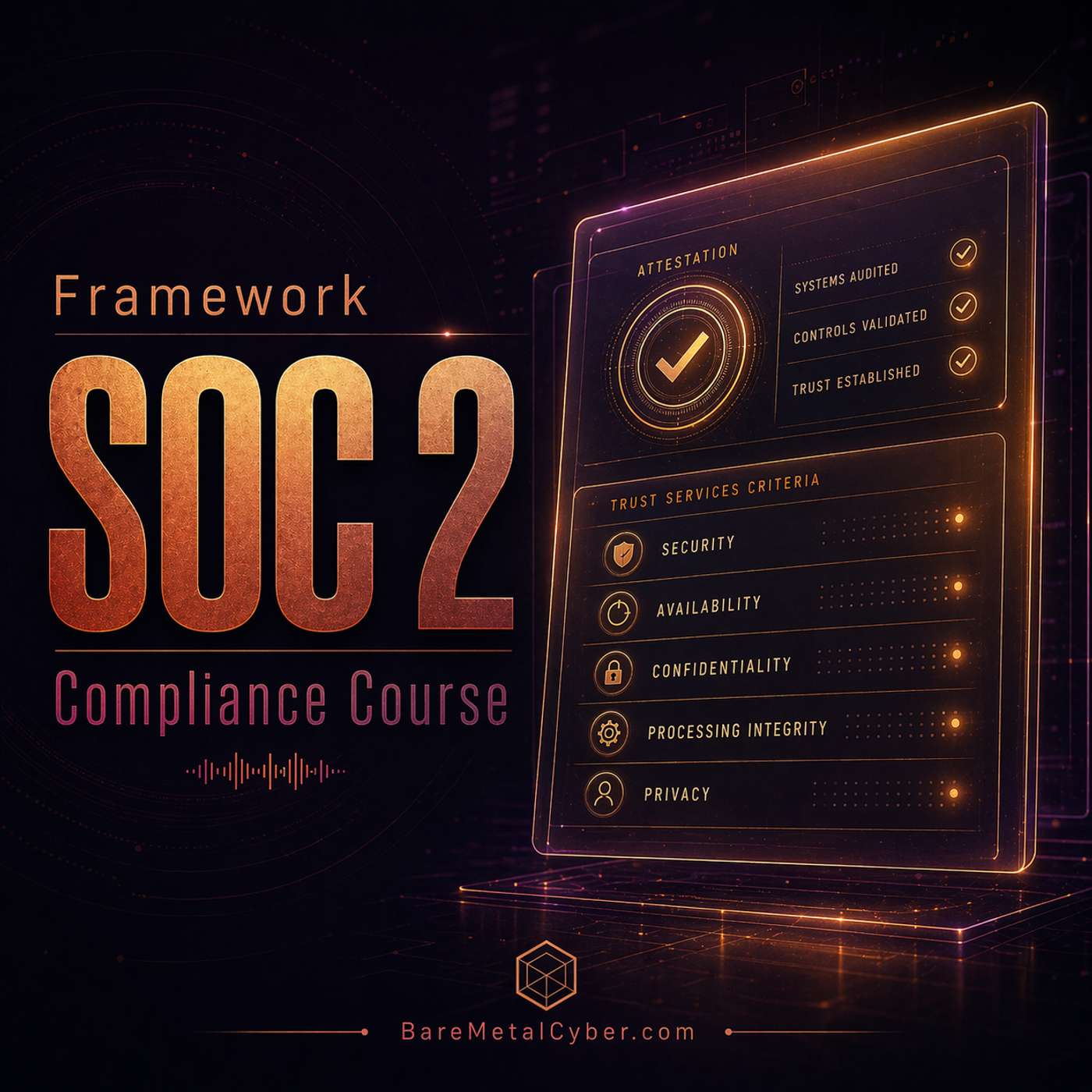
Framework - SOC 2 Compliance Course
by Jason Edwards
The **SOC 2 Compliance Audio Course** is your comprehensive, audio-first guide to understanding and implementing the Service Organization Control (SOC) 2 framework from the ground up. Designed for cybersecurity professionals, auditors, and business leaders, this course breaks down the American Institute of Certified Public Accountants (AICPA) Trust Services Criteria into clear, practical lessons that connect compliance theory with daily operational reality. Each episode explores essential concepts such as governance, risk assessment, security controls, and audit preparation—helping you understand how SOC 2 reports demonstrate assurance to customers and regulators.The course takes a structured approach to explaining each trust principle—**Security, Availability, Processing Integrity, Confidentiality, and Privacy**—and how they apply to different types of organizations. Listeners learn how to interpret requirements, design and map controls, gather appropriate evidence, and prepare for
Episodes
-
Episode 64 — Pre-Sales Enablement: Using SOC 2 to Accelerate Deals
SOC 2 becomes a sales accelerator when its lessons and artifacts are packaged for fast, consistent buyer due diligence. The exam will expect you to explain how to translate control narratives and evidence into customer-ready answers: a concise overview of scope and criteria selected, a timeline…
more -
Episode 63 — Pentest Scoping, Findings Lifecycle, Remediation Proof
Penetration testing complements SOC 2 by validating the real-world effectiveness of defenses, but its value depends on disciplined scope and a complete findings lifecycle. The exam will expect you to distinguish between internal and external testing, application and network layers, authenticated...
-
Episode 62 — IaC Guardrails & Policy-as-Code (OPA, conftest, SCPs)
Infrastructure as Code accelerates delivery, but it can also scale misconfigurations, so SOC 2 programs enforce guardrails that codify security expectations and make them testable. For the exam, connect IaC to CC7 and CC8: baselines live in version control, changes flow through pull requests, and...
-
Episode 61 — Mobile App SDLC & App-Store Release Governance
Bringing mobile applications into SOC 2 scope requires aligning the software development lifecycle with platform-specific governance so releases remain predictable, auditable, and secure. The exam will expect you to articulate how requirements, design, coding, testing, and approval stages…
more -
Episode 60 — Multi-Cloud Specifics: AWS/Azure/GCP Control Patterns
Operating across Amazon Web Services, Microsoft Azure, and Google Cloud Platform introduces divergent primitives that must still yield consistent control outcomes. The exam will expect you to articulate pattern-level equivalence: identity and access management, network segmentation, encryption…
more -
Episode 59 — Evidence Retention, Chain-of-Custody, Immutability
SOC 2 programs live and die by the quality and integrity of their records. The exam will expect you to distinguish operational retention (keeping artifacts long enough to support the audit and legal obligations) from over-retention that increases exposure. Define retention schedules per artifact...
-
Episode 58 — Customer Trust Portals & Controlled Evidence Sharing
Trust portals convert audit artifacts into a curated, self-service experience for customers, reducing email churn and accelerating procurement reviews. For the exam, anchor your design in least privilege and purpose limitation: authenticate requestors, validate need-to-know, and gate sensitive...
-
Episode 57 — GenAI/ML Services in Scope: Risks, Controls, Evidence
When generative artificial intelligence and machine learning enter scope, the risk profile expands to include data leakage through prompts, model inversion, training data provenance, and integrity of model outputs embedded in business processes. The exam will expect a structured approach…
more -
Episode 56 — Designing a Metrics & KRIs Program for SOC 2
A metrics and Key Risk Indicators program translates abstract control objectives into observable signals that management can act on throughout the audit period. For exam readiness, understand the progression from vision to measurement: define objectives tied to the Trust Services Criteria…
more -
Episode 55 — SRE for Availability: SLOs, Error Budgets, Incident Math
Site Reliability Engineering provides quantitative tools to manage availability as a product feature rather than a vague aspiration. The exam will expect fluency in service level indicators, service level objectives, and error budgets that translate customer expectations into measurable targets....
-
Episode 54 — Backup, Restore, and DR Testing at Scale
Backups provide recoverability; restores prove it. The exam emphasizes the difference between having copies and demonstrating business-level recovery within stated recovery time and recovery point objectives. At scale, design a tiered strategy: frequent, near-line snapshots for fast rollback;...
-
Episode 53 — Remote Work Security: Home Offices, Travel, Contractors
Remote work extends the security perimeter to living rooms, hotel networks, and partner sites, increasing variability and exposure. The exam will expect coverage of secure connectivity, user authentication, and environment controls. Standardize on strong multifactor authentication, device...
-
Episode 52 — Endpoint & MDM Controls for Distributed Teams
Endpoint security anchors the control environment when users operate outside traditional offices. The exam will expect you to describe a layered model: device enrollment, baseline configuration, patching, anti-malware, disk encryption, host firewalls, and telemetry. Mobile Device Management (MDM)...
-
Episode 51 — Secrets Management in Code and Pipelines (Deep Dive)
Secrets management protects credentials, tokens, keys, and connection strings from exposure across source code, build systems, and runtime environments. For exam readiness, understand the lifecycle: creation, storage, retrieval, rotation, and revocation, with least-privilege access at every step....
-
Episode 50 — Key Management & BYOK/KMS Rotations
Key management underpins encryption controls within the Confidentiality and Privacy criteria. The exam expects understanding of lifecycle governance—key generation, storage, distribution, rotation, and destruction. Bring Your Own Key (BYOK) models let customers retain control of cryptographic…
more -
Episode 49 — Data Residency & Sovereignty in SOC 2 Scopes
Data residency defines where data physically resides; sovereignty defines which jurisdiction’s laws apply. The exam tests understanding of how these concepts shape SOC 2 scope, particularly under the Availability, Confidentiality, and Privacy criteria. Multi-region hosting and cross-border...
-
Episode 48 — Beyond the Stamp: Turning SOC 2 into Real Outcomes
Achieving a SOC 2 report should mark the start of continuous improvement, not the end. The exam expects you to articulate how organizations convert audit results into measurable business outcomes: faster sales cycles, improved operational maturity, and stronger customer confidence. SOC 2 findings...
-
Episode 47 — Annual Maintenance: Calendars, KRIs, Maturity
SOC 2 compliance is not a one-time milestone but a continuous program requiring annual maintenance. The exam emphasizes how recurring activities—control execution, evidence collection, and management reviews—are organized through compliance calendars. These calendars schedule control tasks…
more -
Episode 46 — Startup vs Enterprise Right-Sizing
Implementing SOC 2 at a startup differs dramatically from doing so in a large enterprise. The exam expects you to recognize proportionality—controls must be effective and sustainable, not excessive for the organization’s size or risk profile. Startups should focus on policy clarity, automation…
more -
Episode 45 — Pairing with Pen Tests, Bug Bounties, SSDF/SLSA
SOC 2 alone does not verify technical vulnerability depth, so many organizations augment it with penetration testing, bug bounty programs, or secure development frameworks such as SSDF (Secure Software Development Framework) and SLSA (Supply-chain Levels for Software Artifacts). The exam expects...
-
Episode 44 — Using SOC 2 to Answer SIG/CAIQ/Customer Questionnaires
SOC 2 reports often serve as primary evidence when responding to security questionnaires like SIG (Standardized Information Gathering) or CAIQ (Consensus Assessments Initiative Questionnaire). The exam expects you to understand how SOC 2 streamlines assurance by providing verified, auditor-tested...
-
Episode 43 — Crosswalks: SOC 2 ↔ NIST CSF / ISO 27001 / CIS 18
Crosswalking frameworks allows organizations to reuse evidence across multiple compliance obligations. SOC 2 aligns conceptually with frameworks like NIST Cybersecurity Framework (CSF), ISO/IEC 27001, and CIS Critical Security Controls. The exam expects you to explain that each uses different...
-
Episode 42 — Final Report Reviews & Distribution Practices
Once fieldwork concludes, the auditor issues a draft SOC 2 report for management review. The exam expects you to know how this stage validates accuracy and confidentiality before distribution. Management must verify that system descriptions, exceptions, and representations are correct and free of...
-
Episode 41 — Handling Exceptions & Deviations
Even mature SOC 2 environments experience exceptions—instances where a control did not operate as intended. The exam expects you to differentiate between design deficiencies, operational deviations, and isolated anomalies. Exceptions are not automatic failures; what matters is documentation…
more -
Episode 40 — Fieldwork Do’s & Don’ts; Request Lists & Walkthroughs
Fieldwork is the active phase of the SOC 2 audit when auditors test controls, review evidence, and conduct walkthroughs. The exam expects familiarity with the rhythm: request list issuance, evidence submission, clarifications, and interviews. “Do’s” include organizing artifacts before requests...
-
Episode 39 — Readiness Assessments & Gap Closure
A readiness assessment bridges the gap between current state and audit expectations. It is a dry run designed to identify deficiencies in design, documentation, or operation before formal examination begins. The exam expects you to outline its purpose: reduce audit risk, clarify scope, and build…
more -
Episode 38 — Selecting the CPA Firm & Independence
Choosing the right Certified Public Accountant (CPA) firm is critical because SOC 2 is an attestation engagement requiring auditor independence. The exam expects you to know that the firm must be licensed, subject to peer review, and experienced in SOC examinations under AICPA standards....
-
Episode 37 — Policy-to-Practice Traceability (Text → Proof → Tests)
Policy-to-practice traceability connects written commitments to measurable evidence. The exam will expect you to map a control statement from the policy, through its implementation procedure, to the proof and corresponding test result. This linkage ensures that every “shall” or “must” in...
-
Episode 36 — CI/CD & Cloud Proofs: Pipelines, Baselines, Diffs
Continuous Integration and Continuous Deployment (CI/CD) pipelines are now central to SOC 2 evidence collection because they record how code and infrastructure move from development to production. The exam expects you to explain how build pipelines, infrastructure baselines, and configuration…
more -
Episode 35 — Audit-Ready Logs & Screenshots: Accept vs Reject
Audit-ready evidence depends on provenance, completeness, and repeatability. Logs should originate from systems of record, be time-synchronized, and retained immutably for the audit period. For the exam, differentiate acceptable artifacts—exported reports with filters documented, log extracts...
-
Episode 34 — Ticketing as Evidence (Approvals, Change, Incidents)
Ticketing systems provide the audit backbone for approvals, changes, incidents, and exceptions, turning ephemeral conversations into durable records. The exam will expect you to tie SOC 2 controls to specific ticket fields: requester, approver, timestamps, risk classification, test results, and...
-
Episode 33 — Continuous Control Monitoring & Automation
Continuous control monitoring (CCM) converts periodic, manual checks into automated, near-real-time assurance. For the exam, be prepared to explain how CCM maps control objectives to measurable signals—metrics, events, and thresholds—captured from systems of record such as IAM, cloud…
more -
Episode 32 — Evidence Strategy & Sampling for Type II
Type II reports evaluate operating effectiveness over time, so your evidence strategy must prove consistency, not isolated success. The exam expects fluency with defining populations (for example, all change tickets between specific dates), selecting statistically or judgmentally appropriate...
-
Episode 31 — Strong Control Narratives: Before/After Examples
A strong control narrative translates policy intent into the specific, routine actions a team performs, expressed in clear, testable language. For exam readiness, understand that narratives must answer who performs the control, what system or dataset it affects, when and how often it runs, and…
more -
Episode 30 — Cloud & Multitenant Edge Cases (Scope, Tenancy, Regions)
Cloud-native and multitenant architectures introduce scoping complexities that the exam will expect you to navigate precisely. Define the “system” to include services, infrastructure-as-code, managed platforms, and shared components that affect commitments. Tenancy models—single-tenant, pooled...
-
Episode 29 — Evidence for A/C/PI/P: What “Good” Looks Like
Auditors evaluate whether controls for Availability, Confidentiality, Processing Integrity, and Privacy are designed and operating effectively, so your evidence must be relevant, complete, and reliable. “Good” evidence ties a stated control to a dated sample that demonstrates performance over the...
-
Episode 28 — Privacy in Context: SOC 2 vs ISO 27701 vs HIPAA
This episode situates SOC 2 Privacy alongside ISO/IEC 27701 and HIPAA so you can compare scope, obligations, and evidence expectations. SOC 2 is an attestation over your system against Trust Services Criteria, including Privacy, and is adaptable across industries. ISO 27701 extends ISO 27001 with…
more -
Episode 27 — Privacy: Notice, Rights, DPIAs, Retention, DSRs
Under the SOC 2 Privacy criterion, organizations must show that personal information is collected, used, retained, disclosed, and disposed of in accordance with commitments and applicable regulations. The exam expects you to connect privacy program elements to operational controls: clear,...
-
Episode 26 — Processing Integrity: Accuracy/Completeness/Monitoring
Processing Integrity in SOC 2 focuses on whether systems deliver the right results at the right time for the right reasons, emphasizing accuracy, completeness, validity, timeliness, and authorization. For exam purposes, you should be able to explain how business rules, input validation,...
-
Episode 25 — Confidentiality: Classification, Encryption, DLP
Confidentiality ensures that sensitive information is protected from unauthorized disclosure. The exam focuses on how organizations identify, classify, and safeguard data based on sensitivity. Classification frameworks define what data is public, internal, or confidential, guiding appropriate...
-
Episode 24 — Availability: Capacity, DR, RTO/RPO, Game-Days
Availability is one of the Trust Services Criteria most closely tied to operational resilience. It ensures that systems meet uptime commitments and can recover from disruptions within defined tolerances. The exam highlights concepts like capacity management, Disaster Recovery (DR) planning, and...
-
Episode 23 — CC12 Physical/Environmental & Remote-First Realities
CC12 governs physical and environmental safeguards—controls that protect systems from unauthorized access, damage, or environmental hazards. Traditionally, this meant data centers, offices, and server rooms. However, the rise of remote and hybrid work models has transformed CC12’s application.…
more -
Episode 22 — CC11 Vendor Risk & Subservice Oversight
CC11 addresses how organizations manage risks associated with third-party vendors and subservice providers. It requires structured due diligence, contract management, and ongoing monitoring to ensure external parties meet the same security and compliance standards as internal operations. The exam...
-
Episode 21 — CC10 Data Integrity in Pipelines
CC10 ensures that information processed within systems remains accurate, complete, and valid throughout its lifecycle. It focuses on maintaining data integrity from input to output, particularly in automated or multi-stage processing pipelines. The exam highlights that controls must detect,...
-
Episode 20 — CC9 Incident Management & Communications
CC9 covers how organizations prepare for, detect, respond to, and communicate security incidents. The exam emphasizes structured processes that define roles, escalation paths, and notification requirements. Effective incident management limits damage and maintains trust with customers and...
-
Episode 19 — CC8 Change Management & SDLC (incl. IaC Basics)
CC8 evaluates how organizations manage system changes to prevent unintended disruption or new vulnerabilities. It covers structured change management processes, Software Development Lifecycle (SDLC) controls, and increasingly, Infrastructure as Code (IaC). The exam focuses on documentation,...
-
Episode 18 — CC7 Ops: Config Management, Vulnerability Mgmt, Patching
CC7 governs how organizations maintain secure, reliable operations through configuration management, vulnerability management, and patching. The exam tests understanding of how operational hygiene translates into risk reduction. Configuration management ensures systems remain consistent with...
-
Episode 17 — CC6 Logical Access: IAM, SSO, MFA, JML
CC6 focuses on logical access—ensuring that only authorized individuals can interact with systems and data. It encompasses Identity and Access Management (IAM), Single Sign-On (SSO), Multi-Factor Authentication (MFA), and Joiner–Mover–Leaver (JML) processes. The exam expects understanding of how...
-
Episode 16 — CC5 Control Design, Reviews, and Monitoring
CC5 addresses how controls are designed, implemented, and monitored for continued effectiveness. The exam expects you to understand the full lifecycle—from establishing control objectives that align with risks to ensuring management reviews validate their operation. Well-designed controls must be...
We're indexing this podcast's transcripts for the first time — this can take a minute or two. We'll show results as soon as they're ready.
No matches for "" in this podcast's transcripts.
No topics indexed yet for this podcast.
Loading reviews...
ABOUT THIS SHOW
The **SOC 2 Compliance Audio Course** is your comprehensive, audio-first guide to understanding and implementing the Service Organization Control (SOC) 2 framework from the ground up. Designed for cybersecurity professionals, auditors, and business leaders, this course breaks down the American Institute of Certified Public Accountants (AICPA) Trust Services Criteria into clear, practical lessons that connect compliance theory with daily operational reality. Each episode explores essential concepts such as governance, risk assessment, security controls, and audit preparation—helping you understand how SOC 2 reports demonstrate assurance to customers and regulators.The course takes a structured approach to explaining each trust principle—**Security, Availability, Processing Integrity, Confidentiality, and Privacy**—and how they apply to different types of organizations. Listeners learn how to interpret requirements, design and map controls, gather appropriate evidence, and prepare for
HOSTED BY
Jason Edwards
CATEGORIES
Loading similar podcasts...
Frequently Asked Questions
How many episodes does Framework - SOC 2 Compliance Course have?
Framework - SOC 2 Compliance Course currently has 65 episodes available on PodParley. New episodes are automatically indexed when they're published to the podcast feed.
What is Framework - SOC 2 Compliance Course about?
The **SOC 2 Compliance Audio Course** is your comprehensive, audio-first guide to understanding and implementing the Service Organization Control (SOC) 2 framework from the ground up. Designed for cybersecurity professionals, auditors, and business leaders, this course breaks down the American...
How often does Framework - SOC 2 Compliance Course release new episodes?
Framework - SOC 2 Compliance Course has 65 episodes. Check the episode list to see recent publication dates and frequency.
Where can I listen to Framework - SOC 2 Compliance Course?
You can listen to Framework - SOC 2 Compliance Course on PodParley by clicking any episode. We provide an embedded audio player for direct listening, and you can also subscribe via your preferred podcast app using the RSS feed.
Who hosts Framework - SOC 2 Compliance Course?
Framework - SOC 2 Compliance Course is created and hosted by Jason Edwards.
URL copied to clipboard!