
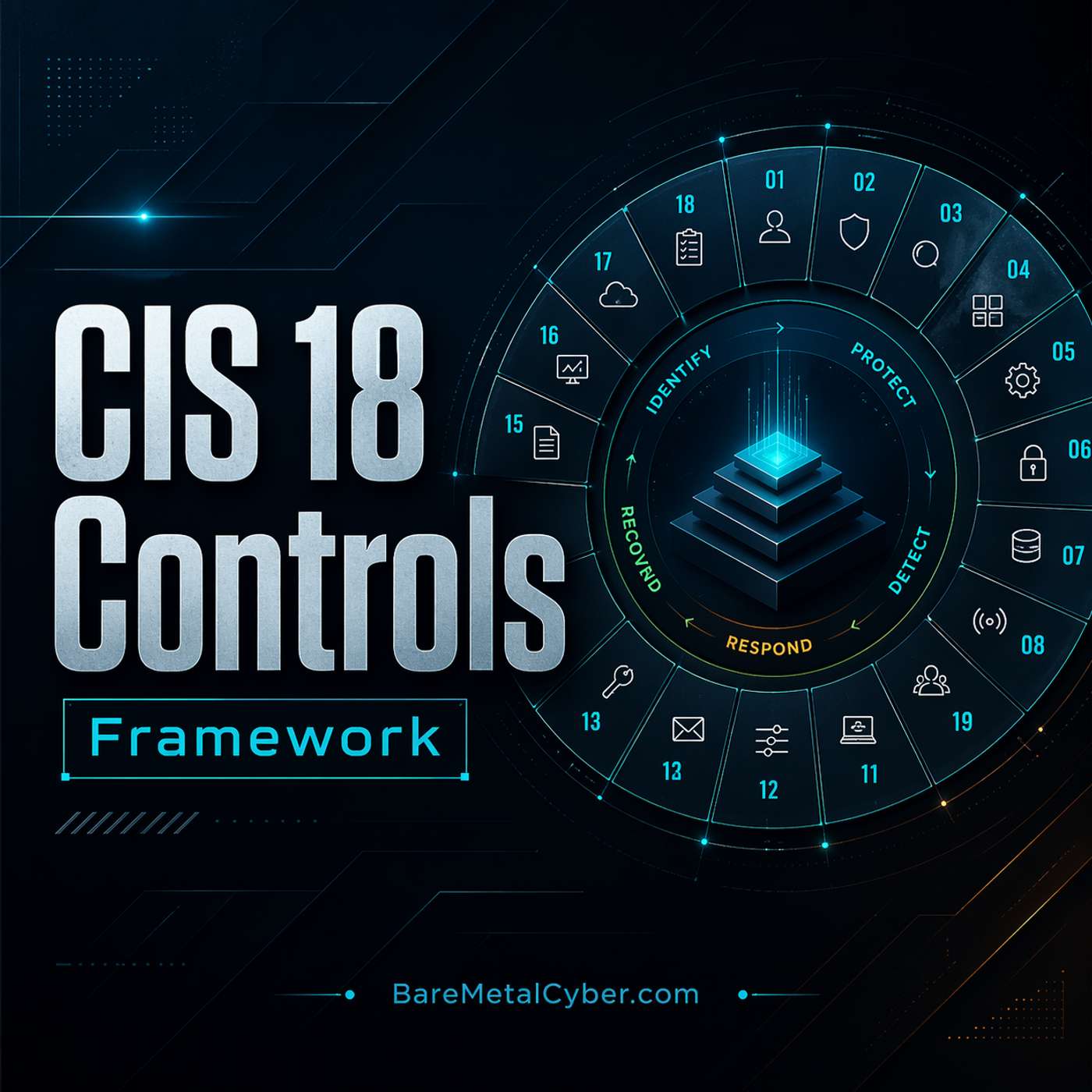
PODCAST · technology
Framework: The Center for Internet Security (CIS) Top 18 Controls
by Jason Edwards
The **CIS Critical Security Controls Audio Course** is a comprehensive, audio-first training series that guides listeners through all eighteen **CIS Controls**, transforming one of the world’s most respected cybersecurity frameworks into clear, actionable learning. Designed for professionals, students, and auditors alike, this series explains each control in practical, plain language—focusing on how to implement, assess, and sustain them in real environments. With eighty-three structured episodes, the course walks you step by step through the safeguards that define effective cybersecurity, helping you understand not only what to do but why each measure matters.The **CIS Controls**, maintained by the Center for Internet Security, represent a globally recognized set of prioritized actions proven to reduce the most common and dangerous cyber risks. Organized across eighteen control families—from inventory and configuration management to incident response and data recovery—the framework
-
83
-
82
Episode 82 — Safeguard 18.2 – Internal and red team exercises
Safeguard 18.2 extends penetration testing to include internal assessments and red team exercises that emulate an attacker with initial access. Internal testing evaluates how far a threat could move laterally, escalate privileges, and access sensitive data once inside the network. Red team exercises simulate full-scale adversary campaigns, testing detection, containment, and response capabilities across technical and human layers. These exercises reveal not just vulnerabilities, but also gaps in processes and situational awareness. They measure whether monitoring tools trigger alerts, whether analysts interpret them correctly, and how quickly response teams can contain the intrusion. Internal and red team testing transforms theoretical preparedness into proven readiness, helping organizations close the final mile between defense design and real-world resilience.Implementing this safeguard involves careful planning and coordination between leadership, blue teams, and testing personnel. Internal tests should include domain privilege escalation, network traversal, and data exfiltration attempts, all performed under controlled conditions with predefined safety boundaries. Red team engagements require clearly documented objectives, such as testing detection of phishing payloads or lateral movement techniques. During these exercises, communication protocols and deconfliction measures prevent accidental business disruption. Post-engagement debriefs bring together both offensive and defensive participants to review findings collaboratively, focusing on lessons learned rather than blame. Metrics such as detection time, escalation efficiency, and remediation completion rates guide continuous improvement. When performed regularly, internal and red team exercises evolve cybersecurity from static prevention toward adaptive readiness—where the organization learns directly from simulated adversaries and strengthens every layer of its defense and response capability. Produced by BareMetalCyber.com, where you’ll find more cyber audio courses, books, and information to strengthen your educational path. Also, if you want to stay up to date with the latest news, visit DailyCyber.News for a newsletter you can use, and a daily podcast you can commute with.
-
81
Episode 81 — Safeguard 18.1 – External testing programs
Safeguard 18.1 requires organizations to establish and maintain a formal penetration testing program that includes recurring external assessments. External tests simulate real-world attackers operating from outside the enterprise perimeter, probing exposed systems, web applications, and cloud environments for exploitable weaknesses. Unlike automated vulnerability scans, these engagements apply human expertise to chain vulnerabilities, test business logic, and evaluate how well network defenses withstand targeted attacks. The program must define scope, frequency, and reporting standards, ensuring that results are actionable and repeatable. External penetration testing provides the most realistic measurement of how resilient an organization’s public-facing assets truly are and whether the layered defenses described in previous controls—such as patching, configuration management, and monitoring—perform effectively under adversarial pressure.To operationalize this safeguard, enterprises should define a documented testing policy outlining which assets, IP ranges, and applications fall within scope. Engagements must be performed by qualified testers who follow strict rules of engagement to avoid service disruption while still providing comprehensive evaluation. Pre-test coordination with internal teams ensures monitoring and incident response systems are aware of expected activity, allowing evaluation of detection effectiveness. After testing, findings should be risk-ranked, correlated with asset criticality, and assigned to responsible owners for remediation. Reports must include technical evidence, proof-of-concept details, and mitigation recommendations. Testing frequency should be at least annual, or more often after significant infrastructure or application changes. Over time, an external testing program evolves from compliance validation into a continuous improvement process—one that strengthens trust by demonstrating that defenses are not only designed well but tested against real threats in authentic conditions. Produced by BareMetalCyber.com, where you’ll find more cyber audio courses, books, and information to strengthen your educational path. Also, if you want to stay up to date with the latest news, visit DailyCyber.News for a newsletter you can use, and a daily podcast you can commute with.
-
80
Episode 80 — Overview – Why penetration testing validates defenses
Control 18—Penetration Testing—closes the CIS framework by validating how well all other controls perform under real-world conditions. While vulnerability scanning identifies potential weaknesses, penetration testing goes further by exploiting them to assess the enterprise’s true exposure. These controlled attacks, conducted by skilled professionals, reveal how vulnerabilities chain together, how far an attacker could advance, and whether detection and response mechanisms activate as intended. Penetration testing provides management with concrete evidence of risk, translating technical gaps into business impact. It verifies that security investments deliver measurable protection and highlights areas where layered defenses may overlap or fail. Ultimately, this control ensures that an organization’s cybersecurity posture is not theoretical but proven through realistic adversarial testing.Conducting effective penetration tests requires clear scope, defined rules of engagement, and strong collaboration between testers and stakeholders. Scenarios should reflect both external and internal attack perspectives, covering network, application, and physical entry points. Tests may also include social engineering components to gauge user resilience. All testing must balance realism with safety—avoiding disruption while capturing authentic results. Findings should be prioritized by exploitability and potential business impact, with remediation plans tracked through formal governance channels. Repeat testing validates that fixes are effective and that no regressions occur over time. For mature organizations, red team exercises simulate advanced, persistent threats to evaluate end-to-end detection and response capabilities. Control 18 thus serves as the final proof point of the CIS Controls: confirming that security architecture, processes, and people can withstand—and learn from—the tactics of real adversaries. Produced by BareMetalCyber.com, where you’ll find more cyber audio courses, books, and information to strengthen your educational path. Also, if you want to stay up to date with the latest news, visit DailyCyber.News for a newsletter you can use, and a daily podcast you can commute with.
-
79
Episode 79 — Remaining safeguards summary (Control 17)
The remaining safeguards in Control 17 reinforce the full lifecycle of incident response—spanning preparation, communication, testing, and continuous improvement. These include assigning key response roles, defining secure communication mechanisms, conducting post-incident reviews, and establishing thresholds that differentiate normal events from true incidents. Together, these steps ensure that teams can act quickly, share accurate information, and recover efficiently without confusion. Designated roles provide clarity of authority; communication protocols—both primary and backup—keep coordination intact even if normal channels are compromised. Post-incident reviews transform each response into a learning opportunity, refining both technology and human processes. Defining thresholds prevents overreaction to minor anomalies while ensuring serious incidents receive immediate escalation.Implementing these safeguards requires integrating technical and organizational readiness. Communication tools—such as dedicated incident bridges, encrypted messaging, and offline contact lists—must be tested alongside technical playbooks. Regular cross-functional meetings evaluate whether response thresholds and classification criteria still match business risk and compliance obligations. Documentation from post-incident reviews should update training materials, configuration baselines, and preventive controls. Mature organizations track and trend incident metrics to identify recurring weaknesses and measure improvement over time. When practiced consistently, these safeguards build resilience not just in systems, but in people and processes. Control 17, as a whole, evolves cybersecurity from a set of defensive measures into a dynamic capability—one that anticipates disruption, coordinates under pressure, and emerges stronger from every challenge encountered. Produced by BareMetalCyber.com, where you’ll find more cyber audio courses, books, and information to strengthen your educational path. Also, if you want to stay up to date with the latest news, visit DailyCyber.News for a newsletter you can use, and a daily podcast you can commute with.
-
78
Episode 78 — Safeguard 17.2 – Tabletop exercises
Safeguard 17.2 emphasizes the importance of testing the incident response plan through structured tabletop exercises. These simulations bring together key personnel—from technical teams to executives—to rehearse decision-making during hypothetical security events. Unlike full-scale technical drills, tabletop exercises focus on communication flow, role clarity, and coordination across departments. Scenarios may include ransomware outbreaks, cloud breaches, insider threats, or supply-chain compromises. The purpose is to identify gaps in preparedness—such as unclear escalation paths, communication delays, or conflicting responsibilities—before a real incident exposes them. Regular exercises, conducted at least annually, help maintain readiness and reinforce a culture of collaboration under pressure.To execute effective tabletop sessions, organizations should design scenarios that reflect realistic challenges based on current threat intelligence and business context. Each session should define clear objectives, such as evaluating response time, testing regulatory reporting procedures, or verifying decision-making authority. Facilitators document outcomes and capture improvement actions, assigning ownership for follow-up. Afterward, debrief sessions discuss what worked, what failed, and how the plan can evolve. Mature programs alternate between table-based and functional simulations, gradually introducing live elements such as system isolation or communication with external stakeholders. These rehearsals build confidence, ensure cross-functional awareness, and strengthen trust among participants. Safeguard 17.2 transforms policy into practice, turning static documentation into operational muscle memory that reduces uncertainty and sharpens the organization’s ability to respond effectively when real crises occur. Produced by BareMetalCyber.com, where you’ll find more cyber audio courses, books, and information to strengthen your educational path. Also, if you want to stay up to date with the latest news, visit DailyCyber.News for a newsletter you can use, and a daily podcast you can commute with.
-
77
Episode 77 — Safeguard 17.1 – IR plan and playbooks
Safeguard 17.1 requires organizations to establish and maintain a comprehensive incident response process that defines scope, roles, responsibilities, and communication procedures. This process must include not only the technical elements of response—like containment and remediation—but also compliance reporting, legal coordination, and stakeholder communication. The plan should assign a primary incident manager and designate backups to ensure continuity. Playbooks for common incident types—such as ransomware, phishing, data breaches, or insider misuse—translate broad policy into actionable checklists that guide responders step by step. These playbooks must be reviewed at least annually and updated whenever infrastructure, threats, or regulations change. Their purpose is to eliminate guesswork in the middle of a crisis, ensuring consistency and accountability throughout every stage of response.To implement this safeguard, organizations should adopt a tiered structure: strategic leadership sets priorities, tactical coordinators manage containment and communication, and operational responders execute technical steps. All actions must be logged in a centralized system for traceability and audit. Integrating response workflows with detection systems enables automation of early actions—such as isolating infected endpoints or revoking credentials. Tabletop exercises validate that playbooks are practical, while cross-departmental rehearsals ensure non-technical staff understand escalation protocols. Documenting lessons learned after each incident keeps the process living and adaptive. Over time, Safeguard 17.1 turns incident response from a reactive scramble into a well-choreographed routine that strengthens confidence across the organization and demonstrates to regulators and customers that the enterprise can manage adversity with discipline and transparency. Produced by BareMetalCyber.com, where you’ll find more cyber audio courses, books, and information to strengthen your educational path. Also, if you want to stay up to date with the latest news, visit DailyCyber.News for a newsletter you can use, and a daily podcast you can commute with.
-
76
Episode 76 — Overview – Incident response principles
Control 17—Incident Response Management—defines how an organization prepares for, detects, responds to, and learns from security incidents. Even the most robust defenses can be breached, and when that happens, success depends on disciplined, preplanned response rather than improvised reaction. The control requires formal policies, documented procedures, and assigned roles to ensure rapid coordination across technical, legal, and communication teams. A well-structured incident response (IR) plan identifies what constitutes an incident, who has authority to declare it, and how containment, eradication, and recovery should unfold. Equally important are communication protocols—both internal, for quick escalation, and external, for compliance and public trust. A tested, well-practiced plan limits damage, shortens downtime, and preserves critical evidence for analysis or legal action.Building strong IR capability begins with preparation. Teams must define severity classifications, escalation paths, and decision-making authority before an event occurs. Tooling should support efficient detection and documentation—such as case management platforms that integrate with SIEM and endpoint detection systems. During incidents, responders rely on predefined playbooks outlining immediate containment steps, forensic collection methods, and notification requirements. Post-incident reviews capture lessons learned and feed them back into prevention and training. Mature programs track metrics such as mean time to detect (MTTD) and mean time to respond (MTTR), using them to improve readiness over time. Ultimately, Control 17 instills organizational calm under pressure, ensuring that when disruption occurs, the enterprise acts decisively, transparently, and in unison to restore trust and continuity. Produced by BareMetalCyber.com, where you’ll find more cyber audio courses, books, and information to strengthen your educational path. Also, if you want to stay up to date with the latest news, visit DailyCyber.News for a newsletter you can use, and a daily podcast you can commute with.
-
75
Episode 75 — Remaining safeguards summary (Control 16)
The remaining safeguards under this control expand beyond coding and testing to address the full ecosystem in which applications live. They include maintaining an inventory of third-party components (a software bill of materials), enforcing trusted and up-to-date libraries, applying secure design principles, separating production and non-production environments, leveraging vetted platform services for identity and logging, and conducting code-level checks, application penetration testing, and threat modeling. Together, these measures reduce the attack surface by design—choosing well-understood building blocks, hardening infrastructure, and eliminating privilege excess. Separation of environments prevents test data and tools from bleeding into production; standardized hardening templates keep servers, containers, and PaaS resources aligned to least-privilege configurations; and runtime logging provides the forensic depth needed when incidents occur. Penetration testing and threat modeling then validate that controls work in real workflows and that design assumptions still hold under adversarial pressure.Operational maturity comes from orchestration and evidence. Component inventories must update automatically as builds change, with policies that fail pipelines when unsupported or vulnerable versions enter the graph. Environment segregation is enforced through distinct accounts or subscriptions, isolated networks, and unique identities, with deployment automation guaranteeing identical, hardened baselines. Design reviews document decisions and trace security requirements through user stories and test cases. When vulnerabilities appear, root-cause analysis updates patterns and guardrails so teams do not reintroduce the same flaw elsewhere. Finally, metrics—like time to remediate, percentage of builds passing security gates, and recurring-defect rates—give leadership clarity on risk trendlines and investment payback. By coordinating these safeguards, engineering organizations achieve a state where security is demonstrably built-in: predictable, testable, and resilient from architecture through runtime, and continuously improved with each release cycle. Produced by BareMetalCyber.com, where you’ll find more cyber audio courses, books, and information to strengthen your educational path. Also, if you want to stay up to date with the latest news, visit DailyCyber.News for a newsletter you can use, and a daily podcast you can commute with.
-
74
Episode 74 — Safeguard 16.2 – Static and dynamic testing
This safeguard advances assurance by requiring a structured process to accept and address reported vulnerabilities and by embedding testing that sees both code and behavior. Static analysis inspects source or bytecode without executing it, uncovering issues like injection points, insecure APIs, tainted data flows, or missing sanitization. Dynamic analysis executes the running application to identify problems that only appear at runtime—input validation gaps across parameters, authentication flow weaknesses, session handling flaws, or misconfigurations. When paired with SCA and container/image scanning, teams obtain a layered view: custom code risks, third-party component exposure, and environment weaknesses. Findings must flow into a tracked system with severity ratings, SLAs, and verification steps so that fixes are prioritized and validated consistently across sprints.Effectiveness depends on tuning and fit-for-purpose coverage. Static tools should be configured per language and framework, with custom rules that reflect enterprise patterns—e.g., ensuring internal wrapper functions actually enforce parameterization. Dynamic tools need realistic test data and authenticated sessions to exercise protected paths and business logic; for APIs, include fuzzing and schema validation to expose subtle failures. Integrate scanners into CI so every merge receives fast feedback, and schedule deeper, periodic scans for full-stack scrutiny. Close the loop with automated retesting to confirm remediation, and capture root causes to update coding standards or architectural guidelines. For critical applications, complement automated testing with manual penetration testing focused on complex workflows and abuse cases. The goal is not a wall of scanner output but a reliable signal that drives predictable, risk-based fixes—turning testing into a continuous guardrail that keeps vulnerabilities from accumulating between releases. Produced by BareMetalCyber.com, where you’ll find more cyber audio courses, books, and information to strengthen your educational path. Also, if you want to stay up to date with the latest news, visit DailyCyber.News for a newsletter you can use, and a daily podcast you can commute with.
-
73
Episode 73 — Safeguard 16.1 – Secure coding practices
This safeguard directs organizations to formalize a secure application development process and set explicit standards for how code is designed, written, reviewed, and released. Secure coding practices begin with consistent patterns that remove entire classes of defects: input validation at all trust boundaries; strict output encoding; centralized, parameterized data access; safe file handling; and default-deny authorization checks enforced server-side. Developers should never implement their own crypto—use vetted libraries and platform services for encryption, key storage, and hashing. Secrets must be externalized and rotated, not hard-coded in repositories or configuration files. Code reviews include security checklists that look for dangerous functions, insecure deserialization, insufficient logging, and error handling that leaks internals. Standards extend to infrastructure code as well, ensuring that IaC templates set secure defaults for networks, identities, and storage with least-privilege policies and explicit deny rules.To make these practices stick, automation must back them up. Pre-commit hooks and CI gates can run linters and Static Application Security Testing (SAST) to catch injection risks, unsafe APIs, or missing input normalization before code merges. Software Composition Analysis (SCA) inventories third-party components, flags known vulnerabilities, and enforces version policies or allowlists. Build systems sign artifacts and verify provenance to guard against tampering in transit, while pipelines inject secrets at build or deploy time via managed vaults. Severity thresholds guide triage so that high-impact flaws block release until remediated or risk-accepted formally with time-boxed exceptions. Security champions embedded in each team tailor guidance to language and framework specifics, convert incident lessons into new guardrails, and coach peers through refactors that reduce attack surface. Over time, these mechanisms transform secure coding from ad-hoc heroics into a repeatable, auditable craft that measurably lowers defect density and vulnerability recurrence across releases. Produced by BareMetalCyber.com, where you’ll find more cyber audio courses, books, and information to strengthen your educational path. Also, if you want to stay up to date with the latest news, visit DailyCyber.News for a newsletter you can use, and a daily podcast you can commute with.
-
72
Episode 72 — Overview – Secure software lifecycle
A secure software lifecycle integrates security activities into every stage of building and operating applications—planning, design, development, testing, deployment, and maintenance—so that weaknesses are prevented early and detected quickly when they occur. In this view, security is not a gate at the end of development but a set of habits and checks embedded alongside feature work. Threat modeling during design clarifies how the application might be attacked and what architectural patterns—like strict input validation, parameterized queries, and robust authentication—must be applied. Dependency governance ensures that third-party libraries, containers, and services are vetted and tracked, with automated checks that flag known CVEs or end-of-life components before they reach production. Build and deployment pipelines enforce repeatable baselines, signed artifacts, and secret management so that configuration drift and credential sprawl do not undo sound coding practices. The outcome is a pipeline where security and delivery speed reinforce each other rather than compete.Sustaining a secure lifecycle requires feedback loops that tie operations back to engineering. Static and dynamic analysis, software composition analysis, and container scans should run on every change, failing builds when severity thresholds are exceeded and creating tickets automatically for triage. In production, application logging, runtime protections, and anomaly detection provide visibility into misuse and business-logic abuses that scanners cannot simulate. Post-incident reviews feed root-cause fixes into backlogs and update coding standards, while severity matrices and risk acceptance processes keep decisions transparent to auditors and leadership. Role-specific training turns developers into first-line defenders who understand the cost of flaws and how to prevent them; similarly, product owners learn to balance feature priorities with security debt reduction. By treating security as an attribute of quality, teams gain predictability, reduce rework, and deliver software that resists exploitation in the wild without sacrificing velocity or customer experience. Produced by BareMetalCyber.com, where you’ll find more cyber audio courses, books, and information to strengthen your educational path. Also, if you want to stay up to date with the latest news, visit DailyCyber.News for a newsletter you can use, and a daily podcast you can commute with.
-
71
Episode 71 — Remaining safeguards summary (Control 15)
The remaining safeguards in Control 15 round out a complete third-party risk program by adding structured assessment, continuous monitoring, and secure decommissioning. After building the inventory and embedding security in contracts, organizations must evaluate providers proportionally to their risk classifications, using recognized attestations such as SOC 2, PCI AoC, or ISO 27001 to reduce questionnaire fatigue while still validating control operation. Ongoing oversight should track provider release notes, public disclosures, and dark-web chatter for exposure indicators, while requiring timely remediation plans when issues surface. Equally critical is making the end of a relationship as disciplined as the start: providers must support provable data deletion, account revocation, termination of integrations and data flows, and return or destruction of encryption keys. These practices ensure that the enterprise’s obligations for confidentiality, integrity, and availability extend beyond organizational boundaries and persist through the full vendor life cycle, minimizing residual risk from dormant connections or forgotten datasets long after a contract ends.Operationalizing these safeguards depends on clear ownership and automation. A centralized third-party risk platform can map each provider to data classifications, system dependencies, and contractual obligations, then trigger reviews on an annual cadence or when material changes occur—such as a breach disclosure, leadership change, or scope expansion. Continuous monitoring scores can feed dashboards that highlight outliers by inherent and residual risk, guiding limited assessment capacity to where it matters most. Incident response runbooks should include vendor-specific contact trees and escalation timelines that mirror contractual notification clauses, ensuring coordinated containment when a provider experiences an event. For decommissioning, standardized checklists verify that SSO access is removed, service accounts and API tokens are revoked, data exports are reconciled against destruction certificates, and architecture diagrams are updated. By weaving assessments, monitoring, and offboarding into routine governance, the program shifts from episodic gatekeeping to measurable, end-to-end assurance of supply-chain security. Produced by BareMetalCyber.com, where you’ll find more cyber audio courses, books, and information to strengthen your educational path. Also, if you want to stay up to date with the latest news, visit DailyCyber.News for a newsletter you can use, and a daily podcast you can commute with.
-
70
Episode 70 — Safeguard 15.2 – Security requirements in contracts
Safeguard 15.2 ensures that contracts with service providers explicitly define security expectations and obligations, creating enforceable accountability. Every vendor relationship introduces risk, and legal agreements must formalize how those risks are managed. Security requirements within contracts should address data protection, incident notification, vulnerability disclosure, encryption standards, and compliance with relevant frameworks such as GDPR or HIPAA. These clauses establish baseline controls for confidentiality, integrity, and availability, while giving the enterprise leverage to enforce remediation when noncompliance occurs. This safeguard also mandates periodic review of existing contracts to confirm that terms remain aligned with current threat landscapes, regulatory updates, and technological shifts.Implementing this safeguard requires collaboration between procurement, legal, and security teams. Standard contract templates should include mandatory security language vetted by counsel and aligned to organizational policies. Contracts must specify timelines for incident reporting, right-to-audit provisions, and requirements for third-party assessments like SOC 2 Type II reports. Where appropriate, agreements should address data residency, encryption key management, and secure data destruction at contract termination. Maintaining a contract library within a vendor management system enables tracking of compliance clauses and renewal schedules. Regular audits verify adherence to these terms and ensure that vendors uphold their commitments. Over time, embedding security in contracts transforms vendor oversight from reactive response to proactive governance, ensuring that security responsibilities are clear, measurable, and enforceable throughout every stage of the vendor relationship. Produced by BareMetalCyber.com, where you’ll find more cyber audio courses, books, and information to strengthen your educational path. Also, if you want to stay up to date with the latest news, visit DailyCyber.News for a newsletter you can use, and a daily podcast you can commute with.
-
69
Episode 69 — Safeguard 15.1 – Inventory of service providers
Safeguard 15.1 requires organizations to establish and maintain a complete inventory of all service providers that store, process, or access enterprise data. This inventory must include vendor classification, assigned business owner, contact information, and review frequency. A clear, current list of service providers allows enterprises to assess cumulative risk exposure and prioritize oversight efforts based on impact. Without it, vendor relationships can proliferate unchecked, creating shadow supply chains that operate outside governance and security scrutiny. The safeguard formalizes the tracking of all external entities—whether large cloud providers, SaaS platforms, or niche consultants—ensuring no dependency goes unnoticed.To implement this safeguard effectively, organizations should centralize vendor information within a dedicated repository, such as a risk management platform or governance database. Classification criteria may include the sensitivity of data handled, access to production systems, and regulatory requirements. Owners assigned to each vendor must oversee performance, compliance, and renewal decisions. Automation can pull data from procurement systems to ensure completeness and accuracy. Periodic reviews—conducted annually or after significant changes—validate that the inventory reflects current relationships. Integrating this list with other controls, such as incident response and data classification, ensures alignment between vendors and internal governance. Over time, the service provider inventory becomes not just a static record but a strategic tool—providing transparency into third-party exposure and guiding informed risk decisions that protect both the enterprise and its customers. Produced by BareMetalCyber.com, where you’ll find more cyber audio courses, books, and information to strengthen your educational path. Also, if you want to stay up to date with the latest news, visit DailyCyber.News for a newsletter you can use, and a daily podcast you can commute with.
-
68
Episode 68 — Overview – Third-party and vendor risks
Control 15—Service Provider Management—addresses the growing reliance on third-party vendors and the risks that accompany it. In today’s interconnected ecosystems, external partners often handle sensitive data or manage critical business processes, making their security posture an extension of your own. A weak vendor can serve as an attacker’s gateway into the enterprise, as demonstrated by numerous high-profile breaches traced to supply chain vulnerabilities. This control ensures that organizations evaluate, monitor, and manage service providers with the same rigor applied internally. It includes maintaining an inventory of providers, classifying them by risk level, embedding security clauses in contracts, and continuously verifying their compliance. The goal is to ensure that outsourced services strengthen rather than compromise overall cybersecurity resilience.Implementing this control begins with visibility. Organizations must document every service provider—whether cloud platform, software vendor, or managed service—and define ownership for each relationship. Providers should be categorized by the sensitivity of the data they handle or the criticality of the function they perform. Standardized assessment questionnaires, certifications like SOC 2 or ISO 27001, and evidence of independent audits help validate their controls. Security requirements must be written into contracts, specifying incident notification timelines, encryption standards, and data disposal obligations. Continuous monitoring through vendor portals, risk scoring tools, or dark web intelligence ensures ongoing assurance beyond onboarding. Control 15 transforms third-party management from a procurement checkbox into an ongoing discipline, ensuring that trust is verified continuously and that every external dependency reinforces—not undermines—the enterprise’s defensive posture. Produced by BareMetalCyber.com, where you’ll find more cyber audio courses, books, and information to strengthen your educational path. Also, if you want to stay up to date with the latest news, visit DailyCyber.News for a newsletter you can use, and a daily podcast you can commute with.
-
67
Episode 67 — Remaining safeguards summary (Control 14)
The remaining safeguards under Control 14 extend awareness beyond general staff by emphasizing continuous reinforcement, contextual learning, and cultural integration. They include training employees to recognize and report missing updates, understand risks of insecure networks, and conduct role-specific awareness sessions. Each safeguard strengthens the organization’s ability to identify, report, and respond to threats proactively. Training users to verify system patch status and notify IT of irregularities helps detect failed automation before attackers exploit unpatched systems. Educating staff on the dangers of public Wi-Fi and the proper use of VPNs protects data confidentiality when working remotely. Role-specific awareness ensures that specialized teams—such as finance, HR, or executive staff—receive targeted instruction on threats relevant to their functions, from wire fraud to data privacy.Operationalizing these safeguards requires integrating security awareness into existing workflows. Automated reminders, contextual pop-ups, and microlearning modules can reinforce lessons in real time. Periodic refreshers aligned with new threats, such as deepfake or AI-enabled phishing, keep content timely. Tracking metrics like incident reporting rates and patch compliance provides measurable outcomes that link awareness to risk reduction. Leadership engagement remains crucial—executives should model good practices and communicate security priorities openly. Over time, these safeguards evolve from training programs into organizational culture, embedding cybersecurity consciousness at every level. Control 14 ultimately transforms human behavior into a strategic asset, proving that when awareness and accountability align, people become the enterprise’s most resilient line of defense. Produced by BareMetalCyber.com, where you’ll find more cyber audio courses, books, and information to strengthen your educational path. Also, if you want to stay up to date with the latest news, visit DailyCyber.News for a newsletter you can use, and a daily podcast you can commute with.
-
66
Episode 66 — Safeguard 14.3 – Role-based training for admins and developers
Safeguard 14.3 focuses on providing targeted, role-based training to employees whose responsibilities involve elevated privileges or specialized technical duties—such as system administrators, developers, and IT support staff. These roles have direct influence over critical systems and data, making them prime targets for attackers. Role-specific training ensures that individuals understand both general security principles and the unique threats associated with their job functions. For administrators, topics include secure configuration management, privilege separation, and incident response protocols. For developers, the focus extends to secure coding practices, input validation, and protection against vulnerabilities like injection attacks and cross-site scripting. By aligning education with job responsibilities, enterprises foster a deeper understanding of how daily decisions impact overall security.Implementing this safeguard requires collaboration between security, HR, and department leadership to identify which roles require advanced instruction. Training should incorporate hands-on exercises and real-world case studies that simulate relevant attack scenarios. For developers, integrating security into the software development lifecycle (SDLC) through code reviews and secure frameworks reinforces theory with practice. Administrators should engage in scenario-based labs focusing on configuration hardening, log analysis, and recovery. Certification programs and continuing education ensure that skills remain current as technologies evolve. Metrics such as vulnerability reduction in code reviews or incident response speed can measure the effectiveness of training. Ultimately, Safeguard 14.3 ensures that personnel with the greatest control over systems also possess the greatest awareness—transforming privileged roles from potential weaknesses into defenders who strengthen the organization’s cyber posture from within. Produced by BareMetalCyber.com, where you’ll find more cyber audio courses, books, and information to strengthen your educational path. Also, if you want to stay up to date with the latest news, visit DailyCyber.News for a newsletter you can use, and a daily podcast you can commute with.
-
65
Episode 65 — Safeguard 14.2 – Phishing simulations
Safeguard 14.2 emphasizes the use of phishing simulations to test, measure, and improve employee awareness of social engineering attacks. Phishing remains the most prevalent method for initial compromise, exploiting human curiosity, urgency, or trust. Simulated phishing exercises expose employees to realistic scenarios in a controlled environment, allowing them to practice identifying and reporting malicious messages without real-world consequences. These exercises serve as both diagnostic and educational tools, revealing behavioral trends and training gaps. Over time, consistent simulations strengthen organizational readiness, reducing click rates on real phishing attempts and encouraging proactive incident reporting.Effective phishing simulations require thoughtful design and ethical implementation. Campaigns should mimic realistic attack techniques, such as fake invoices, HR announcements, or cloud-service alerts, while maintaining clear educational intent. After each campaign, employees must receive immediate feedback explaining red flags they missed and best practices for future vigilance. Metrics—such as click-through rates, report rates, and response times—inform targeted follow-up training. To prevent fatigue, simulations should vary in complexity and timing, ensuring sustained engagement. Integration with incident response processes allows reported simulations to validate escalation workflows. Senior leadership should communicate support for these initiatives, framing them as empowerment rather than punishment. When executed consistently, phishing simulations evolve from simple tests into dynamic learning experiences—turning potential vulnerabilities into confident first responders who recognize and stop social engineering attacks in their tracks. Produced by BareMetalCyber.com, where you’ll find more cyber audio courses, books, and information to strengthen your educational path. Also, if you want to stay up to date with the latest news, visit DailyCyber.News for a newsletter you can use, and a daily podcast you can commute with.
-
64
Episode 64 — Safeguard 14.1 – Security awareness program
Safeguard 14.1 requires organizations to establish and maintain a formal security awareness program that educates the workforce on secure behaviors and threat recognition. The program should define clear objectives, training frequency, and content scope. Awareness efforts must extend beyond one-time videos or checklists, evolving into continuous engagement that reinforces the importance of cybersecurity in every role. Key topics include safe internet usage, recognizing phishing, handling sensitive data, and reporting incidents promptly. The program must be reviewed annually and updated to address emerging threats, new technologies, and lessons learned from incidents. By formalizing awareness initiatives, enterprises ensure consistency and accountability, making education a strategic component of risk management rather than an afterthought.To implement this safeguard, organizations can leverage e-learning platforms, in-person workshops, or blended formats tailored to their workforce. Training completion should be tracked and reported to management, with non-compliance escalated appropriately. Awareness campaigns—like posters, internal newsletters, or short video tips—maintain visibility between sessions. For regulated industries, training records support compliance with standards such as HIPAA, PCI DSS, and ISO 27001. Feedback mechanisms, such as surveys or follow-up quizzes, measure understanding and highlight areas for improvement. Leadership participation amplifies impact, demonstrating that cybersecurity is everyone’s responsibility, from executives to interns. Over time, this structured, evolving program fosters behavioral change across the organization, reducing the likelihood of security incidents caused by human error and creating a workforce that recognizes and responds to threats instinctively. Produced by BareMetalCyber.com, where you’ll find more cyber audio courses, books, and information to strengthen your educational path. Also, if you want to stay up to date with the latest news, visit DailyCyber.News for a newsletter you can use, and a daily podcast you can commute with.
-
63
Episode 63 — Overview – Human factor in cyber defense
Control 14—Security Awareness and Skills Training—addresses the most variable element in cybersecurity: human behavior. Technology can block many attacks, but user actions often determine whether defenses hold or fail. This control ensures that employees understand the threats they face and know how to respond appropriately. Effective awareness programs transform users from potential vulnerabilities into active participants in defense. Topics typically include recognizing phishing attempts, handling sensitive data, reporting incidents, and maintaining good password hygiene. Training should be ongoing and adaptive, incorporating real-world examples and metrics that measure behavioral change over time. The goal is not just to inform employees, but to shape a culture of security where vigilance becomes part of daily workflow.Implementing this control begins with defining training objectives aligned to organizational risk. New hires should receive baseline training upon onboarding, with annual refreshers for all staff and specialized instruction for high-risk roles such as system administrators and developers. Regular communication—through newsletters, posters, and simulated phishing campaigns—reinforces key messages between formal sessions. Metrics such as reporting rates, quiz scores, and incident trends provide feedback on effectiveness. Advanced organizations tailor content by department or role, ensuring relevance and engagement. By integrating awareness into daily operations rather than treating it as an annual compliance event, enterprises strengthen their most unpredictable defense layer—the human mind. Over time, a mature security culture reduces errors, accelerates threat reporting, and complements technical controls with informed, cautious user behavior. Produced by BareMetalCyber.com, where you’ll find more cyber audio courses, books, and information to strengthen your educational path. Also, if you want to stay up to date with the latest news, visit DailyCyber.News for a newsletter you can use, and a daily podcast you can commute with.
-
62
Episode 62 — Remaining safeguards summary (Control 13)
The remaining safeguards under Control 13 enhance monitoring precision, response efficiency, and overall situational awareness. They include collecting network traffic flow logs, enforcing port-level access control, and tuning alert thresholds regularly. Collecting flow logs provides visibility into data movement and communication patterns, supporting both security analysis and capacity planning. Port-level access control—using technologies such as 802.1X—verifies the identity of devices before allowing them to connect, preventing unauthorized hardware from entering the network. Finally, continuous tuning of detection thresholds ensures that monitoring remains effective as network usage and attacker tactics evolve. These measures ensure that defenses remain not only active but intelligent, capable of adapting to shifting operational realities without overwhelming analysts with noise.Implementing these safeguards requires coordination between security operations, network management, and endpoint administration. Automated systems should collect, store, and analyze flow logs, correlating them with asset and vulnerability data for context. Port-level controls integrate with directory services, ensuring that access is granted only to compliant, authenticated devices. Regularly reviewing detection thresholds prevents alert fatigue and ensures meaningful coverage of emerging risks. Mature programs document and test these processes within an overarching detection engineering strategy, where lessons from incident investigations feed back into improved monitoring logic. Collectively, these safeguards transform network monitoring from passive observation into active defense. Control 13’s remaining elements close the visibility gaps that attackers exploit, reinforcing an enterprise’s ability to see, understand, and respond to threats faster and more effectively. Produced by BareMetalCyber.com, where you’ll find more cyber audio courses, books, and information to strengthen your educational path. Also, if you want to stay up to date with the latest news, visit DailyCyber.News for a newsletter you can use, and a daily podcast you can commute with.
-
61
Episode 61 — Safeguard 13.3 – Anomaly detection
Safeguard 13.3 focuses on detecting anomalies within network activity that may signal emerging threats or compromised systems. Traditional defenses rely on predefined signatures, but anomaly detection analyzes behavioral patterns—such as unexpected traffic spikes, irregular data transfers, or unusual login times—to identify suspicious deviations from normal operations. These systems use statistical baselines or machine learning models to understand what “normal” looks like for the enterprise and then trigger alerts when patterns diverge. Anomaly detection adds depth to security monitoring by revealing stealthy or novel attacks that might evade signature-based tools. It functions as an early-warning mechanism, complementing intrusion detection systems by identifying subtle indicators of compromise long before damage becomes visible.To operationalize this safeguard, organizations must first establish baselines for network and user behavior. This involves collecting telemetry data from endpoints, servers, and network sensors over a representative period. Analytics engines then model these baselines to identify deviations in traffic volume, protocol usage, or access frequency. Integration with SIEM platforms allows correlation between anomaly alerts and other security events, reducing false positives and providing context for investigations. Thresholds and alert sensitivity must be tuned continuously to adapt to business changes. When anomalies are detected, automated responses—such as isolating affected assets or initiating forensic capture—can limit potential impact. Over time, anomaly detection evolves from reactive monitoring into proactive defense, enabling teams to spot malicious activity even when attackers employ previously unseen tactics, techniques, or procedures. Produced by BareMetalCyber.com, where you’ll find more cyber audio courses, books, and information to strengthen your educational path. Also, if you want to stay up to date with the latest news, visit DailyCyber.News for a newsletter you can use, and a daily podcast you can commute with.
-
60
Episode 60 — Safeguard 13.2 – Segmentation and filtering
Safeguard 13.2 extends the principle of defense in depth by enforcing traffic segmentation and filtering between network zones. The goal is to limit unnecessary communication paths so that even if one area is compromised, attackers cannot easily move laterally. Segmentation divides the network into distinct trust zones—such as production, development, and user environments—while filtering defines which traffic types are permitted between them. Firewalls, access control lists (ACLs), and virtual network policies enforce these boundaries. This safeguard not only enhances security but also improves performance and compliance, ensuring that sensitive systems—like those processing financial or personal data—operate within isolated, monitored environments. Segmentation turns the network into a series of controlled compartments rather than a single, open ecosystem vulnerable to uncontrolled spread.Operationalizing segmentation and filtering involves both strategic design and technical enforcement. Network teams must map data flows, identify interdependencies, and design policies that permit only essential communication. Firewalls and routers should implement “default deny” rules, allowing traffic explicitly required by business operations. Cloud and hybrid environments require equivalent controls through virtual firewalls or software-defined networking. Continuous monitoring ensures that exceptions and rule changes remain documented and justified. Periodic audits and penetration tests validate that segmentation boundaries resist bypass attempts and maintain intended isolation. Automated compliance checks can highlight misconfigurations or outdated ACLs. Over time, segmentation becomes a proactive defense tool—reducing exposure, enhancing control, and providing the containment necessary for effective incident response. Safeguard 13.2 exemplifies how thoughtful network design transforms reactive protection into structural resilience. Produced by BareMetalCyber.com, where you’ll find more cyber audio courses, books, and information to strengthen your educational path. Also, if you want to stay up to date with the latest news, visit DailyCyber.News for a newsletter you can use, and a daily podcast you can commute with.
-
59
Episode 59 — Safeguard 13.1 – Intrusion detection and prevention
Safeguard 13.1 requires organizations to centralize security event alerting and deploy systems that can detect and, when appropriate, block malicious activity across enterprise networks and endpoints. Intrusion Detection Systems (IDS) and Intrusion Prevention Systems (IPS) play complementary roles: IDS monitors traffic for suspicious behavior and generates alerts, while IPS actively blocks or quarantines detected threats. The safeguard emphasizes integration—alerts should feed into centralized platforms such as SIEM systems to provide unified visibility. This consolidation enables analysts to correlate events across systems, distinguishing genuine threats from false positives. Properly configured detection systems identify early indicators of compromise, giving defenders the chance to respond before attackers gain persistence or escalate privileges.To implement this safeguard effectively, organizations should deploy sensors at critical points in the network—between internal segments, at perimeter gateways, and within cloud environments. Signature-based detection identifies known threats, while behavior-based analysis uncovers novel attack patterns. Tuning these systems is essential to balance sensitivity and accuracy, reducing noise while maintaining coverage. Integration with automation platforms allows immediate response actions such as isolating devices or blocking IP addresses. Regular updates of signatures and detection rules keep systems aligned with evolving threats. Security teams must review alerts daily, investigate anomalies, and refine detection criteria based on findings. Over time, this continuous improvement cycle transforms intrusion detection from a static tool into a dynamic defense mechanism—one capable of adapting to attacker tactics while maintaining real-time situational awareness across the enterprise. Produced by BareMetalCyber.com, where you’ll find more cyber audio courses, books, and information to strengthen your educational path. Also, if you want to stay up to date with the latest news, visit DailyCyber.News for a newsletter you can use, and a daily podcast you can commute with.
-
58
Episode 58 — Overview – Monitoring as the nervous system
Control 13—Network Monitoring and Defense—represents the organization’s sensory system for detecting, analyzing, and responding to cyber threats. Even the best preventive controls can fail, making continuous monitoring essential for timely detection and containment. This control requires enterprises to collect and analyze network telemetry to identify anomalies, intrusions, and suspicious behaviors. The goal is to develop situational awareness across all environments—on-premises, cloud, and remote—and to respond before minor incidents escalate into full-scale breaches. Effective network monitoring combines technology, process, and people: sensors capture traffic, analytics interpret events, and analysts investigate and act on findings. This visibility not only helps identify attacks in progress but also validates the effectiveness of other controls, ensuring a feedback loop for continuous improvement.Implementing comprehensive monitoring begins with understanding normal network behavior. Baselines of typical traffic patterns, ports, and protocols allow deviations to stand out clearly. Intrusion Detection Systems (IDS) and Intrusion Prevention Systems (IPS) monitor inbound and outbound traffic, while flow logs reveal trends over time. Integrating this telemetry into a centralized Security Information and Event Management (SIEM) platform enables correlation with endpoint and authentication data, turning isolated alerts into contextualized incidents. Automation enhances efficiency by prioritizing high-risk events and initiating containment workflows. Continuous tuning of thresholds prevents alert fatigue and ensures relevance. When combined with trained analysts and defined response playbooks, network monitoring becomes the enterprise’s early warning radar—detecting threats before they cause significant harm and transforming security from reactive to anticipatory. Produced by BareMetalCyber.com, where you’ll find more cyber audio courses, books, and information to strengthen your educational path. Also, if you want to stay up to date with the latest news, visit DailyCyber.News for a newsletter you can use, and a daily podcast you can commute with.
-
57
Episode 57 — Remaining safeguards summary (Control 12)
The remaining safeguards under Control 12 reinforce disciplined management of network infrastructure by combining secure management, centralized authentication, and dedicated administrative environments. They require enforcing secure network protocols such as SSH and HTTPS, centralizing authentication through AAA (Authentication, Authorization, and Accounting) services, and establishing separate systems for administrative work. These practices ensure that network devices are managed securely and consistently, reducing the risk of compromise through weak or outdated management channels. Secure management protocols prevent plaintext transmission of credentials, while centralized authentication provides uniform access control and auditing across all devices. Segregating administrative functions from everyday operations further isolates privileged activity, protecting both users and the network from lateral movement.Implementing these safeguards demands a mix of policy enforcement and technical automation. Configuration templates should mandate encrypted management sessions, and network access controls must restrict administrative interfaces to trusted IP ranges or jump servers. Centralized AAA systems like RADIUS or TACACS+ should integrate with enterprise identity directories, applying multi-factor authentication for administrative logins. Administrative workstations must be hardened, isolated from the internet, and used exclusively for configuration and maintenance tasks. Continuous monitoring ensures that any deviation from approved management channels triggers alerts. Periodic reviews of administrative access logs provide visibility into configuration changes and detect suspicious patterns. Collectively, these safeguards align operational reliability with security governance, ensuring that network infrastructure remains resilient, auditable, and protected against insider error or external compromise. Control 12 thus closes the loop between network design and ongoing defense, creating a foundation for secure connectivity and scalable management. Produced by BareMetalCyber.com, where you’ll find more cyber audio courses, books, and information to strengthen your educational path. Also, if you want to stay up to date with the latest news, visit DailyCyber.News for a newsletter you can use, and a daily podcast you can commute with.
-
56
Episode 56 — Safeguard 12.3 – Remove legacy and unused devices
Safeguard 12.3 requires organizations to identify, isolate, and remove legacy or unused network devices that no longer serve operational or security purposes. Outdated hardware and abandoned configurations pose a hidden but significant risk—they often lack vendor support, remain unpatched, and may still provide active network connections that attackers can exploit. These devices can also create bottlenecks or interfere with newer technologies, introducing inefficiencies alongside vulnerabilities. The safeguard directs enterprises to inventory all network devices, compare them against current architectural needs, and decommission those that are obsolete or unneeded. Proper decommissioning includes securely wiping configurations, removing credentials, and updating documentation to reflect the change. By eliminating legacy and unused assets, organizations simplify their infrastructure and reduce attack surface, improving both performance and manageability.To operationalize this safeguard, enterprises should integrate network discovery tools with configuration databases to identify inactive or unsupported devices automatically. Clear criteria—such as end-of-life status, replacement availability, and utilization metrics—guide retirement decisions. Decommissioning procedures must include secure disposal of hardware and revocation of any associated access rights or certificates. For systems that cannot be immediately retired due to dependencies, isolation within a restricted network segment mitigates risk until full replacement occurs. Documentation updates ensure that inventory records, topology diagrams, and change logs remain accurate. Regular reviews, conducted at least annually, confirm that no abandoned assets persist. By institutionalizing these practices, Safeguard 12.3 transforms infrastructure management into a lifecycle-driven process—one that prioritizes security, efficiency, and accountability over convenience or habit. Produced by BareMetalCyber.com, where you’ll find more cyber audio courses, books, and information to strengthen your educational path. Also, if you want to stay up to date with the latest news, visit DailyCyber.News for a newsletter you can use, and a daily podcast you can commute with.
-
55
Episode 55 — Safeguard 12.2 – Secure and configure devices
Safeguard 12.2 focuses on the secure configuration and segmentation of network infrastructure, ensuring that devices operate within controlled, least-privilege boundaries. Secure network architecture begins with clear separation between critical and general-purpose segments—isolating administrative networks, production systems, and user environments to limit lateral movement. The safeguard also mandates consistent configuration management that enforces encryption, access control, and redundancy. By applying the principles of least privilege and defense in depth, enterprises can minimize the impact of compromises and ensure high availability even during disruptions. Proper segmentation also supports compliance by restricting sensitive data to approved zones, aligning with frameworks such as PCI DSS and NIST.Implementing this safeguard involves structured design and continuous validation. Network administrators should define logical segments using VLANs, subnets, or software-defined networking policies. Firewalls and access control lists must restrict traffic between segments to only what is operationally necessary. Redundant routing paths and failover mechanisms maintain availability during outages. Configuration templates standardized across devices prevent inconsistencies, while automation tools monitor for drift and unauthorized changes. Strong authentication—often integrated with centralized directory services—ensures only authorized personnel can modify device configurations. Periodic penetration testing and simulated failovers validate that segmentation and redundancy operate as designed. Over time, this safeguard transforms network architecture from a static framework into a dynamic, self-correcting ecosystem that adapts to business needs without sacrificing security or performance. Produced by BareMetalCyber.com, where you’ll find more cyber audio courses, books, and information to strengthen your educational path. Also, if you want to stay up to date with the latest news, visit DailyCyber.News for a newsletter you can use, and a daily podcast you can commute with.
-
54
Episode 54 — Safeguard 12.1 – Maintain network diagrams
Safeguard 12.1 requires organizations to establish and maintain accurate network architecture diagrams, ensuring complete visibility of how assets and data connect across the enterprise. These diagrams should depict physical, virtual, and cloud components, including routers, switches, firewalls, wireless access points, and external service connections. By visualizing these relationships, administrators can identify single points of failure, redundant paths, and potential vulnerabilities in design. Accurate diagrams support both defensive and operational functions: they guide troubleshooting, validate segmentation, and ensure that firewall rules or routing changes align with security policy. Without them, network management becomes reactive and error-prone, as staff may lack awareness of how changes in one area impact others.To operationalize this safeguard, enterprises should treat network diagrams as living documents updated whenever infrastructure changes occur. Automated discovery tools and configuration management systems can map network topologies in real time, exporting results into visual diagrams that reflect the current environment. Standardized labeling and version control ensure consistency and traceability during audits. Diagrams should highlight critical assets, trust boundaries, and data flow paths to help prioritize protections. Cloud environments must be included, with visibility into virtual networks, gateways, and peering connections. Access to diagrams should be restricted to authorized personnel to prevent exposure of sensitive architecture details. When consistently maintained, these diagrams evolve from static visuals into operational intelligence—tools that enable proactive planning, efficient troubleshooting, and continuous verification of network security posture across complex hybrid infrastructures. Produced by BareMetalCyber.com, where you’ll find more cyber audio courses, books, and information to strengthen your educational path. Also, if you want to stay up to date with the latest news, visit DailyCyber.News for a newsletter you can use, and a daily podcast you can commute with.
-
53
Episode 53 — Overview – Network devices and hygiene
Control 12—Network Infrastructure Management—ensures that the systems responsible for connecting, routing, and protecting enterprise communications are securely configured, maintained, and monitored. Network infrastructure includes routers, switches, firewalls, wireless access points, and virtual gateways—components that form the backbone of connectivity and data flow. Because these devices sit at the intersection of internal and external systems, attackers often target them to intercept traffic, reroute data, or disable defenses. The objective of this control is to establish processes that maintain the confidentiality, integrity, and availability of network services through configuration baselines, patching, and centralized management. Properly maintained network hygiene prevents the slow decay of security posture caused by outdated firmware, open ports, and unmanaged changes.Implementing strong network hygiene starts with documentation. Up-to-date architecture diagrams reveal how systems interconnect and where critical controls—such as firewalls or authentication servers—reside. Administrators must ensure all network devices run current, supported firmware versions and are configured according to secure baselines that disable unnecessary services. Access to device management interfaces should require strong authentication and encryption. Automated monitoring tools should continuously assess device health, configuration drift, and patch status. Periodic reviews align architecture with business requirements and identify obsolete or redundant components. By combining structured governance, technical automation, and consistent documentation, Control 12 establishes a network environment that is not only efficient but resilient—capable of defending against evolving attacks while supporting reliable, uninterrupted business operations. Produced by BareMetalCyber.com, where you’ll find more cyber audio courses, books, and information to strengthen your educational path. Also, if you want to stay up to date with the latest news, visit DailyCyber.News for a newsletter you can use, and a daily podcast you can commute with.
-
52
Episode 52 — Remaining safeguards summary (Control 11)
The remaining safeguards within Control 11 establish a comprehensive framework for secure, reliable data recovery. They include protecting recovery data with equivalent security controls as production data, maintaining an isolated instance of backups, and ensuring encryption and access control mechanisms safeguard stored copies. These measures guarantee that recovery repositories themselves do not become attack targets. Backups must be shielded from ransomware and insider threats by using segregation techniques such as air-gapped systems, immutable storage, or dedicated recovery networks. Additionally, maintaining detailed inventories of recovery data and implementing multi-factor authentication for backup management interfaces help prevent unauthorized manipulation or deletion. Collectively, these safeguards align data recovery with broader cybersecurity principles of confidentiality, integrity, and availability.Operationalizing these safeguards requires thoughtful design and continuous oversight. Backup infrastructure should undergo the same security hardening, patching, and monitoring applied to production systems. Network segmentation ensures that compromised environments cannot directly access recovery repositories. Logging and audit trails provide visibility into backup operations and detect unusual activity, such as mass deletions or unauthorized access. Documentation of recovery processes, storage locations, and encryption methods ensures consistency and transparency across the organization. Periodic reviews validate that recovery methods remain compatible with current technologies and meet compliance mandates. Together, the remaining safeguards elevate data recovery from a reactive last resort to a fully integrated component of enterprise resilience—one capable of restoring trust, preserving operations, and proving that security maturity extends beyond prevention to reliable restoration. Produced by BareMetalCyber.com, where you’ll find more cyber audio courses, books, and information to strengthen your educational path. Also, if you want to stay up to date with the latest news, visit DailyCyber.News for a newsletter you can use, and a daily podcast you can commute with.
-
51
Episode 51 — Safeguard 11.2 – Testing data recovery
Safeguard 11.2 requires organizations to test their data recovery capabilities on a regular basis, validating that backup systems and restoration procedures function as intended. Backups only hold value if they can be successfully restored when needed. Testing confirms data integrity, verifies procedural accuracy, and reveals gaps in both technology and human readiness. The safeguard calls for quarterly recovery tests—or more frequent exercises for critical systems—covering a representative sample of enterprise assets. Testing should confirm that restored systems are fully operational, data is complete, and recovery times align with documented Recovery Time Objectives (RTOs) and Recovery Point Objectives (RPOs). Regular testing prevents false confidence in backups and ensures that teams remain proficient under pressure during actual incidents.Implementing this safeguard involves defining clear objectives, scope, and success criteria for each test. Recovery exercises can range from small-scale file restoration to full disaster recovery simulations involving multiple systems. Documentation of test results, lessons learned, and corrective actions provides an audit trail and supports continuous improvement. Automation tools can assist in verifying backup integrity by performing checksum validation and generating reports. In hybrid or cloud environments, testing must include restoring data across different platforms to validate cross-compatibility. Organizations should treat recovery tests not as routine checkboxes but as operational rehearsals that build confidence and resilience. When executed consistently, this safeguard ensures that recovery processes evolve alongside the enterprise, guaranteeing that when data loss or corruption occurs, restoration is not a theoretical plan but a proven, repeatable capability. Produced by BareMetalCyber.com, where you’ll find more cyber audio courses, books, and information to strengthen your educational path. Also, if you want to stay up to date with the latest news, visit DailyCyber.News for a newsletter you can use, and a daily podcast you can commute with.
-
50
Episode 50 — Safeguard 11.1 – Backup process design
Safeguard 11.1 directs organizations to establish and maintain a documented data recovery process that defines how, where, and when critical information is backed up. The process must specify scope, recovery priorities, and the security of backup data. It also outlines responsibilities, schedules, and verification procedures. Automated backup solutions ensure that important data is captured regularly—ideally daily—and that copies are protected from tampering, deletion, or ransomware encryption. Backups must be encrypted, versioned, and stored in isolated or offline environments to prevent attackers from corrupting them during an incident. This safeguard emphasizes that backups are not merely storage copies but controlled, auditable artifacts that guarantee recovery integrity. The goal is to make restoration predictable, fast, and verifiable under real-world conditions.To implement this safeguard effectively, enterprises should adopt a tiered strategy combining onsite, offsite, and cloud-based backups. Data criticality determines frequency and retention periods, with higher-value systems backed up more often and stored in multiple locations. Recovery Time Objectives (RTOs) and Recovery Point Objectives (RPOs) must align with business continuity requirements, ensuring that recovery efforts meet operational expectations. Automated monitoring tools should confirm backup completion, integrity, and encryption status, alerting teams immediately to failures. Documentation must include clear instructions for restoration, along with contact points for technical and leadership escalation. Testing is essential—quarterly recovery drills validate the process and uncover procedural or technical gaps. By institutionalizing these practices, Safeguard 11.1 transforms backups from a passive precaution into an active guarantee of resilience, ensuring that when failures occur, recovery is deliberate, secure, and timely. Produced by BareMetalCyber.com, where you’ll find more cyber audio courses, books, and information to strengthen your educational path. Also, if you want to stay up to date with the latest news, visit DailyCyber.News for a newsletter you can use, and a daily podcast you can commute with.
-
49
Episode 49 — Overview – Planning for inevitable failures
Control 11—Data Recovery—acknowledges an unavoidable truth in cybersecurity: failures, whether caused by attacks, accidents, or system errors, are inevitable. The focus of this control is to ensure that organizations can restore critical assets and operations to a trusted state after an incident. Recovery is not only about backup copies; it is about the ability to rebuild functionality and confidence quickly, reducing downtime and loss. This control mandates defining, implementing, and testing data recovery processes regularly to validate readiness. Effective data recovery minimizes the operational, financial, and reputational damage caused by disruptions. It also complements other controls—such as data protection, configuration management, and incident response—by providing the last line of defense when prevention fails. The control recognizes that resilience, not perfection, defines mature cybersecurity.Building an effective data recovery capability begins with identifying which systems and datasets are mission-critical and establishing recovery priorities based on business impact. Backups should be automated, isolated from production networks, and protected by equivalent security controls, including encryption and access restriction. Recovery data should exist in multiple forms—onsite, offsite, and cloud-based—to mitigate regional or catastrophic failures. Regular testing, such as restoring samples in controlled environments, verifies that backups are functional and complete. Documentation of recovery procedures and clear assignment of roles ensure a coordinated response when time is critical. Data recovery must be integrated into the organization’s overall continuity plan, aligning technology with governance and training. Ultimately, Control 11 transforms recovery from an emergency reaction into a predictable, repeatable process that preserves trust and operational capability even in the face of severe cyber incidents. Produced by BareMetalCyber.com, where you’ll find more cyber audio courses, books, and information to strengthen your educational path. Also, if you want to stay up to date with the latest news, visit DailyCyber.News for a newsletter you can use, and a daily podcast you can commute with.
-
48
Episode 48 — Remaining safeguards summary (Control 10)
The remaining safeguards under Control 10 reinforce malware defense through layered, automated protection and proactive monitoring. These include automatic signature updates, disabling autorun and autoplay on removable media, scanning all external storage upon connection, enabling anti-exploitation features, and centralizing anti-malware management. Each measure addresses a different stage of the attack chain—prevention, detection, and containment. For example, disabling autorun stops malware from launching automatically when USB drives or external disks are inserted, while centralized management ensures that updates and configurations remain consistent across the enterprise. Enabling anti-exploitation tools, such as Data Execution Prevention (DEP) and Windows Defender Exploit Guard (WDEG), strengthens system memory protections, reducing the risk of code injection attacks. Together, these safeguards form a cohesive strategy that integrates policy, technology, and automation to block common infection paths and limit damage if malware succeeds in breaching the perimeter.To operationalize these safeguards, organizations must standardize endpoint configurations and align them with secure baselines that restrict unnecessary functions. Centralized anti-malware consoles should track agent health, update frequency, and incident metrics, generating alerts for noncompliance. Regular testing—through controlled phishing simulations or simulated malware injections—validates whether defenses operate as intended. Network isolation policies ensure that infected devices are quarantined immediately, preventing lateral movement. Integration with patch and vulnerability management further reduces exploitable weaknesses. Over time, these processes evolve into a continuous improvement loop that refines detection accuracy and response agility. By combining automated updates, behavior analysis, and centralized oversight, the remaining safeguards of Control 10 transform malware defense into a living system—constantly adjusting to the changing threat landscape and reducing the organization’s overall attack surface. Produced by BareMetalCyber.com, where you’ll find more cyber audio courses, books, and information to strengthen your educational path. Also, if you want to stay up to date with the latest news, visit DailyCyber.News for a newsletter you can use, and a daily podcast you can commute with.
-
47
Episode 47 — Safeguard 10.2 – Endpoint detection and response (EDR)
Safeguard 10.2 expands traditional anti-malware defenses by introducing Endpoint Detection and Response (EDR)—a technology designed to detect, analyze, and contain threats that bypass signature-based systems. EDR platforms monitor endpoint behavior in real time, capturing telemetry such as process creation, registry changes, and network connections. This data enables security analysts to identify anomalies indicative of advanced or fileless attacks that would otherwise remain hidden. The safeguard requires enterprises to configure automatic updates for detection signatures and behavioral models, ensuring the system remains effective against evolving threats. EDR not only detects intrusions but also supports rapid response by isolating compromised devices, collecting forensic evidence, and enabling remote remediation. It bridges the gap between prevention and incident response, making it a cornerstone of modern security operations.Deploying EDR successfully requires integration with the organization’s broader security ecosystem. Agents should be installed on all managed endpoints, reporting to a centralized console that correlates alerts across systems. Automation can trigger predefined containment actions—such as disabling network interfaces or terminating processes—based on threat severity. Security teams must tune alert thresholds to minimize false positives while maintaining sensitivity to genuine anomalies. Integrating EDR with a Security Information and Event Management (SIEM) system allows analysts to cross-reference endpoint data with network and log events, producing a holistic view of the threat landscape. Regular threat-hunting exercises using EDR telemetry enhance proactive detection capabilities. In essence, Safeguard 10.2 transforms endpoint protection from passive defense into an active investigative framework—detecting sophisticated attacks early, containing them rapidly, and preserving operational continuity across the enterprise. Produced by BareMetalCyber.com, where you’ll find more cyber audio courses, books, and information to strengthen your educational path. Also, if you want to stay up to date with the latest news, visit DailyCyber.News for a newsletter you can use, and a daily podcast you can commute with.
-
46
Episode 46 — Safeguard 10.1 – Anti-malware solutions
Safeguard 10.1 directs organizations to deploy and maintain anti-malware software on all enterprise assets to provide a frontline defense against malicious code. This includes endpoints, servers, and mobile devices that connect to corporate networks. Anti-malware solutions serve as the first detection and containment layer against viruses, ransomware, and spyware, inspecting files and processes for known patterns or suspicious behavior. These systems continuously monitor activity, blocking execution of unauthorized or harmful code before it spreads. The safeguard emphasizes that protection must extend across the enterprise—not just to traditional desktops but also to cloud workloads, virtual machines, and remote devices. Regular updates and configuration validation ensure that anti-malware agents maintain compatibility and coverage, closing the gaps that attackers often exploit in outdated or unmanaged systems.To implement this safeguard effectively, organizations should adopt centrally managed platforms that enforce uniform policies, automate signature updates, and provide unified reporting. Agents must be configured to perform real-time scanning and scheduled full-system scans to detect dormant infections. Integration with endpoint protection and response (EDR) tools allows correlation of malware events with user and network activity, providing deeper context for incident investigations. Administrators should verify that no device operates without an active, up-to-date anti-malware agent, using compliance dashboards or mobile device management systems for enforcement. Regular performance reviews ensure that the software does not interfere with business processes while maintaining high detection rates. By combining automation, centralized oversight, and continuous validation, Safeguard 10.1 transforms anti-malware deployment from a one-time installation into an adaptive, enterprise-wide service that evolves alongside emerging threats. Produced by BareMetalCyber.com, where you’ll find more cyber audio courses, books, and information to strengthen your educational path. Also, if you want to stay up to date with the latest news, visit DailyCyber.News for a newsletter you can use, and a daily podcast you can commute with.
-
45
Episode 45 — Overview – Malware threats and defenses
Control 10—Malware Defenses—addresses the ongoing challenge of detecting, preventing, and mitigating malicious code across the enterprise. Malware encompasses a broad spectrum of threats, including viruses, Trojans, ransomware, and fileless attacks that exploit legitimate processes. These threats evolve continuously, often leveraging automation, obfuscation, and artificial intelligence to evade detection. The control’s objective is to deploy technical and procedural measures that reduce both infection likelihood and impact. Core principles include maintaining current anti-malware software, enabling real-time scanning, and updating detection signatures automatically. However, modern defense strategies go beyond signature-based detection, employing behavior analysis, heuristics, and machine learning to recognize suspicious activity even in previously unseen threats. Effective malware defense protects not only endpoints but also email gateways, servers, mobile devices, and cloud workloads that can serve as infection carriers.Implementing robust malware defenses requires a combination of prevention, detection, and response. Prevention starts with securing configurations, limiting execution privileges, and disabling autorun features on removable media. Detection relies on centralized management of anti-malware tools that provide consistent protection policies and unified reporting across all endpoints. Behavior-based solutions such as Endpoint Detection and Response (EDR) platforms monitor processes in real time to detect anomalies, isolate infected systems, and enable rapid remediation. Regular testing of anti-malware effectiveness through controlled simulations ensures readiness against evolving tactics. Integration with vulnerability management and incident response processes ensures swift containment and eradication of threats once identified. In essence, Control 10 acknowledges that malware cannot be eliminated entirely but can be managed systematically—through layered defenses, continuous monitoring, and resilient recovery capabilities that together prevent small intrusions from becoming major disruptions. Produced by BareMetalCyber.com, where you’ll find more cyber audio courses, books, and information to strengthen your educational path. Also, if you want to stay up to date with the latest news, visit DailyCyber.News for a newsletter you can use, and a daily podcast you can commute with.
-
44
Episode 44 — Remaining safeguards summary (Control 9)
The remaining safeguards under Control 9 expand email and web browser protection into a comprehensive strategy against social engineering and content-based attacks. They include implementing DNS filtering services, maintaining URL filters, restricting unauthorized extensions, deploying DMARC authentication, blocking unnecessary file types, and maintaining email server anti-malware defenses. Each of these measures targets a specific weakness in the content-delivery chain. DNS and URL filtering prevent access to known malicious domains, while restrictions on file types—such as executables or scripts—eliminate the risk of users opening infected attachments. Network-based malware detection at the email gateway adds an additional inspection layer, quarantining suspicious content before it reaches endpoints. By combining these capabilities, organizations can stop the majority of phishing and malware campaigns before human interaction occurs.Executing these safeguards effectively requires integration across multiple platforms. Email gateways, DNS filters, and endpoint protections should share intelligence feeds to update threat signatures automatically. Browser and email policies must be standardized across all systems, and updates applied promptly to maintain compatibility with current security features. For cloud-hosted mail environments, administrators must ensure that security settings—like attachment scanning and link protection—are fully enabled and properly configured. Metrics such as blocked phishing attempts, sandboxed attachments, and user reporting rates help measure the program’s effectiveness. Together, these safeguards embody the concept of defense in depth—layering controls so that if one fails, others still provide protection. Control 9 ultimately reinforces that human-facing systems require constant attention, combining technology, process, and education to reduce risk from the single most exploited vector in cybersecurity: the inbox and the browser window. Produced by BareMetalCyber.com, where you’ll find more cyber audio courses, books, and information to strengthen your educational path. Also, if you want to stay up to date with the latest news, visit DailyCyber.News for a newsletter you can use, and a daily podcast you can commute with.
-
43
Episode 43 — Safeguard 9.2 – Browser configuration and isolation
Safeguard 9.2 focuses on securing web browsers—the most widely used and simultaneously most exposed application within any organization. Because browsers connect directly to external content, they are frequent delivery channels for malware, malicious scripts, and credential theft. This safeguard mandates the use of fully supported browsers with current security updates and the implementation of configuration controls that reduce risk exposure. Examples include disabling or uninstalling unnecessary extensions, blocking automatic downloads, enforcing pop-up blocking, and limiting the execution of active content such as JavaScript or Flash. Enterprises should also use DNS or category-based URL filtering to prevent users from accessing known malicious sites. Together, these measures ensure that browsers operate within safe boundaries, protecting both users and the systems they connect to.Operationalizing browser protection involves combining central management with network-level enforcement. Group policies or Mobile Device Management (MDM) solutions can enforce browser settings, while enterprise proxies and secure gateways apply URL reputation filtering and SSL inspection. For higher-risk environments, browser isolation technologies create virtual containers or remote sessions that segregate browsing activity from internal systems, preventing malicious code from reaching endpoints. Regular review of installed browser extensions and strict control of administrative rights help maintain integrity over time. Training users to recognize unsafe prompts—such as certificate warnings or permission requests—adds another human layer of defense. When technical controls, policy, and awareness operate together, browsers evolve from uncontrolled access points into secure, monitored interfaces that support safe productivity. Safeguard 9.2 demonstrates that effective defense lies not in restricting web use, but in managing it intelligently to neutralize common attack paths before they can inflict harm. Produced by BareMetalCyber.com, where you’ll find more cyber audio courses, books, and information to strengthen your educational path. Also, if you want to stay up to date with the latest news, visit DailyCyber.News for a newsletter you can use, and a daily podcast you can commute with.
-
42
Episode 42 — Safeguard 9.1 – Spam and phishing defenses
Safeguard 9.1 requires organizations to ensure that only fully supported and up-to-date email clients are used and that layered spam and phishing defenses are in place. Attackers frequently exploit vulnerabilities in outdated email clients or manipulate users through convincing phishing campaigns that mimic trusted entities. To counter this, enterprises must combine technical controls with user awareness. Technical defenses include deploying spam filters that inspect message headers, attachments, and embedded links using heuristic and signature-based detection. Advanced systems use machine learning to recognize phishing indicators such as spoofed domains or language anomalies. Implementing Domain-based Message Authentication, Reporting, and Conformance (DMARC) in conjunction with Sender Policy Framework (SPF) and DomainKeys Identified Mail (DKIM) standards verifies sender authenticity and blocks fraudulent messages before they reach users. These tools collectively prevent the majority of malicious emails from entering user inboxes.Equally important is user empowerment through training and simulation. Even the best filters cannot stop every malicious message, so employees must be able to recognize and report suspicious communications. Phishing simulations conducted periodically help reinforce vigilance and provide measurable feedback on awareness levels. Centralized reporting tools can automatically flag and quarantine reported emails for security review, accelerating response. Organizations should also restrict executable attachments, sandbox unknown file types, and enforce encryption for sensitive outbound messages. Logging and monitoring all email activity within a SIEM platform allows correlation with network events for early detection of breaches. By integrating robust technical filtering with continuous education, Safeguard 9.1 transforms users from passive targets into active participants in email security, greatly reducing the success rate of phishing and business email compromise attacks. Produced by BareMetalCyber.com, where you’ll find more cyber audio courses, books, and information to strengthen your educational path. Also, if you want to stay up to date with the latest news, visit DailyCyber.News for a newsletter you can use, and a daily podcast you can commute with.
-
41
Episode 41 — Overview – Email and browser as attack vectors
Control 9—Email and Web Browser Protections—targets the entry points most frequently exploited by attackers: users’ inboxes and browsers. These applications are gateways between trusted internal systems and the untrusted external world. Malicious links, attachments, and scripts routinely bypass basic defenses by exploiting human behavior rather than technical vulnerabilities. Phishing remains the most common initial attack vector, with web browsing a close second due to drive-by downloads, compromised websites, and fake login portals. This control ensures organizations implement technical and procedural safeguards that reduce risk from these high-volume, socially engineered threats. By hardening browsers, filtering email, and controlling what content can run or download, enterprises protect users from being the unwitting delivery mechanism for malware, ransomware, and credential theft.Defending these channels requires layered controls that combine filtering, configuration, and awareness. Email systems should employ anti-spam, anti-phishing, and malware scanning at the gateway level, supplemented by authentication standards like DMARC, DKIM, and SPF to verify message integrity. Web browsers should be configured to disable unnecessary plugins, block pop-ups, and prevent automatic execution of potentially dangerous scripts. DNS and URL filtering further strengthen protection by preventing access to known malicious domains. Training users to recognize phishing cues and suspicious web behavior reinforces these technical defenses with human vigilance. Together, these safeguards build a resilient perimeter around the most targeted interfaces of modern computing—email and browsers—turning them from constant liabilities into managed, defensible gateways. Produced by BareMetalCyber.com, where you’ll find more cyber audio courses, books, and information to strengthen your educational path. Also, if you want to stay up to date with the latest news, visit DailyCyber.News for a newsletter you can use, and a daily podcast you can commute with.
-
40
Episode 40 — Remaining safeguards summary (Control 8)
The remaining safeguards under Control 8 expand audit logging into a fully mature detection capability that supports real-time defense, forensic analysis, and compliance reporting. Safeguards 8.3 through 8.12 include maintaining adequate log storage, synchronizing system clocks, logging detailed user activities, and collecting specialized records such as DNS, URL, and command-line logs. They also call for periodic log reviews, retention policies, and collection of logs from service providers. Together, these measures ensure that security teams can detect threats quickly, trace attacker actions precisely, and reconstruct incidents comprehensively. Proper time synchronization across systems guarantees chronological accuracy during investigations, while detailed audit trails reveal not only what happened but how and why. By combining visibility, correlation, and disciplined review, these safeguards convert log data from passive records into a living intelligence resource.To operationalize these safeguards, enterprises must maintain automated retention and archiving systems that balance security, performance, and compliance. Scheduled log reviews—performed weekly or automatically through analytics platforms—help identify anomalies before they escalate into breaches. DNS and URL logs aid in detecting phishing or malware command-and-control activity, while command-line logging exposes misuse of administrative tools. Collecting service provider logs extends visibility into outsourced systems, ensuring accountability across supply chains. Organizations should continually refine their logging strategy, aligning event capture with evolving threats and compliance requirements. The result is an environment where no significant action goes unnoticed and every system event contributes to defense readiness. In essence, Control 8 establishes the nervous system of cybersecurity operations—a constantly flowing source of intelligence that enables rapid detection, efficient response, and enduring resilience against adversaries. Produced by BareMetalCyber.com, where you’ll find more cyber audio courses, books, and information to strengthen your educational path. Also, if you want to stay up to date with the latest news, visit DailyCyber.News for a newsletter you can use, and a daily podcast you can commute with.
-
39
Episode 39 — Safeguard 8.2 – Centralized log collection and SIEM
Safeguard 8.2 builds upon basic log activation by requiring centralized log collection and correlation through Security Information and Event Management (SIEM) or equivalent platforms. Centralization solves one of the biggest challenges in security operations—fragmentation. When logs remain dispersed across servers, applications, and network devices, it is nearly impossible to detect complex attack chains that span multiple systems. SIEM platforms aggregate logs in real time, normalize them into consistent formats, and apply correlation rules to identify suspicious patterns. For example, repeated failed logins followed by a successful one from an unfamiliar location could trigger an alert for credential compromise. By consolidating event data, enterprises gain a unified operational picture, enabling faster detection, more accurate investigation, and informed decision-making.To implement this safeguard effectively, organizations must integrate all critical log sources into the SIEM, including endpoints, domain controllers, firewalls, and cloud applications. Logs should be transmitted over encrypted channels and stored in tamper-resistant repositories. Proper tuning is essential to avoid “alert fatigue”—the flood of false positives that can overwhelm analysts. Defining use cases aligned with business risk, such as monitoring privileged accounts or data exfiltration, keeps detection focused and relevant. SIEM analytics can also feed dashboards and reports that demonstrate compliance with frameworks like PCI DSS, ISO 27001, and the CIS Controls themselves. Regular health checks ensure that log ingestion and correlation remain reliable as systems evolve. Through centralized collection and intelligent analysis, Safeguard 8.2 converts raw log data into a cohesive detection ecosystem—one that empowers defenders to recognize threats earlier, investigate more efficiently, and respond with confidence. Produced by BareMetalCyber.com, where you’ll find more cyber audio courses, books, and information to strengthen your educational path. Also, if you want to stay up to date with the latest news, visit DailyCyber.News for a newsletter you can use, and a daily podcast you can commute with.
-
38
Episode 38 — Safeguard 8.1 – Enable audit logging
Safeguard 8.1 requires organizations to establish and maintain a documented process for audit log management, defining the collection, review, and retention of event data across enterprise assets. This safeguard ensures that every system capable of generating logs has logging features enabled and configured according to policy. Logging should capture significant security events such as authentication attempts, privilege changes, configuration modifications, and data access. These records form the foundation of situational awareness, allowing defenders to reconstruct incidents, detect anomalies, and verify compliance. Without comprehensive logging, even advanced detection tools operate in the dark, as they depend on accurate event data to recognize malicious activity. Enabling audit logging is therefore one of the most critical first steps in building any effective detection and response capability.Implementation requires coordination across infrastructure, application, and cloud teams. Logging settings must be standardized to prevent gaps or inconsistencies, and collection points should funnel data into a centralized system or SIEM platform. Logs should be timestamped using synchronized clocks and stored securely to prevent tampering. Enterprises must also define retention periods appropriate to business and regulatory requirements—commonly 90 days for immediate access and up to one year for archival purposes. Automated tools can monitor log integrity and alert administrators to sudden drops in log volume, which may indicate misconfiguration or tampering attempts. Enabling logging across all assets transforms network activity into a continuous stream of telemetry, converting previously invisible actions into traceable, measurable data. Safeguard 8.1 thus establishes the foundation for visibility, accountability, and proactive defense throughout the enterprise ecosystem. Produced by BareMetalCyber.com, where you’ll find more cyber audio courses, books, and information to strengthen your educational path. Also, if you want to stay up to date with the latest news, visit DailyCyber.News for a newsletter you can use, and a daily podcast you can commute with.
-
37
Episode 37 — Overview – Logs as the backbone of detection
Control 8—Audit Log Management—focuses on one of the most essential yet underutilized capabilities in cybersecurity: the power of audit logs. Logs are the digital footprints of system activity, recording events such as logins, file access, configuration changes, and network connections. When properly collected, analyzed, and retained, they provide the evidence needed to detect, investigate, and recover from security incidents. Unfortunately, many organizations generate massive volumes of logs but fail to monitor them effectively, creating “blind spots” that attackers exploit to remain undetected. This control establishes a structured approach to collecting and managing logs across systems, networks, and applications, ensuring that key events are captured in a standardized and reviewable manner. Comprehensive log management is foundational for intrusion detection, compliance reporting, and digital forensics, turning raw data into actionable intelligence.Implementing effective log management begins with establishing a clear process that defines what to log, where to store it, and how long to retain it. Logs from endpoints, servers, network devices, and cloud services should feed into a centralized repository or Security Information and Event Management (SIEM) platform. Centralization enables correlation—linking related events across systems to detect patterns that individual logs might miss. Standardizing time synchronization across all assets ensures accurate event sequencing during investigations. Regular log reviews and automated alerts help detect anomalies early, such as repeated failed login attempts or unusual data transfers. Organizations must also balance retention requirements with storage capacity and privacy obligations, maintaining sufficient history to support both security analysis and compliance audits. By transforming logs from static records into dynamic analytical tools, Control 8 enables defenders to detect attacks quickly, understand their scope, and respond decisively before damage escalates. Produced by BareMetalCyber.com, where you’ll find more cyber audio courses, books, and information to strengthen your educational path. Also, if you want to stay up to date with the latest news, visit DailyCyber.News for a newsletter you can use, and a daily podcast you can commute with.
-
36
Episode 36 — Remaining safeguards summary (Control 7)
The remaining safeguards under Control 7 complete the vulnerability management cycle by ensuring that discovery, remediation, and verification operate as an ongoing, measurable process. Safeguards 7.4 through 7.7 require enterprises to automate both operating system and application patching, perform internal and external vulnerability scans, and validate remediation results. These steps close the feedback loop between detection and correction, ensuring that vulnerabilities are not just identified but fully resolved. Automated patch management minimizes manual effort and ensures that updates are applied consistently across all assets. Internal scans validate the integrity of systems within the organization’s network, while external scans simulate the attacker’s perspective, revealing exposures visible from the public internet. Finally, periodic verification ensures that previously remediated vulnerabilities do not reappear due to regression or configuration drift. Together, these safeguards turn vulnerability management into a continuous cycle of assessment and improvement, rather than a one-time compliance exercise.Implementing these safeguards successfully demands both automation and analytics. Modern enterprises rely on vulnerability management platforms that integrate with patch management and configuration tools to ensure seamless coordination. Reports should track vulnerability trends over time, helping teams identify systemic weaknesses—such as recurring misconfigurations or delayed patch cycles—that require process-level correction. Remediation results must be verified automatically to ensure that fixes are applied and effective. Leadership should review vulnerability metrics regularly, using dashboards to monitor compliance with defined service level targets. This data-driven feedback loop transforms vulnerability management into a proactive discipline, allowing organizations to anticipate risk, allocate resources efficiently, and demonstrate measurable security progress to auditors and stakeholders. Ultimately, Control 7 reinforces that cybersecurity is not about eliminating every vulnerability—it’s about managing them faster and more intelligently than attackers can exploit them. Produced by BareMetalCyber.com, where you’ll find more cyber audio courses, books, and information to strengthen your educational path. Also, if you want to stay up to date with the latest news, visit DailyCyber.News for a newsletter you can use, and a daily podcast you can commute with.
-
35
Episode 35 — Safeguard 7.3 – Integration with patch management
Safeguard 7.3 connects vulnerability management directly to patch management, ensuring that identified issues lead to timely, verifiable fixes. Vulnerability scanning without patching creates awareness but not improvement; patching without visibility risks misalignment and wasted effort. By integrating the two, enterprises establish a closed feedback loop where discovered vulnerabilities trigger automated patching workflows, and completed patches feed back into scanners for validation. This integration provides continuous assurance that systems remain up-to-date and compliant with policy. Centralized dashboards correlate vulnerability data with patch status, allowing teams to see at a glance which assets are protected and which remain exposed. Automated systems can also deploy emergency patches for critical exploits—such as zero-day vulnerabilities—without waiting for full patch cycles, reducing exposure dramatically.Building this integration requires strong coordination between IT operations and security teams. Patch management systems must share data with scanners through APIs or unified management consoles, synchronizing asset inventories and remediation results. Testing procedures ensure that patches do not disrupt operations, while rollback capabilities protect system stability. Reporting should include metrics for patch success rates and verification scans to confirm that vulnerabilities are fully resolved, not just marked as complete. Over time, this integrated approach transforms patching from a manual maintenance task into an intelligent, automated defense mechanism. It shortens remediation windows, eliminates redundant effort, and enforces consistent application of security updates across every platform. Safeguard 7.3 represents the operational maturity point where vulnerability identification, prioritization, and correction merge into a seamless, data-driven cycle of continuous improvement and resilience. Produced by BareMetalCyber.com, where you’ll find more cyber audio courses, books, and information to strengthen your educational path. Also, if you want to stay up to date with the latest news, visit DailyCyber.News for a newsletter you can use, and a daily podcast you can commute with.
-
34
Episode 34 — Safeguard 7.2 – Remediation timelines and SLAs
Safeguard 7.2 establishes the requirement for formal remediation timelines, often codified as Service Level Agreements (SLAs), to ensure that identified vulnerabilities are addressed promptly and consistently. Without clear deadlines, patching and remediation can slip behind operational priorities, leaving systems exposed for extended periods. This safeguard mandates defining risk-based timeframes for remediation—such as fixing critical vulnerabilities within 15 days, high-severity issues within 30, and lower-risk items within 90. These benchmarks align with the enterprise’s risk tolerance, compliance obligations, and available resources. Documented timelines transform vulnerability management from an open-ended exercise into a structured commitment that can be measured and enforced. They also facilitate accountability, as each vulnerability record includes an assigned owner responsible for remediation progress.Implementing this safeguard involves collaboration between security, IT, and business units. Automated workflow tools can generate tickets directly from scan results, tracking status and escalation according to SLA deadlines. Dashboards should display metrics like remediation rate, overdue vulnerabilities, and trend analysis to guide leadership oversight. Exception processes allow justified delays—such as compatibility concerns—to be documented and risk-accepted formally. Periodic reviews ensure that timelines remain realistic and aligned with current threat levels. When consistently applied, remediation SLAs foster a culture of urgency around security hygiene, balancing operational stability with proactive risk reduction. Over time, adherence to defined timelines not only lowers the number of exploitable systems but also builds organizational discipline—embedding security maintenance into standard business rhythm rather than treating it as an afterthought. Produced by BareMetalCyber.com, where you’ll find more cyber audio courses, books, and information to strengthen your educational path. Also, if you want to stay up to date with the latest news, visit DailyCyber.News for a newsletter you can use, and a daily podcast you can commute with.
We're indexing this podcast's transcripts for the first time — this can take a minute or two. We'll show results as soon as they're ready.
No matches for "" in this podcast's transcripts.
No topics indexed yet for this podcast.
Loading reviews...
ABOUT THIS SHOW
The **CIS Critical Security Controls Audio Course** is a comprehensive, audio-first training series that guides listeners through all eighteen **CIS Controls**, transforming one of the world’s most respected cybersecurity frameworks into clear, actionable learning. Designed for professionals, students, and auditors alike, this series explains each control in practical, plain language—focusing on how to implement, assess, and sustain them in real environments. With eighty-three structured episodes, the course walks you step by step through the safeguards that define effective cybersecurity, helping you understand not only what to do but why each measure matters.The **CIS Controls**, maintained by the Center for Internet Security, represent a globally recognized set of prioritized actions proven to reduce the most common and dangerous cyber risks. Organized across eighteen control families—from inventory and configuration management to incident response and data recovery—the framework
HOSTED BY
Jason Edwards
CATEGORIES
Loading similar podcasts...
Frequently Asked Questions
How many episodes does Framework: The Center for Internet Security (CIS) Top 18 Controls have?
Framework: The Center for Internet Security (CIS) Top 18 Controls currently has 50 episodes available on PodParley. New episodes are automatically indexed when they're published to the podcast feed.
What is Framework: The Center for Internet Security (CIS) Top 18 Controls about?
The **CIS Critical Security Controls Audio Course** is a comprehensive, audio-first training series that guides listeners through all eighteen **CIS Controls**, transforming one of the world’s most respected cybersecurity frameworks into clear, actionable learning. Designed for professionals,...
How often does Framework: The Center for Internet Security (CIS) Top 18 Controls release new episodes?
Framework: The Center for Internet Security (CIS) Top 18 Controls has 50 episodes. Check the episode list to see recent publication dates and frequency.
Where can I listen to Framework: The Center for Internet Security (CIS) Top 18 Controls?
You can listen to Framework: The Center for Internet Security (CIS) Top 18 Controls on PodParley by clicking any episode. We provide an embedded audio player for direct listening, and you can also subscribe via your preferred podcast app using the RSS feed.
Who hosts Framework: The Center for Internet Security (CIS) Top 18 Controls?
Framework: The Center for Internet Security (CIS) Top 18 Controls is created and hosted by Jason Edwards.
URL copied to clipboard!