
PODCAST · religion
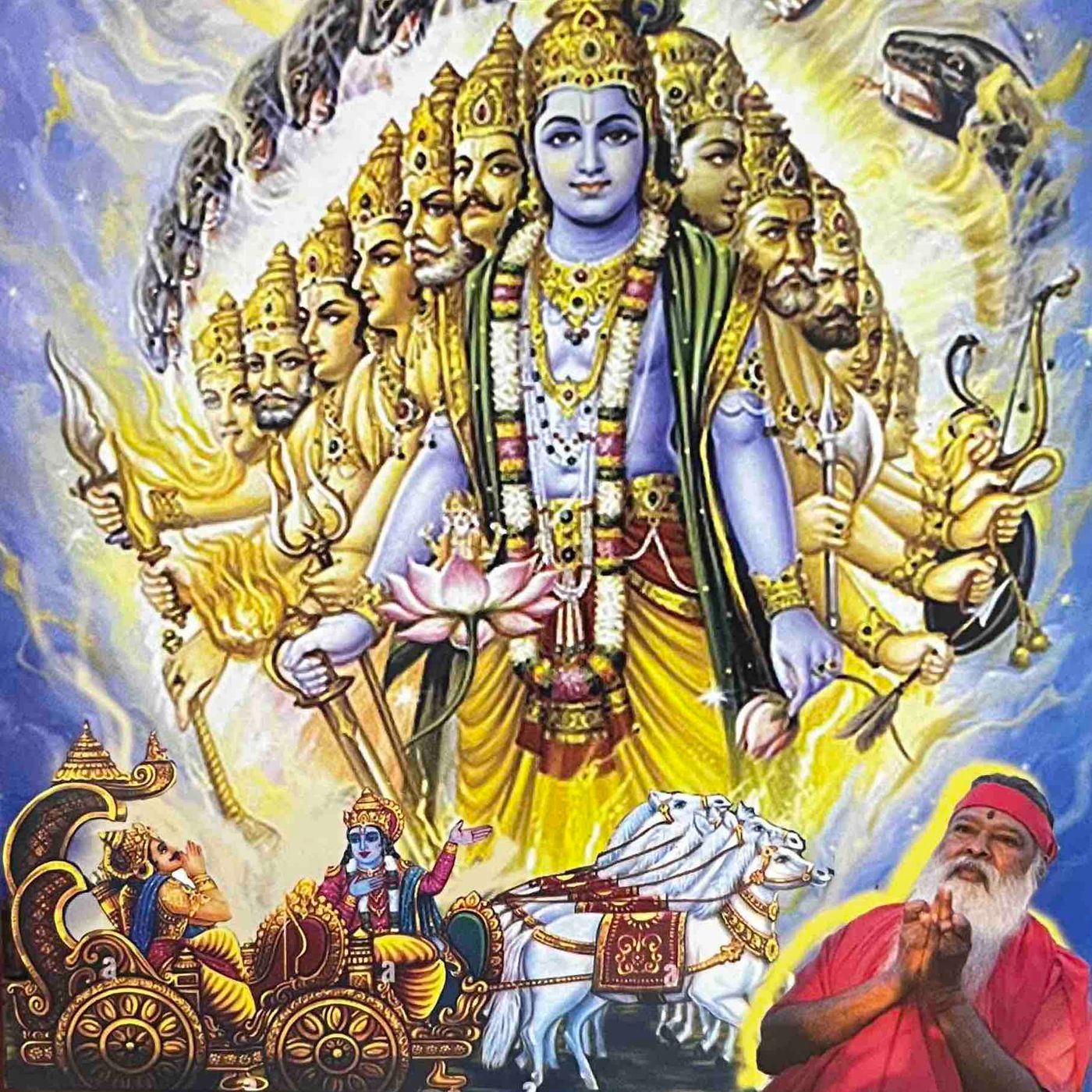
Gita Swara Prastaaram - The meaning of Bhagavad Gita
by Sri Sri Sri Ganapathy Sachchidananda Swamiji
The Pontiff of Avadhoota Datta Peetham, His Holiness Sri Sri Sri Ganapathy Sachchidananda Swamiji, has expounded on the meaning of Bhagavad Gita in Telugu language. A three volume set of books has been published for the benefit of mankind. We are offering a voluntary service (seva) to record it for listeners who cannot read Telugu with the intent that they should not miss out on the opportunity of tasting this divine nectar.
-
29
Bhagavad Gita_Chapter 2_Shloka 9, 10
Arjuna gives up fighting even after submitting to Lord Krishna, so the Lord cheekily says to Arjuna that he is talking like a great scholar while grieving for others when he is not supposed to.
-
28
Bhagavad Gita_Chapter 2_Shloka 7, 8
Arjuna realises he is overcome with an uncharacteristic despondency so powerful that he is unable to choose the righteous path that is best for him. So he seeks refuge in Krishna as his Guru to guide him.
-
27
Bhagavad Gita_Chapter 2_Shloka 5, 6
Arjuna is putting forth the doubts and concerns clouding his mind.
-
26
Bhagavad Gita_Chapter 2_Shloka 3, 4
Lord Krishna reprimands Arjuna to cast away despondency and encourages him to stand firm. Arjuna laments that he cannot bear to slay his own grandfather and teacher.
-
25
Bhagavad Gita_Chapter 2_Shloka 1, 2
Chapter 2 commences with Sanjaya setting that context that Lord is about to speak to a distraught Arjuna. Lord begins with clearly disagreeing with Arjuna in a disapproving tone.
-
24
Bhagavad Gita_Chapter 1_Conclusion_Part 3
Chapter 1 conclusion commentary Part 3 tells us about a story from Padma Purana that illustrates the benefits of chanting the Chapter 1.
-
23
Bhagavad Gita_Chapter 1_Conclusion_Part 2
The Part 2 of the concluding commentary on Chapter 1 gives insight into how Arjuna's dejection can be called a Yoga, the significance of the number 18 in Bhagavadgita, Mahabharata and the Puranas.
-
22
Bhagavad Gita_Chapter 1_Conclusion_Part 1
In the Chapter 1 conclusion, it is explained how Bhagavadgita is an Upanishad, which contains knowledge about Brahman, and is also a Yogic science.
-
21
Bhagavad Gita_Chapter 1_Shlokas 46,47
Arjuna prefers giving up fighting and die at the hands of Kauravas rather than striking back. Overcome with emotion, he slumps down in his chariot unable to attack.
-
20
Bhagavad Gita_Chapter 1_Shlokas 44,45
“Despite knowledge that future generations rot in hell when Dharma in dynasties crumble, what a great sin we are about to commit due to greed for kingdom and riches!” exclaims Arjuna.
-
19
Bhagavad Gita_Chapter 1_Shlokas 42,43
When there is adulteration in the social structure, the future generations will be relagated to hell due of lack of ancestral rites, which in turn leads to the crumbling of Dharma.
-
18
Bhagavad Gita_Chapter 1_Shlokas 40,41
Furthering his case, Arjuna avers that when the important men in a dynasty die, unrighteousnes takes root, first affecting the women ultimtely leading to moral depravation in society.
-
17
Bhagavad Gita_Chapter 1_Shlokas 38,39
Defending his thought process Arjuna tries to make a case against killing relatives even though they were sinners. Layered meaning throws light on Arjuna's unequanimous state of mind.
-
16
Bhagavad Gita_Chapter 1_Shlokas 36,37
Arjuna is despondent feeling nothing good is going to come from kiling the Kauravas. The layered meaning shows how Arjuna's distress has distorted his thinking.
-
15
Bhagavad Gita_Chapter 1_Shlokas 34,35
Arjuna sees his preceptors and close relatives in the Kaurava army; he is not ready to strike even if attacked by them, not even for lordship over heavens, let alone for mere earthly kingdom.
-
14
Bhagavad Gita_Chapter 1_Shlokas 32,33
Arjuna struggles to see the purpose behind waging this war which is going to result in a massacre of all near and dear. Even a victory in this war seems like a loss to him.
-
13
Bhagavad Gita_Chapter 1_Shlokas 30,31
Distraught Arjuna says his great bow Gandeeva is slipping from his hands and he is seeing bad omens indicating an impending massacre of his own kith and kin.
-
12
Bhagavad Gita_Chapter 1_Shlokas 26,27,28,29
Arjuna takes a look at the Kaurva army and instead of seeing warriors, he sees them as his kinsmen who are about to get slain by him, and becomes distraught.
-
11
Bhagavad Gita_Chapter 1_Shlokas 23,24,25
Arjuna wants to look at the people who came in support of Duryodhana despite his evil intentions. Lord Krishna stations the chariot in between the two armies and asks Arjuna to take a good look.
-
10
Bhagavad Gita_Chapter 1_Shlokas 19,20,21,22
The Pandava side instills fear in Kauravas. And Arjuna asks Lord Krishna to station the chariot exactly in between both the armies for him to take a good look at the people who came to battle him.
-
9
Bhagavad Gita_Chapter 1_Shlokas 17,18
The main warriors of Pandava side are introduced in the shlokas 17 and 18.
-
8
Bhagavad Gita_Chapter 1_Shlokas 15,16
The significance and the inner meaning of the conches blown by Lord Krishna and the Pandavas is explained in the commentary on shlokas 15 and 16.
-
7
Bhagavad Gita_Chapter 1_Shlokas 13,14
The introduction to Kaurava side concludes and the introduction to Pandava side begins. The layered meaning immediately underlines the contrast between the two sides starting with the way they are introduced.
-
6
Bhagavad Gita_Chapter 1_Shlokas 9,10,11,12
Duryodhana's boastful nature, his insecurities and duplicity can be seen in the meanings of shlokas 9,10,11,12.
-
5
Bhagavad Gita_Chapter 1_Shlokas 7,8
Duryodhana's bias towards his people, his over confidence in some of them, his glaring lack of respect towards elders, and interpersonal relationships are elucidated in the meaning of Shlokas 7 & 8.
-
4
Bhagavad Gita_Chapter 1_Shlokas 3,4,5,6
The failings of Duryodhana's character such as his egoistic attitude, over confidence, anxiety, envy and so on can be observed in the layered meanings of these shlokas.
-
3
Bhagavad Gita_Chapter 1_Shlokas 1 & 2
The introduction and context setting of Bhagavad Gita, the interpretation of its layered meaning and the lyrical and tattvik meanings of shlokas 1 and 2
-
2
Gita Mahatmyam
The effect/eminence/fruit of chanting Bhagavad Gita has been explained by Sri Varaha Swamy to Sri Bhu Mata in Varaha Puranam as Gita Mahatmyam. This needs to be chanted after chanting Bhagavad Gita to obtain fullest blessings.
-
1
Dhyana Shlokas
Meanings of the prayer verses that are chanted before commencing the chanting of Bhagavadgita.
We're indexing this podcast's transcripts for the first time — this can take a minute or two. We'll show results as soon as they're ready.
No matches for "" in this podcast's transcripts.
No topics indexed yet for this podcast.
Loading reviews...
ABOUT THIS SHOW
The Pontiff of Avadhoota Datta Peetham, His Holiness Sri Sri Sri Ganapathy Sachchidananda Swamiji, has expounded on the meaning of Bhagavad Gita in Telugu language. A three volume set of books has been published for the benefit of mankind. We are offering a voluntary service (seva) to record it for listeners who cannot read Telugu with the intent that they should not miss out on the opportunity of tasting this divine nectar.
HOSTED BY
Sri Sri Sri Ganapathy Sachchidananda Swamiji
CATEGORIES
Loading similar podcasts...
Frequently Asked Questions
How many episodes does Gita Swara Prastaaram - The meaning of Bhagavad Gita have?
Gita Swara Prastaaram - The meaning of Bhagavad Gita currently has 29 episodes available on PodParley. New episodes are automatically indexed when they're published to the podcast feed.
What is Gita Swara Prastaaram - The meaning of Bhagavad Gita about?
The Pontiff of Avadhoota Datta Peetham, His Holiness Sri Sri Sri Ganapathy Sachchidananda Swamiji, has expounded on the meaning of Bhagavad Gita in Telugu language. A three volume set of books has been published for the benefit of mankind. We are offering a voluntary service (seva) to record it for...
How often does Gita Swara Prastaaram - The meaning of Bhagavad Gita release new episodes?
Gita Swara Prastaaram - The meaning of Bhagavad Gita has 29 episodes. Check the episode list to see recent publication dates and frequency.
Where can I listen to Gita Swara Prastaaram - The meaning of Bhagavad Gita?
You can listen to Gita Swara Prastaaram - The meaning of Bhagavad Gita on PodParley by clicking any episode. We provide an embedded audio player for direct listening, and you can also subscribe via your preferred podcast app using the RSS feed.
Who hosts Gita Swara Prastaaram - The meaning of Bhagavad Gita?
Gita Swara Prastaaram - The meaning of Bhagavad Gita is created and hosted by Sri Sri Sri Ganapathy Sachchidananda Swamiji.
URL copied to clipboard!