
PODCAST · history
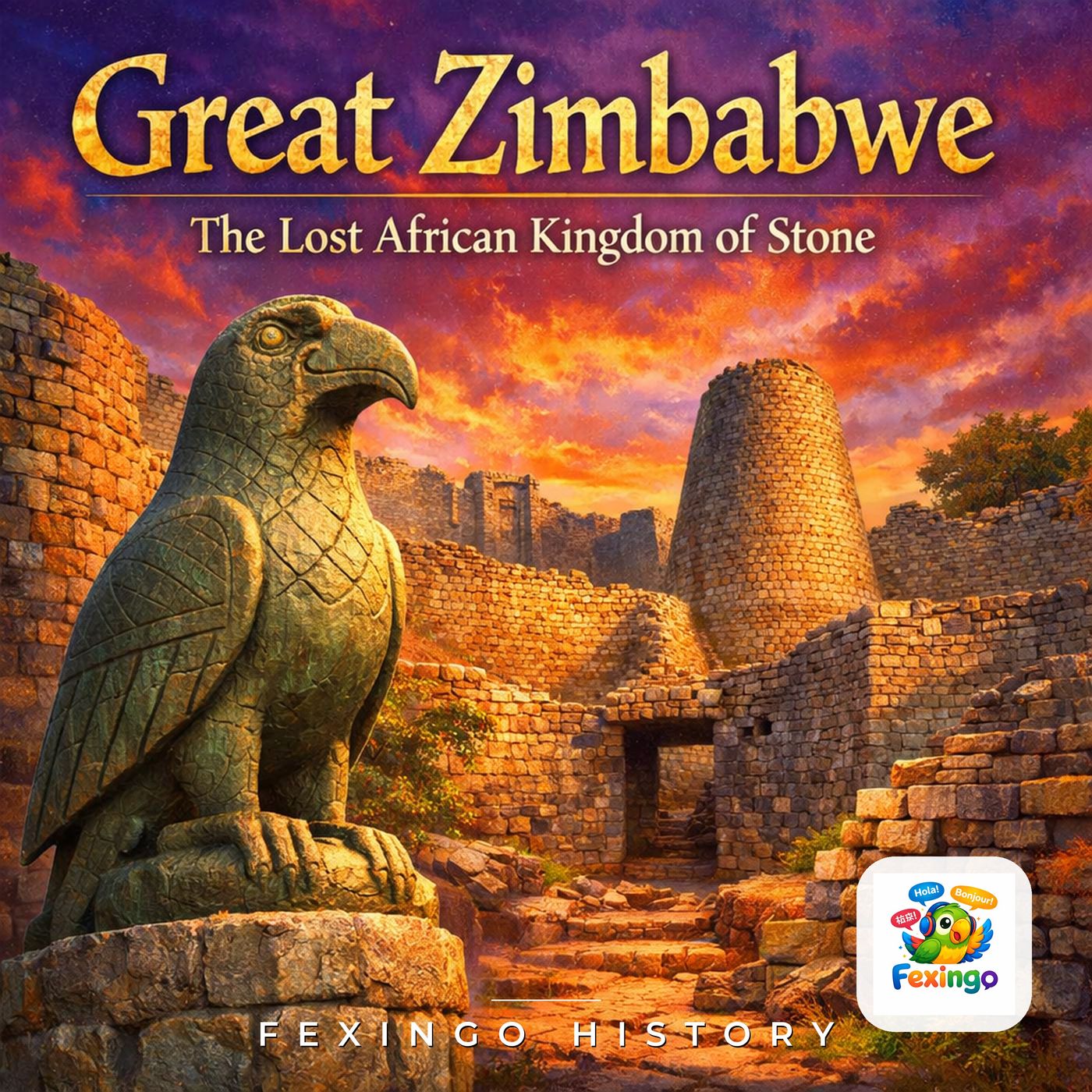
Great Zimbabwe: The Lost African Kingdom of Stone — Fexingo History
by Fexingo
Perched on a windswept plateau in southern Africa, Great Zimbabwe stands as the continent's most monumental pre-colonial stone city — a testament to the ingenuity of the Shona civilization that built it between the 11th and 15th centuries. This show, hosted by Lucas and Luna, delves into the rise of the Kingdom of Zimbabwe, from its origins as a modest ironworking settlement to its zenith as a trading power whose gold and ivory reached as far as China and Persia. We explore the architectural marvel of the Great Enclosure, with its dry-stone walls rising 11 meters high, and the enigmatic soapstone birds that have become the nation's emblem. We confront the colonial erasure of African civilization: how Portuguese explorers and later Cecil Rhodes' British South Africa Company dismissed Great Zimbabwe as the work of Phoenicians or Arabs, a racist fiction that persisted into the 20th century. Through archaeology, oral traditions, and recent DNA studies, we piece together the kingdom's court
-
35
Great Zimbabwe's Mambo Chikanda and the Elephant Hunt Protocol of 1317
In 1317, Mambo Chikanda faced a crisis that threatened the spiritual and economic foundations of Great Zimbabwe: the disruption of the elephant hunt. For generations, the vaShona had conducted organized hunts, with the ivory trade from Sofala and Kilwa underpinning the kingdom's wealth. But a rogue elephant herd, led by an unusually aggressive bull, began terrorizing the cattle danga and destroying crops. The mambo, advised by the nganga and svikiro, declared a royal hunt, but the protocols governing who could kill an elephant—and how the ivory was divided—were ancient and strict. This episode follows the conflict between the mambo's authority, the hunting guilds, and the spirit mediums who insisted that a sacred mandate was needed. We explore the actual hunt, the political maneuvering, and how the crisis revealed tensions between the Hill Complex and the Great Enclosure. The episode also covers the ritual role of the elephant in vaShona cosmology, and how the ivory trade connected Great Zimbabwe to the wider Indian Ocean world. #GreatZimbabwe #MamboChikanda #vaShona #IvoryTrade #ElephantHunt #Sofala #Kilwa #Nganga #Svikiro #Mhondoro #HillComplex #GreatEnclosure #Danga #IndianOcean #AfricanHistory #SouthernAfrica #History #FexingoHistory Keep every episode free: buymeacoffee.com/fexingo
-
34
Great Zimbabwe's Mambo Gara and the Matopo Hills Water Crisis
In this episode, Lucas and Luna examine the environmental catastrophe that struck Great Zimbabwe in 1285: a severe drought that pushed Mambo Gara and his advisors into desperate measures. They explore how the svikiro spirit mediums turned to the Mwari cult at the Matopo Hills, the role of the mhondoro lion spirits in rainmaking ceremonies, and the controversial human sacrifices that accompanied the drought-breaking rituals. The episode also delves into the sociological impact—how dwindling cattle herds eroded the danga economy, strained the tribute system, and exposed tensions between the Hill Complex elite and the commoners in the Valley Complex. Lucas explains the significance of the Zimbabwe bird as a rain-bringer and how the drought reshaped Great Zimbabwe's political landscape, setting the stage for later shifts in power. A vivid look at how a medieval African kingdom confronted climate crisis through faith, politics, and survival. #GreatZimbabwe #MamboGara #MatopoHills #Drought #Svikiro #Mhondoro #Mwari #Rainmaking #HumanSacrifice #DangaEconomy #HillComplex #ValleyComplex #ZimbabweBird #ClimateCrisis #MedievalAfrica #VaShona #History #FexingoHistory Keep every episode free: buymeacoffee.com/fexingo
-
33
Great Zimbabwe Mambo Ndabaningi and the Cloth Trade Rebellion of 1295
In 1295, Mambo Chitono faced a rebellion sparked by his decision to centralize the cloth trade, cutting out local chiefs and angering the nganga. But the real story is about Mambo Ndabaningi, his half-brother and rival, who led the uprising. This episode dives into the political intrigue, the role of the muraya courtiers, and how the rebellion reshaped Great Zimbabwe's trade networks with Kilwa and Sofala. We also explore the svikiro spirit mediums who backed Ndabaningi, and the aftermath that saw the Great Enclosure expanded. A tale of power, cloth, and betrayal in 13th-century Southern Africa. #GreatZimbabwe #MamboNdabaningi #MamboChitono #ClothTrade #Rebellion #1295 #Svikiromediums #Murayacourtiers #Ngangas #Sofala #Kilwa #GreatEnclosure #HillComplex #vaShona #Zimbabwe #GoldenAge #History #FexingoHistory Keep every episode free: buymeacoffee.com/fexingo
-
32
Great Zimbabwe's Mambo Nemakonde and the Poison Ordeal of 1297
In Episode 100, Lucas and Luna return to the reign of Mambo Nemakonde, but from a fresh angle: the elaborate system of legal trials and oath-taking that held Great Zimbabwe together. While earlier episodes touched on the poison ordeal of succession, this episode dives into a specific case from 1297, when a prominent dzimbabwe headman named Chisunga was accused of witchcraft and forced to undergo the mupfura poison test. Lucas explains how the nganga administered the ordeal, the role of the svikiro spirit medium in interpreting the results, and the political fallout when Chisunga survived — which was taken as proof of his innocence but also as a sign that Nemakonde's authority was slipping. The conversation also covers the broader legal culture of the vaShona: how oaths were sworn on sacred objects like the Zimbabwe bird soapstone carvings, how trade disputes with Sofala and Kilwa were adjudicated, and how the mambo's court functioned as both a judicial and spiritual center. Luna asks sharp questions about the reliability of ordeal justice and how it compared to other African legal traditions. The episode ends with a reflection on what the ruins of the Great Enclosure tell us about the spatial organization of justice — where the mambo sat, where the nganga performed rituals, and where the accused waited. #GreatZimbabwe #MamboNemakonde #PoisonOrdeal #Mupfura #Nganga #Svikiro #VaShona #ZimbabweBird #GreatEnclosure #HillComplex #Sofala #Kilwa #AfricanHistory #MedievalAfrica #LegalHistory #WitchcraftTrials #History #FexingoHistory Keep every episode free: buymeacoffee.com/fexingo
-
31
Great Zimbabwe's Mambo Chikanda and the Gold Embargo of 1320
In 1320, Mambo Chikanda, ruler of Great Zimbabwe, imposed a gold embargo that reshaped southern African trade. This episode explores the economic and political pressures that led to the decision, the role of the nganga (spirit mediums) in advising the mambo, and the impact on the Indian Ocean trade networks centered at Sofala and Kilwa. We examine how the embargo affected the vaShona chiefdoms, the rise of competing gold routes, and the eventual collapse of the policy. Along the way, we meet the mhondoro spirits, the sacred Zimbabwe bird, and the mambo's dhlandhlo council. This is a story of wealth, power, and the fragile balance between tradition and commerce in medieval Zimbabwe. #GreatZimbabwe #MamboChikanda #GoldEmbargo #1320 #Sofala #Kilwa #vaShona #nganga #mhondoro #ZimbabweBird #HillComplex #GreatEnclosure #IndianOceanTrade #MedievalAfrica #AfricanHistory #TradeHistory #History #FexingoHistory Keep every episode free: buymeacoffee.com/fexingo
-
30
Great Zimbabwe's Mambo Chitono and the Cloth Trade Rebellion
In Episode 97 of our Great Zimbabwe series, we explore the Cloth Trade Rebellion of the early 1300s, when Mambo Chitono faced a crisis that threatened the kingdom's economic foundation. Trade in cloth from the Swahili coast—especially from Sofala and Kilwa—was central to Great Zimbabwe's wealth, used for everything from daily wear to royal regalia and bride-price. But when Mambo Ndabaningi, a regional governor, began hoarding cloth and manipulating prices, Chitono had to act. We discuss the role of the muraya (royal council) and the nganga (spirit mediums), the complex network of trade routes linking the interior to the Indian Ocean, and the rebellion that nearly tore the kingdom apart. We also touch on the symbolic importance of cloth, the use of copper and gold in trade, and the delicate balance of power between the mambo and his chiefs. A key episode in understanding the economic and political dynamics of Great Zimbabwe. #GreatZimbabwe #MamboChitono #ClothTradeRebellion #MamboNdabaningi #Sofala #Kilwa #muraya #nganga #vaShona #dzimbabwe #IndianOceanTrade #SouthernAfrica #MedievalAfrica #1300s #EconomicHistory #AfricanKingdoms #History #FexingoHistory Keep every episode free: buymeacoffee.com/fexingo
-
29
Mambo Rusvingo's Stone Guilds and the Conical Tower
In this episode, Lucas and Luna explore the engineering marvels of Great Zimbabwe's stone masonry, focusing on the reign of Mambo Rusvingo and the specialized stone guilds he organized. They discuss how these guilds, known as vaShona masons, developed advanced techniques for shaping and fitting granite blocks without mortar, creating the iconic Conical Tower and the towering walls of the Great Enclosure. The episode delves into the spiritual significance of the tower, the role of the svikiro spirit mediums in blessing construction, and the economic factors that funded these monumental projects, including gold trade with Sofala and Kilwa. Lucas explains the training of apprentices, the hierarchical structure of the guilds, and the legacy of their work, which continued to inspire later Rozvi and Mutapa stone building. The conversation also touches on the decline of the tradition as trade routes shifted and political power moved north, leaving the stone city to stand as a testament to Shona ingenuity. #GreatZimbabwe #MamboRusvingo #StoneMasonGuilds #ConicalTower #GreatEnclosure #vaShona #svikiro #GoldTrade #Sofala #Kilwa #ShonaArchitecture #MedievalAfrica #SouthernAfrica #ZimbabweHistory #MutapaEmpire #Rozvi #StoneMasonry #FexingoHistory Keep every episode free: buymeacoffee.com/fexingo
-
28
Great Zimbabwe's Mambo Gara and the Year the Rivers Ran Dry
In 1315, the rains failed at Great Zimbabwe. Mambo Gara faced not just a drought but a crisis of legitimacy. This episode follows Gara's desperate measures: opening the royal grain stores, sending nganga rainmakers to the Matopo Hills, and confronting the svikiro spirit mediums who questioned his right to rule. We explore the brutal logic of redistributing cattle during famine, the collapse of trust in the mhondoro ancestors, and the forgotten ritual of the 'year of weeping' where the king himself walked barefoot to the shrines. How did a king hold his kingdom together when even the spirits seemed silent? The answer lies in dry riverbeds, cracked earth, and the resilience of the vaShona. No prior episodes needed—we refresh the context naturally as we go. #GreatZimbabwe #MamboGara #Drought #ClimateHistory #MatopoHills #Shona #Mwari #Svikiro #Mhondoro #Nganga #Rainmaking #Famine #Cattle #ZimbabweBird #HillComplex #GreatEnclosure #History #FexingoHistory Keep every episode free: buymeacoffee.com/fexingo
-
27
Great Zimbabwe's Mambo Chisamuturu and the Iron Oath of 1258
In this episode, Lucas and Luna explore a pivotal event that solidified royal authority at Great Zimbabwe: the Iron Oath of 1258, sworn by Mambo Chisamuturu and his war council before a campaign against the Torwa. The oath, sealed with blood and rust from a sacred iron spear, bound every warrior to death before retreat. We unravel the ritual's deeper meaning—how the nganga forged the spear from meteoritic iron, how the svikiro channeled Mwari's will, and how Chisamuturu used this ceremony to unite fractious clans. The episode also examines the political fallout: the oath established a precedent for absolute loyalty, centralizing power in the mambo and reducing the influence of rival chieftains. Lucas explains the role of dhlandhlo spirit mediums in legitimizing the oath, and how the iron spear became a symbol of the mambo's authority, eventually housed in the Great Enclosure. The conversation touches on comparisons to similar oath-taking traditions across Africa, and why this moment marked a turning point in Great Zimbabwe's rise as a regional power. A must-listen for anyone fascinated by the rituals and politics of medieval African kingdoms. #GreatZimbabwe #MamboChisamuturu #IronOath #1258 #Torwa #nganga #svikiro #Mwari #dhlandhlo #GreatEnclosure #Shona #History #FexingoHistory #AfricanHistory #MedievalAfrica #Ritual #IronSpear #SouthernAfrica Keep every episode free: buymeacoffee.com/fexingo
-
26
Great Zimbabwe's Mambo Dandaro and the Gold Fraud of 1310
In 1310, Great Zimbabwe's gold trade with the Swahili coast was rocked by a scandal that reached the Mambo's court. This episode tells the story of Mambo Dandaro's crackdown on the kiln owners who secretly alloyed copper with gold dust, cheating Indian Ocean merchants and risking the kingdom's hard-won reputation. We follow the investigation led by the muraya, the master of weights, and the nganga who tested metal purity using fire and herbal acids. The fraudsters were caught, their kilns smashed, and the adulterated gold was melted down in public, but the question of trust lingered. How did the Mambo restore confidence in Zimbabwe gold? And what does this episode reveal about the sophisticated economic systems of medieval Southern Africa? #GreatZimbabwe #MamboDandaro #GoldFraud #1310 #ShonaHistory #IndianOceanTrade #Sofala #Kilwa #Muraya #Nganga #GoldTrade #MedievalAfrica #SwahiliCoast #ZimbabweGold #CopperSmelting #EconomicHistory #History #FexingoHistory Keep every episode free: buymeacoffee.com/fexingo
-
25
Great Zimbabwe's Mambo Rusvingo and the Stone Mason Guilds
In this episode, we explore the hidden world of the stone masons who built Great Zimbabwe's iconic walls. Lucas and Luna uncover the role of Mambo Rusvingo, a legendary master builder who may have organized the first guild of stone workers around 1250 CE. We discuss the techniques used to create the dry-stone walls, the social status of masons, the training of apprentices, and the spiritual rituals that accompanied construction. The episode also touches on how the masons' knowledge was passed down through generations and how their work symbolized the power of the Mambo. Finally, we consider the mystery of why this masonry tradition declined after Great Zimbabwe's fall, and what modern archaeologists have discovered about these ancient craftsmen. A rare look at the hands that shaped the stone kingdom. #GreatZimbabwe #MamboRusvingo #StoneMasonGuilds #DryStoneMasonry #ShonaArchitecture #MedievalAfrica #GreatEnclosure #HillComplex #ValleyComplex #Archaeology #ZimbabweBird #Soapstone #Craftsmanship #OralTradition #SouthernAfrica #History #FexingoHistory #AncientEngineering Keep every episode free: buymeacoffee.com/fexingo
-
24
Great Zimbabwe's Mambo Dandaro and the Gold Weights Scandal
In this episode, Lucas and Luna explore a forgotten economic crisis at Great Zimbabwe: the gold weights scandal of the late 13th century. They focus on Mambo Dandaro, a ruler who confronted systemic fraud in the gold trade that threatened the kingdom's reputation with Swahili Coast merchants. The conversation covers the muraya trade corridors from Great Zimbabwe to Sofala, the role of the nganga in verifying gold purity, and the introduction of standardized soapstone weights stamped with the Zimbabwe bird. They discuss how Dandaro's reforms—including public weight inspections and executions of corrupt officials—restored trust but also centralized power in ways that later contributed to the rise of the Mutapa state. The episode draws on archaeological evidence from the Hill Complex and Great Enclosure, as well as oral traditions about the mhondoro spirits that legitimized Dandaro's crackdown. A specific detail: the discovery of mismatched weight sets in the ruins suggests the fraud was widespread, involving even svikiro mediums. The hosts also touch on the diplomatic fallout with Kilwa, whose merchants briefly boycotted Great Zimbabwe's gold. #GreatZimbabwe #MamboDandaro #GoldWeights #FraudScandal #Sofala #Kilwa #SwahiliCoast #muraya #nganga #svikiro #mhondoro #ZimbabweBird #Soapstone #HillComplex #GreatEnclosure #Mutapa #History #FexingoHistory Keep every episode free: buymeacoffee.com/fexingo
-
23
Great Zimbabwe's Soapstone Birds: Spirit Messengers of the Mambo
In this episode, Lucas and Luna explore the iconic soapstone birds of Great Zimbabwe—the seven carved birds discovered in the ruins, now a national symbol. They discuss their discovery by European antiquarians in the late 19th century, their possible meanings as spirit messengers (svikiro) linking the Mambo to the ancestors, and the debate over whether they represent bateleur eagles, fish eagles, or hornbills. The hosts touch on the birds' placement on monoliths, their connection to the Mwari cult, and the significance of the crocodile and other motifs. They also examine how one bird was taken to South Africa and only returned in 2003. The conversation weaves in recent archaeological theories about the birds' role in royal rituals and the legitimation of power at Great Zimbabwe. #GreatZimbabwe #SoapstoneBird #ZimbabweBird #BateleurEagle #Svikiro #Mwari #Mambo #AfricanHistory #Archaeology #MedievalAfrica #ShonaHistory #SpiritMessengers #HillComplex #GreatEnclosure #Monolith #CulturalHeritage #FexingoHistory #History Keep every episode free: buymeacoffee.com/fexingo
-
22
Great Zimbabwe's Mambo Shumba and the War with Mapungubwe
In the early 1300s, Great Zimbabwe faced its greatest military challenge yet: the kingdom of Mapungubwe to the south. This episode follows Mambo Shumba, the lion-hearted king who led Zimbabwe's armies against a rival that once dominated the southern African gold trade. We explore the causes of the conflict—competition for Indian Ocean trade routes, control of the Limpopo River crossing, and a generations-old rivalry between two Shona dynasties. Lucas walks us through the decisive battle at the Limpopo Drift, where Shumba's forces used strategic deception and the rugged terrain to break Mapungubwe's power. We also unpack the aftermath: how Zimbabwe absorbed Mapungubwe's trading networks, why the kingdom declined, and how this war reshaped the political landscape of southern Africa for centuries. Featuring details on Shona military tactics, the role of spirit mediums (mhondoro), and the economic stakes that made this conflict inevitable. A story of ambition, strategy, and the rise of a regional superpower. #GreatZimbabwe #Mapungubwe #MamboShumba #LimpopoDrift #ShonaMilitary #Mhondoro #IndianOceanTrade #GoldTrade #Sofala #Kilwa #ZimbabweHistory #SouthernAfrica #AfricanKingdoms #MedievalAfrica #Battle #History #FexingoHistory #AfricanHistory Keep every episode free: buymeacoffee.com/fexingo
-
21
Great Zimbabwe's Ironworkers: The Secrets of Ancient Metallurgy
While Great Zimbabwe is famous for its towering stone walls, the kingdom's wealth was built on iron. This episode explores the sophisticated ironworking techniques of the Shona people, from mining and smelting to forging tools and weapons. Lucas and Luna discuss the bloomery process, the role of iron in trade and agriculture, and the spiritual significance of the forge. They also examine the evidence for iron production at Great Zimbabwe, including furnaces and slag heaps found at the site, and how control over iron resources helped centralize power in the hands of the mambo. Learn about the specialized knowledge of the blacksmiths, who were both skilled artisans and ritual specialists. This episode sheds light on a crucial but often overlooked aspect of Great Zimbabwe's economy and society. #GreatZimbabwe #Ironworking #Shona #AfricanMetallurgy #BloomeryProcess #AncientTechnology #Mambo #IronAgeAfrica #Archaeometallurgy #Forging #Smelting #Trade #ZimbabwePlateau #AfricanHistory #PrecolonialAfrica #Blacksmith #History #FexingoHistory #ShonaCivilization #MedievalAfrica Keep every episode free: buymeacoffee.com/fexingo
-
20
Great Zimbabwe's Lost City: The Fall of the Torwa Dynasty
In the 15th century, as Great Zimbabwe declined, a new kingdom rose in the southwest: the Torwa state, centered at Khami. This episode explores the Torwa dynasty's rise, their distinctive architecture, and their eventual absorption by the Rozvi under Changamire Dombo. Lucas and Luna discuss the archaeological evidence at Khami—the platform walls, the chevron patterns, the terraced hills—and what it reveals about Torwa's political and economic power. They delve into the role of the Mwari cult in legitimizing Torwa rule, the shifting trade routes from the Indian Ocean, and the contested history of the dynasty's origins. Was Torwa a direct successor to Great Zimbabwe, or a separate Shona state? What happened to its people after the Rozvi conquest? Drawing on recent excavations and oral traditions, this episode pieces together the story of a lost kingdom that once rivaled its predecessor in stone and gold. #Torwa #Khami #GreatZimbabwe #Shona #Rozvi #ChangamireDombo #Mwari #ZimbabwePlateau #StoneArchitecture #AfricanHistory #Archaeology #OralTraditions #GoldTrade #15thCentury #16thCentury #SouthernAfrica #History #FexingoHistory #ShonaCivilization #MedievalAfrica Keep every episode free: buymeacoffee.com/fexingo
-
19
Great Zimbabwe's Forgotten Farmers: The Agrarian Revolution
We often think of Great Zimbabwe as a city of stone and gold, but its foundation was agriculture. In this episode, Lucas and Luna explore the farming practices that sustained the kingdom for centuries: the cultivation of sorghum, millet, and cowpeas, the use of iron hoes and cattle manure, and the ingenious dry-stone terraces that transformed the Zimbabwe Plateau into a breadbasket. They discuss how climate shifts and soil exhaustion may have contributed to the kingdom's decline, and what archaeological evidence—from grain bins to pollen cores—reveals about daily life. Along the way, they touch on the role of the mambo in controlling food distribution, the sacred importance of the first harvest, and the resilience of Shona farming traditions that persist today. #GreatZimbabwe #Shona #Agriculture #IronAge #Sorghum #Millet #Cowpeas #Terraces #ClimateChange #SoilExhaustion #Mambo #FirstHarvest #ZimbabwePlateau #Archaeology #PollenCore #FoodSecurity #History #FexingoHistory #ShonaCivilization #MedievalAfrica Keep every episode free: buymeacoffee.com/fexingo
-
18
The Mwari Cult: Great Zimbabwe's Hidden Religion
In this episode of Fexingo History, Lucas and Luna explore the spiritual heart of the Kingdom of Great Zimbabwe: the Mwari cult. They delve into how this ancient religion, centered on a supreme god communicated through oracles and possessed mediums (svikiro), shaped political power for centuries. The conversation traces Mwari's origins before Great Zimbabwe, its role in legitimizing the mambo (kings), and its surprising survival after the kingdom's collapse. They discuss the cult's revival under the Rozvi Empire in the 17th century, its shrine at Matonjeni (the Matopos Hills), and how the Mwari oracle resisted Portuguese and later European colonization. Lucas explains the secret councils that controlled access to the oracle, the rituals of pilgrimage, and the annual rain ceremonies that united diverse Shona groups. Luna asks about Mwari's transformation from a royal cult to a popular religion of resistance, and Lucas reveals how the British eventually suppressed it in the 1890s, only for it to re-emerge in the 20th century as a symbol of Zimbabwean identity. The episode ends with a reflection on how the stones of Great Zimbabwe echo with a faith that outlasted empires. #Mwari #GreatZimbabwe #ShonaReligion #Svikiro #Matonjeni #RozviEmpire #Mambo #AfricanHistory #OralTradition #RainCeremonies #PortugueseColonialism #Zimbabwe #MatoposHills #SupremeGod #OracleCult #Resistance #SpiritMediums #History #ShonaCivilization #MedievalAfrica Keep every episode free: buymeacoffee.com/fexingo
-
17
The Portuguese Siege of Masangano: Great Zimbabwe's Final Stand
In this episode, Lucas and Luna explore the dramatic Portuguese siege of Masangano in 1633, a pivotal moment that led to the collapse of the Mutapa Empire and the end of Great Zimbabwe's influence. They discuss the role of the Mambo, the Shona resistance led by Mwene Mutapa Gatsi Rusere, the strategic use of the dzimbabwe fortresses, and the betrayal that allowed the Portuguese to breach the walls. The episode also touches on the aftermath: the rise of the Rozvi under Changamire Dombo, the decline of Swahili trade, and the lasting legacy of the stone kingdom. Listeners will learn about key figures, weapons, and tactics, as well as the archaeological evidence that confirms this lesser-known battle. #Masangano #PortugueseSiege #MutapaEmpire #GatsiRusere #ChangamireDombo #Rozvi #Shona #Mambo #Dzimbabwe #GreatZimbabwe #Sofala #SwahiliCoast #1633 #17thCentury #AfricanHistory #ColonialConflict #History #FexingoHistory #ShonaCivilization #MedievalAfrica Keep every episode free: buymeacoffee.com/fexingo
-
16
The Lemba and the Lost Ark of Great Zimbabwe
Episode 19 of Great Zimbabwe: The Lost African Kingdom of Stone takes a fresh look at the Lemba, a southern African people who claim Jewish ancestry and possess a mysterious tradition of a lost ark. We explore their oral history linking them to the ancient kingdom, the genetic evidence of the Cohen Modal Haplotype found in their priests, and the ongoing debate over whether they were the builders or later inheritors of Great Zimbabwe. Lucas and Luna discuss the Lemba's migration stories, their unique cultural practices like endogamy and circumcision, and the controversial theories that connect them to the Queen of Sheba. The episode also examines the Lemba's role in the gold and ivory trade with the Swahili coast, and how their sacred object, the ngoma lungundu, or 'drum of the dead,' may have inspired legends of the Ark of the Covenant. We delve into the history of the Lemba clan identity, their relationship with the Venda and Shona peoples, and the modern efforts to preserve their heritage. This is a nuanced exploration of how genetics, oral tradition, and archaeology intersect in one of Africa's most enduring mysteries. #Lemba #GreatZimbabwe #LostArk #CohenModalHaplotype #NgomaLungundu #Venda #Shona #Zimbabwe #GeneticHistory #OralTradition #AfricanHistory #QueenOfSheba #GoldTrade #SwahiliCoast #AncientMigrations #History #FexingoHistory #Podcast #ShonaCivilization #MedievalAfrica Keep every episode free: buymeacoffee.com/fexingo
-
15
Great Zimbabwe's Mambo: The Sacred Kings Who Ruled the Stone Kingdom
In this episode, Lucas and Luna explore the institution of the Mambo—the sacred hereditary kings who governed Great Zimbabwe and later Shona states. Drawing on oral traditions and archaeological evidence, they discuss how the Mambo combined political authority with religious duties as intermediaries with the high god Mwari. The episode covers the Mambo's role in controlling trade, managing cattle wealth, and performing rituals at the Hill Complex. It also examines the succession disputes and Portuguese accounts that illuminate the Mambo's power. Finally, they consider how the Mambo title and its divine kingship legacy influenced successor states like the Mutapa Empire and the Rozvi kingdom, and how the concept of sacred kingship persists in Shona culture today. #GreatZimbabwe #Mambo #Shona #Mwari #SacredKingship #HillComplex #DivineKings #OralTraditions #ZimbabweHistory #AfricanKingdoms #PortugueseAccounts #CattleEconomy #Trade #Succession #MutapaEmpire #RozviKingdom #History #FexingoHistory #ShonaCivilization #MedievalAfrica Keep every episode free: buymeacoffee.com/fexingo
-
14
Great Zimbabwe's Cattle Economy: Wealth on the Hoof
In this episode, Lucas and Luna explore the central role of cattle in the economy and society of Great Zimbabwe. While gold and ivory trade with the Swahili coast brought immense wealth, it was cattle that formed the bedrock of Shona power and prestige. We look at how cattle were used as currency, symbols of status, and offerings in the Mwari cult. Lucas explains the practice of lobola (bride price), the seasonal grazing patterns that shaped settlement, and how cattle raiding fueled the rise and fall of kingdoms. The conversation touches on the ecological pressures that contributed to Great Zimbabwe's decline, as overgrazing and drought hit the plateau. Specific terms covered include: dzimbabwe (royal court), mambo (chief), svikiro (spirit medium), and the role of the Nanga (rainmaking rituals). We also discuss the archaeological evidence of cattle pens and the importance of the Nguni cattle breed. The episode ties together economic history, environmental science, and cultural anthropology to give a fresh perspective on this iconic African kingdom. #GreatZimbabwe #CattleEconomy #Shona #Mambo #Dzimbabwe #MwariCult #Lobola #NguniCattle #Rainmaking #Svikiro #Nanga #ZimbabwePlateau #AfricanHistory #MedievalAfrica #EnvironmentalHistory #CattleRaiding #Wealth #FexingoHistory #ShonaCivilization #StoneArchitecture Keep every episode free: buymeacoffee.com/fexingo
-
13
Great Zimbabwe's Last Queen: The Female Mambo Who Defied the Portuguese
When the Portuguese arrived on the Zimbabwe Plateau in the 16th century, they encountered a powerful female ruler known to traders as Queen Barwa. This episode explores the life and reign of this mysterious Mambo, who commanded armies, controlled gold trade routes, and defied Portuguese attempts at conquest. We discuss how she rose to power in a patriarchal Shona society, her military strategies against the Portuguese, and the legends that surround her disappearance. Drawing on oral traditions, Portuguese records, and archaeological evidence, we uncover the story of a woman who ruled one of Africa's greatest kingdoms at a time of crisis. This is a tale of power, gender, and resistance in the face of colonial invasion. #GreatZimbabwe #QueenBarwa #Mambo #PortugueseEmpire #Shona #ZimbabweHistory #FemaleRulers #GoldTrade #Sofala #MutapaEmpire #AfricanHistory #ColonialResistance #16thCentury #OralTradition #Archaeology #SoutheastAfrica #ZimbabwePlateau #FexingoHistory #ShonaCivilization #MedievalAfrica Keep every episode free: buymeacoffee.com/fexingo
-
12
The Gold Trade That Built Great Zimbabwe
In this episode, Lucas and Luna explore the economic engine behind Great Zimbabwe's rise: the gold trade. They trace how gold from the Zimbabwe plateau reached the Swahili coast through networks controlled by Shona chiefs, and how this trade connected a landlocked kingdom to the Indian Ocean world. They discuss the role of Sofala as the main port, the types of goods exchanged (Chinese porcelain, Persian beads, Indian cloth), and how control over gold production and trade routes fueled the power of the Mambo. The episode also touches on the social organization of mining, the symbolic use of gold, and the eventual decline of the gold trade due to exhaustion of surface deposits and competition from Portuguese traders. #GoldTrade #GreatZimbabwe #Shona #Sofala #SwahiliCoast #IndianOceanTrade #Mambo #MedievalAfrica #Mining #Porcelain #Beads #Kilwa #Portuguese #Economy #TradeRoutes #History #FexingoHistory #AfricanKingdoms #ShonaCivilization #StoneArchitecture Keep every episode free: buymeacoffee.com/fexingo
-
11
The Mwari Cult and the Rise of the Rozvi Empire
In this episode of Fexingo History, Lucas and Luna explore the role of the Mwari cult in shaping the political and military history of southern Africa after Great Zimbabwe's decline. They trace how the shrine of Mwari at Matonjeni became a center of oracular authority, influencing the rise of the Rozvi Empire under Changamire Dombo in the 17th century. The conversation covers the cult's origins among the Shona and Venda peoples, its structure of priestly intermediaries (svikiro), and how Dombo used religious legitimacy to unite disparate groups and resist Portuguese encroachment. They discuss the battle at Masangano in 1693, where Dombo's forces used guerrilla tactics to defeat the Portuguese, and the subsequent Rozvi hegemony that lasted until the 1830s. Lucas explains the cult's role in rainmaking, healing, and moral guidance, and how it adapted to the upheavals of the slave trade and colonial contact. The episode also touches on the legacy of Mwari worship in modern Zimbabwe and its connections to earlier Great Zimbabwe traditions. A nuanced look at the intersection of faith, power, and resistance in pre-colonial Africa. #Mwari #RozviEmpire #ChangamireDombo #GreatZimbabwe #Shona #Venda #Matonjeni #Svikiro #Masangano #PortugueseEmpire #AfricanHistory #MilitaryHistory #ReligiousHistory #17thCentury #Zimbabwe #PreColonialAfrica #History #FexingoHistory #ShonaCivilization #MedievalAfrica Keep every episode free: buymeacoffee.com/fexingo
-
10
The Rozvi Empire: Great Zimbabwe's Last Defenders
In the aftermath of Great Zimbabwe's decline and the rise of the Mutapa Empire, a new Shona state emerged from the south: the Rozvi. Under the leadership of Changamire Dombo, the Rozvi not only challenged Portuguese dominance on the Zimbabwe plateau but also established a powerful empire that preserved the cultural and architectural traditions of Great Zimbabwe. This episode explores how Changamire Dombo, originally a general under the Mutapa, rebelled and carved out his own kingdom, pushing the Portuguese out of the interior and creating a state that lasted for over a century. We delve into the Rozvi's military tactics, their use of cattle as a symbol of wealth, their religious practices centered on the Mwari cult, and their eventual decline due to internal divisions and competition for trade routes. Central figures include Changamire Dombo himself, his successors, and the Portuguese traders who sought to control the gold and ivory trade. We also examine the Rozvi's relationship with the Torwa state at Khami and how they became the custodians of Great Zimbabwe's legacy. Listeners will gain a deeper understanding of the little-known Rozvi Empire and its role in southern African history. #Rozvi #ChangamireDombo #GreatZimbabwe #Shona #MutapaEmpire #Portuguese #Sofala #Khami #Torwa #Mwari #ZimbabwePlateau #GoldTrade #IvoryTrade #AfricanHistory #PrecolonialAfrica #SouthernAfrica #Empire #FexingoHistory #ShonaCivilization #MedievalAfrica Keep every episode free: buymeacoffee.com/fexingo
-
9
The Great Enclosure: Great Zimbabwe's Architectural Marvel
In this episode, we focus on the Great Enclosure, the largest and most iconic structure at Great Zimbabwe. Built in the 14th century, this massive elliptical wall, over 250 meters in circumference and 11 meters high at points, was constructed without mortar using carefully shaped granite blocks. Lucas and Luna explore the purpose of the Great Enclosure — was it a royal palace, a religious center, or something else? They discuss the conical tower, the chevron pattern decorations, and the narrow passageways that shaped movement within the space. Evidence of soapstone bird stands and imported goods suggests ritual and elite use. They also examine the engineering challenges: how builders managed to raise such walls on uneven terrain and the role of the dolerite stone. The episode touches on comparisons with other structures at the site, like the Hill Complex, and the symbolism of the enclosure as a symbol of Shona royal power. Listeners will gain a deeper understanding of one of Africa's most remarkable precolonial architectural achievements. #GreatZimbabwe #GreatEnclosure #Shona #StoneArchitecture #Zimbabwe #AfricanHistory #MedievalAfrica #Archaeology #ConicalTower #Herringbone #Dolerite #HillComplex #Mambo #Architecture #Engineering #History #FexingoHistory #SouthernAfrica #ShonaCivilization #IndianOceanTrade Keep every episode free: buymeacoffee.com/fexingo
-
8
Great Zimbabwe: The Portuguese Invasion and the Fall of the Mutapa Empire
In this episode, Lucas and Luna explore the dramatic encounter between the Portuguese empire and the Mutapa state that succeeded Great Zimbabwe. They trace the arrival of Portuguese traders and missionaries in the 16th century, the fractious relations that led to the 1629 Battle of Masangano, and the subsequent puppet kings imposed by Lisbon. The conversation unpacks how Portuguese muskets and internal Shona rivalries allowed a small European force to topple one of Africa's most powerful kingdoms. Lucas explains the infamous gold tariffs, the rise of the Rozvi under Changamire Dombo, and the final expulsion of the Portuguese from the Zimbabwe plateau in 1693. Along the way, they discuss the legacy of Mwene Mutapa Gatsi Rusere, the role of Swahili intermediaries, and the archaeological evidence of Portuguese trade goods at Great Zimbabwe. This is a story of guns, gold, and resistance that reshaped southern Africa. #PortugueseEmpire #MutapaEmpire #BattleOfMasangano #ChangamireDombo #RozviEmpire #MweneMutapaGatsiRusere #GreatZimbabwe #Shona #Sofala #SwahiliCoast #GoldTrade #KhamiRuins #16thCenturyAfrica #ColonialResistance #AfricanHistory #FexingoHistory #History #SouthernAfrica #ShonaCivilization #MedievalAfrica Keep every episode free: buymeacoffee.com/fexingo
-
7
Great Zimbabwe's Sacred Birds: Religion and Power
In this episode, Lucas and Luna explore the spiritual and political significance of the soapstone birds of Great Zimbabwe, going beyond their role as royal symbols. They discuss how the birds represented the connection between the Mambo (king) and Mwari (the supreme being), serving as intermediaries in Shona religion. The conversation delves into the oral traditions of the Shona people, the role of the svikiro (spirit mediums), and how the birds were used in rituals to ensure rain, fertility, and prosperity. Lucas also examines the controversy over the birds' meaning—some scholars link them to the Zimbabwe bird, now a national symbol, while others see connections to the Bateleur eagle or sacred kingfisher. The episode highlights how the birds were kept in the Hill Complex, the spiritual heart of Great Zimbabwe, and how their removal by European colonizers in the 1890s led to cultural loss and ongoing repatriation debates. A specific focus is on the famous bird that was taken by Cecil Rhodes' associates and later returned. This episode offers a nuanced look at the intersection of art, religion, and power in the Shona kingdom. #GreatZimbabwe #SoapstoneBirds #ShonaReligion #Mwari #ZimbabweBirds #BateleurEagle #SacredKingfisher #HillComplex #Svikiro #Mambo #OralTradition #Repatriation #CecilRhodes #ColonialLooting #AfricanHistory #SouthernAfrica #History #FexingoHistory #ShonaCivilization #MedievalAfrica Keep every episode free: buymeacoffee.com/fexingo
-
6
Women of Great Zimbabwe: Power and Daily Life in the Stone Kingdom
In this episode of Fexingo History, Lucas and Luna explore the often-overlooked roles of women in the society of Great Zimbabwe. From the spiritual authority of the Mwari cult's female mediums, known as svikiro, to the economic power of women in cattle and craft production, we piece together archaeological and ethnographic evidence. We discuss the daily lives of women in the Hill Complex, the Valley Complex, and the rural areas, examining their contributions to agriculture, trade, and the symbolic economy of soapstone and gold. We also consider what remains unknown due to the biases of early European accounts, and how oral traditions and modern archaeology are reshaping our understanding. The episode touches on the matrilineal aspects of Shona society, the role of women in royal succession, and the gendered division of labor that sustained the kingdom's wealth. #GreatZimbabwe #WomenInHistory #Shona #Mwari #Svikiro #AfricanHistory #GenderRoles #OralTradition #Archaeology #Soapstone #Cattle #Matrilineal #HillComplex #ValleyComplex #MedievalAfrica #LostKingdom #FexingoHistory #History #ShonaCivilization #StoneArchitecture Keep every episode free: buymeacoffee.com/fexingo
-
5
The Mutapa Empire: Great Zimbabwe's Successor State
After Great Zimbabwe's decline, the Shona heartland didn't fall into silence. Instead, a new power rose: the Mutapa Empire, founded by Nyatsimba Mutota around 1430. This episode traces Mutota's journey north from Great Zimbabwe, his conquest of the Mbire people, and the establishment of a new capital at Zvongombe. We explore how Mutapa controlled the gold trade with the Swahili coast, extracting tribute from vassal states, and how it clashed with the Portuguese when they arrived in the 16th century. Learn about the Mwene Mutapa's divine kingship, the role of spirit mediums, and the internal rebellions that ultimately weakened the empire. We also touch on the Torwa and Rozvi states that emerged in the south, including the stone city of Khami. This is the story of how Great Zimbabwe's legacy lived on, not in ruins, but in a new dynasty that dominated Southern Africa for over two centuries. #MutapaEmpire #NyatsimbaMutota #GreatZimbabwe #Shona #MweneMutapa #Zvongombe #GoldTrade #SwahiliCoast #Sofala #PortugueseEmpire #Torwa #Khami #Rozvi #SpiritMediums #SouthernAfricaHistory #AfricanKingdoms #History #FexingoHistory #ShonaCivilization #MedievalAfrica Keep every episode free: buymeacoffee.com/fexingo
-
4
Great Zimbabwe's Mysterious Stone Architecture: How Were the Walls Built?
This episode dives into the architectural marvels of Great Zimbabwe, focusing on how the massive stone walls were constructed without mortar. Lucas and Luna explore the dry stone technique, the tools used, the labor organization, and the meaning behind the herringbone patterns. They discuss the role of the mambo (king) in directing construction, the mystical significance of the stone, and recent controversies about whether the site was built by indigenous Africans or outsiders. The conversation also touches on the water management systems and the alignment of structures with celestial bodies. #GreatZimbabwe #StoneArchitecture #DryStoneMasonry #Shona #Mambo #HerringbonePattern #AfricanHistory #FexingoHistory #MedievalAfrica #AncientEngineering #GreatEnclosure #HillComplex #ZimbabweBirds #Sofala #GoldTrade #IndigenousKnowledge #ArchitectureHistory #History #ShonaCivilization #IndianOceanTrade Keep every episode free: buymeacoffee.com/fexingo
-
3
The Lemba: Great Zimbabwe's Lost Jewish Legacy
In this episode of Great Zimbabwe: The Lost African Kingdom of Stone, Lucas and Luna explore the controversial and fascinating story of the Lemba, a Bantu-speaking people in southern Africa who claim Jewish ancestry. They discuss the Lemba's oral traditions, which trace their origins to a group of men who left Judea and settled in Africa via Yemen, and examine how genetic studies have found a high prevalence of the Cohen Modal Haplotype among Lemba men, supporting their claims. The conversation delves into the Lemba's role as traders and craftsmen in the Great Zimbabwe and Mutapa states, their connection to the gold trade, and their unique religious practices that blend Judaism and Christianity. Lucas and Luna also address the controversy surrounding the Lemba narrative, including its appropriation by European colonialists and its impact on modern identity. The episode ends with a reflection on how the Lemba story challenges simplistic narratives about Africa's past and invites listeners to consider the complexity of historical identity. #Lemba #GreatZimbabwe #CohenModalHaplotype #AfricanJudaism #MutapaEmpire #GoldTrade #OralTradition #GeneticHistory #Bantu #Shona #Yemen #Judea #Zimbabwe #LostTribeOfIsrael #AfricanHistory #History #FexingoHistory #Podcast #ShonaCivilization #MedievalAfrica Keep every episode free: buymeacoffee.com/fexingo
-
2
The Fall of Great Zimbabwe: Climate, Gold and Collapse
In this episode, Lucas and Luna explore the final centuries of Great Zimbabwe, focusing on the environmental and economic pressures that led to its decline. We discuss the role of gold depletion, overgrazing, and drought around the 1450s, the rise of the rival kingdom of Torwa at Khami, and the shifting trade routes to the Swahili coast. We also examine the legend of Nyatsimba Mutota and the foundation of the Mutapa Empire, the sacking of Great Zimbabwe in the 16th century, and the ongoing debate about whether the city was abandoned or slowly depopulated. Along the way, we touch on the symbolic significance of the Zimbabwe birds and the soapstone carvings, the arrival of Portuguese traders, and the evidence from Chinese porcelain and glass beads that helps date the site's decline. Specific terms covered include the Munhumutapa dynasty, the Lemba people, the nearby site of Mapungubwe, and the modern legacy of Great Zimbabwe as a national symbol. #GreatZimbabwe #Munhumutapa #Torwa #Khami #MutapaEmpire #NyatsimbaMutota #SoapstoneBirds #ZimbabweBirds #Shona #Lemba #ClimateCollapse #GoldTrade #SwahiliCoast #PortugueseExploration #Mapungubwe #SouthernAfricaHistory #History #FexingoHistory #ShonaCivilization #MedievalAfrica Keep every episode free: buymeacoffee.com/fexingo
-
1
The Swahili Coast and Great Zimbabwe: A Lost Trade Empire
This episode of Fexingo History explores the deep economic and cultural ties between Great Zimbabwe and the Swahili city-states of the East African coast. Lucas and Luna trace the routes of gold, ivory, and textiles that connected the stone kingdom to the Indian Ocean trade network. They discuss the role of the Shona in controlling production, the Swahili merchants as middlemen, and the archaeological evidence—from Chinese porcelain to Persian beads—found at Great Zimbabwe. The episode also examines how this trade fueled the kingdom's rise and its eventual decline as global patterns shifted. A fascinating look at an overlooked axis of medieval commerce. #GreatZimbabwe #SwahiliCoast #Shona #IndianOceanTrade #GoldTrade #IvoryTrade #Kilwa #Sofala #Monomotapa #MedievalAfrica #ChinesePorcelain #PersianBeads #TradeRoutes #Archaeology #AfricanHistory #FexingoHistory #History #LostKingdom #ShonaCivilization #StoneArchitecture Keep every episode free: buymeacoffee.com/fexingo
-
0
Great Zimbabwe's Rise and Fall: Gold, Cattle and the Climate Crisis
In this episode of Fexingo History, Lucas and Luna explore the dramatic rise and eventual decline of Great Zimbabwe, sub-Saharan Africa's largest stone structure. They discuss how the kingdom's wealth, built on gold, ivory, and cattle, attracted long-distance trade with the Swahili coast and even Asia. Lucas explains the sophisticated dry-stone masonry, the role of the Shona-speaking ancestors, and the political structure centered on the king, the Mambo. The conversation then turns to the mysteries of Great Zimbabwe's abandonment: was it due to overgrazing, deforestation, soil exhaustion, or a shift in trade routes? Lucas highlights recent archaeological findings that suggest climate change and resource depletion played a key role. They also touch on the colonial erasure of Great Zimbabwe's African origins, a controversy that persisted into the 20th century. The episode ends with a reflection on what the ruins tell us about the fragility of complex societies. Specific names and terms include Great Zimbabwe, Shona, Mambo, Munhumutapa, Swahili coast, gold trade, dry-stone masonry, soapstone birds, and the Lemba people. #GreatZimbabwe #Shona #Mambo #Munhumutapa #SwahiliCoast #GoldTrade #DryStoneMasonry #SoapstoneBirds #Lemba #ClimateChange #SouthernAfrica #AfricanHistory #MedievalAfrica #TradeRoutes #Colonialism #Archaeology #History #FexingoHistory #ShonaCivilization #StoneArchitecture Keep every episode free: buymeacoffee.com/fexingo
-
-1
The Soapstone Birds of Great Zimbabwe: Symbols of Royal Power
In this episode of Fexingo History, Lucas and Luna delve into one of the most enigmatic artifacts from Great Zimbabwe: the soapstone birds. Only eight survive, carved from local stone and perched atop monoliths. What did they represent? Were they totems, royal insignia, or spiritual messengers? Lucas explores their discovery by European antiquarians in the 1890s, the controversy over their removal (four now sit in museums in Cape Town and Pretoria, with calls for repatriation), and their deep connection to Shona cosmology and the Mwari cult. He also reveals how the birds may have been used in the investiture of kings, linking them to the Munhumutapa empire. The conversation touches on iconography — the bird's features combine human and avian elements, possibly representing a spirit medium. Along the way, Lucas addresses the colonial looting of Great Zimbabwe and the ongoing debate over who owns African heritage. A rich, focused exploration of one artifact's power and mystery. #GreatZimbabwe #SoapstoneBirds #Shona #Munhumutapa #MwariCult #AfricanHistory #Zimbabwe #Archaeology #ColonialLooting #Repatriation #Heritage #StoneCity #MedievalAfrica #Mystery #Symbolism #AncientArtifacts #FexingoHistory #History #ShonaCivilization #StoneArchitecture Keep every episode free: buymeacoffee.com/fexingo
-
-2
Great Zimbabwe: The Lost African Kingdom of Stone
In this pilot episode, we journey to the towering stone ruins of Great Zimbabwe, a medieval African kingdom that dominated trade routes between the interior and the Indian Ocean coast. Lucas and Luna explore the city's massive, mortarless stone walls—the largest ancient structures in sub-Saharan Africa—and the iconic soapstone birds that became a national symbol. Who built this city? When did it flourish, and why was it abandoned? We dive into the competing theories, the deliberate colonial erasure of its African origins, and how Great Zimbabwe forces us to rethink the narrative of African civilization. From gold and ivory trade with Swahili city-ports to the mysterious decline in the 15th century, this episode lays the groundwork for a series that will challenge what you thought you knew about Africa's precolonial past. No romanticization, just the evidence—and the questions that remain. #GreatZimbabwe #AfricanHistory #MedievalAfrica #Zimbabwe #Shona #StoneArchitecture #Munhumutapa #IndianOceanTrade #GoldTrade #SwahiliCoast #SoapstoneBirds #AfricanCivilization #ColonialErasure #LostCities #Archaeology #SouthernAfrica #History #FexingoHistory #ShonaCivilization #KingdomOfZimbabwe Keep every episode free: buymeacoffee.com/fexingo
We're indexing this podcast's transcripts for the first time — this can take a minute or two. We'll show results as soon as they're ready.
No matches for "" in this podcast's transcripts.
No topics indexed yet for this podcast.
Loading reviews...
ABOUT THIS SHOW
Perched on a windswept plateau in southern Africa, Great Zimbabwe stands as the continent's most monumental pre-colonial stone city — a testament to the ingenuity of the Shona civilization that built it between the 11th and 15th centuries. This show, hosted by Lucas and Luna, delves into the rise of the Kingdom of Zimbabwe, from its origins as a modest ironworking settlement to its zenith as a trading power whose gold and ivory reached as far as China and Persia. We explore the architectural marvel of the Great Enclosure, with its dry-stone walls rising 11 meters high, and the enigmatic soapstone birds that have become the nation's emblem. We confront the colonial erasure of African civilization: how Portuguese explorers and later Cecil Rhodes' British South Africa Company dismissed Great Zimbabwe as the work of Phoenicians or Arabs, a racist fiction that persisted into the 20th century. Through archaeology, oral traditions, and recent DNA studies, we piece together the kingdom's court
HOSTED BY
Fexingo
Loading similar podcasts...
Frequently Asked Questions
How many episodes does Great Zimbabwe: The Lost African Kingdom of Stone — Fexingo History have?
Great Zimbabwe: The Lost African Kingdom of Stone — Fexingo History currently has 38 episodes available on PodParley. New episodes are automatically indexed when they're published to the podcast feed.
What is Great Zimbabwe: The Lost African Kingdom of Stone — Fexingo History about?
Perched on a windswept plateau in southern Africa, Great Zimbabwe stands as the continent's most monumental pre-colonial stone city — a testament to the ingenuity of the Shona civilization that built it between the 11th and 15th centuries. This show, hosted by Lucas and Luna, delves into the rise...
How often does Great Zimbabwe: The Lost African Kingdom of Stone — Fexingo History release new episodes?
Great Zimbabwe: The Lost African Kingdom of Stone — Fexingo History has 38 episodes. Check the episode list to see recent publication dates and frequency.
Where can I listen to Great Zimbabwe: The Lost African Kingdom of Stone — Fexingo History?
You can listen to Great Zimbabwe: The Lost African Kingdom of Stone — Fexingo History on PodParley by clicking any episode. We provide an embedded audio player for direct listening, and you can also subscribe via your preferred podcast app using the RSS feed.
Who hosts Great Zimbabwe: The Lost African Kingdom of Stone — Fexingo History?
Great Zimbabwe: The Lost African Kingdom of Stone — Fexingo History is created and hosted by Fexingo.
URL copied to clipboard!