
PODCAST · history
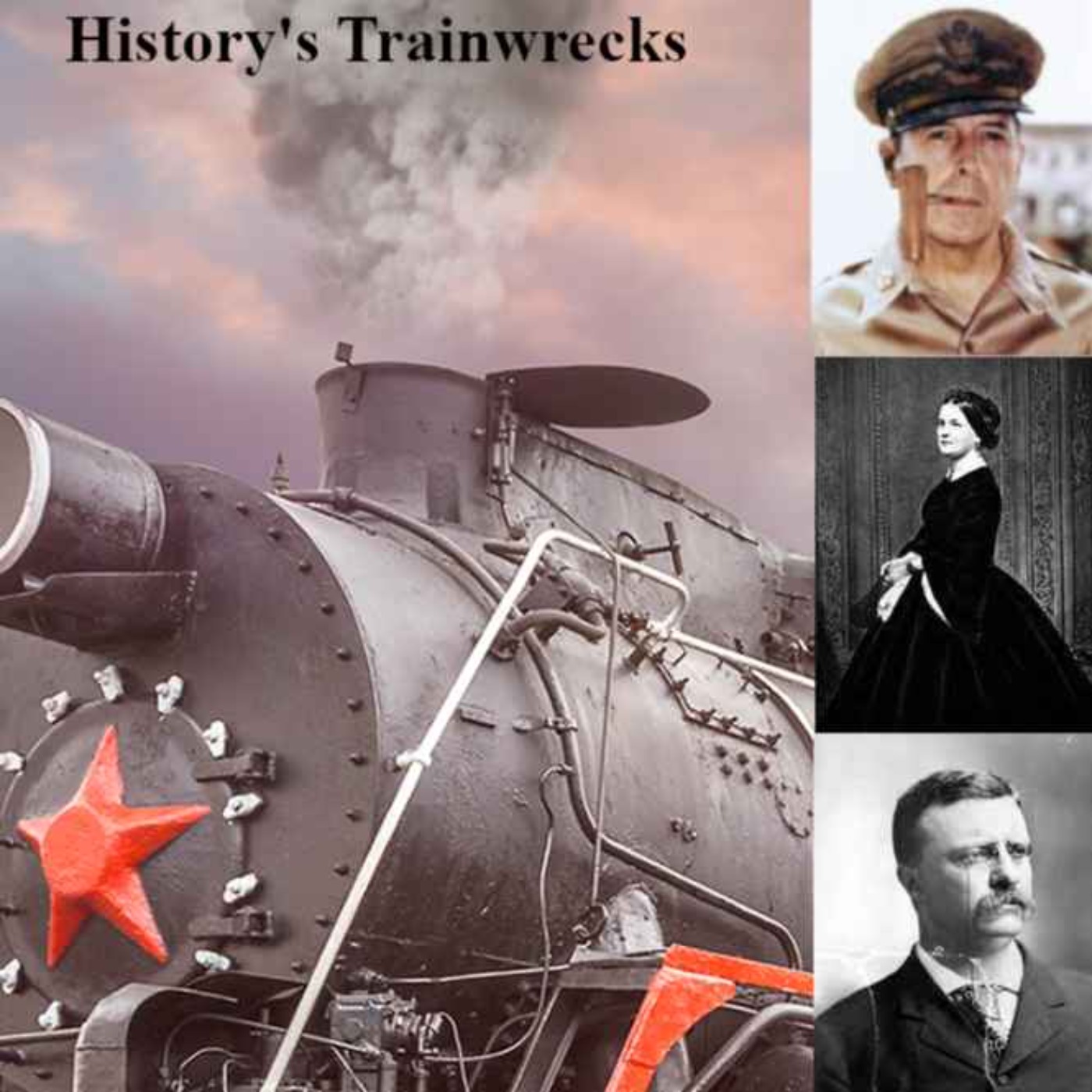
History's Trainwrecks
by Stacey Roberts
This is the stuff they never taught us in history class. Ever wonder why famous historical figures like Aaron Burr, George McClellan, Douglas MacArthur, Cato the Younger, Julius Caesar, and many others fell from the great heights to which they had ascended to end up in death or disgrace? History's Trainwrecks explores the self-destructive tendencies of historical figures who lose everything even when the prize of a lifetime is in reach, often costing them a treasured place in history. History is full of trainwrecks, and we can’t look away. Support the show with a one-time gift! or Help keep Trainwrecks on the tracks with a paid membership! Support this show <a target="_blank" rel="payment" href="http://supporter.acast.com/historys-tra
Episodes
-
069 - All Star Trainwrecks - Richard Nixon - Part I
As foretold by the prophecy—well, the one I made myself—I’m back, with the first episode of our series on All-Time, All-Star History’s Trainwrecks. Since I’m going in no particular order, I’m starting with Richard Nixon, our thirty-seventh president and first and only one thus far to resign…
more -
068 - Where's the Conductor?
If you've noticed my conspicuous absence, don't worry. I've been doing my whole history nerd thing. And I wrote a book about ancient Rome, because I just can't help myself. And it's got footnotes! Stay tuned for that, and our first episode of All Star History's Trainwrecks - Richard Nixon.…
more -
067 - Valley Forge - Almost A Trainwreck - Conclusion
The Conway Cabal had been beaten. This unholy trinity of general slimeballs—General Horatio Gates, General Thomas Mifflin, and General Thomas Conway—had schemed to get rid of George Washington, his best generals, his staff of wunderkind (Alexander Hamilton, John Laurens, and the Marquis de...
-
066 - Valley Forge - Almost A Trainwreck - Part III
Supplies are running low and snow is running high at Valley Forge, along with desertions and resignations. The remaining officers are squabbling amongst themselves and the Congress is nearly no use at all, having fallen under the sway of the slimy and traitorous Conway Cabal. This band of…
more -
065 - Valley Forge - Almost A Trainwreck - Part II
On our last episode, we left George Washington’s ragtag Continental Army without any shoes in the snow, marching their bloody way to Valley Forge in December, 1777. The year 1777 had been a lousy one for the American cause—Washington couldn’t seem to decisively win a battle against the British…
more -
064 - Valley Forge - Almost A Trainwreck - Part I
You know how I love a good trainwreck, with all the self-inflicted calamity thereupon, but I found an episode of American history that could have been a massive fireball of a trainwreck, but then wasn’t. Its an inspiring story, one that should definitely not be lost on modern-day Americans. The...
-
063 - Another Secretary of the Navy!
If you’re a fan of the Presidencies of the United States podcast, you’re familiar with the special series host Jerry Landry does called Seat At The Table, in which he and a special guest cover the life of a Cabinet secretary. Most of whom you’ve never heard of. Jerry does this because no…
more -
062 - In The Shadow Of The Dam
Building Hoover Dam was difficult and deadly work. But there was a Great Depression going on and dam work paid real money. If it could be said that there was a choice between your family starving to death or you risking your life on building the engineering marvel of the age, you chose the dam....
-
061 - I'll Trade You A General, Part II
On our last episode of History's Trainwrecks, we left our major characters in serious predicament: oppositionally-defiant crank Charles Lee was in British captivity, although he did have his dogs and thirty shillings a day in expenses. General Richard Prescott was unwisely spending his nights…
more -
060 - I'll Trade You A General, Part I
American Major General Charles Lee had picked a great place to hide. Like big-city mobsters two centuries later, George Washington’s second in command had discovered that New Jersey was a great place to lay low if someone was after you. Charles had a lot of people after him in December 1776.…
more -
059 - Remember The Ladies
There's an awful lot of testosterone on History's Trainwrecks. I tend to think it's because men are far more likely than women to self-sabotage in a big way. But as Abigail Adams told her husband John, we should always "remember the ladies." Samantha Wilcoxson, author of the phenomenal Women of…
more -
058 - Great Mind In History - George Washington
It occurred to me that we’ve been doing quite a lot of talking about George Washington in this series—or more accurately, talking AROUND George, so I thought it would be a good time to stop and focus on the man himself, and delve into what made him so darn indispensable. I didn’t exactly HAVE a...
-
057 - The Men Who Would Be Washington, Part VIII
American major general Charles Lee is free of British captivity and gets one more chance to redeem himself at the Battle of Monmouth Court House in summer, 1778. But he doesn't take it. By the time of the second anniversary of the signing of the Declaration of Independence, Charles is facing a...
-
056 - The Men Who Would Be Washington, Part VII
Christmas 1776 wasn't such a great time for two American generals. George Washington was wrapping a Christmas present for the Hessian garrison at Trenton, New Jersey. He was going to cross the Delaware and drop it down their metaphorical chimney like some kind of badass Santa Claus. Second in...
-
055 - The Men Who Would Be Washington, Part VI
As Christmas, 1776 approached, it sure looked like the cause of American liberty was going to find a lump of coal under the tree. The British had taken New York and had George Washington's army on the run. They had a massive force pointed right at Philadelphia, the American capital. The…
more -
054 - The Men Who Would Be Washington, Part V
1776 was a great year for Charles Lee. He had overseen the defensive preparations in New York, Virginia, and North Carolina. The British didn't attack those places, which Charles called a win. He successfully led the defense of Charleston, South Carolina against a British assault, which he also…
more -
053 - The Men Who Would Be Washington, Part IV
Brand new Major General Charles Lee was looking pretty darn indispensable in the early days of the American Revolution. After the British abandoned Boston, their next move was unclear. The Continentals believed that the next attack would either hit Canada, New York City, or the Southern colonies....
-
052 - The Men Who Would Be Washington, Part III
If Charles Lee was alive today, he would be considered a master networker. That guy knew EVERYBODY. As we’ve seen in prior episodes, Charles was pals with a few kings and kings-in-waiting like Stanislaus of Poland, Frederick I of Prussia and his son, future king Frederick Wilhelm, as well as Holy...
-
051 - The Men Who Would Be Washington, Part II
Major General Charles Lee was a complainer. It didn’t start when he joined the Continental Army in 1775. Charles was predisposed to crabbiness. His father was a British major general and his mother was descended from landed gentry. He was the youngest child, and the only son to survive to...
-
050 - The Men Who Would Be Washington, Part I
Was George Washington truly America's indispensable man? John Adams thought so, and lots of later historians agreed. Washington had the qualities the country needed at the time - dignity, gravitas, and integrity. He was perceived to be above the kind of petty squabbles that would doom the newborn...
-
049 - The Most Dangerous Man In America, Conclusion
I’m trying to figure out who REALLY killed Huey Long. Don’t worry. Your favorite history podcast hasn’t suddenly turned into a true crime show. Neither has this one. There are few viable ways to stop a dictator. Julius Caesar and a disturbingly large number of Roman emperors were assassinated in...
-
048 - The Most Dangerous Man In America, Part V
Huey Long was losing political control of Louisiana, thanks to the Depression-era policies of the new President. Federal jobs, which were literal lifesavers, were given to Huey's opponents. Huey's own dictatorial behavior was costing him support among the people of the state, so he took his show…
more -
047 - Top Ten Trainwrecks, Part II
We're counting down to number one - the biggest historical trainwreck of all time. Can you guess who it is? Check out the Beyond The Big Screen Podcast at the link below. https://www.atozhistorypage.com/beyond-the-big-screen/ George McClellan Aaron Burr Marcus Crassus Douglas MacArthur Support…
more -
046 - Top Ten Trainwrecks, Part I
I love a good trainwreck. I mean, who doesn’t? One day, historian and podcaster Steve Guerra, host of the Beyond the Big Screen Podcast, asked me what I call The Big Question: of all the trainwrecks you’ve studied so far, who is on your top ten list of all time? It gave us the opportunity to…
more -
045 - The Most Dangerous Man In America, Part IV
Huey Long was the bull in the United States Senate’s china shop. He stormed into the world’s greatest deliberative body in 1932 after it had already been in session for two months. In a room full of men in dour blue suits, Huey wore “flashy brown tweeds, beautiful white shirts of the finest…
more -
044 - Ben Franklin in the Cockpit, Part II
The most famous American in the world was about to have one of the worst days of his life, and everyone who was anyone in London wanted to be there to see it. Benjamin Franklin had been summoned to the Cockpit, a room King Henry VIII had once used for cockfighting, to appear before the King’s…
more -
043 - I'm Not Allowed To Watch The News
As you surely know by now, I love history. I always have. If you do too, you know that studying history invariably leads to learning about politics. It’s inescapable. The Greek city-states, the rise and fall of the Roman Empire, monarchies and religious wars, the Enlightenment that led to the...
-
042 - Ben Franklin In The Cockpit, Part I
England’s American colonists were a serious problem for the British Empire by 1774. Mad old King George was pretty…well…you know. Great Britain was the world’s foremost military power, which meant it had bills to pay. The American colonies were prosperous, what with all their self-starting...
-
041 - The First Secretary of the Navy
On this special episode, I join Presidencies of the United States Podcast host Jerry Landry for his Seat at the Table series. This series covers the known and unknown Cabinet officers of American presidential administrations. No president can do it alone, and the early American Presidents...
-
040 - The Most Dangerous Man In America, Part III
Huey Long had won a seat in the United States Senate while still in office as Louisiana’s governor. His move to the national stage was a real threat to the re-election of Franklin D. Roosevelt in 1936. Huey amassed dictatorial control over Louisiana in a very short time. He survived impeachment,...
-
039 - Stubborn Nags of Ancient Rome, Conclusion
Julius Caesar's war against the Roman Republic, and his dictatorship, didn't go the way he planned. Cato the Younger's suicide made him a hero during the short years of Caesar's rule. The men who conspired to kill the tyrant held Cato up as their inspiration. So did the Founding Fathers of the...
-
038 - Stubborn Nags of Ancient Rome, Part XIV
Julius Caesar was finally ready to put an end to that pesky civil war. His best legions had mutinied while he was away in Egypt consorting with Queen Cleopatra. He had left Rome in the hands of less-capable surrogates for about a year, which gave the remaining Republican resistance time and space...
-
037 - Stubborn Nags of Ancient Rome, Part XIII
The Roman Republic was making its last stand, but first it had to figure out who was in charge. Not that it didn’t have bigger problems. Pompey the Great, thinking the civil war was over, failed to capitalize on his victory at the Battle of Dyrrhachium, allowing Julius Caesar all the time he…
more -
036 - Stubborn Nags of Ancient Rome, Part XII
Someone needed to rally the troops, and Rome’s greatest living general was having a hard time doing it. Pompey the Great had a—well…great reputation as a commander, which his recruits and veterans alike could see for themselves. He trained and drilled right alongside them, and could swing a sword...
-
035 - Stubborn Nags of Ancient Rome, Part XI
“Not bad for a lawyer.” Marcus Tullius Cicero, former Roman consul, famed orator, Senator, and jurist, had been sent to govern the province of Cilicia, near modern-day Turkey. He had vanquished some roving bands of thieves, sent a Parthian reconnaissance force scurrying back to their territory…
more -
034 - Stubborn Nags of Ancient Rome, Part X
It was every man for himself. The First Triumvirate was collapsing. Julia, the beloved daughter of Julius Caesar and adored wife of Pompey the Great, died in childbirth in 54 BC. Her daughter lived only a few days. Pompey fell into deep mourning, which was unusual. This was a time when…
more -
033 - Stubborn Nags of Ancient Rome, Part IX
The dancing girls would take their clothes off, but not while Cato the Younger was in the audience. It was 55 BC, and the Floral Games were in full…um…bloom. The Games were the culmination of a week-long festival celebrating fertility, with the usual accompanying shenanigans: outrageous dress…
more -
032 - Stubborn Nags of Ancient Rome, Part VIII
Cato the Younger’s exile from Rome began with a cross-dressing aristocrat who had a crush on Julius Caesar’s wife. In 62 BC, Publius Clodius figured that the best way to get close to Pompeia—Mrs. Caesar—was to dress as a female lute player and worm his way into the Good Goddess ceremony. This...
-
031 - Stubborn Nags of Ancient Rome, Part VII
It’s almost like Cato the Younger had no idea he was putting his head in the lion’s mouth. In the space of two years he had managed to get on the wrong side of Julius Caesar, Rome’s up and coming populist leader, Pompey the Great, Rome’s greatest living general, Marcus Crassus, Rome’s richest…
more -
030 - Stubborn Nags of Ancient Rome, Part VI
The battle for the fate of the Roman Republic was on. On one side were the empire-builders: Julius Caesar and his right-hand man Marc Antony (and sickly little Octavian in the next tent), Pompey the Great, and Marcus Crassus, who wanted to be great himself but never quite got there. On the other...
-
029 - Stubborn Nags of Ancient Rome, Part V
The ancient Roman Republic was under threat from all sides. Catiline's insurgency was coming to a head. Cicero was dictator of Rome. Julius Caesar, Pompey Magnus, and Marcus Crassus waited to see how it all turned out. Rome stood on the brink of empire, and the only one trying to stop it was Cato...
-
028 - Teddy Roosevelt's Third Term, Conclusion
Theodore Roosevelt was kept out of World War I by Woodrow Wilson, so he sent his sons instead. Their fate, his own poor health, and watching from the sidelines while the President of the United States covered himself in glory had him down in the dumps. But the election of 1920 promised a good...
-
027 - Teddy Roosevelt's Third Term, Part XI
There was no way Woodrow Wilson was going to let former President Theodore Roosevelt anywhere near Europe during the First World War. Teddy had made multiple requests to War Secretary Newton Baker, asking permission to raise a division of volunteers, with himself as a major general, "to put our...
-
026 - Teddy Roosevelt's Third Term, Part X
In 1916, the world was on fire, and Theodore Roosevelt was down in the dumps. The country, with either Woodrow Wilson or Charles Evans Hughes destined for the White House, was “in the hands of two aloof and cagey deliberators. Wilson and Hughes were men who waited for events to happen and then...
-
025 - Stubborn Nags of Ancient Rome, Part IV
Rome’s greatest orator pointed his finger at Cato the Younger and said, “Do you not see a storm coming?” Marcus Tullius Cicero was consul for the year 63 BC, and thanks to the aforementioned storm, was a virtual dictator. But he had a number of problems, and he was going to use Cato the Younger…
more -
024 - The Most Dangerous Man In America, Part II
Lousiana governor Huey Long had learned a lot from his impeachment trial, and it was no more Mr. Nice Governor down in the bayou. He wanted to expand a road-building program and build a new massive state capitol building as a lasting monument to his reign. The legislature (and Huey's own brother)...
-
023 - Tractors For Fidel Castro
The Bay of Pigs invasion was, to coin a phrase, a train wreck. Fidel Castro had come to power in Cuba in 1959, planting a Communist country right on America’s back porch. Having a Soviet satellite ninety miles away from American soil was, shall we say, troubling. The Eisenhower Administration...
-
022 - Teddy Roosevelt's Third Term, Part IX
As had become his practice after, shall we say, NOT winning a presidential election, Theodore Roosevelt left the country. He didn’t trust himself to stay quiet while Woodrow Wilson did things he didn’t approve of: removing African-Americans from the federal bureaucracy, passing a pro-business...
-
021 - Stubborn Nags of Ancient Rome, Part III
It's 81 BC, and ancient Rome is under the control of the drunken bloodthirsty dictatorship of Cornelius Sulla. There were three things you could do - be on Sulla's side and live, oppose him and get exiled, or oppose him and get your head stuck on a pike in the Forum. Cato the Younger, fourteen...
-
020 - The Most Dangerous Man In America, Part I
The governor of Louisiana was in serious trouble, but he didn’t really know how bad it was. Until it was almost too late. Huey Long was far more than just a guy who told the people what they wanted to hear. “There are smarter guys than I am,” he said, “but not in Louisiana.” By the end of his...
We're indexing this podcast's transcripts for the first time — this can take a minute or two. We'll show results as soon as they're ready.
No matches for "" in this podcast's transcripts.
No topics indexed yet for this podcast.
Loading reviews...
ABOUT THIS SHOW
This is the stuff they never taught us in history class.
Ever wonder why famous historical figures like Aaron Burr, George McClellan, Douglas MacArthur, Cato the Younger, Julius Caesar, and many others fell from the great heights to which they had ascended to end up in death or disgrace?
History's Trainwrecks explores the self-destructive tendencies of historical figures who lose everything even when the prize of a lifetime is in reach, often costing them a treasured place in history.
History is full of trainwrecks, and we can’t look away.
Support the show with a one-time gift! or Help keep Trainwrecks on the tracks with a paid membership!
Support this show <a target="_blank" rel="payment" href="http://supporter.acast.com/historys-tra
HOSTED BY
Stacey Roberts
Loading similar podcasts...
Frequently Asked Questions
How many episodes does History's Trainwrecks have?
History's Trainwrecks currently has 69 episodes available on PodParley. New episodes are automatically indexed when they're published to the podcast feed.
What is History's Trainwrecks about?
This is the stuff they never taught us in history class. Ever wonder why famous historical figures like Aaron Burr, George McClellan, Douglas MacArthur, Cato the Younger, Julius Caesar, and many others fell from the great heights to which they had ascended to end up in death or disgrace? History's...
How often does History's Trainwrecks release new episodes?
History's Trainwrecks has 69 episodes. Check the episode list to see recent publication dates and frequency.
Where can I listen to History's Trainwrecks?
You can listen to History's Trainwrecks on PodParley by clicking any episode. We provide an embedded audio player for direct listening, and you can also subscribe via your preferred podcast app using the RSS feed.
Who hosts History's Trainwrecks?
History's Trainwrecks is created and hosted by Stacey Roberts.
URL copied to clipboard!