
PODCAST · education
Hume
by La Trobe University
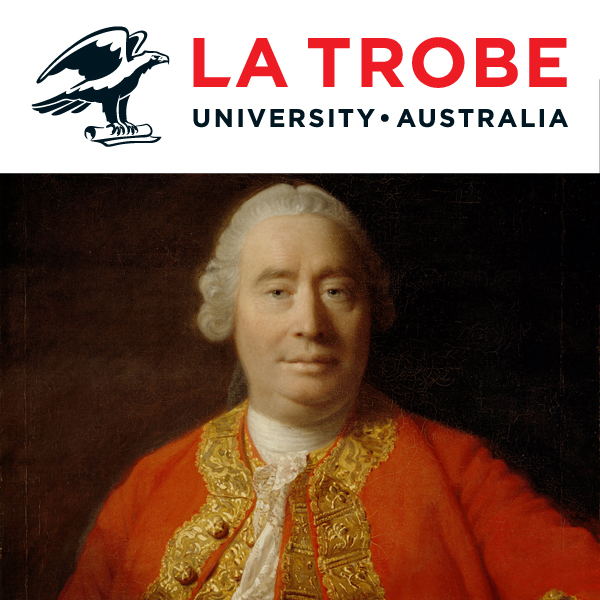
If Descartes is the father of modern philosophy, Hume is the person who gave shape to the contemporary philosophical world. First by querying Descartes' theories about knowledge, and then developing his own modest account of knowledge, and later his theories of ethics and aesthetics.
Episodes
-
Inter-Species Sympathy/Empathy
According to Hume, many nonhuman animals (or beings whom he sometimes calls 'sensible creatures') are analogous to human beings in respects of the body and the mind. We are able to sympathise with an animal in similar ways we sympathise with another human being. Copyright 2013 La Trobe…
more -
Sympathy/Empathy
‘Sympathy’ (or what is now often called ‘empathy’) is in Hume’s view a complex mechanism of the human mind which relies on the combined operation of three more fundamental principles: the ‘copy principle’, principle of ‘association of ideas’, and the principle of more vivid perceptions…
more -
What Can we Know?
According to Hume, all the objects of human inquiry and knowledge can be divided into two kinds (and only two kinds). They are 'relations of idea' on the one hand, which are discoverable by reason independent of real existence in the universe, and 'matters of fact' on the other, which are...
-
Association of Ideas
What Hume calls the ‘association of ideas’ is a fundamental operating ‘principle’ (i.e. mechanism) of the human mind. The principle operates by resemblance, by contiguity, and by causes and effect. Copyright 2013 La Trobe University, all rights reserved. Please contact for permissions.
-
Impressions and Ideas
Hume divides all 'perceptions' (i.e. experiences) into 'impressions' and 'ideas'. This theory device gives him a more finely grained account of the operations of the mind than either Locke or Descartes have. Impressions are original 'perceptions of the human mind' which are vivid, forceful…
more -
Moral Foundations
If Hume is right in arguing that reason alone is not sufficient to generate moral judgements that distinguish between good and evil, right and wrong, then what are the missing ingredients? This question brings us to Hume's positive account on the foundations of human morality. Copyright 2013 La...
-
Moral Motivations
According to Hume, reason alone can never determine the distinction between moral good and evil. We can never find out whether an act is morally right or wrong just by using our reasoning. Copyright 2013 La Trobe University, all rights reserved. Please contact for permissions.
-
Reason vs Passion
Hume has said some very provocative things about the roles of, and the relations between, reasons and passions. "We speak not strictly and philosophically when we talk of the combat of passion and of reason. Reason is, and ought only to be the slave of passions, and can never pretend to be any...
We're indexing this podcast's transcripts for the first time — this can take a minute or two. We'll show results as soon as they're ready.
No matches for "" in this podcast's transcripts.
No topics indexed yet for this podcast.
Loading reviews...
ABOUT THIS SHOW
If Descartes is the father of modern philosophy, Hume is the person who gave shape to the contemporary philosophical world. First by querying Descartes' theories about knowledge, and then developing his own modest account of knowledge, and later his theories of ethics and aesthetics.
HOSTED BY
La Trobe University
CATEGORIES
Loading similar podcasts...
Frequently Asked Questions
How many episodes does Hume have?
Hume currently has 16 episodes available on PodParley. New episodes are automatically indexed when they're published to the podcast feed.
What is Hume about?
If Descartes is the father of modern philosophy, Hume is the person who gave shape to the contemporary philosophical world. First by querying Descartes' theories about knowledge, and then developing his own modest account of knowledge, and later his theories of ethics and aesthetics.
How often does Hume release new episodes?
Hume has 16 episodes. Check the episode list to see recent publication dates and frequency.
Where can I listen to Hume?
You can listen to Hume on PodParley by clicking any episode. We provide an embedded audio player for direct listening, and you can also subscribe via your preferred podcast app using the RSS feed.
Who hosts Hume?
Hume is created and hosted by La Trobe University.
URL copied to clipboard!