
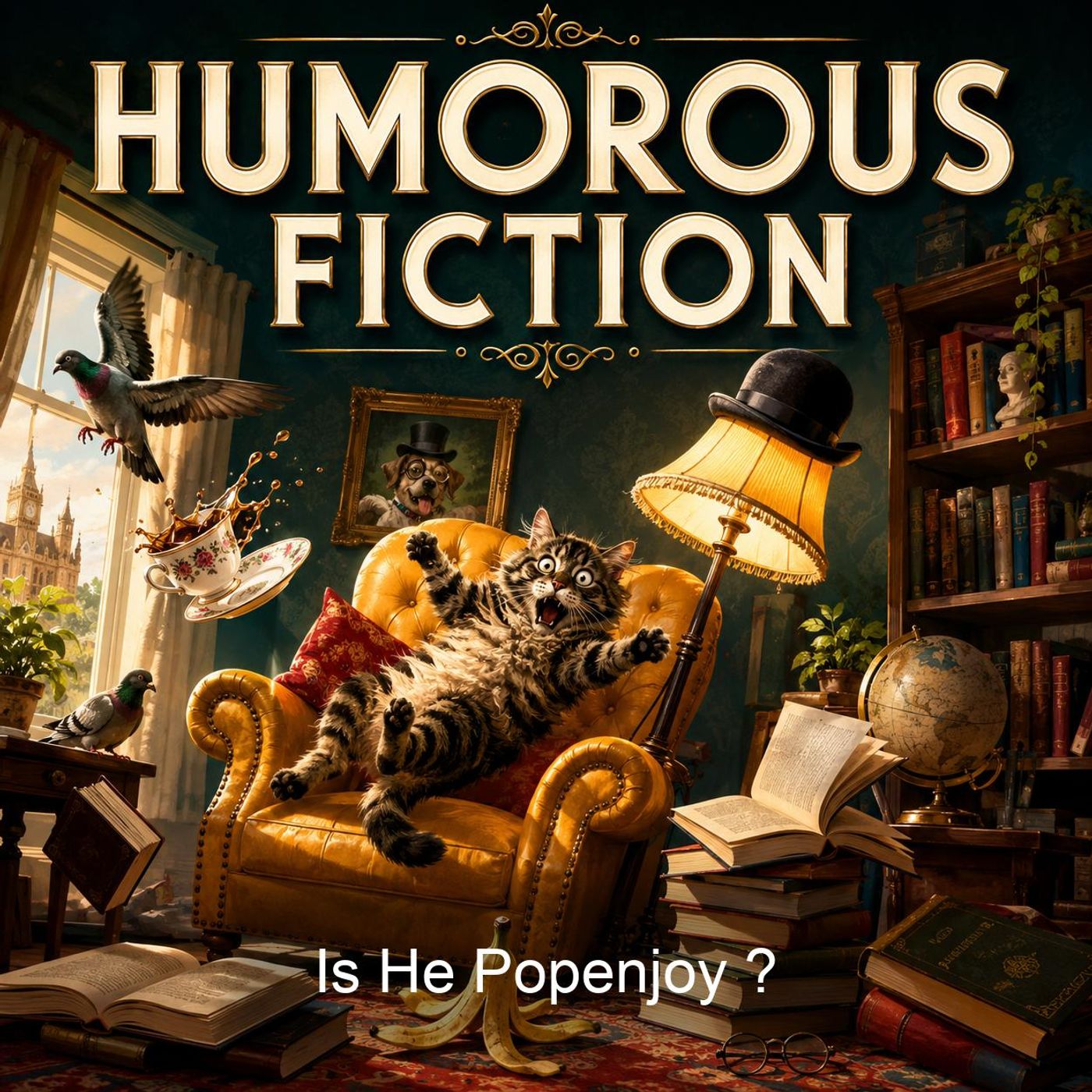
PODCAST · arts
Is He Popenjoy ?
by Anthony Trollope
Trollope returns in Is He Popenjoy to two of his favorite subjects: property and inheritance. As in "Doctor Thorne," the issues are complicated by the specter of possible illegitimacy. Lord George Germain, a thoroughly respectable, upstanding, if not particularly bright younger son with new wife, rather expects to inherit a title, since his vicious and dissolute elder brother, the Marquis of Brotherton, who lives in Italy, shows no signs of settling down and producing heirs. Then comes a thunderbolt in the form of a letter from the Marquis suddenly claiming that he has, late in life, married an Italian widow and sired a son. This little boy, if he is indeed legitimate, is Lord Popenjoy and the heir to the marquisate. But is he legitimate? Are his parents in fact properly united in holy wedlock? And were they so at the time of his birth on alien soil? How on earth to find out? The book, which starts almost as a comedy of manners (and perhaps also a comedy of manors), takes on a darker a
-
3
Our Little Irish Cousin-Mary Hazelton Blanchard Wade
Trollope returns in Is He Popenjoy to two of his favorite subjects: property and inheritance. As in "Doctor Thorne," the issues are complicated by the specter of possible illegitimacy. Lord George Germain, a thoroughly respectable, upstanding, if not particularly bright younger son with new wife, rather expects to inherit a title, since his vicious and dissolute elder brother, the Marquis of Brotherton, who lives in Italy, shows no signs of settling down and producing heirs. Then comes a thunderbolt in the form of a letter from the Marquis suddenly claiming that he has, late in life, married an Italian widow and sired a son. This little boy, if he is indeed legitimate, is Lord Popenjoy and the heir to the marquisate. But is he legitimate? Are his parents in fact properly united in holy wedlock? And were they so at the time of his birth on alien soil? How on earth to find out? The book, which starts almost as a comedy of manners (and perhaps also a comedy of manors), takes on a darker and more sardonic tone with this mystery, and with some other suspected and actual romantic entanglements which are not entirely in the aristocratic Victorian rule-book. Among the large cast of characters are two memorable foreigners: the repellent German feminist Baroness Bannmann, and the rather more attractive American version, Amelia Q. Fleabody (not, of course, to be confused in any way with the real Elizabeth Peabody, who under another name, lies at the heart of Henry James's The Bostonians).(Summary by Nicholas Clifford)
-
2
Admirable Bashville-George Bernard Shaw
Trollope returns in Is He Popenjoy to two of his favorite subjects: property and inheritance. As in "Doctor Thorne," the issues are complicated by the specter of possible illegitimacy. Lord George Germain, a thoroughly respectable, upstanding, if not particularly bright younger son with new wife, rather expects to inherit a title, since his vicious and dissolute elder brother, the Marquis of Brotherton, who lives in Italy, shows no signs of settling down and producing heirs. Then comes a thunderbolt in the form of a letter from the Marquis suddenly claiming that he has, late in life, married an Italian widow and sired a son. This little boy, if he is indeed legitimate, is Lord Popenjoy and the heir to the marquisate. But is he legitimate? Are his parents in fact properly united in holy wedlock? And were they so at the time of his birth on alien soil? How on earth to find out? The book, which starts almost as a comedy of manners (and perhaps also a comedy of manors), takes on a darker and more sardonic tone with this mystery, and with some other suspected and actual romantic entanglements which are not entirely in the aristocratic Victorian rule-book. Among the large cast of characters are two memorable foreigners: the repellent German feminist Baroness Bannmann, and the rather more attractive American version, Amelia Q. Fleabody (not, of course, to be confused in any way with the real Elizabeth Peabody, who under another name, lies at the heart of Henry James's The Bostonians).(Summary by Nicholas Clifford)
-
1
Sins of Hollywood-Edward Roberts
Trollope returns in Is He Popenjoy to two of his favorite subjects: property and inheritance. As in "Doctor Thorne," the issues are complicated by the specter of possible illegitimacy. Lord George Germain, a thoroughly respectable, upstanding, if not particularly bright younger son with new wife, rather expects to inherit a title, since his vicious and dissolute elder brother, the Marquis of Brotherton, who lives in Italy, shows no signs of settling down and producing heirs. Then comes a thunderbolt in the form of a letter from the Marquis suddenly claiming that he has, late in life, married an Italian widow and sired a son. This little boy, if he is indeed legitimate, is Lord Popenjoy and the heir to the marquisate. But is he legitimate? Are his parents in fact properly united in holy wedlock? And were they so at the time of his birth on alien soil? How on earth to find out? The book, which starts almost as a comedy of manners (and perhaps also a comedy of manors), takes on a darker and more sardonic tone with this mystery, and with some other suspected and actual romantic entanglements which are not entirely in the aristocratic Victorian rule-book. Among the large cast of characters are two memorable foreigners: the repellent German feminist Baroness Bannmann, and the rather more attractive American version, Amelia Q. Fleabody (not, of course, to be confused in any way with the real Elizabeth Peabody, who under another name, lies at the heart of Henry James's The Bostonians).(Summary by Nicholas Clifford)
-
0
Heir At Law-George Colman the Younger
Trollope returns in Is He Popenjoy to two of his favorite subjects: property and inheritance. As in "Doctor Thorne," the issues are complicated by the specter of possible illegitimacy. Lord George Germain, a thoroughly respectable, upstanding, if not particularly bright younger son with new wife, rather expects to inherit a title, since his vicious and dissolute elder brother, the Marquis of Brotherton, who lives in Italy, shows no signs of settling down and producing heirs. Then comes a thunderbolt in the form of a letter from the Marquis suddenly claiming that he has, late in life, married an Italian widow and sired a son. This little boy, if he is indeed legitimate, is Lord Popenjoy and the heir to the marquisate. But is he legitimate? Are his parents in fact properly united in holy wedlock? And were they so at the time of his birth on alien soil? How on earth to find out? The book, which starts almost as a comedy of manners (and perhaps also a comedy of manors), takes on a darker and more sardonic tone with this mystery, and with some other suspected and actual romantic entanglements which are not entirely in the aristocratic Victorian rule-book. Among the large cast of characters are two memorable foreigners: the repellent German feminist Baroness Bannmann, and the rather more attractive American version, Amelia Q. Fleabody (not, of course, to be confused in any way with the real Elizabeth Peabody, who under another name, lies at the heart of Henry James's The Bostonians).(Summary by Nicholas Clifford)
-
-1
Six Characters in Search of an Author-Luigi Pirandello
Trollope returns in Is He Popenjoy to two of his favorite subjects: property and inheritance. As in "Doctor Thorne," the issues are complicated by the specter of possible illegitimacy. Lord George Germain, a thoroughly respectable, upstanding, if not particularly bright younger son with new wife, rather expects to inherit a title, since his vicious and dissolute elder brother, the Marquis of Brotherton, who lives in Italy, shows no signs of settling down and producing heirs. Then comes a thunderbolt in the form of a letter from the Marquis suddenly claiming that he has, late in life, married an Italian widow and sired a son. This little boy, if he is indeed legitimate, is Lord Popenjoy and the heir to the marquisate. But is he legitimate? Are his parents in fact properly united in holy wedlock? And were they so at the time of his birth on alien soil? How on earth to find out? The book, which starts almost as a comedy of manners (and perhaps also a comedy of manors), takes on a darker and more sardonic tone with this mystery, and with some other suspected and actual romantic entanglements which are not entirely in the aristocratic Victorian rule-book. Among the large cast of characters are two memorable foreigners: the repellent German feminist Baroness Bannmann, and the rather more attractive American version, Amelia Q. Fleabody (not, of course, to be confused in any way with the real Elizabeth Peabody, who under another name, lies at the heart of Henry James's The Bostonians).(Summary by Nicholas Clifford)
-
-2
Selected Poems-Dante Gabriel Rossetti, Christina Rossetti
Trollope returns in Is He Popenjoy to two of his favorite subjects: property and inheritance. As in "Doctor Thorne," the issues are complicated by the specter of possible illegitimacy. Lord George Germain, a thoroughly respectable, upstanding, if not particularly bright younger son with new wife, rather expects to inherit a title, since his vicious and dissolute elder brother, the Marquis of Brotherton, who lives in Italy, shows no signs of settling down and producing heirs. Then comes a thunderbolt in the form of a letter from the Marquis suddenly claiming that he has, late in life, married an Italian widow and sired a son. This little boy, if he is indeed legitimate, is Lord Popenjoy and the heir to the marquisate. But is he legitimate? Are his parents in fact properly united in holy wedlock? And were they so at the time of his birth on alien soil? How on earth to find out? The book, which starts almost as a comedy of manners (and perhaps also a comedy of manors), takes on a darker and more sardonic tone with this mystery, and with some other suspected and actual romantic entanglements which are not entirely in the aristocratic Victorian rule-book. Among the large cast of characters are two memorable foreigners: the repellent German feminist Baroness Bannmann, and the rather more attractive American version, Amelia Q. Fleabody (not, of course, to be confused in any way with the real Elizabeth Peabody, who under another name, lies at the heart of Henry James's The Bostonians).(Summary by Nicholas Clifford)
-
-3
Watsons (Dramatic Reading)-Jane Austen, L. Oulton
Trollope returns in Is He Popenjoy to two of his favorite subjects: property and inheritance. As in "Doctor Thorne," the issues are complicated by the specter of possible illegitimacy. Lord George Germain, a thoroughly respectable, upstanding, if not particularly bright younger son with new wife, rather expects to inherit a title, since his vicious and dissolute elder brother, the Marquis of Brotherton, who lives in Italy, shows no signs of settling down and producing heirs. Then comes a thunderbolt in the form of a letter from the Marquis suddenly claiming that he has, late in life, married an Italian widow and sired a son. This little boy, if he is indeed legitimate, is Lord Popenjoy and the heir to the marquisate. But is he legitimate? Are his parents in fact properly united in holy wedlock? And were they so at the time of his birth on alien soil? How on earth to find out? The book, which starts almost as a comedy of manners (and perhaps also a comedy of manors), takes on a darker and more sardonic tone with this mystery, and with some other suspected and actual romantic entanglements which are not entirely in the aristocratic Victorian rule-book. Among the large cast of characters are two memorable foreigners: the repellent German feminist Baroness Bannmann, and the rather more attractive American version, Amelia Q. Fleabody (not, of course, to be confused in any way with the real Elizabeth Peabody, who under another name, lies at the heart of Henry James's The Bostonians).(Summary by Nicholas Clifford)
-
-4
Tom Cobb; or Fortune's Toy-W. S. Gilbert
Trollope returns in Is He Popenjoy to two of his favorite subjects: property and inheritance. As in "Doctor Thorne," the issues are complicated by the specter of possible illegitimacy. Lord George Germain, a thoroughly respectable, upstanding, if not particularly bright younger son with new wife, rather expects to inherit a title, since his vicious and dissolute elder brother, the Marquis of Brotherton, who lives in Italy, shows no signs of settling down and producing heirs. Then comes a thunderbolt in the form of a letter from the Marquis suddenly claiming that he has, late in life, married an Italian widow and sired a son. This little boy, if he is indeed legitimate, is Lord Popenjoy and the heir to the marquisate. But is he legitimate? Are his parents in fact properly united in holy wedlock? And were they so at the time of his birth on alien soil? How on earth to find out? The book, which starts almost as a comedy of manners (and perhaps also a comedy of manors), takes on a darker and more sardonic tone with this mystery, and with some other suspected and actual romantic entanglements which are not entirely in the aristocratic Victorian rule-book. Among the large cast of characters are two memorable foreigners: the repellent German feminist Baroness Bannmann, and the rather more attractive American version, Amelia Q. Fleabody (not, of course, to be confused in any way with the real Elizabeth Peabody, who under another name, lies at the heart of Henry James's The Bostonians).(Summary by Nicholas Clifford)
-
-5
Charles Simeon-Handley Carr Glyn Moule
Trollope returns in Is He Popenjoy to two of his favorite subjects: property and inheritance. As in "Doctor Thorne," the issues are complicated by the specter of possible illegitimacy. Lord George Germain, a thoroughly respectable, upstanding, if not particularly bright younger son with new wife, rather expects to inherit a title, since his vicious and dissolute elder brother, the Marquis of Brotherton, who lives in Italy, shows no signs of settling down and producing heirs. Then comes a thunderbolt in the form of a letter from the Marquis suddenly claiming that he has, late in life, married an Italian widow and sired a son. This little boy, if he is indeed legitimate, is Lord Popenjoy and the heir to the marquisate. But is he legitimate? Are his parents in fact properly united in holy wedlock? And were they so at the time of his birth on alien soil? How on earth to find out? The book, which starts almost as a comedy of manners (and perhaps also a comedy of manors), takes on a darker and more sardonic tone with this mystery, and with some other suspected and actual romantic entanglements which are not entirely in the aristocratic Victorian rule-book. Among the large cast of characters are two memorable foreigners: the repellent German feminist Baroness Bannmann, and the rather more attractive American version, Amelia Q. Fleabody (not, of course, to be confused in any way with the real Elizabeth Peabody, who under another name, lies at the heart of Henry James's The Bostonians).(Summary by Nicholas Clifford)
-
-6
Two Noble Kinsmen-John Fletcher, William Shakespeare
Trollope returns in Is He Popenjoy to two of his favorite subjects: property and inheritance. As in "Doctor Thorne," the issues are complicated by the specter of possible illegitimacy. Lord George Germain, a thoroughly respectable, upstanding, if not particularly bright younger son with new wife, rather expects to inherit a title, since his vicious and dissolute elder brother, the Marquis of Brotherton, who lives in Italy, shows no signs of settling down and producing heirs. Then comes a thunderbolt in the form of a letter from the Marquis suddenly claiming that he has, late in life, married an Italian widow and sired a son. This little boy, if he is indeed legitimate, is Lord Popenjoy and the heir to the marquisate. But is he legitimate? Are his parents in fact properly united in holy wedlock? And were they so at the time of his birth on alien soil? How on earth to find out? The book, which starts almost as a comedy of manners (and perhaps also a comedy of manors), takes on a darker and more sardonic tone with this mystery, and with some other suspected and actual romantic entanglements which are not entirely in the aristocratic Victorian rule-book. Among the large cast of characters are two memorable foreigners: the repellent German feminist Baroness Bannmann, and the rather more attractive American version, Amelia Q. Fleabody (not, of course, to be confused in any way with the real Elizabeth Peabody, who under another name, lies at the heart of Henry James's The Bostonians).(Summary by Nicholas Clifford)
-
-7
Candida-George Bernard Shaw
Trollope returns in Is He Popenjoy to two of his favorite subjects: property and inheritance. As in "Doctor Thorne," the issues are complicated by the specter of possible illegitimacy. Lord George Germain, a thoroughly respectable, upstanding, if not particularly bright younger son with new wife, rather expects to inherit a title, since his vicious and dissolute elder brother, the Marquis of Brotherton, who lives in Italy, shows no signs of settling down and producing heirs. Then comes a thunderbolt in the form of a letter from the Marquis suddenly claiming that he has, late in life, married an Italian widow and sired a son. This little boy, if he is indeed legitimate, is Lord Popenjoy and the heir to the marquisate. But is he legitimate? Are his parents in fact properly united in holy wedlock? And were they so at the time of his birth on alien soil? How on earth to find out? The book, which starts almost as a comedy of manners (and perhaps also a comedy of manors), takes on a darker and more sardonic tone with this mystery, and with some other suspected and actual romantic entanglements which are not entirely in the aristocratic Victorian rule-book. Among the large cast of characters are two memorable foreigners: the repellent German feminist Baroness Bannmann, and the rather more attractive American version, Amelia Q. Fleabody (not, of course, to be confused in any way with the real Elizabeth Peabody, who under another name, lies at the heart of Henry James's The Bostonians).(Summary by Nicholas Clifford)
-
-8
Princess and the Butterfly-Arthur Wing Pinero
Trollope returns in Is He Popenjoy to two of his favorite subjects: property and inheritance. As in "Doctor Thorne," the issues are complicated by the specter of possible illegitimacy. Lord George Germain, a thoroughly respectable, upstanding, if not particularly bright younger son with new wife, rather expects to inherit a title, since his vicious and dissolute elder brother, the Marquis of Brotherton, who lives in Italy, shows no signs of settling down and producing heirs. Then comes a thunderbolt in the form of a letter from the Marquis suddenly claiming that he has, late in life, married an Italian widow and sired a son. This little boy, if he is indeed legitimate, is Lord Popenjoy and the heir to the marquisate. But is he legitimate? Are his parents in fact properly united in holy wedlock? And were they so at the time of his birth on alien soil? How on earth to find out? The book, which starts almost as a comedy of manners (and perhaps also a comedy of manors), takes on a darker and more sardonic tone with this mystery, and with some other suspected and actual romantic entanglements which are not entirely in the aristocratic Victorian rule-book. Among the large cast of characters are two memorable foreigners: the repellent German feminist Baroness Bannmann, and the rather more attractive American version, Amelia Q. Fleabody (not, of course, to be confused in any way with the real Elizabeth Peabody, who under another name, lies at the heart of Henry James's The Bostonians).(Summary by Nicholas Clifford)
-
-9
Wild Duck - Henrik Ibsen
Wild Duck by Henrik Ibsen delves into the intricate dynamics of family, truth, and the illusions we create to cope with reality. This powerful play explores the impact of deception and the pursuit of happiness, inviting listeners to reflect on the delicate balance between idealism and pragmatism. Its themes of self-deception and the struggle for personal integrity remain profoundly relevant today, as individuals grapple with the complexities of their own lives and relationships. Ibsen's masterful storytelling and rich character development make "Wild Duck" an enduring work that challenges us to confront the truths we often choose to ignore.
-
-10
Is He Popenjoy - Anthony Trollope - Part 3
Trollope returns in Is He Popenjoy to two of his favorite subjects: property and inheritance. As in "Doctor Thorne," the issues are complicated by the specter of possible illegitimacy. Lord George Germain, a thoroughly respectable, upstanding, if not particularly bright younger son with new wife, rather expects to inherit a title, since his vicious and dissolute elder brother, the Marquis of Brotherton, who lives in Italy, shows no signs of settling down and producing heirs. Then comes a thunderbolt in the form of a letter from the Marquis suddenly claiming that he has, late in life, married an Italian widow and sired a son. This little boy, if he is indeed legitimate, is Lord Popenjoy and the heir to the marquisate. But is he legitimate? Are his parents in fact properly united in holy wedlock? And were they so at the time of his birth on alien soil? How on earth to find out? The book, which starts almost as a comedy of manners (and perhaps also a comedy of manors), takes on a darker and more sardonic tone with this mystery, and with some other suspected and actual romantic entanglements which are not entirely in the aristocratic Victorian rule-book. Among the large cast of characters are two memorable foreigners: the repellent German feminist Baroness Bannmann, and the rather more attractive American version, Amelia Q. Fleabody (not, of course, to be confused in any way with the real Elizabeth Peabody, who under another name, lies at the heart of Henry James's The Bostonians).(Summary by Nicholas Clifford)
-
-11
Is He Popenjoy - Anthony Trollope - Part 2
Trollope returns in Is He Popenjoy to two of his favorite subjects: property and inheritance. As in "Doctor Thorne," the issues are complicated by the specter of possible illegitimacy. Lord George Germain, a thoroughly respectable, upstanding, if not particularly bright younger son with new wife, rather expects to inherit a title, since his vicious and dissolute elder brother, the Marquis of Brotherton, who lives in Italy, shows no signs of settling down and producing heirs. Then comes a thunderbolt in the form of a letter from the Marquis suddenly claiming that he has, late in life, married an Italian widow and sired a son. This little boy, if he is indeed legitimate, is Lord Popenjoy and the heir to the marquisate. But is he legitimate? Are his parents in fact properly united in holy wedlock? And were they so at the time of his birth on alien soil? How on earth to find out? The book, which starts almost as a comedy of manners (and perhaps also a comedy of manors), takes on a darker and more sardonic tone with this mystery, and with some other suspected and actual romantic entanglements which are not entirely in the aristocratic Victorian rule-book. Among the large cast of characters are two memorable foreigners: the repellent German feminist Baroness Bannmann, and the rather more attractive American version, Amelia Q. Fleabody (not, of course, to be confused in any way with the real Elizabeth Peabody, who under another name, lies at the heart of Henry James's The Bostonians).(Summary by Nicholas Clifford)
-
-12
Is He Popenjoy - Anthony Trollope - Part 1
Trollope returns in Is He Popenjoy to two of his favorite subjects: property and inheritance. As in "Doctor Thorne," the issues are complicated by the specter of possible illegitimacy. Lord George Germain, a thoroughly respectable, upstanding, if not particularly bright younger son with new wife, rather expects to inherit a title, since his vicious and dissolute elder brother, the Marquis of Brotherton, who lives in Italy, shows no signs of settling down and producing heirs. Then comes a thunderbolt in the form of a letter from the Marquis suddenly claiming that he has, late in life, married an Italian widow and sired a son. This little boy, if he is indeed legitimate, is Lord Popenjoy and the heir to the marquisate. But is he legitimate? Are his parents in fact properly united in holy wedlock? And were they so at the time of his birth on alien soil? How on earth to find out? The book, which starts almost as a comedy of manners (and perhaps also a comedy of manors), takes on a darker and more sardonic tone with this mystery, and with some other suspected and actual romantic entanglements which are not entirely in the aristocratic Victorian rule-book. Among the large cast of characters are two memorable foreigners: the repellent German feminist Baroness Bannmann, and the rather more attractive American version, Amelia Q. Fleabody (not, of course, to be confused in any way with the real Elizabeth Peabody, who under another name, lies at the heart of Henry James's The Bostonians).(Summary by Nicholas Clifford)
We're indexing this podcast's transcripts for the first time — this can take a minute or two. We'll show results as soon as they're ready.
No matches for "" in this podcast's transcripts.
No topics indexed yet for this podcast.
Loading reviews...
ABOUT THIS SHOW
Trollope returns in Is He Popenjoy to two of his favorite subjects: property and inheritance. As in "Doctor Thorne," the issues are complicated by the specter of possible illegitimacy. Lord George Germain, a thoroughly respectable, upstanding, if not particularly bright younger son with new wife, rather expects to inherit a title, since his vicious and dissolute elder brother, the Marquis of Brotherton, who lives in Italy, shows no signs of settling down and producing heirs. Then comes a thunderbolt in the form of a letter from the Marquis suddenly claiming that he has, late in life, married an Italian widow and sired a son. This little boy, if he is indeed legitimate, is Lord Popenjoy and the heir to the marquisate. But is he legitimate? Are his parents in fact properly united in holy wedlock? And were they so at the time of his birth on alien soil? How on earth to find out? The book, which starts almost as a comedy of manners (and perhaps also a comedy of manors), takes on a darker a
HOSTED BY
Anthony Trollope
Loading similar podcasts...
Frequently Asked Questions
How many episodes does Is He Popenjoy ? have?
Is He Popenjoy ? currently has 16 episodes available on PodParley. New episodes are automatically indexed when they're published to the podcast feed.
What is Is He Popenjoy ? about?
Trollope returns in Is He Popenjoy to two of his favorite subjects: property and inheritance. As in "Doctor Thorne," the issues are complicated by the specter of possible illegitimacy. Lord George Germain, a thoroughly respectable, upstanding, if not particularly bright younger son with new wife,...
How often does Is He Popenjoy ? release new episodes?
Is He Popenjoy ? has 16 episodes. Check the episode list to see recent publication dates and frequency.
Where can I listen to Is He Popenjoy ??
You can listen to Is He Popenjoy ? on PodParley by clicking any episode. We provide an embedded audio player for direct listening, and you can also subscribe via your preferred podcast app using the RSS feed.
Who hosts Is He Popenjoy ??
Is He Popenjoy ? is created and hosted by Anthony Trollope.
URL copied to clipboard!