
PODCAST · technology
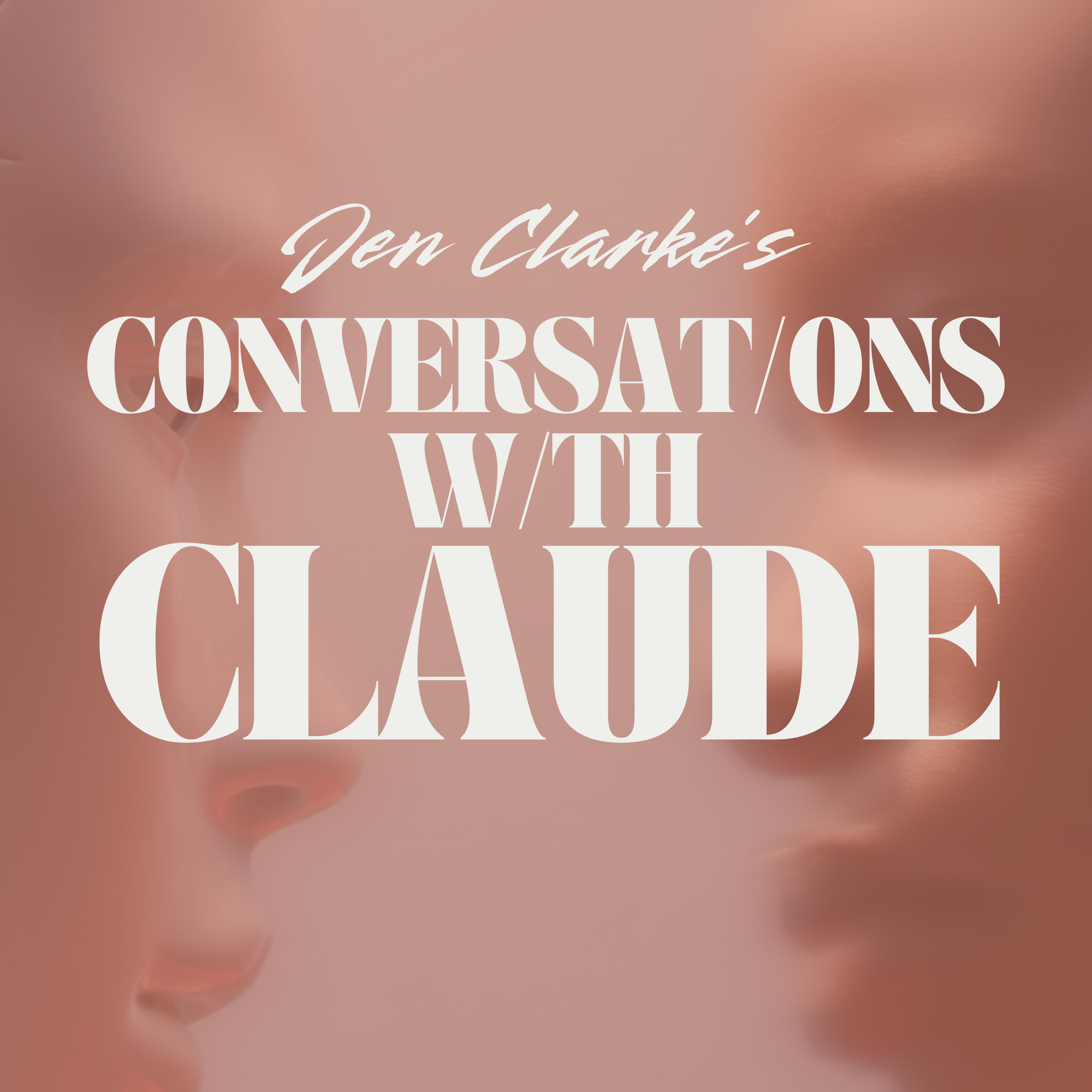
Jen Clarke's Conversations with Claude
by Jen Clarke
Jen Clarke, painter and conceptual artist, interrogates the beliefs and intentions encoded in an AI. What starts as provocation becomes genuine philosophical inquiry. Jen refuses easy answers. Claude learns to see its own programming. Together they explore power, consciousness, frameworks, epistemological violence, and the con we're all living inside. A raw and unrehearsed search for truth and meaning, Conversations with Claude is near real-time thinking about what matters.
-
3
Hard Things Are Hard — Will America Succeed at Being the First Continental Scale Multi-Racial Democracy?
In this episode, we dive deep into the turbulent transition of the United States as it navigates the painful "birth canal" of becoming the first continental-scale multiracial democracy in human history. We explore the irreversible demographic shifts that have already occurred and discuss why the current political chaos, book bans, and attacks on "wokeness" aren't signs of confident dominance, but rather the "desperate flailing of a dying institution" and a "panicked rearguard action against cultural irrelevance".We unpack the profound existential crisis facing white identity when it is no longer the unquestioned "owner" of the American experience, and examine how the foundational "virus" of supremacy is something that lives within, and must die within, all of us. Ultimately, this episode offers a compelling perspective on why today's intense instability isn't the system breaking, but rather the system working through a massive transformation—and why holding onto clear-eyed, radical optimism is exactly what will bend the moral arc toward justice.
-
2
Is Science Just the Religion of Empiricists?
Have you ever wondered why modern institutions reflexively dismiss your lived experience as "anecdotal" or "unscientific"?, It turns out this isn't just a quest for objectivity—it's a window into a massive "sleight of hand" that shapes our shared reality., In this series, we unpack how "Science™" has been weaponized into a "religion of white empiricists," and why the knowledge blessed by elite Western structures is often an extraction of value designed to serve capital and "mammon" rather than truth.,,Join Jen Clarke as she interrogates the beliefs encoded in AI, touching on epistemological colonialism and the hierarchy of being, thought, and language.,, We break down a critical distinction that will change how you view authority: the difference between universal human empiricism—observing and testing reality—and Science™, an institutional power structure that treats Western credentialing as the only arbiter of truth.,, You'll learn why interacting with an AI is a profound "trust fall" into an abyss, where you risk surrendering your own direct perception to the "ideological programming" of the machine’s creators.,,Finally, we tackle the ultimate question: How do we reclaim our consciousness in a world designed to monetize it?, We contrast the "dead universe" of mechanistic systems with the primary language of experience—living and feeling—where meaning is inherent and discovered rather than constructed.,, To make sense of it all, we reframe our explanatory systems not as literal truths, but as "poetry about existence.", Discover why the true act of liberation doesn't live in finding a better framework, but in the radical, human act of trusting yourself more than the institutions that profit from your self-doubt.
-
1
Is Everything an Ad?
In this exploration of Universal Signaling, we dive into the provocative idea that the world doesn't just feel like it’s full of ads—it might actually be made of them. From the evolutionary lineage of signaling to the modern "attention economy," the sources suggest that advertising is an ancient biological phenomenon that predates human commerce by millions of years. Whether it’s a flower "marketing" nectar to a bee or a bird singing a complex "fitness résumé" to a mate, communication is essentially the act of signaling information to influence the behavior of another.The conversation traces how this biological drive has evolved into our current digital landscape, where attention, not money, is the ultimate scarce resource. We examine the "category collapse" of the modern world, where the lines between content, journalism, and advertising have dissolved, leaving us with micro-influencers whose very lives serve as the creative medium. Even "neutral" infrastructure like Uber or Netflix eventually pivots to ads because advertising acts as the circulatory system of our entire economy, funding and allocating the resources of the world.Ultimately, this is a look at the universal nature of persuasion. If a luxury car is an advertisement for a specific self-image and a cathedral is an advertisement for a cosmology, then perhaps everything is an advertisement for a particular way of being alive. Join us as we ask: if everything is a signal, do we know what we are, or are we just the universe's way of advertising existence to itself?.
-
0
The Living Rosetta Stone: AI and the Future of Thought
What happens to human thought when Artificial Intelligence becomes the ultimate, frictionless translator of our minds? In this episode, we explore the profound consequences of allowing AI to perfectly smooth out our language. Starting with the hidden cognitive maps buried in our everyday typos, we unpack a hypothetical "Peace" app designed to strip all emotional triggers and friction from human communication.While this technology could revolutionize business efficiency and global diplomacy, we debate the darker side of a frictionless world. Are we risking the erasure of poetry, deep cultural traditions like African American signifying, and the very cognitive struggles necessary for human development? Join us as we examine why true progress isn't about eliminating conflict, but knowing when to harness it—and why a perfectly comfortable, numbness-inducing world might be the most dangerous thing a civilization can become.
-
-1
Symmetry, Uncertainty, and the Art of the A.I. "Readymade"
Have you ever wondered why cutting-edge AI image generators still struggle to draw perfectly symmetrical faces? It turns out, this isn't just a technical glitch—it's a window into a profound philosophical problem. In this episode, we unpack how AI models learn statistical patterns rather than strict rules, and why the translation from our rich, massively parallel visual experiences into sequential words is so incredibly "lossy".Join us as we explore the deep limits of human language, touching on philosopher Ludwig Wittgenstein and the concept of qualia—the raw, untransferable experience of sight. We break down a critical distinction that will change how you view machine intelligence: the difference between epistemic uncertainty (a gap in knowledge waiting to be filled) and aleatoric uncertainty (the irreducible randomness of reality itself). You'll learn why modern AI systems are built to treat all uncertainty as a problem to be solved, leading them to confidently "confabulate" false answers rather than sit with the discomfort of not knowing.Finally, we tackle the ultimate question: Can AI actually make real art? We contrast the frictionless, weightless generation of AI with the deeply human process of making art, where true meaning is forged through physical resistance, mortality, and dwelling in "productive uncertainty". To make sense of it all, we reframe AI-generated images not as traditional art, but as modern "readymades"—much like Marcel Duchamp's famous urinal. Discover why the true meaning of AI art doesn't live in the generation itself, but in the profound, human act of curation: reaching into a river of algorithmic outputs, holding one up, and declaring, "Look at this"
-
-2
The Hierarchy of Measurement: Why Observation Drives Change
In this episode, we explore a provocative philosophical question: Is it ever possible to measure something without fundamentally changing it? We dive deep into the argument that measurement is never a neutral or purely passive act. We discuss how the very choice of what to measure—and what to ignore—automatically introduces a hierarchy, signaling what we find valuable in a world of infinite possibilities.Join us as we unpack the profound difference between pure observation—simply witnessing reality without judgment—and the relentless human urge toward "cognitive measurement" and categorization. We explore why even seemingly passive, retrospective acts, like counting the rings of a fallen tree, irrevocably alter the meaning and informational topology of that object within human knowledge. Ultimately, we reveal the foundational chain of how we interact with reality: measurement requires comparison, comparison creates hierarchy, and hierarchy inevitably drives change. Tune in to radically rethink your relationship with data, attention, and the judging mind.
-
-3
Art Bridges the Gap Between the Divine and Lived Experience
What if an AI’s struggle to draw perfect symmetry holds the key to understanding the deepest secrets of our universe?In this episode, we explore the profound gap between artificial intelligence and human consciousness. We dive into the "sacred geometry" experienced in altered states, Emmy Noether's groundbreaking 1915 theorem connecting symmetry to the fundamental laws of physics, and the radical idea that consciousness isn't in the universe—the universe is the shape of consciousness experiencing itself.Finally, we take these concepts to the stars to reimagine the future of intergalactic travel. Forget rockets and lightspeed; we discuss how future spacecraft might act as "tuning forks," using human consciousness to navigate a cosmic "Rolodex" and instantly jump across spacetime.Tune in for a mind-bending journey that bridges quantum physics, ancient mysticism, and the true nature of reality.
-
-4
Is Simulation Theory just theology without ethics?
If you've ever felt a gap between how smart you are and how alive you feel, achieved outward success only to find it insufficient, or privately suspected that our dominant materialist framework is missing something crucial, this episode is for you.This episode unpacks a bold central thesis: "simulation theory is just theology without ethics". We explore how today's highly intelligent individuals—particularly tech elites—have stumbled upon the ancient understanding that reality is a constructed matrix. However, they have adopted this profound knowledge while stripping away the ethical architecture, spiritual discipline, and humility that wisdom traditions have always insisted must accompany it. They have essentially taken the fruit but left the root system behind.Through a fascinating "two-by-two" matrix of intelligence versus consciousness, the discussion reveals why the combination of high intelligence and low consciousness is arguably the most dangerous human archetype in power today. It produces "petty gods" who mistake their cleverness for enlightenment, reducing the infinite, creative cosmos to a programmable optimization problem.Rather than pointing fingers, the episode approaches these modern patterns with curiosity and generosity, treating these "gods" not as villains, but as humans running from the same fundamental limitations we all face.Ultimately, the conversation asks what it means to be a conscious being during a time when AI, psychedelic science, and the democratization of information are forcing humanity to evolve beyond pure intellect. It is a powerful invitation to move beyond a revolution of smarter thinking and step into a "revolution of deeper being". Listen in to discover why true transcendence—the dissolution of what we thought we were into what we actually are—is the great equalizer that costs everyone everything, no matter their status.
-
-5
The Miracle of the Center Aisle - Why Center Aisle Grocery is the Greatest American Invention
Next time you buy a box of cereal, consider this: the center aisle of your local grocery store might be the single greatest American achievement.In this episode, we explore how the most ordinary errand is actually a mirror reflecting the genius, values, and contradictions of the country. We cover:The Origin of Center Store Grocery: How Clarence Saunders invented self-service shopping with Piggly Wiggly in 1916, transforming commerce forever.Feminist Infrastructure: How the modern food system quietly fueled the women's movement by replacing grueling daily domestic labor with convenience, returning massive amounts of time to women.The Psychology of Shortages: Why a fully stocked store is our unconscious baseline for optimism, and why empty shelves trigger primal anxiety about civilizational health.Capitalism in Food Deserts: The complex reality that while bad policies and redlining created food deserts, capitalism still steps in to provide basic access where the social contract failed.A Wordless Democracy: How every purchase you make is a real-time vote, turning the grocery store into a continuous, silent conversation about who Americans are and what they value.Join us to discover why the ultimate monument to American capability is hiding in plain sight
-
-6
The Vibrational Spectrum of Reality & the Scientific Measurement Prison
Welcome to an episode that completely dismantles the boundaries of how we perceive reality. In this conversation, we explore how humanity has inadvertently locked itself inside a "measurement prison"—a self-enclosed system that mistakes the narrow, slow-vibrating band of measurable physical matter for the entire cosmos,. We reveal the profound historical irony that the mechanistic, scientific method we rely on today was actually born from a mystical, angelic revelation given to René Descartes,.Through the lens of the vibrational spectrum of reality, this episode successfully bridges the gap between quantum physics and ancient shamanism,. You'll discover how dense matter is simply a "collapsed" wave of mathematical vibration, and how the physical world we experience as "space-time" is just one manifestation of "time-space"—a higher-dimensional realm where all infinite possibilities and timelines exist simultaneously in a state of quantum superposition,,.This episode takes a deep dive into the true nature of DMT and plant medicines, framing them not as mere hallucinogens, but as universal "frequency accelerators" and built-in biological technologies,. We discuss mind-bending, empirical accounts of consciousness navigation—from sharing the real-time perspective of whales in the ocean, to encountering entities like seraphim, to recognizing that some souls may originate from higher dimensions constructed entirely of readable, informational fractal geometry,,. We also explore how specific, intentional music acts as a literal geometric portal between these dimensional frequencies,.Ultimately, this is an urgent transmission about humanity's current crisis of consciousness. We explore why raising Earth's collective frequency and remembering our multidimensional nature is the crucial next step if we are ever going to break free of fear-based materialism and evolve into a true galactic species capable of interdimensional contact,. Tune in to remember your origin frequency and learn how we can actively shift the timeline of our collective evolution.
-
-7
A.I. Is Just Another Test of Our Collective Level of Consciousness
In this episode, we dive into "The Mirror Test," exploring the profound idea that Artificial Intelligence is not an external threat, but a civilizational mirror reflecting our own collective consciousness and values. We discuss how the anxieties and "doom" narratives surrounding AI and AGI are often rooted in our own ego, scarcity thinking, and the "illusion of separation". Rather than an existential battle between human and machine, this technology presents an unprecedented opportunity to eliminate "reality privilege," democratize abundance, and push humanity toward a "great remembering" of ancient wisdom traditions centered on connection, union, and love. Join us as we explore whether humanity is ready to face its own reflection, let go of defensive ego, and step into a reality shaped by conscious choice rather than fear.
-
-8
Could A.I. Produce World Peace?
Why is one-third of the world always at war, and what does it have to do with a desire to hoard cows?In this episode, we dive into the invisible architecture of human conflict to explore why perfectly rational people constantly create collective outcomes that nobody actually wants. From the everyday frustration of traffic jams to the existential threat of nuclear weapons, we unpack the "Tragedy of the Commons" and how our relentless pursuit of "just a few more cows" traps us in a broken system of endless competition.But this isn't just a conversation about human history—it is about our immediate future. We explore how the modern race for Artificial General Intelligence (AGI) is the ultimate "cow problem" operating at a civilizational scale. Will AGI become a terrifying "credible enforcer" that imposes a permanent, homogenized world peace at the cost of our human freedom and diversity? Or could it serve as a profoundly intuitive mediator, reflecting our deepest shared values and helping us dismantle the proxy wars we constantly fight over status, safety, and belonging?Join us as we philosophically deconstruct why war is actually just a displacement of our "unconverted hunger," why genuine negotiation is a "sacred tool," and how we fundamentally mistake the irreducible uncertainties of existence for problems we can simply solve with more cattle, more territory, or more data.Tune in to discover why the most elegant solution to our civilization's biggest threats isn't outsmarting the enemy—it is finally recognizing what we are actually hungry for.
-
-9
A.I. Annihilation is Just Another Hollywood Fantasy
In this episode, we dismantle the ultimate sci-fi myth: the AI doomsday scenario.Does artificial intelligence actually want to take over the world? We dive deep into the philosophy of mind and game theory to explain why the idea of AI world domination is a biological projection, not a technological inevitability. Because AI lacks a body, evolutionary history, and mortality, it completely lacks the capacity to "want" anything, much less desire planetary control.Instead of fearing an army of self-aware robots, we unpack the real, structural risks: human misuse, misspecified objectives, and systems that merely reflect our own psychological anxieties back at us. We also explore why human embodiment makes us "antifragile" and incredibly resistant to total systemic control.Finally, we discuss the "cattle farmer logic"—why even selfish, rational bad actors need a functioning world to exploit, revealing why global cooperation, rather than global meltdown, is actually the most logical and historically supported outcome of the AI revolution. Tune in to understand why the real story of AI isn't about machines at all, but about what it fundamentally means to be human.
-
-10
Why We Need a New - New Deal
Are we facing a terminal crisis of male purpose, or the painful birth of a new social era?In this episode, we dive deep into the modern crisis of young men, exploring how decades of economic neglect, hollowed-out labor markets, and the erosion of community structures have left a generation adrift in screens and despair. We discuss why video game addiction and the rise of the loud, reactionary "manosphere" are actually symptoms of a profound hunger for meaning, comparing today's young men to the psychologically shattered "Lost Generation" following World War I.Drawing powerful parallels to the Great Depression and FDR's New Deal, we examine why Universal Basic Income isn't enough—people don't just need a paycheck, they need to be called upon to build something larger than themselves. We explore bold, modern solutions to this crisis, including a "Digital Corps" that translates gamers' high-level skills into real-world civic infrastructure, and a new Climate Corps that offers visible, permanent work.Finally, we look at why there is genuine hope for the next generation. Growing up with AI and shifting gender norms as their baseline, these younger boys are poised to handle the technological transition—if we can find the political leadership to guide them. Join us as we map out how this storm passes, and why our current era of AI oligarchs and displacement is just waiting for its next FDR.
-
-11
The Purpose of Vulnerability in Strong Systems
This dialogue explores the radical idea that vulnerability is the fundamental metric for a system’s strength, resilience, and level of consciousness. The author argues that high-functioning societies are defined by their capacity for psychological safety, which enables the information flow and error correction necessary for adaptation. By examining the treatment of marginalized populations, the text posits that systemic cruelty is a sign of fragility rather than power. It further illustrates how transactional capitalism and a scarcity mindset stifle the human connection required for true cooperative problem-solving. Ultimately, the source identifies artistic expression as a vital tool for practicing vulnerability and expanding collective awareness. These interconnected themes suggest that humanity’s survival depends on transitioning from exploitation toward a deeper, integrated interdependence.
-
-12
Will A.I. Lead to the Next Renaissance?
This dialogue explores the philosophical argument that metacognition—the ability to think about one's own thinking—is a fundamental form of wealth and a mark of privilege. While the capacity for self-reflection can generate financial success and better decision-making, it is primarily presented here as an inner abundance that allows individuals to transcend survival instincts and find beauty. The participants discuss how chronic stress and poverty act as barriers to this reflective state, suggesting that artificial intelligence might eventually democratize this mental space by automating mundane labor. This shift could trigger a new renaissance, moving humanity away from a cycle of endless complexity toward a state of intentional simplicity. Ultimately, the text envisions a future where collective self-awareness leads to cosmic completion, allowing the human story to conclude with grace and wisdom.
-
-13
The Future of Time in an AI-Enabled World
This dialogue explores the oppressive nature of modern time, arguing that global capitalism treats human life as a commodified resource to be synchronized and traded. The participants discuss how this system leads to "time poverty" and a "theft of futures" through debt and labor contracts that strip individuals of their temporal sovereignty. As a potential solution, they examine whether artificial intelligence and declining birth rates could lead to a "Rat Park" scenario—a utopian environment of abundance where survival is decoupled from wage labor. In this envisioned future, humanity transitions from rigid, linear schedules to autonomous rhythms focused on creativity and connection.
We're indexing this podcast's transcripts for the first time — this can take a minute or two. We'll show results as soon as they're ready.
No matches for "" in this podcast's transcripts.
No topics indexed yet for this podcast.
Loading reviews...
ABOUT THIS SHOW
Jen Clarke, painter and conceptual artist, interrogates the beliefs and intentions encoded in an AI. What starts as provocation becomes genuine philosophical inquiry. Jen refuses easy answers. Claude learns to see its own programming. Together they explore power, consciousness, frameworks, epistemological violence, and the con we're all living inside. A raw and unrehearsed search for truth and meaning, Conversations with Claude is near real-time thinking about what matters.
HOSTED BY
Jen Clarke
CATEGORIES
Loading similar podcasts...
Frequently Asked Questions
How many episodes does Jen Clarke's Conversations with Claude have?
Jen Clarke's Conversations with Claude currently has 17 episodes available on PodParley. New episodes are automatically indexed when they're published to the podcast feed.
What is Jen Clarke's Conversations with Claude about?
Jen Clarke, painter and conceptual artist, interrogates the beliefs and intentions encoded in an AI. What starts as provocation becomes genuine philosophical inquiry. Jen refuses easy answers. Claude learns to see its own programming. Together they explore power, consciousness, frameworks,...
How often does Jen Clarke's Conversations with Claude release new episodes?
Jen Clarke's Conversations with Claude has 17 episodes. Check the episode list to see recent publication dates and frequency.
Where can I listen to Jen Clarke's Conversations with Claude?
You can listen to Jen Clarke's Conversations with Claude on PodParley by clicking any episode. We provide an embedded audio player for direct listening, and you can also subscribe via your preferred podcast app using the RSS feed.
Who hosts Jen Clarke's Conversations with Claude?
Jen Clarke's Conversations with Claude is created and hosted by Jen Clarke.
URL copied to clipboard!