
PODCAST · education
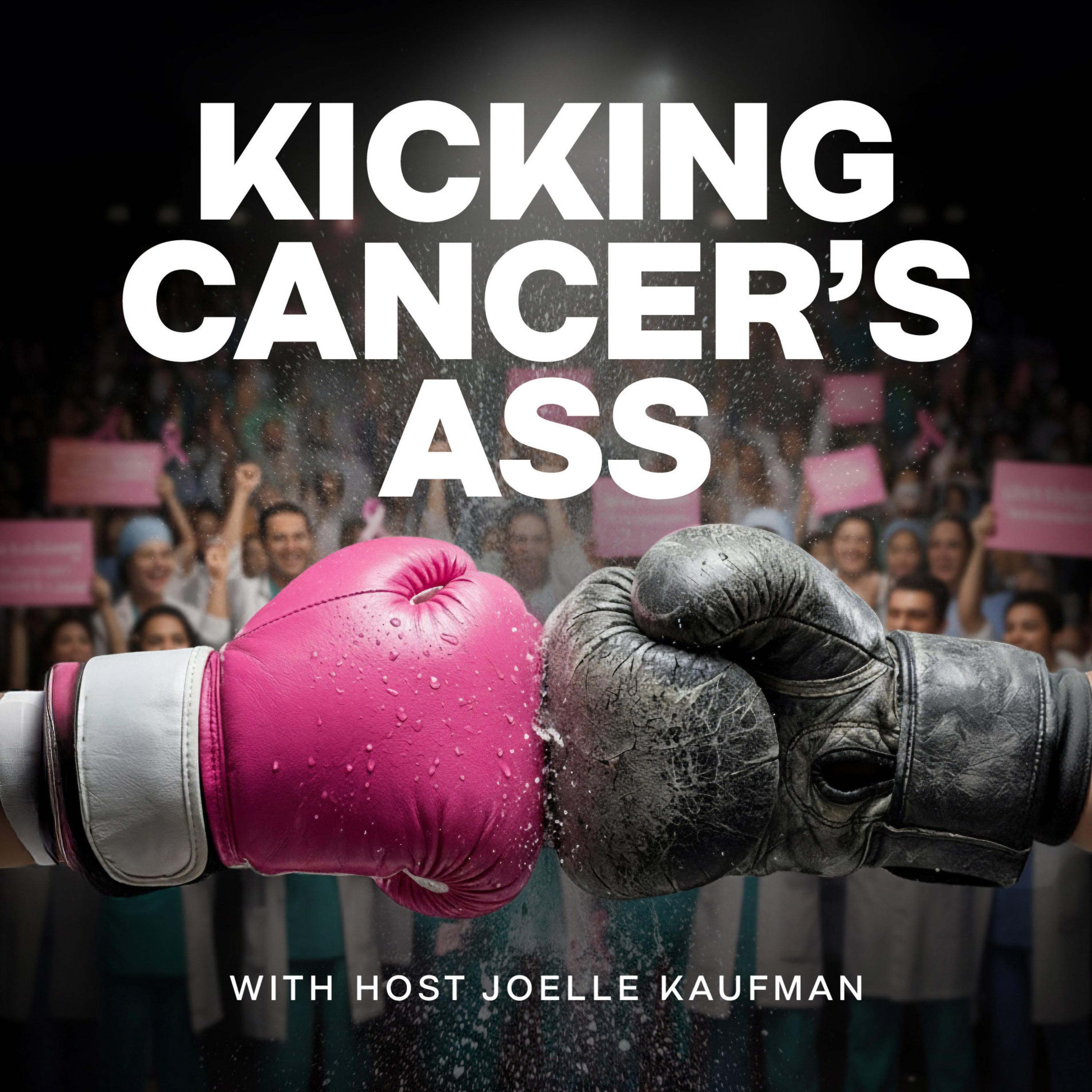
Kicking Cancer's Ass
by Joelle Kaufman
Kicking Cancer’s Ass is the weekly podcast giving cancer survivors, patients, and caregivers hope and power through stories, strategies, and science.
-
64
Episode 45: Your Blood Shows Cancer Is Back 8 Months Before a Scan Does.
The technology exists. The blood draw is simple. So why won't most oncologists order it?Amy Delson has been treated for cancer four times. She's currently in active treatment. She's also a longtime breast cancer patient advocate — she reviews research grants for the Department of Defense, sits on lab teams asking researchers to do fewer biopsies on patients, and edits the informed-consent forms patients sign before clinical trials.She can't have mammograms anymore. So she fought to get a circulating tumor DNA test — ctDNA — through a researcher she works with, because her own community oncologist wouldn't order one. She talks about that fight in this episode, and about the bigger argument behind it: most oncologists are deciding for patients whether patients can handle the test results. Amy thinks that decision belongs to the patient.The science is moving fast. In 2025, the SERENA-6 trial — published in the New England Journal of Medicine — showed that switching therapy based on a ctDNA signal, before any scan showed progression, nearly doubled progression-free survival in HR-positive HER2-negative metastatic breast cancer. The "we don't have clinical utility yet" objection just got harder to hold.The test isn't perfect. It can detect DNA from cancer your immune system has already cleared. Amy is direct about that. The argument isn't that ctDNA is a crystal ball. The argument is that patients deserve to know what's available, what it can show, what it can't, and to decide for themselves.About Amy Delson Four-time cancer survivor. Breast cancer patient advocate. Reviews research grants for the Department of Defense. Works with I-SPY, the Translational Breast Cancer Research Consortium, and Komen.Recorded at RiseUp 2026.Subscribe for stories, science, and strategies from people kicking cancer's ass. New episodes weekly.Learn more about scalp cooling from episode sponsor - www.coldcap.comLearn more about UCSF RiseUp at https://riseup.ucsf.edu/ Listen to more episodes: Apple Spotify YouTubeWebsite
-
63
Episode 44: 3 Cancers. A Brain Tumor. His Doctors Wouldn't Give Him a Prognosis.
"You're the only person who truly cares about you."Jeffrey Eisenberg faced three cancer diagnoses during the pandemic: stage 1 colon cancer that turned into a four-month ileostomy after his intestines burst during surgery, large B-cell lymphoma, and then a 2cm lymphoma tumor behind his brain where his MD Anderson oncologists couldn't promise the chemo would cross the blood-brain barrier. He came out cancer-free after an autologous stem cell transplant at Houston Methodist on December 28, 2023 — and in this conversation he tells Joelle why most "survivor talk" is too shallow to help anyone, and what actually got him through.They dive deep into:Why the question is never "what are my odds?" — population studies lump 97-year-old grandmothers and 20-year-old athletes together. The phrasing that actually gets an oncologist to answer: "Do I have a fighting chance?"The sequencing logic for picking autologous stem cell transplant over CAR-T first — and what three months living within five minutes of Houston Methodist, with zero ports and a non-functional immune system, actually requires.Mia's three-poster-board strategy for humanizing a patient in a transplant unit — and how it shifted the care Jeffrey received on a floor where staff are trained to disengage.Why Jeffrey and Mia got legally married mid-treatment despite decades together in Texas, a common-law state — and exactly what their estate attorney flagged about insurance, power of attorney, and the paperwork limbo unmarried partners hit.EMDR as a treatment for cancer-specific trauma — the non-talk modality Jeffrey and Mia both used, and why it's often harder to find a practitioner in New York or California than in Texas.The one-line question Jeffrey used to replace a pharmaceutical cardiac stress test with a treadmill: "If I can't make it on the treadmill, you still have the option of doing the shot, right?"What actually breaks through professional detachment on a transplant floor — the Patch Adams book inscribed to a covering doctor, and the nurses who quietly started bringing him coffee from their own break room.The 26:40-per-mile walk with his aging labradoodle that Jeffrey now ranks alongside Rome, Zurich, Jerusalem, Istanbul, and the New York Times bestseller list — plus what his father, who outlived a six-month mantle cell lymphoma prognosis by six and a half years, taught him about regret.Kicking Cancer's Ass. We never chose the pitch, but we always choose the swing.
-
62
Episode 31 – The Cancer Support Program Most Patients Miss: 100+ oncology nurses guiding you on care journey
“Call us. Get into the program and allow us to help you. You need someone there to help you. Cancer is a journey—you’ve got to have a support system.” In this eye-opening episode, Steve Cain, CEO of UnitedHealthcare California, joins Joelle Kaufman to reveal how insurance companies are transforming from claims processors into active care partners during the most vulnerable moments of a patient’s life. They dive deep into: The Cancer Support Program: 100+ oncology RN navigators who coordinate your entire care journey Zero-copay cancer screenings and first diagnostics in California—removing financial barriers that delay treatment Cancer Guidance Program: NCCN-pathway platform embedded in provider EMRs approving treatments in hours, not weeks How claims data triggers proactive outreach when diagnostic codes and pharmacy fills signal a serious diagnosis Why most denials stem from “insufficient information” and how navigators bridge documentation gaps The $130 million affordable housing investment driven by data proving stable housing improves cancer outcomes Transparency tools showing exact episode-of-care costs and quality metrics at decision time Why calling your insurance company the moment you hear “you have cancer” is the most underutilized resource From eliminating copays to deploying AI for early detection outreach, this is essential listening for anyone navigating cancer—or leading healthcare innovation. Don’t just survive the system. Make it work for you. Learn more: kcapodcast.com
We're indexing this podcast's transcripts for the first time — this can take a minute or two. We'll show results as soon as they're ready.
No matches for "" in this podcast's transcripts.
No topics indexed yet for this podcast.
Loading reviews...
Loading similar podcasts...
Frequently Asked Questions
How many episodes does Kicking Cancer's Ass have?
Kicking Cancer's Ass currently has 3 episodes available on PodParley. New episodes are automatically indexed when they're published to the podcast feed.
What is Kicking Cancer's Ass about?
Kicking Cancer’s Ass is the weekly podcast giving cancer survivors, patients, and caregivers hope and power through stories, strategies, and science.
How often does Kicking Cancer's Ass release new episodes?
Kicking Cancer's Ass has 3 episodes. Check the episode list to see recent publication dates and frequency.
Where can I listen to Kicking Cancer's Ass?
You can listen to Kicking Cancer's Ass on PodParley by clicking any episode. We provide an embedded audio player for direct listening, and you can also subscribe via your preferred podcast app using the RSS feed.
Who hosts Kicking Cancer's Ass?
Kicking Cancer's Ass is created and hosted by Joelle Kaufman.
URL copied to clipboard!