
PODCAST · kids
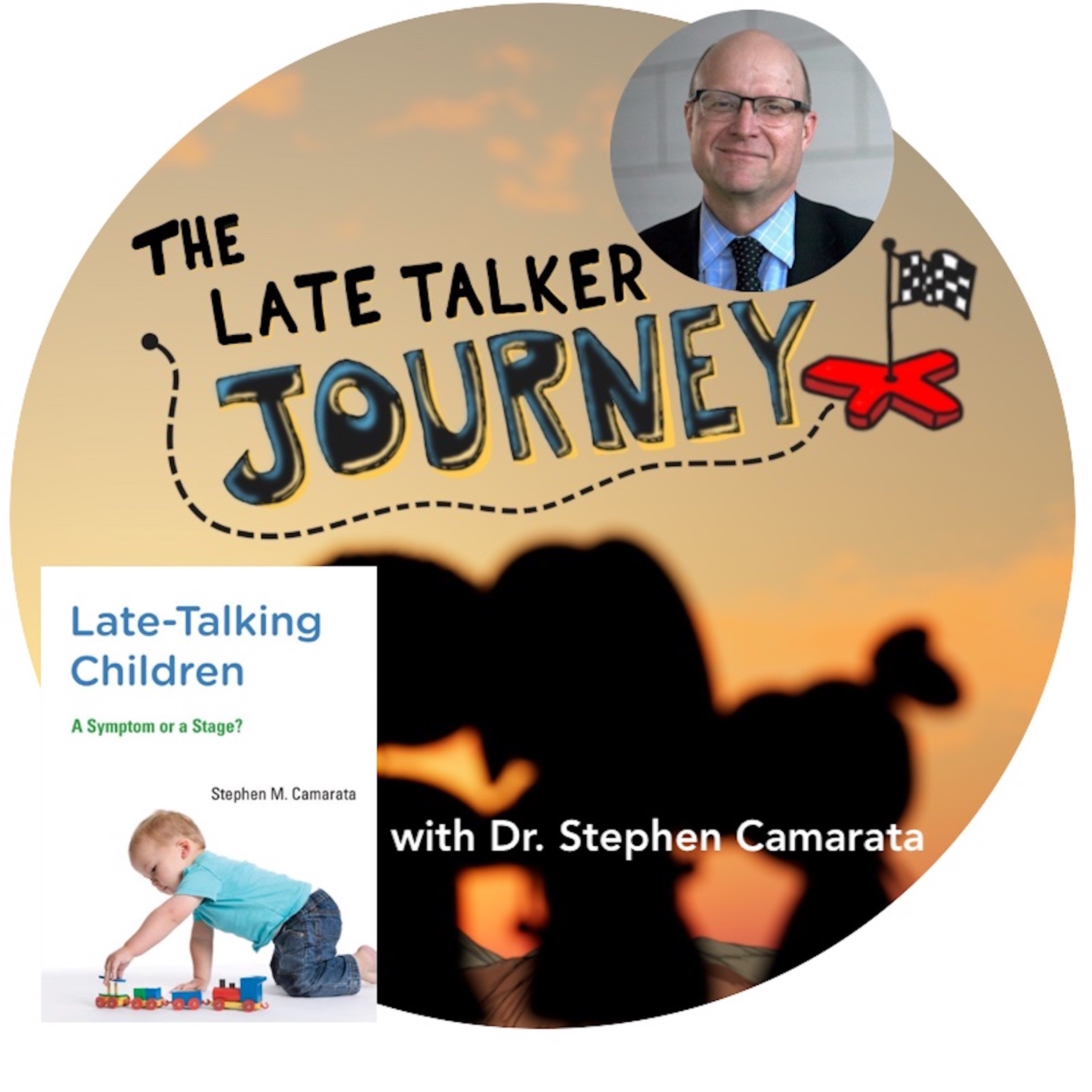
Late Talker Journey with Dr. Stephen Camarata
by Stephen & Mary Camarata
Always remember! The best thing for your child is you! You are listening Late Talker Journey audio presentation. Late Talkers Foundation empowers parents of late-talking children through education and the realization that they are extremely capable and not alone.
-
30
Early Uh-oh Feelings! How to Turn "Questioning" into "Constructive!"
Are you sometimes questioning if your child's talking is coming along as it should be (?) but also feel a full diagnostic and differential diagnosis is too premature? There is an alternative path forward! And it's good for all parents and children, regardless if they are late talking or not! View this episode of "Late Talker Journey: Travel Notes" and learn of another way forward where your voice is heard, and your child (and you!) benefit. Check out the Late Talkers Foundation website for more helpful resources: https://latetalkers.org/ Check out the Late Talkers Foundation channel: https://www.youtube.com/@Late-TalkerJourney/featured INTRODUCING MARY: Mary Camarata is a speech pathologist with more than 40 years experience teaching children with a wide variety of abilities, including giftedness, exceptional learners, language disorder, Autism, and cognitive disabilities. In addition to assisting families and schools across the country, she has coordinated numerous federally funded research projects on language & learning, support models, treatment efficacy, and behavior. most. In this capacity, she has been an author on more than 35 scholarly papers appearing in peer-reviewed journals. Over the past years, she has held positions at Pennsylvania State University, University of California Santa Barbara, and Vanderbilt University. More recently, assisted with the development of new tests for the Woodcock-Johnson Tests of Cognitive Abilities and Achievement. Mary is in private practice assisting families whose children are experiencing developmental delays, have successful outcomes in their homes, school, and other daily environments. Finally, she is the mother of seven children, including one who had an IEP from preschool through middle school.
-
29
Late Talker Foundation Interview: Shirley
Shirley shares her perspective. :-)! ABOUT LATE TALKERS FOUNDATION: A guiding principle of the Late Talkers Foundation is that parents are the most significant influence in their child's life. Our mission is to provide parents with insight, knowledge, and a continuing resource of support so that they can provide the best possible environments for their child. When parents understand their child's needs and are trained to meet those needs, their ability to influence development and learning overall are optimized. As a result, the quality of life for all family members, including the child's, is improved. It is so important for families to experience parenthood's joys and the wonder of the growing up years. A parent's confidence in their understanding and ability to provide for their child improves the outlook for every member of the family. The Late Talkers Foundation strives to fulfill this mission with each family and is privileged to partner with families in this process. CHECK OUT THE LATE TALKERS FOUNDATION WEBSITE https://latetalkers.org/ CHECK OUT THE LATE TALKERS FOUNDATION CHANNEL https://www.youtube.com/@Late-TalkerJourney/featured
-
28
Ep.#15 Late Talkers: PART 2: Parent Questions from "Late Talking: A Symptom or a Stage"
Our chapter-by-chapter dive into the best-selling book, "Late Talking Symptom or a Stage" is completed! This episode is part 2 of the wrap-up Q&A session with the author, Stephen Camarata. He continues to answer the questions that you have submitted. Join us as we explore the various topics presented. LATE TALKING: A SYMPTOM OR A STAGE Late-Talking: A Symptom or a Stage is a best-selling book by Stephen Camarata, Ph.D., about late-talking in all its variations. The 2nd edition of the book is about to be released. In this video series, Collette Wieland and Stephen Camarata explore each chapter of this book and discuss the questions on the minds of many parents of late-talking children. ABOUT DR. CAMARATA: Stephen Camarata, Ph.D. CCC-SLP is a late talker himself and is an internationally recognized expert on child development broadly with a focus on how children learn to talk. His clinical and scientific expertise includes speech and language intervention in children with autism, down syndrome, hearing loss, and developmental language disorder (DLD). Dr. Camarata is a professor of Hearing & Speech, Psychiatry, and Otolaryngology at Vanderbilt University School of Medicine and a Professor of Psychology and Human Development and Special Education at Peabody College, Vanderbilt University. He has written two books related to development, "Late Talking Children: A Symptom or a Stage" MIT Press 2014 and "The Intuitive Parent" Penguin 2017, and has a regular blog on Psychology Today CHECK OUT THE LATE TALKERS FOUNDATION WEBSITE https://latetalkers.org/ CHECK OUT THE LATE TALKERS FOUNDATION CHANNEL https://www.youtube.com/@Late-TalkerJourney/featured
-
27
Ep.#14 Late Talkers: PART 1: Parent Questions from "Late Talking: A Symptom or a Stage"
Our chapter-by-chapter dive into the best-selling book, "Late Talking Symptom or a Stage" is completed! In this episode (and the next!) the author, Stephen Camarata, answers questions that parents submitted as we explored the various topics presented. Come join us! LATE TALKING: A SYMPTOM OR A STAGE Late-Talking: A Symptom or a Stage is a best-selling book by Stephen Camarata, Ph.D., about late-talking in all its variations. The 2nd edition of the book is about to be released. In this video series, Collette Wieland and Stephen Camarata explore each chapter of this book and discuss the questions on the minds of many parents of late-talking children. ABOUT DR. CAMARATA: Stephen Camarata, Ph.D. CCC-SLP is a late talker himself and is an internationally recognized expert on child development broadly with a focus on how children learn to talk. His clinical and scientific expertise includes speech and language intervention in children with autism, down syndrome, hearing loss, and developmental language disorder (DLD). Dr. Camarata is a professor of Hearing & Speech, Psychiatry, and Otolaryngology at Vanderbilt University School of Medicine and a Professor of Psychology and Human Development and Special Education at Peabody College, Vanderbilt University. He has written two books related to development, "Late Talking Children: A Symptom or a Stage" MIT Press 2014 and "The Intuitive Parent" Penguin 2017, and has a regular blog on Psychology Today. CHECK OUT THE LATE TALKERS FOUNDATION WEBSITE https://latetalkers.org/ CHECK OUT THE LATE TALKERS FOUNDATION CHANNEL https://www.youtube.com/@Late-TalkerJourney/featured
-
26
Late Talkers Foundation Interviews: Ellen
Ellen shares her story.
-
25
Late Talker Foundation Interviews: Carlos
Carlos shares his story.
-
24
Late Talker Travel Notes: Pick Your Pediatrician Prudently
Listen to why your connection with your child's pediatrician is fundamental and goes well beyond well-check and sick visits. Chapters 00:00 Introduction 00:40 Your Pediatrician 02:10 Repository of records 02:20 Referrals and pursuing other services 04:14 Talking with your pediatrician, let your voice be heard 04:24 A foundational springboard 04:50 A quality relationship is critical 05:48 If it is not a good fit, find a good fit Check out the Late Talkers Foundation website for more helpful resources: https://latetalkers.org/ INTRODUCING MARY: Mary Camarata is a speech pathologist with more than 40 years experience teaching children with a wide variety of abilities, including giftedness, exceptional learners, language disorder, Autism, and cognitive disabilities. In addition to assisting families and schools across the country, she has coordinated numerous federally funded research projects on language & learning, support models, treatment efficacy, and behavior. most. In this capacity, she has been an author on more than 35 scholarly papers appearing in peer-reviewed journals. Over the past years, she has held positions at Pennsylvania State University, University of California Santa Barbara, and Vanderbilt University. More recently, assisted with the development of new tests for the Woodcock-Johnson Tests of Cognitive Abilities and Achievement. Mary is in private practice assisting families whose children are experiencing developmental delays, have successful outcomes in their homes, school, and other daily environments. Finally, she is the mother of seven children, including one who had an IEP from preschool through middle school.
-
23
Late Talker Journey: Three Brief Messages for the Road
Three brief messages for the road! Mary presents three quick considerations to keep in mind to enhance your journey with your late talker. Check it out! Late Talkers Foundation Website: https://latetalkers.org/ INTRODUCING MARY CAMARATA: Mary is a speech pathologist with more than 40 years experience teaching children with a wide variety of abilities, including giftedness, exceptional learners, language disorder, Autism, and cognitive disabilities. In addition to assisting families and schools across the country, she has coordinated numerous federally funded research projects on language & learning, support models, treatment efficacy, and behavior. In this capacity, she has been an author on more than 35 scholarly papers appearing in peer-reviewed journals. Over the past years, she has held positions at Pennsylvania State University, University of California Santa Barbara, and Vanderbilt University. More recently, assisted with the development of new tests for the Woodcock-Johnson Tests of Cognitive Abilities and Achievement. Mary is in private practice assisting families whose children are experiencing developmental delays, have successful outcomes in their homes, school, and other daily environments. Finally, she is the mother of seven children, including one who had an IEP from preschool through middle school.
-
22
Ep. #13 Late Talkers: Putting It All Together!
Collette and Stephen have finished the book! Today, Collette and Stephen look back and summarize the essential takeaway messages addressed in the chapters of "Late Talking: A Symptom or A Stage." The deep dive into this best-selling book is not over! Addressing parent questions is the topic of the concluding episodes (2) airing over the next two weeks! Let us hear from you! LATE TALKING: A SYMPTOM OR A STAGE Late-Talking: A Symptom or a Stage is a best-selling book by Stephen Camarata, Ph.D., about late-talking in all its variations. The 2nd edition of the book is about to be released. In this video series, Collette Wieland and Stephen Camarata explore each chapter of this book and discuss the questions on the minds of many parents of late-talking children. ABOUT DR. CAMARATA: Stephen Camarata, Ph.D. CCC-SLP is a late talker himself and is an internationally recognized expert on child development broadly with a focus on how children learn to talk. His clinical and scientific expertise includes speech and language intervention in children with autism, down syndrome, hearing loss, and developmental language disorder (DLD). Dr. Camarata is a professor of Hearing & Speech, Psychiatry, and Otolaryngology at Vanderbilt University School of Medicine and a Professor of Psychology and Human Development and Special Education at Peabody College, Vanderbilt University. He has written two books related to development, "Late Talking Children: A Symptom or a Stage" MIT Press 2014 and "The Intuitive Parent" Penguin 2017, and has a regular blog on Psychology Today CHECK OUT THE LATE TALKERS FOUNDATION WEBSITE https://latetalkers.org/
-
21
Late Talker Journey Travel Notes: Don't Leave the Gifts On The Shelf
It is normal to want to help your child where they are struggling. But don't forget to spend time on their strengths! There is a significant cost-benefit to consider when allocating our's and our late talker's time. Mary presents a thought-provoking orientation as to why supporting our late-talking child's strengths is "as" or potentially "more" important than working to bring weaknesses or lower "scores" up to par. When we support our child, we need to keep the current -and- big picture in mind. Introducing Mary: Mary Camarata is a speech pathologist with more than 40 years experience teaching children with a wide variety of abilities, including giftedness, exceptional learners, language disorder, Autism, and cognitive disabilities. In addition to assisting families and schools across the country, she has coordinated numerous federally funded research projects on language & learning, support models, treatment efficacy, and behavior. In this capacity, she has been an author on more than 35 scholarly papers appearing in peer-reviewed journals. Over the past years, she has held positions at Pennsylvania State University, University of California Santa Barbara, and Vanderbilt University. More recently, assisted with the development of new tests for the Woodcock-Johnson Tests of Cognitive Abilities and Achievement. Mary is in private practice assisting families whose children are experiencing developmental delays and have successful outcomes in their homes, school, and other daily environments. Finally, she is the mother of seven children, including one who had an IEP from preschool through middle school. CHECK OUT: Late Talkers Foundation Website: https://latetalkers.org/
-
20
-
19
Ep.#11 Special Education Law and Practice
IEP stands for Individualized Educational Program, and it is a contract that sets out a framework of learning support for eligible students. The IEP document identifies how the student is eligible for the program, outlines the specific needs of the student, and then tells how those needs will be accommodated within a free and appropriate public education. It may sound like a lot of legalese and be intimidating at first. But you (parents) are a critical and equal part of the team. Remember, you are an expert on your child. There are many parent-friendly resources to help you understand the process. Collette interviews Stephen Camarata about the IEP process and the advice he has for parents LATE TALKING: A SYMPTOM OR A STAGE Late-Talking: A Symptom or a Stage is a best-selling book by Stephen Camarata, Ph.D., about late-talking in all its variations. The 2nd edition of the book is about to be released. In this video series, Collette Wieland and Stephen Camarata explore each chapter of this book and discuss the questions on the minds of many parents of late-talking children. ABOUT DR. CAMARATA: Stephen Camarata, Ph.D. CCC-SLP is a late talker himself and is an internationally recognized expert on child development broadly with a focus on how children learn to talk. His clinical and scientific expertise includes speech and language intervention in children with autism, down syndrome, hearing loss, and developmental language disorder (DLD). Dr. Camarata is a professor of Hearing & Speech, Psychiatry, and Otolaryngology at Vanderbilt University School of Medicine and a Professor of Psychology and Human Development and Special Education at Peabody College, Vanderbilt University. He has written two books related to development, "Late Talking Children: A Symptom or a Stage" MIT Press 2014 and "The Intuitive Parent" Penguin 2017, and has a regular blog on Psychology Today CHECK OUT THE LATE TALKERS FOUNDATION WEBSITE https://latetalkers.org/
-
18
Late Talker Journey Travel Notes: Resist "Shoulding" Yourself. You do you best!
Mary talks about the pressure we sometimes put on ourselves, particularly with decisions making. In this episode, Mary uses the example of homeschooling. We may take something on that we have been told is best or preferred even though it is not a right fit for us. The best YOU is the best for your child. Make the choice that is right for you and your situation, and it will be best for your child.
-
17
Ep. #9 Early Childhood Services & Special Ed Part 1
This video is the first of a two-part series on considerations parents should be mindful of when pursuing early childhood and school-age services for their late talker. Parent(s) are integral members of the support team devising the best ways to serve your child. Looking at the chapter titles below will lay out the topics and questions addressed. So, please take in Part 1 of this two-part series and let us hear from you!
-
16
Ep. #8 Getting a Proper Diagnosis
In this episode, we take a deep dive into the intricacies of getting a proper evaluation and diagnosis and the parent's instrumental role in that process. There are several components to an excellent evaluation and diagnosis. Getting as complete and well-rounded an understanding of the child as possible is crucial. Many children present differently, to a greater or lesser extent, when they are the subject of a clinical appointment. Add to this that late talkers are most often not adept in their communication, and many have particular temperaments, and the magnitude of the parent's vital role is plain. Your knowledge of your child is crucial, and it should feel that way. Still, there are many additional pointers presented to help assure that the parent(s) and the child experience a quality evaluation where insight, help, and the benefit of a dedicated professional's expertise are gained. There is a lot in this episode. You may want to listen twice! Please feel free to contact the LATE TALKERS FOUNDATION at: - [email protected] - 615-866-9457 - https://latetalkers.org/ "Late-Talking: A Symptom or a Stage" is a best-selling book by Stephen Camarata, Ph.D., about late-talking in all its variations. The 2nd edition of the book is about to be released. In these videos, Collette Wieland and Stephen Camarata discuss and explore the questions on the minds of many parents of late-talking children. About Dr. Camarata: Stephen Camarata, Ph.D. CCC-SLP is a late talker himself and is an internationally recognized expert on child development broadly with a focus on how children learn to talk. His clinical and scientific expertise includes speech and language intervention in children with autism, down syndrome, hearing loss, and developmental language disorder (DLD). Dr. Camarata is a professor of Hearing & Speech, Psychiatry, and Otolaryngology at Vanderbilt University School of Medicine and a Professor of Psychology and Human Development and Special Education at Peabody College, Vanderbilt University. He has written two books related to development, "Late Talking Children: A Symptom or a Stage" MIT Press 2014 and "The Intuitive Parent" Penguin 2017, and has a regular blog on Psychology Today. Chapters in this podcast 00:00 Welcome! 00:38 Why is getting a diagnosis important 01:40 Should you seek a second opinion 02:55 What if there is disagreement or question 06:06 Treatment indications 12:57 What is included w speech and language evaluation 13:57 Use widely accepted diagnoses 17:17 Steps for every parent 20:50 Questions every parent should ask 23:23 Is there truly "denial" 26:10 Experiences in school 30:16 Encouraging parent's voice
-
15
Late Talker Journey Travel Notes: Partnering With a Helper is Priceless!
A Guide For Parents: https://latetalkers.org/wp-content/uploads/2023/03/parent-tools-how-to-find-helpers-sample-questions.pdf The above resource is one of many on the Late Talkers Foundation website. Check it out for more helpful resources: https://latetalkers.org/ "You are the best expert on your child! Mary talks about the need and undeniable value of having excellent helper(s) along the way. Expert helpers (Speech Pathologists, Teachers, Occupational Therapists, Psychologists, etc.) possess information about development and the multitude of different developmental paths children take. They have dedicated their efforts to helping children and their families. They are invaluable guides to you. And you are an invaluable guide to them! Where you are concerned, there is only -one- developmental path and pattern you need to understand: your child's! You already know your child best! With your keen awareness and knowledge of your child and the helper's expertise in development, your partnership will be awesome for all concerned. It's a matter of finding the helpers with whom you work well. Help Finding Helpers: "Parent-Only Appointments" are valuable any time you are looking for helpers. They are not only for evaluations. They can be used when looking for help with intervention, or school, or to form a relationship with a potential speech pathologist, occupational therapist, teacher, psychologist, physician, or other helpers. Parent-Only Appointments: A Guide For Parents: https://latetalkers.org/wp-content/uploads/2023/03/parent-tools-how-to-find-helpers-sample-questions.pdf Introducing Mary: Mary Camarata is a speech pathologist with more than 40 years experience teaching children with a wide variety of abilities, including giftedness, exceptional learners, language disorder, Autism, and cognitive disabilities. In addition to assisting families and schools across the country, she has coordinated numerous federally funded research projects on language & learning, support models, treatment efficacy, and behavior. most. In this capacity, she has been an author on more than 35 scholarly papers appearing in peer-reviewed journals. Over the past years, she has held positions at Pennsylvania State University, University of California Santa Barbara, and Vanderbilt University. More recently, assisted with the development of new tests for the Woodcock-Johnson Tests of Cognitive Abilities and Achievement. Mary is in private practice assisting families whose children are experiencing developmental delays, have successful outcomes in their homes, school, and other daily environments. Finally, she is the mother of seven children, including one who had an IEP from preschool through middle school.
-
14
Ep. #7 Einstein Syndrome: The Details & Telling The Difference
Dr. Camarata and Collette Weiland explore the characteristics of late talkers and the particular characteristics of a subset of late talkers associated with the term "Einstein Syndrome." Please feel free to contact the LATE TALKERS FOUNDATION at: [email protected] - 615-866-9457 - https://latetalkers.org/ "Late-Talking: A Symptom or a Stage" is a best-selling book by Stephen Camarata, Ph.D., about late-talking in all its variations. The 2nd edition of the book is about to be released. In these videos, Collette Wieland and Stephen Camarata discuss and explore the questions on the minds of many parents of late-talking children. "The Einstein Syndrome: Bright Children Who Talk Late" by Thomas Sowell. https://www.tsowell.com/latetalk2.html About Thomas Sowell & his book(s): The Einstein Syndrome is a follow-up to Late-Talking Children. While many children who talk late suffer from developmental disorders or autism, there is a certain well-defined group who are developmentally normal or even quite bright yet who may go past their fourth birthday before beginning to talk. These children are often misdiagnosed as autistic or retarded, a mistake that is doubly hard on parents who must first worry about their apparently handicapped children and then see them lumped into special classes and therapy groups where all the other children are clearly very different. Since he first became involved in this issue in the mid-90s, Sowell has joined with Stephen Camarata of Vanderbilt University, who has conducted a much broader, more rigorous study of this phenomenon than the anecdotes reported in Late-Talking Children. Sowell can now identify a particular syndrome, a cluster of common symptoms and family characteristics, that differentiates these late-talking children from others; relate this syndrome to other syndromes; speculate about its causes; and describe how children with this syndrome are likely to develop. (Barnes & Nobel Synopsis) About Dr. Camarata: Stephen Camarata, Ph.D. CCC-SLP is a late talker himself and is an internationally recognized expert on child development broadly with a focus on how children learn to talk. His clinical and scientific expertise includes speech and language intervention in children with autism, down syndrome, hearing loss, and developmental language disorder (DLD). Dr. Camarata is a professor of Hearing & Speech, Psychiatry, and Otolaryngology at Vanderbilt University School of Medicine and a Professor of Psychology and Human Development and Special Education at Peabody College, Vanderbilt University. He has written two books related to development, "Late Talking Children: A Symptom or a Stage" MIT Press 2014 and "The Intuitive Parent" Penguin 2017, and has a regular blog on Psychology Today.
-
13
Ep. #6 LATE TALKERS: Diagnoses and Considerations
In this interview, Collette interviews Stephen about late talking children, Autism, diagnosis, and treatments. There are many considerations to bear in mind, particularly with regard to indicated treatments. The Late Talkers Foundation wants to hear from you (!) on these considerations. Please, send your questions or send your insights. Above all, enjoy your child. Late-Talking: A Symptom or a Stage is a best-selling book by Stephen Camarata, Ph.D., about late-talking in all its variations. The 2nd edition of the book is about to be released. In this video series, Collette Wieland and Stephen Camarata explore each chapter of this book and discuss the questions on the minds of many parents of late-talking children. About Dr. Camarata: Stephen Camarata, Ph.D. CCC-SLP is a late talker himself and is an internationally recognized expert on child development broadly with a focus on how children learn to talk. His clinical and scientific expertise includes speech and language intervention in children with autism, down syndrome, hearing loss, and developmental language disorder (DLD). Dr. Camarata is a professor of Hearing & Speech, Psychiatry, and Otolaryngology at Vanderbilt University School of Medicine and a Professor of Psychology and Human Development and Special Education at Peabody College, Vanderbilt University. He has written two books related to development, "Late Talking Children: A Symptom or a Stage" MIT Press 2014 and "The Intuitive Parent" Penguin 2017, and has a regular blog on Psychology Today
-
12
Late Talker Journey Travel Notes: The Invisible Side of Language,
How much language does your child understand? In this video, Mary talks about: A) why language comprehension is the "invisible" side of language. B) why determining our child's ability to understand the language is important, particularly in optimizing our support. C) why it can be a tricky determination for both parents and clinicians! This video will also guide you to helpful resources. Join Mary and learn a bit about the invisible side of language! LINK: Understanding What You Hear: https://latetalkers.org/courses/three-things-you-need-to-understand-what-you-hear-the-brick-house-analogy/ Mary: Mary Camarata is a speech pathologist with more than 40 years experience teaching children with a wide variety of abilities, including giftedness, exceptional learners, language disorder, Autism, and cognitive disabilities. In addition to assisting families and schools across the country, she has coordinated numerous federally funded research projects on language & learning, support models, treatment efficacy, and behavior. most. In this capacity, she has been an author on more than 35 scholarly papers appearing in peer-reviewed journals. Over the past years, she has held positions at Pennsylvania State University, University of California Santa Barbara, and Vanderbilt University. More recently, assisted with the development of new tests for the Woodcock-Johnson Tests of Cognitive Abilities and Achievement. Mary is in private practice assisting families whose children are experiencing developmental delays, have successful outcomes in their homes, school, and other daily environments. Finally, she is the mother of seven children, including one who had an IEP from preschool through middle school.
-
11
Late Talker Journey Travel Notes: Paths!
Everyone has their own path(s) in life, and late talkers are no different. We, each of us, find our way and, more beautifully so, with the love and support of others. Mary: Mary Camarata is a speech pathologist with more than 40 years experience teaching children with a wide variety of abilities, including giftedness, exceptional learners, language disorder, Autism, and cognitive disabilities. In addition to assisting families and schools across the country, she has coordinated numerous federally funded research projects on language & learning, support models, treatment efficacy, and behavior. most. In this capacity, she has been an author on more than 35 scholarly papers appearing in peer-reviewed journals. Over the past years, she has held positions at Pennsylvania State University, University of California Santa Barbara, and Vanderbilt University. More recently, assisted with the development of new tests for the Woodcock-Johnson Tests of Cognitive Abilities and Achievement. Mary is in private practice assisting families whose children are experiencing developmental delays, have successful outcomes in their homes, school, and other daily environments. Finally, she is the mother of seven children, including one who had an IEP from preschool through middle school.
-
10
Late Talker Journey's Travel Notes: Child Driven Intervention -- Not Label Driven
In this message, Mary drives home the inadequacy of basing a support plan primarily on a label rather than the child's individuality and their particular pattern of strengths and challenges. For example, there are tens of millions of children in the US, of which roughly 7 to 9% have some kind of communication disorder. And we have roughly half a dozen to a dozen recognized diagnostic labels. A good helper knows that a label will never capture the unique needs of each child. The child should drive the support plan, not the label.
-
9
Ep. #5, Toddlers and Late Talking
Almost all kids with autism are late talkers—but not all late talkers have autism," Professor Stephen Camarata, at Vanderbilt School of Medicine Department of Speech and Hearing Science, talks about why many late talkers are ending up with inaccurate diagnoses and why this can be particularly true for toddlers. Professor Camarata goes on to talk about other behaviors to pay attention to that can provide important clues to help distinguish between what may be a stage or perhaps a symptom.
-
8
Late Talker Journey Travel Notes: Well-meant is not necessarily well-advised!
Mary cautions parents about common advice that, though well meant, is wide of the mark. Viewers will hear three pieces of advice that often come from good-intentioned sources and why we may want to reconsider them. The aim is to present another perspective and more knowledge. The perspective will likely resonate with parents and encourage them to keep regarding their instincts. The knowledge will allow consideration, meaningful discussion, and teamwork with those helping along the journey. Intro To Initiations! Take this free course (approximately 30 minutes) and learn why "communicative initiations" are so important and how you can increase them with your child! https://latetalkers.org/courses/initiations-an-introduction/ Check out the Late Talkers Foundation at: https://latetalkers.org/ Hanen Centre Review: Clarifying common assumptions about child care https://www.hanen.org/Helpful-Info/Articles/Does-child-care-make-a-difference-to-childrens-de.aspx#:~:text=Children%20who%20attend%20child%20care,at%20home%20by%20their%20mothers&text=A%20study%20by%20the%20National,%2Ddeveloping%20children%20%5B1%5D. The home–daycare link: mapping children's new world order Noam Shpancer https://www.academia.edu/19472444/The_home_daycare_link_mapping_children_s_new_world_order We welcome your comments below. Or, email us at [email protected]
-
7
Late Talker Journey Travel Notes: Don't judge the picture by the frame; confusing intelligence & language.
Mary reminds viewers not to confuse intelligence and language. Our language may have some influence on our thinking, but it does not determine nor define our underlying intelligence.
-
6
Late Talker Journey Travel Notes: A highly valuable tool you can use when seeking help
It can be scary when your child is referred for an evaluation or to see a therapist. How do you know you are going to get a good evaluation? How do you know if the therapist will work well with your child? In this video, you will learn one extra step in this process that will make a huge difference in feeling positive about where you and your child choose to go and who they are seeing! This step is invaluable for any parent approaching the process of finding a professional to see their late-talking child.
-
5
Ep. #4, Talkers: Finding Your Way, Important Considerations
Stephen Camarata discusses differential diagnosis and our aim to support the child as early as possible. Parents should not automatically assume that their late-talking child is a genius. On the other hand, signs of high intelligence and analytical ability should not be held against a late-talking child, nor should anyone attempt to derail the nurturing of their intellectual gifts. It is crucial that support is the right kind of support. Early intervention is important, but it must be the right kind of early intervention and must be predicated upon an accurate diagnosis. Prof. Camarata is a permanent member of the NIH study section on Communication Disorders Research and has been a member of review panels at the National Academies of Science, Engineering, and Medicine. He has also served as an editor for the Journal of Speech Language Hearing Research. (JSLHR). He is a professor at Vanderbilt University School of Medicine.
-
4
Ep. #3, Traits of Late Talkers
Collette Wieland interviews Prof. Camarata about traits often seen in late-talking children. The Intuitive Parent: Why the Best Thing for Your Child is You, a book by Stephen Camarata, Ph.D. https://www.barnesandnoble.com/w/the-intuitive-parent-stephen-camarata/1120328430 Please check out The Late Talkers Foundation for more information and support for families of late-talking children: https://latetalkers.org/ Prof. Camarata is a permanent member of the NIH study section on Communication Disorders Research and has been a member of review panels at the National Academies of Science, Engineering, and Medicine. He has also served as an editor for the Journal of Speech Language Hearing Research. (JSLHR). He is a professor at Vanderbilt University School of Medicine.
-
3
Ep #2, What We Know About Late Talking
In this session, we discuss what is known about late-talking. We will discuss the different profiles we see in late-talking, along with what the science tells us. Here are links to information mentioned within this episode. Learn more about Professors Camilla Benbow and David Lubinski. This news article contains links to more information about their study of mathematically precocious youth: https://news.vanderbilt.edu/2018/02/07/noted-scholars-of-giftedness-to-receive-lifetime-achievement-award/ The Intuitive Parent: Why the Best Thing for Your Child is You, a book by Stephen Camarata, Ph.D. https://www.barnesandnoble.com/w/the-intuitive-parent-stephen-camarata/1120328430 Prof. Camarata is a permanent member of the NIH study section on Communication Disorders Research and has been a member of review panels at the National Academies of Science, Engineering, and Medicine. He has also served as an editor for the Journal of Speech Language Hearing Research. (JSLHR). He is a professor at Vanderbilt University School of Medicine.
-
2
Ep. #1, Dr. Camarata & Collette Wieland explore topics from the best-selling book, Late-Talking a Symptom or a Stage.
Late-Talking: A Symptom or a Stage is a best-selling book by Stephen Camarata, Ph.D., about late-talking in all its variations, and a 2nd edition of the book is about to be released! In this series, Collette Wieland interviews Dr. Stephen Camarata and the questions on the minds of many parents of late-talking children are explored and discussed. Dr. Camarata: Stephen Camarata, Ph.D. CCC-SLP is a late talker himself and is an internationally recognized expert on child development broadly with a focus on how children learn to talk. His clinical and scientific expertise includes speech and language intervention in children with autism, down syndrome, hearing loss, and developmental language disorder (DLD). Dr. Camarata is a professor of Hearing & Speech, Psychiatry, and Otolaryngology at Vanderbilt University School of Medicine and a Professor of Psychology and Human Development and Special Education at Peabody College, Vanderbilt University. He has written two books related to development, "Late Talking Children: A Symptom or a Stage" MIT Press 2014 and "The Intuitive Parent" Penguin 2017, and has a regular blog on Psychology Today. For additional resources, please check out the Late Talkers Foundation website at https://latetalkers.org/ And be sure to visit our YouTube Channel at https://www.youtube.com/@Late-TalkerJourney We love hearing from you! Contact us at [email protected] Join our newsletter! https://latetalkers.org/join-the-foundation/ Thank you! for considering a donation: https://latetalkers.org/donate/
We're indexing this podcast's transcripts for the first time — this can take a minute or two. We'll show results as soon as they're ready.
No matches for "" in this podcast's transcripts.
No topics indexed yet for this podcast.
Loading reviews...
ABOUT THIS SHOW
Always remember! The best thing for your child is you! You are listening Late Talker Journey audio presentation. Late Talkers Foundation empowers parents of late-talking children through education and the realization that they are extremely capable and not alone.
HOSTED BY
Stephen & Mary Camarata
Loading similar podcasts...
Frequently Asked Questions
How many episodes does Late Talker Journey with Dr. Stephen Camarata have?
Late Talker Journey with Dr. Stephen Camarata currently has 29 episodes available on PodParley. New episodes are automatically indexed when they're published to the podcast feed.
What is Late Talker Journey with Dr. Stephen Camarata about?
Always remember! The best thing for your child is you! You are listening Late Talker Journey audio presentation. Late Talkers Foundation empowers parents of late-talking children through education and the realization that they are extremely capable and not alone.
How often does Late Talker Journey with Dr. Stephen Camarata release new episodes?
Late Talker Journey with Dr. Stephen Camarata has 29 episodes. Check the episode list to see recent publication dates and frequency.
Where can I listen to Late Talker Journey with Dr. Stephen Camarata?
You can listen to Late Talker Journey with Dr. Stephen Camarata on PodParley by clicking any episode. We provide an embedded audio player for direct listening, and you can also subscribe via your preferred podcast app using the RSS feed.
Who hosts Late Talker Journey with Dr. Stephen Camarata?
Late Talker Journey with Dr. Stephen Camarata is created and hosted by Stephen & Mary Camarata.
URL copied to clipboard!