PODCAST · arts
Latter-day Saint Art
by Jenny Champoux
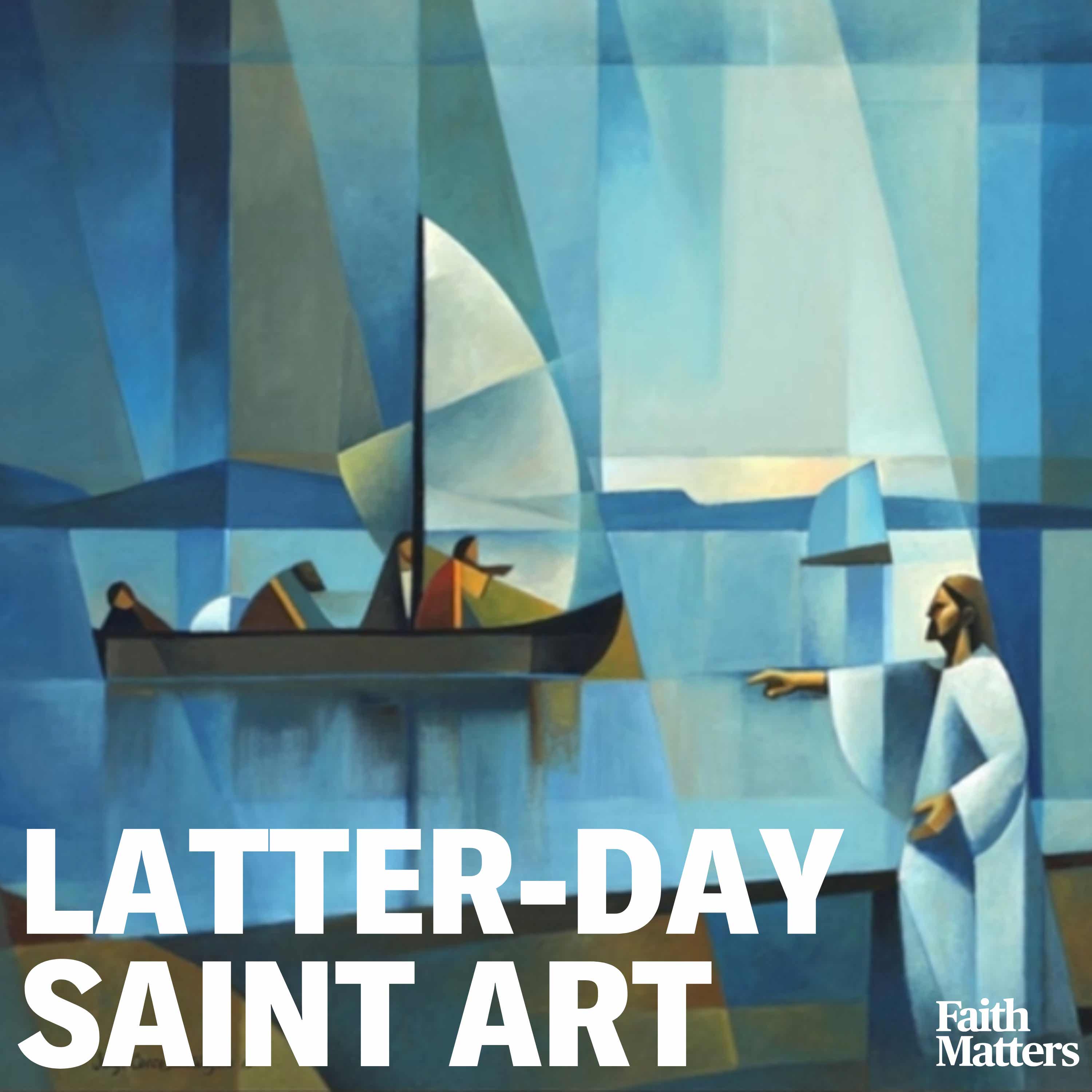
Latter-day Saint Art is a limited series podcast from Wayfare Magazine hosted by Jenny Champoux. In Latter-day Saint Art, I'll guide you through an examination of the artistic tradition of The Church of Jesus Christ of Latter-day Saints. Each guest is a contributor to the new book, Latter-day Saint Art: A Critical Reader, from Oxford University Press and the Center for Latter-day Saint Arts. www.wayfaremagazine.org
-
10
Latter-day Saint Art Episode 10: Charting LDS Art
Jenny Champoux: Hello, and welcome to our final episode of Latter-day Saint Art, a limited series podcast from Wayfare Magazine. I'm your host, Jenny Champoux. Throughout this series, we've examined the artistic tradition of The Church of Jesus Christ of Latter-day Saints, and we've talked with contributors to the book Latter-day Saint Art: A Critical Reader. The book was published in September by Oxford University Press, with support from the Center for Latter-day Saint Arts. If you're listening on the podcast, keep in mind that you can find a video, transcript, and images of the artworks at wayfaremagazine.org.In this episode, we're looking at some of the broad themes introduced in the book. How has Latter-day Saint history and belief affected art production? And similarly, how has Latter-day Saint art affected faith and culture? We'll discuss the value of religious art, what makes it worthy of academic study, and what areas of Latter-day Saint art need further scholarship. [00:01:00]Our guests today are Emily Larsen and Micah Christensen.Emily Larsen is a Utah-based curator, museum professional, researcher, and collage artist. She currently serves as the executive director at the Springville Museum of Art, where she's worked in a variety of positions since 2014. Her research and writing focus on Utah artists and the Utah art scene, from 1880 to 1950. She has an M.A. in US History from the University of Utah.Micah Christensen is a scholar of European, Asian, and American fine art, porcelain and decorative objects. He earned his doctorate in the history of art from University College London, and his master's in fine art from Sotheby's Institute. He served on the board of the Springville Museum of Art until last year and is now the director of the new Salt Lake Art Museum opening in 2026. Micah is also a partner at [00:02:00] Anthony's Fine Art and Antiques. He is a co-author of the Dictionary of Utah Fine Artists and the founder of the Zion Arts Society, a nonprofit organization dedicated to showcasing works by professional and emerging Latter-day Saint artists.Although Emily and Micah were not authors in the book, they are gifted and knowledgeable art historians and curators working in the Utah and Latter-day Saint space. I'm excited to have them join our discussion today, and I think adding their perspectives to this series shows just how much more work on Latter-day Saint art is being done out there and is still left to do. Emily and Micah have been friends of mine and colleagues for several years, and they're both doing incredible work. I can guarantee that you'll not only learn something new from them today, but you'll also be inspired by their enthusiasm and passion for this work.Emily and Micah, thank you so much for talking with us today.Micah Christensen: Thank you. It's great to be here.Jenny Champoux: Emily, congrats on the annual Spring Salon that is currently at the Springville Museum of Art. I know that's a huge project. For our listeners who may not be familiar, can you tell us what the Spring Salon is and what role it plays in the Utah art scene?Emily Larsen: Yeah, so the Spring Salon is one of the longest running and biggest juried art competition shows in Utah. So, it's an open call show anyone can enter. And we've been hosting it in Springville since 1922. So, it's a huge tradition. And this year we got about a thousand entries. We had jurors who came and drew it down to about 250, and it's kind of a snapshot of contemporary Utah art, what's happening in Utah art today.It leans a little bit more towards representational art and traditional art than some of the other juried shows in the state. And is just a great celebration of Utah art and an opportunity for artists to show some of their best works [00:04:00] and be awarded for it. So, it's a fun, a fun tradition, and we'd love for everyone to come.Jenny Champoux: Great. Thank you. Yeah. Is there, have you noticed any trends this year in the show or any themes that you see popping up?Emily Larsen: You know, actually one thing that I think is really interesting about this show, sometimes we feel the shows are really a commentary on what's happening in the world, and there's a lot of, political or social commentary. And this year with everything that's going on in the world, we maybe expected that more.But I think the artists are really using the art and art as a respite. Because it feels like it's really a celebration of art and fine art and is, I guess maybe less about current events than you would expect.Jenny Champoux: Okay. Thank you. Yeah. Micah, you're joining us today from what will soon be the new Salt Lake Art Museum opening next year. Tell us about your vision for this new institution and what we can look forward to seeing [00:05:00] there.Micah Christensen: Boy, I've never done this before. I don't know what to tell you. I've never started a museum! Well, the Salt Lake Art Museum will open officially in the spring of 2026 and it's housed in the historic B’nai Israel Temple, which was a synagogue built in 1890 on land that was given to the Jews in Salt Lake by Brigham Young. And my great-grandfather was a member of that congregation. I'm half Jewish by descent and I'm half Mormon. And well, I'm a mutt. And, it was a, a building that I'd always wanted. And, uh, there's a lot of construction going on in Salt Lake and the population is growing dramatically. It's doubled in the past five years in Salt Lake and it's supposed to double again by 2030. And the, uh, [00:06:00] it’s the first new art museum in Salt Lake since 1983, which, you know what, how we imagine our role is, is we'll play well with other museums. I was on the board of the Springville Museum of Art for more than 13 years. I'm still on the acquisitions committee for Springville. I see that our role is just to educate about Utah art and artists. And it's not much more complicated than that.We’re hoping to have historic and living artists on a regular basis. Competitions here and there. Nothing like the Springville Museum's competition, but more like, you know, for one, one example is we're having a small competition that's more like an invitational of 15 of the country's best plein air painters, many from Utah, to [00:07:00] focus on the Great Salt Lake and to talk about its preservation. So, things like that that we're planning on our first, I can announce now, no one really knows this, that our first retrospective next spring we'll be opening with is James Christensen. And I think it'll be the first major show to happen since he passed, and we're working with the Christensen family now.Jenny Champoux: Oh, great.Micah Christensen: It's exciting. It's total chaos. And half the time it's really exciting. And the other half of the time you just, what was the quote that I heard the other day? You know you're on the right path if the path disappears. The path, the path has disappeared.Jenny Champoux: That sounds really exciting. A lot of possibilities and exciting things coming. So, just so I understand, your museum then is just for artists that lived and worked in Utah or is just to [00:08:00] showcase Utah artists, but from any, any faith tradition or any time period or,Micah Christensen: Yeah, there's no origin criteria. It's whether or not they were connected to Utah in a meaningful way.Jenny Champoux: Okay.Micah Christensen: you know, some of the shows we're looking at doing are maybe one on Emil Kosa, who trained with Alphonse Mucha then worked in California and was the only artist I know who won an Academy Award.He did all the set design for Cleopatra and he did the 20th century Fox logo with the search lights. He invented that. But he spent about 30% of his time painting in Utah just because he loved the atmosphere. And he worked with a lot of artists that we know, like LeConte Stewart.I mean, he's not strictly from Utah, but he painted in Utah a lot. I'm not going to do a lot of those shows. The plan is that Utah needs to just [00:09:00] know its artists better.Jenny Champoux: I like that. I like that. And you also were involved in the publication a couple years ago on, was it the Dictionary of Utah Artists?Micah Christensen: I got roped into the Dictionary of Utah Fine Artists project,Jenny Champoux: Okay.Micah Christensen: so there have, this was the fourth edition of the Dictionary of Utah Fine Artists. The last one I think was published in 1997 and it had about 1500 artists living and historic in it. And we increased that size to 4,500 roughly artists. I wrote myself about 900 biographies of artists.Jenny Champoux: Wow.Micah Christensen: And I got some of them right. Some of them. And, and we would try and talk with every artist we possibly could. It was a revelation. It was overwhelming. It was inspiring. And I think that it was just a testament to the idea that we come from a place that is inordinately [00:10:00] populated by people who create art. and presently, uh, it, it was really humbling. And if you're, if any of you have a hard time sleeping at night, buy a copy, you'll, you, it's truly like a dictionary. It's like you, it's not the kind of book you buy because you're just casually reading about art. It's like a reference book.Jenny Champoux: Okay. Okay. Is Emily in the book? Because Emily, I know you're a practicing artist as well.Emily Larsen: You know, I think Vern decided that I was not, um, my art was not worthy of inclusion as an artist, but I did, I did write about maybe like 15 or 20 of the bios for some of the historic women artists.I’m a very, very small contributor, but not my collage art did not make it in as one of the 4,500, which I agree with. I agree with the decision.Micah Christensen: You know, Emily, I'm in charge of the next edition. Who knows when it happens, but, you know, we'll have a [00:11:00] conversation.Emily Larsen: I think my contributions as a museum professional are much more significant than my art contributions. But I love making art and that I think it's such a great, that that project is so important and is such a testament to the creative spirit of Utah and all the contributions that artists have made here, which it, it is fun to read about all the different people who have made art in Utah.And, and I mean, like me, there's so many people. You can never get everyone in a project like that. So, there's always more work to do, which I think is true of Latter-day Saint art too. If we're talking about specific faith tradition, it's just, there's so many stories and so many people to talk about.Jenny Champoux: Yeah, that's right. Yeah. So, we're, this is our final episode of this series, looking at the Latter-day Saint Art Critical Reader. And the afterword was written by Laura Hurtado, who's another curator there in Utah. We all know, she’s done [00:12:00] fantastic work for years in the Utah and Latter-day Saint art scene.She unfortunately isn't able to join us today, but we're going to use her afterword as the jumping off point for our discussion. And in her essay, she reflected on what she saw as the central tension in the book’s essays. And it was this desire by the Latter-day Saints to be seen as both unique and sort of different, and also at the same time to be accepted by the larger society.And I think we see that theme throughout many of the essays in the book and in the art, it's reflected in the art. So, in earlier episodes that we did in the series, we saw how Saints, the earlier Saints, used art to project an image of refinement and normalcy. Even sometimes sending artwork back East to say, you know, kind of look at what we're doing out here. We’re just nice Americans building a beautiful [00:13:00] American settlement out here.Laura points out in her essay that recently most pieces for the outside art world directly addressing Latter-day Saint issues tend towards a sort of exotic approach. So, sort of looking at sort of the weirdness or the strangeness of Latter-day Saint culture and practice.I see that. But on the other hand, I also see that within the Church, it seems like there's been kind of a move by leaders and even members. And we see this like in the offerings at Deseret Book of a move towards more kind of typical Christian imagery that is less distinctly like Mormon and more just kind of Christian.So, more crucifixion imagery. Yongsung Kim has been very popular with these images of Jesus. Jesus as the shepherd, or [00:14:00] Jesus in a field, or Jesus just smiling at us. I even see artists kind of turning to these Catholic visual devices in their framing or the format of the canvas and sometimes even the symbolism.So, I mean, just, I see this sort of widening divide, right, between maybe some contemporary LDS artists and also artists outside of the faith tradition focusing on the sort of strangeness of Mormon art. But then within the Church, I see a desire for this more like mainstream kind of Christian art. So, I want to ask, are, are you seeing this as well?Do you agree with my assessment here? Do you want to push back on any of this? Or what do you think are the trends happening right now with, with Latter-day Saint art? Emily, can I go to you first?Emily Larsen: Sure. Yeah, I mean, I agree with you Jenny and I, and I agree with Laura. I think that you see such a wide variety. I think you [00:15:00] do see this, like Laura points out, especially in artists working in larger contemporary art circles and in, in different venues, that there is this emphasis on the strangeness and the, that exoticization.But like you're saying, there's so much art being created that does kind of try to conform to this mainstream imagery. We, one of the other shows we host at Springville each year is an annual exhibition competition of spiritual and religious art. And it's open to any faith tradition, but of course we're in Springville, Utah. So many pieces are dealing with the Latter-day Saint faith tradition, either from a devotional aspect or from an outsider out aspect. And think what's great about these shows at Springville, where we get so many entries is you really do see this wide swath of variety and kind of anywhere along the spectrum, you'll see are.I was talking to some other people [00:16:00] recently about in the gallery last fall for this Spiritual and Religious show. In one of the galleries, we had this very traditional depiction by Del Parson, who, that's the artist who did the very traditional portrait of Christ in the red robe that you see in the meetinghouses. So, there was a portrait of Christ by him with a young child. And then right across from this was more of an installation piece by an artist who, and I could be getting this a little bit wrong, but I think in their artist statement, identified themselves as a queer Mormon witch. And I think that speaks to the, and it was very contemporary, and it was installation based, and it was interactive. And those kind of, to me, in the same gallery in Springville showed this just the wide variety of art being made for different audiences and for different motivations in the Latter-day Saint tradition.So that was my long rambly answer to say, yes, I agree with you, Jenny.Jenny Champoux: Yeah. So, you kind of see this like widening divide here, that there's Yeah, I, yeah, but I think, yeah, it depends [00:17:00] on the audience, right? Of, of who they're marketing it towards. Micah, what do you think?Micah Christensen: Oh, I've got a lot of thoughts. First of all, I read through what Laura wrote a few times and really just, I thought she was so thoughtful and she had so many thoughts that, uh, I had thought and I thought, oh, I was the only one who thought, I thought I was the only one who thought that. Right?When I read it and then I thought, boy, you could take so many of the things she wrote and write an entire chapter or book about just one paragraph or thought that she had. I found it to be, really, really, really thoughtful and this idea that you, that, that you brought out. And you've, I agree with you.I think that there is this, uh, this idea that there's a larger art world within that art [00:18:00] world, it's not cool to be religious in, in, in some parts of that art world. And I don't want to flatten the art world too much because there's a lot of variety in the art world, right? But she talks a little bit about that.And, and I think what she's talking about is really the world of contemporary art. The kind of art that's really demanding most of the attention and resources in, in museums and art schools and, and, and galleries worldwide, which is, she travels quite widely. And she talks about going to the Venice, she doesn't biennale, but it's where I know she's gone to that. She's spent a lot of time in London. And those are things that I also have spent a lot of time at.And, you know, it the, the, when I have seen LDS artists who play in that world, they do assume this kind of, it's almost like that is what makes them different, being a Latter-day Saint.And they use that as a way to get some traction in a world where everybody [00:19:00] is trying to get some kind of identity. Right? And then there's, there, uh, she breaks down, pretty, in a fascinating way, what it was like working for the Church and the Church's concerns with the kinds of things they were collecting and what they were encouraging or not encouraging. And then I, also, I, my perspective that I think is maybe different from hers or most people's is I did my master's and PhD on how artists were trained in academic traditional art, plays very well with religious subjects in a non-cynical way. Right? It's very earnest often, and there is a Venn diagram that crosses over with Latter-day Saint artists who are working in figurative art and making very sincere images and finding an audience for it, and they see no reason to compromise what they're doing.And a larger world that's [00:20:00] doing representational figurative artwork. But even that world, which is the Michael Angel Academy, the Daniel Graves Academy in Florence, the, the academies in New York of the Grand Central Academy where there are a lot of LDS artists go to these places. When you get to, when I've spoken at these academies in London, Spain, France, Italy. The United States, even Latin America, they all have a mentality, like some of these figurative Latter-day Saints do feel that as figurative artists working in a traditional method, the art world is against us. Which then makes them feel really cool too, right? Because then they're the young upstarts that are just like the modernists who were upstarts against the academy.Now they're the upstarts.Jenny Champoux: HmmMicah Christensen: So I, I don't know, I kind of, sometimes I'm somewhat cynical when I think, oh, Latter-day Saints have to be seen as weird, or, [00:21:00] they have to, they have, I, I think it's, it's almost like you pick your audience. Or your patron is another way of saying that. And there are the demands that are put on you limitation or opportunity, right.Jenny Champoux: Yeah. No, that's really interesting. Because even though the figurative artists maybe right, are less, I don't know, in the majority, in the contemporary art world, they're very much in demand with our Church leadership, right, who was commissioning art, figurative art for temples, or just other gospel art. So it's like you said, and I think Laura touched on this in her essay too, that Latter-day Saint artists are trying to negotiate between these different patrons or audiences. Like the Church leaders who want didactic, figurative images, and members who want that too, who want prints of those kinds of images in their home.And then [00:22:00] you've got the Church History Museum trying to, you know, like build a comprehensive repository of Latter-day Saint art, trying to encompass everything. And then this really expansive contemporary art market. And, and they each have different motivations, different styles that are preferred.And, I don't know, Emily, how do you see Latter-day Saint artists negotiating those different markets?Emily Larsen: Yeah, it's really interesting and I mean, I'm so familiar with our local and regional art scene, most familiar with that versus kind of an international or national contemporary art scene, even though I keep up on that and try to be sure I'm staying aware of what's going on. But you do see artists prioritizing, like Micah said, and like Laura really points out in the book different audiences and patrons.And I think too, once you kind of decide what kind of art you're making as an artist and who that art is really for and what's motivating it, you cut, there's these different subcultures, even in like a [00:23:00] small of place as Utah and Salt Lake City, there's dozens of different art communities and cultures and they're all having different conversations and sometimes it overlaps and, and sometimes it doesn't.And that's really interesting because you do see that like what's motivating the art and who the art is trying to speak to most, whether that is a, a larger contemporary art scene or, or a scene in Utah or a religious patron. It really does affect the way that the artists are making art. And, sorry, I don't know if this thought is very well formed, but, it is interesting to see where those overlaps happen and where they don't and what motivates the different artists, even just here in Utah.Jenny Champoux: Mm-hmm. Yeah. Micah, do you see, are there places for Latter-day Saint artists that are doing religiously informed art? Are, are there places for them to market that outside of, you know, Deseret Book or Church Temple art commissions?Micah Christensen: [00:24:00] Absolutely. I, I don't know how big it is.Jenny Champoux: Yeah.Micah Christensen: that, it's, it's happening. So, for instance, there's a, an international show that's called The Art Renewal Center.So, the Art Renewal Center has this major competition every year, there's a competitor that's come up to it called the Almenara Prize that's happening in Spain. And each one of them has a lot of religious art that's sent to them, much of it by LDS artists. And it's either bought by the organizations that are putting on the competition or by people who see the artwork on the site.And I've talked with artists, they're working for Ang, the LDS artists who were working for an Anglican commission or a Catholic commission or a commission that is, it has nothing to do with Latter-day Saint group. There was a major, one of the most beautiful installations I've ever seen of [00:25:00] sculpture and painting was done by Joseph Brickey in a church in, in Minnesota. And it was done for a Catholic church. He worked on it for many years in collaboration with a Catholic priest. And here's Joseph Brickey, who is one of the fun, like most LDS of LDS artists. I mean, he's been around for decades doing work for temples, for church publications. And here he's got a huge commission that he was given by the Catholic Church. So I know that, I know that it's happening. Uh, and you know, I've judged art competitions in Spain and in France before, and there's always, you know, a few Latter-day Saint artists that are competing in them. I think that's, it's there. There is a small group that are doing it.Jenny Champoux: Yeah.Micah Christensen: I was [00:26:00] speaking to somebody who I, you know, I own, I'm one of the owners of Anthony's Fine Art in Salt Lake, and about 70% of our clients are out of the state or out of the country. And most of the religious art that I sell, that I don't have a lot of contemporary artists that are LDS that are in the gallery. It's mostly historic, but whether it's historic or contemporary religious artists, most of my art goes to non-LDS out of state buyers.Jenny Champoux: Oh, really?Emily Larsen: And we're working with a smaller group of collectors than Micah is, but we sell a huge variety of works each year from our Spiritual and Religious show that are all across kind of the genre spectrum, medium style, some very devotional and traditional, some very contemporary. And I think there's examples. Like I keep thinking of Camilla Stark.She's a, a great artist based here in Provo, who works in a more contemporary style. She just did a [00:27:00] Kickstarter campaign for her graphic novel, The Desert Prophet, and it went, it was hugely successful. And so I think there are lots of people out there, religious art answers these huge questions about what it means to be human or attempts to, right, attempts to get at some of those and some of these shared experiences.And I think there's a, a hunger for that among people. So I think there is a, a big market.Jenny Champoux: I like that. I like that idea of thinking about these universal themes, but maybe viewed through a Latter-day Saint lens or perspective on it. Yeah.All right. To shift gears a little bit, and looking more at artwork within Latter-day Saint culture, Laura's essay talked about how there is this limited list of approved images for meeting houses.For listeners who may not know, probably most of you do, but in May of 2020, Church leaders announced this initiative to emphasize Jesus or images of Jesus in meeting [00:28:00] house artwork, especially in the foyers of the meetinghouse. And as part of that, if the stake president needed to select new artwork for the foyer, there is a provided list. And at the time in 2020, it was 22 images on this approved selection of foyer artwork. I've noticed over the past five years, that list has changed a little bit. Some, some pieces have been removed, some have been added. I think there are actually 23 now, but it's, it's kind of a different list than it was five years ago.I know you're both aware of that. Without getting too much into the particulars of any, any of the paintings, which maybe we could do if you want to. But I just kind of want to take a step back a little bit and think about what's your take on the impact of having this limited scope of approved images?Are there benefits to that? I mean, it seems like clearly there are limitations, but like, what are [00:29:00] the pros and cons here? Micah, will you start?Micah Christensen: Oh yeah, I've got, I got a lot of thoughts on this.Jenny Champoux: Okay.Micah Christensen: so first of all, I think we should talk about the mechanics of this,Jenny Champoux: Okay.Micah Christensen: So it's, the Church is broken up into various patronages, you could say, right? So, there's the temple, which has images which are not reproduced outside of the temple. There's the Ensign and Church magazines and website, which things that they sometimes use the art for, but don't usually own the original art. They just buy a limited use or maybe a long-term use image, and they tend to be the most liberal with the kinds of images they use.Jenny Champoux: Right.Micah Christensen: Then you've got the Church History Museum, which is, Laura talks about, has a, she used the word edict from D&C 22 to just collect everything. Right? Not from a, just from a perspective of being good [00:30:00] stewards, of collecting what's being made right. And then there is the Church department that oversees meetinghouses, and that is what we're talking about with this particular question. And what they give, when you build a new building in the Church, usually it's given as a book to the stake president. Abook of images that the stake president, hopefully in counsel with the, like the stake leadership, including men and women.Jenny Champoux: Right?Micah Christensen: a decision to put what images in what building and they, they're, and then they say to the Church, these are the images I want.And the Church out. It's, you know, it, it, it gives them whatever size they need and frames it and sends it to them. So they have this booklet that they, they've had around since the 90s.And they chose, [00:31:00] a really important, I think to say why they chose to change it. In 2020, the Black Lives Matter movement was happening. I don't think right away, but the Church leadership, even Dallin, President Oaks, said Black Lives Matter. Right? He did use those words and there was not a lot of art that showed people of different races. Right? There's very European informed, so what the Church did in its first iteration is it took, it, it scoured their rights of what they had, that had a variety of things, and they immediately added like 10 paintings that they already owned. But then as I understand it, they've commissioned 10 or 15 more. From different artists.And it was chaos for a little while. I remember I got a phone call, I don't know if Emily, you had anything like this, but I got this phone call, five or six different versions of it. I'll tell you the one from Oakland. So a stake [00:32:00] president and stake Relief Society president gave me a phone call, conference call, and they said, we want to change out all the art in our meetinghouses. We've been told you're somebody who knows a lot of different LDS artists. We want people to walk into our meetinghouses and to see themselves. They don't see Black people, they don't see Hispanic people, they don't see people who are of all different colors. We want those kinds of images in our place. What do you think we should do? And the Church had given the counsel of, to them, of pick your own art and if, and then we will at some point send an administrator to come in and see if it's okay. But if you, but if you picked it through a counsel system, it's gonna be very, but they we're gonna largely trust you.They went out and bought the, they convinced Kirk [00:33:00] Richards and Rose Datoc Dall, who are not on the list, from what I understand, to make some original works and to buy the rights of other works, which they, as a stake paid for, to put in their building. And as far as I understand, the Church has not gone in and, and taken it out. But the Church was kind of panicked that everyone was gonna do this, I thinkJenny Champoux: Right, right,Micah Christensen: it was like, it was like, oh my gosh, like if everybody's picking their own art and going directly to the artist, we better, we better like get some standardized images.Jenny Champoux: right. Well, and that seems to be one of the benefits is you have that kind of familiar uniform visual culture throughout the world. Emily, what do you think about that? Is that, is that useful or, or are there ways that go.Emily Larsen: oh, it's, it's incredibly useful for a certain motivation of the Church, right? Like I, I Laura's book chapter talks a lot about all the [00:34:00] different ways you can identify as LDS or more or not, and I'm definitely in that complicated, I, uh, I'm not a practicing active member though I grew up LDS and am very, obviously very in, in this culture and in this world.So I might have maybe more of a cynical view of this than someone who was very much more of a believing devotional member. But I think there's, there's a lot of motivation for the corporate Church, right, to standardize that, for it to be uniform. That this is, these are the artworks that are going to be on display when we want our members taking part in taking the sacrament and doing these really devotional rituals each Sunday or, or when they're there for classes, they can then control the imagery that's part of that experience. And I think that's very useful when you have a church of millions of members all over the world.But I think you, for me, there's a huge [00:35:00] con to it because I really love the things that have come out of Latter-day Saint visual culture. Out of our, our super specific and super local. We have this great piece in our collection. It's by Mabel Frazer. Heather Belnap discusses it in her chapter in this book, and it's a work of art that Mabel created for her chapel for where that her local congregation came each Sunday and took the sacrament.And it's, it's this very strange painting of Jesus among the Nephites. I think a lot of people who see it just think it's bizarre, but it is monumental, it's, you can't even really fit it in the museum because it's so big. And that she created that for her chapel and of her understanding of this Book of Mormon's story is so much more meaningful and interesting to me as an art historian.And even as someone who would go to worship, I would love to worship in a space that had some of that more local art. But I, [00:36:00] I think there's a lot of reasons to not do it that way. Because as Micah points out, you, you kind of let it open to anything and then it's hard to, keep it standard amongst all those different congregations.Jenny Champoux: Yeah, I, I mean, I feel like it's a little tricky, right? Because I do see benefits to having that kind of uniform visual culture and there's just sort of a visualization of belief and doctrine that is appropriate. But then, you know, when the art is always like, when you have 23 paintings that are the only 23 paintings you see in Church foyers, I feel like over time there's a potential for it to become just kind of like background noise where you don't even, they're so familiar, you don't even really engage with them anymore as a viewer. It doesn't spark new thought or conversation or questions. And also, you know, may [00:37:00] not reflect, in our global church, it may not reflect individual experiences or, or different cultures. So I think it's, I think it's tricky. I don't know.Micah Christensen: I feel like she, Laura, nailed in this. There are two thoughts that I want to kind of combine that she shared. The first is that she said that we're iconoclastic in the Church. As Protestants. And I want to say more about that.But before I do, the other thought was that, I'll quote it. She says, by comparison to many other faith traditions, is still in its infancy, are at the very least in early puberty, and is awkward, naive, and still very much obsessed with policing its boundaries. Beau, I mean, brilliantly said, right? Brilliantly said. And I feel like to me, when you are half Jewish by descent, right?And my, anytime, [00:38:00] I'm not trying to belittle the pioneer experience, but anytime somebody would get up at the pulpit and talk about how much the Mormon pioneers suffered, my Jewish grandma would be like, okay, here we go again. Suffered more than the Jews, right? And she would, she would have kind of this perspective of, you know, they're, they're young people, Micah, they've only been around for, you know, a couple hundred years of religion. We've been around for 8,000 years. That was her, that was her thinking. Whether it's, we could examine that right? As an idea. But, and, and whether or not we are glomming onto other traditions and borrowing from them and those kinds of things.But I think Laura's point, I, I specifically to this question you're asking of, is uniformity good? It's a chicken in the egg scenario for me on some level because how do you have an identity and a uniform experience as a global church when you don't have [00:39:00] imagery that's shared by everybody, right? But at the same time, you're so young and the imagery you're creating is arguably underdeveloped, awkward, naïve. Like she said, in puberty. And so when you're creating work that's like that, do you, are you on some level stunting its growth by creating uniformity at such an early stage?To me that's a real, it's a, it's a, it's, it's a thought that I think is, none of us can answer it until 500 years from now.I'm not a huge fan of uniformity myself. I do not like uniformity. I am like, just everybody create whatever they want to create and, and let the best stuff win. Right?Jenny Champoux: yeah.Micah Christensen: and maybe the best stuff means that everything wins and just has different audiences. Right?Jenny Champoux: Yeah. Mm-hmm. [00:40:00] Yeah.Micah Christensen: I, I also realized that as if I were in Church leadership that I, I understand at some point you have to say. Yeah. You know, we're building a building and people come here and they, and we've got to contribute to a certain kind of experience.Emily Larsen: I think it's interesting to think about like, how, what are the ways that the Church or, or us as a, a larger Latter-day Saint culture need to introduce people to different artists? Because maybe in meetinghouses isn't the way to show the great variety of art that's being made in our tradition or about our faith tradition.But there's, I find people really at our visitors at the museum, they're experience is so specific to a specific artwork, and when it becomes, when it is that individual expression that relates to their own human experience, that's where that magic, transformative, spiritual experience can happen with the work of art.And, and how do you, a kid in a [00:41:00] random chapel in in the world, how do you help them have that opportunity to find the artwork that speaks to them spiritually? I don't, I don't know if I have answer to that. And actually, Jenny, I think you have done a lot of work on that by creating the Book of Mormon Art Catalog, where you create this huge repository of art being made about a subject that people can find.But it's, it's such an interesting and complicated question when we get down into the weeds of it.Jenny Champoux: Thanks.Micah Christensen: Yeah, I mean the, the, I think that something you said, Emily, I, I. Goes back to this iconoclasm and why we have to be iconoclastic on some level, on a doctrinal level know, you, when you go into these chapels and, and uh, Laura talks about this and quotes a couple others, the things that are definitely like utilitarian in uniform or you go in and it's the same chairs, the same tables, the same [00:42:00] walls everywhere you go because it's practical, right? It's super practical. And, and I think that you want people to have, we are a people who are extremely literate in the sense that, in the history of religions, most people before the Enlightenment were not very literate and they were experiencing religion through images, maybe mostly in architecture. They relied on a priest whose job it was to interpret. Right? And to read to them the text and, and then Protestantism comes along and everybody in our church is encouraged to read the words. Right?If I had to say, like, for me as an example is like maybe a fake made up example is you a revealed, uh, a sacrament meeting prayer that has to be word for word and it's corrected if it's wrong. We would never put an image above a sacrament meeting table [00:43:00] in, in order to show it off. We would never really put an image in a celestial room either. Right? Because the whole idea is that, that it's the revealed word. It's your personal revelation, your personal experience. And an artwork is by definition someone else's vision and idea. That's their vision and idea. And the Church is at its own cross-purposes the moment they pick one artist to represent, because words can be interpreted in all kinds of ways, right? The moment you create an image that's supposed to be everybody's way of interpreting something and thinking about something, then you create a much narrower vision what those words potentially mean. And so on some level, I think the demand of religion is either, you got two ways to go. Either have no images and everybody has their own interpretation, right? Or you let every image possibly come in. So you've got tons of variety [00:44:00] interpretations everybody has got an interesting way of looking at the first vision or something else.Or you're in this weird in between place where we've got like five official first visions and they're all a little different than one another, but they're not necessarily like, how do you depict brightness of the sun? Literally, right? Abstraction is sometimes a better way to do it, and the Church does not accept abstraction as the way to depict it.And so you're immediately like, at cross-purposes with what art can do and what the Church will do and what the word can do.Jenny Champoux: That's such an, that's such an interesting tension there between these different competing factors and motivations.Okay. Switching gears again in, in the book, in the introduction to the book, written by the co-editors, they identified several themes that they saw in Latter-day Saint art, including things like, you know, self [00:45:00] fashioning through image, or notions of race and gender. I, as I've done this 10 episode series, I kind of regrouped the way they had them grouped in the book because I wanted to think about maybe additional kind of cross dialogue between these essays.And I've really enjoyed that talking to the, the authors over the series. One that came up over and over again, I mean, there were several, but one that stood out to me was, it came up in the very first chapter by Terryl Givens, is this fluid boundary between the sacred and the profane in Latter-day Saint art.And, I wanted to ask you both how you see that. Maybe Emily, maybe with your Spiritual and Religious show there, how, how do you see artists negotiating or like transgressing that boundary between sacred and profane? And, and then Micah, I'd love to get your take as someone who, like you said, has judged [00:46:00] religious, you know, Catholic religious competitions or European religious art. Like how does Latter-day Saint, how do Latter-day Saint approaches to this sacred and profane paradigm? How do they compare with maybe what Catholics or Europeans are doing? Is it different? Is it similar?Emily Larsen: Yeah, I think, I think this is a huge theme in Latter-day Saint art that you see different artists approaching differently. And I mean, we already mentioned Joseph Brickey, but I think artists like him and who are really interested in sacred geometry and symbolism and, and really understanding how their visual language is tying into this spiritual symbolism and, and Christian iconography that goes back centuries.They're on maybe one end of a spectrum that's really more in the sacred there. I would say that they consider their art sacred. And, and, and Micah maybe can push back on my interpretation of this too, but then there's a lot of artists who are playing with the [00:47:00] daily life, sacredness, spirituality, and daily life, and that's of how they're communicating their beliefs or the, the Latter-day Saint doctrine.I think like a great example that is really popular is Brian Kershisnik’s Jesus and the Angry Babies.Jenny Champoux: Yeah.Emily Larsen: like the, this hugely celestial figure of Jesus Christ, a a God, part of our godhead sitting with babies he can't make happy. Like that's the, the, the daily ritual experience. And there's a lot, a lot of artists in Utah and in, in the Latter-day Saint tradition who, who express their religion and their spirituality through these daily lives and moments.And then there's artists like, and I already mentioned her too, so sorry, I keep just repeating artists that we've already mentioned, but Camilla Stark and the Arc-hive, which is this Mormon Art Collective, who purposefully is examining these intersections of the sacred and profane. And even in kind of a, a funny way, they curated a show that I was part of [00:48:00] maybe six or seven years ago called Holy Hell.And it was all about how do we use these symbols in our visual culture that sometimes are sacred or these sacred figures, but start to kind of play, add a playfulness to that, add a sense of humor, poke fun a little bit, and there's artists all across the spectrum doing all sorts of that.Jenny Champoux: Fascinating. Okay. Micah, what do you think?Micah Christensen: I think that fundamentally the Church is of two minds of this sacred and profane because I, I think that if you're Catholic, for instance, God is mysterious. There's a kind of unknowability and a lack of human understanding of what God is doing and why. And as Latter-day Saints, we've got that from the King Follett discourse.The idea of as man, as God as man is God once was, as God is man may become. And that was seen [00:49:00] as blasphemous by a lot of religions. We know this because it was like almost on an idea of like, of God is so much different than us, it was more like you know, we're, from their perspective, we're pulling God down to our level. A little bit, right. That he's understandable. He is knowable, he's logical from our own comprehension. I'm not saying that all our, the, all the doctrine of, of, of the Church says that, but I think in our arts it's, funny because even the way we, even use paintings there, there, you know, they're, we're posing in a picture during a baptism in front of a painting where Christ is hugging children. Right? He's somebody who's like, he's your, he's your buddy. He's your friend. He's like a member of the family, right?And, uh, it's this, this whole debate that I don't think is anything new. There's this great, [00:50:00] oh, I can't remember who it was, but it was a, was a Swedish author who comes to the United States, and he does a commentary as he's traveling across the United States in the 1970s. he says that all, the one thing that's interesting about the Mormon Christ is he looks like Bjorn Bork, which who was a famous tennis star at the time, and you've heard me talk about this before, both of you, that the Mormon depiction of God tends to track pretty closely whatever, with whatever the popular image of a perfect Hollywood star man looks like at any one time. In the eighties, he looks kinda like Sylvester Stallone and Schwarzenegger. He is big. He's got a jaw. He becomes more beautiful and Brad Pitt and Tom Cruise-like in the nineties. And now he kinda looks like a Marvel superhero. Right. And I think that not mysterious and even this discussion's about we can, he was, he, he was Semitic.Let's make him look Semitic. [00:51:00] Let's make him look like somebody who really existed, you know, 2000 years ago. And let's get that exactly right. because we can, we can do anthropology and research and we can know exactly what Jesus looked like. These are conversations that Catholics are like, you can’t know that stuff.I mean, it that, like, that is in and of itself a profane discussion, right? That we're bringing God down to this definable thing. And, and I, don't know. I think that it's got its pluses and minuses because we really have a relatable imagery of Christ. He's somebody you can relate to who understands us and our needs according to these images,Jenny Champoux: Yeah.Micah Christensen: it's also got the limitation of, it's limited by our own imagination of, you know, of what people are like. So I think Givens, it's a really profound question of, I think maybe [00:52:00] Latter-day Saints more than anybody in the shows I've judged, are more willing to make everything profane. To make it sacred.It's like going to a Church temple department meeting that they had in like 2019 where they said, okay guys, we're gonna make images for the Church. And we've got on staff anthropologists and archeologists who can make sure that the jars you put in your paintings are accurate. As if like, we look at a work of art and say, I am so inspired by that painting. That jar is really from the first century ad. Holy cow. Right? Like, I feel the spirit so strongly because that textile is accurate, right? That to me is how I like, look at this sacred and profane discussion on some level of, I, I don't think it's a I'm, I'm not trying to like knock somebody who's got it accurately. I just [00:53:00] don't think that it's necessarily the thing that's going to make art inspiring or useful.Jenny Champoux: That's an interesting example you give of that sort of drive for historical accuracy in biblical art. And that, I mean, that was very popular among other American and European 19th century Bible artists. Right? And, and, and Latter-day Saints, I think kind of picked that up and ran with it and have continued it in a way that, uh, a lot of other faith traditions have left off.But maybe one of the motivations there is that, that if it looks like a first century pottery, then somehow that speaks to like the truth of Christ's life as a mortal man in, in Jerusalem. I don't know. I mean, I'm assuming that's sort of the motivation there is that it like, is this sort of truth signaling.Micah Christensen: [00:54:00] I think that's true, and I also think it's a fight and another way against the Northern European, white Jesus. Right? Which is itself an invented image.It's also a necessary, it's one way of battling that kind of like, we're gonna have our own Mormon Christ that's different from the Danish Carl Bloch, or the German Heinrich Hofmann Christ. So I think it's part of what Laura was talking about. It's we're kind of in our infancy and our puberty trying to figure out like, is history is, is is some anthropological answer gonna get us our own Mormon Christ? I don't know.Jenny Champoux: Yeah.Micah Christensen: I don't know. I mean, it is, right, too about the idea of by making it more about accuracy historically, it also maybe brings us closer to who he actually was, which [00:55:00] goes to that profane question because it's like an everyday.Jenny Champoux: Right,Micah Christensen: than a mysterious, symbolic figure that you would possibly see in a Catholic image.Jenny Champoux: right. It's, it's emphasizing his mortality more than his divinity, right? He's not standing on a cloud. He's a real personMicah Christensen: right.Jenny Champoux: you know, in sandals standing in the dirt. Yeah. So that, that's a, yeah. Lot, lots to think about. Well, also thinking about kind of where things are headed, in the forward to the book, it was written by Richard Bushman and Glen Nelson. They talked about the book as being a launching point to inspire additional work. I mean, obviously both of you are doing amazing work in Utah and LDS adjacent spaces and there's so much more going on out there. And I just wanted to ask you both as, as curators and scholars, what, [00:56:00] what other themes do you think need to be explored or what are, what kind of work needs to be most urgently done to fill in the gaps of Latter-day Saint visual culture history?Emily, do you wanna start us off?Emily Larsen: Yeah. You know, I think great the more that gets published. I think, I don't have a specific, like I wanna see this book. I mean, there's a million books that I tell people all the time, like, I'm really excited Vern’s John Hafen books coming out. And Heather Belnap and I eventually will finish our book on Mormon Women art or Utah women artists, which a lot of them are Mormon.And there's, I know of all these projects and I feel like there's still so little done that at this point it's kind of like, do anything! Start with like, keep adding to our conversation on Latter-day Saint art and visual culture. Because I think what, what I actually think what it really means with this book is a great launching point, is more conversations between scholarship. [00:57:00] Like there's a lot of like, oh, someone's written about this and someone's written about this, but where are people kind of arguing scholarly in an academic conversation about some of these things? I think that's where we'll start to get really fruitful scholarship when there's enough of us writing about it that we're actually starting to debate with one another in the scholarship.Jenny Champoux: Oh, I like that. Yeah. That, that sounds good. Yeah. Micah, what about you? What, what do you see? How can we bring a more complete picture to this history?Micah Christensen: I, I think we're living at a time when we're getting away from being just official images and there's a lot of things happening in, in the private market. You see people like Kirk Richards who's got his JKR Gallery, and you've got Esther Candari. You've got the Center for Latter-day Saint Arts. You’ve got a lot of [00:58:00] different people who all bring their own audiences and their own perspective are, they've got very different tastes than, than the Church does. There's some crossover with some. But I, I just kind of, I kinda feel like we're at the precipice of, it's, the Church is no longer gonna be the one who may be, and it's exciting, who's commissioning all the great works of art. Right? Or, or the ones that are the most remembered potentially. Right? We may be entering a time when, maybe there are private chapels or private homes or things like that, who knows? Right? And I think that if I were, if I were writing about this right now, I'd want to be talking with collectors and what they're after, right?That, and, and I would want to talk with artists who are kind of on the margin of deliberately chosen to continue making day art, but that isn't, is deliberately [00:59:00] not for the Church as a patron.I think that that world to me is, is kinda like the jazz that's going on.Jenny Champoux: Yeah. Nice. Yeah. You know, when I, Emily mentioned my Book of Mormon Art Catalog website, and that project really started when I was writing a sort of scholarly history of images of Lehi's dream from 1 Nephi 8 in the Book of Mormon. And I wanted to kind of see how, how artists had responded to that chapter of scripture and what had changed over time or what, what parts of that chapter were emphasized more than others in the art.And even how artists from different countries maybe were interpreting it differently. And so I started trying to gather just images of Lehi's dream and it partly made me feel like there [01:00:00] just, there needs to be a better repository for Latter-day Saint art. Especially art based on the scriptures to show, if we want to do scholarship on Latter-day Saint art, we need to have, right, the primary sources to, to look at it. And, so yeah, so I started, that's what started the whole Book of Mormon Art Catalog. And now we have I think like 250 Lehi's dream artworks in there and over 12,000 artworks cataloged in there total. And there's just, there's so much out there and, like Emily said, I mean, just do anything, right?There's so much to be done in terms of the scholarship and the contextualization and helping, not just art historians or scholars, but also just members of the Church, understand their history better, understand how to look at art, how to engage with it, how to ask questions of it, and how to use it as a [01:01:00] helpful, study tool as, as they read the scriptures and study the doctrine.So, yeah, I don't know. Yeah, I, I, so I don't know that I have one answer of like, what's the biggest gap in the history, if it is, like Emily said, just, just get to work everybody. Like there's, there's work to be done. Yeah.Okay. So I'm ending every episode by asking our guests to share a particular artwork that is meaningful to you.Emily Larsen: One that I love is the one I already talked about this Mabel Frazer painting in our collection. And the other one that I've been thinking about as I've been mulling around this question is we just have this great self-portrait by Gary Ernest Smith in our collection.And I think actually Menachem Wecker talks about it in his chapter on the Mormon Art and Belief. But it's kind of this, it's a very dark, in some ways self-portrait. It's the moment I think it's even called Decision. But, as Gary Ernest Smith, who was one of the founding members of the Mormon Art and Belief Movement was, was [01:02:00] deciding to convert to the Latter-day Saint faith and this moment of decision.And you kinda see him very and in, in deep thought in the foreground. And then behind him are like these kind of two pathways that it's very, kind of a psychological self-portrait. And I think. To me that is the, the great thing about almost all religious art and all art, but especially Latter-day Saint art is like, it is all these very individual human experiences and spiritual experiences and spiritual decisions.And that's one of the great things about Latter-day Saint art and doctrine is there's such an emphasis on personal revelation and your own experience. And I, I think that self-portrait captures that, that moment of doubt and of belief and the tension between the two and what way are you gonna go and how will spirituality in your life.So that's one of my favorites.Jenny Champoux: Yeah, that's a really, that's a really powerful piece. Yeah, it really does capture all those emotions. Thanks. Micah, what about you?Micah Christensen: So the piece that [01:03:00] I'm thinking of is by Walter Rane. It's an oil painting that he did that, uh, I think it's called. Oh my gosh. I'll have to look it up. It may, the theme of it is resurrection.Jenny Champoux: Okay.Micah Christensen: It has a woman who is clearly holding a man who has, who is kind of being carried by the woman.And I asked Walter how he came up with it and, and what the theme was. Because I think the title isn't clearly about resurrection.He said, Micah, and if you've met Walter, he's a very soft spoken person, but he has a lot of original thinking and he does a lot of official images for the Church.And he said, Micah, this is not official doctrine. Okay. He said, but if women have a role in bringing life to and, and giving birth, don't you think they have a role in resurrection [01:04:00] and it's their job to resurrect people? And it, it, it blew my mind. Because you know, there's, there's occasionally you see these lists go around by Church officials who are trying to commission works and they're going through the scriptures and they're trying to come up with, oh, do we have that one of the prophet talking to the donkey?Or do we, do we have this one? Like we, we've got like so many of Christ talking to the Samarian woman, but we only have one of this particular image. Right? And it's like they're going by text that's literal. Walter, he was coming up with something that's not on any list. It's a, it's something that is an exploration that only art could possibly do.Jenny Champoux: Right.Micah Christensen: And I, to me that is the kind of art I wanna see more of. I want to see something that's not, it's not rebellious in its [01:05:00] nature. It's not disrespectful to anyone. It's maybe not doctrinal either. Right? But it's, but it's an exploration of a thought that makes me a little emotional, you know, to think about that piece.Jenny Champoux: Oh, that's a beautiful example of how a member of the Church is using the medium of art to, yeah, to explore their own beliefs and theology. Yeah. I like that. I'm gonna look that one up. Thank you.Micah Christensen: Yeah.Jenny Champoux: I don't know that I want the job of resurrecting people, though.Micah Christensen: Yeah. I, uh, I don't know either. And can you choose whether or not to do it? You're like, yeah, I don't know if I want to do that guy.Jenny Champoux: Yeah. It's like, well, how long has it been? I don't know. We'll see.Micah Christensen: Yeah.Jenny Champoux: Well, Emily and Micah, it was so great to talk with you both today. Thank you.Micah Christensen: [01:06:00] It was a privilege. Thanks for having us. Real honor to be picked.Jenny Champoux: For our listeners, thanks for being with us throughout this series. I hope you've enjoyed these discussions as much as I have, and that they've inspired you to look carefully at art and to learn more about Latter-day Saint visual culture. I believe there are exciting things ahead, so please keep exploring and keep looking at art.Thanks for tuning in. Thank you for listening to Latter-day Saint Art a Wayfare Magazine limited series podcast. Each guest is a contributor to the new book, Latter-day Saint Art: A Critical Reader from Oxford University Press and the Center for Latter-day Saint Arts. I hope you'll order a copy of the book to read the full essays and see all the gorgeous full-color images of the artwork.You can learn more about the book and other projects at the Center's website at centerforlatterdaysaintarts.org. If you enjoyed this interview, be sure to listen to the other episodes in this series. You can subscribe to Wayfare [01:07:00] Magazine at wayfaremagazine.org. And thanks to our sponsor, Faith Matters, an organization that promotes an expansive view of the Restored gospel.If you'd like to learn more about Latter-day Saint art, check out my other podcast, Behold: Conversations on Book of Mormon Art. You can also learn more at my website, the Book of Mormon Art Catalog. With more than 11,000 artworks, it's the largest public digital database of Latter-day Saint art. You can search by scripture reference topic, artist, country, year and more.And we recently added a new section for art based on Church history, the Doctrine and Covenants, and the Pearl of Great Price. The website is bookofmormonartcatalog.org. Check it out and see what exciting new art you can find to enrich your study.Jennifer Champoux is the founder and director of the Book of Mormon Art Catalog. She wrote C. C. A. Christensen: A Mormon Visionary (University of Illinois Press, forthcoming) and co-edited Approaching the Tree: Interpreting 1 Nephi 8 (Maxwell Institute, 2023). Get full access to Wayfare at www.wayfaremagazine.org/subscribe
-
9
Latter-day Saint Art Episode 8: Film Studies
Jenny Champoux: Welcome back to Latter-day Saint Art, a limited series podcast from Wayfare Magazine. I'm your host, Jenny Champoux in Latter-day Saint Art, I'll guide you through an examination of the artistic tradition of The Church of Jesus Christ of Latter-day Saints. Each guest is a contributor to the new book, Latter-day Saint Art: A Critical Reader, from Oxford University Press and the Center for Latter-day Saint Arts. A video and transcript of each episode along with images of the artworks discussed are posted at Wayfaremagazine.org.In today's episode, we'll look at the history of films in the Latter-day Saint tradition. We'll focus on four themes: approaches to embodiment, the performance of values and beliefs, the influence of global cultures, and the projection of a Latter-day Saint self-image. Our guests today are Mason Kamana Allred and Randy Astle.Mason Allred is an associate professor of communication, media and culture at Brigham Young [00:01:00] University Hawaii. He earned his PhD from the University of California Berkeley with a designated emphasis in film studies. He is the author of Weimar Cinema: Embodiment and Historicity and Seeing Things: Technologies of Vision and the Making of Mormonism. In addition to being a co-editor of Latter-day Saint Art: A Critical Reader, he wrote a chapter for the book titled, “The Piety of Perspective: Bodies, Media and Cinematic Experience In Latter-day Saint Film, 1970 to 2020.”Randy Astle is the author of Mormon Cinema: Origins to 1952 and over 60 articles on Mormon film. He has taught Mormon cinema at BYU, acquired hundreds of DVDs as the BYU Library’s Mormon film specialist. He edited special issues of BYU Studies and Mormon Artist Magazine. He served for two [00:02:00] years as film editor for Irreantum and programmed film screenings at the Sunstone Summer Symposium. And he created the Annual Academic Forum at the LDS Film Festival. He's currently writing a second book, Mormon Cinema: 1953 to 2024. His chapter we're looking at today is called, “Moving Pictures: Subjectivity and Mormon Identity in Documentary Film.”It's going to be fun to hear from these excellent scholars and to turn our attention to a slightly different form of art today. So, let's get started.Mason and Randy, thank you for talking with us today!Mason Kamana Allred: Happy to,Randy Astle: Thanks for having us.Mason Kamana Allred: be with you.Jenny Champoux: Mason, will you tell us more about your work as co-editor of this book? What was your vision for this project and how do you hope it will inspire future scholarship?Mason Kamana Allred: Thank you for that question. I love this book, so I'm happy to talk about it. And it was so much work it's really nice and [00:03:00] almost cathartic to talk about it now. But to be honest, the, the project was already really in place with, with Laura Hurtado and Glen Nelson kind of planning it out and reaching out to different authors who could cover uh, subject areas of expertise. So, by the time I was brought in to not only be a chapter, uh, author, but to be a co-editor with Amanda Beardsley, was already kind of set. So that was nice. She had done a lot of that front loading, preliminary work. But then when I came in, 'cause she's had other things going on in her life, she had to turn her attention too.So, Amanda Beardsley and I came in and took over editing together and worked with Glen Nelson and Mykal and all the team at the Center and Richard Bushman. And what it was like was, um, because we already had the author set and the, the basic subjects, we could still kind of mold a little bit like the direction of chapters and the overall sense of the volume. And we really enjoyed that. And, and Randy knows this too, but like, we kind of agreed, uh, Amanda, I, and, and Glen too, that we really wanted to have, [00:04:00] um, we wanted to be quite academic. We wanted it to like work in a college classroom, you know, at any, any campus, whether it was like BYU or Harvard, that you could totally use this in some class on, on religion and media or religious history or, or art and religion, something like that. So, we did want that, that kind of register to hit that register. Not to be inaccessible or pedantic, but to, to be legit. Like we wanted to treat it like that, and we felt like we had the right authors to pull that off.The other thing we both felt strongly that like we didn't, as much as possible, we didn't want people to write about art in a way that you could do if you'd never seen the artwork. So, we wanted them to do a lot of, to kinda lean into formal analysis, close textual analysis whenever possible. And that was great 'cause some people were more comfortable with that than others. Um, but you saw even historians kind of getting into more of that to really get descriptive and interpret at least analytical, if not interpretive, uh, at some points on these.So, we did want more of that. We knew we were gonna have tons of images. [00:05:00] So we had like, you know, 200 and something images in there. That was a lot of work. I'd never really worked with that many permissions and images and files before. That was daunting. Um, but that was the basic idea and we didn't wanna really tell authors what to do far as like their approach or coverage.And we tried to let them know like, it doesn't need to be exhaustive. Like that would be ridiculous to pretend like we could be comprehensive what we can. But you go where it takes you. And we tried to give them as much room to just do what they do 'cause they're all brilliant. Um, and I think it worked out well because of that. The, the sad thing for me was. I love this project, but the sad thing was when we first all signed up, and Randy will remember this in like 2020, it was like this idea that we were gonna get together like once, twice a year and have these big kind of like, know, moments to really counsel together, think about chapters, share with each other, what you're working on. And that only happened over Zoom, which was helpful, but not quite the same. So that was kind of sad 'cause I really wanted to hang out with all these people and we [00:06:00] gotta do like Zoom breakout rooms instead, but do anything about it at the time, right? So that's kind of how it all came together. So, it's been really exciting, uh, you know, steep learning curve. It's been great for me, but, um, I'm really proud of it. It's really a great volume. In fact, let me do my Bushman gif and hug this book because, uh, it, I'm really proud of it.I think it's a really great book. I can't wait to see how people build on it and how they critique it and do new things, but I feel, I feel really great about it.Jenny Champoux: Thank you. Yeah. And I'm glad you held up the book there for people to see. It is a gorgeous cover with that Jorge Cocco artwork on the front. Um, and I, I like, I appreciate that you, and, and also in our conversations with Glen Nelson and Amanda Beardsley, each of you have talked about how this was not an exhaustive survey of Latter-day Saint art, but, um, just sort of a first step and I think there's so much great information here, but it also just reveals the breadth of what [00:07:00] there is that can still be tackled in this field and how much there is to think about and analyze and contextualize. So, I think it's really inspiring for future work too.Mason, let me ask you one more follow up question. How did you decide the order of chapters? Because I noticed you and Randy have the only two chapters that deal exclusively with film studies, but they're, you know, separated by four or 500 pages in the book. What was your thinking as you put the chapters together?Mason Kamana Allred: So, we, we first looked at them kind, basically chronologically first. That was the list we had and how authors were reached out to. So, we all kind of saw it like that. And then as a, we got closer and closer once they were kind of written and we'd had seen versions, and I were just talking about it and we're like, it, it actually might be more productive.It just, 'cause, I don't know if it's just the way we, you know, learned about history in grad school and stuff, but just we thought it'd be more productive to get more kind of, um, constellations of ideas [00:08:00] across time rather than just this chronological. There's always a sense, I think, with chronological histories that it fills too inevitable it feels like you're headed towards some end goal. And, while that might, that might work well, theologically, I don't think it works great to think about art history that way. So, we thought it would be really productive to just bring things together and see if there weren't some kind of guiding themes or topics that we could cluster them around. And that was really productive for us too, because then we both sat down separately and thought about how we might do that, then came together and merged some those ideas and adjusted those.And, um, so yeah, we ended up the way it is, which is within a cluster. They are chronological, but they're smashed together in, in ways that we thought would, um, open up new ways of thinking about the chapters themselves. they, so they work like that across the volume. So, I think just because, um, the way that Randy and I each approached ours, um, it didn't make sense in the way we were doing that to put them together.And so, his worked out so well to put with, and I'm already kinda getting into this chapter a bit here, [00:09:00] but because he was thinking about, is such a great idea, let me just glaze this chapter for a second to think about how Latter-day Saints are so steeped in this idea of record keeping. I mean, you have like early scriptures in the Church and the Doctrine and Covenants saying keep a record like the Lord is telling them, keep a record. And there's like keep journals, keep records. such a great way to think about it is kind of the practice of Mormonism record keeping and as bearing testimony. You know, those are two things you've heard over and over across, um, since 1830 up till now. And so, to think about documentary nonfiction film in those ways works so well because then we could put his together with Colleen McDannell and Terryl Givens who both think about kind of like theological ways of thinking that are shaping what's being made and what's being displayed and how we're thinking about art.Randy Astle: That's interesting how they connect because it is because otherwise it is kind of a jump between their subject matters and mine, all of a sudden we're talking about documentaries, where'd this come from? But, but because I went so broad, I don't think I spent more than two or maybe three [00:10:00] paragraphs on a individual film.But Mason, you were able to, to limit your scope and go much deeper in your formal analysis of the films that you talk about, uh, in a way that, um, would, that I didn't do in my chapter and that. I don't think any of the films that you discuss have ever had a serious critical analysis, um, from the Mormon scholarship angle about them.Oliviera’s films were completely unknown until they've just been restored at, at BYU's film archives. And, and so you're like the first one to introduce this to the, the film scholarship community, which is, um, a different approach from mine that really phenomenal way to, to really get into the depth of, of the symbolism and the meaning and everything that was going on in these films from these directors that most Latter-day Saint viewers and readers will not have heard of before.Mason Kamana Allred: And I don't know if you know this Jenny, but like the way this worked out is because we were kind [00:11:00] of covid lockdown, I was doing research trying to find these films and I was interested in like what else is out there that I just don't know about. So, Randy's right that several of the ones I chose to go deep on are actually pretty obscure in the sense of if you're thinking of Mormon cinema. And that was a kind of deliberate move I made. So, then I felt like if you're gonna do that, to be fair, you need to be really descriptive and spend more time on each one to really, 'cause they may never see these.And the Oliviera ones, José María Oliveira, like, know, I'd heard these but I'd never even seen it back then when I was writing it.So, I was reaching out, trying to find people online who had a copy. And so eventually I, I get his phone number and I talk to him on the phone and. And then I,Randy Astle: Nice.Mason Kamana Allred: Ben Harry over at uh, BYU Provo, 'cause we worked together at the Church History Library. I was like, Hey, you gotta go to his house and get these masters and like restore this thing.And he was like, oh wait, who's it? So, in that conversation, I got Ben to go over there and meet with them and he got, and he actually had, and only Oliviera had them in his garage. Then those got restored and it was this really great relationship where like [00:12:00] I was teaching this Mormon cinema class then the next year it came around again, I had a restored copy, like a digital file of the restored copy fromRandy Astle: Huh.Mason Kamana Allred: because of that. So, and then there was a Salt Lake Tribune articleRandy Astle: I didn't know that's how it happened.Mason Kamana Allred: like what, just a few days ago talking to himRandy Astle: Yeah,Mason Kamana Allred: Right. So was really happy about that and, um, not that I'm trying to like, you know, get everyone exposure to these movies. Never heard of alone, just for the sake of being obscure. But because I think they're really worth looking at and talking about, like, I do think that they merit more attention.Jenny Champoux: I really liked this about both of your chapters that you both showed that there is a much longer historic tradition of film in the Latter-day Saint tradition that isn't as well known. Um, and I think both of you mentioned kind of the one, when people think about Latter-day Saint cinema, the first thing they think of is the movie God's Army from 2000. Randy, I saw you recently wrote a little essay [00:13:00] about this in the Association for Mormon Letters journal. Uh, so tell us what I mean, this, this may be a film that most of our listeners actually are familiar with, as you pointed out, one of the most, you know, groundbreaking LDS films.So, what, what was so revolutionary about this film? Um, what effect did it have?Randy Astle: Yeah. Well, um, I wrote this, uh, blog post, um, a couple weeks ago because God's Army actually came out on March 10th, uh, 2000. And so, I'd been casting around with some AML people or, or Ben at BYU and just saying, Hey, is anyone going to do anything, um, to, to celebrate this? And so I thought I'd write up a quick little, um, in memoriam or celebration of, of this film on its 25th anniversary, um, be, which is ironic because I kind of feel like I've made a, a little vocational career here for the past 25 [00:14:00] years of proving that God's Army was not the first LDS or Mormon film.Uh, when it came out. I, um, was really impressed by it, which is, I'll talk about that in a, in a minute, but I, I guess I have enough of a nerdy or academic bent that I thought, you know, I know this is not the first movie. I showed movies to people on my mission. I'd seen Legacy at the Legacy Theater, uh, and there's this mysterious Brigham Young movie from 1977.So, I thought, okay, what else can I go out there and, and see that there is, and you know, so that's taken 25 years as I've been learning all these thousands, not just hundreds of films that came before God's Army, um, let alone the explosion that it caused. So, so God's Army is not the first, um, LDS or Mormon film, Richard Dutcher's, not the father of, of Mormon cinema in that way.But we, I do have to give it credit, which is what I was trying [00:15:00] to do with this little blog post, because it did change everything. It's very arguably the most important, um, Mormon film ever made, at least in terms of the corpus of Mormon cinema and, and what it did to shape the course of that movement. Um, so I was a, I was a freshly enrolled, newly minted BYU film student in 2000 when it came out.And there were occasional student films and things that, that talked about something happening at BYU. So those were technically, uh, informed by the Church or the culture. Um, but then these rumors started going amongst the, the film students about this film that someone, some guy in California made a feature film about missionaries and he's going to release it.And no one knew who he was, uh, at least in my peer group or anything like that. But then he came for a Tuesday or a Thursday afternoon, um, college devotional there in the Harris Fine Arts Center. And he showed the trailer, and it was just the, I was [00:16:00] talking with Ben Harry about this 'cause we're the same age.He was there with me and he remembered it as well. Similarly, that the feeling in the room was just electrified. And there were, I think, two people crying and asking questions like, how did you do this? What, you know, where did this come from? What changed, I think, with God's Army was that it made it legitimate to tell, um, Mormon stories, but outside of, of a church setting.Not like literally going to work for the Church or showing things in, in Sunday school or seminary or firesides, but to put it into a commercial theater where it's accessible to the entire world. And, and before God's Army, you didn't think that way. That, that you could do that, that that was even a possibility.And after God's Army it was, uh, from that point on, you, um, could legitimately make a feature film about a Mormon or an LDS subject matter, which [00:17:00] just seemed unfathomable, didn't even occur to us, um, for the most part, uh, before that. Um, but, uh, you, you get sub genres. You, you get different, um, perspectives from people in different geographical locations.And it took a long time, but more and more women filmmakers, uh, entered the, the fray. So, it, it was slowly expanding, um, what it meant to, to be Mormon cinema, um, or the perspectives that you got from it. Um, but I don't think any of those would've happened, at least not on the timescale that they did, if, if God's Army hadn't come out, um, when it did and had the effect of just saying, yes, now you can actually, um, make these films for a general audience.Jenny Champoux: After I read your essay, um, I, I went back and, and watched it.Randy Astle: Oh.Jenny Champoux: Uh, and boy, it really was, I think, ahead of its time. And like you said, the [00:18:00] way that it shows these universal human experiences of with family trauma and relationships and finding spirituality, figuring out who you wanna be in life, finding love, um, finding how you want to relate to the world.And, but it's, they, the characters happen to be Mormon missionaries. Um, but it really centers around these, these bigger human universal themes and, um, I think really, really lovely. Yeah.Randy Astle: Yeah, I, I should watch it again and, and see how it's held, um, held up because I haven't really talked about the film itself. It's a well-made film, well-written, well-acted, um, shot, music, performances, everything. Um, it'll probably seem a little dated with the no smartphones and things like that, but, um, if it hadn't been one of the better Mormon films made, it wouldn't have had that effect. It would've, um, well had the opposite. In fact, it would've [00:19:00] tanked the idea for another 10 or 20 years, which is what's happened in the past with the, the movie from 1977 Brigham, which I've alluded to. I like it. I think it's fun, but it is a little campy. And it did kind of kill Mormon cinema for another 20 years in a, in a way.Mason Kamana Allred: you know what'sRandy Astle: Um, just because it didn't have the, didn't have the effect.Mason Kamana Allred: I was gonna say on, on God's Army, I think Randy's right, and, and he's written about it before where he talks about how like it's nice 'cause he has this smart way of thinking about it off that line. And like, well, Elder, you're not in Kansas anymore. It's a shift, right?You're you're not in your old Mormons anymore. And I remember I went on my mission in 2000, so I watched it right before I went on my mission. I was like, whoa, this is what I'm getting into. Wow. Because I'd seen like Labor of Love, I'd seen like some of these missionary ones where it's just so soft and sweet. then I saw that and it really opened my eyes. But I remember I was in Las Vegas and I do remember members in the ward like, oh, that's like disrespectful. That's, you know what I mean? It was aRandy Astle: Hmm.Mason Kamana Allred: reception of it, which tells me it did do something. It, it did shift the needle a little bit. And if it's ruffling,[00:20:00]Randy Astle: Yeah.Mason Kamana Allred: is probably a good sign. But I will say this too, I teach it in that Mormon cinema course, and it's wild how much these students who've never heard of it, never seen it. Love it.Randy Astle: Really?Mason Kamana Allred: it's often their favorite movie of Mormon cinema. And so, and they, the, andRandy Astle: Huh?Mason Kamana Allred: missionary is always like, oh yeah, that feels pretty spot on to my experience.I'm like, that's crazy. 25 years later. connect with these audiences still, uh, these latterRandy Astle: Yeah.Mason Kamana Allred: who've served missions. So, I'll just say it still seems to work. It still seems to hold up. The music feels a little bit outdated, I think, to a lot of students. Um, but the way it's cut together, the topics, it covers the of the characters.Like I, I think it's still a good movie.Randy Astle: It's interesting, uh, in that they relate to it so much because as I'm writing my, my second book, the second half of the history of Mormon film, um, when you're looking at it historically, the first thing you think about with God's Army is the theatrical feature film. Now we are having these movies, [00:21:00] The Other Side of Heaven, Brigham City, et cetera, et cetera, showing in theaters.But the more I thought about it, the more it was that point that you just made, Mason, that it was more realistic than Labor of Love, a Church missionary film or any other movie that missionaries had been in made by the Church. Um, so I'm calling the period, it's like mainstream realism more than, than, um, theatrical feature films because.God's Army shows a mission experience in a way that no film before it had, but which is accurate, which is realistic and, and which is some of the people were very offended by the shenanigans. They take a picture of a missionary using the toilet, things like that. Like yeah. But that's, that's how it happened.And then some other people, there were people in my student ward at BYU who were offended because they showed baptism some blessings and these things that are sacred ordinances, um, which they didn't think should belong in a commercial theater. It was not a, a [00:22:00] sacralized space that was a appropriate place to have these kinds of things.But that was Richard's entire argument. Yes, it should be. Why are we not sharing this with people? And I've written about that before about other small cultures who have similar reactions. Um, when they see something from their nationality or their religion, um, being portrayed on screen, they're like, you're, you're an insider sharing this protected thing with outsiders. That's a violation of the community boundaries.Mason Kamana Allred: I just say before we leave God's Army, that there is something redeeming, I think too, about its form. Like it is, it's an indie film, and so it feels kind of scrappy. And I think that's a great way to think about a, a Mormon mission too. The way it's cut together, the way it's shot, it feels like not cheap, but you know, it's on a budget.You know, it's an independent filmmaker making it, they're not gonna like license huge needle drop songs and stuff like that. Um, and I think that scrappiness works in its favor. know what I mean? Instead of saying like, oh, it's a [00:23:00] simple little small production. It works well to take like this idea of a mission as a microcosm of life and the Latter-day Saint stuff through it.So, I, I think it holds up maybe because of that too. It, it works. I.Randy Astle: Yeah.Jenny Champoux: Okay. So reading your two chapters together, I saw kind of four main themes running through, running through them. So, I wanna kind of organize our discussion around these. The first one is this idea of embodiment that you both touch on. And in our Latter-day Saint theology, we have this duality where we believe the body is a God-given gift, and it's, it's, uh, one reason that we come to the earth and it's, it's a wonderful thing. On the other hand, it has this potential to be dangerous, um, or, um, arousing and right, and that we have this idea that you have to control the body and its passions and appetites. Um, so Mason, why don't we start with you and let's talk a little bit about how you see filmmakers in [00:24:00] the Latter-day Saint tradition exploring these ideas of embodiment or the body.Mason Kamana Allred: Well, yeah, thank you. It's, you know, I think that my mind started to think about the movies like this because, so like in graduate school I studied with Linda Williams and she's really the one who originally kind of like coined this phrase of body genres, the type of genres that are really trying to appeal to your body over your mind. That's changed over time. Right. And you look at a lot of like, kind of like art house horror and stuff, it's doing it differently, but still the idea remains. And it was a, a new kind of rubric to throw them through to think about how these Mormon films are working. And, and it drove my attention to certain ones over other ones. So, it was a kind of guiding way to think about them. And, and you're exactly right. Like the way I saw it was embodiment is so integral to Latter-day Saint theology it's almost weird how much they, um, love and believe in flesh and bone and that it will be eternal. And they believe in like a Heavenly Father and a Heavenly Mother who have flesh and bone. So you really wanna know how to like live in [00:25:00] this and it will be glorified. I mean, that's kind of wild and kind of amazing to believe, things like that. How's that showing up in your cinema then? And it's just, um, easy to see in a, in a lot of Mormon cinema fare. Like that they're very comfortable with kind of, I think kind of schmaltzy, sentimental.Let's get the audience to cry. And if you're having a spiritual experience, excellent. Who am I to judge? You know what I mean? But like, if you are kind of dropping into these melodramatic forms to, in a negative way, manipulate in a positive way, uplift or get them to feel something audience, I think that's actually pretty normal.And Latter-day Saint creators have gotten pretty good at doing that, but it's also safe. So, you're making what I, I think in terms of the culture or kind of harmless entertainment, it's okay to cry or it's okay to laugh, right? Like as Randy said, after the kind of this new birth of new Mormon cinema in the early two thousands, like, you know, you get a lot of comedies. Um, and so that seems fine, right? To get a, to use bodies on screen, to get bodies in the [00:26:00] audience to cry or to laugh seems okay as, as long as it's appropriate. Things that they're crying or laughing about. What's really scary for Latter-day Saints is these things when you drip more into like horror or eroticism or these kinds of things that are gonna pull on the body in different ways, like you said.So, um, to really freak you out, to get you scared, to jump scare, like your stomach to turn. These kinds of things, which can be used so effectively to engage with really important ideas. But initially, I think Latter-day Saints are scared of it. It feels wrong. We're not supposed to do this. Why are you doing this?And then of course, with arousal, anything that's gonna be like intimacy on screen, which is again, if you think about the theology, these are people who I think on paper, believe deeply about the importance of intimacy between humans and procreation. And, and sex is like actually a really important thing, think they believe goes on in some form eternally.So it's interesting that the, that the practice, the way it's showing up in movies is all that. Like avoid all that. [00:27:00] So once you think about it like that, it seems pretty clear. It's not too like, you know, this crazy, weird academic way of thinking. It's just like, how are bodies being addressed through these films and what techniques are they using to do it? So instead of looking at those mainstream ones I'm talking about that are getting you to cry, I was kind of interested in ones that make you feel other things and how they're addressing your body. So, then I turned to these, know, seemingly obscure ones in some ways, especially ones that were from other countries to think about like how, how do they pull this off? How do they get you to feel and what do they want you to feel and why do they seem less timid about some of these topics? And surely some of that's their culture, right? If you're coming from Spain or the Philippines, it's a little bit different than a Mormon corridor sense of like, let's just call it like prudishness. And so that, I just got really fascinated by it and I found individual scenes that are doing it in really interesting ways and to what to me was so encouraging was like they seem quite sophisticated. Whether it was conscious and deliberate or it's just the way they make movies based on their brain, how it works [00:28:00] and their culture, where they come from. I was really impressed with the way that they would edit, shoot, sound, design, all this stuff address your body, to feel certain things that I felt like were, not just manipulative for the sake of getting an audience to cry, but to get you to sort of identify with certain characters that I think would make you think new thoughts and maybe even questionRandy Astle: Hmm.Mason Kamana Allred: that I thought were really actually quite creative and productive.So, I kind of wanted to praise that and point it out, but it's a kind of just a way of thinking about Mormon cinema-making in terms of bodies on screen and bodies and audiences. What does that tell us if we look at it like that?Jenny Champoux: Right. I, I really liked that one of the, um, kind of tropes that you point to, that shows up repeatedly in the Latter-day Saint cinema is, um, dancing. That, that dancing pulls these two things together where, um, it's like, can be an expression of beauty and like self-actualization, but it can also be [00:29:00] potentially like being overrun by the body's passions. Um, and even, I mean like Napoleon Dynamite, right? Like you give that example, the, the dancing scene is that sort of climax where he, um, lets himself go and is able to do the, perform this dance and it's like the highlight of the film and it's sort of where he finds himself right through the dance. But then you talk about how in these 1970s films from other countries, dancing was also, um, a really important symbol that the filmmakers were using to express some of these ideas. Can you tell us a little more about that?Mason Kamana Allred: So, once I was focused on like the way the body's being used, um, symbolically in films to get at the audience, then I was thinking like this, like you said, where dance is kind of like media. For Mormons where it can be so great and it can quickly be so scary, right? So, like, yeah, it's a sign that you're finally in touch with your body and maybe you're feeling feeling great and you're dancing.It's a wonderful thing. [00:30:00] Please dance. Like Brigham Young would say dance. But then maybe, uhoh, it's this like weird sensual dance you shouldn't be doing, you're losing yourself. Something like that. And media's always like that too, right? Like we, oh, we love it. We're gonna use it. And Latter-day Saints are so good at using media and content creation, and we're early adopters, but media will corrupt you.It's dangerous, it's scary. Don't let it come into your home. So that ambivalence around it, the duality of, of dancing and media showed up for me in, in these films. So I wanted to focus on that. And you're right, it's happening in so many where it can be a sign of, of either. And if you go back to the one in the early seventies, like Eros, uh, The Dead, the Devil and the Flesh, that scene, it's almost like it just reaches out the film and grabs you and is like, you've gotta talk about me.'cause it's so unexpected. It's so,Randy Astle: weird.Mason Kamana Allred: so weird. It's so beautiful. Can we describe it for your listeners? I can't play, I can't play it in the background. I guess I could have set up, share my screen and do it, butRandy Astle: We have video, so you can just stand up and.Mason Kamana Allred: lemme just act it out and get the song going. First of all, the soundtrack is amazing. [00:31:00] He has an original score for this film that's just beautiful and you have to understand in by the early seventies, late sixties, early seventies in Spain, we're talking about Spain at this time, and this is the first like Stake President there, convert to the Church, but wanted to be a filmmaker. And if you look at the other films around that time, it's just so fascinating the context in which he's making this. 'cause you know, they're coming towards the end of Franco, Spain, they have a dictator, right? Franco's running things quite oppressively. So, a lot of like control and censorship, even in filmmaking and so forth towards more like nationalism and religion and family and stuff like that. You start to have these early things creeping in of like a little bit of horror, a little bit of eroticism, the exact things I'm talking about coming in the late sixties, early seventies. When he makes his, he's interested in these topics, but he is not quite doing it the same way as everyone around him. Um, so in his scene of dancing, it's in the spirit world and Korihor basically invites or commands these spirits to stand up and dance, kinda like in the way you used to when you had a body. So they're like enacting what it would be [00:32:00] like to have a body 'cause they miss these, these lustful, sensual things that were so like carnal when they had a body. So this dance ensues where it's semi-choreographed definitely from the beginning, but then they're not all in unison, great song. It's just shot and fascinating ways where he'll, like, blocks it so he can see the whole thing in a long shot, but he'll get a lot of like the waist down kind of a shot.So it's like a, you know, medium closeup, but the bottom half of the body to the top half. And I'm like, this is visually exactly what I'm talking about is if you shoot a movie to address someone's body, not their brain, he's doing it formally in the way he's actually making the movie. So you're visually taking in what some of these people are doing on a editing level, formal level, so they have characters doing what they're hoping to do to your body anyway, in that sense, it's this weird, thing that they don't have bodies to experience this, but they're trying to remember what it felt like and go through these hollow movements and these kinds of things. And I just, I think, I mean, like Randy said, it is weird. Like I said, it does stand out, but [00:33:00] it's also and emotionally like a beautiful way to do this. To actually think about what he means by the doctrine of being in a spirit world and losing a body and how much Mormons love the idea of getting a body back, but to then act it out as a dance where you miss having a body and you're missing the point what it means to a body. Like that's actually quite sophisticated and I think it's worth that scene.As weird as it is, I kinda like that it's quirky and weird too. 'cause you will never forget it. But it's doing something I think on a few layers.Randy Astle: Yeah, the, the mise en scene, the whole way that he shot it and staged it. 'cause from that point on, there's no dialogue for this scene. It's just the dancing scene with the music. And, but it's uncomfortable. It's not just weird. It's, um, it's uncanny, Freud's heimlich, where you have these bodies imitating something alive, but we know they're not alive in that way.And he's doing this with actual actors instead of like, um, stop motion puppetry or things like that. Um, like when you see a [00:34:00] doll over across the room, you, and at first you think that's a real person, you're like, oh, you're, it freaks you out for a second. Oliviera manages to sustain that across the scene by making them act, they're moving like puppets.They're moving unnaturally. And so this thing which should be joyful or physical embodied distinctly feels off in, in that way, uncanny and, and strange. And that's his the greatest scene in the film for the tragedy that it would be to, to lose your body and to not be able to perform these very physical actions.And I think it, it's standing in for sex and for other things that you wouldn't want to, um, to portray. I, I like that you brought up another dance scene in the 1990s cult film, uh, Plan 10 from Outer Space by Trent Harris, because these are aliens, not zombies, but they're moving the same way, um, in this really awkwardly choreographed scene, which is such a contrast to, to how Napoleon Dynamite, just lets go with, with the physicality.[00:35:00] And, and that's more of an eruption of, of abundance and pleasure and joy, uh, as opposed to, to when it's done in, in this false way that just doesn't, doesn't feel right. Um, I think that Mormonism, um, focuses in the culture often about what is wrong with these movies? What, what content is in a film that makes it R-rated or that makes it objectionable?Is there sexuality? Is there violence? Is there profanity? Those are all legitimate concerns if, if you don't want to participate or view that kind of behavior. But it can make you kind of restricted or uptight about anything that gets close to, to physicality in, in that way. And so it's great when a film like Napoleon Dynamite can say, well, set aside your, um, uh, restrictions about what you're going to be able to allow yourself, your body to do and, and just enjoy this moment of, of abundance where, [00:36:00] um, all the repression kind of gets broken through and you have this great moment of joy or, or something like that.You, you don't see that very often in LDS films. Uh, done really well. Um, that's maybe one example. Um, I. The, there's a, the climax of Once I Was a Beehive, uh, is a crying scene, but it's so, it's very physical and emotional in that way, but it's a scene where this teenage girl who has been repressing her grief over the death of her father for the whole film, finally lets it out.And, and you just have this surge of, of abundance as film scholars sometimes like to say, where everything just, all the emotion comes through the physicality and it works really well in, in these, in these rare occasions when it happens.Mason Kamana Allred: I think the other thing that's so interesting about the dancing too, 'cause, and I'm reminded when Randy was talking about the scene from The Dead, the Devil, and the Flesh, is because it also gets at this idea of like, like are you in control? Are you being controlled? [00:37:00] And that even takes us back to Heretic and Randy's essay on this, the blog.But,Randy Astle: Oh yeah.Mason Kamana Allred: that's important for ritual movements because like in The Dead, the Devil, and the Flesh, Korihor kind of commands them up and it's shot like he's a puppet master and they're being sort of controlled to do this dance where it's always this, that kind of low angle up at him and there's a literal, uh, art frame behind his head, like a painting.So it frames his head, he tells 'em kind of what to do, and then you shoot from a high angle over them, this kind of wide shot to see the whole thing. And then they dance. And then you come in with those closeups I was talking about. So it, it's edited the feel like he's kind of controlling them and they are hollow mindlessly just doing what they've been told to just dance like this. That can happen in film. So like, are you following into the unison uniformity of just like someone else is controlling you? And you could say that about ritual too. Like if you've ever done like a Hosanna shout or how some people take the sacrament, or even in the temple when you do rituals where everyone falls into unison, it can feel so and ritual and you're being controlled.You're just like a cult that mimics each other [00:38:00] or it can feel like you truly are feeling something. You’re an individual in this collective doing something amazing. And that's gonna depend on the way you do it, where your head space is, all these things. But true that, that that little flip of the coin. Is a fascinating way to think about all these things. Media, dancing, control, they're all that duality. And I think dancing scenes just get at that so well of like, are you truly letting loose, like Napoleon Dynamite or are you actually kind of controlled? You're doing the same Fortnite dances, everybody else does, and but manipulating controlled by short form media and video games.You know what I mean? Like that's a really important thing to think about.Randy Astle: Well, when I was reading your chapter again, Mason, um, I, for some reason I kept thinking about Richard Dutcher again, in, in this context, because of all the Mormon or post-Mormon directors. Uh, the way he approaches physicality is really interesting. We talked about it a bit with God's Army. Um, but the main, his character, Pops, has epilepsy, I [00:39:00] believe.He has seizures and, and he heals through a blessing someone who they're teaching who's crippled and got beat up and, and so they give him a blessing. And then the next day, um, it was like this transformative moment for him. Um, so, um, like the elephant man not laying, going down to bed on his pillows, Pops, decides not to take his medicine that night and he dies the next day.Uh, and so this is all a very physical thing. And then in Brigham City there's violence 'cause it's about a serial killer in a small Utah town, and it gets, um, a bit of gore and, and a lot of dread. Um, there's sex in States of Grace, his next film and, um, also violence as well, gang violence. But then you get to his, his first film that came out after he left the church falling, which he said he thought of at the same time as God's Army.These are all in his, in his approach to Mormonism. That film Falling is about, uh, he plays a, um, [00:40:00] freelance cameraman in Los Angeles who follows around, um, violent crimes, gang shootings, car accidents, things like that. And he films 'em for the news and, and the violence there gets very gory and, and just uncomfortable in the same way of these dances that we're talking about because he's, he's putting the, the, um, gore right in your face.But it's, it's not to celebrate at all. It's very uncomfortable. And, and it shows how tragic and, and horrific this is. And then even when there's a sexual scene in the same film where his character's wife has to undress during a film audition. It is not sexual. It's uncomfortable in the same way as the shootings and the stabbings and things like that because it's showing, it's exploited, that she's being exploited, um, by the people in power in this, um, film situation.And, and it's a brilliant way to just, um, show how horrific some this misuse of bodies or mistreating other people's bodies, um, can [00:41:00] be. So I think that Dutcher needs more credit for that kind of, uh, really visceral filmmaking.Mason Kamana Allred: He needs to unvault that film. 'cause none of us have seen it. But it's, it's the Night Crawler. It's like the night crawler one. Right. Where they, he feels likeRandy Astle: Yeah. It's the one that he, he actually filed a suit against Night Crawler against saying that they had copied his idea. I only saw it because he's a great guy and he let me see it at his studio.Mason Kamana Allred: But I think that's, like Jenny and, and as we move on here, like when you think about creating art and Latter-day Saints creating film, I think it's important to remember as creators that even like, kinda the way Randy's talking about that movie from Dutcher right now is that any scene of violence or any scene of sexuality, a commentary on that thing. It doesn't necessarily mean it's already saying do this, you know? But it is usually a way of thinking about that. And so it's important to learn how to, to appreciate and attend to the framing how it's set up in the film as far as narrative, but also even just formally the way it's shot.What is the, is the music telling you? It's just like Randy just said, like he knew how to watch that movie. Right? [00:42:00] But if I just read online, it hasRandy Astle: Yeah.Mason Kamana Allred: this, this. I'm gonna say, oh, man.Randy Astle: Oh yeah. People are really offended by the, the blurb about that movie. Um, 'cause they haven't seen it. Um, and see that it's not praising this kind of stuff. Yeah.Mason Kamana Allred: I’m not saying that Latter-day Saint film needs to get gorier or needs to be more erotic, but I am saying that I think we should be sophisticated enough, and I would hope for the kind of art that really thinks deeply about how to treat these things, but that violence and sex and sadness and crying are three of the most universal things for all humans.So how do they get, how do they look when you take 'em through the filter of Latter-day Saint theology and thought, I just think it could be done in really sophisticated ways, and it has sometimes, but I think that, um, you'll see even more and more in that direction.Jenny Champoux: Yeah, really interesting. So for me, I am much more comfortable looking at like a painting or a sculpture or a drawing. Um, that's sort of my training and film [00:43:00] studies feels a little different to me. It's a different medium. Um, I mean, just the way that there's, there's movement, there's character development. Things happen and change in a way that they don't in a static painting. Right? And, um, so I, I wanted to, let me ask you first, Randy, ask you, um, how, through, through this kind of performance or action of the characters in the films, is that being used by Latter-day Saint filmmakers to express Latter-day Saint values or beliefs?Randy Astle: Hmm. Yeah. Um. Uh, somewhat of the, it's not where I started on this article, but the ending where I, I wound up, um, putting my focus is that there's not any universal, um, monolithic kind of Latter-day Saint values or, or, um, things of that nature where, where you can really homogenize and put [00:44:00] people into a box.Um, so I wound up saying that it's individual. There are as many ways to have, quote unquote Latter-day Saint values as there are people who have passed through, um, the faith. Uh, the, so I, I focused in my chapter about documentary films on three different, um, ways that you could approach this. And, and Mason uh, mentioned it at the beginning with the record keeping and, and the kind of proselytizing.Um, so one is if you are focusing on proselytizing, if you are trying to put your films out there for outsiders, quote unquote, um, to, to be exposed to the Church or to the faith for the first time. Then what tends to happen is it does tend to homogenize, it does tend to, to gloss over faults and quirks and individualities, uh, to just say like, this is what Mormons are.So we've had two films from the seventies and from the 2010s called Meet the Mormons, uh, which obviously just by the titles tells you that they're gonna say, this is what our people are like. Um, the first film [00:45:00] from the seventies made by Judge Whitaker or Wetzel Whitaker, the director of the BYU Motion Picture Studio, the first lines of dialogue of, uh, voiceover narration or something like this is a story of a people, uh, people not unlike you, people who are admirable and part of society today, and let's learn about them.Um, and as soon as you do that, you know, you're, you're not going to be getting, um, into the nitty gritty, uh, the remake by Blair Treu focuses on individuals rather than on like practices, customs, like family home evening or tithing. Uh, but he profiles individuals. So you do get, um, individual, um, personality traits in those, but the effect is still to, um, put your best foot forward sometimes at the expense of, um, realism or, or believability.If you're just, if you're facing inward, if you are, um, making a record of a person, then you're, you don't have that weight on [00:46:00] you of like, of presenting the church in its best light to this outside audience, which is somewhat that we talked about with God's Army. People being offended that he's putting this out there to, to this outside audience.Hundreds, thousands of historical documentaries and, and repertorial and other styles. So I, I kind of focused on the ones that are just profiles or portraits of an individual or of a family. Um, so in, in film speak, those would be like cinema verite films or, or direct cinema, observational cinema films where the camera and the subject are just there in a room together.Um, and those can be brilliant, those can be some of our, our greatest movies, um, where you just get to spend 20 or 60 or even 90 minutes with someone and, and to see what their life is like. And that's what, um, you know, myself as someone who's no longer practicing in the church. To me that's the, the beautiful thing about [00:47:00] Mormonism, the, the beauty of these people's lives without having to say this proves a thesis about the Church itself, or its veracity or anything like that, you can still see these beautiful, wonderful people who are living these lives of service and love and, and dealing with their struggles of disabilities or death or, um, relationships. And so, um, that those are the greatest values to me, and the, the greatest ways to express people's faith and how their faith informs their lives. Um, not because of some statement about, um, the Church, but it's just about this is who I am.And oh, and then the third way, um, that I, I tagged onto the end of my article is about people who feel misrepresented or underrepresented by the large culture of the church, especially near its, its center, um, racial minorities, women, some or um, LGBTQ, uh, people and their allies who have been very prolific and making films advocating [00:48:00] for acceptance and, and, and just making their version of formalism.Made known, um, in, in contrast to the dominant narrative that, that you normally see.You've got people with cell phone video functions, um, there's lots of documentation. It's just going on to social media.They're not making giant finished documentaries or anything of that sort. But when they hike up Y mountain to light the Y in rainbow colors, every phone is going, that kind of thing. And I, I think that's going to have a long-term impact on, on the Church, um, or on the culture I should say, where you've got, um, people's voices being amplified in ways that they couldn't be before the internet, before social media, before, um, smartphones and, and things like that.I've gone off on a tangent, but hopefully that shows that there's a variety and infinite variety of different ways to express how Mormonism affects people's lives through film. And that's why I think, [00:49:00] um, documentaries are some of our, our greatest films because it's taking its material from real life like that.Jenny Champoux: Yeah. No, that's, that's great. And that's actually one of the other themes that I wanted to touch on is that idea of, um, how maybe Latter-day Saint images and film have changed over time from this more, you know, monolithic, leader-led, you know, institutional, top-down projection to the world to, like you said, more individual members of the Church sharing their own experiences in a variety of ways now that there's so many more platforms to do that as an individual. Mason, let me ask you too, uh, how, how have you seen that evolution? And, um, and also I wanna get your thoughts too, on the second theme of this performance of Mormonism through characters in, in film.Mason Kamana Allred: Yeah, I think it's true for, for feature films. To that there's been more room more recently to deal with kind of more warts and faults and a little more [00:50:00] three-dimensional characterization for sure. Especially like Randy said, when it's not institutional so people have a little more freedom. Um, but the kind of stuff where it was like a lot of comedies were just kind of making fun of, um, some Mormon culture I don't think accomplished too much.Their performance of it was kind of already a, a self-caricature, which can be fun and funny, but, um, I feel like that didn't necessarily move the needle artistically as much as many of us would hope. So, the performance of of Mormonism on screen though, in some ways there, it's like, you know, obviously missionaries are huge, this performance of dedication, like literally dedicating time, years of your life to something like this. And if you look at that, that kind of a parameter, films like that where it's like this sense of these people dedicate themselves, they consecrate their life to this, but they're not perfect that I think that has been kind of productive. So, if [00:51:00] that's for an outside audience, which I often think hasn't been enough of that, it's still, to me, to my mind, it feels like a lot of these films still feel somewhat insular.Like the hope is that the core audience will be Latter-day Saints, who will, who will get this, and then if it reaches others, excellent. I'm, I'm sort of excited about those who would try to flip that model and say, let's try to reach everybody. And if Latter-day Saints get it on an on another level, excellent. But they should reach everybody. I think that's also really, really worthwhile to try and do it like that. The performance though, I would say, like, I think even, like Randy was saying with, with the ordinances in God's Army or, or at the end of Brigham City that he just wrote about, again, with these transcendental endings. Like to, to display Latter-day Saints as those who engage with ordinances that some way literally change their lives, is such a great prospect for cinema because it's literally changed over time. But it's through this catalyst that may be very meaningful to these people. So to show someone, [00:52:00] someone a blessing and then the person walks like that, I, it is so audacious in God's Army to do that.'cause you're gonna lose half your audience if you have a miracle like that. But to do something like that, or at the end of Brigham City to have that sacrament meeting where they come together and don't take it, then they all take it and it's really, I think, touching communal moment that's cathartic for them.And maybe even transcendental as, as Randy wrote about it, that's actually a bold move to show the performance of Mormonism as we who do ordinances. That for us have really deep meaning and are embodied actions. Taking bread, touching someone's head, putting oil on 'em, whatever, that actually can change ourselves, change the world. You know what I mean? Like that's, that's a bold wayRandy Astle: Yeah.Mason Kamana Allred: if you can pull it off.Randy Astle: I was gonna say that, uh, they're by definition embodied. They, uh, it's not just a, a prayer or a internal revelation as you're reading your scriptures or something like that. You have to pass that tray around in the scene in Brigham City. And every single [00:53:00] person refuses to take the sacrament because the bishop who feels guilty for the people who got killed on his watch, um, doesn't take it.And then it goes back to him and he takes it. And it means more than, than you normally ever, um, realize if that, if that's a routine part of your weekly life. And then it goes around again and everyone takes it this time. And it, it's an embodied to go back to that previous theme, um, healing moment and knitting together, unifying of this community that's, that's been scarredMason Kamana Allred: Yeah.Randy Astle: by this, um, traumatic event that's happened over the last few weeks.Mason Kamana Allred: to think about it is like the performance of Mormonism, literally saints is often this connection between the temporal and the spiritual that like it's true. Like you don't believe that he's gonna bless this guy and heal him by just thinking in his head like, you know, father, please bless this.It doesn't work like that. He actually has to put his hands on his head or put oil on him and his hands on his head, or they have to touch the bread and put it in their mouth and digest it and [00:54:00] pass it around. But it's connected to these spiritual beliefs and hopefully for them spiritual outcomes and that I think we shouldn't lose sight of in Latter-day Saint filmmaking is that connection between the temporal and the spiritual. That embodied actions are connected to like eternal ideas. And if you lean into that in ways that are kind of smart, think that can actually be a really cool cinema.Randy Astle: Mm-hmm. Yeah. Uh, I was gonna say, I was actually the, a home teacher of the actor who got the blessing in the film when the film came out. So I knew him personally and I knew that he could walk and things like that, but it still had that same effect where I'm like, okay, um, this, it's a miraculous moment.We've talked about transcendental endings, um, which comes from a, a book from 1972, I think, by the director and screenwriter, Paul Schrader, where he talks about, um, three international directors, auteurs, uh, Yasujiro Ozu, Carl Dryer in Denmark, and, um, Rob Roberta, Robert Brion, and France. [00:55:00] And how they have the, this style where their films are very flat emotionally, um, through the duration and they just pair it down, take away any emotional meaning, um, or psychological motivation for the characters or things like that until the ending when they have this moment, this eruption of abundance, like I mentioned earlier, where something amazing happens, someone comes back to life. Or something like that. Um, and, and those are the kinds of things I, I mean, that that book is now feeling dated and, and people have had a lot of, um, things to say about it and, and Schrader's own filmmaking practice.Um, but his, his film from a few years ago, First Reformed, had an ending like that where, um, this, uh, suicidal pastor instead of killing himself has this lengthy embrace with this woman. Um, it's not very sexual, but it's very emotional and, and, um, I want more of that in moron films, IMason Kamana Allred: [00:56:00] Yeah,Randy Astle: guess.Mason Kamana Allred: First Reformed was awesome, but you know, this style, he'sRandy Astle: Yeah.Mason Kamana Allred: this, at least the way that, that, uh, Schrader talks about that transcendental style a, as a form to use is so interesting. 'cause it, it would today work like, um, so narratively for film, it would almost be the parallel to like a, a, like a digital detox because what you do with the audience is you bring the stimulation down so you get a kind of like baseline that's much lower than a normal film.So that then when you do have it, it works better. And if you believe in a theology of opposition in all things, you need the sort of silence. So, the sound means something, right? You need the sort of that lower baseline. So, the eruption is bigger and grander. And, and I'm glad that, that Randy brought that in in his discussion of, of, um, Heretic and Brigham City. It's a great, like, just think about making movies like this where you can use all of these tools at your disposal. You’re not reinventing the wheel. It's actually already there. But you're thinking about why use that one and what it might do. And when it's done well, man, it can be powerful.Jenny Champoux: Okay, fourth theme, [00:57:00] and we've touched on this a little bit already, um, and this may apply mostly to, to Mason's chapter, but maybe both of you. Um, the fourth theme is the way filmmakers are bringing their own cultures from around the world into Latter-day Saint, um, based ideas in film. And, you know, this is a theme that popped up throughout the book in the different chapters, and, and on these podcast episodes too. And I think that's really important think about the ways that we are a global church, and, um, right, that there's more than one way to think about how to visualize Latter-day Saint ideas.It's not, doesn't have to be just an American or Western type of visualization, but, um. Uh, Mason, do you, do you see, I mean, you talked a little bit about Oliviera using his sort of Spanish culture. Can you give us a little more detail about how he's bringing those two things together?Mason Kamana Allred: like it'd be really helpful if [00:58:00] you look at trailers from the early seventies of like The Blind Dead or other series like this that have these elements and that little micro genre in, in Spain at the time is called Fantaterror. 'cause fantasy with terror. So kind of horror with fantasy. But these Fantaterror films, you know, they feel a little bit campy. But they're starting to play with these scary things. And so in, in The Blind Dead, for instance, these like Knights Templar or zombies who come back, so it's the undead Knights Templar, and they're supposed to symbolically represent that old conservative regime of Franco that's still holding people back from progressing forward.So politically people are writing about at the time, like they kind of know this new cinema that's eking through the cracks is exploring more eroticism and horror because it's like been so repressed under Franco that how can we push back a little bit cinema. So you think about, um, Oliviera as the Stake President there in Spain making this movie in that context. And he'll, he'll gesture towards some of those aesthetics. [00:59:00] But because he is doing it in such a Mormon way, like it's all about this theology of a guy who's like converted to Christianity. He never says Latter-day Saint or anything in it, but this guy's converted to Christianity and his wife isn't happy about that, and she sleeps like with just about every guy that comes into the movie.Um, so she's cheating on him and he's wants to, he's converted so he's changed his life then when they end up in the spirit world, she is killed. So she ends up there and then he somehow magically walks across a cemetery and he is, finds himself in the spirit world so they can then converse there and, and, and deal with that.So he has this doctrine of kind of idea of spirit world, how that works. And one moment in the spirit world, they go in a room and there's two Latter-day Saint missionaries with their name badges on. He's infused these ideas about like agency. Uh, he calls one of the guys his good, helping him, Alma, the bad guy, Korihor, like he has definitely infused it with these things. If you didn't know Latter-day Saint doctrine, you might not catch all those, obviously. And it played as like a double feature [01:00:00] with, with, uh, Bruce Lee's, uh, Enter the Dragon in Spain at the time. Like, and it, it's in, you know, mainstream theaters is like a normal movie.So it's just such a cool, uh, thing that he created there. But it, it is definitely a very Spanish for him at the time, early seventies version of thinking through Latter-day Saint ideas. And, you know, he even says that he was very inspired by films like Exorcism, stuff like that. He is like, how would, how would Latter-day Saints think about the next life though?So he is interested in spiritualism and life after death and with this belief system of Latter-day Saints, how it show up.So I just got really fascinated in, in the ways that the culture was, shaping their experience of Mormonism differently, where I feel like they latched more onto the doctrines that they were fascinated by. But then it gets dressed with their own culture, which is I think really great for viewers to see the difference there. 'cause I mean, I've showed like the Singles Ward in my class students from like, you know, Japan or like Tonga. Like I don't, I don't get this, what the heck is this? This makes no sense. So like, they don't quite get the [01:01:00] same culture. So to see the different dressing on the different packaging I think is really good for our brains to see that it can be thought of differently.Randy Astle: Well the Singles Ward gets a lot of flack, um, precisely for this. Like it's unintelligible if you're from, as far as 40 miles outside of Utah Valley. But I love it for that specificity because in that, you know, 'cause I lived in Utah Valley, I was a BYU student when that came out, like, okay, this is, I get it, it's not going to speak to someone from California, let alone from Japan or Tonga.Um, but it got to show our culture, a little slice of life culture in 2002 there, um, in a funny way. And I got all the references. It was cool. Um, but if, if Kurt Hale, the director of that film, can do that for Provo. Then what can Leino Baka or someone from, from the Philippines or um, any other director from any other, um, place on Earth would be able to do with a fiction film, but with nonfiction [01:02:00] early in the fifth wave in this post God's Army period, I was really looking at the potential of online video on BYU TV's broad broadcasting range and things like that.And, and envisioning this period when people would be kind of sending films around or posting 'em all online and we'd have this nonfiction, um, renaissance of what are Church members doing in France? What are they doing here? And everyone's just kind of building a global community that way. I don't think it really happened, um, in that sense that I was kind of, uh, hoping it might.Jenny Champoux: Hmm. Okay, I am ending every episode in this series by asking our guests to share an artwork that is meaningful to them.Randy, why don't we start with you?Randy Astle: I haven't chosen one beforehand because I know what we talked about. Um, I think we haven't talked about New York Doll.Jenny Champoux: Right.Randy Astle: much. Um, which is, uh, I, this is a spoiler. I'm working on a list [01:03:00] of my 100 greatest Mormon films for Irreantum, the AML journal, and that's got a lock on number one. So it's a documentary, um, came out in 2005, 20 years ago.Um, is Greg Whiteley his first film? He's now a pretty celebrated documentarian. Um, it was just about his friend Arthur Kane, who used to be Arthur Killer Kane, when he was the bass player for the New York Dolls, the glam rock punk band in, uh, the 1980s. Um, his life took a turn, took a tumble when the band fell apart, and, and, um, he was dealing with addiction issues and health issues.And he saw reader's guide ad for the Church and he converted and started working at the Family History Center by the LA Temple. And that's how Greg Whitely knew him. They were friends in the same word, I believe. But then, um, Morrissey, um, in London wanted to have a reunion [01:04:00] for, for the band. And so Arthur Kane, who'd left this whole life behind, suddenly has an opportunity to go back to make up with, um, David Johansson, who just passed away a month ago or so, and his other band mates, um, and play his music again.And so it's this swirling, um, vortex of a film. Um, Arthur knows that he's living these two completely incompatible lives where he, he has lived them. And what he now has to do is put them together, go back, play his music, be in that environment at the Royal Festival Hall in London, um, see all these people from all these bands.Um, the Smiths, the Pretenders, uh, um. And, and be there with his old self without losing his identity as a disciple of Jesus Christ. And as someone who's reformed and has this great love for the Church and for Joseph Smith. And so it's just a fascinating film to watch this successfully happen. And [01:05:00] then a powerhouse of an ending, which, um, isn't exactly transcendental but kind of somewhat is, um, which I guess I won't spoil because I think everyone should go watch it.Um, that it ends with David Johansen singing “A Poor Wayfaring Man of Grief” over the closing credits, which is a great decision. 'cause we go out on this really emotional song, which has a lot of, um, uh, allusions for Mormon viewers who are in the know. It's a song. It's about Jesus Christ. And it's coming from things like Isaiah 53, how he was a man of sorrow, acquainted with grief.But we also associate it with Carthage and the martyrdom of Joseph Smith. And so we associate it with him. And now, um, David Johansson is singing it about Arthur, it seems. So you've got Jesus and, and Joseph Smith and Arthur Kane all mixed together with this really resonant and rich, um, symbolism and, and meaning.So [01:06:00] it, it achieves that kind of emotional peak with no dialogue or anything. It's just a song being sung. But, um, that's the kind of thing you can do in, in a film that you can't do in a painting or a sculpture or a static piece of art.Jenny Champoux: Yeah. Thank you. All right, Mason.Mason Kamana Allred: I was trying to think about this and I didn't choose a painting. Sorry. We're gonna be different, but I'm gonna give you a few and then I'm gonna land on my favorite film. I consider these pieces of art that are Latter-day Saint in some way. So I really love, I'm calling this art, Bushman's, Rough Stone Rolling.I know it's historical book, but it's, it's an art. And Panic! at the Disco’s “This is Gospel.” Killers’ human song. I mean, we talk about are we dancer, are we human on your knees praying. I think that's important. Um, so I would take those all as somehow Latter-day Saint in some way. And I really like those.But, um, the film I would choose I, I think I still always go back to Electrik Children as my favorite, uh, you know, narrative feature film. And, um,Randy Astle: I second that. For [01:07:00] what it's worth.Mason Kamana Allred: it's a great movie, right?Randy Astle: Yeah.Mason Kamana Allred: I feel like this one's really well done. Rebecca Thomas made it after she was out at Columbia, I think she went to BYU Provo for film, but then ending to Columbia got funding and put this movie together. And it's a smart way to approach it. What I like about it is she starts with Julia Garner as this young woman named Rachel in a clearly like fundamentalist Mormon, uh, society in southern Utah. um, so it allows her to do it, I think is deal with very just generally Mormon anxieties ideas, but put 'em in a kind of extreme form because she went with this more like, um, uh, this more fundamentalist, uh, structure around it. And so I like the idea that it's this, um, really like a visual director. I really like Rebecca Thomas's style. It opens with Rachel having a interview with who we find out is her stepfather, who's also like her, the prophet figure that runs this commune here and then her brother there in the room, and they're gonna, and they turn on a tape record, [01:08:00] record. The interview, the interview questions will sound very familiar to most Latter-day Saints. And this, this little girl is just, you know, kind of joking at first and falling into this of power in the room and is shot like that. Like this guy's got all the power. He interviews you and capturing that, that kind of vulnerable situation for a young woman to be interviewed by this man and, uh, just have another guy in there as a witness to, it is a great opening to the movie to already set the stakes of who's in power and who's not. Anyway, she shortly ends up getting fascinated by that cassette player. She, out of her, uh, her room at night and goes down and finds it and plays this, you know, this little tinny pop song of, um, “Hanging on the Telephone” and she listens to it and then she thinks it made her, it impregnated her. So she's gonna deal with this pregnancy.And anyway, the way it works out to deal with the kind of young woman's experience of in religion, her escaping fundamentalist Mormon setup. 'cause her mom helps her and gives her the keys somehow more understanding. Helps her get a pregnancy test. Actually the film like, kind of follows her experience as a kind of a maybe [01:09:00] unreliable narrator.Can we trust her that this was an immaculate conception? Is it actually abuse what happened here? And then she'll move, she'll travel from southern Utah, this very deserty escaping into Las Vegas full of lights. She's like on Fremont Street and stuff. And she'll hang out with, um. She gets in this little group of these kind of like punk skater kids. They're in this music scene and different world for her. Um, and try to make sense of, um, what happened with that tape and where's the, where's the father? I'm looking for the father of my child.And anyway, the way it plays with his anxieties that I was very interested in around media, the power of media, the idea of dancing. She's dancing to that tape recorder when she thinks that she's pregnant. The ideas of, um, religion and its power and the abuses of that power, the idea of a woman's experience in in religion, it's shot well, and even the little touches where I, I can, I feel like I can trust the director. She, there's a little hint of maybe how this happened when. Rachel puts on these red heart glasses that if you know her from Lolita, Stanley Kubrick's version of Lolita that he shot with these red heart-shaped sunglasses.And [01:10:00] then the end, she has this almost homage to the ending of The Graduate, like with Dustin Hoffman, the Mike Nichols movie, where she pulls up in a red convertible where disrupt and stop a wedding and then to run off. And so I just, I like it when I can see directors have seen the right movies they're quoting them in the ways that work for their own movie, not just in hollow reference. I think that's a powerful movie that works really well. I like the way Rebecca Thomas teed that up.Randy Astle: Yeah, I've described it, I frequently describe it as, as almost a magical realism kind of thing. 'cause of ambiguity you're talking about. Is that an immaculate conception really? And, and by the end of the film I had an opinion about whether it was or not. But, um, it's, it's so cool that you have these kinds of possibilities that go up, take a step outside of, of realism.The Devil, the Dead and the Flesh does that, and that he walks into the spirit world. Um, there are lots of possibilities for, um, some more flights of fancy [01:11:00] and fantasy. Um, instead of sticking to strict realism all the time, like it often happens in Mormon films. So it's, it, it provides new avenues for us in that way.Jenny Champoux: Well, you both have really, um, opened my eyes to a whole genre of art that I really didn't know a lot about. And thinking about the ways that Latter-day Saints are making films for themselves and films to project themselves to outsiders and the way other people are making films about Latter-day Saints, it's just, it's really fascinating to see all that happening. Um, so Mason and Randy, thank you both for joining us today.Randy Astle: Thank you.Mason Kamana Allred: Thank you for having us. That was really fun.Jenny Champoux: To our listeners, thanks for tuning in and join us on the next episode as we consider contemporary Latter-day Saint art. Chase Westfall and Maddie Blonquist, who are both museum curators, will be our guests and we'll talk about current trends in the art and offer our [01:12:00] predictions for the future. We'll see you then.Thank you for listening to Latter-day Saint Art, a Wayfare Magazine limited series podcast. Each guest is a contributor to the new book, Latter-day Saint Art: A Critical Reader from Oxford University Press and the Center for Latter-day Saint Arts. I hope you'll order a copy of the book to read the full essays and see all the gorgeous full color images of the artwork.You can learn more about the book and other projects at the Center's website at centerforlatterdaysaintarts.org. If you enjoyed this interview, be sure to listen to the other episodes in this series. You can subscribe to Wayfare Magazine at Wayfaremagazine.org. And thanks to our sponsor, Faith Matters, an organization that promotes an expansive view of the restored gospel.If you'd like to learn more about Latter-day Saint art, check out my other podcast, Behold: Conversations on Book of Mormon Art. You can also learn more at my website, the Book of Mormon Art Catalog. [01:13:00] With more than 11,000 artworks, it's the largest public digital database of Latter-day Saint art. You can search by scripture reference topic, artist, country, year and more.And we recently added a new section for art based on Church history, the Doctrine and Covenants, and the Pearl of Great Price. The website is bookofmormonartcatalog.org. Check it out and see what exciting new art you can find to enrich your study.Jennifer Champoux is the founder and director of the Book of Mormon Art Catalog. She wrote C. C. A. Christensen: A Mormon Visionary (University of Illinois Press, forthcoming) and co-edited Approaching the Tree: Interpreting 1 Nephi 8 (Maxwell Institute, 2023). Get full access to Wayfare at www.wayfaremagazine.org/subscribe
-
8
Latter-day Saint Art Episode 9: Looking Ahead
Jenny Champoux: Welcome back to Latter-day Saint Art, a limited series podcast from Wayfare Magazine. I'm your host, Jenny Champoux. Throughout this series, we've been examining the artistic tradition of The Church of Jesus Christ of Latter-day Saints, and talking with contributors to the book, Latter-day Saint Art: A Critical Reader. It was published in September by Oxford University Press, with support from the Center for Latter-day Saint Arts. If you're listening on the podcast, keep in mind that you can find a video transcript and images of the artworks wayfaremagazine.org.In today's episode, we'll look at contemporary Latter-day Saint art and thinking about current trends. What distinguishing features do we see in contemporary art and how do they relate to those of more traditional art forms? Where is the art headed in the future? We'll also consider the role of the BYU Art Department in shaping Latter-day Saint art approaches.Our guests today are Chase Westfall and Maddie Blonquist.Chase Westfall is an artist, educator, curator, and arts administrator. He currently serves as curator and head of gallery at VCU Arts Qatar. In 2024, he served as the interim executive director at the Institute for Contemporary Art at Virginia Commonwealth University. Prior to that, he served as director and curator of student exhibitions and programs at the Anderson, also at VCU. In 2021, he curated Great Awakening: Vision and Synthesis in Latter-day Saint Contemporary Art at the Center Gallery for the Center for Latter-day Saint Arts. Westfall received a BFA from the University of Florida and an MFA from the University of Georgia with a concentration in painting. His book chapter we're exploring today is titled, “Toward a Latter-day Saint Contemporary Art.”[00:02:00] And then Maddie Blonquist works primarily with religious art objects within the BYU Museum of Art’s collection as the Roy and Carol Christensen curator of religious art. In 2018, she graduated from Brigham Young University with degrees in music and interdisciplinary humanities, and she went on to receive an M.A.R. in Visual Arts and Material Culture from Yale Divinity School and Institute of Sacred Music. Maddie has worked at numerous art institutions, most recently at the Yale University Art Gallery and Utah Museum of Contemporary Art. Maddie is not one of the book authors, but I'm delighted that she's agreed to join us to enhance our discussion, offering her perspective as a curator and scholar of Latter-day Saint art.So, let's get started.Chase and Maddie, thank you for talking with us today!Maddie Blonquist: Of course.Jenny Champoux: Before we jump into [00:03:00] the book, I'm hoping we can tell our listeners a little more about the work you do. Chase, I want to say that you're a triple threat because you're not only a working artist, you're also a scholar of visual culture, and a curator, a museum curator. So, can you tell us how, how do those things overlap for you, or how does your scholarly work inform your artistic production?Chase Westfall: First of all, yeah, that's a very flattering way to categorize, I think what I do is very kind of you. I often feel a lot of imposter syndrome that because I work in a lot of areas, I'm sort of a quasi or semi, all of those things, with a few other things thrown in. I think, at its best taking that kind of jack of all trades approach creates moments where you can have these really lovely kind of synergies, where the different perspectives can inform one another and augment and sort of be a force multiplier for one another.I used to play a lot of sort of like punk [00:04:00] rock guitar and I think about like a phase shifter. If anybody has familiarity with that, it's like a, it is a special effects pedal where the different sort of frequencies come in and out of phase. And so, you get these really wonderful, I think, high peaks when the, the different bodies of knowledge can align in exciting ways.But then you have some sort of troughs and valleys and tough places where you feel like you're not making the progress you might want to, in any given area because of being sort of spread thin. But, you know, so there's challenges that come with not really being a subject expert, not necessarily being an expert in terms of the modalities.But on the whole, it's a good thing. If you'll indulge me, there's a, there's a term that comes from a really well known curator, which is Ausstellungsmacher, which sounds really pretentious, but it's a German word that just means like “exhibition maker.” And I like using that term because it has, uh, it implies sort of a more pragmatic approach to exhibition making.And I think within that pragmatic [00:05:00] framework, having all those different areas of knowledge to draw on really helps you kind of get the work done, get projects across the finish line with some assurances that at least it's gonna hit some of the right notes for the different audiences that you're trying to serve.So anyway, it's a, it's mostly a good thing and, and sometimes a very challenging thing.Jenny Champoux: Yeah, I would think that being a practicing artist and having worked with the different kinds of media and materials might give you some additional insights as you're doing scholarly work into analyzing art.Chase Westfall: I think it does. You know, when you get into, uh, talking through the artwork, which is sometimes the first sort of step in doing that analysis, having some familiarity with the means and methods, I think does help. It gives you an entry point. Or you can engage it as an object, you can engage it as a process in addition to whatever it might sort of mean or [00:06:00] signify.And bringing that multiple perspectives to bear is, I think, a, a nice way of sometimes triangulating a compelling argument that you want to be able to make for work. I think that's a good point.Jenny Champoux: Maddie, congratulations on recently joining the BYU Museum of Art as the religious art curator. I'm curious, what are you enjoying most there so far? And is there anything in the role that has surprised you?Maddie Blonquist: So, I can't say I've been very surprised just because I worked at the MOA as a student for a few years during my undergraduate degree, and they actually gave me quite a bit of independence, and let me work on some really amazing projects at a very high level. And so returning feels very much like coming home. Although it's still surreal to be in the office that, Kenneth Hartvigsen had when he was there and I was being mentored by him, I still sometimes feel a little bit funny opening that door [00:07:00] and I have the key now. But no, it's been really wonderful to, to be back in that space and I'm really enjoying.Being able to work with the collection and acquire new works into the collection and shape sort of the future of, uh, what holdings we have. And Ashlee Whitaker, who held the role before me, who's featured in this book as well, huge shoes to fill, but I think she's left such an amazing legacy and Dawn Pheysey before her in that same position I'm just trying to build upon and move forward.So it's been wonderful so far. It's not quite been a year yet, but I plan to be there for a very long time.Jenny Champoux: Wonderful. I'm so thrilled. And I've known Kenneth for a long time too. We overlapped just a little bit in our graduate program at Boston University and, you know, he did really great work there at the MOA. And Ashlee too, with putting [00:08:00] on some fantastic exhibitions there and did great work. So, I'm so excited that you're part of that legacy now. I'm excited to see what you do thereMaddie Blonquist: Thanks, me too.Jenny Champoux: As we start thinking about Chase's chapter from the book today, let's first define for our listeners what we mean by contemporary art. Chase, can we start with you? What is contemporary art and how is it different from what we might call modern art or more traditional kind of art of the past?Chase Westfall: That's a great question. It's an elusive definition. I think anybody in the field would be willing to admit that. Maybe one of the simplest ways to sort of start to signal where it is, is thinking about it almost as, as much to do with attitude and disposition. Certainly more to do with that than, than any particular set of materials or any particular visual sensibility, right?It's about sort of thinking about art making as a kind of [00:09:00] space of interrogation, as a space for thinking through being vulnerable, asking questions, dealing with uncertainty, et cetera. So I think that marks a big shift in, you know, what we might call like a turn away from like a modernist sensibility towards a post and now meta or whatever you want to call our kind of contemporary moment that, that it's a space for getting murky and kind of getting into the muck of things and breaking down definitions rather than maybe asserting definitions. And, for that reason, it can be a really exciting space, but can also be a really challenging space for people because it asks them to sort of check their presuppositions at the door.Jenny Champoux: So it sounds like it's meant to be a little bit disruptive.Chase Westfall: Yeah. Not always and not exclusively, but yeah, that willingness to be disruptive I think sits very much at the heart of a contemporary approach to sort of culture making and especially visual art making.Jenny Champoux: And do we think about [00:10:00] contemporary art as needing to be relevant to a particular time or place?Chase Westfall: That's a great point. I think that one of the things that gets sort of slippery with contemporary art is its need appropriate need to always sort of be hunting for what the, what the latest kind of language is. So I guess maybe that might not be an exact answer to your question, but if we think about sort of the temporality of it, it's always about that sort of now, now, now, now, now.Right? So, whatever it is now, that's the contemporary art movement and that's a real challenge. And, I think where again, we wanna focus on its sort of attitude and its energies and its, you know, demeanor maybe more than we think about the particularities or the sort of formal structures that it presents because what is resonant with and what speaks to, with what you know, what [00:11:00] can speak with urgency to the questions of the day as kind of a constantly shifting target.Jenny Champoux: Sure. Yeah. Maddie, anything you'd wanna add to that?Maddie Blonquist: No, I think that's true. I think there's sort of a way of thinking about it where it's like, well, art of the last 10 years, right? Like, because I do think there's maybe a bigger window than just now, but I also think I see a lot of contemporary artists being very referential to other movements in art history and reclaiming those movements and conventions and of traditions in new ways that are relevant now. So, I definitely second everything Chase has said, but I think there's also something about, never completely, it's not always completely original, if that makes sense. There's always a dialogue, it seems to be between the artists that are working today, whether that's through the medium or the process that they're revisiting. Even if you don't see that on [00:12:00] the canvas, there might be a process that they're engaging that is actually, has quite an extensive history, even, you know, hundreds of years sometimes before they are sort of living and working today. I think that referential component is often there, even if what appears to be quite divorced from, uh, an older historic context.Jenny Champoux: Okay. Thank you. That's helpful.Chase Westfall: That's totally true. I think that's a great point. It doesn't mean a, now that's severed from, you know, itself. And in fact, I think one of the things that really marks our, our kind of turn in contemporary art is art that's very self-aware about how it situates itself within a continuum.So, and then there is this other question, you know, thinking about from a practitioner's perspective, how do I make contemporary art now? Which is in some ways a separate question from how does a museum and how does a collection speak to notions of contemporary? Because there, again, you're talking about a [00:13:00] wider sort of maybe set of temporal terms because there is work that was made in some cases a hundred years ago, they can still feel very contemporary in the sensibility that it brings, you know, et cetera.Jenny Champoux: Well, Maddie, as curator of religious art at BYU, I know you're dealing with pieces that fall into an array of styles, time periods, and even different faith traditions. How do you approach more traditional religious art versus contemporary pieces that maybe challenge expectations? And do you feel like those approaches can ever be in context with each other in productive ways?Maddie Blonquist: So one thing that my predecessor Ashlee Whitaker did that I always loved about her curatorial approach is she frequently put more traditional or even academic works of art and dialogue with newer pieces. And I think when we talk about [00:14:00] conventional art or traditional art, we're usually thinking of something that's illustrative figurative.There's a legibility to that, but I think a lot of people find very comforting and familiar and beautiful, and our brains love that because it's easy, right? Like it doesn't take a lot of work on our part to, you know, unpack that. We're like, oh, a tree, a horse, like a man, like, great, you know, and, and I think there's amazing techniques, like the, sort of, the subjects are sometimes a vehicle for an artist to show off their stuff, and we can appreciate that.And they are sort of making creative choices that I would argue as you get into it, like really are quite cutting edge. But often I think people are intimidated by contemporary art, art that's more abstract in its style that is a little bit less legible in those ways because it asks more of them as a viewer and that can put some people [00:15:00] off.But what I have found is that it's actually a way of an artist being completely invitational and inviting you to participate in the meaning making of the work. Like I love when artists do not title their pieces. Like I think that's something that people find frustrating when they look at a label and they're like, well, I don't even know what this is called. Like how am I even supposed to find entry into, you know, this work? But it's completely open to you. It just takes sort of maybe a maturity and a willingness on the viewer's part. And I would also say an empowerment to feel like they're allowed, they have permission to engage it and meet it where it's at from their perspective and their experience.But artists that I've talked to that are living and working today are very, uh, much open. And they know they're gonna, they know you're gonna be there, you're gonna be looking at their work. And that's what they're interested in facilitating, is that dialogue. And for me as a curator, I don't know that everyone really notices this, even though I'm like, what do you think I've been doing upstairs in my office, but I'm [00:16:00] setting up dialogues all the time between artworks.There are often sort of a title or thematic section in the way that I'm approaching curating exhibitions, and then there's maybe sections the way that, uh, artwork are grouped together, there's sort of a unifying theme or something that I want you to notice or think through. I'm trying to give you tools in your toolbox so that not only can you look at the works in those, uh, sort of that section or that room and find connections yourself, but that you'll leave and come back to other exhibitions or other artworks and be able to kind of do those work in those same modes.So I find those dialogues, especially between traditional art that's more figurative, that's easier to understand in some ways and next to a contemporary piece of artwork. Fascinating, and I'm doing that constantly. Um, this next religious show I'm working on at BYU will have a lot of that, so I'm just gonna put a little plugin for that.That show's gonna be up in [00:17:00] the fall and will be up for the next three years. It's called Earthbound and Heavenward: The Sacred Art of Discipleship. And there are lots of pieces that are by artists that are living, artists that are working today and also next to others that have been gone a long time, but there's still a lot of really fruitful connections that they're making even so.Jenny Champoux: Wow. I'm really excited for that. Thanks for your work putting that together. We'll look forward to seeing that in the fall. And I like the way you talked a little bit about, um, maybe just visual literacy and how you said people are often more comfortable looking at more figurative descriptive of art, more traditional kind of art. But then putting it next to maybe a more abstract or non-representational contemporary piece, helps you find ways to bridge or, or to like carry those skills that you might use to [00:18:00] decipher a traditional piece to a contemporary piece and see that a lot of times the same analysis that you might bring in terms of formal elements or the style help, or even the symbolism, that you can use that same kind of visual literacy in approaching both kinds of art.I definitely think that's something that from my own experience and having taught art history for years too, uh, it's something that we're lacking in America, that this kind of, there's just a sort of discomfort that I think a lot of people have with looking at art. And I think, like you said, Maddie, really that kind of permission that they feel like they need to their own context or interpretation to a piece.That at least when I taught, I often would have students feel like there was one right way to approach a piece and they were always looking for like the right answer. But I [00:19:00] like what you said about, having permission to engage with it on your own terms. That's great. Chase, anything you wanna add there?Chase Westfall: I mean, again, strongly second that I think that there is this really important work to do that good museums do. I think the BYU Museum is a wonderful example of this in helping empower audiences and helping take away some of the anxiety people can feel and encountering new work art has benefited.I think it's, you know, the role that it has culturally and the way that it's, it's sort of value is taken for granted. Like everybody knows art is important, right? I think one of the ways that it's created that sense of its own sort of value is by, um, perpetuating the story that it's meaning is like intuitive and, and it's welcoming and everybody can sort of get it.And you can sort of be born an artist and those are really helpful narratives, but they do a disservice to, to people or [00:20:00] they, they, they become a double-edged sword when people have an expectation that they can just walk into a space, encounter a work of art, and get it, and don't understand that what they're seeing is also sometimes an expression of a discipline that is inaction.That is, that has been pursued for a very long time. And so, you know, I've sometimes said to, to friends of mine who struggle with contemporary art, you know, that you wouldn't, you wouldn't expect to be able to pick up the latest journal of medicine. And be literate in all of the arguments and all the points and all the sort of technical language.So, you know, don't necessarily expect that you can, by the same token then walk into a space of a different discipline and, and be readily fluent in the very detailed and very kind of particular lexicon, lexicon of that, of that, you know, discipline. So just be willing to put in a little bit of work, be willing to, um, learn the language a little bit, give yourself a little [00:21:00] grace, give the work a little grace and you know, work towards that moment when you'll have a kind of aha with the work.But anyway.Jenny Champoux: Yeah. Yeah. Fantastic. Chase, in your chapter you noted a book published in 2020 by the BYU Art Department. It's called A 15-Year Expanse. And in it, Laura Hurtado chronicled 10 art department alumni and reviewed their contemporary work. What has been the response to this book? Uh, both maybe within Latter-day Saint circles or from the broader arts community.Chase Westfall: That's a great question. And to be honest, I wish I knew. Um, I don't, I can't say that I have a sense for the broader sort of reception,Jenny Champoux: Oh,Chase Westfall: um, and, and shame on me. I, I, it, your question prompts me and, uh, makes me realize that I wanna dig a little deeper and I'd like to talk to some of the folks and, and see [00:22:00] how they felt it was received.I obviously can sort of speak to my own enthusiasm for the book. Um, I talk a lot about it in the chapter. It was, um, it sort of came to me in a moment when I had a lot of sort of questions about, um, what kind of steps could be made forward in an effective way. And then it sort of exemplified and embodied and modeled a lot of those, uh, for me.I am hopeful that it's been really well received, that people sort of take it as, as what it is, which is a kind of, um, you know, like a proof, you know what I mean? Like a proof of concept of, uh, a body of people who can be working together in a really thoughtful and faithful way, and also making really compelling art.Jenny Champoux: Maddie, in your role there at the BYU Museum of Art, do you have any overlap with the BYU Art Department or do you collaborate with them at all?Maddie Blonquist: I mean, we always want more. [00:23:00] They're currently at a sort of a West campus location. So they're further than they've ever been from us, which I think is a little bit tricky. But the new arts building is scheduled, I think, to be up fall 2026, and they will be right next door. So we're really excited to have that proximity with that department again. I think there's amazing collaboration that happens, especially our educational department reaches out to them. They have open studio nights where they'll invite, uh, professors to come and do a workshop on something like Jen Watson did one on screen printing, I think recently for like the, uh, pop art sort of show with our Andy Warhol that we had up.So we're always drawing on their expertise and also trying to meet their students' needs as well. So we'll have sketch nights frequently, or you can apply for a sketch pass at the museum to just come and, and draw and sketch and kind of, you know, learn from the masters, uh, that way. And, um, so there's all [00:24:00] kinds of program that we gear towards art practitioners. Both in our community but also on campus. I had a really great experience collaborating with Madeline Rupard recently, who you feature one of her works in this show. She's also, uh, newly appointed faculty in the BYU Art Department, doing an amazing job. And we, um, the museum had an opportunity to display Eight Approaches, which is a work, an eight panel, uh, triptych, octtych, I guess you you might call, um, by Joshua Meyer, who's a Boston-based Jewish artist.And this work was all about sort of Hanukkah and commemorating that religious tradition in the way that he remembered it and memory and it really beautiful work that we had up for a very short period of time. And, Madeline and I worked together to bring him for an artist talk, so a Q&A that we hosted at the museum and many of her students attended, but we also set it up so that Joshua could work with the students before he [00:25:00] arrived on campus. Sort of a one part, two part, situation where he gave them a lecture over Zoom and then the students created work inspired by him and his art style. He's this sort of a distinctive palette knife approach to his panels. Um, and then that same day we had the artist talk, we ran over to that class with Madeline and he critiqued like, and reviewed and workshops all their work with the students.So I think at like peak, that is like what we would wanna be doing every day with the art department. Um, but we, we certainly would love to do, you know, even more things like that in the future I think.Jenny Champoux: That sounds like a really exciting collaboration and good things happening there. Yeah. Chase, as I was reading your chapter, I was reminded of Art and Belief movement, which was covered in one of the other chapters. We talked about this in episode five of this podcast, and it seemed like these Art and Belief movement artists who [00:26:00] came out of BYU mostly, um, never really found an audience because they were too religious for the broader art world, but then they were too weird for a Latter-day saint audience. Is that still the case today with contemporary LDS artists? Do, do they feel like they have to choose one audience over another, or can they ever kind of find a happy middle ground there?Chase Westfall: That's a great question. I'm gonna sort of, I'm gonna start by not speaking to the question directly, but acknowledging something that your question helped me realize when it comes to sort of art and belief I've had. On the one hand over, over the years as again as an LDS artist, been really drawn to some of the work that, that came out of that moment outta that movement, as coming from the perspective of like a painter, which is where I sort of started my kind of artist journey.Those were some of the kind of most exciting LDS paintings. Things that, um, [00:27:00] helped encourage, inspire me to feel like this was a, you know, that, that art was a place where I could express my sort of spiritual self. Um, but I think there is a sort of, there's a consensus that, that their vision wasn't ever quite achieved or wasn't quite realized in the way that they would've hoped.So there are these, there, there are all these little lingering questions around them, and one of the things that I realize is that, that they, I think give, they deserve more credit than I've given them in the sense that I've always seen them as this kind of, kind of, um, again, like, like they couldn't ever quite make a breakthrough into the cultural space within the Church that they had hoped or into the broader cultural space within, in the way they might have hoped.But they did do something which no one else has sort of done, which is to sort of be a moment, be a movement. We're talking about it now. There's a chapter dedicated to them in the book. So, I'm taking an opportunity to sort of like, maybe just admit that I haven't [00:28:00] probably given them the sort of credit they deserve, and maybe even culturally we can, we can do more to think about the success that they had because, you know, for better or worse, they are an established thing.They are a really crucial cultural touchstone for us, um, in ways that I think other groups that have given up that fight and decided, well, I'm just gonna lean church, or I'm just gonna lean, um, you know, secular, um, you know, haven't been able to, haven't been able to achieve that. So, I don't know. I, but I do think to your question, that artists still do sort of struggle with this feeling.I think that feeling is going away, but it is still there that I have to sort of choose between kind of a faithful approach, a really sort of neatly, culturally aligned approach, an approach that's sort of palatable to an LDS audience. Um, and or an approach that sort of caters more to my wild side maybe, or, you know, to the, um, the sort of [00:29:00] the more, um, permissive sensibilities of contemporary art.I think people often feel that they come to a why and they have to sort of go left or right. Um, I think that that feeling is something that can be sort of challenged and worked through and sort of debunked. That's one of the things that I try to talk about in the chapter is that, you know, in my experience, when you actually look at what is working in contemporary art, people are very open about all kinds of very, sort of powerful faith experiences.I think where it gets sticky is when people want to use contemporary art as a space for, um, religious exploration. Uh, or maybe to put it another way, if they think that they can sort of roll their comfortable experience and expression of their, of their own religion into a contemporary art space, they're gonna be in for a little bit of a, of a, of an unpleasant surprise when that religious sort of [00:30:00] sensibility is sort of challenged and broken down and brought into question, and kind of brought into the muck, as I said, as as contemporary does in many things.Whereas on the other hand, people who bring what we might call less, you know, an exploration of religious sensibilities and whether we might come more like an, an, an, an exploration of their kind of faith journey, we'll find that that faith journey, um, expressions of which are really welcomed within contemporary art, right?So, um, to the extent that they can maybe reframe their practice and think about it less as exploring their sort of. Again, like their religious sense of self and more of their kind of like faith journey. They can, they can find a good audience there anyway.Jenny Champoux: Okay, so maybe they feel like they have to be a little less overtly religious or about a particular religion and more just kind of a spiritualityChase Westfall: You know, there is room to sort of see Art and Belief [00:31:00] more from the lens of sort of being a success, right? That they, that they did something important in that they modeled the tension, um, of trying to be their authentic selves in, in a space where, or in answer to two cultural spaces, neither of which was completely comfortable with them exploring that full, authentic range of self.Right? To your point earlier, I think the sort of secular audiences weren't quite ready for, or weren't quite attuned to the spiritual, um, kind of rawness that they were bringing or, or, um, the particular spiritual perspectives they were bringing. And an LDS audience wasn't comfortable with explanations of faith that were as kind of vulnerable as the ones that they were putting on the table.Um, and so that vulnerability maybe is where the key factor lies, that if people want to make contemporary art a space for [00:32:00] you know, uh, evangelizing or simply kind of perpetuating, uh, conventional lines of religious thought. they're gonna find that being challenged consistently. But if they can bring their, again, authentic spiritual journey, uh, which could even be an explicitly LDS spiritual journey, there's nothing that, that demarcates that, that says that that's out of bounds.Uh, whatever your kind of spiritual path is, LDS or otherwise, I think as long as it's worked through in a really raw and honest, and vulnerable and open way, contemporary art will embrace that. That's been my experience. Um, and maybe not contemporary art. I won't necessarily speak for the market, but I'll speak for sort of the peer group and the community and the artists themselves.There's a lot of openness to sort of faith expressions of every kind. As long as they, as long as they're, you know, like honest.Jenny Champoux: Yeah, I think that's a great way to put it, that emphasis on the vulnerability and honesty. Maddie, what about you? Do you [00:33:00] see Latter-day Saint artists feeling like they have to tone down the religious elements of their art to be taken seriously in the art world outside of Utah?Maddie Blonquist: I mean, I think I agree with Chase in that I, it's maybe less so than it ever has been, although, I do know that one of the questions that came up actually when we were doing that Q&A with Joshua Meyer was, How do I as a student, like incorporate faith into my art practice? So this is, you know, this is as recent as, you know, a few months ago.So clearly students at BYU, at least are thinking about this question, and that makes sense to us, right? Like we, we know that it would, because there's this dual heritage there, this mission to produce disciple scholars that whatever major you declare, you are doing it sort of in a spirit of consecration. And I think that's wonderful if, if people want to do that. My, I have a couple thoughts about this. [00:34:00] One is that I think we can't dismiss the importance of venue. I think there are certain, there's a lot of different kinds of contemporary art. There's a lot of different sort of registers and tones that, that it hits. And I think that. There's a landscape, particularly in Utah where I am based, um, of amazing venues that will allow certain contemporary art to be shown, maybe to better reception than others. And so, BYU Museum of Art, for example, like we will be having a Trevor Southey in the next show. And we've had, we've showed Trevor Southey in the past and we've showed Gary Ernest Smith and we've shown, you know, Bruce Hixon Smith.You know, like there's, there's members of that kind of Art and Belief movement or that sort of time period that have established themselves as artists working within the Latter-day Saint tradition and with Latter-day Saint or, uh, religious subject matter. And they've done that successfully and it's sort of demonstrated that [00:35:00] it's, uh, it's held up over time. But I also think there are, you know, the closer you sort of move to like the nucleus of the Church as an institution, that sort of flexibility might change. So what is accepted in the International Art show, um, at the Church Museum, that is gonna be different than what can come in the Spiritual and Religious that Springville does.So I actually love that there's this network. Um, I feel it's very expansive and abundant in the way because know that if there's something that doesn't feel like it's as good of a fit for BYU, there's probably another institution even within an hour drive somewhere that is gonna be a great place for that to be.And so I think that would be my sort of for artists is to think carefully about, you know, do the art that you feel is, um, is important for you to be making. And [00:36:00] that if your Latter-day Saint identity, um, is an important part of your process or of the subject matter you're dealing with, um, like, don't take that.Don't, don't take that out. If that feels authentic or important, like lean into that because there's a lot of other identity markers in the art world that are being given, given a lot of space right now. I mean, and some of those are, you know, racial or geographical or, you know, there's lots of different ways that identity is being explored in contemporary art that is acceptable.I think religion and religious identity is one that we are becoming more. Comfortable with. It's sort of, it hasn't been as sexy to talk about, but I think now there's a lot more discussion and exhibition sort of dealing with this in secular spaces. And maybe the treatment of those curatorially or academically is a little bit more but it doesn't mean that it doesn't exist.So it's about venue for me. Um, the other thing that I, I [00:37:00] would say, and, and this is a quote that you have in your chapter, Chase, you say, “In my personal practice, I had spent enumerable hours hashing and rehashing the question of what it meant to be an LDS person making contemporary art.” And I first love that you sort of distinguish like you're an artist who happens to be LDS.Like I feel like that's an important kind of way that we can talk about it and the, the book necessary, like necessarily, excuse me, necessitates the use of that of right Latter-day Saint art, Latter-day Saint artists. We can't really escape that in this book, but I just wonder if this is something that we would find an easier time navigating if we look to other examples of artists that are working within a faith tradition that are also having to think this through.We have some unique pressures that I, I think the book lays out pretty But, um, is this something that like a Catholic artist or Jewish artist or a Muslim [00:38:00] artist, like, are we even talking about this in those ways outside of our tradition? And if we aren't, can we move into that modality as well and find that helpful in resolving some of these things internally for ourselves as creatives?Jenny Champoux: Hmm. That's a great point, Maddie. I like the way you're thinking about that. And I like the way you talked about thinking about venue too, as you know, that artists maybe need to think about the right space for the art that they're making. Just kind of a follow up question for both of you. Are there other steps that can be taken to try to position Latter-day saint artists more meaningfully in the contemporary art world? Chase, do you have any thoughts on that?Chase Westfall: Um, I think again, sort of building a, uh, kind of credible and exciting kind of critical mass of conversation around some of the strong examples of work that we have would be really [00:39:00] helpful. I think that there's a, um, because of the kind of precarious relationship that, um, contemporary art has to, again, mainstream LDS culture and even to a certain extent like, you know, like the Church as a kind of organization, there, there, there's a feeling that our best products, best cultural products as people are somewhat sort of adrift, right? And so if there was I think a sense of more buy-in and momentum from our audiences, uh, from our academics, from our institutions, uh, if external audiences felt that we were more kind of rallied around our artists, I think they would, um, um, be sensitive to, susceptible to the feeling of enthusiasm that we could bring to arts.So sometimes I think it's maybe just organizing ourselves a little more as a people so that when someone from the outside comes in and, and encounters an example of LDS work, they can feel that there is some weight behind it, that it isn't [00:40:00] just a kind of a little island that's adrift out there. That's one thing that sort of comes to mind and that sort of tails into thinking about systems of patronage.Um, you know, one of the sort of shame on me, I had this epiphany in my thirties when it probably should have been self-evident when I was in art school, you know, like in my twenties. But like, um, it, it, it, I realized that all of the sort of canonical works I was familiar with, um, that were in the National Gallery of Art in DC were canonical because they were there. They weren't there because they were canonical. Do you know what I mean?And so if we can be more thoughtful again about, um, creating systems that position our best works in a place that they can then be absorbed into the canon, that will be a really thing. And that has to do, as I mentioned a moment ago with just maybe organizing ourselves a little better.So [00:41:00] that, um, we can create some of those, um, uh, conspicuous places for some of our best stuff. And that would also include maybe somewhat crassly, just better systems of like patronage. I think outside of the Church, can we tap into some of the Silicon slopes energy and in the way that young, you know, like young, wealthy, you know, upwardly mobile, people are supporting, uh, contemporary art in other spaces around the globe.If we could get them to do so there in Utah, for example, um, then, you know, those, those, those collections mature and they go into museums and then they become part of the discourse and then that is a way of building momentum.Jenny Champoux: Yeah. Chase, I'm thinking also of the Great Awakening show that you curated for the Center for Latter-day Saint Arts and, and because I think that was largely contemporary,Chase Westfall: Yeah, I would say, I would say exclusively contemporary and.Jenny Champoux: Exclusively. Yeah. So that, IChase Westfall: Yeah,Jenny Champoux: [00:42:00] I think that's a great example of an organization and, and people that are giving a, a platform and a, like a showcase to this kind of Latter-day Saint contemporary art, bringing it to the attention of a larger audience.Chase Westfall: absolutely. I think, you know, I think the center is doing a lot of amazing work. I think Wayfare is doing a lot of amazing work, and I say that speaking a little bit outta turn because to my, to my shame, I haven't invested in that space as much as I ought to have. I, I, I am actually, I have a, a to-do list item. It's, you know, convenient because we're doing this conversation, but I swear I have a to-do list item this week. I'm gonna finally get my subscription to Wayfare, right? Because like, I, I know that I have to sort of walk that walk also and be more invested in, um, bringing whatever I can, um, in terms of consecrating the best of my abilities to helping, uh, you know, sort of gather the storm and, and make sure that some exciting things can happen, that we have that critical mass within our own kind of.Within our own cultural space. Um, but yeah, so there, there's, there [00:43:00] are, there are the beginnings of, and I say this even in my chapter, but I think, you know, I think this book, um, uh, whether my chapter helps this or doesn't help us, I don't know. So I, again, in a disinterested way, I would say that this book and the fact that it exists, um, these are the kinds of things that will hopefully help us get the momentum that we need and, and start to break through into some of these other spaces.Jenny Champoux: Mm-hmm. Yeah, I think you're right that these are all good things and, and Wayfare certainly is doing a good job of bringing lesser-known artists, um, to the attention of a broader audience. And they, they do a really nice job of incorporating visual art into all their publications. I'll say just personally a personal plug here for my Book of Mormon Art Catalog, that's a, you know, a website I've built to try to gather Latter-day Saint artists from all around the world who [00:44:00] are engaging with the Book of Mormon and Doctrine and Covenants and Church history.And, I hope gives them a platform to also reach a broader audience that people can more easily find a variety of art, um, or international artists, um, or different styles. We definitely have some abstract, uh, pieces in there that people may not be as familiar with. And, um, I just think that having that variety is really important to, um, about how art can inform our reading of scripture, um, and, and, uh, and having a greater variety, I think is important there. Maddie, anything you see that could be useful to help Latter-day Saint artists be taken more seriously if they're working on religious subjects?Maddie Blonquist: I mean, I think my, I'm well positioned to participate in that. I [00:45:00] think other curators have demonstrated that this is, curator, like that the institutional liaison plays a huge role in introducing new artists and giving them validity. Um, at, I think there's, I mean, there is institutional trust, right?If someone comes into a museum and something's on a wall, the assumption is this is good art. Like this is, this is important. There's something noteworthy about this. We should be looking at it. Um, there's a, there's a cultural value that is ascribed to that, that already, and actually monetarily as well, because as works of artists enter collections, the value of any other works, other people own and private collections increases.And so there's a real, um, currency to that, that I take very seriously. But I think in the one thing I love about this book this reader is that, and I think it's very clear about its objectives to do this, but I mean, it's published by Oxford University Press. Like this is not something that is, [00:46:00] um, sort of, uh, self-produced. It is going through a rigorous peer review process. Um, it's done by academic scholars, curators, people who have been doing this for a while. Um, it's thorough and everything that I think the editors and project managers hoped that it would be.When I'm writing text, especially for that I'm sort of lifting up, we've got a few works in this next show. One is by Amelia Wing, the other is by Elise Wehle. These are women artists that are working in Latter-day Saint spaces that to my knowledge, we have never shown before in our venue, but have sort of made their way actually in, in Wayfare, both of them and, um, other spaces. And I'm really pleased to be in a position to sort of help take their careers to maybe the next level by acquiring their works into our collection or, um, showing them on display for a longer period of time.[00:47:00] And writing text in a thoughtful, thorough a way that demonstrates the value of what they're doing aesthetically, even if sort of there is an inherent accessibility to those works because they are beautiful and interesting to look at. But I think they're doing something too that's worthy of intellectual engagement. And as a curator, you know, selecting the works and then contextualizing them in a way that does them justice. Like I feel like that is the work I'm trying to do every day. And I mean, there is, there is impact there. I mean, Jorge Cocco Santangelo, who is, is very saturated now. Like we, he is super recognizable and that sort of sacrocubist style that he does and people love him, but he didn't, you know, this was sort of a discovery that was made not that long ago and it was because a curator thought there was something interesting there and put it up.So there is, [00:48:00] you know, impact on the market. Um, and in the visual material culture on the ground of members, you know, these prints end up in people's homes.I think that that, uh, sort of or trickle down process that I'm engaged in, um, I'm very aware of my position that's in that um, again, wanna do right by everybody, the artists and the community that we, that we serve.Jenny Champoux: Yeah. Fantastic. That's really good insight. Thank you, Maddie. Okay, we've gotta get into some of the artworks here. Chase, in your chapter, I loved the piece by, is it Jason Metcalf?Chase Westfall: yeah. Hie to Kolob is the name of the exhibition and in and in fairness, I do it a little bit of a disservice because I refer to it by the, the title of the exhibition when, you know, all of the, all of the independent works also have titles and, and ought to be extended. The, you know, the, the right that they have of having a life of their own.But I just lump 'em all [00:49:00] together, so shame on me.Jenny Champoux: Yeah. Okay. So it's several different pieces, but organized into one sort of group show. And I just felt like this piece really encapsulated the point you were trying to make in your chapter about how contemporary art shifts from the depictive to the sort of questioning or interrogating mode, and less represented, like less figurative or representative too.So walk us through this piece. Tell us about the different pieces and, and how it all comes together.Chase Westfall: Yeah. In fairness, I think it should be admitted, I did not ever, I didn't see the exhibition in person. Right? So my understanding of the exhibition comes from documentation and from conversations that I've had with Jason and with others who did experience the, the installation firsthand.So, as I sort of talk about in the chapter, it's almost kind of like a diorama, and that immersive quality that it has is, is I think one of the things that, um, is sort of [00:50:00] an ear marker of what we would call sort of contemporary art, right? Um, it's willingness to embrace different modes of, of, um, making within a kind of comprehensive, kind of unified gesture.Um, the fact that it, um, uh, you know, embraces its own kind of like theatricality. Um, that it's sort of self-aware in that way and that it's willing to, um, think more about, maybe, sort of more holistically about an, an instance of encounter, right? And the affect and sort of the feeling and the mystery that all of that might carry with it, rather than just trying to communicate a specific message or a specific, uh, narrative or et cetera.Right? So, um, the viewer comes in and steps into a space, and within that space there are a series of paintings hung along the wall. And the space itself goes from being dark at one end to sort of being brightly lit at the other end. And the, the paintings that are there hanging on the wall are kind of [00:51:00] matched to the gradation.They don't, um, they don't obviously touch on every single sort of. Moment within that transition, but they sort of step out for the key moments from, from almost sort of pitch black on the one end to basically like a fully brightly lit kind of like white painting on the other end. And, um, what, you know, there are many ways in which you could interpret it, but, but the, the sort of title tees it up for one kind of interpretation, which is a visual and experiential standing for the sort of spatial journey that is referenced in Hie to Kolob.Right? Like, one of the very unique things about LDS doctrine and cosmology is this belief that, you know, God is an embodied being who lives on a planet, right? And there's a sort of, there's a, there's a physical concreteness to his existence. Um. And so Hie to Kolob puts this kind of really radical, kind of doctrinal belief sort of front and [00:52:00] center by sort of spatializing this journey.And then also at its conclusion, um, once you've moved from the darkest part of the gallery to the brightest part of the gallery where you encounter the bright white painting, which in many ways is again, kind of like a symbolic of maybe being in the, the celestial space or celestial presence. There is also, um, a plated, a sort of a, what it's called, a paved work of pure gold is the name of the individual gesture.So it's a sort of 12 inch by 12 inch square, um, gold plated piece of aluminum that sits on the floor that's sort of spot, and there's this incredible kind of plume of golden light that sort of bounces off it. And then, you know, uh. So by virtue of that sort of golden square, we sort of symbolize either God's direct presence or a place where God could come and sort of stand and be present.Um, so I mean that's sort of the, the, the setup to help [00:53:00] viewers kind of maybe understand what, what that encounter is like. Um, and it, it doesn't sort of shy away from I think the kind of radicality of some of our more heterodox, more sort of hetero if you think about sort of within the mainstream Christianity, right?Some of our sort of more strange, um, um, beliefs and, um, because it sort of situates them there directly and states them directly and doesn't kind of mince words in that regard. It, it does sort of feel very kind of like revelatory, right? You have, um, a kind of collision with this kind of bold, new concept of the universe that is part of the understanding that comes out of the restoration.Um, and so as I, as I try to talk about in the chapter, I think for people who are not LDS, this is a kind of really radical concept. Um, or, you know, the different concepts that the, that the, um, installation is built from are all very kind of strange and radical and new. And [00:54:00] even for persons coming from an LDS perspective, it asks us to kind of put our money where our mouth is and take, take literally and take seriously some of the things that we, um, might compartmentalize and not be actively considering as part of our kind of daily experience of faith.Right. Um, so, you know, all that said, you know, there's, there's again, paintings, sculpture, there's this sort of theatrical lighting set up. So, um, Jason sort of does all the things to put you in this place where you feel, um, um, exposed to a whole new kind of other reality, and you have to kind of sit with it and be in it and deal with it.Jenny Champoux: Mm-hmm. Yeah. Great, great discussion of that. I, I think this is such a great example of, um, maybe what we mean when we're talking about contemporary Latter-day Saint art. That compared with of the art we see as Church members, [00:55:00] so, you know, the sort of illustrations of scripture stories like, um, Arnold Friberg or Simon Dewey, and which is wonderful and certainly has its uses, right, and is, and is useful and, and important. Um, but this is such a different approach, right? That it's not trying to be didactic, it's not trying to teach you a particular story or a particular message, but it's just opening space for you to think differently and to think theologically, I think. Right? To encourage you to really, um, engage with doctrine and the scripture, um, but in a very embodied way. I like the way you talked about how you actually move through this space and the light changes and it's theatrical and it's almost like you as a viewer are part of this performance of the piece as you move through it. And, um, and I think lends to that materiality that you talked about. [00:56:00] Um, I, I just think this is an incredible piece and, and your analysis of it in the book was fantastic. And, um, and I thought showed your analysis, showed some of the, just new ways of thinking that this piece opened up for you and for me, reading your, your analysis of it. So yeah. Thank you.Chase Westfall: Well, I appreciate that very much. Yeah.It confronts us with some of the things that really test what we might think of as our, um, understanding of ourselves. As sort of spiritual beings and as Christians. So, um, that's heavy lifting, right? And an artwork that can put in that place is doing meaningful work.Jenny Champoux: Yeah. Maddie, is there a Latter-day Saint artist that you see that is doing successful contemporary art that you wanna mention for us?Maddie Blonquist: I mean, there's so many. I, I think there's a few that are gonna be well known and established at this point. Um, [00:57:00] I think. I, I'll say Bruce Smith again, just because he also taught a next generation of artists as well, like J. Kirk Richards, um, I, I see artists I think, that are the most successful in navigating all of these different venues, um, that have appeared in multiple places.Like, I think that's what I'm looking at again, just thinking about like who is able to, um, sort of pivot and, and make sense to a variety of members in the community. And I think both of them have, I think it's because are meeting people where they're at in terms of like, here's something you can recognize. Here's a human form. Um, but here's my way of stylistically interpreting it that's doing something different. And of course it's still beautiful. I mean, that's [00:58:00] not a word that I think a lot of, uh, of cutting edge contemporary venues are looking for in their art is they're not saying, well, give us the pretty stuff, you know, and that's fine.I don't, I think there's an incredible value to looking at things that you don't like. Actually, those are the experiences with art that are the most meaningful to me. and that push me and I think in, in growth for me as a person. But I would say those that have sort of proven their success, um, that would be good for artists working now as they're sort of starting out to maybe look at are those like Bruce Smith and J. Kirk Richards, who have found a way to appeal to a diverse number of audience audiences, but also maintained integrity in their own style and approach. So I don't know those are who I would mention. There's amazing people doing incredible things. [00:59:00] Like I think Jason Metcalf is an incredible artist. I, I love the examples that you picked Chase, because that to me is like art.Even the ones that you mentioned, um, that are not necessarily Latter-day Saints, but they're engaging ideas that would resonate with members, like prophecy and, and those other things. I think those are hallmark examples of exactly what you're talking about. But for me, in terms of who sort of the test of time and demonstrated success over a long period that we can recognize and maybe learn from for the next generation, those are the two that I think of.Jenny Champoux: Mm-hmm. Maddie, you mentioned earlier you maybe think of contemporary art as art from the past 10 years, so let me ask you, where do you see Latter-day Saint art headed in the next 10 years? Or where would you like it to be headed?Maddie Blonquist: Well, I mean, maybe I can revise even my previous, one thing I didn't say, but I do think is important is to, to note that all art is contemporary [01:00:00] art. Because at some point it was new. So that's sort of the first, the first thing. But then also there are contemporary modern viewers that look at it now with their own context and make it new again.So, um, I think, I think that's important to note. In terms of the next 10 years, I am hoping Uh, again, I mentioned I feel strongly about giving people tools and empowering viewers. Hoping that we'll see maybe not on the artist's end because I think they're doing amazing things. I'm not worried about them, um, on the audience and reception end. People that are more open to looking at whatever the artists are making. So that is maybe not the answer you would expect, but, but on my end, I'm, I'm really thinking about our audience and how can we equip them receive the amazing things that artists have been doing and will continue to do, um, so that [01:01:00] we. We can basically try, you know, Art and Belief over again, but we'll be ready for them this time. So my hope to see is I hope to see more, um, audience engagement. I, I wanna see and support, um, spaces like Wayfare and, uh, compass Gallery. I mean, Faith Matters, they're all sort of a, a unit. But, um, you know, all of those spaces that I think are are doing that legwork of, representing new artists well, but also institutions that are participating in educating viewers and collectors. There's a really rich, um, of people dedicated to the arts and their respective spheres.Jenny Champoux: Yeah. Chase, in your chapter one part that stood out to me was you said a revolutionary theology calls for a revolutionary art. Talk to us about what you mean by that and, and where do you see the art headed in the next 10 years?Chase Westfall: Um, [01:02:00] well, what do I mean by that? Um, I think there is a hope, and maybe it's a sort of a romantic and idealistic hope, but you know, we can have a cultural impact that's as radical as the theological impact that we've had. I mean, the Restoration transforms the world and, uh, can we have, um, a similar world transforming impact through the, the, the other kinds of cultural products that are attendant to the restoration.Um, but you know, that's also, it is also that kind of thinking that, um, creates the, some of the challenges that we face. So, admittedly, I'm sort of even as I'm trying to maybe be part of the, or or provide pathways for, for a solution. I'm also, in some sense, part of the problem because, um, uh, statements like that, you know, put pressure on us to do something that's really exceptional.You know what I mean? I sort of, I sort of feel that [01:03:00] pressure. I think other artists feel that pressure and that pressure isn't always healthy, but, but I do hope I hold onto the hope that we can. Um, we, you know, as a people can, can put some things out there, um, that will astound ourselves and astound, you know, our kind of audiences.I think high to call is an example of that, and that's one of the reasons that I think I've given as much attention as I have.Jenny Champoux: Where do you think we're headed with Latter-day Saint art? What do you see as being the trends coming up in the next 10 years?Chase Westfall: I, I honestly don't know. I think one of the things that, um, you know, I, I sort of outlined some hopes in my chapter, um, but they are, um, you know, contingent upon certain trends that are, that are happening contemporary art now. And if those trends shift, I should say maybe when they shift, um, then the goals might shift accordingly.But, um, we are in a moment where there is a lot of openness to different [01:04:00] kinds of, um, earnest explorations of faith. And so if we can spend the next couple years and move quickly to kind of break down the residual kind of mistrust that we have of, uh, you know, collectively as a culture of, of contemporary art.Then we might be able to sort of make some hay while that sun shines and get a version of the authentic faith journey, um, enmeshed in there alongside all the other beautiful expressions of the authentic faith journey that, that are part of contemporary art. Um, I'm really looking forward to, you know, A 10-Year Expanse: Volume Two.Uh, I don't know if BYU is gonna come through with that sort of intimated promise, but I'll be looking to take a lot of my cues from that. I, you know, I have kind of an implicit trust in BYU and their art department there. They've, they've shown over the years that they're worthy of that trust. They continue to do exciting things.And when I get a little, um, curmudgeony [01:05:00] about the state of LDS culture, um, they will always produce something that helps, helps me get past my cynicism again. The first version, volume one, was a great example of that. And, you know, we mentioned Madeline Rupard earlier, that Madeline's, you know, joining the, the faculty there alongside some of the, you know, all the incredible folks already there is, is cause for optimism on my part.So, um, I don't know. I think if we sort of move fast, um, and if we can continue to build from the, um, the sort of systemic support that some of these organizations that we've already talked about, providing that within a few years, I, I really think we could see one of our folks break through into, you know, like the Whitney Biennial, kind of like one of the moments in a meaningful way.Um, and that would have a lot of cascading and sort of trickle down, uh, door opening effect.Jenny Champoux: Mm-hmm. Yeah. You know, I was really inspired in your chapter, your kind [01:06:00] of call for Latter-day Saint art that looks, as you said, authentically and honestly at the doctrine and the culture and the history, but in a way that is not apologetics, that's not trying to tone it down or sugarcoat it or idealize it. But is also not looking at it as something that's like spectacle or comedy as is often done. Right? But that there's some, there's a third way where it's just an honest engagement. And I think as you said, let the doctrine speak for itself through the art.Chase Westfall: Yeah.Jenny Champoux: I think that's a really great, uh, a great way to think about, um, an exciting way to move forward with Latter-day Saint religious art.Chase Westfall: Thanks. I appreciate that. I think it's, yeah, the, the doctrine is, is radical. Let it, let it do its radical work. Like unleash it, you know? [01:07:00] Um, and, and not just the doctrine, but also our values, you know? Uh. The, I mean, I am, I am totally converted to, you know, the values of Christian discipleship and in my life experience anywhere that those are applied unapologetically in a spirit of love and the spirit of sort of truth, amazing things happen.You know, and if we can sort of get out of our own way and apply our discipleship with that kind of earnestness in the sort of the cultural sector, I think incredible things can happen.Jenny Champoux: Yeah. Okay. I am ending every episode by asking our guests to share, um, an artwork that is meaningful to them. And it could be contemporary art here. It doesn't have to be, um, just Latter-day Saint artwork that you feel like you'd like to tell us about. Chase, why don't we go to you first?Chase Westfall: You know, I, I actually, I mentioned Madeline came up, Madeline Rupard came up earlier in the, in the wonderful sounding [01:08:00] collaboration that you all did. And I mentioned her just a moment, her recent, uh, um, recently joining the faculty. And so, uh, the piece that comes to mind for me is a piece she did recently called Father Johns, and you can find it on her Instagram account.Um, I, I love Madeline's work for a lot of reasons. Um, it is a really beautiful embodiment of some of the things that I have kind of clumsily hinted at today, right? Like a person who is just working through their faith via the tools of, um, creative expression. Um, taking, taking the skillset that she has as an artist and applying it, um, in an earnest way to the, the big philosophical and metaphysical questions of her life.Um, and doing it in a way that reflects the, the, you know, the absurdity of, of, of daily life and the sort of strangeness and alienation and the, again, the even sometimes the indecency [01:09:00] of a daily life, right. So, but this one piece, Papa John or Father John, um, is a quick series of images with accompanying text where she's sort of narrating her thoughts about the perverseness of a Papa John's pizza being next to this, um, old cloisters.Um, that was a, a monastic cloisters that was built. And let me, I'm looking at my notes to make sure I get the town right. Ephrata, it's called the Ephrata Cloisters. It's at Ephrata, Pennsylvania. I've never been there, but I think it's something like a, kind of like Shaker village, right? There was a, a religious community, a, a community of monks that live there.And so she's navigating the grounds and kind of reflecting on the legacies that they speak to of faith and scholarship and all that, you know, monasticism stands in for. And that now in the contemporary mode across the street, there's this Papa John's pizza and she, you know. Among the many sort of beautiful and wonderful observations that she makes, it ends in the last frame with [01:10:00] this text, which for me is just, I don't know, it feels like it sort of hits the nail on the head of, of where art does its beautiful work. And so it says, after asking these questions of herself, right, she says, “I think these questions matter, but I can't prove why.” Um, willingness to acknowledge, um, that I think these things matter.I think art making matters. I think making a painting can have value for someone in some way, even though I can't prove why. You know? Um, and I think if, you know, I won't say if we are honest with ourselves. I'll say if I am honest, the same kind of thing can be said about my discipleship journey. Like there are times when I have big questions and there are times when things get cloudy and you don't know what's going on, and you have hopes and you have fears, and you have all these things.Um, um, but in the end, what holds you there is that thinking that these things matter, even if you can't always prove why. Um, so I, I [01:11:00] just, that resonated with me in a really profound way. So I offer it, uh, a, a, an answer to your answer to your question. I encourage anybody to go check out Madeline's Instagram and look for that piece in particular.It's really, it's really beautiful.Jenny Champoux: Thank you. Yeah, and we'll try to put it in our show notes.Chase Westfall: Yeah. Thank you. Because I did not give it a description convoluted. So.Jenny Champoux: Okay, Maddie, let's go to you.Maddie Blonquist: Yeah, so I mean, so many, right? Like, this is such a hard question,Jenny Champoux: I know.Maddie Blonquist: um, it related to sort of what direction do we see it going? I, I do think the works that we've recently acquired can kind of speak to like that trajectory and like what are we acquiring now? What will be up, sort of what's been up for three years, what's gonna be up for the next three years?So one work that um, we recently acquired that was in the last show and will be in this show, is a work by Paige Crosland Anderson.I think her name will be familiar to many, if they don't know [01:12:00] her name, they will recognize her work. It's very distinctive. Um, and we have her, um, Atonement triptych, which is the three-panel work that shows each, uh, phase of Christ's atonement.So there's Gethsemane on the left-hand side and on the right-hand side there's sort of a crucifixion type. And then there's in the center panel a resurrection type of page. If you've seen her work before, you'll know she is an abstract artist. She doesn't deal with, uh, human forms very often, at least not in the, in a strict, readily um, legible way. And she instead is inspired by, um, quilt work and quilting and sort of the history of women's work and domestic art forms. Um, and also, you know, other, other sort of patterning [01:13:00] that we see in nature and sort of these other everyday, um, ways that pattern crops up. She's very fascinated by that and so I love that she's taken in her painting, which is sort of on the hierarchy of art historically at the top, you know, sort of, it's like painting and sculpture sort of like at the top. And then you have something like quilting, which is a craft or a fiber art form that is done mostly by women in the home, rarely on display. And so has again, that sort of referential dialogue that I think artists even now engage in still.She has created a painting in the form of sort of a patchwork quilt that is about the savior sacrifice. And she will sand things and she will repaint layers there. She doesn't, um, I don't believe she uses anything. Like a straight edge or anything. So she's doing these all meticulously by hand. So there's an incredible amount of time and effort that you can see just on the canvas.Like this must have taken hours. So the [01:14:00] labor is very apparent. Um, and yet she's touching on these really universal Christian themes and theologizing, um, in this work that is sort of pointless or um, you know, abstract. And so I love that. She, again, I think is, I've mentioned kind of Bruce Hixon Smith and J. Kirk Richards who maybe have done and contemporary work that has worked.I feel like I see Paige sort of that next push in that direction to get people feeling that much more comfortable with abstraction. I find it incredibly meaningful and, uh, devotional. That's one of my favorites that I think we have. And she's got many others. Um, Wayfare I think, has featured her in several of their issues.The last issue, I think she was a main essay and a new work she created just for that. So she's a great one and [01:15:00] um, I'm looking forward to having that one on display again very soon.Jenny Champoux: Yeah, that is such a beautiful piece. Just really gorgeous just to look at. And I like the way that piece is framed too, with the kind of old sort of gold, right? Isn't it a gold kind of,Maddie Blonquist: yeah. It's like a period frame. Frame as well for this.Jenny Champoux: yeah. In that triptych three panelMaddie Blonquist: Yeah.Jenny Champoux: but then with a totally different kind of visual inside of the frame than what you might expect to see in a frame like that. And that's a, a really cool juxtaposition and, um, like you said, just helps you, helps you think about things a little differently.Well, Chase and Maddie, thanks for all the great curatorial work that you're both doing, and thanks for an enlightening discussion today.Maddie Blonquist: Thank you. This was really fun.Chase Westfall: Thanks for the time. Thanks to both of you and yeah, wonderful discussion and appreciate that you know, you guys are building audience for this kind of conversation. It's important.Jenny Champoux: Thanks. [01:16:00] To our listeners, thanks for tuning in. Join us next time for our final episode of this series where we'll be joined by Emily Larsen Booth and Micah Christensen. We'll see you then.Thank you for listening to Latter-day Saint Art, a Wayfare Magazine limited series podcast. Each guest is a contributor to the new book, Latter-day Saint Art: A Critical Reader from Oxford University Press and the Center for Latter-day Saint Arts. I hope you'll order a copy of the book to read the full essays and see all the gorgeous full-color images of the artwork.You can learn more about the book and other projects at the Center's website at centerforlatterdaysaintarts.org. If you enjoyed this interview, be sure to listen to the other episodes in this series. You can subscribe to Wayfare Magazine at wayfaremagazine.org. And thanks to our sponsor, Faith Matters, an organization that promotes an expansive view of the Restored gospel.If you'd like to learn more about Latter-Day Saint art, check out my [01:17:00] other podcast, Behold: Conversations on Book of Mormon Art. You can also learn more at my website, the Book of Mormon Art Catalog. With more than 11,000 artworks, it's the largest public digital database of Latter-day Saint art. You can search by scripture reference topic, artist, country, year and more.And we recently added a new section for art based on Church history, the Doctrine and Covenants, and the Pearl of Great Price. The website is bookofmormonartcatalog.org. Check it out and see what exciting new art you can find to enrich your study.Jennifer Champoux is the founder and director of the Book of Mormon Art Catalog. She wrote C. C. A. Christensen: A Mormon Visionary (University of Illinois Press, forthcoming) and co-edited Approaching the Tree: Interpreting 1 Nephi 8 (Maxwell Institute, 2023). Get full access to Wayfare at www.wayfaremagazine.org/subscribe
-
7
Latter-day Saint Art Episode 7: Temple Art and Architecture
Jenny Champoux: Hi everyone, and welcome back to Latter-day Saint Art, a limited series podcast from Wayfare Magazine. I'm your host, Jenny Champoux. In Latter-day Saint Art I'll guide you through an examination of the artistic tradition of The Church of Jesus Christ of Latter-day Saints. Each guest is a contributor to the new book, Latter-Day Saint Art: A Critical Reader, from Oxford University Press and the Center for Latter-day Saint Arts.If you're watching the video at home, you'll see that I'm holding up a copy of the book with the beautiful cover art by Jorge Cocco. I'm also posting a video and transcript of each episode along with images of the artworks discussed at WayfareMagazine.org.In today's episode, we'll look at the history of Latter-day Saint temple art and architecture. We'll ask, how does design affect, experience and mood? Hearkening back to our discussion about the sacred and profane with Terryl Givens in our first episode, we'll think about [00:01:00] the ways material and spiritual boundaries are blurred in the built environment of the temple. We'll also learn about recent changes in temple design and interior decoration, and what this tells us about how the Church is responding to a growing and increasingly international membership.Our guest today is Josh Probert.Josh Edward Probert is a historian and historic design consultant who specializes in the material culture of 19th century domestic and religious life. He is a historic interiors consultant to the Church on the renovation of five of the Church's oldest temples. A graduate of the program in Religion and the Arts at Yale Divinity School and Institute of Sacred Music, he earned a PhD from the University of Delaware in cooperation with the Winterthur Museum. His chapter in the new art book is, “Latter-day Saint Temple Design: Aspirations of Grandeur and Tempering Restraints.”Colleen [00:02:00] McDannell is unable to join us today, but her chapter in the book nicely parallels many of the topics that Josh covers. So, we'll also be looking at her chapter titled, “Temple Art Renewal, 2000 to 2022.” Colleen McDannell is a professor of history and the Sterling M. McMurrin Professor of Religious Studies at the University of Utah in Salt Lake City. A recipient of a Guggenheim Fellowship, she's a specialist in American religions. In 2019, her book, Sister Saints: Mormon Women Since the End of Polygamy, won an award given by the Organization of American Historians.These chapters were both really interesting to me, and I like that we're going to get a chance to talk a little bit about Latter-day Saint architecture today. So, let's jump in.Josh. Thanks for talking with us today.Josh Probert: Thank you for having me.Jenny Champoux: Your chapter and Colleen's chapter complemented each other so well with their analysis of Latter-day Saint temple art and architecture. I really appreciated the [00:03:00] ways you each highlighted the evolution of these sacred spaces. Before we get into more recent developments, I liked that in your chapter you explained some of the early history of Latter-day Saint temple building and use, which is a little different than how we think about it today.Can you tell us more about that early history?Josh Probert: Sure. Joseph Smith and his family, Brigham Young, his family, Hebrew, Kimball, all the, this group of early actors in the Church grew up in this long shadow of Protestant architecture, since the Reformation. And then the, you know, immigration to the New World, you know, British North America, French North America, all these colonies, right? Their minds, the cultural universes which they inhabited, of the idea of a religious meeting house [00:04:00] influences the way that early LDS temple architecture is realized. And so, we know that the early Church met in, you know, people's houses, things like that. They didn't, you know, build what we today call a church or a, or what Protestants would've called a meetinghouse.And then Joseph Smith receives a revelation to build a temple in Missouri, in Independence, Missouri, that is never realized. But they take those plans and, uh, they're modified slightly in some ways executed in Kirtland, Ohio. And so that temple in many ways is a Protestant meetinghouse. It doesn't have endowment rooms because the endowment room hadn't been introduced yet, you know?And so you think of just two preaching halls stuck on top of each other, [00:05:00] and with the architecture drawing largely from contemporary builders’ guides. In this case, a very popular builder named Asher Benjamin, who wrote a design guide that you can go in the Kirtland Temple and just go, oh, there's that window surround, there's that door surround, there's that Greek key design, right? And, and see where they're drawing from. And the same thing happens in Nauvoo is that there are these two meetinghouses stacked on top of each other basically, and that is the design intent for the temples through the late Utah period, Manti, Salt Lake, St. George and Logan. And that's why they're masked like that with a long fenestration of tall, you know, windows because they're originally supposed to be two meetinghouses or two, you know, let's call them assembly rooms. Sorry, not too meetinghouses stacked on each other.What [00:06:00] happens is that, as you know, the endowment is performed in the attic of the Nauvoo Temple. In St. George, it's performed in the basement. And in mid-construction of the building of the Logan Temple, the architect there in consultation with John Taylor, decides to introduce endowment rooms into the temple. And they change the first floor construction of the temple that's mid-construction and put in endowment rooms, but you still have the vestige of the two assembly rooms with the upper assembly room. And so, they changed the floor plans for the Manti Temple, for the Salt Lake Temple accordingly as well. So, you have that Protestant meeting house interior carrying all the way up through the dedication of the Salt Lake Temple. And then it pops up again in, you know, Los Angeles and DC. They put an assembly room upstairs. But by the time you get the Cardston Temple and the Hawaii temple and the Mesa Temple, they don't have that assembly room anymore.Jenny Champoux: [00:07:00] Okay, so that's an interesting evolution of the kind of functional spaces in there that changed some of the design. I also liked how you and Colleen both considered the ways in which that material environment contributes to a certain kind of feeling. Intentionally. And I wondered, does art, you know, framed art, does it play a role in creating that kind of feeling of peace or refuge in the temple? And does art in the temple ever have other functions? Is it ever used to teach or to provoke additional thought, or is it just meant to sort of be restful?Josh Probert: Right, right. Well, you know, the question of framed art, is a nest is, is part of a nested, you know, like a Russian nested doll of the broad, a larger question that your [00:08:00] question, it really taps into this question of the role of the built environment writ large. And what, why built a built environment?What, what is the goal of enlisting material objects for religious purposes? You know, many of Joseph Smith's contemporaries, romantics of letters, of poetry, whatever, would say that God is in nature, right? And they have this, a lot of them have an impulse to look to God in nature. One could ask, “Well, why not do the endowment outside? Why not do baptisms outside baptisms for the dead outside like they did for the living?” Right? And so this is one of the unique things that Joseph Smith contributes or introduces that when he receives the revelation about [00:09:00] baptism for the dead it said, this ordinance belongeth to mine house. And then he says, we need to build a temple so that we can do these ordinances. Now in exigent circumstances, there were times when the endowment was given in other places and baptism. So, and, and that's all, you know, scriptural too, that, you know, but the, it's kind of like President Oaks’ talk, “Good, Better, Best,” like for the best. You know, the ideal that the scriptures layout is a building. And so, okay, well that building then, what is its purpose, right? And, and it's this idea of, of demarcating sacred space, creating holy space something Protestants didn't believe in, in the same way that early Mormons did or do today, or Catholics do.Right? Then the question is what, you know, what does that do? The [00:10:00] bottom line I think for me is Joseph Smith thought of the material environment metaphorically, that it, it was a metaphor for the grandeur of God, for the importance of the ordinances that just, you know, that he can see, like in Lucy Mack Smith's reminiscence, right?She talks about this meeting in Kirtland where some said we're gonna build a temple of the Lord out of logs. And she and Joseph Smith says, no, I'll show you a better way. Right? And so, I don't know, you know, all the historicity of that account, she's writing it years later. But the point is right, that you know that he's saying he wants to do something, grander. So now your question about the painting or a framed artwork, they do both that, that that paintings can be didactic. They teach scriptural lessons. They can represent, like the Church today would like to have represent more, it's worldwide diversity in its art. Local landscapes, [00:11:00] right? It's a way of bringing familiarity and localizing the, you know, religion and those places.And, but there's also, art is always caught up in discourses of taste. And, and therefore, good taste. Bad taste. Who gets to decide who has good taste? Who has bad taste, right? So, it's a moving target. And so that's why somebody that did the temple art in the eighties, it's all been changed. History doesn't, won't end in 50 years. And in a hundred years, people will look back at what we say, “Perfect. Don't change it, it's perfect.” They'll be like, whoa, like that old 2020, whatever art. My guess is anyway. Now not all of it, but the likely something will change, right?And then you mentioned the idea of repose or rest.Jenny Champoux: [00:12:00] Yeah.Josh Probert: I think that's a, that's a more contemporary interpretation of temples. My sense is in the 19th century, people viewed, especially like the old temples, Kirtland was a multipurpose use building. But in the Salt Lake Temple, we have record of Wilford Woodruff having his birthday party in the Salt Lake Temple. We have meetings of kinds going on, and I, my sense is that people saw it more as work, as doing the ordinance work, more than a, a quiet, you know, place. Because that, that history of, I don't know it all, but other people know better than I during David O. McKay's administration and that reverence culture really became more, dominant.Jenny Champoux: Yeah, that's interesting. I, that makes me think of just a family anecdote with the Manti Temple. So [00:13:00] My great-grandfather was the president of the Manti Temple in the 1930s, uh, James Petersen. And he, his health was not good. He was from Richfield, Utah, nearby, and, he, yeah, he really, to do the job, couldn't really travel back and forth from Manti to Richfield every day.So, he actually moved into the Manti Temple with his wife Lou, and they lived in, I, we think the room that is now that blue endowment room that had beenJosh Probert: Well, it's, it's a blue sealing roomJenny Champoux: Oh, thank you. Thank you. Blue sealing room, and I think maybe at one time had been an office for the Temple president.Josh Probert: An an apartment.Jenny Champoux: And yeah, so he, I mean he actually lived there and, I have a, we have a photo of my great-grandmother, Lou, on that spiral staircase right outside that [00:14:00] room, bringing up his lunch. You know, she'd go downstairs, get his lunch together and bring it up that spiral staircase for him.Josh Probert: right.Jenny Champoux: And I think that's a really interesting collapse of the sacred space but also just this sort of embodied lived experience of these saints. Making it both, right?Josh Probert: Yeah. Yeah. I think that story, what you tell it, it evidences the increased specialization of buildings in the church. That if you think of the Kirtland Temple as having church offices, a high school, a meeting place, they do sacred ordinances here as well in the offices. Then in Utah when you get, you get tabernacles for meeting places.So now you have a tabernacle of what you mean at, and not in the temple in the same way. [00:15:00] Right. And then as the century progresses, they get meetinghouses more. There were some earlier, early ones, I wonder. Like, just rare though. But now meetinghouses and then you have now, for example, in the Salt Lake Temple, there were rooms, meeting rooms, for high councils of the Salt Lake stakes there and now they don't need those.They don't need, they have their own Stake Centers and they have their own meeting places. Right. And so there's an, so what's happened is, the temples have become more focused on what, on, on the ordinances that the revelations say can only be performed in them.Jenny Champoux: Right. So more of a specialized space, right.Josh Probert: Yeah.Jenny Champoux: As, as you were talking, I also, about the art. I also thought, we should bring up art that wasn't framed and hung on the wall, but that was actually painted directly onto the wall with some of these early murals in Manti, St. George, Salt Lake.Josh Probert: yeah,Jenny Champoux: Can you tell us a little bit [00:16:00] about that history?Josh Probert: Sure, This comes back to my comment earlier about Joseph Smith. Creating a built environment frame the rituals that he imbued with priesthood, salvific power, and, for him, the revolution is that in a Protestant meetinghouse situation, if you go to, if you would've gone to a Baptist church, a Methodist church, right? You go and you listen to the preached word of God.Jenny Champoux: Okay.Josh Probert: It, it's a passive experience largely. They would do the Lord's Supper, but it's a largely passive experience. For the endowment, the way Joseph Smith envisioned it and framed it, and that it was enacted in 19th century Utah and continues to, you know, different permutations, is that it was an immersive, participatory ritual [00:17:00] in which the liturgants reenacted themselves as Adam and Eve going through mortality. Pre-mortality, mortality, you know, and afterlife. So, in doing that, the people themselves, if you think about material culture, right, the body itself became part of the ritual. The materiality of the body even is the metaphor, right? Of reaction. And so, then what happens is you frame that by murals.So murals were a common, no, I don't want to say common. Murals existed in 19th-century America and 18th-century America. People sometimes would go to see panoramas of somebody paint this round room of Versailles, let's say, and visitors could stand and look around the room like they're in Versailles, right? And so, [00:18:00] then for interior painting surfaces. So, he's borrowing from that tradition in creating this immersive environment, a creation room, a world room, right? Now, Smith doesn't have murals in his time, but the later temples do. You know, he, he makes this makeshift do in the Redbrick Store, in the attic, the Nauvoo temple, et cetera, right? So, but in the endowment house on Temple Square, the basement of St. George Temple, and then in the big temples, they do create these murals. And they, and so they create in the participants this sense of when you went from one room to the next room to the next room, this sense of progression you feel it in your body going up the stairs from the creation room to the garden room, right?And it's different. And then you go up the stairs and go and to where this, you know, celestial room. And [00:19:00] so the Cardston Temple in Alberta, you know, has the same connected room progression with the murals. And to do that, they valued, they needed painters who could do these and do them well, and Church leaders wanted them to be really well done, and they went to, to a lot of effort to make it so.Jenny Champoux: Okay. I want to shift gears a little bit. I was interested in your chapter, how you talked about how certain spaces of the temple could be read as, as gendered. That some are male and some are female. What messages do the temple art and architecture send about gender divisions and hierarchies, either historically or today? Or what's changed over time?Josh Probert: Yeah, that's, that's a, it's a big topic and, and, let me say, one of the things I wanted to do in my [00:20:00] chapter is show the ways that the 19th century temples complicated gendered spaces and appropriated them. Because one of the things that temple architecture does is it borrows from preexisting forms, meaning cultural forms, whether it's public architecture, Masonic architecture, domestic architecture, theater, architecture, you know, proscenium and curtain and the whole deal. And then, you know, like Claude Lévi-Strauss would call this, you know, a bricolage or a bricoleur type of creating something new out of these existing things. And in doing that, in the 19th century, the home increasingly became the domain of women. As industrialization happens, urbanization and [00:21:00] professionalization of, you know, things like now men will take the boat in from Staten Island to New York and work at an accounting firm, at an insurance company, at a finance firm, right?And a woman will take care of the home. Whereas if you think like George Washington, Thomas Jefferson's time, the home, that was their office, that was their public representation of themselves, their gentility, their refinement, et cetera. Right. And so, it's not to say that the house wasn't still a man's place or that it wasn't a reflective of him, but you know, then you have spaces within it. And the temple designers, they introduce endowment rooms into the Salt Lake Temple, the Logan Temple, and the Manti Temple. They use the language of a Victorian parlor as a metaphor of the Celestial Kingdom. And parlors were, by and large, you could argue women's spaces in middle class, upper [00:22:00] middle class, domestic homes. It gets more complicated when you get to the Vanderbilts and the Rockefellers. But largely, I think it's safe to say that, and so in the Salt Lake Temple though, you have this like parlor, but then there are portraits of Church, of priesthood leaders throughout it. And then later, in the early like 1900s, then there are portraits of the presidents of the Relief Society who were also the president or the matron of the Salt Lake Temple in the hall, just outside the doors. And so it's this sort of flipping, you know, and so it's sort of this tension where in the one hand the women do exercise and act under priesthood authority in the, in the temple. But there's this sense of that the priesthood though, that the ordained men [00:23:00] held was the key to going through that veil. If that makes sense.The best metaphor of that, it was in the Nauvoo Temple attic. There's a great painting at the Daughters of the Utah Pioneers Museum of Brigham Young, it's really huge.It's really cool. I'm guessing Ashlee talked about thisJenny Champoux: She did. Yeah.Josh Probert: And so when you, it was right there when you came through, you know, because there are people warring over who is Joseph Smith's successor.Jenny Champoux: Right.Josh Probert: Rigdon, Strang, whoever, and, and Brigham Young saying, no. Here I am with my hand on the book of the Law of the Lord, and he would, and he wouldn't have necessarily at that time, said to go through me. He would've said, gone through the 12 and I am the president of the 12. And Joseph Smith gave us the keys. So that's one way in which gender kind of, I don't, I don't want to say in simple ways, oh, it's a man's room, it's a woman's, but that it's complicated. But there are also, um. Originally participants, men's side on one side, women's side on another side in the endowment. They still do that. And so this is an interesting, you know, practice. Quakers did this, other religious groups did that in their services. But you know, the metaphor there, right, is about like eternal union. And then in the celestial room everybody mingles.Jenny Champoux: Hmm.Josh Probert: And so, I read it that way. I think it can be read that way, that there's, there's this necessity of, of eternal marriage to be in the celestial kingdom, right? Or I dunno. Now you don't have to be married to go through an endowment, so it's more complicated.But, but you can see kind of how they're thinking about that. Adam and Eve are clearly demarcated. Now. And the other [00:25:00] way is that you have women's, there were women's washing rooms and initiatory rooms.There were men's initiatory and what, where they acted alone. Women didn't have men in their supervising them. Right. And so in that way it's a gendered space of power, for women. And then just the way also that, you know, like when I talk about those portraits, like say you go into a Masonic Hall, like the Philadelphia famous Masonic Hall, or they, you'll see all these men right in the halls, da, da, da. And so I think it's really cool that in the early 20th century they had this portraits of the matrons of the temple. And then that has continued it through most 20th century temples that you will have portraits of the president and the matron both, lining the walls. In some temples, they've taken them down because it's become like 50 of them or something.It's just too many they've, but it was a tradition to [00:26:00] honor not just the president, but the matron as well.Jenny Champoux: That's really interesting history. I haven't actually seen that anywhere, so I was excited to learn about that in your chapter. I also really liked the way you talked about this Victorian parlor culture and how that, at the time that these early temples were being built, kind of filtered into the way we thought about how to decorate temples, interiors.And this theme keeps popping up in our episodes in this series. Of the late 19th century, early 20th century Saints, feeling this really strong need to show the rest of the world that they are respectable and refined. And there's all these different ways they do that. It sounds like this is another one of those ways, but how, how are they trying to balance that sort of refined, it's almost opulent, kind of decoration with this sort [00:27:00] of, you know, call to be humble and this sort of Protestant heritage that you talked about?Josh Probert: Right, right, right. Yeah. And this is the main architecture I want in my chapter to hang on, that you lay out, thematic or, you know, architecture. Uh, I, I guess I shouldn't use the word architecture talking about temple, that's, you know. Academic scaffolding. How's that?Jenny Champoux: Great.Josh Probert: Theoretical scaffolding. Because this is one of the fundamental tensions of the Church, of the culture. It's in the Book of Mormon, replete about God will bless you if you're righteous, you'll prosper in the land and, you know, seek first the kingdom of God and all things, things will be added unto you. But then, and Brigham Young talks about this and he was scared to about it. He warned about these people can withstand persecution and famine and whatever else he said. Right? But I [00:28:00] don't know if they'll be able to withstand riches. Or wealth. And so, that tension goes through the Book of Mormon, right? The, the pride follows and the Book of Mormon's critical of people who are overly fancy worrying about their dress,Jenny Champoux: Yeah.Josh Probert: oppressing the poor class struggle, right? All that stuff. And I wish I had this picture, but in the Daughters of the Utah Pioneers Museum, there's a, a needle point work. I don't know if we know who it's by, but it has a beehive, the symbol of, you know, Mormon communitarianism and it says, “growing in wealth” on it. And so it so is like, wow, that is that pole right there. Right. Somebody had that hanging in their house that stitched it and, and it's a sign of righteousness, right? It's like a prosperity gospel type play of, [00:29:00] of, you know, look at how God is blessing us. The desert is blossoming as a rose, et cetera. And then on the other hand, that warning against pride. So, so this tension is there in temples. Joseph Smith lays out, he was very, just very audacious in what he said a temple would be. I have, you know, like just a quote here, a couple quotes wherein, you know, he talks about Zion itself, that Nauvoo at the time it actually says Nauvoo is to be polished with refinement, which is after the similitude of a palace in 1843. You know, build a temple to my great name, the revelation says, and call the attention of the great, the rich and the noble. And then he says, then designed and contribute to the erection of temples, sanctuaries, and [00:30:00] palaces, such as the world never saw with their walls. Finished with the pencil of Raphael, decorated with gold and pearls and precious stones. So this is like, you know, something to rival St. Peter's Basilica.Or Buckingham Palace or more because he says such as the world never saw and, and so I think that speaks to the seriousness, which he took. His revelations and the priesthood and what he, his, you know, what you might call his project of his life. That, that he believed that deeply in what the importance of these ordinances and these buildings that this is, I talk about metaphor, right, he, he's thinking metaphor. That's why a simple meetinghouseg has like when it needed to be. So, he lays out that poll. But then, the Kirtland Temple, [00:31:00] handsome, conservative Protestant building.The Nauvoo Temple is very lovely. It rivaled a lot of nice city churches, but it wasn't, like I say this crazy, you know, there's no precious stones and golden pearls. Right? It, or like you would see in, you know, like a medieval cathedral. You know, when they get to Utah, they do have the chance to build these more robust designs. The Salt Lake Temple, for example, the exterior is an exuberant, sort of Gothic Revival expression, but the original interior plans are very simple. Uh, you know, engaged pilaster columns and they had some carvings, maybe some even figures of Joseph Smith and Hiram Smith that were to be in it. But it wasn't all that, you know, and so that Protestant heritage I've argued, put the brakes on it, that there's just something in the culture that just feels like, ah, we want it to be nice, but it can't be that nice. [00:32:00] We can't be too, you know, over the top. What I argue is that, that that's what puts the brakes on it. That, that the reason we never get, you know, whatever this would've been, you know, when he says temples is the world never saw these palaces. And the word palace could be used at that time for not just palaces, but for like other things. It's because of that Protestant heritage that said anything that distracts from the preached word of God is idolatrous. If you go to colonial Massachusetts and look at a meetinghouse, right, it would just been simple. No organ, no windows of stained glass. No. Just the preached word of God, right? And that's the world that Joseph Smith grew up in and his contemporaries.And the other I think is, is the warning against being prideful, being worldly vain. All those characteristics [00:33:00] that the gospel teaches against. And so you have this tension that Hebrew Bible descriptions of the temples how great they should be, right? It's the house of the Lord, but then these cultural constraints that shape and so that, that spectrum, it's constantly moving.It's never, since 1836 rested, like, this is it, this is the way that Latter-day Saints do it. It's, this generation of leaders, and that generation, oh, and styles come in and out and it's, it's kind of a moving conversation.Jenny Champoux: Amazing. I'm really interested in that, that tension there and the initial vision, but then sort of how it gets tempered in the actual production of it. Another tension that I found really interesting while reading your chapter and Colleen's chapter was the fact that the temple experience is meant to be a really powerful experience for an [00:34:00] individual, for one person. At the same time, temples are meant to sort of usher many people through, when we're trying to do, you know, do temple work for all of humanity here. And so there's this pull between like a powerful personal experience and a need for efficiency.I got married, I got sealed in the Washington DC Temple, which is where I grew up back there. And my friends who were not members of the church, several of them would say things like, oh wow, like, that must have been amazing. You know, thinking it's like the National Cathedral kind of, you know, with like a beautiful long nave and stained glass windows. And, you know, it's not, it's not that at all.And that's I think, a really interesting tension too. How do you see that in the evolution of temple design?Josh Probert: That's a great question and it's a, it's a I'll, I'll try to not be too long-winded about it.[00:35:00]You used the example of sealing. Sealings have had, have become less expedited over the past two centuries. Whereas endowments have become more. There was a sealer, uh, George F. Richards, uh, I hope I can remember his name in the early 20th century. He was a member the 12, Salt Lake Temple president, and he would brag about how many ceilings he could do an hour. You know, like 40 or something. And so people would just come in and you'd crank, crank, crank, crank. There the sealing rooms originally were quite small. Most of them. I mean the Manti sealing room for the living was a little larger, but there's usually a sealing room for the living and a sealing room for the dead. And that's how the ordinances were, you know, divided up. And so people talk about. Say you're from Southern Utah and you come to Salt Lake that you would go get [00:36:00] sealed and come home or go get married in the, it, and you didn't invite your parents and grandparents and aunts, and today, you know, all these friends, so you can have like, you know, a hundred people there instead.It was, it was a quick thing. Today it's, it's a, a bigger, longer ordinance, not the ordinance, but everything around it, right. And all the people. So in that way it's been less, it's become less efficient in terms of endowment. It's become much more, because in the 19th century when you went to the temple, it could take up six to eight hours, um, to go through aJenny Champoux: Hmm.Josh Probert: because you would start, you would do initiatories and baptism as part of your thing.The way I understood it, I could be wrong, but, and then there were additional components that aren't there now. And there were lectures, lectures here, lectures there, hymns [00:37:00] et cetera. And so it sort of flushed it out. And the way I understand it, people would bring lunch and you have lunch break and then come back and, so it was a big to do. And so that's what, and that, and that's what I, uh, me when I talk about that immersive, you know, experience that. Metaphorically liturgically, saturated with meaning, experience that went through it all. So of the, um, things that happens in the Western, well, not in the world, not just the western world, the world is with the, a adoption of efficiency. You know, methods of efficiency that go into things like factories in the 19th century, businesses and scientific farming, all that, that way of thinking of how to save time, how do things more [00:38:00] quickly. It speeds up society altogether. It saves time, but it, it creates more of itself and it just keeps to where today people are as busy as they are as ever. And so, for the Church today, if I am a parent that I work a job eight hours a day and I have kids that have to go to soccer practice and choir practice and dah, dah, dah, I've gotta do all these things. What am I gonna spend eight hours or six hours, whatever it might be to go to the temple? And so that trajectory has changed over that time, whereas in the 19th century you could take a day off the farm and have somebody feed the cows or weed the garden or whatever. Right. And it, it was easier. And so, there's a practical, I [00:39:00] think, reason, you know, that helps explain it along with the theological urgency that I think you touched on earlier of, of saving as many souls as possible.Jenny Champoux: Right, right. Okay, so we've talked quite a bit about the evolution of temple art and architecture in the United States. But you know, we are a global church and it's exciting to see new temples being announced all the time. All over the world, lots of different countries and cultures.What differences do you see in the art and architecture in those temples? Or is there kind of a blending of the sort of traditional Western styles or the parlor refinement that you talked about? Is that still coming across in these international temples?Josh Probert: Right, right. It's a, it is a good question. Um, [00:40:00] the 19th-century American floor plan, uh, general structure survives wherever it goes. What has changed is the way that floor plan and architecture is expressed in its ornament, in its design, in its massing to be sensitive to local cultures and to communicate that the Church's project of building Zion in a post Joseph F. Smith world, where he instructed the saints to build Zion where they are instead of immigrating to Utah. Right. That [00:41:00] building of Zion is enculturated and localized. So I use the example of the Tijuana Temple, for example, in my, in my chapter that has this sort of Spanish Baroque Revival architecture, Spanish tiles, et cetera. So that has been done in various ways throughout the Church. And I know that, uh, both the design teams and the General Authorities and people are very sensitive to this topic.Jenny Champoux: Yeah, so even I've heard things like the kind of fabrics that are being chosen for furniture in different temples would be more familiar or appropriate to that culture.Josh Probert: Yeah.Jenny Champoux: the artwork, and as you said, even the, you know, the facade, [00:42:00] the, the shape of the building.Josh Probert: Yeah, that's right.Jenny Champoux: Yeah. Yeah. Fascinating. To think more about the art inside the temple, and this is gonna point more to Colleen's chapter, but if you don't mind taking a stab at this, Colleen said that in the past 20 years, or 25 years, really in the 21st century, there's been this massive effort by Church leaders to update artworks in the temple and to improve the quality of the art.She pointed out that there have been more than 300 original easel paintings and 40 murals placed in temples since the year 2000. So can, what's different in terms of both the style and maybe the content between this new art and what we used to see in the temples?Josh Probert: Okay. Well, in the earliest [00:43:00] makeshift celestial room, in the attic of the Nauvoo Temple, we have record of what was there they brought portraits, maps, mirrors, things that they had in their houses. Just sort of brought 'em and hung 'em up. And there you go to that. There's these signs of gentility. That's what, you know, these all are markers of. And in the later temples in the 19th century you have the murals, but portraiture still is a, a real dominant thing in these, and then the 20th century and up through, let's say the 1980s, with the more, let's call them modern of architecture with less ornate ceilings, less ornate and interiors. [00:44:00] It wasn't as amenable to a fairly French frame, you know, like a Rococo Revival frame or something like that. It sort of didn't have the same design discourse at play.Jenny Champoux: Right.Josh Probert: and, and so that was one, that's one piece is that there was just a simplification of design throughout the western world altogether. I think you could argue other places in the world as well. I just need to be careful. I don't know everything about like, you know, a lot of overseas stuff.But the second thing is that there's a concern for standardization that happens with correlation in the Church and that the same message is [00:45:00] being communicated from whether it was in Salt Lake or the Philippines or Brazil or whatever. And so that gets into all this question about art and what's appropriate and what's not. And so, there was a limited, a very limited number of images that the Church owned the copyright to, and that were comfortable with being used. And so that's one of the reasons is that you just don't have a lot of of images to select from. With this efflorescence of temple building since Gordon B. Hinkley that it's just, you know, skyrocketed.There’s a demand for more quantity of art. For global art that reflects global cultures in the same [00:46:00] way that the architecture does. So that's a demand, whether it's landscapes or figures. There's a demand for racial diversity from Church leadership and we didn't have all those in the catalog, so to say. Right. So, what's happened is then, there has been an official you know, drive to increase art, but not just for like an 1880s, you know, art for art's sake, aesthetic movement type. And you know, it's not just for its own. It, it has a, to go circle back to your question a while ago of. There are specific stories that are told. There are specific stories that are selected, you know, about Old Testament [00:47:00] anointing and stuff like that will be by the initiators. The resurrection as you exit the building is often there. Women, scriptural female figures or other figures will be by women's spaces. And so the, there's a lot of demand to create specific meanings, because any artistic iconographic program is always selective. You can't have a painting that shows every verse of the Bible or the Book of Mormon. I guess you could, it'd be millions of paintings, right? So one has to choose are the stories that even though all this that, that we privilege or that help frame and give meaning this is why this building's here, this is what this ordinance does.And so, so I think on the one [00:48:00] hand, yeah, it's about quality, it's about taste, it's about beauty. And I don't wanna downplay any of that because that is clearly a part of it, but I don't want to underplay the important iconographic, role that the artistic program plays, um, both culturally and spiritually.Jenny Champoux: Yeah, and it seems like the art is really meant to help patrons feel included and to feel the love of the Savior for them specifically for all, for all of his, you know, for all of us. I know Colleen mentioned in her chapter, one of the new newer trends she's seen in the more recent batch of art going in the temples is even some non-scriptural figures. So maybe just kind of a sort of an every woman, um, who's not white,Josh Probert: Yep.Jenny Champoux: Elspeth Young has done some like [00:49:00] this in the DC Temple in the new renovation there. So including, right, racial diversity and, yeah, just I think, I think that's really interesting that you were saying that you feel that from the Church leaders too, that there's that call for good art, but art that includes everyone.Josh Probert: Yeah. Let me touch on, on something, another reason that's a little more banal or quotidian. And that's technology. That today one can take a high res photograph of an oil on canvas painting and have a giclee print made of it that looks really, really good. Some of them you have to go up and really look at it.Is this a print or is this an original? I can't tell. And whereas the art in the sixties and seventies looked like prints of art, know, and, and the colors weren't great. They faded and the colors changed. And so, it wasn't the same thing. [00:50:00] So with today's technology, the Temple Department and the special projects department can take that Elspeth Young painting that was commissioned for one building and put in 200 temples if they want, and it will look really great.Jenny Champoux: Mm-hmm. Yeah, interesting. But at the same time, it seems like the Church is also making a real effort to not allow paintings that are hung in the temple to be available publicly or for private use or purchase. And I don't know what, I mean, it seems to me like partly that's motivated by a desire not to, you know, see the temple as an art museum. That's not why we go there. I don't know. Are there other reasons why they would wanna keep that art special?Josh Probert: I, my official answer on that is I don't know.Jenny Champoux: okay.Josh Probert: I can't speak for whoever made those decisions, but I can speak [00:51:00] to an effect of it. And that is, um, of the ways that we create sacred space in addition to dedicating a building, right? like we just saw the consecration of the Notre Dame Cathedral.Like this is a elaborate ritual and the blessing of the altar. And that, you know, in the, in the Catholic believing mind is what makes it a cathedral, but look at all the architecture, what they did, you know, in the Middle Ages to make it feel like not so, it doesn't feel like a grocery store or, you know, I mean it so, so with both of our play with temples, we have priesthood, dedications, but the same way the design and the beauty of it is meant to say, am set apart and an Old Testament, ancient Hebrew ideas of holiness.That's boils down to that in a lot of ways. It's, it's something that's set [00:52:00] apart from the world. It's separate from the world. And so, when you have art that's only in there, adds to that separateness there's something. We want these spaces to not feel like your refrigerator magnet art. Because that's what can happen. If you take that temple art and now it's available for purchase anywhere, it's the same picture anywhere. So, so in this way it sort of makes it special it's not, in the same commoditized, maybe, or commercial market. Now, the downside of that is a lot of people, they, they find great inspiration and power and, oh, I wish I had that portrait of the savior. It just speaks to my soul.Jenny Champoux: Hmm.Josh Probert: Um, but, but that, but I do, I, I think that is something that is at play with it.Jenny Champoux: Interesting. I think that's probably a good insight.Josh, I'm [00:53:00] ending every one of these episodes by asking our guest to share with us a work of art that is especially meaningful to them. And for you, it can be an artwork or you could choose architecture if that,Josh Probert: Okay.Jenny Champoux: if that suits you better.Josh Probert: Okay. Well since that's my, my beat on this book, this project, I'll, I'll stick with architecture. And there are a lot, uh, I could go through, meetinghouses, tabernacles. There are chapels, there are buildings that are, I think very important to our cultural heritage and to my personal identity that's tied into up into them. I think they're really special.I think the Manti Temple is what the one I would highlight at the end of our discussion. It is, it's important to me because I mean, that's where a lot of, at least on [00:54:00] my, you know, my parents were sealed there. My family grandparents on my dad's side anyway, and on others. And so as far as like I have a rich non-Mormon, you know, history as well. And, and we all do actually when you get past 1830. Right. So I have that right, that was my temple as a kid. And I went there and all that. So that's a little personal piece. The other thing is, oh, and I've, you know, been able to work on it to, you know, help design new furnishings and all that.The Manti Temple is one of the masterpieces of Church architecture. In my article I quote Thomas Carter as saying, it's the finest piece of Mormon architecture. It's so, it's a stunt in a way [00:55:00] to build this Gothic Revival mass with its crenelations that has this fortresslike feeling to it. Then to put Second Empire Mansard cupolas at the two ends, which was in the United States, largely a sign of domestic architecture. Now in Paris, it's often on civic buildings and government buildings, right? Hotels. But a lot of Second Empire houses in America had that cupola on it. So, the architect, a gentleman named William Folsom, talented guy. And so, to, to mix those styles and to just have it sing and just be perfect. It combines, in many ways, it makes the temple, it domesticates it as a literal house of the Lord.Through that, I think through that language, [00:56:00] Second Empire, I, I, if there's one out there, I'm open to seeing it. I've never seen something like that on a religious building anywhere else. Government, buildings, houses, but, and so it was for him to be like, I'm gonna take that and put it on a religious building.I think it was, and then it like worked. And then this, the audacious of it that the Salt Lake Temple is audacious, don't get me wrong. But you do have a respectable population center here that is building it over 40 years. Uh, and in Manti there's almost nobody. It is tiny. And Ephraim, Spring City, Fairview, all these little towns, right?It's not a big settlement, but look at this. And so it speaks, it has the same sort of cultural aspirations [00:57:00] of poor immigrants in America. If you go through Pittsburgh or Cincinnati or some of these cities, you'll see, oh, here's the poor Polish immigrant neighborhood, and there's this huge church, right?Think of St. Patrick's Cathedral. I mean poor Irish people who built this monument to their faith. So this is what the settlers in Sanpete County, they're up to in, in a similar way, it's a similar project of being in America, a lot of them are immigrants down there from Scandinavia, and they're building this huge towering monument to their faith.But in this case, it's not an urban center. It's in the middle of the nowhere and it's not just the exterior. The interior was really well done. The Celestial Room was amazing. The Terrestrial room. All the architecture [00:58:00] and there are so many elements in the interior and with the, the decorative paint schemes, like all the different layers of colors and, uh, and the, if you go in the sealing room for the dead, it's one of the most fantastic rooms anywhere in the Church. The people that built it lived in quite humble homes. And so I think that temple, I and, and in Salt Lake in many ways, they, they really are fulfillments, the closest in their cultural relative worlds of what Joseph Smith saw a temple to be so different from your everyday [00:59:00] experience.Jenny Champoux: That is such great insight. I, it's true when you drive from Salt Lake down to Manti and, and you come, you pass through Ephraim and then you go into Manti and you see the temple on the horizon just rising up out of this desert landscape and. Like you said, the architecture sings. That's a great way to describe it.It just, uh, it's really magnificent and, and the interior too. And thank you for the work you've done on, on restoring that andJosh Probert: Thank you.Jenny Champoux: preserving that history for all of us,Josh Probert: Thank you.Jenny Champoux: Josh, you've helped us so much to think more deeply about the art and architecture of our most sacred spaces today. Thank you so much for joining us.Josh Probert: Thank you for having me. It's been a pleasure.Jenny Champoux: For our listeners, I hope you'll tune in next time. We'll turn our attention then to Latte-day Saint film studies. Mason Allred, who was also one of the co-editors [01:00:00] on this book, and Randy Astle will join us to talk about films and Latter-day Saint art. We'll see you then.Thank you for listening to Latter-day Saint Art, a Wayfare Magazine limited series podcast. Each guest is a contributor to the new book, Latter-day Saint Art: A Critical Reader from Oxford University Press and the Center for Latter-day Saint Arts. I hope you'll order a copy of the book to read the full essays and see all the gorgeous full color images of the artwork.You can learn more about the book and other projects at the Center's website at centerforlatterdaysaintarts.org. If you enjoyed this interview, be sure to listen to the other episodes in this series. You can subscribe to Wayfare Magazine at Wayfaremagazine.org. And thanks to our sponsor, Faith Matters, an organization that promotes an expansive view of the restored gospel.If you'd like to learn more about Latter-day [01:07:00] Saint Art, check out my other podcast, Behold: Conversations on Book of Mormon Art. You can also learn more at my website, the Book of Mormon Art Catalog. With more than 11,000 artworks, it's the largest public digital database of Latter-day Saint art. You can search by scripture reference topic, artist, country, year and more.And we recently added a new section for art based on Church history, the Doctrine and Covenants, and the Pearl of Great Price. The website is bookofmormonartcatalog.org. Check it out and see what exciting new art you can find to enrich your study.Jennifer Champoux is the founder and director of the Book of Mormon Art Catalog. She wrote C. C. A. Christensen: A Mormon Visionary (University of Illinois Press, forthcoming) and co-edited Approaching the Tree: Interpreting 1 Nephi 8 (Maxwell Institute, 2023). Get full access to Wayfare at www.wayfaremagazine.org/subscribe
-
6
Latter-day Saint Art Episode 6: Race and Identity
Jenny Champoux: Hello everyone and welcome back to Latter-day Saint Art, a limited series podcast from Wayfare Magazine. I'm your host, Jenny Champoux. In Latter-day Saint Art, I'll guide you through an examination of the artistic tradition of The Church of Jesus Christ of Latter-day Saints. Each guest is a contributor to the new book, Latter-day Saint Art: A Critical Reader, from Oxford University Press and the Center for Latter-day Saint Arts. In this episode, we're thinking about ways that race has been used as a visual symbol in Latter-day Saint Art. We will examine the 19th century history and then consider recent efforts by artists and Church leaders to include diverse global artworks in Latter-day Saint visual culture. Finally, we'll ask what lessons we can learn from this history to move forward in inclusive ways.Our guest today are W. Paul [00:01:00] Reeve and Carlyle Constantino.Paul Reeve is chair of the history department and Simmons Chair of Mormon Studies at the University of Utah. He is author of Religion of a Different Color: Race and the Mormon Struggle for Whiteness and Let's Talk about Race and Priesthood. He is project manager and general editor of an award-winning digital database, Century of Black Mormons, designed to name and identify all known Black Latter-day Saints baptized into the faith between 1830 and 1930. His chapter in the new book is called, “Race and Latter-day Saint Art.”Carlyle Constantino is a doctoral student in the history department at the University of California Santa Barbara. With both a BA and MA in art history and curatorial studies from Brigham Young University, she interrogates race and image in the 19th and 20th centuries. Her current [00:02:00] research and dissertation project examines artistic labor in the World War II era Japanese American concentration camps, exploring the interplay between art education in the camps and the exhibitions of Japanese American inmate art happening simultaneously around the country. Today we're talking about her new book chapter, “Native Americans, Mormonism, and Art.”I am so grateful for the good work these two scholars are doing and excited to hear from them today. Let's get started.Paul and Carlyle, welcome to Latter-day Saint Art.Paul Reeve: Thank you. Pleasure to be here.Carlyle Constantino: Yeah. Thank you for having me.Jenny Champoux: We're so excited to talk to you both today, and your chapters complemented each other so well in these considerations of race in the art. Paul, just to give our listeners a little bit more about your background, your scholarship on understandings of race in Latter-day Saint history includes not only these really important analyses of the record, but also the [00:03:00] recovery of information about Black members in the early years of the Church.And you're doing that a lot through this Century of Black Mormons website. Can you tell us about that project, that digital database and what you hope its impact will be?Paul Reeve: Yeah, sure. So Century of Black Mormons is a digital public history project. We launched in June of 2018. Uh, the goal is to name and identify and write short biographies of every person of Black African ancestry baptized into The Church of Jesus Christ of Latter-day Saints between 1830 and 1930. So, the first 100 years of the faith, and it's simply designed to recover what was lost, the identity and stories of Black Latter-day Saint pioneers.The first documented member of Black African ancestry was baptized in [00:04:00] 1830, and there have been Black Latter-day Saints ever since, but largely been erased from collective memory, both on the inside and outside of the faith. So, the database is simply designed to recover those stories and identities. Latter-day Saint racial history has largely been told from the perspective of White male leaders. And the database is designed to help us understand what meant to be a Latter-day Saint, Black Latter-day Saint from the vantage point of Black Latter-day Saints in the pews.I hope it allows us to tell a more diverse Latter-day Saint story, and that the racial diversity was there from the beginning. And I hope it allows us to imagine in art, for example, new stories to depict, right? [00:05:00] These Black Latter-day Saints have largely been erased from collective memory and from Latter-day Saint history.And so, it's a way of recovering that and, I think, giving voice to people who were erased. And I guess that helps us to tell a more complete story.Jenny Champoux: Yeah, just fantastic that you're not only doing the scholarship, but also you're uncovering these sources that allow for more research and scholarship. So really fantastic. Thank you.Paul Reeve: Yeah. Thank you.Jenny Champoux: And Carlyle, congrats on recently passing your qualifying exams. That's a major accomplishment.Carlyle Constantino: Yes, thank you. Yes. I'm happy to be done with this. It was a long process.Jenny Champoux: So, you're working on your dissertation now. Can you tell us a little more about that project?Carlyle Constantino: Yes, absolutely. So my dissertation has taken a few different [00:06:00] trajectories. It started out as a history of internment camps in the United States, and I was feeling like that might be a little bit too, a big of a topic to try and conquer with my dissertation. So, I narrowed it down a little bit to the 20th century.So, I am looking at this idea of artistic labor in the Japanese American concentration camps during World War II, and specifically looking at the art schools in the camps and how the students and teachers of those schools, they put on exhibitions in the camps for their fellow inmates and the other areas.But there were also exhibits happening on the outside of the camps where inmates sent their artwork to the outside. Happening, you know, across the country during World War II. And so, I find that tension really interesting between what's going on in the camp and what's going on outside. And also the question of, well, who is looking at these [00:07:00] exhibits on the outside, you know, who is this for? As opposed to in the camp, you know, it's really for the inmates and to kind of have this sense of community and uplift, but then how does that kind of turn or twist maybe when it's, when there's exhibits of inmate art happening during the same time on the outside simultaneously. So, it's, it's very interesting, to me at least.But, so there's a lot of good research there and scholarship, so I'm excited to dig in more into that.Jenny Champoux: Yeah, I can't wait to read that one day. I think that's, I mean, such a tragic moment in history. But I didn't know that there was a lot of art coming out of that time. So yeah, I'm really excited to see what you do with that.Carlyle Constantino: Thanks. Yeah, it's, I didn't know either until, you know, fairly recently. But then I'm finding, you know, just doing some digging in [00:08:00] archives at universities who hosted exhibitions or, you know, small galleries in Massachusetts or California. And it's just fascinating to see, reception and how people were talking about these exhibitions.Like, you know, these groups are still making beautiful art even though they're in this kind of tragic, you know, confined spaces. So, it's very interesting how it's being talked about as well, which is, you know, that kind of brings. Ties into this in my chapter, in this book of, of just thinking about how, you know, Latter-day Saints are looking at Native Americans and, you know, how that translates into visual culture.Jenny Champoux: Hmm. Okay. Beautiful transition there. Thank you, Carlyle. So, let's do it. Let's get into the art from these book chapters. You know, when you look at sort of a survey of the history of Latter-Day Saint art, really until the past 40 years or so, most of the figures depicted have been White.Paul, your [00:09:00] chapter explains that one reason for that was maybe a desire by 19th century, early 20th century Church members to assimilate with American culture at the time and ideas of whiteness in the broader American culture at the time.How did early Latter-day Saint art use depictions of race to contrast members of the Church with other groups?Paul Reeve: Yeah, so I think it's important, like you, like you said, Jenny, to kind of understand that whiteness played a pretty significant role, in Latter-day Saint history and theology. And that shows up in the art as a result. And if we understand race in the Latter-day saint context as something ascribed from the outside and aspired to from within, it helps us to understand maybe, how this plays out. I thought maybe we could just talk, [00:10:00] briefly about a political cartoon that shows up in Frank Leslie's Budget of Fun in January, 1872. This is when Brigham Young is arrested and hauled off to jail. And Frank Leslie's Budget of Fun is a 19th century pictorial magazine. And it imagines what that scene must looked like, right. Really what it imagines is Brigham Young presiding over a mixed race family, that he is actually intermarrying with people of Black African ancestry and as a result, denigrating the White race, like darkening the White race. And in the minds of outsiders, what's really at stake is not just the traditional family, but American democracy. Senator Calhoun says on the floor of the United States Senate that ours is the government of a White race. Only White people are capable of self-rule. So if you are intermixing with other [00:11:00] races, especially with, African Americans, you are darkening the White race, making it unfit for democracy.And that's, in fact what this scene depicts is Brigham Young presiding over, a mixed racial family. His wives and imagined his imagined wives and children, right, are mixed race, but also even the angle of the face of the supposed Un-American wives, signal degeneration. They're more ape-like than, you know, human. And Brigham Young himself is depicted in an ape-like physical characterization. So that's one example of how outsiders are imagining Latter-day Saints.And then I think that helps us to understand how a Latter-day Saint artist also in the same decade. So, I thought we could just choose two from the 1870s. So that's 1872. And then you have C. C. A. [00:12:00] Christensen, painting Joseph Preaching to the Indians around 1878. And so, you have outsiders ascribing a degenerate racial identity onto the Latter-day Saints, and you have Christensen at least suggesting that, no, Latter-day Saints actually are those who are preserving whiteness and civilization in his depiction. So he is, in his depiction showing Joseph Smith preaching to a group of Native Americans and you have Joseph Smith and then presumably other White Latter-day Saints in one corner. And that's sort of the light corner and the white corner of the depiction. And then you have the group of Native Americans all depicted in, uh, red face. And sort of blending into the foliage in, in the picture, sort of a notion of, you know, primitive, [00:13:00] children of nature and the sense is that Joseph Smith and the Latter-day Saint gospel is bringing racial uplift to these people.And, you know, the Book of Mormon itself will encourage that kind of interpretation, that, as they convert they will become “white and delightsome,” to use a Book of Mormon phrase. Joseph Smith actually changes the word “white” to “pure,” but a printing mishap sort of loses that until the 1981 edition of the Book of Mormon changes it to “pure.” And there were Latter-days Saints who read that literally. And believed that in converting native peoples, they would become White, their skin color would actually change. And so, it gives an example of the ways in which there is a certain power embedded in whiteness and in [00:14:00] Latter-day Saint history theology, and it shows up in the art. So Latter-day Saints sort of not White enough as ascribed from the outside and then they aspire towards whiteness from the inside. And I think those two visual depictions help us to understand how that plays out.Jenny Champoux: Yeah, I think so too. That's a great comparison. In the C. C. A. Christensen piece I also noticed, and I think you may have mentioned this in the chapter, so you have Joseph Smith and the members of the Church that are wearing formal clothing, jacket and suit and dresses and bonnets, and then the Native Americans, who are wearing this kind of stereotypical imagined sort of state of half dress almost. And even the Mormon woman is sitting in a chair, whereas the Indigenous people are just sitting all on the ground.So yeah, [00:15:00] again, these interesting little visual cues that Christensen is, pointing to these ideas of refinement, and the contrast there. Yeah.Paul Reeve: And, and you know, the shading itself, the light, you know, centers on, uh, the Latter-day Saints and the, the one depiction, and then darkness sort of goes the other direction, over the Native Americans. And you can sort of see the contrast in even the light and dark in the picture itself.Jenny Champoux: Yeah. Carlyle, just to continue with C. C. A. Christensen, because you also had a really interesting comparison of two others of his pieces. And you were considering in your essay these types of contrasts in the depiction of Native Americans by artists in the early Church. Can you talk about those two pieces and the juxtaposition you see there?Carlyle Constantino: Yes. Yeah, I'm happy to. Uh, so the first one is from [00:16:00] 1880. It's Indian Encampment at Manti. And it is interesting because in that painting, the foreground and even, you know, the middle ground is this Native American encampment, like the title says, and it's very peaceful. I would say the atmosphere seems tranquil. It is, you know, kind of a tender scene of, of these families. And there's really nothing that is, worrisome or dangerous it's a pleasant scene and you know, but you notice in the background that there are these white wagons, white covered wagons, that are kind of looming on the horizon. And they're there, but they're obviously not the, uh, the focal point of the painting. And so it's interesting that you notice there's a presence, but it's not impeding the scene in any way. And whereas 20 years later in 1900, he paints, Handcart Pioneers and it's a very different scene, very different feeling. Whereas now it's kind of, the perspective [00:17:00] has shifted quite a bit. And so we see the pioneers, we see these White individuals, families, young, older, you know, it's very, I would also say tender. There's these sweet familial interactions of, uh, you know, people sitting together starting a fire.This woman, I love the woman who's breastfeeding because that is just so relatable, you know, to women who have children. And, you know, really kind of creating this empathetic and compassion for these people, who are crossing the plains. But then it is interesting, and this one, it's a very different, background.We have these figures that are riding out. And you know, it's, at first I didn't even notice them, to be honest. But then as you look closer, you realize, oh, you know, you wonder who are these people? And then you realize as you zoom in that the main figure is likely Native American. He has dark [00:18:00] hair. He's not wearing, you know, any shirt, and so again, we see this type, we see this type of figure that is, that has been circulating, you know, through visual culture, especially in the 19th century with photographers like Edward Curtis who photographed, you know, all of these, uh, these individuals who in the blankets and with props.And it was very much staged and trying to create this, this type of, some of someone who is distinctly, as I was saying, other. And also, not White. And so we see here kind of the foregrounding of whiteness, right? In a way, and it's, it is, it is interesting that the Latter-day Saints are given the compassion and the tender in this, you know, the pioneers are given the compassion, whereas now it's, it's just the opposite.And so it's, it's very interesting to see that, that [00:19:00] difference and how it diverges in only 20 years. And to think about, you know, the historical context of what's happening at this time, you know, we have all of the laws and acts that are being passed against Native Americans. You have the Indian Appropriation Act in the 1850s and the Dawes Severalty Act, which is, you know, it's just cutting down the land for the, for Native Americans, and then you have boarding schools that are, that are showing up. And so it's just interesting to see you can see reverberations in these paintings of the visual culture of the Latter-day Saints.Jenny Champoux: Yeah, I think that context is so important. I'm so glad you mentioned that and I, I believe that both of these paintings by the time, they were 20 years apart, but by the time both of them were painted, most of the Ute and Shoshone and Paiute people in Utah had already been moved onto reservations.And so it was already this sort of nostalgic, looking back to this romanticized, like you said, [00:20:00] almost stereotypical kind of idea of, of Native Americans. So we, we've already passed right? The moment where they were actually living together. Yeah.Carlyle Constantino: Yeah, and it's, that's interesting too because then it's kind of like, as Paul's talking about, it's this idea of Latter-day Saints were trying to legitimize themselves during this time and to really be seen as, you know, to, to portray themselves as they are of, you know, of course they're White, you know, that kind of thing, and they're civilized. And so, it's, it's also a way to show that we are civilized as opposed to this group or these people. Which, you know, even though they're not in proximity to each other and necessarily that they can draw back to that image, which I find interesting.Jenny Champoux: Yeah. So, I think complicating all of this history in the visual art is the way that language from the Book of Mormon has sometimes been seen in racial terms. And Paul, you've done really [00:21:00] great work in your Let's Talk about Race Book to sort of contextualize this and show what's actually going on there.But these sort of cultural traditions of thinking about race this way, the way that it's talked about in the Book of Mormon, they show up in the art. So, we have the righteous people being shown as White. We have wicked people being shown as darker skinned, right?Nephites and Lamanites are even still today usually contrasted in the art by their skin color. That seems to be the main, the main way that artists continue even, you know, 150 years later to, visually distinguish the two groups. So, there is this sort of entrenched history in the art and also in, in the scripture and the way it's permeated into the culture.So, let me ask you both, how does this kind of visual symbolism [00:22:00] play into traditional stereotypes like Carlyle was talking about? And why is it important for Church members and artists to more carefully consider such depictions? Paul, can we go to you first?Paul Reeve: Sure. So why is this problematic? It's, it's, it's problematic because it assumes that White is normal. And then as it plays out in Latter-day Saint theology and gets represented in Latter-day Saint art, right? Like anything that is not White is a deterioration away from White. And then the assumptions that go along with it, right?That, brown or Black or dark, darker skinned people, you associate righteousness with skin color. And, you know, there are the problematic verses in the Book of Mormon. That's a, just such a reading. But the Book of Mormon also is filled with verses about God's love for all [00:23:00] of His children.Right? And so, you have Nephi who gives us, you know, the “skin of blackness” language, but you also have Nephi I think, you know, teaching universal truths when he says “all are alike unto God.” Uh, and it's the same person saying both things, right? So which one is actually, right, theologically grounded in God's universal love.And so you have this association that plays out in the way that Latter-day Saints interacted with Native peoples, but other peoples, right, including people of Black African ancestry, uh, in the 19th century. And they are bringing those racialized assumptions with them, and it's all grounded in the notion that White is normal. That White is default. The Church of Jesus Christ of Latter-day Saints in the [00:24:00] 21st century has officially stated right that skin color is not related to righteousness, but it still exists in Latter-day Saint culture amongst Latter-day Saint members. And so, I think helping to get our minds around what the implications are.I start the chapter, here in this book, with African American Janan Russell Graham, who went to a Latter-day Saint temple in Chicago for the first time as a convert to a faith and sees a depiction of, uh, Jesus, uh, and the resurrection. And they're all White angels. And she's asking does my new faith even see me in the eternities? Right. Do I even exist? And so that's how it intersects, right, the theology with the art and gives that impression.Jenny Champoux: Yeah, this is, I think, a really timely [00:25:00] discussion because the Church just released a new Topics and Questions essay titled, “Race and the Church.” And they talk about some of these things and they, like you said, they even mentioned the Book of Mormon language about a skin of blackness. And the essay explains that we don't quite know what that means and whatever it meant, it doesn't apply to people today.It also, I just want to read one quote from it. It says, “The Church of Jesus Christ of Latter-day Saints teaches that everyone is an equal child of God regardless of race, ethnicity, background, skin color, or nationality. The Book of Mormon teaches that all are alike unto God.” So,Carlyle, let me get, get your take on all this.Carlyle Constantino: Yeah, I mean, I don't think I could say it any more eloquently than Paul, but I think though that, I think it's just reiterating the notion that, you know, in 2025 it is discouraging to hear that beliefs and [00:26:00] tropes are still present and active, but it's also important to realize and to remember that in 2025, the Church has made statements and that there is a way to move beyond that. And so, and you know, just, just thinking we can, we can move past these notions that, that do not hold truth that are, you know, and, and that should be distinguished, or extinguished, excuse me. And so, you know, it's just, I guess reinforcing you both have said is that listening to the Church leadership and following the statements and also immersing yourselves in the scriptures because the scriptures, you know, like you said, Paul, all are like to God and I think that is just, uh it's important to just remember that and, and try to do your best [00:27:00] to move away from those old notions. And, it's, you know, it's something that I think is just, it's going to take time to really get away from all of that. But I am hopeful in certain ways. Definitely something to consider and to think about and to, to ponder and, you know, we all want to hope to try to be better.Jenny Champoux: Carlyle, I liked in your chapter how you showed a sort of progression over time. And you were specifically looking at Native American artists. You talked about how in the 19th century, mostly they were being represented by White male artists in the art. And then in more recent years we see more self-representation from native peoples in the art.Can we just first look at some of [00:28:00] these 19th century pieces that you talked about? There were two that I thought made a really interesting comparison. Dan Weggeland, his portrait of a Native American woman, and then Mahonri Young has a landscape with a sort of anonymous Native American woman.Talk to us about these pieces and what works or what doesn't work for you in these two artworks.Carlyle Constantino: Yes, absolutely. I like that you asked for a comparison because I think I hadn't really compared them in my mind before, but I think it's interesting considering, the subject that, you know, they're both women and so with, with Weggeland’s painting, it's very interesting considering the context of the piece.And I think that's really important for this piece is knowing who Sarah Maraboots was. And so she was a second wife of Ira Hatch who was a Mormon, Latter-day Saint missionary down in the Four Corners region. [00:29:00] And she had several kids with him and, one of the kids is featured in the painting. And so I think that context is in, is important to understand, relationship with the Church and with Latter-day Saint visual culture. Because she is portrayed, she's painted on a leather hide, which was common in Native American trading economy. So that again, is just kind of reinforcing this notion of, you know, that Native American identity in and of itself. And then she's looking at the viewer straight on, which I think is fascinating. She has a blanket on her, which is again, kind of like that stereotypical Navajo blanket. I do think it is interesting considering her relationship with the Church and with the Latter-day Saint missionaries, that he decided that [00:30:00] Weggeland decided to paint her instead of, you know, the missionary Ira Hatch or someone else who was, and so it, you know, who was in the, the Latter-day Saint Church who was White.And so I think that's interesting, kind of again, going along that idea of it's this, it's kind of like this fascination with things Native American. It was, I termed it in the book, it's called the Indian Craze. That's what another a scholar has used. And I think you kind of see that a little bit here is this, this fascination with things that are Native American, especially in this time period.And comparing that to Mahonri Young. Young is interesting in and of itself, himself because he's lauded pretty prominently throughout the Church or, you know, he's, he is celebrated and his artwork is, you know, pretty well-loved throughout the Church, I would say. And you know, technically [00:31:00] his paintings are beautiful in the post-impressionist style. He went and trained in Paris, and you know, he has this really, you know, formal education. That's wonderful, but is, it is interesting his paintings of Navajo, well, he termed them Indian women.I titled it Navajo Woman because I wanted to hopefully try to find a little more accuracy and, and give a little bit of, you know, give the woman her space, you know, her time. So, it is interesting that he paints these women as part of the landscape. So, it is very much like she is, it's not focused on her, on her figure, you know, really at all. We have this tree that is kind of, you know, overgrowing and we have a goat and then we have the sky and the clouds are thick and the grass, you can tell it's brown, but it's kind of blowing in the wind and it's a really lovely [00:32:00] painting. But when you think about it, you know, who is this woman what is her story?And we don't get any of that, which I, you know, and that's, that's kind of going back to, you know, the positionality of the artist is it was a White male and, you know, looking, kind of having this certain kind of gaze on the Native Americans and especially Native American women as part of the landscape and really kind of defining that landscape. And I think it's, yeah, it's interesting that her identity is not particularly important to the, to Mahonri Young, but, you know, she is there regardless. And, uh, and so that is, yeah, that's something that I, I really took notice of.Jenny Champoux: So, I had not been familiar with this Mahonri Young painting before. I'm so glad you included it. It's visually a beautiful painting. You know, it reminded me a little bit of John Hafen's Girl with Hollyhocks.Carlyle Constantino: Yeah.Jenny Champoux: [00:33:00] Which I mean, that's another White male artist and this is his daughter in it. But it's actually kind of similar that there's a girl in a landscape. You don't really see her face. It's partially obscured. She actually, I think in John Hafen's, we see her from the back. And it just, I thought that was interesting that I think they're painted around the same time. I think Hafen’s is 1902 and Young’s, it seemed like we weren't quite sure, but maybe 1915 or something like that.Carlyle Constantino: Yeah, I, we, so there wasn't a date, associated with this painting and, it was kind of buried a little bit. And, and the title was, you know, again, that was something that had been given by the curator at the Church History Museum. So, he hadn't even named this. So, it was a little bit of just a, a big question mark as to when this was painted, why it was painted, who it's painted of. [00:34:00] but I do think that's, that is interesting. I never thought of that comparison with the John Hafen piece.Jenny Champoux: Well, I just thought since they're painted around the same time in the same community, by artists that knew each other, and it made me think maybe the issue is more with male gaze than any kind of statement about race. Right? I mean, in both it's a male artist putting an anonymous woman in a landscape and in one it's a White girl and in one it's a Navajo woman. But kind of a very similar composition. I don't know.Carlyle Constantino: Yeah, we could get, I mean, there could be a whole podcast about the male gaze, but the, it is interesting. I mean, especially, you know, training in Europe and, and, and being kind of around, you know, the, the post-impressionists and, something that you see, you know, in Manet and, and I mean, Ingres, and all the, all these, these very prominent European artists.And so it's that, isn't it? I like that you brought that. It could just be [00:35:00] the gaze and not race. That’s interesting. But I definitely think it's part of it. I think it's, I think it's complicated,Jenny Champoux: Yeah. I had one more question about the portrait of Sarah Maraboots. Do we have any information on was Weggeland commissioned by the family to do this, or was it something he just did on his own? Because I feel like that would change maybe the way we, right, think about his motivations there.Carlyle Constantino: Yeah. That's a great question. I wish I had an answer for you. I tend to find pieces that nobody knows anything about, so I really have to dig to. I was actually, I was talking with Laura Howe at the Church Museum. She shared what she knew about the piece, and I just think it's one of those that came to the museum, and it was, uh, just something that was, we had. They kind of had to dig to find some research on, or to find some information about. And so, I don't know if it was commissioned. I, I'm not sure.Jenny Champoux: Well, again, another piece that I wasn't familiar with, so I love that you're bringing these early pieces to light for us to, to think more deeply about deeply.Paul, in the 19th century, are there many portrayals of Black latter-day saints?Paul Reeve: Uh, the simple answer is no. I don't find them being represented, at all as pioneers in sort of pioneer depictions, uh, they're just .The one, one exception that I include in the chapter is just simply the fact that the 1847 pioneers, both Black and White into the Salt Lake Valley, maintained a revered status throughout the 19th century and into the early 20th century. Each July 24th [00:37:00] celebration, which commemorated Young's entrance into the Salt Lake Valley, would include, 1847 pioneers who would receive sort of a venerated spot, and sometimes even included in the speeches. It's important to remember there were three Black enslaved men who arrived on July 22nd in the Salt Lake Valley, two days ahead of Brigham Young. One of those, Green Flake, remains a practicing Latter-day Saint for the rest of his life. And, there are at least 19 newspaper accounts that mention him in conjunction with Pioneer Day celebrations. And he is depicted with a line drawing in a newspaper article in the 19th century, that commemorates his role as an original pioneer into the Salt Lake Valley. The other exception is Jane Elizabeth Manning James and her brother Isaac Manning, are [00:38:00] also depicted in newspaper with line drawings, commemorating their status as people who worked in Joseph Smith's home, Joseph and Emma's home in in Nauvoo. Of their connection to the founding prophet of the faith, uh, newspaper reporters would track them down and, and talk to them.And Jane and her husband, who was also named Isaac, and their two children were also 1847 pioneers into the Salt Lake Valley. And so, because of that status, uh, they were remembered in the 19th century. And both Jane and Isaac Manning her brother, not her husband, and Green Flake, were depicted visually with line drawings.I mean, you know, it's always possible that, historians miss something, right? There could be some depictions [00:39:00] out there that we're not aware of, but that, seems to be the only indications that I'm aware of, and it's the connection to 1847. Uh, once that generation dies away, it just really then, depictions disappear of Black Latter-day Saints. They seem to really disappear. And the Black Latter-day Saints themselves, even in written forms, seem to disappear from the narratives that Latter-day Saints tell about the pioneering experience.Jenny Champoux: I really liked that you both talked about how in recent decades we've seen this move toward greater representation, or self-representation by non-white artists. And, bringing their own cultures and styles to bear in Latter-day Saint art. Paul, let me, I wanna go to both of you, but Paul, let me stick with you for a minute. Could you share an example or two from your chapter about this idea?Paul Reeve: Yeah, sure. I think [00:40:00] it's, you know, like you mentioned Jenny, the last 40 or so years where we have, remember 1996 is the year in which historians have documented, there are more Latter-day Saints outside of the United States than inside. And, you have Latter-day Saints around the globe who start to imagine themselves in the arts that they are producing.One of my favorite examples, uh, the, a Church History Museum commissioned who is an artist in Sierra Leone, uh, in the 1990s, I believe. Yeah, it was 1992 to create a variety of depictions and, uh, it was really difficult picking one to include. This was the frustration of, this chapter is, the visual depictions that actually make it into print. [00:41:00] Uh, he did a whole series. they included just everyday scenes of a Latter-day Saints in Sierra Leone, blessing the sacrament or, you know, giving them a blessing or, or whatever, just what Latter-day Saints around the globe would recognize as these rituals.But everyone included was Black, so really atypical. But the things that really captivated me, the pieces that captivated me were, uh, he did a depiction of Joseph and Mary and baby Jesus, all Black. He did a depiction of the Last Supper. Everyone was Black. The depiction that I chose to include was Christ on the Cross. Um. It, it still kind of gets to me. It's just, for me, a beautiful depiction that, centers blackness at the heart of the [00:42:00] redemption rather than being relegated, as people who aren't redeemable. It actually centers them at the heart of the redemption.I just find it visually compelling, theologically compelling. And I love that, uh, you know, Emile Wilson, gave us a Black Jesus, that I think conveys profound meaning. And, you know, it's a part of the Church History Museum's collection.Jenny Champoux: Yeah. Thank you. Thanks for explaining that history and including that image in your chapter. Carlyle, what about you? What examples do you see recently of this greater self-representation in the art?Carlyle Constantino: Yeah. I appreciate what you shared, Paul. And I think just sticking with my chapter too, I guess actually to bring it up for a sec, I think to [00:43:00] reiterate that this is a global church now, you know, and that's, it's exciting and I, hope and wish that we can embrace that, that this is a global church that we are part of.And my chapter, I focus primarily on Kwani Winder, who is, she's a Santa Clara, or of that tribe and Native American. And she's really inspiring in many ways. I was, had the opportunity to interview her for my chapter and I shared that in the book. But I think, just her thoughts were really enlightening and eye-opening in ways that even I didn't think about in the sense that, you know, she's just talking about how for her, you know, it's complicated and it's messy, and she doesn't know all the answers to why certain things happened in Latter-day Saint history or, talking about, you know, the Indian Placement [00:44:00] Service Program and just her family's, you know, experience with that.And just a lot of really kind of sensitive and tough topics and histories in the Church. Yet, you know, I'm inspired by her because she says, well, I, you know, don’t know all the answers. But she paints her truth. So, I love that she incorporates elements of her heritage, of her, of not only, you know, the Santa Clara tribe, which is very, a lot of emphasis on pottery. And so the designs that, you know, are used and by that tribe, but also, just her, her spiritual heritage or cultural heritage, just kind of all of that combined. And I love a piece, it's not in, in my chapter, but it's called Heavenly Mother. It's just this beautiful, you know, Indigenous woman who she has, you know, this kind [00:45:00] of the tribal pottery, the designs behind her.And it's just something so different so far than what I think a lot of people would, would envision when they think heavenly mother or just kind of anything that is, is related to, you know, spiritual, the divine. And so, I love that, that's, that's her divine and that that's what she goes to. And I wish, I want to see more of that from artists.And I know that there's artists who are working now, who are, who are, really embracing their heritage and I love it. And I, I hope that we as a church and church members can embrace that more going forward.Jenny Champoux: Yeah, I think it adds such a richness to our iconography. I also loved the Les Namingha Hopi pottery that you included, and, and the way he is fusing Christian symbolism, like Christ with the nail marks in his hands, but fused it with these traditional Hopi symbols, like the [00:46:00] whirlwind and the spiral, indicating the universe or a sense of eternity.And, I think that is really exciting to me. And it feels very peculiarly Latter-day Saint. And I think we need to lean into that a little more, that like really interesting fusion of our beliefs and doctrine and these different cultural heritages and iconography. I think it's really beautiful.Yeah. Thank you.Carlyle Constantino: I, and just to, to make a, to comment on Winder and, and just Native American artists in particular. You know, I think it's just really important to remember that, you know, Native Americans are not monolithic. That they are, you know, it's, they're nuanced and, and complex and that there are, you know, very different, know, not only from different, uh, but just very different people and, you know, culture, like, just like [00:47:00] the spiritual faith journeys that we're all going on.You know, it's, it's complicated and of life and messy so.Jenny Champoux: Yeah. That's great nuance. Thank you for pointing that out. Paul, you mentioned that the Church History Museum had commissioned this series of works from Wilson in Sierra Leone. Are, are there other efforts that you see among Church leaders or just Church members to try to include a greater variety of art?Paul Reeve: Yeah, I think so. Obviously the Museum's International Art Competition, is probably the best example of that. But I actually conclude my chapter with one example that I found quite heartening, because it contrasts really well with the opening to the chapter where I open with Janan Russell Graham encountering the imagined resurrected savior and the angels who are all White wondering if, [00:48:00] uh, her faith, even sees her in the eternities. And I end with the example, the Washington, DC Temple was rededicated and the artwork that was included was deliberately diverse. But it included a commissioned piece, which indicates to me at least that Latter-day Saint leadership are attuned to the kind of things we're talking about today.They commissioned artist Dan Wilson to paint once again a new version of Christ’s anticipated reappearance, the second coming. Uh, and it includes, uh, you know, hundreds of imagined angels. And an incredible diversity of, uh, racial diversity amongst those angels, right? So that, those who enter the Washington DC Temple, it's one of the images they will encounter, and it does see right, [00:49:00] all of God's children in the eternities. So, to me, that's a great example of how, what it, it seems that there is an effort, right, to, I think those are efforts that I see taking place that are deliberate, and I welcome them.Jenny Champoux: Yeah. I do think you're right that at the Church History Museum, there's [00:50:00] been several decades now of curators there interested in expanding, to a broader cultural representation. Richard Oman in the eighties and nineties certainly did a lot to begin that effort and collecting, I mean, going to villages and reservations and collecting things and commissioning things and, from all over the world and then, and writing about it and presenting it to the Church.And then Laura Hurtado and now Laura Howe, all, I think all of them are like of that same mindset of really feeling excited by the possibilities of a global visual culture.Carlyle, what about you? Do you see any efforts here towards greater diversity?Carlyle Constantino: Yeah. I do, I mean, I would reiterate all of Paul's points and I think, you know, even just thinking [00:51:00] about this volume, the Latter-day Saint, you know, our critical reader, I think that that's also an important step to just getting it out to people so they can have it in their homes. And something to, to look at.I know not everybody's gonna read this book. But I think it, it starts with talking about it, with writing about it, with, you know, I've noticed that, and even in chapels that they're changing out the artwork.Our chapel in Santa Barbara, they changed out their artwork recently. And I do notice that there is a little bit of difference. I mean, the old paintings were more of the Arnold Friberg style. So it is interesting to see updated artwork and maybe that's just because we're out there and maybe it was Utah, it would be different, but, and quicker. But it is interesting to see changes happening and it's, it's, [00:52:00] me hopeful, you know, especially with the art competition at the Church History Museum and the art that's going into the temples and then this book. I think that there are gains that are being made. And I think it's exciting, and I'm hoping that as we go forward, that there will only be more. I hope we'll be on an upward, swing here so that we can continue to, you know, talk about these, these tough histories, but also, you know, show that church is, it's a global church.It's, you know, it's not just White. It's more than that. And, we should celebrate that. So I'm, I'm hopeful for the future.Jenny Champoux: Yeah, I love that. I've also seen recently some artworks done by White members of the Church depicting early Black Latter-day Saints. And Paul, I [00:53:00] imagine that your great Century of Black Mormons project has helped shift the conversation here a little bit and sparked an interest in thinking about that early history and then trying to visualize it to a broader audience.So, I know like Anthony Sweat has done The Ordination of Q. Walker Lewis, who was an early 19th century member of the Church. Megan Rieker has done several paintings of Jane Manning, James. Walter Rane last year did a, uh, a Black Jesus painting. So, I think that I, I've seen that trend too, of just artists across the board, White or not, feeling like they just want to explore that history more and include a, a greater diversity of figures.Paul Reeve: Yeah, I might mention, that the, the Church History Library has now commissioned a series, I hope I'm not going to get in trouble by saying this, [00:54:00] based on stories from Century of Black Mormon. So, the painting of Isaac Lewis Manning that Marlena Wilding did. And then they have commissioned Marlena to do three additional ones.Two of them are complete, so, they're, they're a part of the permanent collection, of the Church History Museum. William and Marie Graves, uh, who were, uh, converts in, in Oakland, California, uh, the turn of the 20th century, uh, who went on vacation in 1920 to Georgia and were asked to leave the Georgia chapel because they were Black. They bothered to look up where a church was, Marie invited two of her friends to introduce them to her faith, and they were invited out of the chapel and, and dismissed. They returned to Oakland and continued to worship there for the rest of their lives. [00:55:00] Marlena has now painted them, and a copy of their painting hangs in one of the churches.The original is in the Church History Museum. And then, Freda Lucretia Magee Beaulieu, who waited six, nine years to get into a Latter-day Saint temple and lived in New Orleans, has also, Marlena has done a portrait of her and then is working on an additional one. So, there is a deliberate effort yes, to include some of these stories visually. And it's grounded in the Century of Black Mormons database.Jenny Champoux: Yeah. Thank you. Okay, final question here. Paul, I like the way you've talked in some of your writings about President Nelson's call, where you said, calling on members everywhere to lead out in abandoning attitudes and actions of prejudice. So, can you each give me some specific thoughts on what can members of the Church can [00:56:00] do to heed that call?Paul Reeve: Yeah, I remain hopeful in that chapter. I give some examples. I, you know, uh, we're asked to consider our brothers and sisters as ourselves. And if we're only thinking of that as, you know, White people, then we're missing the point. Or as a White person, if I'm only thinking of that as considering, esteeming my brothers and sisters as myself, I'm missing the point.And if I'm encountering people of my faith who have had difficult experiences because of their racial identity or their ethnic identity, if I get defensive or suggest that somehow whiteness is under attack, I am not fulfilling my obligation to, uh, [00:57:00] esteem my brothers and sisters and myself. Sometimes, just being a listening ear and being willing to understand that other people's experiences may very well be different from mine because their ethnic and racial identity is different than mine. Being willing to be inclusive, to think about in which, we can be inclusive. And I've, I've had people, you know, these are the unintended consequences of the Century of Black Mormons database, but I've had people, you know, send me pictures of the bulletin boards that have created by simply downloading pictures and documents from the Century of Black Mormons database and creating, bulletin boards in their chapels for Black History Month.Jenny Champoux: Beautiful. Thank you.Carlyle Constantino: I guess I think about it in this way. I always tell my kids when they go to school, remember to be like Jesus. And they're like, okay, mom I, you know, I think about it and it's like, why do I say that? And then I think about [00:58:00] it and Jesus was no respecter of persons.He was kind to all, and it seems like such a simple thing, but it makes such a difference when you approach your life that way. And when you approach everyone that way is that he was no respect or persons. And so, who am I to judge? Who am I to, to put someone above another person? You know? And I, I think about it, you know, it's funny because I only study non-White people and that's how it's been my whole, my whole academic career. So, it's interesting to me to be in this space and to think about, you know, it's like, of course, like treat everybody, you know, kindly and, and fairly and you know, it's just interesting with my own biases and my perspectives and, you know, just thinking about. Well, what does it boil down to? And it really boils down to the scriptures and to, to be like our savior, to be like Christ. To be [00:59:00] kind and, and to avoid judgment. I love, Paul, what you said about the Black History Month. I think that is something that's exciting because it's tangible and it's something that, that people can actually do.So, I'm gonna, I'm gonna start thinking about things that are like that, that we could do, that are, you know, can be experienced by people in the ward or, or whatever.Jenny Champoux: Yeah. Okay. At the end of every episode, I'm asking our guests to share a Latter-day Saint artwork that is meaningful to them. Doesn't have to be your very favorite and it doesn't have to relate to this discussion. Paul, can we start with you? Do you have one you'd like to talk about?Paul Reeve: Yeah, so I'm gonna just use Marlena Wilding’s portrait of Isaac Lewis Manning. I did the research on Isaac for the Century of Black Mormons database, and I found enough information that I ended up publishing an [01:00:00] article on him in the Journal of Mormon History. Most of the attention has been on Jane and rightfully so.She's an amazing Latter-day Saint pioneer. But I was also intrigued by Isaac’s story. He digs four graves for the slain bodies of Joseph and Hiram Smith. He digs two decoy graves in the Nauvoo Cemetery because the Latter-day Saints were worried that those who had killed Joseph and Hiram would dig up the bodies and desecrate them. So, caskets filled with sand were buried in the public ceremony. But the bodies were actually buried at the Joseph and Emma homestead location. And Isaac dug those graves as well.After the 20th century in 1904 he's in Salt Lake and living with Jane, his sister, [01:01:00] he swears out an affidavit in which he proudly declares, “I dug the graves.” And he gives details in that affidavit, that only he could have known. I tried to match up everything in the affidavit with what is known about the burials and, he had inside information that just confirms to me that this was just his badge of honor. Uh, and so Marlena's portrait of Isaac includes him holding a shovel as the symbol for him digging those graves.And then in the other hand, holding his affidavit. That was his connection to Joseph Smith and, like I said, his badge of honor that he carried with him for the rest of his life. And so, Marlena in my estimation, beautifully captures that. And so it is kind of captivating to me, [01:02:00] and it was on display at the LDS Church History Museum's temporary exhibit.And it's now back in the corner of my office. I haven't unwrapped it yet after getting it from the Church History Museum. But I’m just thrilled about the visual depiction and sort of the meaning that it conveys.Jenny Champoux: I had a chance to see that piece in the Work and Wonder exhibition out there this year and was really excited to see it. It is a really stunning piece, aesthetically. And then knowing the history. Thank you for sharing that.Carlyle, how about you?Carlyle Constantino: The one that I, that really kind of stuck to my mind was, it's called Living Waters by Madeline Rupard. She's featured in Chase's chapter, Chase Westfall’s chapter. And we were actually housemates in Provo a long time ago. And that was when I first got to know her and got to kind of experience her art. And [01:03:00] and then as she's gone on. I love that she paints just kind of like the every day, the real life and like these quirky moments and just things that you don't even just, you pass by and they're just so real.And the painting, Living Waters, it is of the fountains, the water fountains in a Church building and there's a trash can sitting next to the fountains like you typically see. And then above the fountains is a painting of Christ. And I think it is just, so real and so relatable and so personable, especially, you know, just now as a churchgoer, as someone who goes into these Church buildings.You know, they're all kind of, that you get that same feeling when you go into the Church building. You know, it's just very familiar and seeing this scene that is so familiar and having that title of Living Waters. There's the water, but there's also [01:04:00] Christ, you know, that kind of interesting double meaning. It's just, I love that piece because it's just something that is easy and relatable and like Christ is the living waters, and this is where I go to worship him, you know? And, and this is, it's just familiar. And, and I really like that, about that. And she actually, she talked with Glen Nelson, I think it was, in a podcast about that piece specifically, and she said that she found that image from someone else's Instagram, kind of just like textures of Mormon life. And so just interesting too, this connection to social media and kind of where we're at in, you know, just it feels very now and very real.Jenny Champoux: Yeah, I feel like that piece really taps [01:05:00] into a point that Terryl Givens made in his chapter, and we talked with him on the first episode of this podcast about it. This, the way the Latter-day Saints just completely collapse the distance between sacred and profane, right? So, you've got this image of Christ, but then like the trash can, and, and the way, like, we're all, like, “Every member a janitor!” Like we're all, you know, it's like holy but it's holiness in just the most mundane, everyday things. Which is beautiful. And I like the way Madeline is capturing that in her art.Carlyle Constantino: Yeah.Jenny Champoux: Yeah. Thanks. Well, Paul and Carlyle, thank you so much for talking with us today.Carlyle Constantino: Thank you. This was awesome. So, thank you, Jenny.Paul Reeve: Yeah, it was a lot of fun. Thanks. Thanks for the opportunity.Jenny Champoux: To our listeners, thanks for tuning in. Join us on the next episode as we consider the evolution of [01:06:00] temple art and architecture. Josh Probert will be our guest to discuss the material environment of the temple, including some recent developments in building design and art commissions. We'll see you then.Thank you for listening to Latter-day Saint Art, a Wayfare Magazine limited series podcast. Each guest is a contributor to the new book, Latter-day Saint Art: A Critical Reader from Oxford University Press and the Center for Latter-day Saint Arts. I hope you'll order a copy of the book to read the full essays and see all the gorgeous full color images of the artwork.You can learn more about the book and other projects at the Center's website at centerforlatterdaysaintarts.org. If you enjoyed this interview, be sure to listen to the other episodes in this series. You can subscribe to Wayfare Magazine at Wayfaremagazine.org. And thanks to our sponsor, Faith Matters, an organization that promotes an expansive view of the restored gospel.If you'd like to learn more about Latter-day [01:07:00] Saint Art, check out my other podcast, Behold: Conversations on Book of Mormon Art. You can also learn more at my website, the Book of Mormon Art Catalog. With more than 11,000 artworks, it's the largest public digital database of Latter-day Saint art. You can search by scripture reference topic, artist, country, year and more.And we recently added a new section for art based on Church history, the Doctrine and Covenants, and the Pearl of Great Price. The website is bookofmormonartcatalog.org. Check it out and see what exciting new art you can find to enrich your study.Jennifer Champoux is the founder and director of the Book of Mormon Art Catalog. She wrote C. C. A. Christensen: A Mormon Visionary (University of Illinois Press, forthcoming) and co-edited Approaching the Tree: Interpreting 1 Nephi 8 (Maxwell Institute, 2023). Get full access to Wayfare at www.wayfaremagazine.org/subscribe
-
5
Latter-day Saint Art Episode 5: Bodies and Belief
Jenny Champoux: Welcome back to Latter-day Saint Art, a limited series podcast from Wayfare Magazine. I'm your host, Jenny Champoux. In Latter-day Saint Art, I'll guide you through an examination of the artistic tradition of The Church of Jesus Christ of Latter-day Saints. Each guest is a contributor to the new book, Latter-day Saint Art: A Critical Reader, from Oxford University Press and the Center for Latter-day Saint Arts. Please note that a transcript of each episode and images of the artworks discussed are posted at WayfareMagazine.org.In this episode, we're considering how the human body is either displayed or hidden in Latter-day Saint art. Our guests will chat with me about the messages or beliefs that might be encoded into the representation of bodies. The discussion will focus on 19th-century photographs of polygamous families, the Art and Belief movement of the 1960s, and feminist artistic approaches. Our guests today are Amanda Beardsley, Mary Campbell, and Menachem Wecker.Amanda Beardsley is the Cayleff and Sakai Faculty Scholar at San Diego State University and received her PhD in Art History from Binghamton University. Her research and publications have ranged from sound studies and feminism in Mormon culture, to science and technology studies, gender, and faith. Her chapter in the book is titled, “Latter-day Saint Feminism and Art.”Mary Campbell is an Associate Professor of American Art History at the University of Tennessee, Knoxville. A lawyer as well as an art historian, she works on the intersections of race, gender, and the law in the arts of the United States. Her first book, Charles Ellis Johnson and the Erotic Mormon Image, received the support of the Stanford Humanities Center and the American Council of Learned Societies. Campbell received her JD from Yale Law School and her PhD from Stanford University. [00:02:00] She clerked for the Honorable Sharon Prost of the U.S. Court of Appeals for the Federal Circuit and is a member of the New York Bar Association. Today we're talking about her book chapter, “Success in Circuit: Brigham Young's Big Ten.”And then Menachem Wecker is the U.S. News Editor at the wire Jewish News Syndicate. He holds a master’s in art history from George Washington University. He has published frequently on the intersection of faith and the arts in both general interest and scholarly publications. And his essay is called, “Draw All Men Unto Him: The Mormon Art and Belief Movement.”There is so much to talk about from these three chapters, so let's get started!Amanda, Mary, Menachem, thank you for joining us today to talk about your chapters in Latter-day Saint Art!Amanda Beardsley: Hi. Thank you for having us.Mary Campbell: It's great to be here.Menachem Wecker: Thank you.Jenny Champoux: Okay. Before we jump into the essays, I want to ask each of you about your art [00:03:00] historical work. Amanda, we're going to start with you since you were a co-editor of this book project. Congratulations. I've loved reading the book. What an accomplishment. Really a landmark contribution to the field. Can you tell us about your vision for the project as a co-editor and what it was like collaborating with all of these authors?Amanda Beardsley: Yeah, I mean, from the beginning the project was collaborative and so the vision actually was, it, I, I have to give a lot of credit to Glen Nelson, Richard Bushman, and Laura Allred Hurtado, who brought us all together initially. And so at first I was just an author alongside everyone else, and then, COVID happened and some changes took place.And so, Mason and I were asked to be co-editors on the volume, which was [00:04:00] a huge honor to be given this project and to take the reins and figure out how to still make it ours, while also honoring that history that Laura, Glen, and Richard had kind of given us.And so, collaborating with 22 authors, um, was, uh, an experience. I think it was such an experience because, and it was a good experience. I mean, I remember we did a, like a mini symposium, mini conference with the authors where we brought them together in Utah and were able to share our chapters, like just really early versions of our drafts with the chapters.And I think those kind of moments were really generative for us. I know that like in my chapter for instance, like Menachem, like had given me some great advice and knowledge about like some of the Hebrew that was used by one of the [00:05:00] artists that I was featuring. And so it was that knowledge sharing that was for me, super exciting. And then, I think also just like the multidisciplinary-ness of it, that was also really exciting knowing that like, I'm working with, you know, a few art historians, you know, and the book is mainly an art history, you know, like book. But also bringing those disciplines to bear, I think on art and especially Mormon art history was another kind of exciting thing.So, I think out of it all, it was just a great experience and one that required a lot of communication and a lot of patience on our author's parts, with Mason and I tackling such a large project. So we are, we're just really, really grateful for all of their work.Menachem Wecker: And I think for some of us who just had to show up and not do that immense amount of work behind the scenes, at least for me, it felt kind of like [00:06:00] pilgrimage. Like it was really nice to come together as, as a community. I had forgotten about the Hebrew that you mentioned, but I know for my chapter, I got in touch with a lot of people who were, you know, who contributed other chapters and ran questions by them, and we looked at things and it was just, it felt great to have a community, which didn't happen on its own. There's a lot of effort that behind the scenes went into it.Mary Campbell: Absolutely. And I have to say, because I continue to work in the sort of visual culture of the Church, but I'm also working on a book in a completely different area. And that's such solitary work that to come back to my sort of art historical roots and then have all of these people involved in it.And again, like Amanda and Mason, I'm not quite sure how you held onto your sanity throughout the process. But again, that kind of communal scholarship that I had stepped away from was really wonderful.Amanda Beardsley: [00:07:00] Mm-hmm.Jenny Champoux: Yeah. And Mary, just speaking about your work in this book, so you are, you have training as a lawyer and as an art historian. So, when I was in graduate school for art history, my husband was in law school, so I have a little glimpse into, you know, both worlds and I just am so impressed that you've done both.Mary Campbell: Thank you.Jenny Champoux: Could you, could you tell us a little bit about how that dual training is used in your work? How you draw on both of them?Mary Campbell: Yeah, absolutely. So actually, my book, which looks at LDS visual culture and especially this photographer named Charles Ellis Johnson, who was working for the Church right around the turn of the century. It started out as a law school paper. And then that turns into an article that I published in the Yale Journal of Law and Feminism. And so, when I went back to grad school, I still had this kind of foot [00:08:00] in LDS legal studies, and then what became really interesting to me was the way in which the Church relied so heavily on images. To really mainstream itself and its members back into the nation after the scandal of polygamy and the ways in which sort of, the Church's appeals to more kind of standard political or legal interventions, whether it was taking cases up to the Supreme Court under the First Amendment or starting newspapers, the way in which that ultimately wasn't as effective as this move to really present a different image of the Church through, you know, I focused on photography.So, through photographs and family photographs and then even the fact that, you know, like [00:09:00] Congress and the court in Reynolds v. United States in 1897, no, 1879, was talking all about this kind of terrible LDS image. And then you get Canon v. United States, and the court says, you know, it doesn't matter if you're actually living with multiple women, it's, you know, you look like a polygamist. So, it's like even the courts understood that LDS polygamy was a problem of image as well as actual kind of legalistic definitions of polygamy and cohabitation. That was a very long answer.Jenny Champoux: No, that was fascinating. I hadn't thought about all those connections. Thank you.Menachem Wecker: It just reminds me one of my favorite things about, what I've read about trying to authenticate Rembrandt paintings, which are so often copied, right, is I love how we know so much about them because he mismanaged his money so poorly and the state, in a legal context, had to come in and [00:10:00] take inventory of everything so that it could be put up to auction to cover his debts.And of course, they said painting of and described it. And we have that kind of provenance, you know, we have that information because of the state, because of law. So, there's all these wonderful intersections of law and art that maybe people think, you know, don't necessarily think.Mary Campbell: I mean, I think that's such a wonderful point. I'm teaching an art law class right now, and I think the students are really kind of shocked, but pleased by these intersections, right?Menachem Wecker: Somebody, I can, sorry. If we turn this into a 17th century DutchMary Campbell: Sorry, old master,Jenny Champoux: That's, that's actually my expertise, so I love it.Menachem Wecker: I think Rembrandt was sued by someone also, and we have like the whole court case that the likeness wasn't good enough. Right? So we had to like maybe prove in court that the painting was good enough. So anyway, that'sMary Campbell: right? Any, sorry, just to finish up, like Dürer like starts the, you know, 16th century German Master Albrecht Dürer starts out copyright because somebody, an [00:11:00] Italian, copies one of his prints and starts selling it. And so, a lot of people, again, know Dürer because he got so feisty from a legal standpoint.Menachem Wecker: Yeah.Mary Campbell: SoJenny Champoux: Yeah.Mary Campbell: rich intersection of the two disciplines.Jenny Champoux: Okay, Mary, sounds like you need to start your own Art and Law podcast.Amanda Beardsley: Yeah.Jenny Champoux: How fun.Amanda Beardsley: Yeah.Mary Campbell: you.Jenny Champoux: Yeah. No, I, I'm really enjoying that. Yeah. So much to think about. And then, Menachem, you're a journalist. I know today you're not speaking in your official capacity as a journalist there, but as someone who's done some art, you, you've done art history training and you've written extensively on art and religion. And I really loved reading some of your work on thinking about how art can bridge divides by expressing the ineffable. So, I want to ask you, what do you see as the value in studying the art of religions other than one's own?Menachem Wecker: Mm-hmm. Yeah. So, my, my thinking changed on this at [00:12:00] some point, and I don't remember exactly when I, I started really writing about this intersection maybe 25 years ago, and I, I've done it almost exclusively as a journalist. If one squints one's eyes and uses a lot of imagination, occasionally I impersonated a scholar.And I, I think in the beginning it was really that, like, I thought it was fascinating that there was this group of people, and this will be relevant to Art and Belief I think later on. There was this group of people making work for an audience that didn't exist. And I found that fascinating because I think that religious communities very often want art to be enlisted in the service of talking about how beautiful that tradition is.And, you know, and, and the art is lovely if it doesn't get in the way of the message. Some people would call it a distinction between illustration and art. That will, that comparison will offend some people. It will excite some others. But, but the kind of storytelling, you know, [00:13:00] the kind of art as a way of let's say kind of doing PR for the, you know, for the faith tradition or highlighting that which is positive.Some would say kitsch. I mean, you know, whatever terms one uses are going to be complicated. Artists who are, you know, someone who's trying to do something different from that often doesn't find much purchase in the, you know, in the religious community. On the other hand, the art world, you know, for centuries now has not been centered around faith communities in the way it used to be.So, work ends up being kind of too focused on faith for the art world and too, you know, focused on art, let's say for, for the faith community. So, there were all these people trying to make serious work and, and finding no audience. And I thought that was fascinating and the way that, like, I've always been interested that there are biographies, there's podcasts now that all center on, somebody starts a company in their parents' garage or something, and then it becomes a billion-dollar company. And therefore, we draw a straight line and say this person was a genius in every decision that she or [00:14:00] he made. I'm much more interested in, you know, the band that starts and gets no success, but keeps playing for, you know, for many years.So, making this work without an audience is very interesting to me. And so, talking to people, it became very interesting to hear why they were doing it, why it was so important. Gradually, I think I came to see that art is a really good kind of language to discuss faith. Faith is very hard to discuss even within a group.We say God, and we mean, you know, at least as many things as the number of people in the conversation. Words can be very divisive, particularly between faith traditions. It's really hard, you know, to find some kind of translating mechanism. But art, you can talk about a red and a blue and a square and a line.We can say, why did you put that thing in this painting? Why did you sculpt in this way? And it becomes a way to enter a conversation that maybe doesn't start with faith but can move there. And once there's familiarity. It struck me that every work that somebody makes that comes from a faith tradition, no matter what the subject has some kind of aspect of [00:15:00] self-portraiture in it.Like one's faith and beliefs inform it, even if it's not a portrait. The stakes are huge at times, depending upon the faith tradition. It could be heaven and hell, it could be life and death. Like these works are aiming quite high. That doesn't mean many or all or most of them reach the kind of ambition that they aim for.But I think it's this fascinating group of works that that often, doesn't get enough attention and can be really complicated. And I think it can be, like, art can definitely be a bridge that helps us understand one another. But I think it's also worth noting that it can do the opposite. Like, you know, you go through museums and, you know, contemporary sure, I'm, I know more about the Middle Ages and the Renaissance, but you see lots and lots of works that were literally weapons that were used to demonize others and to be used to drum up hate. So, I think it's, it's a tool that's powerful and, and can be used, you know, for good and it's worth celebrating that. But I, I wouldn't want to make it sound like it's only used for good. It can be quite dangerous also [00:16:00] if it's wielded inappropriately.Jenny Champoux: Yeah, that's great nuance to that discussion. Thank you. All right, so let's dig into your essays. Mary, I want to start with yours. You focused on an 1865 photograph. It shows 10 of Brigham Young's daughters, and you point out that it's interesting, you see these 10 young ladies and they're all dressed in a similar way.Their hair looks the same, they're about the same age, and so you argue that it's possible to read them even as one body. But then at the same time you have this really complex family tree represented by, you know, they’re siblings and half siblings and adopted siblings and cousins, and some of them end up being sister wives in the future. So, it's, it's this really interesting dynamic. Can you tell us more about that and what messages are encoded onto their bodies in this image?Mary Campbell: Yeah, absolutely. And one thing that I thought was just [00:17:00] so fascinating about the work is the way or the ways in which it would play very differently depending upon the audience. So, for Young and his wives and even the young women, it's a portrait. It's, it's a sort of family portrait, right? It's a kind of testament or memorial to all of these relationships and so often relationships that really couldn't safely be spoken outside of a very small community. I think I started thinking about that because as I was going through archives of LDS photographs from the time, um, you would see these pictures that were actually sold as a type of curiosity, a kind of almost, I mean, kind of freak show image, a sort of vignette with Brigham Young in the [00:18:00] center and these multiple wives.And so, tourists who came to Salt Lake City during, you know, the late 19th century and even into the early 20th century, they, these were souvenirs. They were, they came, these tourists came. These non-Mormon tourists came expecting to see a very particular view of a sort of like freakish domestic relationship. And they bought the souvenirs as a result to like take them home. And yet I found the same images in the archives of various LDS families, right? So, the pictures were effectively working as a sort of tourist attraction for one audience and then family photo photos for another.And that really got me thinking about the idea of audience in the context of, you know, kind of turn of the century LDS [00:19:00] art. And to think about the ways that it would function differently to think about the sort of importance again of the female body in representing a sort of relationship that couldn't be shown, the stakes of their beauty, sort of being costumed in this way that would've struck an audience regardless, as really refined. But then the way in which, if you were a part of this community and you knew Young and you knew his family, that you would read it in a much different way.Jenny Champoux: This reminds me a little bit of a conversation we had in episode two where we talked with Ashlee Whitaker Evans about her chapter, and she mentioned these little paintings by Frank Treseder of the Utah Penitentiary that were, um, Treseder gave them or sold them to men who had served time in the penitentiary for [00:20:00] unlawful cohabitation.Mary Campbell: Yeah,Jenny Champoux: And it's kind of a similar thing where if you know the backstory, then you know what's happened here. But to an outsider, it might just look like a nice kind of landscape portrait of Utah scene with some buildings. But you have to, you have to know the context. There's something encoded in it, that reads differently for insiders and outsiders, kind of like these polygamous photographs.Mary Campbell: and I actually had a friend as I was working on this, totally randomly be like, oh yeah, I'm related to that man. Do you know what I mean? So, there's always this shifting between sort of coding, hiding, you know? And at this point, photographs of polygamist, family photographs could be entered as evidence. In court proceedings, right?So, it's sort of the, you know, daring and perhaps not so smart man [00:21:00] and family that's gonna be like, here we are in our glory. So, the ways in which you have to hide if you are living under that sort of, you know, social scandal, but also real threats of legal action.Jenny Champoux: Yeah. Okay. So, Amanda, I want to shift a little bit from these 19th century images to some of the more recent 20th or 21st century feminist approaches you see in the art. And one that you mentioned, but didn't actually get an image in the book. I just have to bring it up because it's my cousin Becky Knudsen who did it.So, it's a hand-hooked rug that Becky made of, um, it's, it's my great-great-grandmother, her great-grandmother, Lucy Heppler, Louisiana Heppler, who I just, I love. So, I have a personal connection to this in my own, [00:22:00] family history and, we'll put an image of it in the, in the show notes.But how do works like this, that draw on the lived experience of women, in this Latter-day Saint tradition, how do they help fill in narrative gaps, right? Or show what life was like for these women or contribute to the larger story?Amanda Beardsley: Thank you. And also, I love that you have all of these different connections, Jenny, that you kind of bring in. It shows kind of like the vast amazingness of your network, uh, everything it seems like. And so, I love it. Yeah. So this work, I came across it, when Linda Jones Gibbs, who's one of the authors in our book, shared with me her exhibition catalog for the Out of the Land exhibit that she curated in 1992 and 93 [00:23:00] in Washington, DC. And the work itself features a woman in the middle of the quilt, and she has her arms kind of crossed with different types of fruit it looks like from a tree in her hands. Uh, that must be your, your great, greatJenny Champoux: Yeah, that's,Amanda Beardsley: Okay.Jenny Champoux: right.Amanda Beardsley: That's really cool and she is giving that fruit to, I don't know, maybe progeny. I don't know a lot about this work, and I would love to know more about it,Jenny Champoux: Oh, I can tell you, I can tell you who the children are, if.Amanda Beardsley: Oh, please do. Yeah.Jenny Champoux: So, and I think this fits in nicely with, with Mary's discussion too, because, um, so Lucy's husband was sent on a mission to Germany. At the time, she had six children. When he came home, he brought a German widow with him and her six children and told Lucy, um, I feel like I should take this German widow as [00:24:00] a second wife. That was very, very difficult for Lucy. She really struggled with that. Finally, she agreed, but, in the meantime, the German widow, Katherina, she got sick with typhoid that she'd caught on the ship coming over and she died. And as she died, she pled with Lucy to take care of her six children. So, Lucy agreed. She adopted these six children and then she had 12. And then she had six more. So, she ended up with 18 children.Amanda Beardsley: Okay.Jenny Champoux: It’s just amazing and that, so, but there's a story that's been passed down through our family of how Lucy would sometimes feel that she would want to, I mean, they were just kind of eking out a living in this little Utah settlement in Glenwood, Utah. And she would want to give larger portions of food to her biological children. But then as she approached the table, she would force herself [00:25:00] to cross her arms so that the larger portions actually went to the adopted German children. That's become and passed down in our family as a kind of symbol of unity and sort of gathering and reaching out and including others and sharing our blessings with others. And I just, I mean, obviously for me she's like a great matriarch and personal example to me. And so, all right, Amanda, tell us more aboutMenachem Wecker: If I can cut in for a second. Rhymes with a long art, historical tradition. We could go back to Rembrandt now if we wanted to, but not necessarily, of depictions of Jacob blessing Joseph's sons and the biblical story talks about how he put his right hand, which incidentally, the way you say left hand in biblical Hebrew is weaker right hand. So, everything is put in terms of right hand, but he puts his right hand on the younger child and, and the left hand on the [00:26:00] older, and Joseph says, you've got it wrong, switch them. But there's a long tradition of, of blessing children with crossed arms, you know, crossed arms and it's. To look at that kind of art with this.Jenny Champoux: Oh, yeah. I think that's a great connection. Yeah.Mary Campbell: if I can jump in, and just going back to what we were talking about, um, in terms of audience, the idea that, you know, your family would have this incredibly kind of personal iconography that continues to go down through the generations, I find so moving and then so fascinating from an art historical standpoint and goes back to the idea too of how works, right? And theJenny Champoux: yeah,Mary Campbell: it's really good.Jenny Champoux: Amanda, I want to go back to you and just have you like, with that understanding of what this piece is about, how does this fit into, right, these kind of feminist approaches that you're talking about, including women's experiences?Amanda Beardsley: Yeah. It [00:27:00] sort of further reinforces what I argue in the chapter is that there are these kind of like counter archives that are created to like a dominant, kind of like genealogical archive because genealogy in the Mormon church is so to its functioning. It creates this narrative of humankind that's very, very important.And I know that like in my family, collecting things and going to, you know, like the various genealogical centers and kind of bringing together that family tree, which I see in this work is featured right behind Lucy Heppler is I think very, very important. And so, I was very curious as I was observing a work all as many works as I could in exhibitions as I could. What are some of kind of like the salient themes that are emerging here that might also, you know, coincide and depart from feminist art as maybe we know it art narratives as we know it, but I think there's a few ways, especially [00:28:00] in this work that we see. I think what Mary was saying about the ways that histories are passed down, it sounds like it's so interesting that you're sharing kind of your story of how it's passed down.Because I think it could be passed down through this quilt. Right. Which is generally something that is not considered, you know, like within art as like the high art with the capital A, right? It's something that is usually associated with women's labor. It's something that a, a quilt to something that warms you.It's comforting, it's associated with like nurturing. So, I think there's some really interesting associations here,That oral history that was passed down, I think through your lineage, you know, through your family is also, I think, I know a lot of feminist kind of scholars have written about that in particular because there haven't been very many outlets or of discourse that have allowed them to tell their stories. So, I was really [00:29:00] curious about that. And so, when I was working on it and trying to maybe create like a linear-ish history of those themes, this exhibition and this work, for me, reflects an attempt to kind of document maternal lineages and patriarchal religion, right, through these, um, measures that are like associated generally with women's work.On the other hand, as my chapter argues, the upsurge in art considering like Heavenly Mother, which I think this was one that also kind of related to it, but I had, I was talking about different exhibitions. It represents a type of feminism that is both validating to kind of cisgender women, so it really validates that kind of experience, but is also really exclusive to them. And so, it represents kind of like a [00:30:00] wave, if we want to look at the history of feminism as waves.It represents like a wave of feminism that is a little bit more, um, insular, I think, when we think about the history of feminism. So, in other words, it reflects the steep investment in, like, for me, a gender binary and like, that might make any expressions outside of those associations of like woman as it's attached to mother, a little less validating.And so, I've seen, you know, within Mormonism, attempts to kind of rework this and we'll talk, I think a little bit later, hopefully, about Angela Ellsworth's work, right? Um, that, that both align with and kind of depart with how we understand written histories of feminism. But yeah, I think that's a very complex kind of like narrative of it.But it's so exciting to hear that additional information from you because it does align with some of the arguments I'm making [00:31:00] in my chapter.Jenny Champoux: Well, Amanda, thanks for humoring me and letting me bring a piece that is very personally meaningful to me. I was just thrilled to see that you mentioned it in your chapter, and I really appreciated that your chapter showed the value of thinking outside of traditional norms of materials and styles and even histories.And like you said, thinking about oral histories and thinking about domestic crafts and quilts and hand-hooked rugs, and that the process of those kind of works is actually important to telling these women's stories. So yeah. Thank you so much.Mary Campbell: Amanda, I'm just, you know, so happy in your work to find somebody who's really exploring that. And that seems, you know, especially so many LDS women are creating a sort of usable past for themselves to point out, you know, the kind of [00:32:00] necessary limitations within that and the way that sort of, you know, aligns with the kind of larger trajectory of feminism, which is so often, you know, obviously about straight, white, privileged women.So just to say that I think your scholarship is amazing,Amanda Beardsley: Thank you, Mary. You were the one who like, really, I mean this is like, we go way back because I was a master’s student when I met Mary for the first time at the College Arts Association and like fangirled over Mary's work and was like, Mary, like, can we stay in touch? And then we're in a book together and it just like so exciting full circle moment for me. SoMary Campbell: because we were on a panel too in what, 2018?Amanda Beardsley: Yeah,Mary Campbell: we keep having these intersections,Amanda Beardsley: yeah.Mary Campbell: really great. And yeah, again, to be in the same book and to have you editing it is, youAmanda Beardsley: Yeah.Mary Campbell: to me too.Jenny Champoux: Yeah. [00:33:00] Wonderful. So, Amanda's chapter looked a lot at art by women. Menachem, your chapter looked at the Art and Belief movement, which, tend, a lot of the artists focused heavily on the human figure and especially the male human body. You started off the chapter with this discussion of a piece by Gary Ernest Smith called Eternal Plan. It's from 1966 and it sort of, it seems like, kind of kicked off the movement or sort of symbolized what they were trying to accomplish as they began this movement. And I feel like it represents a tension in that the piece is both, represents very detailed human anatomy. There's a real focus on the human body, and at the same time, it's also very conceptual and a little bit surreal almost. Can you talk to us about that tension and how this was different from what other Latter-day Saint artists were doing at the time?Menachem Wecker: Yeah, I'll try. I think the question [00:34:00] is much better than the answer that's about to come. So, I think people should, you know, understand also my information might be dated, but there is supposed to be a massive tome, I don't know, hundreds of pages coming out about the Art and Belief movement, by someone who knowsJenny Champoux: Vern Swanson,Menachem Wecker: So, he forgets more about Art and Belief in a, you know, in a day than I'll ever know. So that would be a good thing to look at it.You know, Picasso said that it took him a lifetime to draw like children. My youngest is three years old and I feel like I'm trying to impersonate him in my writing. Sometimes I, he does this interesting thing where I teach him a new concept or something and you know, let's say the concept is justice. I'm not teaching him justice, but he'll immediately ask, “what is not justice?” And like trying to understand the positive by what it's not. And that was kind of the key to this chapter, like Art and Belief and this is kind of at the core of what Art and Belief is. The question of what it was not was almost as important to me.It was so ambitious. I love. Um, you know, the story kind of for [00:35:00] me revolved around these four characters, two of whom were living. So, and are living. So, I was able to talk to them. I love Gary Ernest Smith's name because if you add an ‘A’ earnest is really what they're aiming for in a kind of way.And whether one thinks that they succeeded or failed, or whether one looks at what, you know, when one looks at the impact. The earnestness, I think, is really a key in trying to define what they were after. I thought this work was so interesting for two reasons. Number one, you know, Gary told me this great story about how he got a call from BYU that this painting of his was on the floor in a closet with a bucket on top of it.And, you know, and sometimes in, you know, in journalism, somebody tells you something and in the moment you're like, this is so good that the article's gonna revolve around it. This is such a good anecdote that it's gonna lead. And it wasn't just that it was in the closet, but the bucket being on top of it somehow was like the detail that propelled it and it kind of became, it was interesting kind of, I think I, [00:36:00] I don't remember what term I used, but almost kind of it seesaws back and forth because the university called him up and said, do you want this? And he said, sure, I'll take it if you don't want it. He repossesses it, then the school takes it back.But then when I went looking for it, nobody had heard of it or seen it. So, it kind of felt to me like a metaphor for the movement at large that like, you know, the jury's out in a kind of way what the impact is. It's not clear who wants it. It's this kind of biblical, you know, prophetic voice kind of crying out in the wilderness and nobody hears the sound.So that was one thing, the kind of physicality of this object and the journey it went through at BYU kind of stood in for the movement for me. It was also interesting to me that this is a work that because it had, I would call it a semi-nude form. I mean, it is a, it is a form that would strike a lot of people who spend a lot of time in museums, studying art history textbooks, as not nude. I mean, a partial nude, and yet it was too much. So, for one of the presidents of [00:37:00] BYU, who, you know, who apparently said it had to be taken down later on in the movement. Trevor Southey makes a lot of paintings that for a lot of people would be much more kind of problematic.But the idea of like, of, I've always been interested, and again, I don't remember if this was in the chapter, but a lot of this rhymed with things that I knew about Orthodox Judaism. And, and there is that like people who study to become medical doctors and people who are doctors, even if they are devout, are exposed to the human form, you know?Right. I mean it is, but there's a kind of exemption sometimes if one is saving lives, if one is diagnosing, if one is studying the body that is not seen as something that is going to be a temptation or, you know, or problematic, it is seen as professional and, and why is it? Really that an artist who's studying from the human form is not thinking as professionally as somebody who's training to be a medical doctor.But I've always thought it's interesting that in a [00:38:00] lot of faith traditions, the act of making art is seen as less important, I would say, in terms of, of the value of it.So, it's easier to say, well, just don't work from the form. Can't you just draw a still life instead? Can't you, you know, can't you do something, you know, make a, make a pretty flower instead that, you know, you could learn from that, and one can learn from, from flowers. But of course, there's a complexity to the human body.It's not a, it is not an accident that that's something that one has drawn, you know, has studied throughout the age. So, the idea of like what this form was, was it too provocative? And I got the sense returning to that earnestness that like I got the sense that Gary was even surprised. Like I think he was so moved by the vision and what he was trying to get at and thought that he was trying to do something that was more complicated, that was more nuanced, that was deeper, that was devout and firmly rooted in, in the art world.And I think he was genuinely surprised and maybe to some extent like that surprise endured that this movement [00:39:00] wasn't taken more seriously in the Church. That here were people who were trying their best to do, like, you know, to do two things at once, right? To be a, a foot in the Church and a foot in, in a serious art world.I was able to spend quite a bit of time with Gary and with Dennis Smith. It got a little confusing with the two Smiths both, I think, born in the same year. Unfortunately, I wasn't able to talk to Trevor Southey or Dale Fletcher, who Dale was a few years older, uh, was, was quite a bit older. Trevor Southey, I think a couple of years older. But there was also this wonderful documentary that had just come out that I was able to review and, and to talk to the, to people who put it together. And there was a great recording of an interview where Trevor was talking about the kind of, I think it was Trevor talking about the disappointment of having had a commission and, and hearing back from the Church that there were an insufficient number of buttons and in a clothing, it wouldn't have been accurate to that time.And saying, well, who cares about the number of buttons? And I think that's an interesting, you know, patrons and artists have argued, you know, for a long time, Michelangelo is [00:40:00] maybe one of the, the most notorious examples of this sort of thing. But what role does art play? Like, do the number of buttons have to be accurate to the time?Is that more important than the composition, than maybe the feeling? I think some of those questions kind of run in parallel to what does it mean? To use the human form, what is the point where the human form is playing a role that is, you know, that is artistic and not, you know, a temptation that is gonna lead people astray, where does one draw that line?Mary Campbell: If I can just add to that. I'm writing about this right now for another presentation, but to think about the way, sort of going to that idea of whether this is like visual temptation or whether this is, you know, a, a different love affair with a kind of idealized. Male body new to think. I think it's something that we, you know, as art historians tend to suppress a little bit, if you look at, because apparently, we're just gonna be talking about Old Master [00:41:00] painting. But if you look at the trajectory of you know, western art between say the Renaissance and the middle of the 19th century, there's this incredibly sort of regimented curriculum in which students, almost always male students, learned how to make kind of the highest forms of art and the real kind of pinnacle of that education process was the right to draw from the body and usually the nude body. And these sort of drawings of the nude body were referred to as academies. Um, and these formed the basis for, again, the sort of highest genre of art, which was referred to as the history painting. And that it can be the same kind of, these, these interests can intersect in one work and one artist's practice, and they don't need to negate [00:42:00] each other.Menachem Wecker: and there's, particularly with Art and Belief, there's this wonderful thing that happens, which is when Trevor first, Southey first moves to Utah. He ends up passing through in New York and he goes to the 1964 World's Fair and sees Michelangelo's Pieta there. And, and he, that clearly makes a big impression on him, and he is very unimpressed with, with the art from the, with, with art from the LDS church that he sees there.He's very impressed with the Vatican Pavilion. And he later writes, including two Church leaders when he is trying to get a commission. And he says the Church needs to have better art. Like the, you know, the Vatican like this. Michelangelo was wonderful. We need our Michelangelo. And the fascinating thing to me is this is such a tragic story of like, you know, various leaders of the Church had, you know, gave speeches where they said, where is our Michelangelo, where is our somebody else?And, and now they, they added an element which, which was, they said that someone who's, [00:43:00] you know, a Michelangelo with the right beliefs would've made even better work. A Michelangelo working from, let's say truer scripture or more compelling scripture, whatever the right term would be used, think about how much he could soar to a higher height, you know?But this idea of wanting that great quality, wanting to represent the Church in a great way, where the art was as transcendent and, you know, and great, and magical as the belief was, was at least what Church leaders were saying they wanted, it was what the Art and Belief movement said they wanted.I'm not, I'm not an expert here, but the closest thing I've seen of somebody working within the Church tradition trying to be like Michelangelo is in my mind, Trevor, you know, Trevor Southey. But for a whole host of reasons and reasons that rhyme with other examples of artist and patron throughout history and other traditions, it didn't work out. And as I was talking to the two Smiths and as I was researching this, it just was so sad that, you [00:44:00] know, that, that this didn't work out.Jenny Champoux: Yeah, so you explained in the chapter it sort of ended up being too edgy for the Church, but too religious for the secular art world. So, it wasn't really acceptedMenachem Wecker: right.Jenny Champoux: in, in either, at least not at the time. I feel like there's a little bit of a moment now where we're kind of scholars are kind of looking back to it and trying to,Menachem Wecker: Right.Jenny Champoux: bring that history back to light. And I know there are certainly some artists that are still working inMenachem Wecker: Right.Jenny Champoux: of trying to develop a distinctive Mormon art and iconography.Amanda Beardsley: Well, it makes me think Jenny too, and Menachem and Mary, like, it, it makes me think about the alignments between the construction of like gender or even like masculinity, both within images, through particular bodies, especially with the parallels that you point out in your chapter between Southey and his sexuality, right? And that outside of the artistic renderings that are happening with these kind of larger calls [00:45:00] for the Church to have a great art that reflects maybe a kind of like very masculine or like culturally, um, like legible, kind of like, I don't know, image. Really fascinating. I found that fascinating chapter too.Menachem Wecker: But just like, you know, I, I got the idea also that like, you know, unlike maybe many other artists, like he was, like, he, he was making works where he was putting his self, you know, his own portrait in the piece in a way that made it feel like in real time he was trying to use his art to understand his place in the world and understanding his place in the world by his, you know, it was a, like, he was living and, and, and painting himself, I think seemingly co-terminus at times, to me, in a way that's unusual, like a lot of people.And, and you know, there's, I think there's an image that, a self-portrait of Gary Ernest Smith that I think is in my chapter also, where he's also doing that. But the idea of like, you know, using one's art, [00:46:00] not only looking in a mirror and trying to transcribe what one sees, but trying to, to figure out one's place in the world and one's place in the painting at the same time is very interesting to me. Because those, you know, art imitates life, and life imitates art as I think Oscar Wild said.Jenny Champoux: This was such a fascinating discussion. I also, I just, I was kind of struck by your description of the story of how this piece was bought by students at BYU and then was on the wall at one point, and then BYU President Wilkinson said, apparently said, take it down. It was later found under this bucket in the janitor's closet. And it just echoes so clearly the story in Glen Nelson's chapter about Dibble who had, and we talked about this on episode three, of a very similar experience where he has this kind of abstract modernist art piece. It's a little different maybe from what was in Latter-day Saint art culture at the [00:47:00] time. And take at a museum up in Logan and then ends up, right, tacked to the wall in the janitor's closet.It was just kind of striking to me that it's almost the same story that happened to these two kind of mid-century artists who were trying to push the boundaries a little bit, but I think in a faithful way, trying to reconcile art and belief. But finding some pushback from the institutionsMenachem Wecker: I don't want to be callous to anybody'sJenny Champoux: Mm-hmm.Menachem Wecker: of course, but like if one is an artist who's trying to work out of a faith tradition, creating work that is ignored and misunderstood seems to me to be much more aligned with some of the central religious texts in which, you know, those who, those who understand the truth, those who are part of the right path are usually few and far between and persecuted.Nobody should be [00:48:00] persecuted, of course. But there's a kind of interesting parallel sometimes between artists working in faith traditions and the religious material that they are mining if the work doesn't gain widespread purchase and goes through some of its own kind of trials and tribulations in the wilderness, as it were.So that's, that's also something that I think is kind of common in the broader areas.Jenny Champoux: Okay. So, I want to keep thinking about the male image in art. And Mary, let's go back to your chapter, because even though you focus mostly on this image of Brigham Young, 10 of his daughters, you pointed out that this was actually kind of unusual. That the wives and the daughters usually don't appear in these photographs.But we do have, at least not as often as we see, maybe men with other polygamous men maybe in jail together, or men with all of their children from their different wives. So, talk to us about that and how [00:49:00] these kind of images were generally obscuring the presence and contributions of women.Mary Campbell: Yeah, absolutely. And you know, you do get pictures of women with like their female children occasionally. There's one with Zina. There are like three sort of generations of Zina. But so often you'll either see LDS men with one wife sort of these of generations of LDS men.And there's one of Wilford Woodruff with, you know, his first son and then his first son's son. And they're sitting in this carte de visite and everybody, it is presented is self-presenting. The way, you know, late 19th century, early 20th century upscale, kind of upper middle class [00:50:00] people would present themselves at a photographer's studio. And it is interesting to me, and Brigham Young is doing this, you know, early on he loves photography. He seems to be getting himself photographed all the time, but he only sits for portraits with two of his wives. And then there's a third one where the face has been scratched out. So again, so often I think there's this kind of absence in the archive. Of, you know, both polygamous families and their fullness, which again, would've been a really bad idea from a legal perspective, but also of, you know, what is identifiable as a polygamous wife, which then really I think memorialize, at least visually so many LDS women's, you know, real commitment to polygamy [00:51:00] their, you know, the sort of suffering they underwent, often emotional as of the practice. What happened to so many plural wives after, you know, the First Manifesto, the way in which so often husbands would essentially discard, the sort of latter plural wives and, you know, I have a relative that happened to. So there again is this kind of visual absence, and I'm thinking even of, you know, my own polygamist ancestor, William Flake, and I don't think you ever, at least the family photos we have, you don't see him with his two plural wives.Instead, we just see him on a horse, right? And the family story is always that, you know, the first wife, Lucy Hannah, who's my ancestor, and then the second wife, Prudence, just got along wonderfully and it was very happy. And then I was doing more research, and it was like, [00:52:00] oh no, Lucy Hannah was in like black depression after Prudence came along and sometimes couldn't even get out of bed. So, the sort of importance of the ways in which these plural wives are memorialized both visually and then, you know, as Amanda discusses in these other traditions, even including oral traditions, there is a sort of absence that I think now so many scholars are trying to fill in.Jenny Champoux: Yeah, that's so, so great. Thanks for sharing that. And Amanda, I feel like this ties in so well with your chapter too, because you mentioned that Angela Ellsworth earlier, her seer bonnet pieces. And I love the way you described these in the chapter and it's interesting to me that even in these feminist pieces, the female body is, not always, but is often missing, or invisible still. Talk to us about that. Why do you think that is? I would [00:53:00] love to have you talk more about these seer bonnet pieces.Amanda Beardsley: Yeah, the Seer Bonnets are like a favorite of mine and of a lot of people's because they're part of her, what she calls the Plural Wife Project. So, we're also working with the 19th century kind of polygamy. Uh, she focuses on sister wives as what she calls like this point of departure for discussing contemporary issues around non-heteronormative relationships by reimagining a community of women with their own visionary and revelatory powers.So, the project really consists of like performances and sculptures, including the seer bonnet series. So, it's part of a larger kind of like, thing, that she's been doing for years. This series of bonnets, though, in particular, they're made from pearl-tipped corsage pins and fabrics set at different heights on steel and wood pedestals. [00:54:00] Each prairie style bonnet is meant to kind of represent each wife of the 19th century LDS leader, Lorenzo Snow, who faced federal charges for polygamy. And so, when you look at these, and I saw these on exhibit at the Utah Museum Fine Arts years ago, but you see that like, the thing I was struck with was how gorgeous they are and how painstakingly they were made because there are thousands of, corsage pins, right, that are put into this fabric. The exterior of each bonnet has this kind of like exquisite patterning with these pins. And it's like this beautiful mosaic of swirling shapes and textures and the pearly white designs and kind of alternating heights give it like individual kind of, I don't know, individuality.That's very subtle with them, in contrast to kind of like on the inside, when you look [00:55:00] in, you see there's this kind of violent underbelly where the corsage pins are revealed. On their pin side. Right. And you have to imagine that putting these bonnets on would, I mean, it would kill you probably, right? Like, you try and force that on your head and it's just like, be awful. And so, the, it's this really interesting juxtaposition I think between like interior pain because all of that's happening like on the inside and then exterior self-fashioning that I think really, I, I don't know for me is you can look at images, right? Of like people, and I think Angela Ellsworth uses the body a lot and her work with her performance art that I talk about later on. But I think in this way there's a really beautiful kind of like I don't know, salience to like absence. Not being there and an object standing in for a human, right? And I think that [00:56:00] participates in like these larger kind of like, within feminist art in particular of the objectification of the female body.Conversations around that, right? Through like maybe thinking about like the male gaze that we get in like the nineties with Laura Mulvey and things like that. But I think just in, in general, you know, letting these bonnets kind of stand in for humans, through is, I don't know, like a very emotional, at least for me, it was a very emotional encounter that felt. Very familiar as someone who grew up in the LDS church, where I always felt like, and I was always commented on for like the way that I dressed when I was younger. I remember like dating a guy, and going to church with him once, and him and his friends looked up like a passage in the Book of Mormon that talked about modesty.And they were like, your shirt is like, the sleeves are not [00:57:00] long enough. And so like, I think fashioning and clothing, I mean like, which I broke up with him for, you know, like that was like, like we're not dating anymore. But also, it was really an interesting way of thinking about the ways that women body, women's bodies have been policed through clothing within the religion. What modesty kind of might mean in some form or another through that lens. And I think that like. I don't know. This absence that we talked about with Mary, you know, too is like maybe a self-reflexive, form of showing how present that absence is. Right? I think it's a really interesting strategy, you know, to render absent through the presence of something else, right?To make it that this is actually absent.Jenny Champoux: I just think that piece is so powerful in the way it expresses, like you were saying, [00:58:00] the interior pain, but the exterior beautyMary Campbell: Hmm.Jenny Champoux: especially the way the whole, the whole piece is sort of about women's bodies, right?And, and the way they're used or made to put on certain clothing or meet a certain modesty standard, like you were saying. And yet the body isn't there, right? There, it's just the bonnet. There's the absent body, but there's the idea of the body very strongly, even though there is no body.And then just the materiality of it. I mean, I just, I haven't seen it in person, but just looking at the photo, I want to run my hand over those pearl beads on the top of the pins, on top of the bonnet. And I even, like, I want to touch the inside. There's something that feels like I want to engage with it that way. It, it encourages, I think, in the [00:59:00] viewer a very embodied response. Which, again, is like this really, really cool dynamic of the way it's making a comment about bodies and embodiment by the way it revels in materiality and the way it encourages that embodied response from the viewer.To just transition back to Menachem, we talked in our first episode about an Art and Belief sculpture by Trevor Southey. Terryl Givens talked to us about the materiality of this bronze sculpture being an important part in a similar kind of way that the materiality was important to its meaning. I see that in some Art and Belief works, although to me as an art historian looking at, you know, the images in your chapter, I feel like stylistically they're kind of all over the place, right?There's abstraction, there's expressionism, there's just kind of [01:00:00] whimsical sculpture. Sculpture and mobiles, and then there's like these really precise geometric approaches. So, do you feel like you can pin down a style for this movement? The way we might say, oh, I know what impressionism looks like? Can you say that about Art and Belief or, or if it's not a style, what is it that sort of holds this group together?Menachem Wecker: I think impressionism is interesting too because who is Impressionism and who isn't, and what, like, when does Impressionism stop and post-Impressionism start? You know, I don't know. When does Impressionism start? I think it's pretty clear that Pissarro is impressionist. He was, I think, the only one who was in all of the, you know, impressionist exhibitions. But if we, you know, if we look at who's in and who isn't, it's often hard to determine.What I came around to seeing is that there are certain characters and certain scenes that seem clearly to be Art and Belief. And in the way I was saying before about my 3-year-old saying, well, what isn't Art and Belief? Like determining what's in and [01:01:00] what isn't in is a complicated thing.I don't know how much we need to know precisely what the contours are. And I, again, the earnestness or ambition or wanting to be firmly rooted in these two worlds at the same time, those, to me, those were the more important things.Clearly Dale Fletcher and Trevor Southey and the two Smiths—Gary Ernest and Dennis—are, you know, are Art and Belief. Art and Belief is clearly tied to BYU. It leaves BYU at some point and either remains Art and Belief or becomes something else. And it, you know, it, it kind of moves somewhere else.It gets tied to, you know, this concept of Eden in a kind of way. So, for some people it's just those four. Just at BYU there's various other people who are coming to meetings who are writing about it. Some of them describe themselves as flies on the wall. Some of them describe themselves as part of it. Some of the principals seem to think that those other people are in or are not in. Some of the principals seem to think [01:02:00] that at least one of them seems to think Art and Belief still continues. Now, the other one doesn't.The lovely thing about the people I talked to, and I talked to a bunch of people who didn't make it into the chapter, you know, at all, but were really helpful and informative. Like some of the people, there was a lot of disagreement amongst the people I spoke to, and there was a lot of disagreement when I talked to people multiple times between sometimes what they had told me the prior time. So, I think the most fascinating thing about this is that it is a live complicated question.And when you have people who are, we're making new work now, but saying they're inspired by it. Well, is that part of the movement? Is it inspired by it?Yeah, I think with this movement, what's interesting is the four principals are men. Some of the people who are doing the most work and thinking that I talk to curators, museum directors, historians are women now, and I think that's interesting. The first wave, if there is a wave, seems to be largely men also, but that, that changes as [01:03:00] time goes on.You mentioned stylistically and I don't want to dwell too much on style because I think what binds them is less style. I mean, you know, Dennis Smith is doing things that are so different from what Trevor is doing. But the, if I had to say it was most like something I'm familiar with, I think I would look to Pre-Raphaelites probably in terms of, of both kind of, the mark-making, but also the kind of way that they're looking to earlier traditions but also thinking in a spiritual way. It's not nearly a perfect comparison and there's a lot of differences, but if I had to think about a group also that has enough elasticity and room for variety, but still a kind of common direction they were going in, that's probably the one I would think the most about.Jenny Champoux: Yeah. You know, it's interesting that you mentioned, at least the first group was all men. It seems like most of the successive waves have been mostly men also. Lee Bennion is, I think, the only woman artist who I see associated as part of this [01:04:00] tradition. I don't know, I'm speculating here, but maybe that has something to do with why it never really got off the ground because there weren't enough women working with them. I don't know.Menachem Wecker: Well, I'll just say the former director of the Springville [Museum]. She just, when I talked to her, I think she was the director and now she's not. Rita.Jenny Champoux: Rita. Rita Wright.Menachem Wecker: Like she's someone who was great to talk to because she was there. I don't know if she would just, I don't remember if she would describe herself as part of the movement or someone who was in the room often.But she taught me quite a lot about the movement and I would have difficulty saying, even if she wasn't making works like the four of them were at the time she was there and part of it.Jenny Champoux: Okay, so we're going to end as we do every episode. I want to ask each of you to share an artwork that is meaningful or interesting to you. Mary, can we go to you first?Mary Campbell: Yes, absolutely. Thank you. So again, I'm quite torn on this front because there are so many that are meaningful to me. But I think when it comes down to it, if I [01:05:00] have to pick one, it's this stereoscopic portrait. So, a portrait that becomes three dimensional in the right viewer. And just to double check I want to say that it is from 1899, and it shows all of Brigham Young's surviving widows.And it's a moment when these women are dying. So many of them have died. Some of them in the stereo view are about to die and it's right before we turn to the next century. And, and to see these women and to see them in three dimensions, to see them really embodied, looking at the camera and really declaring their own presence, right? Sort of what, Young, for whatever reason, would never document, would never put into visual form to see them [01:06:00] all lined up, sitting and standing, addressing the camera, right? For, for their own audience and their own kind of posterity I find just to be so terribly moving and beautiful.Jenny Champoux: Yeah.Mary Campbell: I think I'm gonna have to go with that one.Jenny Champoux: I love it.Amanda, can you share your work with us?Amanda Beardsley: I mean, I always go back to these works in Jenny Reeder's chapter, the hair art, like, I just, it's so creepy to me, but also so beautiful. You know, it's like 19th century hair isn't, is, you know, not specific to Mormonism, but the way that these women kind of took their hair and turned them into these sculptural pieces, takes on, I think, a different tone within Mormonism when you think about genealogy and specifically kind of the bodily implications of presence in those, right? And I think it takes a from that, like memento mori kind of like thing, right? [01:07:00] To where I can like look at something and it'll allow me to remember and assert that presence in a very similar way to, I think what Mary was saying, right? Like where it's like we have this three-dimensional assertion of presence.And then for us, we have this material assertion of presence with hair. And that was, you know, hung in the temples and Mormon temples, you know, in the 19th and 20th centuries. And so, I love the way that Jenny writes about those, and I just can't get them out of my head. And I almost wanted to make some, when my mom passed away this year, I wanted to make like, hair art from her, you know, like, it just, it, it resonated on so many beautiful levels.Jenny Champoux: Mm-hmm. Mm-hmm. Yeah. Yeah, those were so fun to learn about and I feel like not something that is really well known in Latter-day Saint visual culture today. So, I really appreciated that recovery of the history there. Reintroduction of that. Thanks. [01:08:00]Okay, Menachem. Can you share one with us?Menachem Wecker: I can, I'm going to continue to not live up to the questions and I don't know that I know enough. I don't know if I have enough of a kind of a body of art from the Church in my head that I could pick a favorite. I'm going to share two, and if we put the two together, it might answer your question.So, one of them really quickly is, you know, I went to graduate school and worked for about five years at George Washington University, nearby in Washington, DC and I was always struck that, particularly around graduation time, all these students come and pose in front of, I think there are five of them, enormous sculpted heads of George Washington, on campus. And I don't think anybody pays any attention to who the artist is. And if one goes and looks, it's one. I hope I pronounce his name right. Avard Fairbanks. Is that how you pronounce his firstJenny Champoux: Yeah.Menachem Wecker: And there's a whole fascinating story people can look into about how these got to GW and there, you know, we talked about law and art before, there is some room for things that the IRS maybe should have been investigating on this, but it's fascinating. They all get [01:09:00] there and I don't think anybody makes the connection. These works are not, you wouldn't call them religious particularly, but when one goes to Temple Square and sees all the sculptures there, one wonders if all of his work is not infused, you know, with at least some faith angle.But I don't think most people put two and two together when they're driving in the DC area and see the temple in Kensington, Maryland and think that the Angel Moroni, on the spire I think is also Fairbanks and, and don't draw that kind of a connection. So that's one thing I think about sometimes how works are kind of hiding in plain sight. That people don't think about.Another work that's not from the Church but I think conveys something that I find really interesting about art in the church is one of my favorite paintings that's in Vienna at the Kunsthistorische Museum is a work by Jan Gossaert, who went by Mabuse. I think his, I think the work was about 1520, give or take five years on either side.And it's a St. Luke painting the, drawing the virgin. And it's a [01:10:00] wonderful picture if people haven't seen it. The saint is kneeling there, and he's got like his work and he's drawing it. There's the virgin and child kind of encircled with clouds, and there's an angel who's guiding St. Luke's hand and high up tucked on a shelf is a little sculpture of Moses with horns due to the misinterpretation of the Hebrew word, which meant that his face was illuminated rather than horned.And he's pointing to Ten Commandments that he holds in his hand, particularly the second commandment. And I love this work because this is the Catholic moment that you know that the angel is saying to Luke, don't worry about those Mosaic Ten Commandments that say don't make idols. It's okay. You can draw this virgin.So that to me was always interesting, kind of an artistic depiction of permission to make sacred art and that it wasn't going to be idolatrous. The thing that's fascinating to me about artistic tradition in something like the LDS church is that what does it mean for artists when you have more or less a pretty good idea of what a prophet looked like?[01:11:00] Like what does that do for questions of idolatry? What does that do to the kind of way that people create biblical figures in other traditions, in their own images over the centuries? I just think that is a fascinating thing that is rather different, you know, in some art that's part of the Church and, and other traditions and I, you know, I don't know what to make of it.I just think that's a fascinating thing that comes up that is, you know, that's part of these larger body of fascinating questions about sacred art.Jenny Champoux: Wow. Those were amazing examples and really gave me a lot to think about. I think there's a lot more to explore there. I love that you just opened up this whole discussion that I want to think about more now. Thank you.Menachem Wecker: Next, next podcast.Jenny Champoux: Next time. Yeah.Amanda Beardsley: Menachem, I think you and Mary should have a podcast though. The two of youJenny Champoux: Yeah.Amanda Beardsley: That was really funMenachem Wecker: I'm not used to answering questions, though, I have to be asking them. So.Jenny Champoux: Amanda, Mary, Menachem, thanks for talking with us today!Menachem Wecker: [01:12:00] Thank you.Amanda Beardsley: Thanks so much, Jenny.Jenny Champoux: To our listeners, thanks for tuning in. Join us on the next episode where we'll build on this discussion and dive into questions of race and identity in Latter-day Saint history and art. We’ll be joined by scholars Paul Reeve and Carlyle Constantino. We'll see you then.Thank you for listening to Latter-day Saint Art, a Wayfare Magazine limited series podcast. Each guest is a contributor to the new book, Latter-day Saint Art: A Critical Reader from Oxford University Press and the Center for Latter-day Saint Art. I hope you'll order a copy of the book to read the full essays and see all the gorgeous full color images of the artwork.You can learn more about the book and other projects at the Center's website at centerforlatterdaysaintarts.org. If you enjoyed this interview, be sure to listen to the other episodes in this series. You can subscribe to Wayfare Magazine at WayfareMagazine.org. And thanks to our sponsor, Faith Matters, [01:13:00] an organization that promotes an expansive view of the restored gospel.If you'd like to learn more about Latter-day Saint art, check out my other podcast, Behold: Conversations on Book of Mormon Art. You can also learn more at my website, The Book of Mormon Art Catalog. With more than 11,000 artworks, it's the largest public digital database of Latter-day Saint art. You can search by scripture reference topic, artist, country, year and more.And we recently added a new section for art based on Church history, the Doctrine and Covenants, and the Pearl of Great Price. The website is bookofmormonartcatalog.org. Check it out and see what exciting new art you can find to enrich your study. Get full access to Wayfare at www.wayfaremagazine.org/subscribe
-
4
Latter-day Saint Art Episode 4: Geographies
Jenny Champoux: Hello and welcome back to Latter-day Saint Art, a limited series podcast from Wayfare Magazine. I'm your host, Jenny Champoux. In Latter-day Saint Art, I'll guide you through an examination of the artistic tradition of The Church of Jesus Christ of Latter-day Saints. Each guest is a contributor to the new book, Latter-day Saint Art: A Critical Reader, from Oxford University Press and the Center for Latter-day Saint Arts.Please note that a transcript of each episode, along with the images we discuss, is available at Wayfaremagazine.org.In this episode, we'll consider questions of geography and culture in the art, particularly as it relates to Latter-day Saints in Utah and Mexico. We'll look at how members of the Church reshaped landscape, built architecture, and then projected an image of their space through the art.Our guest scholars will also teach us about the dynamic interweaving of cultures in the art, and how Latter-day Saints have wrestled with combining faith and art making. Our [00:01:00] guests today are Heather Belnap, James Swensen, and Rebecca Janzen.Heather Belnap is a professor of Art History and Curatorial Studies and a Global Women's Studies affiliate at Brigham Young University. She presents and publishes widely in feminist and cultural history, including the fields of Utah and Mormon studies. Recent publications in these areas include the book Marianne Meets the Mormons: Representations of Mormonism in Nineteenth Century France and a special issue for the Utah Historical Quarterly on Utah women in the arts at mid-century. She is currently working on a biography of Minerva Teichert and a book project on Utah women in the arts. Her chapter in the Latter-day Saint art book is, “Globetrotting Mormon Women Artists and the Art of Travel, 1900 to 1950.”James Swensen is a professor of art history and the history of photography at BYU. He is the author of Picturing Migrants: The Grapes of Wrath and New Deal Documentary Photography. And also, In a Rugged Land: Ansel Adams, Dorothea Lange, and the Three Mormon Towns Collaboration. His chapter in the Oxford volume is, “Defining the Mormon Landscape: Photography, and the Representation and Evolution of a Distinctive American Space.”And then Rebecca Janzen is a professor of Spanish and Comparative Literature at the University of South Carolina in Columbia. She is a scholar of gender, disability, and religious studies in Mexican literature and culture, whose research focuses on excluded populations in Mexico. Her most recent book, Unlawful Violence: Law and Cultural Production in 21st Century Mexico, is about human rights, law, and literature. Her essay that we'll discuss today is titled, “Mormon Art and Architecture in Mexico: Between Mexico and the United States.”If you're following along at home with the book, you'll notice that we're not moving [00:03:00] chapter by chapter in these episodes. Instead, I've grouped the authors in ways that will highlight themes or that I think will create interesting dialogue.I'm really looking forward to talking with our three brilliant guests today. So, let's get into it.Heather, Rebecca, James. Thank you for talking with us today.Heather Belnap: Great to be here.James Swensen: Glad to be with you.Rebecca Janzen: Yeah. Thanks for having us.Jenny Champoux: Thank you. I've given our listeners a little short introduction to your scholarship, but I want to give you each a chance to tell us more about your work. Heather, I want to start with you. I've known you for a long time, since I was an undergraduate at BYU and took a class from you. And you just had a way of making the art and the history come alive. And you really helped me learn to look more closely and more critically at art. And so I was thrilled to read your chapter and see still, I'm still learning from you that way, from the great work you're doing.And I really appreciate your [00:04:00] attention in this book and so much of your work, to highlighting the experiences and contributions of women artists. I know you recently helped curate the Work & Wonder exhibition at the Church History Museum, and I just wanted to ask, in what ways did you hope viewers would come away from that exhibition better informed about Latter-day Saint women artists?Heather Belnap: Yeah, so as you know, first of all, thank you. You are a credit to the profession and, just having had students like you makes kind of all the difference. And as you know, most of my research and publication has been on women artists and critics and patrons, just kind of sort of women in the arts.And that's something I hold really near and dear. In turning the lens to Latter-day Saint art, I was particularly keen on making sure that people knew about the [00:05:00] contributions of women. And part of that was expanding what I think a lot of people have in terms of their definition of what is art. So, as you go through the exhibition, you will see a lot of material with objects, right? Things that have been considered craft. Everything’s material. This an exhibition, but I'm talking about textiles and pottery, and the like, and those media and genres have been, as you know, overlooked for, for a long time in the annals of art history.And I think that's especially true actually in Latter-day Saint arts. So, that was important to highlight that women artists sometimes use nontraditional media.Jenny Champoux: Yeah, thank you. I think that is really important to have that broader sense of what we consider art or the visual culture. Yeah, thank you. Okay. And then Rebecca, your work often draws [00:06:00] on literature in considering Mexican culture. I just wondered, do you find that the tools you use in literary analysis are also helpful in considering material and visual culture?Rebecca Janzen: I do think that. My PhD is in Spanish in the study of Mexican literature. So that's what I was trained in, in critical cultural theory and thinking about how we can use those.So I was trained in the study of literature, like close reading, a text in its historical context, and in conversation with critical and cultural theory. And, I think that these tools are really useful for analyzing anything that you could ever want to analyze.And when I first started working on or expanding what I had already written about Mexico in a subsequent project, which was about Mennonites and later on Mormons, including members of The Church of Jesus Christ of Latter-day Saints, I needed to [00:07:00] look for sources that were not literary because there weren't things in literary sources.So I see this chapter as expanding a little bit of what I had done in that previous work.I’ll add one anecdote. Amanda Beardsley was assigned to edit my section and many of her comments were encouraging me to pay closer attention to the visual elements. So I was really thankful for the expertise of an art historian to help me think about art as also art and also material culture as art.Jenny Champoux: Yeah, I think that's great. It's always nice when you can get a little cross disciplinary action going and just kind of open up new avenues for thinking about things. So yeah, thank you. And then, James, I know you're a scholar of art history and photography history, and your chapter mostly, I think, maybe exclusively focuses on photographs. Just to help our listeners who maybe aren't as familiar with [00:08:00] photography studies, can you tell us, do viewers tend to respond differently to photographs than to paintings? Or do you as a scholar read a photograph differently than a painting?James Swensen: That's a great question, and thanks for having us on. I think we react to photography differently, and yet one of the things that I really love is, in so many ways, as you can read a painting, you can read a photograph. And, you know, it is a little different, obviously. I mean, with a photograph, there's always a there, there.I mean, we can always assume that. At some point in time, that thing really did exist. And so in that sense, I think we trust photographs. What I really love is artists who against that or go with that. So, yeah, I've always loved photography in that sense in that it really does enable you to encapsulate time, but also to see it, to read it, and to think [00:09:00] about what images do and how they act and what they can be. And so in that sense, it's a lot like painting in that, you know, you can really read into them and spend a lot of time actually exploring what a photograph, just like a painting, what it is.Jenny Champoux: Yeah, I loved reading your chapter because it helped, I think it modeled that kind of, engagement with photography. So, I want to focus our discussion today around three themes that I saw that emerged from your three chapters when I read them together. First, shaping space through art. Second, interweaving cultures in the art. And then, finally, combining faith and art making. First, each of your essays spoke to this Latter-day Saint desire to shape a distinctive space. Maybe that's an actual literal geographical space, like in Salt Lake City, or it might be a domestic space or more of a more nebulous cultural space. Heather, let me go to you first. [00:10:00] Your essay starts with a consideration of Mary Teasdel's Mother and Child, which I know you also included in that Work & Wonder exhibition. I loved being able to see that there. So compositionally, this piece juxtaposes interior and exterior space in a pretty dramatic way. Can you tell us more about this artist and the kind of spaces she was carving out with this?Heather Belnap: Sure. And so Mary Teasdel is often, you know, talked about as the first, Latter-day Saint woman to go abroad to Paris to study and train and then come back and apply the lessons that she had learned there. So this painting, it shows a mother holding a young baby, might be a nurse actually, but who knows?Right. Anyway, but, but it's come down to us as mother and child and she is seated at a window. She's looking outside through these diaphanous curtains to clearly a quaint French village. You can just tell from the architecture [00:11:00] that is there. But Mary was very astute in that the work that she created, for audiences back home, sort of brought together the French traditions and even some French subjects, but they were ones that could translate meaningfully to those who are part of the largely Latter-day Saint community in Utah. And so that scene of domesticity, but it is domesticity that is welcoming a connection to the exterior world and to sites and spaces beyond. You know, beautifully painted in all of the latest styles that were being taught in Paris. You know, but again, with the kind of tone and mood and subject matter that would resonate with locals.Jenny Champoux: Yeah, I was really fascinated in your discussion of how she was bringing those French elements back to Utah and [00:12:00] then combining it with Utah spaces and culture. And then for Becca, just to totally shift gears and move to Mexico here. In your chapter, you compared two early 20th century photographs of the Monroy family that reveal the ways that Mexican saints sought to create a new cultural space that was blending their traditional culture with their commitment to this modern American-based religion, which was just fascinating. Can you talk to us more about how you see that tension reflected in these two family photographs?Rebecca Janzen: Yeah, Mexico is actually not as far away from this Parisian art as you might think because France was so influential on Mexico after its independence, which is in the earliest part of the 19th century and particularly influenced in the 19th century constitution of Mexico. And now the part that it relates to these photographs in the later, [00:13:00] the very last years of the 19th century, and first decade of the 20th century, the Mexican president, Porfirio Díaz, wanted to modernize the country.And this is kind of a shift in looking to France for ideas to the U.S. And with railways and all kinds of things that modernize countries at that time. And then there's a revolution that dramatically changes the country and imposes mandatory secularism and takes away a lot of power from the Catholic church.And some of the leaders who were imposing this mandatory secularism, looked very favorably upon Protestantism. And then there was The Church of Jesus Christ of Latter-day Saints that, of course had been in Mexico for a long time. But in the more central part of Mexico, where this family was living in Mexico State, these are some of the earliest saints in Mexico.And, I had read about them really briefly in some histories of the Church in Mexico, but then to actually, like, see their faces [00:14:00] and in the context of their official biographies, and some stories by their descendants, it's just incredible because they're in these, like, profile pictures that you might, I think they're called carte de visite in French, that you could send to other people, that were given to the mission president's wife, and who I believe have been very important to them.And you can see things in their clothes and in how they're posing that in some ways are similar to European or US styles. And then in other ways are maintaining some more traditional Mexican ideas, but it's in this context of so much change happening in Mexico, with like, how are we going to be like this modern nation? Plus, okay, now we've joined The Church of Jesus Christ of Latter-day Saints. Like what is that going to look like? And how is that going to let these two people claim their identities? So, in one of them, Jesús Mera de Monroy, she is, I'm just looking at the picture now, [00:15:00] like, it's, has like a little pin at her neck, like in a Victorian style, and then some, like, what is this word, ruffles, I guess, and in some ways this evokes traditional Indigenous clothing, but then there is like the neck and the sleeves evoke other styles, and then she's wearing a cross, which at that time was really not worn by Church members, so this is definitely referring back to her Catholic background.So all of these things are converging in one photograph that we receive in the archives from the Church and by looking at it closely and in this historical context you can see all kinds of things that are happening, but that are also having a real impact on a real person. So I just think they're really cool.And there's a lot about this family, so you can see them in different contexts, in different situations. But, going back to what James was saying about photographs, like, it did really happen, but also [00:16:00] what were all of the things around it that made it look like this? And what can that tell us?Jenny Champoux: Yeah, Rebecca, I just, it was just amazing reading your analysis of these two photographs, which at first glance just looked like a couple of old family photographs. And then you were able to pull all of this context and history and complicated cultural negotiations that, you see just by looking at what they're wearing and how they're posed and what's the style of the, the card. Just, yeah, really interesting, that tradition and modernity kind of brought together in these photographs.And then, James, to continue with photos, your discussion of Savage's photo of the Great Salt Lake City panorama was another great example of how early Latter-day Saints were shaping the geography in Utah and then projecting it to the world through these images. So tell us about how does this image work to shape [00:17:00] space?James Swensen: Well, can I say one thing first? So like Rebecca mentioned, carte de visites and just how these two great photographs and Savage, who you mentioned was producing these by the hundreds. It's, in fact, my wife's family ended up down in the colonies and they came out with Charles Savage’s carte de visites too.So this connection that you can make here, it's really great. And how I love that how photographs describe it, they can't explain. And just looking at, I'm just looking at those two photographs right now, Rebecca, and how great they are and just all the stuff that you can get out of them. And, and to that point, with Savage.So Savage made it out to Utah in 1860. And so his photograph of, so he makes a photograph of Salt Lake Valley, but he makes it as a panorama, which he takes three or four shots looking straight down, you know, one of the avenues actually what is now State Street and creates this panorama that is then picked up by Harper's Weekly. And so this image of the Salt Lake Valley and the [00:18:00] growth of the city, but also the dramatic landscape is featured there. And what I really love is when Harper's publishes that they need to make sense of it, right? So they write of how the Saints are turning or making the desert bloom as a rose, which obviously has biblical prophecy and this idea that here we are, we're making this landscape or changing it, we're transforming it into this thing where, you know, we're literally taking a desert and now making it into farms and a prosperous city. And if you look at Savage's photograph, it's great because, and even the Harper’s, because you can see literally the city rising up and filling the northern end of the valley and facing south, right? That at one point they're going to fill not just the Intermountain West, but continue down to Rebecca's point all the way down to Mexico.And there's just no end to what the Saints can do. And Savage was a believer, right? He wanted to use his work [00:19:00] as a way of projecting who the Saints are and the great things they were doing out in the American West. So it's a really great example. And when it showed up in Harper's, not only did it have the Salt Lake Valley, but it had an image of Brigham Young, had image of the 12 apostles, had an image of the tabernacle, which was then being built. And some of the other things that the Saints were doing in, you know, the Salt Lake Valley. And so it was just this, this real opportunity for a national audience to show what, Brigham Young in the center of this constellation, what he was, what was happening out in the American West.Jenny Champoux: I know this was 19th century, can you remind me of the date?James Swensen: Yeah, so the Harper's shows up in 1866.Jenny Champoux: well,James Swensen: Harper's Weekly.Jenny Champoux: yeah.James Swensen: So, he probably made the photographs either 1864, 1865, and then they would have transformed to woodblock print, which made it possible to show up in [00:20:00] Harper's.Jenny Champoux: Right. And you mentioned in your chapter, also pointed out who is left out of this image of the Salt Lake Valley.James Swensen: Yeah, we need to remember that this territory was not theirs, and so this is an act of colonization, and that for centuries, the Shoshone and Utes, in particular, had been using, had been basically, Salt Lake Valley and especially Utah County, in and around Utah Lake was one of their most important cultural centers and had been for centuries.And so, interesting enough, when you look at the Savage Photographs, you're not going to see the presence of Native Americans, and in essence, right, that this was new land, right, and, this land that was open for the taking of the Saints. That clearly is there as well.Jenny Champoux: Let's jump now from 19th century photographs to 21st century. And James, we're going to move into our second theme [00:21:00] here about this interweaving of cultures. Savage's photograph that you just talked about really leaned into this distinctly Mormon aspect of the landscape with the image of Brigham Young above it and everything. But then in the 21st century, you talk about some artists, including Christine Armbruster.James Swensen: Armbruster? Yeah.Jenny Champoux: She situates her rural Utah scenes as part of a broader contemporary American portrait. How do her photographs put American and Mormon elements into conversation?James Swensen: Well what I love about Christine's project is one is actually started when she was a student of mine here at Brigham Young University and she received a grant to go out and photograph towns in Utah that were 800 inhabitants and less so that was the, that was the basic parameter of what she was going to do.And so she went out photographing these small little Utah towns. What's really great about it is in some ways these towns do maintain in Christine's photographs some of [00:22:00] their Mormon identity. By and large, they show larger trends. For example, an immigrant, at a restaurant, right? That, again, a different sense of who is here, what the West has become. Yeah, those earlier elements are there, but this real Americanization that you see of the American West that, you know, she's photographing an old couple, it's in Escalante, you know, he's drinking a Pepsi, she's drinking a Coke. And so almost to that Warhol, like they were all drinking the same things, we're all doing the same things. And so with Christine's work, it's really great because she didn't set out to necessarily make a portrait of a Mormon landscape. But what she revealed was how the Mormon landscape had increasingly become similar to almost any other landscape in the American West or an American landscape. And so I really like how she was able to kind of walk that interesting line and, and show those two things in conversation with them, with each other.Jenny Champoux: [00:23:00] Rebecca, I was really intrigued by your discussion of 20th century church buildings in Mexico and the way their design reflected this weaving of cultures. Tell us more about that built space.Rebecca Janzen: Yeah, I was also intrigued by them, evidently, and I think that they show us certain trends that are unique to Mormons or to Mexico, but going off of what James was just saying, like, studying a small group of people can also show you these broader trends that are happening, and in the case of these church buildings, they are, speaking to architectural trends that are popular in the U.S. So, what I was thinking about, trying to do in the chapter is move from earlier part of the 20th century, late 19th century, and then through the middle part of the 20th century, the best art that I could find were photographs in the archives, and they were primarily of buildings. [00:24:00] There were some of people, of course, but the more telling ones, and they were very much what we have in our minds from the United States, an idea of what Mexico should look like.So it's Spanish colonial revival. If any of your listeners are familiar with San Diego, like the area around the zoo is very much in that spirit. And this is not like in California or in Mexico from the Spanish colonizers. It's from the 20th century. And realizing that was, it's kind of surprising to me, and then that the U.S.-based Church was bringing their idea of Spain to Mexico, and I conjecture that it's perhaps because they thought, “oh, Mexico, that's like Spain. So we'll provide something that's like where you're from, kind of.” You can see these [00:25:00] buildings, I primarily noted this in the roofs, like the red tile roofs and, like the arches that you might see, and there are some photographs from southern Mexico, where you can also see the inside. And I was thinking there, that it's possible that this was reusing another space that had been previously used in Mexico, because so which church, Catholic Church property was expropriated in the middle of the 19th century, and again, in the early part of the 20th century, there are a lot of buildings that were formerly convents, formerly churches, formerly something Catholic, that are used for other things, sometimes hotels, sometimes government buildings, sometimes libraries that are publicly owned and operated.So I'm not sure that the photographs are that, but this is something that is so common, it's possible that they are in fact an old building, and not [00:26:00] necessarily, you know just what people in the United States thought they should do in Mexico. But thinking about all of these different influences on the group of people who joined, The Church of Jesus Christ of Latter-day Saints, or whose children remained in the Church and were engaged in all these activities, like you can see in one of the pictures a bunch of kids, and that these became spaces for meaning and that, yeah, that were really significant for people, who were trying to navigate this new identity for themselves, but in the midst of all of these strange conglomeration of influences.Jenny Champoux: So in the early 20th century, we have people in Mexico joining The Church of Jesus Christ of Latter-day Saints. And then you have, and then they need a [00:27:00] building space. So you have members of the church that are Americans, probably in Utah, designing these spaces to be built in Mexico, they're designing it with what seems like Mexican styling to them, but you're saying that actually didn't, it wasn't actually Mexican and it may be, I'm just curious, did the members in Mexico when they were starting to attend meetings at these new buildings, did they look at the buildings and think of them as more American than Mexican?Rebecca Janzen: I don't know. There are really great recorded interviews with people, like oral histories, but it's primarily the story of someone's faith. So like when they joined the church, or when they got married, or when there was a temple that was close enough that they could actually go to, that kind of thing, which is really nice in some ways, but I'm like, but I want to know, like, what happened when this major historical event happened?Like, how did that affect you? Did your community come together? Like after there was a big earthquake? I [00:28:00] don't know. I'm guessing that the answer is yes, but that's not perceived as part of, you know, the story that they're telling to the person who's collecting this oral history. I think that because these buildings are so different from a Catholic church, and like a Catholic church in Mexico is also different from a Catholic church in the United States. It is extremely ornate, like much more gold plated everything. And you will see many more images and statues of significant religious figures than you would probably see in a Catholic church in the US unless it was predominantly used for Latino people and particularly masses in Spanish.So I think that they would have said, okay, like we're joining this American church. Of course it's going to look different. And other Protestant church buildings, which predates some of them also have some of these elements, but more closely mirror the denominations in the United States. I'm seeing that I've only seen the exteriors, [00:29:00] but like of Lutheran churches in Mexico or Episcopalian or Methodist.And now of course, all of the buildings have a more uniform look. So if I have been able to talk to people or attend with them, it's, The questions that would come up are just like, oh, well, this is what the standard building looks like. Like, so I know no matter where I am in the world, like what I'm doing, which is a different message.And, and it's a different time. So I don't know.James Swensen: Can I ask, so I really love, in fact, looking at these photographs of these chapels, now there's a time where they try to blend in and trying to blend in, they're actually standing out more, but also to that point, and Paul Starrs, the geographer, mentions like he knows exactly when he's traveling through Mormon country because he sees that distinctive LDS chapel that looks like no other. Like churches in the West or beyond that. And just how that instantly reminds him of where he is. And, and we all know kind of thinking about what these chapels look like, exactly what they look like, exactly what kind of [00:30:00] carpet they have, wainscoting. I mean, all the things, right. That becomes like the standard LDS chapel type. So I love it. I can't almost win either way with this.Jenny Champoux: Heather, you were also looking at the early 20th century, but focusing more on American women artists that were Latter-day Saints, and you explained how they suddenly had this ability to travel internationally in a way that women really never had before. How did that newfound ability to travel affect Utah or Latter-day Saint art and culture?Heather Belnap: Yeah, I mean, that was your travel was critical. That's sort of the argument of the essay is that in order to be considered a professional artist, which is what the women that I highlighted wanted to be considered, you had to travel abroad. Ideally, you trained abroad as well. initially that would happen back East and in Europe. And then you would go and travel hopefully beyond. What I see is a larger opening up of just the opportunity for travel for people, period. It becomes more affordable, it becomes faster, it becomes safer, just all of these things. So we see these young women moving beyond the East coast and Europe, going into the Holy Land, going into Central and South America, all over the world actually.And that becomes a really important element to their, training and to their education, but also to their legitimacy as these artists who are worldly. So, two of the artists that I focused on, Minerva Teichert and Verla Birrell, both spent considerable time in Central and South America as part of that, their enterprise of becoming globetrotters and [00:32:00] expanding kind of definitions of what it meant to be a Mormon woman and to make Latter-day Saint art.Jenny Champoux: So expanding both the art canon and the definitions of Mormon womanhood.Heather Belnap: And I was thinking as, Rebecca and then James were talking about these churches that were, that were down in Mexico, Minerva spent the two trips and one was a kind of study abroad with her daughter who was at school, University of California. Mexico and Mexico City. So there for several weeks at a time and then spends two months in South America.And not once does she record going to church in her letters, which, you know, at least the ones that are extant and, and, you know, been kept and the like. But she spoke an awful lot about the architecture that she was seeing elsewhere, and it may have just been, you know, sort of no comment.I'm sure she went to church when she could. I'm sure [00:33:00] she, you know, entered into those spaces. But it may felt it have felt a little bit, yeah, too familiar, right? And not the sort of thing that she wanted to record for posterity.Jenny Champoux: I loved how you talked about the ways Minerva, in her travels in Latin America, looked to architecture or indigenous costuming or even like the flora and fauna of the area and incorporated that into her Book of Mormon paintings. Can you give us an example of how she's doing that?Heather Belnap: Yeah. Well, she did a lot of preparatory work too. So, she always dreamed of traveling and when she couldn't, she spent her money with National Geographic magazines and other kinds of, just kind of visual cultures so that she could become acquainted with that. And then as she is able to travel the forties, and in the fifties, you know, she is doing sketches of these new architectural sites and of the various costumes.She's [00:34:00] writing about the various colors that she's seeing there. And you can tell that, you know, she's trying to preserve this because she has this ambition to do a suite of Book of Mormon paintings that will be, anthropologically, architecturally accurate or authentic. And as we know, this is part of a broader movement that happens in the mid 20th century with this idea of Book of Mormon archaeology and both Minerva Teichert and Verla Birrell are part of that, you know, of that, of that moment of being interested in authenticity and, Mabel Frazer is another one.I should mention her. I don't want to leave her out. That spent quite a bit of time down there and she would actually go and measure and of the sites. And, because she used that particular, sacred sites she used as a backdrop in her Christ among the Nephites painting. And she wanted to [00:35:00] have all of the dimensions and proportions and scale and so on correct. So I think that's also a part of adding to that, legitimacy, right? And, and that this is not just from descriptions. This is not just from things that have been seen in books, but this is from lived reality and being really conscientious about trying to translate that and transmit that in their art.Jenny Champoux: Okay, so the final theme I want to think about is the intersections of faith and art. And Heather, you explained that some of these women artists felt compelled to focus on Latter-day Saint or subjects in their art, and others felt more free to explore other subjects. And yet, it seems that all of them felt their artistic careers and their spiritual faith were compatible. Was this a change in attitude from the prior generation? Was this new for this group of women or was there a shift going on? And can you give us an example of [00:36:00] woman artist that felt like she could tackle subjects outside of religion?Heather Belnap: Yeah. So, for the first generation or wave of women artists, and this is primarily during the progressive era, so 1890, 1920, 1930, where, this whole idea of having separate spheres or separate kind of lives just was very foreign, right, to Latter-day Saints, and especially to Latter-day Saint women, where it was: my faith, my profession, my family, my citizenship, all of that comes together. And there is no sort of separation, right?I was thinking around here. I've got several family members that are into this film Severance where you split your home life with your work life with this idea that it can make life easier or something. They lived unsevered lives where this was [00:37:00] everything that they did was for the building of the house of the kingdom of God. And so you see that with that first wave of artists, of Rose Hartwell and of Mary Teasdel, and others, who really take this idea that they have a mission. And it's the Gospel of Beauty is what Alice Merrill Horne calls and that they have been called to do this work. And they recognize the need to go abroad, as I said, to study and train and the like. But with the second generation or second wave of artists, Minerva is sort of on the cusp of the first and the second. I mean, she sort of occupies both places, but Minerva, Mabel Frazer, Verla Birrell, they all want to be taken very seriously as artists and artists who are going to do subjects that are associated with the Church and with Mormon culture. But also maybe with just the American West, or, you know, sites that they see as, as they are, are [00:38:00] traveling. And, and so, that kind of confidence to kind of move out, I guess, from that subject matter, came in part because they saw themselves as part of a larger art world and a larger, market, you know, and the fact of the matter was there wasn't a lot of patronage for artists in the Church. There were some temple murals. There would be, you know, occasional illustrations that would go into Church manuals and, and, and, and the like, or inclusion in some of the auxiliary publications. But, but by and large, you know, these were artists who needed to make a living. And so they're going to, you know, be expanding purview of, of the art, what constituted the art world and the art market and subjects that would be commercially viable.Yeah.Jenny Champoux: Yeah, I really appreciated that discussion, because I feel like, as a member of the church, I'm pretty familiar with, you know, Minerva Teichert's [00:39:00] work, or even Mabel Frazer, but then some of the others you mentioned that were less focused on scripture but we're more just these scenes of a little village in Mexico or somewhere where they had traveled and, these beautiful, just unromanticized, very realistic, but, but gorgeous and dynamic scenes of their travels.And that was a side of it that I hadn't really seen that artwork before.Heather Belnap: Yeah. Yeah. And again, you're, you're referencing the works of Verla, Verla Birrell, you know, she wanted a national stage. She self-published a couple of books, including one on textiles that got picked up, eventually by a publisher back in New York and is still circulation, uh, these, this book on textile arts.And so part of uh, kind of the subtext, I guess, of her career was also mainstreaming what Latter-day Saint artists doing, who they were, their [00:40:00] interests, you know, and again, thinking about kind of broader communities.Jenny Champoux: So, James, continuing this theme of art production and faith, I loved in your chapter the way you compared three, well, you compared several photographs of the Manti Temple, and three of them, I thought, really made a fascinating comparison. George Edward Anderson, Midgley, and Daniel George, which I guess they also all have the name George somewhere…James Swensen: iIt's making it as confusing as possible. Yes.Jenny Champoux: But I mean, these artists were all drawing on their faith and culture, but in really different ways in these photographs. Will you walk us through them?James Swensen: Yeah. Can I say one thing? Verla Birrell grew up down the street for me. And I'm sorry, I grew up up the street from Verla Birrell. Let me put this the right way. And so I regret nothing. Like, why did my mom knew her? In fact, I was talking with my mom. And I'm like, I wish I would have known questions to ask as you know, as a 12 year old boy.Heather Belnap: James, I had [00:41:00] no idea.James Swensen: I didn't either actually Heather. So I'm just telling you this now. All the things I wish I would have been able to ask at the time. Sorry, to your question though, Jenny, Yeah, there's actually four images of the, of the temple, but you're right, three from Georges. George Anderson, George Midgley, and, Daniel George.But there's also a good old Ansel Adams thrown in there for good measure. And, you know, it was nice when I was thinking about this chapter and this topic, that it really became an opportunity for me. The Manti Temple became like a leitmotif, like an opportunity for me to really look at how we photographed it differently from one century, actually three centuries, basically, the 19th, the 20th and the 21st century, and how it stood as the symbol, but also this opportunity to capture what it is we think about it, about the landscape that surrounds it. So, yeah, so you mentioned George Anderson's the first, right. And, and he was actually the first person I think [00:42:00] married in the Manti Temple. So he has this personal connection you see in his work and he makes hundreds, thousands of photographs that, that are still extant you can literally just see him returning to this site over and over again, almost like a pilgrimage to photograph. The temple as it's starting to rise up right out of this landscape and become this, this symbol, right? Literally on a hill. And then George Midgley, who was the, the son in law of Heber J. Grant through a pictorial style. So it's soft and hazy, right? A style that's very popular at the turn the century, but well into the mid 20th century in Utah for him, it's about nostalgia, right This aspect of Utah life that is slowly starting to slip away. I mean, shepherds and sheep being replaced with automobiles and all the other thing. And I do have to put in a plug for Ansel Adams because you're right. If it's about belief, Ansel Adams is not a member of the Church. I'm not saying that, but he has a [00:43:00] definite belief in modernism and that's, that's so different from the others that are photographing this and this idea that it's, it's, yes, it's just this beautiful thing.It's about harmony and form and pattern, and that you can find these things, even in, you know, the middle of nowhere, right, in Utah. So, I really love that contrast, especially between the Midgley and the Ansel Adams, where it's, you see two very different ways of photographing the exact same thing and how they're steeped in meaning but in really disparate opposite ways. And then the last image is an image I love. Daniel George is a young photographer. He's now here at BYU and he did a series called God Go West. And he comes to Manti, but not just to photograph the temple, but for those of you who haven't seen it, he's actually photographing all the chairs that are set up for the Manti pageant. You know, pageantry is obviously such an important part of [00:44:00] the visual culture and the culture of what we do. And, and yet slipping away, I think this was the Manti Temple pageant. I think this was the second to last year, something like that. And so here we have these empty seats that are set up and Daniel George reacting against earlier photographic styles.He's reacting against things like Ansel Adams. He wants to show culture. He doesn't want things to seem as idyllic or as perfect. And yet at the same time, he's showing us this other way in which this temple is not just a symbol, but a backdrop for our belief and these empty chairs. I love them because they're, they're very, almost symbolic of all the people that are going to fill them.And, and yet it's a very realistic view of what just a Mormon landscape looks like, but really the Mormon experience, because if you've been involved with the Mormon experience, you know, you're setting up a lot of chairs and taking down a lot of chairs. And so that's a part of, that's part of it too.And, and so for Daniel to capture all those things in a very tongue in cheek, yeah, if you're, [00:45:00] you're supposed to laugh, you're supposed to kind of chuckle at all these empty seats and the fake rocks on the hillside and Manti Temple seemingly kind of rising up above all this. So yeah, Manti was, uh, that really was the thing that helped me link all these things together from one century through another and ending up in the 21st century.Jenny Champoux: Yeah, it was brilliant. And I think, I think these three, if I could just focus on the three Georges for a second, as much as I love Ansel Adams too. But I think those three, because they were all members of the Church, I think, I think reflects something about Latter-day Saint identity and its evolution over time, where you have Anderson in the 19th century and an emphasis on, right, this incredible structure rising up out of the desert and the idea that it's done through the hard work of the Saints. And then 20th century, you've gone on to a [00:46:00] generation or two removed from the early pioneers settlers and you've got Midgley with that more nostalgic looking back to those early days. And then with Daniel George in the 21st century, it's kind of a postmodern, like you said, tongue in cheek, self-reflective and critical play with our identity.So I just think there's something really interesting there about what it says on that evolution.James Swensen: Yeah, Daniel George employs what's called a New Topographics approach. Topographics has been popular landscape photography in the West since the 70s. And it's this real reaction of, of not showing an idyllic West, but a very realistic West. A sense of what this place is, how it looks, how culture and how other forces have impacted this place. And yeah, Daniel George does a great job on this. And, and photograph of the Manti Temple is one of my favorites. I mean, it just, it makes me chuckle every time I see it. And every time I look at it, there's always something else I can learn from [00:47:00] it.Jenny Champoux: Okay. I'll go back and take a closer look at that one again. And Rebecca, let's, I want to come to you too, to think about this idea of cultural negotiation and thinking about art and faith and, uh, one of the works you pointed to was by Blanca Estella Pavón Martínez, from 2002. It's called Earthly Symbol of a Spiritual Reality. I thought this was a great example you included of how saints in Mexico are dealing with tensions and cultural negotiation and, and framing their faith and culture in the art.Rebecca Janzen: Yeah, I was really happy that in the part of the chapter where I talked about more recent events that there was art that was produced by Church members and who were named, like I'm assuming that some Church members were taking some of the pictures that I included that weren't like the more formal portraits, but we don't know who they were.And so this is [00:48:00] a person, Blanca Estella Pavón de Martínez, who entered this work in one of the art competitions, which are part of some of the other chapters in the book. And we see so much about Mexico and about the Church. This is the kind of work that I would love to be able to run my hand on because you can just see the texture.Some of it is clearly beaded, but there's definitely things happening with textiles in it. And most of it is the Mexico City Temple and then there is a group of people that are like, looks like a photograph that is tacked onto it. And also an image of the Nauvoo Temple, which is harkening back to an even earlier part of the Church's history, and to see how this is kind of a continuum from mid 19th century onwards, and then the Mexico City Temple has Mayan revival art in its style.So [00:49:00] it's an idea of indigenous people, which is very much in keeping with the Mexican government's idea and use of indigenous symbolism, which is to say, ignoring particular languages and cultures in favor of a global indigenous identity that the government relates to in ways that are problematic and different than the ways that, for example, the United States government relates to indigenous nations, which are problematic for different reasons.And so this gets incorporated into the art. And of course, it's an important part of the restored gospel. And so that's really important for Church members in Mexico to see yourself in this text, where that, especially for people who join the church, like that wasn't part of, for example, their experience as Catholics.And so, you know, in spite of my criticisms of this architectural style, that it's a way that people feel so included and so part of this broader group. And that's what this person put in her artwork, like there's the family in front of it. [00:50:00] So of course that is also important. And either about to go in or leaving, that's unclear, but to me it's aesthetically pleasing and also there's so many interesting layers of history and culture and art all within this work that's in the Church History Museum.James Swensen: But I think it's almost interesting that, it would almost make more sense if it was Salt Lake Temple, right?Rebecca Janzen: Yeah,James Swensen: and literally how it kind of floats there in the sky as this thing, I mean, it really is as I'm looking at it right now, I'm like, that's really interesting.And why wouldn't it be Salt Lake, which would have more of a direct connection? Why are you hearkening back at this point to a temple that doesn't, well, from earlier Church history that's being rebuilt, or maybe not even rebuilt at that point. I'm sorry. I don't remember. But like, that's, it's really interesting why that one I'd be curious to know.Jenny Champoux: I feel like it was around 2002James Swensen: It's, is that maybe [00:51:00] that's in this conversation.Jenny Champoux: that the Nauvoo Temple was rededicated.James Swensen: with President Hinckley and maybe it's in the discussion. Maybe, maybe that's why it's showing up.Jenny Champoux: yeah.James Swensen: It is interesting.Rebecca Janzen: that would make sense. Like, the artwork is from 2002, but usually that means that the art was made before then. So I guess it was, yeah, just in whatever this person was hearing at whatever they were doing, but like in general conference talks or something. But It's really not something that any Mexican church member I know of has ever talked about, um, unless they've had missionaries from Missouri, which has not been what I've observed.James Swensen: Okay. So it was, it was completed and dedicated in 2002. So that makes sense then that they're like,Rebecca Janzen: Mm hmm.James Swensen: what I'm talking about. I've been cheating, but like, so it is in the, it's in the kind of the ether that literally in the ether,Rebecca Janzen: Mm hmm.James Swensen: Yeah. I think it's really [00:52:00] cool.Rebecca Janzen: Yeah.Jenny Champoux: Your discussion here is, is making me think about what you were saying earlier too, about the early 20th century Church meetinghouse buildings and, and just this tension between native elements,Rebecca Janzen: Mm hmm.Jenny Champoux: and the U. S. elements and maybe even the Mexican members seeing themselves through that U.S. lens. way, like not even seeing themselves as they see themselves, but the way they think they're being seen. Right. I think you touched on this in your chapter, right?Rebecca Janzen: Yeah, I think there's just so many layers. This is my casual observation, that many people in the United States would perceive most people in Mexico as being Indigenous or Native, when that's not how people in Mexico would identify themselves. The [00:53:00] national discourse is a discourse of mestizaje, or like everyone after the Mexican Revolution in 1917, there was this mandatory discourse, people weren't Indigenous anymore, they were going to be mestizo.So people look exactly the same but this is a like state-imposed identity shift, particularly for people who speak Spanish and no longer live in rural areas, in their traditional lands. But as it pertains to what we're talking about on this podcast, I do wonder like how they're being seen by mission presidents who would have come from Northern Mexico, which is pretty different culturally, like even within Mexico, from Mexico State or Mexico City.And, but they would have spoken Spanish because they're from, what we could call the colonies, in states like Chihuahua and Sonora, but like such a different vibe. And they're looking at these people and they're like, okay, you're one thing. And then the people who are joining the Church are like, no, we're not that, we're this other thing, but also we're trying to become something [00:54:00] else.Like all of these layers of identity, I just find it so fascinating. Especially because, I mean, I don't know how many active Church members there are in Mexico because those statistics are not available, but the most recent ones were 1. 2 million members were active or inactive. And I'm not sure about the most recent Mexican census data, but that's just so many people.So obviously a lot of people are having these identity shifts and ideas and maybe not conversations like verbalized, but there's reasons why people are doing what they're doing. And some of it aligns with broader trends in Mexican history. But some of it is very particular to people who decide to join the Church.And then their families who are Church members of this US-based denomination, or this US-based religious body. And then, [00:55:00] but it's always been their church too. So I just think it's so interesting and there are other people who have written a little bit about this, but I think there is so much more that can be discussed.Jenny Champoux: Yeah. And I think you said this piece came through the International Art Competition.Rebecca Janzen: Yeah.Jenny Champoux: We talked on our first episode, we talked with Laura Howe about the history of this competition and the way that it's embraced different types of materials. Like Heather was talking about earlier different. Like you said, the beading and the textiles here and, yeah, I just think that that's another great example of how the International Art Competition is encouraging members around the world to combine their art and faith and bringing it to a more global audience of Latter-day Saints.Okay. Finally, at the end of each episode, I want to ask each of our guests to quickly share a Latter-day [00:56:00] Saint artwork that is meaningful or just intriguing to them. This doesn't have to be your very favorite, but just something that you think is interesting to look at or talk about. Heather, why don't we start with you?Heather Belnap: Totally unfair! I just curated a showJames Swensen: to hear what you're going to say, Heather,Heather Belnap: where there's so many artworks,James Swensen: then you could, you get the, she's still, you might steal one of ours. So you get to goHeather Belnap: there's so many artworks that are there. Okay, well, I'll put in a plug for a work that is totally unfair. In the exhibition. It's the Salt Lake City 14th Ward's Relief Society album quilt that was completed in 1857. uh, the story of getting it to the museum and in the exhibition is a podcast in and of itself. It is of blocks, individual blocks that women, who were part of that Relief Society made, and that tell their own stories of, as individuals or families, and then when stitched together, it becomes a record, historical record of [00:57:00] the 14th Ward Relief Society. Then it was won at a bazaar by a young boy, and as he got older and had children, he didn't know who to give the quilt to, so he cut it in half, and then, and then that, the quilt ended up, you know, being scattered and going into these different kinds of directions. And, this work to me is such an important record, both of kind of individual and family history, but also of Church history and of just many, many wonderful lessons that can be from that.So that's. That's my favorite. That's in the exhibition. How's that?Jenny Champoux: Wonderful. I love that piece too. And it's so great that you were able to bring those two halves together. Rebecca, let's go to you.Rebecca Janzen: That story was just incredible of the quilt, like I’m from a Mennonite background and so quilting is a big thing. It [00:58:00] is not something I can do, but, so for me, it was especially interesting because of that. I wanted to talk about one of the artists that you included in Work & Wonder, Ricardo Rendon.Heather Belnap: Mm.Rebecca Janzen: I wanted to write about him and Georgina Bringas in this chapter, but there was too much.So hopefully in a future project, but all of his work, is like installation art. And this piece, it's like string and I don't know how to describe it. You can look on Instagram, at Ricardo Rendon 2014. But to me, it's really emblematic of a lot of his art that it's three dimensional in a unique way.And it is similar to a lot of contemporary art trends that happen in galleries in Mexico City, but there's also always an element of some theological ideas, like, and particularly the idea of time, seems to [00:59:00] appear in a lot of his work and I'm, yeah, I'm sorry that I have not been able to see it in real life, but it's just really thought provoking to me.Heather Belnap: We, and we had that recreated for the show. So he actually came and, like did itRebecca Janzen: So cool.Heather Belnap: himself and installed his wife, Georgina's, piece. Really, yeah, really exciting to see.Jenny Champoux: Okay. And James,James Swensen: So my choice is going to be someone we've talked about already, and there's also in Work & Wonder, and that's Mabel Frazer's, The Furrow from 1929. Yeah, it's, it's one of, it's always been one of my favorites. It's great as always to see it up on the wall. And so I'm really interested. I've been thinking about it for a while, and particularly interested in not just the work itself, but 4 years later, she writes a short little blurb for the Improvement Era about what it is and what it means and how she, you know, doesn't follow a school and yet it does. And so I just [01:00:00] love if it's so well within my research in terms of looking at the Great Depression and regionalism. And yet this distinctive artist again, Mabel is fantastic. And just with this distinctive artist working in Salt Lake, who's working, in Southern you, she's working, making some of my favorite landscapes at the time, but also just this of faith hard work and, working the land and all these things that just really resonate in that period that I really enjoy researching so much.Jenny Champoux: Heather, do you need to say anything about that piece too?Heather Belnap: No, I, I love, I love that piece so much and just to build, off what James was saying, Mabel was known for, being a straight shooter and playing talker, and in her, the eulogy that was [01:01:00] given of Mabel, it was said that, that she really only cared about two things and that was her religion and art and that those were, core to her identity and to the work that she did. And I think that that's just, you know, a really important point to take away from. A lot of the, the art and the artists that we've considered, is, you know, how it is an expression of faith. It can be a means of worshiping. It can be a means of exploring, but that just how grounded so many of these artists were in, in their, uh, religion and inner spirituality and how that guided them regardless of the subject. You know?James Swensen: I think people like Mabel understood that art needs to be part of Zion.Heather Belnap: Yes,James Swensen: And she just, you know, she was going to do what she needed to do.Heather Belnap: Right.James Swensen: it's really great because, yeah, there's a phrase a contemporary used for that: she had a tyrannical grace. That I just really love.In [01:02:00] fact, I wrote an essay about her and that was the part of the title and that she just had this force, this kind of force of nature and was not going to let anyone get in the way of, of producing these works that, that summed up who she was as an artist, as a human being, but also as a Saint, right? So it's really great that way.Jenny Champoux: Thank you. All right. Those were wonderful pieces to share and so different, all of them. So I appreciate that too. Heather, Rebecca, and James, thank you so much for being with us today.James Swensen: Thank you.Heather Belnap: My pleasure. My pleasure.Rebecca Janzen: Yeah. Thank you.Jenny Champoux: It's been a great conversation about geography and landscape and Latter-day Saint art. For our listeners, thanks for tuning in, and I hope you'll join us next time as we examine how portrayals of bodies are used to express belief in the art. Amanda Beardsley, Mary Campbell, and Menachem Wecker will talk with us about the legacy of polygamy in the visual culture, feminist artistic approaches, and the Art and Belief movement of the [01:03:00] 1960s.You'll definitely want to listen in. We'll see you then.Thank you for listening to Latter-day Saint Art, a Wayfare Magazine limited series podcast. Each guest is a contributor to the new book, Latter-day Saint Art: A Critical Reader, from Oxford University Press and the Center for Latter-day Saint Arts. I hope you'll order a copy of the book to read the full essays and see all the gorgeous full color images of the artwork.You can learn more about the book and other projects at the Center's website at centerforlatterdaysaintarts.org. If you enjoyed this interview, be sure to listen to the other episodes in this series. You can subscribe to Wayfare Magazine at wayfaremagazine.org. Thanks to our sponsor, Faith Matters, an organization that promotes an expansive view of the restored gospel.And if you'd like to learn more about Latter-day Saint art, check out my other podcast called [01:04:00] Behold: Conversations on Book of Mormon Art. You can also learn more at my website, the Book of Mormon Art Catalog. With more than 10,000 artworks, it's the largest public digital database of Latter-day Saint art. You can search by scripture reference, topic, artist, country, year, and more. We recently added a new section for art based on Church history, the Doctrine and Covenants, and the Pearl of Great Price.The website is bookofmormonartcatalog.org. That's bookofmormonartcatalog.org. Check it out and see what exciting new art you can find to enrich your study! Get full access to Wayfare at www.wayfaremagazine.org/subscribe
-
3
Latter-day Saint Art Episode 3: Recovering the History
Jenny Champoux: Hi, everyone, and welcome back to Latter-day Saint Art, a limited series podcast from Wayfare Magazine. I'm your host, Jenny Champoux. In Latter-day Saint Art, I'll guide you through an examination of the artistic tradition of The Church of Jesus Christ of Latter-day Saints. Each guest is a contributor to the new book, Latter-day Saint Art: A Critical Reader, from Oxford University Press and the Center for Latter-day Saint Arts.Please note that a transcript of each episode, along with images of the artworks discussed, is posted at wayfaremagazine.org.In this episode, we'll learn about efforts by early Utah artists to improve their skills and stay connected to the cosmopolitan art world. For many, this meant traveling back east to New York. For some, it meant traveling all the way to Paris, France. The experiences and training they gained there would affect Utah art styles and culture for years to come.We'll also discuss mid-20th century opposition to avant garde [00:01:00] movements, like modernism, in Utah and reflect on whether that history still influences Latter-day Saint preferences today. Our guests in this episode are Glen Nelson and Linda Jones Gibbs.Glen Nelson is a co-founder of the Center for Latter-day Saint Arts, and he hosts the Center's podcast. He is the author of 33 books, as well as essays, articles, short fiction, and poetry. As a ghostwriter, three of his books have been non-fiction New York Times bestsellers.He curated the museum exhibition John Held, Jr. at the Brigham Young University Museum of Art, and co-curated Joseph Paul Vorst: A Retrospective, at the Church History Museum in Salt Lake City, Utah. His most recent books include the first biography of Joseph Paul Vorst and a volume about the lost fiction of John Held, Jr. He has two chapters in this new book. One is, “LDS Artists and the Art Students League of New York,” and [00:02:00] the other is titled, “George Dibble and Modernism in Utah.”Linda Jones Gibbs, an independent scholar living in New York, has a PhD in art history from the City University of New York, with specialties in American and modern art. She was a former curator at the Museum of Church History and Art in Salt Lake City and at the Brigham Young University Museum of Art. She has written extensively on American artists in France and on the artist Maynard Dixon. Her essay in the Oxford volume is, “The Paris Art Mission.”Glen and Linda are both passionate about studying Latter-day Saint art history and teaching others about it. I guarantee you're going to learn something new from them today. So, let's get started!Linda and Glen, thanks for joining us on episode three of Latter-day Saint Art.Glen Nelson: Thank you for having me.Linda Gibbs: Thank you so much.Jenny Champoux: I'm so delighted to get to talk to two of the best scholars [00:03:00] helping to recover the history of Latter-day Saint art. I think the events you highlight in your chapters are not well known to most members, but it's important history that really helps us understand the development of our visual culture. So, I'm grateful to you for the good work you're doing.Linda, I want to start with you. You were working at the Church History Museum in its earliest days in the 1980s and then also at the BYU Museum of Art when it first opened in the 90s. So as someone who's been part of the development of this field studying Latter-day Saint visual culture, really since the beginning in those early days, what, what changes have you since then, in terms of how we're thinking about Latter-day Saint visual culture and do you see any areas that you think need further exploration and scholarship right now?Linda Gibbs: There's been a wonderful explosion since those early days. When I first started working [00:04:00] at the church historical department, the art collection was uncatalogued and unknown, as was BYU's collection. If you go back to really not that long ago, I mean, it is what, 35 years or so, the present, there's been a tremendous expansion of knowledge and scholarship, a great infusion of interest in women's art, in international LDS art.I see it only getting better. As artists, as the church grows and expands and artists are highlighted in various venues in Utah. I don't really perceive of big gaps at this point. I see it just a wonderful expansion.Jenny Champoux: Yeah, it is a really exciting moment. And Glen, I think you have a lot to do with [00:05:00] that as well. You have the distinction of having two chapters in this book. And you also helped write the foreword along with Richard Bushman. The book itself wouldn't have happened without your longstanding commitment to the study of Latter-day Saint art.Can you tell us a little bit about your work at the Center for Latter-day Saint Arts in New York and how this book grew out of your projects there?Glen Nelson: Well, I'm happy to. I don't know if I can remember it very well, um, but Richard Bushman, contacted me. He had worked with me previously when I, I had an organization called Mormon Artist Group for a few decades. And he said, let's get together and see what we can do with visual art. If that appeals to you.And I said, yes, it appeals to you very much. And so we had a list of big projects to do. And one of them was to try to figure out what the canon would be, but also thematically what the canon might be. So there were greatest hits for sure. There were usual suspects [00:06:00] for sure. What weren't we kept covering and what was still to be discovered? And so one of the things that I'm happiest about is gathering these scholars. We made a list of people who have PhDs in art history or who were teaching at the university level or were executive directors at museums, that sort of level. And there were about 50 of them. And the majority of them didn't know each other, didn't live close to each other. And so when this book came about, it was kind of a social experiment. Can we get people together? Can they write about stuff that they actually care about? Not assigned to them, but what they really care about, and then it all evolved from there.Jenny Champoux: Yeah, I love that you had the authors really tackle projects that they were passionate about, and I think that really came through in the book, that there's just, there's such variety and, but the passion really comes through and it gives you a sense of how much there is still to [00:07:00] explore in this history.Glen Nelson: I think there are lots of holes, and anybody who travels the world knows that it's impossible to write a global story of anything. But I don't think of this book as being the be all and end all, the final word on anything. I, but I do love it as being an initial resource.Jenny Champoux: Yeah, thank you. All right, so let's get into your chapters from the book. Linda, yours is on the, your chapter is on the Paris Art Mission of 1890, and, I know you were involved with an exhibition years ago at the Church History Museum, and I think you wrote the catalog for that exhibition as well, is that right?Linda Gibbs: I did. It was 1987. It was called Harvesting the Light: The Beginning of the Paris Art Mission - artists, missionaries.Jenny Champoux: Yeah, yeah, it's a beautiful catalog and I love that you were able to draw on your previous scholarship and expertise [00:08:00] to write this excellent chapter. So for those who aren't familiar, can you tell us what, what was the Paris Art Mission? Why were Church leaders wanting to send members of the church to Europe to study art?Linda Gibbs: So their, their wanting to send was really a response to a request, a very fervent request by a group of artists, most notably John Hafen, who wrote to the First Presidency after actually met with George Q. Cannon of the First Presidency in 1890, and he said, you know, we've got this beautiful temple that's about to be completed. It had been under construction for 40 years, the Salt Lake Temple. What are we going to do to decorate the interior? Now, the three previous Utah temples, Manti, St. George, and Logan had murals. So it was an expectation that the Salt Lake Temple as the crowning jewel in the temple environment [00:09:00] should have murals and nothing had been discussed.These were artists who were getting their training as best they could in Utah. I think they had a dual motivation in mind. One was, of course, to be able to paint the murals in the Salt Lake Temple, they also, I believe, saw this as a way they could get some training by requesting that the church send them to Paris to study, get their skills improved so they could come back and really do justice to the Salt Lake Temple. And so they fervently asked the Church to consider the request. This is in the 12th hour. You know, the dedication is coming up and no murals are on the walls and within weeks, the Church presidency came back and told John Hafen [00:10:00] we will send you. And so they had to work out some details of the money and whatnot.And, within, gosh, a few months, they were on a train to New York and on a ship to Liverpool and on another to Paris.Jenny Champoux: Wow.Linda Gibbs: So it was quite a quick dramatic story.Jenny Champoux: Yeah, so you mentioned John Hafen. Were there other artists involved in this group?Linda Gibbs: Yes, the initial group was four artists, John Hafen, John B. Fairbanks, Edwin Evans, and Lorus B. Pratt. They were all friends. They knew each other just through the art world in Utah. And then, later on, they would add a fifth, Herman Haag, who came, the following year and, very young, 19 years old, I believe the age of missionaries, but he, this was not a typical mission by any means, but they were, it was called an art mission because they were [00:11:00] literally set apart by the General Authorities of the Church and given this express charge to go see all that they could see, learn all that they could learn in order to glorify the kingdom of God in Utah. And so they, they were told, learn and see all that you can be careful. You know, don't see too much. I mean, it was a weird kind of, charge to really throw yourself into the world but kind of keep some boundaries. You know, this is a mission after all.Jenny Champoux: What an interesting thing for them to have to negotiate. Yeah.Linda Gibbs: Yes.Jenny Champoux: And then Glen, it was just a few years later, I think 1899, that you recount how artists also started traveling to New York for the Art Students League in New York. And I think over a period of years around that time, you [00:12:00] said about a hundred members of the Church were coming from Utah going back east there. So tell us what, what is the Art Students League? Who are some of these artists that were involved from Utah and how, how would it compare to the Paris Art Mission? Was the Church supporting these artists in the same way or was it more of an independent project for them?Glen Nelson: Well, I have to say before I say anything else, how much I love Linda's work.Jenny Champoux: Oh,Glen Nelson: I grew up with that Paris missionary story thinking, well, that would be cool. They should send me to, you know, but, I love that story. And I'm surprised that more people don't know it now. I'm, I'm a little concerned about that, actually. And so when I started thinking that there might be a story in the Art Students League of New York and LDS artists, I reached out to Linda and I said, how might this be different than the Paris experience? And so I'm grateful to you, Linda, for helping to shape some of my thoughts on it. But as I came across the biographies of a lot of [00:13:00] well known artists.They would be like Mahonri Young, Minerva Teichert, and LeConte Stewart, and George Dibble, and Louise Farnsworth, Mary Teasdel, all of those people, Mabel Frazer, some others. They all mentioned how important the League had been to them. I thought, I wonder if there's a story here. And I do wonder how it would differ from the Paris experience.So, it's quite a contrast. It started, the League started in 1875, so 150 years ago. Its purpose was to basically teach artists, especially about drawing the figure. And it was a certified program, and once people had this, under their belt, they were more employable. And so it was for a long time, one of the few places that you could really go the U.S. to be serious about it. Previously, you went to Paris or you went to Munich and you went elsewhere. But after world during, you know, world conflicts [00:14:00] that didn't become possible to travel abroad as much. And so New York really became became paramount. So what I found was these nearly 100 artists are all over the map stylistically. But they have a lot of things that they could accomplish that Paris couldn't accomplish. For example, the women, a lot of women studied at the Art Students League, and many of these students became faculty people eventually at the Utah schools and elsewhere. And so the ethos of the Art Students League, which were quite distinct from Paris shifted, their thinking and sifted into their ways of teaching.So those were the basic, the germs of an idea that I had and what struck me as I got deeper and deeper into it was that it was a really important moment. And maybe to my mind, one of the largest outside sources, cultural sources of influence on the [00:15:00] culture, on the LDS culture.Jenny Champoux: That's so interesting. Yeah. I, I want to get back to that point about the long-term effects on the culture, but, but first let me ask about some more of the technical art skills that they learned. It seemed to me that both of you pointed out at the art students league and at the Académie Julian in Paris, there's this real emphasis on, draftsmanship or drawing, like really technical, good drawing as a foundational skill.Was that different than what they were able to learn in Utah? Was there anything like that in Utah? And I know often along with that, it was being able to draw from live models, sometimes nude models. Was there anything like that available in Utah or could they only get those experiences by going back to these other schools?Linda Gibbs: I doubt very seriously, right Glen, that there were new models in Utah in the 19th [00:16:00] century.Glen Nelson: Actually, Mahonri [Young] in his bio talks about hiring sex workers to be models.Linda Gibbs: That's so, and I read that. I thought that was fascinating. Yes. So they did not, no, they did not have the regimented, skills. They probably did a lot of copying of engravings and other paintings. Maybe they had clothed models. I can't recall of anything by any of the Paris art missionaries doing figure, figurative work, I'm sure they did, but, I think it's interesting, and I really loved your chapter, Glen, and as I pondered it, I thought it was kind of interesting that it both, certainly differences between the Julian Academy and the Art Students League in terms of the professorships, the instructors. But in both cases, there were diverging trends.You had, teachers at the art students league, [Robert] Henri [00:17:00] versus Chase, who had very different approaches. In Paris, some of the teachers had very different approaches, which allowed the students to kind of pick who they wanted to follow or a regiment they wanted to follow. And Henri at the Art Students League, was in Paris for 12 years on and off.So he's bringing some of that back, but I think he certainly, his philosophy was certainly follow your own artistic path and did everything he could to encourage it. And that maybe was not the case in Paris. It was more adhere to the rules.Glen Nelson: Yeah. And I would say too, that you had asked earlier, Jenny, about the Church's sponsorship. One of the aspects that made New York so interesting to me is how much they sacrifice to be there. And the same is true for Paris, but they didn't have there was no subsidy to come to the Art Students League. Like, these people worked a long time, even [00:18:00] to work, even to work in New York for a semester. That's how valuable it was to them.Another difference between the two is in New York. There was an expectation that the students, and this was true for the students from the Mountain West, really immersed themselves into the city and hang out with other people and, and be influenced by them, not just their art. And the teachers were extremely approachable. There are lots of stories about, you know, just hanging out with them at night and so that formality broke down in, in the American school.Jenny Champoux: Yeah, and Glen, along with that, again, you mentioned some of these lasting effects that this experience had on the Latter-day Saint imagination, and not just in terms of the art styles they brought back, but just, how did these students, their experiences or their education there, how did that transfer back to Utah? What effect did it have on the larger culture?Glen Nelson: Well, let's talk about women. So, in, [00:19:00] you know, 150 years ago, it would be quite unusual for an arts organization to say, all right, half of the board of directors from the first day have to be women. Part of the, that was part of the, the charter. So there were divisions. I mean, every once in a while for, for in the earliest days, if you had a nude model, the men and the women drew separately. But there weren't that many distinctions and breakdowns of things. And so just that as a fact that women were invited to be part of it. And, and I think you're right too, uh, Linda about Henri's tell your own story and he would tell that he told that to everybody Minerva heard it differently.Linda Gibbs: Right,Glen Nelson: heard it as a mission call,Linda Gibbs: right.Glen Nelson: And that trickles down into our culture, that, the Mormon story is validated and worth talking about, and that prejudice didn't really happen to these artists in New York. I, [00:20:00] I don't know about Paris. And then the other thing, stylistically, is there are these two large schools in the earliest days of the the Art Students League, the Paris school, which was quite precise, as you were saying earlier, and the Munich school, which was not that. And, and, and Henri's part of that school, actually stylistically, it's darker, it's messier, it's more emotive. And so the, the precision of creating the figure is less important than the impact of seeing the figure depicted. And so as, so as students from the West returned, they both embraced. In their schools that you could have multiple points of view, and that none of them should be supreme and that a student should be able to pick and choose how he or she wanted develop.So, I think those fascinating, like, years ago, these things were already in place, and they had a huge impact that ripples out. Over our culture. And the, the, the biggest example, the [00:21:00] most ready example is University of Utah, where you've got Mabel Frazer butting heads with LeConte Stewart, and, and both of them are, are people from the Art Students League.Jenny Champoux: So they're coming back with greater, maybe freedom to feel like they can use their own styles, take their own approach. But also they felt maybe able to embrace their own faith in their art. Because they'd had that validation there. Like you said, they weren't, the mentors and teachers, there weren't prejudice against them for for their beliefs and even encouraged them to lean into that perspective, their own experience.And then I love what you said about the women too. That the women felt empowered in a different way and brought that perspective back to Utah.Glen Nelson: I’m curious, Linda, to know about how this worked at the Académie Julian, but in New York. It was kind of an even division between the artists who were [00:22:00] professional and were serious about it and those who were just hobbyists and wanted to paint for a little while. I don't know if that's the same in Paris, but I think that helped with it helped in New York, bringing a whole lot of different kinds of viewpoints into a classroom.Linda Gibbs: When the art missionaries were at the Julian Academy, there were 1,500 other Americans there. And would guess that what it took to get there would imply that they were pretty serious about wanting a career. There was, as an aside, there, there were classes for women that were segregated from the men. But no Utah woman, the only Utah woman who was there was Harriet Richards Harwood, who, who marries James T. Harwood, who was the first Utahn to go to Paris. There were several that preceded the art missionaries. I don't know that she formally studied, [00:23:00] uh, at the academy. But just to answer your question, I, I think, think they weren't there on a lark.Maybe some of the Europeans were, that were, but the Americans, I'm sure we're all trying to have that as a, you know, as a gold star in their resume to have studied there.Glen Nelson: As I was reading your chapter, Linda, I was struck by the idea of the landscape.So the, the art missionaries went, went off into the countryside and did a lot of painting. I don't think that happened in New York. And I'm curious, the New Yorkers returning, other than other than Stewart, who really is essentially a landscape painter. There really aren't that many that focused specifically on the landscape. And I wonder if that might be another byproduct of their training.Linda Gibbs: In the, you mean, the, the students at the Art Students League, not gone in the landscape. No, I hadn't thought about that. [00:24:00] I think that's an interesting thought. Of course, Stewart does. And to some degree, Mabel Frazer, Teichert is so narratively sourced, I don't think she would count as a landscape artist. Perhaps you're right. I mean that, I think the Paris art missionaries were far more influenced long term by their ventures into the countryside than they were by their studio work, which is true for a lot of the, of course, the French and European artists, too.Jenny Champoux: And of course they are there to train to do murals in the temple, like a garden room, right? That a lot of what they're going to do when they return is that kind of landscape painting. Linda, after they do the temple murals, what did these artists go on to do? Was that the end of it for them? Did they go on to have artistic careers in Utah?Linda Gibbs: Oh, they did. They, [00:25:00] many of them were teachers. Hafen started the, what is now the Springville Art Museum, uh, by a donation of a painting to Springville High School. They started arts organizations. They held annual or semi-annual exhibits that, according to the newspaper clippings of the time, people came in droves to see their art.So there was this real injection of enthusiasm and interest, think, in still quite rural community for the fine arts as a direct result these art missionaries bringing back the influence of European painting.Jenny Champoux: Yeah, and I see that preference for Impressionist landscapes still today in, in Utah art, being produced and collected today. Do you see that as a direct, I don't know, result of these early art missionaries and [00:26:00] their Impressionist landscapes?Linda Gibbs: It’s probably more a result of just the ongoing love affair that we Americans have with Impressionism. I mean, I, I think it was too long ago for it to be a direct connection, but it's just, it's still, I mean, you go to the Metropolitan Museum today, Glen, and where are all the people there? In the Impressionist exhibits. So it's not, I don't think anything that's unique to, to Utah.Jenny Champoux: Interesting. Yeah. So to shift gears a little bit, Glen, you also wrote a chapter on George Dibble. He was a mid-20th century artist, who also studied at the Art Students League, but unlike many of those other students that came back to Utah and found success, it sounds like Dibble always struggled for acceptance.He had a very modernist style, and you see this as kind of [00:27:00] an example of how Utah culture can be resistant to artistic change. What were some of the main concerns that people in Utah or even in the institutional church had about modernist art at that time in the mid-20th century?Glen Nelson: Well, it wasn't just Utah, of course. America kind of hated modern art. It started in 1913 with the Armory Show here in New York that actually was, it's sort of funny. Mahonri Young was one of the very small group of people who got that together and was part of the show. But modernism just really freaked out America. And they did not understand it, did not like it. They, it was more than just stylistically. They, ascribed really negative terms to it. It was communist. It was, it was, atheist work. You couldn't be a religious person and modernist, they would say. And this was not just cubism, but the whole, the whole early 20th century, [00:28:00] styles of, of creating work. so, if you're a Utahn, who's a good member of the Church, and you have no real exposure to it, and then you come out to New York, as Dibble did, and he went to Columbia, as well as to the Art Students League, he said he found his voice. He said he was a landscape painter, but his way is, turning, he's a by nature. And so turning modernist lens and a watercolor lens onto the landscape gave him this whole new way of working. So he was teaching at the time at the University of Utah, and LeConte Stewart hated modernism, hated it. And so he wasn't, and so Dibble didn't get promotions. He didn't, he, he felt that he had to paint a certain way. And, he, but meanwhile, he's the art critic for the Salt Lake Tribune for 40 years, and he doesn't have an agenda. He loves artists, and anything that they do that he thinks is valuable, he'll promote them. [00:29:00] So, then finally, when LeConte Stewart died, basically, then he felt unleashed and created the work that he's most known for. But, you know, he had people in the Church approach him who were artists. And say, listen, we worry, we worry for your soul, you’ve got to give up this modernism. And it sounds kind of weird. Like a hundred years later, we're still having this discussion. We're still having this discussion. There are a lot of artists and a lot of other people, the Church, in Utah and elsewhere. Who just don't think this is a thing of value and the story.If you don't mind the story that I found the most illuminating is, Dibble was getting ready to create a book on the techniques of watercolor, and he wanted to use an image of his own that was quite well known, and it won some prizes at the state fair, and it ended up being at Utah State. And so he went up to Utah State and Logan, which [00:30:00] was at the time, the most progressive of the art schools regarding modernism in Utah, he was, he didn't have a good image of it, so he wanted to go get a nice image and he couldn't find it and the museum didn't have it and the university didn't know where it was.And all the paperwork was lost. So he's dejected as you can imagine, because this is the breakthrough image for him. Cedar Breaks No. 2 is the title of it. It's a beautiful, beautiful image. It's not just because I'm from Cedar City. Anyway, so he, so he's leaving dejected and he walks by the janitor's office and the janitor has that watercolor pinned up on the board he says to the janitor, obviously, I won't use the language that he probably felt justified using, but, how did you get that?Why? Why is that here? And the janitor said he fished it out of the garbage. So, when I'm saying that artists felt like that, they weren't accepted. This is a whole other level. These are artists and institutions and museums who [00:31:00] are shutting these things down. This is, you know, this is tough stuff. I, in my opinion, this is censorship at its at its highest level.Jenny Champoux: Yeah.Glen Nelson: So that's that, that's the, that's the very long answer. I apologize for being so windy here, but I, I really liked Dibble a lot and he's an excellent example of how the, how the Church still really, really struggles with this. Even at the Church History Museum, for example, you know, to get, to get an artwork into that show that's modernist is really quite difficult.Jenny Champoux: Yeah. We have such a longstanding tradition of figurative and narrative art that that's officially used by the Church. It seems like, yeah. So, but despite this pushback, you described how some artists in Utah were still trying to experiment with this modernist style and they actually wrote in the early 1940s a manifesto.What was in this manifesto? What were their [00:32:00] goals?Glen Nelson: Oh, now you're quizzing me. This doesn't seem fair. Linda wasn’t asked to quote stuff or to speak in French or anything, but the manifesto generally, was to say we exist and we're curious and let, don't shut us down. In my chapter, I, I compare this to the abstract abstract expressionist in New York, who wrote a manifesto at the roughly the same time, which is extremely combative. You don't like our stuff. Get over it. Like we're here, you know. In Utah, it's a little bit more placating, I think, but yeah, the manifesto was basically an invitation for other people look at their work with a little more curiosity.Jenny Champoux: Yeah, and you describe this in a little bit more detail in the book, which I really appreciated. And two of the things that stood out to me there were, yeah, that is just freedom of thought that they wanted to have freedom of thought and also of stylistic expression. And [00:33:00] then, just this emphasis on, on the formal elements, right?On the actual interplay of canvas and paint. It was less, maybe less about trying to create this window on the world, like we do in the Old Master paintings and more about experimenting and thinking about emotions and the aesthetic ideas that you can express through the formal elements of art.It's just a very different way of thinking about painting and art. But I think a very, eye-opening way to reapproach art. So it's interesting. I can see why there was some pushback, right? Because it was new and different.Glen Nelson: Yeah, I mean, I think our Church has, has had a different opinion of abstraction than other churches. So, at the same time that President Kimball was saying we needed our, you know, we need our own Michelangelo's and so forth, [00:34:00] the Pope was saying to modern artists, don't abandon us. We need you. And so it was, it was a call for artists who are writing, who are creating work and contemporary styles to come together and contribute to what the messaging of, of the Catholic church would to be. And they put their money behind it. They opened a museum almost immediately at the Vatican. And now it's the second largest museum in the Vatican. It has all of the, of the big names of the 20th century. There's Picasso. There's, you know, like just goes down the whole list. So they've really supported their artists. And I think one aspect of it that's compelling to me is the, is the possibility that abstraction can communicate things that are impossible to articulate the unknowability of God and power that's much easier in a way with abstraction than it is with, let's say illustration [00:35:00] or styles that are completely realistic.Jenny Champoux: Yeah, beautiful. Thanks. That's a really good point. So I also Glen, I liked that you brought up landscape a few minutes ago, because as I read through these 3 chapters, I felt that this might be a really nice way to sort of highlight the stylistic differences that you're each focusing on in each chapter.So I wanted to look at a landscape piece from each chapter. Linda, we'll go to you. And, I mean, these are so iconic, the harvest scenes, the kind of wheat fields. Lorus Pratt has a beautiful one. You talk about this a little bit in your chapter. How are these landscapes more than just pretty pictures of the geography? What, what are the, the symbolism or the ideas that they're trying to express through these landscapes?Linda Gibbs: This is my opinion, my personal opinion. Anyway, hard to look at any work of art without trying to look deeper into [00:36:00] layers of meaning. And when I look at the landscapes of the harvest, I can't extricate the fact from them that Utahns were committed to hard work to turning, you know, to making the desert into a rose and to making it productive.And so there is this overlay of the style of the Impressionist style, I should say American Impressionist style, which is a little more structured and less, kind of a fleeting moment than you see in French impressionists. So you get the perpendicular lines in, Edwin Evans and Lorus Pratt’s grainfields that lead us, lead our eye into the landscape. But then, so you have the style, but then you have, again, what is it telling us about what's important to these artists? Yes, they painted the [00:37:00] mountains. What did the mountains symbolize? I don't think I have any examples in the, in the chapter of their mountainscapes, there's that whole, you know, holiness to the Lord in, in, all of the landscape and they couldn't divest from the actual landscape.I think their religiosity, their belief, and this does go back in American landscape painting to the very beginning in the Hudson River School where they saw God in every leaf and every detail. I think that translates into Utah landscape painting.Jenny Champoux: Yeah, I, I see that too. That sense of finding God or even a kind of divine Eden-like place in the landscape. And you mentioned, too, the idea of, especially in these early days, the sense of reclaiming the land, right? There was definitely this narrative in the 19th century among the settlers, and you saw that it was a [00:38:00] desert, that they had to work hard to reclaim the land through the providence of God and make it blossom as a rose.I, and I like how you point that out, that that's part of the symbolism that you see in these landscape works.Linda Gibbs: Of course, there's no sense of the other occupants that were there before.Jenny Champoux: Yes.Linda Gibbs: The irony, you know, but that's history. That's just the history. This is our land and we're going to make it what we need to make it into. But it was there. I think it's, you can't diminish the fact that Utah their land, their landscape as, you know, as their refuge, and where they had to build the place that was safe from persecution, and so that adds yet another layer of importance to the very ground that they're standing on.This is where we can worship as we please, without fear for our lives, and, know, that's a pretty heavy mantel to lay on the [00:39:00] ground.Jenny Champoux: Yeah. And thanks for bringing that point up. Because it is important to pay attention to who is not in the art, right? Who doesn't show up and the indigenous people that were there, that were part of that geography. But again, like you said, the, the early saints had a specific history and a, a narrative that, and a sense of, I think their, their duty to, to, to reclaim this land and build Zion there.So it's complicated for sure. Yeah.Linda Gibbs: So I think it is an important point to say, what did what does this art leave out? And that's a whole other subject for another time, but they were highly selective as all are all artists are and what they choose to focus on and what they did choose to focus on is very telling in terms of the society.Jenny Champoux: And then Glen, in your chapter on the Art Students League, [00:40:00] you talk about an interesting painting by LeConte Stewart, um, called Private Car. This is from 1937. Can you talk us through this painting a little bit, and, and how it compares to those earlier harvest landscapes that Linda was just mentioning?Glen Nelson: Well, I love Linda's examination of the potential connection to Monet and the Haystack series. I was always curious to know about the Paris art missionaries in the questions of influence. So I found that one a really interesting paragraph or two, Linda. For me, LeConte Stewart's Private Car is is his most exceptional painting and Wallace Stegner, who is the famous writer and also one of his colleagues at the University of Utah said it was probably the finest picture ever painted by a Utahn or in Utah and unlike its competition.He said it totally resists the temptation to sensationalize the Utah scenery. So I think that scenery is all well and [00:41:00] good, but the artists who have something to say about it are the ones that capture my attention the most. So when Mabel Frazer is doing a landscape, she's playing around with it. The colors, for example, might be very different. And LeConte Stewart's, this story is basically during the depression. And Utah was really hit hard by the depression. People don't realize how, how difficult it was, in part, because they wanted to avoid taking any money from the government and they suffered for it. But in 1937, this was going on and people were riding the rails and the statistics of the number of people in America who were riding the rails is a really, really big number. So this is landscape. That's quite beautiful. And then there are Union Pacific trains going through the landscape with people riding on top of it or in open cars, and so that's their private car, which isn't as fancy as that title would suggest, as they're trying to find work someplace else.Jenny Champoux: So, I, I love that you talked about this. LeConte Stewart is my cousin. [00:42:00] Well, he was my grandmother's cousin, so I, I like, I have a family connection. I never, I mean, I never knew him, but I, so I've looked at a lot of LeConte Stewart's art and I also love, he has many pen and ink sketches of Utah landscapes. And as much as I love his beautiful paintings, I also, there's something, that really appeals to me about the immediacy of his pen and ink sketches of little, little rustic Utah scenes, you know, maybe a barn and a horse and a tree, that's just kind of, I think it shows a real love for the people and the landscape, that he's just capturing these little vignettes of things and, and elevating them, these sort of quotidian, everyday, moments you might see on a farm, but elevating them to something that is a beautiful art form.I love that about him.Glen Nelson: Well, you [00:43:00] know, I'm not a, I'm not a Stewart scholar. But from what I've read, this guy was constantly drawing. Every single day after work, he would try to go find some barn or, or whatever. For me, the works that have the most impact are those that have a melancholy tone to them. Like a Hopperesque feel to them. Kind of depopulated. Or the lighting is such that you're saying, Wait a minute, this is, this is a little sadder. And part of it when I'm, I don't know if this is fair to give a biographical reading to it, but by the time he was 16, both of his parents and all of his siblings had died. I mean, he was a loner. And then he finally met his wife when he was doing the murals for the Hawaii temple. And I think his life ended up kind of nicely and he, he has a successful and satisfying life. But there is this loneliness inherent in his work earlier on that I really find beautiful and it's it's different than just going out into a landscape and just painting what you [00:44:00] see. He was always trying to figure out how he could manipulate the things he was seeing. Like, if I move that tree over a little bit, what would happen? What would happen to the composition? And he was he was a scholar of color theory and other things too. So there's a lot more going on than just setting up an easel on the side of the road for him.Jenny Champoux: For sure. Yeah. Okay. And then our third landscape, I want to talk about the one you already mentioned, George Dibble, Cedar Breaks No. Two. This is from 1952. And if you're listening to us, I hope you'll go to the show notes or buy a copy of the book and make sure that you're able to compare these three landscape paintings because they're each so different, but so intriguing in their own way.So tell us about Cedar Breaks No. 2.Glen Nelson: Well, he was teaching, Dibble was teaching at whatever the name of the school was at the time, BAC. In my era, it was SUSC, now it's SUU,Jenny Champoux: Okay.Glen Nelson: He was just [00:45:00] really intrigued by the natural landscape there, which is a, a really beautiful place. You know, cedar breaks is this really fascinating thing. It's just this sheer, sheer cliff with almost nothing growing below it.And it's just very dramatic. And so he thought like a good cubist would, what if I reduced all of these things to its simplest form and because he's a watercolorist, that's essentially a single stroke. And the thing about watercolor is, you know, If, if you make the stroke and don't like it, that's, that's pretty much all you can do.Like you can't erase it, I guess, you can't paint over it really readily. And so this was from, what was it? 1952, this watercolor. And immediately he said, I've landed on something. And when I look at the image now, it evokes my experience there more than a photograph would. And, this guy was a smart guy and he knew how to change the smallest thing, the white space on the corner of [00:46:00] a, of a artwork, what does that do to your eye to let you pace yourself to see it? And how is that? How is he leading your eye in the painting? I, and so I really think he's swell. When we're talking about him as this rabble rousing modernist, he's not at all. Like this is many, many years after other artists are doing similar things in New York, like let's say Milton Avery, for example, or, or John Marin, who was an influence. So it's not that he was, it's not that he was radical. He was just responding to his training and his development and, you know, evolution as an artist. But he was doing it in an atmosphere wasn't particularly welcoming. But there were enough of a group of people who got what he was doing that he felt supported though, I would think.And as you talk to his family members, all of them are amazing. And quite a few of them connected to the arts now, different, different [00:47:00] artistic disciplines. They really talk with pride about George. You know, heJenny Champoux: Yeah,Glen Nelson: he stood up for himself. He made work that was meaningful to himself, but there's another story for him.He sold a work to the Utah to the unit to would it be the state of Utah itself. Another LDS artist was in charge of the collection at one point and said he was going to go clean it quote unquote and he took sandpaper to it and just and pretty much destroyed it. The museum the the state collection to their credit have kept it and when they exhibit it they note what happened to it exactly and so he was offered Dibble was offered to replace it or whatever and he said no that’s the work now. You did it. You keep it. So that was, that's, that was a little combative maybe, but I, I think justified. And so actually we put that [00:48:00] image in the book as well. So, those are, you know, it's, it's the state, it's the Church, it's other artists, they're all, they're all struggling with this and he was sometimes a focus of their displeasure.Jenny Champoux: yeah. I, I liked that. Glen, you ended this essay on Dibble with a reflection on whether, you know, Do we still see that same kind of opposition to artistic change today? And so let me ask you both and Linda, I'll start with you. How would you answer that question? Do you see evidence of openness to stylistic difference in our Latter-day Saint culture?Linda Gibbs: Well, I'm a little removed from it. I mean, I'm a lot removed from it, so it's a harder for me to say. It's certainly, there was certainly resistance when I was working for the church. People took things so literally. I [00:49:00] remember one time I was carrying, of all things, a Harry Anderson painting.I think it was, it had angels in it, flowing robes and somebody was offended by the fact that the robes like wings, you know, so was, you know, I was just blown away by how limited people's vision could be that they could even be offended by something that wasn't even there, but in their mind implied. I know that the Church has made advances since then. I don't think it's come far enough. I think as Glen mentioned, I think there still is an anti-abstraction definitely. And for the reasons he named, I absolutely agree. And that we are brought up in the Church to equate art with something that is easily [00:50:00] translatable.And, and we have a bias against, there's a bias against the individualist that comes with being an artist. I remember Arnold Friberg saying to me once that the beehive state is called such because it's a working, the working beehive. Everyone contributes and artists don't fit that symbol because they're out, they're outsiders, they work alone. And so there's this built in discrimination in a sense, if you get too highly individualized. And I think that is something that modernism in the Church is, is still combating.Jenny Champoux: Fascinating. Glen, what about you? Do you see encouragement of newness in the art?Glen Nelson: I do. I have a really interesting vantage point because I've worked with this, of reaching out for artists who in [00:51:00] some way identify with the Church all over the world for a few decades now, and I have a database of a few thousand names and they're all, you know, it's, it's, it's wild. They're doing fascinating stuff, completely distinct one from the other, for the last, you know, safely to say 25 years or so, I've had an email from somebody somewhere in the world every day, saying, Hey, here I am. Hello. and the most common comment they make to me is, I feel so isolated. And that's the guy this week who was writing to me from Zimbabwe and also somebody who's in Provo, you know? So I think that a lot of artists though, it's not, it's not endemic to our culture. A lot of artists don't quite feel understood. But I think that it's, it's hard, it's hard to break through. I suspect that social media platforms are helping with the democratization [00:52:00] of expectation regarding art. I think almost every phone is a little art collection. A lot of people have a lot of art on their phones. The young people in particular that I know are happy to show me, Hey, look whose work I'm just following now.This is so cool or whatever. And I don't think that they're hoping that their work looks like somebody else. The opposite. Yeah. So I, I think that's a good thing and a healthy thing and the people at the Church itself, I wouldn't say at the temple necessarily this is happening, but at museums and the institutions that are affiliated with the Church, we've had some very well educated, ambitious, progressive people in charge for a few decades now who are trying to push the needle when that wherever they can. And I, I've seen quite a lot of progress. So I was on a jury once for the Church History Museum [00:53:00] international show. And there was, there was a lot of controversial work in the sense that it was abstract or it was, you know, video art or installation art or whatever. The Church acquired all of it. Bought all of it, and they've exhibited it. And so I think that people like to project onto the Church, quote unquote, whatever that means their feelings about it. And so those who are looking for some kind of ax to grind will blame the church for its inability to do this thing or that thing, which may or may not be true. But from, for me, what I'm seeing is a different side of it. Having worked just recently with the Church for the last five years on this huge exhibition of 120 works at the Church History Museum show right now, are much more willing to show interesting things and be, and talk about it in bold ways than most people give them credit for.Jenny Champoux: Oh, I'm, I'm really glad to hear that. And, [00:54:00] I loved the show by the way. Fantastic. It was such a joy to get to see all those artworks gathered together out there. And I'm glad you brought up the International Art Competitions because for almost 40 years now, the Church runs those every three years. And that really has been, I think a good impetus to help Church leaders and also just viewers think about a broader definition of art. We talked with, Laura Paulsen Howe in the first episode about how as soon as they started that competition in the 1980s, they realized they were going to have to include tapa cloth and basket weaving and, you know, things that they hadn't really considered high art.And it's not just the materials, but also as you pointed out, the style, right? That abstraction is often the traditional style in in other cultures, and it's it's not for us. It's not for as Americans or sort [00:55:00] of the Western art tradition. We tend to be more figurative typically, but abstraction is traditional for other cultures.And so it's it's been, I think, a good way to have a broader perspective and to rethink some of the assumptions we tend to make about art.Glen Nelson: If I can say one additional thing about that,Jenny Champoux: Please.Glen Nelson: that show is super important in the discovery of new voices. So it's a themed show, so they they'll announce the theme, which is usually a scripture, and then everybody has to send work that in some way connects to that, which is not how artists tend to create work. They're kind of shoehorning sometimes their work into this theme. So I wouldn't even say that artists, let's say, outside the US are sending their best work to that show. They're sending work that the, the Church they imagined will like. But, but what I do every single time there's a show is I, I capture all of [00:56:00] those names and then I hunt them down and say, okay, what else are you making?So let's say in Jorge Cocco, you know, when he first started sending works to the Church History Museum and they became really quite popular and are beautiful. Actually, his work before that's really interesting. The cubist work, the sculptural work, the graphic design work and the, uh, and the etchings work. All of those things are really cool. Like they're, they're legit. I don't think we've even now seen those works. So it's, it's not a double edged sword. It's just an incomplete story. The international competitions are great. And I would say the same thing about Springville, those Springville shows that they have and multiple shows each year, but let's say the spirituality show that they do, that is the most incredible thing. These open calls for huge shows and artists who aren't necessarily, you know, involved in art for paying their [00:57:00] rent still can have this wonderful way to communicate. Which I think is really, really cool. Don't you think that's cool? Like, I don't know. It's amazingJenny Champoux: Yes. Yes. Yes. Absolutely. Yeah. There are really exciting things happening right now. Thank you. Okay. I am ending every episode by asking our guests to each describe a Latter-day Saint artwork that is personally meaningful to them, for whatever reason. Linda, let's go back to you.Linda Gibbs: I think I would choose one that's in the chapter. You can show it. It's John Hafen's Girl Among the Hollyhocks. I think it's, I had an experience when I first moved to New York and I had dinner with some friends who were acquainted with some very prominent, collectors of American Impressionism. In fact, since they, they both passed away, they have donated their collection to the National Gallery in Washington and the Met.That's the quality of their collection. And I followed it up with presenting them with a [00:58:00] catalog of, that I did for Harvesting the Light all those years ago. And they wrote to me and said that, that painting was good enough to be in any major collection of American Impressionism. And so it speaks to the quality that our artists were producing in the late 19th century, early, it was, I think 1901, speaks to the quality of it.It's a personal painting. It's his daughter in their backyard. It's just has come to stand for me as as the highest quality that LDS artists are capable of achieving and in any methodology.Jenny Champoux: And I love the Utah connection there with the hollyhocks that were so popular with the settlers there. Yeah. Wonderful. Thank you. That is an iconic piece in our heritage. Glen, how about you?Glen Nelson: Well, I want to say [00:59:00] ditto. I love that painting so much. Linda, where is that painting now?Linda Gibbs: Well, I'm not 100 percent sure. I had to lobby to get it out of President Kimball's secretary's office to put in the show. He did not want to let it go. And so I placated him at the time with getting a nice giclee copy. And, it went into the exhibit and then it was on permanent exhibition at the Church Museum.I have heard through the grapevine that it has gone back into somebody's office. I don't know. I don't know what, where it is, to be honest. It needs to be where it can be seen by everyone.Glen Nelson: I think my apartment would be an excellent place.Linda Gibbs: I know where you can get a nice print.Glen Nelson: I don't. I don't do those. Thanks.Linda Gibbs: I know. Me either.Jenny Champoux: Okay. Glen.Glen Nelson: [01:00:00] Well, a very different stylistic choice. But when I first moved to New York, I lived with Ultra Violet and she was one of Andy Warhol's factory people. And she had joined the Church in the mid-eighties and I liked her work a lot. It was pop influence, but it had a big spiritual. And, each year I would go, she would, she would twice a year, she would say, hey, come down to my gallery. And my, you know, where my studio rather come down to my studio in Chelsea. And so I would go and I would see new work and she was always doing something cool. And I said, oh, I would love to acquire something. And she was, oh, you can just have it, but not today. She would say, anyway, so years and years past doing this, and she was getting older. And I just felt this real urgency. I don't know what it was. It felt like a spiritual thing, a real urgency that I needed to acquire some of her work and she wasn't responding. She would always push me off. So I had a friend who used to be at Sotheby's and he's a dealer and he's [01:01:00] LDS as well. And so he connected with her and she ended up selling me three works. So my favorite work is called Self portrait. It has a really long Baroque title. I have no idea what it means, essentially, if I could describe it, she had an antique, she's French. Her family's, uh, kind of aristocratic French, they were glove makers and they came from money, anyway.So there's this ornate frame that she had cast in some way that she could reproduce it with resins. So the image itself, if I'm just like, since it's a self portrait, it's a mirror and then acrylic frame, but it's really an ornate frame. Then with little letters that are also mirrored, it says self portrait. And so, uh, that was her self portrait when I asked her what it was, you know, what her most favorite interpretation of it was, she would say, oh, it's the way that anybody can anybody. You don't have to be rich. You can just [01:02:00] look in a mirror and you can, you know, you can have your own self portrait. So what it means to me, though, and my family was, it sat in a very prominent place, actually, just right behind me here. And we looked at it every day and we, you know, adjusted our ties and we, and for me, it meant if Oscar Wild-like, my face is a reflection of who I am, then I'm creating my own self portrait every day in the way that I'm taking care of myself or the way that I'm showing emotion or, you know, whatever. And so for me, that work had a conceptual side that I really like. Something that's not illustration that anybody who came into my house could immediately understand and love. A personal connection because she was very dear to me, it was sad to me when she passed away. Anyway, so that [01:03:00] was, that was my connection.We had a collection that was kind of large for a small apartment in New York, maybe 150 works of LDS artists. And all the people that we've discussed today, were, although they were like little prints or little drawings, but all of those people and a lot of contemporary work was in that collection.And actually the Church History Museum acquired it, the whole thing. I was feeling at the time, uh, what should we do with all of this artwork? And I just, again, felt this urgency to do something with it. And so they acquired it all. So that work is at, is somewhere in that building somewhere.Jenny Champoux: Wow. That is so fun. I, I hadn't heard of that work before and I love hearing your personal interaction with the artwork over years, uh, and, and with the artist too. That makes it so nice that you had that personal relationship.Glen. Linda. This has been fascinating. Thank you so much for joining us [01:04:00] today.Linda Gibbs: Thank you for having us.Glen Nelson: Thank you so much.Jenny Champoux: I'm grateful to you both for all the great work you're doing to preserve and study Latter-day Saint art. Thank you.To our listeners out there, thanks for listening in. I hope you'll join us next time as we think about ways Latter-day Saint artists have considered geography, culture, and landscape. Heather Belnap will teach us about the international travels of Latter-day Saint women artists in the early 20th century. And James Swensen will discuss how Utah artists used photography to define a Mormon landscape. And also, Rebecca Janzen will consider the confluence of Mexican culture and American norms in the visual culture of Saints in Mexico.So we'll see you then.Thank you for listening to Latter-day Saint Art, a Wayfare Magazine limited series podcast. Each guest is a contributor to the new book, Latter-day Saint Art: A Critical Reader from Oxford University Press and the Center for Latter-day Saint Arts. [01:05:00] I hope you'll order a copy of the book to read the full essays and see all the gorgeous full color images of the artwork.You can learn more about the book and other projects at the Center's website at centerforlatterdaysaintarts.org. If you enjoyed this interview, be sure to listen to the other episodes in this series. You can subscribe to Wayfare Magazine at wayfaremagazine.org. Thanks to our sponsor, Faith Matters, an organization that promotes an expansive view of the Restored Gospel.And if you'd like to learn more about Latter-day Saint art, check out my other podcast called, Behold: Conversations on Book of Mormon Art. You can also learn more at my website, the Book of Mormon Art Catalog. With more than 10,000 artworks, it's the largest public digital database of Latter-day Saint art. You can search by scripture reference, topic, artist, country, year, and more. We recently added a new section for art based on Church history, the Doctrine and Covenants, and the Pearl of Great Price. The website is bookofmormonartcatalog.org. That's bookofmormonartcatalog.org. Check it out and see what exciting new art you can find to enrich your study! Get full access to Wayfare at www.wayfaremagazine.org/subscribe
-
2
Latter-day Saint Art Episode 2: 19th Century Art and Community
Jenny Champoux: Welcome back to Latter-day Saint Art, a limited series podcast from Wayfare Magazine. I'm your host, Jenny Champoux. In Latter-day Saint Art, I'll guide you through an examination of the artistic tradition of The Church of Jesus Christ of Latter-day Saints. Each guest is a contributor to the new book, Latter-day Saint Art: A Critical Reader, from Oxford University Press and the Center for Latter-day Saint Arts.In this second episode, we look at some of the earliest Latter-day Saint art from the 19th century. It's going to be a fun mix of mediums and styles as we discuss paintings, sculptures, cartoons, quilts, and even commemorative designs crafted out of human hair. We'll consider the ways these early artists were navigating a pull between the individual and the community, how they used art to announce their respectability to the world, how women used domestic crafts to visualize belief and shape identity, [00:01:00] and how art was displayed in the earliest temples.Our guests are Ashlee Whitaker Evans, Nathan Rees, and Jennifer Reeder.Ashlee Whitaker Evans is the former head curator and Roy and Carol Christensen Curator of Religious Art at the Brigham Young University Museum of Art. Prior to that, she was associate curator and registrar at the Springville Museum of Art. She is an alumna of BYU, graduating summa cum laude with degrees in art history and curatorial studies. Her research interests span religious art and visual culture, as well as western regional American art. Ashlee has curated numerous exhibitions, including Rends the Heavens: Intersections of the Human and Divine, In the Arena: The Art of Mahonri Young, The Interpretation Thereof: Contemporary LDS Art and Scripture, and Moving Pictures: C. C. A. Christensen's Mormon Panorama. Her chapter in this new book [00:02:00] is titled, “Establishing Zion: Identity and Communitas in Early Latter-day Saint Art.”Our second guest, Nathan Rees, is an Associate Professor of Art History at the University of West Georgia. His research focuses on the intersection of race and religion in American visual culture. He has published and presented on topics ranging from the influence of metaphysical religion on 20th century abstractionists’ encounters with Native Americans, to the representation of race in the visual culture of Southeastern shape note hymnody. He is the author of the book, Mormon Visual Culture and the American West. And his chapter in this new Latter-day Saint art book is called “The Public Image: How the World Learned to See Mormonism from Cartoons to the World's Fair.”And then finally, we'll be joined by Jennifer Reeder, who is the 19th Century Women's [00:03:00] History Specialist at the Church History Department in Salt Lake City, Utah. Jenny has co-authored three collections of women's writings and written a narrative history of Emma Smith. She grew up playing under the quilts her mother, grandmother, and great-grandmother sewed, and she has an innate interest in folk art. At George Mason University, where she earned her Ph.D. in American History, Jenny studied religious history, memory, and material culture. And her chapter in this book is called “Creating Something Extraordinary: 19th Century Latter-day Saint Women and Their Folk Art.”I've known our three amazing guests for many years, and I know from experience that they are brilliant, dedicated, and generous scholars. You are going to love hearing from them today.Ashlee, Nathan, and Jenny, thank you so much for being here!Jenny Reeder: HelloAshlee Whitaker Evans: Thank you.Jenny Champoux: What a treat to have such a powerhouse group with us today. [00:04:00] I'm really excited to dive into early Latter-day Saint art of the 19th century with you. I've already given our listeners a little bit of background on you and your scholarship and professional work, but I'd like to give you a chance to tell us a little bit about yourselves. Ashlee, let's start with you. You recently helped curate a really important exhibition at the Church History Museum on Latter-day Saint art. How did your work on that exhibition inform your scholarship in this chapter? Or maybe vice versa?Ashlee Whitaker Evans: Yeah. That's a great question. And just to start off, a wonderful nod to the center for Latter-day Saint Arts, because I feel like we were all part of this book and that preceded the exhibition, but just a little, they had the vision of creating this unprecedented publication of Latter-day Saint Art.And then, shortly thereafter, it felt [00:05:00] like, they approached myself and two other just outstanding art historians about doing an exhibit, also kind of an unprecedented scope, looking at Latter-day Saint art, and one of the things that really felt important was to root it thematically. Not necessarily chronologically, not linear, but thematically. And the reason for that was we felt like it was really important to allow for the values and kind of the, some strong beliefs of the Latter-day Saint people to be the framework in which we look at how these have been manifested over time, over countries, continents, genders, that type of thing. And I think similarly, my thought process as I was approaching my chapter in particular, which, is the more traditional art media of the 19th century. I really kind of kept coming back to this idea that [00:06:00] at least for me to look at this media, there really needed to be a strong foundation and understanding at the core, who the Latter-day Saint people were, and most particularly in context of what I wrote is how deeply the idea of covenant identity of a people that were, you know, Zion, that were seeing themselves as a modern day Israel were.In informing portraiture, landscapes, and genre scenes, etc. And so in that way, I, it just felt like characterizing and putting the artwork in context of values, beliefs, and even discussions of doctrine felt like a really important framework.Jenny Champoux: I had a chance to visit the exhibition out there and just loved it. It was such a fantastic juxtaposition of really iconic pieces, [00:07:00] plus stuff maybe we're not as familiar with that we don't see as often. Old things, new things, things from America, things from all over the world, from members globally.And it just, it was just gorgeous and really gave me a lot to think about. So great work!Ashlee Whitaker Evans: Good, good. That was our hope. That was really our hope.Jenny Champoux: Thanks. Okay. Nathan, when we think about Latter-day Saint art, probably for a lot of people, the default is to think about paintings, right? Your chapter deals more with cartoons from 19th century and monumental sculptures. What drew you to thinking about those different types of media? And do you, as an art historian, do you read those kinds of works differently than you would a painting?Nathan Rees: Yeah, so there's kind of two answers to that question. And the broader answer is that I'm interested in visual culture beyond just what we might think of as art history. And I [00:08:00] think that's something we have in common, actually, with several of us that worked on this project. So the idea with visual culture is that you are interested in how people communicate through images. And you don't really pay as much attention to the hierarchies of like which images are maybe more important. So to me that really just expands the whole range of what we can actually think about as important images to consider and that's not to say that you don't employ all of those methods of art history as well, too. So visual analysis is super important. Thinking about how all of these creators whether they thought about themselves as artists or not, used the formal elements of art to actually communicate what they were trying to get across. That's a really important piece of visual culture analysis. So that's like the method. The question about why these two things because that is a little weird I know to have like stuff that's just ephemeral and then like giant monuments. But to me the [00:09:00] connection is that it's all about audience. So we're thinking about things that were made to be public, although they're very, very different in terms of their modalities, their materials, they both have that in common, that these printed things were disseminated widely. Monumental displays or monuments were things that people would just see out in public. And so not only they had that broader audience, but the people who created them were thinking about this as something that is reaching this much broader audience than what we have, for instance, a painting might have achieved at the same time.Jenny Champoux: That's really interesting. I'm always a big fan of when a scholar can bring together two seemingly or totally different things and find interesting connections. And you certainly did that in your chapter. So well done!Nathan Rees: Well, thank you. It's a lot of fun. I appreciate it.Jenny Champoux: Okay. And Jenny Reeder. I think most of our listeners will be familiar with the amazing work you've been doing [00:10:00] to recover and catalog the history of early Latter-day Saint women. You've published on these women, you've published their collections of writings. Here in this book, though, you're looking more at the material legacy. So, I just wanted to ask, is that a very different project for you, looking at, instead of writings?Jenny Reeder: You know, it's actually the material culture that has brought me to the writings. I've always been interested in quilts. I wrote a master's thesis in a human communication program at Arizona State about quilts as memorials and I also curated an exhibit at BYU in their special collections on how Mormon women have collected and preserved their past. So that's what actually drew me to the history, the written work. I wrote my dissertation on [00:11:00] extraordinary objects and Mormon women in the creation of a usable past. So each chapter looks at a different item or artifact that remembers and commemorates the Nauvoo Relief Society. And it was a lot of fun. So I, of course, had to do quilts and other things similarly, and I'm working on publishing that dissertation, but that's what brought me so easily and quickly into this world.Jenny Champoux: Oh, that's wonderful. Yeah. I think that's great too. That there's that crossover between those different types of things that have been left to us from the past, so, thank you.Jenny Reeder: Absolutely. Yeah.Jenny Champoux: I loved these 3 chapters as I read through them. I saw really 4 themes that stood out to me that I saw kind of repeating across these 3 chapters.And I think that's going to be a helpful way to organize our discussion today. So the 1st theme is, is that 19th century Latter-day [00:12:00] Saint art often exhibits a tension between the individual and the community. So we'll just go back in order here. Ashlee, you could start us off. Can you share an example, each of you, from your chapter that illustrates this dynamic between the individual and the larger community?Ashlee Whitaker Evans: Yeah, totally. So I'm going to be a little bit of a hog. I'm going to, I want to give an important nod to one work and then talk about a second work. So I, as I was thinking about this, there is this incredible dynamic that Jenny's just described. And I think one of the most outstanding examples of it is also one of the most well recognized works of art of the 19th century, and Nathan and Jenny have both written extensively about this, but it's C. C. A. Christensen's Mormon Panorama. And, I mean, for those that are familiar with Latter-day Saint art at all, it's probably the most iconic work of that era. Of that century, that time period within our church, and it does an [00:13:00] incredible job of showing of showing how the Latter-day Saint past and the traumas and the miracles experienced by that first Pioneer generation could be experienced and felt by subsequent generations because C. C. A. created a panorama format.To immerse his audiences, whether they've experienced it or not, into these moments to truly transport them and create a highly emotional event. So that, that just feels like it needs to be mentioned. It's so signature.One piece that I thought was really interesting as I researched that it doesn't have the same notoriety, but I think is so, so poignant, was actually created by a different artist, George Ottinger, and he's a really fascinating 19th century artist.Super interesting. His teen and youthful years read like a novel, but long story short, he ends up [00:14:00] leaving a career and hopefully sailing, joining the Church back East with his mother and they travel across to Utah. And as they travel, it's in 1861 in the Milo Andros, Andrus, sorry, pioneer company--he paints scenes on the trail and it's very rare to see those, actually, so his documents, I call them documents, his paintings are documents, really unique, and what's beautiful about it is they're rather modest in scale, maybe 17 by 23, but there's a painting that I focused on called The Burial of John Morse, is what Ottinger titles it, but it's really John Moss, and it shows a gentleman who traveled as, based on sources, traveled alone in that pioneer Company.He was from England. And he was buried on July 25th at nighttime along the trail. [00:15:00] And you see the burial party up on a bluff. It's a nighttime scene again. And the wagon train is on the plain below the bluff and there is a sacred sense of light emanating from the very small body of the figure that they're about to bury.And there's just a halo of light around that burial circle. And that's echoed in the halo of the white canopies of the pioneer train. And it just invokes this sense, I think of the individual kind of the shared experience that the Latter-day Saints, as they were having this exodus to the West.They were truly leaving what they knew they were becoming a people set apart in a physical as well as a spiritual sense. And that, you know, one death of the community represented a sacred consecration, really, that impacted the [00:16:00] whole group, but also spoke to, I think, the very strong motivations of faith that were governing the Latter-day Saints actions at the time.It's a beautiful memorial painting and I think really evokes that sense of, that kinship that was being forged as they went through these events together.Jenny Champoux: Yea, so that’s great. It’s a perfect example because it’s this one person, memorializing this one person, but then kind of generalizing it to the larger pioneer experience that so many went through. Yeah, thanks, Ashlee. All right, Nathan. What examples do you see of this?Nathan Rees: Yeah, thank you. This is such an interesting question. And with public art, that's also a critical question because the idea is that this is not just one individual person's statement. It's like supposed to be the community speaking. So then how does that artist have to negotiate maybe their [00:17:00] specific perspective with a way of trying to describe something that's broader about their whole community? And then that got me thinking too about like, well, who exactly is the community? And I was thinking about an example that took a lot of negotiation that is something really fun also that I learned about and I wish it still existed. I think somebody needs to figure out a way to recreate this, it was called the Utah Exposition Palace Car. So it's like a rail car. It was donated by Union Pacific. It was sponsored by the Salt Lake Chamber of Commerce. The idea was they had Utah artists, and it was run by an artist named Henry Culmer, but they had Alfred Lambourne, John Tullidge, and Dan Weggeland, painted landscapes of Utah, and then also like all the different crops you could grow in Utah. Then when you went inside the car, they had expositions about various kinds of agricultural, industrial, mineral stuff that was going on in the state. And then the car actually got [00:18:00] like taken from city to city across the Midwest and to the East. And, you know, people could come to the train station and if they're like, just waiting on a train or whatever, it's like, Oh, come stop into the Utah Palace Exposition Car. So people did. Apparently 190,000 people, at least according to Henry Culmer, visited this thing and he went along with it. And so it's really interesting to think like, so how do you represent Utah? If this is on the one hand, mostly Latter-day Saints that are producing, doing art for this, trying to self promote, it's an era right before the manifesto.So there's like a lot of need to generate some goodwill about Latter-day Saints, but it also can't really just be that because this is the Chamber of Commerce. It's Union Pacific. It's got to be something that's this broader community of Utah. So it's interesting to see that kind of negotiation in the way that that car, it alludes to the successes of Latter-day [00:19:00] Saint settlers, it doesn't really quite actually have anything that you would identify as like, Oh, that's Mormon. But in 1888, like everybody, as soon as they saw the word Utah was like, Oh, Mormon. So it was complicated. It's interesting to hear some of the voices from, from people back then.And so Culmer, he was really adamant that like people come see this. And so his quote was he wanted to impress upon the public that life and property are safe in Utah and that the Mormons are not heathens. That's his quote. But then at the same time, a Jewish businessman named Fred Simon, who was going to become the Chamber of Commerce president a little bit later on, so he was heavily involved in that. He wrote that, quote, while religious and political differences exist, they are being obviated as quickly as circumstances could possibly permit. So you've got all these different people making up this big kind of conglomerate community trying to figure out how to [00:20:00] like, arrive at one kind of representation that's going to satisfy everybody. Pretty big idea to try to, to, to get that. And make it work. And it seems like they did.Jenny Champoux: That's amazing. I had actually never heard of this rail car before. So I really enjoyed reading about that in your chapter.Nathan Rees: Yeah. I wish it was still around somewhere.Jenny Champoux: I know, wouldn't that be fun to see?Okay, Jenny Reeder, are, what's an example you see of this individual and community dichotomy?Jenny Reeder: It's so interesting to me to hear both from Ashlee and Nathan, because I feel like the work that I've done goes right in the middle of all of that. So, two formats that I look at in this chapter are extremely traditional and popular during the time. Even though we don't particularly relish hair art as maybe they did in the 19th century, it was a very popular [00:21:00] thing. And it's interesting to see the piece that's hanging up in the exhibit. And also the, one of the pieces that's featured in the chapter this beautiful, it's, I think it's even more beautiful if you don't know it's hair, but since it is hair, I think it's, it's incredible the work that, how they were able to be so resourceful with something so readily available. And they did this piece for the Manti Temple and it's a, it's actually a, there's a wood chip a tub or font where they did baptisms for the dead. And then coming out of the font is this beautiful different kinds of flowers and plant life coming out of it. And it's, it's something that was typical for the time.And yet it's so distinct for a Latter-day Saint population, particularly a temple viewership, where only worthy Latter-day Saints could enter. But it reflects [00:22:00] also their understanding of ordinances and of the plan of salvation, of baptisms for the dead and all these other things. So it's a really beautiful piece in that sense.There's another piece that I look at in the chapter that's very defined as to who is, whose hair is where, and it's much more hierarchical. This one is much more democratic and universal. It doesn't tell you whose hair is where it's just the hair of the women of the Manti North Relief Society. So I think that's really interesting. They are trying to use something that's a, it's a symbol of refinement that time period. And yet they're tweaking it in a way that displays their own doctrine and thought and theology. Another piece that I think is really interesting is, is quilts. And now in the exhibit, there's this beautiful Salt Lake City 14th word quilt. And in my chapter, I look at the Salt Lake City [00:23:00] 20th word quilt and quilt is probably the most universal American symbol of women and domesticity and refinement. And it's so interesting, I think, though, to look at these pieces and to see who these women were and why they did what they did. In both the 14th word quilt that's on exhibit and the 20th word quilt, each block represents a different woman.So each one quilted her own block and then they put it all together. In the 20th ward, it's so interesting. This is a ward that wasn't one of the original 18 wards in Salt Lake City. This is a ward that comes a little bit later. So the people that live there, it's on the Northeast side of Salt Lake City. So where the Avenues are now and the people that have come to live there, a lot of them are international. So Denmark and Sweden and England and Scotland and Ireland and all these other places. Now this quilt was made in [00:24:00] 1870, which is significant. Because earlier that year, in January, February of 1870, the women had what they called the Great Indignation Meeting, where they all met in the tabernacle, there were only women there, there were no men, even reporters, only women reporters, and they, it was the first time they really gathered publicly to speak publicly, and their topic was religious freedom, a.k. a. Defending the right to practice plural marriage.So it's a, it's kind of a weighted topic, but these women are so anxious to be able to worship as they choose and to make that message go across. Now, I also think it's interesting because many of the women that made that 20th word quilt are not English speakers. And so being able to make something or create something visually is much easier for them. And [00:25:00] some of them do motif, nature motifs or flowers or something that represents their country or their cultural, cultural heritage, but then others transcend that and do something that represents woman's suffrage or refinement and domesticity, like the fruit that they grow and the things that they do. It's, it's really interesting to see that all together in one place.But Nathan, I think you had a really interesting point in your discussion of the need for Latter-day Saints to display in contrast to what they thought other people were thinking of them. So also during this time period, you have a lot of the cartoons of women, particularly in Utah, of Brigham Young's wives, and they're all in bed with them, or the harem, or whatever it may be. And so I feel like they are trying to display themselves or market themselves in a much [00:26:00] more broad way. So the poster that I, I'm so interested in is called the Representative Women of Deseret and it is incredible. They are taking the, the photographs of each of these leading women. So there's clearly a hierarchy in this poster. They have them all cut out in little ovals and then Augusta Joyce Crocheron takes them and illustrates them in ways that represent the women. So there's a lot of little things. Eliza R. Snow has, for example, Oh my father right underneath her and she's at the very top, a very prominent position. And there's a crown at the very top with rays of light streaming down from heaven. And so what I think is going on here is these women are trying to project themselves as refined, as educated, as talented, and civically involved. And this is their way to do it. [00:27:00]It wasn't a hot bestseller, poster. I think there's actually only one of them that exists today that has Oh, no, there's two, because one of them actually, and maybe this is significant, it's in the National Portrait Gallery in Washington, DC. So that's a pretty nice audience, right? The other one's in the Daughters of Utah Pioneers Museum in Salt Lake City, but it's a, it's a fun little piece.Jenny Champoux: Yeah, thank you. I loved seeing this in the book too. And what you're saying here is bringing me actually to our second theme that I noticed, which is this need of the saints in the late 1800s to project this sense of respectability. And, I mean, they had come through this moment where they were pushed out of American society and fled and went to make their own society in the wilderness. And now they're at a point where want to look like [00:28:00] good citizens. Let me start with Nathan here. Can you just contextualize a little bit about that? Why there's this shift and what are some of the ways that the early saints are using art to try to announce themselves as civilized Americans?Nathan Rees: Yeah, it's, so it's complicated. But, one piece that stands out to me as really an iconic representation of this idea is the Brigham Young monument that was commissioned from Cyrus Dallin, to be placed in the just like absolute center of Salt Lake City. And it's, so it's another example of collaboration that wasn't entirely done just by Latter-day Saints. It was also supported by variety of other Utahns at the time to be kind of a big point of civic pride. It's very, surprising, really, if you look at where the Church was financially, where Latter-day Saints were financially around 1890, that they would be in a position, they're really not in a position [00:29:00] to spend tons of money that they have to mostly just self-fund to create this gigantic monumental thing. It's also really important to them to all of these images. I mean, just looking through the anti-polygamy cartoons and caricatures and everything else. And then, you know, let alone the things that are being written and published, they felt like they were not representative of who they really were as people. So they tried to find ways to showcase their refinement and sophistication. What better way to do that than with a giant monument and this is also really, I mean, in an era where you don't see that, if you were going to, especially in the Western United States, that really would have stood out as, as something surprising and sophisticated.Cyrus Dallin was a Utahn. He had gone back East, gotten a bunch of attention there. So it was also kind of a point of civic [00:30:00] pride that they were able to produce someone with this artistic talent from within their own community, although he wasn't a Latter-day Saint himself. He purposefully modeled this after a monument in Paris that had just been erected about five years prior. So another kind of connection, it's like, you know, we're right behind Paris here in Salt Lake City on this world of refined, high quality works of art. Everything about that monument as a work of art, but then also just the way that it represents Brigham Young as a person who brought culture and civilization to, this, to their mind, completely uncivilized part of the world and whether you're a Latter-day Saint, whether you are another Utahn who just kind of like wants to get out from under the shadow of Utah being this kind of pariah state is territory at that time. That's a great way of saying, like, look, we've arrived. We have not only arrived, but we brought ourselves here. We brought this place [00:31:00] up. We brought civilization to the desert. And it's a pretty dramatic statement.Jenny Champoux: Yeah, it really is.Ashlee, so I know we don't have really a lot of Latter-day Saint art happening until these last three decades of the 19th century. And especially religious art or art dealing with the history of the Latter-day Saint people. We start seeing that in the 1870s, 80s, 90s.And, you know, at that time, there's this, you know, federal government is cracking down on cohabitation and polygamy. And there are you know, the, the Utah settlers are responding to that. And there's this push for Utah statehood. And so how, how does all that play into what you see happening in the way Latter-day Saints are projecting themselves in the art of that time?Ashlee Whitaker Evans: Yeah, I mean, it's such a dynamic period, and I [00:32:00] think definitely when you look to some of the landscapes, the genres, other scenes, but what's interesting to me is finding examples like, you know, Brigham Young's estate in Salt Lake City, where he's having it painted multiple times the same view, one of which we knew hung in his home over the fireplace, sort of showing his embrace of, this ideal of, ou know, cultivating the land, having a schoolhouse on your land, having working farms. It shows something to, for example, guests that might come to Brigham Young's home to see his landed estate from this view, where you get a picture of it. You know, a broader, more aerial type of view at the same time.It's interesting going through some of the rhetoric of the time. The Church leadership would travel around the Utah territory, the Mormon corridor, and they would be preaching the ideal of, you know, it's your first [00:33:00] duty. In Zion to learn how to plant a crop to have an orderly, whatever your home is having the orderly plant trees.I mean, those were recurring dialogues and admonitions to the people. And so it's interesting to see some of these landscapes in that context. Just knowing that there was not only a temporal motivation, of course, there was a communal motivation and a spiritual motivation that they, that they really saw, I think.One painting that I really, really love that I think hearkens to this is by C. C. A. Christensen. So, I mentioned him before, but he's a Danish convert, and he comes over to the U.S. and begins painting, quite a bit in the 1870s and onward. And he paints a scene of the Manti, Utah Temple, and from the records that we have, it was actually commissioned by the Relief Society in Manti, so go Relief Society again. [00:34:00] But the temple has recently been dedicated in 1888. And it is an incredible structure in a relatively small farming community in Sanpete County, Utah, but it is, you know, a castle like structure that just vertically dominates it's surroundings, it's built up on a hillside.He shows it as a very commanding way that the Latter-day Saints have taken this landscape, the home of indigenous peoples that they've, they've kind of, He's taking this land as a means of serving their great cause of building a temple to the Lord.And he shows the terracing that was the original vision for the temple landscape. It's not really seen that way today in the same way, but it's just totally man made and altered. And it shows an impressive level of refinement, I think, and an [00:35:00] impressive architectural feat. And the commission, going back to that commission by the Relief Society, but the understanding is, through documents, that it was intended as a prospective painting for the Chicago World's Fair in 1893.So this painting really was, perhaps more so than some of the other, you know, scenes of, you know, of homesteads or things really was intended for a broader audience and showing this impressive structure. The, my favorite part about this depiction is probably that you've got the temple, the terracing that leads up to it, and then you've got figures promenading around the temple. And I did my some of my graduate work in 18th century landscape gardens, and you would always see these landscape gardens portrayed with people, you know, pairs, couples promenading through and just scattered about showing the leisure. This was a [00:36:00] genteel kind of depiction. And so seeing C. C. A.'s picture there, it speaks in so many ways to this idea of portraying refinement.That these are people that have the same kind of, you know, social aspirations as the outside world that have the same kind of refinement.Jenny Champoux: Yeah, I just think this is such a great example of this. And like you said, it was specifically meant, you know, to send back East and say, here's, here's what's happening in Utah and isn't it amazing. And we've got these great structures and fancy people promenading on the terraces and like, Hey, we're just like you, we're just normal, civilized Americans out here in the desert. Right.Um, okay. Let's continue with Relief Society a little bit, Jenny, and I was really fascinated in your chapter with, you talked about Relief [00:37:00] Society buildings and how this early architecture helped project the sense of refinement. Can you tell us more about that?Jenny Reeder: Absolutely. This idea started in 1868, 1869, the Relief Society is, is growing once again. And Sarah Kimball had this idea. She was the president of the 15th Ward Relief Society. Had this idea to make a space, a location where the Relief Society could have their, their gathering place, as well as their workspace. So, there's a picture, and I love this photograph, of the 15th Ward Relief Society Hall. It is located where now we have the Delta Center. So I don't think they're going to want to move that to put up a replica of the Relief Society Hall, unfortunately. But it's, it's this really cool idea. She, in fact, she takes it, I think it looks just like, [00:38:00] the same format, the same construction as the Nauvoo red brick store where the Relief Society was first organized in 1842. So there's a store on the bottom and then there's meeting rooms on the top. And by this point in Utah, Brigham Young is really encouraging the women and particularly the Relief Society to make their own clothing and household needs to be able to rely on themselves as a distinct and separate and isolated people rather than really being involved with the mass transportation that's coming with the, with the transcontinental railroad and items from the Gentiles.So it gave them this place where they could sell their wares and make money for them, for their organization and for their needs and meet. And when they started this place, they, they had a dedication ceremony. I mean, they used all the things that we do today for a temple and they [00:39:00] had a march where they marched from the ward house to the location and laid cornerstones. And Eliza R. Snow wrote a poem about how this was a place of science and of art. It's, it's really a great spot. And the photograph, if you look really closely, you can actually see two, Black people in there. And we haven't been able to figure out who they are, but, it's, it's interesting to see that. These, these Relief Society halls really became, I think, a permanent, well, okay, maybe not permanent, but for the time, because we don't have many of them today, but for the time they were a permanent fixture on the landscape in the settlements and sometimes the, you know, the second or third building, permanent building built they were able it's so interesting to look over time to trace the architectural designs and the features that they add on. [00:40:00] I was really motivated by Richard Bushman's book The Refinement of America because he talks about how through architecture and through the layout of a house or the placement of the garden or things like that that that people could project this idea that they were more.It's the development of the middle class that they were more middle class verging on the upper class than they were lower class. And I think that's what these women were trying to do. Not only were they creating their own space, their own autonomy to make money and to serve others, but they were leaving their mark on the very visual front of the town or settlement.Jenny Champoux: Yeah, just amazing. I'm just so impressed that these women had the foresight and just the ability to get this done and to build these incredible spaces.So we've talked about how the Latter-day Saints are sort of projecting what they want people to see about them in their art. But then the third theme that I saw [00:41:00] in all of your chapters was how Latter-day Saints are being perceived by others outside the faith that are sometimes in visual ways.Nathan, you had a really fascinating comparison of two lithographs from the 1880s of Latter-day Saint women, one by somebody else, and one done by, within the Latter-day Saint community. Could you talk us through these two, and like, tell us a little bit about what they reveal, about how outsiders were seeing Latter-day Saints?Nathan Rees: Yeah, sure. So the illustration I have is from a magazine that was published in New York called Chic, and the title of this little illustration is called The Elders’ Happy Home, and it has, I think, 10 women on this gigantic bed that are involved in a just complete brawl. They're fighting and pulling at each other, and it's just complete mayhem. The elder himself is up on top of a chest of drawers trying to like escape from all this [00:42:00] mayhem. And then there's a little, well, actually a very long crib with, I believe, 10 little babies who are all wailing as well, too. So it's just kind of one of a million different representations of polygamy that thinks of polygamy as a joke, that imagines this thing that is threatening and different and scary to a lot of Americans in the age of Victorian public morality.It's just like, violates so much about their idea about what the household and the family should be like that a lot of people created these caricatures in response that are not really meant to be taken seriously. But you have to remember that behind that there's actually a lot of vitriol, that these like kind of ridiculous, absurd depictions are meant to be degrading about the people that they're representing. And obviously the people that are in that image are not like these women that Jenny was just describing, you know, building [00:43:00] infrastructure and creating community in these important kinds of ways.So I compared that with the one that Jenny also mentioned earlier, too, by, I guess, Augusta Joyce Crocheron, which is, to me, such an interesting response because in its representation of polygamy, which it really does directly address, instead of trying to create, uh, a more positive, uh, what it does is tries to get you to think differently about who Mormon women and polygamist women are. She also published a little booklet that goes with it. And that booklet is pretty straightforward. It mentions, and I think purposefully, because you've had to know if you're reaching a public audience in that time, it mentions that these women are polygamous wives, but then it also talks about the things that they've been able to accomplish. And of course, it frames this system that's so scary to people on the outside as something that is actually liberatory [00:44:00] for the women who are participants within it. To me, it's just such an amazing juxtaposition of two radically different ways of thinking about this world.It's also, I think, a useful reminder that the truth behind these things is a lot more subtle and a lot more nuanced. And that, you know, whichever side of this you're on, like, not all of the women involved in polygamous marriages in Utah perhaps had the respect for that institution or the positive kinds of outcomes that the women in that print did to be fair. Also, of course, neither was polygamy anything like the ridiculous farce that the illustration in Chic magazine published.Jenny Champoux: Yeah, it seemed to me, reading your three chapters, that polygamy was sort of the thing that a lot of outsiders kept coming back to as a way to, you know, caricature the Latter-day Saints and, and to show them as something different and maybe dangerous to American people.Jenny, [00:45:00] you also had a really interesting comparison of two quilts related to polygamy, one from inside the Latter-day Saint faith and one from outside. Can you tell us about those?Jenny Reeder: Absolutely. So, like I said, with that 1870 quilt, it's during this time of severe anti polygamy legislation. And we have another quilt that was made a little bit later by people not of the Latter-day Saint faith in Salt Lake City, and they wanted to send it to, well, they wanted to make a statement most of all about who they were and what they were fighting against. I'm going to have to go back just a little bit. Latter-day Saint women, in the 19th century, lived during this time where the Republican party was really dividing into what they described as the two evils of the time, the twin relics of barbarism. One is plural marriage and the other one is slavery. So this changed a little bit during the Civil War, but then the plural [00:46:00] marriage fight picked up. And so we have this quilt that is made by the anti polygamy association. And it's like a, it's a crazy quilt. It's beautiful actually, but, and it's owned by the Church, which I think is fascinating, but it was a way for them to express the fact that they didn't they didn't approve of that.They didn't support that there were people in Utah that did not support that. And yet on the other hand, Utah women were the second state or territory given the right to vote. Wyoming women received the franchise before Utah women, but they didn't have an election until after the Utah women had an election. So I think a lot of Republicans figured that if they give women in Utah the right to vote, they would vote off polygamy. But they didn't. They, they became all the more, not all of them, but many of them became all the more [00:47:00] politically involved.At the same time, polygamy divided the domestic responsibilities. So it allowed women to things that they hadn't been able to do before, like go to medical school, or start a women's newspaper, Lead this grain storage movement or make be involved in the Sarah culture or silk making production. It gave them it opened up their doors to a little bit of more action.Jenny Champoux: That was really interesting. Ashlee, your chapter also had a little discussion of polygamy with these little paintings of the Utah Territorial Penitentiary from the late 1800s. I just was fascinated by this. Tell us about these and why did these become so popular among Latter-day Saints at this time?Ashlee Whitaker Evans: Yeah, so, polygamy is such a defining issue of the time, and the complexities are so real. I think these [00:48:00] paintings, so there's a series of paintings that were created by an artist named Frank Treseder, and he was a gentleman who had been baptized into the Latter-day Saint faith.He was a member. He had a lot of encounters with the law. So he ended up in the penitentiary multiple times. And, in 1886, he once again found himself in the penitentiary. This time, what I think is interesting is he was sentenced because He was, um, charged with bribery. He was trying to get some U.S. Marshals to kind of surrender some of their information that could have been potentially incriminating about Latter-day Saints living in polygamy. Which is so interesting, but, so at the time, I mean, we've mentioned this, but I mean, 1882, there's federal legislation against polygamy. So gentlemen, gentlemen, men of the faith begin being [00:49:00] incarcerated at times.And then by 1887, when we have the Edmunds Tucker Act, the incarcerations of Latter-day Saint men who have plural wives, increases quite a bit. As far as we know, there were probably about 1,300 men that actually went to prison, served their sentences, a prison sentence for not renouncing their commitment to their wives and their children.More than that were tried, but some, because of extenuating circumstances, were, were not necessarily sent to the penitentiary. But, Treseder is there, again in 1886, it's kind of his last stay in the pen. And while he's there, he, a newspaper article says that they give him space for an art studio.Apparently he has an interest in art, he's dabbled in it from his youth, so he begins painting these views of the [00:50:00] penitentiary, and the Latter-day Saint men that are there, they were often called cohabs, because they were there for unlawful cohabitation with more than one wife. But, you know, a lot of them, this became a real, I mean, a sacrifice, of course, but it became their way of really, not denying their faith and their covenants.In that language that they had made, and so it was almost a badge of honor to serve that time. The time could range anywhere from, you know, five to six months to three years, but shorter sentences were, were more common, as I understand it, and a fine, a monetary fine, might have to be paid. And so there was this brotherhood of these, these men that were being incarcerated for they would, it was often called prisoners for conscience.And these paintings, some men bought them from Frank Treseder, and they would take them home, kind of [00:51:00] documenting that they had been among those that had done time, you know, and not denied the fate. So we know, I mean, these paintings have popped up a few places, but we know, for example, Rudger Clawson, served time in the penitentiary and later became an apostle. He purchased some from Treseder. He writes in his journal, like, I kind of liked them, so I bought some. Daughters of the Utah Pioneers has an example that is just inscribed with the names of, of James C. Watson, that he had also served a prison sentence and had taken one of these home with him.We also know that, Mariner Merrill, another then apostle, purchased one. And gifted it to his son who served time in the penitentiary for having plural wives.But again, speaking to the ideal, a lot of the women, when they bore a sacrifice as these men were [00:52:00] away, but to them, it was also a way of, you know, maintaining covenant and being very true and stalwart within their faith.So it was a tribute to those women also in many cases.Jenny Champoux: Yeah, thank you, Ashlee. It's just a really fascinating history of, in, in the visual artifacts that we have, right? And that they, in the material culture, they were taking home these almost like postcards, these paintings, and I don't know, would they display them in their homes? Do you know, do we have any information on that?Ashlee Whitaker Evans: Likely looking at the scale of them again, most of them were fairly modest, you know, maybe a foot and a half tall at the most, maybe two feet wide. So they're modest in size. So they would be probably most appropriate to be displayed in a home in that kind of setting. You know, passed on from generations of, I know we do know of one painting that's in private collections.There's probably more right images out there that aren't in the more [00:53:00] public collections yet. So passed down to family.Jenny Champoux: Yeah. And interesting too that, I mean, if you had it hanging in your home, unless you were an insider and knew what it was and what the history there was, what it meant, you wouldn't necessarily know what it was or what, you know, that just, it looks like a nice building. Right? And, and it, maybe you wouldn't know it was a penitentiary and that it had reference to the time that the man of that house had served there for, for polygamy. Yeah, amazing. Thank you for sharing that.One final theme that I saw here was the way the interiors of temples have been decorated. I mean, today we think about interiors of temples as having pictures of Jesus or scripture stories or peaceful landscapes. Ashlee explained in her chapter that actually the earliest temples had mostly portraits of Church leaders. [00:54:00] And then Jenny Reeder talked a lot about just the incredible hair art that shows up in temples.Ashlee, can I just go back to you for a second? Just, want to talk about why, why these things, portraits and hair art, showed up in the temple and what kind of theological significance these objects on by virtue of being placed inside a temple.Ashlee Whitaker Evans: Yeah, so, my chapter looks at the Nauvoo temple interior, and that mirrors what we know of the Kirtland temple. So the two earliest temples. And they were largely portraits in, for example, in the Nauvoo Temple Celestial Room. And, I mean, there could be different reasons for that.And portraiture was so prominent in American painting at the time to show gentility, refinement, to capture likeness. There's lots of motivations behind the popularity of portraiture. But in terms [00:55:00] of the context of it being hung in the celestial room, I mean, the Nauvoo temple is perhaps unique in that at some point during its decoration phase, the latter phase in 1845, 46, you know, Church leadership knew that the paints were going to move west.And that, I mean, the temple in their minds would stand, you know, indefinitely, but that the body of the saints would be moving West. And so the, the temple was dedicated in, you know, in phases as ordinances were able to be offered. And as the construction was completed. So it could have been that, you know, some of the paintings were borrowed, we know from people and hung there to decorate it like the fine interior of an American parlor.Right? Very appropriate. Yet at the same time, there is a message there, the idea that the portraits hung were of prominent leadership. And to me, the most interesting painting of that group was [00:56:00] actually a commission, which I think is important, by Brigham Young in 1845. He commissioned almost a, you know, a seven foot tall portrait, it's almost full length, of him standing up.And it's called Brigham Young Delivering the Law of the Lord. So he's standing in front of a bookcase that has all sorts of books, you know, Josephus and History of Greece, showing his refinement. And this wonderful cloth of honor. So it aligns with a lot of those distinctive portrait elements, but the important thing is he's standing with on a, on a table next to him is a Book of Mormon, a Bible, and his hand is on a book called The Book of the Law of the Lord.And that was Joseph Smith's record that he began keeping. And, it was known that there were some revelations there. It contained information kind of about the, kind of the organization and leadership of the church of God, the names of those that, donated [00:57:00] to the Nauvoo temple were in that book as well.So it shows that Brigham Young connected to this very specific book of Joseph Smith's that talked about leadership. It talked about, a message that those who align and devote themselves to this work will be their names will be in the book of the Lord, right? That there is implication of, of salvation connected.So this portrait was commissioned for and hung in the temple. So I think it's a very pointed message at a time when Joseph Smith has been martyred. Hyrum Smith, his brother also martyred and the leadership is in flux. Brigham Young is the successor and through his role in the church leadership as a senior apostle, but, you know, the Church has never been in this moment before, and there's a lot of uncertainty among different people.And so that message that Brigham Young [00:58:00] is an inheriting right, that authority from God passed down through Joseph Smith to be a believer, I think is really, really distinctive.And the portraits of couples, what was notable also that with that were portraits of couples, man and wife together. I think alluding to this idea of, in Latter-day Saint temples, there is considered a crowning ordinance is an eternal marriage where they're a man and a wife are married. And there's the idea that through covenant living, that marriage will be eternal, will not end at death. And so that idea, I think, is playing out on the walls there.Jenny Champoux: Yeah. Thank you, Ashlee. Yeah. I think that's really interesting that they're thinking about authority and succession and displaying it in this really visual way in the most sacred space.Okay, Jenny, for something very different. Now, we know that hair art [00:59:00] is a popular commemorative approach, not just for Latter-day Saints, but for Americans in the 19th century throughout America. But what, what happens when you put hair art in the temple? How does that affect the meaning of it?Jenny Reeder: This is such an interesting question, and I'm so glad you asked. I think that we can get a lot of ideas and understanding of their religious views, their ideology by looking at this hair. So, for example, in the Manti hair, Manti Temple hair art, we see this, we have this idea of women giving up some of their hair.I mean, it obviously wasn't like a big deal for them. They didn't have bald patches in their heads. But, it's interesting that once you cut hair, the color and the texture remains the same. It doesn't change with age, which is so fascinating. And in that way, it's like a snapshot of time. It's a [01:00:00] very specific time, think it's also in, especially in Manti, it's telling this idea, giving this sense of how. One day they will be resurrected and they will be in their prime and in their, their body will be reunited with their souls that, you know, they talk about age and aging, but this hair, this idea of hair, something so permanent. In fact, often they would have hair or quilts or something rather than photographs before photography became so much more accessible. But that was their connection. And I think it's incredible. Now in the Salt Lake Temple, they're hung up a weeping willow hair piece, hair art. It's now at the Daughters of Utah Pioneers in Salt Lake city. And it's fascinating because they have like a little key of whose hair is whose, but they take care from. They're all from significant leaders. And so we have like [01:01:00] this hierarchy here of the hair, the long hair in the trunk is from women, obviously, because it's longer than the hair of men, but they have preserved hair from Joseph Smith, who never came to Utah, and other leaders that were not there. So it's just interesting to see how that all fits together.And, my friend, Josh Probert, who also has a chapter in this book, talked about how this is the finest Victorian parlor. And so they want to show the demonstrator or show the, their finest.Jenny Champoux: That is just I, I mean, the whole idea of hair art feels very foreign to us today, right? But, I think there's, it's really beautiful and, and especially poignant the way that the Latter-day Saint women were using it to visualize community and symbolism about the Zion community that they were trying to build there. [01:02:00] Thank you.Okay. I want to wrap up every episode by asking each of our guests to share a work of art that is meaningful to, to them. Now, I'm not asking you to share your favorite work of art, because I know that's an impossible question for art historians, right? Or historians. But just something that is meaningful to you, either that relates to our conversation or just, it could be something different too.Nathan, let's start with you.Nathan Rees: Yeah, I want to go back to the Brigham Young monument because I think one of the things that really has struck me as I've, I've been doing this research is to realize that these artworks, they're compelling and they, they bring you in and, and, and they tell you a story and really effective, but it's also really important to think about who's being left out from some of these stories. And to me, the Brigham Young monument is maybe the clearest about this because it kind of is. What's the expression? It like says the quiet part out loud. [01:03:00] I, you know, I, I shouldn't be making light of this either, but one of the things that it represents is this native man that's cowering, basically at the feet of Brigham Young, who's up at the top of this monument. And it's a reminder that when these people came, this place wasn't empty. And then if you go around the backside of the monument, among the people who came, three of the people that are listed, they're actually, they're put at, at the end, with a little euphemism. Uh, indicating that they were actually enslaved when they were brought here. And so, to me, it's, it's a really important kind of a reminder that the stories behind these things are so complicated and they're so nuanced. It's important read about this history. I think it's great to celebrate history. But it's also, I think, critical to recognize where these works of art maybe aren't telling us the whole history.Jenny Champoux: Fantastic. Thanks for that insight. Ashlee?Ashlee Whitaker Evans: Yeah. Um, well, first I'm really glad Nathan shared that because I [01:04:00] do agree. The work of art I actually thought of, this was hard, but I actually thought of one that I think is, well, it's definitely inspired by the 19th century, by this period, but it's actually a contemporary work, that we ended up including in the Work & Wonder exhibition.And it, it's one that's proved to be really impactful, and it's by the artist Sarah Lynn Lindsay, and she created a handmade linen dress. And this work is an homage to her great great great great grandmother, Sarah Darman Rich. And Sarah Rich was an early convert to the church, you know, went through the persecutions of Missouri, stalwart in the faith.She ended up marrying Charles C. Rich. Who, in 1849 was named an apostle, to Brigham Young. So they were, you know, prominent and very faithful and lived a [01:05:00] life of sacrifice. And interestingly, she writes an autobiography and really tells about these experiences. I mean, it just is a very engaging and a very, powerful read.And Sarah Lindsay, the artist, you know, a namesake, really, Sarah and Sarah, she grew up hearing this testimony, these experiences of Sarah Rich, and was very inspired by them, very touched by them. So in this dress, she envisioned Sarah Rich and tried to make it to scale, as if it's, you know, a dress Sarah would have worn.And it's hung on the wall, and the skirt just flows out in this beautiful circle, almost nine feet wide, with the bodice hanging at the center, and, in circles radiating out from the waist of the dress are lines taken from Sarah Rich's own autobiography, her own words, the same words that [01:06:00] inspired the artist, and generations of posterity and other church members.They radiate outward and it's just so beautiful. Like the ripples showing how, you know, the experiences of these 19th century Latter-day Saints were so complex and so many of them were undergirded by a faith, a faith that led to sacrifices that changed them, that changed their families and that that's really inspiring to go back to and learn from them and learn the complexities and the hardships and the, The victories and the joys they experience and Sarah's piece is a beautiful metaphor also because it looks like rings on a tree and you look at it from a distance and it's beautiful.You think of the layers of generations that are impacted by these pioneer era experiences and as we learn more about them, I think it really does enrich us and enlighten us.Jenny Champoux: Thank you, Ashlee. [01:07:00] Jenny Reeder, can you share yours with us?Jenny Reeder: Yeah, I'm going to talk briefly about two pieces. One is a gold watch and it's not necessarily a piece of art, but it's a gold watch that Joseph Smith gave to Eliza R. Snow when she was the secretary of the Relief Society and he, one of her responsibilities was to begin and end the meetings on time, but she didn't have a watch. So he gave her this watch and If you look at photographs of Eliza, you'll often see that watch that's like on a chain, either around her neck or stuck in a little pocket on her dress. But the most interesting thing about that watch is that she would often take it with her when she would go visit, especially primary associations and organized primary associations. And she would let them hold the watch. It became a relic. She would let them hold it. And she would say, now you have held a watch that once belonged to Joseph Smith. And these are a generation away from [01:08:00] Joseph that never knew him. And they would grow up and talk about holding this watch. It was, it was an amazing piece.But the other thing I want to talk about is more of a, vernacular thing, which I really like. I, and again, it's not a fine, fancy piece of art hanging in a somewhere. This is a piece of string, literally that Mary Whitmer, who was the wife of, the wife and mother of the Whitmers in Fayette, New York, and who hosted Joseph and Emma and Oliver Cowdery and Martin Harris and, and a lot of other people. And she made everything, right? She was from Switzerland. She was Pennsylvania Dutch and then come up to live in New York and this piece of string she had created. She had crafted this piece of string because you always needs a string, right? You know, on a farm and it later was used to tie together the [01:09:00] manuscript of the Book of Mormon when Joseph took the manuscript to the Grandin store in Palmyra. And so it's a piece of string. But it shows so much more and that's why I love this idea of women and material culture. It's beautiful.Jenny Champoux: Oh, thank you. I hadn't heard that before. Thank you for sharing that.Jenny, Ashlee, Nathan, this was such an eye opening discussion. Thank you.Ashlee Whitaker Evans: Thank you.Nathan Rees: Appreciate it.Jenny Reeder: It's fun to meet with other authors and to learn about how their pieces speak with our pieces.Ashlee Whitaker Evans: Yeah.Jenny Champoux: Yeah, I love seeing those connections.Be sure to join us next time as we continue diving into the history of early Latter-day Saint art. Did you know that in 1890, the Church called several members as art missionaries and sent them to Paris to study the latest styles there and then bring them back to Utah? [01:10:00] Also around the turn of the century, um, quite a few Utah artists were traveling to New York to study at the Art Students League in New York, and then coming back to Utah. So we will learn more about that history next time as we chat with Glen Nelson and Linda Jones Gibbs. We'll see you then.Thank you for listening to Latter-day Saint Art, a Wayfare Magazine limited series podcast. Each guest is a contributor to the new book, Latter-day Saint Art: A Critical Reader from Oxford University Press and the Center for Latter-day Saint Arts. I hope you'll order a copy of the book to read the full essays and see all the gorgeous full color images of the artwork.You can learn more about the book and other projects at the Center's website at centerforlatterdaysaintarts.org. If you enjoyed this interview, be sure to listen to the other episodes in this series. You can subscribe to Wayfare Magazine at wayfaremagazine.org. [01:11:00] Thanks to our sponsor, Faith Matters, an organization that promotes an expansive view of the Restored Gospel.And if you'd like to learn more about Latter-day Saint art, check out my other podcast called Behold: Conversations on Book of Mormon Art. You can also learn more at my website, the Book of Mormon Art Catalog. With more than 10,000 artworks, it's the largest public digital database of Latter-day Saint art. You can search by scripture reference, topic, artist, country, year, and more. We recently added a new section for art based on Church history, the Doctrine and Covenants, and the Pearl of Great Price. The website is bookofmormonartcatalog.org. That's bookofmormonartcatalog.org. Check it out and see what exciting new art you can find to enrich your study. Get full access to Wayfare at www.wayfaremagazine.org/subscribe
-
1
Latter-day Saint Art Episode 1: Why Latter-day Saint Art Matters
Latter-day Saint Art is a limited series podcast from Wayfare Magazine hosted by Jenny Champoux. In Latter-day Saint Art, I'll guide you through an examination of the artistic tradition of The Church of Jesus Christ of Latter-day Saints. Each guest is a contributor to the new book, Latter-day Saint Art: A Critical Reader, from Oxford University Press and the Center for Latter-day Saint Arts. Get full access to Wayfare at www.wayfaremagazine.org/subscribe
We're indexing this podcast's transcripts for the first time — this can take a minute or two. We'll show results as soon as they're ready.
No matches for "" in this podcast's transcripts.
No topics indexed yet for this podcast.
Loading reviews...
ABOUT THIS SHOW
Latter-day Saint Art is a limited series podcast from Wayfare Magazine hosted by Jenny Champoux. In Latter-day Saint Art, I'll guide you through an examination of the artistic tradition of The Church of Jesus Christ of Latter-day Saints. Each guest is a contributor to the new book, Latter-day Saint Art: A Critical Reader, from Oxford University Press and the Center for Latter-day Saint Arts. www.wayfaremagazine.org
HOSTED BY
Jenny Champoux
CATEGORIES
Loading similar podcasts...