
PODCAST · history
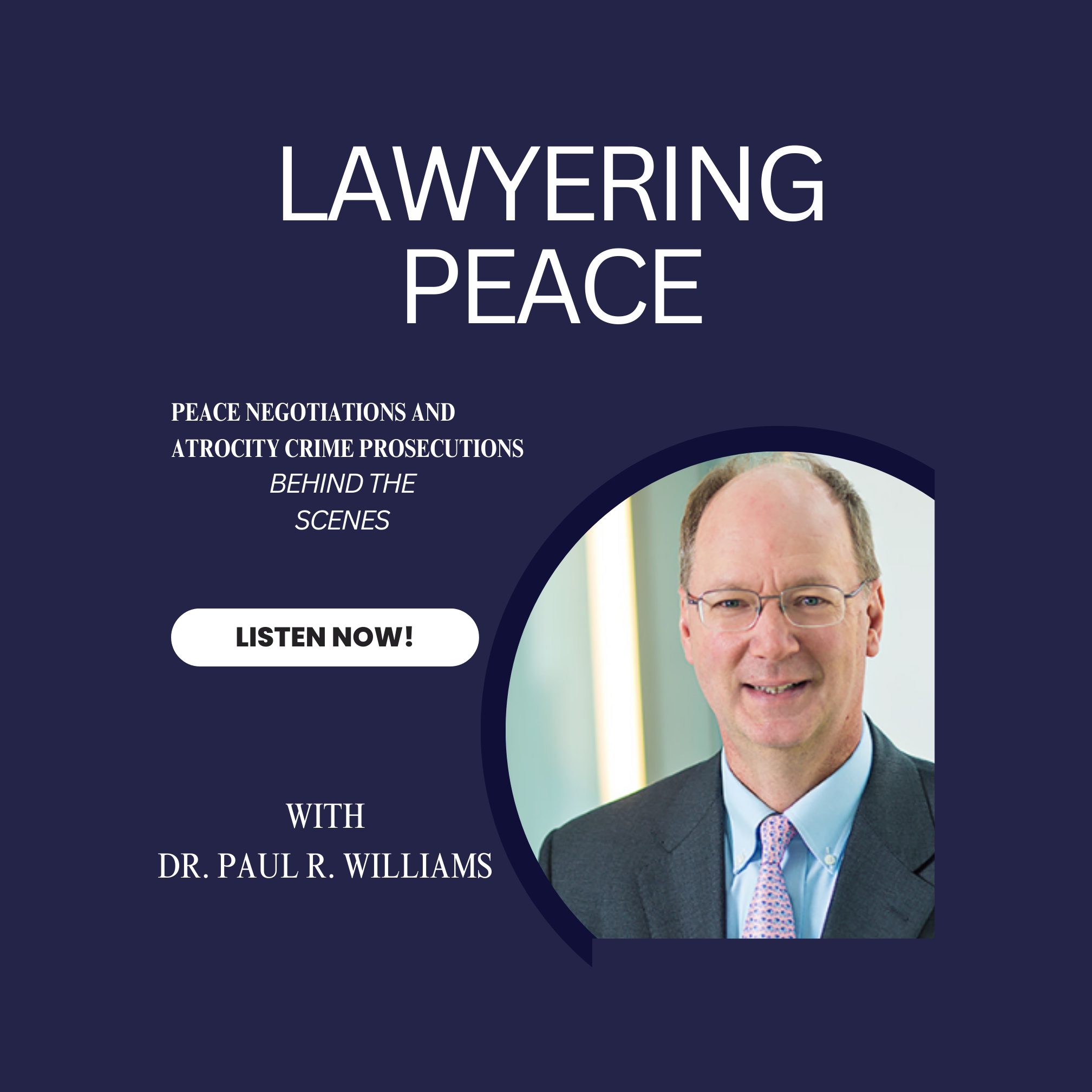
Lawyering Peace
by Dr. Paul R. Williams
In the Lawyering Peace interview series, Dr. Paul R. Williams explores the realm of peace negotiations, diplomacy, and international criminal justice with guests including seasoned peace negotiators and mediators, legal and strategic advisors, former ambassadors, prosecutors, and veterans of international criminal tribunals. Through the conversations, Dr. Williams and his guests shed light on the hurdles and triumphs of peace talks, the intricacies of negotiation strategies, the rigorous pursuit of justice in the aftermath of atrocities, and, in some instances, the lessons learned from failure. This series is a platform for the insights and wisdom of the friends and colleagues that Dr. Williams has had the honor of working with for over 30 years in the field, and offers an insider’s perspective on the complex dynamics of seeking justice and durable peace on the international stage. Host & Executive Producer: Dr. Paul R. WilliamsCo-Producer & Content Manager: Katie Hetherington Co-Pr
-
71
The United Nations, Human Rights, and the Fracturing Global Order with Ambassador Joachim Rücker
In this episode of Lawyering Peace, Dr. Paul Williams speaks with Ambassador Joachim Rücker, former President of the United Nations Human Rights Council and former Special Representative of the UN Secretary-General for Kosovo, about the future of the rules-based international order. Drawing on decades of diplomatic experience, Ambassador Rücker argues that today's geopolitical tensions represent a genuine paradigm shift that demands both renewed commitment to international law and meaningful institutional reform. The conversation explores practical proposals for strengthening the United Nations, the challenges artificial intelligence and digital surveillance pose to human rights, and why implementation, rather than the absence of norms, remains the greatest weakness of the international system. Despite mounting pressures, Ambassador Rücker offers a cautiously optimistic vision for reform and explains why the United Nations remains indispensable to global governance.
-
70
Ukraine’s Future, Europe’s Security: Rule of Law, Reform, and EU Integration During Wartime with Oksana Tsymbrivska
In this episode of Lawyering Peace, Dr. Paul Williams speaks with Oksana Tsymbrivska, Team Leader of the European Union's flagship Pravo-Justice project in Ukraine, about how Ukraine is advancing toward EU membership while fighting a full-scale war. Oksana explains why accession is about far more than economics. It is a transformative process centered on judicial independence, accountable institutions, anti-corruption reforms, and the rule of law. She discusses how Russia's invasion accelerated Ukraine's European integration, turning reform into both a national priority and a foundation for long-term security. The conversation explores the challenge of implementing sweeping legal reforms during wartime, the resilience of Ukraine's justice system, and why strong institutions are essential not only for EU membership but also for building a durable peace and strengthening Europe's future security.
-
69
Human Rights and the Role of Diplomacy in the New World Order with Ambassador Dr. István Lakatos
In this episode of Lawyering Peace, Dr. Paul Williams speaks with Ambassador Dr. István Lakatos about human rights diplomacy in a fragmented and increasingly geopolitical world order. Drawing on decades of experience in multilateral diplomacy, Ambassador Lakatos argues that diplomacy has not collapsed, but its political layer has changed dramatically. Quiet technical work continues, while public diplomacy is increasingly shaped by speed, social media, artificial intelligence, and domestic political narratives. He explains why human rights institutions are bending under pressure rather than breaking, and why today’s challenge is less normative expansion than normative defense. The conversation explores UN reform, issue-based coalitions, the role of small and middle powers, AI’s impact on diplomacy, and the importance of credibility for the next generation. At its core, this episode offers a cautious but hopeful view of how diplomats, institutions, and civil society can still shape the future.
-
68
Trade, Technology, and the Future of Peace with Axel M. Addy
In this episode of Lawyering Peace, Dr. Paul Williams speaks with Axel M. Addy, former Minister of Commerce and Industry of Liberia and founder of the Trade for Peace initiative, about the often-overlooked relationship between economic development and stability. They discuss how trade can help reduce the drivers of conflict, why economic opportunity matters for lasting peace, and how emerging technologies are reshaping the future of development. From artificial intelligence to global supply chains, Axel offers a practical perspective on the challenges and opportunities facing governments seeking to build more resilient and prosperous societies.
-
67
Africa and the Emerging Global Order: Peace, Power, and Regional Leadership with Berhanemeskel Nega
In this episode of Lawyering Peace, Dr. Paul Williams speaks with Berhanemeskel Nega, veteran diplomat, former senior United Nations peacekeeping official, and Senior Peace Fellow at PILPG, about Africa's place in a rapidly changing global order. Drawing on more than three decades of experience in diplomacy, mediation, peacekeeping, and peacebuilding, Berhanemeskel examines the transition from a unipolar world toward an increasingly multipolar system and what that shift means for international institutions, regional organizations, and conflict-affected states. He reflects on the evolution of UN peacekeeping, the growing role of the African Union, the consequences of great power competition across the continent, and the internal challenges that continue to shape Africa's ability to influence global affairs. The conversation also explores Ethiopia's future, the promise and risks of artificial intelligence, and why sustainable peace ultimately depends on countries resolving their own internal conflicts while engaging constructively with regional and international partners. This episode offers a practitioner's perspective on power, peace, and the opportunities and challenges facing Africa in the emerging global order.
-
66
Paradigm Shifts, Small State Diplomacy, and Negotiating for Humanity with Ambassador Elayne Whyte-Gomez
In this episode of Lawyering Peace, Dr. Paul Williams speaks with Ambassador Elayne Whyte, former Permanent Representative of Costa Rica to the United Nations in Geneva and President of the 2017 United Nations Conference to Negotiate a Legally Binding Instrument to Prohibit Nuclear Weapons that negotiated and adopted the Treaty on the Prohibition of Nuclear Weapons, which entered into force in 2021. In this episode, Ambassador Whyte argues that the world is experiencing a profound renegotiation of the existing international order rather than a clean break from it. She explores how power is becoming more crowded at the top, why small states still depend on rules and institutions, and how Costa Rica has used diplomacy, law, and coalition building to exert influence beyond its size. The conversation also examines inequality, artificial intelligence, regional dynamics in Central America, and the challenge of preserving human rights and cooperation in a more fragmented world. This episode offers a thoughtful reflection on how diplomats can adapt global governance while preserving the core principles that underpin international cooperation.
-
65
France, Europe, and the Architecture of a New World Order with Dr. Charles Tenenbaum
In this episode of Lawyering Peace, Dr. Paul Williams speaks with Dr. Charles Tenenbaum, Associate Professor at Sciences Po Lille and expert on international mediation and conflict resolution, to examine how France and Europe are responding to the accelerating transformation of the global order. Drawing on decades of work in diplomacy, mediation, and international security, Dr. Tenenbaum explores France’s evolving vision of strategic autonomy, the future of the rules-based international order, and the growing pressure on Europe to assume greater responsibility for its own security. The conversation examines Russia’s war against Ukraine, the future of NATO and European defense integration, and the challenges facing the European Union as it balances enlargement, flexibility, and political cohesion. The discussion also turns to the Global South, artificial intelligence, and the broader competition shaping the next international system. Throughout, Dr. Tenenbaum reflects on whether Europe can remain both a normative and strategic power in an increasingly fragmented and contested world. This episode offers a timely and nuanced assessment of diplomacy, power, and global governance at a moment of profound geopolitical transition.
-
64
International Law and the Architecture of Justice in a New World Order with Dr. Brianne McGonigle Leyh
In this episode of Lawyering Peace, Dr. Paul Williams speaks with Dr. Brianne McGonagle Leyh, Professor of Global Justice Studies at Utrecht University and Director of the Netherlands Institute of Human Rights, about the fragility and enduring power of international law during a period of profound global transition. Drawing on her work in human rights, transitional justice, and accountability, Dr. McGonagle Leyh reflects on why international law has always depended on political will, how double standards undermine legitimacy, and why today’s crises reveal both the weaknesses and resilience of the rules-based order. The conversation explores the relationship between law and power, the role of victims and civil society in shaping accountability, and how universities and new technologies are becoming increasingly important actors in global justice. They also discuss the impact of artificial intelligence and digital investigations on documenting atrocities and preserving evidence during active conflict. This episode offers a thoughtful and grounded examination of what international law can still achieve in an increasingly fractured world.
-
63
Technology, Law, and the Future of Warfare with Prof Matthew Ford
In this episode of Lawyering Peace, Dr. Paul Williams speaks with Professor Matthew Ford, an expert at the Swedish Defence University, about how smartphones, artificial intelligence, and private technology platforms are reshaping modern warfare. Ford explains that ubiquitous connectivity has blurred the line between battlefield and home front, as seen in Ukraine, where soldiers and civilians operate within real time digital information flows. Smartphones now function as tools for communication, intelligence gathering, targeting support, and global narrative shaping, while also creating new risks including surveillance, misinformation, and information overload. The discussion also explores the growing role of private technology companies as essential infrastructure providers in war, raising questions about sovereignty, subscription-based access to military capabilities, and democratic accountability. Ford highlights challenges posed by algorithmic targeting, deepfakes, and the overwhelming scale of digital evidence in conflict zones. The episode offers a timely reflection on how digital literacy and legal frameworks must evolve to keep pace with technologically mediated warfare.
We're indexing this podcast's transcripts for the first time — this can take a minute or two. We'll show results as soon as they're ready.
No matches for "" in this podcast's transcripts.
No topics indexed yet for this podcast.
Loading reviews...
ABOUT THIS SHOW
In the Lawyering Peace interview series, Dr. Paul R. Williams explores the realm of peace negotiations, diplomacy, and international criminal justice with guests including seasoned peace negotiators and mediators, legal and strategic advisors, former ambassadors, prosecutors, and veterans of international criminal tribunals. Through the conversations, Dr. Williams and his guests shed light on the hurdles and triumphs of peace talks, the intricacies of negotiation strategies, the rigorous pursuit of justice in the aftermath of atrocities, and, in some instances, the lessons learned from failure. This series is a platform for the insights and wisdom of the friends and colleagues that Dr. Williams has had the honor of working with for over 30 years in the field, and offers an insider’s perspective on the complex dynamics of seeking justice and durable peace on the international stage. Host & Executive Producer: Dr. Paul R. WilliamsCo-Producer & Content Manager: Katie Hetherington Co-Pr
HOSTED BY
Dr. Paul R. Williams
CATEGORIES
Loading similar podcasts...
Frequently Asked Questions
How many episodes does Lawyering Peace have?
Lawyering Peace currently has 9 episodes available on PodParley. New episodes are automatically indexed when they're published to the podcast feed.
What is Lawyering Peace about?
In the Lawyering Peace interview series, Dr. Paul R. Williams explores the realm of peace negotiations, diplomacy, and international criminal justice with guests including seasoned peace negotiators and mediators, legal and strategic advisors, former ambassadors, prosecutors, and veterans of...
How often does Lawyering Peace release new episodes?
Lawyering Peace has 9 episodes. Check the episode list to see recent publication dates and frequency.
Where can I listen to Lawyering Peace?
You can listen to Lawyering Peace on PodParley by clicking any episode. We provide an embedded audio player for direct listening, and you can also subscribe via your preferred podcast app using the RSS feed.
Who hosts Lawyering Peace?
Lawyering Peace is created and hosted by Dr. Paul R. Williams.
URL copied to clipboard!