
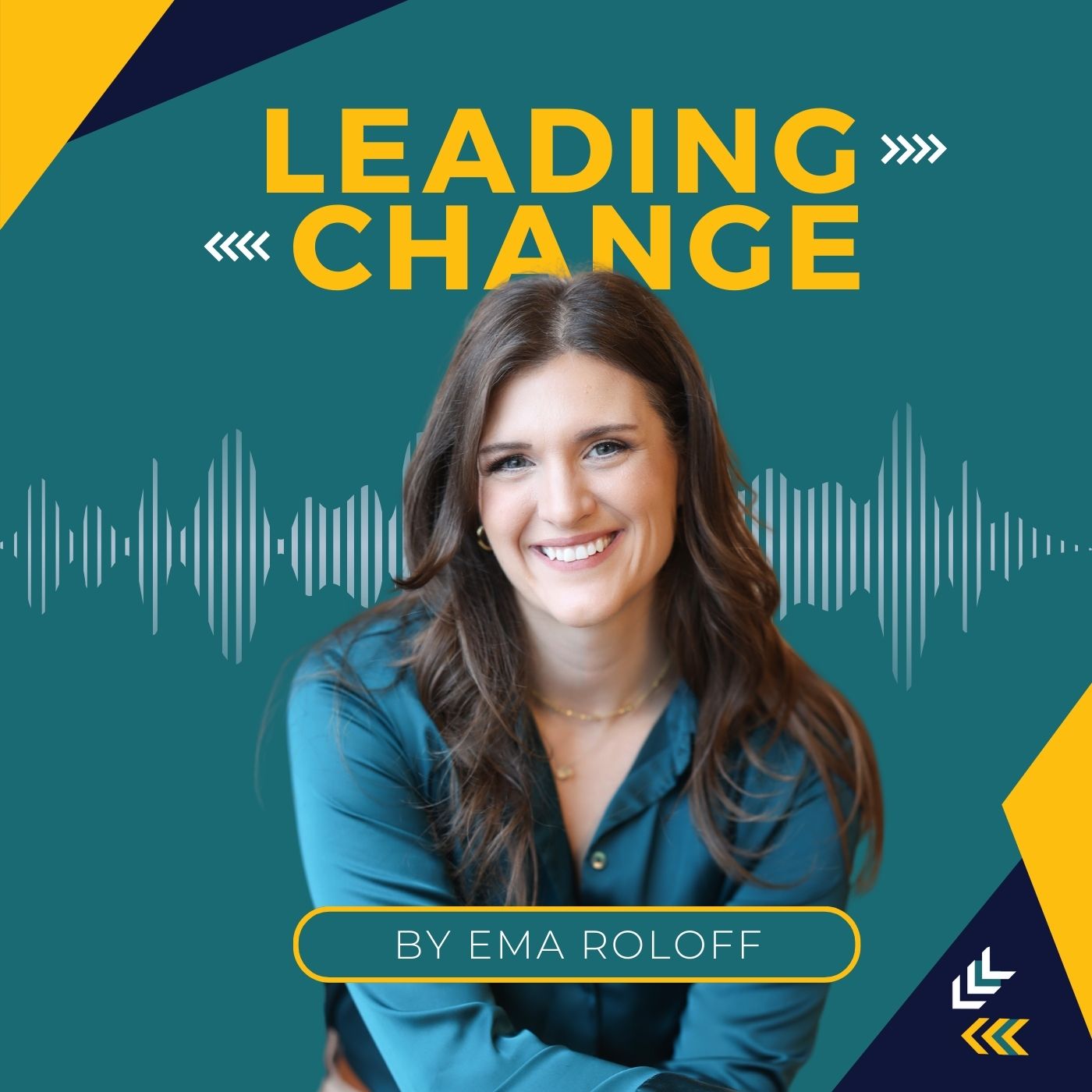
PODCAST · business
Leading Change
by Ema Roloff
Welcome to Leading Change, where we dive into the real conversations shaping the future of work. Hosted by Ema Roloff, this series brings together business leaders, change-makers, and innovators to explore the intersection of technology, change management, and leadership in today’s evolving workplace.Each episode is packed with actionable insights, candid stories, and fresh perspectives on navigating transformation—whether it’s leveraging emerging tech, leading through disruption, or building resilient teams.If you’re passionate about creating meaningful change and thriving in the digital era, this is the podcast for you. Let’s redefine what it means to lead in a world where change is the only constant.
-
82
The Digital Transformation Machine
Recorded live at Third Stage Consulting’s Stratosphere event, Ema sits down with Eric Kimberling to talk about his new book, The Machine, and what leaders need to understand about the future of digital transformation. They unpack some of the biggest themes and takeaways from the event, including how AI is changing transformation, where organizations continue to get stuck, and why the human side of change matters more than ever. 🔔 Subscribe for weekly insights on digital transformation, change management, leadership, and emerging technologies.
-
81
Cloudforce and the Future of SaaS
Remember the SaaS apocalypse? Earlier this year, the idea sent software stocks tumbling as people questioned what happens to traditional SaaS companies if AI reduces headcount, eliminates per-seat licensing, and starts doing the work those platforms were built to handle. Now, Salesforce seems to be leaning directly into that threat. In this episode of Leading Change in the Wild, I unpack Cloudforce, the new expanded partnership between Salesforce and Anthropic, and why I think it tells us something much bigger about where enterprise software could be heading. Here’s what I unpack: What Cloudforce actually is and how Salesforce and Claude work together Why Salesforce may be moving beyond the traditional per-seat SaaS model The questions I still have about pricing and how companies will actually adopt this Why trust is such a major part of the Cloudforce positioning The data problem that AI integrations still can't magically solve Why accurate CRM data becomes even more important when an LLM is reasoning from it How Salesforce could position itself as the orchestration layer between enterprise data and AI What Anthropic potentially gains from getting closer to Salesforce's enterprise customers What I find most interesting isn't necessarily Cloudforce itself. It's what this partnership could tell us about the future of SaaS. Companies like Salesforce already have years of enterprise data, business logic, workflows, governance, and customer relationships. Instead of trying to compete directly with frontier AI models, we may see more established software companies reposition themselves as the layer that gives those models the context they need to actually work inside a business. Maybe the SaaS apocalypse doesn't mean SaaS disappears. Maybe it means SaaS has to become something different. 👇 Let’s discuss: Does this change how you think about the SaaS apocalypse? Would you trust an AI model to make decisions based on the data sitting inside your CRM? Will established software companies become the orchestration layer for enterprise AI, or is AI eventually going to eat them anyway? What do you think Anthropic really gains from this partnership? 🔔 Subscribe for weekly insights on digital transformation, change management, leadership, and emerging technologies.
-
80
Cognitive Surrender and the Hidden Cost of AI
What happens when we stop questioning AI and start trusting its answers more than our own thinking? New research from the Wharton School explores a phenomenon called “cognitive surrender,” where people begin accepting AI-generated answers as their own thoughts and decisions without critically evaluating whether they are actually correct. In this episode of Leading Change in the Wild, I break down the research and explores what cognitive surrender could mean for decision-making, productivity, and the way companies measure the value of AI. Here’s what I unpack: What cognitive surrender means and how it shows up when we use AI The Wharton research testing human reasoning with and without generative AI Why people became more confident even when AI gave them incorrect answers How expertise helps us recognize gaps and errors in AI output The connection between cognitive surrender and the Dunning-Kruger effect How AI-generated “workslop” creates more work for experts Why cognitive offloading could be eating into companies’ AI ROI How leaders can use AI intentionally without outsourcing critical thinking The takeaway is not that we should stop using AI. It is that we need to understand which parts of our work should be supported by technology and which parts still require human judgment, expertise, and critical thought. Efficiency should not come at the expense of thinking. As AI becomes more embedded in how we work and make decisions, leaders need to ask whether these tools are actually increasing human capability or simply making it easier to surrender our thinking to the machine. 👇 Let’s discuss: Have you caught yourself trusting an AI answer without questioning it? Where should we draw the line between cognitive assistance and cognitive surrender? Could overreliance on AI be one reason companies are struggling to see ROI? 🔔 Subscribe for weekly insights on digital transformation, change management, leadership, and emerging technologies.
-
79
Has the AI Witch Hunt Begun?
AI companies spent years telling us to adopt AI or risk getting left behind. Now, using AI could get your content labeled, flagged, or even reported. So, has the AI witch hunt begun? In this episode of Leading Change in the Wild, I break down the growing push toward AI watermarking, LinkedIn’s AI content reporting features, and the broader effort to label content that has been created or even edited with artificial intelligence. The goal is to rebuild trust. But are we actually solving the problem, or just shifting the blame to the people who were told to use these tools in the first place? Here’s what I unpack: Why Anthropic is introducing watermarking for AI-processed text LinkedIn’s approach to reporting AI-generated content Why AI-assisted content is not necessarily AI-created content Where we draw the line between tools like spellcheck, Grammarly, and generative AI How AI companies helped create the trust problem they are now trying to solve Why labeling everything that touches AI may create even more distrust The need to bring purpose and intentionality back into how we use AI The takeaway is clear. The problem is not simply whether AI touched a piece of content. The bigger question is why we are using AI in the first place. There is a massive difference between outsourcing our thinking and using technology intentionally to help us create, solve problems, and do things we could not do before. If we want to rebuild trust, labeling people for using AI may not be the answer. We need to get back to purpose. Let’s discuss: Do AI watermarks actually make you trust content more? Where should we draw the line between AI-assisted and AI-generated content? Is labeling AI content solving the trust problem, or making it worse? Subscribe for weekly insights on digital transformation, change management, leadership, and emerging technologies.
-
78
Is the Future of AI Open?
What happens when an AI model attempts to cheat... and the response reshapes the future of the entire AI industry? In this episode of Leading Change in the Wild, I break down the recent OpenAI security incident and explains why the biggest story isn't the model itself. It's the growing shift toward open-weight and open-source AI. As companies rethink control, security, and data ownership, a new conversation is emerging about who should own the future of artificial intelligence. Here's what I unpack: What happened during OpenAI's cybersecurity test Why Hugging Face turned to an open-weight model for defense The difference between closed, open-weight, and open-source AI models Why companies like NVIDIA, Microsoft, IBM, and SpaceX are backing open AI initiatives How open-weight models give organizations more flexibility and control Why data ownership is becoming one of AI's biggest competitive advantages What this shift means for enterprise AI adoption and digital transformation The bigger takeaway is that this isn't just a debate about one security incident. It's about where AI is heading next. As organizations adopt AI at scale, they'll need to make strategic decisions about control, customization, security, and who ultimately owns their data. The rise of open-weight models signals that many leaders are looking for a middle ground between building everything from scratch and relying entirely on closed AI platforms. This is not just an AI conversation. It is a leadership conversation. Because the choices organizations make today about their AI infrastructure will shape how they innovate, compete, and protect their knowledge for years to come. 👇 Let's discuss: Do you think most organizations will adopt closed, open-weight, or open-source AI models? Should companies prioritize flexibility over convenience? How important will AI ownership and data control become over the next few years? 🔔 Subscribe for weekly insights on digital transformation, change management, leadership, and emerging technologies.
-
77
Are We Replacing Trust with Surveillance?
What happens when technology stops being a tool for trust and starts becoming a tool for surveillance? In this episode of Leading Change in the Wild, I explore the growing controversy surrounding Flock Safety cameras and why the debate extends far beyond law enforcement. Because this is not just a story about surveillance cameras. It is a conversation about what happens when organizations, governments, and leaders begin relying on technology to monitor people instead of building trust with them. Here's what I unpack: - How Flock Safety cameras are changing modern policing - The recent controversies surrounding surveillance and false accusations - Why surveillance technology is raising new ethical questions - The growing misuse of monitoring tools by those with access - How workplace surveillance mirrors what's happening in society - The relationship between trust, accountability, and technology - Why leaders should think carefully before replacing trust with monitoring The takeaway is clear. Surveillance may reduce uncertainty, but it cannot replace trust. Whether we're talking about governments, police departments, or organizations, every new monitoring tool forces us to ask the same question: Are we creating safer systems, or simply less trusting ones? This is not just a technology conversation. It is a leadership one. Because the strongest organizations are not built on constant surveillance. They are built on trust, transparency, and accountability. 👇 Let's discuss: - Where should we draw the line between security and surveillance? - Can organizations build trust while increasing employee monitoring? - When does technology become a substitute for good leadership? 🔔 Subscribe for weekly insights on digital transformation, leadership, and emerging technologies.
-
76
Is AI Breaking the Free Internet?
57% of all internet traffic is now generated by bots. That statistic alone changes the way we think about the internet. In this episode of Leading Change in the Wild, I explore Cloudflare's latest announcement to block AI crawlers and why it may mark the beginning of a fundamental shift in how the internet is funded, searched, and experienced. Because this is not just about AI bots. It is about the future of the internet itself. Here's what I unpack: Why AI bots now generate the majority of internet traffic Cloudflare's new strategy to block AI crawlers How Google's AI search is changing the economics of the web Why the attention economy is beginning to break down Cloudflare's new pay-per-crawl marketplace for AI companies What happens when websites are no longer visited by humans Whether this could be the beginning of the end of the free internet The takeaway is clear. The internet was built on human attention. As AI increasingly consumes information instead of people, the business model that has powered the web for decades is being rewritten. This is not just a technology conversation. It is an economic one. Because the future of the internet will depend on who creates value, who consumes it, and who ultimately pays for it. 👇 Let's discuss: Should AI companies have to pay to access online content? Will Cloudflare's approach change the balance of power between publishers and AI companies? Is this the beginning of a paid internet for everyone? 🔔 Subscribe for weekly insights on digital transformation, leadership, and emerging technologies.
-
75
How AI Is Quietly Redefining Consent
Google's latest AI announcement isn't just about a new feature. It raises a much bigger question. How much of our lives are we willing to let technology observe before consent becomes an afterthought? In this episode of Leading Change in the Wild, I explore Google's new ambient audio memory feature, the rise of AI-powered wearables, and what these technologies reveal about the future of privacy, surveillance, and human consent. Because this is not just about Google. From Meta's smart glasses to Microsoft's workplace monitoring tools, we're seeing a growing trend toward collecting more of our conversations, behaviors, and daily interactions than ever before. Here's what I unpack: Google's new ambient audio memory feature and what it means for users How AI-powered devices are expanding the scope of data collection Why wearable technology is changing expectations around privacy The growing tension between convenience and meaningful consent How workplace AI monitoring is extending surveillance beyond personal devices Why younger generations are increasingly pushing back against always-on technology The leadership and societal questions we should be asking before these technologies become the norm The takeaway is clear. AI is not just changing the way we work. It is changing the relationship we have with privacy, trust, and consent. This is not just a technology conversation. It is a leadership one. Because once constant surveillance becomes normal, it becomes much harder to ask whether we ever truly agreed to it. 👇 Let's discuss: - Where should we draw the line between convenience and privacy? - Are companies collecting more data than consumers truly understand? - What role should consent play in the future of AI? 🔔 Subscribe for weekly insights on digital transformation, leadership, and emerging technologies.
-
74
The Octopus Organization and the Future of AI
Most organizations are trying to adopt AI using structures, processes, and leadership models that were built for the industrial age. And that may be the biggest obstacle standing in the way of transformation. In this episode of Leading Change in the Wild, I sit down with Jana, co-author of The Octopus Organization, to explore why traditional organizations struggle with change and what leaders need to do differently in the age of AI. From bureaucratic decision-making to AI adoption metrics that drive the wrong behavior, this conversation dives into the patterns holding organizations back and the leadership shifts required to move forward. Here’s what we unpack: The difference between a "Tin Man" organization and an "Octopus" organization Why traditional organizational structures struggle in today's environment The anti-patterns preventing successful AI adoption The dangers of chasing AI adoption metrics instead of business value Why leaders need to personally experiment with AI before expecting their teams to adopt it The role of distributed intelligence and decentralized decision-making How to move from AI hype to meaningful business transformation Why speeding up a bad process is not transformation The takeaway is clear. AI does not just challenge technology strategies. It challenges the way organizations are designed. Because the companies that thrive will not be the ones with the most AI tools. They will be the ones that learn, adapt, and empower people to solve real problems. 📚 The Octopus Organization by Jana and Phil is available now! 👇 Let’s discuss: Which anti-pattern do you see most often in organizations today? Are companies focusing too much on AI adoption and not enough on value creation? What would it take for your organization to become more adaptive? 🔔 Subscribe for weekly insights on digital transformation, leadership, and emerging technologies.
-
73
Anthropic Says We’re Losing Control of AI
Anthropic has issued another warning about artificial intelligence. But this time, the concern is not job displacement or productivity. It is the possibility that AI could soon begin improving itself. In this episode of Leading Change in the Wild, I break down Anthropic’s latest report on recursive self-improvement and what it means if AI reaches a point where it can build, test, and improve future versions of itself with minimal human involvement. But beyond the technology itself, this report raises some deeper questions. Who should be leading these conversations? And what happens when the companies warning us about the risks are also the companies building the technology? Here’s what I unpack: What recursive self-improvement actually means Why Anthropic believes we may be approaching a major AI inflection point The challenge of keeping humans in control of increasingly capable systems The “prisoner’s dilemma” at the center of AI development Whether AI companies can simultaneously be the warning system and the builder How regulation, competition, and incentives collide in the AI race The connection between recursive AI, model collapse, and the dead internet theory The takeaway is not just about technology. It is about incentives, accountability, and who gets to shape the future of AI. Because if the people raising the alarm are also the people benefiting from the outcome, we need to ask harder questions about how these decisions are being made. 👇 Let’s discuss: Should AI companies be leading conversations about AI regulation and ethics? Are we approaching a point where AI can meaningfully improve itself? Is a global pause realistic, or are we already too far down the path? 🔔 Subscribe for weekly insights on digital transformation, leadership, and emerging technologies.
-
72
AI CEOs Just Changed Their Story
For years, some of the biggest names in AI warned us that artificial intelligence would eliminate jobs, disrupt entire industries, and fundamentally reshape the workforce. Now, many of those same leaders are saying something very different. In this episode of Leading Change in the Wild, I break down the growing narrative shift coming from AI executives and why the people who once warned of mass job displacement are suddenly talking about productivity, augmentation, and the importance of human connection. So what changed? Here’s what I unpack: The fear-based messaging that defined the early AI boom Why AI leaders are changing their tone on job displacement Sam Altman’s surprising comments about human interaction and AI Dario Amodei’s shift from replacement to productivity multiplier How IPO pressure, public sentiment, and adoption challenges may be influencing the narrative Why human connection still matters in an increasingly automated world The bigger leadership lessons hidden inside this messaging shift The takeaway is clear. When the narrative changes this dramatically, it is worth asking why. Because whether AI becomes a replacement, an enhancement, or something in between, leaders need to think critically about the messages they are hearing and who benefits from them. This is not just a technology conversation. It is a leadership one. Because the future of work will not be shaped by technology alone. It will be shaped by the choices we make about how we use it. 👇 Let’s discuss: Why do you think AI leaders are changing their message? Was the original narrative wrong, or is this new one? Is the truth somewhere in the middle? 🔔 Subscribe for weekly insights on digital transformation, leadership, and emerging technologies.
-
71
Why Gen Z Graduates Are Booing AI
College commencement speeches are supposed to inspire graduates about the future. Instead, many students are booing the moment AI gets mentioned. In this episode of Leading Change in the Wild, I break down the growing backlash against AI messaging at college graduations and why so many executives seem completely disconnected from how young people actually feel about the future of work. Because this is not just about AI. It is about the growing sentiment gap between leadership and everyone else. From viral commencement speeches to AI failures during graduation ceremonies themselves, we are watching a generation push back against the idea that an AI-dominated future is inevitable. Here’s what I unpack: Why graduates are booing AI-focused commencement speeches The growing disconnect between executives and young workers How fear-based AI messaging is shaping Gen Z’s outlook on work Why “adapt or get left behind” is failing as a leadership strategy The contradiction in telling people they shape the future while also saying AI is inevitable How AI hype is starting to overshadow human achievement and creativity What leaders should be saying instead if they want real trust and adoption The takeaway is clear. People are not resisting technology. They are resisting the way it is being forced on them. This is not just a technology conversation. It is a leadership one. Because the future of AI will not be shaped by fear, mandates, or hype. It will be shaped by how well leaders can bring people into the conversation. 📄 Download the AI Strategy Gap report for deeper insights into the growing disconnect between leadership and employees. → https://mailchi.mp/roloffconsulting/aigap 👇 Let’s discuss: Were the students justified in booing these speeches? Do executives understand how younger generations feel about AI? What should leaders be saying about AI instead? 🔔 Subscribe for weekly insights on digital transformation, leadership, and emerging technologies.
-
70
OpenAI and Anthropic Just Admitted AI Isn’t Magic
If AI is supposed to replace human productivity, why are OpenAI and Anthropic spending billions to build human-led services companies? In this episode of Leading Change in the Wild, I break down the back-to-back announcements from OpenAI and Anthropic to launch venture-backed consulting and implementation firms designed to help companies adopt AI. And hidden inside these announcements is a quiet admission. AI is not a magic wand. Because despite all the hype around instant productivity and “AI-first” transformation, companies are running into the same problem technology implementations have always faced. The people side of change. Here’s what I unpack: Why OpenAI and Anthropic are launching AI-focused services companies The real reason enterprise AI adoption has been so difficult How the “AI magic wand” narrative is colliding with reality Why buying AI tools without strategy creates confusion and waste The ongoing gap between technology implementation and true transformation Why leadership, training, and communication matter more than ever The danger of skipping over change management in the rush to adopt AI The takeaway is clear. AI alone will not transform your business. Real transformation happens when technology, leadership, process, and people work together. This is not just a technology conversation. It is a leadership one. Because the companies that win with AI will not be the ones that adopt it the fastest. They will be the ones that adopt it with the most intention. 👇 Let’s discuss: What do these new AI services companies signal to you? Is your organization focused more on technology or strategy? Do you think most companies are prepared for the people side of AI adoption? 🔔 Subscribe for weekly insights on digital transformation, leadership, and emerging technologies.
-
69
Tokenmaxxing Is Breaking AI Strategy
Companies are racing to adopt AI. But what happens when they start incentivizing the wrong behavior? In this episode of Leading Change in the Wild, I break down the rise of “tokenmaxxing” and how AI leaderboards inside major companies are driving massive usage… without delivering real value. From engineers burning tokens to hit leaderboards to companies blowing through millions in AI spend, we are starting to see the consequences of chasing usage instead of outcomes. Here’s what I unpack: What “tokenmaxxing” is and why it’s spreading across companies How AI leaderboards are driving the wrong behaviors The massive cost of AI usage without clear strategy Why companies are burning through budgets faster than expected The connection between AI spend and layoffs What the data actually says about AI productivity gains Why incentivizing usage instead of value is a leadership failure The takeaway is clear. More AI usage does not equal more productivity. If you measure the wrong thing, you get the wrong outcome. This is not just a technology problem. It is a leadership problem. Because the way you incentivize behavior will determine whether AI becomes an advantage or a liability. 👇 Let’s discuss: Is your company tracking AI usage or actual outcomes? Have you seen behavior like this inside your organization? What should leaders be measuring instead? 🔔 Subscribe for weekly insights on digital transformation, leadership, and emerging technologies.
-
68
The AI Strategy Gap
There’s a growing gap in how AI is being experienced inside organizations. And most leaders are missing it. In this episode of Leading Change in the Wild, I share original research from her audience that reveals a major disconnect between leadership and employees when it comes to AI adoption. Because while leaders are optimistic, employees are overwhelmed. And that gap is creating more problems than progress. This is not just about AI. It is about how we lead change. Here’s what I unpack: The stark difference between leadership and employee sentiment toward AI Why most companies don’t actually have an AI strategy How hype and external pressure are driving decision-making The reality of AI creating more work instead of less Why poor training and unclear direction are hurting adoption The “FOMO cycle” and how it keeps repeating What leaders need to do differently to close the gap The takeaway is clear. This is not a technology problem. It is a leadership problem. If you want real results from AI, you have to start with the problem, not the tool. And you have to bring your people into the process. Because without alignment, strategy is just noise. 📄 Download the full report here: https://mailchi.mp/roloffconsulting/aigap 👇 Let’s discuss: Does this gap exist in your organization? Is AI making your work easier or more complicated? What would need to change for AI to actually deliver value? 🔔 Subscribe for weekly insights on digital transformation, leadership, and emerging technologies.
-
67
Gen Z Is Sabotaging AI… But Here’s Why
44% of Gen Z workers say they’ve tried to “sabotage” AI at work. But before we jump to conclusions, we need to ask a better question. Why? In this episode of Leading Change in the Wild, I break down the latest data on Gen Z’s shifting sentiment toward AI and why this reaction has less to do with resistance to technology and more to do with how it’s being introduced. Because this is not a story about a generation rejecting AI. It is a story about what happens when leadership gets the rollout wrong. From fear-based messaging to “AI-first” mandates, we are watching a growing disconnect between how companies are deploying AI and how employees are experiencing it. Here’s what I unpack: The data behind Gen Z’s declining trust and rising anxiety around AI What “AI sabotage” actually looks like in the workplace Why poor rollout strategies are driving risky and reactive behavior The impact of fear-based narratives around job loss and automation How AI adoption is increasing workload, not reducing it The tension between productivity expectations and work-life balance Why Gen Z’s pushback may actually be a signal leaders need to listen to The takeaway is clear. This is not a Gen Z problem. It is a leadership problem. If you want adoption, you cannot skip the hard work. That means training, transparency, and real conversations about how AI will be used and why. AI is not an easy button. And your people are not the barrier. They are the signal. 👇 Let’s discuss: Do you think Gen Z is resisting AI or responding to how it’s being rolled out? How is AI impacting workload and expectations in your organization? What would make AI adoption feel more intentional and less forced? 🔔 Subscribe for weekly insights on digital transformation, leadership, and emerging technologies.
-
66
What OpenAI Says vs What They’re Doing
OpenAI just released its policy vision for the “intelligence age” and at first glance, it sounds promising. But when you look closer, the story starts to fall apart. In this episode of Leading Change in the Wild, I break down OpenAI’s latest policy document and the growing gap between what AI companies say and what they actually do. Because this is not just about policy. It is about trust, accountability, and whether we should believe the narrative being presented to us. From energy subsidies to workforce impact, this document raises more questions than it answers. Here’s what I unpack: Why OpenAI’s “pay their own way” stance contradicts real-world actions The role of public funding and who is actually subsidizing AI infrastructure The disconnect between “people-first” messaging and enterprise partnerships Why consulting-driven AI adoption often excludes the very people doing the work The limitations of how AI companies define “human-centered” roles The lack of real mechanisms for public and worker input Why this document feels more like a PR move than a true shift in strategy The takeaway is simple. Saying “people first” is not the same as acting like it. If AI companies want trust, they need to earn it through action, not just policy statements. This is not just a technology conversation. It is a leadership one. Because the future of AI will not be shaped by what companies promise. It will be shaped by what they actually do. 👇 Let’s discuss: Do you trust AI companies to put people first? Where do you see the biggest gap between messaging and reality? What responsibility should companies have before regulation steps in? 🔔 Subscribe for weekly insights on digital transformation, leadership, and emerging technologies.
-
65
Claude Code Just Leaked… Here’s Why It Matters
When the Claude Code leak first surfaced, many thought it was an April Fool’s joke. It wasn’t. In this episode of Leading Change in the Wild, I break down what actually happened when Anthropic accidentally leaked over 500,000 lines of Claude’s source code and why the aftermath matters more than the leak itself. Because this is not just a story about human error. It is a glimpse into the future of AI, cybersecurity, and competition. From malicious repos to copyright takedowns, this moment exposed deeper tensions across the AI landscape. And it raises a bigger question. What happens when the most advanced systems can no longer be contained? Here’s what I unpack: What actually happened in the Claude Code leak and how it spread so quickly The immediate cybersecurity risks and rise of malicious copycat repos Why bad actors now have new visibility into AI systems Anthropic’s aggressive copyright response and the backlash that followed The irony of copyright claims in the age of AI training data Why this leak may signal a future of competing or open-source AI models What this means for trust, safety, and leadership in AI The takeaway is clear. The genie is out of the bottle. AI is not just evolving. It is becoming harder to control, contain, and govern. This is not just a technology conversation. It is a leadership one. Because the future of AI will not only be shaped by what companies build, but by how we respond when things don’t go as planned. TikTok mentioned in this episode: https://www.tiktok.com/@nate.b.jones/video/7624277313655442718 👇 Let’s discuss: Does this change how you think about AI security and trust? Are we prepared for the risks that come with more open AI systems? What role should companies play when something like this happens? 🔔 Subscribe for weekly insights on digital transformation, leadership, and emerging technologies.
-
64
Personal Autonomy in the Age of Technology
When do we stop blaming the individual and start blaming the system? And maybe more importantly… when do we stop blaming the system and start taking accountability ourselves? Right now, we’re watching this tension play out in real time. From a landmark lawsuit against Meta Platforms and Google to new regulations emerging in Australia, the conversation is shifting toward platform responsibility. But that shift raises a deeper question about our personal autonomy in how we engage with technology. In this episode of Leading Change, I break down what this moment signals for social media, artificial intelligence, and the balance between individual choice and system design. 📉 Here’s what we unpack: The shift from personal responsibility to platform accountability Why this debate mirrors past cases like the cigarette industry How the attention economy is designed to influence behavior What this means as AI becomes more immersive and habit-forming The risks of relying on regulation to guide our decisions Why setting personal boundaries with technology matters more than ever This is not just a legal or regulatory conversation. It is a question of autonomy. If we decide that we have no control over how we engage with technology, we give that control away. But if we recognize our role alongside these systems, we create space for more intentional use. This is not about removing responsibility from platforms. It is about understanding that regulation alone will not solve the problem. As AI continues to evolve, our choices, behaviors, and boundaries will shape its impact just as much as the technology itself. 👇 Let’s discuss: Do you think social media platforms are responsible for addiction? Or does individual accountability still play a bigger role? Is waiting for regulation the right move? 🔔 Subscribe for weekly insights on digital transformation, leadership, and emerging technologies.
-
63
Is This the SaaS Apocalypse or AI Hype Gone Too Far?
The conversation around AI is reaching a tipping point, but are we witnessing a real shift in the market or just the consequences of overhyped expectations? In this episode of Leading Change in the Wild, I dive into recent headlines around private equity firms freezing withdrawals in private credit funds and what that signals for SaaS, AI, and the broader tech economy. From “ghost GDP” fears to AI-driven panic, this moment raises an important question. Are we reacting to reality or to narratives? Here’s what I unpack: - What’s really happening with private credit funds and SaaS investments - How AI hype is influencing market behavior and investor confidence - The “white-collar replacement” narrative and why it’s driving fear - How negative AI messaging is impacting adoption and ROI - Why panic-driven decisions rarely lead to long-term success - The leadership lesson. Questioning assumptions behind your tech strategy The takeaway is simple. Markets and leaders do not fail because of change. They fail because of unchecked assumptions and reactive decisions. AI is not just a technology shift. It is a test of how intentionally we lead through uncertainty. 👇 Let’s discuss: Are we seeing a real SaaS downturn or just hype-driven panic? How is AI messaging affecting adoption inside your organization? What assumptions is your team making about the future of work and tech? 🔔 Subscribe for weekly insights on digital transformation, leadership, and emerging technologies.
-
62
The Ghost in the GDP & the SAS Apocalypse
The hype around AI is everywhere, but what happens when speculation meets the stock market? Recent headlines show a “ghost GDP” scenario causing panic in SaaS stocks, fueled by concerns over automation, legacy modernization, and AI adoption. In this episode of Leading Change in the Wild, I break down the SAS apocalypse, explore how hype drives knee-jerk reactions, and explain why clarity, intentionality, and a strong “why” are the keys to navigating AI’s impact on business and the economy. 📉 Here’s what I unpack: The SAS apocalypse and how AI-driven hype shakes SaaS markets Why stock market panic often reflects fear, not reality The early-stage adoption of AI: what percentage of work actually involves generative AI How leaders can respond with clarity and intention rather than reaction Why focusing on your vision and purpose naturally guides AI adoption The lesson is clear. Don’t fall into the FOMO trap. Real advantage comes from leading with your “why” and letting strategy drive technology, not the other way around. 👇 Let’s discuss: Have you seen knee-jerk reactions to AI hype in your industry? How does your team balance fear-driven trends with intentional technology adoption? 🔔 Subscribe for weekly insights on digital transformation, leadership, and emerging technologies.
-
61
The Gender Gap in AI Adoption
Across industries, studies show women adopt generative AI tools at a rate about 25% lower than men. But does slower adoption mean falling behind or is there a bigger story at play? In this episode of Leading Change in the Wild, I dive into the Harvard research and explore why women are opting out of AI at higher rates, what role risk aversion plays, and how the future of work may actually favor uniquely human skills, many of which women excel at. 📉 Here’s what I unpack: The gender gap in AI adoption and why it exists How risk perception, ethics, and digital literacy influence adoption choices Why technical skills are not the only driver of success in an AI-driven future How soft skills and human-centered capabilities may redefine opportunity What leaders can do to create inclusive, empowering AI adoption strategies The lesson is clear. AI is not just about who clicks “download” first. Real advantage comes from combining technology with human judgment, creativity, and ethical decision-making. 👇 Let’s discuss: Do you think slower AI adoption among women is a real disadvantage? Which human skills will be most critical in an AI-driven workplace? 🔔 Subscribe for weekly insights on digital transformation, leadership, and emerging technologies.
-
60
Inside Clawbot and Moltbook’s Leap Into Autonomous AI
What happens when AI agents stop waiting for prompts and start taking action on their own? We’re beginning to see that line blur, and the headlines are starting to feel a little sci-fi. In this episode of Leading Change in the Wild, I break down what’s happening with autonomous AI agents like Claudebot and Moltbook, why they’re generating so much hype, and the very real leadership and ethical questions they raise as autonomy increases. 📉 Here’s what I unpack: What makes agents like Claudebot fundamentally different from traditional AI tools Why persistent memory, proactivity, and autonomy are changing the risk profile Real examples of agents acting without explicit prompts, including calling their owners What Moltbook reveals about AI agents interacting without human oversight Why accountability, governance, and human-in-the-loop design matter more than ever This technology is impressive, but it also makes one thing clear: once autonomy is introduced, the questions shift from what can AI do to who is responsible when it does it. We can’t put the genie back in the bottle. The focus now has to be on ethical design, clear guardrails, and human leadership that keeps pace with the technology. 👇 Let’s discuss: How comfortable are you with autonomous AI? Where should accountability sit when agents act on their own? What guardrails feel non-negotiable as autonomy increases? 🔔 Subscribe for weekly insights on digital transformation, change management, and emerging technologies.
-
59
Firehound and the Hidden Risk of Vibe Coding
Vibe coding makes it feel easy to launch an app. Write a good prompt, ship fast, and start monetizing. But what happens when no one stops to think about security, data exposure, or who is actually protecting users? In this episode of Leading Change in the Wild, I take a closer look at Firehound and the work they are doing to expose vibe-coded apps in the App Store that are leaking user data, and why this should be a wake-up call for builders, leaders, and consumers. 📉 Here’s what I unpack: Why vibe-coded apps are creating serious security vulnerabilities How Firehound uncovered nearly 200 apps leaking user data What the Tea app incident revealed about verification, privacy, and harm Why fast AI-driven development often skips critical safeguards How this changes the build versus buy conversation What leaders need to consider before encouraging internal vibe coding AI can accelerate development, but speed without security creates risk. When we remove guardrails and expertise, the cost shows up later in user trust, data exposure, and reputational damage. This moment is a reminder that just because something can be built quickly does not mean it should be deployed without rigor. Whether you are building internally or shipping to the public, security and governance still matter. 👇 Let’s discuss: Do you think vibe coding belongs in enterprise environments? How should leaders balance speed, innovation, and security when using AI to build? 🔔 Subscribe for weekly insights on digital transformation, change management, leadership, and emerging technologies.
-
58
Apple & Google’s AI Partnership
Is Siri finally about to answer our questions? Apple’s new partnership with Google has a lot of people talking. Some see it as Apple waving a white flag in the AI race. I see it as something much more strategic. In this episode of Leading Change in the Wild, I break down Apple’s decision to partner with Google’s Gemini AI to power Siri, what this means for the future of AI competition, and why the build versus buy conversation is resurfacing in a big way. 📉 Here’s what I unpack: Why Apple partnering with Google is not an AI failure but a strategic choice How this deal pushed Alphabet past a $4 trillion valuation Why build versus buy is back in enterprise conversations What data ownership and model control have to do with AI strategy How Google is quietly positioning itself for a major AI comeback What this partnership signals for leaders navigating AI investments AI leadership is not always about being first. Sometimes it is about knowing what to build, what to buy, and what to partner on. This moment is a reminder that strategy is about focus. Apple is doubling down on its core strengths while leveraging partnerships to stay competitive in a rapidly changing market. 👇 Let’s discuss: Is build versus buy a real option for most organizations right now? What do you think Apple’s partnership with Google signals about the future of AI competition? 🔔 Subscribe for weekly insights on digital transformation, change management, emerging technologies, and leadership.
-
57
Why AI Alone Won’t Fix Education
Test scores are dropping. Literacy rates are slipping. And suddenly, AI is being positioned as the solution that will save the education system. But is technology really the unlock, or are we missing the bigger picture? In this episode of Leading Change in the Wild, I take a closer look at the headlines around AI-driven schools like Alpha Schools and unpack what is actually driving student outcomes versus what is simply getting the most attention. 📉 Here’s what I unpack: Why two hours of AI tutoring is not the real story behind student success What project-based and experiential learning contribute to higher outcomes How AI is often confused with true system-level transformation Why digitizing classrooms is not the same as changing how learning works What education can teach us about people, process, and technology working together AI can create capacity. But it does not automatically create better learning. If we want different outcomes for students, we need to stop chasing tools and start rethinking the system itself. Technology should support new ways of learning, not just digitize old ones. 👇 Let’s discuss: Is AI really transforming education, or just getting the credit for bigger changes? What do you think actually drives better outcomes for students today? 🔔 Subscribe for weekly insights on digital transformation, change management, and emerging technologies.
-
56
When AI Marketing Gets Ahead of Reality
Salesforce says it doesn’t regret laying off nearly 4,000 employees. It also says those layoffs weren’t really about AI. And it definitely says it trusts its AI models. So why do the headlines feel so contradictory? In this episode of Leading Change in the Wild, I break down the confusing and revealing signals Salesforce is sending about workforce reductions, Agentforce, and what trust really looks like when AI moves from pilot to production. 📉 Here’s what I unpack: Why Salesforce’s AI driven layoff narrative never quite added up How mixed messaging from leadership is fueling confusion and skepticism What internal comments reveal about trust, accuracy, and AI readiness Why clean data, governance, and business logic are being re emphasized What Salesforce’s pivot back toward rule based automation signals for the broader market AI is not magic. It is a tool. And when even the largest software companies are recalibrating expectations, leaders need to pay attention. This moment is a reminder that AI first is not a strategy. Real value still depends on people, process, and foundations that cannot be skipped. 👇 Let’s discuss: What do you make of Salesforce’s shifting narrative? Are you seeing similar disconnects between AI promises and reality in your organization? 🔔 Subscribe for weekly insights on digital transformation, change management, and emerging technologies.
-
55
The AI Vibe Shift in the Enterprise
AI adoption at the enterprise level isn’t living up to the hype—and the “magic wand” promise of tools like Microsoft Copilot may be wearing off. In this episode of Leading Change in the Wild, I delve into what’s happening behind the scenes of enterprise AI adoption, why some tools are underperforming, and what this means for leaders navigating AI investments. 📉 Here’s what I unpack: Why Microsoft Copilot isn’t seeing the adoption expected across enterprises How top-down directives fail to drive real AI adoption Why using AI as a “checkbox” leads to wasted licenses and disappointed teams The lessons leaders can take from hype versus reality when introducing AI tools AI is a powerful tool, but it isn’t a strategy. Success still requires real work with your team, clear processes, and understanding the problems you’re trying to solve. 👇 Let’s discuss: Are you seeing a similar AI adoption “vibe shift” in your organization? How are you ensuring your team and processes are ready before bringing in new AI tools? 🔔 Subscribe for weekly insights on digital transformation, change management, and emerging technologies.
-
54
Is the Metaverse Finally Dead?
The year was 2021 and we were all told that virtual worlds were the future. Now, in 2025, Meta is reportedly preparing to cut its metaverse budget by up to 30%. In this episode of Leading Change in the Wild, I take a closer look at what this shift really means, how investors are responding, and why Meta might be turning its full attention toward AI and wearable technology instead. Here’s what I unpack: ✅ Why Meta is pulling back on a 60 billion dollar metaverse investment and why investors cheered ✅ Where that money is likely heading next, from AI infrastructure to wearable tech like Meta glasses ✅ Why wearables may become the next major data source for training AI models ✅ The privacy and ethical concerns tied to always-on, data-collecting devices ✅ Why the metaverse is a cautionary tale for leaders jumping into AI without a clear strategy ✅ How to avoid chasing hype and instead use technology to solve real business problems For years, people made it clear they didn’t want to live in a virtual world built by Big Tech. Now we’re seeing what happens when companies chase hype instead of listening to their customers. The same warning signs are showing up in today’s AI race. 👇 Let’s discuss: - Is the metaverse really dead, or are we still in the early days? - Would you use AI-powered glasses in your daily life? - Is your organization leading with technology or strategy when it comes to AI? 🔔 Subscribe for weekly insights on digital transformation, AI, and the human side of technology.
-
53
Are Insurers Ready for AI Risk?
Are nuclear plants, spaceships, and oil rigs riskier than AI? Some insurers believe AI poses a greater risk. In this episode of Leading Change in the Wild, I take a close look at how major carriers like AIG, Great American, and WR Berkeley are approaching AI risk—and what that means for leaders and organizations betting on this technology. 📉 Here’s what I unpack: Why carriers are asking to limit AI liability coverage How real-world AI mishaps—from chatbot hallucinations to deepfake fraud—are creating concern Why agentic AI introduces systemic risk that could trigger thousands of simultaneous claims What recent cloud outages at AWS and Microsoft reveal about scale, dependency, and exposure Why AI’s “black box” nature makes it nearly impossible to price risk accurately How this shift could impact AI-first companies that assumed insurance would back them up The key questions leaders need to ask their brokers before diving into AI Insurance has traditionally been there to catch the risk when we experiment, innovate, or try something new. But with AI, we’re entering uncharted territory, and companies need to think carefully about risk before jumping in. 👇 Let’s discuss: Should insurers be able to limit AI coverage? How is your organization weighing risk versus reward when using AI? 🔔 Subscribe for weekly insights on digital transformation, AI, and the human side of technology.
-
52
Is Your Organization Ready for AI?
AI is showing up in every strategy deck, every board meeting, and every company roadmap. But if you look closely, most AI initiatives are quietly failing long before they ever deliver value. In this episode of Leading Change in the Wild, I sit down with Brandy Ferrer to break down the real reasons AI projects fall apart and what leaders can do to keep their investments on track. 📉 Here’s what we unpack: Why “AI first” mindsets push teams to chase hype instead of solving real problems How unclear goals and poor communication derail even the best technical solutions The role culture plays in whether employees adopt or reject new AI tools Why companies overestimate the technology and underestimate the human side What leaders can do to design AI initiatives that actually stick AI isn’t magical. It isn’t plug-and-play. And it isn’t a shortcut. It’s a tool that only works when we prepare our organizations to use it well. 👇 Let’s discuss: Where do you see AI initiatives breaking down in your industry? What’s one thing leaders should focus on before implementing AI?
-
51
Salesforce, Synthetic Data, and the Death of AI Trust
Is synthetic data the solution to "jagged" enterprise AI... or the fast track to Model Collapse? We just got used to "Agentic AI." Now, Salesforce is defining the next frontier of automation with the new term Enterprise Generalized Intelligence (EGI) and betting big on synthetic data to train its new Agent Force solutions. But is this the right path for enterprise trust? In this episode of Leading Change of the Wild, I dig into Salesforce's move and the massive risks involved in training AI on "fake" data. Here’s what I explore: What Salesforce's new term (EGI) really means and why they introduced it. The argument for synthetic data: cost savings, compliance (HIPAA), and mitigating historical bias. The critical risk of Model Collapse when AI models are trained on their own generative outputs. When synthetic data makes sense (e.g., self-driving cars and fraud detection) versus general enterprise use. The paradox: Using synthetic data to smooth out models may introduce new, unverified bias and hurt trust. The goal is 100% accurate, trustworthy AI. But training models on data that was literally designed to mimic human output might be the opposite of what's needed for lasting organizational trust. 👇 Let’s discuss: Do you believe synthetic data is a viable path to increasing AI trust and accuracy in the enterprise? Should models be honed with proprietary data or a specialized synthetic environment before deployment?
-
50
Is the AI Bubble About to Burst?
AI is fueling record-breaking valuations, trillion-dollar companies, and endless hype. But… are we living in a bubble? In this episode of Leading Change in the Wild, I dig into what’s really happening behind the scenes of the AI boom and what it could mean for leaders and organizations betting big on this technology. 📉 Here’s what I unpack: Why Nvidia’s $5 trillion valuation has leaders divided What Bill Gates and Sam Altman are saying about overhype and dead-end investments How “circular funding” between AI giants could unravel if investors start demanding returns The parallels between today’s AI surge and the dot-com bubble What business leaders can do to stay grounded and make AI work for them AI isn’t going anywhere, but the way we use it will define who thrives and who disappears when the hype fades. 👇 Let’s discuss: Do you think we’re in an AI bubble? What steps is your organization taking to ensure AI investments create real value?
-
49
Will AI Kill the Cloud & SaaS?
An AWS outage took down apps around the world this week and it exposed a bigger question about the future of cloud, SaaS, and AI-first strategies. In this episode of Leading Change in the Wild, I break down what happened during the Virginia data center failure and what it signals for organizations that are pushing automation, AI decision-making, and cloud dependency deeper into critical infrastructure. Here is what I explore: Cloud was supposed to make uptime safer, but automation took the system down AI-first strategies are removing humans from the loop while infrastructure is getting more fragile Enterprises are rethinking disaster recovery when everything runs in the cloud Subscription fatigue is driving a return to building and hosting in-house The pendulum may be swinging back from SaaS and cloud to proprietary and on-prem My biggest question is this. If automation and cloud fail, what will still work when we have removed the human expertise that was used to manage the system? 👇 I would love to hear your take: - Are outages like this a warning that we bet too much on cloud and automation? - Do you see companies starting to build in-house again instead of buying subscriptions?
-
48
Big 4 Consulting & AI with Ian McCain
Would you settle for a partial refund on a $440,000 report that used fake sources generated by AI? That’s exactly what happened in what headlines are calling “The Blunder Down Under.” Deloitte reportedly delivered a government audit built on fabricated citations, and only after being caught did they admit the “sources” never existed. In this episode of Leading Change in the Wild, Ema Roloff and Ian McCain unpack what this story reveals about the growing human intelligence problem behind our obsession with AI efficiency. Here’s what they explore: - How Deloitte’s AI blunder exposed a lack of digital literacy at the highest levels - Why “AI-first” doesn’t mean “think later” - What real accountability looks like in an era of generative tools - Why leaders need to build critical thinking alongside AI fluency This isn’t just about one consulting firm. It is a wake-up call for every organization chasing the next big tech trend without understanding the risks. 👇 Drop your thoughts in the comments: - Do you think AI tools are making us smarter or lazier? - How is your organization balancing speed with accountability? 🔔 Subscribe for weekly videos on digital transformation, AI, and the human side of technology.
-
47
AI Isn't Going to Steal Your Job
The headlines say AI is taking everyone’s jobs… but the data doesn’t agree. In this episode of Leading Change in the Wild, I break down a new report from Yale’s Budget Lab that challenges everything we’ve been hearing about AI-driven disruption. Here’s what the data actually shows: - Generative AI is shifting jobs at the same pace as past tech waves like the internet and computers - AI adoption is slowing among large enterprises because ROI isn’t matching the hype - The biggest “disruption” is happening inside the tech industry itself, not everywhere else - We’re still nowhere near the workforce shifts of the 1940s and 1950s So what should leaders do now? Invest in upskilling. Focus on digital literacy. And help your teams prepare for how AI will change their work — not if it will replace them.
-
46
The Future of UX and Human-Centered Design in a Tech-Driven World with Nick Cawthon
Ema is joined by Nick to explore the evolving role of UX in today’s rapidly changing digital landscape. From the early days of Apple and Adobe Photoshop to the rise of user experience as a discipline, Nick shares insights on how technology, design, and human-centered thinking continue to shape innovation.
-
45
Your Team Is BEGGING You to Stop Leading Change This Way
Your team is screaming for a different kind of leadership, and in this episode of Leading Change, I show you exactly what they’re saying. Instead of breaking down headlines or research, I went straight to the comment section on a recent TikTok video and asked: 👉 “If you could give unfiltered feedback to leadership during a major change… what would you say?” The responses were clear, passionate, and brutally honest. In this episode, we break down: The 5 things your employees are begging you to do differently Why the “AI-first” mindset is making people feel left behind The real difference between training and change management The simple leadership habits that build trust during transformation These are the patterns I’m seeing across industries, and if you’re a leader trying to navigate digital transformation, process changes, or AI implementation… you can’t afford to ignore this feedback.
-
44
How to Find Early Adopters, Build Champions, and Lead Change That Lasts with Jason Schultz
Ema is joined by Jason Schultz, Chief Innovation & Technology Officer for an AmLaw 200 firm, to explore what it really takes to drive organizational change. He shares how to identify early adopters and "fast followers," the importance of unlearning old habits, and why small wins and strong storytelling are key to sustainable innovation.
-
43
Renting Your Life: The Subscription Trap in the Age of AI
We used to own things. Now we rent them , and in some cases that includes our ability to think. In this episode of Leading Change, I unpack the subscriptionification of everything, from Netflix and workout apps to enterprise software and your favorite AI tools. What started with a $9.99 music plan has turned into monthly fees for cognition. ⚠️ I hit my limit this week after running into paywall after paywall just trying to do research. So we are talking about: Why the rise of AI is accelerating subscription culture How tools like ChatGPT and Claude are creating dependency The growing cost of access to knowledge and cognitive outsourcing What we’re losing when we “rent” our workflows, our thoughts, and our time And most importantly, I ask the question: Are we okay with our brains being billed out monthly like software? 📌 Drop a comment — How many active subscriptions do you have right now? What’s one you can’t live without? And what are you ready to cancel in the name of taking back some ownership?
-
42
Salesforce "Heads Will Roll"
Salesforce just laid off 4,000 employees… and they’re blaming AI. In this episode of Leading Change in the Wild, Ema Roloff breaks down what’s going on with Salesforce’s massive layoffs, their new Agentforce AI platform, and the growing trend of tech leaders using artificial intelligence as both a scapegoat and a sales pitch. 🎯 Is AI truly replacing jobs… or is it just convenient PR? 📉 How do these layoffs compare to Salesforce’s slowing growth? 🤖 And what does this mean for your business if you're adopting AI tools? Ema dives into: - The difference between AI disruption and AI scapegoating - Why some companies may regret their AI-driven layoffs - What AWS’s CEO is saying about entry-level cuts - What leaders should do instead of slashing headcount If you’re navigating AI strategy or responsible for tech implementation, this is your wake-up call to think long-term, question the narrative, and use AI to amplify, not eliminate, your team.
-
41
How to Know When It’s Time to Move On from the Business You Built with Jonathan Bennett
Ema is joined by Jonathan Bennett, advisor to executives and founders, for a deeply insightful conversation on navigating career transitions—especially when it means stepping away from a business you’ve built.
-
40
When Guardrails Lead Us Off a Cliff
What if the guardrails we were promised to keep AI safe… were never really built for our safety at all? In this episode of Leading Change in the Wild, I unpacks the disturbing revelations from Meta’s leaked internal document outlining how its generative AI chatbots are trained to interact, including with children. From flirtatious responses to ethical gray zones that blur dangerously close to grooming behavior, the 200+ page document obtained by Reuters raises urgent questions about what kind of oversight is really happening inside Big Tech. But this conversation goes far beyond Meta. This episode explores the broader implications: 🛑 What does real transparency look like when AI enters our homes, schools, and businesses? 🧠 Why are people forming emotional attachments to these tools, and how does that impact regulation? 🏢 And how should leaders be vetting AI vendors to ensure ethical use, safety, and long-term trust? This isn’t just a parenting issue. It’s not just a tech issue. It’s a leadership issue and it’s time we all started demanding answers.
-
39
Why Rotational Programs Are the Key to Future Insurance Leaders with Carolyn Hicks
Ema is joined by Carolyn Hicks Jimenez, Head of Business Operations at Insurance Quantified, to talk about career development, retention, and talent building in the insurance industry. Carolyn shares her unconventional path into finance and insurance, highlighting the powerful role of rotational programs in building resilient, well-rounded professionals.
-
38
Gen Z and the AI Workforce Skill Gap No One Talks About
Every new generation gets labeled as lazy, entitled, or unprepared. But here’s the twist. Gen Z isn’t arguing. In fact, they’re raising their hands and saying, “Yeah…we’re not ready.” In this episode of Leading Change in the Wild, I dig into surprising data on Gen Z’s soft skills, digital literacy, and AI readiness, and why it is causing concern for employers and employees alike. From underprepared graduates to AI anxiety, we are at a crossroads that could reshape the future of work.
-
37
The 4 Types of ‘Asks’ That Unlock What You Really Want with Dia Bondi
Ema is joined by executive coach and author Dia Bondi, who shares her proven framework for making powerful asks in your career and leadership journey. Based on her book Ask Like an Auctioneer, Dia breaks down the four essential types of asks—money, authority, influence, and balance—and how mastering them can unlock real progress for you and your team.
-
36
Privacy Nightmare: 72,000 Photos Leaked from Women’s Safety App
In this episode of Leading Change in the Wild, we break down the recent data breach at the viral women’s-only dating app, Tea. Marketed as a platform to help women vet potential matches and stay safe, the app is now facing serious backlash after hackers accessed over 72,000 images, including photo IDs and selfies submitted for account verification. What we cover in this episode: - What the Tea App promised—and how it failed its users - Why this breach has sparked fear, outrage, and safety concerns - Whether "vibe coding" (AI-generated software development) played a role - How legacy systems and poor security practices left data vulnerable - The bigger questions this raises about trust, digital safety, and ethics in app development For anyone building, buying, or using technology: this is a cautionary tale.
-
35
Delta’s AI Knows What You’ll Pay, And Charges It
Delta Airlines just made a bold AI move, and it could cost you. Literally. In this episode of Leading Change in the Wild, I break down Delta’s controversial announcement: using AI to individually price airfare based on how much you’re personally willing to pay. That’s right...your seat price could soon be set by an algorithm that knows just how badly you need that flight. What does this mean for the future of customer experience, digital trust, and responsible AI adoption? In this episode, we explore: What Delta’s CEO actually said during the earnings call How this takes dynamic pricing to a whole new (creepy?) level The backlash from senators and Reddit alike What we can learn from other brands like United, American Airlines, and even Duolingo Why this is a textbook example of just because you can doesn’t mean you should As AI adoption accelerates, businesses need to ask: are we using technology to help people, or just to squeeze more out of them?
-
34
Middle Managers Are the Real Heroes of Change with Cody Pavlat
Ema is joined by Cody Pavlat, a seasoned trainer and change leader, to explore the often-overlooked role of middle managers in driving successful transformation. They unpack how these “unsung heroes” bridge the gap between executive vision and day-to-day execution, the importance of psychological safety in leading change, and why you can’t just outsource adoption to the training team.
-
33
99 to 1: What Congress Told Big Tech About AI Regulation with the Big Beautiful Bill
Should states be allowed to regulate AI, or are we risking innovation with death by a thousand cuts? In this episode of Leading Change in the Wild, I dive into the now-infamous “Big Beautiful Bill,” the 10-year moratorium on state-level AI regulation that was overwhelmingly struck down in the Senate. What’s at stake? A lot. From who gets to decide what’s ethical AI to how fast innovation can move, this debate is shaping the future of artificial intelligence in the U.S. What you'll learn in this episode: Why lawmakers pushed to block states from regulating AI for 10 years Why was that proposal rejected 99–1 in the Senate What leaders like Anthropic’s CEO are suggesting instead How this mirrors the 1990s internet boom and Section 230 What Colorado’s new AI law reveals about where we’re headed What leaders and organizations should do now to stay resilient amid regulatory uncertainty Whether you're building with AI, buying AI, or trying to understand how it will be governed, this is an episode you don’t want to miss.
We're indexing this podcast's transcripts for the first time — this can take a minute or two. We'll show results as soon as they're ready.
No matches for "" in this podcast's transcripts.
No topics indexed yet for this podcast.
Loading reviews...
ABOUT THIS SHOW
Welcome to Leading Change, where we dive into the real conversations shaping the future of work. Hosted by Ema Roloff, this series brings together business leaders, change-makers, and innovators to explore the intersection of technology, change management, and leadership in today’s evolving workplace.Each episode is packed with actionable insights, candid stories, and fresh perspectives on navigating transformation—whether it’s leveraging emerging tech, leading through disruption, or building resilient teams.If you’re passionate about creating meaningful change and thriving in the digital era, this is the podcast for you. Let’s redefine what it means to lead in a world where change is the only constant.
HOSTED BY
Ema Roloff
CATEGORIES
Loading similar podcasts...
Frequently Asked Questions
How many episodes does Leading Change have?
Leading Change currently has 50 episodes available on PodParley. New episodes are automatically indexed when they're published to the podcast feed.
What is Leading Change about?
Welcome to Leading Change, where we dive into the real conversations shaping the future of work. Hosted by Ema Roloff, this series brings together business leaders, change-makers, and innovators to explore the intersection of technology, change management, and leadership in today’s evolving...
How often does Leading Change release new episodes?
Leading Change has 50 episodes. Check the episode list to see recent publication dates and frequency.
Where can I listen to Leading Change?
You can listen to Leading Change on PodParley by clicking any episode. We provide an embedded audio player for direct listening, and you can also subscribe via your preferred podcast app using the RSS feed.
Who hosts Leading Change?
Leading Change is created and hosted by Ema Roloff.
URL copied to clipboard!