
PODCAST · history
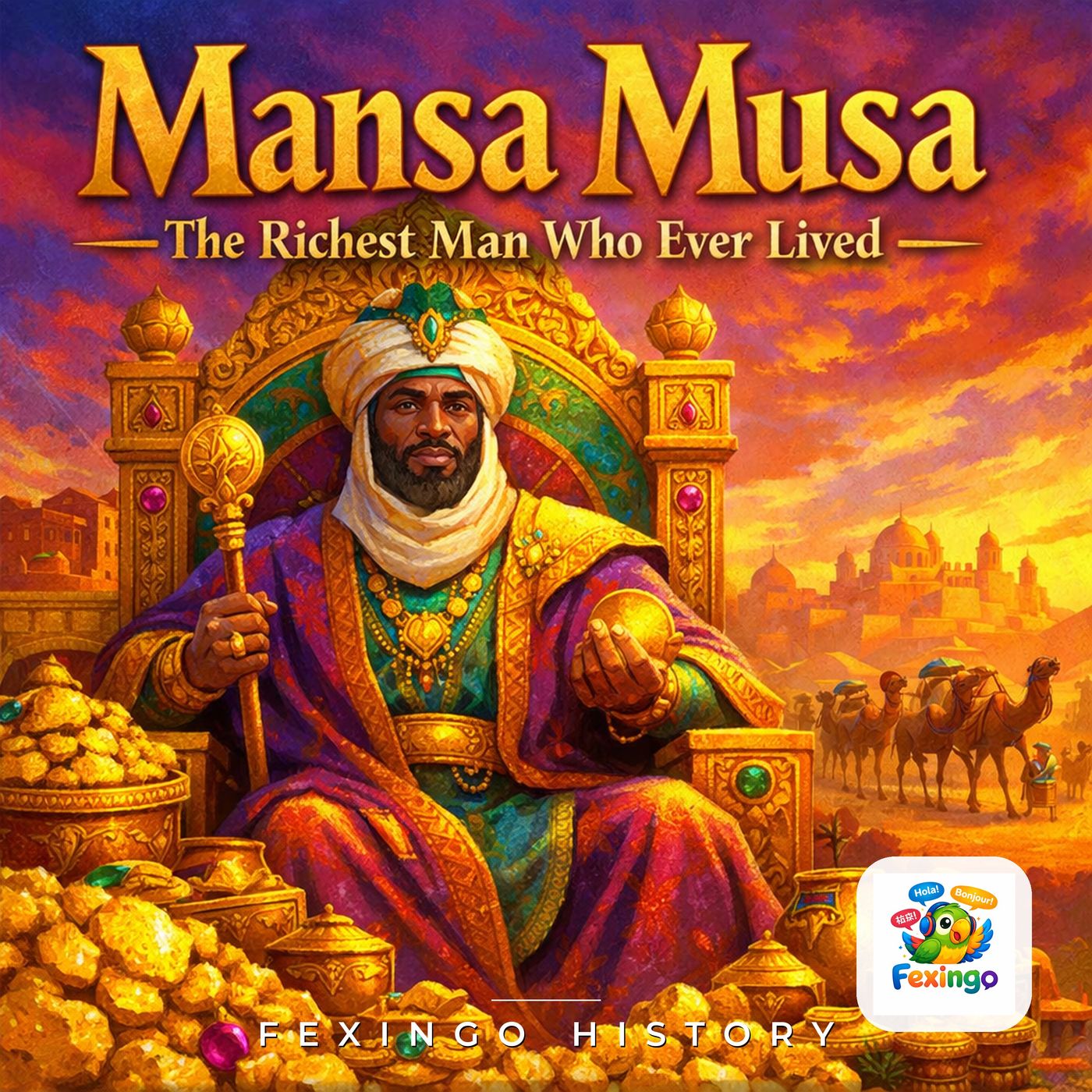
Mansa Musa: The Richest Man Who Ever Lived — Fexingo History
by Fexingo
Step into the golden age of the Mali Empire and meet Mansa Musa, the 14th-century ruler whose pilgrimage to Mecca in 1324 CE remains one of history's most extravagant displays of wealth. With a caravan stretching for miles, laden with gold and accompanied by thousands, Musa single-handedly reshaped the economies of Cairo, Medina, and beyond—flooding markets with so much gold that its value took a decade to recover. But his legacy is far more than glittering treasure. Under his reign, Timbuktu became a beacon of learning, home to the Sankore University and thousands of manuscripts that fused Islamic scholarship with West African traditions. Lucas and Luna guide listeners through the rise of the Mali Empire from Sundiata Keita's founding to Musa's consolidation of power, exploring the sophisticated governance of the Mande world, the role of the griot in preserving oral history, and the trans-Saharan trade networks that connected salt, gold, and knowledge. They examine the Mansa's diploma
-
35
Mansa Musa's Slave Soldiers: The Sahel's Mamluk-Style Army
We've covered Mansa Musa's gold, his pilgrimage, his architects, and his spy network — but what about the army that kept the Mali Empire secure? In this episode, Lucas and Luna explore the little-known system of enslaved soldiers (often called ghana or farbabila) that Mansa Musa and his predecessors used to build a standing professional army. Drawing on al-Umari's Masalik al-Absar and the Tarikh al-Sudan, we discuss how the mansa acquired young men from pagan regions, trained them in Mande warfare and the Maliki legal tradition, and deployed them as a loyal counterweight to the provincial farari cavalry. We compare this force to the Mamluks of Egypt and the Janissaries of the Ottomans, noting key differences in recruitment, Islamisation, and political role. We also touch on how this system changed under later mansas and what it reveals about slavery, social mobility, and state-building in the medieval Sahel. #MansaMusa #MaliEmpire #SlaveSoldiers #Ghana #Farbabila #MasalikAlAbsar #TarikhAlSudan #AlUmari #Sahel #MilitaryHistory #Mamluks #Janissaries #Slavery #Mande #KeitaDynasty #WestAfrica #History #FexingoHistory Keep every episode free: buymeacoffee.com/fexingo
-
34
Mansa Musa's Fragile Peace: The Treaty of Niani
In this episode, Lucas and Luna explore a little-known diplomatic triumph of Mansa Musa's reign: the Treaty of Niani of 1324, a pact that secured Mali's borders with the rising Songhai Empire to the east. Drawing on the Tarikh al-Sudan and al-Umari's Masalik al-Absar, they unpack the high-stakes negotiations led by Musa's farba, the diplomatic gifts of salt and copper, and the marriage alliance that bought Mali a generation of peace. Lucas explains how the treaty's terms—including shared control of the Niger River trade—reflected Musa's shrewd statecraft and his desire to focus on internal consolidation rather than endless war. Luna questions whether the treaty was a sign of strength or a concession, and they discuss how this fragile peace unraveled after Musa's death under his son Maghan I. A specific, grounded look at the art of diplomacy in the medieval Sahel. #MansaMusa #TreatyOfNiani #MaliEmpire #SonghaiEmpire #TarikhAlSudan #AlUmari #MasalikAlAbsar #Farba #NigerRiver #SahelDiplomacy #MaghanI #KeitaDynasty #SaltTrade #CopperTrade #MedievalAfrica #WestAfricanHistory #History #FexingoHistory Keep every episode free: buymeacoffee.com/fexingo
-
33
Mansa Musa's Astronomy: The Star Charts of Sankore
Mansa Musa's Mali Empire was not just a source of gold and scholarship—it was also a hub of astronomical observation. Before European Renaissance astronomers mapped the southern skies, West African scholars at Sankore in Timbuktu were tracking stars, predicting seasons, and aligning mosques to Mecca. Lucas and Luna explore the celestial knowledge that guided Mali's farmers, navigated its caravans, and timed its prayers. From the star 'Sulaiman' (Canopus) to the lunar calendars of the Mande, they uncover how Mali's astronomers merged Islamic science with indigenous knowledge. Did Mali's scholars influence later European astronomy? What happened to the star charts after the empire's decline? This episode traces the sky above the Sahel. #MansaMusa #MaliEmpire #Timbuktu #Sankore #Astronomy #StarCharts #Canopus #Sahel #IslamicAstronomy #Mande #WestAfrica #HistoryOfScience #LunarCalendar #CaravanNavigation #PreColumbianAstronomy #AfricanHistory #History #FexingoHistory Keep every episode free: buymeacoffee.com/fexingo
-
32
Mansa Musa's Hajj Route: The 4,000-Mile Pilgrimage That Broke Economies
In 1324, Mansa Musa embarked on a pilgrimage to Mecca that would become legendary. But beyond the famous Cairo gold crash, his 4,000-mile journey reshaped the Mali Empire's diplomatic ties, exposed its subjects to new ideas, and nearly bankrupted Egypt. In this episode, Lucas and Luna trace Musa's actual route: from Niani to Walata, through Tuat and Cairo, to Mecca and back. Along the way, they examine the logistics of moving a caravan of 60,000 people, the diplomatic gifts exchanged with Mamluk sultan al-Nasir Muhammad, and the architectural legacy of al-Sahili, who returned with Musa to build Timbuktu's mosques. They also unpack the controversy around Ibn Battuta's account of the pilgrimage, which contradicts al-Umari on key details like the number of slaves carried. For history fans who think they know the Mansa Musa story, this episode reveals the gritty reality of the medieval hajj—and why the journey mattered more than the gold. #MansaMusa #MaliEmpire #Hajj #CairoGoldCrash #alNasirMuhammad #alUmari #IbnBattuta #alSahili #Timbuktu #Niani #Walata #Tuat #MedievalTrade #WestAfricanHistory #Pilgrimage #Diplomacy #History #FexingoHistory Keep every episode free: buymeacoffee.com/fexingo
-
31
Mansa Musa's Spy Network: Intelligence in the Mali Empire
Long before modern intelligence agencies, the Mali Empire under Mansa Musa operated a sophisticated network of informants and spies that kept the emperor informed of threats, rebellions, and economic opportunities across his vast domain. Drawing on the accounts of al-Umari and Ibn Battuta, this episode explores how Mansa Musa used his farba (provincial governors), dyula (traders), and jeliw (oral historians) as eyes and ears. We examine specific instances of intelligence gathering, including monitoring the salt caravans from Taghaza, tracking gold production in Bambuk, and watching the powerful Songhai city of Gao. Luna and Lucas discuss how this network helped Mansa Musa maintain control without a standing army, and why the system began to fray under his successors. A rarely discussed aspect of Mali's imperial power. #MansaMusa #MaliEmpire #SpyNetwork #IntelligenceHistory #Farba #Dyula #Jeliw #AlUmari #IbnBattuta #Taghaza #Bambuk #Gao #WestAfrica #Sahel #MedievalAfrica #History #FexingoHistory #Espionage Keep every episode free: buymeacoffee.com/fexingo
-
30
Mansa Musa's Farari: The Cavalry That Built an Empire
In this episode of Fexingo History, Lucas and Luna explore the farari, the elite cavalry corps that formed the backbone of Mansa Musa's Mali Empire. These horsemen, bound by a code of honor, enforced imperial law, secured trade routes, and crushed revolts across the Sahel. Drawing on the writings of al-Umari and Ibn Khaldun, we examine their armor, tactics, and role in expanding Mali's borders. The conversation also touches on the equestrian culture of West Africa, the challenges of raising horses in a tsetse fly zone, and how the farari's loyalty to the mansa shaped the empire's golden age. Discover how these silent warriors became the mailed fist behind the richest ruler in history. #MansaMusa #MaliEmpire #Farari #Cavalry #Sahel #WestAfrica #AlUmari #IbnKhaldun #Horses #TsetseFly #ImperialGuard #CodeOfHonor #TradeRoutes #SundiataKeita #KouroukanFouga #Gold #History #FexingoHistory Keep every episode free: buymeacoffee.com/fexingo
-
29
Mansa Musa's Timbuktu: The University That Outshone Europe
Episode 102 of Fexingo History uncovers the intellectual revolution Mansa Musa sparked in Timbuktu. Far from just a trade hub, the city became one of the world's great centers of learning—home to the Sankore Madrasa, a vast library system, and scholars like Ahmed Baba who debated law, astronomy, and medicine. Lucas and Luna explore how Musa's patronage attracted academics from across the Muslim world, how the curriculum worked without formal degrees, and how Timbuktu's manuscripts survived centuries of upheaval, including a modern-day rescue operation. They also touch on the city's decline after the Moroccan invasion in 1591 and the resilience of its scholarly tradition today. This episode offers a view into a golden age of African education that rivaled Cairo, Fez, and even European universities of the time. #MansaMusa #Timbuktu #SankoreMadrasa #AhmedBaba #MaliEmpire #WestAfrica #HistoryOfEducation #Manuscripts #IslamicScholarship #Sahel #SahelianUniversities #GoldAge #MoroccanInvasion1591 #AfricanHistory #FexingoHistory #PrecolonialAfrica #LibraryOfTimbuktu #OralTradition Keep every episode free: buymeacoffee.com/fexingo
-
28
Mansa Musa's Engineers: The Builders of Mali's Stone Architecture
Mansa Musa is famous for his pilgrimage and gold, but who built the structures that defined his empire? This episode explores the engineers and architects behind Mali's stone mosques and palaces, from the legendary al-Sahili to the local Mande builders who adapted Sahelian techniques. Lucas and Luna discuss the construction of Djinguereber Mosque in Timbuktu, the use of banco and fired brick, the role of farba administrators in organizing labor, and the blend of Berber, Egyptian, and West African influences. They also examine the controversies around al-Sahili's true contributions and the evidence from al-Umari's Masalik al-Absar. How did Mali's building projects reflect imperial power, and what do surviving structures tell us about the empire's reach? This is a deep dive into the practical engineering that supported Mansa Musa's legacy. #MansaMusa #MaliEmpire #alSahili #DjinguereberMosque #Timbuktu #Sahel #WestAfricanHistory #Banco #MasalikAlAbsar #AlUmari #FiredBrick #Farba #Mande #Architecture #Engineering #MedievalHistory #History #FexingoHistory Keep every episode free: buymeacoffee.com/fexingo
-
27
Mansa Musa's Chief Wife: The Woman Who Ruled the Harem
In the court of Mansa Musa, one woman held immense power behind the throne: his senior wife, often called the 'queen of the women' in Mande society. This episode explores the life of Inari Konte, the daughter of the king of the Mandinka chiefdom of Do, who became the most influential woman in the Mali Empire. We examine her role in managing the royal harem, her political influence through marriage alliances, and her involvement in trade networks stretching from the Niger River to North Africa. Drawing on the Tarikh al-Sudan, al-Umari's Masalik al-Absar, and oral traditions preserved by the jeliw, we piece together how Inari Konte leveraged her position to accumulate wealth, broker diplomacy, and ensure her son's succession. We also discuss the broader role of elite women in the Mali Empire, including the 'farba' system and the Kouroukan Fouga's provisions for female inheritance. This is the untold story of Mansa Musa's queen, revealing the hidden power structures of one of history's wealthiest empires. #MansaMusa #InariKonte #MaliEmpire #RoyalWomen #AfricanHistory #WestAfrica #Harem #TarikhAlSudan #AlUmari #MasalikAlAbsar #Jeliw #KouroukanFouga #Sahel #Niani #GoldTrade #Queenship #History #FexingoHistory Keep every episode free: buymeacoffee.com/fexingo
-
26
Mansa Musa's Gold Mines: The Secret Sources of Mali's Wealth
In this episode of Fexingo History, Lucas and Luna explore the hidden geography of Mansa Musa's gold. While the pilgrimage to Cairo and the crash of the dinar are well known, the actual sources of Mali's legendary gold remain mysterious. Lucas explains that the gold came from the Bambuk and Bure regions, whose locations were deliberately kept secret by the Mande kings and dyula traders. He discusses the Wangara, the merchant guild that controlled the gold trade, and how they used a silent trade system to acquire gold without revealing the mines. The episode also covers the geology of alluvial gold, the role of the farba (imperial overseers), and the Mande concept of baraka (blessing) that was tied to the emperor's control of gold. A highlight is the story of the Wangara merchant who, according to al-Umari, was the only person allowed to wear gold in the emperor's presence. The hosts end with a reflection on how the secrecy of the gold sources made Mansa Musa's wealth even more legendary. #MansaMusa #MaliEmpire #GoldTrade #Bambuk #Bure #Wangara #Dyula #SilentTrade #Farba #AlUmari #MasalikAlAbsar #Sahel #WestAfrica #AlluvialGold #Baraka #MedievalAfrica #GoldMines #FexingoHistory Keep every episode free: buymeacoffee.com/fexingo
-
25
Mansa Musa's Copper Trade: The Hidden Pillar of Mali's Empire
In this episode, Lucas and Luna explore the Mali Empire's copper trade, a crucial but often overlooked pillar of Mansa Musa's wealth. While gold gets the glory, copper from Takedda and other Saharan sources powered Mali's economy, was used for currency, and was even more valuable than gold in some regions. Lucas shares insights from Moroccan traveler Ibn Battuta's account of Takedda's copper mines, the role of the farba in regulating trade, and how copper connected Mali to North Africa and Europe. They also touch on the environmental impact of mining and the decline of the copper trade after Mali's fall. A fascinating look at the unsung metal that helped build the richest empire of its time. #MansaMusa #MaliEmpire #CopperTrade #Takedda #IbnBattuta #WestAfrica #Sahel #MedievalTrade #SaharanCaravans #Farba #Currency #Mining #History #FexingoHistory #MedievalAfrica #TransSaharan #Copper #Gold Keep every episode free: buymeacoffee.com/fexingo
-
24
Mansa Musa Tax Records: Mali's Imperial Bureaucracy
In Episode 97 of Fexingo History, Lucas and Luna explore a forgotten dimension of Mansa Musa's Mali Empire: its sophisticated tax and record-keeping system. Drawing on the account of the Egyptian scholar al-Umari (Masalik al-Absar) and the Sudanese chronicle Tarikh al-Sudan, they reveal how the empire collected tithes, customs duties, and tribute from vassal states — and how these revenues were tracked by a class of royal scribes called 'farba'. The episode also examines the legendary salt tax at Taghaza, the gold trade with Wangara, and the role of oral accountants (jeliw) who memorized imperial ledgers. Discover how Mansa Musa's bureaucracy, rooted in the Kouroukan Fouga charter of Sundiata Keita, enabled the hajj that dazzled Cairo and funded the mosques of Timbuktu. #MansaMusa #MaliEmpire #TaxHistory #alUmari #MasalikAbsar #TarikhSudan #KouroukanFouga #Sahel #Taghaza #Wangara #GoldTrade #SaltTrade #Farba #Jeli #Bureaucracy #MedievalAfrica #FexingoHistory #History Keep every episode free: buymeacoffee.com/fexingo
-
23
Mansa Musa's Griot: The Oral Historian Who Shaped His Legend
Episode 96 of Fexingo History dives into the role of griots, or jeliw, in the Mali Empire, focusing on how Mansa Musa himself used oral historians to craft his legacy. We explore the griot's training, their sacred duty to memorize centuries of genealogy and epic poetry, and how the Kouroukan Fouga constitution defined their role. Drawing on accounts from Al-Umari and Ibn Battuta, Lucas and Luna discuss how Mansa Musa's griots—likely led by a master jeli—accompanied him on his hajj, spreading his fame across the Islamic world. We also examine the griot's influence on the Tarikh al-Sudan and the Sundiata epic, revealing how Mansa Musa's story was shaped as much by performance as by historical fact. This episode offers a fresh angle on the richest man in history: the artists who made him unforgettable. #MansaMusa #MaliEmpire #Griot #Jeli #OralHistory #WestAfrica #KouroukanFouga #AlUmari #IbnBattuta #SundiataKeita #TarikhAlSudan #FexingoHistory #History #MedievalAfrica #Sahel #EpicPoetry #Mande #Hajj Keep every episode free: buymeacoffee.com/fexingo
-
22
Mansa Musa's Secret Weapon: The Mali Empire's Naval Ambitions
When you think of Mansa Musa's empire, you probably picture gold, caravans, and the great mosques of Timbuktu. But there's another side to the Mali Empire that rarely gets talked about: its navy. This episode dives into the maritime ambitions of Mansa Musa and his successors, exploring how the Mali Empire controlled the Niger River, built fleets of war canoes, and possibly even launched expeditions into the Atlantic. We look at the evidence from Arab geographers like al-Umari and Ibn Battuta, the role of the farba (provincial governors) in naval logistics, and the mysterious story of a Mali fleet that sailed west and never returned. Along the way, we consider what kind of ships the Malians used, how they navigated, and whether the empire's reach truly extended beyond the coast of West Africa. This is a fresh angle on a familiar story—one that reveals an empire as comfortable on water as it was on land. #MaliEmpire #MansaMusa #NigerRiver #WestAfricanNavy #WarCanoes #AtlanticExpedition #AlUmari #IbnBattuta #Farba #Timbuktu #Djenné #Sahel #MedievalAfrica #NavalHistory #Malinke #Mande #History #FexingoHistory Keep every episode free: buymeacoffee.com/fexingo
-
21
Mansa Musa's Elephant Corps: War Beasts of the Sahel
In this episode, Lucas and Luna explore a little-known military innovation of the Mali Empire: Mansa Musa's use of war elephants. While Mansa Musa is famous for his pilgrimage and gold, his army also deployed elephants in battle, drawing on a long Sahelian tradition of elephant warfare. We discuss the training of these animals, their role in sieges and open-field combat, the logistical challenges of keeping them fed and healthy in the dry Sahel, and how they compared to the war elephants of India and Carthage. We also look at the decline of this practice after Mansa Musa's reign, as the empire shifted toward cavalry-based warfare. Specific sources include Ibn Battuta's accounts, the Tarikh al-Sudan, and archaeological evidence from the Niger River valley. This episode sheds light on a fascinating but overlooked aspect of Mali's military power. #MansaMusa #WarElephants #MaliEmpire #Sahel #MilitaryHistory #ElephantCorps #Warcraft #AfricanHistory #IbnBattuta #TarikhAlSudan #NigerRiver #Cavalry #SiegeWarfare #IndianElephants #AfricanForestElephant #MedievalWarfare #History #FexingoHistory Keep every episode free: buymeacoffee.com/fexingo
-
20
Mansa Musa's Salt: The Hidden Wealth Behind the Gold
Everyone knows Mansa Musa was rich in gold. But what if the true engine of the Mali Empire's power wasn't gold at all? This episode dives into the salt trade—the silent, strategic commodity that made the empire indispensable. We trace the grueling caravans to Taghaza, the salt mines in the Sahara where slaves extracted slabs of rock salt under brutal conditions. We explore how salt was more valuable than gold in the Sahel, used as currency and essential for survival. Lucas and Luna discuss the geography of salt routes, the role of the farba (imperial officials) in controlling production, and how Mansa Musa's monopoly on both gold and salt gave him unprecedented leverage. They also touch on the famous story of Ibn Battuta's visit to Taghaza and the curious fact that the miners lived in houses made of salt. This episode offers a fresh angle on Mansa Musa's economic empire, revealing that his legendary wealth was built as much on a mineral necessity as on glittering nuggets. #MansaMusa #MaliEmpire #SaltTrade #Taghaza #Sahara #IbnBattuta #MedievalAfrica #Farba #GoldAndSalt #TransSaharanTrade #WestAfricanHistory #Sahel #AfricanEmpires #SaltMines #EconomicHistory #History #FexingoHistory #Podcast Keep every episode free: buymeacoffee.com/fexingo
-
19
Mansa Musa's Mother: The Powerful Queen Behind the Throne
Who was the woman who raised the richest man in history? In this episode, Lucas and Luna explore the shadowy figure of Sogolon Kédjou, Mansa Musa's mother. Drawing on the oral traditions of the Mande griots and the writings of Al-Umari, they piece together the life of a queen who navigated the treacherous politics of the Mali Empire. Sogolon wasn't just a mother — she was a political strategist, a regent who held the realm together during her son's legendary pilgrimage, and the force behind the architectural patronage that made Timbuktu a center of learning. The episode also examines the broader role of women in Malian court life, from the kèlèmousso (warrior women) to the farba's wives who managed trade networks. Lucas and Luna discuss the controversies around Sogolon's origins — was she a princess from the Sahel or a concubine who rose to power? — and the silence of the written sources that forces historians to rely on the jeliw's songs. A rare glimpse into the maternal lineage of a medieval African empire. #SogolonKédjou #MansaMusa #MaliEmpire #WestAfrica #Mande #Griot #Jeliw #AlUmari #QueensOfAfrica #Timbuktu #Hajj #OralTradition #MedievalAfrica #WomenInHistory #AfricanEmpires #History #FexingoHistory #Sahel Keep every episode free: buymeacoffee.com/fexingo
-
18
Mansa Musa's Cairo Gold Crash
In 1324, Mansa Musa's pilgrimage to Mecca flooded Cairo's markets with so much gold that the value of the metal collapsed — and didn't recover for over a decade. This episode dives into the economics behind the legend: how much gold did Musa actually spend? Why did al-Maqrizi and Ibn Iyas record the crash so meticulously? And what does it tell us about the global gold trade in the 14th century? We explore the Mamluk reaction, the role of qadi and moneylenders, and the long shadow Musa's generosity cast over Cairo's economy. Drawing on al-Umari's Masalik al-Absar and al-Maqrizi's own account, we separate inflation from anecdote and trace the real impact of one man's wealth on a medieval metropolis. #MansaMusa #CairoGoldCrash #MaliEmpire #GoldTrade #MedievalEconomics #AlMaqrizi #IbnIyas #MamlukSultanate #AlUmari #MasalikAlAbsar #Pilgrimage #1324 #GoldInflation #FexingoHistory #WestAfrica #MedievalAfrica #History #Podcast Keep every episode free: buymeacoffee.com/fexingo
-
17
The Qadi of Timbuktu and Mansa Musa's Legal Legacy
In this episode, Lucas and Luna explore the judicial revolution set in motion by Mansa Musa during the Mali Empire's golden age. They focus on the role of the Qadi al-jama'a, or chief judge, and how Mansa Musa's pilgrimage brought Maliki legal scholars to Timbuktu, transforming it into a center of Islamic jurisprudence. The conversation covers the appointment of the first Qadi al-jama'a by Mansa Musa, the integration of Islamic law with the traditional Kouroukan Fouga code, and the lasting impact on the Sahel's legal traditions. They also touch on the famous Qadi of Timbuktu, Al-Aqib ibn Mahmud, and his role in building the Sankore Madrasah. The episode highlights the tension between customary Mande law and Sharia, and how Mansa Musa navigated this balance to consolidate his empire. #MansaMusa #MaliEmpire #Timbuktu #Qadi #IslamicLaw #Maliki #KouroukanFouga #Sankore #Sahel #WestAfrica #14thCentury #History #FexingoHistory #LegalHistory #AlUmari #IbnBattuta #SundiataKeita #Mande Keep every episode free: buymeacoffee.com/fexingo
-
16
Mansa Musa's Diplomacy: The Embassy to Morocco's Sultan
The Mali Empire under Mansa Musa was not only a land of immense wealth but also a kingdom that engaged in sophisticated diplomacy with North African powers. This episode explores Mansa Musa's embassy to the Marinid sultan of Morocco, Abu al-Hasan Ali, in the 14th century. We examine the motives behind the diplomatic mission, the gifts exchanged, and the political context of the western Sahel and Maghreb. Lucas and Luna discuss the challenges of cross-Saharan travel, the role of the Malian farba (governor) in facilitating the embassy, and the significance of the alliance in the broader geopolitical landscape of the time. Drawing on accounts by Ibn Khaldun and al-Umari, this conversation sheds light on the strategic ties between the Mali Empire and Morocco, highlighting how Mansa Musa projected power beyond Africa's shores. #MansaMusa #MaliEmpire #Marinid #Morocco #Diplomacy #IbnKhaldun #AlUmari #Fez #Niani #Farba #Sahel #SaharanTrade #AbuAlHasanAli #WestAfrica #NorthAfrica #MedievalHistory #FexingoHistory #AfricanHistory Keep every episode free: buymeacoffee.com/fexingo
-
15
Mansa Musa's Faltering Heir: Why Maghan I Couldn't Hold the Empire
Mansa Musa’s death in 1337 left the Mali Empire in the hands of his son, Maghan I. But Maghan’s reign lasted barely four years, and by 1341 the empire was fraying at the edges. This episode unpacks what we actually know about Maghan I — a figure so obscure that even his name is disputed. Lucas and Luna sift through the fragments: Ibn Khaldun’s curt entry in Kitab al-Ibar, the Tarikh al-Sudan’s conflicting genealogy, and the elusive evidence for a failed military campaign against Gao. They explore why Malian tradition remembers Maghan as a weak ruler, how the jeliw (griots) preserved his story, and what his short reign reveals about the fragility of imperial succession in the medieval Sahel. Along the way, they consider the broader pattern of succession crises that would eventually unravel the empire. This is a deep dive into a nearly forgotten ruler — and a cautionary tale about what happens when a giant’s shoes are too big to fill. #MansaMusa #MaghanI #MaliEmpire #WestAfrica #IbnKhaldun #TarikhAlSudan #Jeliw #Griot #Sahel #Niani #Gao #KeitaDynasty #SuccessionCrisis #MedievalAfrica #KankuMusa #SundiataKeita #History #FexingoHistory Keep every episode free: buymeacoffee.com/fexingo
-
14
Mansa Musa's Lost Library: The Manuscripts of Timbuktu
In this episode, Lucas and Luna explore a lesser-known facet of Mansa Musa's legacy: his patronage of scholarship and the book culture that flourished in Timbuktu under Mali's rule. They discuss the founding of the Sankore Mosque and university, the arrival of scholars from across the Muslim world, and the vast manuscript libraries that collected works on astronomy, medicine, law, and Sufi mysticism. The conversation touches on the role of the Qadi al-jama'a in building a legal curriculum, the influence of al-Sahili's architecture on learning spaces, and the survival of these texts through the 2012 crisis in Mali. Lucas explains how the Ahmed Baba Institute now holds thousands of manuscripts, many dating from Mansa Musa's era, and what they reveal about intellectual life in the Sahel. The episode also includes a brief, organic discussion of how listener support through buy me a coffee dot com slash fexingo keeps the show ad-free. #MansaMusa #Timbuktu #Sankore #MaliEmpire #Manuscripts #AhmedBabaInstitute #alSahili #Qadi #Sahel #WestAfrica #IslamicScholarship #BookCulture #Sufism #14thCentury #History #FexingoHistory #AfricanHistory #LostLibrary Keep every episode free: buymeacoffee.com/fexingo
-
13
The Qadi of Timbuktu: Mansa Musa's Legal Revolution in the Sahel
After the hajj, Mansa Musa didn't just build mosques—he transformed how justice worked across the Mali Empire. This episode explores the forgotten figure of the Qadi al-jama'a, the chief judge who brought Maliki law to the Niger bend and reconciled it with Mande custom. Drawing on al-Umari's Masalik al-Absar and the Tarikh al-Sudan, we trace how Mansa Musa imported legal scholars from Cairo, established qadis in every major city, and used Islamic courts to centralize power over fractious provinces. We also examine the tension between sharia and the Kouroukan Fouga, the ancient constitution of Sundiata Keita, and how everyday disputes—over gold, salt, inheritance, and marriage—were adjudicated in places like Timbuktu, Gao, and Niani. This is the story of how a ruler used law as an instrument of empire, and how the legal legacy of Mansa Musa outlasted his gold. #MansaMusa #MaliEmpire #Qadi #Timbuktu #Maliki #Sharia #KouroukanFouga #AlUmari #TarikhAlSudan #IslamicLaw #WestAfrica #Sahel #Niani #Gao #SundiataKeita #MedievalAfrica #History #FexingoHistory Keep every episode free: buymeacoffee.com/fexingo
-
12
Mansa Musa's Hajj Through the Eyes of Cairo
In 1324, Mansa Musa, the emperor of Mali, embarked on a pilgrimage to Mecca that would shake the economies of North Africa and the Middle East. But what did Cairo, the bustling Mamluk capital, actually see? This episode draws on the detailed accounts of the Egyptian historian Al-Umari, who interviewed officials and merchants who had met Musa during his lavish stay in Cairo. We explore the precise amount of gold Musa spent, how his generosity collapsed the price of bullion in Egypt for over a decade, and what the Mamluks thought of this West African ruler. We also examine Musa's audience with Sultan al-Nasir Muhammad, the diplomatic gifts exchanged, and how the Mamluk chroniclers like al-Maqrizi recorded the event. Despite the legendary tales, the historical sources reveal a calculating ruler who used display as statecraft. This is not the story of naive wealth, but of strategic piety. #MansaMusa #MaliEmpire #Hajj #Cairo #MamlukSultanate #AlUmari #AlNasirMuhammad #AlMaqrizi #IbnIyas #Gold #MasalikAlAbsar #1324 #MedievalAfrica #Diplomacy #Islam #WestAfrica #History #FexingoHistory Keep every episode free: buymeacoffee.com/fexingo
-
11
Mansa Musa's African Army: The Soldiers of the Mali Empire
In this episode, Lucas and Luna dive into the military might behind Mansa Musa's Mali Empire. Beyond the gold and the hajj, Mali fielded a formidable army that protected trade routes and expanded territory. Lucas explains how the farba system organized provincial levies, how the cavalry used stirrups and chain mail from North Africa, and how the navy on the Niger River supported campaigns. They discuss the role of the Wangara gold miners as a strategic resource, the use of poisoned arrows by infantry, and the command structure under the mansa. Lucas also touches on the controversial practice of taking captives and how the army projected power across the Sahel. A focused look at the soldiers, tactics, and logistics that made Mali a medieval superpower. #MaliEmpire #MansaMusa #AfricanMilitaryHistory #Sahel #Farba #Wangara #NigerRiver #Cavalry #MedievalWarfare #WestAfrica #GoldTrade #Mandinka #KeitaDynasty #SundiataKeita #TransSaharanTrade #FexingoHistory #History #MedievalAfrica Keep every episode free: buymeacoffee.com/fexingo
-
10
Mansa Musa's Debt: The Economic Collapse He Left Behind
Mansa Musa's 1324 Hajj is famous for its extravagant spending, but what happened when he went home? This episode examines the economic aftermath of his pilgrimage—not just in Cairo, but across the Mali Empire itself. We explore Musa's efforts to stabilize Mali's gold-based economy after flooding Mediterranean markets with bullion, how he managed inflation and debt among his own merchants, and the little-known 'gold loan' crisis that nearly bankrupted the empire. Featuring insights from Al-Umari's accounts, medieval Arab historians, and recent economic history studies, we uncover how the richest man who ever lived dealt with the consequences of his own generosity. The episode also touches on the long-term effects of Musa's spending on trans-Saharan trade networks and the eventual decline of Mali's economic dominance. #MansaMusa #MaliEmpire #GoldEconomy #Hajj1324 #Inflation #TransSaharanTrade #AlUmari #MedievalEconomics #WestAfrica #SundiataKeita #GoldCrisis #Debt #MamlukSultanate #Cairo #Niani #Timbuktu #FexingoHistory #History Keep every episode free: buymeacoffee.com/fexingo
-
9
Mansa Musa's Salt: The White Gold of Mali
We all know Mansa Musa was rich in gold. But what about salt? In this episode, Lucas and Luna explore the salt trade that underpinned the Mali Empire's wealth. From the mines of Taghaza (a bleak Saharan outpost where slaves mined blocks of salt) to the bustling markets of Timbuktu and Niani, salt was literally worth its weight in gold. Lucas explains how the Mali Empire controlled the trans-Saharan salt routes, the brutal conditions at Taghaza described by Ibn Battuta, and the complex barter system where salt was exchanged for gold in the Wangara region. They also discuss the environmental and geopolitical factors that made salt so precious, the role of the dyula merchants, and how the decline of Mali's salt monopoly contributed to the empire's fall. Packed with vivid details from medieval sources, this episode reveals the humble mineral that made Mansa Musa the richest man who ever lived. #MansaMusa #SaltTrade #MaliEmpire #Taghaza #IbnBattuta #TransSaharanTrade #WestAfrica #GoldSaltTrade #Dyula #Wangara #Timbuktu #Niani #FexingoHistory #History #MedievalAfrica #Sahara #CommodityHistory #AfricanEmpires Keep every episode free: buymeacoffee.com/fexingo
-
8
Mansa Musa's Son Maghan I and the Fall from Gold
After Mansa Musa's historic hajj and golden era, his son Maghan I inherited the Mali Empire. But Maghan's reign was short and troubled. In this episode, Lucas and Luna explore the succession crisis after Musa's death, the rise of Maghan, and the immediate unraveling of Musa's carefully built systems. They discuss the role of the farba governors, the strain on Mali's treasury from Musa's lavish spending, and the rebellion of the Songhai city of Gao. Drawing on al-Umari's accounts and oral Mande traditions, they examine how Maghan's brief rule—lasting only four years—set the stage for civil war and the eventual decline of the empire. Was Maghan simply unlucky, or did Mansa Musa's own policies doom his successor? This episode dives into the fraught transition of power in one of history's greatest empires. #MaliEmpire #MaghanI #MansaMusa #WestAfrica #MedievalAfrica #SuccessionCrisis #Songhai #Gao #Farba #AlUmari #Mande #KeitaDynasty #14thCentury #AfricanHistory #CivilWar #EmpireBuilding #History #FexingoHistory Keep every episode free: buymeacoffee.com/fexingo
-
7
Mansa Musa's Lost Fleet The Mali Navy That Ruled the Niger
Mansa Musa's Mali Empire controlled a stretch of the Niger River over a thousand miles long, and to rule it, the emperor maintained a powerful navy. This episode reveals the forgotten fleet of war canoes that patrolled the river, suppressed rebellions, and protected trade from Jenne to Timbuktu. Lucas and Luna explore the Bozo and Sorko boatbuilders who crafted vessels from giant kapok logs, the farba river governors who commanded flotillas, and the 1325 military campaign that crushed the Songhai rebellion. Drawing on oral traditions and the writings of Al-Umari, they piece together the scale and operations of this inland navy. Along the way, they discuss a remarkable 2012 discovery: a sunken canoe near Gao, radiocarbon-dated to the 14th century, that may have been part of Musa's fleet. The episode also examines how the navy's decline after Musa's death opened the door for Songhai's rise. For listeners who love hidden chapters of empire, this is an overlooked story of riverine power and West African statecraft. #MaliEmpire #MansaMusa #NigerRiver #Bozo #Sorko #Songhai #farba #Jenne #Timbuktu #AlUmari #canoe #riverinewarfare #14thcentury #WestAfrica #History #FexingoHistory #AfricanHistory #NavalHistory Keep every episode free: buymeacoffee.com/fexingo
-
6
Mansa Musa's Kanku Musa: The King's Real Name
Almost everyone knows Mansa Musa as the richest man in history, but what did he actually call himself? This episode peels back the layers of his name—Kanku Musa—and what it reveals about Mande kingship. Lucas and Luna explore the meanings of 'mansa,' 'kanku,' and 'Musa,' drawing on oral traditions from the griots and the writings of Al-Umari. They discuss how the title 'Mansa' differs from European concepts of kingship, the role of the kanku as a deputy or 'king's shadow,' and what Musa's Islamic name says about his identity. They also touch on the Epic of Sundiata and how naming conventions in the Mali Empire carried political and spiritual weight. This episode digs into the cultural and linguistic specifics that make Mansa Musa's reign unique, without rehashing the gold or the Hajj. #MansaMusa #KankuMusa #MaliEmpire #MandeKingship #Griot #AlUmari #SundiataKeita #KouroukanFouga #Niani #Timbuktu #WestAfrica #OralTradition #MedievalAfrica #1324 #IslamicHistory #History #FexingoHistory #NamesAndTitles Keep every episode free: buymeacoffee.com/fexingo
-
5
Mansa Musa's Forgotten Rival: The Mali Civil War of 1300
While Mansa Musa is celebrated as the richest king in history, his path to the throne was anything but smooth. This episode uncovers the civil war that erupted in the Mali Empire around 1300, when Musa's predecessor, Sakura, a former slave turned usurper, seized power after the death of Sundiata Keita's last direct heir. We explore the chaotic succession crisis, the loyalty of the farba (imperial governors), and how Musa, a grandson of Sundiata's brother, eventually emerged victorious after Sakura's assassination on his own pilgrimage. Drawing on the accounts of Al-Umari and Ibn Battuta, and the oral traditions of the Mande griots, we reveal the political cunning and military might that allowed Musa to not only reclaim the throne but also launch Mali into its golden age. This is the untold story of the war that almost prevented Mansa Musa from ever becoming the legend we know today. #MansaMusa #MaliEmpire #Sakura #SundiataKeita #farba #AlUmari #IbnBattuta #Mande #griots #WestAfrica #CivilWar #SuccessionCrisis #MedievalAfrica #Pilgrimage #Sahara #History #FexingoHistory #AfricanHistory Keep every episode free: buymeacoffee.com/fexingo
-
4
Mansa Musa's Pilgrims: The People Who Traveled with the King
In episode 46 of our Mansa Musa series, we step away from the emperor himself and focus on the thousands of pilgrims who accompanied him on his 1324 Hajj. Who were these people? Soldiers, scholars, slaves, craftsmen, and wives—including Mansa Musa's senior wife, Inari Konte. Drawing on the accounts of Al-Umari and Ibn Battuta, we explore the logistics of moving a caravan of 60,000 people across the Sahara: how they were fed, housed, and governed. We discuss the role of the farba (provincial governors) in organizing supplies, the construction of temporary mosques at each stop, and the fate of those who died en route. The episode also examines the social hierarchy within the caravan—how a goldsmith from Niani had more privileges than a slave from the Sahel—and how the pilgrimage reshaped Mali's internal politics. Finally, we touch on the stories of those who never returned, including some who settled in Mecca and Medina, becoming part of a West African diaspora that lasts to this day. #MansaMusa #MaliEmpire #Hajj #Pilgrimage #InariKonte #farba #AlUmari #IbnBattuta #Sahara #Caravan #WestAfrica #Niani #Mecca #Medina #Diaspora #1324 #FexingoHistory #History Keep every episode free: buymeacoffee.com/fexingo
-
3
Mansa Musa's Lost Elephant Ivory: The Trade That Built Mali
When we think of Mansa Musa's wealth, we think of gold. But the Mali Empire also dominated the trans-Saharan trade in elephant ivory, a luxury as prized as gold in medieval Europe and the Islamic world. In this episode, Lucas and Luna explore the vast elephant herds of the West African savanna, the specialized hunting techniques of Mandinka and Soninke elephant hunters, and the long caravan routes that carried tusks to North Africa and beyond. They discuss how the Mali state managed the ivory trade, the role of the dyula merchant class in financing expeditions, and the ecological impact of centuries of hunting. We meet the farba, the provincial governors who taxed every tusk, and learn how ivory was carved into intricate objects in Cairo, Fez, and even as far as China. This episode also touches on the little-known 10th-century Battle of the Elephants, when the armies of Ghana and the Almoravids clashed, and the surprising fact that Mansa Musa himself gifted ivory to the Mamluk sultan. A fresh angle on the economic and cultural power of one of history's greatest empires. #MansaMusa #MaliEmpire #IvoryTrade #ElephantHunting #TransSaharanTrade #Dyula #Farba #Mande #Soninke #WestAfricanHistory #MedievalAfrica #LuxuryGoods #IslamicWorld #AlUmari #Cairo #Ecology #History #FexingoHistory Keep every episode free: buymeacoffee.com/fexingo
-
2
Mansa Musa's Lost Gold: The Legend of the Wandering King
In this episode, Lucas and Luna explore a little-known chapter of Mansa Musa's life: his mysterious, almost mythical journey to the Atlantic Ocean. According to oral traditions and the writings of the Egyptian scholar Al-Umari, Musa launched a massive fleet of 200 ships to explore the 'sea of darkness'—the Atlantic Ocean west of Africa. When only one ship returned, he prepared a second, even larger expedition. What drove the wealthiest man in history to risk everything on the unknown? Was it a search for new trade routes, a response to a rival's claim, or something more personal? Lucas unpacks the sources, the doubts, and the enduring puzzle of Mansa Musa's lost Atlantic fleet. Featuring the Mali Empire, Al-Umari, Masalik al-Absar, Abu Bakr II, the Niger River, Timbuktu, Niani, the Atlantic Ocean, and the limits of historical evidence. #MansaMusa #MaliEmpire #AtlanticExpedition #SeaOfDarkness #AlUmari #AbuBakrII #WestAfrica #Gold #Timbuktu #Niani #NigerRiver #MedievalAfrica #Exploration #History #FexingoHistory #Podcast #LostFleet #OralTradition Keep every episode free: buymeacoffee.com/fexingo
-
1
Mansa Musa's African Gold in European Coins
How did Mansa Musa's gold end up in the coins of medieval Europe? This episode traces the journey of West African gold from the Mali Empire to the mints of Italy, France, and England. Lucas and Luna explore the trans-Saharan trade routes that funneled gold to North African ports like Tunis and Ceuta, where European merchants bought it for minting into florins, ducats, and even English nobles. They discuss the role of the Catalan Atlas, which depicted Mansa Musa holding a gold nugget, and how European rulers like Henry IV of England benefited from Mali's wealth. The episode also covers the competition between Genoese and Venetian traders for access to African gold, and the impact of the gold on European economies, including the inflation known as the 'price revolution.' The conversation ends with the irony that while Mansa Musa's name was known in Europe, the source of his wealth remained a mystery for centuries. #MansaMusa #MaliEmpire #GoldTrade #TransSaharanTrade #CatalanAtlas #MedievalEurope #VenetianGold #GenoeseTrade #Florin #Ducat #EnglishNoble #HenryIV #NigerRiver #Taghaza #Walata #Fez #Tunis #FexingoHistory Keep every episode free: buymeacoffee.com/fexingo
-
0
Mansa Musa's Lost Gold Mine: The Mystery of Bambuk
In this episode of Fexingo History, Lucas and Luna explore the legendary gold mines of Bambuk, the primary source of Mansa Musa's immense wealth. They discuss the geography of the Bambuk region, located between the Senegal and Falémé rivers, and how its gold deposits were formed by ancient geological processes. The conversation covers the secretive mining techniques used by the Soninke and Mandinka peoples, the role of the dyula merchants in transporting gold, and the political control exercised by the Mali Empire through farba governors. Lucas explains the debate among historians about whether Mansa Musa ever took direct control of the mines or left them in the hands of local chiefs. They also touch on the environmental impact of medieval mining and the decline of Bambuk's output after the 14th century. This episode offers a deep dive into the geological, economic, and political factors that made Bambuk the engine of the Mali Empire's prosperity. #Bambuk #MansaMusa #MaliEmpire #GoldMines #WestAfrica #MedievalTrade #Soninke #Mandinka #Dyula #Farba #Geology #Mining #SenegalRiver #FalemeRiver #AlUmari #IbnBattuta #History #FexingoHistory Keep every episode free: buymeacoffee.com/fexingo
-
-1
Mansa Musa's Agricultural Revolution: The Fields That Fed Mali
While Mansa Musa's gold and pilgrimage have been covered extensively, this episode explores the agricultural backbone of the Mali Empire that sustained its population and trade. Lucas and Luna delve into the ingenious farming techniques of the Mande people along the Niger River, the cultivation of sorghum, millet, and rice, and the role of fishers and farmers in supporting the empire's wealth. They discuss the importance of the Niger's floodplains for agriculture, the use of terracing, and the management of food surplus. The episode also touches on the Kouroukan Fouga charter's provisions for land use, the role of farba as provincial governors overseeing food production, and the integration of farming communities into the Mali economy. Discover how Mansa Musa's empire was not just built on gold but on the fertile lands of the Sahel. #MansaMusa #MaliEmpire #AfricanAgriculture #NigerRiver #Sahel #FoodHistory #Mande #KouroukanFouga #Farba #Sorghum #Millet #Rice #FloodplainFarming #WestAfrica #History #FexingoHistory #Podcast #Agriculture #GoldTrade #Timbuktu Keep every episode free: buymeacoffee.com/fexingo
-
-2
Mansa Musa's Griots: The Keepers of Mali's Oral History
In Episode 40 of Fexingo History's Mansa Musa series, Lucas and Luna explore the crucial role of griots in the Mali Empire. These oral historians were not just praise-singers but the living archives of the Mande people, preserving genealogies, laws, and epic tales like the Epic of Sundiata. Lucas explains how griots underwent rigorous training from childhood, memorizing centuries of history verbatim, and how their art of verbal artistry ensured the continuity of Mali's legacy long after its decline. The episode delves into specific griot families, the instruments they used (like the kora), and their social status as advisors and diplomats. Lucas also discusses how griots adapted after the fall of the Mali Empire, continuing to keep traditions alive into the 21st century. This episode sheds light on a vital but often overlooked aspect of Mansa Musa's world—the human memory that preserved his story and that of his predecessors. #MansaMusa #Griots #MaliEmpire #OralTradition #EpicOfSundiata #Kora #Mande #WestAfrica #History #FexingoHistory #SundiataKeita #Jeli #Niani #Sunjata #WestAfricanHistory #OralHistory #TransSaharan #MedievalAfrica #GoldTrade #Timbuktu Keep every episode free: buymeacoffee.com/fexingo
-
-3
Mansa Musa's Diplomatic Letters to the Mamluk Sultan
In this episode, Lucas and Luna explore Mansa Musa's diplomatic correspondence with the Mamluk Sultan al-Nasir Muhammad, based on the account of Al-Umari. They discuss how the Mali emperor's letters, written in Arabic and carried by his ambassadors, reveal the sophisticated chancery culture of his court. The conversation covers the content of the letters—requests for protection of pilgrims, offers of gifts, and discussions of tribute—and the broader diplomatic networks of the Mali Empire. Lucas explains the role of the qadi and the use of secretaries in crafting these messages, and how the Mamluks responded. The episode also touches on the symbolic meaning of gold in these exchanges and what the letters tell us about Mansa Musa's political ambitions. #MansaMusa #MaliEmpire #AlUmari #MamlukSultanate #Diplomacy #Gold #Timbuktu #Hajj #Letters #Ambassador #Qadi #Arabic #Cairo #AlNasirMuhammad #WestAfrica #Medieval #Sahara #FexingoHistory #GoldTrade #MedievalAfrica Keep every episode free: buymeacoffee.com/fexingo
-
-4
Mansa Musa's Golden Diplomatic Gifts to the Mamluk Sultan
In this episode, Lucas and Luna explore a little-known aspect of Mansa Musa's legendary 1324 pilgrimage: the lavish diplomatic gifts he presented to the Mamluk sultan al-Nasir Muhammad in Cairo. Drawing on the accounts of the Egyptian historian al-Umari, who interviewed officials who witnessed the encounter, they unpack the staggering quantities of gold dust, ingots, and luxury items Musa gave away. They also examine the political calculations behind the gifts—how Musa used wealth to secure alliances, display Mali's power, and navigate the complex Mamluk court. The conversation touches on the protocols of gift-giving in the Islamic world, the lasting impression Musa made on Cairo's elite, and how these gifts contributed to his legendary status. No previous episodes have focused solely on the diplomatic strategy of Musa's pilgrimage, making this a fresh angle on his legendary journey. #MansaMusa #MalEmpire #AlUmari #MamlukSultanate #AlNasirMuhammad #Cairo #Hajj #GoldGifts #Diplomacy #IslamicHistory #WestAfrica #MedievalTrade #TransSaharan #GiftGiving #Gold #Pilgrimage #History #FexingoHistory #MaliEmpire #GoldTrade Keep every episode free: buymeacoffee.com/fexingo
-
-5
Mansa Musa's Copper: The Overlooked Metal of Mali
Everyone knows Mansa Musa for gold, but what about copper? In this episode, Lucas and Luna explore the role of copper in the Mali Empire—its use in currency, status objects, and trade. They discuss the mines of Takedda, the trans-Saharan copper trade, and how copper flowed alongside salt and gold. The episode also touches on the mysterious 'copper bars' mentioned by Ibn Battuta, the role of copper in armlets and royal regalia, and how the Wangara traders handled this metal. A fresh angle on the wealth of Mansa Musa's empire. #MansaMusa #MaliEmpire #Copper #TransSaharanTrade #Takedda #IbnBattuta #Wangara #Gold #Salt #WestAfrica #MedievalAfrica #Trade #Currency #Metal #Sijilmasa #Niani #FexingoHistory #History #GoldTrade #Timbuktu Keep every episode free: buymeacoffee.com/fexingo
-
-6
Mansa Musa's Gold Wages of Timbuktu Scholars
In this episode of Fexingo History, Lucas and Luna explore a lesser-known aspect of Mansa Musa's reign: his systematic patronage of Islamic scholarship through gold stipends. They delve into how Musa used his legendary wealth not just for display but to transform Timbuktu into a center of learning, attracting scholars like Abu Ishaq al-Sahili and funding the Sankore Madrasa. The conversation also touches on the controversy surrounding the lavish salaries paid to qadis and imams, which some saw as corrupting religious integrity, and how this patronage created a unique intellectual culture that outlasted the empire itself. Drawing on accounts from Al-Umari and Ibn Battuta, they examine the sums involved—some scholars received up to 200 mithqals of gold annually—and the ripple effects on West African education and law. This episode offers a fresh angle on Mansa Musa's legacy, focusing on the gold that greased the wheels of knowledge rather than just the coins he scattered in Cairo. #MansaMusa #Timbuktu #SankoreMadrasa #MaliEmpire #GoldPatronage #IslamicScholarship #AbuIshaqalSahili #AlUmari #IbnBattuta #WestAfrica #MedievalAfrica #Qadis #Maliki #GoldStipends #Scholars #History #FexingoHistory #Podcast #GoldTrade #SundiataKeita Keep every episode free: buymeacoffee.com/fexingo
-
-7
Mansa Musa's Lost Fleet: The Mali Navy That Ruled the Niger
When you think of Mansa Musa, you think of gold, camels, and caravans crossing the Sahara. But the Mali Empire's true superpower was its navy. On the Niger River, a fleet of hundreds of war canoes — some over 80 feet long — controlled trade, projected power, and transported armies. This episode dives into the forgotten naval tradition of the Mande people. We explore the Bozo and Sorko boat-builders, the strategic use of the river as a highway, the legendary naval battle against the Songhai, and how control of the Niger allowed Mansa Musa to project influence from the inland delta to the Atlantic. Lucas and Luna examine archaeological evidence from Jenne-Jeno, the role of the farba (provincial governors) in managing river trade, and the lasting impact of Mali's maritime power on West African history. Discover how wood and water, not just desert caravans, built the richest empire of its time. #MaliEmpire #NigerRiver #Bozo #Sorko #MansaMusa #WestAfricanHistory #NavalHistory #JenneJeno #Farba #SonghaiEmpire #Mande #RiverTrade #AfricanEmpires #Canoe #InlandDelta #MaritimeHistory #FexingoHistory #History #WestAfrica #GoldTrade Keep every episode free: buymeacoffee.com/fexingo
-
-8
Mansa Musa's Engineers: The Builders Who Shaped Mali
In this episode, Lucas and Luna explore the unsung architects and engineers of the Mali Empire under Mansa Musa. They delve into the role of the farba (governors) in commissioning public works, the construction of the Djinguereber and Sankore mosques using banco (mud-brick), and the influence of Abu Ishaq al-Sahili, the Andalusian poet-architect who brought fired brick and geometric design to Timbuktu. The hosts discuss the organization of labor, the use of enslaved and free artisans, the challenges of building on the Niger River's floodplains, and how these structures served as symbols of Islamic piety and imperial power. They also touch on the maintenance of these mud-brick buildings, which require annual replastering, and the role of the community in preserving them. The episode offers a fresh perspective on Mansa Musa's reign by focusing not on gold or pilgrimage, but on the physical legacy that still stands today. #MansaMusa #MaliEmpire #Timbuktu #AbuIshaqalSahili #Djinguereber #Sankore #Architecture #Banco #WestAfrica #MedievalAfrica #IslamicArchitecture #Engineering #Farba #NigerRiver #Sahara #AfricanHistory #History #FexingoHistory #GoldTrade #SundiataKeita Keep every episode free: buymeacoffee.com/fexingo
-
-9
Mansa Musa's Lost Treasure: The Stolen Gold of Jenne
In this episode, Lucas and Luna explore a little-known chapter of Mansa Musa's reign: the mysterious theft of a massive gold shipment near the city of Jenne. Drawing on oral traditions and the writings of the medieval geographer Al-Umari, they piece together the story of a daring heist that exposed the limits of Mali's imperial control. The robbers, likely from the non-Mande Bozo or Sorko river peoples, made off with an enormous quantity of gold dust and ingots. The episode delves into the political fallout—Mansa Musa's fury, the execution of local officials, and the subsequent tightening of security on the Niger River trade routes. It also examines the broader implications: how the theft revealed internal tensions in the empire, the challenges of governing a diverse realm, and the limits of even the richest king's power. Along the way, Lucas and Luna discuss the role of Jenne as a commercial hub, the relationship between the Mali court and the autonomous trading cities, and what this event tells us about the realities of medieval West African politics. A tale of greed, justice, and imperial fragility. #MansaMusa #Jenne #GoldTheft #MaliEmpire #NigerRiver #Bozo #Sorko #AlUmari #MedievalAfrica #WestAfricanHistory #AfricanGold #TradeRoutes #ImperialPolitics #RiverTrade #FexingoHistory #History #Podcast #LostTreasure #WestAfrica #GoldTrade Keep every episode free: buymeacoffee.com/fexingo
-
-10
Mansa Musa's Hajj: The Gold That Crashed Cairo's Economy
In 1324, Mansa Musa, the emperor of Mali, embarked on a pilgrimage to Mecca that would become legendary—not just for its piety, but for its staggering display of wealth. As his caravan passed through Cairo, he distributed so much gold that its value plummeted in Egypt for over a decade. This episode explores the mechanics of that journey: the 60,000-strong retinue, the 80 camels each carrying 300 pounds of gold dust, and the diplomatic encounters with the Mamluk sultan al-Nasir Muhammad. We delve into the accounts of the Egyptian historian Al-Umari, who interviewed officials still reeling from the effects, and the Moroccan traveler Ibn Battuta, who visited Mali later and saw the consequences. We also discuss how Mansa Musa's generosity was both a blessing and a curse—sparking inflation but also cementing his fame across the Islamic world. How did a single pilgrimage reshape the economy of the Mediterranean? And what does it reveal about the scale of Mali's wealth under the Keita dynasty? Join Lucas and Luna as they unpack the numbers, the legends, and the enduring legacy of the richest man in history. #MansaMusa #MaliEmpire #Hajj #Gold #Cairo #AlUmari #IbnBattuta #SultanAlNasirMuhammad #KeitaDynasty #MedievalAfrica #WestAfrica #Inflation #Pilgrimage #1324 #FexingoHistory #History #WorldHistory #Podcast #GoldTrade #Timbuktu Keep every episode free: buymeacoffee.com/fexingo
-
-11
Mansa Musa's Justice: The Qadis and Law of Mali
How did one of the wealthiest empires in history maintain justice across a realm larger than Western Europe? This episode explores the legal system of the Mali Empire under Mansa Musa, focusing on the role of qadis — Islamic judges — who administered Maliki law alongside traditional Mande customs. We trace the appointment of jurists from Fez and Cairo, the integration of the Kouroukan Fouga constitution with Sharia, and the famous case of a Wangara merchant whose gold dispute reached the mansa's court. Drawing on accounts from Al-Umari and Ibn Battuta, we uncover how Mali's courts handled everything from trade contracts to criminal justice, with Mansa Musa himself presiding over appeals under a baobab tree. The episode also examines the limits of imperial law in the far provinces and the legacy of Mali's legal synthesis for later empires like Songhai. #MaliEmpire #MansaMusa #IslamicLaw #Maliki #Qadi #WestAfrica #MedievalAfrica #LegalHistory #KouroukanFouga #AlUmari #IbnBattuta #Wangara #Timbuktu #Sharia #JusticeSystem #SundiataKeita #FexingoHistory #History #GoldTrade #TransSaharanTrade Keep every episode free: buymeacoffee.com/fexingo
-
-12
Mansa Musa's Architectural Revolution: Mosques and Empire
In this episode, Lucas and Luna explore Mansa Musa's ambitious building program that transformed West African architecture. After his legendary hajj, Musa brought back the Andalusian poet-architect Abu Ishaq al-Sahili to construct grand mosques and palaces across the Mali Empire. They discuss the construction of the Djinguereber Mosque in Timbuktu, the use of banco (mud-brick) and wooden reinforcement, the integration of Tlemcen-style minarets, and the controversial theory that al-Sahili may have simply been a court poet rather than an architect. Lucas explains how these buildings became symbols of Mali's wealth and Islamic piety, and how they influenced later Sahelian architecture. The conversation also touches on the legacy of these structures, including their preservation and reconstruction in the 20th century. A fresh angle that builds on prior episodes about Mansa Musa's pilgrimage and Timbuktu's scholars. #MansaMusa #AbuIshaqalSahili #DjinguereberMosque #Timbuktu #MaliEmpire #SahelianArchitecture #Banco #Tlemcen #IslamicArchitecture #Mudbrick #SankoreMadrasa #1324Hajj #MansaMusasBuildingProgram #WestAfricanHistory #History #FexingoHistory #Podcast #ArchitecturalHistory #WestAfrica #GoldTrade Keep every episode free: buymeacoffee.com/fexingo
-
-13
Mansa Musa's Salt: The Other Wealth of Mali
We all know about Mansa Musa's gold, but what about his salt? In this episode, Lucas and Luna explore the vital role of salt in the Mali Empire. From the legendary salt mines of Taghaza, where buildings were made of salt blocks, to the Tuareg caravans that transported it across the Sahara, salt was as precious as gold. Lucas explains how Mansa Musa controlled both the gold and salt trades, using salt to buy everything from copper to slaves. He also discusses the harsh realities of life at Taghaza, the political power derived from salt revenues, and the environmental disaster at the salt flat of Fachi. Discover how salt shaped the economy, politics, and daily life in medieval West Africa, and why it was worth its weight in gold. #MansaMusa #MaliEmpire #SaltTrade #Taghaza #Sahara #Tuareg #GoldSaltTrade #Fachi #SilentBarter #MedievalAfrica #WestAfrica #TransSaharanTrade #MansaMusaSalt #SaltMines #SaharanCaravan #TradeNetworks #History #FexingoHistory #GoldTrade #Timbuktu Keep every episode free: buymeacoffee.com/fexingo
-
-14
Mansa Musa's Library: The Books That Shaped Timbuktu
When Mansa Musa returned from his 1324 hajj, he didn't just bring back gold and architects—he brought back books. In this episode, Lucas and Luna explore the library of Mansa Musa himself: the manuscripts he commissioned, the scholars he lured to Timbuktu, and the intellectual culture that made the city a beacon of learning. They dive into the works of Ahmad Baba, the most famous scholar of the Sankore Madrasa, and discuss how Musa's patronage created a literary tradition that survived centuries. From legal texts on Maliki jurisprudence to commentaries on the Qur'an to astronomical charts used for navigation, the library of Mansa Musa was a treasure trove of knowledge. But what happened to it? Lucas reveals the fate of these manuscripts during the Songhai invasion and the ongoing efforts to preserve Timbuktu's written heritage. This episode covers the Arabic manuscript trade, the role of the dyula merchants in transporting books, and the legacy of Mansa Musa's literary investments. #MansaMusa #Timbuktu #SankoreMadrasa #AhmadBaba #MalikiJurisprudence #ArabicManuscripts #MaliEmpire #IslamicScholarship #14thCentury #WestAfrica #BookHistory #DyulaMerchants #SonghaiInvasion #ManuscriptPreservation #Quran #Astronomy #History #FexingoHistory #GoldTrade #MedievalAfrica Keep every episode free: buymeacoffee.com/fexingo
We're indexing this podcast's transcripts for the first time — this can take a minute or two. We'll show results as soon as they're ready.
No matches for "" in this podcast's transcripts.
No topics indexed yet for this podcast.
Loading reviews...
ABOUT THIS SHOW
Step into the golden age of the Mali Empire and meet Mansa Musa, the 14th-century ruler whose pilgrimage to Mecca in 1324 CE remains one of history's most extravagant displays of wealth. With a caravan stretching for miles, laden with gold and accompanied by thousands, Musa single-handedly reshaped the economies of Cairo, Medina, and beyond—flooding markets with so much gold that its value took a decade to recover. But his legacy is far more than glittering treasure. Under his reign, Timbuktu became a beacon of learning, home to the Sankore University and thousands of manuscripts that fused Islamic scholarship with West African traditions. Lucas and Luna guide listeners through the rise of the Mali Empire from Sundiata Keita's founding to Musa's consolidation of power, exploring the sophisticated governance of the Mande world, the role of the griot in preserving oral history, and the trans-Saharan trade networks that connected salt, gold, and knowledge. They examine the Mansa's diploma
HOSTED BY
Fexingo
Loading similar podcasts...
Frequently Asked Questions
How many episodes does Mansa Musa: The Richest Man Who Ever Lived — Fexingo History have?
Mansa Musa: The Richest Man Who Ever Lived — Fexingo History currently has 50 episodes available on PodParley. New episodes are automatically indexed when they're published to the podcast feed.
What is Mansa Musa: The Richest Man Who Ever Lived — Fexingo History about?
Step into the golden age of the Mali Empire and meet Mansa Musa, the 14th-century ruler whose pilgrimage to Mecca in 1324 CE remains one of history's most extravagant displays of wealth. With a caravan stretching for miles, laden with gold and accompanied by thousands, Musa single-handedly reshaped...
How often does Mansa Musa: The Richest Man Who Ever Lived — Fexingo History release new episodes?
Mansa Musa: The Richest Man Who Ever Lived — Fexingo History has 50 episodes. Check the episode list to see recent publication dates and frequency.
Where can I listen to Mansa Musa: The Richest Man Who Ever Lived — Fexingo History?
You can listen to Mansa Musa: The Richest Man Who Ever Lived — Fexingo History on PodParley by clicking any episode. We provide an embedded audio player for direct listening, and you can also subscribe via your preferred podcast app using the RSS feed.
Who hosts Mansa Musa: The Richest Man Who Ever Lived — Fexingo History?
Mansa Musa: The Richest Man Who Ever Lived — Fexingo History is created and hosted by Fexingo.
URL copied to clipboard!