
PODCAST · education
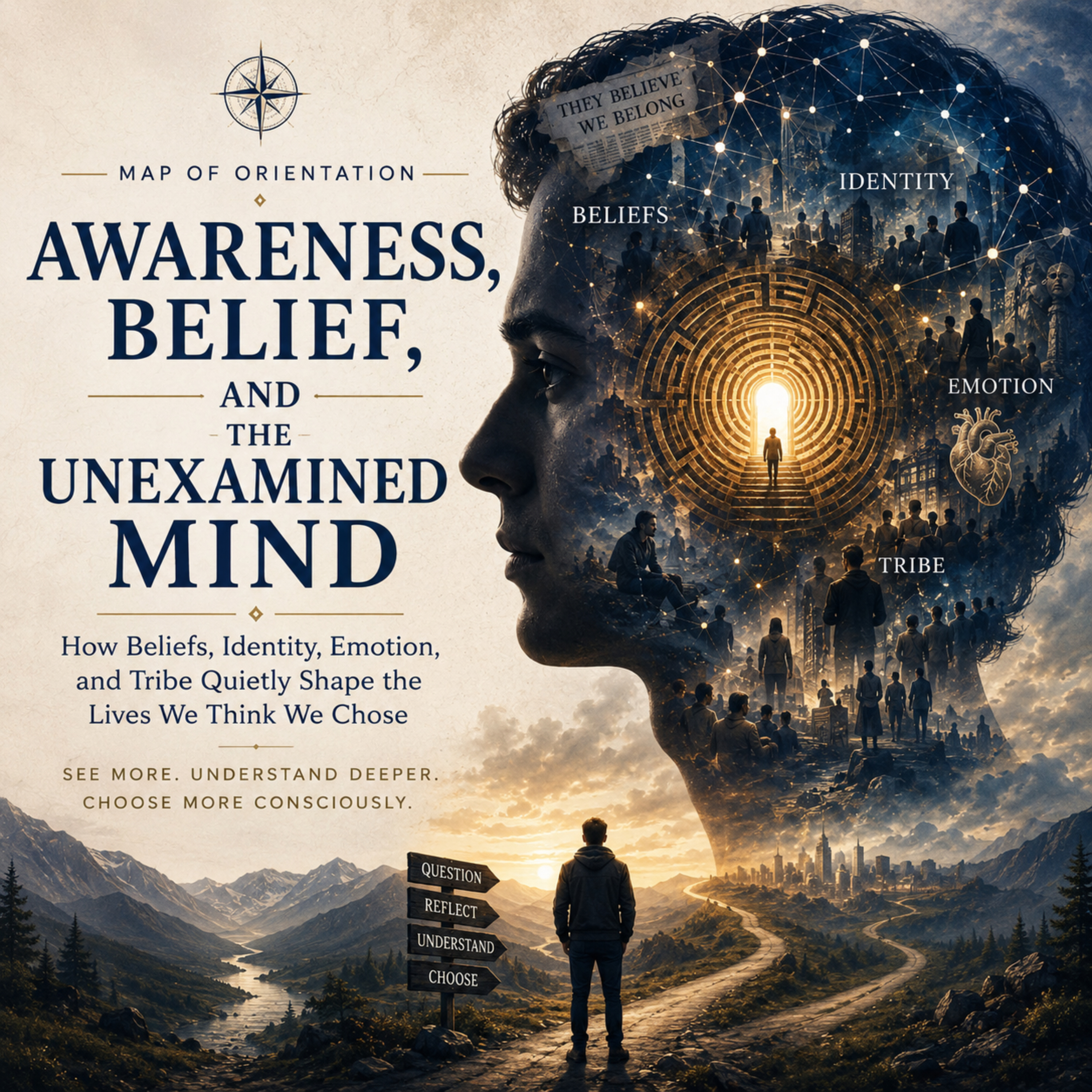
Maps of Orientation: Awareness, Belief, and the Unexamined Mind
by Only Life After All
How Beliefs, Identity, Emotion, and Tribe Quietly Shape the Lives We Think We Chose
-
18
17. Closing Reflection: The Map and the Territory
Over the course of this map, we have explored many of the forces quietly shaping human beings:attachment,tribe,emotion,inherited narratives,borrowed desire,identity,self-deception,attention,comparison,social belonging,and the difficult possibility of increasing self-possession.But perhaps the most important realization is this:The map itself is not the territory.Every framework simplifies reality.Every worldview illuminates certain patterns while obscuring others. Every interpretation emerges through limitations of perspective, temperament, history, language, culture, biology, identity, and emotional orientation. Even the examined mind remains shaped while examining.Including this map.Especially this map.There is a temptation, when constructing any framework for understanding human life, to slowly begin mistaking the explanatory structure for reality itself. The mind naturally seeks coherence. Once a map begins organizing experience successfully, it becomes emotionally attractive to extend it everywhere. Patterns appear increasingly universal. Complexity collapses into interpretation. The framework starts feeling less like orientation and more like truth itself.This temptation never fully disappears.Which is why humility matters so deeply.The purpose of this map was never to explain human beings completely.Human beings are too layered, contradictory, contextual, emotional, social, symbolic, biological, and mysterious for any final theory to fully contain them. No single framework can adequately capture the full complexity of consciousness, identity, meaning, love, suffering, desire, tribe, freedom, or the strange experience of being human.The goal here was something more modest.And perhaps more useful.Orientation.
-
17
16. Becoming More Conscious Participants in Our Own Lives
There is a temptation, after exploring all the ways human beings are shaped by tribe, identity, emotion, conditioning, narrative, status, attachment, and unconscious desire, to arrive at a bleak conclusion:That freedom is mostly illusion.That the self is merely the product of forces operating beneath awareness.That human beings are little more than socially conditioned organisms rationalizing impulses they never truly chose.There is some truth inside this perspective.But only some.Because awareness changes something.Not completely.Not perfectly.But enough to matter.This distinction may sit near the center of the entire examined life.Human beings likely never become fully self-authored in the absolute sense. We do not step outside biology, culture, nervous systems, social belonging, emotional inheritance, language, or history. We remain finite creatures shaped continuously by forces both visible and invisible.The fantasy of total independence is itself often another illusion of the unexamined mind.And yet complete helplessness is also false.
-
16
15. Autotelic Living and the Reclaimed Self
One of the quiet tragedies of modern life is how many people spend years pursuing lives that never truly felt like their own.They move from expectation to expectation, role to role, comparison to comparison, achievement to achievement, without ever fully pausing to ask:“What actually feels deeply alive to me beneath performance, approval, fear, tribe, and imitation?”This question becomes difficult partly because human beings are so socially shaped. Desire, identity, ambition, morality, and meaning are constantly influenced by external forces:family expectations,cultural narratives,status hierarchies,comparison structures,tribe loyalty,economic incentives,and the emotional rewards of belonging.Over time, many people lose contact with the difference between:what genuinely animates themandwhat they learned to pursue for approval, security, admiration, or identity.This disconnection often produces a subtle form of inner fragmentation.
-
15
14. Attention Is the Gatekeeper of the Self
Human beings often think of identity as something formed primarily through beliefs.But identity is shaped just as powerfully by attention.What we repeatedly attend to gradually organizes the structure of the mind itself.Attention determines:what enters consciousness,what becomes emotionally reinforced,what narratives strengthen,what desires intensify,what fears expand,what identities solidify,and ultimately what kind of psychological world a person inhabits.In this sense, attention functions less like a passive spotlight and more like an architect.The mind becomes shaped by what it repeatedly consumes.This is not merely metaphorical.
-
14
13. The Inner Scorecard
Once a person begins recognizing how deeply tribe, identity, status, emotion, and inherited narratives shape human life, a difficult question eventually emerges:If so much of the self is socially conditioned, then what does it actually mean to live from within rather than merely in reaction to the surrounding world?This question sits near the center of self-possession.Because one of the strongest forces shaping human behavior is not truth itself, but social evaluation. Human beings are exquisitely sensitive to approval, admiration, rejection, status, and belonging. Much of life quietly becomes organized around external scorekeeping:how others perceive us,whether we are admired,whether we are successful enough,attractive enough,moral enough,intelligent enough,productive enough,prestigious enough,important enough.People rarely admit this openly because modern culture celebrates individuality rhetorically. Most individuals prefer to imagine themselves internally directed. But careful observation reveals how often external validation quietly governs thought, ambition, behavior, and identity.The desire for approval is not inherently shallow.It is deeply human.
-
13
12. The Mind Examining Itself
There is something strange that happens once a person begins seriously examining their own mind.The observer itself becomes unstable.At first, self-examination feels relatively straightforward. A person notices emotional reactions, inherited beliefs, tribal influences, attachment patterns, or conditioned desires. Awareness increases. Certain unconscious processes become more visible. Reflection deepens.But eventually another realization begins emerging:The mind doing the examining is itself shaped, conditioned, emotionally filtered, and psychologically motivated.The observer is not standing outside the system.The observer is inside it.This realization changes the nature of self-awareness entirely.
-
12
11. The Courage To Doubt Yourself
There is a kind of psychological courage that receives far less admiration than confidence.The courage to doubt yourself.Not performative self-doubt.Not chronic insecurity.Not paralysis disguised as humility.Something quieter and rarer than that.The willingness to honestly entertain the possibility that one’s perceptions, beliefs, interpretations, emotional reactions, or certainties may be incomplete, distorted, emotionally motivated, tribally reinforced, or simply wrong.This sounds easier than it actually is.Because beliefs are rarely just intellectual conclusions.
-
11
10. Reflection Before Reaction
Once a person begins noticing the forces shaping their thoughts, emotions, desires, and identity, a new possibility gradually emerges:The possibility of pause.This may sound small.It is not.Much of human life unfolds automatically. Stimulus appears, emotion activates, interpretation forms, reaction follows. The process happens so quickly that people often experience their reactions as inevitable rather than constructed. Anger becomes speech before awareness arrives. Fear becomes avoidance before examination begins. Desire becomes pursuit before reflection asks whether the object genuinely aligns with deeper values.The unexamined mind moves rapidly from feeling to conclusion.From impulse to identification.From emotional activation to certainty.Reflection interrupts this speed.And interruption changes something profound.
-
10
9. The Shock of Seeing
Most people do not arrive at deeper self-awareness gradually.They arrive through disruption.Something cracks.Sometimes the disruption is external:the collapse of a relationship,betrayal,illness,failure,humiliation,loss,exile,disillusionment,or confrontation with contradiction too large to comfortably ignore.Other times the disruption is quieter:a sentence in a book,an unexpected conversation,an encounter with another worldview,a moment of emotional overreaction,the realization that one keeps repeating the same pattern despite consciously wanting something different.But whatever form it takes, the experience often carries the same underlying feeling:The map no longer fully explains the territory.This can be profoundly destabilizing.
-
9
8. The Stories We Tell to Protect Ourselves
Human beings like to think of self-deception as something rare.A dishonest politician.A manipulative partner.A corrupt executive.A propagandist knowingly spreading falsehoods.But most self-deception is quieter than that.Far more ordinary.Far more human.Most people are not consciously lying to themselves all day long. In fact, the most powerful forms of self-deception often operate precisely because the individual experiences themselves as sincere.The mind protects coherence automatically.This protection begins early and continues throughout life.
-
8
7. Borrowed Desire and the Mimetic Self
Most people experience their desires as deeply personal.“I want this.”“I chose this.”“This is who I am.”And certainly some desires do emerge from genuine temperament, curiosity, values, or intrinsic orientation. Human beings are not empty vessels mechanically programmed by external forces. Individuality exists. Authentic preference exists. Personal agency exists.But once we begin observing human behavior carefully, another uncomfortable reality gradually appears:Much of what human beings desire is socially shaped long before it is consciously examined.People learn not only what to think from one another.They learn what to want.
-
7
6. The Tribe Inside the Mind
One of the more uncomfortable realizations a person can have is that the tribe does not merely exist around us.It gradually takes shape within us.Most people think of tribalism as something external — political factions, religious groups, nations, ideological movements, sports fans, online communities, cultural camps. And certainly tribes do exist externally. Human beings organize themselves into groups constantly.But the deeper phenomenon is psychological.Over time, the tribe becomes internalized.Its language becomes our language.Its emotional reactions become our emotional reactions.Its moral boundaries become our moral boundaries.Its enemies become emotionally legible to us long before we consciously evaluate whether they deserve to be enemies at all.This process usually happens slowly and invisibly.No one wakes up one morning and consciously decides:“I will outsource portions of my perception and identity to the group.”It emerges through belonging.
-
6
5. Feelings Are Signals, Not Instructions
One of the most consequential confusions in modern life may be the tendency to treat feelings as commands rather than information.Human beings often experience emotions as though they arrive carrying truth already embedded within them. Anger feels like proof. Fear feels like certainty. Desire feels like destiny. Resentment feels like moral clarity. Attraction feels like meaning. Anxiety feels like danger. Emotional intensity itself often becomes mistaken for accuracy.But emotions are not objective descriptions of reality.They are signals.Important signals, certainly. Sometimes profoundly important. Human beings would not survive without emotional systems rapidly alerting them to potential danger, reward, social threat, opportunity, attachment disruption, or environmental change. Emotions evolved because they helped organisms respond quickly under conditions where lengthy rational analysis would often arrive too late.The problem is not emotion itself.The problem is unconscious obedience to emotion.Most people rarely pause long enough to examine the distinction.
-
5
4. Stories We Inherit Before We Examine
Human beings do not live inside raw reality alone.We live inside interpretations of reality.Stories.Narratives.Frameworks of meaning that help organize experience into something emotionally and psychologically manageable.Before most people consciously develop a philosophy of life, they have already inherited countless assumptions about what life means, what matters, what success looks like, what is admirable, what is shameful, who belongs, who threatens, what love is, what freedom means, what kind of future is desirable, what role suffering plays, and what sort of person they ought to become.These stories arrive so early and so continuously that they often disappear into the background of consciousness itself.
-
4
3. Tribe, Belonging, and Social Survival
One of the most difficult things for modern people to fully appreciate is how deeply human beings are shaped by the need to belong.We often imagine ourselves primarily as independent thinkers pursuing truth, self-expression, and personal fulfillment. But for most of human history, survival depended less on individuality than on remaining safely embedded within a tribe.To be expelled from the group was not merely emotionally painful.It was dangerous.Human nervous systems were shaped under conditions where social exclusion could mean exposure, starvation, vulnerability, or death. Belonging therefore became deeply intertwined with emotional safety itself. Acceptance brought security. Rejection triggered fear. Approval generated emotional reward. Shame warned of social danger.Much of this ancient architecture still lives inside modern minds.
-
3
2. Attachment and the First Maps of Reality
Long before human beings develop political beliefs, philosophical frameworks, or explicit worldviews, they are already learning something even more fundamental: What kind of world this is.Is it safe or unsafe?Am I wanted or unwanted?Will my needs be responded to or ignored?Can I trust others?Can I trust myself?Is love stable or unpredictable?Is closeness comforting or dangerous?These questions are rarely asked consciously in childhood. Yet the nervous system is listening for the answers constantly.
-
2
1. The Mind That Arrives Before We Do
One of the most persistent illusions human beings carry is the feeling that we begin life as independent selves who gradually gather information and form beliefs through conscious evaluation.But that is not how human life actually begins.We do not arrive first and then build a worldview from scratch.The worldview arrives first.We awaken slowly inside structures that already exist.
-
1
0. Opening Reflection: The House We Wake Up Inside
One of the strangest things about being human is that we experience ourselves from the inside long before we understand how we were shaped.By the time most of us begin consciously reflecting on our lives, much of the architecture is already standing.
We're indexing this podcast's transcripts for the first time — this can take a minute or two. We'll show results as soon as they're ready.
No matches for "" in this podcast's transcripts.
No topics indexed yet for this podcast.
Loading reviews...
ABOUT THIS SHOW
How Beliefs, Identity, Emotion, and Tribe Quietly Shape the Lives We Think We Chose
HOSTED BY
Only Life After All
CATEGORIES
Loading similar podcasts...
Frequently Asked Questions
How many episodes does Maps of Orientation: Awareness, Belief, and the Unexamined Mind have?
Maps of Orientation: Awareness, Belief, and the Unexamined Mind currently has 18 episodes available on PodParley. New episodes are automatically indexed when they're published to the podcast feed.
What is Maps of Orientation: Awareness, Belief, and the Unexamined Mind about?
How Beliefs, Identity, Emotion, and Tribe Quietly Shape the Lives We Think We Chose
How often does Maps of Orientation: Awareness, Belief, and the Unexamined Mind release new episodes?
Maps of Orientation: Awareness, Belief, and the Unexamined Mind has 18 episodes. Check the episode list to see recent publication dates and frequency.
Where can I listen to Maps of Orientation: Awareness, Belief, and the Unexamined Mind?
You can listen to Maps of Orientation: Awareness, Belief, and the Unexamined Mind on PodParley by clicking any episode. We provide an embedded audio player for direct listening, and you can also subscribe via your preferred podcast app using the RSS feed.
Who hosts Maps of Orientation: Awareness, Belief, and the Unexamined Mind?
Maps of Orientation: Awareness, Belief, and the Unexamined Mind is created and hosted by Only Life After All.
URL copied to clipboard!