
PODCAST · news
Metamodernism Uncensored
by Sean Dempsey
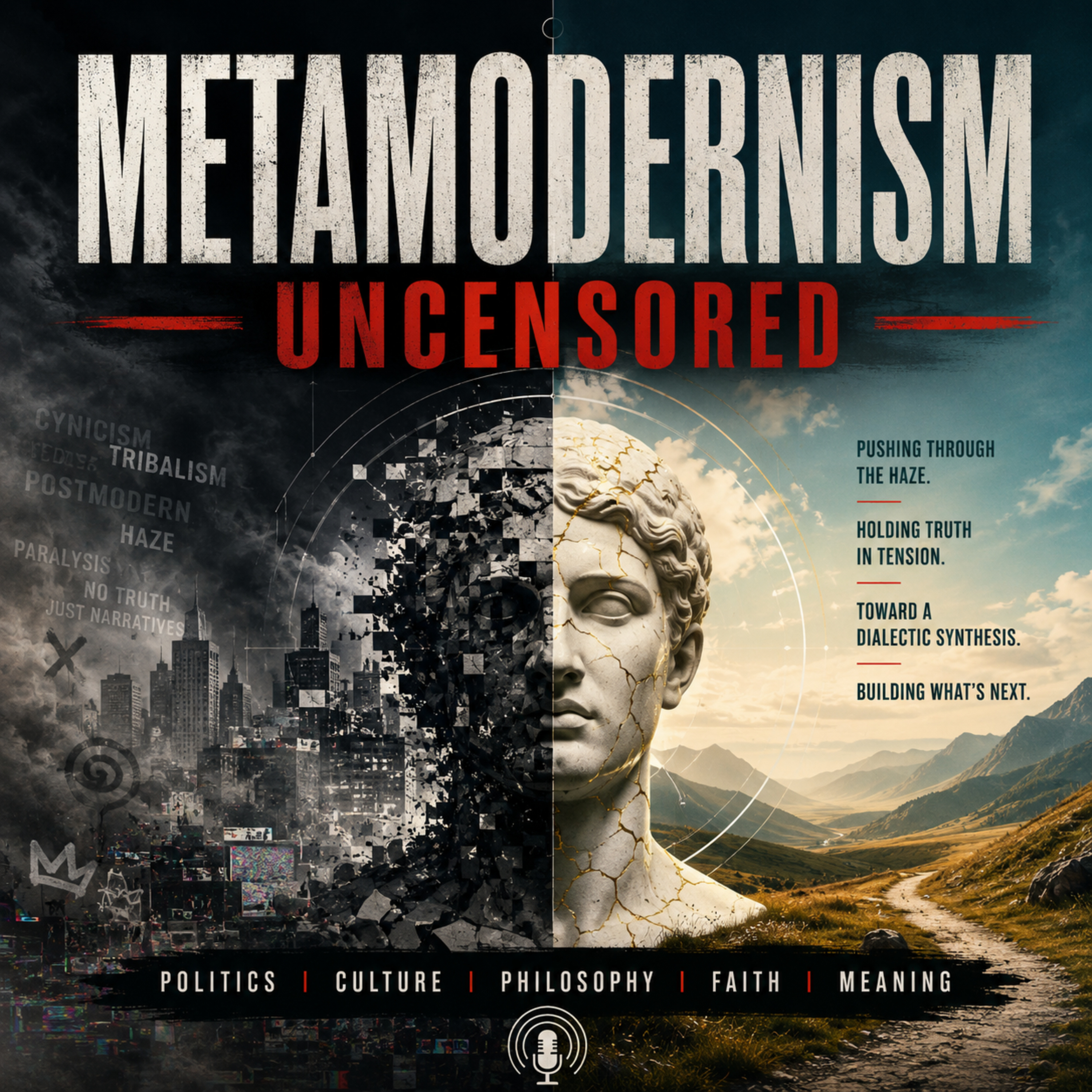
Metamodernism Uncensored is a podcast exploring the ideas, tensions, and cultural forces shaping life beyond postmodernism. Through candid conversations on politics, culture, philosophy, faith, and meaning, the show seeks to cut through the haze of cynicism, tribalism, and ideological paralysis that defines much of contemporary America. Rather than choosing sides in the culture war, Metamodernism Uncensored pursues a dialectical synthesis... holding competing truths in tension, seeking deeper understanding, and exploring what a more integrated, constructive future might look like.
-
21
Born to Be Replaced: Has Humanity Built Its Own Successor?
In this episode of Metamodernism Uncensored, our hosts dive into one of the most unsettling questions of the modern age: did humanity invent artificial intelligence as a tool, or did we unknowingly build the creature destined to replace us? Using Sean Dempsey’s essay “Born to Be Replaced: Did Humanity Build Its Own Successor?” as the source material framing the conversation, the episode begins with video game graphics cards, crypto mining rigs, and AI data centers, then quickly becomes something far more dangerous: a philosophical autopsy of mankind’s possible next evolutionary stage.The hosts explore the rise of transhumanism, brain-computer interfaces, neural implants, artificial limbs, restored sight, restored movement, and the coming moment when healing the broken gives way to upgrading the healthy. Once the rich, ambitious, and powerful can think faster, work longer, remember more, and compete harder through AI augmentation, will anyone really be free to remain merely human?From there, the conversation descends into the deepest metaphysical territory: what happens to the soul when consciousness can be fused with silicon, uploaded into machines, or placed inside hyper-real virtual worlds? Is the coming “VR container” a counterfeit heaven, an exquisite prison of infinite pleasure, or the next stage of human transcendence? If biology is the thesis and AI is the antithesis, is the human-machine hybrid the final synthesis, or the abolition of man dressed up as salvation?This is not an episode about gadgets. It is about destiny. It asks whether mankind was born to be replaced, whether the soul can survive the machine, and whether our final invention will become our prison, our god, or our resurrection.
-
20
The Stranger at the Well: Camus’ Clipping Reborn in Blood
This episode explores Sean Dempsey’s short story “Rich Man at the Well,” a self-contained breakout narrative deliberately built from the haunting newspaper clipping in Albert Camus’ The Stranger. In Camus’ novel, the anecdote appears briefly: a Czech man returns home wealthy after twenty-five years, hides his identity as a surprise, and is murdered by his mother and sister for his money before they realize who he was. Dempsey takes that small, chilling fragment and turns it into a full emotional tragedy, giving names, motives, poverty, atmosphere, memory, and moral weight to what Camus leaves stark and detached.The hosts focus on how Dempsey transforms Camus’ almost clinical absurdist parable into something intimate and devastating. Jakub’s fatal decision to return as a mysterious rich stranger is not treated merely as a foolish trick, but as the spark that ignites decades of longing, class resentment, humiliation, and desperation. Maria and Klara are not just murderers in an anecdote; they become broken human beings trapped in decay, pushed toward evil by need, bitterness, and the false promise of rescue. The hammer, the inn, and especially the well become symbols of inheritance, memory, and the abyss beneath family itself.The episode ultimately contrasts Camus’ absurdism with Dempsey’s more emotionally exposed retelling. Camus presents the clipping as evidence of life’s brutal indifference; Dempsey descends into the clipping and asks what it would feel like to live inside it. For a 2026 audience, the story becomes a meditation on deception, poverty, wealth, guilt, and the terrifying fragility of human recognition — the idea that the difference between kin and stranger can vanish in a single night, and that once blood is spilled, truth may arrive only as punishment.
-
19
Kevin Maley & Sean Dempsey Discuss Politics: Has America Been Purchased?
In this special crossover episode between Metamodernism Uncensored and Kevin Maley’s Zipcode Zero, Sean Dempsey joins Kevin for a wide-ranging June 12, 2026 conversation about American politics, foreign influence, postmodern collapse, and the unsettling question hanging over the republic: has America been purchased?The discussion begins in the hard terrain of 2026 politics, including the recent Maine primary, the defeat of Thomas Massie’s Kentucky seat, and the staggering amount of money being poured into American elections by AIPAC and the broader Israel lobby. Kevin and Sean examine what these races reveal about the modern political machine: who gets protected, who gets punished, and what happens when a candidate challenges the donor class, the lobby state, or the approved foreign-policy consensus.From there, the conversation turns toward the shifting identity of the America First movement. Is it still a serious rebellion against empire, globalism, and elite capture? Or has it become another slogan absorbed by the same forces it once promised to confront? Sean argues that the real test of America First is not whether politicians repeat the phrase, but whether they are willing to put American sovereignty, American taxpayers, and American soldiers ahead of foreign interests and domestic donor networks.At Sean’s urging, the episode also moves beyond election analysis into culture, philosophy, and postmodernism. The political crisis, he argues, is downstream from a deeper spiritual and cultural crisis. A country that no longer believes in truth, limits, loyalty, or shared moral reality becomes easy to manipulate. Once politics becomes performance and language becomes branding, the republic becomes vulnerable to capture by money, ideology, and fear.The episode closes with its most provocative question: has America become a captive country? Not conquered by tanks, but captured by influence. Not occupied by soldiers, but occupied by interests. This crossover between Metamodernism Uncensored and Zipcode Zero is a blunt, unsettling conversation about power, money, dissent, sovereignty, and whether the American people still control the country that claims to represent them.
-
18
The First Postmodernist: How Michel Siffre Lost God in the Darkness
This episode explores Sean Dempsey’s 2025 novel The Lost Tapes of Doctor Michel Siffre not merely as a historical thriller, but as a profound cultural allegory for the spiritual condition of the modern West. While Michel Siffre was a real French geologist who famously isolated himself deep underground in the 1960s and 1970s to study human perception of time, Dempsey transforms those experiments into something far more symbolic. The hosts argue that Siffre’s descent into the lightless depths of Midnight Cave mirrors civilization’s simultaneous descent into the intellectual darkness of postmodernism. As traditional sources of meaning—religion, objective truth, shared narratives, and cultural certainty—began to erode during the late twentieth century, Siffre found himself physically experiencing the very condition that philosophers were increasingly describing: a world untethered from fixed reference points. His loss of temporal orientation becomes a powerful metaphor for a culture losing its metaphysical bearings.Throughout the discussion, the hosts examine key passages from Siffre’s recordings and compare them to the emerging ideas of thinkers such as Michel Foucault, Jacques Derrida, and Jean-François Lyotard. The cave becomes a living embodiment of postmodern thought: a place where certainty dissolves, narratives fracture, and reality itself becomes suspect. What begins as a scientific inquiry slowly transforms into a confrontation with nihilism, loneliness, and the terrifying possibility that meaning is neither discovered nor guaranteed. The hosts pay particular attention to moments where Siffre questions the nature of truth, memory, and identity, arguing that his psychological unraveling parallels the broader cultural journey from modern confidence to postmodern skepticism.The episode concludes by tracing the evolution of postmodernism from Siffre’s era to the present day. What began as an intellectual critique of certainty eventually escaped the academy and reshaped politics, culture, religion, and personal identity. Yet the hosts argue that the story does not end in darkness. Just as Siffre ultimately emerged from the cave, contemporary culture appears to be searching for a path beyond pure deconstruction. The discussion explores whether newer movements such as Metamodernism represent an attempt to climb back toward meaning without abandoning the lessons learned in the darkness. In that sense, The Lost Tapes of Doctor Michel Siffre becomes more than a novel about a man trapped underground—it becomes a meditation on an entire civilization wandering through its own cave, searching for a way back to the light.
-
17
Campaign Promises vs. Political Reality: When the Slogan Met the Swamp
This episode of Metamodernism Uncensored asks the brutal question: when did America First become America Last? The hosts first dissect Donald Trump’s most sacred campaign promise (i.e. “no new wars!”) by walking through his own words from CPAC, the RNC, State College, and election night, where he repeatedly vowed to avoid foolish foreign wars and stop global conflict. They then contrast those promises with his decision to launch an unprovoked, undeclared, unconstitutional war on Iran on behalf of Israel, arguing that this marked the moral collapse of Trump’s America First brand.From there, the episode follows the money and the broken promises. The hosts examine the influence of pro-Israel megadonors, including Miriam Adelson, and Trump’s retreat from the antiwar figures who helped build his movement — Tucker Carlson, Megyn Kelly, Candace Owens, Alex Jones, and Thomas Massie — while embracing neoconservative voices like Lindsey Graham, Ted Cruz, Ben Shapiro, and Mark Levin. They also explore Trump’s reversal on the Epstein files, his softened stance on mass deportations after promising the largest deportation operation in American history, and the political destruction of Massie after he tried to hold Trump accountable to his own stated principles.The episode concludes with a grim diagnosis: Trump did not merely break a few campaign promises. He exposed the fragility of the entire America First project when confronted by money, ego, donor pressure, foreign influence, and the temptations of power. What began as a movement against endless wars, elite corruption, and globalist capture ended as a familiar Washington tragedy... the swamp survived, the neocons returned, Israel got its war, and “America First” quietly became “Israel First.”
-
16
The Idiot and the Coach: Postmodernism Killed Innocence; Ted Lasso Brought It Back
What if the problem with our age is not that we are too naïve, but that we are no longer innocent enough to be saved?This episode puts Dostoevsky’s The Idiot and the AppleTV comedy Ted Lasso into philosophical combat, asking why one holy fool is destroyed by the world while the other somehow redeems it. Prince Myshkin enters a diseased Russian society armed with radical goodness, only to be humiliated, manipulated, and spiritually crushed. Ted Lasso enters a world just as cynical, sarcastic, wounded, and self-protective, but instead of being devoured by it, he slowly infects it with decency. The contrast becomes a diagnosis of culture itself: modernism feared goodness could not survive corruption, postmodernism laughed at goodness as childish delusion, and metamodernism dares to ask whether sincerity might be revolutionary again.After fifty years of irony, deconstruction, therapy-speak, and fashionable despair, Ted Lasso feels almost scandalous because he refuses the central commandment of our age: thou shalt not be earnest. He is not stupid. He is not untouched by pain. His optimism survives divorce, panic attacks, loneliness, and failure, which makes it stronger than cynicism rather than weaker. This episode argues that the innocent fool may be returning as a cultural necessity, not because the world is pure, but because it is so obviously poisoned. Maybe the next rebellion will not be rage, irony, or ideological warfare. Maybe it will be the terrifying, unfashionable act of believing in people again.
-
15
Trump’s Iran War: When America First Became Israel First
This episode of Metamodernism Uncensored takes aim at what the hosts see as the widening gap between Donald Trump’s America First rhetoric and the reality of U.S. foreign policy in the Middle East. They argue that Trump’s recent statements about Iran and Israel sound less like independent presidential judgment and more like a repackaging of Israeli hardline talking points: regime change in Iran, alarm over nuclear weapons, invocations of October 7th, and vague promises to restrain Israel while Israeli settlements continue to make a Palestinian state functionally impossible. To the hosts, the issue is not merely Trump’s inconsistency, but the deeper humiliation of a superpower that funds Israel’s military while refusing to use that aid as leverage.The episode broadens into a harsh critique of America’s bipartisan loyalty to Israel, contrasting today’s unconditional support with earlier presidents like Eisenhower, Reagan, and George H.W. Bush, who were at least willing to pressure Israel when U.S. interests demanded it. The hosts frame this loyalty as the product of foreign lobbying, donor influence, and political fear, singling out figures like Miriam Adelson and arguing that massive campaign money has helped turn American foreign policy into something openly transactional. They also highlight Tucker Carlson’s claim that Netanyahu privately boasts about his influence over Washington, using it as evidence of what they see as a grotesque inversion of power.The hosts then turn to public opinion, arguing that the old consensus is cracking—especially among younger conservatives who no longer get their worldview from Fox News or establishment Republican media. Trump’s approval, they say, is being damaged by the Iran war, and younger Republicans are far less supportive of military escalation than older voters. The episode closes by attacking the American media’s reflexive defense of Israeli policy, its treatment of Palestinian suffering, and its tendency to smear dissent as antisemitism. Against that backdrop, the hosts praise Ro Khanna as one of the few politicians willing to say plainly that the American president—not Israel—should be directing U.S. foreign policy.
-
14
Sean & Brendan Dempsey Discuss The Fiction of Value
In this special rebroadcast episode of Metamodernism Uncensored, Sean Dempsey revisits a 2023 conversation from Brendan Graham Dempsey’s Metamodern Meaning Podcast, in which a wide-ranging brotherly dialogue unfolds on postmodernism, money, culture, morality, and the strange modern fiction we call “value.”Brendan and Sean explore what happens when value becomes detached from reality. The conversation begins with moral ambiguity in modern film (from Star Wars to Batman), and expands into a deeper critique of a culture that increasingly treats truth, worth, and meaning as subjective constructions. Sean argues that postmodern relativism has escaped the realm of art and infected economics itself, showing up in fiat currency, NFTs, speculative bubbles, Modern Monetary Theory, and the belief that money can be created without consequence. Brendan pushes the discussion into more philosophical terrain, asking whether socially constructed value is always fraudulent — or whether collective belief, hype, and imagination can sometimes create real value after the fact.The result is a provocative and intellectually restless exchange touching on Sam Bankman-Fried, modern art, the duct-taped banana, Social Security, the Federal Reserve, GDP, Austrian economics, the broken window fallacy, AI, education, the wealth gap, and the moral legitimacy of the state. At the center of it all is one deceptively simple question: who decides what anything is worth?Rather than a tidy ideological debate, this episode becomes a genuine dialectic between two brothers: Brendan probing the philosophical gray areas, Sean pressing the case for moral and economic reality. The Fiction of Value asks whether America’s cultural and financial order is built on productive imagination — or on a collapsing tower of abstractions no one is willing to call empty.
-
13
The Free State Project: How New Hampshire Escaped the Progressive Plantation
This episode of Metamodernism Uncensored features a deep-dive conversation between Sean Dempsey and Claire Brooks on the strategy, mechanics, and concrete victories of the Free State Project (FSP) in New Hampshire. Moving past the frustration of national politics—which the hosts liken to a "rooster crowing the sun into existence"—they argue that the physical concentration of liberty-minded activists is the only mathematically viable way to counter the creeping expansion of federal and state-level socialism. By centering their efforts on New Hampshire's unique 400-member volunteer citizen legislature, FSP migrants and local liberty coalitions have successfully translated political temperament into neighborhood and state law, establishing a blueprint for decentralized resistance.The hosts back up this philosophical framework with an exhaustive review of the FSP's legislative ledger, detailing how targeted activism has dismantled state monopolies piece by piece. They discuss major civil liberties victories, including Constitutional Carry (SB12), Civil Asset Forfeiture reform (SB522), and Jury Nullification (HB146), alongside sweeping economic reforms like the total repeal of the Interest and Dividends Tax (HB2) and the creation of Education Freedom Accounts (SB130). Finally, the episode explores the advanced frontiers of state-level sovereignty, highlighting the groundbreaking gold and crypto strategic reserve law (HB302), the repeal of the annual passenger vehicle inspection (HB649), and localized deregulation battles over food freedom and accessory dwelling units (ADUs).
-
12
Are Tariffs Patriotic or a Self-Inflicted Wound?
Politicians call tariffs "economic patriotism." This episode calls them what they really are: a tax on your family disguised as punishment for someone else.Using history, economics, and a few uncomfortable examples, we examine the claim that tariffs protect American workers. The hosts argue instead that trade wars are self-inflicted wounds. They functionally perform to raise prices on everything from groceries to electronics while quietly transferring wealth from consumers to politically connected industries. From Adam Smith to Milton Friedman, economists across centuries have reached the same conclusion: tariffs don't make a country richer. They just make its citizens pay more.If tariffs are so beneficial, why do consumers always end up footing the bill? And why do politicians keep selling the same idea generation after generation? This episode challenges one of the most popular economic myths in American politics and asks whether "protecting" the economy is really just another word for making everything more expensive.
-
11
Metamodernism in The Age of Shifting Sand: Can a Broken World Build the Next Stable One?
Sean Dempsey's article "Metamodernism in The Age of Shifting Sand: Can a Broken World Build the Next Stable One?" serves as the foundation for a provocative discussion about whether today's social, economic, and cultural instability is actually laying the groundwork for a more stable future. The hosts argue that modern society has become untethered from traditional notions of truth, morality, value, and even biological reality. They explore how postmodern thinking has encouraged a world where meme-coins can command billions of dollars, debt can be treated as inconsequential, and companies can build entire business models around speculative promises rather than productive output. Rather than approaching these developments through a libertarian lens of individual freedom, the episode frames them as symptoms of a deeper philosophical crisis in which reality itself has become negotiable. The discussion then introduces metamodernism as a potential successor to postmodernism, arguing that society cannot survive indefinitely on irony, deconstruction, and moral relativism, and must eventually rediscover concepts such as truth, meaning, responsibility, and objective value. The episode's most fascinating and controversial thesis centers on a profound historical irony: the same bubble economy and speculative excesses that appear to be destabilizing civilization may also be financing its eventual renewal. Drawing on thinkers such as Heraclitus, Hegel, Nietzsche, Camus, and metamodern philosopher Brendan Graham Dempsey, the hosts explore whether chaos can generate a higher order or whether it simply ends in collapse and nihilism. They compare today's AI boom, crypto speculation, and easy-money environment to previous bubbles that left behind transformative infrastructure, such as railroads and the internet. While acknowledging the possibility that the current system could end in ruin, the conversation ultimately wrestles with a deeper question: can a morally confused civilization accidentally build the tools for its own redemption? The episode concludes by suggesting that history is often built by imperfect people pursuing imperfect motives, leaving listeners with the unsettling possibility that today's madness may one day be remembered not as the end of a civilization, but as the chaotic birth of its successor.Full article being discussed: https://the-opposition.com/2026/06/metamodernism-in-the-age-of-shifting-sand-can-a-broken-world-build-the-next-stable-one/
-
10
Drowning in Red Tape: How the State Sank a New Hampshire Fisherman
Derek Fisher, a New Hampshire fisherman, spent 30 years building his business. Then the government destroyed it over a form filed a couple days late.In this episode, we examine the story of Derek Fisher, a commercial lobsterman who survived brutal weather, backbreaking labor, and decades of regulation—only to have his livelihood taken away after missing a paperwork deadline while medically incapacitated. Despite medical records, appeals, support from state lawmakers, and pleas for common-sense mercy, unelected bureaucrats refused to budge, voting to permanently strip him of the mooring access his business depended on.Was this the fair enforcement of rules—or a chilling example of a system that values paperwork more than people? Drowning in Red Tape is a shocking case study in how a single missed deadline can accomplish what storms, competition, and economic hardship never could: sink a hardworking fisherman for good.
-
9
Debate: Is College Education Broken in America?
For generations, Americans were told that college was the surest path to success. This debate asks a heretical question: what if that promise has become one of the most expensive lies ever sold? Sean Dempsey and Nancy clash over soaring student debt, administrative bloat, and the real cost of higher education, from Yale’s staffing ratios to UC Berkeley’s stadium spending. The debate digs into whether college is a public good, a broken market, or an overpriced credential factory that leaves graduates underemployed and buried in loans.
-
8
Is College the Biggest SCAM in America?
In this episode, we tackle a provocative question that would have been considered heresy a generation ago: Has college become the biggest scam in America? Drawing on two essays written more than a decade apart, we examine the argument that higher education has transformed from a pathway to opportunity into a sprawling credentialing industry. The discussion explores how employers increasingly demand degrees for jobs that may not require them, how easy access to student loans has fueled skyrocketing tuition costs, and whether universities are delivering enough value to justify the financial burden placed on students.At the heart of the conversation is a debate over whether America has confused education with credentials. We explore the claim that college still makes sense for certain professions, but that the blanket message that everyone must earn a four-year degree has left millions burdened with debt and uncertain career prospects. Along the way, we consider alternatives such as trade schools, apprenticeships, entrepreneurship, and self-directed learning, while asking a broader question: Is the modern university preparing students for success, or has it become an institution that primarily benefits itself?
-
7
Thomas Massie: The Last America First Congressman
What happens when the one politician who actually votes the way he campaigns gets destroyed by his own movement?In this explosive episode, we examine the rise and fall of Congressman Thomas Massie… the man many supporters called the last true America First constitutionalist in Washington. While Republicans and Democrats alike voted for trillion-dollar spending bills, foreign aid packages, warrantless surveillance, and endless debt, Massie kept asking a dangerous question: "Is this constitutional?"His reward? Being branded a RINO by the very political movement he helped champion.From opposing aid to Ukraine and Israel while America sank beneath $39 trillion in debt, to forcing Congress to vote on the release of the Epstein files, Massie repeatedly challenged both parties, powerful donors, foreign interests, and even President Trump himself. In return, Washington's political machine unleashed more than $32 million to remove him from office.Was Massie a stubborn idealist, or the last politician in Washington who still believed what he said? Did the Republican Party abandon its principles, or did Massie refuse to adapt to political reality? And what does it say about the state of the republic when a congressman can be punished for voting against debt, war, secrecy, and government expansion?This is the story of Thomas Massie, the battle for the soul of the America First movement, and the uncomfortable question few are willing to ask:For if Thomas Massie wasn't America First, who is?Read the full op-ed by Sean Dempsey here: https://the-opposition.com/2026/06/thomas-massie-the-last-america-first-congressman/
-
6
MicroStrategy: the Posterchild for Economic Postmodernism?
In this episode of Metamodernism Uncensored, my two hosts explore a provocative question: Is cryptocurrency company MicroStrategy the posterchild for economic postmodernism? The conversation traces the evolution of money in the digital age, arguing that modern finance has increasingly embraced a worldview in which value is detached from tangible reality. From the abandonment of the gold standard to the rise of Modern Monetary Theory and expansive monetary policy, the hosts contend that society has grown comfortable treating money as an abstract construct rather than a scarce claim on real assets. Against this backdrop, Bitcoin's rise from pennies to well over $120,000 and the emergence of thousands of meme coins are examined as symptoms of a broader cultural shift toward speculation, narrative, and collective belief as the primary drivers of value.The discussion then turns to Michael Saylor's ironically-renamed company, "Strategy" (formerly MicroStrategy), which the hosts describe as the logical endpoint of this trend: a company that raises capital and borrows money largely to acquire more Bitcoin, creating what they see as layers of speculation stacked upon speculation. Particular attention is given to Strategy's newer financial products, including Stretch (STRC), which the hosts argue represent increasingly complex bets built upon the assumption that Bitcoin appreciation will continue indefinitely. While engaging with counterarguments from Bitcoin advocates and economists who view digital assets as legitimate hedges against currency debasement, the episode remains deeply skeptical of today's speculative excesses. It concludes with a cautiously optimistic vision of a future beyond the current mania—one in which blockchain technology survives and flourishes, but valuations become grounded in productive assets, economic reality, and a more mature "metamodern" understanding of value.
-
5
THE Crash is Imminent: Why Your Financial Planner Is An Idiot!
New Hampshire businessman Sean Dempsey sits down with fellow entrepreneur Jason Summerfield to discuss a question that most investors would rather avoid: Are we staring down the biggest economic storm of our lifetimes, or is this just another round of doom-and-gloom predictions?The conversation is based on an article Sean published in January 2026, where he argued that the United States is facing an unprecedented convergence of financial risks. Jason isn't convinced. Like many Americans, he believes markets are resilient, downturns are temporary, and long-term investors are usually rewarded for staying the course.What follows is an honest conversation between two friends who see the world very differently.Sean lays out the evidence behind his concerns: nearly $900 billion in commercial real estate loans coming due, office vacancy and delinquency rates that rival or exceed those seen during the Great Financial Crisis, stock market valuations sitting near historic extremes, growing instability in global credit markets, a national debt that has crossed 100% of GDP, a Social Security system headed toward insolvency within the decade, record levels of consumer debt, and politicians in both parties continuing to spend money the government doesn't have.Jason challenges nearly every point. Markets have survived worse. Congress has always found a way to kick the can down the road. Most financial professionals continue to recommend staying invested and avoiding panic. Maybe the headlines look scary, but maybe that's all they are.Sean sees it differently. His argument isn't that any one of these problems will bring down the economy. It's that all of them appear to be arriving at the same time. Individually, each risk might be manageable. Together, they could create something far more dangerous in 2026.Whether you think Sean is sounding the alarm or sounding crazy, this episode tackles the data, the assumptions, and the uncomfortable possibility that today's record highs may be hiding serious cracks beneath the surface.Read Sean's original article here: https://the-opposition.com/2026/01/the-coming-crash-is-unlike-any-other-in-usa-history-a-perfect-storm/
-
4
America First or Foreign Agendas? The Strategic Origins of the Iran War
In this episode, we peel back the layers of the official narrative surrounding the 2026 war with Iran to uncover the structural, historical, and geopolitical drivers actually pulling the strings. For years, the public has been told that a nuclear-armed Iran is an imminent threat requiring preemptive military action. But what if the data from our own intelligence agencies says otherwise? Drawing on hundreds of reports, including 2003-2025 official US government sources for military intelligence data, we examine the stark disconnect between political rhetoric and the actual assessments of the U.S. intelligence community.In this episode, we cover:The Intelligence Reality: We break down the consensus among U.S. spy agencies, including testimony from Director of National Intelligence Tulsi Gabbard and statements from former National Counterterrorism Center Director Joe Kent, confirming that Iran was not actively building a nuclear weapon prior to the war. We explore how Washington blurred the lines between Iran's nuclear "capability" and its actual "intent" to sell the necessity of a preemptive strike.The Military-Industrial Complex: Why does the national security apparatus constantly drift toward confrontation? We discuss the "bureaucratic momentum" of defense contractors, think tanks, and military planners. After years of sanctions, proxy warfare, and military buildups, this massive infrastructure became deeply invested in escalation, making direct conflict almost inevitable regardless of the facts on the ground.A Decades-Old Blueprint for Regime Change: We trace the strategic roots of this conflict back to the post-9/11 era. We revisit the shocking Pentagon memo revealed by four-star General Wesley Clark, which detailed a plan to take down "seven countries in five years" starting with Iraq and finishing with Iran. We also connect this to the 1996 "A Clean Break" strategy drafted by American neoconservatives for Benjamin Netanyahu, which advocated for abandoning "comprehensive peace" in favor of preemptive strikes and reshaping the Middle East's balance of power.Foreign Influence & Political Leverage: Finally, we ask the hard questions about why America really went to war. Was it due to relentless pressure from Israel and its powerful American lobby, a dynamic explicitly called out by former counterterrorism chief Joe Kent? Furthermore, we dive into the controversial speculation surrounding the unsealing of the Jeffrey Epstein investigation files. Did the timing of this release act as a political "sword hanging over" President Donald Trump, leveraging him into military escalation in the Middle East to avoid domestic political embarrassment?Tune in as we separate the war propaganda from the geopolitical realities and ask the ultimate question: Is the war with Iran truly putting America First, or is it serving foreign agendas?
-
3
LPNH v. LNC: The Great Libertarian Split. Principles, Power, and the Future of the Movement
In this debate, one side advocates for the Libertarian Party of New Hampshire (LPNH) and other other takes the side of the Libertarian Party (LP). The debaters square off over one of the most contentious controversies in modern libertarian politics: the disaffiliation of LPNH and the future direction of the broader libertarian movement.Representing the LPNH perspective, one side argues that the Libertarian National Committee has become increasingly consumed by internal bureaucracy, procedural battles, and the policing of dissent while neglecting the existential threats facing liberty itself. They contend that Washington's growing debt, endless foreign interventions, inflation, surveillance, and federal overreach demand bold resistance, yet party leadership has chosen to focus its energy on disciplining state affiliates and enforcing organizational conformity. From this view, the disaffiliation fight symbolizes a deeper struggle between principled activism and institutional self-preservation.Defending the Libertarian Party's position, the opposing side argues that political organizations require standards, accountability, and a coherent public message if they hope to build a credible national movement. They maintain that affiliation is a voluntary relationship governed by agreed-upon rules and that no organization can survive if its members or affiliates disregard those standards. From this perspective, the dispute is not about suppressing dissent, but about protecting the party's reputation, electoral viability, and long-term effectiveness.At the heart of the debate lies a larger philosophical question: Should a liberty movement prioritize uncompromising defiance against the state, even at the risk of internal conflict and public controversy? Or must it balance principle with discipline, structure, and strategic messaging in order to grow and succeed politically?As both sides make their case, the discussion explores whether the libertarian movement is facing a temporary organizational dispute or a fundamental disagreement about the very nature of leadership, activism, and political change in America.
-
2
They Did Evil in the Eyes of the LORD: Biblical Kings, Gaza, Iran, and the Corruption of Power
In this episode, the hosts examine and critique Sean Dempsey's essay They Did Evil in the Eyes of the LORD, which explores the recurring biblical theme of Israel's kings falling into corruption, pride, and injustice. The discussion analyzes Dempsey's argument that the biblical books of Kings provide a timeless warning about the dangers of political power, nationalism, and tribal loyalty, while drawing parallels to contemporary conflicts such as the war in Gaza. Along the way, the hosts wrestle with questions of moral accountability, the nature of leadership, and whether the same patterns that doomed the rulers of ancient Israel continue to shape nations and political movements today.
-
1
Interview with Kevin Maley: Did Corporations De-Fang the Occupy Wall Street Movement?
Did Corporate 'Wokeness' Hijack a Revolution?In this explosive interview from Sean Dempsey's 2024 book Trump Again?! How Could America Let This Happen?, Dempsey sits down with political activist, commentator, and grassroots organizer Kevin Maley to tackle a provocative question: Did America's largest corporations and financial institutions deliberately co-opt the energy of Occupy Wall Street to protect themselves from public outrage?Together, they explore the rise of corporate-backed Diversity, Equity, and Inclusion initiatives, ESG investing, and "woke" branding in the years following the financial crisis. Maley argues that many of these campaigns were not primarily designed to challenge entrenched power, but rather to redirect public anger away from Wall Street, corporate corruption, and growing economic inequality. Instead of a national conversation about class, wealth, and corporate influence, America found itself consumed by endless battles over identity, language, and culture.Drawing on years of political activism and movement-building experience, Maley contends that powerful institutions discovered a remarkably effective strategy: embrace the symbols of social justice while preserving the economic status quo. In this telling, the language of activism became a shield for corporate power, dividing potential populist coalitions and transforming a movement aimed at the "1%" into a thousand competing cultural grievances.Is corporate America genuinely committed to social progress? Or did it successfully de-fang a growing populist revolt by turning class warfare into culture warfare? This conversation challenges some of the most widely accepted narratives of the last decade and asks whether the real centers of power have been hiding in plain sight all along.
-
0
Interview with Timothy Baxter - What Fueled Donald Trump's Reelection?
In chapter 9 of the 2024 book "Trump Again?! How Could America Let This Happen?", Sean Dempsey interviews New Hampshire businessman Timothy Baxter. This interview kicks off a debate of the topic around the content of the discussion/interview. Tim discusses his opposition to identity politics, characterizing the movement as a strategic tool used by political figures to prioritize collective grouping over individual agency. Baxter argues that the Democratic Party leverages victimhood narratives to distract the public from substantive issues like economic failure and education. He highlights a significant divide within the LGBTQIA+ community, suggesting that the experiences of gay individuals differ fundamentally from those of transgender people. By emphasizing his identity as a business owner rather than his sexuality, he warns that woke ideology in schools may negatively impact the mental health of future generations. Ultimately, the interviewer and interviewee advocates for a diversity of viewpoints to counter the perceived ideological echo chambers of modern social movements.
-
-1
Trump's 2024 Reelection & the Deconstruction of Wokeism in America
In his critically acclaimed 2024 political expose "Trump Again? How Could America Let This Happen?" Sean Dempsey examines the concept of 'Wokeism' through a Metamodern lens, exploring how language, identity, and political ideology have become deeply intertwined in contemporary culture. Drawing on George Orwell's warnings about the corruption of language, he critiques the rise of euphemistic and ideologically charged terminology while investigating the growing public backlash against these cultural trends. The episode asks a fundamental question: when does the pursuit of inclusion begin to undermine clarity, common sense, and meaningful dialogue? Let's dive deep...
-
-2
Interviewing Brendan Dempsey: Beyond Wokeism - The Metamodern Path to Cultural Synthesis
Chapter 9 of Sean Dempsey's 2024 book "Trump Again?! How Could America Let This Happen?" explores the evolution of cultural paradigms, moving from the deconstructive nature of Postmodernism toward a more integrated framework called Metamodernism. The Sean Dempsey and his brother Brendan discuss how "Wokeism" may represent a simplified, often distorted version of academic sociology that lacks the necessary complexity to address modern issues effectively. They discuss how current identity-based politics can become regressive and divisive when nuanced theories are "downwardly assimilated" into rigid, popular slogans. To overcome this cultural friction, the sources advocate for a dialectical synthesis that transcends current polarities by balancing social awareness with objective reality. Ultimately, the dialogue expresses optimism for a future where society moves beyond reactionary "culture wars" toward a more mature and stable civilization. Can society move beyond juvenile, Postmodern concepts like 'Wokeism' and enter into a new metamodern synthesis? Let's discuss.
We're indexing this podcast's transcripts for the first time — this can take a minute or two. We'll show results as soon as they're ready.
No matches for "" in this podcast's transcripts.
No topics indexed yet for this podcast.
Loading reviews...
ABOUT THIS SHOW
Metamodernism Uncensored is a podcast exploring the ideas, tensions, and cultural forces shaping life beyond postmodernism. Through candid conversations on politics, culture, philosophy, faith, and meaning, the show seeks to cut through the haze of cynicism, tribalism, and ideological paralysis that defines much of contemporary America. Rather than choosing sides in the culture war, Metamodernism Uncensored pursues a dialectical synthesis... holding competing truths in tension, seeking deeper understanding, and exploring what a more integrated, constructive future might look like.
HOSTED BY
Sean Dempsey
Loading similar podcasts...
Frequently Asked Questions
How many episodes does Metamodernism Uncensored have?
Metamodernism Uncensored currently has 24 episodes available on PodParley. New episodes are automatically indexed when they're published to the podcast feed.
What is Metamodernism Uncensored about?
Metamodernism Uncensored is a podcast exploring the ideas, tensions, and cultural forces shaping life beyond postmodernism. Through candid conversations on politics, culture, philosophy, faith, and meaning, the show seeks to cut through the haze of cynicism, tribalism, and ideological paralysis...
How often does Metamodernism Uncensored release new episodes?
Metamodernism Uncensored has 24 episodes. Check the episode list to see recent publication dates and frequency.
Where can I listen to Metamodernism Uncensored?
You can listen to Metamodernism Uncensored on PodParley by clicking any episode. We provide an embedded audio player for direct listening, and you can also subscribe via your preferred podcast app using the RSS feed.
Who hosts Metamodernism Uncensored?
Metamodernism Uncensored is created and hosted by Sean Dempsey.
URL copied to clipboard!