
EPISODE · Jun 6, 2026 · 41 MIN
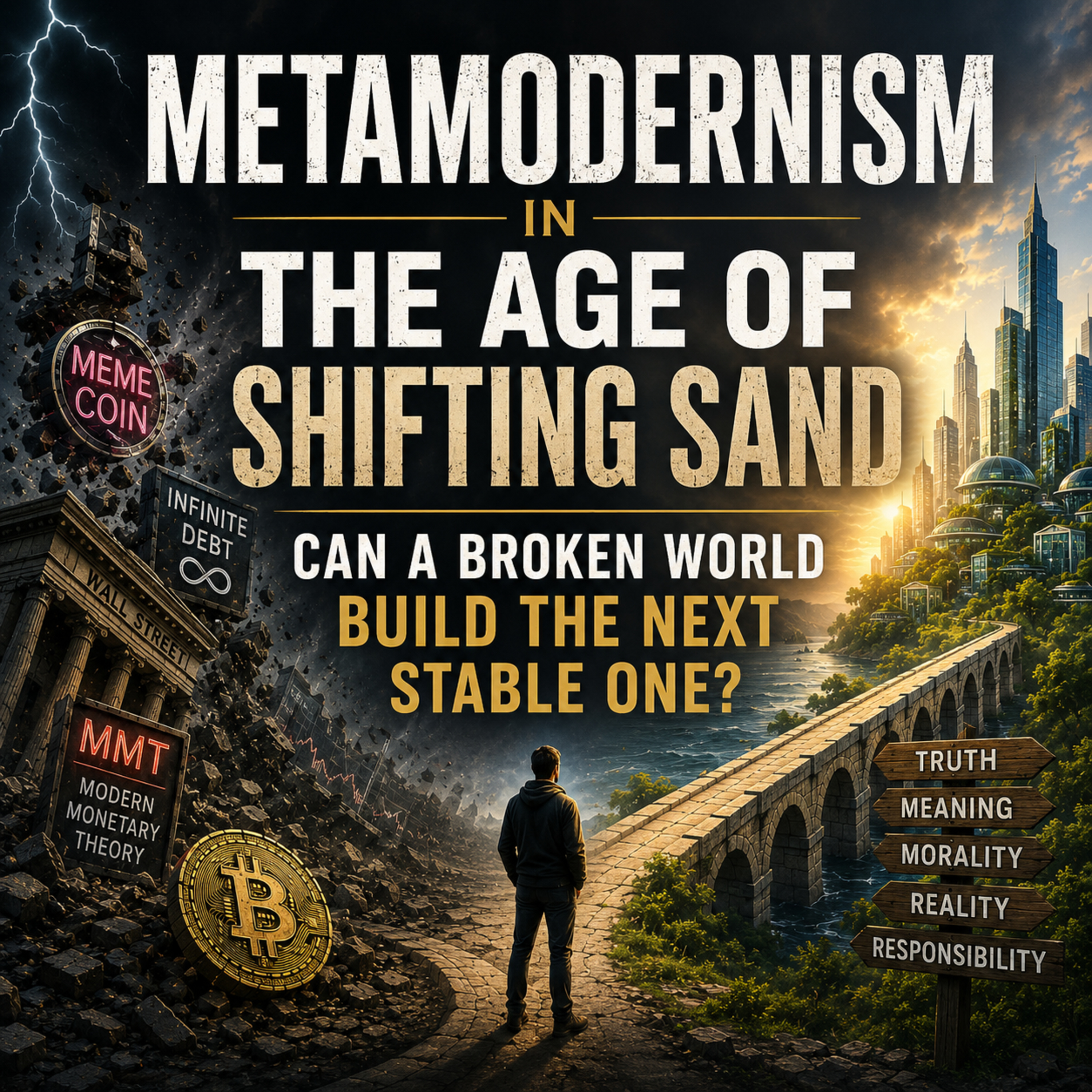
Metamodernism in The Age of Shifting Sand: Can a Broken World Build the Next Stable One?
from Metamodernism Uncensored · host Sean Dempsey
Sean Dempsey's article "Metamodernism in The Age of Shifting Sand: Can a Broken World Build the Next Stable One?" serves as the foundation for a provocative discussion about whether today's social, economic, and cultural instability is actually laying the groundwork for a more stable future. The hosts argue that modern society has become untethered from traditional notions of truth, morality, value, and even biological reality. They explore how postmodern thinking has encouraged a world where meme-coins can command billions of dollars, debt can be treated as inconsequential, and companies can build entire business models around speculative promises rather than productive output. Rather than approaching these developments through a libertarian lens of individual freedom, the episode frames them as symptoms of a deeper philosophical crisis in which reality itself has become negotiable. The discussion then introduces metamodernism as a potential successor to postmodernism, arguing that society cannot survive indefinitely on irony, deconstruction, and moral relativism, and must eventually rediscover concepts such as truth, meaning, responsibility, and objective value. The episode's most fascinating and controversial thesis centers on a profound historical irony: the same bubble economy and speculative excesses that appear to be destabilizing civilization may also be financing its eventual renewal. Drawing on thinkers such as Heraclitus, Hegel, Nietzsche, Camus, and metamodern philosopher Brendan Graham Dempsey, the hosts explore whether chaos can generate a higher order or whether it simply ends in collapse and nihilism. They compare today's AI boom, crypto speculation, and easy-money environment to previous bubbles that left behind transformative infrastructure, such as railroads and the internet. While acknowledging the possibility that the current system could end in ruin, the conversation ultimately wrestles with a deeper question: can a morally confused civilization accidentally build the tools for its own redemption? The episode concludes by suggesting that history is often built by imperfect people pursuing imperfect motives, leaving listeners with the unsettling possibility that today's madness may one day be remembered not as the end of a civilization, but as the chaotic birth of its successor.Full article being discussed: https://the-opposition.com/2026/06/metamodernism-in-the-age-of-shifting-sand-can-a-broken-world-build-the-next-stable-one/
Embed this episode
NOW PLAYING
Metamodernism in The Age of Shifting Sand: Can a Broken World Build the Next Stable One?
No transcript for this episode yet
Similar Episodes
No similar episodes found.