
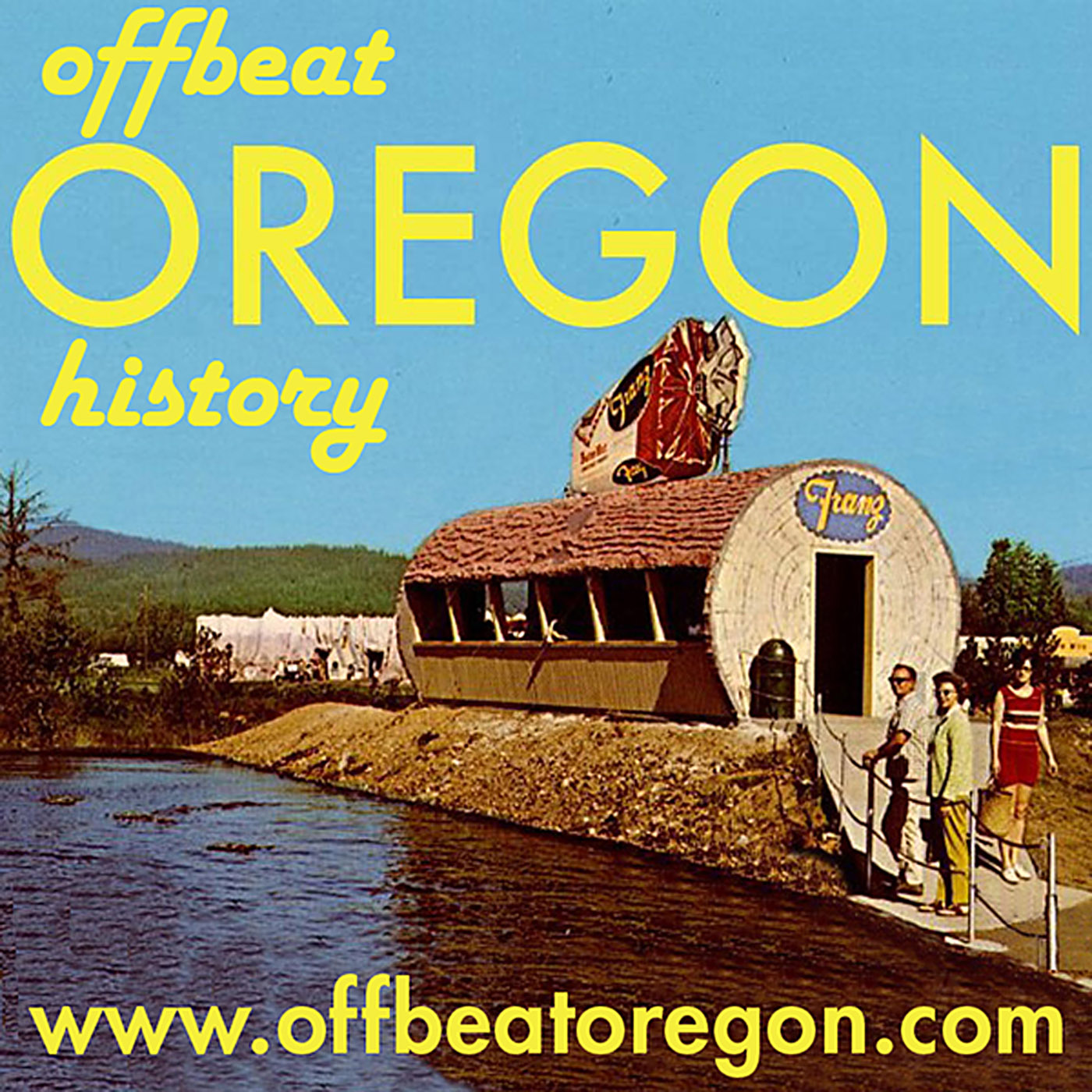
PODCAST · history
Offbeat Oregon History podcast
by www.offbeatoregon.com (finn @ offbeatoregon.com)
The Offbeat Oregon History Podcast is a daily service from the Offbeat Oregon History newspaper column. Each weekday morning, a strange-but-true story from Oregon's history from the archives of the column is uploaded. An exploding whale, a few shockingly scary cults, a 19th-century serial killer, several very naughty ladies, a handful of solid-brass con artists and some of the dumbest bad guys in the history of the universe. Source citations are included with the text version on the Web site at https://offbeatoregon.com.
-
183
Japanese shipwrecks on coast predate Columbus
The case of John Ottoson (ne Otokichi) in 1832 illustrates what can happen: Blown off to sea by a gale, he and his comrades rode the Kuroshio Current to Washington State — much to the astonishment of Dr. John McLoughlin. (Oregon Coast; 1830s) (For text and pictures, see https://offbeatoregon.com/1404d.japanese-junks-blown-across-to-oregon.html)
-
182
‘Automo-bubble’ a part of Deschutes railroad war
Upon his arrival in The Dalles in 1909 in quest of a job on the railroad, 19-year-old Jim Morrell was met by a friend — probably the one who’d told him there was work to be had. Morrell’s friend staked him to a meal and a flophouse bunk, and the next day he wasted no time in seeking out J.D. Porter, who with his brother Johnson Porter ran the construction company that had the Northern Pacific (James J. Hill) contract. Porter’s first question after Morrell introduced himself was straight and to the point: “Do you know how to skin a bubble?” he asked. (The Dalles, Wasco County; 1900s, 1910s) (For text and pictures, see https://offbeatoregon.com/23-11.automo-bubbling-in-a-railroad-war-627.html)
-
181
Gun-toting ‘Wildcat’ was nation’s first ‘shock jock’
Robert Gordon Duncan was the first radio broadcaster ever to be sent to prison for cursing on the air. For the first six months of 1930, the entire city was riveted to his radio show, wondering who he'd slander next. (Portland, Multnomah County; 1930s) (For text and pictures, see https://offbeatoregon.com/1301b-oregon-wildcat-was-early-shock-jock.html)
-
180
Portland’s Pioneer Square pitched as ‘crystal palace’
Mayor Frank Ivancie, Pioneer Courthouse Square’s most intransigent opponent, gleefully declared the project “dead” in a 1982 speech. In doing so, he accidentally galvanized the citizen group that would prove him wrong. (Portland, Multnomah County; 1960s, 1970s) (For text and pictures, see https://offbeatoregon.com/1405c.pioneer-courthouse-square.html)
-
179
Mountain town of Bourne was home of a magnificent swindle
Though home to some productive mines, the Blue Mountain boomtown made much of its money working the suckers back east; then its head honcho disappeared into the night with the money, hours ahead of the law. (For text and pictures, see https://offbeatoregon.com/1011a-gold-mining-swindle-left-bourne-a-ghost-town.html)
-
178
History happenings at OREGON HISTORICAL SOCIETY in Portland, next few months
This is a new Saturday morning feature on the Offbeat Oregon podcast! A quick run-down of the fun things that are happening at local historical museums around the state. We're starting out with "the big one" — the Oregon Historical Society in Portland. There's a fantastic archaeology panel talk, a free-admission "block party" in September, and a Pulitzer Prize-winning Presidential historian on the menu! (Links to all of them are on https://ohs.org/events. By the way, cover art for this episode shows OPB Producer Christie Goshe and archaeologist Chelsea Rose.)
-
177
Did primitive Hug Point Road save our beaches?
SOMETIME AROUND 1908, a resident of south Clatsop County — probably from the hamlet of Arch Cape — got sick and tired of dealing with Hug Point, and decided to do something about it. — It was a decision that had some unintended consequences — because it led directly to the law that made Oregon’s beaches public property.... (Arch Cape, Clatsop County; 1900s, 1910s) -- #ofor #oregonHistory #ORhistory -- 05 Jan 2025 -- By Finn J.D. John" /> (For text and pictures, see https://offbeatoregon.com/2501a1011e.hug-point-road-osWest-beaches-683.099.html)
-
176
Pioneer Chinese doc was a city treasure in John Day
Settlers in John Day in the late 1800s learned the healer of Kam Wah Chung could cure diseases others couldn't; all his patients survived the fatal Spanish Flu epidemic in 1919. (John Day, Grant County; 1880s, 1890s, 1900s. 1910s) (For text and pictures, see https://offbeatoregon.com/1406d.doc-hay-lung-on.html)
-
175
Valley was Oregon Trail’s eden, used-ox dealership
The Grand Ronde Valley was a little pocket of temperate, well-watered land, tucked into some of the most inhospitable territory on the trail, was a real lifesaver for many an emigrant. But, that didn't stop them from griping about the prices they were charged .... (Near LaGrande, Union County; 1840s, 1850s) (For text and pictures, see https://offbeatoregon.com/1709b.grande-ronde-valley-used-oxen-dealership-460.html)
-
174
The world’s smallest natural harbor used to be even smaller
Tiny coastal town was once known for the oldest privately owned aquarium in U.S.; it’s a popular place for stormwatchers. (For text and pictures, see https://offbeatoregon.com/1012c_depoe-bay-worlds-smallest-harbor.html)
-
173
Atlantis in Oregon: The underwater lost cities
The rising waters of lakes and reservoirs have submerged many budding Oregon metropolises over the years, from tiny one-horse towns to an entire Native American homeland. (Klamath, Baker, Lane, Wasco County) (For text and pictures, see https://offbeatoregon.com/1406e.lost-cities-oregon-atlantis.html)
-
172
Grisly slasher murder still baffling a century later (2 of 2)
AS PORTLAND DISTRICT Attorney Walter Evans and his team ramped up their case against Louise Agee, the tone of the newspaper coverage got darker and darker. At one point The Oregonian quotes prosecutors and investigators (anonymously, of course) as saying she was not acting like an innocent person, and even comparing her with Lady Macbeth — she of the Shakespeare play. “She is regarded as a woman without imagination and to whom the finer feelings are undiscovered,” the Oregonian writes... (For text and pictures, see https://offbeatoregon.com/21-08.harry-agee-murder-mystery-600.html)
-
171
State tried to pin Grisly slasher murder on victim's 'grim widow' (1 of 2)
IT WAS A little after 10 p.m. on a Friday evening in the summer of 1921. In their little house on Druid Street in the St. Johns neighborhood of Portland, Robert Green and his family were getting ready for bed when they heard the screams. Rushing to the front porch, they found their neighbor, Ann Louise Agee, in her nightclothes, wild-eyed and disheveled. “Help! Come quick! They’re killing Harry!” she screamed. (For text and pictures, see https://offbeatoregon.com/21-08.harry-agee-murder-mystery-600.html)
-
170
Astronaut left a piece of Oregon lava on the moon
When astronaut Jim Irwin came to Bend for lunar landing training in the lava rock of Oregon's 'moon country,' he made friends with a local resident — who gave him a sliver of Oregon lava to leave on the moon's surface. And so he did. (Bend, Deschutes County; 1960s) (For text and pictures, see https://offbeatoregon.com/1208c-astronaut-left-oregon-lava-on-moon.html)
-
169
Beavercreek Bomber: Pay $1 million or out go the lights
Calling himself “J. Hawker,” David Heesh dynamited several high-voltage powerline towers, then threatened to keep it up unless ransom was delivered; the FBI busted him using a CB radio trick. (Beavercreek, Clackamas County; 1970s) (For text and pictures, see https://offbeatoregon.com/1404b.beavercreek-bomber-targeted-BPA.html)
-
168
Pilot boat’s entire crew mysteriously disappeared
Pilot boat sailed back and forth on the Columbia River Bar all day and all night before finally crashing onto the beach; when onlookers ran to rescue the sailors, they found the boat empty and deserted. (Columbia River Bar, Clatsop County; 1880s) (For text and pictures, see https://offbeatoregon.com/1405a.pilot-boat-jc-cousins-crew-disappears.html)
-
167
Oregon’s tiger pimp went on the lam, became big problem for Idaho (2 of 2)
“The ‘zoo,’ it turned out, was little more than a maze of chicken wire, random sheets of metal, and haphazard boards nailed together in ways that didn’t make structural sense,” writes Idaho Falls Post Register reporter Sally Krutzig in a 2020 article about the events of that night. “Animal feces were piled five feet high in some places, and bones covered nearly every square foot.” Also, three of the lions that had escaped from their pens had climbed up onto the roof, and were now watching the rescue operators as they moved through the compound. (For text and pictures, see https://offbeatoregon.com/23-10.oregons-tiger-king-626.html)
-
166
Oregon had its own 'Tiger King,' only ours was worse (Part 1 of 2)
By 1984, Robert Fieber had more than 75 animals, including several dozen lions, tigers, jaguars, and wolves. He also had changed the name of his operation to Siletz Game Ranch — most likely “Oregon Coast Safari” was too similar to the name of West Coast Game Park Safari, the walk-through petting zoo near Bandon. But then, in September of that year, law enforcement agencies and members of the Humane Society raided the compound. Police seized several of Fieber’s animals and charged him with several counts of animal neglect (For text and pictures, see https://offbeatoregon.com/23-10.oregons-tiger-king-626.html)
-
165
Iconic movies filmed in Oregon, Part 3: 1975-1989
As a filming location, Oregon really started to come into its own in the 1980s, and many locals can point to key cultural touchstones that played out right in their home towns. (Deschutes, Clackamas, Lane, Clatsop, and Multnomah County) (For text and pictures, see https://offbeatoregon.com/1403e.part3.iconic-movies-shot-in-oregon.html)
-
164
Iconic movies filmed in Oregon, Part 2: 1965-1975
By the early 1960s, word started getting out in Hollywood about Oregon's virtues as a place to shoot on location. Productions made here during these eventful years follow changes in popular culture in an almost spooky way. (Lane, Baker, Lincoln, Marion, Deschutes, and Jackson County) (For text and pictures, see https://offbeatoregon.com/1403d.part2.iconic-movies-shot-in-oregon.html)
-
163
Iconic movies shot in Oregon, part 1: 1908-1952
As a place to go shoot pictures on location, Oregon has become pretty popular in the last few dozen years. But the Beaver State's contribution to early cinema, though more sparse, was surprisingly influential. (Clatsop, Lane, Deschutes, Hood River County) (For text and pictures, see https://offbeatoregon.com/1403c.iconic-movies-shot-in-oregon-part1.html)
-
162
Scenic highway was pitched as a 'park to park' experience (Part 2 of 2)
IF MULTNOMAH FALLS has any competition for the title of “crown jewel of the highway,” it would have to be Crown Point Vista House, which you could think of as America’s first rest area. It perches on the brow of a bluff just outside Corbett, overlooking the most spectacular part of the gorge’s big-picture scenery. It was designed by a German architect, built with cut sandstone, and features bathrooms with marble and polished mahogany walls. (For text and pictures, see https://offbeatoregon.com/2407c-1012b.sam-lancaster-columbia-river-highway-101.659.html)
-
161
Columbia Gorge Scenic Highway set the tone for Oregon roadbuilding for decades (Part 1 of 2)
Engineers make stuff that gets a job done. Paying extra money to make it prettier usually just doesn’t make sense. But every now and then you run into an engineer with a vision that marries great aesthetics with top-tier engineering and figures out how to make it all make better financial sense than a plain, cheap job. (For text and pictures, see https://offbeatoregon.com/2407c-1012b.sam-lancaster-columbia-river-highway-101.659.html)
-
160
Getting trapped in ship’s wreckage saved mariner
George May was in an impossible situation, trapped in the upside-down hull of his ship, waiting for death. But then the ship washed ashore, the tide receded, and he lived to tell the story of the wreck of the M/V Oshkosh. (Columbia River Bar, Clatsop County; 1910s) (For text and pictures, see https://offbeatoregon.com/1204a-mariner-survives-shipwreck-by-being-trapped-inside.html)
-
159
For ex-spy Claire Phillips, fame was fleeting but her PTSD was not (Part 2 of 2)
AFTER THE WAR, Claire Phillips was hailed as a hero. Even before she was back in North America, her hometown newspaper was singing her praises. Soon afterward, Reader’s Digest picked up the story and spread it nationwide. She wrote a memoir of her war activities, Manila Espionage, and it was published in 1947. The following year, at Fort Lewis, Gen. Mark Clark presented her with the Medal of Freedom, America’s highest award for a civilian. The accolades kept coming... until suddenly, one day, they didn't. (For text and pictures, see https://offbeatoregon.com/23-09.high-pockets-the-spymaster-625.html)
-
158
Portland woman ran U.S. spy ring in World War II (Part 1 of 2)
'High Pockets' was the nom de guerre of Claire Phillips, a gorgeous brunette Vaudeville girl from the faraway American town of Portland, Oregon ... a dancer of sultry dances, a singer of torchy cabaret songs, and a stage actress of unusual ability. In the Philippines, in the early years of the Second World War, she was playing the role of a lifetime: Madame Tsubaki, Italian nightclub owner. (For text and pictures, see https://offbeatoregon.com/23-09.high-pockets-the-spymaster-625.html)
-
157
Bloody 1925 prison break ended badly for everyone involved (2 of 2)
THE 1925 PRISON break had a big effect on the state prison. Warden Dalrymple, as mentioned before, had been given the job for political reasons, and he was paired up with J.V. Starrett as the state parole officer. Starrett was actually on the Ku Klux Klan’s payroll (he was a Kleagle or something like that) and had done a yeoman’s job getting out the “Klown vote” to elect Pierce as governor; the position of parole officer had been his reward. But like a lot of people to whom membership in a gang of secret vigilante terrorists was appealing, Starrett was always hungry for more power and contemptuous of rules.... (For text and pictures, see https://offbeatoregon.com/23-05.bloody-1925-prison-break-621.html)
-
156
Rampant Klan cronyism led to bloody 1925 prison break (1 of 2)
IT WAS A TYPICAL balmy August evening at the Oregon State Penitentiary. The bell had rung for supper, so inmates were streaming out of their cells and heading toward the dining hall for the evening meal, as they always did. But on this particular evening, four prisoners hung back from the throng, and when the last prisoner had rounded the corner out of sight, they doubled back, hurrying into the cell that had been assigned to one of their number. Working feverishly with an auger stolen somehow from the prison’s shops, they cut a hole in the roof ... (For text and pictures, see https://offbeatoregon.com/23-05.bloody-1925-prison-break-621.html)
-
155
Brutal ‘Oregon Boot’ made our state prison infamous
Named after the warden who invented it, the “Gardner Shackle” eventually caused serious musculoskeletal damage; many former inmates limped for the rest of their lives as a result of habitually wearing one. (Salem, Marion County; 1860s) (For text and pictures, see https://offbeatoregon.com/1403b.oregon-boot-cruel-unusual-punishment.html)
-
154
Meteorites that have fallen on the Beaver State (2 of 2)
The Willamette Meteorite is the most famous heavenly body to end up in Oregon, but it’s far from the only one. Here are some of the others.... (For text and pictures, see https://offbeatoregon.com/23-07.stealing-the-willamette-meteorite-623.html)
-
153
Man found meteorite on his neighbor's land ... so he stole it. (1 of 2)
IT WAS GETTING toward the end of the summer of 1902, and West Linn resident Ellis Hughes was getting worried. His neighbor, William Dale, had traveled back to Eastern Oregon to sell some land he owned there. With the proceeds, Dale and Hughes planned to buy a piece of property next to the Hughes farm. The property belonged to the Oregon Iron and Steel Co., which wasn’t really doing anything with it and which Hughes was pretty sure would be happy to sell … unless, of course, they found out why he wanted to buy it.... (For text and pictures, see https://offbeatoregon.com/23-07.stealing-the-willamette-meteorite-623.html)
-
152
The last-minute choice that made aviation legend Jim Wright a true hero (Part 3 of 3)
“The plane started to swerve away from the boardwalk, flipped perpendicular to the ground, and crashed into a small hill near the river, wing first,” wrote Ian Chen. “Later my family figured that the pilot swerved away so he would not endanger the lives of the people on the ground, which also included my mom.” “I realize Mr. Wright really spared the lives of the people on the ground,” wrote Mei-Ling Chen. “It must (have been) really hard for him to make that decision that final moment. I’m writing this letter to let you know (what) an honorable man he was. Our family is very grateful for his actions.” (For text and pictures, see https://offbeatoregon.com/1207sp-heroic-final-flight-of-jim-wright-howard-hughes-racer-plane.html)
-
151
Aviator Jim Wright's day of triumph: A new world record at Reno Air Races (Part 2 of 3)
BY THE SPRING of 2002, the plane was finally nearly ready, and Wright was starting to think about getting it into the air. Finally, in mid-June, surrounded by a small group of admiring aviators and the entire newsroom staff of the Cottage Grove Sentinel, the plane was rolled out onto the airfield and, with that smoky belch characteristic of all radial engines, the monstrous power plant started up. Cottage Grove’s airport echoed for the first time with the rough, belligerent roar of the Hughes H-1’s massive engine.... (For text and pictures, see https://offbeatoregon.com/1207sp-heroic-final-flight-of-jim-wright-howard-hughes-racer-plane.html)
-
150
The heroic final flight of Cottage Grove's Jim Wright: Part 1 of 3
He’d spent thousands of hours re-creating history’s most mysterious aircraft. Something had gone wrong, and he was about to crash it. When he did, somebody would die. Who that would be was up to him. (Cottage Grove, Lane County; 2000s) (For text and pictures, see https://offbeatoregon.com/1207sp-heroic-final-flight-of-jim-wright-howard-hughes-racer-plane.html)
-
149
Trail Blazers’ fate hung on an extra-long bathroom break: Part 2 of 2
THE PORTLAND TRAIL Blazers, in the summer of 1970, were nothing more than a gleam in the eye of the promoter who’d been banging the “NBA in Portland” drum for the previous 16 years. And it probably would have stayed that way, too, if not for a really long bathroom break taken in Beverly Hills that year. Here’s how that came about: (For text and pictures, see https://offbeatoregon.com/2402c-1011b.blazers-potty-break-096.636.html)
-
148
Trail Blazers came to Portland thanks to amazing promoter: Part 1 of 2
Before 1970, Oregon was home to exactly zero major-league teams from any of these sports. But after 1970, it was home to one: The Portland Trail Blazers, a basketball team that took just over five years to build a team that would win the NBA World Championship and become an absolute legend. Both of those things — the team’s inception, and its rise to the top — had a lot to do with a gregarious Portland promoter and sports fan named Harry Glickman. (For text and pictures, see https://offbeatoregon.com/2402c-1011b.blazers-potty-break-096.636.html)
-
147
Lola Baldwin's life mission: Battle human trafficking in Portland
“We notice,” Lola Green Baldwin said to the Portland City Council, “that there was $5,030 used this year for the dog pound, and an additional thousand is asked for 1908.” Would the Council consider, she asked, allocating half that amount “for practical, positive protection for the growing girlhood of the city of Portland?”, she wondered? Well, when one put it that way, how could they have said no? (For text and pictures, see https://offbeatoregon.com/23-06.lola-baldwin-municipal-mother-622.html)
-
146
First policewoman was a municipal Rescuer — like Bianca
BY THE TIME Walt Disney Productions released “The Rescuers” in 1977, the idea of a “Rescue Aid Society” dedicated to the eradication of kidnapping felt quaint, old-fashioned, and fun. But not many years earlier, when memories of the Progressive Era were fresher, it would not have scanned that way.... (For text and pictures, see https://offbeatoregon.com/23-06.lola-baldwin-municipal-mother-622.html)
-
145
Did ‘Vortex I’ prevent riots in downtown Portland?
On that tense late-August weekend, tens of thousands of young people enjoyed themselves at McIver Park, while the much-dreaded riots failed to materialize. Was there a connection? Many voters thought so. (McIver Park, Clackamas County; 1970s) (For text and pictures, see https://offbeatoregon.com/1406c.291.vortex-the-event.html)
-
144
McCall expected ‘Vortex I’ to cost him re-election
When McCall green-lighted the plan to distract potential street rioters with a week-long music festival, he fully expected to lose his job for it — whether it worked or not. (Salem, Marion County; 1970s) (For text and pictures, see https://offbeatoregon.com/1406b.290.vortex-part2-the-family.html)
-
143
Riot at PSU set the stage for ‘Governor’s Pot Party’
To Governor Tom McCall, it looked like Portland was about to explode, and there was nothing he could do to prevent it ... until two long-haired young people came to his chief of staff with a very unusual plan. (Portland, Multnomah County; 1970s) (For text and pictures, see https://offbeatoregon.com/1406a.vortex-part1-psu-riot.html)
-
142
Yachter’s treasure caught FBI’s interest too late
DAWN WAS JUST breaking, and Tom McAdams had just barely crawled into bed, when he got the alarm. A 50-foot sailboat was washing ashore near Waldport. McAdams had been up all night escorting a leaking fishing boat into port after it got caught in a bad storm 20 miles offshore. Now it was the morning of Dec. 13, 1973, and it was his wife Joanne’s birthday. He’d planned on snatching four or five hours of sleep and then maybe doing something with Joanne. Instead, he was sprinting across the street to Newport’s U.S. Coast Guard station, jumping a fence, and bounding into his 44-foot rescue lifeboat. McAdams was a master chief petty officer in the U.S. Coast Guard (and still is, albeit retired; he’s now in his 80s). In 1973 he was the commander of the Newport station, and was already probably the most famous enlisted man in Coast Guard history, a title he certainly holds today. By the time he retired in 1977 he had personally rescued hundreds of people, and taught hundreds of other rescuers how it was done. On this particular morning, though, there wouldn’t be much for McAdams to do. He raced out across the Yaquina Bay bar — which was rough, but it takes a lot to stop a 44 from crossing any river bar — and turned south. But by the time he’d gone a mile or so, the station radioed that the yacht had gone up on the beach, out of reach for a rescue boat. Other Coasties, rescue swimmers Greg Albrecht, Lewis Cavina and Bill Masten, were on their way down Highway 101 to the beach; saving the people on the boat would be up to them. When the rescue swimmers arrived, they found a middle-aged couple struggling feebly in the icy surf in their life jackets, trying to swim to shore. The rescuers quickly got them out of the water and onto dry land. Job done? Well, no. Because it turned out the boat's owner had his life savings, in gold, stuffed up under the cabin vent ... (Newport and Waldport, Lincoln County; 1970s) (For text and pictures, see https://offbeatoregon.com/21-06.mysterious-yacht-gold-rescue-McAdams-598.html)
-
141
Portland's Vaudeville mayor made city famous as well as notorious
Adorably boisterous and hearty, Mayor George Baker was the life of every party. But if you were a supporter of organized labor or an anti-war activist, he and his “Mayor's Secret Police” goons were not your friends. (Portland, Multnomah County; 1910s) (For text and pictures, see https://offbeatoregon.com/1401b.george-baker-portlands-vaudeville-mayor.html)
-
140
When The Oregonian newspaper burgled a candidate’s home
Will Daly had earned the sworn enmity of the newspaper's publisher, Henry Pittock, by exposing his plan to steal city water for his lush West Hills estate. But Pittock evened the score with a midnight visit to Daly's residence. (Portland, Multnomah County; 1910s) (For text and pictures, see https://offbeatoregon.com/1401a.will-daly-black-bag-job.html)
-
139
How Stewart Holbrook became Oregon's great storyteller (Part 2 of 2)
'Hols' Holbrook picked Portland for his new home because it had the best library, in his opinion, on the West Coast. Plus, it was smack in the middle of logging country. Upon arrival, he got a job as an associate editor of 4-L Lumber News. This was the official publication of the Loyal Legion of Loggers and Lumbermen union. This job more or less completed the apprenticeship of Stewart Holbrook as the premier voice of the American Mid-Century Timberman. (For text and pictures, see https://offbeatoregon.com/21-07.stewart-holbrook-599.html)
-
138
Stewart Holbrook: The literary spirit of mid-century Oregon (Part 1 of 2)
NINETY-EIGHT YEARS ago, in a logging camp deep in the forests of British Columbia, a logger in a funny hat walked up to a big stump, an ax in his hand. Taking off the hat — it was a battered bowler, an old-fashioned dandy’s hat even in 1923 — he laid it on the stump, set a nail in it, and drove it in. Then he turned and walked away. Probably he walked straight to the logging locomotive for his last ride into town. Nailing the hat to the stump was a symbolic act — Stewart H. Holbrook was quitting the logging business forever. ... (For text and pictures, see https://offbeatoregon.com/21-07.stewart-holbrook-599.html)
-
137
How a national mythology was made from massacre
After the missionaries at Waiilatpu were wiped out by a military expedition of the Cayuse tribe, a crafty missionary named Spalding fabricated a wild, patriotic whopper of a phony story about them, and sold it to the nation. It was believed for more than a century afterward. (For text and pictures, see https://offbeatoregon.com/2403b-1010a.marcus-whitman-2of2-091.639.html)
-
136
Marcus Whitman: The man behind the myths and the massacre
JUST ABOUT EVERYONE remembers, from third-grade civics class, the story of Paul Revere’s midnight ride. And most people have since learned that his ride was a bit less dramatic than was portrayed in the famous poem about it. Christopher Columbus is an even more egregious example of how modern mythmakers have shaped even truly unsavory historical characters for propaganda purposes. The Oregon Territory’s late, lamented missionaries Marcus and Narcissa Whitman were certainly not unsavory characters like Columbus. But they had something more powerful going for them: Martyrdom. Or at least, something that looked a lot like it. (For text and pictures, see https://offbeatoregon.com/2403a-1010a.marcus-whitman-saves.091.638.html)
-
135
Portland home of world’s only working P.T. boat
Twenty years ago, PT-658 was a weatherbeaten hulk, rotting away at a pier in San Francisco Bay. Today, it's a priceless piece of American history that you'll occasionally see on the waters of Portland Harbor. (Portland, Multnomah County; 1990s) (For text and pictures, see https://offbeatoregon.com/1401c.pt-658-worlds-only-working-pt-boat.html)
-
134
After logger’s murder, bordello madam vanished
Shortly after Charles Lyons' body was found, the owner of the 'bawdy house' in which he'd been partying skipped town and was never heard from again. Could she have been his murderer? Or was she an unknown killer's second victim? (Linkville, Klamath County; 1910s) (For text and pictures, see https://offbeatoregon.com/1403a.charles-lyons-murder-myster-of-klamath-falls.html)
We're indexing this podcast's transcripts for the first time — this can take a minute or two. We'll show results as soon as they're ready.
No matches for "" in this podcast's transcripts.
No topics indexed yet for this podcast.
Loading reviews...
ABOUT THIS SHOW
The Offbeat Oregon History Podcast is a daily service from the Offbeat Oregon History newspaper column. Each weekday morning, a strange-but-true story from Oregon's history from the archives of the column is uploaded. An exploding whale, a few shockingly scary cults, a 19th-century serial killer, several very naughty ladies, a handful of solid-brass con artists and some of the dumbest bad guys in the history of the universe. Source citations are included with the text version on the Web site at https://offbeatoregon.com.
HOSTED BY
www.offbeatoregon.com (finn @ offbeatoregon.com)
Loading similar podcasts...
Frequently Asked Questions
How many episodes does Offbeat Oregon History podcast have?
Offbeat Oregon History podcast currently has 50 episodes available on PodParley. New episodes are automatically indexed when they're published to the podcast feed.
What is Offbeat Oregon History podcast about?
The Offbeat Oregon History Podcast is a daily service from the Offbeat Oregon History newspaper column. Each weekday morning, a strange-but-true story from Oregon's history from the archives of the column is uploaded. An exploding whale, a few shockingly scary cults, a 19th-century serial killer,...
How often does Offbeat Oregon History podcast release new episodes?
Offbeat Oregon History podcast has 50 episodes. Check the episode list to see recent publication dates and frequency.
Where can I listen to Offbeat Oregon History podcast?
You can listen to Offbeat Oregon History podcast on PodParley by clicking any episode. We provide an embedded audio player for direct listening, and you can also subscribe via your preferred podcast app using the RSS feed.
Who hosts Offbeat Oregon History podcast?
Offbeat Oregon History podcast is created and hosted by www.offbeatoregon.com (finn @ offbeatoregon.com).
URL copied to clipboard!