
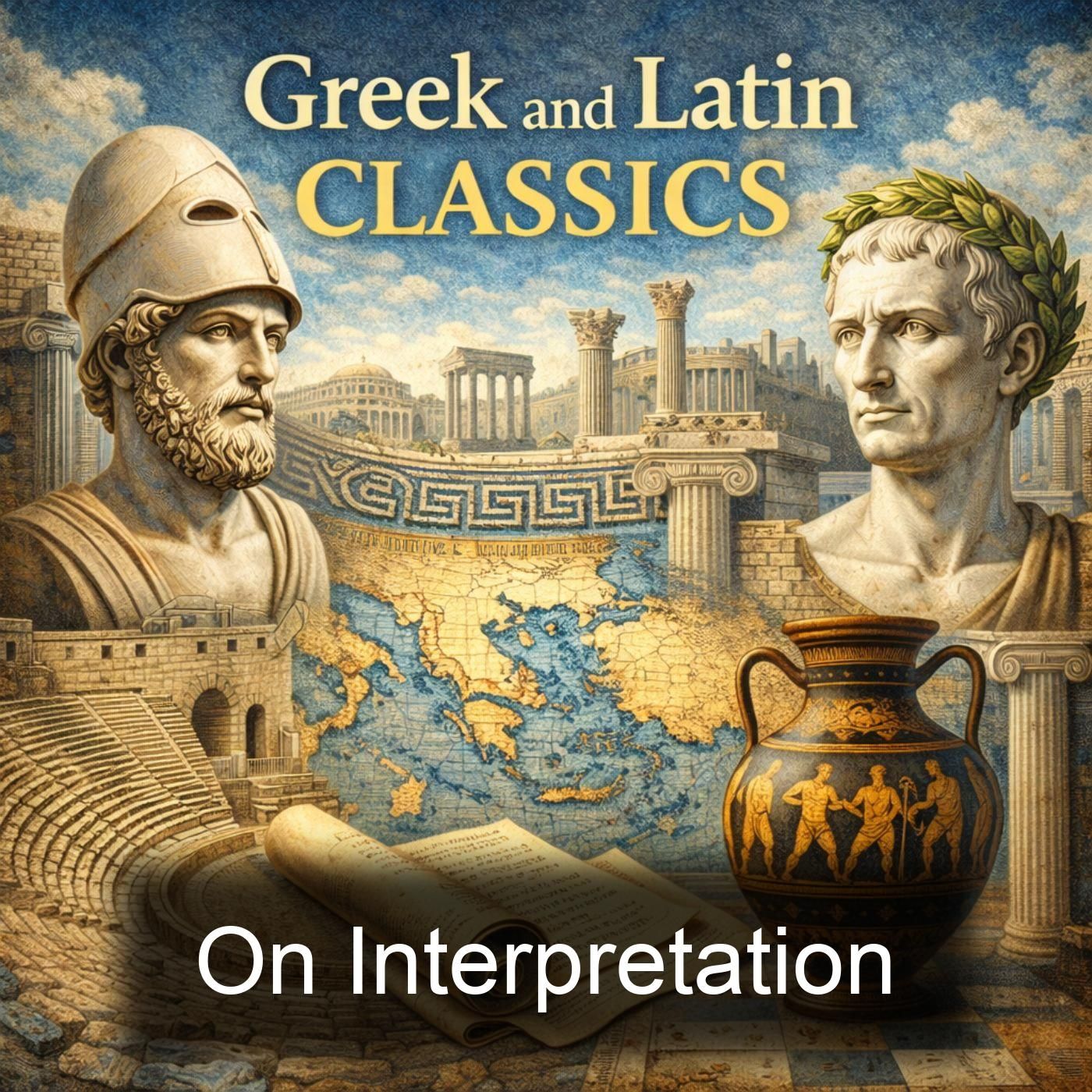
PODCAST · arts
On Interpretation
by Aristotle
Aristotle's On Interpretation (Greek Περὶ Ἑρμηνείας or Peri Hermeneias) or De Interpretatione (the Latin title) is the second of Aristotle's six texts on logic which are collectively known as the Organon. On Interpretation is one of the earliest surviving philosophical works in the Western tradition to deal with the relationship between language and logic in a comprehensive, explicit, and formal way. The work begins by analyzing simple categoric propositions, and draws a series of basic conclusions on the routine issues of classifying and defining basic linguistic forms, such as simple terms and propositions, nouns and verbs, negation, the quantity of simple propositions (primitive roots of the quantifiers in modern symbolic logic), investigations on the excluded middle (what to Aristotle isn't applicable to future tense propositions — the Problem of future contingents), and on modal propositions. The first five chapters deal with the terms that form propositions. Chapters 6 and 7 deal
-
1
On Benefits (De Beneficiis)-Lucius Annaeus Seneca
"On Benefits" (De Beneficiis) by Lucius Annaeus Seneca explores the nature of generosity and the moral implications of giving and receiving. This timeless work delves into the philosophy of benefaction, examining the motivations behind acts of kindness and the responsibilities that come with them. Seneca's insights into human relationships and ethical considerations remain relevant today, as they provoke thought on how we interact with others and the expectations we place on ourselves and those who help us. The enduring themes of gratitude, virtue, and the complexities of altruism invite listeners to reflect on their own lives and the impact of their actions in a world that often prioritizes self-interest.
-
0
Parallel Lives of the Noble Greeks and Romans Vol. 3-Lucius Mestrius Plutarchus
"Parallel Lives of the Noble Greeks and Romans Vol. 3" by Lucius Mestrius Plutarchus delves into the lives of influential figures from ancient Greece and Rome, offering insights into their virtues and vices. This volume continues Plutarch's exploration of character and morality, showcasing how the lives of these noble individuals reflect timeless human experiences. The themes of leadership, ethics, and the complexities of human nature resonate profoundly today, reminding listeners of the enduring lessons that history imparts. Engaging with Plutarch's work not only enriches our understanding of the past but also invites reflection on our own lives and the choices we make in the present.
-
-1
Memorable Thoughts of Socrates-Xenophon
"Memorable Thoughts of Socrates-Xenophon" captures the essence of Socratic philosophy through the lens of Xenophon, offering timeless insights into ethics, virtue, and the nature of knowledge. This collection presents a dialogue that encourages listeners to reflect on their own beliefs and the pursuit of wisdom. The themes of critical thinking and moral inquiry resonate strongly in today's complex world, making this work a significant exploration of human thought and understanding. Hearing these memorable thoughts invites us to engage with the philosophical questions that have shaped our civilization, reminding us of the enduring power of Socratic dialogue in our quest for truth.
-
-2
On the Shortness of Life-Lucius Annaeus Seneca
"On the Shortness of Life" by Lucius Annaeus Seneca is a profound philosophical exploration of time and the human experience, urging listeners to reflect on the fleeting nature of life. Seneca emphasizes that life is not inherently short, but rather it is often wasted on trivial pursuits and distractions. This timeless work encourages individuals to prioritize meaningful actions and cultivate a deeper understanding of their existence. As the modern world continues to grapple with the pressures of productivity and the relentless pace of life, Seneca's insights remain strikingly relevant, reminding us to seize our moments and live with intention.
-
-3
Mythology-Jane Ellen Harrison
"Mythology" by Jane Ellen Harrison delves into the intricate world of ancient myths and their enduring significance in human culture. Harrison's exploration reveals how these narratives shape our understanding of the world and our place within it, highlighting the timeless themes of belief, identity, and the human experience. This audiobook invites listeners to reflect on the power of mythology in contemporary life, reminding us that these ancient stories still resonate in our modern narratives and cultural expressions. By engaging with Harrison's insightful interpretations, audiences can appreciate the depth and relevance of mythology as a lens through which to view our own lives and societies.
-
-4
Full Dialog
"Full Dialog" invites listeners into a rich exploration of communication and understanding, emphasizing the importance of dialogue in our lives. This audiobook delves into the nuances of interpretation, revealing how our perceptions shape our interactions and relationships. Its themes resonate powerfully today, as the ability to engage in meaningful conversations is more crucial than ever in a world filled with division and misunderstanding. By highlighting the art of listening and the transformative power of words, "Full Dialog" offers timeless insights that encourage deeper connections and greater empathy in our daily exchanges. Experience the enduring relevance of thoughtful dialogue and its impact on personal and communal harmony.
-
-5
Eclogues-Virgil
"Eclogues" by Virgil is a collection of pastoral poems that reflect the beauty of nature, the simplicity of rural life, and the complexities of human emotion. These timeless works capture the essence of longing, love, and the search for peace in a rapidly changing world. Virgil's exploration of the relationship between humanity and the natural landscape resonates deeply even today, reminding us of the enduring connection we share with the environment and each other. As listeners engage with these evocative verses, they are invited to reflect on their own experiences and the universal themes that continue to shape our lives.
-
-6
Moral Letters, Vol. I-Lucius Annaeus Seneca
Moral Letters, Vol. I by Lucius Annaeus Seneca presents a collection of philosophical reflections that delve into the complexities of human existence and ethics. These letters offer timeless insights on how to navigate life's challenges and the importance of virtue, self-control, and rationality. Seneca's thoughts on morality and personal conduct resonate profoundly today, reminding listeners of the enduring struggle to find balance and meaning in a chaotic world. His reflections encourage introspection and a deeper understanding of one's values, making this work a vital resource for anyone seeking guidance in their moral journey. The wisdom contained within these letters continues to inspire and provoke thought across generations.
-
-7
Argonautica-Apollonius Rhodius
"Argonautica" by Apollonius Rhodius is an epic poem that recounts the legendary voyage of Jason and the Argonauts as they quest for the Golden Fleece. This timeless tale explores themes of adventure, heroism, and the complexities of human relationships, making it a captivating listen for audiences today. The struggles and triumphs of the Argonauts resonate with contemporary listeners, reflecting the enduring nature of ambition and the pursuit of one's goals. As a cornerstone of ancient literature, "Argonautica" offers rich insights into mythology and the human condition, inviting listeners to engage with its narrative and discover the relevance of its themes in their own lives.
-
-8
On Generation and Corruption-Aristotle
"On Generation and Corruption" by Aristotle delves into the fundamental principles of change and the nature of substances in the world. This profound exploration of how entities come into being and ultimately perish reveals Aristotle's insights into the cyclical processes of life and the underlying causes of transformation. Its themes of generation and decay resonate today as we navigate our own understanding of existence and the environment around us, reminding us of the impermanence that shapes our lives. Aristotle's work continues to be a cornerstone of philosophical thought, encouraging listeners to reflect on the essence of change and the interconnectedness of all things.
-
-9
On Interpretation-Aristotle
"On Interpretation" by Aristotle delves into the intricacies of language, meaning, and the relationship between words and the world they represent. This foundational work explores how interpretation shapes our understanding of reality and the nuances of communication. Its themes of clarity, ambiguity, and the power of language remain profoundly relevant today, as we navigate an increasingly complex landscape of information and expression. By engaging with Aristotle's insights, listeners can gain a deeper appreciation for the art of interpretation and its impact on human thought and dialogue. This timeless examination invites reflection on how we convey and comprehend meaning in our own lives.
-
-10
Argonautica-Apollonius Rhodius
"Argonautica" by Apollonius Rhodius is an epic poem that recounts the legendary voyage of Jason and the Argonauts as they seek the Golden Fleece. This timeless tale explores themes of adventure, heroism, and the complexities of human relationships, making it a captivating listen for those interested in classical literature. Its exploration of ambition and the pursuit of glory still resonates today, reminding listeners of the universal quest for purpose and validation. The rich narrative and vivid imagery invite audiences to immerse themselves in a world of myth and legend, ensuring that "Argonautica" remains a significant work that continues to inspire and entertain.
-
-11
Protagoras-Plato (Πλάτων)
"Protagoras-Plato" delves into the profound philosophical dialogues between Socratic thought and the teachings of Protagoras, exploring the nature of knowledge, truth, and morality. This work challenges listeners to consider the relativity of perception and the essence of human understanding, themes that remain strikingly relevant in today's discourse on subjective truths and ethical frameworks. The exploration of these timeless philosophical questions encourages critical thinking and self-reflection, making it an enduring piece that resonates with anyone grappling with the complexities of modern life.
-
-12
Rhetoric-Aristotle
"Rhetoric" by Aristotle delves into the art of persuasion, examining how language can influence thought and action. This foundational work explores the techniques and principles of effective communication, making it essential for anyone interested in the power of rhetoric in shaping ideas and opinions. Its themes of ethos, pathos, and logos remain relevant today, as they underpin modern discourse in politics, law, and everyday interactions. Hearing Aristotle's insights now offers a timeless perspective on the importance of rhetoric in our lives, reminding us that the way we express our thoughts can profoundly impact our society and relationships.
-
-13
Satyricon-Gaius Petronius Arbiter
"Satyricon," attributed to Gaius Petronius Arbiter, is a satirical and episodic narrative that offers a vivid glimpse into the decadence of Roman society. This work explores themes of excess, the absurdities of human behavior, and the complexities of social dynamics, making it a timeless reflection on the human condition. Its exploration of hedonism and moral ambiguity remains relevant today, inviting listeners to ponder the nature of pleasure and societal values. The sharp wit and keen observations found within its pages continue to resonate, providing both entertainment and insight into the follies that persist across ages. Experience this classic and discover why it has endured through the centuries.
-
-14
Convivio-Dante Alighieri
"Convivio" by Dante Alighieri is a profound exploration of knowledge, philosophy, and the human condition, reflecting the author's insights on life and the pursuit of wisdom. This work delves into the nature of love, the importance of intellectual growth, and the relationship between humanity and the divine. Its themes of enlightenment and the quest for truth remain relevant today, encouraging listeners to reflect on their own beliefs and the world around them. Dante's eloquent prose and timeless wisdom invite readers to engage with the complexities of existence, making "Convivio" an enduring classic that resonates with anyone seeking deeper understanding.
-
-15
Philippics-Marcus Tullius Cicero
"Philippics" by Marcus Tullius Cicero is a powerful series of speeches that critique the political landscape of Cicero's time, particularly targeting the actions and character of Mark Antony. These orations embody the struggle for justice and the defense of the Republic, showcasing Cicero's eloquence and passionate commitment to civic duty. Hearing this work today offers timeless insights into the nature of political discourse and the importance of standing up against tyranny, themes that resonate in any era of political unrest. Cicero's rhetoric not only reflects the challenges of his own time but also serves as a reminder of the enduring fight for truth and integrity in governance.
-
-16
On Generation and Corruption - Aristotle
On Generation and Corruption by Aristotle delves into the fundamental processes of change and transformation in the natural world, exploring the principles that govern the birth, growth, and decay of all things. This work is a cornerstone of Aristotelian philosophy, offering timeless insights into the nature of existence and the cyclical patterns of life. Its enduring relevance lies in the way it prompts listeners to reflect on the interconnectedness of all living beings and the inevitability of change. By engaging with Aristotle's thoughts, contemporary audiences can gain a deeper understanding of the philosophical underpinnings that continue to shape our perceptions of life and the environment around us.
-
-17
On Interpretation - Aristotle
Aristotle's On Interpretation (Greek Περὶ Ἑρμηνείας or Peri Hermeneias) or De Interpretatione (the Latin title) is the second of Aristotle's six texts on logic which are collectively known as the Organon. On Interpretation is one of the earliest surviving philosophical works in the Western tradition to deal with the relationship between language and logic in a comprehensive, explicit, and formal way. The work begins by analyzing simple categoric propositions, and draws a series of basic conclusions on the routine issues of classifying and defining basic linguistic forms, such as simple terms and propositions, nouns and verbs, negation, the quantity of simple propositions (primitive roots of the quantifiers in modern symbolic logic), investigations on the excluded middle (what to Aristotle isn't applicable to future tense propositions — the Problem of future contingents), and on modal propositions. The first five chapters deal with the terms that form propositions. Chapters 6 and 7 deal with the relationship between affirmative, negative, universal and particular propositions. These relationships are the basis of the well-known Square of opposition. The distinction between universal and particular propositions is the basis of modern quantification theory. The last three chapters deal with modalities. Chapter 9 is famous for the discussion of the sea-battle. (If it is true that there will be a sea-battle tomorrow, then it is true today that there will be a sea-battle. Thus a sea-battle is apparently unavoidable, and thus necessary). (Adapted from Wikipedia)
We're indexing this podcast's transcripts for the first time — this can take a minute or two. We'll show results as soon as they're ready.
No matches for "" in this podcast's transcripts.
No topics indexed yet for this podcast.
Loading reviews...
ABOUT THIS SHOW
Aristotle's On Interpretation (Greek Περὶ Ἑρμηνείας or Peri Hermeneias) or De Interpretatione (the Latin title) is the second of Aristotle's six texts on logic which are collectively known as the Organon. On Interpretation is one of the earliest surviving philosophical works in the Western tradition to deal with the relationship between language and logic in a comprehensive, explicit, and formal way. The work begins by analyzing simple categoric propositions, and draws a series of basic conclusions on the routine issues of classifying and defining basic linguistic forms, such as simple terms and propositions, nouns and verbs, negation, the quantity of simple propositions (primitive roots of the quantifiers in modern symbolic logic), investigations on the excluded middle (what to Aristotle isn't applicable to future tense propositions — the Problem of future contingents), and on modal propositions. The first five chapters deal with the terms that form propositions. Chapters 6 and 7 deal
HOSTED BY
Aristotle
Loading similar podcasts...
Frequently Asked Questions
How many episodes does On Interpretation have?
On Interpretation currently has 19 episodes available on PodParley. New episodes are automatically indexed when they're published to the podcast feed.
What is On Interpretation about?
Aristotle's On Interpretation (Greek Περὶ Ἑρμηνείας or Peri Hermeneias) or De Interpretatione (the Latin title) is the second of Aristotle's six texts on logic which are collectively known as the Organon. On Interpretation is one of the earliest surviving philosophical works in the Western...
How often does On Interpretation release new episodes?
On Interpretation has 19 episodes. Check the episode list to see recent publication dates and frequency.
Where can I listen to On Interpretation?
You can listen to On Interpretation on PodParley by clicking any episode. We provide an embedded audio player for direct listening, and you can also subscribe via your preferred podcast app using the RSS feed.
Who hosts On Interpretation?
On Interpretation is created and hosted by Aristotle.
URL copied to clipboard!