
PODCAST · education
Oxford Physics Public Lectures
by Oxford University
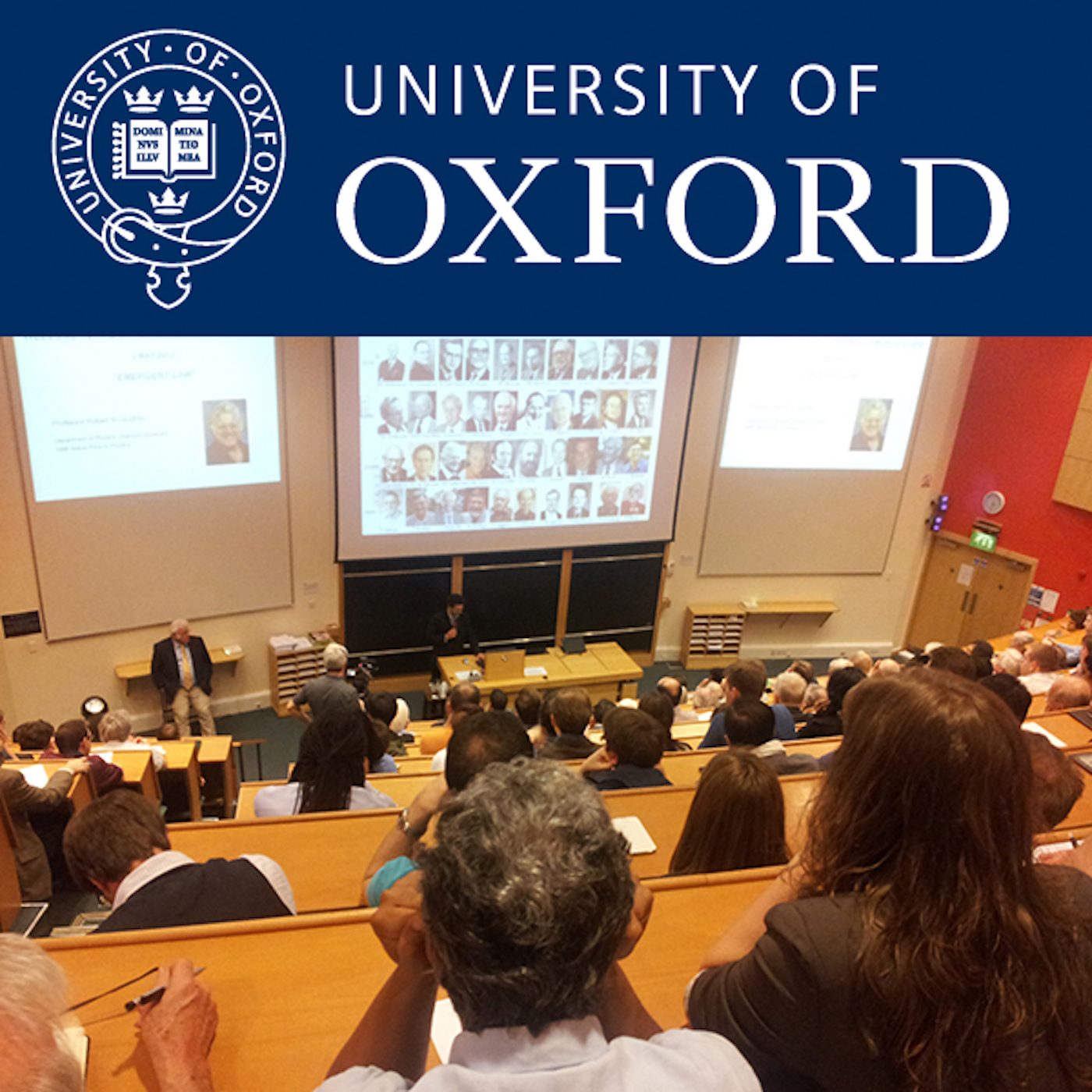
The Department of Physics public lecture series. An exciting series of lectures about the research at Oxford Physics take place throughout the academic year. Looking at topics diverse as the creation of the universe to the science of climate change. Features episodes previously published as:(1) 'Oxford Physics Alumni': "Informal interviews with physics alumni at events, lectures and other alumni related activities."(2) 'Physics and Philosophy: Arguments, Experiments and a Few Things in Between': "A series which explores some of the links between physics and philosophy, two of the most fundamental ways with which we try to answer our questions about the world around us. A number of the most pertinent topics which bridge the disciplines are discussed - the nature of space and time, the unpredictable results of quantum mechanics and their surprising consequences and perhaps most fundamentally, the nature of the mind and how far science can go towards explaining and understanding it. Fe
Episodes
-
Was there a strategic alternative to the atomic bombing of 1945?
Delve into history with Dr Rob Johnson, Director of The Changing Character of War Centre at Oxford, as he explores a pivotal question.
-
Oxford Physics and the ‘remote and speculative project’
A lecture by Prof Stephen Blundell, Professor of Physics – Condensed Matter - (Department of Physics and Mansfield College).
-
Nuclear Physics and the development of the bomb
Explore the history of atomic bomb development with Dr. Georg Viehhauser, Particle Physics Research Lecturer at St John's College, Oxford.
-
IceCube: Opening a New Window on the Universe from the South Pole
Particle Physics Christmas Lecture, hosted by Prof. Daniela Bortoletto, Head of Particle Physics and senior members of the department with guest speaker, Professor Francis Halzen. Professor Francis Halzen is Wisconsin IceCube Particle Astrophysics Center and Department of Physics, University of...
-
The State of the Universe
Our Universe was created in 'The Big Bang' and has been expanding ever since. Professor Schmidt describes the vital statistics of the Universe, and tries to make sense of the Universe's past, present, and future.
-
Seeing the High Energy Universe with IceCube
Members of the Rudolf Peierls Centre for Theoretical Physics hosted the 3rd morning of Theoretical Physics covering the subject of Inner Space Meets Outer Space: Covering the Connections Between Cosmology and Particle Physics
-
The Einstein Lens and a Tale of Two Eclipses
Physics Colloquium 20th November 2015 delivered by Professor Tom Ray This year marks the centenary of Einstein’s General Theory of Relativity. As is well known, physicists became convinced that Einstein was right after Eddington’s and Dyson’s famous expedition to measure the gravitational...
-
LHC searches for dark matter
Members of the Rudolf Peierls Centre for Theoretical Physics hosted the 6th morning of Theoretical Physics covering the ways in which ideas from theoretical particle physics guide the high energy accelerator program at CERN
-
Precision Studies of the Higgs
Members of the Rudolf Peierls Centre for Theoretical Physics hosted the 6th morning of Theoretical Physics covering the ways in which ideas from theoretical particle physics guide the high energy accelerator program at CERN
-
The Standard Model and the LHC! in the Higgs Boson Era
Members of the Rudolf Peierls Centre for Theoretical Physics hosted the 6th morning of Theoretical Physics covering the ways in which ideas from theoretical particle physics guide the high energy accelerator programme at CERN.
-
Turning in the Widening Gyre: Accretion Processes in the Universe
Inaugural Lecture by Professor Steven Balbus looking at the history of the universe A one sentence summary of much of the history of our Universe might be that it is the formation of ever more complex and compact structure from a diffuse background. The build-up of a compact core of material from...
-
Lorenz Gödel and Penrose: new perspectives on determinism and unpredictability, from fundamental physics to the science of climate change
The 9th Dennis Sciama Memorial Lecture, looking at chaos theory and climate change Lorenz is one of the pioneers of chaos theory. However, over 50 years before Lorenz, Poincaré discovered the sensitive dependence on initial conditions that characterises chaos. So what makes Lorenz’s contribution…
more -
Building stars, planets and the ingredients for life between the stars
Halley Lecture 2013 by Professor Dr Ewine van Dishoeck on new developments in astronomy One of the most exciting developments in astronomy is the discovery of planets around stars other than our Sun. Nearly 1000 exo-planets have now been detected. But how do these planets form, and why are they…
more -
The Fast Track to Finding an Inhabited Exoplanet
The 8th Hintze Lecture by Professor David Charbonneau looking at investigating habitable exoplanets. The investigation of planets orbiting other stars has moved from the study of gas giants to the hunt for smaller planets that are predominantly rock and ice in composition. When such Planets are...
-
Radiation and Reason
Professor Wade Allison gives a talk about his book 'Radiation and Reason; The Impact of Science on a Culture of Fear'.
-
Physics and Philosophy: An Introduction
On the inextricable links between physics and philosophy and the ways in which one can lead to the other - how they complement each other in answering the big questions.
-
From Argument to Experiment
Dr Christopher Palmer on the historical ties between physics and philosophy - from ancient philosophical thought through to the scientific revolution and the pioneers of modern physics.
-
Space and Time
Prof. Frank Arntzenius on whether space and time are absolute entities or simply relational properties derived from the idea of motion - an old debate between Newton and Leibniz, carried on today.
-
Quantum Paradoxes
Prof. Vlatko Vedral on the mind-boggling and paradoxical nature of quantum mechanics and its consequences on modern technology - the possibilities of superfast computing and teleportation. This interview was recorded via Skype, so is of a lower audio quality than the other podcasts in this series.
-
Parallel Worlds
Dr. David Wallace on the many-worlds theory, an explanation of the baffling results that quantum mechanics provides us with - and that there may be more worlds than just our own.
-
Consciousness and Computability
Prof. Sir Roger Penrose on the idea of artificial intelligence and whether consciousness can be replicated by a computer - a discussion of new physics which may take us closer to explaining the mind.
We're indexing this podcast's transcripts for the first time — this can take a minute or two. We'll show results as soon as they're ready.
No matches for "" in this podcast's transcripts.
No topics indexed yet for this podcast.
Loading reviews...
ABOUT THIS SHOW
The Department of Physics public lecture series. An exciting series of lectures about the research at Oxford Physics take place throughout the academic year. Looking at topics diverse as the creation of the universe to the science of climate change. Features episodes previously published as:(1) 'Oxford Physics Alumni': "Informal interviews with physics alumni at events, lectures and other alumni related activities."(2) 'Physics and Philosophy: Arguments, Experiments and a Few Things in Between': "A series which explores some of the links between physics and philosophy, two of the most fundamental ways with which we try to answer our questions about the world around us. A number of the most pertinent topics which bridge the disciplines are discussed - the nature of space and time, the unpredictable results of quantum mechanics and their surprising consequences and perhaps most fundamentally, the nature of the mind and how far science can go towards explaining and understanding it. Fe
HOSTED BY
Oxford University
CATEGORIES
Loading similar podcasts...
Frequently Asked Questions
How many episodes does Oxford Physics Public Lectures have?
Oxford Physics Public Lectures currently has 100 episodes available on PodParley. New episodes are automatically indexed when they're published to the podcast feed.
What is Oxford Physics Public Lectures about?
The Department of Physics public lecture series. An exciting series of lectures about the research at Oxford Physics take place throughout the academic year. Looking at topics diverse as the creation of the universe to the science of climate change. Features episodes previously published as:(1)...
How often does Oxford Physics Public Lectures release new episodes?
Oxford Physics Public Lectures has 100 episodes. Check the episode list to see recent publication dates and frequency.
Where can I listen to Oxford Physics Public Lectures?
You can listen to Oxford Physics Public Lectures on PodParley by clicking any episode. We provide an embedded audio player for direct listening, and you can also subscribe via your preferred podcast app using the RSS feed.
Who hosts Oxford Physics Public Lectures?
Oxford Physics Public Lectures is created and hosted by Oxford University.
URL copied to clipboard!