
PODCAST · education
Padmasambhava, Uḍḍiyāna and Tibet
by Oxford University
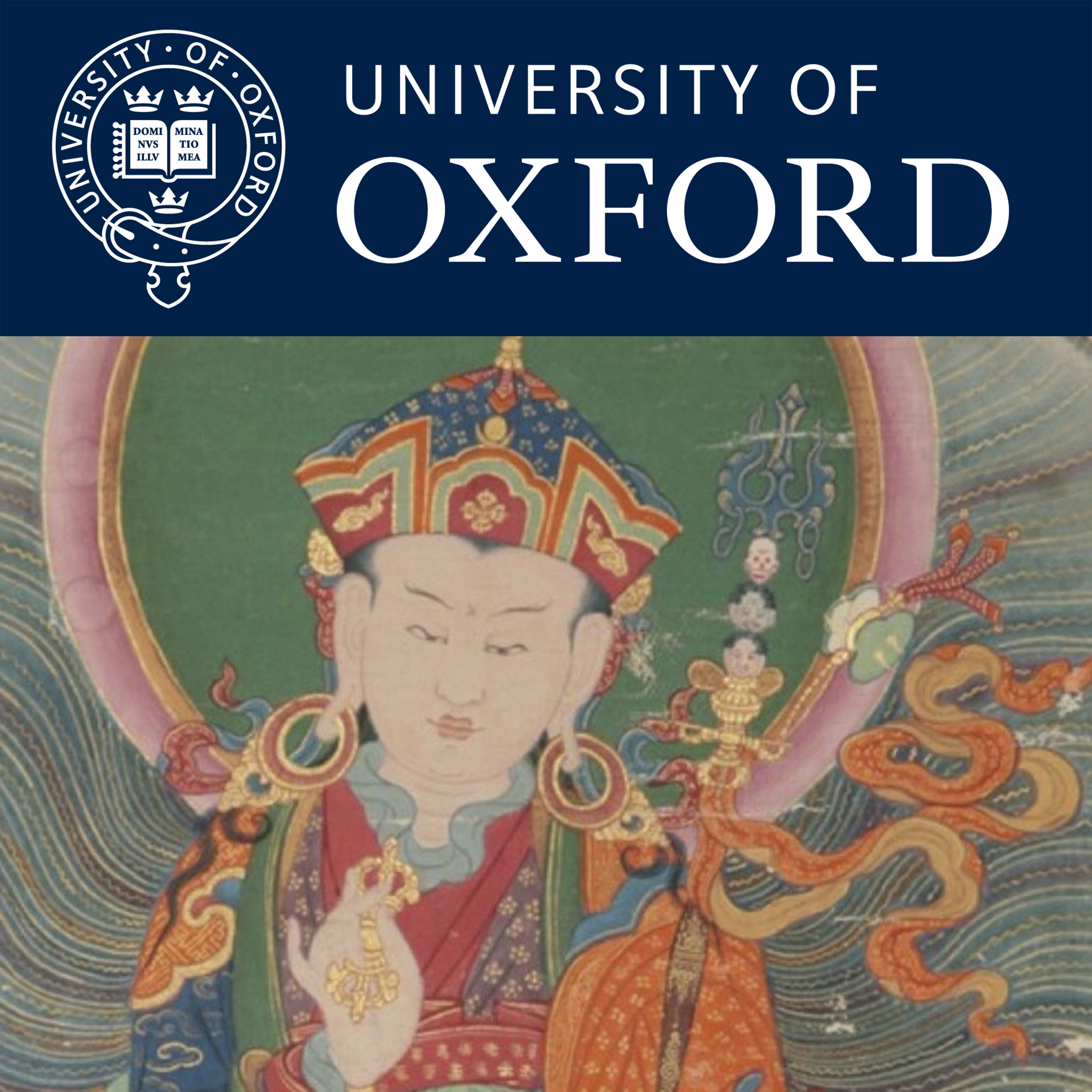
The seminar applies interdisciplinary approaches to the person of Padmasambhava, in history, myth, and ritual. Additional focuses are the regions of Kashmir, Uḍḍiyāna, and Tibet, and their mutual religious, intellectual, economic, and political interactions.
-
12
On the Earliest Depictions of Padmasambhava in Tibet: Emergence and Variation
Christian Luczanits presents some of the earliest depictions of Padmasambhava and explores their historical and religious contexts. While Tibetan texts of some of Padmasambhava’s teachings are recorded in the Dunhuang material, depictions of Padmasambhava are considerably later and appear to become common only in the course of the thirteenth century. This lecture will present some of the earliest such depictions and explore their historical and religious contexts. It will also discuss the distinct appearance of the Precious Teacher in depictions up to the fifteenth century.
-
11
Uḍḍiyāna in the Krama Literature
Uḍḍiyāna looms large in early Krama scriptures, as does its karavīra charnel ground. Ben Williams investigates. Uḍḍiyāna looms large in early Krama scriptures, as does its karavīra charnel ground, which is vividly depicted in the Kālīkuladevīpañcaśataka and Kālīkulakramasadbhāva. This paper looks closely at the way Uḍḍiyāna is envisioned as a powerful seat of Kālī and her sacrificial assembly, and a site of revelation in the Krama tradition, particularly in the lineage inaugurated by Jñānanetra in the ninth-century. This will include a look at later Krama sources that creatively invoke the presence of Uḍḍiyāna through hymns and ritual practice.
-
10
Kashmir and Śaivism in and Around the Late Eighth Century
An overview of the histories of Kashmir and Uḍḍiyāna, and their relations with Tibet in the late 8th century. An overview of the history of Kashmir in and around the late 8th century, attentive to the political and religious landscape of the day and in particular to understanding the links between Tibet and Kashmir. It features an outline of the forms of Śaivism present in Kashmir at that time, set in relation to the Vaiṣṇava and Buddhist traditions active there in the same period. Doing so will serve to establish evidence for the contemporaneous imagination within Śaivism of Uḍḍiyāna and tantric practices related to the same, inasmuch as they can be recovered from this period of history. It is hoped this will serve better to chart the influences of Kashmiri religious traditions on those of Tibet around the time of the life of Padmasambhava.
-
9
Padmasambhava’s Tibet
Brandon Dotson examines what can be said about the social and religious context of Tibet in the late-8th and early 9th centuries, that is, the period during which Padmasambhava would have been active. This paper examines what can be said about the social and religious context of Tibet in the late-8th and early 9th centuries, that is, the period during which Padmasambhava would have been active. In doing so, it queries some general assumptions about “royal religion,” “popular religion,” and tantra.
-
8
Khri Srong lde brtsan and Padmasambhava's Travels through His Land
Lewis Doney compares three different narratives about Padmasambhava and Emperor Khri Srong lde brtsan. This talk compares three perspectives on the travels of Padmasambhava, beginning in Uḍḍiyāna but focusing on his invitation to Tibet by Emperor Khri Srong lde brtsan: the early Tibetan Buddhist perspective; an early first-millennium view from the autochthonous religion, Bon; and that of a European missionary in the eighteenth century. In the former, the emperor rightfully enters a dependent relationship with Padmasambhava due to the evident spiritual and magical power that the master has acquired through his travels. In contrast, the early histories of the Bon religion and the missionary account of Ippolito Desideri (1684–1733) cast this dependent relationship on Padmasambhava as a negative state that entailed destructive consequences in Tibetan history. However, they did not question the dependency of Khri Srong lde brtsan on Padmasambhava. Beyond their differences, this talk shows how these three perspectives on the master's travels around northern South Asia and to Tibet and his relations with political power there are comparable in following certain legitimisation logics of different dependencies, as well as world-building techniques consistent with supporting the religious lineages that have created these narratives.
-
7
Were Padmasambhava and Vimalamitra de facto Sarvadharmāpratiṣṭhānavādins?
Dorji Wangchuk discerns underlying similarities in the philosophical views of Padmasambhava, Vimalamita, and Rong-zom-pa. Padmasambhava and Vimalamitra are two of the many towering figures that came to shape the identity of the rNying-ma school. Over the years, it has increasingly seemed that the philosophy of what Rong-zom-pa calls “special Mahāyāna”, which also turns out to be the doxography of Rong-zom-pa’s Sarvadharmāpratiṣṭhānavāda, actually defines the special positions/presuppositions of the early and later rNying-ma philosophy. It seems that later scholars such as Mi-pham and Klong-chen-pa have been essentially orienting themselves according to this special Mahāyāna. How far back can we trace such a philosophy in the rNying-ma school? Dorji Wangchuk attempts to show that Padmasambhava and Vimalamitra (judging, for example, from the former’s lTa phreng and the latter’s Sher snying ’grel) also appear to propose/presuppose this “special Mahāyāna” or “Sarvadharmāpratiṣṭhānavāda,” as defined by Rong-zom-pa. One will certainly find all sorts of accretions and innovations in the rNying-ma school, but its philosophical core, it will be argued, has remained the philosophy of the special Mahāyāna or Sarvadharmāpratiṣṭhānavāda. In short, the point to make is that the early and later rNying-ma philosophy may or may not be genetically linked with the philosophy of Padmasambhava, but at least generically, it seems to be linked with it.
-
6
Padmasambhava and Nubchen Sangye Yeshe: Legend, Lineage, Legacy
Dylan Esler explores the nexus of links—both legendary and historical—that connect Nubchen Sangye Yeshe with Padmasambhava. Both Padmasambhava and Nubchen Sangye Yeshe are important figures in the foundational mythology of the Nyingma school—the former as the archetypal guru and fountainhead of practically all Nyingma lineages and doctrines and as the spiritual inspiration behind the treasures, the latter as a pivotal link in the transmission of early Nyingma teachings across the era of fragmentation (sil bu’i dus) and as the author of several seminal treatises on Dzogchen and Tantra. In this talk, we will seek to explore the nexus of links—both legendary and historical—that connect both personages.
-
5
The spells attributed to Padmasambhava in the Ba ri be'u 'bum
Sam van Schaik examines the magic spells attributed to Padmasambhava in a grimoire compiled by Bari Lotsawa (1040-1112). The grimoire compiled by Bari Lotsawa (1040-1112), known for short as the Ba ri be'u 'bum, is one of the earliest and most influential of its kind. The grimoire contains hundreds of brief rituals, some of which are attributed to Indian and Tibetan figures. Alongside obscure, and perhaps non-Buddhist names such as Shivaratna, the most often cited source for these spells is Padmasambhava. This is perhaps surprising in a work by a founding figure of one of the 'new' (gsar ma) schools, although it predates the work of Nyangral Nyima Ozer and others which consolidated Padmasambhava's role in the Nyingma terma tradition. In this talk I will make a preliminary investigation of the spells attributed to Padmasambhava in the Ba ri be'u 'bum, drawing out his characterisation in the grimoire as a preeminent sorcerer and role model for Tibetan users of magical rituals.
-
4
Padmasambhava and the Copper-Colored Mountain
Ben Bogin sketches a cultural history of Padmasambhava's 'Copper-Colored Mountain'. Following his sojourn in Tibet, Padmasambhava is said to have departed for the Glorious Copper-Colored Mountain (zangs mdog dpal ri), a site that he transformed into a tantric Buddhist paradise where he resides to the present day. In this talk Ben Bogin sketches a cultural history of the Copper-Colored Mountain through narratives of Padmasambhava’s journey there in the Chronicles (bka’thang) of his life, biographical accounts of travels there by treasure-revealers (gter ston) spanning from the thirteenth to the twentieth century, prayers of aspiration for rebirth there, and visual representations of the mountain and the Palace of Lotus Light at its summit.
-
3
Tripartite Lineages and Cremation Ground Revelations: Crossovers Between Early rDzogs chen and Kaula Śaivism
Paul Thomas presents evidence that Indian Tantric Śaivism exerted a direct influence on Tibetan Dzogchen in the 11th and 12th centuries. As Paul Thomas argues in his recent PhD dissertation, it is probable that Indian Tantric Śaivism exerted a direct influence upon Tibetan rDzogs chen in the eleventh and twelfth centuries. In this talk he discusses two related elements of this crossover: peculiar tripartite lineage schemes, and revelation and transmission in particular cremation ground settings.
-
2
O rgyan Tshe dpag med traditions: Glimpse of an Ocean
Cathy Cantwell traces the tradition of Padmasambhava in the form of Amitāyus from Guru Chowang in the 13th century. Many Nyingma tantric longevity practices are Padma-centric, e.g. the ’Chi med srog thig favoured in the Dudjom tradition, or the Padma tshe’i snying thig of the Khyentse tradition. These complex multi-layered cycles include many elements traceable to early sources, such as the Aparimitāyur-jñāna dhāraṇī widely attested in Imperial times, or Amitāyus longevity practices from the Ancient Tantra Collection (NGB). One NGB tantra, the Pooling Elixir Tantra of Immortal Lifespan (bdud rtsi 'khyil ba 'chi med tshe'i rgyud) contributed much to later Nyingma longevity practices, although not the Padma-centric vision. However, subsequent Nyingma longevity cycles are often presented in relation to the Great Guru’s accomplishment of the Vidyādhara level of deathless life (’chi med tshe’i rig ’dzin). Often the entire practice is conceived as a Guru Rinpoche cycle, with Padmasambhava and his consort Mandārava exemplifying the attainment of immortality at Māratika and appearing as Amitāyus and consort. The coalescing of Padma-centric practices no doubt has a complex history. Rather than attempt a survey, I dip into some early materials to demonstrate this orientation, with specific focus on the O rgyan Tshe dpag med traditions of Gu ru Chos dbang (1212-1270) and Ratna Gling pa (1403-1479).
-
1
On Padmasambhava’s Names, Himalayan Syncretism, and the Apotheosis of the Fierce Guru
Dan Hirshberg describes the origins of the famous 'Eight Names' of Padmasambhava, and also of his fierce form as 'Guru Dragpo'. Padmasambhava earns only scattered mentions among imperial-era sources, and yet in later centuries he becomes the protagonist of a vibrant biographical tradition that would forever establish him as the catalyst for the adoption of Buddhism in Tibet. One key mode of elaborating him and his activities was through the introduction and delimitation of eight “names” (mtshan), each of which eventually becomes distinguished episodically, liturgically, and iconographically. Among them, the tiger-riding Dorjé Drolö (Rdo rje gro lod) emerged as a synthesis of tantric Buddhism, earlier devotionalism to Padmasambhava as the Fierce Guru (Gu ru drag po), and indigenous Himalayan religions. By analyzing Padmasambhava’s apotheosis through his names, this presentation seeks to shed light on the syncretism that contributed to a distinctly Tibetan Buddhism in the renaissance period.
We're indexing this podcast's transcripts for the first time — this can take a minute or two. We'll show results as soon as they're ready.
No matches for "" in this podcast's transcripts.
No topics indexed yet for this podcast.
Loading reviews...
ABOUT THIS SHOW
The seminar applies interdisciplinary approaches to the person of Padmasambhava, in history, myth, and ritual. Additional focuses are the regions of Kashmir, Uḍḍiyāna, and Tibet, and their mutual religious, intellectual, economic, and political interactions.
HOSTED BY
Oxford University
CATEGORIES
Loading similar podcasts...
URL copied to clipboard!