
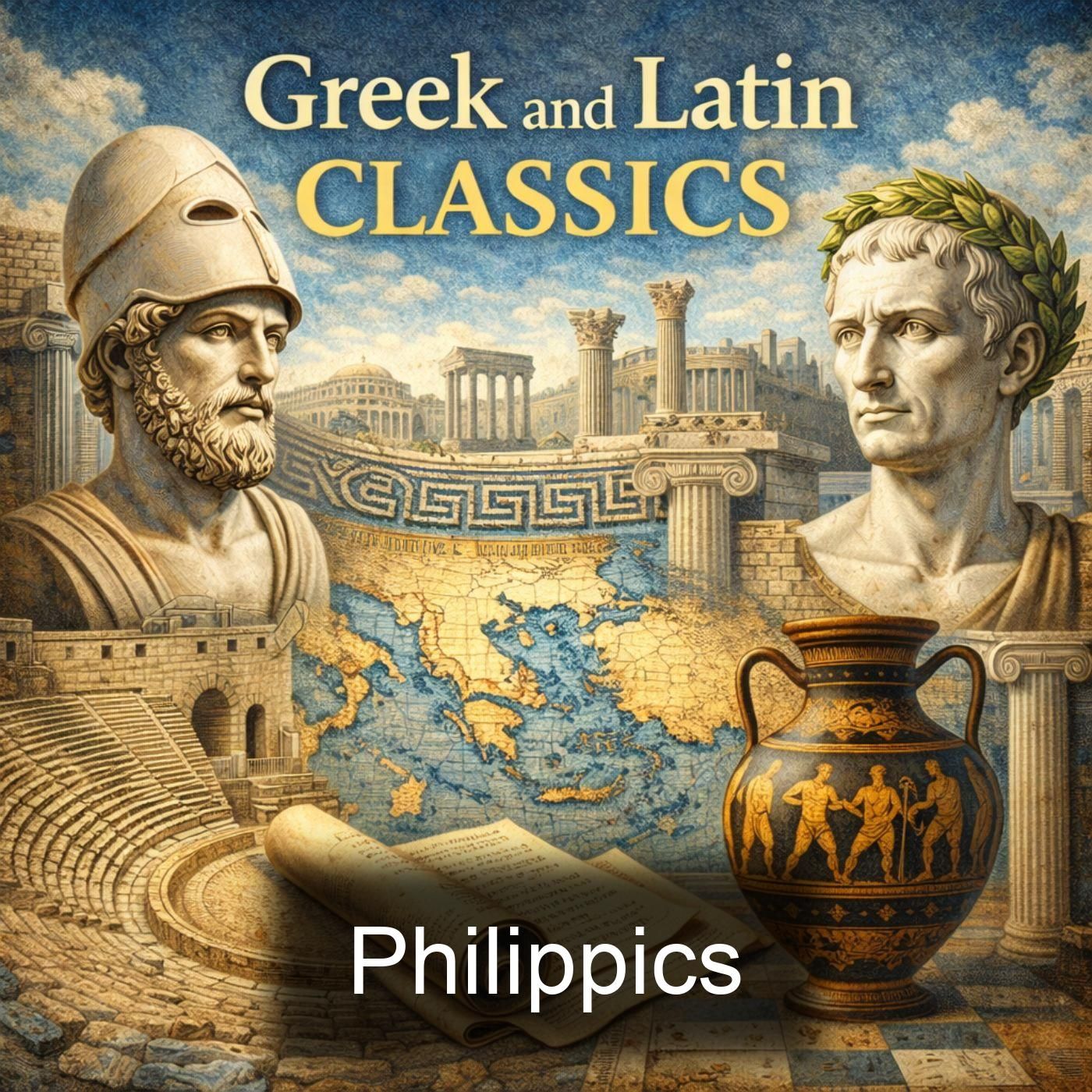
PODCAST · arts
Philippics
by Marcus Tullius Cicero
A philippic is a fiery, damning speech delivered to condemn a particular political actor. The term originates with Demosthenes, who delivered an attack on Philip II of Macedon in the 4th century BCE.Cicero consciously modeled his own attacks on Mark Antony, in 44 BC and 43 BC, on Demosthenes's speeches, and if the correspondence between M. Brutus and Cicero are genuine [ad Brut. ii 3.4, ii 4.2], at least the fifth and seventh speeches were referred to as the Philippics in Cicero's time. They were also called the Antonian Orations by Aulus Gellius. It is ironic that they were named after a series of speeches that failed to effectively warn the Greeks of the danger of Philip of Macedon whose son, Alexander the Great, went on to be one of the greatest conquerors of all time. After the death of Caesar, Cicero privately expressed regrets that the murderers of Caesar had not included Antony in their plot and became focused on discrediting Antony. Cicero even promoted illegal action, such as
-
1
Prometheus Bound (Thoreau Translation)-Aeschylus
"Prometheus Bound," translated by Thoreau, presents the timeless tale of the Titan Prometheus, who defies the gods by gifting fire to humanity, symbolizing the struggle for knowledge and enlightenment against oppressive authority. This powerful work explores themes of rebellion, sacrifice, and the quest for justice, making it a compelling listen for those who appreciate the enduring questions of morality and power dynamics. Its exploration of individual defiance against tyranny resonates strongly today, reminding us of the importance of standing up for what is right in the face of adversity.
-
0
Lucian's Dialogues Volume 3 The Dialogues of the Dead-Lucian of Samosata
Lucian's Dialogues Volume 3, The Dialogues of the Dead, presents a captivating exploration of the afterlife through the lens of Lucian of Samosata's sharp wit and satirical style. This collection invites listeners to witness conversations among the deceased, blending humor with profound philosophical inquiries about life, death, and the human condition. Its timeless themes resonate today, prompting reflection on mortality and the legacy we leave behind. Lucian's unique approach to dialogue encourages critical thinking and challenges societal norms, making this work not only an entertaining listen but also a thought-provoking experience that remains relevant across the ages.
-
-1
Abraham Lincoln's Lyceum Address, with an Introduction by Theodore Roosevelt-Various
Abraham Lincoln's Lyceum Address, accompanied by an introduction from Theodore Roosevelt, presents a profound exploration of the principles of governance and the role of the citizen in a democracy. Lincoln's address underscores the importance of law, order, and morality in maintaining a just society, themes that resonate deeply in today's discussions about civic responsibility and national unity. Roosevelt's introduction further contextualizes Lincoln's timeless wisdom, reminding us of the enduring relevance of these ideas in the face of contemporary challenges. This audiobook invites listeners to reflect on the foundational values that uphold democracy and encourages a renewed commitment to the principles that define a great nation.
-
-2
Square Deal-Theodore Roosevelt
"Square Deal-Theodore Roosevelt" explores the principles and policies that defined Theodore Roosevelt's presidency, emphasizing his commitment to fairness and social justice. This audiobook delves into the enduring themes of equity and reform that resonate in today's societal discussions about leadership and responsibility. Roosevelt's vision of a "Square Deal" for all Americans highlights the importance of balancing the interests of various societal groups, making it a timeless narrative on governance and civic duty. Listeners will find inspiration in Roosevelt's determination to champion the common good, a message that remains relevant as we navigate contemporary challenges in pursuit of a more just society.
-
-3
Homeric Hymns, Epigrams, and The Battle of Frogs and Mice-Homer
Immerse yourself in the timeless world of "Homeric Hymns, Epigrams, and The Battle of Frogs and Mice," where the power of poetic expression meets the playful spirit of ancient storytelling. This collection showcases the rich tapestry of themes such as divine reverence, the nature of heroism, and the whimsical battles of animals, reflecting the complexities of human experience through myth and humor. The enduring appeal of these works lies in their ability to evoke deep contemplation while entertaining, making them as relevant today as they were in antiquity. Experience the lyrical beauty and cultural significance of Homer’s verses, which continue to inspire and resonate across generations.
-
-4
Lucian's Dialogues Volume 2 The Dialogues of the Sea-Gods-Lucian of Samosata
Lucian's Dialogues Volume 2, The Dialogues of the Sea-Gods, invites listeners into a captivating exploration of the mythological realm where sea deities engage in thought-provoking conversations. This collection showcases Lucian of Samosata's wit and keen insight, as he delves into themes of identity, power, and the nature of the divine. The dialogues not only entertain but also challenge listeners to reflect on the complexities of belief and the human experience, making them remarkably relevant even today. With its blend of humor and philosophical inquiry, this work endures as a testament to the timeless nature of storytelling and the enduring questions that shape our understanding of existence.
-
-5
Hecyra The Mother-In-Law-Terence
Hecyra, also known as The Mother-In-Law, is a captivating play by Terence that explores the complexities of family dynamics and the often tumultuous relationships between mothers-in-law and their daughters-in-law. This timeless work delves into themes of love, loyalty, and the societal expectations that shape our interactions within families. Its sharp wit and relatable characters make it a compelling listen for anyone interested in the intricacies of human relationships. The enduring relevance of its themes speaks to the universal challenges of navigating family ties, making it a thought-provoking experience that resonates with listeners today just as it did in ancient times.
-
-6
Institutio Oratoria (On the Education of an Orator), volume 1-Marcus Fabius Quintilianus
Institutio Oratoria, written by Marcus Fabius Quintilianus, is a foundational text on the art of rhetoric and the education of an orator. In this first volume, Quintilian emphasizes the importance of a comprehensive education for effective public speaking, exploring the skills and virtues necessary for persuasive communication. His insights into the development of oratory skills remain relevant today, as the principles of effective communication are essential in various fields, from politics to personal expression. By delving into Quintilian's teachings, listeners can gain a deeper understanding of the timeless art of persuasion and the enduring value of eloquence in shaping discourse.
-
-7
Satires-Decimus Iunius Iuvenalis
"Satires-Decimus Iunius Iuvenalis" offers a sharp critique of Roman society through the lens of satirical poetry. Juvenes' work exposes the vices, follies, and moral decay of his contemporaries, making it a timeless reflection on human nature and societal flaws. The themes of corruption, hypocrisy, and the struggle for integrity resonate powerfully even today, encouraging listeners to reflect on the enduring relevance of these issues in modern life. Juvenes' incisive wit and keen observations invite audiences to engage with the complexities of their own world, making this audiobook a compelling exploration of satire that transcends time.
-
-8
Lausiac History-Palladius
Lausiac History-Palladius offers a profound exploration of early Christian monasticism, chronicling the lives and virtues of notable ascetics. This work serves as a testament to the spiritual fervor and dedication of individuals seeking a deeper connection with their faith. Its themes of perseverance, devotion, and the quest for holiness resonate powerfully today, reminding listeners of the timeless nature of spiritual struggles and triumphs. By delving into the lives of these early monks, the audiobook invites reflection on the enduring quest for meaning and purpose in a fast-paced world. The insights contained within this historical narrative continue to inspire and challenge contemporary audiences.
-
-9
Institutio Oratoria (On the Education of an Orator), volume 2-Marcus Fabius Quintilianus
Institutio Oratoria, volume 2 by Marcus Fabius Quintilianus delves into the art of rhetoric and the education of an orator, emphasizing the importance of training and skill in effective communication. Quintilian's insights into the principles of persuasion and the development of eloquence remain relevant in today's world, where the power of speech can influence opinions and shape societies. This work serves as a timeless guide for anyone looking to enhance their rhetorical abilities, highlighting the enduring value of clear expression and thoughtful argumentation. Listening to this volume offers a rich exploration of the foundations of oratory that continue to resonate with modern audiences.
-
-10
Prometheus Bound (Browning Translation)-Aeschylus
"Prometheus Bound," translated by Robert Browning, is a timeless exploration of defiance and the quest for knowledge. This powerful play by Aeschylus delves into the myth of Prometheus, who defies the gods to bring fire and enlightenment to humanity, ultimately facing dire consequences for his actions. The themes of rebellion against tyranny and the sacrifice for the greater good resonate profoundly in today's world, where the struggle for freedom and justice remains ever relevant. Aeschylus's masterful language and Browning's evocative translation breathe life into this ancient tale, making it a compelling listen that encourages reflection on the nature of power, suffering, and the human spirit.
-
-11
Medea (Way Translation)-Euripides
Medea, a powerful tragedy by Euripides, delves into the depths of betrayal, revenge, and the complexities of human emotion. At its core, the story explores the devastating consequences of a woman's scorn and the lengths one will go to reclaim agency in a world that often marginalizes them. The themes of passion and vengeance resonate strongly today, reminding listeners of the timeless struggles against injustice and the quest for empowerment. Euripides masterfully captures the raw intensity of human feelings, making Medea a compelling listen that continues to provoke thought and discussion in contemporary society. This enduring tale remains a poignant reflection on the darker aspects of love and the human psyche.
-
-12
Henry VI, Part 3-William Shakespeare
"Henry VI, Part 3" by William Shakespeare delves into the tumultuous power struggles and civil war during the reign of King Henry VI, highlighting themes of ambition, betrayal, and the quest for legitimacy. This gripping narrative captures the chaos of a nation divided, portraying the relentless pursuit of power and the tragic consequences that ensue. Shakespeare's exploration of human nature and political machinations remains relevant today, as the conflicts over authority and identity echo in contemporary society. The play serves as a timeless reminder of the fragility of leadership and the enduring impact of personal ambition on the course of history.
-
-13
What's Wrong With the World-G. K. Chesterton
G. K. Chesterton's "What's Wrong With the World" delves into the critical issues facing society, offering sharp insights and thought-provoking commentary. This work challenges readers to reflect on the moral and social dilemmas of their time, making it a timeless exploration of human nature and societal structures. Chesterton's wit and clarity shine through as he addresses themes of family, community, and the importance of tradition, which continue to resonate in today's complex world. Engaging with this audiobook invites listeners to consider enduring questions about justice, responsibility, and the essence of a good society, making it a relevant and enriching experience for contemporary audiences.
-
-14
Bacchanals-Euripides
"Bacchanals-Euripides" presents a powerful exploration of the human condition through the lens of ancient Greek drama. This work delves into themes of ecstasy, divinity, and the conflict between order and chaos, capturing the timeless struggle between societal norms and primal instincts. Its enduring relevance lies in its examination of faith, freedom, and the consequences of unchecked desires, making it a poignant reflection on contemporary issues of identity and belief. As listeners immerse themselves in the evocative language and profound insights of Euripides, they will find echoes of their own experiences and the complexities of modern life within this classic narrative.
-
-15
How a British Subject Became President of the United States-Arthur P. Hinman
Discover the intriguing journey of Arthur P. Hinman in "How a British Subject Became President of the United States." This compelling narrative explores the remarkable transformation of a British subject into a figure of American leadership, shedding light on the complexities of identity and belonging. Hinman's story resonates today as it reflects themes of immigration, aspiration, and the pursuit of the American Dream, reminding us that the paths to leadership are often shaped by diverse backgrounds and experiences.
-
-16
Imperialism and World Politics, Part 3 of 4 - Parker Thomas Moon
"Imperialism and World Politics, Part 3 of 4" by Parker Thomas Moon delves into the complex interplay between imperialism and global political dynamics. This segment of the work explores the enduring implications of imperialistic policies and their effects on international relations. The themes presented resonate strongly today, as the legacies of imperialism continue to shape geopolitical landscapes and influence contemporary power struggles. By examining these historical perspectives, listeners can gain valuable insights into the roots of current global conflicts and the ongoing relevance of imperialism in world politics.
-
-17
Philippics - Marcus Tullius Cicero
A philippic is a fiery, damning speech delivered to condemn a particular political actor. The term originates with Demosthenes, who delivered an attack on Philip II of Macedon in the 4th century BCE.Cicero consciously modeled his own attacks on Mark Antony, in 44 BC and 43 BC, on Demosthenes's speeches, and if the correspondence between M. Brutus and Cicero are genuine [ad Brut. ii 3.4, ii 4.2], at least the fifth and seventh speeches were referred to as the Philippics in Cicero's time. They were also called the Antonian Orations by Aulus Gellius. It is ironic that they were named after a series of speeches that failed to effectively warn the Greeks of the danger of Philip of Macedon whose son, Alexander the Great, went on to be one of the greatest conquerors of all time. After the death of Caesar, Cicero privately expressed regrets that the murderers of Caesar had not included Antony in their plot and became focused on discrediting Antony. Cicero even promoted illegal action, such as legitimatizing Octavian's private army. In total, Cicero made 14 Phillipics in less than two years - an impressively energetic feat for the over 60 ex-consul. Cicero's focus on Antony, however, would contribute to his downfall as he failed to recognize the threat of Octavian and ignored and promoted illegal actions. Cicero's attacks on Antony did not go unpunished and in 43 BC he was proscribed and killed. His head and hands were publicly displayed in the forum discouraging those who would openly oppose the new Triumvirate of Octavian, Mark Antony and Lepidus. (Summary from Wikipedia)
We're indexing this podcast's transcripts for the first time — this can take a minute or two. We'll show results as soon as they're ready.
No matches for "" in this podcast's transcripts.
No topics indexed yet for this podcast.
Loading reviews...
ABOUT THIS SHOW
A philippic is a fiery, damning speech delivered to condemn a particular political actor. The term originates with Demosthenes, who delivered an attack on Philip II of Macedon in the 4th century BCE.Cicero consciously modeled his own attacks on Mark Antony, in 44 BC and 43 BC, on Demosthenes's speeches, and if the correspondence between M. Brutus and Cicero are genuine [ad Brut. ii 3.4, ii 4.2], at least the fifth and seventh speeches were referred to as the Philippics in Cicero's time. They were also called the Antonian Orations by Aulus Gellius. It is ironic that they were named after a series of speeches that failed to effectively warn the Greeks of the danger of Philip of Macedon whose son, Alexander the Great, went on to be one of the greatest conquerors of all time. After the death of Caesar, Cicero privately expressed regrets that the murderers of Caesar had not included Antony in their plot and became focused on discrediting Antony. Cicero even promoted illegal action, such as
HOSTED BY
Marcus Tullius Cicero
CATEGORIES
Loading similar podcasts...
Frequently Asked Questions
How many episodes does Philippics have?
Philippics currently has 19 episodes available on PodParley. New episodes are automatically indexed when they're published to the podcast feed.
What is Philippics about?
A philippic is a fiery, damning speech delivered to condemn a particular political actor. The term originates with Demosthenes, who delivered an attack on Philip II of Macedon in the 4th century BCE.Cicero consciously modeled his own attacks on Mark Antony, in 44 BC and 43 BC, on Demosthenes's...
How often does Philippics release new episodes?
Philippics has 19 episodes. Check the episode list to see recent publication dates and frequency.
Where can I listen to Philippics?
You can listen to Philippics on PodParley by clicking any episode. We provide an embedded audio player for direct listening, and you can also subscribe via your preferred podcast app using the RSS feed.
Who hosts Philippics?
Philippics is created and hosted by Marcus Tullius Cicero.
URL copied to clipboard!