
PODCAST · education
Pod-Textualizing the Past
by Susan Stanfield
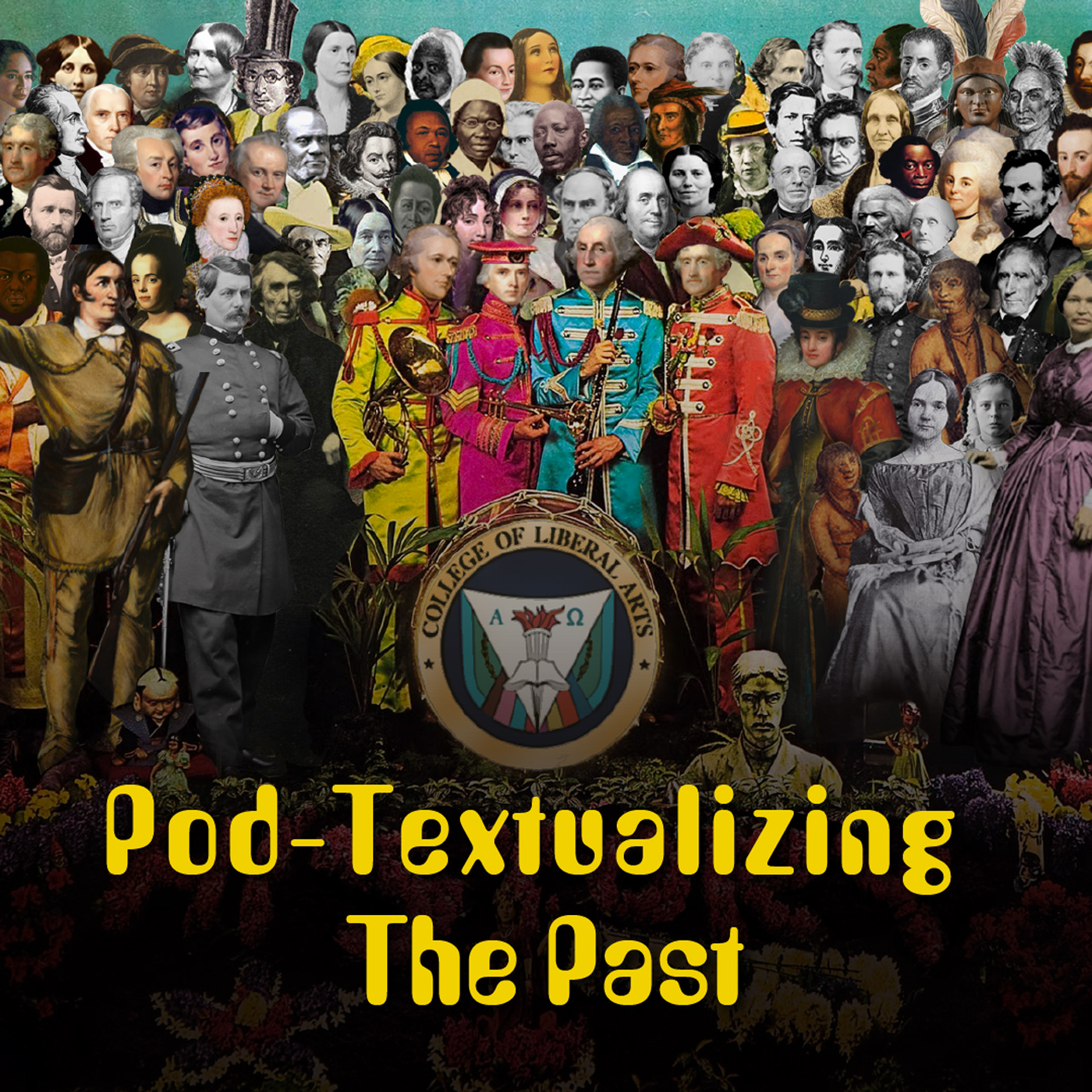
Pod-Textualizing the Past is a podcast that explores U.S. history from pre-colonization through the U.S. Civil War. Produced at the University of Texas at El Paso, Professor Susan Stanfield talks with experts about specific aspects of U.S. history and their cultural impact.
Episodes
-
Episode 25: Understanding Utopian Movements in the 19th Century
Taylor Spence (Ph.D. MFA, Artist and Independent Scholar) will delve into the world of utopian communities in the nineteenth century and explain how and why they were formed. From free love to rethinking how labor practices and gender roles were discussed, these communities shaped the development...
-
Episode 24: Traveling through the 1820s
Sarah Jencks (History Co-Lab, A non-profit company) will discuss traveling in the 1820s. While we may just hop in a plane or take our cars for travel, in the 1820s traveling around for pleasure was much more difficult. It could involve steam ships, canal boats, or a stage coach and in the case of...
-
Episode 23: Bringing Home the Bacon: Money In Early America
Joshua Greenberg (Ph.D. American University) is the author of Banknotes and Shinplasters: The Rage for Paper Money in the Early Republic. In this podcast Dr. Greenberg discusses the development and circulation of paper money in the early years of the United States and how it impacted the lives of...
-
Episode 22: Birth Control and Abortion in American History
Dr. Evan Elizabeth Hart (History-Missouri Western State University) discusses the history of abortion and birth control in this country beginning in the 1700’s. When does life begin? What was important for women’s health? What kinds of birth control were available in the 18th and 19th centuries?...
-
Episode 21: Creating a Government for a New Nation
Dr. Liz Covart (Ph.D. University of California-Davis) joins us today to discuss the first governing bodies and the document of the newly formed United States of America. Creating a nation from separate colonies during a war for independence is no easy task. The United States transitioned from the...
-
Episode 20: The Dakota-U.S. War (1862)
John Legg, (Ph.D. candidate, George Mason University) discusses the war with the Dakota in 1862 which took place in south central Minnesota. Legg has studied the Dakota extensively for years and his Master’s degree focused on the war and historical memory. John has a book chapter that will be...
-
Episode 19: The Pueblo Revolt
Jose Miguel Chavez Leyva, (Ph.D. candidate, University of Texas at El Paso) discusses the Pueblo Revolt of 1680, that took place in modern day New Mexico. The Pueblo challenged the Spanish occupation of their lands preserving their autonomy. Leyva studies environmental history and native groups…
more -
Episode 18: A Change of Dress: Women and 19th Century Reform
Courtney Cauthon, historian and period seamstress joins us today for a discussion of 19th century fashion and the dress reform movement. Cauthon explains why this movement is important and why the study of dress and fashion helps us understand the past. You can find out more about this topic at...
-
Episode 17: Gender, Labor & the Lowell Mills
Dr. Bridget Marshall (English-University of Massachusetts-Lowell) gives us the scoop on the Lowell Mills and the female workforce that kept them running. What was daily life like for a mill girl? How were mill workers portrayed in popular culture? In this podcast, these issues and more are...
-
Episode 16: New England Witches Before Salem
Dr. Bridget Marshall (English-University of Massachusetts-Lowell) discusses accusations of witchcraft and witchcraft trials in British North America, focusing on two cases (Mary Parsons and Mary Webster) that took place before the Salem trials in 1692-1693. You can follow her on twitter...
-
Episode 15: Slavery in New England
Dr. Christy Clark-Pujara, (Associate Professor, Afro-American Studies at the University of Wisconsin) discusses slavery in New England in this podcast. Although we typically think about slavery as being a story of the American South, Dr. Clark-Pujara dispels that myth and explains how northern...
-
Episode 14: Alexander Hamilton: More than a Song and a Dance
Janalyn Moss (History Librarian at the University of Iowa) talks to us about the man, the musical and the world of Alexander Hamilton. By contextualizing the musical, this discussion examines how “Who Lives, Who Dies, Who Tells Your Story,” shapes our understanding of Hamilton and the…
more -
Episode 13: Cooking an American Identity
Rachel Snell (Ph.D. History, University of Maine) studies food and food writing as a way to understand the lived experience of early American women. Focused on the 18th Century, this interview examines women’s kitchen labor, Amelia Simmons, author of the first American cookbook, and the ritual of...
-
Episode 12: Female Soldiers in the American Revolution
Lindsay Reinpold (History-UTEP), a recent graduate of the MA program at UTEP and middle school history teacher discusses female soldiers in the American Revolution. Her study of Elizabeth Zane, Margaret Cochran Corbin, and Deborah Sampson uncovers details of their lives and service while…
more -
Episode 11: Charlotte Forten: Radical, Teenaged, Abolitionist
Dr. Kristen Hillaire Glasgow (Ph.D. History, U.C.L.A.) discusses Charlotte Forten, a young woman of color in the 1850s who is an anti-slavery activist. Using Forten’s diary of her teenaged years as a focal point, Glasgow examines her thoughts and perspective shedding new light on the abolition...
-
Episode Ten: Sickness and Health in British North America
Dr. Angela Keysor (Allegheny College, History) examines illness and its treatment during the eighteenth Century in British North America, with a particular focus on smallpox epidemics. As we experience a pandemic in the twenty-first century, how different was the colonial American experience and…
more -
Episode Nine: African American Soldiers and the Families’ Civil War
Dr. Holly Pinheiro (Augusta University, History) discusses the impact of the Civil War on African American soldiers and their families based on his forthcoming book from the University of Georgia Press. Dr. Pinheiro examines why men enlisted, how they were treated, and the ways their service…
more -
Episode Eight: Marbury v. Madison and the U.S. Supreme Court
Dr. Timothy Johnson (University of Minnesota, Political Science) is interviewed about the U.S. Supreme Court decision in Marbury v. Madison(1803). Beyond the significance of Judicial Review, the legal doctrine established in this decision, Johnson describes the development of the Court during the...
-
Episode Seven: The War at Home: Paso Del Norte During and After the Mexico-U.S. War
Robert Diaz (UTEP-History) is interviewed about how the war with Mexico was experienced in the El Paso area as well as the fluidity of borders both at the time of this war and in more recent history. The Battle of Brazito is also discussed.
-
Episode Six: Politics, Protest & the War with Mexico
Dr. Brad Cartwright (UTEP-History) is interviewed about the political controversy over the Mexico-U.S. War, how the war was protested, and the lasting impact of this war.
-
Episode Five: Herman Melville and Exotic Worlds
Dr. Brian Yothers (UTEP-English) and Brad Cartwright (UTEP-History) are interviewed about Typee, Melville’s first novel. Using the book as a springboard the influence of Herman Melville is discussed as well as the attitudes of Americans about the South Pacific and Manifest Destiny.
-
Episode Four: Texas: Revolution, Independence and Annexation
Dr. Charles Martin (UTEP-History) is interviewed about the emergence of Texas as an independent nation and eventually it annexation by the United States. Dr. Martin looks at reasons for Texas independence, the role slavery played in the political aspects of the status of Texas, and some of the...
-
Episode Three: Guns, Guts and Glory: The American Revolution
Kevin Strombel (UTEP-History) is interviewed about the military aspects of the American Revolution. We examine weapons, strategy, and a comparison between the British and American aims in the war.
-
Episode Two: Viva la Revolucion: French North America
Dr. Lowry Martin (UTEP-Languages and Linguistics) is interviewed about the French presence in North America, including the Haitian Revolution, early French settlements and the cultural legacy of the French in North America.
-
Episode One: The Creosote Bush and Borderland History
Ligia Arguilez (UTEP-History) is interviewed about the Southwest plant, Creosote and its role in the past and present of the region. By looking at the history of plant we can imagine new ways of studying history and learn more about how this plant shapes the everyday lives of those in this area.
We're indexing this podcast's transcripts for the first time — this can take a minute or two. We'll show results as soon as they're ready.
No matches for "" in this podcast's transcripts.
No topics indexed yet for this podcast.
Loading reviews...
ABOUT THIS SHOW
Pod-Textualizing the Past is a podcast that explores U.S. history from pre-colonization through the U.S. Civil War. Produced at the University of Texas at El Paso, Professor Susan Stanfield talks with experts about specific aspects of U.S. history and their cultural impact.
HOSTED BY
Susan Stanfield
CATEGORIES
Loading similar podcasts...
Frequently Asked Questions
How many episodes does Pod-Textualizing the Past have?
Pod-Textualizing the Past currently has 25 episodes available on PodParley. New episodes are automatically indexed when they're published to the podcast feed.
What is Pod-Textualizing the Past about?
Pod-Textualizing the Past is a podcast that explores U.S. history from pre-colonization through the U.S. Civil War. Produced at the University of Texas at El Paso, Professor Susan Stanfield talks with experts about specific aspects of U.S. history and their cultural impact.
How often does Pod-Textualizing the Past release new episodes?
Pod-Textualizing the Past has 25 episodes. Check the episode list to see recent publication dates and frequency.
Where can I listen to Pod-Textualizing the Past?
You can listen to Pod-Textualizing the Past on PodParley by clicking any episode. We provide an embedded audio player for direct listening, and you can also subscribe via your preferred podcast app using the RSS feed.
Who hosts Pod-Textualizing the Past?
Pod-Textualizing the Past is created and hosted by Susan Stanfield.
URL copied to clipboard!