
PODCAST · society
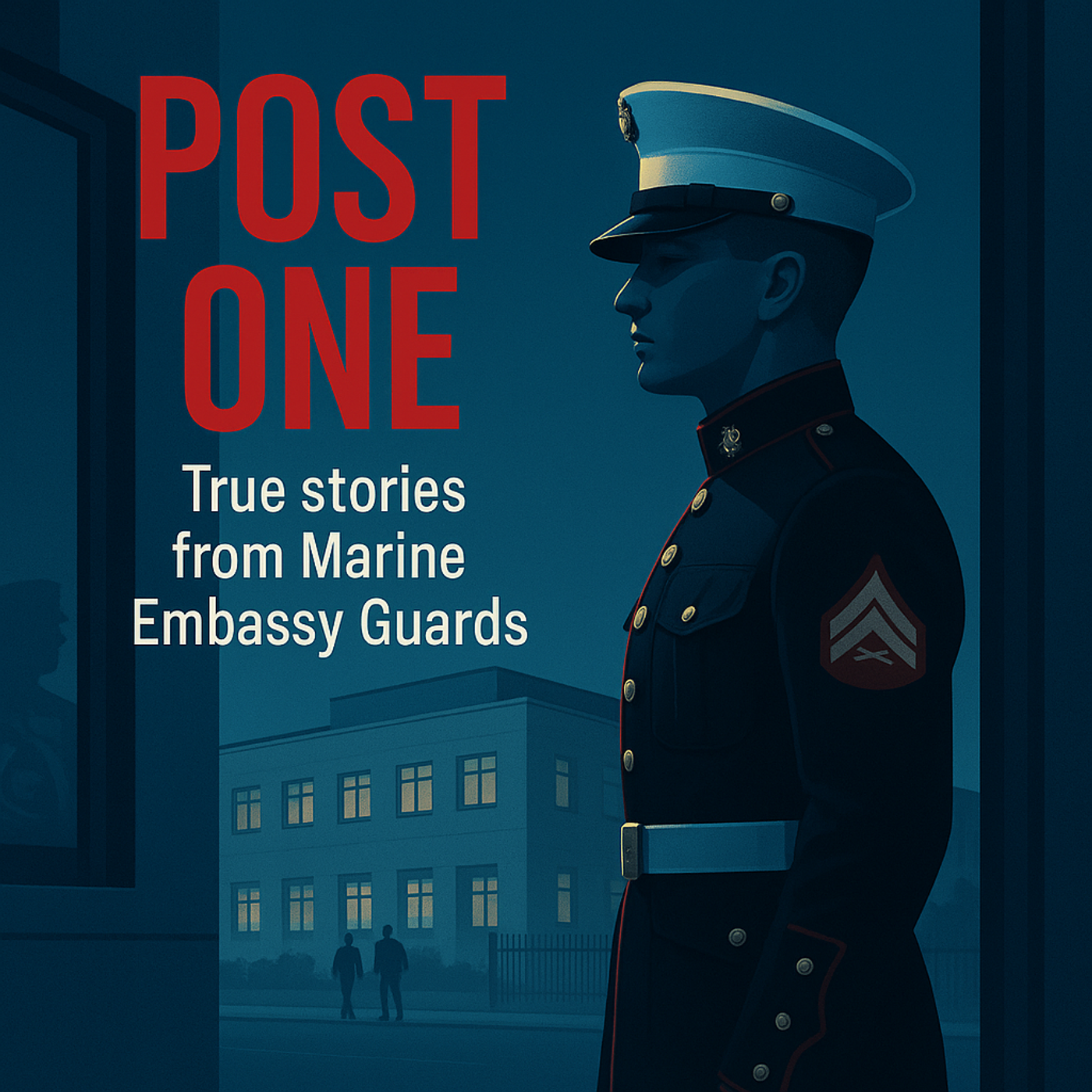
Post One: True stories from Marine Embassy Guards
by James Curry
Marine Embassy Guards serve in some of the most remote and politically volatile places on earth, often alone, unseen, and far from home.Post One is a storytelling podcast that brings their experiences to life. Each episode features candid conversations with Marines who stood watch at U.S. embassies and consulates around the world, saving lives, safeguarding secrets, and navigating cultures most Americans will never see.From tense standoffs and high-stakes evacuations to quiet moments of connection, these are the unfiltered stories of Marines serving on the front lines of American diplomacy.Hosted by James Curry | [email protected]
-
22
Damascus to Tokyo: An MSG smuggled out of Syria & Reagan marks the Marines' Birthday in Japan
Retired Master Sergeant Lance Brown was a Marine Security Guard in Damascus in 1982 — a busy way station for envoys headed into war-torn Beirut fifty miles away. In this episode, he describes standing post at a small, exposed embassy with just nine Marines, the intel warning of thousands of Iranians about to storm the walls, and the two negligent discharges that put holes in a door handle and a wall.He recounts watching a reporter get chewed out for calling Secretary of State George Shultz an ex-Marine, and getting smuggled out of Syria after the post held him so long his exit visa expired.Lance then moves to Tokyo, night and day from Damascus. He stood post at one of the largest embassies in the world and handled a nervous walk-in trying to defect. He watched Japanese police beat back a protester climbing the embassy wall. And when his Marine Corps Ball was cancelled for a Reagan visit, the president arranged a cake cutting at a Tokyo palace instead.He closes on how the program built the independence and judgment that carried him through twenty years in the Marine Corps.
-
21
On Duty in Beirut: "If you receive fire, you'll return fire."
In 1980, Joe Johns was a Marine Security Guard at the U.S. Embassy in Beirut — an old hotel on the Corniche, protected by little more than sandbags, a blast wall, and thirty Americans' worth of resolve. He arrived with one order from his battalion commander: if you receive fire, you'll return fire. Within his first hour in the embassy, the React alarm sent the detachment scrambling into position.In this episode, Joe walks through a year of standing post in one of the most dangerous cities in the world. He describes the ambush on Ambassador John Gunther Dean's motorcade — three rounds in the bullet-resistant glass right where the ambassador's head had been — and how Dean walked back into the embassy looking like he'd been through a storm. He recounts the night Hezbollah set French rockets on a timer aimed at the Marine House bar during a Friday-night gathering, and the scramble into React positions as the Marines waited to be overrun. And he tells the story of the young Marine who cracked under the strain, leveled a shotgun at post one, and was off the compound within twelve hours.Joe also reflects on the human side of the post — the Lebanese staff who became family — and the psychological toll he didn't feel until he left, when the pressure of that year finally caught up with him in Paris.
-
20
September 11, 2001: On Post When the Towers Fell
On September 11, 2001, Marine Security Guard Mark McCabe was standing post at the U.S. Embassy in Tunisia. In this episode, he takes us inside that day from behind post one — the local guard chief walking past with a warning, the RSO rushing in to react the detachment, and piecing together the attacks from blurry images loading on a slow embassy computer while his fellow Marines watched it unfold live on a TV out in town. Hours later, a bomb threat came in, and a normal Tuesday became a day none of them would forget.Mark describes how the attacks pulled a young, still-forming Marine Security Guard detachment together, then takes us to his second post at the U.S. Embassy in Oslo, Norway — a glass-fronted building with almost no standoff, and the massive protests that came as the Iraq war kicked off. He closes on how MSG duty shaped him, the road it opened toward federal law enforcement, and why he'd tell any Marine considering the program to do it without hesitation.
-
19
The Man Behind Post One: A Marine Security Guard on Serving in New Delhi, Togo, and Ottawa
In this episode, the microphone turns around. Prior guest Matthew Kearse takes over as host to interview James Curry — Marine veteran, former Marine Security Guard, and creator of the Post One Podcast — about his own path through the MSG program.James traces his road to Marine Security Guard duty: enlisting at seventeen, deploying to Fallujah in 2004, and getting orders to MSG school almost the moment he returned. He talks about the academic pressure and peer scrutiny of the schoolhouse, then walks through his three U.S. Embassy posts — the chaos and culture shock of New Delhi, the poverty and unmatched detachment camaraderie of Lomé, Togo, and the cold, self-drive normalcy of Ottawa, where a cyclist once spat in his face over President Bush.He shares the moments that stuck: the presidential visit when a hotel fire alarm nearly forced an evacuation, the gray-area decisions of curfew violations and classified material left in the open, and how the program deprogrammed the fleet Marine in him and taught him to manage outsized egos. In the back half, the conversation shifts to the podcast itself — why James built it, the Marine Security Guard stories that have stayed with him, the evolving relationship between Marines and RSOs, and his ongoing struggle to reach Marines who served in the last decade.
-
18
Beaten in Belgrade: A Marine Security Guard Caught in the 1997 Protests Against Milošević
In February 1997, Marine Security Guard Kevin Chavez was serving in Belgrade during the mass protests against Slobodan Milošević. One night, while showing a friend around the city, he was trapped between hundreds of student protesters and a wall of Serbian riot police. In this episode, he describes fighting through the chaos to get her to safety, being pulled to the ground, and taking dozens of baton blows that broke his nose, loosened his teeth, and caused neck damage he would need surgery to repair years later.Kevin recounts making it back to the embassy battered and bloodied, then begging the ambassador — a Marine Veteran — to let him stay rather than be sent home, knowing a replacement could take months to clear into the country. He also talks about the tight-knit detachment and embassy community in Belgrade, the long wait in Bonn for his visa, and why he turned down a chance to stay in Germany for a hardship post most Marines hoped to avoid.
-
17
Blood in the Pink Zone: New details on the 1985 Zona Rosa Attack
In 1985, four Marine Security Guards were killed in a targeted attack at a café in the Zona Rosa district of San Salvador — the deadliest strike on MSG Marines in the program's history. Author Chito Peppler joins the show to discuss his book on the attack and the years of research behind it.He describes how a chance conversation in a hotel lobby led him to a sealed Senate Select Committee on Intelligence report, and how he pieced together what happened that night: the FMLN guerrillas who disguised themselves as Salvadoran soldiers, the two Marines who survived because they had moved to the next café, and the seven civilians who also died.Chito recounts how the mastermind was eventually captured, only to be released under a wartime amnesty and paroled into the United States — a decision driven by a conflict between the CIA and the Department of Justice. He also traces the wider fallout of El Salvador's civil war, the formation of MS-13 and Barrio 18 in Los Angeles, and his own effort to locate the exact site of the attack decades later, now a butcher shop with no marker of what took place there.Chito's book, Blood in the Pink Zone, is available on Amazon.For the firsthand account from a Marine who survived the attack, listen to the earlier Post One episode with Anton Koszuth: Surviving San Salvador: The Deadliest Attack in MSG HistoryChito's YouTube video showing the exact location of the attack.Follow Chito Peppler on LinkedIn and Instagram.
-
16
No Days Off: A Marine Security Guard on the Reality of Embassy Duty in Liberia, China, and Estonia
Marine Security Guard Ken Hayles served three U.S. Embassy posts — Liberia, China, and Estonia — each a completely different world. In this episode, he describes arriving in Monrovia as a first-post Marine and running a short-staffed detachment with no days off, the culture shock of a developing country, and the strange intimacy of searching cleared Americans' offices for classified information. He recounts the night he spotted a figure by the embassy wall and called it in as a threat, only to learn it was a local child using the security lights to do homework. He explains contact reporting — how Marine Security Guards pull personal details out of strangers — and the time it flagged a woman in Tallinn he was told to stay away from. He also covers host-nation surveillance at the U.S. Embassy in Beijing and a rough transition out of the Marine Corps that landed him in a separations unit at Camp Pendleton.
-
15
Embassy in Ruins: A Marine Security Guard and the 1972 Managua Earthquake
When the 1972 Managua earthquake struck Nicaragua on December 23, it killed thousands and destroyed much of the capital. Anthony Trzupek was the senior Marine Security Guard at the U.S. Embassy that night, and with the detachment commander away, he was the one in charge. In this episode, he recounts surviving the violent 48 seconds of shaking, reaching the embassy through the wreckage, and leading the effort to rescue American staff from collapsed buildings — including a secretary trapped in a crushed townhouse. He describes the days that followed: securing the embassy against looters, evacuating American citizens, the death of the U.S. consul general, and the lasting toll the disaster took on him, including a decades-long struggle with PTSD and alcohol and his eventual recovery.
-
14
Breaking Protocol: An MSG's Fight to Save Two Americans in Yemen
Retired Gunnery Sergeant Gregg Jones served as a Marine Security Guard detachment commander in Geneva, Switzerland and Sanaa, Yemen. In Yemen, he heard a distress call over the radio late at night, broke protocol, and fought his way through a crowd of armed Yemenis to rescue two American servicemen who were minutes from being killed. He also helped evacuate the embassy when the security situation deteriorated, coordinating the safe departure of personnel with no support from the US government.
-
13
Card Declined: How a Failed Transaction Led a Marine to the MSG Program
AJ Inman never planned on becoming a Marine Security Guard. A chance encounter with MSG recruiters in Okinawa — and a debit card that wouldn't work at the worst possible moment — put him on a path that took him to Botswana, Bratislava, and Brasilia. In this episode, Inman talks about MSG school, the collateral duties that nobody warns you about, what it's really like standing Post One, and why the friendships you make on the program are unlike anything else in the Marine Corps.
-
12
Ken Kraus: The First American Hostage in Iran
Marine Security Guard Ken Kraus was the first American taken hostage in Iran. On Valentine's Day 1979, the US Embassy in Tehran was overrun by armed militants. Kraus was shot, beaten, and thrown into prison, where he was tortured, put on trial before a panel of mullahs, and sentenced to death. He refused to break. He made it out with minutes to spare.Ken Kraus: A Marine Endures Hell: The First Marine Held Hostage in Iran During the Iranian Hostage Crisis of 1979
-
11
Jeanne Jacko: The First Female Marine Security Guard
In 1979, Jeanne Jacko became the first female Marine Security Guard. She served in Amman, Jordan and Paris, France — part of a ten-woman test program that opened doors female Marines are still walking through today. When the Iranian hostage crisis and the Karachi riots broke out, the State Department pulled the female MSGs from their posts. Jeanne talks about what it felt like to be ordered out, what the program meant to her, and why her photo ended up on a mural at the Women's Memorial in Washington, D.C.For the full story of what happened in Karachi, check out our earlier episode with Vicki Gaglia-McGuire.Other episodes mentioned... Tehran 1979: Inside the First U.S. Embassy Takeover in Iran
-
10
Trey Salmon: The First MSG Awarded the Combat Action Ribbon for El Salvador
Trey Salmon served as a Marine Security Guard in Calcutta, India and San Salvador, El Salvador. On Christmas night 1989, he found himself in the middle of a firefight between FMLN guerrillas and the Salvadoran Armed Forces. In Calcutta, a taxi hit him mid-run, broke his leg, and left him fighting gangrene in an Indian hospital. When he got home, he spent nearly a decade navigating Marine Corps bureaucracy to earn the Combat Action Ribbon for himself and every embassy Marine who served in El Salvador.For the full story of the 1985 Zona Rosa attack, check out our earlier episode with survivor Anton Koszuth.
-
9
Breaking New Ground: The First Career Detachment Commander in Marine Security Guard History
Jesse Wagner is the first career detachment commander in the history of the Marine Security Guard program — a title that didn't exist until he helped create it. In this episode, he breaks down what that means, how the MOS got built from the ground up, and why the program needed it.Beyond that, Jesse pulls back the curtain on MSG school as it exists today — what's getting Marines dropped, how the risk assessment board actually works, and why the answer to what disqualifies most Marines will surprise you. He also addresses the RSO relationship, mental health on the program, and where he sees the career detachment commander MOS going in the next decade.If you want to understand what the MSG program looks like today, this is the episode.
-
8
The Replacements: Resetting the Marine Security Guard Detachment in Shanghai
When an entire Marine Security Guard detachment in Shanghai got sent home, the Marine Corps needed replacements they could trust. Chris Wright was one of them.Shanghai was a designated country post — the highest hostile intelligence threat on the program. The restrictions were tight, the scrutiny was real, and the pressure to not make things worse was constant. Chris and the incoming Marines knew exactly what had happened before them and why it couldn't happen again.From Shanghai, Chris went to Berlin in the mid-90s, where he witnessed firsthand the lasting divide between East and West Germany years after the wall came down. He also met the woman who would become his wife.
-
7
Still Standing: The Luckiest Marine on the MSG Program
Before Mike Pellow held the U.S. Embassy in Panama through a night of RPG attacks during the U.S. invasion (Episode 12), he was a young sergeant on his first MSG tour in Cold War Leningrad — and he was already finding trouble.A night out with the wrong people ended with Mike and a fellow Marine in a Soviet holding room, a man with a gun posted at the door, and the phone getting ripped out of their hands every time they tried to call the consulate. That was just the beginning. In Copenhagen, the woman he was dating turned out to be working as an East German spy.Then Clayton Lonetree turned himself in and Mike's name kept coming up during the investigation.What makes this episode more than just a collection of close calls is what Mike did each time — and what the people around him chose to do with the evidence in front of them. An RSO who remembered the truth. A battalion commander and a company commander who both believed in Mike. And a Sergeant Major who picked up the phone and changed Mike's entire trajectory with one conversation.Luck matters in the Marine Corps. So does the company you keep.Hear Mike's incredible story as a Detachment Commander in Panama on Episode 12.
-
6
Beirut: When the US Embassy Annex Was Bombed
Melvin "Mac" McField was in a shoe store in Beirut when the walls shook. The radio said the American Embassy annex had just been bombed. He raced back to the compound. That night, the RSO came to the Marine House with a warning — they were next. Mac and his buddy climbed to the rooftop armed and ready. What happened up there, he still can't fully remember. What followed were decades of untreated PTSD, drinking, fighting, and NJPs — things he never told anyone because he didn't want to be seen as broken. Somehow, through all of it, he made it to Master Gunnery Sergeant. This episode is about the bombing and the long road after.You can hear about this incident from another perspective on Episode 11, Burying Ghosts: A Marine's Account of the 1984 U.S. Embassy Bombing in Beirut
-
5
MSG DET Uganda: The Uzi, the Coup, the Condoms
In 1986, Staff Sergeant George Holguin arrived in Kampala, Uganda as a brand new detachment commander with one mission — establish the first permanent MSG detachment at the American embassy. Uganda had just come through a coup. On day one, the RSO handed him a .357 and an Uzi and told him to carry both around the clock. George talks about building a detachment from scratch in a post-coup country, navigating armed checkpoints, keeping young Marines focused, and an ambassador who had a very specific welcome for every single person who walked through his door — including a handful of condoms.
-
4
Under Arrest: The Night the Yugoslav Secret Police Took an MSG
Jim Vetternik was an MSG at the U.S. Embassy in Belgrade when Yugoslav secret police arrested him outside a casino and threw him in an interrogation room. What happened over the next five hours is something most Marines never experience — and something the Marine Corps would rather not talk about.That wasn't even the strangest night of his MSG career. That came later in Madrid, standing post outside the Secretary of State's hotel room, when a three-hour massage turned into a diplomatic situation nobody had a protocol for.
-
3
Midnight in Minsk: Standing Post When the World Might End
In this episode of the Post One Podcast, retired Marine Bill Gwaltney takes us back to the late 1990s and life as an MSG in Cold War Belarus. Bill shares what it was like standing post in Minsk during the Y2K scare with embassy vehicles gassed up and a plan to run for the Lithuanian border, navigating constant counterintelligence threats, and accidentally CS gassing the Russian embassy next door.
-
2
Tehran 1979: Inside the First U.S. Embassy Takeover in Iran
Former MSG Glenn Parsons takes us inside the first takeover of the U.S. Embassy in Tehran in 1979. Glenn arrived in Iran to 100,000 people chanting "Death to America" at the airport. Weeks later, armed attackers stormed the compound. Glenn dodged sniper fire sprinting to his post, destroyed classified material as rounds came through the walls, and was lined up against a brick wall with machine guns aimed at the group. He shares how the Marines prepared to rush the guns, how the ambassador negotiated with the clerics at bayonet point, and how Glenn's own words to a captor nearly cost a fellow Marine his life.
-
1
The Fall of Saigon: From Dress Blues to Bayonets
Retired Master Gunnery Sergeant Doug Drummond takes us back to 1975 Saigon, where he served as a young Lance Corporal. Doug shares what it was like to go from standing post in Dress Blue Charlies to wearing flak jackets and fixing bayonets as North Vietnamese forces closed in on the city. He recounts burning classified documents around the clock, screening evacuees as helicopters landed in the embassy parking lot, discovering a pool full of discarded pistols, losing two fellow Marines to a rocket attack, and ultimately being lifted off the embassy rooftop on one of the last helicopters out during Operation Frequent Wind.
We're indexing this podcast's transcripts for the first time — this can take a minute or two. We'll show results as soon as they're ready.
No matches for "" in this podcast's transcripts.
No topics indexed yet for this podcast.
Loading reviews...
ABOUT THIS SHOW
Marine Embassy Guards serve in some of the most remote and politically volatile places on earth, often alone, unseen, and far from home.Post One is a storytelling podcast that brings their experiences to life. Each episode features candid conversations with Marines who stood watch at U.S. embassies and consulates around the world, saving lives, safeguarding secrets, and navigating cultures most Americans will never see.From tense standoffs and high-stakes evacuations to quiet moments of connection, these are the unfiltered stories of Marines serving on the front lines of American diplomacy.Hosted by James Curry | [email protected]
HOSTED BY
James Curry
CATEGORIES
Loading similar podcasts...
Frequently Asked Questions
How many episodes does Post One: True stories from Marine Embassy Guards have?
Post One: True stories from Marine Embassy Guards currently has 22 episodes available on PodParley. New episodes are automatically indexed when they're published to the podcast feed.
What is Post One: True stories from Marine Embassy Guards about?
Marine Embassy Guards serve in some of the most remote and politically volatile places on earth, often alone, unseen, and far from home.Post One is a storytelling podcast that brings their experiences to life. Each episode features candid conversations with Marines who stood watch at U.S. embassies...
How often does Post One: True stories from Marine Embassy Guards release new episodes?
Post One: True stories from Marine Embassy Guards has 22 episodes. Check the episode list to see recent publication dates and frequency.
Where can I listen to Post One: True stories from Marine Embassy Guards?
You can listen to Post One: True stories from Marine Embassy Guards on PodParley by clicking any episode. We provide an embedded audio player for direct listening, and you can also subscribe via your preferred podcast app using the RSS feed.
Who hosts Post One: True stories from Marine Embassy Guards?
Post One: True stories from Marine Embassy Guards is created and hosted by James Curry.
URL copied to clipboard!