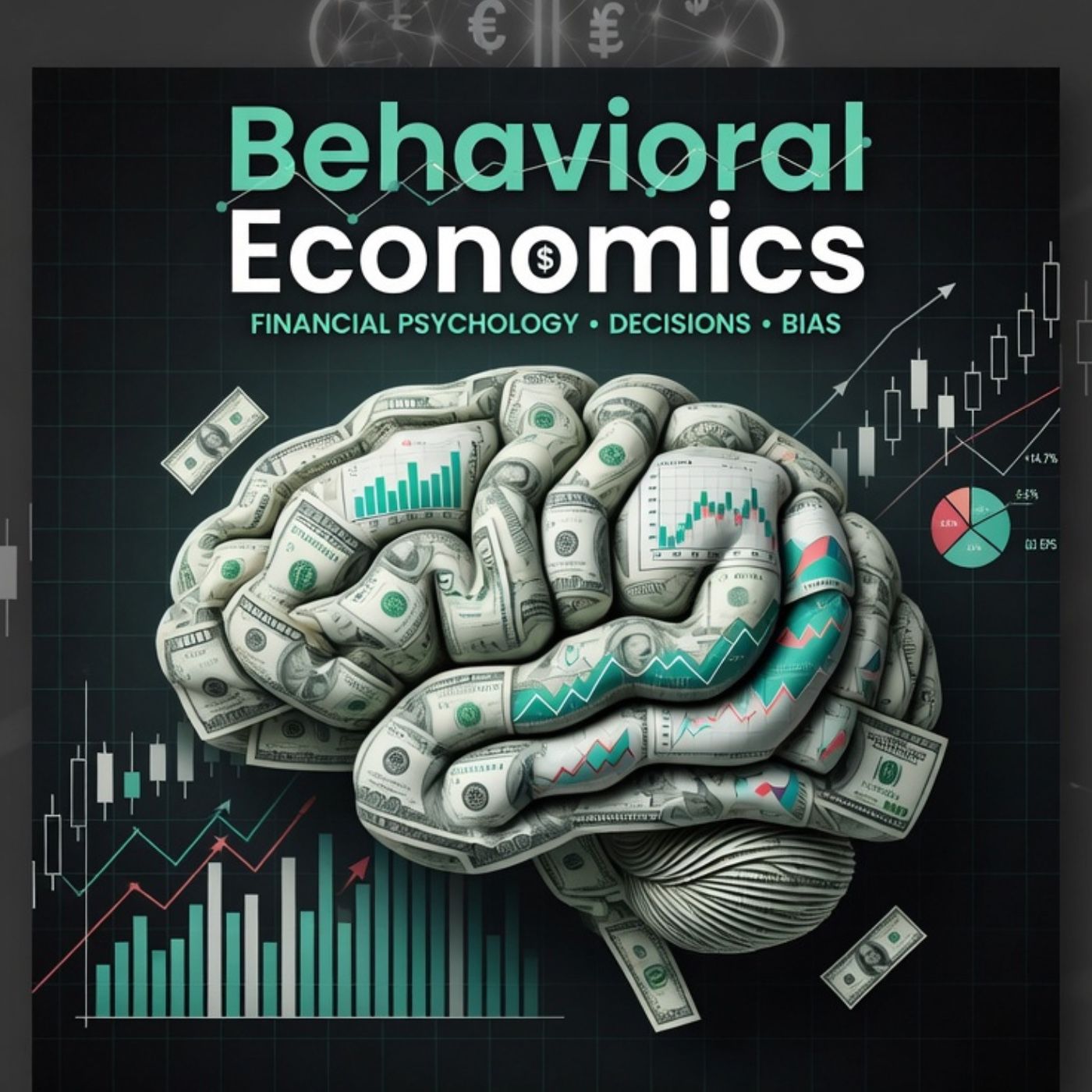
Behavioral Economics
by Circle Of Insight Productions
Behavioral Economics examines why smart people often make irrational financial and life decisions. Drawing on cognitive psychology and real-world market behavior, this show reveals the hidden biases — anchoring, loss aversion, overconfidence, and more — that shape investing, spending, and economic outcomes. Hosted by a clinical psychologist, it offers practical strategies to improve decision-making and better understand both personal finance and broader market movements.
Episodes
-
The 70% Off Illusion: How Anchoring Runs Black Friday
Every Black Friday, millions of shoppers see a crossed-out price and feel a rush of having won something. This episode explains the psychology behind that feeling, starting with one of the most famous experiments in behavioral economics. We look at how a number you never planned to pay can…
more -
When Everyone Is Buying: FOMO, Meme Stocks and the Psychology of Market Bubbles
Why do smart people pile into a stock just because everyone else seems to be getting rich? In this episode, we look at how market bubbles are driven by stories, social pressure, and fear of being left behind, not just by numbers. Using meme stocks as a case study, we explore how online…
more -
Trading on Tilt: The Psychology Behind High-Stakes Options Bets
Why do smart traders keep chasing long-shot options bets that are stacked against them? In this episode, we look at the brain-level drivers of risky financial behavior, and why the huge potential payoff of call options is so hard to resist even when the odds are poor. We break down the “lottery...
-
The Gambler’s Fallacy in Trading: Why a Stock "Is Due" for a Rebound
Behavioral Economist’s at his finest. Traders frequently fall victim to the cognitive conviction that after a prolonged string of down days, an asset mathematically owes the market an imminent green session. In reality, market microstructures treat sequential price moves as independent or...
-
The IKEA effect –The Sweat Equity Trap: Why We Fall in Love with Our Own Labor Markets
When consumers invest personal physical or cognitive effort into assembling an item, they assign an inflated monetary valuation to the finished product. In liquid markets, analysts and retail investors fall into this identical cognitive trap after conducting weeks of grueling due diligence on a...
-
The Glass Half-Full of Dollars: How Attribute Framing Dictates What You Buy Markets
Supermarkets, lenders, and car dealers routinely present identical mathematical data through curated linguistic frames to trigger unreflective impulse spending. In financial markets, this exact mechanism determines how earnings surprises, macro prints, and risk disclosures are priced by momentum...
-
The Anchoring Trap: How the First Price You See Controls What You Pay
Why does a $300 jacket seem like a bargain when its original price was $600, even if you never intended to spend $300? Behavioral economists call this the anchoring effect, a cognitive bias in which an initial number influences subsequent judgments about value, affordability, and fairness. From...
-
The Hidden Psychology of Order Execution: Why Investors Sacrifice Price for Certainty
Investigate how loss aversion, anchoring, overconfidence, and the desire for immediate action influence investor behavior. Explore why traders may choose market orders during emotionally charged situations and why limit orders can introduce their own psychological challenges, including missed...
-
The Subscription Trap: Why $9.99 Never Feels Expensive
Why do consumers hesitate to spend $200 on a purchase but willingly maintain ten subscriptions costing $10 or $15 each month? Behavioral economics reveals how mental accounting, automatic payments, and the psychology of small purchases influence our financial decisions. This episode explores how...
-
The Decoy Effect — How Companies Manipulate Your Choices
Why do consumers sometimes choose a more expensive product when a third option is introduced? This episode explores the decoy effect, a fascinating phenomenon in behavioral economics that reveals how our preferences can be manipulated through carefully designed choices. Drawing on psychological...
-
Why Billionaires Keep Chasing Money: The Psychology of Never Having Enough
Why would someone worth $10 billion continue working relentlessly to accumulate another billion? At what point does wealth stop being about financial security and become about status, competition, identity, and psychological reward? In this episode of Behavioral Economist, we explore hedonic...
-
The Sunk Cost Trap: Why We Keep Investing in Losing Decisions
Why do intelligent people remain in failing relationships, continue investing in losing businesses, or refuse to abandon projects that clearly aren’t working? The answer often involves the sunk cost fallacy, a powerful psychological bias that makes past investments influence future decisions. In...
-
The Endowment Effect: Why We Overvalue What We Already Own
Why does something suddenly seem more valuable the moment it belongs to us? Behavioral economists call this the endowment effect, our tendency to demand more money to give something up than we would have been willing to pay to acquire it in the first place. From houses and cars to stocks and old...
-
The Rebate Trap: Why Making Something Difficult Makes People Give Up
A bargain can look irresistible until you discover how much work it takes to actually receive it. In an episode of Nathan for You, an extraordinarily cheap gasoline offer came with a rebate process so inconvenient that obtaining the savings became an ordeal. Behavioral economics helps explain why...
-
Overconfidence in the AI Boom – Are Investors Repeating Dot-Com Era Mistakes?
Investors are pouring capital into artificial intelligence amid soaring valuations, with Nvidia recently surpassing a $5.5 trillion market capitalization on the back of relentless demand for AI infrastructure. This enthusiasm echoes the late-1990s dot-com boom, raising questions about...
-
Betting on Belief: What Kalshi and Polymarket Reveal About Human Psychology
Prediction markets such as Kalshi and Polymarket turn forecasts into tradable prices, offering a window into collective expectations. Through a behavioral economics lens, they also reveal how overconfidence, herd behavior, and emotional attachment shape decisions under uncertainty. Understanding...
-
When Everyone Is Buying: FOMO, Meme Stocks, and the Psychology of Market Bubbles
Market bubbles are not driven by numbers alone—they are fueled by stories, social pressure, and the fear of being left behind. Meme stocks demonstrate how online communities, perceived scarcity, and rapidly rising prices can make speculation feel like a once-in-a-lifetime opportunity.…
more -
Markets and Mindsets: Overcoming the Cognitive Biases That Ruin Returns
Why do rational investors consistently make irrational choices when confronted with market volatility and economic uncertainty? This episode deconstructs the core principles of behavioral finance, focusing on how systemic cognitive biases like loss aversion and herd mentality dictate asset…
more -
Trading on Tilt: Behavioral Bias and the High-Stakes Psychology of Options
Explore the neurological drivers behind high-risk financial behavior as we dissect why traders are magnetically drawn to the explosive upside of call options despite the statistical odds. This episode examines the "lottery ticket effect" and the devastating impact of overconfidence bias…
more -
The Psychology of Pricing: How Top Companies Use Behavioral Tricks to Shape What You’re Willing to Pay
Discover the hidden psychological tactics companies deploy to influence purchasing decisions and maximize profits. This episode breaks down powerful behavioral economics principles—including anchoring, decoy effects, charm pricing, and scarcity—that subtly guide consumer behavior every day. Equip...
About this show
Behavioral Economics examines why smart people often make irrational financial and life decisions. Drawing on cognitive psychology and real-world market behavior, this show reveals the hidden biases — anchoring, loss aversion, overconfidence, and more — that shape investing, spending, and economic outcomes. Hosted by a clinical psychologist, it offers practical strategies to improve decision-making and better understand both personal finance and broader market movements.
Hosted by
Circle Of Insight Productions
Categories